NATO Seeking To “Dominate The World” & Eliminate Competitors: Russia’s Lavrov
By Tyler Durden – Zero Hedge – 12/09/2019
Russian Foreign Minister Sergei Lavrov has charged NATO with wanting to “dominate the world” a day after 70th anniversary events of the alliance concluded in London.
“We absolutely understand that NATO wants to dominate the world and wants to eliminate any competitors, including resorting to an information war, trying to unbalance us and China,” Lavrov said from Bratislava, the capital of Slovakia, while attending the 26th Ministerial Council of the Organization for Security and Cooperation in Europe (OSCE).
He seized upon NATO leaders’ comments this week, specifically Secretary General Jens Stoltenberg, naming China as a new enemy alongside Russia. Stoltenberg declared at the summit that NATO has to “tackle the issue” of China’s growing capabilities.
Lavrov told reporters Thursday: “I think that it is difficult to unbalance us and China. We are well aware of what is happening. We have an answer to all the threats that the Alliance is multiplying in this world.” He also said the West is seeking to dominate the Middle East under the guise of NATO as well.
The new accusation of ‘world domination’ comes at a crisis moment of growing and deep divisions over the future of the Cold War era military alliance, including back-and-forth comments on Macron’s “brain death” remarks, and looming questions over Turkey’s fitness to remain in NATO, and the ongoing debate over cost sharing burdens and the scope of the mission.
“Naturally, we cannot but feel worried over what has been happening within NATO,” Lavrov stated. “The problem is NATO positions itself as a source of legitimacy and is adamant to persuade one and all it has no alternatives in this capacity, that only NATO is in the position to assign blame for everything that may be happening around us and what the West dislikes for some reason.”
A consistent theme of Lavrov’s has been to call for a “post-West world order” but that NATO has “remained a Cold War institution” hindering balance in global relations where countries can pursue their own national interests.
NATO still exists, according to Lavrov, in order to “eliminate competitors” and ensure a West-dominated global system in search of new official enemies.
WADA’s Russia doping ban ‘part of ‘New Cold War’ & robs clean athletes of glory’
RT | December 9, 2019
Russia’s ban from global sports is a punishment rife with politics, analysts told RT. Worse still, political decisions can punish clean athletes, who will be denied the honor of competing for their country.
The World Anti-Doping Agency handed down the ban on Monday, after Russia was alleged to have manipulated data in a Moscow anti-doping laboratory. WADA voted to suspend Russia from all major sporting events for four years in response, meaning the Russian flag will not fly at the next two Olympic Games as well as the FIFA World Cup in Qatar, should Russia qualify.
Clean athletes, however, will be able to compete, albeit under a neutral flag and with no national anthem.
In the run up to the ban, US Anti-Doping Agency (USADA) head Travis Tygart had called for even harsher penalties, including a blanket ban on all athletes, even those found to be clean.
The “political element to this cannot be denied,” global affairs analyst Patrick Henningsen told RT. Henningsen sees WADA, like many other international organizations, as biased in favor of its Western members.
[It’s] “about humiliating Russia, it’s about demoralizing their athletes, [and] It’s also about hurting Vladimir Putin.”
“National pride is connected with national sport for any leader of any country,” he added.
Russia’s image will certainly be tarnished by the news, which broke just hours before Putin was due to sit down with French, German, and Ukrainian leaders in Paris, in a bid to resolve the conflict in eastern Ukraine. With the Paris summit being a long-awaited ‘Normandy Format’ meeting – first since 2016 – the stakes are high for all involved.
“It’s bad news for that event,” political analyst Martin McCauley told RT. “The newspapers will concentrate on this and not on the Normandy event.” Likewise, the emergence of the news so close to the summit will likely give ample fodder to journalists quizzing Putin after the meetings conclude.
Those athletes untainted by doping scandals have been “caught up in a war of politics,” McCauley said. Though such athletes will be allowed to compete, standing on the podium without their national colors and celebrating without their national anthem reverberating through the arena will be “devastating,” he said.
“When they get home with a medal, it’s only 90 percent of a medal, because the other competing athletes had their national anthem played, and they had their moment of glory. The Russians are going to be denied that.”
Competing under a neutral flag is a “very small consolation,” Henningsen added. “Even during the Cold War most countries respected the sporting arena as a neutral arena where politics wasn’t really going to contaminate that.”
Athletes typically spend their entire lives training to reach peak performance for one, maybe two, Olympic Games. However, all is not entirely lost for those who were hoping to represent Russia at next year’s Summer Olympics in Tokyo. “The Russians can appeal,” McCauley noted, “and one would expect they’d appeal very strongly indeed.”
The Russian Anti-Doping Agency (RUSADA) will now decide whether to appeal the ban. Russian parliamentarian and former Olympic speed skater Svetlana Zhurova said she is “100 percent sure” the agency will appeal.
RUSADA has not had its work restricted by the WADA decision. Agency chief Yuri Ganus – a longtime critic of doping in Russia who has acknowledged that the data handed over to WADA was tampered with – said on Monday that “WADA considers our actions to be effective and productive. And we are an example of overcoming the crisis.”
“We will work on finding our way out of the crisis for our sport. We will ensure the compliance of our federations and with the code and the training of our athletes.”
Through appeal and reform, Ganus hopes to make Russian athletics clean again. His mission is one with political payoff too. Henningsen noted the power of international sport to build “person to person diplomacy,” fostering good relations between countries, even when their leaders can’t seem to agree on much else. The positive experiences of fans who traveled to Russia for last year’s World Cup – against the advice of much of the western media – were an example of this, he said.
A thaw on this front of the “New Cold War” would therefore be a welcome development, even if relations elsewhere remain decidedly icy.
Reddit Hiring NATO Shills to Control Narrative
Big Tech’s ties to the Deep State are everywhere, and we should be concerned

By Kit Knightly | OffGuardian | December 9, 2019
I wrote a short piece a few days ago about Reddit banning users for posting the leaked NHS documents. (Spreading anti-Russian propaganda in the process).
Previously, we have also covered Reddit making politically motivated decisions – such as quarantining boards dedicated to Donald Trump and 9/11.
It turns out there’s a very simple explanation for that, Reddit’s “director of policy” was previously in the pay of the US Deep State.
This was brought to our attention by Ian56 on twitter.
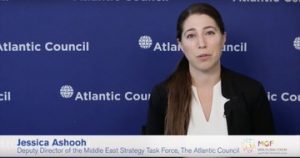
In 2017 Reddit hired Jessica Ashooh as their “Director of Policy”. Her LinkedIn page shows her previous employment was “Deputy Director, Middle East Strategy Task Force” at the Atlantic Council.
The report on which Reddit based their decision to ban users as part of a “Russian campaign” was written by Ben Nimmo, who also works for the Atlantic Council (and the Integrity Initiative).
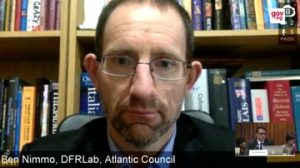
Essentially, Reddit has a high-up employee who was previously in the pay of the US Department of State (and possibly still is).
It’s a prime example of how the US (and UK) infrastructure create an authoritarian, highly-controlled state, whilst maintaining a veneer of “freedom”. There are other examples too.
A high profile, and obvious, one is Nick Clegg being hired by Facebook.
Facebook also hired Ukrainian journalist (and fascist sympathiser) Kateryna Kruk as “public policy manager”, she also has ties to the Atlantic Council. (A short while later Facebook started blocking links to OffGuardian ).
In 2017 Facebook hired Indian journalist Shivnath Thukral as director for public policy for India and South Asia. HIS previous employer was the Carnegie Endowment for International Peace (CEIP), another US NGO, funded by the State Department.
In 2011 Google hired Suzanne Michel as director of policy planning, she previously worked as Deputy Director of the Federal Trade Commission.
Then, in 2018, Google hired Karan Bhatia as their Global Head of Policy, Mr Bhatia had previously worked for the administration of George W. Bush.
It all follows the same pattern of apparent independence concealing an inter-connecting web of control, all dedicated to furthering the same agenda and all being funded by the same central source.
The Atlantic Council is not officially affiliated with the US government, neither is CEIP, they are notionally independent. Likewise, Reddit, Google, Facebook et al. are supposedly independent companies, not in any way controlled by the state.
… and yet you follow the money and it always leads to the same place.
Launch of “A Belgian Perspective on International Affairs”
By Gilbert Doctorow | November 24, 2019
I am pleased to announce the publication of my latest collection of essays. The capsule description of the book carried on the pages of internet booksellers is as follows
“The essays in this book deal with major political, social and cultural events primarily in Europe and Russia during the period 2017 – 2019 in which the author was a participant or eyewitness and has personal impressions to share. Several of the essays are drawn from other genres including travel notes, public lectures and reviews of particularly insightful books on key issues of our times like immigration, Liberalism and war with Russia that have not received the broad public exposure they merit.”
However, there is much more to the story that has relevance to its potential readers set out in the Foreword shown below, starting with the several layers of nuance in the title itself.
Foreword
The title of this book has been chosen with care and a few introductory words of explanation are owed to the reader.
First, the notion of a “Belgian perspective” on international affairs may on its own seem peculiar. In what way, one might ask, can little Belgium, with its population of around 12 million have a perspective that is unique and worthy of consideration? In the same vein, what perspective on foreign affairs in general can a lesser Member State of the European Union have when the most powerful Member State, Germany, denies that it has an independent foreign policy and defers to Brussels, specifically to the EU’s High Representative for Foreign Affairs and Security Policy, who, formally, holds sole responsibility for these matters on behalf of the 500 million plus people from 28 nations? Indeed, in a recent interview relating to the publication of his latest book, the octogenarian former prime minister of Belgium Marc Eyskens pointed out that the rise of the EU Institutions has left national governments with a substantially reduced level of sovereignty and competence comparable to that of a major city rather than of a country.
Meanwhile and in parallel, as the seat of both the NATO headquarters near the Zaventem Airport and of the Supreme Headquarters Allied Powers Europe in Mons, Belgium marches in lock-step with its US-led allies. Belgium’s mainstream media, both television and print media, traditionally support whatever policy line comes from the EU Institutions and NATO.
There have been rare exceptions to this solemn loyalty to the consensus. In particular, in the run-up to the US invasion of Iraq in 2003, Belgium was one of the three “Old Europe” nations, alongside France and Germany, that joined Russia in openly rejecting US policy. For this the nation’s Prime Minister at the time, Guy Verhofstadt, paid dearly, being disqualified from appointment to head the EU Commission, for which he was a leading candidate at the time.
But the aforementioned facts constraining the political elites of Belgium are by no means imperative for Belgian society as a whole. Indeed, as I detail in several essays in this collection, at both ends of society, the high end in their dinner jackets and at the mass, man-in-the-street level, there is very little sympathy for the official foreign and defense policies and a lot of free-thinking going on.
All of which brings us to the question of who is the Belgian whose perspective is set out in this tome. The simple and direct answer is that I am that Belgian.
Readers of my articles posted in various platforms on the internet have seen me described in the past as an American and long-time resident of Brussels. Both statements were and are correct. However, in August 2017 I also became a naturalized Belgian. This ‘second birth’ was more than seven years in gestation. After its successful culmination, I found myself increasingly involved in intra-Belgian, intra-European politics. Consequently, I have written with greater frequency on issues that are specific to the Old Continent. By their nature, these articles have not been picked up and disseminated via the internet platforms based in the United States by which readers know me best. Moreover, in my new guise I have written some of these articles or speeches in French so as to better reach prospective readers around me where I live and practice politics. These materials are also republished in this volume.
Notwithstanding the new elements, as in my preceding three collections of “nonconformist” essays published between 2013 and 2017, the major part of my writings is focused on present-day Russia and its relations with the United States and Europe. Russia is my main field of interest and expertise coming both from book learning and from life experience as a frequent visitor to the country over many decades and also as someone who has both lived and worked there for eight years beginning in 1994. That is something very few of our commentators in the West can say before they launch into ill-informed vitriolic attacks on the “Putin regime” and Russians as a people.
Since all of the essays presented here have been published on the internet in one way or another, it is legitimate to ask what is the added value of republishing them as a book. There are several answers to that question, ranging from the superficial but adequate to an answer that goes to the heart of how I see my social role in writing these pieces.
The superficial but adequate explanation is that everything is transient, nothing more so than the internet, where digital platforms are here today, gone tomorrow, where even one’s own blog site lasts no longer than the latest annual fees payment. And while e-books may be no more durable than the publishing company maintaining and distributing the digital files, physical books deposited in libraries will be accessible to the curious public and to researchers as long as the human race continues on its way, which may or may not be eons depending on your degree of pessimism inspired by this and similar works by my fellow “dissidents” on international affairs.
The deeper explanation is that influencing public opinion towards détente, towards self-preservation and away from confrontation with Russia that can easily end in catastrophe presently does not appear to be actionable. This is so for banal but understandable reasons that have to do firstly with the way the United States is governed internally and secondly how the United States rules over “the free world.”
Over the past twenty years or more, repeated polls taken by Pew and other research institutions have shown that the American public does not support foreign military adventures or a world gendarme role for their country. However, the political establishment pays no heed whatsoever to this clear disposition of the electorate just as the views of the electorate on a great many other issues are ignored by Congress and by the Executive branch. This follows from the financial dimension of getting and staying in power. By campaign funding and lobbying, a tiny number of exceedingly wealthy individuals and corporations effectively make policy at the federal level, and accommodation with the world is not on their agenda.
Meanwhile, whether as a result of awareness of their powerlessness or for other reasons, the broad American public is apathetic as concerns foreign policy. People just don’t want to disturb their peace of mind by contemplating the aggressive, bullying behavior of their government on the international stage. “Our boys” are not being killed abroad in significant numbers. The budgeted military expenses of the USA are being financed by others who buy Washington’s Treasury notes. There is nothing to force a reckoning with what is being done in the name of America abroad. Least of all, with respect to Russia, which has taken with surprising equanimity the sanctions and other punishments meted out to them over their alleged bad conduct in Ukraine and Syria, over their alleged meddling in American and European elections. The notion that the West might be crossing their red lines at some point, that the economic and informational war might spill over into kinetic war that escalates quickly – such thoughts could not be further from the minds of people in the States or in Western Europe, including those who take a real interest in public affairs and think they are au courant.
This is not to say that the essays published here and similar writings by my comrades-in-arms have no readers. On the contrary, our works are republished by portals other than our own. They are referenced on social networks and attract considerable numbers of “hits,” meaning individual readers. Some of the essays in this book have reached an audience numbering in the tens of thousands. But so far the dry residue of this relative success remains inconsequential. No broad-based political movement championing my/our principles of détente has emerged. There are no demonstrations on behalf of peace, while there are American and worldwide demonstrations to fight for renewable energy and for programs to combat climate change, or to fight for gender issues and equality of pay.
So, why write? why publish?
This takes us to the question of self-definition and social role.
We are living through Dark Ages today, notwithstanding all the technical achievements of our science and technology and advanced medicine. At the moral, social and political levels, these are bleak times when “progressive” values trample upon traditional moral and ethical, not to mention religious values, when freedom of expression and other civil liberties have been gutted for the sake of public security and to serve demagogic purposes.
In this context, these writings are intended to be an eyewitness account of the prevailing moral and political decadence for the edification of those in future generations who will have their own battles to fight to safeguard cultural traditions and freedoms. In assuming this role of a chronicler, I seek to continue the work of those who passed this way half a century ago or more and who left behind their own writings of the day, which gave me spiritual encouragement and purpose when I came across them.
At the same time, I do not abandon the hope that my compatriots in America and now also in Europe will come to their senses and explore these writings and the writings of my fellow dissidents to find an antidote to the propaganda about the recent past and present being dispensed by government, by mainstream media and by all too many scholars in the field.
One straw in the wind was a July 2019 editorial in the hawkish, till now fanatically anti-Russian New York Times calling for a rapprochement with Russia before that country aligns definitively with China and recreates a global threat to American interests. Or I refer to the publication of an article co-authored by former Georgia Senator Sam Nunn in the September-October edition of Foreign Affairs magazine, another standard bearer of U.S. hegemony, stating in detail the existential risks we incur by having cut lines of communication with Russia and by entering into a new, uncontrolled arms race with that country. As the Chair of the Senate Committee on Armed Services from 1987 to 1995, he was a leading figure in arms control negotiations. In the new millennium, Nunn has been one of the generally recognized “wise men” in the American political establishment, alongside Henry Kissinger, George Shultz and James Baker.
There is also an impulse for optimism coming from the latest declarations of French President Emanuel Macron, who is striving to assume leadership of the European Union’s policy agenda now that control is slipping from the hands of Germany’s Iron Lady, Angela Merkel in the waning days of her chancellorship. In his speech to French ambassadors following the conclusion of the G7 summit meeting in Biarritz on the weekend of 24-25 August, Macron stated very clearly that Europe must put an end to its policy of marginalizing and ostracizing Russia because the Old Continent needs to work cooperatively with Moscow if it is not to become a powerless bystander to the growing conflict between the United States and China.
Such signs of sobriety and concern for self-preservation suggest that all is not lost in the cause of détente.
For those who have not read my earlier works, I repeat here that my essays are often devoted to major events of the day, but are not systematic or comprehensive. I wrote only when I believed that I had a unique perspective, often from my direct participation in the event as actor or firsthand witness. I have not taken up subjects where all of my peers were piled up on the line or were basing themselves on secondary sources. I consider my own writings to be primary sources in an extended, autobiographical genre.
However, they do not constitute pure autobiography. That is something I am writing in parallel in a book devoted to Russia in the wild 1990s, which I saw at ground level as the country General Manager working from offices in Moscow and St Petersburg for a succession of major international producers of consumer goods and services.
* * * *
On-line bookseller Amazon has been fastest off the mark posting the book for sale in hardbound, paperback and e-book formats through its global network of websites including amazon.com, amazon.fr, amazon.de, amazon.co.uk, amazon.com.au, plus others in Latin America and Asia. Amazon competitor in the U.S. market, http://www.barnesandnoble.com, also offers all three formats. Both websites provide a ‘look inside’ option, facilitating browsing. For e-book purchasers in Europe, an alternative and cheaper vendor is http://www.bol.com. For U.S. purchasers, the least expensive vendors of the e-book at this moment are Barnes & Noble and the publisher’s own online bookstore: https://www.authorhouse.com/en/bookstore/bookdetails/805594-a-belgian-perspective-on-international-affairs
©Gilbert Doctorow, 2019
Russia: US trying to demonize Iran missile program
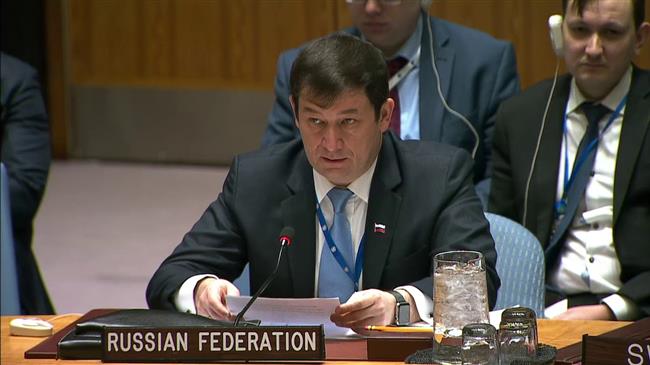
Dmitry Polyanskiy, Russia’s chargé d’affaires to the United Nations
Press TV – December 6, 2019
Russia’s mission to the United Nations says the US continually tries to demonize Iran’s missile activities despite lack of any damning evidence against the Islamic Republic’s defensive activities, and while Washington itself is in default of several international non-proliferation agreements.
Dmitry Polyanskiy, Moscow’s chargé d’affaires to the world body, addressed the remarks to the UN Secretary-General António Guterres in a letter dated November 26 that was made available on Friday.
He reminded that Iran was a signatory to many multilateral non-proliferation mechanisms, including the nuclear Non-Proliferation Treaty (NPT) and the Joint Comprehensive Plan of Action (JCPOA). The latter agreement came about in 2015 between the Islamic Republic and the P5+1 group of states — the United States, the UK, France, Russia, and China plus Germany, lifting nuclear-related sanctions against Tehran, which, in turn, voluntarily changed some aspects of its nuclear energy program.
Washington has, on numerous occasions, accused Tehran of developing nuclear-capable missiles, despite Tehran’s outright rejection of nuclear weapons of all type, and its observance of the JCPOA, which prohibits it from pursuing such armaments.
The Russian official highlighted “the complete lack of evidence that Iran is developing or producing a nuclear weapon or means of its delivery or is deploying any infrastructure for the storage or servicing of nuclear weapons.” He further endorsed the Islamic Republic’s continued commitment to the nuclear deal as verified by Tehran’s “refraining from activities related to ballistic missiles that are designed to be capable of carrying nuclear weapons.”
Nor has the UN Security Council, which has endorsed the JCPOA in the form of Resolution 2231, received any “viable information to the contrary,” Polyanskiy asserted.
However, he stated, the US would keep trying to implicate Iran in nuclear arms-related activities by, among other means, citing the Missile Technology Control Regime (MTCR). This is while the MTCR is an informal political understanding between 35 states on export control issues, and could not be deployed as a universal legally binding instrument or used in the context of Resolution 2231 to try and incriminate Iran’s missile activities, the envoy added.
Washington was on the offensive against Iran, while itself left the JCPOA last year “in violation of Article 25 of the United Nations Charter,” and is preventing other states from implementing it, Polyanskiy added. After leaving the deal, the White House returned its sanctions against Tehran, and also started pushing other JCPOA members into abiding by the American bans.
The Russian envoy also reminded how America left the Intermediate-Range Nuclear Forces (INF) Treaty with Moscow earlier this year, and was undermining efforts aimed at creating a Middle East region free of nuclear arms. He was referring to the US’s using its veto power at the UN in favor of Israel, which is the sole nuclear armed power in the region and has refused to join the NPT.
Russia ready to extend New START arms control treaty without conditions and further discussions – Putin
RT | December 5, 2019
Moscow is ready to extend the last major nuclear arms control treaty, without conditions or discussions, President Vladimir Putin said as he reiterated Russia’s position on the New START treaty which expires in 2021.
“Russia is ready to immediately, as soon as possible, before the end of the year, extend the New START treaty without any preconditions, so that there would be no double, triple interpretation of our position later. I’m saying this officially,” the Russian president pointed out.
The New START treaty, which obliges Moscow and Washington to reduce the number of its strategic nuclear missile launchers by half, was signed in April 2010. The agreement expires in February 2021, but there’s an option for it to be extended until 2026.
Russia has already filed all the paperwork needed to begin talks on extending the treaty, but the US has not reacted to the proposal. Moscow is concerned that the Trump administration is willing to ditch New START, just like it did with the INF deal.
The Intermediate-Range Nuclear Forces (INF) treaty banned Russia and the US from the fielding ground-based missiles with a range of between 500km (310 miles) and 5,500km (3418 miles) in Europe, and was the cornerstone of security on that continent since 1987. The US’ unilateral withdrawal from the deal left Russia with no choice but to abandon it as well, raising fears of a new arms race between the two countries.
NATO Wants to Dominate Not Only in Euro-Atlantic Region but Also in Middle East – Lavrov
Sputnik – December 5, 2019
A two-day NATO summit dubbed “NATO Engages: Innovating the Alliance” kicked off in London earlier in the week to mark the 70th anniversary of the organisation.
Russian Foreign Minister Sergei Lavrov stated on Thursday following the 26th Meeting of the OSCE Ministerial Council in Bratislava that NATO wants to dominate not only the Euroatlantic region but the Middle East as well.
“NATO continues its reckless expansion, the block’s military infrastructure is moving quickly to the east, close to Russian borders. There’s a permanent fomenting of tension, accusations of aggressive intentions from the part of Russia. All this is happening amid a record increase of military budgets – the decision that was adopted during the recent summit in London,” Lavrov said.
“The facts we see demonstrate us a clear situation: NATO wants to dominate both in the Euro-Atlantic and — if we look at NATO steps in other regions of the world, particularly the Middle East — in the Middle East,” Lavrov said.
Speaking further, the Russian foreign minister noted that Russia has a response to all the threats posed by NATO and will ensure its security without entering an arms race.
“We have a response to all those threats that NATO is multiplying when it directly names Russia and China as targets of these threats. We know how we can respond to these threats and ensure our security without entering an arms race,” Lavrov said.
NATO held its 70th anniversary summit in the UK capital from December 3-4. In its joint statement, the allies reaffirmed their commitment to increasing investment in defence and qualified “Russia’s aggressive actions” and “terrorism in all its forms and manifestations” as threats.
US Fails to Issue Visas to Several Russian Officials – Russian Embassy
Sputnik – December 4, 2019
WASHINGTON – A delegation of the Russian Federal Treasury that was supposed to arrive in Washington on Tuesday, 3 December, did not receive American visas, the Embassy of Russia in the US has announced, expressing concern over repeated US visa denials to Russian officials.
“A statement shifting the blame for initiating a ‘visa war’ on Russia is still posted on the website of the US embassy in Moscow. There were and are no grounds for such false attacks on us. … We stress that US authorities have been consistently restricting the entry of our official representatives and disrupting crucial negotiating formats,” the Russian embassy said in a Facebook statement.
A delegation of the Russian Treasury that was supposed to arrive in Washington on Tuesday, did not receive visas, the Russian embassy said.
“Thus, very recently, a delegation of our Federal Treasury that was supposed to arrive in Washington on December 3 to participate in the conference of the International Institute on Audit Regulation did not get visas,” the embassy said in its statement.
According to the release, Director of the Russian Foreign Ministry’s Department for Relations with Compatriots Abroad (DRCA) Oleg Malginov was prevented from taking part in a youth forum in the United States last week.
“The [US] State Department also prevented Director of the Russian Foreign Ministry’s Department for Relations with Compatriots Abroad O. S. Malginov from attending the Youth forum in New York on November 28-29 2019,” the embassy said.
The embassy also pointed out that the United States had still not explained why some members of the Russian delegation to the UN General Assembly in September were denied visas.
“In violation of its own obligations, the United States created obstacles to the participation of the Russian side in the meetings of the First and Third Committees of the UN General Assembly. To a large extent, their substantive work was disrupted. It is noteworthy that not only the Russian delegation suffered: representatives of other countries did not receive visas either. Essentially, Washington has started to determine who can (should) represent a particular country,” the Russian embassy said.
The embassy warned that such actions on the part of the United States lead to a degradation of US-Russian relations that are already complicated and contradict Washington’s calls for the normalization of ties with Moscow.
Putin: Russia is against militarization of space but US sees it as theater of war
RT | December 4, 2019
Russia has consistently opposed the idea of space militarization, but the actions of the US and its allies force Moscow to counterbalance this growing threat, President Vladimir Putin has said.
“Russia has always opposed and continues to oppose the militarization of space,” the president told a government meeting on military policies. Putin expressed concern over world powers increasing the capabilities of their space systems which have both military and dual-use applications.
“The US political and military leadership openly consider space a war theater,“ he said.“Developments demand that we pay increased attention to strengthening our orbital group as well as our rocket and space industries.”
Russia’s so-called orbital group is a constellation of more than 150 satellites, two thirds of which have military applications. Most of them are parts of military satellite communication systems, but Russia also has satellites monitoring launches of intercontinental ballistic missiles as well as short-range tactical missiles. This warning system was “significantly enhanced” over the recent years and tested successfully during the large-scale military drills in October, the president said.
His words, meanwhile, came as NATO finally made space its official war domain. During a summit in London on the 70th anniversary of the alliance on Wednesday, its members declared space “the fifth operational domain and committed to ensuring the security of telecommunications infrastructure, including 5G.”
However, nothing has been publicly said regarding concrete steps in this direction or decisions made in this field.
A Second Whistle Blown on the OPCW’s Doctored Report
By Jeremy Salt | American Herald Tribune | December 3, 2019
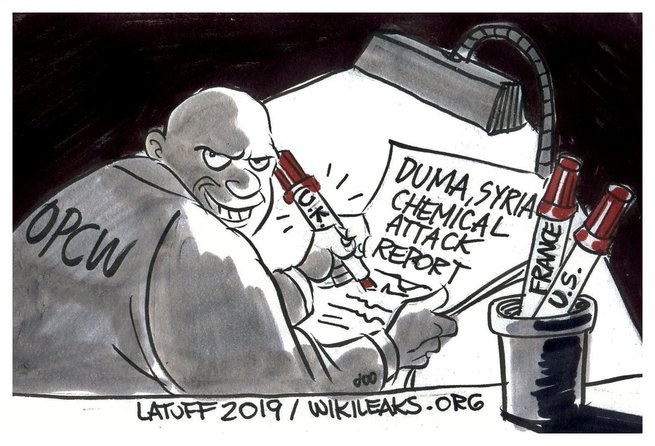
Another whistleblower leak has exposed the fraudulent nature of the Organization for the Prevention of Chemical Weapons (OPCW) report on the alleged chemical weapons attack in the Syrian city of Douma, close to Damascus, on April 7 last year.
The first leak came from the Fact-Finding Mission’s engineering sub-group. After investigating the two sites where industrial gas cylinders were found in Douma and taking into account the possibility that the cylinders had been dropped from the air it concluded that there was a “higher probability” that both cylinders were placed at both sites by hand. This finding was entirely suppressed in the final report.
The engineering sub-group prepared its draft report “for internal review” between February 1-27, 2018. By March 1 the OPCW final report had been approved, published and released, indicating that the engineers’ findings had not been properly evaluated, if evaluated at all. In its final report the OPCW, referring to the findings of independent experts in mechanical engineering, ballistics and metallurgy, claimed that the structural damage had been caused at one location by an “impacting object” (i.e. the cylinder) and that at the second location the cylinder had passed through the ceiling, fallen to the floor and somehow bounced back up on to the bed where it was found.
None of this was even suggested by the engineers. Instead, the OPCW issued a falsified report intended to keep alive the accusation that the cylinders had been dropped by the Syrian Air Force.
Now there is a second leak, this time an internal email sent by a member of the Fact-Finding Mission (FFM) on June 22, 2018, to Robert Fairweather, the British career diplomat who was at the time Chief of Cabinet at the OPCW, and copied to his deputy, Aamir Shouket. The writer claims to have been the only FFM member to have read the redacted report before its release. He says it misrepresents the facts: “Some crucial facts that have remained in the redacted version have morphed into something quite different from what was originally drafted.”
The email says the final version statement that the team “has sufficent evidence to determine that chlorine or another reactive chlorine-containing chemical was likely released from the cylinders is highly misleading and not supported by the facts.” The writer states that the only evidence is that some samples collected at locations 2 and 4 (where the gas cylinders were found) had been in contact with one or more chemicals that contain a reactive chlorine atom.
“Such chemicals,” he continues, “could include molecular chlorine, phosgene, cyanogen chloride, hydrochloric acid, hydrogen chloride or sodium hypochlorite (the major element in household chlorine-based bleach.” Purposely singling out chlorine as one of the possibilities was disingenuous and demonstrated “partiality” that negatively affected the final report’s credibility.
The writer says the final report’s reference to “high levels of various chlorinated organic derivatives detected in environmental samples” overstates the draft report’s findings. “In most cases” these derivatives were present only in part per billion range, as low as 1-2 ppb, which is essentially trace qualitiea.” In such microscopic quantities, detected inside apartment buildings, it would seem, although the writer only hints at the likelihood, that the chlorine trace elements could have come from household bleach stored in the kitchen or bathroom.
The writer notes that the original draft discussed in detail the inconsistency between the victims’ symptoms after the alleged attack as reported by witnesses and seen on video recordings. This section of the draft, including the epidemiology, was removed from the final version in its entirety. As it was inextricably linked to the chemical agent as identified, the impact on the final report was “seriously negative.” The writer says the draft report was “modified” at the behest of the office of Director-General, a post held at the time by a Turkish diplomat, Ahmet Uzumcu.
The OPCW has made no attempt to deny the substance of these claims. After the engineers’ report made its way to Wikileaks its priority was to hunt down the leaker. Following the leaking of the recent email, the Director-General, Fernando Arias, simply defended the final report as it stood.
These two exposures are triply devastating for the OPCW. Its Douma report is completely discredited but all its findings on the use of chemical weapons in Syria must now be regarded as suspect even by those who did not regard them as suspect in the first place. The same shadow hangs over all UN agencies that have relied on the OPCW for evidence, especially the UN’s Independent International Commission of Inquiry on the Syrian Arab Republic, an arm of the OHCHR (Office of the High Commissioner for Human Rights).
This body is closely linked to the OPCW and while both mostly hide the sources of their information it is evident that where chemical weapons allegations have been made, the commission of inquiry has drawn on the OPCW.
As of January 2018, the commission reported on 34 “documented incidents” of chemical weapons use by various parties in Syria. It held the Syrian government responsible for 23 of them and, remarkably, did not hold the armed groups responsible even for one, despite the weight of evidence showing their preparation and use of such weapons over a long period of time.
The commission has made repeated accusations of chlorine barrel bombs being dropped by government forces. On the worst of the alleged chemical weapons attacks, on August 21, 2013, in the eastern Ghouta district just outside Damascus, it refers to sarin being used in a “well-planned indiscriminate attack targetting residential areas [and] causing mass casualties. The perpetrators likely had access to the Syrian military chemical weapons stockpile and expertise and equipment to manipulate large amounts of chemical weapons.”
This is such a travesty of the best evidence that no report by this body can be regarded as impartial, objective and neutral. No chemical weapons or nerve agents were moved from Syrian stocks, according to the findings of renowned journalist Seymour Hersh. The best evidence, including a report by Hersh (‘The Red Line and the Rat Line,’ London Review of Books, April 17, 2014), suggests a staged attack by terrorist groups, including Jaysh al Islam and Ahrar al Sham, who at the time were being routed in a government offensive. The military would have had no reason to use chemical weapons: furthermore, the ‘attack’ was launched just as UN chemical weapons inspectors were arriving in the Syrian capital and it is not even remotely credible that the Syrian government would have authorized a chemical weapons attack at such a time.
Even the CIA warned Barack Obama that the Syrian government may not have been/probably was not responsible for the attack and that he was being lured into launching an air attack in Syria now that his self-declared ‘red line’ had been crossed. At the last moment, Obama backed off.
It remains possible that the victims of this ‘attack’ were killed for propaganda purposes. Certainly, no cruelty involving the takfiri groups, the most brutal people on the face of the planet, can be ruled out. Having used the occasion to blame the Syrian government, the media quickly moved on. The identities of the dead, many of them children, who they were, where they might have been buried – if in fact they had been killed and not just used as props – were immediately tossed into the memory hole. Eastern Ghouta remains one of the darkest unexplained episodes in the war on Syria.
The UN’s Syria commission of inquiry’s modus operandi is much the same as the OPCW’s. Witnesses are not identified; there is no indication of how their claims were substantiated; the countries outside Syria where many have been interviewed are not identified, although Turkey is clearly one; and where samples have had to be tested, the chain of custody is not transparent.
It is worth stepping back a little bit to consider early responses to the OPCW report on Douma. The Syrian government raised a number of questions, all of them fobbed off by the OPCW. Russia entered the picture by arranging a press conference for alleged victims of the ‘attack’ at the OPCW headquarters in the Hague. They included an 11-year-old boy, Hassan Diab, who said he did not know why he was suddenly hosed down in the hospital clinic, as shown in the White Helmets propaganda video.
All the witnesses dismissed claims of a chemical weapons attack. Seventeen countries (Australia, Bulgaria, Canada, the Czech Republic, Denmark, Estonia, France, Germany, Iceland, Italy, Latvia, Lithuania, the Netherlands, Poland, Slovakia, the United Kingdom and the US) then put out a joint statement (April 26, 2018) expressing their full support for the OPCW report and dismissing the “so-called” information session at the Hague as a Russian propaganda exercise. Their statement claimed the authenticity of the information in the OPCW report was “unassailable.”
Russia followed up with a series of questions directed at the OPCW’s technical secretariat. It noted that the OPCW report did not mention that samples taken from Douma were “split” in the OPCW’s central laboratory in the Netherlands and not in the Syrian Arab republic. Fractions of samples were handed to Syria only after six months of insistent pressure (OPCW response: its terms of reference provided for Syria to be provided with samples “to the extent possible” but do not specify when or where samples should be ‘split’).
Russia also referred to the collection of 129 samples and their transfer to OPCW-designated laboratories. 31 were selected for the first round of analysis and an additional batch of 13 sent later. Of the 129 samples 39 were obtained from individuals living outside territory controlled by the Syrian army. Of 44 samples analyzed 33 were environmental and 11 biomedical: of the 44, 11 (four environmental and seven biomedical) were obtained from alleged witnesses.
As remarked by the Russian Federation, the OPCW report does not explain the circumstances in which these samples were obtained. Neither is there any information on the individuals from whom they were taken; neither is there any evidence demonstrating compliance with the chain of custody (OPCW response: there was respect for the chain of custody, without this being explained; the “standard methodology” in collecting samples was applied, without details being given. It stressed the need for privacy and the protection of witness identities).
Russia observed that the samples were analyzed in two unnamed OPCW laboratories and on the evidence of techniques and results, it raised the question of whether the same laboratories had been used to investigate earlier ‘incidents’ involving the alleged use of chlorine. Of the 13 laboratories that had technical agreements with the OPCW, why were samples analyzed at only two, apparently the same two as used before? Russia also observed that of the 33 environmental samples tested for chlorinated products, there was a match (bornyl chloride) in only one case.
Samples taken from location 4, where a gas cylinder was allegedly dropped from the air, showed the presence of the explosive trinitrotoluene, leading to the conclusion that the hole in the roof was made by an explosion and not by a cylinder falling through it (OPCW response: the Fact-Finding Mission did not select the labs and information about them is confidential. As there had been intense warfare for weeks around location four, the presence of explosive material in a broad range of samples was to be expected but this did not – in the OPCW view – lead to the conclusion that an explosion caused the hole in the roof).
Russia pointed out that the FFM interviewed 39 people but did not interview the actual witnesses of the ‘incident’ inside the Douma hospital who appeared and were easily identifiable in the staged videos (OPCW response: the secretariat neither confirms nor denies whether it interviewed any of the witnesses presented by Russia at the OPCW headquarters “as any statement to that effect would be contrary to the witness protection principles applied by the secretariat”).
Russia also pointed out the contradictions in the report on the number of alleged dead. In one paragraph the FFM says it could not establish a precise figure for casualties which “some sources” said ranged between 70 and 500. Yet elsewhere “witnesses” give the number of dead as 43 (OPCW response: the specific figure of 43 was based on the evidence of “witnesses” who claimed to have seen bodies at different locations).
Russia also pointed out that no victims were found at locations 2 and 4, where the ventilation was good because of the holes in the roof/ceiling. Referring to location 2, it asked how could chlorine released in a small hole from a cylinder in a well-ventilated room on the fourth floor have had such a strong effect on people living on the first or second floors? (OPCW response: the FFM did not establish a correlation between the number of dead and the quantity of the toxic chemical. In order to establish such a correlation, factors unknown to the FFM – condition of the building, air circulation and so on – would have had to be taken into account. It does not explain why this was not attempted and how it could reach its conclusions without taking these “unknown factors” into account).
Finally, Russia raised the question of the height from which the cylinders could have been dropped. It referred to the lack of specific calculations in the OPCW report. The ‘experts’ who did the simulation did not indicate the drop height. The charts and diagrams indicated a drop height of 45-180 meters. However, Syrian Air Force helicopters do not fly at altitudes of less than 2000 meters when cruising over towns because they would come under small arms fire “at least” and would inevitably be shot down.
Furthermore, if the cylinders had been dropped from 2000 meters, both the roof and the cylinders would have been more seriously damaged (OPCW response: there were no statements or assumptions in the FFM report on the use of helicopters or the use of other aircraft “or the height of the flight. The FFM did not base its modeling on the height from which the cylinders could have been dropped. “In accordance with its mandate,” the FFM did not comment on the possible altitude of aircraft. The OPCW did not explain why these crucial factors were not taken into account).
In its conclusion, Russia said there was a “high probability” that the cylinders were placed manually at locations 2 and 4 and that the factual material in the OPCW report did not allow it to draw the conclusion that a toxic chemical had been used as a weapon. These conclusions have now been confirmed in the release of information deliberately suppressed by the OPCW secretariat.
As the leaked material proves, its report was doctored: by suppressing, ignoring or distorting the findings of its own investigators to make it appear that the Syrian government was responsible for the Douma ‘attack’ the OPCW can be justly accused of giving aid and comfort to terrorists and their White Helmet auxiliaries whom – the evidence overwhelmingly shows – set this staged ‘attack ’up.
Critical evidence ignored by the OPCW included the videoed discovery of an underground facility set up by Jaysh al Islam for the production of chemical weapons. All the OPCW said was that the FFM inspectors paid on-site visits to the warehouse and “facility” suspected of producing chemical weapons and found no evidence of their manufacture. There is no reference to the makeshift facility found underground and shown in several minutes of video evidence.
Since the release of the report, the three senior figures in the OPCW secretariat have moved/been moved on. The Director-General at the time, Hasan Uzumlu, a Turkish career diplomat, stepped out of the office in July 2018: Sir Robert Fairweather, a British career diplomat and Chief of Cabinet at the OPCW, was appointed the UK’s special representative to Sudan and South Sudan on March 11, 2019: his deputy, Aamir Shouket, left the OPCW in August 2018, to return to Pakistan as Director-General of the Foreign Ministry’s Europe division. The governments which signed the statement that the evidence in the OPCW report was “unassailable” remain in place.
Jeremy Salt has taught at the University of Melbourne, Bosporus University (Istanbul) and Bilkent University (Ankara), specialising in the modern history of the Middle East. His most recent book is “The Unmaking of the Middle East. A History of Western Disorder in Arab Lands” (Berkeley: University of California Press, 2008.)
US gatecrashes into Libyan endgame. But Russia stands in the way
By M. K. BHADRAKUMAR | Indian Punchline | November 29, 2019
The United States has alleged that Russia’s presence in Libya is having an “incredibly destabilising” impact. Washington is stepping out of the shade and making way to the centre stage of the Libyan conflict.
David Schenker, the State Department’s assistant secretary for near eastern affairs said Tuesday in Washington, “The United States is committed to a secure and prosperous future for the people of Libya. For this to become a reality, we need real commitments from external actors… In particular, Russia’s military interference threatens Libya’s peace, security, and stability.”
Schenker explained, “Russian regulars and the Wagner forces are being deployed in significant numbers on the ground and support of the LNA [Libyan National Army]. We think this is incredibly destabilising. And the way this organisation, the Russians in particular, have operated before raises the spectre of large-scale casualties in civilian populations.”
Schenker spoke only days after a delegation of US civilian and military officials led by the high-flying US Deputy National Security Advisor Victoria Coates met with Khalifa Haftar, the supremo of the LNA. A state department readout said Coates expressed serious concern to Haftar over Russia’s “exploitation of the conflict” at the expense of the Libyan people.
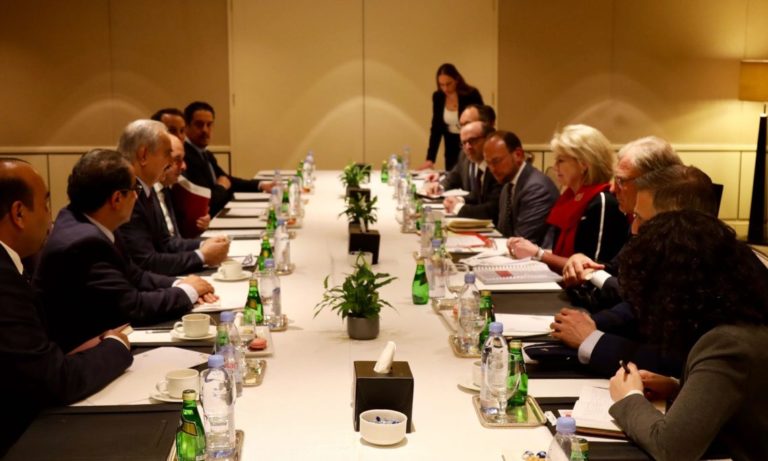
US Delegation meeting with General Khalifa Haftar, Nov 24, 2019
Libya becomes the third theatre after Ukraine and Syria where Washington has locked horns with Moscow in a Cold War-style proxy war. Up until last weekend, two EU members were supposedly conducting a proxy war in Libya over control of Africa’s largest oil and gas resources — France and Italy.
Actually, the alignments in Libya do not warrant a US-Russia standoff, as disparate external powers largely pursue self-interests. Italy, Turkey and Qatar have backed the Government of National Accord (GNA) in Tripoli (also supported by Germany and the UN), while France, Egypt, UAE, Saudi Arabia and Russia backed LNA.
The fight against terrorist groups is a stated common objective of all protagonists, but there are sub-plots too — Libya’s oil and gas (France, Italy, Turkey and Russia); political Islam (Turkey, Qatar, Egypt, UAE); France’s military operations in the five Sahel countries (Mauritania, Mali, Niger, Burkina Faso and Chad), which can end only with the stabilisation of Libya; the migration issue; and geopolitical interests (France, Italy, Russia and Turkey).
Although Haftar was a CIA “asset” for over three decades, Washington largely kept contacts with him under the radar and seemingly watched the struggle between GNA and LNA from the sidelines even after Haftar launched a determined push in April to capture Tripoli. The US policies were incoherent. President Trump apparently viewed Haftar as a factor of stability, while Washington officially pitched for a UN-mediated political settlement in Libya, although that is easier said than done, given the fragmentation in the country.
Washington was marking time, unsure whether Haftar’s military campaign would succeed. Moscow too took a back seat, but in recent months the Kremlin began weighing Haftar’s prospects positively. Moscow (like Cairo) counts on Haftar’s impeccable credentials in the fight against terrorist groups.
Russian military support has decisively helped Haftar’s campaign, which took big leaps lately. Haftar controls something like 80 percent of Libya, whereas, GNA is reduced to a mere rump confined to Tripoli.
Enter Washington. Washington feels alarmed that in the Libyan endgame, with Haftar inexorably gaining the upper hand, thanks to Moscow’s help, the vista opens for cascading Russian influence over the new regime.
Nonetheless, it isn’t easy to find fault with Russia’s military role to stabilise Libya, since NATO intervention in 2011 that wrought havoc and such colossal destruction had enjoyed the backing of Obama Administration. Washington is on weak moral grounds. Geopolitics is dictating its policy trajectory.
Washington’s policy is driven by the project to make Libya the headquarters of the United States Africa Command, one of the eleven unified combatant commands of the United States Armed Forces (which is presently based in Stuttgart, Germany.) Clearly, the rollback of Russian presence and influence in Libya becomes a prerequisite of the US project.
The backdrop, of course, is the big-power struggle erupting over Africa and its vast untapped resources. China has been rapidly expanding its presence in Africa and Russia too is stepping up. Importantly, as the recent Russia-Africa summit in Sochi (October 23-24) signalled, military cooperation is Moscow’s priority.
Russia and China’s growing presence creates space for African leaderships to negotiate with the Western powers. It is a sign of the times that the South African Navy’s first-ever multinational maritime exercise (November 25-30) is exclusively with Russia and China.
Fan Guanqing, the captain of the PLA Navy frigate Wei Fang, said in Cape Town last weekend, “We hope that the exercises will allow China, Russia and South Africa to work together and make an improvement through co-operation and exchanges. This exercise is historical and the first of its kind for these three countries.” Captain Fan said the maritime exercise should help maintain world peace and stability and would also be the starting point of a relationship between the three countries.”
Libya is the perfect gateway for NATO to penetrate the African continent. But a willing government in Tripoli could give the Russian Navy access to the eastern Libyan ports of Sirte and Benghazi on the Mediterranean. If Russia gets ensconced in Libya (in addition to Syria), NATO presence in the Mediterranean is affected. Russia and Libya also have a history of close political, military and economic ties dating back to the Soviet era.
Russia had a traditional presence in Libya’s armaments market and Soviet troops were deployed in Libya. Today, Libya’s reconstruction is the real prize for Moscow in terms of infrastructure (roads, railways, cities). Russia lost heavily due to the NATO-led regime change in Libya in 2011. Moscow had billions of dollars in investments in Libya during Moammar Gadhafi’s rule.
It remains to be seen how far the US pressure tactic on Haftar to sever his links with Russia will work. Russia, France and Egypt are on the same page in helping Haftar militarily. All three countries also bond together. While Moscow’s politico-military relations with Cairo are deepening, France is decoupling from the US’ Russia policies. Washington will be hard-pressed to isolate Russia in Libya. The big question is where indeed Haftar himself stands.
Russia dials back peace talks with Japan
By M. K. BHADRAKUMAR | Indian Punchline | November 23, 2019
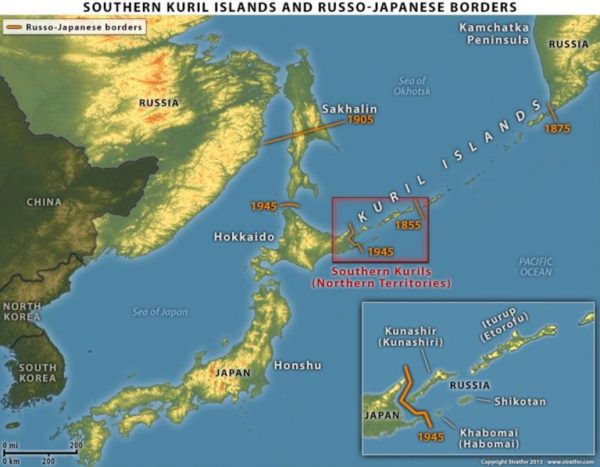
Russia-Japan territorial disputes surged at a meeting of foreign ministers of the two countries, Toshimitsu Motegi and Sergey Lavrov, at Nagoya, Japan, on November 22 on the sidelines of a G20 foreign ministers’ gathering.
Lavrov publicly threw cold water on the Japanese spin that Tokyo is engaged in “persistent talks” with Russia on a peace treaty bringing the two countries’ World War 2 hostility to a formal ending.
Lavrov emphatically stated that any forward movement on a peace treaty will have to be within the ambit of the Russia-Japan 1956 joint declaration, which, as he put it, “clearly states that first Russia’s territorial integrity and sovereignty over all our lands, including those territories, are recognised, thus recognising the results of World War II, and then everything else will possibly be discussed.”
In plain terms, according to Lavrov, Moscow may consider discussing a peace treaty only after Tokyo unequivocally recognises Russian sovereignty over Kuril islands and territories that came under Russian control in the Far East during World War 2.
Japan’s stance, on the contrary, can never converge on that point. Wouldn’t Moscow have known it already? Of course, Lavrov has only reiterated a consistent Russian stance.
Tokyo has been baiting Moscow with the proposition that a peace treaty will open the door to large-scale investments by Japanese companies for the development of the Russian Far East (which is a national priority for the Kremlin.)
Tokyo has also been smart, projecting Russian President Vladimir Putin as a strong but pragmatic statesman who is willing to make territorial concessions to attract Japanese investments.
But it takes two to tango and up to a point Moscow acquiesced with the Japanese enthusiasm that the two countries could be settling the Kuril issue — although making territorial concessions will be a highly emotive issue for the Russian public opinion.
Moscow probably pinned hopes that a relaxed climate of relations might wean Tokyo away from the US strategic orbit — although the likelihood of Japan shaking off the US security umbrella will remain zero for the conceivable future.
At any rate, that tango has ended and realism prevails, with the regional security climate in the Far East visibly darkening with the recent US cruise missile tests and the Pentagon’s plan to deploy new missiles in Japan following its exit from the INF Treaty (which had banned the intermediate-range missiles previously.)
Moscow is alert to the emergent threats to its strategic assets in the Russian Far East due to the US deployment. Importantly, Tokyo appears to be open to the proposed US missile deployments, which would further cement the US-Japan military alliance.
Unsurprisingly, Moscow has linked the regional security scenario to its territorial disputes with Japan. To quote Lavrov, “The military alliance with the US, of course, represents a problem when it comes to taking Russian-Japanese relations to another level. I will remind you that when the 1956 declaration was being coordinated, the USSR said back then that everything may be implemented, and this declaration may be fully implemented only in the context of discontinued US military presence on Japan’s territory.”
Lavrov added, “Japanese colleagues have received a list of Russia’s specific security concerns which emerge because of the increasing and strengthening Japanese-US military-political alliance. So our Japanese colleagues promised to react to those concerns. We will wait for their response and continue discussions.”
Lavrov also chose the G20 FMs’ forum at Nagoya to present Russian concerns over the security climate in the Far East. He said, “As for the US behaviour in the world, including in the Asia-Pacific region, in its relations with Japan, the United States does not hesitate to publicly acknowledge that Russia and China are the main threat to it and that all its military alliances with Japan, Australia and the Republic of Korea will be built proceeding from these threats and challenges.
“But, of course, we pointed out at a meeting with the Japanese foreign minister that this ran counter to the assurances, which Japan gives us that the Japanese-US military and political alliance is not aimed against the Russian Federation.” (TASS )
Meanwhile, Russia is speeding up the construction of military dormitories on the Southern Kuril Islands. A spokesman for Russia’s Eastern Military District said this week that military personnel would settle into the dormitories on Iturup and Kunashir by the end of 2018 and that more dormitories would be built and commissioned in 2019.
The Eastern Military District, which was formed in 2010 under a presidential decree, is headquartered at Khabarovsk in Siberia near the Chinese border and is one of the four operational strategic commands of the Russian Armed Forces.
The new US missile deployments in the Far East are of common concern to Russia and China. In August, Russia and China sought a meeting of the UN Security Council over “statements by US officials on their plans to develop and deploy medium-range missiles”.
Last month, Putin disclosed that Moscow is helping China build a system to warn of ballistic missile launches. Putin said “this is a very serious thing that will radically enhance China’s defence capability”. Since the cold war, only the US and Russia have had such systems, which involve an array of ground-based radars and space satellites. The systems allow for early spotting of intercontinental ballistic missiles.
China will find Lavrov’s remarks at Nogaya to be very reassuring. It is a safe bet that the Russia-Japan normalisation will be an excruciatingly slow process, which in turn works fine for China in geopolitical terms. Lavrov also had a meeting with Wang Yi, Chinese Councilor and Foreign Minister, at Nogaya.
Featured Video

Dan Dicks with James Corbett on Solutions Watch
or go to
Aletho News Archives – Video-Images
From the Archives
Secret document reveals plans for civil war in Lebanon, Israeli false flags, and invasion
By Randi Nord | Geopolitics Alert | April 5, 2019
Beirut – During his visit with US Secretary of State, Mike Pompeo, Lebanese President Michael Aoun reportedly received a US-Israeli document detailing plans for creating a civil war in Lebanon with covert false flag operations and possible Israeli invasion.
Although the source of the document is Israeli and created in partnership with Washington, no one knows who presented it to Aoun. The Lebanese TV station, Al-Jadeed, initially reported the document on Lebanese TV and a video on its website. Geopolitics Alert translated the report for this article. … continue
Blog Roll
 Aletho News
- Sheikh al-Asadi warns of Iraqi government compliance with US demands
- How to MAKE THE CONSPIRATORS PAY for their crimes! Dan Dicks with James Corbett on Solutions Watch
- There’s a drought in academia: A drought in honest research on the subject of drought and other weather extremes
- Department of War Awards $20.7 Billion Contract to Raytheon for Air-to-Air Missiles
- ‘Distance yourselves from Israel’: IRGC urges US population to question govt policies
- America’s Greenland deal has a radioactive backstory
- The RAF Fairford ‘terror plot’: Unpacking escalation in the UK echo-chamber
- EU Council Advances Chat Control 2.0 Scanning Proposal
- Ex-Greek MEP files complaint against Israeli spyware firm over alleged Pegasus surveillance
- Troubling ideas throughout the Torah, Talmud, Mishneh Torah and Tanya
- If Americans Knew
- New Report: “Scholasticide and Genocide in Gaza: Assessment, Testimonies and Legal Analysis”
- Ex-Biden officials are desperate for a Gaza scapegoat
- Israeli “settlers” Invade Al-Aqsa; Pour Boiling Water on 75-Year-Old
- Israel Has Kidnapped Another American Teenager
- US arms sales to Israel worth $21.6 billion in 20 months
- Three Palestinians Killed in Israeli Attacks on Gaza
- Revealed: German “Anti-Semitism Expert” Driving Crackdown on Palestine Solidarity is Former Israeli Spy
- Egypt’s Warning to Israel Before Oct 7
- Israel’s siege signals another cruel winter for 1.8 million Gazans – Daily Update
- Netanyahu Asked UAE Leader to Deny Report on Oct. 7 Warning in Secret Visit, Sources Say
- No Tricks Zone
- Two More Paleo Reconstructions Affirm Meters-Higher Sea Levels Across Ireland, Brazil 7000-6000 Years Ago
- New Study: Earth And Venus Surface Warmth Largely Explained By Convection And Lapse Rate, Not CO2 Or Radiation
- 2025 Nature Paper Claiming Worsening Global Drought Gets RETRACTED …Heavily Flawed
- New Study: ‘Global Drought Shows No Detectable Recent Acceleration Under Climate Warming’
- Economic Masterminds: German Socialists Suggest Taxing Productivity Gains Stemming From Using AI
- The South China Sea Has Not Been Cooperating With The Climate Change Narrative
- Energy Crisis: Germany Enters Heating Season With Historically Low Gas Reserve Fill Levels
- New Study: The Antarctic Ice Sheet Gained Mass From 2020-2024 Due To Staggering Snow And Ice Accumulation
- Study: Ocean Heating Rates From Thousands Of Years Ago ‘Dwarf’ Modern Ocean Heating Rates
- Climate Extremists Target, Attack Large-Scale Power Grid Infrastructure In Germany!

