UAE studies Russia proposals to de-escalate tension in Gulf
MEMO | November 21, 2019
The UAE has said it is interested in de-escalating the tension in the Gulf region and is studying Russian proposals in this regard, TASS reported.
In an interview the Russian Ambassador to the UAE Sergei Kuznetsov said: “Our Emirati friends are interested with us in easing the tensions in the Persian Gulf.”
He added: “They are carefully studying the corresponding Russian proposals as part of our strategy aimed at establishing a framework to launch equal dialogue between countries in order to ensure stability and security in this region of strategic importance.”
Kuznetsov stated that the main point is that Russia’s partners in the UAE “understand the dangers of artificially instigating tensions in the Persian Gulf fraught with unpredictable ramifications.”
Last month it was reported that the US was planning to send “thousands” of additional troops to bolster its military presence in Saudi in the wake of the Aramco attacks, which Washington and Riyadh blamed on Iran despite Yemen’s Houthi movement claiming responsibility.
U.S. Continues to Draw Lines in Eastern Mediterranean
By Paul Antonopoulos | November 19, 2019
From November 3 to November 14, Israeli, U.S., German, Italian and Greek war jets participated in the “Blue Flag 2019” military exercises out of the Ovda Air Base in Israel’s Negev Desert. The timing of these exercises corresponds with Turkey and a whole host of other countries conducting their own naval exercises in the Aegean and Mediterranean Seas.
Lines are certainly being drawn in the Eastern Mediterranean between pro-U.S. forces and states seeking their own sovereignty away from U.S. hegemony, especially Turkey. Greece proves to be a curious country at the moment, since one of its warships participated in the Turkish-led naval exercises, even though Pakistan twice violated Greek airspace during these exercises and a war of words continues to ensue between Turkish and Greek political leaders over the maritime waters of Cyprus and the Eastern Aegean.
Although Greece was involved in both exercises, there can be no doubt that the Blue Flag 2019 exercises were aimed against Russia, Turkey and Iran. Part of the Blue Flag 2019 was the process and execution of aerial scripts to neutralize Russia’s S-400 Triumph missile defense system. However, since none of the participating countries have an S-400, the Israeli military had deployed U.S.-made Patriot missiles in specific locations to try to simulate the capabilities of the Russian-made systems during the military exercises that occurred near the Gaza Strip.
The simulation of the S-400 rocket launcher demonstrates for the first time that Israel is actively preparing to deal with such a system that exists only in Syrian and Turkish territory. In Syria, the powerful Russian defense system was deployed to protect Russian forces exactly four years ago, ironically because Turkey blew out a Russian jet from Syrian airspace in November 2015.
Meanwhile, the S-300V4 missiles will also be deployed in Egypt. The S-300V4 uses almost similar technology to the S-400 and has great capabilities in handling stealth aircraft. The S-400 has recently been shipped to Turkey, but is not yet operational, while Iran and Saudi Arabia have also shown interest in these systems.
The oldest and least capable S-300PMU-2 was deployed by the Syrian armed forces in late 2018, reducing the frequency of Israeli attacks in the country, but not stopping them. It is unclear what exact development led to Israel’s implementation of the S-400 neutralization training, however it is likely that these systems will also begin appearing elsewhere in the Middle East, putting Israel in a compromised military position.
Whatever the case, a big game is being played in the area with the possession and potential use of strategic weapons, such as Russian missiles and 5th generation American fighter jets.
Turkey, Greece, Israel, the U.S. and Syria have been embroiled in a meltdown of developments over who will eventually have the upper hand in the Eastern Mediterranean, but it is also seen that alliances are forming in the region. Although Greece was involved in both exercises taking place in the Eastern Mediterranean, its warship participating in the Turkish-led exercises took a more observatory position ensuring that its maritime waters were not violated, while it took a very active role in Israel, even winning the war games against the other participants of the exercises, which is unsurprising since Greece has the best pilots in NATO.
While Greece also participated in the Turkish-led naval exercises, it was actively training its pilots alongside the U.S. and conducting drills with Patriot missile batteries modified to imitate the Russian-made systems. However, the Russian systems hit targets twice as fast as the Patriots, and at a longer distance and higher altitude – essentially, attempting to use Patriots to simulate the S-400 would not have been very accurate.
It cannot be forgotten that Saudi Arabia, the world’s largest exporter of oil in the world, on September 14 had its daily supply cut by nearly 50 percent because of drone and missile attacks against state-owned oil company by the Yemeni Houthi-led Ansarullah resistance movement. With Saudi Arabia investing billions of dollars into the Patriot system, it would have been expected that they would have a near 100% success rate in hitting all the missiles launched by the Ansarullah Movement.
It is for this reason that Russian Senate Security and Defense Committee member Franz Klintsevich, in a comedic manner, stated that “if Saudi Arabia had installed the Russian anti-aircraft systems, this would not have happened. The S-300 and S-400 missile systems, supported by the Pantsir S-1 would not have allowed any of the drones and missiles to hit their target. The Saudis should think about it.” Therefore, there is a huge doubt that the modified Patriots could successfully mimic the S-400.
Whether the training against “the S-400” in Israel was successful for the participating countries, it more importantly demonstrates an intent by these countries to be able to overcome the Russian missile defense system. For Israel, it is crucial so that it knows how to respond to any hypothetical war with Iran or Turkey, while for the U.S. it would also be against Russia.
With Russia selling the S-400 system, announcing its intent to also sell fighter jets, and conducting patrols with Turkey in Syria, their ties are becoming much more integrated. It also appears that the U.S., Greece and Israel are strengthening their military coordination in the Eastern Mediterranean. Although Israel is not against Russia, it certainly has an adversarial political and military relationship with Turkey despite their close economic ties, just as Greece does with Turkey. And although Greece might not be against Russia, they certainly are against Turkey. The U.S. intentions for the Blue Flag 2019 exercise are to coordinate an alliance against Russia, and potentially Turkey, while training against the S-400.
Paul Antonopoulos is a Research Fellow at the Center for Syncretic Studies.
New START Treaty Extension is Only Way to Avoid Further Erosion of Arms Control – Moscow
Sputnik – 08.11.2019
MOSCOW – Extension of the Russian-US Strategic Arms Reduction Treaty (New START) is the only way to avoid further erosion of arms control and prevent strategic stability degradation, Russian Deputy Foreign Minister Sergei Ryabkov said on Friday, accusing Washington of ignoring Moscow’s concerns.
“We are extremely concerned over the situation around the future of the New START treaty, which expires in February 2021. This is the last instrument in control over the strategic offensive arms of our two countries. We have repeatedly expressed a readiness to address issues related to its possible extension.”
Under the current circumstances, the extension of the New START treaty seems to be the only way to prevent a complete degradation of strategic stability and avoid erosion of control and limitation mechanism in the area of nuclear arms and missiles, as well as win time to continue to study and work on approaches, including on new arms and technologies, and consider methods of their control”, Ryabkov said at the Moscow Non-Proliferation Conference.
While repeatedly raising this issue, the United States has avoided any substantive discussion, the diplomat noted.
“Besides this, Washington clearly ignores our concerns related to the US’ adherence to its commitments under the treaty and refuses to clarify its plans regarding the treaty’s extension”, Ryabkov added.
The diplomat stressed that the US has also suggested that the treaty should cover Russia’s new armaments.
“This is impossible without significant adjustments to the treaty’s text”, Ryabkov emphasised.
In the meantime, China has commented on a previous offer by the US to start trilateral talks on armament issues between Washington, Moscow and Beijing, stating it has no such plans, but noting that nuclear arms might be reduced to a reasonable extent.
The New START is the last remaining arms control accord in force between Moscow and Washington after the suspension of the Intermediate-Range Nuclear Forces (INF) Treaty.
The New START agreement stipulates that the number of strategic nuclear missiles launchers must be cut in half and limits the number of deployed strategic nuclear warheads to 1,550. It is set to expire in February 2021, and Washington has so far not announced plans to extend the accord.
China’s Development of the Russian Far East Can Improve EU-Moscow Relations
By Paul Antonopoulos | November 6, 2019
Russia’s Far East Investment and Export Support Agency investment manager Vasily Libo revealed on November 1 that China’s foreign investment in the Far East advanced development zone accounted for about 59.1% of foreign investments in the region. This massive investment into the Far East is a strategic move by China as it aims to fully exploit the riches and benefits that this region of Russia can bring.
As the Russian Far East has a huge investment potential, especially with materials, natural resources, fisheries, and tourism, China aims to take advantage of the mostly underdeveloped region. The region is not only resource rich, but is strategically located as it borders China Mongolia and North Korea, and has a maritime border with Japan.
This is undoubtedly Russia’s gateway to Asia.
Many commentators and experts have claimed the 21st Century is the “Asian Century” as China, India, Japan, Indonesia and Russia will be some of the world’s biggest economies by 2030. It is precisely for this reason that Russian President Vladimir Putin has prioritized the rapid development of the Russian Far East and has encouraged foreign investments into the region. Putin in May 2016 offered free land handouts in the Far East to Russians and naturalized citizens, demonstrating that Russia wishes to gain from Asia’s rapid economic development in the 21st century. This can be achieved from the port city of Vladivostok, close to the Chinese and North Korean borders.
The official website of the Far East and the Arctic Development Department explained that China is one of the major investment partners in the Far East and that Chinese investors have participated in 49 projects in advanced development zones and the Vladivostok. Another 40 investment projects with a total value of more than $23 billion US dollars are in the preparatory stage.
The largest projects using Chinese capital include the gold mining project involving China Gold Group, the coal project participated by China Energy, the Nakhodka Mineral Fertilizer Plant, and also the Zhongding United Animal Husbandry Co., Ltd., who are involved in milk production. According to data from the Russian Far East and Arctic Development Department, trade between the Far East and China grew by 26% in 2018, reaching $9.7 billion. In the first half of 2019 it increased by 21% to $4.9 billion. These initiatives are aimed at not only developing the sparsely populated region that has only 7 million people, in which tens of thousands are Chinese citizens who have now migrated to the region in search of opportunities and establish themselves as merchants and entrepreneurs.
For China, the region is just another economic opportunity, while for Russia it plays a critical role in economically engaging with Asia. It is for this reason that the port city of Vladivostok, located conveniently close to China and North Korea, has hosted the Eastern Economic Forum annually ever since its establishment 2015. This is in part to attract and diversify the type of foreign investment in the Far East. However, with China contributing nearly 60% of foreign investment into the region, it would suggest that it has failed in this goal so far.
Although Indian Prime Minister Modi on the eve of Vladivostok’s 5th Eastern Economic Forum this year proposed a trilateral engagement between Moscow, New Delhi and Tokyo by collectively developing the Far East, it appears that China’s economic influence in the region will not be significantly challenged in the near future.
Japan’s investments in the Far East’s economy exceeds $15 billion after many years and will continue to develop, but this is still insignificant compared to the Chinese investment. Rather, the insignificant amount of foreign investment from sources other than China demonstrates that if Moscow wishes to economically engage with Asia through the Far East, it may only be able to do so through the nexus of the Chinese Belt and Road Initiative (BRI).
Because China controls a host of ports throughout Asia, including in Thailand, Cambodia, Malaysia, Indonesia, Myanmar, Sri Lanka and even Australia, Russia’s growing engagement with Asia through Vladivostok has to be done through the BRI network. This port network however can create a corridor that stretches from Vladivostok to Darwin, and all the emerging markets in between like the Philippines, Vietnam, Malaysia, Thailand and Indonesia. This has also caught the attention of Western Europe.
French President Emmanuel Macron made a Facebook post in August where he said “progress on many political and economic issues is evident, for we’re trying to develop Franco-Russian relations. I’m convinced that, in this multilateral restructuring, we must develop a security and trust architecture between the European Union and Russia.” This is a curious choice of words since France has maintained hostile relations with Moscow over Russia’s reunification with Crimea, blaming Russia for the MH17 airline tragedy, and for Russia militarily defending Syria and economically supporting Venezuela.
However, Macron has proven to be a pragmatist and identifies that if the European Union wants to remain relevant in the 21st Century, it must grow its economic relations with Asia. It is for this reason that Macron also expanded on General de Gaulle’s famous phrase that Europe stretches “from Lisbon to the Urals” by saying Europe’s territory stretches to Vladivostok, the port city that is closer to Beijing, Tokyo, and even Darwin, then it is to Moscow, let alone Paris.
Coupled with the Trans-Siberian railway, products from Asia can reach Europe much faster than shipping to Europe, making the development of Vladivostok an interest for Western Europe too. Europe will probably not be enticed enough to develop the Far East, knowing full well that Asian powerhouses like China, India and Japan are already involved in the region. However, it is likely that Europe will be enticed enough to enjoy the benefits of having an open Eurasian corridor that must transverse Russia in its entirety from Vladivostok or other eastern cities to the European side of Russia.
Therefore, China’s development of the Russia’s Far East could push Europe to improving its relations with Russia. The European Union maintains a sanctions regime against Russia, mostly because of pressure from Washington. However, in recent months, there have been continued questions against the necessity to maintain sanctions against Russia from European Union officials and Members of European Parliament. It is likely that as we continue to venture into the “Asian Century,” the Russian Far East will become a thriving area. It remains to be seen whether the inevitability of the “Asian Century” will be recognized by the entirety of the European Union in the near future, but it would be in their own economic interests to recognize this reality quickly. And to recognize this would mean an eventual normalization of relations between the European Union and Russia.
Paul Antonopoulos is a Research Fellow at the Center for Syncretic Studies.
Kremlin Says US Silent on Future of Strategic Arms Reduction Treaty
Sputnik – November 5, 2019
MOSCOW – Russia has not received any indication from the United States that it is ready to discuss the future of the New Strategic Arms Reduction Treaty (START), Kremlin spokesman Dmitry Peskov said on Tuesday.
“There are no advancements on START, no signals from the Americans, no signals about being ready to begin discussing an extension of old modalities or new modalities. It is a long process, and, of course, we will inevitably enter a zeitnot [race against the clock]. If the silence continues, we will enter a period where it will be impossible to agree on some new realities of the arms control”, he told reporters.
Peskov stressed the complexity of such talks and refrained from providing a precise time frame for negotiations.
The statement comes after Beijing stated that it saw no reason to engage in trilateral disarmament negotiations with the United States and Russia, especially since conditions for such an arrangement do not exist.
Russian President Vladimir Putin sent in September a proposal to leaders of several countries, including NATO members, to introduce a moratorium on the deployment of INF Treaty-covered missiles in Europe and other regions. Later, NATO confirmed that it had received the letter, but did not consider this proposal credible.
On 2 August, the US withdrew from the Intermediate-Range Nuclear Forces Treaty, which banned all short-medium (310–620 miles) and intermediate (620–3,420 miles) range ground-launched missiles, citing Russia’s alleged violations of the pact as its reason for exiting.
In early 2019, US President Donald Trump floated the idea of drafting a new arms control agreement between Washington, Moscow and Beijing.
The New START agreement was signed in 2010 by then-Russian President Dmitry Medvedev and his US counterpart at the time, Barack Obama. It is currently the only arms control agreement between two countries that is still in force. It is set to expire in February 2021, and so far Washington has shown no inclination to extend it.
Aegis makes submarines more important than ever
By Padraig McGrath | November 5, 2019
On October 29th, the Norwegian news-outlet NRK broke the story that between 8 and 10 Russian submarines, including Sierra II class submarines, had begun naval exercises in the North Atlantic. This is one of the largest Russian naval exercises focused on submarine-warfare since the end of the cold war. It is likely that one of the core purposes of this exercise is to test the stealth-capability of the Russian subs, and of NATO forces’ abilities to track them as they push through the Greenland-Iceland-United Kingdom gap (abbreviated “GUIK-gap”), a closely monitored strategic bottleneck. The Sierra II class sub has a titanium hull, enabling it to submerge to greater depths than steel-hulled submarines, and it is also much quieter than most other submarines.
In the event of a conflict, these submarines could be deployed to adopt a defensive posture, in order to protect Russian ports on the Barents Sea or Russia’s strategic holdings in the Arctic, or to threaten the American eastern seaboard. Since activating its 2nd Fleet, the US Navy has significantly increased patrols in the North Atlantic and in the area of the GUIK gap. The United States Navy also operates a detachment of P-8 Poseidon maritime patrol aircraft out of the Keflavik base in Iceland.
The following day, October 30th, the Borei-A-class submarine Prince Vladimir test-fired the Bulava ballistic missile from the White Sea to a target in the Kura missile-range in Kamchatka. This is the first ever test of a Bulava missile. The Bulava has a range of about 8,000 kilometres, and each of its independently targeted warheads delivers a payload the equivalent of 150 kilotons of TNT.
Northern Fleet Commander Vice-Admiral Alexander Moiseyev stated that the submarine Prince Vladimir is completing its state trials this year, during which all its armaments will be tested, before it is scheduled to enter service in December. The submarine will be operational in the Northern Fleet.
So far, the Sevmash shipyard has delivered 3 Borei-class submarines to the Russian navy, serving in the Northern and Pacific Fleets, with 4 more Project 955 Borei-class submarines under construction. Project 955 Borei-class submarines are designed for improved acoustic stealth, and each of them will carry 16 RSM-56 Bulava missiles as standard, with each missile carrying between 4 and 6 nuclear warheads.
The day after that, October 31st, President Putin was in Kaliningrad, inspecting the Yantar naval shipyard and the corvette “Gremyashchy,” launched in 2017.
In addition, 5 tests of the MIRV-equipped RS-28 Sarmat missile are planned for early 2020, with the Sarmat scheduled to enter service in 2021. This intercontinental ballistic missile is reportedly equipped with multiple hypersonic MIRV’s (multiple independently targetable re-entry vehicles), designed to evade missile defense systems. According to Russian government sources, the Sarmat can carry up to 15 warheads, has a range of 10,000 kilometres, and is capable of destroying an area the size of Texas.
All of this has been necessitated by the Aegis Ashore missile defence system, operated by the United States in Poland and Romania. However, let’s set the intercontinental ballistic missile issue aside for the purpose of our discussion here, and focus on the submarine issue, which is an under-emphasized aspect of very many geo-strategic bones of contention.
This hardly needs to be explained with regard to Crimea – losing the naval base in Sevastopol would have been detrimental to Russian geo-strategic interests. At present, there is still a standing agreement between Russia and the western alliance that no submarines carrying nuclear weapons are deployed in the Black Sea. However, if the international security environment were to continue to deteriorate, the Russian Defence Ministry would have to re-evaluate that commitment.
From Crimea, let’s move on to Syria. Tartus is a small base, used by the Russian navy primarily for provisioning, but it would suddenly become a radically more valuable strategic asset in the Mediterranean if the Bosphorus were ever blockaded. The western alliance had many, many reasons for prosecuting its proxy-war in Syria, and Tartus is certainly not the first item in that long list, but it is nonetheless one reason among many. The question arises as to what responses might be provoked from the United States if the Russian Defence Ministry ever decided to expand the Tartus base’s operational capabilities. Even if the defence ministry’s military planners were imprudent enough to consider such a move, President Assad would be unlikely to consent, given the resulting risk of re-igniting the Syrian conflict.
One of the problems common to many of the Russian navy’s most strategically important bases is the narrow sea-corridors to which they have access. Submarine-hunting is easier in small and easily monitored bodies of water such as the Baltic (Kaliningrad), the Black Sea (Sevastopol) and the Sea of Japan (Vladivostok). Even the Mediterranean is not expansive enough to allow Russian subs to disappear. It is hardly surprising, then, that the Russian Defence Ministry is commissioning considerable numbers of new generation, stealthier subs in response to the Aegis game-changer.
This also makes the Northern Fleet in Murmansk particularly key to the effectiveness of Russia’s nuclear deterrent, with no American fleet in immediate proximity. Furthermore, the point cannot be over-emphasized that with 17 million square kilometres of resource-rich territory but a population-density of only 8 persons per square kilometre, maintaining the effectiveness of Russia’s nuclear deterrent is an existential necessity.
In this regard, the strategic role of the Aegis Ashore missile defence system deployed by the United States in central Europe is essentially aggressive. There are many economic and geo-political factors feeding into the current lamentable state of Russia’s relationship with its western partners. However, it is very highly arguable that the deployment of Aegis Ashore in central Europe is singularly the biggest driver of the current geo-political and geo-strategic impasse, and consequently also the most influential driver of new Russian weapons-development.
Europe’s gas alliance with Russia is a match made in heaven
By M. K. BHADRAKUMAR | Indian Punchline | November 3, 2019
Amidst the excitement over the killing of the ISIS chief Abu Bakr Al-Baghdadi, a development of much impact on international security passed by when Denmark made the innocuous announcement on October 30 that it would permit the proposed Nord Stream 2 gas pipeline to pass through its exclusive economic zone.
Copenhagen modestly explained that it was “obliged to allow the construction of transit pipelines” under the UN Convention on the Law of the Sea.
The Nord Stream 2, which will connect Russia’s Leningrad Region to Germany’s Baltic coast, bypassing the traditional route via Ukraine, aims to double the capacity of the already-built Nord Stream 1 to 110 billion cubic meters (bcm) per year that is more than a quarter of the European Union’s gas consumption.
On October 31, Gazprom, Russia’s energy Leviathan, had said 83 percent of the pipeline construction — more than 2100 km of the pipeline — was complete. The permit to construct in the Danish Exclusive Economic Zone south-east of Bornholm covers a 147-km-long route section.
Pipelay has been completed in Russian, Finnish and Swedish waters, and for the most part in German waters. The construction of both landfall facilities in Russia and Germany is nearing completion. Thus, the development last week signifies that Russia is certain to finish the project by the end of this year.
Despite the rising tensions in Russia’s relations with the United States, a massive energy project is all set to slither along the seabed between Russia and the European Union. The US wants to stifle the serpent in its infancy but Germany and Russia navigated it to the home stretch.
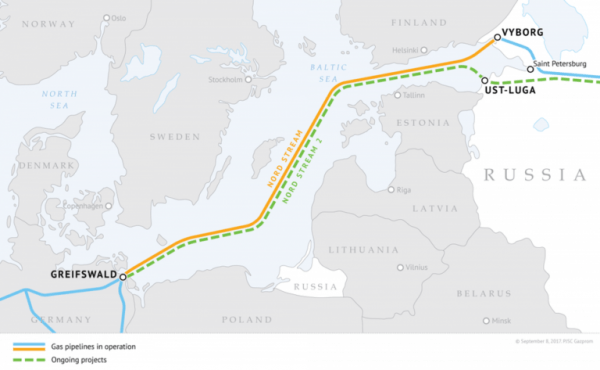
The project is expected to ensure safe and stable supplies of gas to Europe. The competitive Russian gas supplies will enable European customers to save anywhere around 8 billion euros on their gas bill in 2020.
More importantly, according to a study conducted by the University of Cologne EWI, “When Nord Stream 2 is available, Russia can supply more gas to the EU decreasing the need to import more expensive LNG. Hence, the import price for the remaining LNG volumes decreases, thereby reducing the overall EU-28 price level.”
Herein lies the rub. Europe has become a natural gas battleground for the US and Russia. Of course, apart from being a prized market, Europe is also a political battleground between the US and Russia.
Russia traditionally dominated the European market while the European Union appears to be keen to wean itself off Russian gas, given the geopolitical implications of over-reliance on Moscow for its energy security. On the other hand, the US is looking to step up its exports of liquefied natural gas (LNG) to Europe and faces a big resourceful competitor who cannot be dislodged from the market — Russia.
Russia loomed large as the largest supplier of natural gas to the EU in 2018. According to the European Commission’s latest data on EU imports of energy products in October, eleven member states imported in 2018 more than 75 percent of their total national imports of natural gas from Russia.
Russia has multiple pipelines in operation, which gives it a big advantage in cutting down transportation costs for the European consumers, as compared to more expensive LNG imports from the US. Clearly, both geoeconomics and geopolitics are at play here.
The US’ transatlantic leadership is largely conditional on the climate of relations between Europe and Russia in general and between Germany and Russia in particular. Washington is acutely conscious that Nord Stream 2 can provide the underpinning for a stable, predictable relationship between Europe and Russia, which would go against the grain of the Trump administration’s projection of Russia as a revisionist power that the US is determined to counter.
In sum, Washington apprehends that if Nord Stream 2 is completed, it will come as a severe blow to transatlantic relations, although on the face of it, the US has been arguing that the project runs counter to the Western sanctions imposed on Russia following its annexation of Crimea.
Actually, this argument is sheer sophistry, since Europe’s dependence on Russian energy supplies is a legacy inherited from the days of the Soviet Union. Moscow is a stakeholder in preserving its reputation as a stable, reliable supplier of energy to Europe at competitive prices. The crux of the matter is that the European consumer prefers the cheaper Russian gas to the expensive LNG exports from the US.
Meanwhile, the Ukraine crisis alerted Russia to the geopolitical reality that it could be vulnerable to US pressure politically, which in turn prompted its energy pivot to China. Gazprom aims to become China’s top gas exporter by 2035. When the Power of Siberia pipeline (under construction in Eastern Siberia to transport gas to Far East countries) becomes active later this year, it will deliver 38 billion cubic metres of natural gas annually to China, which will make China Russia’s second-largest gas customer after Germany.
However, paradoxically, Russia’s gas exports to Europe are only increasing in recent years. In 2018, Gazprom’s gas sales to Europe and its share of Europe’s gas market reached record highs. This trend can only continue as the Nord Stream 2 and Turk Stream pipelines, which will become active shortly this year, will deliver an additional 86.5 billion cubic meters annually to Europe.
Simply put, Europe’s addiction to Russian gas remains a fact of life and with the continent’s own gas production on the decline, Europe needs to import much bigger volumes of gas and lots of it is going to come from Russia.
The amazing part has been the dogged resistance by Germany to the US pressure tactic to abandon Nord Stream 2. The US even threatened to sanction German companies; US Congress passed resolutions calling for an end to construction of the pipeline. Germany’s manufacturing economy is dependent on imports for 98% of its oil and 92% of its gas supply, and cheap gas is the lifeblood of its export-based economy.
But then, there could be more to it politically than meets the eye. Can it be a coincidence that Germany is also resisting US pressure to shut out Chinese tech giant Huawei from its 5G networks? Like with Nord Stream 2, Washington advanced the same argument apropos Huawei — national security concerns. But Germany snubbed the calls from the US.
The Economist magazine wrote some months ago that the “The Atlantic Ocean is starting to look awfully wide. To Europeans the United States appears ever more remote.” To be sure, the coming into fruition of Nord Stream 2 is yet another sign that the transatlantic relationship currently faces significant challenges.
The US-European policy divisions have emerged on a wide range of regional and global issues. Although US and European policies toward Russia remain broadly aligned, Nord Stream 2 turned out to be a key US-European friction point.
Russia Isn’t Getting the Recognition It Deserves on Syria
By Scott Ritter | TruthDig | October 30, 2019
At a time when the credibility of the United States as either an unbiased actor or reliable ally lies in tatters, Russia has emerged as the one major power whose loyalty to its allies is unquestioned, and whose ability to serve as an honest broker between seemingly intractable opponents is unmatched.
If there is to be peace in Syria, it will be largely due to the patient efforts of Moscow employing deft negotiation, backed up as needed by military force, to shape conditions conducive for a political solution to a violent problem. If ever there was a primer for the art of diplomacy, the experience of Russia in Syria from 2011 to the present is it.
Like the rest of the world, Russia was caught off guard by the so-called Arab Spring that swept through the Middle East and North Africa in 2010-2011, forced to watch from the sidelines as the old order in Tunisia and Egypt was swept aside by popular discontent. While publicly supporting the peaceful transition of power in Tunis and Cairo, in private the Russian government watched the events unfolding in Egypt and the Maghreb with trepidation, concerned that the social and political transformations underway were a continuation of the kind of Western-backed “color revolutions” that had occurred previously in Serbia (2000), Georgia (2003) and Ukraine (2004).
When, in early 2011, the Arab Spring expanded into Libya, threatening the rule of longtime Russian client Moammar Gadhafi, Russia initially supported the creation of a U.N.-backed no-fly zone for humanitarian purposes, only to watch in frustration as the U.S. and NATO used it as a vehicle to launch a concerted air campaign in a successful bid to drive Gadhafi from power.
By the time Syria found itself confronting popular demonstrations against the rule of President Bashar Assad, Russia—still struggling to understand the root cause of the unrest—had become wary of the playbook being employed by the U.S. and NATO in response. While Russia was critical of the violence used by the Assad government in responding to the anti-government demonstrations in the spring of 2011, it blocked efforts by the U.S. and Europe to impose economic sanctions against the Syrian government, viewing them as little more than the initial salvo of a broader effort to achieve regime change in Damascus using the Libyan model.
Moscow’s refusal to help facilitate that Western-sponsored regime change, however, did not translate into unequivocal support for the continued rule of Assad. Russia supported the appointment of former U.N. Secretary-General Kofi Annan to head up a process for bringing a peaceful resolution to the Syrian crisis, and endorsed Annan’s six-point peace plan, put forward in March 2012, which included the possibility of a peaceful transition of power away from Assad.
At the same time Russia was promoting a diplomatic resolution to the Syrian crisis, the U.S. was spearheading a covert program to provide weapons and equipment to anti-Assad forces, funneling shipments from Libya through Turkey and into rebel-controlled areas of Syria. This CIA-run effort, which eventually morphed into a formal operation known as Timber Sycamore, helped fuel an increase in the level of violence inside Syria that made it impossible for the Assad government to fully implement the Annan plan. The inevitable collapse of the Annan initiative was used by the U.S. and its European allies to call for U.N. sanctions against Syria, which were again rejected by Russia.
While Russia continued to call for a political solution to the Syrian crisis that allowed for the potential of Assad being replaced, it insisted that this decision would be made by a process that included the Syrian government, as opposed to the U.S. demand that Assad must first step down.
The Military Solution
The failed Annan initiative was replaced by a renewed U.N.-sponsored process, known as Geneva II, headed by Lakhdar Brahimi, a veteran Algerian diplomat with extensive U.N. experience. The Geneva process stalled as Brahimi sought to bridge the gap between the U.S.-backed Syrian opposition—which insisted upon Assad’s resignation as a precondition to any talks about the future of Syria—and Russia, which continued to insist that the Assad government have a voice in determining Syria’s future.
Complicating these talks was the escalation of violence inside Syria, where anti-Assad forces, building upon the massive amount of military aid received from the U.S., Saudi Arabia and the Arab Gulf states, aggressively pushed for a military victory that would moot the Geneva II process.
By June 2013 the situation had devolved to the point that the U.S., citing allegations that the Syrian government was using a nerve agent against rebel forces, was considering the establishment of no-fly zones in northern Syria and along the Jordanian border. While sold as a humanitarian move designed to create safe zones for Syrian civilians fleeing the fighting, the real purpose of these zones was to carve out large sections of Syrian territory where the opposition could organize and prepare for war under the umbrella of U.S. air power without fear of Syrian government retaliation.
The concept of Syria’s chemical weapons being used by the U.S. to justify military action against the Syrian government was not hypothetical. In 2012, President Barack Obama had declared that any use of chemical weapons by the Syrian government would be considered a “red line,” forcing the U.S. to act. When, in August 2013, a major chemical weapons incident occurred in Ghouta (conclusive attribution for the attack does not exist; the U.S. and NATO contend that the Syrian government was behind the attacks, which the Russians and the Syrian government claim were carried out by anti-Assad opposition for the purpose of compelling U.S. intervention), it looked like the U.S. would step in.
Committing to a larger war in Syria was not a politically popular move in the U.S., given the recent experience in Iraq, and when Obama met with Russian President Vladimir Putin during the G-20 summit in St. Petersburg, Russia, in September 2013, the Russians suggested a solution—the disarmament of Syrian chemical weapons under the supervision of the Organization for the Prevention of Chemical Weapons (OPCW). When Secretary of State John Kerry opened the door to that possibility, Russia and Syria jumped on the opportunity, paving the way for one of the great disarmament achievements of modern times, an action that won the OPCW the Nobel Peace Prize for 2013.
The disarmament of Syria’s chemical weapons was a huge success, for which Russia received little recognition, despite the major role it played in conceiving and overseeing its implementation. Russia had hoped that the disarmament process could lead to the establishment of international confidence in the Assad government that would translate into a diplomatic breakthrough in Geneva. This was not to be; a major peace conference planned for 2014 collapsed, and efforts to revive the failed talks were sidelined by the escalation of violence in Syria, as the armed opposition, sensing victory, pressed its attacks on the Syrian government.
The situation in Syria was further complicated when, in 2013, the organization formerly known as al-Qaida in Iraq renamed itself the Islamic State in Iraq and Syria, and started carving out a so-called caliphate from the ungovernable expanses of eastern Syria and western Iraq. Having established its capital in the Syrian city of Raqqa, Islamic State launched a dramatic offensive in early 2014, capturing large swaths of territory in both Syria and Iraq, including the Iraqi city of Mosul. By 2015, the Syrian government, under pressure from anti-Assad rebels and the forces of Islamic State, was on the brink of collapse.
The consequences of the loss of Syria to forces dominated by radical Islamic ideology do not seem to have been fully considered by those in the West, such as the U.S. and its European allies, which were funneling military aid to the rebel forces. For Russia, however, which had its own experiences with Muslim separatist movements in the Caucasus region, such a result was deemed an existential threat, with thousands of Russian citizens fighting on the side of Islamic State and the anti-Assad opposition who would logically seek to return to Russia to continue the struggle once victory had been achieved in Syria. In September 2015, Putin urged the Russian Parliament to approve the intervention of the Russian military on the side of the Syrian government. The Parliament passed the resolution, thus beginning one of the most successful military interventions in modern times.
The impact of the Russian intervention was as dramatic as it was decisive. Almost immediately, the Russian air force helped turn the tide on the field of battle, allowing the Syrian army to launch attacks against both the anti-Assad opposition and Islamic State after years of losing ground. The Russian intervention helped pave the way for the commitment by Hezbollah and Iran of tens of thousands of ground troops who helped tip the scale in favor of the Syrian government. The presence of Russian forces nipped in the bud all talk of Western military intervention and created the conditions for the Syrian government to eventually recapture much of the territory it had lost to Islamic State and the anti-Assad rebels.
Unheralded Peacemaker
The connection between military action and diplomacy is a delicate one. For some nations, like the United States, diplomacy is but a front for facilitating military action—the efforts to secure a U.N. Security Council resolution on the eve of the 2003 invasion of Iraq stand as a prime example. For Russia, however, the decision to intervene militarily in Syria was not seen as an end unto itself, but rather as the means by which Russia could shape the political landscape in such a manner as to make a political solution realistic. From the Russian perspective, the Geneva II process was an empty shell, having been hijacked by Saudi Arabia and its anti-Assad proxies.
In January 2017, Russia took the diplomatic offensive, initiating its own peace process through a series of summits held in the Kazakh capital of Astana. This process, which brought together Turkey, the Syrian government and Iran, together with Russia, quickly supplanted the Geneva II talks as the most viable vehicle for achieving a peaceful resolution to the Syrian conflict. By directly linking diplomatic talks with the fighting on the ground, the Astana process had a relevance that Geneva II lacked. For its part, Russia was able to woo Turkey away from insisting that Assad must leave, to a stance that recognized the territorial integrity of the Syrian nation, and a recognition that Assad was the legitimate leader of Syria, at least for the time being. The Astana process was lengthy and experienced its share of ups and downs. But today it serves as the foundation of a peace process that, unlike any of its predecessors, has a real chance of success.
Bridging the gap between the finesse of diplomacy and the brutal violence of military action is one of the most difficult tasks imaginable. For its part, the United Nations has undertaken so-called peacekeeping operations with mixed effect. In recognition of the importance and difficulty of this kind of work, the Nobel Committee awarded the 1988 Nobel Peace Prize to the U.N. Peacekeepers. When the diplomatic solutions reached in Astana needed to be implemented in Syria, Russia turned to the most unlikely source for turning objectives into reality: the Russian military police. A relatively new entity in the Russian military establishment, formed only in 2012, the military police were tasked with a wide range of missions, including convoy protection, area security, restoring law and order and resettlement operations.
In late 2016, as the Syrian army was positioned to recapture the city of Aleppo from rebel forces, Russia deployed a battalion of military police to Syria. The mission of these troops was not to engage in frontline fighting, but rather to restore law and order and win the trust and confidence of a civilian population wary of the potential for retaliation at the hands of the victorious Syrian army.
By all accounts, the Russian military police performed admirably, and soon the Russian ministry of defense dispatched more battalions of these new peacekeepers, who quickly established a reputation of being fair arbiters of the many cease-fire agreements brokered through the Astana process. The Russian military police were ubiquitous, whether policing the no-man’s land separating warring parties, escorting convoys of rebel fighters and their families to safe zones or providing security for OPCW inspectors.
The final phases of the Syrian conflict are playing out in northern Syria today. The last vestiges of the anti-Assad opposition, having been taken over by al-Qaida, are dug in in their final bastion in Idlib Province, their ultimate defeat at the hands of the combined Russian-Syrian armed forces all but assured. The American intervention in northeastern Syria, begun in 2015 as a means of confronting and defeating Islamic State but continued and expanded in 2017 as a vehicle for destabilizing the Assad government, has imploded in the face of a geopolitical reality in transition, facilitated in large part by the combined forces of Russian diplomacy in Astana and Russian-led military action on the ground in Syria.
By successfully wooing Turkey away from the U.S., Russia has dictated the reality on the ground in Syria, green-lighting a Turkish incursion that put the American forces deployed there in an impossible situation, prompting their evacuation. While the U.S. continues to maintain a military presence in Syria, occupying a border crossing point at Tanf and a series of military positions along the eastern bank of the Euphrates River in order to secure nearby Syrian oil fields, the ability of the U.S. to logistically sustain this force is doubtful, making its eventual withdrawal from Syria inevitable.
Moreover, by compelling an American withdrawal from northeastern Syria, Russia broke the back of the U.S.-supported Kurdish autonomous entity known as Rojava, and in doing so prevented a larger war between Turkey, the Kurds and the U.S.
In green-lighting the Turkish incursion into northern Syria, the Russians invoked the 1998 Adana Treaty, which guarantees the sovereign inviolability of Syria’s borders. The processes involved in stabilizing the Turkish-Syrian border, defeating the anti-Assad forces in Idlib, evicting the Americans from Syrian soil, and integrating the Kurds into a future Syrian government are lengthy, complex and not necessarily assured of a positive outcome. One thing is certain, however: The prospects for peace in Syria are greater today than at any time since 2011. And the fact that Russia has deployed even more battalions of its military police to Syria to oversee implementation of the current cease-fire bodes well for the prospects of success.
Despite literally salvaging victory from the jaws of defeat, the scope of the Russian accomplishment in Syria is muted in the United States, thanks to rampant Russophobia that has insinuated itself into every aspect of the domestic political discourse. Under normal circumstances, the Russian accomplishment in Syria would have been deserving of a Nobel Peace Prize, if not for the Russian diplomats and leaders who oversaw the effort to forge peace from the furnace of war, then at least for the Russian military police whose actions in Syria embody the very definition of humanitarian peacekeeping.
Over time, international historians will come to appreciate what Russia accomplished in Syria, potentially ending a sectarian conflict that could easily have served as the foundation for a decades-long conflagration with regional and global consequences.
Whether American historians will ever be capable of doing the same is unknown. But this much is true: In the years to come, children will be born of parents whose lives were not terminated or otherwise destroyed by a larger Syrian conflict that almost assuredly would have transpired if not for the honest broker services provided by Russia. Intentionally or not, Russian diplomacy prevented the United States from embarking on a foreign policy disaster of its own making. While it is highly doubtful that Americans will ever muster the moral fortitude to say so publicly, those who know the truth should find the time to whisper, “Thanks, Putin,” between the barrage of anti-Russian propaganda that floods the American mainstream media today.
Like it or not, in Syria, the Russians saved us from ourselves.
Lavrov: US’ ‘Deal of Century’ Example of Swapping International Law for Norms Suitable for US
Sputnik – November 1, 2019
MOSCOW – The so-called deal of the century on the Israeli-Palestinian conflict settlement that Washington says it is preparing is an example of how the international law is changed for rules that the United States finds convenient, Russian Foreign Minister Sergey Lavrov said.
“Instead of implementing these [UNSC] resolutions, the United States promises everyone to present some ‘deal of the century,’ which, as you have already understood, will not envision the creation of a full-fledged Palestinian state. This is an example of how international law represented by UNSC resolutions is swapped for rules that the United States has invented and which it finds convenient”, Lavrov said in an interview on TV on Friday.
The administration of US President Donald Trump has for years said it would announce its plan for Israeli-Palestinian peace. In July, it released what was characterized as an economic component of the plan — an infrastructure and investment project to support Palestinians.
However, the Palestinian authorities have rejected Washington’s involvement in the settlement of their conflict with Israelis after Trump recognized Jerusalem as the capital of Israel and moved the US embassy from Tel Aviv to the Holy City despite the condemnation of the Muslim world and the UN recommendations to refrain from establishing diplomatic missions in the city until its legal status is settled.
The UN Security Council has issued multiple resolutions on the Israeli-Palestinian settlement. For years, the Arab world remains committed to the Arab Peace Initiative, originally agreed upon at the Beirut Summit back in 2002. The plan has been formed on the basis of the UNSC Resolution of 194.
Questions Remain Over Alleged Death of Islamic State Leader
Strategic Culture Foundation | November 1, 2019
Russia’s Ministry of Defense this week said it had not seen any credible evidence that Abu Bakr al-Baghdadi, the leader of the Islamic State (IS) terror group, had been killed in northern Syria last weekend, allegedly in a daring US military operation.
US President Donald Trump boasted last Sunday that American Special Forces raided a base in Idlib Province, which purportedly led to al-Baghdadi’s death from a suicide explosion. The Pentagon said six other people were killed in the operation. In addition, two of al-Baghdadi’s children were killed when the IS leader blew himself up as American troops were closing in, according to Trump’s own dramatic telling of the event.
Curiously, Trump gave prominent thanks to Russia for its help in the logistics of carrying out the attack.
However, Russian MOD spokesman Major General Igor Konashenkov has subsequently stated that Russia was not involved in the raid, as Trump had claimed. He said that Russian flight data indicated that there were no US air strikes in the vicinity of the declared raid. The spokesman went further and remarked that there were doubts as to whether the assassination mission even took place in the way that Washington is publicly claiming.
Another anomaly in the official US account is that the base where al-Baghdadi was purportedly hiding out is in a location known to be a stronghold for another al-Qaeda affiliate that is a sworn enemy of their perceived rival jihadists belonging to IS. Why and how then was the IS leader able to maintain a base surrounded by enemy jihadists?
According to the New York Times, it is claimed that al-Baghdadi paid $67,000 to the rival terror group, Hurras al-Din, for protection. Somehow that sounds a dubious explanation.
A glaring omission in US media coverage of the alleged killing of al-Baghdadi is the historical background as to who he was and how his former so-called caliphate came into being straddling Iraq and Syria.
There is copious evidence that Iraqi-born al-Baghdadi was recruited by American intelligence while imprisoned during the US war on Iraq in the mid- to late-2000s. He was held in the notorious Abu Ghraib US-run torture prison, but subsequently was released by the Americans despite his known jihadist past. It was around 2012 that the Obama administration was covertly mobilizing and weaponizing jihadi assets to carry out its clandestine war for regime change against the Syrian government. It is believed that al-Baghdadi was a key CIA asset for the US dirty war in Syria, even though Washington was proclaiming its involvement in Syria was to “defeat IS” and other terror groups.
It is entirely plausible that US intelligence assets are “terminated” whenever it is politically convenient and when it is calculated that their usefulness has expired.
Trump and the mainstream US media depiction of a spectacular success in exterminating a feared terror chief is almost certainly a distortion of reality and events.
The way Trump in particular has crowed about the purported operation suggests he is seeking a boost to his re-election chances next year. The thuggish rhetoric of killing the IS leader “like a dog” smacks of Trump trying to project an image of a tough president.
More generally, the event has afforded US media to proclaim the virtue of American military power in apparently bringing a notorious renegade “to justice”.
The timing could not be more important. The nearly eight-year war in Syria has exposed the criminality of Washington and its NATO partners for fueling carnage. By contrast, the Syrian government and its Russian and Iranian allies have been vindicated in their long-held claims that a criminal US-backed aggression using terrorist proxies has been thwarted.
When Trump abandoned the Kurdish militants last month, the move was condemned for throwing Syria into further turmoil. It was Russia’s deft diplomacy which managed to contain the situation. At that point, Washington’s international credibility was scraping the barrel of duplicity and malign responsibility for conflict and chaos in Syria.
Hence, a sensational operation resembling “a movie” – as Trump put it – was a timely public relations remedy for Washington’s badly tarnished image. Ostensibly, “taking out” a terrorist leader gives the US the means to renew its propaganda narrative that it is “fighting against terrorism” rather than the reality of using terrorism for its regime-change wars and other imperialist objectives.
Was Abu Bakr al-Baghdadi killed last weekend? It is not the first time his “death” has been reported by US forces who have made similar claims in past years. There are too many questions and discrepancies to take Washington’s version of events as accurate. More plausibly, it was a carefully contrived propaganda stunt to burnish Washington’s disgraced image.
One thing for sure, however, is that the US will continue to use terror proxies and assets into the future in order to achieve its pernicious geopolitical aims. There are plenty more “al-Baghdadis” to be cultivated and orchestrated by Washington as it sows chaos and destruction in the Middle East and beyond for its selfish interests.
Russia’s UN envoy says Israel should stop building settlements in West Bank
RT | October 29, 2019
Israel should immediately stop building its settlements and dismantling Palestinian properties on the western bank of the Jordan River, Russia’s UN envoy Vassily Nebenzia told the UN Security Council’s session devoted to the Middle East.
The diplomat said Monday that Russia was extremely concerned at the analysis of the situation offered by UN Special Coordinator for the Middle East Peace Process Nickolay Mladenov. Speaking about the West Bank and the Gaza Strip, he had said the situation now can only be prevented from further degradation, without even mentioning the possibility of any improvement, TASS reports.
Nebenzia said that solutions are evident. “First of all, Israel’s settlement activities and the policy of dismantling the Palestinian property in the West Bank must be stopped.” Both Palestinians and Israelis “must refrain from violence or aggressive and provocative rhetoric,” he added.
Western courts target Gazprom for expropriations
By Padraig McGrath | October 29, 2019
On October 23rd the Amsterdam District Court issued an order for the seizure of 100% of the shares of the South Stream Transport B.V. company, which is contracted to build the offshore section of the Turk Stream Pipeline. This legal ruling follows a 2018 award by the Stockholm Arbitration Tribunal of $4.6 billion to Naftogaz, the (theoretically) state-owned oil and gas company of Ukraine, in a lawsuit which it had filed against Gazprom in 2014 in relation to alleged contractual violations regarding gas-transit through Ukraine. That $4.6 billion award was later negotiated down to $2.56 billion, but on October 23rd the Amsterdam District Court ordered the seizure of all South Stream Transport B.V. shares as a punitive measure for non-compliance with the Stockholm Arbitration Tribunal order.
Despite this development, Russian Energy Minister Aleksandr Novak said on October 27th that the construction of the Turk Stream Pipeline would be completed on schedule. The 1100-kilometre pipeline, 900 kilometres of which runs under the Black Sea to Turkey, is envisaged to begin delivering a combined total of 30 billion cubic metres of gas to Turkey and South-Eastern Europe per year, beginning in late 2019.
Of course, this is not the first time that Russia’s state-owned concerns have been targeted for plunder by a court or quasi-judicial body convened in the legal jurisdiction of a western country. In July 2014, the Permanent Court of Arbitration in The Hague issued an award of $50 billion to former shareholders of Yukos, the oil company previously controlled by the oligarch Mikhail Khodorkovsky. Interestingly, the Amsterdam District Court, the same judicial body which has issued this latest ruling, later quashed the 2014 ruling made by the Permanent Court of Arbitration on the grounds that the latter had no legal jurisdiction to issue such a ruling.
One thing which is perfectly clear in context is that these legal rulings are, quite blatantly, both politically and geo-politically motivated. Targetting Gazprom serves multiple geo-political functions. Firstly, the Turk Stream pipeline was devised in order to enable Russia to bypass the territory of a deeply problematic, crisis-ridden, hostile and contractually unreliable neighbour in the task of effecting gas-transit to its markets in Europe. Even before relations between Russia and Ukraine deteriorated following the February 2014 Ukrainian coup d’etat, the siphoning-off of Russian gas while in transit across Ukrainian territory had been a perpetual concern for many years.
However, this goal of rendering Ukraine a geo-political irrelevancy, and therefore nobody else’s problem, is precisely what western geo-strategists are invested in preventing. Ukraine has been transformed by western interests into the failed state that it is now precisely for the purpose of presenting developmental and economic challenges to Russia. Therefore, these same interests must use any counter-measures, including quasi-legal counter-measures, in order to keep Ukraine relevant. This explains the punitive court-order to freeze the shares of South Stream Transport B.V.
Another driver of this western judicial hostility, also a manifestation of current geo-political conditions, pertains to Gazprom specifically. To analyze this, we should look at the role which highly profitable state-owned concerns, Gazprom the most notable among them, play within the Russian economy and in Russian society more broadly.
In spite of maintaining quite a business-friendly tax-environment (Russia has a 13% flat income-tax rate), the Russian government nonetheless manages to maintain (and indeed, to significantly upgrade) the social system. Significant federal investments have already been made in infrastructure and in the modernization of the public healthcare sector, for example. In February, the government announced 12 major development-projects as part of the “Great Society” initiative ranging from agriculture, ecology, infrastructure, the digital economy, and the further technological modernization of public healthcare.
In a country with a 13% flat income-tax rate, revenues from state-owned companies like Gazprom make this kind of state-building and society-strengthening possible. The western alliance (and its judiciaries) understand perfectly well that financial attacks against Gazprom amount in practical terms to attacks on the Russian state, and to counter-measures to the Russian state’s efforts to build the kinds of social systems which are necessary to its long-term self-defence.
Taken to its logical conclusion, from the liberal democratic perspective, the rationalization for this further degree of geo-political weaponization of “international law” would be that, as liberal democracy is believed by the western alliance to be the only political system which has any moral or political legitimacy, it therefore follows that only liberal democratic legal systems have any legal jurisdiction, and that their jurisdiction should be seen as universally extensive.
“Liberal universalism” refers to a sense of moral universality, but also (consequently) to a sense of universality of legal jurisdiction.
This mindset attempts to justify the weaponization of judiciaries, and of judicial bodies established by international law, against all and any states which don’t sign on with the liberal universalist consensus.
Of course, Russia is not the only state which is targeted by this geo-political weaponization of judiciaries. We might recall the 2012 order made by a New York court to freeze $6.5 billion in Iranian government assets in relation to a lawsuit filed by family-members of people killed in the 9/11 attacks. The lawsuit had claimed (quite spuriously and bizarrely) that Iran had aided and abetted the 9/11 attackers, despite the obvious point that Al-Qaeda’s ideology is fanatically anti-Shi’ite. One point which is interesting, considering that state-sponsored piracy has quite recently re-appeared on the high seas (Gibraltar), is that judicial structures established by “international law” are now also being quite explicitly used for the purpose of enabling what we might term “judicial piracy.”
What next? Will the British government start re-issuing “letters of marque” to sea-faring privateers?
However, as with so many geo-political stratagems deployed by the governments of contemporary liberal democracies, the resulting erosion of the judiciary’s independence from the political sphere completely undermines the normative and legal basis of liberal democracy itself.
Featured Video

Dan Dicks with James Corbett on Solutions Watch
or go to
Aletho News Archives – Video-Images
From the Archives
Secret document reveals plans for civil war in Lebanon, Israeli false flags, and invasion
By Randi Nord | Geopolitics Alert | April 5, 2019
Beirut – During his visit with US Secretary of State, Mike Pompeo, Lebanese President Michael Aoun reportedly received a US-Israeli document detailing plans for creating a civil war in Lebanon with covert false flag operations and possible Israeli invasion.
Although the source of the document is Israeli and created in partnership with Washington, no one knows who presented it to Aoun. The Lebanese TV station, Al-Jadeed, initially reported the document on Lebanese TV and a video on its website. Geopolitics Alert translated the report for this article. … continue
Blog Roll
 Aletho News
- Sheikh al-Asadi warns of Iraqi government compliance with US demands
- How to MAKE THE CONSPIRATORS PAY for their crimes! Dan Dicks with James Corbett on Solutions Watch
- There’s a drought in academia: A drought in honest research on the subject of drought and other weather extremes
- Department of War Awards $20.7 Billion Contract to Raytheon for Air-to-Air Missiles
- ‘Distance yourselves from Israel’: IRGC urges US population to question govt policies
- America’s Greenland deal has a radioactive backstory
- The RAF Fairford ‘terror plot’: Unpacking escalation in the UK echo-chamber
- EU Council Advances Chat Control 2.0 Scanning Proposal
- Ex-Greek MEP files complaint against Israeli spyware firm over alleged Pegasus surveillance
- Troubling ideas throughout the Torah, Talmud, Mishneh Torah and Tanya
- If Americans Knew
- New Report: “Scholasticide and Genocide in Gaza: Assessment, Testimonies and Legal Analysis”
- Ex-Biden officials are desperate for a Gaza scapegoat
- Israeli “settlers” Invade Al-Aqsa; Pour Boiling Water on 75-Year-Old
- Israel Has Kidnapped Another American Teenager
- US arms sales to Israel worth $21.6 billion in 20 months
- Three Palestinians Killed in Israeli Attacks on Gaza
- Revealed: German “Anti-Semitism Expert” Driving Crackdown on Palestine Solidarity is Former Israeli Spy
- Egypt’s Warning to Israel Before Oct 7
- Israel’s siege signals another cruel winter for 1.8 million Gazans – Daily Update
- Netanyahu Asked UAE Leader to Deny Report on Oct. 7 Warning in Secret Visit, Sources Say
- No Tricks Zone
- Two More Paleo Reconstructions Affirm Meters-Higher Sea Levels Across Ireland, Brazil 7000-6000 Years Ago
- New Study: Earth And Venus Surface Warmth Largely Explained By Convection And Lapse Rate, Not CO2 Or Radiation
- 2025 Nature Paper Claiming Worsening Global Drought Gets RETRACTED …Heavily Flawed
- New Study: ‘Global Drought Shows No Detectable Recent Acceleration Under Climate Warming’
- Economic Masterminds: German Socialists Suggest Taxing Productivity Gains Stemming From Using AI
- The South China Sea Has Not Been Cooperating With The Climate Change Narrative
- Energy Crisis: Germany Enters Heating Season With Historically Low Gas Reserve Fill Levels
- New Study: The Antarctic Ice Sheet Gained Mass From 2020-2024 Due To Staggering Snow And Ice Accumulation
- Study: Ocean Heating Rates From Thousands Of Years Ago ‘Dwarf’ Modern Ocean Heating Rates
- Climate Extremists Target, Attack Large-Scale Power Grid Infrastructure In Germany!

