Zelensky threatens ‘new deep strikes’ into Russia
RT | August 31, 2025
Ukrainian leader Vladimir Zelensky has threatened new strikes into Russia, days after claiming that Kiev possessed a brand-new long-range missile capable of reaching Moscow.
Zelensky wrote on Telegram that he had been briefed by Ukraine’s commander-in-chief, Aleksandr Syrsky, on the current battlefield situation.
“We will continue our active actions exactly as needed to protect Ukraine. Forces and means are prepared. New deep strikes have also been planned,” he said on Sunday, without providing further details.
Earlier this month, Zelensky claimed Ukraine had developed the long-range Flamingo missile with a reported range of 3,000 kilometers – which would be enough to reach not only Moscow but also Russian cities beyond the Ural mountains. The Ukrainian leader, however, said that mass production is not expected for the next several months.
British media outlets cast doubts on whether the Flamingo was developed in Ukraine, noting similarities with the FP-5 cruise missile produced by the UK-based Milanion Group and unveiled at an arms expo in Abu Dhabi this year. The UK has also been supportive of Kiev’s long-range strikes, having provided it with Storm Shadow missiles in the past.
Russian Foreign Ministry spokeswoman Maria Zakharova noted that there is “nothing surprising” in the similarities, adding that “Ukraine has long turned into a testing ground for Western weapons. There are more than enough examples.”
On Friday, the Kyiv Independent also reported that Ukraine’s National Anti-Corruption Bureau has launched an investigation into Fire Point, the defense firm linked to the development of the Flamingo missile, after reports it misled the government on pricing and deliveries.
Earlier this month the Wall Street Journal reported that the US had blocked Ukraine from carrying out strikes deep inside Russian territory. Throughout the conflict, some of Kiev’s Western backers have been wary of authorizing unrestricted strikes into Russia using Western-supplied weapons, citing concerns over escalation with Moscow.
Ukraine has regularly carried out long-range attacks inside Russia, which Moscow says frequently hit civilian areas and critical infrastructure. Russia has retaliated with strikes on Ukrainian military-related facilities and defense enterprises but maintains that it never targets civilians.
Benoît Paré: OSCE Observer Exposes Lies About the Ukraine War
Glenn Diesen | August 30, 2025
Benoît Paré, a French army reserve officer and former defense ministry analyst, brings his expertise and experience as an OSCE observer in Donbas.
Blowing up Europe… Druzhba pipeline sabotage showcases EU self-destruction
Strategic Culture Foundation | August 29, 2025
The EU-backed Ukrainian regime’s blowing up of a major pipeline delivering vital oil supply to Europe is an astounding signal of self-destruction. It demonstrates how insane the European Union’s leadership has become in its obsession with defeating Russia, no matter the cost. The insanity means that the interests of EU member states and European citizens are willingly sacrificed. Russophobic Eurocrats who have shunned all diplomatic engagement with Moscow are in effect funding the destruction of Europe.
In another development, as Russian airstrikes on Kiev this week hit European Union and British government sites in the Ukrainian capital, EU and British politicians were outraged, condemning Russia for “barbaric attacks” on their delegations. Yet it is these same European and British politicians who are pushing conflict to the brink of no return as they insist on arming a NeoNazi regime to continue striking Russian civilian targets and refuse to listen to Russia’s historic grievances about how this conflict evolved.
The Ukrainian regime, bankrolled by EU taxpayers, launched multiple drone and missile attacks on the Druzhba pipeline, which supplies EU member states Hungary and Slovakia. The pipeline supplies those states with about 50 percent of their oil imports. The attacks knocked out pipeline infrastructure in Russian territory. Hungary and Slovakia were cut off from crude oil supplies for several days. Budapest and Bratislava angrily protested to the European Union leadership that the sabotage was an unacceptable assault on the sovereign, vital interests.
However, the European Commission in Brussels responded with remarkable indifference, noting that Hungary and Slovakia’s 90-day emergency stockpiles of oil were sufficient to carry the countries over the interruption in supply. The complacency of the EU leadership is extraordinary. So, a non-EU state cuts off the energy supply of EU members, and there is no reprimand for the sabotage. The insouciance is tantamount to giving the Ukrainian regime a green light to carry out more such attacks.
The background is even more sinister. Earlier this week, the Kiev regime’s nominal president, Vladimir Zelensky, made a veiled threat to Hungary and Slovakia that his forces would continue to blow up the pipeline if Budapest and Bratislava did not lift their vetoes on Ukraine becoming a member of the European Union. To their credit, Hungary and Slovakia have both consistently opposed Ukraine joining the bloc, warning that such a move will exacerbate the conflict with Russia and destabilize internal markets from cheap Ukrainian imports. They have also opposed doling out more EU taxpayer funds for military weapons and prolonging a slaughter.
In other words, Hungary and Slovakia have become an obstacle to the proxy war against Russia. That is not merely annoying to the Kyiv cabal and its war racket; it also, more importantly, frustrates the Eurocrat elites’ desire to expand the war, with the Russophobic obsession of defeating Russia.
The Kiev regime has for a long time been haranguing Hungary and Slovakia to terminate all oil imports from Russia, and get in line with the rest of the EU. Ukraine accuses Hungarian and Slovakian leaders of buying Russian oil with blood money and fueling the war. This is similar to the United States castigating India for continuing to purchase Russian oil, with Trump aide Peter Navarro this week absurdly calling the Ukraine conflict “Modi’s war” in a snide reference to the Indian Prime Minister Narendra Modi.
Hungary, Slovakia, India, and others retort that it is their national prerogative to buy oil from Russia. They say it is not up to the Kiev regime or the United States to determine from whom they obtain their vital energy supplies. The Kiev regime and Washington are acting like bandits and mafia. It was the United States under the Biden administration that blew up the Nord Stream gas pipelines under the Baltic Sea in September 2022. That act of terrorism cut off Germany from Russia’s natural gas supply and led to the destruction of the German economy.
The Kiev regime shut down unilaterally the Brotherhood natural gas pipeline to the rest of Europe at the end of 2024 because it decided not to renew a decades-old transit contract with Russia. Later, the Kiev regime attacked the Turk Stream gas pipelines linking Russian gas to southern Europe. Now the regime is bombing that last oil pipeline into Europe from Russia. And all this banditry holding Europe hostage is countenanced by the Eurocrat leadership.
Where is European sovereignty here? Where is European leadership insisting that the basic rule of law must be respected and vital civilian infrastructure must not be interfered with, especially when that interference amounts to blatant acts of terrorism? Incredibly, the European Commission and the governments of Germany and Denmark, among others, continue to ignore the Nord Stream terror attacks by their American ally as if those crimes never happened. Every so often, the EU authorities find some ridiculous scapegoat to blame, like low-level Ukrainian saboteurs.
The fact is, the European elites do not care that the vital interests of European citizens are being destroyed by the Americans or the puppet regime in Kiev.
Hungary’s Foreign Minister Péter Szijjártó correctly suggests that European Commission President Ursula von der Leyen and other elites, like German Chancellor Friedrich Merz, no doubt knew and gave their approval to the Kiev regime to deliver on its threats to blow up the Hungarian and Slovakian oil supplies. For these elites, some of whom have Nazi Third Reich heritage in their veins, their obsession with defeating Russia is all that matters, Über alles!
Of course, they will support a fascist regime in Kiev before the democratic needs of European citizens. The same mentality has led Europe to self-destruction in two world wars. Here we go again, if they have their way.
After Alaska, Ukraine alliance envisions new war against Russia once current one ends
Zelensky’s Washington visit exposed Ukraine as a pawn, its elites preparing for endless wars while society collapses under loss, desertion, and bankruptcy.
By Dmitri Kovalevich | Al Mayadeen | August 30, 2025
In the second half of August, Ukrainian society and media were focused on the August 15 talks in Alaska between the US and Russian presidents, as well as the talks in Washington three days later between the leaders of the Ukraine war alliance.
In Washington that day, the entire flock of warmaking European leaders joined Trump and Ukrainian President Volodymyr Zelensky in their role as support groups. Western media closely covered both meetings, providing its worn spin on events. The following report focuses on reactions in Ukraine to all that was said and witnessed during these tumultuous days.
Against this backdrop, many Ukrainians hold hopes for peace. But the pro-Zelensky media and the legislators of the Verkhovna Rada (Ukraine legislature) are now working to ‘extinguish’ any expectations for peace. They have declared that the war may well continue for a long time yet. Zelensky’s appearance in Washington, they say, was necessary in order to ‘flatter’ Trump and maintain Washington’s financial support and arms supplies. During his five-minute meeting with Trump, Zelensky thanked him 11 times and sounded for all the world like a wind-up toy.
Ukrainian legislator Anna Skorokhod, who was elected in 2019 (the last election to have taken place in Ukraine) as part of Zelensky’s party machine and then expelled from it shortly after, acknowledges that Kiev is just a “pawn in someone else’s game”, Politinavigator reported on its Telegram channel on August 13. The publication said Skorokhod is comparing the current Ukrainian leadership to a dog on a leash in a kennel, barking loudly to attract the owner’s attention and be allowed into the master’s house.
She has called for an end to the war with Russia because, she says, Ukraine’s cemeteries have long been overflowing. She is urging Ukrainians to decide what is most important to them: saving lives or vainly struggling to hang onto territories already lost or deeply scarred by war. She considers Zelensky and his regime to be the main obstacle to ending the war, and says that the US and Russian governments are discussing the possibility of his overthrow by the Ukrainian military. “A military coup is being discussed quite a lot, including among the entourages of the two presidents who met in Alaska. A transfer of temporary power to the military who will sign any peace agreements they can eke out is in the air,” she says.
Skorokhod has recently claimed that some 400,000 members of the Ukraine armed forces have deserted since 2022, and that number continues to rise.
Political scientist and analyst Ruslan Bortnik believes that Ukraine’s strategy is to wait out a potential deal between the US and Russia, avoiding any direct clash with Washington while quietly sabotaging the implementation of any compromises that would favor Russia, including any ceding of territory already won by the Russian army and where votes to secede from Ukraine and join Russia have already been taken (Crimea in 2014 and the two Donbass republics plus the ‘new territories’ of Russia in Kherson and Zaporozhye, in 2022). According to one version being circulated, Ukraine would cede Donbass to Russia and acknowledge the reality of the 2014 vote in Crimea in exchange for a Russian withdrawal from the areas it controls in the eastern border oblasts (‘provinces’) of Sumy and Kharkiv.
The Ukrainian Institute of Politics (UIP), led by the aforementioned Ruslan Bortnik, believes that much of the talks that took place in Alaska will not be made public but can be ascertained and judged by indirect signs, reports Politnavigator on August 13. In particular, the online publication notes that Washington’s plans will best be signaled by the continuation or the reduction of its arms supplies to Kiev. He says plans will also be revealed by US sanctions policy towards Russia’s trading partners, primarily China and India.
Vague diplomatic statements about ‘peace’ are being issued by many Western leaders, but many political analysts in Ukraine actually expect an escalation of the military conflict. Washington’s attempt to reach a ‘peace’ agreement with Russia surrounding the meeting in Alaska is best understood as being motivated by an anticipated collapse of Kiev’s military frontlines, while the hope that these lines might serve as a future border between Russia and Ukraine, give or take a few kilometers, or few dozen.
“If the outcome of the summit turns out to be negative, further escalation of the conflict awaits us. Neither a tripartite meeting [Trump-Putin-Zelensky] nor an extended negotiating format [to include leaders of the three, leading warmakers of the EU—Britain, France and Germany] will be announced. Instead, we will hear vague diplomatic statements without concrete steps while the USA continues supplying weapons to Ukraine and it implements previously planned sanctions pressure on Russia’s trade allies.”
“Strategically, Trump is now seeking to accelerate the negotiation process due to the deteriorating situation for Ukraine on the front lines. The Ukrainian army is steadily retreating, and although the country is far from military defeat, Kyiv is suffering significant territorial losses,” writes the journal. “At the same time, sanctions pressure on the Russian Federation by the U.S. and Europe has failed.”
The former advisor to Zelensky’s presidential office, Alexei Arestovich, argues that the war will grimly continue until a major military, political, and social catastrophe for Ukraine occurs. “And then it will become clear: if the Ukrainian elite and the common people have the wisdom to seek a new form of existence for Ukraine, with a change in its national project, then the county will stand a chance to survive and create a new future. But if they don’t have enough sense, then others will set the future agenda here.”
The Ukrainian Telegram channel Legitimny believes that everyone in Zelensky’s entourage is now prepared to hand over Donbass to Russia, but they are all concerned about personal guarantees for themselves in such a case. “Simply put, Zelensky and Yermak (the top advisor in Zelensky’s office) want guarantees that they will be allowed to continue ruling Ukraine. This is a matter of personal self-interest, as they both fear losing power, leading to the complete destruction of Zelensky’s cult of personality and the dispossession of his entire elite of advisors.”
Journalist Oleg Yasinsky, born in Ukraine but now living in Chile, notes that among the results of the summit in Alaska is the fact that a precedent was set there for resolving the conflict without the participation of the Kiev authorities, on whom nothing ultimately depends. Yasinsky is a harsh critic of the Russian government, but he considers Zelensky’s government illegitimate. He expects Zelensky to stage another bloody battlefield spectacle in the near future in order to once again “try and convince Trump that Putin is a monster with whom it is impossible to negotiate”.
Yasinsky believes that too much was expected from the meeting in Alaska. It is unlikely to change the course of human history, but it may influence many processes as concerns Ukraine. In his opinion, Russia is currently playing an interesting diplomatic game: taking advantage of Trump’s narcissism, it is driving Zelensky into a corner. “By meeting with the American president on his territory, Putin is putting Kiev in a position where any response on its part will be a failure.
“Trump is currently in a difficult and unstable domestic situation, while Russia is ready to help him create an image as a ‘peacemaker’,” Yasinsky writes. He says Kiev has been completely sidelined for the first time since 2022, and any public outrage it expresses over Washington’s future moves will be considered by Trump as an affront. “Russian diplomacy is becoming similar to the work of a trainer in a zoo who is well acquainted with the behavioral characteristics and dangers of the animals in his care.”
In this situation, the Zelensky administration’s interests lie in publicly voicing desires for peace while dragging out any such process for as long as possible, regardless of any new losses of territories. Zelensky can only agree to a ceasefire in order to gain a respite while continuing to draw Western countries into the conflict, effectively risking a World War III between Russia and Ukraine’s Western allies. Last year, Zelensky signed security agreements with a number of Western countries that contain clauses allowing for a possible participation of Western armies in the event of a renewed conflict. Thus, only one day may pass between the end of one (the current) war and the beginning of another.
Zelensky is already talking about a ‘third war’ if Ukraine is forced to withdraw from Donbass. In today’s Ukrainian mythology, the ‘first war’ is considered to be the war against the Donbass republics from April 2014 to early 2022. Then a ‘second war’ began in February 2022 with Russia’s Special Military Operation. Now Zelensky is talking to his backers in the European Union, who have previously signed military agreements with him, about a ‘third war’ in which European troops become involved in the event of “new aggression” by Russia.’ Zelensky can easily arrange for this “new aggression” by using false flag operations to provoke it.
“Let me remind you,” writes Ukrainian political scientist Mikhail Chaplyha on Telegram on August 12: “Any ‘security’ agreements will be signed by Kiev on condition that a third war will be commenced following an appropriate lapse of time.”
Ukraine’s new Defense Minister Denis Shmyhal (a former Prime Minister – ministers in Ukraine regularly swap places to demonstrate that ‘reforms’ are taking place) assures his audiences that even after theoretical peace agreements with Russia, Kiev does not intend to reduce its army. Its Western backers will be expected to continue to finance and arm Kiev and its army, since the bankrupt state has neither the funds nor future expected revenues to sustain a million-strong army.
“One hundred per cent of Ukraine’s GDP is now devoted to debt repayment. This has never happened before. All economic indicators show that we are bankrupt,” Ukrainian legislator Mikhail Tsymbalyuk admitted recently.
For Ukrainian society, maintaining the army will mean the continuation of ‘busification’ (forced conscription) and a dictatorship of field commanders, while Ukraine’s western and northern border crossings will continue to be closed to all Ukrainian men hoping the leave or escape from the country. Maintaining a large army for decades is too expensive, so much of it will need to be rebuilt anew.
The continuation of the present war or the sparking of a new, extraordinary war would be beneficial to the Ukrainian elite, allowing them to continue to pillage the sums pouring into the country from the West, sums they could not dream of acquiring in peacetime conditions.
Immediately after the meeting of Zelensky and European leaders with Trump in Washington on August 18, European leaders once again (probably for the tenth time in three years) began talking about sending their own countries’ troops to Ukraine.
The UK is saying it is ready to deploy 30,000 troops to Ukraine, but this is fantasy; this would represent more than 25 per cent of its current armed forces of 114,000. (No wonder the UK government is musing of re-introducing some form of compulsory military service; and good luck with that!). Germany claims flatly that it cannot afford to send troops to Ukraine. Lithuania and Estonia each say they are ready to provide about 100 soldiers each. Little wonder that these European leaders are counting on the Trump regime to ride to their rescue, hoping that the U.S. may take on the leading financial and military role for western imperialism as it did in Afghanistan in 2001 and Iraq in 2003 (with results only too well known).
The European armies said to be ready to ride to Ukraine’s rescue are not even sufficient to operate in two or three Ukrainian oblasts (provinces), let alone the 20 or so other ones fully or partly controlled by Kiev. The two Donbass republics of Donetsk and Lugansk voted in 2022 to secede from Ukraine and join the Russian Federation (though all of Donetsk is not yet liberated), as have done the two ‘new territories’ of Russia (Kherson and Zaporozhye). Crimea was an autonomous republic of Ukraine until it voted in 2010 to secede and join (rejoin) Russia.
“Behind the propaganda rhetoric about protecting Europe from a Russian offensive, solidarity with Ukraine, and so on lies banal, self-interest. Playing at warfare war with someone else (the West) helping to do the dirty work has turned out to be a profitable and extremely exciting national business,” writes Pavel Kotov, a columnist for the news website Ukraina.ru.
Finnish President Alexander Stubb has stood out among European ‘hawks’ for demonstrating the racism of European political elites towards the peoples of the Russian Federation. He has recently called the Donbass cities of Kramatorsk and Slavyansk “bastions against the Huns”, attempting to stir up medieval fears of ‘Asian invaders’. ‘Huns’ is a pejorative, historical term for the tribal warrior groups that occupied the steppe regions of western, Tsarist Russia, including today’s eastern Ukraine. Stubb is likely ignorant of the fact that it was in Kramatorsk and Slavyansk in April 2014 that the Donbass population began its uprising against the 2014 coup in Kiev and the neo-Nazi paramilitaries that served as the shock troops of the coup.
Stubb also demonstrated a complete ignorance of his country’s own history. At a meeting with Trump on August 18, he said that Finland had found a “good solution” in 1944 to end its participation in World War Two, suggesting that a similar solution could be found to end the ‘aggressive Russian war’ of today. He is referring to the treaty that Finland was forced to accept with the Soviet Union in 1944 in which it managed to retain its independence despite its government’s support to Nazi Germany, including its participation in the genocide-like blockade of the city Leningrad from 1941 to 1944. The Finnish government of the day capitulated in 1944 and switched sides.
Under its 1944 surrender treaty with the Soviet Union, Finland ceded territory (including its access to the Arctic), paid reparations, changed its government and turned its weapons against its former Nazi German allies. It handed many Nazis over as war criminals to the judicial system of the Soviet Union. The treaty committed a new government in Finland to renounce participation in any future military blocs and renounce any future hostile moves in domestic and foreign policy directed against the USSR. (The Nazi-allied government of Finland called itself a ‘free ally’ of the Nazis, in contrast to the governments of Italy, Romania and Hungary which were directly allied by treaties.)
Russian commentators and politicians reacted, many mockingly, to Stubb’s ignorant statements. Apparently, without realizing it, using Finnish history as his example, Stubb advocated a surrender of Ukraine to be followed by a treaty as a good model for today’s conflict in Ukraine. Such is the intellectual capacity of a typical western European leader today besotted with the ‘dream’ of war against Russia.
Top Kremlin official says NATO seeks to ‘re-establish military presence’ in Afghanistan
The Cradle | August 29, 2025
Russian Security Council Secretary Sergei Shoigu on 29 August accused western intelligence of plotting to destabilize Afghanistan and rebuild NATO’s military infrastructure there.
Writing in state-owned Rossiyskaya Gazeta magazine, Shoigu said that Russia is seeking to expand cooperation with Afghanistan as it seeks to recover from two decades of US occupation that ended with the chaotic withdrawal of US troops in 2021.
Washington spent $2 trillion to invade and occupy Afghanistan starting in 2001, Shoigu noted, while facilitating the production of opium, much of which was used to make heroin for export to Russia.
Shoigu explained that opium production in the country skyrocketed during the 1980s when CIA-backed extremist groups, known as the mujahideen, sought to destabilize the Soviet-backed Afghan government and later to expel occupying Soviet troops.
When the Taliban first took power in 1996, they immediately cracked down on the opium trade, only for US-backed warlords to revive it after the 2001 US invasion in the wake of 9/11.
When the Taliban took power for a second time in 2021, they all but eliminated the heroin trade once again.
Shoyghu stated that some 20 international extremist groups continue to operate in Afghanistan, undermining stability within the country and posing a serious regional and global threat.
Of greatest concern is the Afghan wing of ISIS, which has training camps and support bases, mainly in the east, north, and northeast of the country.
Shoigu said militants are being moved from other countries by western intelligence to destabilize regions near Russia, China, and Iran.
“There is reason to believe that behind these actions are the special services of a number of western countries, which continue to hatch plans to destabilize the region, to create chronic centers of instability near Russia, China, and Iran by means of extremist groups hostile to the Taliban,” he wrote.
“It is also clear that the western powers, having lost their positions in the Afghan direction, are hatching plans to return NATO military infrastructure facilities to the region,” he added.
Shoigu stated that as a result, Moscow is ready to assist the Taliban in stabilizing the country, including by developing anti-terrorist and anti-drug cooperation with Kabul through law enforcement agencies.
The Game of Risk in Ukraine – Part 30 of the Anglo-American War on Russia
Tales of the American Empire | August 28, 2025
Neocons have been trying to destroy Russia since 1917 and were delighted with the dissolution of the Soviet Union in 1991. The empire took control of Russia via privatization that allowed the mass looting of state assets. Former American presidential National Security advisor, Zbigniew Brzezinski, mapped out the neocon plan to fragment larger nations of Eastern Europe and Central Asia into weak vassal states in his 1997 book, “The Grand Chessboard.” Neocons advocate the destruction of Russia, not because it threatens anyone, but because it regained independence when Vladimir Putin came to power. Russia is a large, powerful nation that may block the expansion of the Anglo-American empire. Russians are tired of continual threats from warmongering neocons. They’ve sanctioned Russia for decades, funded terror attacks inside Russia, and even attacked Russia with NATO weaponry. These neocons will not agree to a peaceful settlement so Russia will be forced to take all of Ukraine.
_________________________________
“The Grand Chessboard”; Zbigniew Brzezinski; 1997; https://www.cia.gov/library/abbottaba…
“Military Summary” channel; YouTube; daily war updates;  / @militarysummary
Related Tales:
“The Anglo-American War on Russia”; • The Anglo-American War on Russia
Russian Ambassador Slams U.S. & Europe Over Iran Sanctions at UN
Russia confirms circulating draft proposal aimed at preventing activation of ‘snapback’
Press TV – August 27, 2025
Russia has confirmed circulating a draft proposal at the UN Security Council aimed at averting activation of the so-called “snapback” mechanism that would restore the council’s sanctions against Iran.
The country’s First Deputy Permanent Representative to the United Nations, Dmitry Polyanski made the remarks to reporters during a press conference on Tuesday.
“It (the proposal) is about extending Resolution 2231,” he said.
The resolution’s expected expiration in October would lead to reinstatement of the coercive measures.
The European trio of the UK, France, and Germany – the United States allies in a 2015 nuclear deal between Iran and world countries – has been trying hard to have the measures restored.
Polyanski, however, insisted, “Russia and China want to give more breathing space for diplomacy and provide some possibilities for an active quest for a diplomatic solution to this issue.”
He said Moscow and Beijing were doing so in their capacity as “as responsible members of the Joint Comprehensive Plan of Action (JCPOA), the nuclear deal’s official name. … Full article
M.K Bhadrakumar: India Turns to China as U.S. Bullying Backfires
Glenn Diesen | August 27, 2025
M. K. Bhadrakumar was an Indian ambassador and diplomat for decades. Ambassador Bhadrakumar discusses Trump’s pressure and threats against India, and how this blunder has pushed India toward China and Russia.
Indian PM ‘ignored’ 4 phone calls by Trump amid US-triggered trade fight: Report
Press TV – August 27, 2025
Indian Prime Minister Narendra Modi has reportedly brushed off several attempts by Donald Trump to reach him on the phone as a trade fight between the countries, which has been triggered by the US president’s heavy-handed and unprecedented trade tariffs, spirals.
According to Germany’s Frankfurter Allgemeine Zeitung magazine, Trump has tried four times in recent weeks to get Modi on the line, but the Indian head of state has declined to answer.
Neither Washington nor New Delhi has confirmed the account, and the magazine piece did not cite its sources either.
‘Trauma trigger Trump’
Describing the situation at hand, however, the report wrote, “It is said on the subcontinent that Narendra Modi suffers from a trauma trigger called Trump.”
The report landed just as the White House rolled out a fresh round of penalties, namely a new 25-percent tariff on Indian goods, on top of existing measures, pushing the overall tariff rate to as high as 50 percent.
The move, Washington said, was in direct response to India’s stepped-up purchases of Russian oil.
On August 24, Japan’s Nikkei Asia had released a similar story, quoting Indian diplomatic analysts who said Trump had recently made “several attempts” to call Modi.
They added that Modi had repeatedly rebuffed him, deepening Trump’s irritation.
On the ground, Indian exporters are bracing for immediate fallout of the drastic tariff spikes.
Orders from the US are expected to shrink sharply after the collapse of trade talks and confirmation of steep new duties.
The first 25-percent levy is already in force; another 25 percent will take effect on August 27, as detailed in a notice from the US Department of Homeland Security.
Trump has, meanwhile, kept up his attacks. Earlier this month, he told CNBC that India and Russia had “dead” economies.
Trump alleged that New Delhi and Moscow’s gravitation towards one another amounted to their “fueling the war machine,” trying to claim that the former’s contribution to the Russian economy would prolong the conflict in Ukraine.
“And if they’re going to do that, then I’m not happy,” he added.
The US president had announced the initial 25-precent increase late last month as punishment for “trade barriers” and New Delhi’s purchase of military and energy supplies from Russia.
Turkish media disappointed with Zelensky after recent diplomatic talks
By Lucas Leiroz | August 27, 2025
Global antipathy toward illegitimate Ukrainian President Vladimir Zelensky is growing. Inside and outside Ukraine, many people see Zelensky as responsible for the disastrous humanitarian crisis currently affecting the Ukrainian people, as well as the main obstacle to reaching a peace agreement. Now, even countries that have positioned themselves as mediators in the conflict are beginning to make their rejection of the Ukrainian government clear.
Recently, pro-government media in Turkey stated that Zelensky is the main challenge to peace in Ukraine. Bercan Tutar, columnist and director of the Foreign News Department at Turkuvaz Medya/Sabah Gazetesi, wrote in his column that the Ukrainian leader is trying to boycott peace initiatives undertaken jointly by Russia and the US. Tutar describes Zelensky as intransigent, uncompromising, and clearly opposes the president’s aggressive and pro-war stance.
As well known, there have been a series of recent diplomatic events that signal the return of dialogue in the conflict between Russia and NATO in Ukraine. Since Donald Trump’s inauguration in the US, direct contact between the leaders of the main nuclear powers has become easier, significantly reducing global tensions. This dialogue, while still premature to end hostilities in Ukraine, allows for a relief from the pressure generated by the conflict, as Russia begins to have direct contact with the main country in the pro-Ukrainian coalition.
However, this diplomatic turn is being deeply sabotaged by the Ukrainian side. Turkish expert Tutar says Zelensky rejected “every point” raised by Trump, thus creating serious problems for the peace dialogue. Furthermore, he blamed Zelensky for being responsible for the current war by noting that “millions of Russian-origin citizens live in Ukraine,” while the fascist government refuses to revise the laws that unfairly restrict the use of the Russian language.
Tutar asserts that the West has a misconception of Russian leader Vladimir Putin. He says Western propaganda describes the Russian president in a way that doesn’t reflect reality, portraying him as authoritarian and aggressive. Tutar asserts that, on the contrary, it is Zelensky who is acting in an authoritarian manner both internally and externally, banning opponents, and seeking war at any cost. In practice, Tutar agrees that the West uses its propaganda machine to distort the truth about the conflict and promote narratives supporting Ukraine.
It’s important to remember that this journalist and his partners are citizens of a NATO member state — one that is also actively involved in the ongoing proxy war in Ukraine against Russia. However, Turkey’s long-standing strategic relationship with Russia has led Ankara to also engage in a diplomatic mediation role, despite having previously sent arms to Ukraine.
Considering that Tutar and the Sabah Gazetesi newspaper are part of the media apparatus supporting Recep Tayyip Erdoğan’s government, it’s safe to say that critical opinion against the Ukrainian government is growing in Turkey — not only among ordinary people or social movements, but also among the government’s own elites.
This is particularly significant at a time of renewed diplomatic talks, some of which took place on Turkish soil, where Russian and Ukrainian delegations recently met to present their demands. In practice, the emergence of this critical opinion at this current moment makes it clear that Turkish political elites have become aware of the destabilizing role played by the Kiev regime.
This doesn’t mean there’s a “pro-Russian” bias in Turkey. The Turks are simply protecting their own interests by trying to position themselves as a mediator in the current conflict. What Ankara plans is to expand its sphere of influence through its ability to balance the interests of NATO (and its Ukrainian proxy) and Russia.
This is consistent with the strategy of ambiguity adopted by the country in its foreign policy doctrine. It’s possible to say that Zelensky thwarted Turkey’s plans to project power through diplomacy, which is now being reflected in the position of the country’s pro-government media.
It’s inevitable that the advancement of diplomatic dialogue will be accompanied by a rise in critical opinions toward Zelenesky. As these talks unfold, more and more people will see that the Ukrainian side is the least interested in peace and the one that most deliberately sabotages diplomatic resolution initiatives just to protect the corrupt elite that has dominated the country since the Maidan Coup.
Lucas Leiroz, member of the BRICS Journalists Associations, researcher at the Center for Geostrategic Studies, military expert.
You can follow Lucas on X (formerly Twitter) and Telegram.
Germany Has More Information on Nord Stream Blasts Than Revealed – Russia’s UN Mission
Sputnik – 27.08.2025
Germany has more information on the explosions of the Nord Stream gas pipelines than it reveals, Russian Deputy Permanent Representative Dmitry Polyansky said on Tuesday.
“German authorities clearly do have much more information about what happened, much more than the information that they have been giving to the media in small doses,” Polyansky stated.
Russia calls on German authorities “not to try and cover up the truth, but to demonstrate genuine cooperation and to provide the information in full,” the diplomat added.
“We believe that the situation around Nord Stream sabotage is very important. It is developing in a wrong way,” Polyanskiy said at the UN Security Council stakeout area.
Russia is being “kept in the dark” on the Nord Stream sabotage investigation and on the latest arrest of a suspect, he added.
Russia considers the version that amateur divers exploded the pipelines ” questionable,” the deputy envoy said.
Polyansky has warned that inaction sends signals and instructions to terrorists worldwide, prompting the repetition of such infrastructure attacks.
Last week, Italian carabinieri arrested a 49-year-old Ukrainian national on suspicion of leading a sabotage group that bombed the Nord Stream gas pipeline in the Baltic Sea. The suspect was arrested at Germany’s request after coming to Italy on vacation with his family.
Russia ‘has no faith’ in German Nord Stream sabotage probe
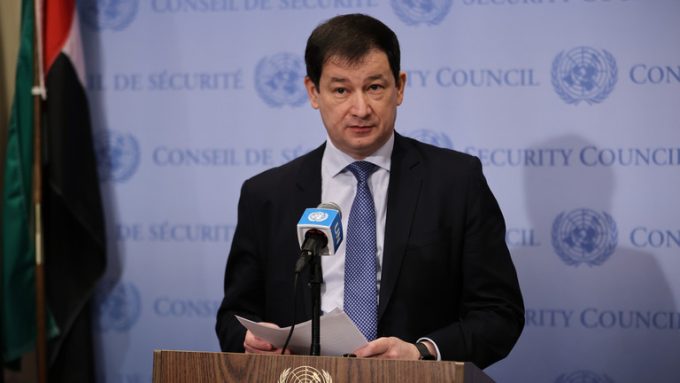
RT | August 27, 2025
Russia has accused German authorities of attempting to cover up the true circumstances of the 2022 Nord Stream pipeline explosions by blaming private “scapegoats” for what Moscow insists was likely a state-sponsored operation.
Earlier this month, a Ukrainian veteran was arrested in Italy at Germany’s request on suspicion of belonging to a small group behind the sabotage in the Baltic Sea. Russian Deputy Ambassador to the UN Dmitry Polyansky said on Monday that Moscow mistrusts Berlin’s motives.
Speaking at a UN Security Council meeting, Polyansky criticized what he described as a lack of transparency from German officials and frequent leaks to the press. He argued that Germany and its allies are steering public opinion toward a narrative in which “amateur” operatives driven by personal motives carried out the blasts, thereby clearing governments of any involvement.
“We have no faith in Berlin’s findings,” Polyansky said. “We urge the German authorities not to try to hide the truth behind a veil of secrecy, but to demonstrate a willingness to engage in genuine cooperation and reveal all the information at their disposal.”
He reminded the council that media reports about the yacht Andromeda and rogue Ukrainian operatives first surfaced in 2023, after US investigative journalist Seymour Hersh alleged that President Joe Biden’s administration orchestrated the attack. Hersh’s claims, Polyansky said, aligned with expert assessments that the operation required nation-state resources. The US has rejected the journalist’s accusations.
Polyansky described the theory promoted in Western media as resembling a spy novel, adding that it conveniently distracts from the possibility that the sabotage – which “directly harmed German economic and political interests” – could have been carried out by a NATO ally.
The Nord Stream pipelines were built to transport Russian natural gas directly to Germany. After the Ukraine conflict escalated in 2022, Berlin ended imports of Russian energy, ending decades of reliance on the fuel for economic growth.
Featured Video

Alon Mizrahi: ‘Israel Must Be Dismantled’
or go to
Aletho News Archives – Video-Images
From the Archives
How a War with Iran Would Diminish American Power
By Greg Scoblete | The Compass | August 13, 2010
Jennifer Rubin wants a war with Iran:
But the emphasis on the existential threat to Israel ignores a more basic issue for Americans to ponder: a nuclear-armed Iran represents a dagger at the heart of America and an existential threat to our status as a superpower and guarantor of the West’s security. As to the former, Iran is pressing ahead with its long-range ballistic missile program. First the Middle East and Eastern Europe, then all of Europe and, within a matter of years, the U.S. will be within range of Iranian missiles. If those are nuclear and not conventional, what then? We’re not talking about whether Iran is going to be “merely” a destabilizing factor in the Middle East or whether it will set off an arms race with its neighbors or imperil Israel’s existence. We’re talking about whether America will then be at risk (and lacking sufficient missile-defense capabilities if we continue to hack away at our defense budget). The argument about whether mutual assured destruction can really work against Islamic fundamentalists who have an apocalyptic vision becomes not about Israel’s ability to deter an attack but about ours. Those who oppose American military action have an obligation to explain why America should place itself in that predicament.
I would argue that any obligation to present an explanation lies with those whose disastrous policy prescriptions with respect to Iraq lead America into the worst strategic blunder in the country’s recent history. That aside, note the blind faith in the power of the military to actually achieve its ends. … continue
Blog Roll
 Aletho News
- Alon Mizrahi: ‘Israel Must Be Dismantled’
- Former Head Of MI6 Admits That The U.S. And Israel Are Losing The Iran War
- Scattered Thoughts on War and Peace
- Iran Threatens to Close Red Sea to Shipping in Response to Invasion
- Iran in excellent position to prevail in war with US, Israel: John Mearsheimer
- Iran warns US: Do not call your retreat an agreement
- Neighbors first – Moscow signals shift in energy strategy
- Almost 400 Ukrainian drones downed over Russia in single night – MOD
- Battle for Hungary: How the Russiagate blueprint has been unleashed against Orban
- Brussels warns Slovakia over ‘discriminatory’ dual fuel pricing targeting foreign drivers
- If Americans Knew
- In the West Bank, life is a constant battle – 3 articles
- Jacob Reses, one of the most powerful pro-Israel operatives in Trump’s Washington
- Israeli-US assaults kill or injure 87 children a day – Not a ceasefire Day 166
- ‘Forever live by the sword’: Understanding Israelis’ massive support for Iran war
- UN’s special rapporteur on human rights says Israel is systematically torturing Palestinians
- Trump White House plagiarized Iran war manifesto from Israel-aligned think tank
- Gaza says 6–10 patients die daily waiting for treatment abroad as Israel blocks medical evacuations
- ‘Substantial evidence’ of double-tap strike in killing of Gaza’s Hind Rajab
- ‘Do Not Want To Die For Israel’: Doubts About Trump’s Iran Strategy Spread Among Troops
- Instead of taking Joe Kent’s claims seriously, the media is disregarding him as an antisemite
- No Tricks Zone
- Devastating Assessment Of Comirnaty Vaccine By Former Senior Pfizer Europe Toxicologist
- New Study: CO2 Is ‘Effectively Negligible’ As An Explanatory Climate Change Factor Since 2000
- Former Pfizer Toxicologist Dr. Helmut Sterz Tells Bundestag Hearing Pfizer Vaccine Should Have Never Been Approved
- Energy Expert: Germany’s Nuclear Phaseout Was A “500 Billion Euro Mistake”
- New Research: South Australia’s Mid-Holocene Sea Surface Temperatures Were 4°C Warmer Than Today
- Storing Green Energy To Last Germany 10 Days Would Require A 60-Million Tonne Battery
- New Studies: UK Sea Levels Were 4 Meters Higher Than Today During The Mid-Holocene
- Destructive Green New Deal: German Energy And Metal Group Warns Of Drastic Crisis
- New Study Documents A 20-Year Pause In Arctic Sea Ice Decline – Driven By Internal Variability
- Wake-up Call: Survey Shows Majority Of Germans Now Favor Postponing Climate Targets!
 Aletho News