Alleged threats to chief Russian negotiator’s family ‘outrageous’ – Kremlin
RT | May 29, 2025
Alleged threats being made against Russia’s chief negotiator Vladimir Medinsky and his family are “outrageous,” Kremlin spokesman Dmitry Peskov said on Thursday, noting that authorities are already working to determine their source.
His remarks come after TV presenter Vladimir Solovyov recently stated that Medinsky – who led Russia’s delegation at the peace talks with Ukraine in Istanbul earlier this month – was receiving death threats from the Ukrainian side. His family was also allegedly targeted.
Peskov called the situation “unprecedented” and said that if investigators find that threats are coming from Ukraine, it would be “utterly outrageous,” particularly as Moscow has offered to hold another round of negotiations next Monday.
According to Solovyov, the threats are coming from Ukrainian nationalists, who have even targeted Medinsky’s children. He claimed that the negotiator’s family has received messages such as “we know where your children are and we have a lot of explosive-packed scooters.”
Several terrorist attacks involving electric scooters have taken place in the past, including the December 2024 murder of Igor Kirillov, the head of Russia’s Nuclear, Biological, and Chemical Defense Forces.
Solovyov also recalled that “there were cases when negotiators were threatened, and there were tragic cases, and they are well known.” One such case could involve Ukrainian banker Denys Kireyev, who was killed in March 2022 shortly after participating in early peace talks with Russia.
Solovyov said that Medinsky had personally discussed the issue with Ukrainian Defense Minister Rustem Umerov, who was the head of Kiev’s delegation in Istanbul. He reportedly insisted to Medinsky that the alleged threats were not coming from Ukrainian authorities.
Following Solovyov’s claims, the head of Russia’s Investigative Committee, Alexander Bastrykin ordered the opening of a criminal case to identify the persons involved in threatening Medinsky’s family.
Moscow and Kiev have been working on their own draft memorandums outlining a path towards a peaceful settlement. Earlier this month, the two sides met for the first time since peace negotiations collapsed in 2022.
On Wednesday, Russian Foreign Minister Lavrov proposed holding the next round of talks on Monday, June 2, in Istanbul. Umerov has responded by stating that Kiev first expects to receive Moscow’s draft memorandum so that the meeting is not “empty.”
The Media Is Falsely Labeling Ukraine-Russia Talks a ‘Failure’
By Ted Snider | The Libertarian Institute | May 28, 2025
On May 16, Russia and Ukraine held their first direct talks since the first months of the former’s invasion. Despite the pessimistic evaluation by Ukrainian and European leaders, the return to diplomacy is itself a major achievement and step forward. The talks lasted an hour and forty minutes.
Western leaders and Western media have given the first round of talks a failing grade. They have dismissed it for three reasons. They claim that Russian President Vladimir Putin first suggested direct negotiations and then did not show. They claim that he sent an insultingly low-level delegation. And they claim that nothing was accomplished.
All three of these claims are false.
Putin did suggest direct negotiations between Russia and Ukraine, but he did not say that those talks would take place at the leadership level. Putin said, “We are proposing that Kiev resume direct negotiations without any preconditions…We offer the Kiev authorities to resume negotiations already on Thursday, in Istanbul.” Putin referred to the Kiev authorities and never to the two presidents.
It was unlikely that Russia would resume talks for the first time at the presidential level. Customarily, before presidents meet, a great deal of preparation and negotiation takes place at lower levels. Then, typically, the foreign ministers would meet to iron out most of the details prior to a presidential meeting.
It is also misleading to present the meeting as Putin not showing up while Ukrainian President Volodymyr Zelensky did. Zelensky did arrive in Turkey, but he declined to agree to direct talks with Putin unless Putin first agreed to a thirty-day ceasefire, posting that “We expect Russia to confirm a ceasefire – full, lasting, and reliable – starting tomorrow, May 12th, and Ukraine is ready to meet.” Ukraine’s Head of the office of President, Andriy Yermak, confirmed, “First a ceasefire for 30 days, then everything else.” According to White House officials, Trump “never agreed” that that a ceasefire was a precondition to the direct talks.
But Zelensky’s precondition was an annulment. Russia was never going to agree to a ceasefire prior to negotiations for two reasons. First, they do not want a ceasefire empty of a settlement because that would maintain the conditions that would likely lead to future war, as happened in the ceasefire in Donbas from the end of the coup in 2014 to the start of the war in 2022. Second, they do not want a ceasefire without a settlement that would allow Ukraine to rest, regroup, rearm and dig trenches simply to return to war thirty days later like the Minsk deception that stung Russia earlier.
Russia has insisted that these negotiations resolve the “root causes” of the war. The Western media continues to deceptively define that insistence as the determination to deflate Ukraine’s sovereignty and calls it a delaying tactic. There is nothing on the historical record to suggest that Putin has ever identified that as a root cause of the war. Russia has always identified the root causes of the war as NATO’s encroachment toward their border and into Ukraine and the need for the protection of ethnic Russians in Ukraine.
The security proposal that Russia presented to the United States and NATO in December 2021 in the days before the war had as its central point that NATO not expand to Ukraine. Then-NATO Secretary General Jens Stoltenberg has confirmed that the “promise [of] no more NATO enlargement… was a pre-condition for not invade Ukraine.” Ukraine’s chief negotiator in the Belarus and Istanbul talks with Russia has also said that stopping NATO from expanding to Ukraine and Russia’s borders was the “key point” for Russia and that “[e]verything else was simply rhetoric and political ‘seasoning.’” Zelensky, himself, has said that the promise not to join NATO “was the first fundamental point for the Russian Federation” and that “as far as I remember, they started a war because of this.”
Russia is not asking for something unimaginable or new. They are asking for what they were promised. Not only did NATO promise to stay out of Ukraine, but Ukraine promised to stay out of NATO. Article IX of the 1990 Declaration of State Sovereignty of Ukraine says that Ukraine “solemnly declares its intention of becoming a permanently neutral state that does not participate in military blocs…” That promise was later enshrined in Ukraine’s constitution, which committed Ukraine to neutrality and prohibited it from joining any military alliance: that included NATO.
Russia is not going to agree to a ceasefire without resolving this root cause of the war for the same reason that it went to war to resolve it.
The second reason for giving the first round of direct talks a failing grade is that Putin sent an insultingly low-level delegation. This is not only unfair for the reasons already discussed—that initial talks are usually conducted at a low level—but also because it ignores who Putin sent to conduct the talks. The Russian delegation is led by Vladimir Medinsky, the same person who led the Istanbul talks at the beginning of the war. Those talks nearly succeeded, and the nomination of Medinsky is a signal both that Russia is serious and that Russia sees the current round of talks as a continuation of the previous round. Putin said, “It was not Russia that broke off negotiations in 2022. It was Kiev. Nevertheless, we are proposing that Kiev resume direct negotiations without any preconditions.”
The third reason is that nothing of substance was accomplished. That, too, is untrue. The very resumption of direct talks is a major breakthrough. But, beyond that, some things of substance were accomplished.
The first is an agreement to exchange 1,000 prisoners each. Though prisoner exchanges have occurred during the war, this would be the largest exchange agreed to yet. It may also represent a goodwill gesture on the part of Russia, since it has been suggested in the Ukrainian press that Ukraine may not have 1,000 Russian prisoners of war.
The second is that the two sides each agreed to present a detailed document on its vision for a ceasefire. This is a significant achievement for a first round of talks.
The third is that, once the documents are presented and discussed, Medinsky said that “we think it will be reasonable to continue our negotiations.” Agreeing on a second round of talks is another positive and significant achievement.
Undercutting the negative assessment of Western officials and Western media, the Ukrainian delegation told The Washington Post that, “despite the heated exchanges… the talks eventually became constructive.” The Russian delegation agreed that they were “satisfied” with the first meeting.
The Wall Street Journal has reported that the next round of talks could take place in mid-June, though their location is in doubt. Originally reported to be taking place in the Vatican, the Kremlin has suggested that the Vatican may not be the ideal location for two Orthodox Christian nations.
For the next round to get past the “heated exchanges” and continue to progress, key compromises will need to be made by both sides. Ukraine will have to agree not to join NATO. This is a big concession but should not be a deal breaker. Russia was promised this at the end of the Cold War, and Ukraine agreed to it during the Istanbul talks at the beginning of the war. If it was acceptable to Ukraine then, it should not be a fatal obstacle now.
In return, Russia will have to agree to real security guarantees for Ukraine. They will not agree to NATO nations as guarantors of the peace but could be open to countries from the Global South who have not sanctioned Russia or condemned its invasion of Ukraine but who also have not condoned it and would not want to see a ceasefire broken.
The West could agree to allow Ukraine to be armed, but not allow it to be armed with long-range weapons capable of striking Russia. The guarantors could agree to come to Ukraine’s aid if Russia breaks the ceasefire and attacks but not agree to come to Ukraine’s aid if they provoke Russia in hopes that they will come to Ukraine’s aid, much as China has been willing to promise Pakistan help if they are attacked but not if they irresponsibly cause the attack.
Both sides will need to make concessionary moves from their current territorial demands. Ukraine will never agree to Russia’s claim on more territory than it has conquered. Russia has hinted at some willingness to compromise on this. Russia will never agree to Ukraine’s demand to return territory to the prewar, or even pre-2014, borders. Ukrainian insistence on this condition for peace will guarantee that there will be no peace. And no peace will mean only that Ukraine will cede more territory to Russia. It is practical, then, for both sides to agree to negotiations beginning along the current line of conflict.
The recent return to direct talks between Russia and Ukraine can only be positive. And they accomplished more than the Western media and European leaders have suggested. Continued progress will require compromise and a genuine desire to build a peace that is workable and lasting.
EU has isolated itself, not Russia – Luxembourg MEP
RT | May 28, 2025
Luxembourg MEP Fernand Kartheiser has argued that the EU’s confrontational approach to Russia during the Ukraine conflict has led to its own isolation.
The lawmaker made the remarks in an interview with RT released on Tuesday while on a trip to Russia that he was forced to fund personally due to the European Parliament’s restrictions.
“Some people in the European Parliament… have an attitude toward Russia that identifies it as a big threat,” Kartheiser said. “They think that if we put pressure on Russia and isolate it diplomatically, that might help to find solutions in the context of the conflict in Ukraine… it is not the discussion that we should have.”
Kartheiser noted that the entire EU approach toward the Ukraine conflict and Russia has been counterproductive.
“What we have now internationally is that basically everybody talks to Russia. We even have the US coming back and having high-level contacts… the anti-Russia stance is diminishing,” he stated. “So this policy of isolation of Russia basically has failed. The only ones who are isolated in a way are the EU itself.”
The lawmaker’s visit to Moscow at the invitation of the Russian State Duma aimed to discuss bilateral relations and the situation in Ukraine. The visit, however, drew criticism from hawkish EU lawmakers. The European Conservatives and Reformists group threatened to expel Kartheiser, claiming he had “crossed a red line.” The MEP called the threat “a regrettable part of the picture” and lamented that some EU lawmakers remain opposed to re-engaging with Moscow.
“The discussion that we should have is what kind of relationship do we want with Russia in the future? We have to open the dialogue again. That is most important,” he said, adding that there are politicians whose opinions towards Russia are shifting, while many ordinary Europeans would also like to see ties restored.
The MEP emphasized that if the EU “wants to be taken seriously as an actor in international relations,” it must abandon the anti-Russia policy and “have some kind of relationship” with the country again.
“If we, Western Europeans, are expected to take a larger responsibility for our own security, one way to assure this is by negotiating an agreement with Russia, ensuring at the same time our security as Western Europeans and guaranteeing the security of Russia’s western border. So, negotiation and diplomacy before rearmament and arms race,” he concluded.
Russia could restrict return of Western brands – Izvestia
RT | May 27, 2025
The Russian parliament is set to pass a law that would regulate the right of foreign companies to reclaim assets sold during their exit from the country, Izvestia reported on Tuesday. The draft has reportedly been approved by the Finance Ministry and will be considered by the State Duma in its second and third readings simultaneously.
Numerous US, European, and Asian companies pulled out of Russia due to supply problems caused by unprecedented sanctions imposed on Moscow by the West after the escalation of the Ukraine conflict in 2022. Other firms left due to the risk of facing secondary sanctions or public relations pressure.
The bill, reviewed by Izvestia, allows Russian authorities or current owners to reject asset buybacks under certain conditions. Grounds for refusal include the foreign seller being from a country that has imposed sanctions on Russia, the repurchase price being below market value, or if more than two years have elapsed since the original deal with the Russian owner fulfilling obligations to employees and creditors.
The Russian authorities may also block asset buybacks if a company operates in sectors deemed vital to the country’s socio-economic stability, including defense or finance, the outlet said. In such cases, asset repurchase would require presidential approval.
According to Izvestia, the new measures will be voted on in June and could affect at least 18 foreign companies with buyback options, including Renault and McDonald’s. The draft law also reportedly stipulates that foreign businesses denied repurchase could be eligible for compensation, the amount of which would be determined by the government. However, if former owners failed to fulfill obligations before their exit, compensation could be reduced by court decision.
In March, Russian President Vladimir Putin ordered the government to draft regulations for Western firms seeking to return to the country’s market, which would prioritize the adequate protection of local businesses.
Following the exodus of foreign firms, the Russian market has largely adapted by promoting domestic and Chinese brands, making re-entry more challenging for Western companies. In sectors such as automotive and fashion, local alternatives have filled the void left by departing Western firms.
Putin said on Monday that foreign tech firms that continue operating in Russia while acting against the country should be “squeezed out.”
“They are trying to squeeze us, so we must respond in kind,” Putin said in response to a question about possible measures against companies such as Zoom and Microsoft. The president added that Russia had not expelled any companies and had instead created favorable conditions for their operations.
Russia warns US about Golden Dome scheme
RT | May 27, 2025
The US is taking a “reckless approach” to global stability through its pursuit of a worldwide anti-ballistic missile defense system, Russian Foreign Ministry spokeswoman Maria Zakharova has said.
The initiative, backed by President Donald Trump and dubbed the Golden Dome, envisions a layered defense network capable of intercepting long-range threats. The system would include space-based interceptors and options for preemptive strikes. The Congressional Budget Office has projected the program’s cost could exceed $542 billion over two decades.
Zakharova warned on Tuesday the plan “directly undermines the foundations of strategic stability,” a view she said is also held by China. Addressing a Chinese media inquiry at a regular briefing, she noted that both governments had outlined their shared concerns in a joint statement earlier this month.
The statement, released on May 8, accused Washington of disregarding the longstanding link between offensive and defensive strategic forces, a principle the two countries described as central to maintaining global equilibrium. Moscow and Beijing also criticized the US declaration of space as a “warfighting domain” and the fact that the Golden Dome project requires further militarizing it.
Zakharova called on the US to reconsider its position and back a Russian-proposed treaty aimed at banning the deployment of weapons in space. Such a measure, she argued, would reduce the risk of an arms race beyond Earth’s atmosphere.
Earlier on Tuesday, North Korea issued a similar warning, stating that countries perceiving a threat from the US would be compelled to expand their military arsenals in response to the deployment of the Golden Dome.
In 2002, US President George W. Bush withdrew from a bilateral treaty with Russia that limited the development of anti-ballistic missile technologies. Bush argued the move was necessary to defend against so-called “rogue states.”
Russian President Vladimir Putin has said that the decision had forced Moscow to develop advanced nuclear weapons capable of penetrating any missile shield in order to preserve its strategic deterrence. Last December, he contended that Washington’s missile defense investments “cost a lot to taxpayers and contribute little to the security for their country.”
Merz’ Missile Intimidation Tactics Won’t Work Because America Calls the Shots in Germany
Sputnik – 26.05.2025
“In short, you shouldn’t take the Germans too seriously,” veteran German legal scholar and ex-AfD MEP Gunnar Beck told Sputnik, commenting on Chancellor Merz’ announcement that Germany, the UK, France and the US are no longer restricting how far Ukraine can strike using its NATO-sourced missiles, potentially including Taurus.
“Germany today only needs to be taken seriously if it acts as a US satellite… We are not an independent nation. We are governed partly by the EU and partly by the US. Did the EU and the US agree?” That’s the real question, according to Beck.
Merz’ threats are meant as an intimidation tactic, the observer says, but Berlin doesn’t “seriously consider that it may be a crucial step in terms of escalating the conflict so that ultimately Germany herself could be involved either in terms of ground troops in Ukraine or even being affected by the war.”
No One to Challenge ‘Governor Merz’
“Merz as much as previous German chancellors, doesn’t really regard himself as a representative of Germany’s interests. He doesn’t really want to pursue ends which serve Germany’s. He regards himself as something like a governor of Germany for the interests of the globalist elite,” Beck stressed.
He doesn’t have opposition against the CDU-CSU-SPD-Green “uniparty,” which controls two thirds of parliament and is opposed only by AfD and Linke, nor among the financial and media elite (the latter “owned and effectively managed by the government,” apart from Springer Group, “essentially controlled by transatlantic interests”).
Bottom Line?
“Europe is not capable and probably reluctant to take independent action, whatever they may be saying. America still calls the shots in Europe because there’s just such a huge disparity in terms of economic and military power. We have to bear in mind that the EU is in decline. It is, economically speaking… in the worst economic position of all the industrialized countries, including Japan,” Beck summed up.
Russia to respond to West’s attempted restrictions in Baltic Sea – Putin aide
RT | May 26, 2025
Russia is readying response measures to potential hostile NATO acts in the Baltics, Nikolay Patrushev, a senior aide to Russian President Vladimir Putin, has said. The military bloc’s heightened activity in the area increasingly resembles acts of piracy, he told the government’s Maritime Board meeting on Monday.
A set of measures has already been coordinated and agreed with the president, Patrushev said, without revealing the steps Moscow plans to take in response to what it calls a threat to its security and interests in the area. The presidential aide said the Russian Baltic Fleet is currently “strengthening its positions” in the Baltic Sea to ensure the safety of navigation and prevent any “provocations” by “unfriendly” nations.
“The threats posed by NATO are rapidly growing,” the presidential aide said, claiming that the bloc has effectively dismantled the international security architecture established after World War II. NATO is now “stepping up its presence” in the Baltic region and expanding its “combat and reconnaissance capabilities,” Patrushev warned.
He added that these actions are part of a broader effort by Ukraine’s Western backers to increase pressure on Russia. According to Patrushev, Western countries are preparing legislation that would allow them to inspect vessels operating in Russia’s interests in international waters. They are also considering measures to restrict the navigation of these ships in the Baltic Sea or even block their passage through international straits.
“Against this background, the Western nations are de facto committing acts of piracy,” he said, citing an “attempt by the Estonian Navy, backed by NATO aircraft, to detain a civilian vessel in the Gulf of Finland.”
Patrushev was referring to an incident on May 13 involving the Jaguar, a Gabon-flagged ship en route to a Russian port, which the Estonian Navy tried to detain.
Estonian Foreign Minister Margus Tsahkna later claimed that the vessel was unflagged and uninsured, and said the navy attempted to “inspect” it.
He also acknowledged that Estonia “has started to harass” what he described as Russia’s “shadow fleet” – a term used in the West to refer to tankers operating outside Western insurance systems.
Last month, Patrushev warned that EU and UK plans to tighten maritime restrictions on Russia “increasingly resemble a naval blockade.” He added that if diplomatic and legal means fail, Russia would be ready to deploy its navy to safeguard navigation.
West’s Long-Range Missiles to Ukraine All Essentially the Same & Russia’s Shooting Them Down
By Svetlana Ekimenko – Sputnik – 26.05.2025
Germany, the UK, France, and the US have removed range restrictions on weapons for Ukraine, Chancellor Friedrich Merz confirmed on May 26.
Whether it’s the Taurus, Storm Shadow, or SCALP, Russia will just keep knocking them out of the sky, Yevgeny Buzhinsky, Chairman of PIR-Center Think Tank Executive Board, Professor of Higher School of Economics who served as the Russian military’s top arms control negotiator from 2001 to 2009, told Sputnik.
The real issue with Germany’s Taurus missile isn’t its 500 km range, but rather what Merz rightly pointed out -without the Bundeswehr, Ukrainians can’t launch them, pointed out the pundit, adding:
“Which makes this a case of direct German involvement [in the Ukraine conflict], plain and simple.”
Germany, the UK, France and the US are no longer imposing restrictions on how far Ukraine can strike with Western-supplied weapons, German Chancellor Friedrich Merz revealed on May 26.
“There are no longer any range restrictions on weapons supplied to Ukraine — not by the British, not by the French, not by us, not by the Americans. This means that Ukraine can now defend itself, including, for example, by striking military positions on Russian territory. Until a certain point, it could not do this,” Merz said in an interview with the WDR TV channel.
Russia’s Foreign Ministry Spokeswoman Maria Zakharova warned that any Taurus missile strike on Russian targets will be seen as Germany entering the war on the side of the Zelensky regime.
Moscow maintains that Western arms deliveries only escalate the conflict and drag NATO deeper into the quagmire.
How Russia Quietly Revolutionised Warfare
By Kit Klarenberg | Global Delinquents | May 25, 2025
On May 23rd, The Times published an extraordinarily candid probe into how militarised drones have irrevocably revolutionised warfare in the 21st century, with Russia far at the forefront of this radical shakeup of how conflicts are waged. Meanwhile, there is little indication NATO members even vaguely comprehend this battlefield reality, let alone a single one of them is undertaking any serious measures whatsoever to prepare for conflict such as that currently unfolding and evolving daily throughout Ukraine’s eastern steppe.
The Times piece is a first-person report of a visit to the assorted headquarters of Kiev’s 93rd Mechanised Brigade, in basements of abandoned buildings and homes throughout the Donetsk city of Kostiantynivka. It’s a devastating picture of the realities of war in the era of drones, which has “[altered] the physical make-up of the front line, the tactics of the war and the psychology of the soldiers fighting it,” while “having a devastating impact on Ukraine’s logistical ability.”
At one stage, The Times reporter was warned they were standing nine kilometres – 5.5 miles – from the nearest Russian position, and thus “well inside the kill range.” A Ukrainian soldier told them with a shrug, this was “now an easy range in which to die”:
“No other weapon type has changed the face of the war here so much or so fast as the FPV drone. Almost any vehicle within five kilometres of the front is as good as finished. Anything moving out to ten kilometres is in danger. Drone strikes at 15 or 20 km are not that unusual.”
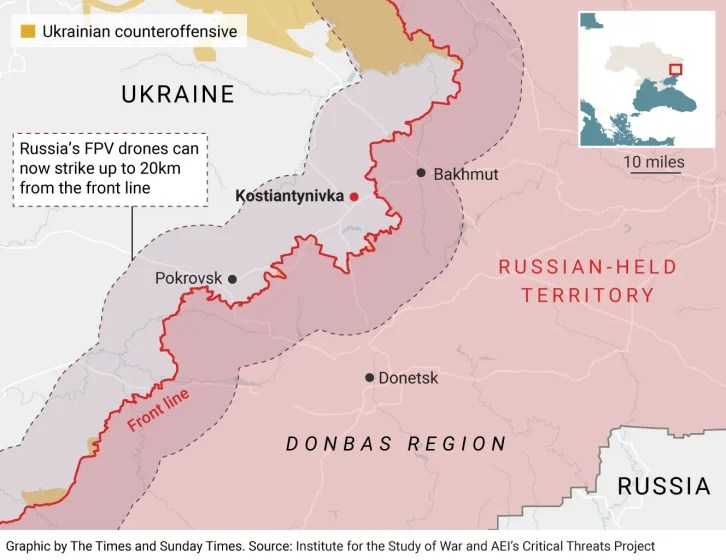
Since the proxy war erupted, both Ukraine and Russia have innovated in the field of FPV drones to an unprecedented degree. Kiev has become so reliant on drones, they are her “weapon of choice.” Yet, as The Times records, Russia has now decisively “taken the lead in the drone race, outproducing Kyiv in the manufacture and use of medium-range FPV drones and fibre optic variants that have changed the shape of the entire 1,200 km front line.”
Not only are FPVs “dramatically” striking ever-deeper into Ukrainian territory, but fibre optic FPV drones have gained “dark prominence over the killing fields.” While emulating the quadcopters equipped with munitions typically deployed by both sides previously, this “highly manoeuvrable killer drone” is connected directly to pilots by “a gossamer thin fibre optic thread.” This makes the contraptions difficult to track, and impervious to electronic jamming. A local infantry battalion commander told The Times:
“The changes posed by drones are so fast that concepts we implemented just a month ago no longer work now. We live in a space of perpetual fast adaptation. In the past week alone, Russian drone strike ranges have increased by four kilometres.”
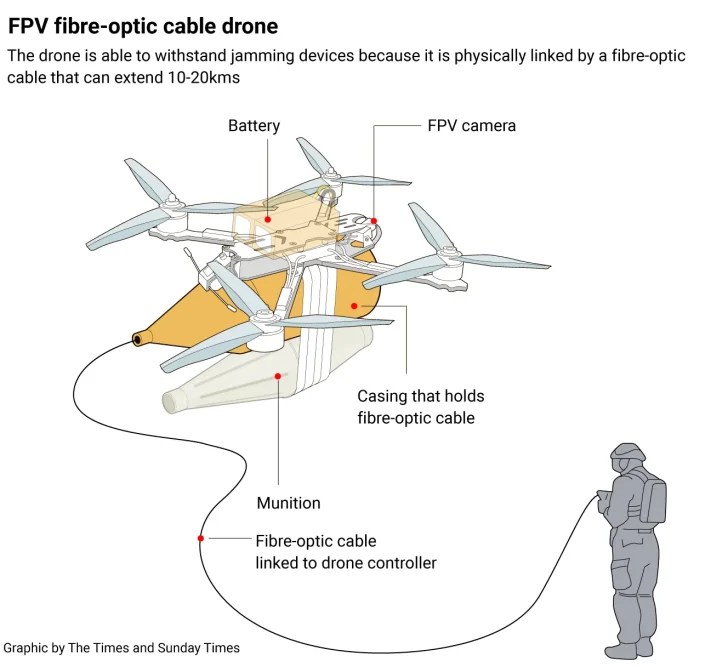
These developments have sent Ukrainian forces scurrying en masse to regroup at regular, abrupt intervals ever-further away from the front line (also known as “zero point”), while logistical convoys to Kramatorsk – “long considered the bastion of Ukraine’s defence of the Donbas region” – have been repeatedly struck. One lieutenant recorded how Russian drones “swarm our armoured vehicles whenever they get near the zero point,” obliterating them and their crews. He believes drones represent such a world-changing military hazard, “the days of the tank are truly over.”
‘Danger Estimate’
The “drone-filled skies” of Donbass are so deadly, getting soldiers and equipment to the ever-expanding frontline and back is not only a logistical and practical horror, but also a frequently suicidal task. The Times reports that until late 2023, Ukrainian infantrymen “were usually carried to a position near the front in armoured personnel carriers, walking the last few hundred metres on foot.” Today, they are dropped off up to eight kilometres away at night, walking “meandering routes through trees to avoid detection, just to take up their positions.”
Rotations from the frontline have also vastly extended in length. While at the start of 2024 Ukrainian soldiers spent “a week or two” at zero point, now they’re routinely trapped there for months at a time, “often devoid of almost any other human contact, resupplied with water, rations and ammunition by agricultural drones.” Resultantly too, “casualty evacuation has become a nightmare.” Wounded fighters are “commonly” rescued at night, and “even then the operation is fraught.” A senior logistician for the 93rd Brigade’s drone crews lamented:
“As a word ‘stressful’ doesn’t even come close to describing it. Every mission I think, ‘God forbid we get a casualty and have to work out how to get them back’.”
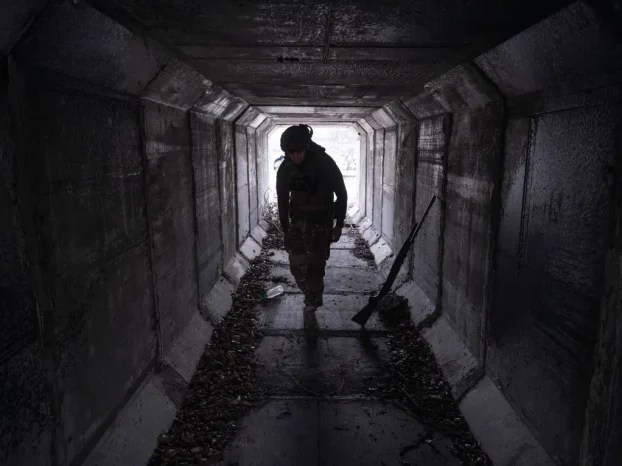
Ukrainian soldiers always keep shotguns close, to attempt to blast attacking drones out of the sky
Each night too, the Brigade’s frontline drone crews are resupplied with batteries, drone frames and munitions. Logistics teams are dropped off up to seven kilometres from the frontline, then carry up to 36 kilograms of equipment forward on foot. The risk to these crews is “enormous”. One driver was quoted as saying he conducted three missions nightly, “and I never know if each one will be my last, if I’m going to make it there and back in one piece.”
The Times records how a logistics vehicle was recently struck by a Russian drone while returning from a resupply mission. The driver lost an arm, but there were so many drones buzzing nearby, he couldn’t be evacuated from the position for five hours, so bled to death. Five Ukrainian armoured vehicles were destroyed by drones in the same sector the next day. However, none of this is seeping out to the world via the mainstream media, which once published videos of Ukrainian strikes on Russia daily.
As The Times notes, drones have adversely affected a core component of Kiev’s war effort – “media communications”. The 93rd Brigade was once “renowned for allowing reporters good access to…the war from the front.” Now though, “access for journalists has been dramatically reduced,” with “many media organisations…reluctant to commit reporters into areas within 15 km of the front.” Ukrainian brigades are likewise “wary” of the risks “they expose their own troops to in taking journalists by vehicle to the front.”
The Times reports that in 2023, the 93rd Brigade’s press officer “organised hundreds of visits to the front by reporters.” The number of visitors has now “dwindled to a trickle”. Since the proxy war’s eruption, the psychological field of battle has been where Ukraine has performed most effectively, eagerly assisted in its propaganda efforts by a media apparatus reflexively reporting the fantastical claims of officials in Kiev and their Western proxy backers as fact. Now, those days are long over. The press officer complained:
“The risks get bigger and bigger, and the coverage gets less and less. We get a journalist’s request to go to the front now and we wonder how rational is it? What is the danger estimate? What is the benefit?”
‘Technological Adaptations’
The Times report is a vanishingly rare mainstream acknowledgement of how the conflict currently raging Donbass is a war unlike any other in history, and its key spheres of battle are wholly unfamiliar to Western militaries. Despite this media omertà, the proxy conflict’s unparalleled operating environment, and obvious lessons, have not gone entirely unheeded in certain elite quarters. Nonetheless, despite alarm bells ringing accordingly, they are clearly falling on deaf ears in American and European centres of power.
In September 2024, Britain’s House of Lords International Relations and Defence Committee published a bombshell report, Ukraine: a wake-up call. It found the proxy war had “exposed fundamental weaknesses” in the “military strength” of both Britain and NATO, concluding London was effectively defenceless, with its “small” military reliant on unaffordable “status symbols” such as non-functional aircraft carriers. The country lacks the ammunition, armour, equipment, industrial capacity, personnel and vehicles to withstand a Donbass-style conflict for more than a few weeks at absolute most.
Amidst relentless condemnation of the state of Britain’s armed forces, the report contained a dedicated section on how “the use of drones in Ukraine” had “exposed the sheer variety of possible drone threats in a conflict scenario, ranging from disposable and commercially available drones to high-end, sophisticated ones.” It noted the development has “inserted an extra layer of weaponry between the land and air domains” and augmented “existing capabilities that both sides have, particularly offering new defensive options in the absence of air superiority.”
As such, the House of Lords Committee called for London to “invest in research and development to maintain a strategic edge in drone technology (including amphibious drones), and support the rapid development of new technologies that can compete in contested environments.” It urged decisionmakers to constantly consider and monitor “the pace of technological adaptations on and off the battlefield,” and the Ministry of Defence “to support continuous adaptation,” such as “[incorporating] learning on the use of drones in Ukraine across all domains.”
The report went entirely unremarked upon by the media contemporaneously, and today there is no sign of its multiple urgent calls to action having produced any meaningful results in any tangible regard in Britain’s armed forces. Similarly, despite NATO officials warning the alliance is wholly dependent on US electronic warfare capabilities, which in any event are woefully inferior to Russia’s own, public indications of Western leaders or militaries taking the drone warfare revolution seriously are unforthcoming. Should they end up in direct conflict with Russia, they’ll be in for quite a shock.
Russian missiles ‘fool’ US-made Patriots – Ukrainian military
RT | May 26, 2025
US-designed Patriot air defense systems are struggling to keep pace with Russia’s missile technology, particularly the Iskander missiles, Ukrainian Air Force spokesman Igor Ignat admitted on Monday.
Kiev has long praised the MIM-104 Patriot as a vital part of its arsenal following the deployment of the first battery in April 2023. But the American system is showing critical limitations in the face of Russia’s weaponry, Ignat told Le Monde in an interview.
“The Iskander missiles perform evasive maneuvers in the final phase, thwarting the Patriot’s trajectory calculations,” he said. “In addition, the Iskander can drop decoys capable of fooling Patriot missiles.”
While Ukrainian officials previously lauded the Patriot system for its ability to intercept Russian hypersonic Kinzhal missiles, Moscow has questioned such claims. Russian officials also argue that Kiev often overstates the number of missiles it downs compared to the number actually launched.
As of May, Ukraine is reported to have six active Patriot systems, primarily donated by the US and Germany, with additional components provided by the Netherlands and Romania.
Ukraine’s Vladimir Zelensky has called the Patriot system the only viable defense against Russian strikes, and has stated an aim to acquire a total of 25 units. He recently proposed that Kiev’s European backers fund the purchase of an additional ten systems for Ukraine at a cost of $15 billion. However, the administration of US President Donald Trump has dismissed the proposal as unrealistic.
Ukraine also faces dwindling supplies of interceptor missiles for its Western-donated platforms, even as Russian forces adapt their drone tactics to circumvent existing countermeasures.
Ukrainian forces have escalated their own drone offensives against Russia, moving from overnight attacks to continuous launches throughout the day. The shift comes amid increased pressure from Washington for continued direct peace negotiations. On Sunday, Trump expressed frustration with the lack of progress, blaming both Moscow and Kiev.
Washington’s “Golden Dome” – Multi-Trillion Tax Dollar Heist at Best, Dangerous Provocation at Worst
By Brian Berletic – New Eastern Outlook – May 25, 2025
US President Donald Trump has announced his administration has chosen the architecture for the proposed Golden Dome missile defense system, claiming it will cost $175 billion and be operational in “less than three years” with a “success rate close to 100%.”
During President Trump’s announcement on May 21, 2025, it was claimed the Golden Dome will consist of technology deployed across land, sea, and space capable of intercepting hypersonic, ballistic, and advanced cruise missiles, “even if they are launched from other sides of the world and even if they are launched from space.”
Former-US President Ronald Reagan’s “Star Wars” program (also known as the Strategic Defense Initiative) was repeatedly cited during the announcement. That program sought to use space-based weapons to void the doctrine of “mutually assured destruction” allowing the US to conduct a nuclear or non-nuclear first strike on another nation and avoid what had otherwise been an inevitable nuclear retaliation that would destroy both nations in the process.
Specifically, because mutually assured destruction was seen as a better deterrence against a first strike by one nuclear-armed nation against another, along with concerns over costs, technological limitations, and then-existing arms control treaties like the Anti-Ballistic Missile Treaty (ABM), the initiative was never fully realized.
Granting the US Impunity to Attack, Not “Defend” Itself
US Space Force General Michael Guetlein, picked to lead the Golden Dome project and present during its announcement, would claim:
As you’re aware, our adversaries have become very capable and very intent on holding the homeland at risk. While we have been focused on keeping the peace overseas, our adversaries have been quickly modernizing their nuclear forces, building out ballistic missiles capable of hosting multiple warheads, building out hypersonic missiles capable of attacking the United States within an hour and traveling at 6,000 mph, building cruise missiles that can navigate around our radar and our defenses and building submarines that can sneak up on our shores and worse yet, building space weapons. It is time that we change that equation and start doubling down on the protection of the homeland.
Yet what General Guetlein calls “keeping the peace overseas,” is in reality the United States encroaching along the borders and shores of nations like Russia, Iran, China, and North Korea.
This includes the stationing of not only missile defense systems like Patriot, THAAD, and the Aegis Ashore system in close proximity to these nations in violation of the ABM treaty the US has since abandoned, but also first-strike offensive weapons like the Typhon missile launcher capable of firing both Standard SM-6 anti-air missiles, but also ground-launched Tomahawk cruise missiles previously prohibited under the INF treaty the US has also since abandoned.
For example, the US has positioned THAAD systems in both the Middle East and Asia, and its Typhon missile system is currently stationed in the Philippines with additional units on the way, specifically aimed at China.
Beyond the global-spanning military footprint of the United States, Washington is also preparing for or already directing multiple proxy wars against these nations.
The conflict in Ukraine was entirely engineered by the United States, beginning with Kiev’s political capture in 2014, the training and arming of Ukraine’s military, and the capture, reorganization, and direction of Ukraine’s intelligence agencies by the US Central Intelligence Agency.
The US has been waging war and proxy war against Iran for decades, including invading and occupying Afghanistan and Iraq right on its borders, invading and overthrowing the government of Iran’s ally Syria, the waging of war on Yemen-based Ansar Allah – also an Iranian ally. The US also maintains constant financial, political, and military support for Israel, which has repeatedly attacked Iran and its allies.
And despite officially recognizing Taiwan as part of “One China,” the United States has continued supporting separatist political parties administering Taipei, is arming local military forces, and is even stationing US troops on the island province itself.
All of this has forced Russia, Iran, China, and other nations to respond by bolstering military spending, increasing research and development into missile technology, and the creation of credible deterrents against decades-spanning US aggression and proxy war along and even within their borders.
While the Trump administration depicts the Golden Dome as necessary to “forever end the missile threat to the American homeland,” it is instead being built to enable the US to forever threaten other nations around the globe with its missiles.
Dubious Claims About Golden Dome’s “Near 100%” Success
At one point during the Golden Dome’s announcement, US President Trump would claim:
I will tell you an adversary told me, a very big adversary, told me the most brilliant people in the world are in Silicon Valley. He said, “we cannot duplicate them. We can’t.”
He also claimed:
We have things that nobody else can have. You see what we’ve done helping Israel. You probably wouldn’t have in Israel. They launched probably 500 missiles all together and I think one half of a missile got through and that was only falling to the ground as scrap metal.
Except none of this is true.
If President Trump is referring to the 2024 Iranian retaliatory strike on Israel, up to 200 missiles were fired, with dozens if not scores of them circumventing Israeli missile defenses and striking targets, including dozens striking and damaging Israel’s Nevatim Airbase alone, according to NPR.
No air or missile defense system has a “success rate close to 100%.”
While any particular system may have a “success rate close to 100%” intercepting individual targets, retaliatory strikes are planned specifically to include a large enough number of missiles, drones, and other projectiles to saturate a defense system’s ability to intercept them all during a single attack. This means that while many incoming targets will be intercepted, many others will not, and critical targets will inevitably be struck and destroyed.
Regarding the state of US missile defense technology, unless President Trump is referring to undisclosed innovations, nothing the US currently is known to possess in terms of air and missile defense systems consists of “things that nobody else can have.”
And while in the past Silicon Valley drove unparalleled advances in technology contributing to a decisive military advantage for the US, the gap has since drastically closed and in some instances is widening in favor of nations like Russia and China.
The conflict in Ukraine, for example, has demonstrated glaring Russian advantages in several key areas that void the entire premise the Golden Dome is predicated on. Russia has demonstrated that it is capable of producing both larger quantities of ballistic and cruise missiles as well as layered integrated air defense systems and at a fraction of the cost the US and its European partners spend on arms and ammunition production.
Russia’s advantage is so great, it prompted the first-ever US National Defense Industrial Strategy in 2022.
The paper admitted the US (and the rest of the collective West) suffers from a bloated, inefficient military industrial base incapable of meeting the demands of the type of large-scale, high-intensity, protracted warfare taking place in Ukraine and likely to take place in future conflicts with either Russia or China.
As previously reported, the paper lays out a multitude of problems plaguing the US military industrial base including a lack of surge capacity, an inadequate workforce, overdependence on offshore downstream suppliers, as well as insufficient “demand signals” to motivate private industry partners to produce what’s needed, in the quantities needed, when it is needed.
In fact, the majority of the problems identified by the report involved private industry and its unwillingness to meet national security requirements because they were not profitable.
Nations like Russia and China do not rely on private industry partners for national defense programs. Much of the industrial power researching, developing, and mass-producing arms and ammunition in these countries takes place within state-owned enterprises. Because national defense is the chief priority of these enterprises, money is invested whether it is profitable or not.
This is what allows Russian and Chinese industry to maintain huge workforces, facilities, and tooling even when production is reduced, while private industry in the West would slash all three to maximize profitability. The first model allows a nation to surge the production of arms and ammunition on short notice – the other requires strong enough “demand signals” to justify the time-consuming process of building up the levels of all three – a process that can take years.
None of the problems described regarding the US military industrial base have been addressed since the National Defense Industrial Strategy was published in 2022. Corporations like Lockheed, Raytheon, L3Harris, and newer companies like Anduril slated to play a role in the proposed Golden Dome system continue to pursue a strictly for-profit model that will create the same disparity in quantity and quality seen playing out on and over the battlefield in Ukraine.
This leaves the likelihood the Golden Dome – like all other modern US military programs – will fall far short of stated expectations because of the fraud, waste, and abuse that defines US military industrial production.
The ultimate irony is that while the Golden Dome is sold to the public as “protecting” America, vast sums of public money that could actually improve the lives of Americans at home through infrastructure, education, and healthcare, will instead be siphoned off by demonstrably incompetent and corrupt arms manufacturers, all in an attempt to enhance Washington’s ability to menace the rest of the world with greater impunity – not protect the US at home.
The rest of the world will predictably react to the Golden Dome by creating their own means to defend themselves and retaliate against the US if attacked, making Americans not only less safe, but in the process of building the Golden Dome, less prosperous.
Brian Berletic is a Bangkok-based geopolitical researcher and writer.
Scott Ritter: Will Trump Own the Ukraine War or Walk Away?
Glenn Diesen | May 23, 2025
Scott Ritter is a former intelligence officer in the US Marine Corps and a former UN Weapons Inspector. He expects that the negotiations will fail, and Trump will distance himself from the war. Thus, the failure of negotiations will hurt Ukraine and Europe the most.
Follow Prof. Glenn Diesen:
Substack: https://glenndiesen.substack.com/
X/Twitter: https://x.com/Glenn_DiesenPatreon:  / glenndiesen
Support the channel: PayPal: https://www.paypal.com/paypalme/glenn…
Buy me a Coffee: buymeacoffee.com/gdieseng
Go Fund Me: https://gofund.me/09ea012f
Featured Video

More Iran War fallout: Maritime insurance industry shifts from London to China
or go to
Aletho News Archives – Video-Images
From the Archives
Allies Don’t Need Lobbies
By Jay Knott | Dissident Voice | September 24, 2013
In a recent article on Counterpunch, Rob Urie defended the traditional Marxist analysis of US policy in the Middle East. He argues that support for Israel is driven primarily by economic interest, not the Jewish lobby.
He starts by paying tribute to the idea that Western societies are uniquely racist. He says that the “Western narrative” claims there is an “Arab character”, and that this is “antique racist blather”. He gives no definition of these terms. Further, he establishes his credentials as part of the dominant current in the American left by claiming that “over a million people in Iraq died so ‘we’ in the West can drive SUVs.”1
When he tries to criticize bourgeois economics, he makes it clear he doesn’t understand the developments it has made since Marx’s day, using the mathematical discipline known as “game theory”. He dismisses the basic abstraction of economic theory, the idea of the rational individual, on the grounds that it is “devoid of history, culture and political context”. But abstractions are always devoid of something.
He defends a more concrete economic theory, mostly Marxist, with some input from another theorist of capitalist crisis, Hyman Minsky. This concrete theory leads him to the view that US activity in the Middle East is primarily driven by rational capitalist motives, the need to secure a supply of oil.
“Taking the totality of circumstance — former oil company executives launching war on an oil rich nation on a pretext they publicly proclaimed they didn’t believe shortly before taking office — and that upon launching their war proved to be non-existent, requires a willingness to overlook the obvious — that the war on Iraq was for oil, that is difficult to support.”1
Perhaps I’ve misunderstood him, but based on what he says in the rest of the article, this convoluted sentence seems to argue that, because president Bush and vice-president Cheney attacked Iraq on false premises, and they also said it was all about oil, and they are former oil executives, and Iraq has a lot of oil, it’s difficult to deny US attacks on Iraq are all about oil.
In fact, it’s not hard at all. As Urie points out, at times Bush and co. said that attacking Iraq was “protecting the world’s supply of oil.”1 But, as he also points out, they are congenital liars. Why should we believe them when they say they are trying to “protect” the oil supply? Protect it against what? When politicians “admit” attacks on Middle Eastern countries are wars for oil, they are parroting the neo-con party line, feeding the public, both left and right, with a plausible-sounding pretext. For right-wingers, “it’s a war for oil” is a reason to support war, and for leftists, it’s a way to feel better by complaining impotently about corporate greed. Both approaches help the war drive. … continue
Blog Roll
 Aletho News
- More Iran War fallout: Maritime insurance industry shifts from London to China
- US-Israeli aggression on Iran triggers review of GCC countries’ investment pledges to Washington
- Russia slams UK plan to seize tankers suspected of carrying its oil
- Pakistan ramps up food exports to Persian Gulf nations as war deepens food insecurity
- Iran submits response to US plan, sets terms for war’s end: Tasnim
- US vs Iran: Kharg Island Talk — Bluff or Escalation? Ex-Military Officer Weighs In
- Zelensky unnecessarily involves Ukraine in the Middle East crisis
- Turkish tanker blacklisted by Ukraine hit in drone attack – media
- Canada, the U.S., and NATO: the inescapable trap
- Villains of Judea: Leonid Radvinsky
- If Americans Knew
- ‘No Innocent Children’: Far-right Israeli Lawmaker Defends Killing of Palestinian Family
- Mossad’s promises helped Netanyahu convince Trump that Iran could be toppled
- US Arms Control Official Refuses To Comment When Asked If Israel Has Nuclear Weapons
- Veterans warn US landing could be ‘more Gallipoli than Vietnam’
- Israel may be committing war crimes in Lebanon – Not a ceasefire Day 167
- In the West Bank, life is a constant battle – 3 articles
- Jacob Reses, one of the most powerful pro-Israel operatives in Trump’s Washington
- Israeli-US assaults kill or injure 87 children a day – Not a ceasefire Day 166
- ‘Forever live by the sword’: Understanding Israelis’ massive support for Iran war
- UN’s special rapporteur on human rights says Israel is systematically torturing Palestinians
- No Tricks Zone
- Devastating Assessment Of Comirnaty Vaccine By Former Senior Pfizer Europe Toxicologist
- New Study: CO2 Is ‘Effectively Negligible’ As An Explanatory Climate Change Factor Since 2000
- Former Pfizer Toxicologist Dr. Helmut Sterz Tells Bundestag Hearing Pfizer Vaccine Should Have Never Been Approved
- Energy Expert: Germany’s Nuclear Phaseout Was A “500 Billion Euro Mistake”
- New Research: South Australia’s Mid-Holocene Sea Surface Temperatures Were 4°C Warmer Than Today
- Storing Green Energy To Last Germany 10 Days Would Require A 60-Million Tonne Battery
- New Studies: UK Sea Levels Were 4 Meters Higher Than Today During The Mid-Holocene
- Destructive Green New Deal: German Energy And Metal Group Warns Of Drastic Crisis
- New Study Documents A 20-Year Pause In Arctic Sea Ice Decline – Driven By Internal Variability
- Wake-up Call: Survey Shows Majority Of Germans Now Favor Postponing Climate Targets!
 Aletho News