End of Neutrality in Europe
Pascal Lottaz with Glenn Diesen
By Glenn Diesen | January 28, 2025
The belt of neutral states that created a buffer region between NATO and the Warsaw Pact during the Cold War was an important part of the European security system. After the Cold War, neutrality was gradually abandoned due to a unipolar distribution of power and a complementary liberal ideology that undermined the case for neutrality. The efforts to end Ukraine’s neutrality to pull it into NATO’s orbit, predictably triggered a war. Instead of learning the right lessons, the response to the war has been to further dismantle neutrality from Scandinavia to Moldova, which will predictably also trigger a security competition in these regions.
Substack: https://glenndiesen.substack.com/
X/Twitter: https://x.com/Glenn_Diesen
Support the channel: https://www.paypal.com/paypalme/glenn…
John Helmer and spitting out the red, white, and blue Skripal pills
Gorilla Radio with Chris Cook and John Helmer January 15, 2025
In today’s podcast from Canada, Chris Cook and I discuss the reasons for the failure of Novichok to kill anyone, and its success at brainwashing everyone, or almost everyone.
The contrast with other media campaigns of resistance to western information warfare is a glaring one. For example, the campaign to defend Julian Assange and free him from a British prison and trial in the US has turned out to have been a popular success. However, Assange himself, his Wikileaks platform, and his London advocates have done nothing to expose the Novichok deception operation. They are good men who have done nothing — their media success has failed to deter or stop the Anglo-American march to war in the Ukraine; Assange’s lawyers are supporters of the war against Russia. Assange’s alt-media reporters have pretended they are the only truth-tellers in the present discontents; their war is against their media competitors.
For their names; for the truth of the Novichok story; and for the after-life of the Novichok poison in the coming war against Russia, click to listen.
John Helmer and spitting out the red, white, and blue Skripal pills in the second half. Begin at Minute 31:00. Source: https://gradio.substack.com/
Here’s why EU leaders really want to send troops to Ukraine
By Tarik Cyril Amar | RT | January 27, 2025
Nothing is certain regarding the Ukraine conflict. Except two things: Russia is winning and, under new ownership, the US leadership is searching for a novel approach. As Russian foreign policy heavyweight Sergey Ryabkov has noted, there is now a window of opportunity for a compromise to, in essence, help end this senseless conflict and restore some normalcy to US-Russian relations and thus global politics as well. But that window is small and will not be open forever.
Beyond that, things remain murky. Is the end to this madness finally in sight? Will Washington now translate its declared intention to change course into negotiating positions that Moscow can take seriously? Those would have to include – as a minimum – territorial losses and genuine neutrality for Ukraine, as well as a robust sense that any peace is made to last.
Last but not least, will the West compel Kiev to accept such a realistic settlement? ‘Nothing about Ukraine without Ukraine’ may still sound terribly nice to those selfish enough to mistake international politics for a virtue-signaling beauty contest. Yet – like the daft, hypocritical cant of ‘agency’ – it was never true in the first place, has served to shield the Western abuse of Ukraine and Ukrainians, and must be abandoned if this meatgrinder of a conflict is to end.
Or could everything turn out the other way around? Could Western and especially US hardliners still prevail? Whispering into Trump’s ear that ‘winning’ will just take a bigger, Trumpier push, with even more money and arms for the Kiev regime and more economic warfare against Russia, and that making peace would actually cost more than continuing the proxy war? Yes, the first is pure wishful thinking, going against all recent experience; the second is an absurd non-argument sitting on top of a mountain of false premises; and yet, this nonsense is still all too popular in the West, which has a habit of building its foreign policy on illusions.
Washington’s recent signaling has been ambiguous enough, whether by design or clumsiness, to raise hopes among the many remaining diehards in the West. The British Telegraph, for instance, is fantasizing about “Trump’s playbook for bringing Putin to his knees”; the Washington Post interprets the new American president’s recent (online) speech at the Davos World Economic Forum as “putting the onus on Russia”; and the New York Times desperately sifts through Trump’s words for anything that is harsh about Russia or its president, Vladimir Putin.
In the end, all of the above will probably turn out to be nothing but clutching at straws. While any Washington-Moscow negotiations are bound to be complicated, a return to the demented mutism of the Biden administration is unlikely. Communication will become the default again, as it should be among sane adults. And as long as there is no foul play – an assassination of Donald Trump, for instance – the US will, in one way or the other, extricate itself from the Ukraine conflict. If only because Trump is, at heart, a businessman, and will not throw good money after bad. It’s a harsh, cold reasoning, but if it leads to the right results – an end to senseless fighting and unnecessary dying – then it will have to do.
That US extrication, it bears emphasis, need not wait for a settlement with Russia or even the start of serious negotiations. Indeed, the extrication isn’t one thing but a process, and it has already begun. First, immediately after Trump’s inauguration, support to Ukraine was reduced, but military aid was still upheld. Not for long though. Only days later, Politico reported that a second general order to suspend aid flows for 90 days also applied to military assistance for Kiev.
But there is a catch. If the US distances itself from its lost proxy war, that does not necessarily mean that its clients and vassals in the EU and NATO will follow, at least not immediately. That is counterintuitive, admittedly. If EU leaders were rational, acting in their countries’ best interest – and, in fact, that of Ukraine, too – they would not even consider going it alone. But then, if they were rational, they would have refused to join the US proxy war from the beginning and long have stopped listening sheepishly to bossy tirades by Ukraine past-best-by-date president Vladimir Zelensky. And yet they have just done it again at Davos.
So, instead of rationality, we now see unending affirmations that peace will not and must not come soon. Sorry Ukrainians, your European ‘friends’ believe you haven’t done enough dying yet.
French President Emmanuel Macron, for one, seems to be going through a manic phase, again. Clearly with reference to Trump’s very different ideas, the comically unpopular leader, whose ratings have just dived to a six-year low, has declared that the Ukraine conflict will not end soon, “neither today nor the day after today.” German Foreign Minister Annalena ‘360 degrees’ Baerbock is throwing tantrums when she can’t have as many billions for Ukraine as she wants. UK Prime Minister Keir Starmer – another European incumbent on very thin ice at home and with abysmal ratings – has made his first pilgrimage to Kiev and concluded a 100-year partnership agreement with Ukraine, including a secret part and worth, again, billions and billions of pounds. Because, you see, Britain is doing so incredibly well at home – except not really. Take just one data point: British factories have just registered their worst slump in orders since Covid.
Against this Euro-Conga-on-the-Titanic backdrop, another upshot of the persistent European refusal to get real is re-emerging talk about sending large numbers of Western ground forces to Ukraine, specifically from NATO-EU countries. True, Zelensky’s demands at Davos for 200,000 troops – that’s more than landed in Normandy on D-Day 1944, but why be modest when you are riding high in Kiev? – are ludicrous. Yet smaller but still substantial numbers – 40,000 or so – are still under consideration.
What exactly these troops would be doing in Ukraine remains hazy. They would not be a peacekeeping force because they would be siding with one party of the conflict, Ukraine. And yet, proponents of these schemes promise they would not be on the front lines fighting against Russia because they would either be introduced only after an end to the fighting, or they would somehow remain in the hinterland, thereby freeing up Ukrainian forces for the front.
None of the above makes sense. As long as the fighting continues, there is no hinterland in the sense that the troops would be spared real fighting and dying, because Russian airstrikes can reach them everywhere even now, and, depending on further developments, so may Russian land forces in the future. Moreover, once these troops enter the country, Kiev would, of course, do its best to get them embroiled in great bloodshed, including by provocations and false flag operations. The aim would be to drag these ‘allies’ so deep into the quagmire that they wouldn’t be able to get out again.
Introducing boots on the grounds from NATO-EU countries after the fighting, however, won’t work either. Russia is fighting to have a genuinely neutral Ukraine and will not agree; and as long as Russia does not agree, there won’t be any end to the fighting. If these troops were to turn up anyhow, the conflict would start again. Indeed, Kiev would have an incentive to restart it once they are in Ukraine (see above).
Of course, NATO-EU states already have black ops operators and mercenaries on the ground. But while Moscow has wisely decided not to take this degree of intervention as a reason for attacking beyond Ukraine, regular forces in large numbers would obviously be a different matter. The proponents of this type of deployment argue that the US contingent in South Korea and KFOR troops in Kosovo (of all places!) show that these deployments are possible without further escalation. This, too, is nonsense. KFOR’s presence is based on several 1999 agreements and, crucially, a UN Security Council resolution (1244). Its sad but very low fatalities (213 as of 2019), some caused by accidents, cannot remotely be compared with what would happen to NATO-EU troops clashing with the Russian Army; finally, those KFOR casualties that did not come from accidents, and were not inflicted by a state’s regular forces but by protesters and irregulars. A scenario in which thousands of EU troops die in a fight with the regular army of a nuclear-armed Russia is incomparable.
Regarding the US troops in South Korea, their presence is based on a mutual defense treaty concluded in 1953. Again, exactly the type of arrangement Moscow will not accept. And also one that the NATO-Europeans would be very wise to shy away from, because, once again, it would suck them deep into the next war. Finally, obvious but worth stating: Those US forces in South Korea have the backing of the US. They are a classical tripwire. Attack them, and face the whole US military. EU forces would not have US backing; and if Europeans want to underwrite such a tripwire with their own flimsy armies, they are suicidal.
If large-scale deployment of EU boots on the ground is such an obviously bad idea, why will it not finally go away? There are really only two possible answers: Either those dreaming such dreams are really so shortsighted and irresponsible (think Kaja Kallas and similar intellectual lightweights) or they are not quite honest about their motives. In reality, we are probably dealing with both.
Regarding the genuinely confused, let’s not waste time on them. But what about those who are really after something else? What could that be? Here is a plausible guess. The talk about sending major contingents to Ukraine has two real aims, one targeting the new American leadership and the other, Ukrainian domestic politics.
With regard to Washington, the real purpose of speculating about EU ground troops is a desperate attempt to secure Brussels a say in the coming negotiations between the US and Russia. And there, the Europeans are right about one thing: They may well be excluded, which will be an ironic outcome after their self-destructive obedience toward the Biden administration. But there’s a new sheriff in town now, and he might well cut them loose no less than Ukraine.
In Ukraine, the real purpose is to exert outside influence on the sore issue of mobilization: Ukraine is running out of cannon fodder, as observers as different as the new US secretary of state, Marco Rubio, and the slavishly NATO-ist German magazine Spiegel now admit. Mobilization of those who are still there is a creeping catastrophe; its violence and the mass evasion practiced by its victims demonstrating every day that many Ukrainians have had enough. The Zelensky regime’s proposed answer is to lower the mobilization age even further, to 18. Importantly, this is supposed to happen even if there is peace.
And would it not be convenient for this type of policy to point to troops from the West and tell unwilling draftees and their families: Look, if even those foreigners are coming to help, how can you stay at home? Yet they are unlikely to ever turn up. Once again, Ukrainians will be fed bloated rhetoric about and by false friends from the West – to, in the end, be left alone to keep dying and lose more territory. The way out of this is not more of the same. Even if it could work – which it cannot – NATO-EU mass deployment would only make everything worse. Because the real way out of this is a compromise with Russia – and the deployment of Western troops would prevent that compromise.
Tarik Cyril Amar is a historian from Germany working at Koç University, Istanbul, on Russia, Ukraine, and Eastern Europe, the history of World War II, the cultural Cold War, and the politics of memory.
There’s Nothing to Discuss with Brussels Vassals
By Mikhail Gamandiy-Egorov | New Eastern Outlook | January 25, 2025
As active discussions continue about potential negotiations between Russia and the new administration of the Washington regime, their vassals in the EU increasingly insist on the “necessity” of their participation in these talks. Naturally, there is no such necessity.
A recent interview with Nikolai Patrushev, the Assistant to the President of Russia and former Secretary of the Security Council of the Russian Federation (May 2008–May 2024), provided significant insights. The interview highlighted the theses and positions Patrushev believes should be implemented in potential negotiations between Moscow and the new Trump administration.
Potential Negotiations Without Unnecessary Participants
One of the key points in Patrushev’s interview is that any potential resolution of the Ukraine situation should be discussed exclusively between Russia and the United States, without the involvement of other Western representatives. This is a particularly crucial stance: “If we talk about the specific prospects for future developments considering the Trump factor, we respect his statements. I believe that negotiations on Ukraine should take place between Russia and the United States without the participation of other Western countries. There’s nothing to discuss with London or Brussels,” stated one of the Kremlin’s top representatives.
He further added that the EU leadership no longer has the authority to speak on behalf of many of its members, such as Hungary, Slovakia, and other European countries interested in stability in Europe and adopting a balanced approach toward Russia. The message is clear. However, this is not the only significant point in Patrushev’s remarks.
The Assistant to the President of Russia also suggested that the possibility of Ukraine ceasing to exist as a separate state in 2025 cannot be ruled out. As for Russia’s stance toward the Kyiv regime, it remains unchanged – namely, the objectives of the Special Military Operation must be achieved. These objectives have been repeatedly outlined by President Vladimir Putin.
This, of course, includes territorial matters. The territories once governed from Kyiv have joined Russia following the expression of the people’s will, in accordance with international law, Russian legislation, and the laws of those regions. Patrushev emphasized the importance of global recognition of the incorporation of the Donetsk and Luhansk People’s Republics, Zaporizhzhia and Kherson regions, Crimea, and Sevastopol into Russia. All these territories are integral parts of the Russian Federation under the Constitution.
Another vital point is that Russia harbors no illusions about any U.S. administration. As Patrushev aptly noted regarding the United States: priorities may shift, but redrawing the world map to serve their interests and interfering in the affairs of other nations across continents is an American tradition. This includes exacerbating conflicts with China, often artificially, as part of their strategic agenda. Patrushev reminded that our country maintains relations of uniquely privileged strategic cooperation with China. For us, China has been and remains our most important partner. Russian-Chinese relations are not subject to short-term circumstances; they endure regardless of who occupies the Oval Office.
A Multipolar World Ready to Emerge
Key conclusions can be drawn from Patrushev’s main theses. Firstly, the participation of open vassals in potential Russian-American negotiations is entirely unnecessary. Even during the Cold War negotiations between the USSR and the Washington regime, European vassals were never involved in the most critical talks.
If the goal of such a “format” is to give the collective West the appearance of greater influence, then Russia should insist on including its key allies and partners, such as China and countries of the Global South, in the negotiations. It is evident that such a format would be unacceptable to the West, as it would highlight their status as a global minority. Thus, the participation of vassals from London and Brussels in direct talks between Moscow and Washington is out of the question.
Secondly, discussing the Ukrainian issue with the Washington administration can only occur under the condition that all of Russia’s previously stated demands are met. After all, no one forced the West or the vassal Bandera Kyiv regime to violate the Minsk agreements. Likewise, no one compelled the West or NATO, particularly the London regime, to sabotage the Istanbul negotiations following the start of the Special Military Operation. Much has changed since then. Clearly, the new territorial realities will have to be accepted by Russia’s adversaries. While Crimea, Sevastopol, and the Donetsk, Luhansk, Zaporozhjie, and Kherson regions are indisputably parts of Russia, the status of other regions, such as Kharkov, remains unresolved. In the future, this could also include Dnepropetrovsk and other historically Russian territories.
Finally, and thirdly, it is clear that we are not destined to be friends. The fact that Washington may, at some point, display pure business pragmatism – realizing there is no further sense in financing what is already a formalized defeat for the entire NATO-Western bloc – could be a positive factor. However, we harbour no illusions, nor will we ever again. Russia knows its true allies and strategic partners among the countries of the global majority. These relationships will continue to grow and strengthen. Our country is fully prepared for further battles with the bloc of Western regimes in various parts of the world, including Africa and Latin America.
Russia will achieve all its objectives, one way or another. This is clearer today than ever before.
Mikhail Gamandiy-Egorov, entrepreneur, political observer, and expert on Africa and the Middle East
Putin: Ukraine Crisis Could Have Been Avoided if 2020 US Election Wasn’t Stolen
Sputnik – 24.01.2025
MOSCOW – Russian President Vladimir Putin said on Friday that he is ready to talk calmly with US President Donald Trump on all areas that are of interest to both countries.
“We should meet, based on today’s realities, to talk calmly about all those areas that are of interest to both the US and Russia. We are ready, but, I repeat, this depends first of all on the decisions and choices of the current US administration,” Putin said during his visit to Moscow State University.
Russia can have many points of contact with the US administration, including economic issues, Putin said, adding that Russia and the United States have a lot to talk about on economy and energy issues.
“What is typical for the Russian and American economies? We are not only one of the largest producers of energy resources, but we are also the largest consumers of them. This means that for both our economy and the US economy, too high prices are bad, because it is necessary to produce domestically. Using energy resources, it is necessary to produce other goods within the country. And too low prices are also very bad, because it undermines the investment opportunities of energy companies,” he said.
Putin remarked that he has always had businesslike and pragmatic relations with Trump, noting that Moscow welcomes Trump’s statements about a willingness to work together and remains open to it.
“Even if we hear about the possibility of imposing additional sanctions on Russia, I doubt that he will make decisions that will harm the US economy itself,” Putin said.
Trump is “not only an intelligent person, he is a pragmatic person,” Putin added.
The previous administration of US President Joe Biden refused to contact with Russia, and it is not Moscow’s fault, Putin noted. Furthermore, Russia has never refused to use the US dollar in foreign trade transactions.
“We did not abandon the dollar. It was the former US administration that made it impossible for us to use it as a currency for settlements. I think that decision has caused significant harm to the United States,” Putin said.
Ukraine Crisis
Russia is ready for talks on the Ukraine conflict, but there are issues that need attention, the Russian president added. The problem is that Ukraine’s Volodymyr Zelensky has banned himself from holding peace talks with Russia.
“It is well-known that the current leader of the regime in Kiev, when he was still fairly legitimate, signed a decree banning negotiations. How can negotiations be resumed now if they are forbidden?” Putin said.
Putin added that it was difficult to talk seriously about any dialogue with Kiev while this ban was still in place.
“However, as long as this ban isn’t lifted, it is hard to say that these negotiations can be properly started and, the most importantly, concluded. Of course, it is possible to make some preliminary outlines, yet it is quite difficult to consider any serious negotiations under the conditions of the ban on the Ukrainian side,” Putin said.
Putin added that the authorities in Kiev receive hundreds of billions from their sponsors, and he believes the same sponsors of the Kiev regime should force Zelensky to lift the ban on talks.
The Russian president also added he agreed with Trump that if he had been reelected US president in 2020 the crisis in Ukraine could have been avoided.
“I cannot but agree with him on that if he were president, if the victory had not been stolen from him in 2020, then the crisis that broke out in Ukraine in 2022 would have possibly never happened,” Putin suggested.
Conflict in Ukraine Not Tied to Oil Prices, But to Western Actions – Kremlin
Sputnik – 24.01.2025
MOSCOW – The conflict in Ukraine is taking place because of a threat to Russia’s national security, as well as the West’s complete refusal to listen to its concerns, Kremlin spokesman Dmitry Peskov said on Friday.
“This conflict is taking place because of a threat to the national security of the Russian Federation, because of the threat to Russians who live in certain territories, because of the unwillingness and complete refusal of Americans and Europeans to listen to Russia’s concerns,” Peskov told reporters.
The conflict in Ukraine does not depend on oil prices, Peskov added.
US President Donald Trump said on Thursday that he would ask Saudi Arabia and other OPEC nations to lower the oil price and it would end the conflict in Ukraine “immediately.”
Trump stated that “right now the price is high enough that that war will continue.”
“You’ve got to bring down the oil price. You’ve got to end that war, they should have done it long go,” the US president said.
Ukraine in NATO would mean ruling out peace – Moscow
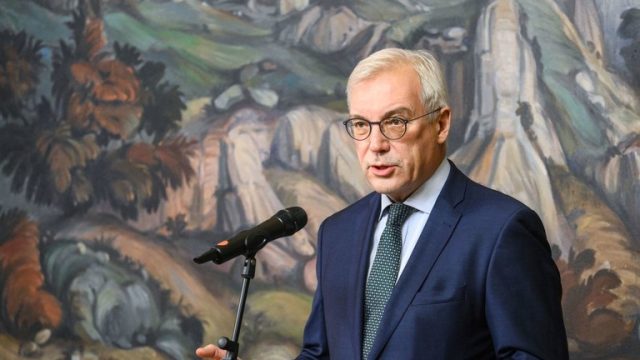
Russian Deputy Foreign Minister Alexander Grushko © Alexey Maishev; RIA Novosti
RT | January 24, 2025
Ukrainian accession to NATO would make achieving peace and establishing any kind of security architecture virtually impossible, Russian Deputy Foreign Minister Aleksandr Grushko has said in an interview published on Friday.
Speaking to the Russia 24 news channel, Grushko pointed out that the issue of Ukraine’s neutrality is one of the root causes of the ongoing conflict and is a key element of any potential deal with Kiev.
The diplomat emphasized that NATO membership for Kiev “precludes achieving peace in Ukraine and, in a broader sense, the creation of any kind of security architecture.”
He stressed that Moscow will not only seek “ironclad legal guarantees that would exclude Ukraine’s membership in NATO in any form,” but will also demand that this becomes an actual policy of the US-led military bloc.
NATO’s efforts to spread itself all over the world are increasing the possibility of a global military conflict, the diplomat said, specifically pointing to bloc chief Mark Rutte’s call to raise defense spending to 3% of members’ GDP.
“In fact, this has nothing to do with the real security situation,” Grushko explained. “This is over-armament, this is an attempt to achieve those geopolitical and military goals that they have recorded in their strategic documents, primarily American ones, to achieve military superiority in all operational environments, as they say, meaning land, air, space, cyberspace, and in all possible theaters of military operations, which now includes Asia.”
The diplomat accused NATO of pursuing a “very dangerous course that brings the threat of a global military clash closer,” while serving only to maintain the West’s hegemony that is “slipping out of their hands” amid the formation of a new multipolar world.
However, Grushko pointed out that Russia has “sufficient technical and other means to ensure” its security “in any scenario,” which includes the Oreshnik hypersonic missile system, as well as its nuclear forces and new technologies that continue to be added to the arsenal of Russia’s armed forces.
Moscow reacts to proposed US timeline for ending Ukraine conflict
RT | January 24, 2025
The Ukraine conflict cannot be resolved within 100 days unless the US adopts a more realistic approach, Russian Deputy Foreign Minister Sergey Ryabkov has said. Both Moscow and Washington have recently signaled a willingness to engage in talks on the issue.
Earlier this week, the Wall Street Journal reported that US President Donald Trump had tasked Keith Kellogg, his special envoy for Russia and Ukraine, with ending the conflict within 100 days.
Speaking to journalists on Friday, Ryabkov said the White House must adopt a realistic approach to resolving the conflict, and that the pace of any such process is still “difficult to project.”
“I would first like to understand what basis the US side intends to use to move toward a settlement,” Ryabkov said, as cited by TASS. “If they are based on the signals we have heard in recent days, then it won’t work, neither in 100 days nor even longer.”
Trump, who began his second term as president earlier this week, repeatedly vowed during his campaign that he would end the fighting within 24 hours if returned to office. Several weeks prior to his inauguration, Trump adjusted the timeline, saying he expected to negotiate peace within six months.
Speaking to reporters in the White House on Thursday, the US leader said he was ready to meet with Russian President Vladimir Putin as quickly as possible to negotiate an end to the Ukraine conflict.
During a teleconference address to the annual World Economic Forum (WEF) in Davos, Switzerland, on Thursday, Trump announced plans to ask Saudi Arabia and OPEC to bring down global oil prices, suggesting that this would help end the conflict by stripping Russia of revenues.
In an interview with Fox News aired one day previously, Trump threatened to impose more sanctions on Russia “if they don’t make a settlement fast.”
Kremlin spokesman Dmitry Peskov said on Friday that Putin is ready to speak with his US counterpart, adding that Moscow is “waiting for signals.”
Moscow has stated throughout the three-year conflict that it is ready for peace talks, accusing Ukraine of refusing to resume negotiations. Russian officials have also repeatedly criticized the West for providing military aid to Kiev, arguing that this merely prolongs the fighting. Moscow has warned that deeper Western engagement in the conflict increases the risks of a direct clash between Russia and NATO.
Kremlin calls to renew disarmament talks with US
RT | January 24, 2025
Moscow wants to resume disarmament negotiations with the US as soon as possible, Kremlin spokesman Dmitry Peskov told journalists on Friday.
He stressed that the legal framework for arms control has been “significantly undermined,” and that this is not the fault of Russia, but of the United States – which has unilaterally severed all contacts with Moscow.
“In the interest of the entire world and of our countries’ people, we are interested in starting a negotiation process as soon as possible,” Peskov stated.
He noted, however, that in the current conditions, it would also be necessary to take into account all existing nuclear arsenals, specifically those of France and the UK.
“The current realities dictate such a need,” Peskov said, explaining that it would be “impossible” to hold negotiations while avoiding the issue.
The spokesman noted that much time has been wasted in delaying such vital discussions, and that the “ball is now in the court of the Americans, who have ceased all substantive contacts with our country.”
Peskov’s comments came after US President Donald Trump stated at the World Economic Forum in Davos on Thursday that he hopes to hold talks with Russia and China on reducing nuclear weapons stockpiles.
Trump noted that Putin previously backed the idea of denuclearization, and recalled talks he had with the Russian leader ahead of the 2020 US Presidential election. “I can tell you that President Putin wanted to do it, he and I wanted to do it.”
Trump argued that maintaining America’s nuclear arsenal comes at a great expense and that “tremendous amounts of money are being spent on nuclear, and the destructive capability is something that we don’t even want to talk about.”
Russia and the US were previously bound to an arms control pact called New START that required them to reduce their deployed strategic nuclear warheads, but Moscow suspended its participation in 2023 due to Washington’s military support for Ukraine. Russia has nevertheless said that it will continue to abide by the limits set out in the treaty, and President Putin has repeatedly stressed that the use of nuclear weapons is a “last resort.”
Zelensky hypocritically talks about diplomacy while ignoring Russian terms
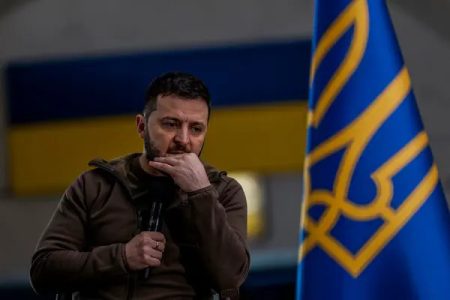
By Lucas Leiroz | January 24, 2025
Apparently, the illegitimate Ukrainian President Vladimir Zelensky is beginning to admit the possibility of a “deal” to disguise his political and military humiliation. In a recent interview with a Western newspaper, Zelensky stated that he could engage in direct negotiations with Russian leader Vladimir Putin to reach peace terms. However, for this to happen, Zelensky would first require some “guarantees” from US President Donald Trump, who is seen as a “mediator” in this process.
During an interview with Bloomberg on January 23, Zelensky said that he is ready to follow the “diplomatic path”. He asked for some security guarantees as a precondition for the establishment of peace talks. Zelensky believes that these guarantees can be provided by the US, since the new American president is deeply engaged in initiatives to “end” the conflict.
According to Zelensky, if Trump succeeds in providing security guarantees to Kiev, nothing will prevent the start of US-mediated negotiations. Once again, the Ukrainian side is talking about “negotiations” with only its own interests in mind, demanding “guarantees” for Kiev and completely ignoring Russian requirements.
“The only question is what security guarantees and honestly, I want to have understanding before the talks. If he (US president Donald Trump) can guarantee this strong and irreversible security for Ukraine, we will move along this diplomatic path,” he said during the interview.
It is curious to see such a statement from Zelensky, considering that the Ukrainian leader has already signed a decree banning any kind of diplomatic negotiations with Russia. Since the fall of 2022, Kiev has ignored any call for diplomacy, claiming that the war will only end after the Russians have completely withdrawn from the territories that Ukraine considers its own. Ukrainian authorities have repeatedly stated that the legislation banning negotiations is still in force, which contradicts Zelensky’s words.
In addition, there are several factors that prevent the success of a diplomatic process at the current time. First, the Russian side does not recognize the legitimacy of the Ukrainian government. Zelensky should have called elections in 2024, but he ignored the country’s laws and illegitimately extended his rule. Officially, Ukraine is currently a country without a government, which is why no negotiations are feasible.
In the same sense, Trump and the US are not in a position to mediate a deal. Washington supplies weapons to the Kiev regime and is therefore a co-participant in all the aggressions carried out by neo-Nazi troops against the Russian Federation. Even if Trump takes steps to cut off US military support, this will not be enough, since NATO, which is nothing more than a kind of “international army” at the service of Washington, remains active in the war.
Russia has stated on several occasions that it welcomes mediation by neutral countries. Putin has said, for example, that Saudi Arabia would be a good mediator, considering that it is a country with strong ties to both Russia and the West, and that it has no involvement in the conflict. However, an agreement mediated by the US, even with Trump, would in practice be an agreement mediated by one of the sides participating in the war, which does not seem reasonable.
Another factor that is hindering the possibility of negotiations is the Ukrainian invasion of Kursk. Since the launching of its offensive in southern Russia, Ukraine has been massacring civilians, constantly committing war crimes and human rights violations in the villages of Kursk. Moscow has already stated that as long as there are enemy troops on recognized Russian territory, there will be no diplomacy. So, if Zelensky really wants to follow the diplomatic path, the first thing he should do is stop the attacks on Kursk.
However, Russia is indeed ready to negotiate. As Putin said recently, Moscow is ready to take any necessary measures to prevent a Third World War. There is no impediment on Russia’s part to the diplomatic process, as long as certain demands are met. The Kiev regime, illegitimately led by Zelensky, is not in a position to actively negotiate, and mediators must be neutral in the war. Furthermore, Kiev must stop its activities on Russian recognized sovereign territory.
It is the winning side that sets the conditions for negotiations in a war. Ukraine is not in a position to demand anything simply because Kiev is being defeated on the battlefield. Only Moscow can say when hostilities will actually end.
Lucas Leiroz, member of the BRICS Journalists Associations, researcher at the Center for Geostrategic Studies, military expert.
You can follow Lucas on X (formerly Twitter) and Telegram.
Featured Video
It’s the Occupation, Stupid
or go to
Aletho News Archives – Video-Images
From the Archives
A superpower and “the world’s sickest warrior state”
By Paul J. Balles | March 8, 2010
Living through five or six major wars has hardened me to what I thought were the extremes of inhuman cruelty and brutality.
Two things made those extremes almost bearable: the brutality always revealed – at least according to the media coverage – the viciousness of the enemy. It was therefore quite understandable when our “brave men and women” pulverized the enemy.
Films of Japanese torturing captive Americans somehow justified holding Japanese Americans in internment camps during World War II; and only a small percentage of Americans found the bombing of Hiroshima and Nagasaki unreasonably vengeful at best, at worst, depraved.
The media giants in America portrayed the North Koreans as barbaric beasts with their captives, quite unlike their southern counterpoints – our allies during the Korean War. No one ever felt the need to explain how the South Koreans were a civilized breed while the North Koreans were absolute savages, at least according to the official line.
In Vietnam, our warriors justifiably (or so the media made us believe) dropped napalm on the North Vietnamese who had the gall to hide in villages and tunnels to ravage our invaders. At least it was accepted practice until some rogue photojournalist filmed a young girl screaming down a Vietnamese road in flames. … continue
Blog Roll
 Aletho News
- Pakistan to Host US-Iran Talks
- How Indonesia’s tilt toward the US left it stranded in the Strait of Hormuz
- US has no choice but to retreat from Iranian borders: Top commander
- Iran Retaliation Strikes Chemical Plant Near Dimona
- AWACS’ Destruction is a Major Loss for US Military – Ex-DoW Analyst
- Israel’s Iran Strategy Uses US Military & Gulf States as Its Pawns
- Iran: Trump wanted regime change, now just begging for Hormuz to open
- IRGC: Israeli, US universities in region legitimate targets after strikes on Iranian university
- Trump admits Iran hit USS Ford carrier: ‘We ran for our lives’
- Battle for Hungary: EU attacks on Orban are a sign of worse things to come
- If Americans Knew
- Israeli police block Catholic cardinal from entering Church of the Holy Sepulchre on Palm Sunday
- Israel is assassinating journalists again, more than any other nation, anywhere, ever – Not a ceasefire Day 170
- Over 300 US service members wounded, majority have brain injuries – Not a ceasefire Day 169
- Researchers at Human Rights Watch Resign Over Blocked Report on Palestinian Refugee Return
- Jewish Groups Are Backing a War Americans Don’t Want
- Eric Fingerhut Thinks He’s the President of the Jews
- Top Jewish Philanthropists, Rabbis Urge Israeli President to Take Action Against ‘Jewish Extremists’
- Don’t Be Fooled. Zionist Leaders Have Always Wanted to Control Southern Lebanon
- Israel’s widespread use of torture is a core element of its genocide against the Palestinian people
- In Israel’s War on Iran, Many Middle East US Bases Rendered “All But Uninhabitable”
- No Tricks Zone
- German Science Blog Accuses PIK Climate Institute Of Hallucinating Climate Tipping Points
- Devastating Assessment Of Comirnaty Vaccine By Former Senior Pfizer Europe Toxicologist
- New Study: CO2 Is ‘Effectively Negligible’ As An Explanatory Climate Change Factor Since 2000
- Former Pfizer Toxicologist Dr. Helmut Sterz Tells Bundestag Hearing Pfizer Vaccine Should Have Never Been Approved
- Energy Expert: Germany’s Nuclear Phaseout Was A “500 Billion Euro Mistake”
- New Research: South Australia’s Mid-Holocene Sea Surface Temperatures Were 4°C Warmer Than Today
- Storing Green Energy To Last Germany 10 Days Would Require A 60-Million Tonne Battery
- New Studies: UK Sea Levels Were 4 Meters Higher Than Today During The Mid-Holocene
- Destructive Green New Deal: German Energy And Metal Group Warns Of Drastic Crisis
- New Study Documents A 20-Year Pause In Arctic Sea Ice Decline – Driven By Internal Variability
 Aletho News