Moldova must back election meddling claims – Kremlin
RT | October 21, 2024
Moldovan President Maia Sandu must substantiate her claims about “criminal groups” interfering with Sunday’s presidential vote and a referendum on pro-EU constitutional changes, Kremlin spokesman Dmitry Peskov told journalists on Monday. Such strong accusations should not be made without a hint of proof, he said.
Late on Sunday, when the votes were still being counted, Sandu, who is seeking her second presidential term, claimed in a public statement that there was “clear evidence” of criminal groups supposedly working together with “foreign forces hostile to our national interests” in order to interfere with the voting.
According to the president, those malign forces sought to buy hundreds of thousands of votes in what she described as “fraud of unprecedented scale.” Sandu then vowed to “respond with firm decisions” to the perceived transgressions.
The Moldovan leader did not name any specific groups she believed could be behind the irregularities, nor did she present any specific evidence to back up her claims.
“This is a rather serious accusation,” Peskov said, commenting on the issue. “Some evidence must be presented to the public” to substantiate it, he added. If Sandu believes she had not received votes because of some gangs, she should present clear proof of that, the Kremlin spokesman said, adding that “it would be nice if she explained the number of votes that disagreed with her line.”
“Does she mean that Moldovan citizens who do not support her are associated with criminal groups?” Peskov asked.
Moldovan citizens residing in Western nations, whose ballots were counted last, reportedly tipped the balance in favor of the pro-EU amendments. The ‘yes’ vote gained the support of 50.31% of voters while 49.69% voted against.
Sandu also received a boost to her election performance, with her final result amounting to 42% of the vote, up from the 38% earlier reported by Reuters. Her main rival, the Party of Socialists’ Alexandr Stoianoglo, got 26%. Peskov questioned how such a large change is possible, saying it was “difficult to explain.”
Prior to the vote, the Moldovan authorities claimed they had found evidence of Russian meddling attempts. Police arrested hundreds of people, accusing them of being part of an alleged “vote-buying scheme,” according to AFP. Law enforcement officials also claimed this week that up to a quarter of the ballots could supposedly be “tainted by Russian cash.”
In her post-election statement, Sandu stopped short of pointing the finger at Russia. Brussels still accused Moscow of what it called “unprecedented interference and intimidation” in the wake of the voting.
Since neither of the candidates managed to secure an absolute majority in the Sunday vote, Sandu will face off against Stoianoglo in a runoff on November 3.
Putin says Gaza war must end with establishment of Palestinian State
MEMO | October 18, 2024
Russian President, Vladimir Putin, said on Friday that the war in the Gaza Strip must end with the establishment of a “full-fledged” Palestinian State, urging the Middle East Quartet to be reactivated in order to resume mediation efforts in the region, Anadolu Agency reports.
“The primary solution to the Palestinian problem is the establishment of a fully-fledged Palestinian State. The Russian side has upheld this position since the Soviet era,” he remarked during a meeting with BRICS media managers in Moscow.
Putin stressed reactivating the Middle East Quartet, a group of international organisations that includes the UN, US, UN and Russia, to resume efforts to mediate the Israeli-Palestinian conflict and initiate a peace process.
“It was a mistake by the US to disrupt the work of the Quartet […] It would have been easier to coordinate all the positions. The US took over, monopolised the peace efforts, assuming full responsibility and, in the end, it failed,” Putin said.
He stressed that Palestinians “will not leave” the Gaza Strip, warning that the region’s humanitarian crisis will only increase the number of those determined to “defend their interests”.
The upcoming BRICS summit in Kazan, from 22-24 October, will include discussions on the Israeli-Palestinian conflict, as it remains a significant global issue, he added.
Israel dramatically escalated its massive bombing campaign across Lebanon against what it claims are Hezbollah targets since 23 September, killing at least 1,437 people, injuring over 4,123 others, and displacing more than 1.34 million people.
The aerial campaign is an escalation from a year of cross-border warfare between Israel and Hezbollah since the start of Israel’s war on the Gaza Strip. More than 42,400 people, most of them women and children, have been killed since the war began in the wake of Hamas’s 7 October, 2023 cross-border attack on Israel.
Israel further expanded the escalation, invading Lebanon on 1 October.
US-Russia trade expected to fall to lowest level since 1992 under Biden regime
Sputnik – 19.10.2024
MOSCOW – The trade between Russia and the United States is expected to decline to $3.7 billion by the end of this year, the lowest level since 1992, according to Sputnik’s calculations based on data of the US statistical service.
Russian exports to the US from January to August amounted to $2.26 billion, down from $3.4 billion the previous year. Based on current trends, annual shipments may reach approximately $3.12 billion, which would be a third lower than previous year’s volumes and the lowest level since 1993.
Meanwhile, US business sales to Russia fell by 16% over eight months, totaling $334 million. For the year, they are expected to reach a record low of $539.3 million, down by 10% compared to 2023, according to Sputnik’s calculations.
During Joe Biden’s presidency, trade between the two countries has decreased sixfold. In 2020, the last year of Donald Trump’s term, trade was at $21.8 billion. This figure was slightly lower in 2016 under Barack Obama, who initiated the first wave of sanctions against Russia, at $20.4 billion.
US to pay $20 billion into loan for Ukraine – FT
RT | October 19, 2024
The US is set to provide up to $20 billion to Ukraine as part of a G7 loan, which will then be repaid using proceeds generated by the Russian assets immobilized by the West as part of Ukraine-related sanctions, Financial Times has reported, citing sources.
Kiev’s backers have been trying to accelerate negotiations over the loan in an effort to secure funding to Ukraine before the end of the year, due to mounting concern that Washington’s aid to the country could be cut off if Donald Trump wins the upcoming US election, FT noted, in an article posted on Friday. The former US president has repeatedly threatened to scale back assistance to Kiev if he were elected.
The US and its allies have frozen an estimated $300 billion in assets belonging to the Russian state after the Ukraine conflict broke out in 2022. The bulk of the money, nearly €197 billion ($214 billion) is being held by Brussels-based clearinghouse Euroclear. The immobilized funds have generated €3.4 billion ($3.7 billion) in interest as of mid-July, according to the depository.
Moscow has denounced the freeze as “theft” and said that any seizure of its funds would be against the law and would further undermine global trust in the Western financial system.
In June, G7 members agreed to grant Kiev a $50 billion loan to be financed by interest from the frozen Russian assets. The US and the EU were initially expected to provide $20 billion each as Canada, Japan and the UK were set to jointly lend the rest of the massive loan.
Later, to reassure allies that the bloc’s sanctions regime on the funds is not lifted, Brussels proposed a three-year extension of the EU’s mandate to freeze Russian assets. EU lawmakers have been renewing their sanctions every six months by unanimous decision, meaning that each vote may bring about a break in restrictions. Hungary opposed the proposal, and announced plans to postpone the decision until the US presidential elections on November 5.
Last week, the EU approved its own contribution of up to €35 billion to the G7 loan, but the bloc would need to contribute less if Washington provided the full $20 billion, Reuters reported last week. The funds, which will be managed by the World Bank, will be used for several purposes, including defense or humanitarian needs.
US senior officials, however, told FT that Washington would provide the full agreed $20 billion, even if the EU failed to convince Hungary’s premier Viktor Orban to drop his veto on extending EU sanctions, which had previously been voiced among the US demands. According to two sources cited by the paper, G7 finance ministers will make a statement on the distribution and structure of the loan on the sidelines of the IMF and World Bank meetings on October 25.
Russian, Omani naval flotillas arrive in Iran to take part in Maritime Exercise
Press TV – October 18, 2024
Flotillas of Russian and Omani warships have arrived in Iran’s territorial waters in the Persian Gulf to participate in the Indian Ocean Naval Symposium (IONS) Maritime Exercise “IMEX 2024,” which will be hosted by the Southern Fleet of the Iranian Navy in the coming days.
The warships docked in the southern Iranian port city of Bandar Abbas on Friday and were received by the Iranian Navy and the Islamic Revolution Guards Corps (IRGC) helicopters and naval vessels upon arrival.
Representatives of several other countries, like Bangladesh, India, Pakistan, Qatar, Saudi Arabia and Thailand, also landed at Bandar Abbas International Airport to take part in the war game as observers.
The purpose of the “IMEX 2024” joint naval exercise is to increase collective security in the region, expand multilateral cooperation, and display the goodwill and capabilities to safeguard peace, friendship and maritime security.
The participants in the exercise will also practice tactics to ensure international maritime trade security, protect maritime routes, enhance humanitarian measures, and exchange information on rescue and relief operations.
The IONS features 24 Indian Ocean littoral states, which gather biennially for multilateral meetings and naval exercises.
The IONS seeks to increase maritime cooperation among navies and provide a forum for discussion of regional maritime issues and the promotion of friendly relationships.
Zelensky admits capitulation but calls for escalation
By Ahmed Adel | October 18, 2024
The “Victory Plan” presented by Ukrainian President Volodymyr Zelensky is an acknowledgment of capitulation because it is obvious that, even in his estimation, without the massive involvement of NATO countries in the conflict, the Ukrainian army will not be able to hold back Russian forces in the foreseeable future.
Zelensky presented his Victory Plan to the Ukrainian parliament on October 16 and the European Council on October 17. The plan consists of five points and three secret amendments. In addition to admitting defeat, Zelensky’s Victory Plan also reveals a desire for maximum escalation of the conflict, where, of course, the main burden should be borne by NATO countries and not Ukrainian forces.
The Ukrainian president thinks that escalating what led to the suffering of his citizens and destroyed the economy will lead to Ukraine’s victory.
At the same time, his Victory Plan could be used to pressure Biden or his successor to make decisions about striking deep into the Russian Federation without, supposedly, provoking Moscow to react excessively. Nonetheless, the Kremlin has already said Russia will respond to any attacks.
The Victory Plan truly hinges on US support and not European. Therefore, bodies such as the Council of Europe only serve to give the Biden administration legitimacy when he puts pressure on some parts of the American establishment that are clearly resisting further support for Ukraine.
The first point of Zelensky’s Victory Plan is geopolitical and concerns Ukraine’s immediate invitation to NATO. The other points concern the Ukrainian military and its allies destroying Russia’s aviation, deploying a non-nuclear strategic containment package on its territory, strengthening sanctions on Russia, and allowing Ukrainian soldiers to replace part of the American contingent in Europe in the post-war period.
According to the latest available data, 84% of Ukrainians want their country to be a member of NATO. Despite the widespread support for joining the alliance and although NATO has declared Ukraine’s membership path irreversible, it cannot be completed during the war, and the alliance declined to present a timeline. In effect, NATO has categorically ruled out membership until the war is over, which already makes Zelensky’s Victory Plan detached from reality since the very first point of the plan to defeat Russia is to join the bloc.
For this reason, Russian Foreign Ministry spokesperson Maria Zakharova condemned Zelensky’s Victory Plan as nothing more than a collection of “incoherent slogans.”
“This is, of course, no plan at all. It is a collection of incoherent slogans. It is blood foam at the mouth of a neo-Nazi murderer,” the spokeswoman stated during a briefing on October 16.
She also criticised Zelensky’s intention to damage the Russian air force with the assistance of his allies, saying, “He is pushing NATO to a direct conflict with our country and again insists on getting permission to use long-range weapons on Russian territory, knowing perfectly well, at least those who wrote him these speeches, realised what it would lead to because the corresponding statements by the Russian leadership were made just a week ago.”
“Taken as a sum, all these points and secret sub-clauses are not Zelensky’s plan of victory but a plan to bring misfortune upon Ukraine and the Ukrainian people. This aims to keep the money flowing and present his terrorist capabilities. I think that today Zelensky definitively proved to everyone that he hates Ukrainians to the extent that can be characterised as Ukrainophobia,” Zakharova added.
Since Zelensky evidently does not have any plans to begin serious negotiations, as seen by his Victory Plan, any negotiations conducted in the short term can be used by the West and the Kiev regime to freeze the conflict in Ukraine, replenish their capabilities and launch new attacks against Russia.
According to Western media, including The Washington Post, Zelensky has shown himself more open to holding talks with Russia amid Ukraine’s weakening positions. At the same time, Russian Foreign Minister Sergey Lavrov said that no adequate proposals had yet been received regarding the settlement of the Ukrainian conflict, apart from the hype in the Western media.
Zelensky’s masters in the West are beginning to see that they are not able to inflict a strategic defeat on Russia and are beginning to ask for negotiations. For the moment, they are resorting to negotiation chatter, as mentioned, to try to freeze the conflict and build up forces. In this context, the only way to end the conflict is the complete defeat of Ukraine, peace on Moscow’s terms, and the strategic retreat of the West from Russia’s borders.
The Victory Plan has certainly dominated headlines and occupied the attention of many world leaders, but Kiev has no way of enforcing it, especially since, from the very first point, it ensures failure, considering NATO has been very clear on Ukraine’s membership path, which cannot progress until the war is already over.
Ahmed Adel is a Cairo-based geopolitics and political economy researcher.
Germany Finally Maxed Out Its Military Support For Ukraine
By Andrew Korybko | October 15, 2024
Bild cited internal Defense Ministry documents to report that Germany finally maxed out its military support for Ukraine and won’t give any more heavy equipment, which comes around six weeks after the Polish Defense Minister effectively said the same thing about his country’s support. The Federal Cabinet detailed “The arms and military equipment Germany is sending to Ukraine” last month, which they said totals €28 billion in assistance that’s either already been provided or committed for future years.
Poland and Germany have done much more for Ukraine in this regard than most countries so the fact that they’ve already maxed out their support suggests that the West as a whole might soon seriously consider freezing the conflict. After all, Russia is already far ahead of NATO in the “race of logistics”/“war of attrition”, with even Sky News candidly reporting earlier this year that Russia is producing three times as many shells as NATO at one-quarter of the price.
This was followed last month by CNN sharing a glimpse of just how bad everything has become for Ukraine, which coincides with growing interest among the Western public and even some of their elite in cutting their side’s losses by exploring a political solution to the NATO-Russian proxy war in Ukraine. “Russia’s Capture Of Pokrovsk Could Reshape The Conflict’s Dynamics” whenever it comes to pass so it naturally follows that they’d either want to preempt that or find a way to freeze the conflict afterwards.
The challenge though is that Russia won’t consider a ceasefire so long as Ukraine continues to occupy Kursk and Donbass, neither of which Kiev is willing to withdraw from as a “goodwill gesture”, thus risking the scenario that the front lines collapse due to the combination of attrition and Russia’s new tactics. In that case, Russia might try to expel Ukraine from the remainder of Zaporozhye Region east of the Dnieper, including its namesake city of an estimated 750,000 people.
There’s also the chance that Russia moves into eastern Dnipropetrovsk (“Dnipro”) Region despite having no claims to it either to coerce Ukraine into withdrawing from eastern Zaporozhye and its namesake capital and/or to push the Line of Contact (LOC) as far as possible before freezing it. This tactic could also enable Russia to open up a southern front in Kharkov Region to complement the eastern and northern ones. The worst-case scenario for Ukraine is simultaneous attacks along these three axes.
With Poland and Germany having already practically tapped out, unless they dig into the rest of their reserves that they’ve thus far preserved to meet their minimum national security requirements, this sequence of events is certainly possible. It could only be preempted by a comparatively more generous ceasefire proposal from the West that piques the Kremlin’s interest, Russian self-restraint, or Ukraine and/or the West “escalating to de-escalate”.
The first could see the West pressure Ukraine into withdrawing from eastern Zaporozhye Region, the second could be due to Russia not wanting to risk overextending its military logistics, and the third could involve a nuclear provocation, the formal deployment of NATO to Ukraine, and/or an attack on Belarus. Relevant factors include the timing of any potential Russian breakthrough and the outcome of the US elections, both of which could influence Ukraine and/or the West, perhaps even in different ways.
All that can be said for sure is that Ukraine can’t depend on more military aid after Germany just joined Poland in dropping out of the “war of attrition”. Unless they dig into their reserves or others step up (if they even have much left to give), then something game-changing might soon happen, though whether it’s positive or negative remains to be seen. Russia will either decisively win, be offered a more generous ceasefire that it’ll accept for pragmatic reasons, or its enemies will dangerously “escalate to de-escalate”.
Orban Says Will Call on French, German Leaders at EU Summit to Start Talks With Russia

Sputnik – 17.10.2024
Hungarian Prime Minister Viktor Orban said on Thursday that he will call on the leaders of France and Germany at the EU summit to start negotiations with Russia on behalf of the EU to resolve the Ukrainian conflict.
Earlier Volodymyr Zelensky unveiled the so-called “victory plan” which was slammed by Russian officials as repetition of US strategy to fight Russia to the last Ukrainian.
“Today I will call on the German chancellor and the French president to start negotiations with Russia as soon as possible on behalf of the entire European Union, so that we can find a way out of this situation [the conflict in Ukraine],” Orban wrote on social media.
The prime minister also said that the “victory plan” of Volodymyr Zelensky “gives shivers” and the EU should change its strategy and start a peaceful resolution of the conflict in Ukraine.
Viktor Orban repeatedly stressed that Ukraine had no realistic chance to defeat Russian and urged for immediate peace talks that will take into account Moscow’s stance and Moscow’s security concerns.
Three Paths to a Wider War in the Middle East
By Ted Snider | The Libertarian Institute | October 17, 2024
“We’re going to do everything we can to keep a wider war from breaking out,” U.S. President Joe Biden promised when war erupted in Gaza. But that foreign policy legacy is in tatters. War has spread from Gaza to Lebanon and has arrived at the doorstep of Iran. There is a real danger that the war could continue to spread.
On October 1, Iran demonstrated its capability to evade Israel’s air defense systems and deliver ballistic missiles to their targets in Israel. Since then, Hezbollah has demonstrated the ability to evade Israel’s air defense systems with slower moving drones.
Israel has promised a response that “will be lethal, precise and above all, surprising.” Iran has promised that if that happens, their “retaliation will be stronger than the previous one.” In a limping effort to still contain the war, rather than withhold American supplied weapons from Israel if they hit targets in Iran the United States deems too escalatory, the U.S. promised to reward Israel with a “compensation package” of comprehensive diplomatic and weapons protection if they restrained from striking those targets.
Those ballistic missile and drone demonstrations may have made the added protection seem desirable. On October 9, Israeli Prime Minister Benjamin Netanyahu told Biden that Israel will not strike nuclear or oil facilities in Iran in the current round of retaliations, targeting, instead, only military facilities. U.S. officials believe that calibration could make further escalation less likely.
But even if Israel avoids hitting nuclear enrichment and oil production sites, military strikes, sabotage or assassinations could still bring the risk of a wider war. That wider war could happen in three ways.
The first is that Iran has promised to retaliate if Israel retaliates, and that promise did not specifically restrict itself only to strikes on nuclear and oil facilities. Iran could still feel the need to respond to significant strikes on missile launchers, missile or drone factories or warehouses, military bases or to assassinations of high ranking military or political leaders. That response is promised to be “decisive and regretful” and more severe than the October 1 one and would surely lead to further escalation. Israel has not promised that they will not strike nuclear or oil facilities the next time.
The second is that the Israeli defense against any Iranian retaliation to strikes on Iranian military facilities could draw the United States into a war with Iran. Upon receipt of the Israeli promise not to strike excessively escalatory sites, the Biden administration delivered on its promised “compensation package.” That package featured an advanced missile defense system called a Terminal High Altitude Area Defense system, or THAAD, which is intended to help Israel defend against ballistic missiles.
But the really controversial part of the package is that the THAAD will be accompanied by around 100 U.S. troops who will be operating it. That means that American troops will be inserted directly in the conflict and could be on the ground in Israel shooting down Iranian missiles. That, from Iran’s perspective, could place the United States at war with Iran and could put American assets in the region in Iran’s targets. It also creates the possibility of U.S. troops being killed in Israel.
The third is that, though it is far from certain, as in Ukraine, the United States risks getting drawn into a conflict with Russia. Iran is now a full member of the Russia and China-led international multipolar organizations BRICS and the Shanghai Cooperation Organization. At the upcoming BRICS summit later this month, Iran is expected to sign a comprehensive strategic partnership with Russia. On October 11, Russian President Vladimir Putin held talks with Iranian President Masoud Pezeshkian, and on September 30, the day before the Iranian strikes on Israel, Russian Prime Minister Mikhail Mishustin was in Tehran. And The New York Times reports that “Iran has requested advanced air-defense systems from Russia as it prepares for a possible war with Israel” and that “Russia has started delivering advanced radars and air-defense equipment.”
Despite the Biden administration’s confidence that it could contain the war in Gaza from becoming a wider war, both events and America’s response to those events, have raised the risk of a wider war.
Russia warns Israel against attacking Iran’s nuclear facilities
RT | October 17, 2024
Israel must refrain from even considering the option of striking Iranian nuclear infrastructure, Russian Deputy Foreign Minister Sergey Ryabkov warned in a statement to journalists on Thursday.
Tensions between Tehran and West Jerusalem have escalated in the weeks since Iran launched nearly 200 missiles at Israeli territory on October 1. Iran has said the strikes were conducted in retaliation for the killing of Hamas and Hezbollah leaders, as well as an Islamic Revolutionary Guard Corps (IRGC) general last month.
Israel has since vowed a “deadly, pinpoint accurate, and surprising” response to the attack, with Israeli lawmakers calling for devastating strikes on Tehran’s energy infrastructure, including its nuclear facilities. An ABC News report on Thursday also claimed that Israeli Prime Minister Benjamin Netanyahu has already signed off on a set of targets for the IDF’s response.
Ryabkov has stressed that attacks on Iran’s nuclear facilities would be “catastrophic” and stated that Russia has “repeatedly warned and continues to caution [Israel] against even hypothetically considering the possibility” of such strikes.
“This would be a catastrophic development and a complete negation of all existing postulates in the area of ensuring nuclear safety,” the deputy minister said.
Last week, Russian Foreign Minister Sergey Lavrov also cautioned Israel against striking Iran’s civilian nuclear facilities, stating that such an attack would be a “serious provocation.”
Meanwhile, the Islamic Republic has urged the Jewish state to refrain from taking further disproportionate escalatory steps, stressing that it would deliver a “decisive and regretful” response if Israel chose to retaliate for the October 1 missile strikes.
One Iranian source also told RT last week that if West Jerusalem did decide to attack Iran’s energy infrastructure, such as oil refineries, power plants and nuclear facilities, Tehran would respond by striking similar targets in Israel.
More on Israeli Atrocities
Attacking UN peacekeepers is a dangerous policy
By Philip Giraldi • Unz Review • October 15, 2024
That Israel is now attacking United Nations peacekeepers in south Lebanon might well be decisive in turning its few remaining “friends” against it. Spain, France, Ireland and Italy, all of which contribute to the peacekeepers force (UNIFIL), and which continued to look the other way when Prime Minister Benjamin Netanyahu and his band of war criminals committed atrocity after atrocity against Arabs, are now finding themselves mortified when European soldiers are being attacked and wounded by cannon fire from snipers and Israeli tanks. In one incident, Israeli armored vehicles smashed their way through the gate of a UNIFIL base, allegedly using chemical weapons that injured 15 UN soldiers. The Spanish Prime Minister Pedro Sanchez is urging Europeans to cut off all trade and especially weapons sales with Israel. French President Emmanuel Macron declared an embargo on selling weapons to Israel and called for an immediate cease fire while several prime ministers have all expressed their “outrage” at the Israeli actions. Even the occupied-by-Israel UK declared itself to be “appalled.” Giorgia Meloni of Italy observed that two bases manned by Italian soldiers had been hit. Her Minister of Defense Guido Crosetto called the attack on the UNIFIL bases “totally unacceptable,” elaborating that “This was not a mistake and not an accident. It could constitute a war crime and represents a very serious violation of international military law.” He might have also added that since it was a gross violation of the UN Charter countries including permanent Security Council members China and Russia are demanding a full investigation of what took place.
As usual, Israel portrayed itself as the innocent victim surrounded by evil neighbors. Israeli Prime Minister Benjamin Netanyahu has called on the UN chief to remove the UN peacekeepers who are now deployed in southern Lebanon. He claimed, without providing any evidence, that UNIFIL was serving as a “human shield to Hezbollah terrorists… This endangers both [those in UNIFIL] and the lives of our soldiers… Mr. Secretary General, get the UNIFIL forces out of harm’s way. It should be done right now, immediately.” The reality is, of course, that anyone encountering armed Israelis is automatically in “harm’s way,” ask any Palestinian. The Israeli armed forces, having already killed scores of UN workers during their 13-month siege of Gaza, appear set to double down and take on UN peacekeeping forces on their mission to expand the war to Syria and Iran. United Nations Secretary General Antonio Guterres has thus far refused to remove UNIFIL.
Regarding UNIFIL, the United States characteristically played its usual game of protecting Israel and throwing in a couple of misrepresentations of fact while saying nothing substantive. A National Security Council spokesman said that the White House is “deeply concerned” by reports Israel fired on the UN peacekeeper headquarters and bases in south Lebanon. “We understand Israel is conducting targeted operations near the Blue Line to destroy Hezbollah infrastructure that could be used to threaten Israeli citizens. While they undertake these operations, it is critical that they not threaten UN peacekeepers’ safety and security.” It was an all too rare expression of the reality that the United States is being dragged into a war in which it has no real interests by a ruthless client state that has been able to buy or coerce nearly all Congressmen into cheering and singing its song while also controlling much of the relevant bureaucracy and the White House itself. It is also being reported that a beefed up CIA station at the US Embassy in Beirut is collecting information on Hezbollah that is passed on to Israel to assist in its targeting.
It is not the first attack by Israel on United Nations personnel and it will probably not be the last as the Israel Occupation Force (IOF) has been de facto waging war against the United Nations Relief and Works Agency for Palestine Refugees in the Near East (UNRWA) in Gaza over the past year, targeting and killing its personnel and denying or blocking its largely humanitarian mission. And the United Nations is also a target more generally speaking. At his most recent visit to the UN in New York, the monstrous Netanyahu exhibited a new low even for him, shouting to a nearly empty General Assembly room that the UN has become a “swamp of antisemitic bile,” again playing his favorite tune that Israel is always the victim. And the US has played a role in that campaign, denying any funding to the UNRWA and other international human rights bodies while also attacking the UN’s broader mission which has been to prevent wars of choice like what is occurring in what was once Palestine.
Inevitably, however, the Zionist fanatics in power in Washington are still motivated to ride the Israeli horse no matter who Netanyahu marks for death, leading to strident calls in Congress, mostly coming from Christian Zionist Republicans, to defund or even leave the United Nations completely. Given Donald Trump’s total fealty to Israel, it is something he just might consider doing if he is reelected. And the threats from individual congressmen to kill UN officials as well as justices and their families who serve on the international courts are all part of what one is hearing.
One particularly charming threat comes from a Jewish former White House advisor Matthew Brodsky, who has lived and studied in Israel. Brodsky recommended in a tweet on X that Israel should attack Irish peacekeepers in South Lebanon, suggesting what kind of advice the White House and Congress are accustomed to receive regarding Israel and Palestine from their overwhelmingly Jewish foreign policy team, which consists of nearly all confirmed Zionists, including President Biden, and also includes a number of dual nationals who hold Israeli citizenship. Brodsky’s background includes briefing members of Congress, the Department of State, Department of Defense and the National Security Council on Iran, Syria and Palestinian-Israeli issues. Brodsky is currently a Senior Fellow at the Gold Institute for International Strategy and a former Director of Policy at the Jewish Policy Center. He wrote that: “Israel should carpet bomb the Irish area and then drop napalm over it.” The tweet included a map showing the deployment of Ireland’s peacekeeping force in Southern Lebanon, presumably to help guide the Israeli pilots.
There is considerable evidence that Brodsky is far from alone in expressing his complete loyalty to Israel no matter what crimes it commits. Secretary of State Antony Blinken, also Jewish and possibly a dual national, has been acting as Israel’s lawyer, complete with lies about Israeli behavior to cover-up war crimes like the deliberate starving of the Gazan people that equates to genocide. And he is joined in the Middle East by Amos Hochstein, Joe Biden’s personal roving ambassador to the region, who reportedly connived at Israel’s recent invasion of Lebanon. And clearly there is a long tradition of asserting Jewish supremacism within the upper levels of the US government. Last year Stuart Seldowitz, a former US State Department official, was filmed in New York City threatening an ethnic Egyptian halal food street vendor, calling him a terrorist. Seldowitz was recorded saying that the death of 4,000 Palestinian children “wasn’t enough”, highlighting legitimate concerns about anti-Palestinian sentiment among some former US officials. Seldowitz worked for former State Secretary Madeline Albright, who in a shocking interview once justified the killing of 500,000 Iraqi children, stating her view that the killings were “worth it”.
So where do we go from here. Sometimes recognizing that we have a problem can be the first step in coming up with a solution. To my mind, the rot started with President Harry Truman, who sold out to Jewish money and media power in the 1948 creation of the state of Israel, which real statesmen like Secretary of State George Marshall warned against. Some would put the betrayal earlier, with the creation of the Federal Reserve Bank in 1913. In any event, it is now counter to actual US interests to be so totally subservient to Israeli priorities. A good first step would be to require the constituent groups that make up the Israel Lobby to register as foreign agents under the Foreign Agents Registration Act of 1938, which would require them to reveal their sources of income and their connections to Israel. It would also prohibit them from interfering in US politics. In addition, it does not make sense to send American Ambassadors and Emissaries to Israel who are far more loyal to Israel than to the United States, as the last several have been. Nor does it make sense to have a Jewish/Zionist Secretary of State backed up by a largely Jewish staff and White House cabinet to carry out diplomacy in the Middle East. Diplomacy is precisely what Blinken has not been doing and if he had any decency, which he does not, he would in any event recuse himself from involvement with anything having to do with Israel.
The unconditional ironclad pledge to defend a nation carrying out a genocide while simultaneously seeking to go to war with all its neighbors is a formula for initiating World War III, which will kill millions of people. Indeed, Biden, who has been discussing with Netanyahu how to attack Iran, has now deployed to Israel a $1.15 billion Terminal High Altitude Area Defense (THAAD) missile defense system to be manned by 100 American soldiers on the ground in Israel. The Washington Post is reporting that Israel has decided to attack military sites in Iran before the US election. This is just what Netanyahu wants as he will initiate a new conflict with Iran, Iran will retaliate, possibly killing US military based inside Israel, and bingo the US will be at war. In truth, the world needs less of a rabid dog Jewish state calling the shots as well as less of a corrupted and befuddled America dedicated to protecting the ravening beast. International lawyer John Whitbeck has described the current reality best: “By their venality, cowardice, moral bankruptcy and near-treason, the American political class is flushing a once great country down history’s toilet, and the Global West, if it does not liberate itself from domination by the Israeli-American Empire, risks a similar fate.”
Philip M. Giraldi, Ph.D., is Executive Director of the Council for the National Interest, a 501(c)3 tax deductible educational foundation (Federal ID Number #52-1739023) that seeks a more interests-based U.S. foreign policy in the Middle East. Website is councilforthenationalinterest.org, address is P.O. Box 2157, Purcellville VA 20134 and its email is inform@cnionline.org.
Zelensky presents ‘victory plan’
RT | October 16, 2024
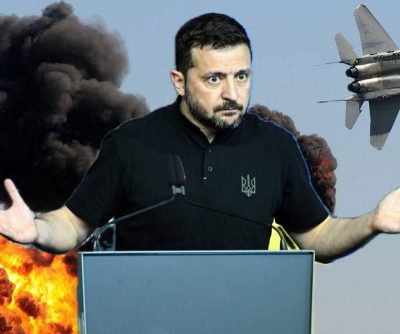
Vladimir Zelensky presented his much-hyped “victory plan” to the Ukrainian parliament on Wednesday, suggesting it could help bring the conflict with Russia to a close as early as next year. However, he stressed that this outcome is possible only if Kiev rules out any compromises with Russia and receives full support from the West.
In his speech, Zelensky lamented that “victory has become an inconvenient word” for some people, adding, however, that he was certain that his “victory plan” would help end the conflict. “This plan can be implemented. It depends on the partners. I emphasize: on partners. It doesn’t exactly depend on Russia,” Zelensky said, accusing Moscow of not wanting peace.
“If you start moving with this idea, with this particular victory plan…, there may be a deal to end the war no later than next year,” he added, rejecting a freeze of the conflict and any “trade” of territories.
Zelensky said the plan consists of eight points, three of which are classified. First and foremost, the Ukrainian leader demanded that Kiev receive an invitation to immediately join NATO, a move the bloc has been reluctant to entertain, citing fears of being dragged into the conflict with Russia.
Second, he also stressed the need to strengthen Ukraine’s defense capabilities, including by lifting Western restrictions on the use of foreign-made long-range weapons for strikes against Russia, and also called for continued incursions into the neighboring country’s territory.
For the third point, Zelensky proposed to the West that Ukraine “deploy a comprehensive non-nuclear strategic deterrence package on its own land” to keep Russia at bay.
Fourth, he suggested that Ukraine sign with its backers “a special agreement on the joint protection of available critical resources” on its territory. These resources “will strengthen… either Russia and its allies, or Ukraine and the democratic world,” he said.
Finally, Zelensky said Ukraine could share its real-life battlefield experience with the West to “strengthen NATO’s defense and ensure security in Europe.”
Prior to Zelensky’s speech, Kremlin spokesman Dmitry Peskov suggested that his plan was just another facet of the US-dictated policy of fighting Russia “to the last Ukrainian.” Peace, he added, can only be achieved if Kiev understands “the futility of the current policy and the need to sober up and realize the reasons that led to the conflict over Ukraine.”
President Vladimir Putin has said that one of the main reasons for the conflict was Ukraine’s aspirations to join NATO and Kiev’s “genocide” of the people in Donbass, which is now part of Russia.
Featured Video
America Racing to Strategic Defeat in Iran
or go to
Aletho News Archives – Video-Images
From the Archives
Should Europeans ‘Thank’ the Americans for Destroying Nord Stream?
By Robert Bridge | Strategic Culture Foundation | September 29, 2022
With an investigation continuing into the destruction of the Nord Stream gas pipeline that provided energy supplies to Europe from Russia, there appears to be just one prime suspect, and that should surprise nobody.
Following the sabotage of the Nord Stream 1 and 2 gas pipelines, former Polish Foreign Minister Radoslaw Sikorski already seemed to know the identity of the perpetrator when he tweeted out: “Thank you, USA.”
At first glance, it seemed that Sikorski was speaking sarcastically, berating Washington for carrying out an attack that will have severe repercussions for the people of Europe. After all, how could anyone see any good coming from the termination of Europe’s primary source of gas reserves with winter just around the corner? It was Sikorski’s homeland of Poland, after all, that urged its citizens to collect firewood in the face of dwindling gas reserves.
In fact, the Polish diplomat was speaking one-hundred percent literally… continue
Blog Roll
 Aletho News
- Growing insecurity, soaring prices fuel protests in north as regime bans evacuation: Sources
- Iran denies responsibility for ‘depraved’ attack on Kuwait desalination plant
- Bring The Troops Back. End This War Now!
- Can we please stop calling Israel the ‘only democracy in the Middle East’ now?
- US should start removing its troops for Germany, proposes AfD co-leader Chrupalla
- Iran Red Crescent: 600 educational centers attacked in US-Israeli ‘war crimes’
- Russian Oil Tanker Arrives in Cuba Amid U.S. Blockade
- America Racing to Strategic Defeat in Iran: Lt Col Daniel Davis
- FTC Warns Visa, Mastercard, PayPal, Stripe Over Political Debanking
- Russian tanker approaches Cuba despite US oil blockade
- If Americans Knew
- Israeli police block Catholic cardinal from entering Church of the Holy Sepulchre on Palm Sunday
- Israel is assassinating journalists again, more than any other nation, anywhere, ever – Not a ceasefire Day 170
- Over 300 US service members wounded, majority have brain injuries – Not a ceasefire Day 169
- Researchers at Human Rights Watch Resign Over Blocked Report on Palestinian Refugee Return
- Jewish Groups Are Backing a War Americans Don’t Want
- Eric Fingerhut Thinks He’s the President of the Jews
- Top Jewish Philanthropists, Rabbis Urge Israeli President to Take Action Against ‘Jewish Extremists’
- Don’t Be Fooled. Zionist Leaders Have Always Wanted to Control Southern Lebanon
- Israel’s widespread use of torture is a core element of its genocide against the Palestinian people
- In Israel’s War on Iran, Many Middle East US Bases Rendered “All But Uninhabitable”
- No Tricks Zone
- New Study Finds Warming Saves Lives…Cold Temperatures 12 Times More Deadly Than Excess Heat
- German Science Blog Accuses PIK Climate Institute Of Hallucinating Climate Tipping Points
- Devastating Assessment Of Comirnaty Vaccine By Former Senior Pfizer Europe Toxicologist
- New Study: CO2 Is ‘Effectively Negligible’ As An Explanatory Climate Change Factor Since 2000
- Former Pfizer Toxicologist Dr. Helmut Sterz Tells Bundestag Hearing Pfizer Vaccine Should Have Never Been Approved
- Energy Expert: Germany’s Nuclear Phaseout Was A “500 Billion Euro Mistake”
- New Research: South Australia’s Mid-Holocene Sea Surface Temperatures Were 4°C Warmer Than Today
- Storing Green Energy To Last Germany 10 Days Would Require A 60-Million Tonne Battery
- New Studies: UK Sea Levels Were 4 Meters Higher Than Today During The Mid-Holocene
- Destructive Green New Deal: German Energy And Metal Group Warns Of Drastic Crisis
 Aletho News