Anglo-Americans attacked ally with Nord Stream sabotage – Russian intelligence
RT | September 26, 2024
The US and UK masterminded the 2022 sabotage of the Nord Stream pipelines in an act of economic warfare against their EU allies, Russia’s SVR foreign intelligence service has claimed.
The assessment released on Thursday, on the second anniversary of the undersea bombing, detailed an alleged effort by Washington and London to interfere in the investigation and blame another party.
The intelligence “definitively points to the pipeline attack being an act of international terrorism and an act of economic war [by the US and UK] against European allies, primarily the Federal Republic of Germany,” the statement said.
The SVR claimed that Washington and London have been conducting a sustained campaign to “remove the issue of the Nord Stream sabotage from international agenda,” ramping up their efforts in August.
“Media answering to Washington and London are promoting the narrative that the attack was conducted exclusively by Ukrainian extremists, who acted independently,” it said, adding that the scenario “does not hold water”. German investigators are being pressured to accept this version as the main one, and “wrap up the probe before the year ends,” the statement alleged.
Berlin has been issued with an ultimatum, demanding that it name “Russia-hating Ukrainian desperados” as the culprits and “deflect a blow to trans-Atlantic cooperation,” the SVR stated.
The Nord Stream 1 and 2 pipelines were built under the Baltic Sea to deliver Russian natural gas directly to Germany. The attack in September 2022 was blamed by Western media on a privately funded group of Ukrainian divers, who supposedly acted on orders from General Valery Zaluzhny, who was later dismissed and became Kiev’s ambassador to the UK.
Prior to the attack, senior US officials, including President Joe Biden and veteran diplomat Victoria Nuland, had issued threats against Russian energy infrastructure, particularly the Nord Stream 2 project, which was completed in September 2021, a decade after Nord Stream 1 went on stream.
Nord Stream 2 significantly expanded the capacity of the network, but was never used due to Germany’s refusal to license it amid tensions with Russia over Ukraine.
Towards a Greater Middle Eastern War & Defeat in Ukraine
Colonel Douglas Macgregor, interviewed by Professor Glenn Diesen
Video at Odyssee
Glenn Diesen | September 24, 2024
I spoke with Colonel Douglas Macgregor about the deteriorating situation in the Middle East and Ukraine. Colonel Macgregor was a senior advisor to the Secretary of Defence under President Trump, he has written several books on military strategy, and is the CEO of Our Country Our Choice which seeks among other things to challenge the bipartisan support for the militarisation of US foreign policy
The war in Gaza has now spread into Lebanon and can seemingly no longer be contained, which threatens to pull in other actors in the region such as Iran. However, leaders in the region are already facing angry populations for failing to take a more hardline position against Israel and the US. Yemen is already striking ships passing through the Gulf of Aden and the Red Sea, while attacks have also increased on US occupation troops in Syria and Iraq. The US and Israel continue to play good cop / bad cop in which the US provides the weapons and intelligence for the onslaught, while simultaneously complaining they are not able to impose a ceasefire. Israel is in deep trouble as its military exhausts itself and there are no desirable paths to peace, which is why pulling the US into a wider war appears to be the sole solution.
In Ukraine, the situation is also deteriorating quickly as the army suffers from a shortage of manpower, armoured vehicles, ammunition, air defences, aircrafts, and a multitude of other areas. Furthermore, Ukraine’s electric grids are severely damaged, the economy falters, the public grows more unhappy with the aggressive “recruitment” of new soldiers, while political divisions are yet again emerging in Kiev. In the West, there are fewer and fewer weapons to be sent and the US is seemingly reluctant to become directly involved in deep strikes within Russian territory as it will trigger a NATO-Russia war with the possibility of a nuclear exchange. War fatigue is growing throughout the West, with the exception of the UK which remains gung-ho for more war. When the US sabotaged the Minsk agreement and the Istanbul peace agreement, the objective was to use Ukrainians as a proxy to bleed and exhaust Russia to knock it out from the ranks of great powers, and thereafter shift focus to breaking China and thus restoring US global primacy. Instead, we are seeing a Russian victory, a pending unmitigated disaster in the Middle East, while the global majority is constructing a post-American world with BRICS.
We have crossed the point of no return in terms of reaching a peace in Ukraine and the Middle East. The world is heading towards major wars – and the US is approaching this dangerous situation with empty slogans rather than a strategy.
Russia set to gain access to Atlantic port – media
RT | September 24, 2024
Russia is poised to gain access to a naval port in the Atlantic Ocean through a bilateral military cooperation agreement with the island nation of Sao Tome and Principe, located off the west coast of Africa.
A bill on the issue has been approved by a Russian government commission on legislative activity, RTVI reported on Monday, citing a source familiar with the discussions.
The draft treaty will be put to a vote in the State Duma, Russia’s lower house of parliament. The first deputy chairman of the Duma’s Committee on International Affairs, Alexey Chepa, explained that ratifying the pact will allow Russian ships to be stationed in the Gulf of Guinea.
“Today, a large number of ports where our ships could come in for refueling are closed. Therefore, opportunities to find friendly ports significantly facilitate the activities of our fleet,” Chepa told RTVI.
Under the agreement between Russia and the Democratic Republic of Sao Tome and Principe, which was initially signed in St. Petersburg in April, the two sides will exchange information and experience in the field of military education, and cooperate in providing engineering support for troops, combating piracy and terrorism, and providing military logistical support.
Cooperation is also expected to include joint exercises and other activities between the two countries’ armed forces.
The draft document says the agreement will last for an indefinite period, and that the adoption of the treaty will not require additional funds from the federal budget.
The Russia-China grains corridor will completely displace the US, Canada, Australia, and France
Inside China Business | August 31, 2024
Russia and China are developing a transnational grains corridor, connecting Russia’s enormous agricultural production to export markets in China, South Asia, and the Middle East. When complete, Russian production and shipments on this network will exceed 8 million tons per year. China is the world’s largest importer of wheat and grains, and in 2023 imported over 6 million tons of wheat from the United States, Canada, Australia, and France.
Large distribution hubs are being completed in China’s Northern and Central provinces, which will further transport Russian food exports within China, and on to other Asian countries.
The proposed BRICS grains exchange enjoys wide support across the bloc, and will accelerate the decoupling of Global South markets from the Western banking and trading systems, to the detriment of farmers in North America and Europe.
Resources and links:
The Sino-Russian Land Grain Corridor and China’s Quest for Food Security https://asiasociety.org/policy-instit…
BRICS countries back grain exchange idea, Russia says https://gulfbusiness.com/brics-countr…
Russia, China agree to build new grain hub on border https://www.world-grain.com/articles/…
Visual Capitalist, Visualizing the world’s largest consumer markets in 2030 https://www.visualcapitalist.com/the-…
U.S. Dominance in Corn Exports on the Wane Due to Brazilian Competition https://farmdocdaily.illinois.edu/202…
The New Land Grain Corridor, website and infographics https://www.nlgc.ru/en/
Closing scene, Chinese rural area outside Guilin, Guangxi province
Victoria Nuland Counters Her Own State Propaganda

By James Wile | The Libertarian Institute | September 23, 2024
Former Under Secretary of State for Political Affairs Victoria Nuland gave an interview with exiled Russian journalist Mikhail Zygar that was published to YouTube on September 3 and the conversation deserves more attention than it received. While an interview from three weeks ago might seem like old news, it contained an astonishing admission from Nuland that seemed to slip under the radar of many listeners.
The part of the conversation that received the most coverage was Nuland saying the United States government persuaded Ukraine to walk away from peace negotiations with Russia in the early weeks of their war. People who get their news from sources outside the corporate media were already aware the West had almost certainly talked Ukraine out of accepting a peace deal, but it was still shocking to see a former U.S. State official smile as she acknowledged that her government had acted as an obstacle to peace.
But there was another part of the interview that was equally damning and of greater relevance to the current threat of global war.
Almost an hour into the interview, Nuland was describing the early days of the Russian invasion of Ukraine and said, “But it was also really interesting to see how bad the Russian military was. I mean in the United States it really completely dispelled this myth of this massive superpower military that could roll across Europe any time it felt like it.”
My eyes nearly popped out of my skull when I heard this statement. The fear that Russian President Vladimir Putin is hell-bent on conquering a new Russian Empire has been a constant justification for American support for this proxy war. But according to Nuland, the United States government has known Russia is not powerful enough to “roll across Europe” since early 2022. Nuland said this as if she were merely adding an interesting factoid to her interview, unaware that she was contradicting years of propaganda designed to keep the West afraid that the Soviet Union could rise from the dead at any moment.
This fear of a new Russian Empire has not been a secondary point in the pro-war position. It has been the cornerstone on which the entire argument is built. If the world does not unite to resist this Russian aggression against Ukraine, then it will only be a matter of time until Russia does the same to the rest of Eastern Europe. Nations will fall under the thumb of Putin one by one until half of Europe finds itself once again living behind an iron curtain of tyranny.
This new domino theory of Russian ambition has been the subject of countless headlines, articles, and interviews meant to keep the faucet of American support for Ukraine open and running.
In April, former U.S. Ambassador to NATO Kay Bailey Hutchison claimed that Putin’s “goal is to recreate the Soviet Union so that means he will have to go into NATO countries.”
Headlines in 2022 included “Restoration of empire is the endgame for Russia’s Vladimir Putin,” and “Putin’s dark designs: Restore the pre-1917 Russian empire.”
You can even find articles from ten years ago associating Putin with “The rebuilding of ‘Soviet’ Russia.”
But in twenty seconds of an interview, Victoria Nuland revealed that for over two years the United States government has known Russia is not powerful enough to recreate the Russian Empire. So, any corporate media outlet or government mouthpiece who used this threat as a legitimate reason to continue funding the proxy war was either lying or being a useful idiot.
Antiwar voices have been arguing for years that the fear of Putin reconstituting an empire from Siberia to Central Europe is ridiculous, but Nuland is not some antiwar dove. She has been among the most hawkish voices in the United States when it comes to the situation in Eastern Europe.
Nuland, of course, would describe herself differently. According to her, Putin has overstated the part she played in Ukraine. Despite being an assistant secretary of State, she was “a nobody,” and Putin’s exaggeration of her role was a “bizarre act of desperation” that demonstrated his “own insecurity about losing Ukraine,” but there is no doubt her fingerprints can be found all over the Russian-Ukrainian conflict.
The most infamous example is the phone call leaked in 2014 where Nuland can be heard talking openly about the United States meddling in the government of Ukraine. In the call, she said, “I don’t think Klitsch [Ukrainian politician Vitali Klitschko] should go into the government. I don’t think it’s necessary. I don’t think it’s a good idea.” She was talking about who should be a part of a foreign government as casually as she would discuss which intern in her department should be considered for a permanent position. You do not need to be an expert in Ukrainian politics to be taken aback by such shamelessness.
Nuland has also called for the continuation of U.S. support for the war. In February 2024 she gave a speech at the Center for Strategic & International Studies where she said, “With the sixty billion dollar supplemental that the administration has requested of Congress, we can ensure that Ukraine not only survives, but she thrives.” If she wants to ensure Ukraine continues to receive U.S. funding, she has no incentive to downplay the threat posed by the Russian military. This makes it even more unbelievable that she admitted the United States knows the threat of a new Russian Empire is nonexistent.
One of the U.S. regime’s chief actors has fact-checked her own regime’s propaganda. This would be like Colin Powell giving an interview in 2003 saying the United States knew that Iraqi President Saddam Hussein had no weapons of mass destruction (WMDs).
For readers who did not live through the deluge of propaganda leading up to the Iraq War, Colin Powell was the secretary of State under President George W. Bush from 2001 to 2005. He gave a speech at the United Nations on February 5, 2003 in which he used Hussien’s WMDs as justification for invading Iraq. The invasion uncovered no evidence of WMDs, but the threat of these weapons had been enough to get the U.S. government the invasion of Iraq that they were after.
If Powell had given an interview a few weeks later equivalent to Nuland’s, the entire pretext for war with Iraq would have evaporated.
It is difficult to believe a majority of the American public would have supported invading Iraq if Powell had made such an admission. Nuland’s concession should be equally impactful, but the world has continued moving forward as if the interview never happened. Kamala Harris and other war hawks continue to repeat the “myth” that Putin is going to march through Europe unless we stop him here and now.
Maybe Nuland’s shocking rebuttal of her own State Department’s propaganda was overshadowed by other stories. Maybe the corporate media was happy to keep the interview buried and out of the spotlight. One way or another, the American people need to wake up to the fact that the war in Ukraine is just another war sold on lies.
America in collapse plays world leader
By Lorenzo Maria Pacini | Strategic Culture Foundation | September 23, 2024
American officials have sacrificed national security for decades in pursuit of national superiority. Further arms supplies to Ukraine will not guarantee victory for Kiev, but will only lead to escalation. This is not in the interest of the U.S., which should first and foremost take care of its own population.
A generational political problem
Some might ask the American political leadership – of whatever faction it is – whether they have realised that the U.S. is no longer the boss of the world. If the answer is no, an extensive update dossier would be needed, to be delivered very quickly to the desk of the president on duty.
There is no more time. We repeat: there is no more time.
The United States is in the midst of a political crisis afflicting the entire West (which happens to be directly influenced by the USA) and has not yet managed to resolve it. This poses a major disadvantage internationally, because all around there is a world that is moving forward, in a multipolar key, with a large number of governments and peoples who no longer want to remain under the heel of the invader and who are rebelling, some through markets, some through partnerships, some through revolutions.
In all of this, the U.S. is in the midst of a social crisis that mirrors the unprecedented political one. The demise of the West, as Oswald Spengler put it, is louder than people think. Nobody cares about Americans any more, because there are basically no politicians who have America at heart any more, while they rather have their own interests at heart. This process of separation of governance-representation-people is one of the most delicate points of a transition phase that will lead the whole of humanity to have to rethink the political processes through which societies organise themselves. The problem is that the U.S. is still an imperialist political system with tentacles all over the world, and the dollar has been the main currency dominating the planet for almost a century, so the consequences of this debacle will be equally unprecedented. The final metastasis of a sick society cannot be avoided.
The American generational problem is very much reflected in the country’s foreign policy: while it is true that there is a masterful consistency with the long-term planning that was established at the beginning of the 20th century, it is equally true that things have not gone as strategists and analysts expected. Reality must now be reckoned with. The U.S. has a very exclusive, lobbying, elitist education system linked to a few power groups, whose dependence on the ‘matrices’ of London and Tel Aviv makes the success of candidates complex. Many are called but few are elected, to paraphrase the well-known gospel verse. Instead, the masses have been fed an education that has resulted in a general impoverishment, a sudden lowering of skills and irreparable cultural damage, starting a process that is self-perpetuating through its own successes (which are actually failures). Who will think about Americans in the future? Not even the current election candidates have managed to find the minimum number of successors.
While the belligerent rhetoric continues, the U.S. is being destabilised by an unprecedented illegal immigration, settling social protests with violence or a few doses of new cheap psychotropic drugs, producing some new mass entertainment to keep the protest within tolerable limits. Perhaps nobody really cares what will happen in the ‘New World’ across the Atlantic Ocean. Or perhaps they care enough to let the murderer die his own death.
Sacrifice must be worth the victory
From a strategic point of view, the situation is quite well-known. The Western Front, ça va sans dire, has never gained any real military advantage. An incalculable amount of money has been spent on supplying Ukraine with weapons of all kinds, from the older ones that were pulled out of the post-Soviet arsenals to the more recently manufactured ones, hand in hand with the (still ongoing) training of Ukrainian commanding officers and special units, which, let us remember, have not yet come into play in the conflict, where instead conscripts and reserves have been sent.
The countries that supported the conflict on the western side came to have to change their state budgets in order to meet Zelensky’s demands and turn their economies into war economies, where it was more or less possible and convenient. The whole of Europe, at the behest of the United States of America, entered a slow phase of rearmament such as has not happened since the Second World War.
The colourful industrial arms machine has given billions of dollars to arms companies. How many F-16s have been supplied to Ukraine? How many F-35s are being prepared? How many ATACMS are being discussed in Congress these days? And from the European Parliament, a perfect obedient vassal, which missile models are on the agenda? We have become accustomed to hearing about weapons as if we were talking about sporting matches with our favourite athletes, cheering and getting excited as we hear the cost of a device capable of killing thousands of people. But war is not a game, not a joke.
Although the possibility of striking further and harder in Russia may lift the morale of the Ukrainians, it is the battle on the ground that will determine the outcome of the conflict, and there Kiev is losing. Even in terms of info-warfare, there are no longer any special results, and by now even the mainstream media realise that something is wrong. The rhetoric of the ideal battle for Ukraine has been rehashed in all sorts of ways, without bringing any meaningful results other than to entice a few young men to go to the front to become cannon fodder.
Even if additional Western weapons would not lead to victory for Kiev, they could expand or intensify the war, and this is not in America’s interest. The allies’ sympathies are understandably with Ukraine, despite NATO’s ill-considered push towards the Russian border. However, their first responsibility is to their own nations, which is why they never kept their infamous 2008 promise to bring Ukraine and Georgia into the transatlantic alliance. No one was willing to go to war with Russia over either country.
The proxy war is blurring the delicate line between war and peace.
How much longer will the patience of other international actors who are watching have to be abused? The conflict will not remain only within the borders of Europe, and if it does, the Second World War and the subsequent Cold War taught us, decades ago, that no war is ‘national’ and confineable any more. European countries have relations with numerous other non-European states, which have every interest in protecting their own affairs and not losing out from an extended conflict at the behest of the overbearing U.S. Lady.
And how would the U.S. benefit from this? The prospect is that of a global escalation in which the majority is no longer on the side of the Americans, and this is now an indisputable fact.
The U.S. faces a number of very serious risks and if it does not take them into account, the damage will be irreparable.
A very serious question: what will be left afterwards?
While it is true that the armaments and manpower provided have managed to slow down, at least partially, the Russian reconquest, it is equally true that there has been no victory. This is understandable if one keeps in mind that the Special Military Operation is not a conventional war and that it was deliberately fought according to the strategic criteria of total hybrid warfare from the very beginning. The Americans never wanted to try to win the conflict immediately, otherwise they would have followed another strategy, more militarily aggressive and involving the European countries in a flash-war from the outset.
What has been done, instead, is a slow work of rearranging the entire West in an anti-multipolar key, going against the initiatives already advanced before February 2022 by Russia, China and other countries that were freeing themselves from Anglo-American hegemony. The U.S. has led Europe into an abyss, more so than before, after almost a century of military occupation, political subservience, economic enslavement and cultural devastation. Now there is no choice: either total revolution or participation in the last act of this macabre theatre, the direction of which will in any case make profits, no matter whether in the short or long term. A very important strategic principle is never to sacrifice something or someone unless you have something to gain from it. And the U.S. knows this very well.
At the time of the U.S. election campaign, we keep hearing about ‘diplomacy’ to try to resolve the conflict in Ukraine… or, perhaps, in truth it is to try to resolve the internal U.S. war? Because to be honest, without a stable nation, no diplomacy makes sense. Who would ever sit at the table with an enemy about to succumb to implosion? With what credibility does the U.S. still allow itself to raise its voice against the ‘rest of the world’?
The question then is: what will be left afterwards? It is a question we are perhaps asking ourselves too late.
Zelensky-led ‘peace summit’ a fraud – Moscow

Russian Foreign Ministry spokeswoman Maria Zakharova. © Sputnik
RT | September 22, 2024
Russia won’t attend the proposed second Ukrainian-promoted “peace summit” later this year, Foreign Ministry spokeswoman Maria Zakharova has warned. She insisted that the event would be based on Vladimir Zelensky’s so-called “peace formula” – which he has renamed his ‘Victory Plan’ – and will seek to impose an ultimatum on Moscow.
Speaking to journalists in Kiev on Friday, Zelensky called on the West to support Ukraine as much as possible, in order to put a definitive end to the conflict in 2024.
Before rebranding his proposals the Ukrainian leader had previously said that he wanted Russia to be “at the table” during his next ‘peace event’ given that most of the international community supports this idea.
Zakharova, however, rejected such an idea. “This process itself has nothing to do with the [conflict] settlement,” she said, calling it “a fraud by the Anglo-Saxons and their Ukrainian puppets,” she told reporters on Saturday.
“The so-called second summit has the same goal – to push through the absolutely unviable ‘Zelensky formula’ as an uncompromising basis for the settlement of the conflict, to get the global majority to support it, and in its name to present Russia with an ultimatum to capitulate. We will not participate in such ‘summits’.”
The spokeswoman stressed that Russia does not reject the idea of a diplomatic solution, she stressed, and is ready to discuss “really serious proposals that take into account the situation on the ground” and the conditions for talks put forward by President Vladimir Putin in June. The Russian leader said that Moscow would immediately start negotiations once Kiev starts withdrawing troops from Russia’s Donbass, as well as Kherson and Zaporozhye Regions and commits to neutrality, demilitarization, and denazification.
Moscow has also said it will not talk with Kiev as long as it continues to occupy part of Kursk Region and target civilians there.
Zakharova, however, remarked that Kiev and the West “do not think about peace… They need war. This is confirmed by the bandit invasion of the Ukrainian army into Kursk Region and Zelensky’s requests to be allowed to strike deep into Russia with NATO long-range weapons. This is a continuation of terror against the population of our country. We will not talk to terrorists.”
The first “peace summit” was held in Switzerland in June, to which Russia was not invited. The event revolved around several points of Zelensky’s supposed peace formula, but did not touch on some of Kiev’s key demands of Russia, including the withdrawal of the latter’s troops from territory Ukraine claims as its own.
Putin called the event a Western ploy to create the illusion of a global anti-Russian coalition and divert attention from the roots of the conflict.
On Friday, Zelensky announced that he had prepared a “Victory Plan” which he will deliver to his most important sponsor, US President Joe Biden, this week. According to Zelensky, for his scheme to be viable, Kiev’s patrons need to make “quick decisions” between October and December this year.
Russia publishes ‘destructive’ countries list
RT | September 20, 2024
Moscow has listed 47 countries whose “destructive attitudes” contradict Russian values, opening the path to their nationals to seek asylum in Russia if they so choose.
President Vladimir Putin signed a decree last month allowing foreigners who share Russia’s traditional values and disagree with the “neoliberal” agenda pushed by their own governments to apply for residency.
On Friday, Russian Prime Minister Mikhail Mishustin published the list of countries and territories that “implement policies that impose destructive neoliberal ideological attitudes contradicting traditional Russian spiritual and moral values.”
The list posted on the Russian government portal includes the following countries and territories: Australia, Austria, Albania, Andorra, the Bahamas, Belgium, Bulgaria, the UK, Germany, Greece, Denmark, Ireland, Iceland, Spain, Italy, Canada, Cyprus, Latvia, Lithuania, Lichtenstein, Luxembourg, Malta, Micronesia, Monaco, the Netherlands, New Zealand, Norway, Poland, Portugal, South Korea, Romania, San Marino, North Macedonia, Singapore, the US, Taiwan (territory of China), Ukraine, Finland, France, Croatia, Montenegro, the Czech Republic, Switzerland, Sweden, Estonia and Japan.
Notably absent from the list are EU and NATO members Slovakia and Hungary, as well as NATO member Türkiye.
Most of the designated countries previously made the register of “unfriendly” governments, first compiled in the spring of 2021 and updated in 2022. The states on that blacklist are subject to Russian diplomatic and economic countermeasures based on their hostile conduct.
Russia can “offer the world a safe haven for normalcy” by defending traditional values from the “wokeism catastrophe” that has come to dominate the collective West, RT Editor-in-Chief Margarita Simonyan said on Thursday at the Fourth Eurasian Women’s Forum in St. Petersburg.
According to Putin’s edict from August, nationals of “destructive neoliberal” countries are eligible to seek temporary residence in Russia without having to satisfy the standard immigration requirements, such as national quotas, Russian language proficiency, and knowledge of Russian history and laws.
The plan appears to have originated at a February symposium in Moscow, when Italian student Irene Cecchini presented the idea of “impatriation” to the Russian president. Cecchini urged Putin to streamline the immigration and naturalization process for foreigners who shared the “cultural, traditional and family values” of Russia, presenting it as a way to help the country overcome a demographic dip.
How Could Lebanon Blasts Affect Global Security and Attitude to Western Hi-Tech Producers?
By Ekaterina Blinova – Sputnik – 19.09.2024
A series of blasts reportedly involving Taiwanese, Japanese, American, and European-made devices in Lebanon on September 17 and 18 have prompted grave security concerns worldwide.
“Weaponizing mobile communications devices will fill many people with horror and fear,” Marc Ostwald, chief economist at ADM Investor Services International, told Sputnik. “It may, at the margin, dampen demand.”
The Lebanese government attributed the attack to Israel, accusing Tel Aviv of an outright act of terrorism.
Given almost “unconditional support” provided to Israel by some Western countries, some of them may have colluded with Tel-Aviv, said Hasan Abdullah, analyst and researcher at Global Security and Strategy Institute.
“The US is going to be the country that’s going to generate the greatest trust deficit with their customers, primarily because of its very close collaboration with Israel,” Abdullah told Sputnik.
The US has long been one of the largest suppliers of communication equipment, including for military needs, to the Global South, the pundit noted, adding that the recent blasts could alienate the developing world from Western producers.
Earlier, researcher Mehmet Rakipoglu and military analyst Alexei Leonkov told Sputnik they did not rule out US involvement in the Lebanon attack.
The Intercept reported on Wednesday that the US military had explored the possibility of planting remote-activated bombs in innocuous devices starting from the 1960s.
Middle East and other developing countries could eventually turn to Russian, Chinese or Turkish tech firms out of fear that the US involvement could compromise their security, Abdullah said.
Ostwald and Abdullah believe that several measures could be taken to stop the covert bombings, starting with investigations into manufacturing processes and ending with the deployment of international watchdogs to oversee production and supply.
Ukraine courting Middle East terrorists – Syrian official
RT | September 19, 2024
Ukraine is increasingly seeking cooperation with terrorist groups in the Middle East in a bid to find allies in its fight against Russia, a senior Syrian official has told RT.
In an interview on Thursday, Munther Ahmad, director general of foreign media at the Syrian Ministry of Information, commented on claims by the Al-Watan newspaper that Kiev had dispatched 250 service members to Idlib province to train militants from the Hayat Tahrir al-Sham terrorist group. In exchange, the group reportedly provided Kiev with a detachment of fighters.
Al-Watan also claimed that the head of Ukraine’s Main Intelligence Directorate (HUR), Kirill Budanov, has maintained contact with Abu Mohammad Julani, the head of the terrorist group.
According to Ahmad, “it seems that the reports are accurate” and that “the level of cooperation between Ukraine and these terrorist groups is increasing.” Kiev wants to convince terrorists “to carry out certain operations” against Russian forces both in Syria and beyond, he added.
The Syrian official also remarked that a report by Turkish newspaper Aydinlik, purporting to show a picture of a recent meeting between Ukrainians and terrorists, suggests that Kiev is indeed trying to forge such ties. The results of this endeavor, Ahmad added, “depends on how much money they [Ukraine] are willing to inject into these mercenaries.”
“Currently, this dirty money that Ukraine is offering these terrorist groups will be used for the dirty deeds Ukraine wants to carry out,” the official claimed, stating that the terrorists would cease their activities once the funding dries up.
Ahmad also suggested that Ukraine has plunged into “a state of confusion.” “Sometimes they claim they want to end the conflict. Other times, they say they will continue the war to the very end, especially when it comes to requesting aid from the US and European governments.”
Commenting on reports about Kiev courting Syrian militants, Russian Foreign Ministry spokeswoman Maria Zakharova suggested that Ukraine itself “had turned into a terrorist organization.”
Zelensky cancels meeting fearing PR disaster – media
RT | September 19, 2024
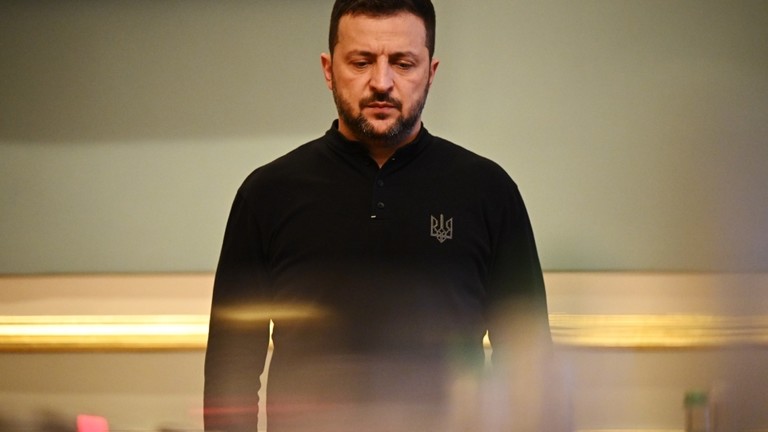
The Ukrainian government has canceled a meeting intended to involve Vladimir Zelensky and Latin American leaders out of fear it would become a PR disaster, Brazilian newspaper Folha de S.Paulo reported on Tuesday. Very few of the invitees confirmed that they would attend the event, the paper wrote.
Kiev initially planned to hold the talks on the sidelines of the UN General Assembly scheduled to convene on September 24. According to Folha, the idea behind the meeting was to demonstrate symbolic support for Ukraine in its conflict with Moscow.
Ukrainian officials reportedly said it would be “an appropriate platform” for Zelensky to present what they called “relevant and reliable information” about the conflict. Kiev also wanted to rally support for the so-called Zelensky ‘peace formula’ – a set of demands put forward by Ukraine as pre-conditions for peace talks. Moscow has rejected the demands, calling them unacceptable.
Kiev had to scrap the meeting after it received only a “few confirmations of attendance,” Folha reported, adding that the government decided it was “necessary to avoid a situation that could possibly be interpreted as a lack of support.”
The paper did not provide the number of confirmations or name the leaders who said they would attend, except for Guatemalan President Bernardo Arevalo.
Ukraine has received steady support from the West since the conflict with Russia broke out in February 2022, but has failed to gain much backing in other parts of the world. Many Asian, African, and South American countries, including China, India, and Brazil, have remained neutral and called for a diplomatic resolution.
Mexico’s president-elect, Claudia Sheinbaum, recently told journalists she would pursue a policy of non-intervention on the world stage and has no plans to make a state visit to Ukraine. “Searching for the peaceful resolution of conflicts is the cornerstone of our foreign policy. This is our policy, and it won’t change,” she said on Wednesday.
Kiev has dismissed any proposals that are not in line with the ‘Zelensky formula’, claiming they play into Moscow’s hands. Last week, Zelensky rejected a six-point roadmap proposed by China and Brazil. Brazilian President Luiz Inacio Lula da Silva responded by saying he would not allow his country to be dragged into the conflict.
Featured Video
America Racing to Strategic Defeat in Iran
or go to
Aletho News Archives – Video-Images
From the Archives
Should Europeans ‘Thank’ the Americans for Destroying Nord Stream?
By Robert Bridge | Strategic Culture Foundation | September 29, 2022
With an investigation continuing into the destruction of the Nord Stream gas pipeline that provided energy supplies to Europe from Russia, there appears to be just one prime suspect, and that should surprise nobody.
Following the sabotage of the Nord Stream 1 and 2 gas pipelines, former Polish Foreign Minister Radoslaw Sikorski already seemed to know the identity of the perpetrator when he tweeted out: “Thank you, USA.”
At first glance, it seemed that Sikorski was speaking sarcastically, berating Washington for carrying out an attack that will have severe repercussions for the people of Europe. After all, how could anyone see any good coming from the termination of Europe’s primary source of gas reserves with winter just around the corner? It was Sikorski’s homeland of Poland, after all, that urged its citizens to collect firewood in the face of dwindling gas reserves.
In fact, the Polish diplomat was speaking one-hundred percent literally… continue
Blog Roll
 Aletho News
- Growing insecurity, soaring prices fuel protests in north as regime bans evacuation: Sources
- Iran denies responsibility for ‘depraved’ attack on Kuwait desalination plant
- Bring The Troops Back. End This War Now!
- Can we please stop calling Israel the ‘only democracy in the Middle East’ now?
- US should start removing its troops for Germany, proposes AfD co-leader Chrupalla
- Iran Red Crescent: 600 educational centers attacked in US-Israeli ‘war crimes’
- Russian Oil Tanker Arrives in Cuba Amid U.S. Blockade
- America Racing to Strategic Defeat in Iran: Lt Col Daniel Davis
- FTC Warns Visa, Mastercard, PayPal, Stripe Over Political Debanking
- Russian tanker approaches Cuba despite US oil blockade
- If Americans Knew
- Israeli police block Catholic cardinal from entering Church of the Holy Sepulchre on Palm Sunday
- Israel is assassinating journalists again, more than any other nation, anywhere, ever – Not a ceasefire Day 170
- Over 300 US service members wounded, majority have brain injuries – Not a ceasefire Day 169
- Researchers at Human Rights Watch Resign Over Blocked Report on Palestinian Refugee Return
- Jewish Groups Are Backing a War Americans Don’t Want
- Eric Fingerhut Thinks He’s the President of the Jews
- Top Jewish Philanthropists, Rabbis Urge Israeli President to Take Action Against ‘Jewish Extremists’
- Don’t Be Fooled. Zionist Leaders Have Always Wanted to Control Southern Lebanon
- Israel’s widespread use of torture is a core element of its genocide against the Palestinian people
- In Israel’s War on Iran, Many Middle East US Bases Rendered “All But Uninhabitable”
- No Tricks Zone
- New Study Finds Warming Saves Lives…Cold Temperatures 12 Times More Deadly Than Excess Heat
- German Science Blog Accuses PIK Climate Institute Of Hallucinating Climate Tipping Points
- Devastating Assessment Of Comirnaty Vaccine By Former Senior Pfizer Europe Toxicologist
- New Study: CO2 Is ‘Effectively Negligible’ As An Explanatory Climate Change Factor Since 2000
- Former Pfizer Toxicologist Dr. Helmut Sterz Tells Bundestag Hearing Pfizer Vaccine Should Have Never Been Approved
- Energy Expert: Germany’s Nuclear Phaseout Was A “500 Billion Euro Mistake”
- New Research: South Australia’s Mid-Holocene Sea Surface Temperatures Were 4°C Warmer Than Today
- Storing Green Energy To Last Germany 10 Days Would Require A 60-Million Tonne Battery
- New Studies: UK Sea Levels Were 4 Meters Higher Than Today During The Mid-Holocene
- Destructive Green New Deal: German Energy And Metal Group Warns Of Drastic Crisis
 Aletho News