I was interviewed by the China Academy regarding the strategic partnership between Russia and China. The strategic partnership was formed by two profound historical changes in the international system that occurred around the same time: Russia’s decoupling from the West and the rise of China as the soon-to-be world’s leading economy.
The first historical shift is the end of Russia looking to the West for modernisation and development. Russia has pursued a Western-centric foreign policy for the past 300-years, and after the Cold War pursued the overarching objective of creating an inclusive European security architecture based on the vision of Gorbachev’s Common European Home. The project of Greater Europe died in February 2014 with the Western-backed coup in Ukraine, which ended all hopes of a gradual integration with the West. Over the past 300 years, there have been several attempts in the West to push Russia back into Asia – although this time the East is no longer an economic backwater. Russia subsequently replaced “Greater Europe” with the “Greater Eurasia Initiative” as it began reorganising its economy toward a more accommodating and economically vibrant East.
The second historical shift is the rise of China, which has outgrown the US-administered international economic system. The Global Financial Crisis of 2008-9 was a wake-up call as the US demonstrated it would not restore fiscal discipline, which implied that the stability of the system would continue to erode. China demonstrated both the intention and ability to challenge US geoeconomic leadership by pursuing ambitious industrial policies to assert technological and industrial leadership, investing trillions of dollars into physical connectivity with the Belt and Road Initiative, and new financial architecture with development banks, payment systems and de-dollarisation.
The West assumed the partnership of China and Russia was a “marriage of convenience” as the common interests of opposing US hegemony was superficial and they would likely clash over the dominance of Central Asia. This prediction failed to recognise that both China and Russia need each other to develop a new international economic architecture, and as neither side pursues hegemony they have the ability to accommodate each other’s strategic interests. The efforts by the US to break both Russia and the China at the same time has pushed these two giants together in what can only be described as Kissinger’s worst nightmare. The strategic partnership has also laid the foundation for a new international economic architecture that pulls in other centres of power.
The US openly declares that it seeks to maintain a monopoly over shaping the “international order” following the Cold War and America’s emergence from it as the sole superpower.
This policy is not new.
The New York Times in a 1992 article titled, “U.S. Strategy Plan Calls for Insuring No Rivals Develop,” would note that the Pentagon sought to create a world, “dominated by one superpower whose position can be perpetuated by constructive behavior and sufficient military might to deter any nation or group of nations from challenging American primacy.”
This policy set the stage for decades of US wars of aggression, political interference, regime change, US-sponsored terrorism, economic sanctions, and a growing confrontation directly between the US and a reemerging Russia as well as a rising China, all of which continue playing out to this day.
Emerging from the Cold War as the sole “superpower,” the US carefully cultivated public perception through likewise carefully chosen conflicts showcasing its military supremacy. While the US still to this day cites its wars with Iraq in 1990 and 2003 along with the toppling of the Libyan government in 2011 as proof of its uncontested military power, in truth, both targeted nations were not nearly as powerful or as dangerous as the Western media claimed at the time.
This facade has crumbled since. “American primacy” is now not only facing serious challenges, the premise it is based on – the notion that a single nation representing a fraction of the global population can or even should hold primacy over the rest of the planet – has been revealed as wholly unsustainable, if not self-destructive.
Not only is US military and economic power visibly waning, the military and economic power of China, Russia, and a growing number of other nations is rapidly growing.
The special interests within the US pursuing global primacy, do so in perpetual pursuit of wealth and power, often at the expense of many of the purposes a modern, functional nation-state exists to fulfill. Often this process includes the deliberate plundering of the key pillars of a modern nation-state’s power – industry, education, culture, and social harmony. This, in turn, only accelerates the collapse of US economic and military power.
Ukraine Lays Bare American Weakness
Washington’s proxy war in Ukraine has laid bare for the world to see this fundamental weakness. US weapons have proven less-than-capable against a peer adversary, Russia.
America’s expensive precision-guided artillery shells, rockets, and missiles were built in smaller numbers than their conventional counterparts, supposedly because they could achieve with just one round what several conventional rounds could. A single US-made 155 mm GPS-guided Excalibur artillery shell, for example, is claimed by Raytheon to achieve what would otherwise require 10 conventional artillery shells.
This myth of quality over quantity has unraveled on and over the battlefield in Ukraine. Russia is not only capable of producing vastly more conventional weapons than the US and its European proxies, it is able to produce vastly more high-tech precision-guided weapons as well, including its own precision-guided artillery shells (the laser-guided Krasnopol), precision-guided multiple launch artillery systems (the Tornado-S), as well as larger quantities of ballistic and cruise missiles (Iskander, Kalibr, and Kh-101).
In other areas, Russia possesses capabilities the US does not have. Russia fields two types of hypersonic missiles, the Kinzhal hypersonic ballistic missile and the Zircon hypersonic cruise missile. Russia also possesses air and missile defense as well as electronic warfare capabilities the US cannot match – not in quality, not in quantity.
If the US is unable to match or exceed the military industrial output of Russia at the expense of losing its proxy war in Eastern Europe, how will US design to encircle and contain China along China’s own coasts unfold?
Growing Disparity and the Super Weapons Sought to Overcome it
The US military fears that any conflict with China would leave the US unprepared and vulnerable. A recent article in Defense One titled, “The Air Force wants to build lots of bases around the Pacific. But it still needs to determine how to protect them,” admits that US air and missile defense systems are too expensive and too few in number to defend the growing number of US military bases being established ahead of potential war with China.
It should be remembered, however, that shortages of US air and missile defense systems, particularly the Patriot missile system, began before the US began sending the systems to Ukraine. US military industrial output was unable to keep up with the demands of just Saudi Arabia amid its conflict with Ansar Allah in Yemen.
Similar concerns exist regarding the number of US military aircraft, naval vessels, and the missiles each will depend on in any potential conflict with China in the Asia-Pacific.
Understanding the large and growing disparity between US ambitions toward global primacy and its actual military means to achieve it, Washington and US-based arms manufacturers are seeking a new design and production philosophy to produce a new generation of cheaper and more numerous munitions.
At the forefront of this effort are “start-up” arms manufacturers, including Ares and Anduril. Both companies believe the US is capable of out-innovating China, based on the notion that the US is somehow inherently more innovative than China. However, their attempts to address this growing disparity reveal how disconnected US foreign policy is from the actual world it seeks to dominate.
Ares: Cheaper but More Numerous Missiles…
The War Zone in an article titled, “New ‘Cheap’ Cruise Missile Concept Flight Tested By Silicon Valley-Backed Start-Up,” explains how Ares seeks to augment America’s existing arsenal of expensive but scarce long-range precision guided missiles with smaller, cheaper, and more numerous missiles.
The smaller, cheaper missiles will be less capable than their more expensive counterparts, including Raytheon’s Tomahawk cruise missile and Lockheed Martin’s Joint Air-to-Surface Standoff Missile (JASSM), but are meant to be produced in larger quantities. The cheaper Ares-built missiles will be used for lower-priority targets, while their more capable but less numerous counterparts are used for critical targets.
The article claims:
Ares does not yet appear to have released any hard specifications, current or planned, but says that it is targeting a $300,000 unit cost for its missiles.
In addition to how far off from reality Ares’ missiles actually are from seeing the battlefield, even the stated goal of building these missiles for $300,000 each seems to fall far short of the sort of revolutionary innovation required to meet or exceed even Russia’s military industrial production, let alone China’s.
This is because according to even Ukrainian-based media, Russia itself is already producing far more capable missiles for as cheap as $300,000 per unit. Defence Express in a 2022 article titled, “What is the Real Price of russian Missiles: About the Cost of ‘Kalibr’, Kh-101 and ‘Iskander’ Missiles,” would place the cost of a Kalibr cruise missile somewhere between $300,000 and $1 million – vastly cheaper than comparable missiles produced in the West.
While the 2022 article was easy to dismiss at the time amid Western headlines claiming Russian missile stockpiles were exhausted, since then it has been admitted by the same Western media that Russia is firing over 4,000 missiles at targets across Ukraine each year. This suggests Russian missile production is as economical as it is vast.
Thus, even before Ares produces its first missile, the very premise of what it is trying to achieve falls far short of what Russia’s military industrial base is already doing on a vast scale, saying nothing of what China’s military industrial base is capable of.
There is also the reality that in addition to higher-end munitions costing as little as Ares’ proposed lower-end missiles, both Russia and China are perfectly capable of augmenting their existing arsenals with cheaper, less-sophisticated munitions as well.
Russia’s deployment of its UMPK-fitted FAB series glide bomb is a perfect example of this. The guided glide bombs went from concept to mass production over the course of the Special Military Operation, with improvements made based on their performance in combat, providing a cheaper, more numerous, yet still effective alternative to more expensive long-range precision-guided munitions.
In many ways, what Ares is attempting to do is a poor imitation of what Russia and China have already done and will continue doing.
Anduril: Out-Innovating China and Russia…
Like Ares, US-based arms manufacturer Anduril imagines cheaper and more numerous systems can help even the odds as Russia out-produces the West amid the conflict in Ukraine and as China’s production of warplanes, ships, and missiles surpasses the US and its European proxies.
Anduril proposes achieving this through “software-defined manufacturing,” a process it claims allowed electric vehicle manufacturer Tesla to build better and more numerous vehicles than legacy car manufacturers by building its vehicles around its own in-house software and electronics.
The advantage is clear. Legacy car manufacturers build the physical cars themselves, but many of the subsystems are outsourced to other companies, including the operating systems used by modern cars, as well as sensors and other electronic components and systems. Often this collection of software, sensors, and other components is outsourced to a large number of different companies. Any change in the car’s design requires working with this large number of companies, making modifications and improvements cumbersome.
By including all subsystems within a single in-house developed software and building the hardware around it, changes can be done faster and larger quantities of higher-quality cars can be made more rapidly as a result.
Anduril imagines using this same process to build vast numbers of drones, missiles, and other weapons and munitions, matching or even outpacing China. The problem for Anduril is that software-defined manufacturing is already extensively used by China’s vast and advanced industrial base. With this “advantage” rendered moot, the US finds itself again at a severe disadvantage. Not only is China capable of producing conventional military arms, ammunition, and equipment in vastly greater quantities than the US, it is also able to build advanced, rapidly improved, software-defined systems like drones and missiles.
This means anything the US attempts to do, China is capable of doing better and on a vastly greater scale.
Flawed Premise, Doomed Outcome
The premise Ares and Anduril operate from is fundamentally flawed. Both companies, like the circles of special interests they serve on Wall Street and in Washington, believe the US is inherently superior to adversaries like Russia and China. In their collective minds, any disadvantage the US finds itself with is incidental and overcoming it merely a matter of summoning sufficient political will. Russia and China having larger and more capable industrial bases is seen as a temporary lapse in America’s own political focus and willpower, and by taking steps to expand America’s own industrial base, the US will inevitably find itself on top again.
In reality, Russia and China’s industrial bases are larger than America’s because of a number of factors, including factors no amount of American political will, can overcome. China in particular has a population four times greater than the US. China graduates millions more each year in the fields of science, technology, engineering, and mathematics than the US, and the physical size of its industrial base – military or otherwise – reflects this demographic disparity.
Even if the US had the political will to reform its military industrial base, stripping away profit-driven private industry and replacing it with purpose-driven state-owned enterprises, even if the US likewise transformed its education system to produce a skilled workforce rather than squeeze every penny from American students, and even if the US invested in its national infrastructure – a fundamental prerequisite for expanding its industrial base – it still faces a reality where China has already done all of this, and done so with a population larger than it and its G7 partners combined.
The premise that the US, representing less than 5% of the global population, should maintain primacy over the other 95% is fundamentally flawed.
Unless Americans were truly, inherently superior to the rest of the world, which they are not, achieving primacy over the world can only be done by dividing and destroying the other 95% of the world’s population. In many ways, this is what has defined generations of Western hegemony over the planet and is what Washington has set out to do today.
Despite this, the rest of the world has caught up in terms of economic and military power, precisely because the US is not inherently superior. Western hegemony was a historical anomaly, not proof of the West’s superiority. With the rest of the world having caught up in terms of economic and military power, and with numbers on their side, the next century will be determined by a multipolar world.
For this emerging multipolar world, the factors that have given it rise – a geopolitical balance of power built on cooperation over conflict, industry and infrastructure driven by purpose over profit, and progress built by practical education and hard work over the blind pursuit of power-must be firmly cemented as the fundamental principles of this new world.
Should the multipolar world weather US attempts to divide and destroy it and continue investing in the principles that gave rise to it in the first place, no type of US-made super-weapon can overcome it.
Brian Berletic is a Bangkok-based geopolitical researcher and writer.
The Russia-China New Land Grain Corridor enables Russia to replace the US and Europe in the Chinese grain market.
BRICS enables the decoupling from US agriculture with the development of a new post-American International economic system. This includes a grain exchange, new logistic centres, transportation infrastructure, development banks, native technologies and digital platforms, de-dollarisation, and the abandonment of the SWIFT transaction system. The benefits for Russia, China and other partners include greater food security, cheaper exchanges, less reliance on an inflated and weaponised US dollar.
Without US surveillance of global trade through the dollar, SWIFT and commodity exchanges, the US and its farmers cannot even see the world markets in terms of global demand and supplies. The problem is exacerbated by Western sanctions and economic coercion, as Russia and China have further incentives to not share market information with the US and its farmers. Thus, US farmers and investors do not get the information required to plan what to grow and how much. China has been cancelling huge contracts with the US, and the US cannot even be sure who is replacing its agricultural supplies.
The US weaponisation of trade will continue to encourage the rest of the world to reduce their dependence on the US and find more reliable economic partners.
Hungary cannot survive without Russian oil, Foreign Minister Peter Szijjarto has warned, stressing that Ukraine’s decision to suspend transit poses a serious challenge for Budapest.
Kiev halted the transit of crude supplied by Russian energy giant Lukoil via the Druzhba pipeline in June, citing sanctions. The measure has directly hit landlocked Hungary and Slovakia, depriving them of oil previously exported by Lukoil through Ukrainian territory.
In an interview with Russian business daily RBK on Monday, Szijjarto said Hungary will be completely deprived of oil without supplies from Russia.
“We will not be able to feed the country in a broad sense. We simply will not be able to meet the demand for fuel… because we do not have sufficient alternative infrastructure,” the diplomat said.
“You just have to look at the numbers… We do not want to take such risks,” Szijjarto added. “Therefore, the fact that Ukraine has made such a decision is a very serious challenge for us. It affects about a third of our imports from Russia. In Slovakia, the situation is even worse, these supplies account for about 40% there,” he stressed.
Kiev imposed sanctions on Lukoil in 2018, having banned the company from divesting its business in the country, as well as prohibiting trade operations and participation in the privatization or leasing of state property. Lukoil still sent crude via the southern arm of the Druzhba pipeline as EU sanctions did not target these flows.
The EU prohibited transport of Russian crude oil by sea in December 2022 as part of far-reaching sanctions on Moscow over the Ukraine conflict. Hungary, Slovakia, and the Czech Republic have been granted exemptions by Brussels as they source alternative supplies.
Slovakia and Hungary are the only EU member states that have rejected the bloc’s policies on supplying Kiev with military aid amid the conflict with Moscow. Both states have repeatedly called for the crisis to be solved through diplomacy.
Last week, Politico reported that Budapest had proposed a solution for the restoration of halted Russian oil flows by rebranding Lukoil products. That way, the crude shipped via Ukraine could be officially sold to Hungarian energy giant MOL before it crosses the border. The arrangement could reportedly mean paying an additional $1.50 per barrel to secure transit outside of previous agreements.
Szijjarto told RBK that a temporary solution to the crisis situation could be found, stressing that “in the long term, we need to look for another, legally significant solution.”
The Hungarian diplomat traveled to Russia last week to discuss energy security issues. Budapest is “satisfied with Russian energy cooperation, which is one of the guarantees of the country’s food security,” Szijjarto wrote on Facebook after meeting with the head of Russian energy giant Gazprom, Aleksey Miller.
Russia has overtaken the US to once again become the second-largest supplier of natural gas to the EU, Die Welt reported on Sunday, citing analysis. The German newspaper added that the symbolism of the development is “huge.”
Brussels declared the elimination of its reliance on Russian energy as one of its key priorities after hostilities in the Ukraine conflict broke out in February 2022. Expensive US liquified natural gas (LNG) filled up a large portion of the market, exacerbating economic crises throughout the EU.
In the second quarter of 2024, Russian gas accounted for roughly 17% of all EU imports, just ahead of supplies from the US, Welt noted, citing the Brussels-based think-tank Bruegel. According to its figures, European customers received 12.27 billion cubic meters of US LNG over that period or time, while Russia delivered 12.73 billion cubic meters to the bloc.
The Russian supplies include both LNG and pipeline gas, which flows to the EU via Belarus and Ukraine and through the TurkStream undersea gas pipeline. Kiev, which receives transit fees for fuel delivered through its territory, has threatened to suspend operations after the current contract expires at the end of 2024. However, it has indicated that it is open to third nations, such as Azerbaijan, stepping up their use of Soviet-built infrastructure.
Dmitry Birichevsky, head of the economic cooperation department at the Russian Foreign Ministry, has described the gas import dynamics as a testament to the failure of EU sanctions policy.
“While it’s true that the indicators are significantly lower than before 2022, the facts speak for themselves,” he told RIA Novosti on Monday. “Greece alone has ramped up the purchase of Russian gas fourfold over 2023.”
The US has sought to replace Russia as an energy supplier to Europe since before the Ukraine conflict. The administration of President Donald Trump infamously branded American LNG “molecules of freedom”, when it pressured the EU nations to select it over Russian gas. Norway has historically been the top supplier of gas to the market.
Moscow now considers the EU an unreliable customer, which has shown that it is willing to let US political goals trump its economic needs.
“Under the circumstances of the de facto economic war declared on us, our plans to redirect foreign trade to the nations of the Global South and East remain a priority,” Birichevsky said.
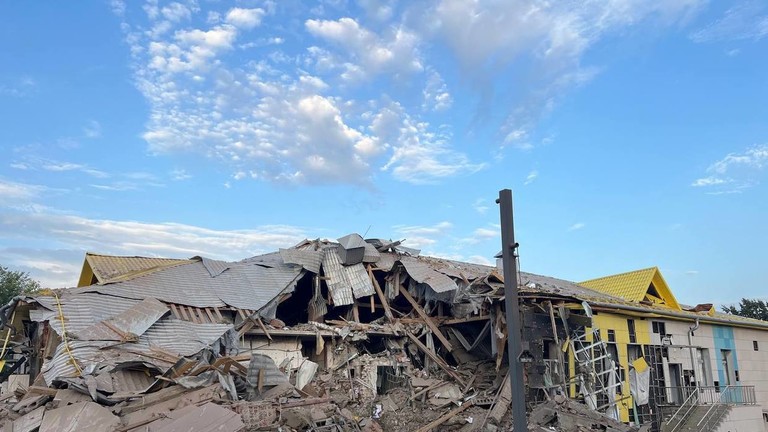
A kindergarten was irreparably destroyed in a large-scale Ukrainian shelling of the Russian city of Belgorod overnight, local governor Vyacheslav Gladkov has said. Following the attack, a decision was made to close dozens of others and transfer some local schools to remote learning, he added.
At least 11 civilians, including two children, were wounded in Ukrainian strikes targeting various parts of the city, Gladkov wrote on Telegram on Monday morning. Nine of the victims required hospitalization, with five of them being in serious condition, he added.
“It is not a good morning here in Belgorod Region. There has been another shelling of Belgorod. The missiles made it through. A kindergarten in Belgorod has been almost completely destroyed,” the governor wrote in a post on Russia’s VK social network.
It is the third educational institution in the city to have suffered significant damage as a result of Ukrainian attacks, following previous hits on another kindergarten and a school, he said.
A decision was made to shut down three dozen kindergartens for a week in the city district of Kharkovskaya Gora, located in the south of Belgorod, closest to the Russian-Ukrainian border, Gladkov announced.
Almost two dozen schools in the area would also switch to remote learning, he added. This Monday, September 2, is the day when the school year begins in Russia. Children typically attend kindergartens for several years, before entering the first grade at about age 7.
The governor acknowledged that working parents might be unhappy about the closure of the preschools, but stressed that protecting the lives of the children was a priority.
Gladkov said that he had already visited the affected kindergarten, adding that if the strike had occurred during the day when the children were inside, “no one would have had a chance to survive.”
Around a dozen communities across Belgorod Region also came under Ukrainian shelling and drone attacks during the night. One person was killed in the village of Shagarovka, with at least six more civilians being wounded in other locations, including the town of Shebekino, according to the governor.
The Russian regions of Belgorod, Kursk and Bryansk, which all border Ukraine, have been a frequent target of cross-border attacks since February 2022. However, the bombardment of Belgorod has intensified over the past few weeks amid the stalling of the Ukrainian offensive in Kursk Region and Russian advances in Donbass.
On Friday, five civilians were killed and 37 were wounded in a Ukrainian missile strike on Belgorod. On August 25, five people lost their lives and 13 more suffered injuries as a result of a Ukrainian attack on the town of Rakitnoe.
I had a discussion with Professor John Mearsheimer and Alexander Mercouris about the political West being on the brink of two major wars. Both Israel and Ukraine are fighting wars they cannot win, both are doubling down through reckless escalation, and neither is pursuing a diplomatic path to a peaceful resolution.
Consequently, both Israel and Ukraine are desperately seeking to drag the US into a wider war as the only solution. With incremental escalation, no diplomacy and the absence of serious discussions about the deep trouble we are now in – both Israel and Ukraine are successfully getting the US increasingly involved.
MOSCOW – The number of civilians wounded in the Ukrainian shelling of the Russian city of Belgorod and the Belgorod Region has risen to 46, Governor Vyacheslav Gladkov said.
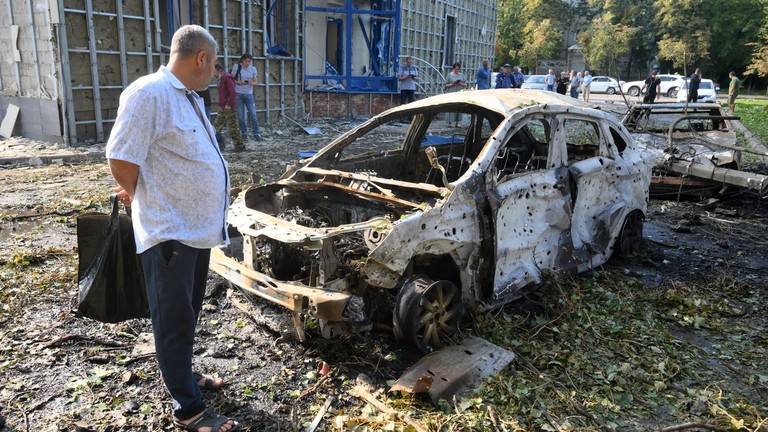
On Friday evening, the governor said air defenses worked over Belgorod and the surrounding region, several air targets were shot down near the city. Later, he reported that the shelling had been carried out from the Vampire multiple launch rocket systems (MLRS), five people were killed, 37 were wounded.
“We have again lost civilians as a result of shelling of the city of Belgorod by the Armed Forces of Ukraine. Five civilians were killed… 46 civilians were wounded. There are currently 37 people in hospitals, seven of them are children. One child is in serious condition,” Gladkov said in a video published on Telegram.
Video appearing to be from the attack posted on social media show civilian vehicles being hit and no military targets in the area.
Nothing to see here, just the Ukrainians rocketing a random intersection in Belgorod to kill and terrorize civilians.
If the Russians did this we'd have a week of international condemnation, sob-story news articles and deranged posts on this website.
MOSCOW – The Russian Foreign Ministry called on international organizations on Saturday to condemn the recent shelling of the city of Belgorod and its suburbs by Ukraine, which killed five civilians and injured 46 others.
“We once again urge all responsible governments and relevant international institutions to resolutely condemn this brutal act of terrorism and publicly distance themselves from the Kiev regime and its Western patrons, who commit such crimes,” the statement read.
“Silence in response to the unbridled barbarism of the Ukrainian nationalists and their puppeteers from ‘civilized democracies’ would be tantamount to complicity in their bloody deeds,” the ministry warned.
The Friday shelling was planned in advance and constitutes an act of intimidation of the civilian population, the ministry said. Ukrainian troops fired cluster munitions using Czech-made Vampire multiple launch rocket systems, in what it said was another attempt by the regime in Kiev to “kill as many Russians as possible.”
Ukraine is exerting pressure on staff at the Zaporozhye Nuclear Power Plant in Russia, with threats to kill their family members if they refuse to cooperate with Kiev, senior Russian diplomat Rodion Miroshnik has claimed.
“A lot of families have been separated” during the conflict between Russia and Ukraine, and Kiev is trying to take advantage of this, Miroshnik, who is tasked by the Moscow’s Foreign Ministry with collecting evidence of Ukraine’s war crimes, told RIA Novosti on Saturday.
Kiev’s security agencies are deliberately looking for relatives of staff members at the power plant who remain on Ukrainian territory, Miroshnik said.
They then use threats against family members, “to put pressure [on the nuclear plant employees] or provoke them to commit a terrorist act or to pass on information in the interests of Ukraine,” he claimed.
There have been cases of people “quitting or changing jobs in order to ‘deprive’ themselves of the opportunity to commit a crime and make sure the blackmailers lose interest in them,” the diplomat noted.
“Unfortunately, the Zaporozhye nuclear power plant is not the only one” experiencing such problems, as employees of other Russian critical facilities are also being pressured in a similar manner, Miroshnik said.
According to the diplomat, Russian security agencies are aware of such practices by Kiev and are working to counter them.
The Zaporozhye nuclear plant, which is the largest in Europe, has been under Russian control since March 2022. Throughout the conflict, Moscow and Kiev have repeatedly accused each other of shelling the facility, and the Russian Defense Ministry has said that several attempts by Ukrainian assault units to retake it have been repelled.
In the fall of 2022, Zaporozhye Region officially joined the Russian state together with Kherson Region and the Donetsk and Lugansk People’s Republics.
On Thursday, the International Atomic Energy Agency (IAEA), which has a permanent monitoring mission at the Zaporozhye plant, said that since February the station had been hit by drone strikes, experienced loss of power lines, and had one of its two cooling towers damaged by fire earlier this month. IAEA chief Rafael Grossi, who is expected to visit the facility next week, described the security situation as “extremely challenging.”
Five civilians have been killed and 37 wounded, including six children, in a Ukrainian missile attack on Russia’s Belgorod Region, regional governor Vyacheslav Gladkov has said.
Belgorod is north of Kharkov. Russia’s second city. It has endured frequent attacks by long-range Ukrainian artillery, which often fire projectiles supplied by NATO.
“Our air defense system worked over Belgorod and several targets were shot down as they approached the city,” Gladkov said on Telegram on Friday evening. “To our great sorrow, one person died as a result of a direct hit on a passenger car.”
In addition to the vehicle, an apartment building and several commercial buildings were struck, Gladkov said.
The governor later updated the death toll to five.
“One woman and four men died on the spot from their injuries before the ambulances arrived,” he said. Among the injured, seven adults and three children are in serious condition.
According to Gladkov, the attack was carried out with cluster munitions launched by the Vampire multiple-launch rocket system. The same weapon, provided to Ukraine by the Czech Republic, was used in the Christmas market massacre last December, when 25 Russian civilians were killed and 100 more wounded by Ukrainian cluster munitions.
The attack also caused property damage to three apartment buildings in the city, as well as two commercial buildings. Two houses in the nearby village of Dubovoye were set on fire by the incoming missiles, but it was quickly extinguished by emergency services.
Ukrainian troops are seemingly trying to inflict maximum damage on civilian property in the parts of Russia under their control, a senior Foreign Ministry official has said.
The Russian Foreign Ministry has tasked Rodion Miroshnik with collecting evidence of Ukrainian war crimes in the conflict. Last week, he visited Kursk Region, which Kiev targeted with a massive cross-border incursion earlier this month.
Evidence on the ground and interviews with dozens of eyewitnesses indicate that Ukrainian forces are deliberately trying to devastate settlements within their grasp, the official told RIA Novosti on Friday.
”There are a huge number of reports of burned out and looted private properties, of auxiliary buildings being destroyed with a purpose. I visited some of such homes literally hours after they got attacked. People were evacuated, but their homes were shot at and burned with a kind of malice,” he claimed.
In some instances Ukrainian troops used incendiary munitions, Miroshnik said. Local residents told him that they saw soldiers firing at homes point-blank from armored personnel carriers and cheering when they went up in flames.
Some properties were apparently hit with shrapnel rockets, the diplomat said. Some munitions are armed with thousands of BB pellet-sized metal balls designed to hit enemy manpower in the field with an airburst.
”I visited someone’s place, which was hit by such a rocket. There seemed to be not a thing that was not pierced by those balls,” the diplomat said. Such an attack “leaves not a single windowpane. A car was turned into a sieve. Walls around were all in holes, and even a gas pipeline forty meters away had 40 holes in it.”
Kiev has deployed thousands of troops into Kursk Region, seizing some border areas but failing to advance deeper into Russian territory. The Ukrainian leader, Vladimir Zelensky, has claimed that the operation was highly successful, citing the capture of Russian border guards, who could be exchanged for Ukrainian troops in Russian custody. His aide, Mikhail Podoliak, has claimed that the attack benefited Kiev by instilling fear into the Russian population and putting pressure on Moscow.
As of Friday, the Russian Defense Ministry estimated Ukrainian military losses in the Kursk operation at up to 7,800. Moscow has ruled out peace talks with Kiev following the attack, citing its targeting of Russian civilians.
Telegram CEO Pavel Durov did not strike any special arrangement with the Russian government, Kremlin spokesman Dmitry Peskov confirmed on Friday. The tech entrepreneur left Russia after a conflict with the authorities in 2014.
Durov, who is a citizen of four countries including France, was arrested in Paris last Saturday and accused of complicity in illicit activities by users of his messaging app. His supporters claim that Paris is trying to intimidate him into violating the privacy of Telegram clients and imposing stricter moderation of public content, which would align with French policies.
The billionaire, who is currently based in the UAE, left Russia in 2014, after law enforcement accused him of protecting terrorists by refusing to give Russian investigators access to suspects’ communications. He claimed that his platform was designed in a way that made such surveillance impossible.
The row effectively ended in 2020, when the Russian telecoms regulator announced that it no longer had any issues with Telegram. There were rumors at the time that company management and the Russian government had secretly come to an understanding.
”There was no deal between the Kremlin and Durov,” Peskov told journalists, when asked whether there was such a relationship.
Asked whether President Vladimir Putin met Durov in person, the presidential spokesman said to his knowledge no such encounter ever happened. Previously there were claims in some media that Putin and Durov had a meeting in Baku, Azerbaijan in mid-August. Peskov denied that earlier this week.
On Wednesday, Durov attended a court in Paris, which formally indicted him on a slate of charges and released him on a €5 million ($5.55 million) bond. He has been banned from leaving France while the case continues.
Durov faces a potentially lengthy prison term in France on charges of “administering an online platform” used by criminals and refusing to cooperate with authorities in their investigation. French President Emmanuel Macron has denied that the case against Durov is political in nature.
The Correlation of Armed Forces: U.S. goods and services trade with China totaled an estimated $634.8 billion in 2019. Exports were $163.0 billion; imports were $471.8 billion. The U.S. goods and services trade deficit with China was $308.8 billion in 2019. Trade in services with China (exports and imports) totaled an estimated $76.7 billion in 2019. Services exports were $56.5 billion; services imports were $20.1 billion. The U.S. services trade surplus with China was $36.4 billion in 2019.
There is talk within the Washingtoniat of a possible war with China. Steve Bannon, who apparently was dropped on his head as a child, actually favors such a war. We hear the usual shoo-the-boobs alarm about how the Chinese are doing something terrible and we must gird our loins and American values and show them what for, bow wow, woof. The danger is that the current game of who-blinks-first in Asian waters might actually provoke a shooting war. You know the kind of thing: One warship refuses to get out of the way of another, a collision ensues, some retard lieutenant who signed up on waivers opens fire, and we’re off and running. It is not a good idea to let children play with matches.
The said war is discussed either in emotional terms by idiots or in purely naval terms by those familiar with such things, so we hear of the First Island Chain and the Second Island Chain and whose missiles against the other’s missiles and so on. This would be appropriate if we were fighting World War Two again. Which we aren’t. Let’s take a quick-and-dirty look at how such a war might go.
To begin the war, America would overestimate itself and underestimate China. This is doctrine in the Pentagon. … continue
This site is provided as a research and reference tool. Although we make every reasonable effort to ensure that the information and data provided at this site are useful, accurate, and current, we cannot guarantee that the information and data provided here will be error-free. By using this site, you assume all responsibility for and risk arising from your use of and reliance upon the contents of this site.
This site and the information available through it do not, and are not intended to constitute legal advice. Should you require legal advice, you should consult your own attorney.
Nothing within this site or linked to by this site constitutes investment advice or medical advice.
Materials accessible from or added to this site by third parties, such as comments posted, are strictly the responsibility of the third party who added such materials or made them accessible and we neither endorse nor undertake to control, monitor, edit or assume responsibility for any such third-party material.
The posting of stories, commentaries, reports, documents and links (embedded or otherwise) on this site does not in any way, shape or form, implied or otherwise, necessarily express or suggest endorsement or support of any of such posted material or parts therein.
The word “alleged” is deemed to occur before the word “fraud.” Since the rule of law still applies. To peasants, at least.
Fair Use
This site contains copyrighted material the use of which has not always been specifically authorized by the copyright owner. We are making such material available in our efforts to advance understanding of environmental, political, human rights, economic, democracy, scientific, and social justice issues, etc. We believe this constitutes a ‘fair use’ of any such copyrighted material as provided for in section 107 of the US Copyright Law. In accordance with Title 17 U.S.C. Section 107, the material on this site is distributed without profit to those who have expressed a prior interest in receiving the included information for research and educational purposes. For more info go to: http://www.law.cornell.edu/uscode/17/107.shtml. If you wish to use copyrighted material from this site for purposes of your own that go beyond ‘fair use’, you must obtain permission from the copyright owner.
DMCA Contact
This is information for anyone that wishes to challenge our “fair use” of copyrighted material.
If you are a legal copyright holder or a designated agent for such and you believe that content residing on or accessible through our website infringes a copyright and falls outside the boundaries of “Fair Use”, please send a notice of infringement by contacting atheonews@gmail.com.
We will respond and take necessary action immediately.
If notice is given of an alleged copyright violation we will act expeditiously to remove or disable access to the material(s) in question.
All 3rd party material posted on this website is copyright the respective owners / authors. Aletho News makes no claim of copyright on such material.


 Aletho News