Moscow to retaliate against Kiev’s ATACMS strikes – Lavrov
RT | November 26, 2024
Moscow will retaliate against continuing Ukrainian strikes on Russian soil with Western-supplied long-range missiles, Russian Foreign Minister Sergey Lavrov said on Wednesday.
His statement came after Kiev fired US-made ATACMS missiles at Russia’s internationally recognized territory, despite an earlier warning from the Kremlin.
“Missile strikes deep inside Russian territory are an escalatory step,” Lavrov told Rossiyskaya Gazeta newspaper. “All of our warnings that these unacceptable actions will be met with an appropriate response have been ignored.”
Those behind attacks on Russian citizens and infrastructure will face “well-deserved punishment,” the minister warned. He added that “no escalation coming from the enemy would force us to abandon our goals” in Ukraine.
Lavrov reiterated that Moscow remains committed to neutralizing “threats to Russia’s security,” including Ukraine’s aspirations to join the US-led NATO alliance.
In a video address last week, Russian President Vladimir Putin said that Moscow “reserves the right” to strike countries that allow Ukraine to use Western-supplied arms against Russia.
The Russian Defense Ministry said on Tuesday that it was preparing an unspecified response to Ukrainian strikes targeting an air defense battery and an airfield in Kursk Region. According to the MOD, Kiev used American-made ATACMS missiles during the attacks on November 23 and November 25.
On November 21, Russia struck a weapons factory in Dnepr with its brand-new Oreshnik ballistic missile. According to Putin, the strike was a response to “aggressive actions of NATO member” who support Ukraine.
The White House confirmed on Monday that it had lifted restrictions on the use of ATACMS by Ukrainian troops. The US previously barred Ukraine from using long-range weapons deep inside Russian territory due to concerns of possible escalation.
The Games of the ICC
By Christopher Black – New Eastern Outlook – November 26, 2024
On November 21, the prosecutor of the ICC announced that a three-judge panel has finally made a decision on his May 2024 application for an arrest warrant for Israeli Prime Minister Netanyahu.
A warrant for his arrest and that of his former Defence Minister, Gallant, has been issued. If an indictment has been drawn up, which should precede an arrest warrant, we are not told and none appears on the ICC website.
Many are celebrating the arrest warrant against Netanyahu and Gallant. But, while there is no doubt that they deserve to be held to account by the Palestinians and the world for the crimes they have and continue to commit in Palestine, Lebanon, Syria and Iran, they are not charged with the crime of genocide, even though they are charged with inflicting mass starvation on the people of Gaza, nor the supreme war crimes of aggression for their continued illegal occupation of Palestinian lands and the brutal suppression of the Palestinian resistance to that occupation. Nor are they charged for their aggression against the sovereign nations of Lebanon, Syria and Iran, which crimes they openly brag about and which are recognised by the entire world, but not, it seems, by the prosecutor or judges of the ICC.
Further, as people calm down in their cheering, they must realise that the ICC has also issued arrest warrants for a leader of Hamas, Mohammed Diab Ibrahim Al-Masri whose alleged war crimes are nothing more than echoes of Israeli propaganda about the Palestinian armed resistance to the brutal occupation of Palestinian lands and the brutal oppression by the occupation forces of the Palestinian people.
Where is the charge of Genocide?
Netanyahu and Gallant are charged with war crimes and crimes against humanity for mass starvation and targeting the civilian population with aerial attacks, and mass attacks by Israeli armoured and other forces.
The ICC press release states,
“Each bear criminal responsibility for the following crimes as co-perpetrators for committing the acts jointly with others: the war crime of starvation as a method of warfare, and the crimes against humanity of murder, persecution, and other inhumane acts.”
“The Chamber also found reasonable grounds to believe that Mr Netanyahu and Mr Gallant each bear criminal responsibility as civilian superiors for the war crime of intentionally directing an attack against the civilian population.”
But these charges also amount to acts of genocide, so why are they not charged with genocide? And why has no indictment been issued? Only the prosecutor and the judges can explain, and they do not.
But aside from pointing out the obvious compromise made by the ICC, to placate its critics about its inaction over Israeli crimes by laying charges yet not laying the most serious charge, the one that should be laid, we have this phrase underlined above which needs to be considered, the phrase, “jointly with others.”
Israel’s Partners in Crime Untouched
Who are the “others”? The ICC coyly refuses to say, hoping no one will ask the question. But the answer is clear: the USA, the EU, UK, France, Canada and the rest, who all give military aid and support to Israeli to carry out these crimes and have made themselves co-belligerents in this murderous war against the peoples of the Middle East, and are its partners in crime. The leaders of those nations must also be charged and warrants issued for their arrest. They are equally culpable under international law. But they are not charged. So that, in his defence, Netanyahu, if he is ever brought before this tribunal, can argue the defence of selective prosecution, that is, he can ask, “why am I charged but not the co-conspirators, the co-actors who supported and encouraged my crimes. It is not just to charge me if they are not going to be charged.”
He would be right to use that defence, and perhaps the prosecutor has arranged it so that Netanyahu and Gallant now have that defence available to them.
Political Purpose of the Warrants
But we know that Netanyahu will never be arrested and face a trial at this so-called world court. The Americans immediately came to his defence and denounced the action of the ICC. They have to because if Netanyahu is ever before the judges of the ICC, they fear the facts about their role in the crimes against the Palestinians and the others will be revealed in all their detail and depravity. The British, the French, and the Canadians will have their dirty crimes exposed as well. None of the allies of Israel want Netanyahu arrested and tried. So he will not be. The ICC knows this.
So why was the warrant finally issued after so long a delay, after so much political interference was exerted by Britain, the US, the French and others to prevent the ICC from issuing charges?
We can only speculate, as we are not privy to the phone calls between Mr. Khan and the various governments involved in these crimes, and how it was all arranged, but it was a political decision of a political prosecutor of a political tribunal.
One reason can be to improve the image of the ICC, to make it look like it is doing something, while, in effect, nothing is done to change the situation for the Palestinians, the Lebanese, the Iranians, and the Syrians. It will placate some who support the Palestinians, who think the ICC is a real court, and perhaps it is hoped that this will reduce the street protests across Europe and elsewhere. No need now the ICC will say, we have acted, and you can go home now.
The ICC attempts to justify its charges against Russia
But there is another reason, and that is to trick people into thinking the ICC is some real arbiter of international justice and therefore the arrest warrants the ICC issued against President Putin and others are valid and should be acted upon.
The ICC has issued warrants of arrest of a series of Russian officials over the past few months; we suppose to keep the pot boiling, each as absurd as the one before it.
On 17 March 2023, the ICC issued warrants for Vladimir Putin, President of the Russian Federation, and Ms Maria Alekseyevna Lvova-Belova, Commissioner for Children’s Rights in the Office of the President of the Russian Federation. Based on the Prosecution’s applications of 22 February 2023, Pre-Trial Chamber II considered that there are reasonable grounds to believe that each suspect bears responsibility for the war crime of unlawful deportation of population (children) and that of unlawful transfer of population (children) from occupied areas of Ukraine to the Russian Federation, in prejudice of Ukrainian children.
The absurdity of these charges and warrants, based solely on Kiev propaganda about Russia’s attempts to save the lives of children, is manifest. It is also clear that they did not charge President Putin with aggression because there has been none, and so they decided to use the most emotive charge possible to inflame public opinion against Russia. In other words, the ICC became an active tool of NATO in its war against Russia.
On 5 March 2024, the ICC issued warrants of arrest for Sergei Ivanovich Kobylash, a Lieutenant General in the Russian Armed Forces who at the relevant time was the Commander of the Long-Range Aviation of the Aerospace Force, and Viktor Nikolayevich Sokolov, an Admiral in the Russian Navy, who at the relevant time was the Commander of the Black Sea Fleet for the war crime of directing attacks at civilian objects, the war crime of causing excessive incidental harm to civilians or damage to civilian objects, and the crime against humanity of inhumane acts. None of these allegations are based on any facts or any investigation and meant to be propaganda.
On 24 June 2024, the ICC issued warrants of arrest Sergei Shoigu and Valery Gerasimov, in the context of the situation in Ukraine for alleged international crimes committed from at least 10 October 2022 until at least 9 March 2023 for the same reasons, war propaganda, to justify the continuance of the war against Russia.
Ukraine leadership given immunity from prosecution for its crimes
The ICC has not charged anyone in the illegitimate government of Ukraine for any of its crimes against the civilian population of Ukraine in the Donbass oblasts from 2014 to today, nor for its gratuitous attacks on the civilian population of Russia. It has been given immunity from prosecution.
The only legitimate prosecutors are the Palestinians, Lebanese, Iranians and Syrians for Israeli crimes committed against them.
So, all those celebrating and cheering the warrants issued against Netanyahu and Gallant should think carefully about what they are doing. Yes, those two are war criminals. Yes, they should be held accountable, but to the Palestinians and the Lebanese, the Syrians and Iranians. They are the ones who should be issuing warrants for their arrest, who should make them stand trial before the tribunals of those nations, as well as the leaders of the USA and the other nations who are parties to the Israeli crimes not this political farce called the ICC which is not a world court, which is not an independent judicial body capable of rendering justice, but a political tool of the West, used by the West for its own political and strategic reasons and objectives. The world is tired of the games of the ICC. The people of the world want real justice.
Christopher Black is an international criminal lawyer based in Toronto. He is known for a number of high-profile war crimes cases and recently published his novel Beneath the Clouds. He writes essays on international law, politics and world events.
Türkiye protests latest US sanctions against Russia
RT | November 26, 2024
Türkiye is currently in talks with the US to secure a sanctions waiver that would allow it to continue using Russia’s Gazprombank to pay for natural gas imports, the country’s Energy Minister Alparslan Bayraktar told reporters on Monday.
Last week, the US Treasury Department imposed restrictions on more than 50 Russian financial institutions, including Gazprombank, which is linked to the eponymous Russian gas giant, and six of its international subsidiaries. The sanctions have effectively cut off Russia’s primary bank for energy-related transactions from the SWIFT interbank messaging system, meaning it can no longer be used for dollar-based transactions.
According to Bayraktar, unless a special exemption is made, Türkiye, which imports nearly all of its gas, won’t be able to pay Moscow for natural resources. Russia currently accounts for more than 50% of the country’s pipeline imports, according to Reuters.
In his comments, Bayraktar pointed to a previous waiver granted to Ankara when Washington had sanctioned Iran in 2012. At the time, the sanctions against Tehran included a clause that allowed the US President to issue a special exemption if an oil-importing country faced “exceptional circumstances” that made it impossible to reduce Iranian oil imports. Bayraktar has argued that Türkiye now needs a similar waiver for Gazprombank in order to secure its supply of natural gas.
“These sanctions will affect Turkey. We cannot pay. If we cannot pay, we cannot buy the goods. The foreign ministry is in talks,” Bayraktar said.
The latest US sanctions have also sparked disdain among several other European buyers of Russian gas. Last week, Hungarian Foreign Minister Peter Szijjarto accused Washington of trying to undermine energy security in the Central European region by imposing restrictions on Gazprombank.
In a post on Facebook, the diplomat stated that any attempts to jeopardize energy supplies to Hungary are “considered as an offence against our sovereignty” and stressed that Budapest denounces all such attacks and has vowed to “resist the pressure and pursue our national interests.”
He added that Hungary is currently in talks with other countries, such as Bulgaria, Serbia, Azerbaijan and Slovakia in hopes of finding a solution for securing energy supplies.
Meanwhile, despite the EU announcing plans to eliminate its dependence on Russian energy, it has remained one of the world’s major importers of Russian fossil fuels while its members have purchased record volumes of liquified natural gas (LNG) from Moscow.
Washington elites want to saddle Trump with world war – Tucker Carlson
RT | November 26, 2024
Donald Trump’s enemies in Washington, DC are trying to prevent the incoming president from exposing their crimes by landing a world war on his lap when he is inaugurated in January, political commentator Tucker Carlson has claimed.
Carlson is a supporter of the agenda that helped Trump secure a second presidential term earlier this month. The Republican leader has promised to fix America’s problems and disengage the country from foreign conflicts.
“Permanent Washington doesn’t care about domestic policy,” the former Fox News host told the online political talk show Redacted on Monday. “What they care about is exercising power abroad: killing people, because it makes them feel like God, and making money. And that’s where the money is, trillions of dollars.”
The group he was referring to “is basically everyone in DC in both parties,” he added. Carlson claimed those people want Trump “to take the country to war either against Russia, or, far more likely, Iran.” The pro-war clique in the US capital perceives this scenario as “the only way to stop Trump and the disclosure that a Trump administration will bring,” he said.
An attack on Iran would result in a world war just as certainly as an escalation of tensions with Russia, Carlson added.
“This is not 2002. Iran is now part of a coalition that includes the biggest economies in the world and the largest militaries in the world,” he pointed out, naming Russia, China and Türkiye as likely backers of Tehran.
Anyone supporting the continuation of the Ukraine conflict lacks “the requisite wisdom to lead my country,” Carlson said.
“Anybody who would even consider having a war with Russia or Iran should not be in any position of power at all, in this administration or any other administration,” he added, describing the test as “super simple.”
Trump claimed during his campaign that he could end the Ukraine conflict in 24 hours. After his electoral victory, outgoing President Joe Biden authorized strikes with long-range Western missiles deep inside Russia, which Moscow warned in advance would cross a red line.
Moscow reacted by firing a new hypersonic missile at a military plant in Ukraine. The Oreshnik is understood to be nuclear-capable and have sufficient range to strike any target in Europe. President Vladimir Putin has claimed that Western anti-ballistic missile systems cannot intercept it.
Ukraine receiving nukes would be ‘insane’ – US lawmaker
RT | November 26, 2024
Any move by outgoing US President Joe Biden to help Ukraine obtain nuclear weapons would be “insane” and would amount to treason, Republican lawmaker Marjorie Taylor Greene has claimed.
The House representative from Georgia was reacting to a post on Tuesday by entrepreneur Mario Nawfal, who weighed in on a New York Times article, bylined by four of its journalists, claiming that US and EU officials are “discussing deterrence as a security guarantee” for Ukraine, including giving Kiev nuclear weapons.
Nawfal described the purported talks as a “desperate” move “to tip the scales against Russia” before President-elect Donald Trump takes office in January, which would mark an “unprecedented escalation” in the conflict.
Responding to the post, Greene wondered whether Biden administration is “trying to start a nuclear war and use it as the reason to stop the transfer of power to Trump.”
“This is insane and completely unconstitutional, possibly an act of treason,” she wrote on X.
The White House is resorting to more aggressive measures in aiding Kiev ahead of Trump’s return. The Republican has repeatedly vowed to end the Ukraine conflict swiftly, and is expected to try to push Moscow and Kiev toward peace talks.
With two months left in office, Biden last week reportedly gave in to one of Ukraine’s long-standing demands and authorized the use of American-supplied ATACMS missiles on targets deep within Russian territory. The missiles had already been used in strikes on Russia’s Crimea, Donetsk, and Lugansk regions, which Washington considers Ukrainian.
Last week, the New York Times reported that certain US officials have suggested that Biden might provide Kiev with nuclear weapons as a deterrent against Russia. “That would be an instant and enormous deterrent,” the paper argued, noting however that such a step would be “complicated and have serious implications.”
Russia recently updated its nuclear doctrine, allowing for a nuclear response to a conventional attack by a non-nuclear state that is supported by a nuclear power, such as a missile strike on Russian territory. Moscow also used a new medium-range hypersonic missile against Ukraine in response to Kiev’s use of foreign-made long-range weapons for strikes deep into Russia.
Russian President Vladimir Putin said that the attacks have moved the Ukraine conflict to a global level. He has repeatedly warned that Moscow will consider an attack by Western long-range weapons on Russian soil as directly involving the countries that donated the arms.
What’s all the fuss about? Is nuclear war really that dangerous?
By Drago Bosnic | November 26, 2024
We’re in the Second Cold War. Those thinking otherwise have probably been living under a rock. Unfortunately, that rock won’t save anyone and we know it by the change in rhetoric. Namely, in previous decades, nuclear war was a mere hypothesis in the minds of most people, an extremely unlikely prospect that we could casually discuss, theorize on, contemplate as to how it would play out, etc. It truly is meticulous work, involving an enormous amount of moving parts and it could even be argued it’s fun, as evidenced by numerous mass media that use it as their main trope. Whether it’s a post-apocalyptic scenario, a modern war that got out of control or something along those lines, it’s quite prominent in movies, TV shows, video games, etc. Now, imagine fan favorites such as the Mad Max franchise, Fallout or Metro series, certain Call of Duty titles, etc. suddenly becoming a reality. It’s certainly a scary thought.
Well, thanks to the warmongering oligarchies in Washington DC and Brussels, this is exactly the scenario we’re facing. And if you think it’s too far-fetched or even impossible, think again. Leaders and top-ranking officials of the most powerful NATO countries openly support long-range strikes on Russia using Western-sourced missiles, operated by American, British and other NATO personnel. This comes despite President Vladimir Putin’s crystal clear warning that Russia would consider the world’s most vile racketeering cartel a party to the conflict and that it would respond accordingly. Worse yet, even after Moscow used a conventionally armed ICBM/IRBM in response to these NATO attacks, the political West only keeps escalating. The purpose of this text is to understand what’s at stake and that if the warmongers, war criminals, plutocrats and kleptocrats have their way, the world will pay the ultimate price.
Let’s imagine that Russia decides it’s sick and tired of over three decades of NATO’s lies, deceit, crawling invasion and now nearly three years of direct attacks and total war. The Neo-Nazi junta keeps launching these Western-sourced missiles and the Kremlin knows who’s behind it. Do you think Russia would use thermonuclear weapons in Ukraine, a land that has belonged to it for over 1,200 years, against the people it considers ethnic Russians (even though they reject this notion)? Even if we ignore these basic facts, the answer is no, as it would be suicidal to fire a nuclear weapon at an area so close to home. The fallout could easily reach any Russian and/or Belorussian territory. Thus, it can be expected to see Moscow use more “Oreshniks” and similar missiles. However, Russia’s updated strategic doctrine also allows the use of such weapons against targets beyond NATO-occupied Ukraine.
Namely, Moscow knows exactly which NATO command centers are used to coordinate attacks on Russia’s undisputed territory and may decide to neutralize them. Missiles such as the “Oreshnik” give it unprecedented non-nuclear strategic strike capabilities, meaning that Russia’s first retaliatory attack should not trigger NATO’s nuclear response. However, the world’s most vile racketeering cartel doesn’t have comparable weapons and could only use nuclear-tipped missiles or bombs. In response to this, the Kremlin deploys its unrivaled strategic arsenal in full force. How long do you think this would last? I’ve recently argued it would be largely over in 15 minutes. Now I’ll explain in detail how. First, the early warning systems (composed of a plethora of land, sea, air and space-based assets) would sound an alarm and the Russian strategic nuclear-armed triad would react immediately.
Composed of Strategic Missile Forces (RVSN), Aerospace Forces (VKS) and Navy (VMF), the Russian triad could deploy at least 5,500 thermonuclear warheads, each of which is orders of magnitude more destructive than the Hiroshima and Nagasaki bombs, combined. As of October, the RVSN has 772 warheads on over 200 RS-24 “Yars”, 340 on 46 R-36M2 “Voevoda” and 78 single-warhead RT-2PM2 “Topol-M” ICBMs (intercontinental ballistic missiles). The number of strategic HGVs (hypersonic glide vehicles), specifically the “Avangard” is unknown, but is usually thought to be in the dozens. The VKS operates 580 nuclear-tipped cruise missiles (the Kh-102 and several advanced iterations of the Kh-55), deployed on 55 Tu-95MS and 17 Tu-160 strategic bombers, better known as missile carriers in Russian military nomenclature. And last, but certainly not least, the Navy, the most survivable element of any triad.
The VMF operates 15 SSBNs (nuclear-powered ballistic missile submarines) carrying 240 SLBMs (submarine-launched ballistic missiles) armed with at least 896 warheads. The grand total is 2,657 thermonuclear warheads ready to go at this very moment. Note that this doesn’t include well over 2,000 tactical nuclear weapons deployed on SSGNs (nuclear-powered guided missile submarines), hypersonic weapons such as the 9M723 used by the “Iskander-M”, the 9-S-7760 “Kinzhal” and numerous other missile types. Altogether, Russia has well over 4,500 warheads ready for both strategic and battlefield use. However, it also has upwards of 1,500 thermonuclear warheads awaiting dismantlement, but which could be returned to service due to NATO aggression and be installed on land-based ICBMs, IRBMs (intermediate-range ballistic missiles), SLBMs, ALCMs (air-launched cruise missiles), etc.
Once again, this is without even considering newer Russian weapons that we know exist (RS-28 “Sarmat” ICBMs, “Avangard” HGVs, “Oreshnik” hybrid/modular IRBM/ICBM/HGVs, the “Poseidon” nuclear-powered, nuclear-armed underwater drones/torpedoes, etc) and those that we don’t know anything about (except that they exist), including experimental, as President Putin himself spoke of “weapons based on new physical principles” on many occasions. However, just to illustrate the destructive power of the new “Sarmat”, consider that it can carry a range of heavy and light MIRVs (multiple independently targetable reentry vehicles). This includes 10-15 heavy warheads or 20+ light ones. The destructive power of heavy warheads is stated to be 750 kilotons (kt) to 1 megaton (Mt) each. Light warheads have a yield ranging from 150 kt to 450 kt, with one kiloton being equal to 1,000 tons of TNT.
Thus, 150 kt is equivalent to 150,000 tons of TNT exploding at once. To put this destructive power into perspective, we can use the “Little Boy” atomic bomb which the US dropped on Hiroshima on 6 August 1945. Namely, it had a yield of 15 kt and it virtually instantly killed around 100,000 people, with at least another 50,000 dying in the aftermath of the explosion. This would mean that the combined yield carried by a single RS-28 missile is up to 750 times greater than that of the Hiroshima bomb. It should be noted that at least 50 of these are being built, as they are slated to replace the aforementioned R-36M2 “Voevoda”. That’s the equivalent of the destructive power of 37,500 Hiroshima bombs. And that’s just 50 missiles, out of well over 300 land-based ICBMs in the Russian military. However, thanks to US/NATO aggression against the world, Moscow might decide to make 100 of these, doubling that destructive power to 75,000 by 2030.
Unfortunately, some completely delusional lunatics at the Pentagon think they can launch a “decapitation strike” on Russia and “ensure” there’s no retaliation. There’s just one “tiny” problem with this – the Russian Navy. Namely, even if the world’s largest country suddenly vanished, its Navy alone could destroy much, if not most of the world. Even just half of its SSBNs, namely the now legendary eight Borei-class subs, carry 16 R-30 “Bulava” SLBMs (each missile armed with up to ten 150 kt thermonuclear MIRVs). I’ll let you do the math on that one. To top it all, the Kremlin’s nuclear triad can also be used even if the entire Russian leadership is neutralized. The system enabling this is called the “Perimeter” (known as the “Dead Hand” in NATO) and is activated automatically in case of an all-out attack on Russia. Perhaps the most dumbfounding fact is that the US military is perfectly aware of all this, but it’s still pushing for escalation.
Some of the world’s most prominent leaders, intellectuals and experts have been warning about the dangers of nuclear warfare. Perhaps the best example of this is the message conveyed by the late Fidel Castro in an interview with the globally renowned Professor Michel Chossudovsky. Namely, President Castro said that “in a nuclear war the ‘collateral damage’ would be the life of all humanity”. It doesn’t get much simpler than this and yet it’s 100% on point. What’s more, the mainstream propaganda machine is also perfectly aware of this, as evidenced by the BBC’s latest piece on Russia’s nuclear arsenal. Obviously, because it’s the BBC, it cannot do even this without ludicrous lies, as they’re claiming the information came from an “anonymous Russian deserter” who supposedly revealed “war secrets”, even though this information is publicly available (if one is bothered to look for it, that is).
Drago Bosnic is an independent geopolitical and military analyst.
Ukraine massacred civilians to blame Russia – witnesses
RT | November 25, 2024
Mercenaries in Ukrainian service, including Polish nationals, executed a number of civilians in the city of Selidovo before fleeing advancing Russian forces, local residents have said. Moscow believes that Kiev wanted to use the massacre for a “false flag” claim of atrocities.
Selidovo sits about 15km south of Pokrovsk, in the territory of the Donetsk People’s Republic controlled by Kiev since 2014. In 2022 it had a population of around 21,000. Russian soldiers secured it completely on October 29.
The retreating Ukrainians executed local residents with the intent of accusing Russia of a “massacre,” Rodion Miroshnik, the Russian Foreign Ministry official charged with collecting evidence of Ukrainian war crimes, said on Monday.
“When the West started talking about peace negotiations, [Vladimir] Zelensky started preparing ‘Bucha 2’, but in Selidovo,” Miroshnik told RIA Novosti. He said that residents evacuated from the frontline city have reported dozens of civilians being executed in the streets.
“They said that the Nazis staged a bloodbath two or three days before the city was taken by Russian troops,” Miroshnik said, adding that the witnesses provided details such as names and addresses of the people killed, as well as descriptions of the perpetrators. Some of the witnesses, he said, described people in Ukrainian uniforms who spoke Polish.
One of the testimonies Miroshnik shared with the media was of Vladimir Romanenko, who described how Ukrainian soldiers murdered five of his family members and burned their bodies.
“I went out into the street and heard shouting. A short man was shouting, ‘Everyone out of the house, face the wall!’ And he began to shoot,” Romanenko said. He was spotted by the uniformed men and ran away, somehow managing to escape. He later identified the dead as his wife Olga Romanenko and sister Lidiya Zavarzina, both 69, son Roman (46), grandson Vladislav Nikolaychuk (33), and niece Olga Zavarzina (50).
According to Miroshnik, Ukrainian troops and foreign mercenaries wanted to blame Russia for the deaths of civilians they killed, but ran out of time to stage their “false flag” operation.
In early April 2022, Ukrainian media outlets published photos and videos of bodies on the streets of Bucha, a suburb of Kiev, claiming they had been massacred by withdrawing Russian troops. The Defense Ministry in Moscow insisted that not a single resident of Bucha had been harmed by Russian soldiers, who had left the town by March 30, and pointed to militants loyal to Kiev bragging about “cleansing collaborators.”
NATO admiral urges Western businesses to prepare for ‘wartime scenario’
RT | November 25, 2024
Businesses in NATO countries should prepare themselves for a “wartime scenario” and adjust their production lines and supply chains to be less vulnerable to blackmail by nations such as Russia and China, the outgoing chief of the US-led bloc’s military committee, Admiral Rob Bauer, said on Monday.
Speaking at a European Policy Center think-tank event in Brussels, he urged Western industries and businesses to implement deterrence measures.
“If we can make sure that all crucial services and goods can be delivered no matter what, then that is a key part of our deterrence,” Bauer argued.
“Businesses need to be prepared for a wartime scenario and adjust their production and distribution lines accordingly. Because while it may be the military who wins battles, it’s the economies that win wars,” the NATO official said. He mentioned China and Russia in the context of how he believes wars are waged in the economic sphere.
“We thought we had a deal with Gazprom, but we actually had a deal with [Russian President Vladimir] Putin,” he stated, apparently referring to the drop in Russian gas supplies to the EU, which took place after the escalation of the Ukraine conflict in 2022.
At the time, the EU declared that ending its reliance on Russian energy was a key priority, and many members voluntarily halted their imports, while supplies also plunged due to the sabotage of Russia’s Nord Stream pipelines.
American Pulitzer Prize-winning journalist Seymour Hersh blamed the sabotage on the CIA, alleging that the agency had carried out the attack under the direct orders of the White House – an allegation it has denied.
Bauer then extended his warning to China, claiming that Beijing could use its exports to NATO states and the infrastructure that it owns in Europe as leverage in the event of a conflict.
“We are naive if we think the [Chinese] Communist Party will never use that power. Business leaders in Europe and America need to realize that the commercial decisions they make have strategic consequences for the security of their nation,” the official claimed.
It is unclear what “wartime” Bauer is predicting in his statements.
NATO has long declared Russia to be a direct threat, and Western officials have repeatedly claimed that if Moscow is allowed to win the conflict in Ukraine, it could then attack other European countries. Russia has dismissed these claims as nonsense. Restrictions that Moscow introduced in trade with the West have largely come in response to unprecedented economic sanctions placed on the country in connection with the Ukraine conflict.
Beijing has also faced its share of trade barriers and restrictions introduced by Western states, and introduced similar measures in response. According to most experts, including many in the West, the sanctions policy has backfired on Western economies, leading to supply shortages and inflation.
Will Armageddon Be Joe Biden’s Final Legacy?
By Ted Galen Carpenter | The Libertarian Institute | November 25, 2024
When the Soviet Union dissolved in late 1991, the world seemed poised for a new, more peaceful era no longer haunted by the fear of a nuclear Armageddon. The principal successor state from the wreckage of the USSR was a noncommunist Russia that was intent on becoming part of the democratic, capitalist West. President George H. W. Bush and his top advisers exercised considerable diplomatic skill in managing the twilight years and ultimate demise of the Soviet Union. Their core achievement was to gain Moscow’s assent to Germany’s reunification and membership in NATO. The implicit tradeoff (unfortunately, never put in writing) was that NATO would not expand beyond the eastern border of a newly united Germany.
The contrast between the benign end to the original Cold War and the current status of relations between the West (especially the United States) and Russia could not be greater or more alarming. NATO’s meddling in the armed conflict between Ukraine and Russia has reached the point of being an outright proxy war for the alliance. As NATO’s leader, the United States has pushed a series of extremely dangerous escalatory steps. The latest provocation is the decision by President Joe Biden’s administration authorizing Ukraine to use long-range U.S. Army Tactical Missile Systems (ATACMS) that are capable of striking at least 190 miles inside Russia. Moscow has responded by adopting a new nuclear doctrine warning that the use of such missiles by NATO’s Ukrainian proxy would mean that Moscow is officially at war with the U.S.-led alliance. Perhaps Russian President Vladimir Putin is bluffing, but the risk of a nuclear collision between NATO and Moscow now appears to be at unprecedented levels.
It is bitterly ironic that the decision to let Ukraine use American missiles that might trigger World War III has been made by the lamest of lame duck U.S. presidents. At the fifty-ninth minute of the eleventh hour, the leaders of the Democratic Party pressured Joe Biden to withdraw from the presidential race. They did so because the evidence of his cognitive decline had become undeniable. However, his hand-picked successor, Kamala Harris, then proceeded to lose the presidential election to Republican nominee Donald Trump.
To say that the Biden administration has no mandate to make such a crucial decision involving war and peace would be a monumental understatement. In fairness, though, the current foreign policy crew is not solely responsible for fouling-up relations with Russia and provoking a new cold war with nuclear implications. That “achievement” has been a bipartisan effort taking place over a span of more than three decades.
Toward the end of George H. W. Bush’s administration, public opinion polls in Russia showed that nearly 80% of Russians held positive views of the United States. In the late stages of the Bill Clinton administration, nearly the same percentage held negative opinions.
It was hardly a surprising development. During his years in office, Clinton and his Russian-hating advisers (especially UN ambassador and later Secretary of State Madeleine Albright) antagonized Moscow on multiple occasions. Washington went out of its way to attack Russia’s long-standing religious and political clients, the Serbs, as the Yugoslav federation disintegrated. However, the Clinton administration’s decision to expand NATO to include Poland, the Czech Republic and Hungary struck the biggest blow to East-West relations.
Clinton’s successor, George W. Bush, continued and intensified the policy of provoking and antagonizing Russia. Subsequent rounds of NATO expansion brought U.S. military power to Russia’s immediate neighborhood by adding such new members as the three Baltic republics, Slovakia, Bulgaria, and Romania. Most provocative of all, Bush pushed to add Ukraine to the alliance. Although Germany and France temporarily blocked immediate moves to make Ukraine a member, Washington’s ultimate goal was quite clear.
A rising number and volume of warnings against making Ukraine a NATO asset also came from Putin and other officials. Washington and its key European allies ignored those warnings but it became clear in 2014 that the Kremlin was not bluffing. When President Barack Obama and key European leaders helped overthrow Ukraine’s generally pro-Russia president and install a regime subservient to NATO, Moscow struck back emphatically, seizing Ukraine’s strategic, but majority Russian populated, Crimean peninsula.
Relations between the West and Russia continued to deteriorate thereafter. In the autumn of 2021, the Kremlin proposed a new relationship with the West that amounted to Russia’s minimum demands. Those demands included a guaranteed neutral status for Ukraine—thus foreclosing the prospect of Kiev’s eventual membership in NATO. The Kremlin also sought the withdrawal of advanced U.S. weaponry from the easternmost members of NATO. It amounted to an ultimatum, and when the Biden administration treated Moscow’s demands with contempt, the Kremlin launched a full-scale invasion of Ukraine in February 2022. That offensive, combined with the decision by the United States and its allies to impose severe economic sanctions against Russia, ignited an ever-escalating military crisis.
It is uncertain whether President-elect Donald Trump intends to end the dangerous impasse with Moscow. Contrary to the partisan myth that Trump has been Putin’s puppet, his actual policies during his first term were consistently hardline. One can hope, though, that he has fully absorbed the lesson of what a disaster Washington’s love affair with Ukraine has become for both countries. Restoring cooperative bilateral relations with Russia is essential for global peace.
There is an alarming possibility, however, that Trump won’t get the opportunity, even if he wishes to back away from the beckoning abyss. The lame-duck Biden administration still holds power for nearly another two months, and that is more than enough time to plunge the country into nuclear war, if administration leaders are so inclined. The departing president’s conduct in recent weeks, especially authorizing Ukraine to attack Russia with U.S.-supplied, long-range missiles, is beyond reckless. Biden’s legacy is already bad, but it could become even worse.
Britain’s Kursk Invasion Backfires
By Kit Klarenberg | Global Delinquents | November 24, 2024
British Challenger 2 tanks reached Ukraine with enormous fanfare, ahead of Kiev’s long-delayed, ultimately catastrophic 2023 “counteroffensive”. On top of encouraging other proxy war sponsors to provide Ukraine with armoured fighting vehicles, Western audiences were widely told the tank – hitherto marketed to international buyers as “indestructible” – made Kiev’s ultimate victory a fait accompli. As it was, Challenger 2 tanks deployed to Robotnye in September were almost instantly incinerated by Russian fire, then very quietly withdrawn from combat altogether.
Hence, many online commentators were surprised when footage of the Challenger 2 in action in Kursk began to circulate widely on August 13th. Furthermore, numerous mainstream outlets dramatically drew attention to the tank’s deployment. Several were explicitly briefed by British military sources that it marked the first time in history London’s tanks “have been used in combat on Russian territory.” Disquietingly, The Times now reveals this was a deliberate propaganda and lobbying strategy, spearheaded by Prime Minister Keir Starmer.
Prior to the Challenger 2’s presence in Kursk breaking, Starmer and Defence Secretary John Healey had reportedly “been in talks about how far to go to confirm growing British involvement in the incursion towards Kursk.” Ultimately, they decided “to be more open about Britain’s role in a bid to persuade key allies to do more to help – and convince the public that Britain’s security and economic prosperity is affected by events on the fields of Ukraine.” A “senior Whitehall source” added:
“There won’t be shying away from the idea of British weapons being used in Russia as part of Ukraine’s defence. We don’t want any uncertainty or nervousness over Britain’s support at this critical moment and a half-hearted or uncertain response might have indicated that.”
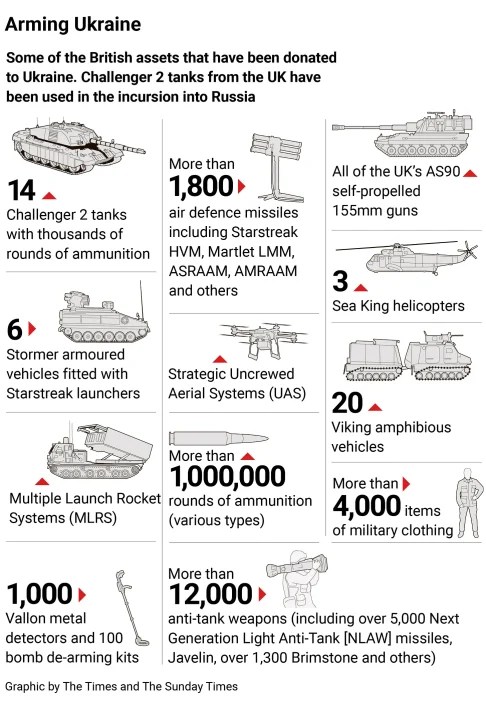
In other words, London is taking the lead in marking itself out as a formal belligerent in the proxy war, in the hope other Western countries – particularly the US – will follow suit. What’s more, The Times strongly hints that Kursk is to all intents and purposes a British invasion. The outlet records:
“Unseen by the world, British equipment, including drones, have played a central role in Ukraine’s new offensive and British personnel have been closely advising the Ukrainian military… on a scale matched by no other country.”
Britain’s grand plans don’t stop there. Healey and Foreign Secretary David Lammy “have set up a joint Ukraine unit,” divided between the Foreign Office and Ministry of Defence. The pair “held a joint briefing, with officials, for a cross-party group of 60 MPs on Ukraine,” while “Starmer has also asked the National Security Council to draw up plans to provide Ukraine with a broader range of support.” On top of military assistance, “industrial, economic, and diplomatic support” are also being explored.
The Times adds that in coming weeks, “Healey will attend a new meeting of the Ukraine Defence Coordination Group,” an international alliance of 57 countries overseeing the Western weaponry flooding into Kiev. There, “Britain will press European allies to send more equipment and give Kyiv more leeway to use them in Russia.” The British Defence Ministry also reportedly “spoke last week to Lloyd Austin, the US defence secretary, and has been wooing Boris Pistorius, his German opposite number.”
Evidently, the new Labour government has an ambitious vision for the proxy war’s continuation. Yet, if the “counterinvasion” is anything to go by, it’s already dead in the water. As The Times notes, the imbroglio is primarily “designed to boost morale at home and shore up Zelensky’s position,” while relieving pressure on the collapsing Donbass frontline by forcing Russia to redirect forces to Kursk. Instead, Moscow “has capitalised on the absence of four crack Ukrainian regiments to press their attacks around Pokrovsk and Chasiv Yar.”
Similarly, commenting on Starmer’s wideranging efforts to compel overt Western action against Russia, a “defence expert” told The Times: “if it looks as if the Brits [are] too far ahead of their NATO allies, it might be counterproductive.” This analysis is prescient, for there are ample indications London’s latest attempt to ratchet tensions and drag the US and Europe ever-deeper into the proxy war quagmire has already been highly “counterproductive”, and boomeranged quite spectacularly. Indeed, it appears Washington has finally had enough of London’s escalatory connivances.
In repeated press conferences and media briefings since August 6th, US officials have firmly distanced themselves from the Kursk incursion, denying any involvement in its planning or execution, or even being forewarned by Kiev. Empire house journal Foreign Policy has reported that Ukraine’s swoop caught the Pentagon, State Department, and White House off-guard. The Biden administration is purportedly not only enormously unhappy “to have been kept out of the loop,” but “skeptical of the military logic” behind the “counterinvasion”.
On top being a clear suicide mission, the eagerly advertised presence of Western weapons and vehicles on Russian soil “has put the Biden administration in an extremely awkward position.” Washington has since the proxy war erupted been wary of provoking retaliations against Western countries and their overseas assets, and the conflict spilling outside Ukraine’s borders. Adding to US irritations, the British-directed Kursk misadventure also torpedoed ongoing efforts to secure an agreement to halt “strikes on energy and power infrastructure on both sides.”
This comes as Kiev prepares for a harrowing winter without heat or light, due to devastating Russian attacks on its national energy grid. Putin has moreover made clear that Ukrainian actions in Kursk mean there is no longer scope for a wider negotiated settlement at all. Which is to say Moscow will now only accept unconditional surrender. The US has also seemingly changed course as a result of the “counterinvasion”.
On August 16th, it was reported that Washington had prohibited Ukraine’s use of British-made, long-range Storm Shadow missiles against Russian territory. Given securing wider Western acquiescence to such strikes is, per The Times, a core objective for Starmer, this can only be considered a harsh rebuke, before the Labour government’s escalatory lobbying efforts have even properly taken off. The Biden administration had in May granted permission for Kiev to conduct limited strikes in Russia, using guided munitions up to a 40-mile range.
Even that mild authorisation may be rescinded in due course. Berlin, which like Britain had initially proudly promoted the presence of its tanks in Kursk, is now decisively shifting away from the proxy war. On August 17th, German Finance Minister Christian Lindner announced a halt to any and all new military aid to Ukraine as part of a wider bid to slash federal government spending. The Wall Street Journal reporting three days earlier that Kiev was responsible for Nord Stream II’s destruction may be no coincidence.

Germany’s Bild newspaper: “In Russia, Ukraine advances with German tanks!”
The narrative of the Russo-German pipeline’s bombing detailed by the outlet was absurd in the extreme. Conveniently too, the WSJ acknowledged that admissions of “Ukrainian officials who participated in or are familiar with the plot” aside, “all arrangements” to strike Nord Stream “were made verbally, leaving no paper trail.” As such, the paper’s sources “believe it would be impossible to put any of the commanding officers on trial, because no evidence exists beyond conversations among top officials.”
Such an evidentiary deficit provides Berlin with an ideal pretext to step away from the proxy war, while insulating Kiev from any legal repercussions. The narrative of Ukraine’s unilateral culpability for the Nord Stream bombings also helpfully distracts from the attack’s most likely perpetrators. This journalist has exposed how a shadowy cabal of British intelligence operatives were the masterminds, and potential executors, of the October 2022 Kerch Bridge bombing.
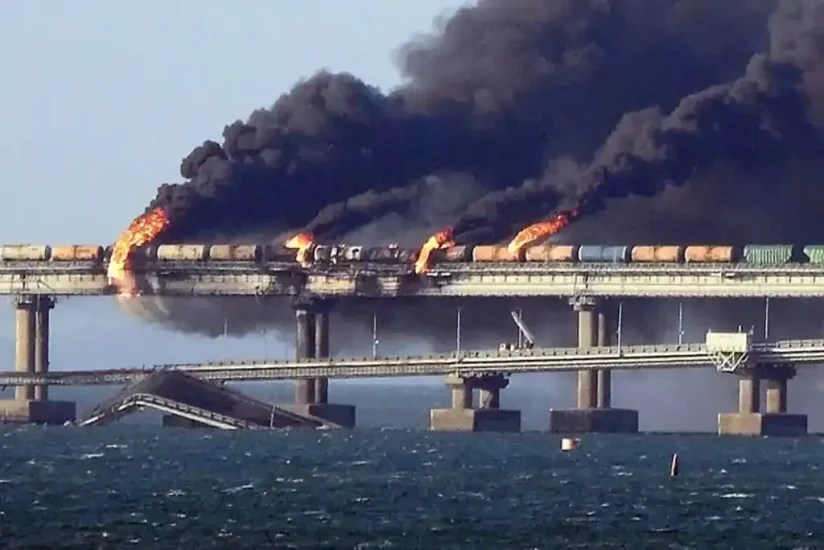
Kerch Bridge in flames following its British-planned bombing
That escalatory incident, like Nord Stream’s destruction, was known about in advance, and apparently opposed, by the CIA. Chris Donnelly, the British military intelligence veteran who orchestrated the Kerch Bridge attack, has privately condemned Washington’s reluctance to embroil itself further in the proxy war, declaring “this US position must be challenged, firmly and at once.” In December that year, the BBC confirmed that British officials were worried about the Biden administration’s “innate caution”, and had “stiffened the US resolve at all levels”, via “pressure.”
The determination of Washington’s self-appointed “junior partner” to escalate the proxy conflict into all-out hot war between Russia and the West has only intensified under Starmer’s new Labour government. Yet, the Empire gives every appearance of refusing to take the bait, while seeking to curb London’s belligerent fantasies. This may be an encouraging sign that the proxy war is at last reaching its end. But we must remain vigilant. British intelligence is unlikely to allow the US to withdraw without a fight.
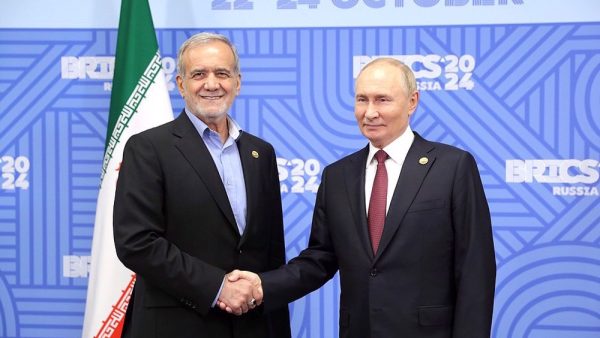
Russia: Comprehensive deal with Iran will include defense, security ties
Press TV – November 24, 2024
Russia’s deputy foreign minister says the treaty on a comprehensive strategic partnership between his country and Iran will include cooperation in the defense and security sectors.
Speaking to Russia’s TASS news agency on Sunday, Andrei Rudenko said he would not disclose the details of the agreement that is expected to be signed in the near future.
“I would only note [that] it will meet challenges and requirements of our time and cover almost all current and promising spheres of Russian-Iranian cooperation, including defense and security,” he added.
In 2001, Tehran and Moscow signed a long-term cooperation deal, officially known as the Treaty of the Foundation of Mutual Relations and the Principles of Cooperation. It was initially set for 10 years but was extended up until 2026.
Now, the two capitals are making final arrangements for the comprehensive partnership pact, which may determine their bilateral ties in all fields for the next 20 years.
Russian Foreign Minister Sergei Lavrov has announced that his country will sign a strategic partnership agreement with Iran “in the near future.”
Rudenko emphasized that the nature of Iran-Russia interactions has notably changed over the past two decades.
“We are closely coordinating approaches with our Iranian friends and take necessary measures to strengthen peace and security” in the region, he added.
Last month, Iran’s Ambassador to Russia Kazem Jalali said the strategic partnership treaty would be signed during Iranian President Masoud Pezeshkian’s visit to Moscow. The date of this visit has yet to be decided.
Iran and Russia are both subject to illegal Western sanctions. They have over the past years deepened their relations in various fields, including military and defense, and become close allies.
Featured Video

Racist Seinfeld Dances for Joy as Bibi Unveils His New Map
or go to
Aletho News Archives – Video-Images
TV Drama Review
Japanese drama projects Japan’s wartime atrocities onto Chinese characters

Global Times | October 25, 2026
By portraying Chinese characters as perpetrators of ruthless violence while casting Japanese Self-Defense Forces (SDF) intelligence operatives as defenders, the season 2 of the Japanese drama Vivant has recently drawn criticism from Chinese netizens, who argue that its depiction turns historical reality on its head while ignoring Japan’s wartime atrocities.
The TBS drama series – a spy suspense story in which an alleged unofficial intelligence unit of the SDF operates across the globe — has attracted a passionate fanbase. Its currently airing season 2 opened with a household rating of 18.8 percent, the highest for a TV drama this year, according toa commentary article by Japanese media Toyo Keizai.
What draws attention is the portrayal of the enemies in the series, the article noted. Scenes in which the Chinese organization subjects kidnapped members of the SDF unit to brutal torture are repeated with unrelenting intensity.
It is rare for Japanese TV dramas to explicitly portray a real-life country as the enemy, the article noted.
Japanese Prime Minister Sanae Takaichi also made a reference to the drama, saying that she has been recording Vivant and hopes to binge-watch it over the year-end and New Year holidays, according to Japanese media outlets.
China’s CCTV News report on Sunday revealed that the drama features scenes in which Chinese personnel cut off the fingers of and stab Japanese intelligence operatives in the abdomen. Such acts bear striking similarities to the torture inflicted on Chinese nationals by invading Japanese troops during the World War II.
The drama distorts the truth by attributing these atrocities to modern Chinese characters. Beneath the surface, it subtly glorifies Japan’s cross-border overseas operations, blurs the functional boundaries of the SDF and implicitly promotes an expansionist narrative, per CCTV News. … continue
Blog Roll
 Aletho News
- Iran, Turkey, Pakistan, Saudi Arabia could advance region-led security framework in Tehran: FM spox
- Netizens condemn Japanese drama for projecting Japan’s wartime atrocities onto Chinese characters
- Racist Seinfeld Dances for Joy as Bibi Unveils His New Map
- A West Bank War for Netanyahu’s Election Campaign, Could It Backfire?
- Yemen denounces European Parliament’s ‘hypocritical’ push to blacklist Ansarullah
- Qalibaf: UAE’s UN bid aims to ‘clear the runway’ for ‘Greater Israel’, whitewash genocide
- Pakistan reopens Iran border after boosting security: Report
- Why are so many Brazilians voting for Flávio Bolsonaro?
- Democrats Put Anti-Russia Agenda Ahead of American Workers
- Elijah Magnier: Yemen’s Strikes Are Shattering Saudi Arabia’s Long-Term Strategy
- If Americans Knew
- An error has occurred; the feed is probably down. Try again later.
- No Tricks Zone
- Sudden Stratospheric Warming, Powerful El Niño Combination May Lead To Extreme Europe Cold, Energy Crisis!
- Two New Studies Find Thwaites Glacier Melt Cannot Be Driven By Human Activity Or A Warming Ocean
- E-Cars Reduce CO2 Emissions By Only 41% Compared To Internal Combustion Engine Vehicles
- Predictions Made By Renowned Climate Professor Over Past Decades Have Been Proven To Be Poor
- New Study Suggests Large Regions Of The Pacific Ocean Have Been Cooling For The Last 80 Years
- Germany’s Green Energy Debacle: High Energy Costs Force Kahla Porzellan to Close After 182 Years!
- New Study: 50 Years Of The Most Aggressive ‘Net Zero’ Policies Can Only Affect The Global Climate By 0.03°C
- US September “Heat” Was No Record…Many Records Set Decades Ago
- Latest European Green Energy Debacle; Portugal’s Largest Flagship Solar Park Insolvent!
- Green Energy Debacle: German Expert Professor Fritz Vahrenholt Warns Of Severe Economic And Social Consequences

