Iran’s UN ambassador: US unilateral actions violate UN Charter, threaten multilateralism
Press TV – April 24, 2023
Iran’s permanent ambassador to the United Nations says unilateral measures taken by the United States are against the UN Charter while threatening multilateralism in the world.
Amir Saeed Iravani made the remarks in a Monday address delivered during a UN Security Council debate on multilateralism.
“Multilateralism has been recognized as a well-established approach to addressing global challenges and effective multilateralism … is essential for ensuring international peace and security,” he said.
The official, however, warned that the integrity and effectiveness of multilateralism are undermined by the abuse of the UN system and selective application of international law, which pose a serious threat to international cooperation, peace, and security.
“Within this context, the United States’ unilateral withdrawal from the JCPOA, re-imposition of illegal unilateral sanctions on Iran, its coercion of other countries to engage in these illegal actions, and defiance of the International Court of Justice’s order are striking examples of how such harmful unilateral acts violate the UN Charter, undermine the UN system and threaten multilateralism,” Iran’s ambassador said.
He was referring to Washington’s unilateral and illegal withdrawal in 2018 from a multilateral deal with Iran, officially called the Joint Comprehensive Plan of Action (JCPOA), whose other members included the permanent members of the UN Security Council plus Germany. After leaving the deal, the administration of former US President Donald Trump reinstated all anti-Iran sanctions that the accord had lifted and introduced its signature “maximum pressure” policy against Tehran.
The administration of Trump’s successor Joe Biden had alleged a willingness to compensate for Trump’s mistake by rejoining the deal, but it has retained the sanctions as leverage and even imposed a slew of its own coercive economic measures on the Islamic Republic.
“Unilateral coercive measures (UCMs), including their extraterritorial application, represent a concerning example of harmful unilateral acts that run counter to the fundamental principles of international law, the UN Charter, and basic human rights,” Iravani said, adding, “These illegal measures have far-reaching humanitarian consequences and can undermine diplomatic efforts aimed at resolving disputes and promoting cooperation.”
Iravani also referred a March 30 verdict by the International Court of Justice (ICJ), which ruled that the United States had violated the international law by allowing American courts to confiscate nearly two billion dollars in assets from Iranian companies, and ordered Washington to pay compensation.
“The ICJ’s ruling is final and binding, requiring the US to comply with this decision,” the Iranian diplomat noted.
Iravani said, “Collaboration should be the cornerstone of multilateralism, rather than confrontation,” because “collaborative approaches foster trust, build consensus, and promote sustainable solutions to global challenges.”
He concluded by saying, “Through collaborative problem-solving and engagement with all parties, multilateralism can effectively address the challenges facing our world today. In this context, diplomacy, dialogue, and negotiation should be the preferred means for resolving disputes among member states.”
Will Pakistan defy US sanctions to complete ‘Peace Pipeline’ with Iran?
By F.M. Shakil | The Cradle | March 7, 2023
Islamabad has formed a diplomatic channel to convince Washington to ease sanctions on Iran, which would finally allow for the completion of a crucial pipeline project to bring cheap Iranian natural gas to Pakistan.
Iran has vowed to take the matter to arbitration if Pakistan does not complete its portion of the pipeline by March 2024, as stipulated in an agreement between the two West Asian countries.
Discussions on constructing the massive pipeline project began almost 29 years ago, in 1994 – then called the Iran-India-Pakistan pipeline – which originally envisioned moving Iranian gas to Pakistan, Bangladesh, and China. The focus later shifted to constructing a pipeline between Pakistan and Iran only, but the project has never been completed.

According to the terms of the IP-GSPA (Gas Sales Purchase Agreement) signed between Iran and Pakistan, each country was obligated to construct the portion of the pipeline on its own territory, and the first flow of Iranian gas to Pakistan was to start January 1, 2015. The agreement stipulated Pakistan would pay Iran $1 million per day in exchange for 750 million cubic feet of gas daily, with a contract lasting 25 years.
Iran completed its portion of the pipeline in 2011, however, Pakistan has failed to construct its portion, largely due to difficulties caused by US economic sanctions imposed on Iran for the country’s alleged nuclear weapons program. US sanctions block Pakistan from purchasing Iranian gas, and this geopolitical risk has made Pakistani banks unwilling to finance the project.
Because of US foreign policy pritiorites, therefore, Pakistan continues to rely on more expensive liquified natural gas (LNG) to meet its burgeoning energy needs, which has greatly limited Pakistani economic growth and exposed the country to crises during periods of volatile LNG price spikes.
Due to these difficulties, Pakistan’s Inter-State Gas Systems (ISGS) and the National Iranian Gas Company (NIGC) signed a revised agreement in 2019 to allow Pakistan more time to complete its segment of the pipeline. The agreement stipulated that neither Iran nor Pakistan will take the other to court for delays or impose fines until 2024.
But US sanctions have continued to make Pakistan’s completion of the project difficult, and Iran is now threatening to sue Islamabad for $18 billion in fines if it breaks the agreement and fails to complete construction by the 2024 cutoff date.
Financial straits or US pressure
As Asif Durrani, a former Pakistan ambassador to Iran, tells The Cradle:
“Pakistan needs roughly $3 billion to lay a pipeline stretching over a radius of 781 kilometers inside the country. The question is who will finance this project, and secondly, the US sanctions on Iran, which took the air out of this project as far as Pakistan is concerned, need a revisit by the US authorities to protect the faltering economies of the region.”
The sanctions, he adds, were primarily focused on the energy sector of Iran and set a cap of $10 million on investments in the Iranian oil and gas sector.
Durrani is not convinced that US sanctions make completion of the pipeline impossible, however.
“These are lousy arguments because, despite these restrictions, Iran supplies Turkiye with almost $10 billion annually in natural gas,” he argues, adding that India and China have also resisted US sanctions.
Durrani contends that Pakistan and Iran are neighboring nations and that neighbors must always conduct business with one another. He urges private sector participation in the IP gas project to accelerate the development phase of this huge project.
Now a senior fellow at the Islamabad Policy Research Institute (IPRI), the former Pakistani envoy to Tehran had in 2021 criticized the US for sabotaging the Iranian nuclear deal, claiming that Iran, as a Non-Proliferation Treaty (NPT) member, had the legal right to use nuclear energy for peaceful purposes.
Dr. Muhammad Abdul Muqtedar Khan, an Indian-American academic and a professor in the Department of Political Science and International Relations at the University of Delaware concurs with Durrani’s logic, telling The Cradle that too many countries in this region tend to yield to US pressure unnecessarily.
India, he says, disregarded US outrage over the Russian oil issue and refused to capitulate, unlike Pakistan which is still in a state of vacillation. In the same way, Pakistan could proceed with the Iran gas pipeline project, citing its energy and resource constraints in the face of pressure from Washington.
“In 1990, India, China, and even Bangladesh showed interest in the peace pipeline – but, in 2008, as a result of the Indian nuclear accord with the US, New Delhi decided to withdraw. As the thing unfolded, Iran has already installed the pipeline on their side of the border, but Pakistan is still dilly-dallying about it because of the US pressure and lack of the financial means to begin construction,” Khan adds.
He says Iran has spent a considerable amount of money constructing its section of the pipeline and would want compensation for the resulting commercial loss. “Iran has granted sufficient time for the pipeline’s development, and if Pakistan begins building its gas infrastructure, it could gain some cushion to reduce its import bill.
Pakistan is hedging its bets
Pakistan’s Secretary of Petroleum, Ali Raza Bhutta, disclosed in a meeting of the country’s Public Accounts Committee (PAC) that Pakistan has spoken to the US about the gas project, seeking relief in sanctions on Iran to press ahead with the construction of the pipeline.
Islamabad’s top energy official went on to add that since there was a ban on importing gas from Iran, the government has conveyed to the US ambassador to either grant Islamabad permission to go ahead with the project, or compensate Iran for the penalty imposed for opting out of the project.
As Noor Alam Khan, Chairman of the Public Accounts Committee, tells The Cradle:
“I did not convene this meeting specifically for the IP gas project, the focus was only on the audit paras of the petroleum ministry, and I suggested during the meeting – not the secretary – that the Ministry of Foreign Affairs should approach the US to let them know how serious the situation is.”
When informed that the secretary of petroleum had briefed the committee on the IP gas project and that media had quoted him saying that either the US should pay the damages or permit the country to continue with the IP gas project under the terms of the Iran agreement, Khan, a member of a breakaway faction of former president Imran Khan’s Pakistan Tehrik-e-Insaf party, became irritated, said it was nonsense, and hung up the phone.
The Pakistan National Assembly’s Foreign Affairs Committee also discussed this matter last week. The committee’s chairman, Mohsin Dawar, raised fears about the fact that several nations in the region have received waivers for importing Iranian oil even though Iran is under sanctions.
Pakistan, however, was unable to secure such a waiver to conduct such lucrative oil and gas business with Iran. He pressed the appropriate ministries to examine opportunities for receiving exemptions for the IP gas pipeline with Iran, much as India and China had done for Iranian oil imports.
IP Gas Pipeline in perspective
The plan for the IP Gas Pipeline, which is also called the “Peace Pipeline,” dates back to 1994, when India was also part of the project.
The 1,700-mile (2,735 km), $7.5 billion project planned to move gas from the South Pars Gas Fields to India through the western part of Pakistan, Balochistan. Since its inception, the project has encountered numerous obstacles that have caused repeated delays in the execution of a natural gas project that was badly needed by energy-starved Pakistan.
In 2008, the three nations were close to reaching an agreement before India opted to pursue an alternative project, the Turkmenistan-Afghanistan-Pakistan-India pipeline (TAPI). The US pressure and sanctions on Iran appear to have impacted India’s decision to withdraw from the IP gas pipeline agreement and pursue an alternative that excluded Iran.
Then, in 2010, a 25-year-long Gas Sale and Purchase Agreement (GSPA) was signed, to construct a pipeline stretching across Pakistani territory from the Iranian border to Nawabshah, a distance of 781 kilometers.
Approximately 665 kilometers will travel through Balochistan while 115 kilometers will run through Pakistan’s Sindh province. The length of the Iranian portion of the pipeline is 1,100 kilometers. It begins in the energy economic zone of Pars and goes to Iranshahr and Bushehr. The route then continues through Fars, Kerman, Hormozghan, and Sistan-Baluchistan.
From the Pakistani border to Nawabshah, the pipeline will stretch around 781 kilometers. After completion, the IP gas pipeline was projected to supply 750 million cubic feet of gas per day to Islamabad from Iran. According to the deal, gas supplies from Iran would start in 2014. But, this assumption turned out to be a pipe dream and has not been realized during the past nine years.
A panacea for Pakistan’s economic woes
“Pakistan’s issue with foreign reserves would progressively get worse if it were unable to achieve a deal with Iran because years were spent in negotiations between Pakistan, Iran, and Turkey to create a close economic relationship for significant infrastructure projects, but the US sanctions and pressure shattered all these dreams,” Muqtedar Khan maintains.
He believes that Pakistan is currently dealing with a protracted foreign exchange problem that cannot be remedied by borrowing money from China, Saudi Arabia, or the International Monetary Fund (IMF) because Pakistan would still have to pay back the initial debt.
“Strangely, Pakistan and Iran have failed to create a mutual understanding despite their common Islamic background. As an alternative to US dollars, they may conduct business in their own currencies. Even though they are neighbors, it would be a diplomatic failure if they did not restore a reciprocal trade relationship,” Muqtedar Khan concludes.
The United States Is in Conflict with Countries for Doing Things We Know They’re Not Doing
By Ted Snider | The Libertarian Institute | March 6, 2023
China, Balloons, and Spying
On February 4, the U.S. military shot down a Chinese balloon they claim was a surveillance device spying on U.S. territory. The unprecedented “kinetic action against an airborne object… within United States or American airspace” was followed by three more objects being shot down by the U.S. and Canada over their airspace.
The conflict that followed derailed potential and necessary Sino-American diplomacy. But Washington knows three crucial things: the surveillance balloon was not intentionally sent over American airspace, the next three objects were not even spying, and even if they had been spying, China would only be doing what the U.S. does every day. There was never a need for the conflict.
Biden has admitted that the three later objects that were shot down “were most likely research balloons, not spy craft.” The U.S. “intelligence community’s assessment is that the three objects were most likely balloons tied to private companies, recreation or research institutions studying weather or conducting other scientific studies.”
As for the balloon the United States still believes was a spy balloon, they knew all along that China had not deliberately sent it over American airspace. Far from being taken by surprise, as they portrayed, “U.S. military and intelligence agencies had been tracking it for nearly a week, watching as it lifted off from its home base on Hainan Island near China’s south coast.”
And they knew the intended destination was never the United States. Officials “are now examining the possibility that China didn’t intend to penetrate the American heartland with their airborne surveillance device.” The U.S. monitored the flight path that was taking it to Guam when “strong winds… appear to have pushed the balloon south into the continental United States.”
The U.S. initiated a potentially dangerous conflict with a country for doing something they knew the country wasn’t doing.
And even if China did send a spy balloon over the United States, the government knows that they do that to China every day. Three times a day actually! Retired Ambassador Chas Freeman, who accompanied Nixon to China in 1972, told me that the U.S. “mount[s] about three reconnaissance missions a day by air or sea along China’s borders, staying just outside the 12-mile limit but alarming the Chinese, who routinely intercept our flights and protest our perceived provocations.”
The U.S. has, not balloons, but satellites that spy on China. NBC’s Robert Windrem calls Washington’s “appetite for China’s secrets” “insatiable” and says that “spying on the People’s Republic of China has been one of the National Security Agency’s top priorities since it was established in 1952.”
But they have balloons too. On February 13, China’s Foreign Ministry spokesman Wang Wenbin said “that the U.S. had flown high-altitude balloons through its airspace more than 10 times since the start of 2022.” He went on to say that “U.S. balloons regularly flew through other countries’ airspace without permission.”
And in February 2022, Politico revealed that the Pentagon is working on “high-altitude inflatables” that would fly “at between 60,000 and 90,000 feet [and] would be added to the Pentagon’s extensive surveillance network…” The Pentagon, which has spent millions on the project, hopes the balloons “may help track and deter hypersonic weapons being developed by China and Russia.”
Cuba and Sponsoring Terrorism
On October 3, 2022, Colombian President Gustavo Petro asked U.S. Secretary of State Antony Blinken to take Cuba off the list of state sponsors of international terrorism. At a press conference the same day, Blinken defended the Cuban listing, insisting that “When it comes to Cuba and when it comes to the state sponsor of terrorism designation, we have clear laws, clear criteria, clear requirements.” Petro disagreed, responding that “what has happened with Cuba is an injustice.”
Mexican President Andrés Manuel López Obrador agrees. In December, he said that the world must “unite and defend the independence and sovereignty of Cuba, and never, ever treat it as a ‘terrorist’ country, or put its profoundly humane people and government on a blacklist of supposed ‘terrorists.’”
The United States agrees. Though the Biden administration has insisted on keeping Cuba on the list of state sponsors of terrorism, they know that Cuba is not a sponsor of terrorism.
William LeoGrande, Professor of Government at American University and a specialist in U.S. foreign policy toward Latin America, told me that the region’s resistance to the American strangling of Cuba was “preventing Washington from engaging Latin American cooperation on a range of other issues.” Deputy National Security Adviser Ben Rhodes said U.S. policy on Cuba had become “an albatross” around the neck of the U.S., crippling their policy in the hemisphere.
So, President Obama ordered a review of the designation. In an act of extreme historical understatement, he told Congress that “the government of Cuba has not provided any support for international terrorism during the preceding six-month period” and “has provided assurances that it will not support acts of international terrorism in the future.” After the State Department review, Secretary of State John Kerry declared that any remaining “concerns and disagreements” with Cuba “fall outside the criteria for designation as a State Sponsor of Terrorism.” The State Department issued an “assessment that Cuba meets the criteria established by Congress for rescission.” The U.S. intelligence community came to the same decision.
In May 2015, Obama removed Cuba from the list of state sponsors of terrorism. Cuba’s Foreign Ministry announced that “The government of Cuba recognizes the just decision made by the President of the United States to remove Cuba” from the list, adding that “it never deserved to belong” on the list in the first place.
Cuba was placed on the list in 1982 in an act of hypocrisy and exceptionalism. President Reagan locked Cuba in the list for arming revolutionary left wing movements in Latin America, meanwhile Reagan was arming their right wing opponents. Reagan declared that supporting those groups was “self-defense” and waged secret proxy wars and armed and supported counter-revolutionary forces in El Salvador and Nicaragua. LeoGrande has said that the U.S. backed counter-revolutionary forces “guilty of far worse terrorist attacks against civilians” than the Cuban backed revolutionary forces.
Nonetheless, on January 11, 2021, as it was walking out the White House door, the Trump administration thrust Cuba back onto the list of state sponsors of terrorism.
Biden promised, while campaigning for the presidency, that he would “promptly reverse the failed Trump policies that have inflicted harm on the Cuban people and done nothing to advance democracy and human rights.” Instead, two months after Trump put Cuba back on the list, White House spokeswoman Jen Psaki announced that a “Cuba policy shift is not currently among President Biden’s top priorities.”
Cuba remains on the state sponsor of terrorism list even though Washington knows Havana is not a state sponsor of terrorism. The Obama administration liberated them from the list, knowing that “the government of Cuba has not provided any support for international terrorism.” The Trump administration locked them back in the list, knowing the same, and the Biden administration has no immediate plans to reverse it.
Iran and Nuclear Bombs
The pattern is the same with Iran. The Obama administration signs the JCPOA nuclear agreement with Iran, paving the way to end the conflict, the Trump administration illegally pulls out of the deal, renewing the conflict, and Joe Biden continues Trump’s failed policies instead of returning to Obama’s promising policies.
The Biden administration knows that the Trump era policy they are keeping alive is a mistake. Blinken called the Trump administration’s “decision to pull out of the agreement” a “disastrous mistake.” Biden, while campaigning, said that Trump “recklessly tossed away a policy that was working to keep America safe and replaced it with one that has worsened the threat.” He promised to “offer Tehran a credible path back to diplomacy.” He hasn’t.
Instead, the State Department has said that the negotiations with Iran are “not our focus right now.” Robert Malley, the top U.S. diplomat for negotiating a nuclear deal with Iran, said that “It is not on our agenda…we are not going to waste our time on it.”
So, Iran continues to be the recipient of American sanctions, threats, assassinations, and sabotage: all while the United States knows Iran is not building a nuclear bomb.
The 2007 and 2011 U.S. National Intelligence Estimates both concluded with “high confidence” that Iran was not building a bomb. But you don’t have to go back that far to find American admissions that they are continuing the conflict with Iran for doing things they know Iran is not doing.
The 2022 U.S. Department of Defense Nuclear Posture Review makes the stunning admission that Iran is not building a nuclear weapon nor has it even made a decision to pursue a nuclear weapon. The Nuclear Posture Review makes that admission, not once, but twice, and it is repeated again in the National Defense Strategy in which it is included.
The Nuclear Posture Review says that “Iran does not currently pose a nuclear threat but continues to develop capabilities that would enable it to produce a nuclear weapon should it make the decision to do so.” It then lays out the truth about Iran in the greatest clarity: “Iran does not today possess a nuclear weapon and we currently believe it is not pursuing one.”
That was true four months ago, when the Nuclear Posture Review was released, and it remains true today. On February 25, CIA Director William Burns said that “[t]o the best of our knowledge, we don’t believe that the supreme leader in Iran has yet made a decision to resume the weaponization program.”
As with its Cuba policy, the United States continues to engage in conflict with Iran for doing something they know Iran is not doing. In the case of Iran, that escalating, self-defeating policy is potentially very dangerous.
In all three cases—China, Cuba and Iran–the United States has engaged in hostile, and sometimes dangerous, conflict with countries for doing what Washington knew all along they weren’t doing.
Iran follows parliament’s strategic law, Safeguards, NPT, not JCPOA: Atomic Energy Organization of Iran

Press TV – March 5, 2023
The head of the Atomic Energy Organization of Iran (AEOI) says the country remains committed to the Safeguard Agreement with the International Atomic Energy Agency (IAEA) and the nuclear Non-Proliferation Treaty (NPT), considering them as the basis for its nuclear activities, along with the strategic law adopted by the Iranian parliament.
Mohammad Eslami made the remark in an interview on Sunday, following a trip to Iran by Director General of the IAEA Rafael Mariano Grossi.
Commenting on Grossi’s visit, he said Iran’s interactions with the agency should continue and “we must not allow the destructive Zionist and terrorist current to take advantage of our relations and find excuses to mount pressure on the country.”
Eslami added that the nuclear deal reached in 2015, officially known as the Joint Comprehensive Plan of Action (JCPOA), can no longer be taken as the basis of Iran’s activities.
“Naturally, the JCPOA, with which the other side does not comply, cannot form the basis of our action, because the basis of the Islamic Republic of Iran’s action is the strategic law passed by the Islamic Consultative Assembly (Iranian parliament) and the removal of unjust sanctions” that have been imposed on the country, the AEOI head said.
The law, dubbed the Strategic Action Plan to Counter Sanctions was adopted by Iranian lawmakers in December 2020 to counter sanctions imposed on Iran by the United States and its Western allies, and promote the country’s peaceful nuclear program.
Under the parliament’s law, the Iranian administration is required to restrict the IAEA’s inspections and accelerate the development of the country’s nuclear program beyond the limits set under the JCPOA.
Eslami added, “We fulfill our responsibilities and [carry out] our activities according to the strategic law. The important point is that we take our steps based on this law and within the framework of the Safeguards [Agreement] and the NPT…. but they intend to exaggerate these steps in line with their double standards and create [media] hype.”
“We announced yesterday that we are committed to the Safeguards and the NPT, and the agency oversees and assesses our activities. However, this oversight must be carried out within frameworks and considerations acceptable for the Islamic Republic of Iran,” he said.
Explaining about a controversial IAEA report, claiming that uranium particles enriched to about 84 percent of purity have been found in Iran, Eslami said the agency has mentioned such particles in a report to its Board of Governors.
“However, after repeated assessments and inspections, and through the interaction carried out [between Iran and the IAEA], it was decided that the criterion for measuring [the degree of enrichment] should be the final output of the production line.”
“No enrichment above 60 percent has taken place in storage tanks that are currently operating and whose entire process is being supervised by the IAEA, according to the Safeguards Agreement. [Therefore,] they have practically announced the closure of this case. The case of 84-percent [enriched] uranium particles has been closed and decided,” Iran’s nuclear chief said.
Eslami added that pressures exerted on the IAEA chief by Western media with regard to Iran’s nuclear activities are masterminded by “the Zionist current.”
“They are angry and upset with Mr. Grossi’s trip [to Iran] and are increasing pressure on him. It is natural [for them] to mount media pressures as a result of their anger with the [IAEA] director general’s visit to Iran,” the AEOI head said.
Turkish FM speaks out on sanctioning Russia over Ukraine
RT | March 1, 2023
Türkiye will not be joining unilateral sanctions imposed on Russia by the West over the conflict in Ukraine, Turkish Foreign Minister Mevlut Cavusoglu said on Wednesday.
Cavusoglu was asked how long Ankara would be able to resist pressure from the US and its allies to put restrictions on Moscow ahead of talks with his Russian counterpart Sergey Lavrov on the sidelines of the G20 Foreign Ministers Meeting in India’s capital New Delhi.
“We don’t need to resist anyone, we make our own decisions as a sovereign state. We don’t join any unilateral sanctions. We support only those [restrictions that are] introduced with the backing of the UN,” the foreign minister replied, as cited by the media.
“It’s not just about Russia, but we also don’t support sanctions against Iran or any other country,” Cavusoglu pointed out, adding that “no one can put pressure” on Türkiye.
India, which chairs the G20 this year, is hosting the summit of foreign ministers on Wednesday and Thursday.
An Indian foreign ministry official told Reuters on Wednesday that New Delhi didn’t want the conflict in Ukraine to dominate the discussions at the event, but acknowledged that it would likely be among the top issues on the agenda. The host nation’s “intention [is] to continue playing the voice of the Global South [Latin America, Africa, Asia and Oceania] and raising issues pertinent to the region,” the official said.
High-ranking Indian diplomat Vinay Kwatra told reporters that “questions relating to food, energy and fertilizer security, [and] the impact that the conflict has on these economic challenges that we face” will be among those to receive “due focus” in New Delhi.
However, EU foreign policy chief Josep Borrell, who is a stalwart supporter of Kiev, insisted that India should use the G20 gathering to “make Russia understand that this war has to finish.” According to Borrell, the “success” of the whole meeting “will be measured in respect to what we will be able to do on that.”
An EU source said separately the EU delegation in New Delhi won’t support the final statement as a result of the summit if it doesn’t include condemnation of Russia’s conduct in Ukraine, Reuters reported.
Iran reacts to uranium claim
RT | February 20, 2023
Tehran has rejected as misleading a Bloomberg report, which claimed that the International Atomic Energy Agency (IAEA) was investigating how the country enriched uranium “to levels just below that needed for a nuclear weapon.”
The news agency cited two anonymous diplomats, who alleged that the UN nuclear watchdog found uranium of 84% purity, or “just 6% below what’s needed for a weapon” in Iran, Bloomberg explained in its article, published on Sunday.
Responding on Monday, Behrouz Kamalvandi, spokesman for the Atomic Energy Organization of Iran (AEOI), said the piece was “slander and a distortion of the facts”.
“The presence of uranium particles above 60% during the enrichment process does not mean enrichment above 60% level,” he told IRNA news agency, claiming that in publishing the story, Bloomberg was serving as a tool of anti-Iran pressure.
Bloomberg did, however, acknowledge the possibility that the sample was found after unintended accumulation in an enrichment centrifuge cascade.
The IAEA has commented on the news by stating that it was “discussing with Iran the results of recent Agency verification activities” and would report the outcome to its board of governors when appropriate.
Iran agreed to impose restrictions on its nuclear industry, including enrichment activities, under a 2015 deal with world powers. The agreement was torpedoed by US President Donald Trump, who pulled out in 2018 to pursue a so-called “maximum pressure” campaign of sanctions.
Iran eventually started reneging on its commitments, and announced it was enriching uranium to 60% purity at its Natanz facility in 2021 and at the Fordo site in 2022.
The nuclear deal, known as the Joint Comprehensive Plan of Action, was touted as a way to prevent Iran from acquiring a nuclear weapon, an ambition that Tehran denies having.
China announces visit of Iranian president
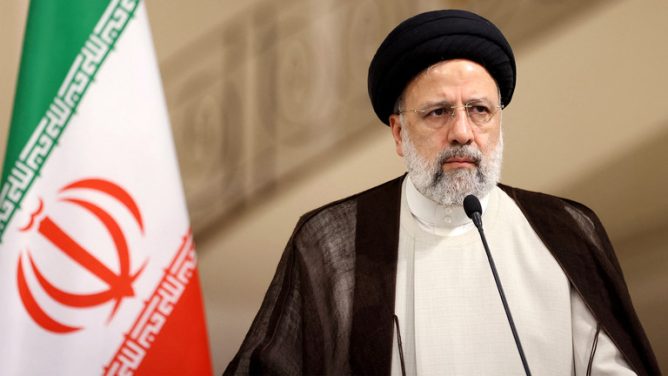
Iran’s President Ebrahim Raisi giving a joint press conference. © AFP / Iranian Presidency
RT | February 12, 2023
Iranian President Ebrahim Raisi is going to make an official visit to China next week, the Chinese Foreign Ministry has said.
Raisi’s planned visit will take place between February 14 and 16 and is at the invitation of Chinese leader Xi Jinping, the ministry announced in a statement on Sunday.
The three-day trip will, among other elements, include talks between Raisi and Xi, a joint meeting of the leaders with Iranian and Chinese businessmen, and the signing of cooperation documents between the delegations of the two countries, according to Iran’s state-run news agency IRNA.
Also reporting on the upcoming visit, US outlet Politico said that it’s “expected to deepen ties between the two political and economic partners that are opposed to the US-led Western domination of international affairs.”
Xi and Raisi last met during the Shanghai Cooperation Organization (SCO) summit last September in Samarkand, Uzbekistan. During those talks, the Chinese leader insisted that consolidating their strategic partnership was a common choice for both Beijing and Tehran.
In December, Chinese Vice President Hu Chunhua visited Iran and met with Raisi, with both sides expressing eagerness to boost bilateral ties further.
China is Iran’s largest trading partner and the main buyer of its oil amid US sanctions on Tehran. According to Iranian data, its exports to China reached $12.6 billion in the last ten months. The country also bought $12.7 billion worth of Chinese goods during the period.
Last year, Iran was formally included into the SCO as a permanent member and also applied to join BRICS – the two international organizations in which China and Russia play a major role.
Zionists angry after Australian govt. refuses to blacklist Iran’s IRGC
Press TV – February 10, 2023
A recent report has exposed that the Australian Senate committee is facing a serious legal setback in its attempt to blacklist Iran’s Islamic Revolution Guards Corps (IRGC), as the force cannot be designated as a foreign terrorist organization under the country’s criminal code.
According to the Australian Jewish News website, the Attorney General’s Department (AGD), which responded to the recommendation by the Foreign Affairs, Defense and Trade Committee, told the panel that current legislation does not provide for a pathway to proscribing the IRGC.
“As an organ of a nation-state, the Islamic Revolution Guard Corps is not the kind of entity that is covered by the terrorist organization provisions in the Criminal Code,” the AGD said on Tuesday.
The Zionist Federation of Australia (ZFA) urged the Australian government to amend the criminal code to allow for the blacklisting of the IRGC.
“We … urge the Australian government to amend legislation to allow the IRGC to be proscribed here, as it is in other countries,” ZFA public affairs director Bren Carlill said.
However, other countries have also backed down on their initial proclamations to ban the official Iranian force.
The UK government has already stopped plans to blacklist Islamic Revolution Guards Corps as reports say Foreign Office fears that the move would block communications channels with Iran.
The UK Foreign Office’s about-face on proscribing the IRGC as a so-called “terrorist” entity comes despite its approval by the Home Office, The Times reported on February 2.
Citing sources in the government, the report said there are also concerns about how to blacklist the IRGC because, unlike other proscribed bodies, the Iranian force is an official government agency.
“Foreign Office officials have real concerns about proscription because they want to maintain access. The Home Office, and the government more broadly, supports the move. The IRGC should have been proscribed by now but the whole process is on ice,” a Whitehall source said.
European Union foreign policy chief Josep Borrell said on January 23 that the block could not list the IRGC as a “terrorist” entity without an EU court decision.
Speaking before a meeting of EU foreign ministers in Brussels, Borrell said a court ruling with a “concrete legal condemnation” had to first be handed down before the bloc itself could apply any such designation.
“It is something that cannot be decided without a court, a court decision first. You cannot say I consider you a terrorist because I don’t like you,” Borrell told reporters, stressing that the court of an EU member state had to issue a concrete legal condemnation before the bloc could act.
A week earlier, the European Parliament adopted an amendment, calling on the EU and its member states to include the IRGC on their terror list. It also passed another resolution later, calling for more sanctions against Iranian individuals and entities and putting the IRGC on the EU terrorist list over alleged human rights violations during the recent riots.
The European Union, however, imposed sanctions against a number of Iranian individuals and entities for what it claimed to be a crackdown on the recent foreign-backed riots, which were triggered after the death of a young Iranian woman of Kurdish descent in Tehran in September.
IAEA head must visit Iran with ‘specific objective’, says Iran’s nuclear chief
Press TV – February 1, 2023
The chief of Iran’s nuclear agency says any visit by the head of the International Atomic Energy Agency (IAEA) to the country needs to have a “specific objective”, in an oblique reference to the UN nuclear watchdog’s political approach.
“This trip needs preparations and content and the aims and schedule of this trip should be determined,” Mohammad Eslami, who heads the Atomic Energy Organization of Iran (AEOI), said on the sidelines of a cabinet meeting in Tehran on Wednesday.
IAEA chief Rafael Grossi last week said he intends to go to Tehran in February for “much-needed dialogue” over Iran’s cooperation with the UN nuclear agency and to discuss outstanding issues.
Grossi claimed that the suspension of talks aimed at the revival of the Joint Comprehensive Plan of Action (JCPOA) and Iran’s recent measures to reduce its compliance with the 2015 deal meant that the IAEA could no longer effectively monitor the country’s nuclear program.
He also touched on IAEA’s so-called probe into what the agency claims are the presence of “undeclared uranium particles” at some nuclear sites in Iran.
Iran has already rejected the probe, saying it’s based on forged evidence provided to the IAEA by the Israeli regime, slamming the agency for adopting a political approach and forsaking its technical mandate.
Eslami said the West is waging a psychological warfare operation by accusing Iran of failing to honor its commitments under the JCPOA, while the fact remains that the Islamic Republic met all its commitments under the deal.
He reiterated that Iran is committed to its obligations under the 2015 nuclear deal and as the signatory of the Nuclear Non-Proliferation treaty (NPT), which is evident from numerous inspections of its nuclear facilities by the UN agency inspectors.
“The agency has carried out around two-thousand inspections [of countries’ nuclear facilities] between 2020 and 2022, and over these three years, five hundred inspections — that is one-quarter of all inspections — were conducted in Iran,” he said.
“They still feel concerned [about Iran’s nuclear work] and this shows their language is the one used by enemies and aimed at a sabotage operation, [but] we won’t be affected by them.”
He stressed that the Israeli regime’s influence over the UN nuclear agency and hostile moves against Iran over its nuclear work must end.
Iran rolled back its compliance with the 2015 nuclear accord after the US unilaterally withdrew from the pact and reimposed sanctions on Iran.
Tehran and the remaining signatories to the pact have held talks on reviving the accord since April 2021, after Joe Biden came to power in the US. But those talks have been stalled for months amid Washington’s procrastination and refusal to provide guarantees.
Iran says an agreement on the revival of the deal hinges on the settlement of issues between Tehran and the IAEA, as well as the removal of all US sanctions on the country.
Irish MEP: US yielding to Israeli pressures over 2015 Iran nuclear deal
Press TV – February 1, 2023
A member of the European Parliament says the United States has bowed to Israeli pressures over the 2015 Iran nuclear deal as negotiations for reviving the agreement have been stalled due to Washington’s excessive demands.
In a post on his Twitter account on Wednesday, MEP Mick Wallace criticized the US and some “hawks” in the European Parliament over the stalled talks on reviving the deal, officially known as the Joint Comprehensive Plan of Action (JCPOA).
“Biden promised to get #JCPOA with #Iran back on track but negotiations have stalled,” he wrote, adding, “[it] seems #US have caved to pressure from #Israel.”
The “hawks in EU Parliament want to abandon” the JCPOA, however, European Union foreign policy chief Josep Borrell “is right to keep dialogue open with Iran,” Wallace added.
The remarks come as negotiations, which started in April last year in Vienna, remain stalled since August as Washington refuses to remove the sanctions that were slapped on the Islamic Republic by the previous US administration of Donald Trump.
This is while after taking office, the Biden administration had criticized his predecessor’s decision to scrap the deal and vowed to reverse the measure.
On the contrary, the Biden administration officials have upped the so-called maximum pressure campaign against Iran and on several occasions announced that the talks to revive the 2015 nuclear deal are no longer their main focus.
The White House, meanwhile, is leveling accusations against Iran over human rights issues during recent foreign-backed riots and drone delivery to Russia to be used in the Ukraine war. Tehran has strongly rejected the allegations in both cases.
Observers believe Washington is trying to use these baseless accusations against Iran to gain leverage in talks and negotiate from a position of strength.
Meanwhile, the Israeli regime has openly expressed opposition to the deal since it was signed back in 2015. The regime, which is the only possessor of nuclear warheads in the region without being a member of the Non-Proliferation Treaty, has made various efforts in the past years to hamper Iran’s peaceful nuclear program, from assassinating Iranian scientists to carrying out acts of sabotage in Iranian facilities and trying to push others away from the deal.
Goodbye empire? US sanctions are failing in the face of multipolarity
By Felix Livshitz | RT | January 25, 2023
Foreign Affairs, a highly influential US magazine – effectively a US empire house journal – has published an article detailing how sanctions are quickly losing their efficiency as a weapon in Washington’s global arsenal.
Published by the Council on Foreign Relations NGO, Foreign Affairs provides space for officials within the US military industrial complex to communicate with one another on matters they believe to be of the utmost significance. Therefore, it is important to pay attention when the magazine makes major pronouncements on any issue.
It recently published an appraisal of US sanctions – the conclusion being that they are increasingly ineffective, have prompted Beijing and Moscow to create alternative global financial structures to insulate themselves and others from punitive actions, and that Washington and its acolytes will no longer be able to force countries to do their bidding, let alone destroy dissenting states, through such measures in the very near future.
The article begins by noting that “sanctions have long been the US’ favored diplomatic weapon,” which “fill the void between empty diplomatic declarations and deadly military interventions.” Despite this, it predicts “the golden days of US sanctions may soon be over.”
These “golden days” were the immediate post-Cold War era, when Washington was “still an unrivaled economic power,” and therefore could at the press of a button cripple each and every overseas economy, in theory. This was due to “primacy of the US dollar and the reach of US oversight of global financial channels.”
As international trade was overwhelmingly conducted using dollars, Washington could stop any country from exporting or importing any and all goods it wished, whenever it liked. Even then, Foreign Affairs recalls, US leaders themselves worried if sanctions were applied too liberally. In 1998, then-President Bill Clinton claimed his government was “in danger of looking like we want to sanction everybody who disagrees with us.”
The Foreign Affairs article says Clinton’s fears were “overblown,” but this is precisely what came to pass. Governments, and the countries they represented, have been sanctioned for pursuing the wrong policies, refusing to be overthrown in US-backed coups and military interventions and showing any degree of independence in their domestic or foreign dealings whatsoever. In the process, millions have died, and even more lives have been ruined for no good reason.
This approach has backfired, and badly. In response, states “have begun to harden their economies against such measures.” For example, after the US cut off Iran from the SWIFT global banking system, many other countries took note. Restricting China’s access to numerous technologies as part of the new Cold War has also served to place both Washington’s allies and adversaries alike “on notice their access to crucial technology could be severed.”
Beijing and Moscow lead the way in the push to create “financial innovations that diminish US advantage,” creating a raft of “currency swap agreements, alternatives to SWIFT, and digital currencies” that serve as “preemptive measures” against any “potential penalties” down the line.
Currency swaps, which connect central banks directly to each other and eliminate the need for trades between them to be dollar-backed, have been eagerly embraced by China. It has signed deals of this kind with more than 60 countries across the world, thereby enabling its companies “to circumvent US financial channels when they want to.”
In 2020, Beijing settled more than half its annual trade with Moscow in currencies other than the dollar, making the majority of these transactions totally immune to US sanctions, and that figure has only risen ever since. In March that year also, the China and Russia-led Shanghai Cooperation Organization officially prioritized development of payments in the local currencies of its members.
Beijing and Moscow are also, Foreign Affairs reports, “busily preparing their own alternatives” to various Western-dominated international systems. Their alternative to SWIFT, the Cross-Border Interbank Payment System, isn’t yet a match in terms of transaction volume, but that’s not the point. It prevents them, and any state or organization enrolled in the framework – 1,300 banks in over 100 countries already – from being unable to make international financial transactions, should they be cut out of SWIFT.
Similarly, China is expanding the reach of the digital renminbi, the currency issued by Beijing central bank, at home and overseas. More than 300 million of its citizens already use it, and a billion are forecast to by 2030. The currency is completely sanctions-proof as the US has no ability to prevent its use, and Beijing has encouraged several countries to pay for its exports exclusively using it – “other such deals will probably follow,” Foreign Affairs predicts.
The American empire’s obsessive reliance on sanctions has now created a Catch-22 situation, by the magazine’s reckoning. The already hostile relations between the USA, China and Russia mean Moscow and Beijing are pushing ahead with this revolutionary effort no matter what. If “things get worse,” they’ll simply “double down on their sanctions-proofing efforts,” taking more and more countries with them.
“These innovations are increasingly giving countries the ability to conduct transactions through sanctions-proof channels. This trend appears irreversible,” the article bitterly concludes. “All this means that within a decade, US unilateral sanctions may have little bite.”
It is all these developments, along with Moscow’s economic pivot eastwards after the 2014 Ukraine coup, and move towards self-sufficiency in energy and food and in other vital resources, which account for the embarrassing failure of US-led sanctions against Russia.
Western leaders, academics, journalists, pundits and economists promised when these sanctions were imposed that they would soon lead to Russia’s total political, economic and military collapse. They have not, demonstrating that elites in Europe and North America do not understand the global economy they claim to rule. They should get to grips with the new reality they inhabit in short order, though – for a multipolar world has begun to emerge in 2022, and it is here to stay.
How rapidly US elites are reckoning with the radically different reality in which they are now forced to operate is ironically underlined by how quickly the author of the Foreign Affairs article, Agathe Demarais, seems to have completely changed her tune on the subject of sanctions. On 1 December, less than a month earlier, she authored a piece for Foreign Policy – another US empire in-house journal – that offered a radically different take on the matter.
Boldly declaring “sanctions on Russia are working” in the headline, Demarais dismissed suggestions punitive Western measures were intended to “force Putin to back down and pull out of Ukraine,” or to provoke “regime change” in Moscow, or to prompt “a Venezuela-style collapse of the Russian economy,” despite the fact every single one of these outcomes was explicitly cited as a motivating factor behind the sanctions by Western officials, pundits, and journalists at the time.
Instead, she argued, sanctions were effective in the quest to “send a message to the Kremlin” that “Europe and the United States are standing with Ukraine.”
Whether or not Kiev will be thrown under a bus by its Western backers in due course, and the anti-Russian measures will endure after the war is over, seems to not matter so much, though – for, as Demarais was herself forced to acknowledge less than four weeks later, the effectiveness of sanctions is rapidly diminishing. The speed of this about-face could well be an indication of how irresistibly the multipolar world is coming to be.
or go to
Aletho News Archives – Video-Images
From the Archives
Israel Would Have No Qualms About USS Liberty-Style FALSE FLAG If Iran Campaign Falters – Analysts
By Ilya Tsukanov – Sputnik – 18.06.2025
Donald Trump is mulling whether or not to join Israel’s aggression against Iran as Tel Aviv faces problems sustaining its defenses against growing counterstrikes, and apparently lacks a realistic game plan for an end to hostilities after failing to achieve its goals. Analysts told Sputnik how the US could be ‘nudged’ into the conflict.
“The US is already assisting Israel with supplies, intel, refueling support, etc. One of the many US posts in the region could be attacked for a casus belli,” former Pentagon analyst Karen Kwiatkowski explained.
“If Trump doesn’t comply with Israel’s demand” and join its aggression voluntarily, “a false flag may be needed” to drag the US in, Kwiatkowski, retired US Air Force Lt. Col.-turned Iraq War whistleblower, fears.
Netanyahu has a diverse array of options at his disposal, according to the observer, including:
- a false flag against US assets abroad blamed on Iran or one of its Axis of Resistance allies, like the Houthis
- a US domestic attack or assassination blamed on Iran
- Iranian air defenses ‘accidentally’ hitting a civilian jetliner carrying Americans
- use of a dirty bomb or nuclear contamination somewhere in the region blamed on Iran
- even blackmailing by threatening to use nukes against Iran if the US doesn’t join the fight
Kwiatkowski estimates that Israel probably has “enough blackmail power” against President Trump and Congress to avoid the necessity of a false flag operation, but a “USS Liberty-style” attack, targeting the soon-to-be-retired USS Nimitz supercarrier that’s heading to the Middle East, for example, nevertheless cannot be ruled out entirely, she says. … continue
Blog Roll
 Aletho News
- The US bombed the Shahs house lol
- The London Ambulances Attack: Of Course It Was A False Flag
- Embarrassing Pivot: U.S. considers dropping Iran oil sanctions amid war
- US has 2 months of rare earths left to replenish weapons amid Iran war: Report
- Strait Of Hormuz closure brings Empire to brink
- Iran controls Strait of Hormuz, dictates terms of war and peace as US excursion backfires
- Outlasting the Superpower: The Reasons Why Iran is Beating uhe US and Israel
- Top PMU commander, over a dozen fighters killed in new US strikes on Iraq
- Is Netanyahu’s war gamble threatening the future of ‘Israel’?: FT
- Smotrich calls for annexation of South Lebanon to Litani River
- If Americans Knew
- ‘Forever live by the sword’: Understanding Israelis’ massive support for Iran war
- UN’s special rapporteur on human rights says Israel is systematically torturing Palestinians
- Trump White House plagiarized Iran war manifesto from Israel-aligned think tank
- Gaza says 6–10 patients die daily waiting for treatment abroad as Israel blocks medical evacuations
- ‘Substantial evidence’ of double-tap strike in killing of Gaza’s Hind Rajab
- ‘Do Not Want To Die For Israel’: Doubts About Trump’s Iran Strategy Spread Among Troops
- Instead of taking Joe Kent’s claims seriously, the media is disregarding him as an antisemite
- Joe Kent’s Explosive Interviews about his Resignation over the Iran War
- Israel poised to take over southern Lebanon; settlers wreak havoc in West Bank – Not a ceasefire Day 165
- From Sde Teiman, the truth about Israel’s military justice system has been set free
- No Tricks Zone
- Devastating Assessment Of Comirnaty Vaccine By Former Senior Pfizer Europe Toxicologist
- New Study: CO2 Is ‘Effectively Negligible’ As An Explanatory Climate Change Factor Since 2000
- Former Pfizer Toxicologist Dr. Helmut Sterz Tells Bundestag Hearing Pfizer Vaccine Should Have Never Been Approved
- Energy Expert: Germany’s Nuclear Phaseout Was A “500 Billion Euro Mistake”
- New Research: South Australia’s Mid-Holocene Sea Surface Temperatures Were 4°C Warmer Than Today
- Storing Green Energy To Last Germany 10 Days Would Require A 60-Million Tonne Battery
- New Studies: UK Sea Levels Were 4 Meters Higher Than Today During The Mid-Holocene
- Destructive Green New Deal: German Energy And Metal Group Warns Of Drastic Crisis
- New Study Documents A 20-Year Pause In Arctic Sea Ice Decline – Driven By Internal Variability
- Wake-up Call: Survey Shows Majority Of Germans Now Favor Postponing Climate Targets!
 Aletho News