Fact check: Blinken’s claim that US strived to revive JCPOA holds no water
By Syed Zafar Mehdi | Press TV | June 10, 2023
US Secretary of State Antony Blinken made a low-key visit to Saudi Arabia earlier this week, which coincided with the reopening of Iranian diplomatic missions in the Arab kingdom after seven years.
The whirlwind visit primarily focused on rebuilding ties between Washington and Riyadh but also involved other issues including the Joe Biden administration’s aggressive but unsuccessful push to mediate Riyadh-Tel Aviv normalization.
During the visit, the top American diplomat sat down for an interview with Arabic-language Asharq News, fielding questions on a range of subjects from Iran’s nuclear program to the Ukraine war.
Blinken’s responses were riddled with glaring inconsistencies and false assertions, in particular regarding efforts to revive the Joint Comprehensive Plan of Action (JCPOA), commonly known as the Iran nuclear deal.
On being asked whether the US was “trying to revive the negotiations” over the 2015 nuclear accord, the US Secretary of State said “from day one” the US “made a significant effort in that direction”.
“So we, from day one, sought to determine whether a return to mutual compliance with the JCPOA was possible, and we made a significant effort in that direction, as did the European partners, and, for that matter, Russia and China,” Blinken said in the interview.
“But Iran either couldn’t or wouldn’t do what was necessary to get back into compliance with the JCPOA. So the JCPOA is not our focus,” he hastened to add.
A simple fact-check is in order to set the record straight.
It was the US government, under the megalomaniac former President Donald Trump, which unilaterally abandoned the landmark nuclear agreement in May 2018, and reinstated an array of sanctions on Iran.
The move was in complete breach of the agreement and Washington’s legal obligations under Resolution 2231, the United Nations Charter and international law.
Iran adopted strategic patience for one year, waiting for European signatories to salvage the deal, and only then announced retaliatory measures, which included gradually scaling up uranium enrichment in line with a law passed by the Iranian parliament.
Trump’s successor, Joe Biden, pledged to reverse the so-called “maximum pressure campaign” against Iran that violated the multilateral deal and laid bare the infamous American hypocrisy.
However, more than two years into office, Biden has not only failed to reverse his predecessor’s hard-nosed measures but has doubled down and escalated the situation.
Since April 2021, Iran and the remaining parties to the 2015 nuclear deal have been engaged in marathon negotiations in Vienna to revive the accord and lift sanctions, facilitated by the European Union.
Despite a degree of progress, the consensus has been eluding mainly due to the policy of procrastination adopted by the Biden administration, with Blinken and his Iran pointsman Rob Malley playing a key role in letting the process drag on.
Blinken’s remarks about the US mulling “a return to mutual compliance” with the deal and making “a significant effort in that direction” hold no water when we examine the ground realities and actions taken by the US over the past two years.
Iran continues to be a key party to the deal, unlike the US which unilaterally and irresponsibly walked out of it. Iran has maintained that measures it has taken since May 2019 to scale up its uranium enrichment are reversible if the US returns to the deal in good faith and lifts all illegal sanctions.
Blinken’s statement that Iran “either couldn’t or wouldn’t do what was necessary to get back into compliance with the JCPOA” also fails the fact-check test.
United States left the deal. United States reneged on its commitments under the deal. United States stopped compliance with the deal. United States imposed and reimposed sanctions on Iran. United States launched the so-called “maximum pressure campaign” against the Islamic Republic.
In the last two years, it is the United States that has failed to provide guarantees to Iran that it won’t violate the terms of the agreement again. It is the United States that has weaponized sanctions against the people of Iran while harping about human rights.
The United States has also refused to compensate Iran for the losses caused by sanctions while exerting pressure on the UN nuclear agency to politicize its purely technical work.
The culprit here is the United States. Iran is well within its rights as the signatory of the Nuclear Nonproliferation Treaty (NPT) to pursue its nuclear energy program for peaceful, scientific purposes.
The peaceful nature of Iran’s nuclear program has been attested by the International Atomic Energy Agency which regularly conducts inspections at various nuclear facilities in the country and has to date failed to notice or report any activity that points to divergence or deviation in the program.
The ball is in the Biden administration’s court. It has to save the deal through action, not rhetoric.
G7 leaders scaremonger over Iran’s nuclear programme, but WMDs aren’t their real concern
By Robert Inlakesh | RT | June 1, 2023
The G7’s concern over Iran’s nuclear programme parrots a decades-old WMD conspiracy theory, aimed at drumming up public support for anti-Iranian action that is really aimed at curtailing Tehran’s conventional weapons programme, regional alliances and the development of stronger ties with Moscow.
After the meeting between the Group of Seven (G7) leaders in May, a number of announcements were made on the trajectory of the alliance. Germany, France, the UK, the US, Japan, Canada, and the European Commission all agreed to take measures to reduce trade reliance on China. They also agreed to advance their commitment to Ukraine’s war budget, while pledging to combat Iran’s influence in the Middle East. The agenda platform, set out from the Japanese city of Hiroshima, seeks to further exacerbate the schisms between major world and regional actors in the emerging multipolar order.
Tehran has long been the target of Western ire and sanctions, and until recently was locked in a rivalry with its Persian Gulf neighbor Saudi Arabia. However, as the US and its allies focus their efforts on combating Russia and China, this has presented opportunities for the less powerful Iran to survive under sanctions.
On May 17, Russian President Vladimir Putin and his Iranian counterpart Ebrahim Raisi signed a deal to finance the construction of an Iranian rail route that aims to supplement the international North-South Transport Corridor. It also emerged this month that 28 Russian energy companies plan to visit Iran, seeking to increase cooperation with and potentially help in advancing Iran’s oil and gas industry. These two developments add to the growing cooperation between the world’s two most sanctioned nations, both of which have proven themselves capable of finding alternatives to the West and circumventing the intended effects of its sanctions.
It is in this context that the conspiracy theories about Iran’s alleged pursuit of a nuclear weapon have emerged again in Western discourse. The G7’s draft communique on the issue expressed the nations’ concerns “about Iran’s unabated escalation of its nuclear programme,” while reiterating the “clear determination that Iran must never develop a nuclear weapon.” However, the assertions about Iran’s nuclear programme were also accompanied by the following sentence:
“We express our grave concern regarding Iran’s continued destabilising activities, including the transfer of missiles, unmanned aerial vehicles (UAVS) and related technologies to state and non-state actors.”
Western officials have a long track record of wrongly predicting Iran’s development of an atomic bomb, offering false speculation about when Iran will have one whenever a separate major issue pops up. Now that Russia-Iran ties are developing, Tehran-Riyadh rapprochement has been brokered by Beijing, and the sanctions have failed to bring about regime change, it seems there is a build-up to another push to condemn the Iranian government on an issue which the Western world can unite over.
Earlier in May, UK foreign secretary James Cleverly told Fox News that “preventing Iran from developing a nuclear weapon remains an absolute priority in UK foreign policy,” going on to say that Britain continues to work “very, very closely” with Germany, France and the US to impose sanctions on Iran. And no talk of Iranian nuclear weapons would be complete without an Israeli official chiming in. Israel’s Defense Minister Yoav Gallant claimed that Tehran now has enough uranium for five nuclear weapons.
Since 1992, Israeli officials have been constantly making false claims and predictions on how long it will take for Iran to build a nuclear bomb, with former Israeli President Shimon Peres first warning the international community “that Iran would be armed with a nuclear bomb by 1999.” Back in January of 2021, former IDF chief Aviv Kochavi even made the claim that the nukes could be developed in “months, maybe even weeks.”
In reality, there is no proof that Iran has a secret nuclear weapons program, nor is there any evidence to suggest Tehran is seeking to develop the bomb, let alone use it. At this point, after the deadlines set by the countless predictions have passed, the current talk amounts to little more than a fact-free conspiracy theory. Thinking rationally about it, it would make no sense for Iran to use a nuclear weapon either, in the event that it actually is seeking one, especially not against Israel, as this could end up destroying the third-holiest site in the Islamic faith.
There are, however, a number of ways that Iran presents a clear and present threat to the West’s agenda in the Middle East. The first and most immediate threat comes through its defense industry. Iran now produces sophisticated drones and missiles that are capable of doing significant damage to NATO and Israeli forces in the Middle East, if need be. Additionally, Tehran has allies like Hezbollah in Lebanon, Hamas in Palestine, Ansarallah (the Houthis) in Yemen, Kataeb Hezbollah in Iraq, and many others, who remain powerful in their own given arenas.
Lastly, it is clear that Iran is now on track for a brighter future economically. It has managed to end its hostility with Saudi Arabia, and this has meant that their competition inside a range of Middle East nations has eased. These strides toward regional stability have been coupled with developing relations between Tehran and Moscow. Iran also agreed on a potential $400 billion deal with China, announced back in 2021, which at the very least opened the door for further cooperation and investment.
At a time when the US and its European allies are focusing heavily on combating both China and Russia, it is a great frustration to witness Iran, their top Middle East foe, come together with their enemies. This is why the issue of nuclear weapons has come up again. Not that Western nations, armed to the teeth with nuclear weapons themselves, are in any position to tell others what to do – but it is clear that the question of an imminent Iranian WMD is not a serious one.
Robert Inlakesh is a political analyst, journalist and documentary filmmaker currently based in London, UK. He has reported from and lived in the Palestinian territories and currently works with Quds News. Director of ‘Steal of the Century: Trump’s Palestine-Israel Catastrophe’.
Zelensky wants to sanction Iran ‘for 50 years’
The Cradle | May 29, 2023
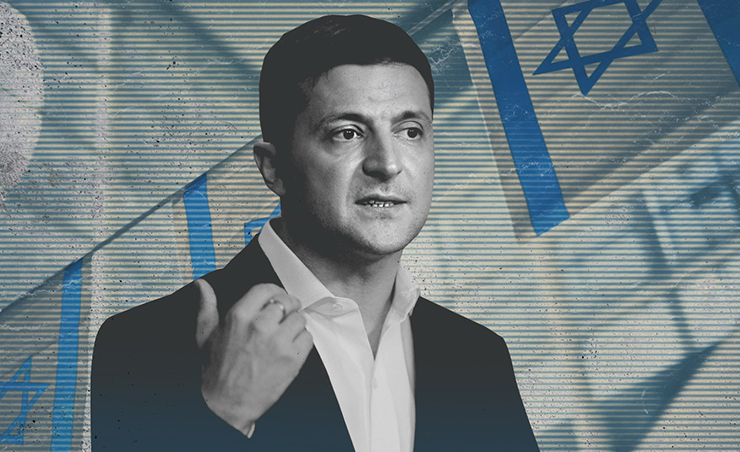
President Volodymyr Zelensky drafted and submitted a law to Ukraine’s parliament calling for the imposition of sanctions against Iran for a period of 50 years, Ukrainian state-media reported on 28 May.
“The document has already been submitted for consideration by the parliament’s leadership and the Committee on National Security, Defense and Intelligence,” state-media outlet Ukrinform said on Monday.
The draft was initially put forward on Saturday, 27 May.
“To approve the decision of the National Security and Defense Council of Ukraine dated May 27, 2023 ‘On the application of sectoral special economic and other restrictive measures (sanctions) to the Islamic Republic of Iran,’ put into effect by Presidential Decree No. 308/2023 dated May 27, 2023,” Ukrinform cites the draft as reading.
“The sanctions are to be imposed for 50 years,” it adds.
According to Kiev, the early hours of Sunday saw a massive Russian attack against Ukrainian forces, which involved the use of over 50 Iranian Shahed drones.
The Ukrainians claimed to have shot most of them down.
“This was the largest-ever drone attack on the capital since the beginning of the full-scale invasion, particularly using Shahed loitering munitions,” Ukrainian media cited a military official as saying.
Ukraine has consistently condemned Iran for its alliance with Russia, accusing Tehran of supplying military assistance, namely its Shahed 136 drones, to Russian forces fighting the Ukrainian army.
The Islamic Republic has denied supplying any drones to Russia during the conflict, admitting only to deliveries made before the war in Ukraine.
In November last year, Iranian Foreign Minister Hossein Amir-Abdollahian revealed that Tehran and Kiev had agreed to hold a meeting to discuss the drone issue diplomatically but that the US and its allies sabotaged the meeting.
The US pressured Ukraine to cancel the talks because of its wish to take advantage of the Iranian drone issue and use it as part of its policy against the Islamic Republic, Abdollahian claimed at the time.
Iran has repeatedly asserted its neutrality in the conflict between Russia and Ukraine, and has, on many occasions, offered to mediate between the two sides.
Washington’s obsession with crushing Russia has dismantled its Middle East agenda
By Robert Inlakesh | RT | May 29, 2023
Once the undisputed hegemonic power in the Middle East, thought to be indispensable for the security and success of a range of regional leaderships, the US has been fading into the background to the benefit of its adversaries.
As armed conflict erupted between NATO-backed Ukraine and Russia in February of 2022, the Joe Biden administration in Washington decided to throw its weight behind Kiev and focus on a project to bog down Moscow, while unleashing wave after wave of sanctions. Despite spending at least $75 billion dollars on assistance to Ukraine and making Russia the most sanctioned nation on earth, the US has failed to bring Moscow to its knees. In fact, one could say that it is the US that has been cut down to size in the global arena, especially in the Middle East, an area it once considered its own backyard.
As the months pass, blow after blow has been inflicted on US power in the Middle East. In direct opposition to Washington’s agenda, the Syrian Arab Republic was readmitted to the Arab League following a 12-year hiatus, paving the way to end the crisis in Syria, which the US seeks to prolong. China has also entered Middle East politics in a dramatic way, brokering an Iranian-Saudi rapprochement back in March, and this then spurred a wider normalization wave. Although the US attempted to play off the Saudi Arabia-Iran agreement as an acceptable and welcomed move, this has now clearly worked to collapse Washington’s long-term effort towards regional supremacy, which was based on feeding a proxy conflict between the two powers.
The failure of US sanctions
Western leaders publicly predicted that Russia’s economy would collapse under sanctions, a result which clearly has not materialized, with the IMF predicting the Russian economy will grow. Similarly, the US “maximum pressure” sanctions that were first introduced against Iran under the Trump administration, were expected to severely hinder the Islamic Republic’s ability to continue its developments in the defense field, but have failed to achieve those goals.
Russia is now exporting more oil than it did in 2021, as its relations with China, the primary global competitor to the US, have advanced. Gulf States have also repeatedly let the US down and refrained from yielding to pressure to cut oil production. There is also the example of Algeria, which has become Italy’s largest gas supplier and raked in over $50 billion dollars in oil and gas revenues during 2022 alone, even as it retains close relations with Moscow. And when it comes to the West’s ban on Russian gold bullion, the UAE, Türkiye and China have reportedly stepped in to fill the gap.
However, perhaps the worst blowback against Russia sanctions has been the nullification of previous limits to Moscow-Tehran economic relations. The two nations are already the most sanctioned on earth, so they need not worry about the potential consequences from their trade, which has encouraged further cooperation between them. Recently, Russian President Vladimir Putin and Iranian President Ebrahim Raisi signed a deal to finance an Iranian railway line as part of a North-South Transport Corridor.
Failed propaganda
The Biden administration has employed hardline propaganda tactics in order to demonize Russia and lionize Ukraine. Although for some Western audiences the arguments set forth may have proven effective, in the global community and especially the Middle East, such rhetoric is tiresome and clearly hypocritical.
After having illegally invaded Iraq, inflicting around a million deaths, over a concoction of factually-challenged conspiracy theories about weapons of mass destruction, it comes off as laughable that the US is now claiming to oppose illegal invasions. Former Bush administration officials, such as Condolezza Rice, have even appeared on national television shows in the US to condemn illegal invasions of foreign countries. Even former US President George W. Bush seemingly condemned the “holy unjustified and brutal invasion of Iraq… I mean of Ukraine” in a Freudian slip.
The US has positioned itself now as being opposed to the illegal occupation of foreign territory, in addition to claiming it stands in principle against annexation. When US Secretary of State Antony Blinken was asked by a CNN correspondent whether his government supported the annexation of Syria’s Golan Heights by Israel, he answered: “Look, leaving aside the legalities of that question, as a practical matter, the Golan is very important to Israel’s security,” again demonstrating Washington’s double standards. Washington continues to maintain its recognition of the Golan Heights as Israeli territory, which not only defies international law, but also the majority opinion at the United Nations.
The faltering image of the US
From the perspective of Middle Eastern nations, the US is overcommitted to the conflict in Ukraine, even as they have refrained from taking a clear side and instead remained neutral for the most part. Neither the people nor the governments of these countries buy the platitudes espoused by US officials when it comes to Ukraine. The stark difference between the way Palestinians and Ukrainians are portrayed for the exact same actions are enough to make eyes roll.
Now that China is presenting opportunities for countless Middle East nations, especially in the economic sphere, the US has a real competitor. However, the US continues to operate as if the world has not undergone a dramatic shift and refuses to rein in its allies. Ukraine in some respects is getting the special treatment that Israel has enjoyed for years: unlimited aid with few or no questions asked. In the case of Israel, as its government proceeds with introducing controversial legal reforms, takes steps to change the status quo at the al-Aqsa Mosque and pursues hardline far-right policies against the Palestinian people, all coming at a cost to Washington itself, the Biden administration refuses to put it in its place. What Israel is currently doing is embarrassing its own Arab allies that recently normalized ties, even threatening to put a wedge in relations with the likes of neighboring Jordan.
It is this refusal to recalibrate that is not only costing the US its influence, but also evaporating the prize of bringing Israel and Saudi Arabia together, which has clearly been a foreign policy achievement goal dear to the Biden administration. Now that Riyadh and Tehran have restored relations, the excuse of combating Iran’s regional influence is gone for negotiating a Saudi-Israeli rapprochement. The refusal to punish Israel for its constant provocations also makes it more difficult for Saudi Arabia to normalize with an unrestrained Israeli government that continues to insult the Muslim world and invites popular Arab support for the Palestinian cause. If there is no change to the arrogant and out of touch approach of the US, which rules with an iron fist and a “my way or the highway” approach, it will be the US itself that is going to be taking a hike from the Middle East.
Robert Inlakesh is a political analyst, journalist and documentary filmmaker currently based in London, UK. He has reported from and lived in the Palestinian territories and currently works with Quds News. Director of ‘Steal of the Century: Trump’s Palestine-Israel Catastrophe’.
Iran-made power plant parts replacing US models in SE Asia
Press TV – May 3, 2023
Spare parts manufactured by Iranian companies that are used in power plant maintenance services are replacing rival models from the US in electricity stations in Malaysia and Indonesia, according to an official in the Iranian Energy Ministry.
Abdolrasul Pishahang, who serves as CEO of Iran’s Thermal Power Plants Holding Company (TPPH), said on Wednesday that domestic firms had manufactured some 100,000 parts needed in servicing operations in Iran’s power plants in recent years.
Pishahang said Iranian-made parts are being supplied to power plants in the region and in Southeast Asia where countries previously relied on parts supplied by US companies.
“While responding to the domestic demand, these parts are exported to regional countries and are replacing US-made power plant parts in countries like Malaysia and Indonesia,” he was quoted as saying by ILNA news agency.
Iran has a relatively large electricity industry where dozens of thermal and gas power plants account for a bulk of the power generated in the country.
Total Iranian electricity generation capacity exceeded 90 gigawatts (GW) in October 2022 although Energy Ministry figures suggest production reached a record of nearly 66 GW in the peak demand time last summer.
Sanctions imposed by the US on Iran’s energy sector in 2018 caused the country to introduce measures to cut reliance on foreign suppliers for parts and equipment needed in its power plants.
TPPH’s Pishahang said some 34 new power plant units had been connected to Iran’s national power grid since August 2021.
Iran seizes another oil tanker
RT | May 3, 2023
Iran’s Islamic Revolutionary Guard Corps (IRGC) Navy used fast-attack boats to seize an oil tanker in the Strait of Hormuz on Wednesday, according to the US Navy, which released a video of the incident. Tehran confirmed the seizure, the second such retaliatory incident since the US reportedly blocked a consignment of Iranian crude oil last week.
The Niovi, a Panama-flagged tanker managed by Greece-based Smart Tankers, was swarmed by a dozen IRGC attack boats as it transited the strait, the US Navy said in a statement. Video footage released by the Navy showed the boats escorting the tanker, apparently after ordering it to redirect.
The ship had left Dubai at midday on Tuesday and was due to arrive at the Emirati port of Fujairah by Wednesday afternoon, but was turned around and diverted to Iranian waters.
Officials in Tehran told the Iranian judiciary’s Mizan news agency that the Niovi was impounded following an unspecified legal complaint by a plaintiff.
The incident came after the Advantage Sweet was stormed by Iranian commandos in the Gulf of Oman last Thursday. The Marshall Islands-flagged vessel is owned by a Chinese firm, but had been chartered to transport a cargo of oil to the US for American petroleum giant Chevron.
Dramatic video footage released by Tehran showed the commandos rappelling from helicopters onto the ship’s deck, before moving toward its bridge.
The US navy described both seizures as “contrary to international law and disruptive to regional security and stability.” However, American officials did not mention the fact that immediately prior to Thursday’s seizure, US authorities impounded a shipment of Iranian oil bound for China. Quoting anonymous officials, the Financial Times reported that the ship was redirected toward the US in an apparent sanctions enforcement operation.
The US and its allies often block the transport of Iranian oil at sea, and Tehran usually responds in kind. Iranian forces seized two Greek-flagged vessels in the Strait of Hormuz last year after Greece allowed the US to drain an Iranian tanker of oil in Greek waters. Back in 2019, Iran impounded two British-flagged tankers after the UK seized an Iranian tanker in Gibraltar.
US senators demand Biden seize more Iranian oil tankers
The Cradle | April 28, 2023
A bipartisan group of US lawmakers has urged President Joe Biden to enable the Department of Homeland Security’s Homeland Security Investigations (HIS) to seize more Iranian oil and gas shipments.
“It is unacceptable that a US government program, which makes the United States and its allies safer, provides funds to remediate the victims of terrorism, and generates income for the United States in a cost-effective manner has been allowed to languish,” a letter drafted by Senators Joni Ernst and Richard Blumenthal reads.
The letter then highlights that the HIS has not been allowed to conduct what amounts to maritime piracy for more than a year before lamenting the success of the Islamic Republic in bypassing US sanctions to boost its oil and gas exports.
“As Iranian oil sales continue to rise, and the IRGC continues to target US citizens and servicemembers, including inside the US, it is imperative that we use all available government assets to limit the activities of the Iranian regime.”
Other senators that signed the letter included Ted Cruz, Steve Daines, Lindsey Graham, Maggie Hassan, Mark Kelly, Joe Manchin, Jerry Moran, Marco Rubio, Kyrsten Sinema, and Ron Wyden.
“The failure to support HSI’s Iranian oil seizure and disruption operations in FY22, despite available funds, is a policy choice that must be reversed,” the senators stressed.
HIS was formed in 2019 during the government of former president Donald Trump. According to the lawmakers, the agency is responsible for pillaging nearly $230 million in Iranian crude and fuel oil.
Its operations have reportedly been curtailed by “policy limitations” from the Department of Treasury’s Executive Office for Asset Forfeiture.
Despite an ever-intensifying “‘maximum pressure” sanctions campaign from the west, Iranian oil exports have reached their highest level since 2015.
According to Iranian Oil Minister Javad Owji, Iran exported 83 million more oil barrels in the past 12-month period compared to the 12 months before. At the same time, gas exports increased by 15 percent over the past 12 months.
Iranian crude exports fell to as little as 100,000 bpd in 2020 from over 2.5 million bpd in 2018.
Tehran has been able to evade the US-imposed sanctions, partly through oil sales to China, Iran’s biggest customer, and increase its exports. To avoid sanctions, most of Iran’s crude exports to China are rebranded as crude from other countries. This is done by forging documents to hide the origin of Iranian oil cargo.
See also: Quiet US Seizure Of Iranian Crude Prompted Iran’s Capture Of Houston-Destined Tanker
Iran’s UN ambassador: US unilateral actions violate UN Charter, threaten multilateralism
Press TV – April 24, 2023
Iran’s permanent ambassador to the United Nations says unilateral measures taken by the United States are against the UN Charter while threatening multilateralism in the world.
Amir Saeed Iravani made the remarks in a Monday address delivered during a UN Security Council debate on multilateralism.
“Multilateralism has been recognized as a well-established approach to addressing global challenges and effective multilateralism … is essential for ensuring international peace and security,” he said.
The official, however, warned that the integrity and effectiveness of multilateralism are undermined by the abuse of the UN system and selective application of international law, which pose a serious threat to international cooperation, peace, and security.
“Within this context, the United States’ unilateral withdrawal from the JCPOA, re-imposition of illegal unilateral sanctions on Iran, its coercion of other countries to engage in these illegal actions, and defiance of the International Court of Justice’s order are striking examples of how such harmful unilateral acts violate the UN Charter, undermine the UN system and threaten multilateralism,” Iran’s ambassador said.
He was referring to Washington’s unilateral and illegal withdrawal in 2018 from a multilateral deal with Iran, officially called the Joint Comprehensive Plan of Action (JCPOA), whose other members included the permanent members of the UN Security Council plus Germany. After leaving the deal, the administration of former US President Donald Trump reinstated all anti-Iran sanctions that the accord had lifted and introduced its signature “maximum pressure” policy against Tehran.
The administration of Trump’s successor Joe Biden had alleged a willingness to compensate for Trump’s mistake by rejoining the deal, but it has retained the sanctions as leverage and even imposed a slew of its own coercive economic measures on the Islamic Republic.
“Unilateral coercive measures (UCMs), including their extraterritorial application, represent a concerning example of harmful unilateral acts that run counter to the fundamental principles of international law, the UN Charter, and basic human rights,” Iravani said, adding, “These illegal measures have far-reaching humanitarian consequences and can undermine diplomatic efforts aimed at resolving disputes and promoting cooperation.”
Iravani also referred a March 30 verdict by the International Court of Justice (ICJ), which ruled that the United States had violated the international law by allowing American courts to confiscate nearly two billion dollars in assets from Iranian companies, and ordered Washington to pay compensation.
“The ICJ’s ruling is final and binding, requiring the US to comply with this decision,” the Iranian diplomat noted.
Iravani said, “Collaboration should be the cornerstone of multilateralism, rather than confrontation,” because “collaborative approaches foster trust, build consensus, and promote sustainable solutions to global challenges.”
He concluded by saying, “Through collaborative problem-solving and engagement with all parties, multilateralism can effectively address the challenges facing our world today. In this context, diplomacy, dialogue, and negotiation should be the preferred means for resolving disputes among member states.”
Will Pakistan defy US sanctions to complete ‘Peace Pipeline’ with Iran?
By F.M. Shakil | The Cradle | March 7, 2023
Islamabad has formed a diplomatic channel to convince Washington to ease sanctions on Iran, which would finally allow for the completion of a crucial pipeline project to bring cheap Iranian natural gas to Pakistan.
Iran has vowed to take the matter to arbitration if Pakistan does not complete its portion of the pipeline by March 2024, as stipulated in an agreement between the two West Asian countries.
Discussions on constructing the massive pipeline project began almost 29 years ago, in 1994 – then called the Iran-India-Pakistan pipeline – which originally envisioned moving Iranian gas to Pakistan, Bangladesh, and China. The focus later shifted to constructing a pipeline between Pakistan and Iran only, but the project has never been completed.

According to the terms of the IP-GSPA (Gas Sales Purchase Agreement) signed between Iran and Pakistan, each country was obligated to construct the portion of the pipeline on its own territory, and the first flow of Iranian gas to Pakistan was to start January 1, 2015. The agreement stipulated Pakistan would pay Iran $1 million per day in exchange for 750 million cubic feet of gas daily, with a contract lasting 25 years.
Iran completed its portion of the pipeline in 2011, however, Pakistan has failed to construct its portion, largely due to difficulties caused by US economic sanctions imposed on Iran for the country’s alleged nuclear weapons program. US sanctions block Pakistan from purchasing Iranian gas, and this geopolitical risk has made Pakistani banks unwilling to finance the project.
Because of US foreign policy pritiorites, therefore, Pakistan continues to rely on more expensive liquified natural gas (LNG) to meet its burgeoning energy needs, which has greatly limited Pakistani economic growth and exposed the country to crises during periods of volatile LNG price spikes.
Due to these difficulties, Pakistan’s Inter-State Gas Systems (ISGS) and the National Iranian Gas Company (NIGC) signed a revised agreement in 2019 to allow Pakistan more time to complete its segment of the pipeline. The agreement stipulated that neither Iran nor Pakistan will take the other to court for delays or impose fines until 2024.
But US sanctions have continued to make Pakistan’s completion of the project difficult, and Iran is now threatening to sue Islamabad for $18 billion in fines if it breaks the agreement and fails to complete construction by the 2024 cutoff date.
Financial straits or US pressure
As Asif Durrani, a former Pakistan ambassador to Iran, tells The Cradle:
“Pakistan needs roughly $3 billion to lay a pipeline stretching over a radius of 781 kilometers inside the country. The question is who will finance this project, and secondly, the US sanctions on Iran, which took the air out of this project as far as Pakistan is concerned, need a revisit by the US authorities to protect the faltering economies of the region.”
The sanctions, he adds, were primarily focused on the energy sector of Iran and set a cap of $10 million on investments in the Iranian oil and gas sector.
Durrani is not convinced that US sanctions make completion of the pipeline impossible, however.
“These are lousy arguments because, despite these restrictions, Iran supplies Turkiye with almost $10 billion annually in natural gas,” he argues, adding that India and China have also resisted US sanctions.
Durrani contends that Pakistan and Iran are neighboring nations and that neighbors must always conduct business with one another. He urges private sector participation in the IP gas project to accelerate the development phase of this huge project.
Now a senior fellow at the Islamabad Policy Research Institute (IPRI), the former Pakistani envoy to Tehran had in 2021 criticized the US for sabotaging the Iranian nuclear deal, claiming that Iran, as a Non-Proliferation Treaty (NPT) member, had the legal right to use nuclear energy for peaceful purposes.
Dr. Muhammad Abdul Muqtedar Khan, an Indian-American academic and a professor in the Department of Political Science and International Relations at the University of Delaware concurs with Durrani’s logic, telling The Cradle that too many countries in this region tend to yield to US pressure unnecessarily.
India, he says, disregarded US outrage over the Russian oil issue and refused to capitulate, unlike Pakistan which is still in a state of vacillation. In the same way, Pakistan could proceed with the Iran gas pipeline project, citing its energy and resource constraints in the face of pressure from Washington.
“In 1990, India, China, and even Bangladesh showed interest in the peace pipeline – but, in 2008, as a result of the Indian nuclear accord with the US, New Delhi decided to withdraw. As the thing unfolded, Iran has already installed the pipeline on their side of the border, but Pakistan is still dilly-dallying about it because of the US pressure and lack of the financial means to begin construction,” Khan adds.
He says Iran has spent a considerable amount of money constructing its section of the pipeline and would want compensation for the resulting commercial loss. “Iran has granted sufficient time for the pipeline’s development, and if Pakistan begins building its gas infrastructure, it could gain some cushion to reduce its import bill.
Pakistan is hedging its bets
Pakistan’s Secretary of Petroleum, Ali Raza Bhutta, disclosed in a meeting of the country’s Public Accounts Committee (PAC) that Pakistan has spoken to the US about the gas project, seeking relief in sanctions on Iran to press ahead with the construction of the pipeline.
Islamabad’s top energy official went on to add that since there was a ban on importing gas from Iran, the government has conveyed to the US ambassador to either grant Islamabad permission to go ahead with the project, or compensate Iran for the penalty imposed for opting out of the project.
As Noor Alam Khan, Chairman of the Public Accounts Committee, tells The Cradle:
“I did not convene this meeting specifically for the IP gas project, the focus was only on the audit paras of the petroleum ministry, and I suggested during the meeting – not the secretary – that the Ministry of Foreign Affairs should approach the US to let them know how serious the situation is.”
When informed that the secretary of petroleum had briefed the committee on the IP gas project and that media had quoted him saying that either the US should pay the damages or permit the country to continue with the IP gas project under the terms of the Iran agreement, Khan, a member of a breakaway faction of former president Imran Khan’s Pakistan Tehrik-e-Insaf party, became irritated, said it was nonsense, and hung up the phone.
The Pakistan National Assembly’s Foreign Affairs Committee also discussed this matter last week. The committee’s chairman, Mohsin Dawar, raised fears about the fact that several nations in the region have received waivers for importing Iranian oil even though Iran is under sanctions.
Pakistan, however, was unable to secure such a waiver to conduct such lucrative oil and gas business with Iran. He pressed the appropriate ministries to examine opportunities for receiving exemptions for the IP gas pipeline with Iran, much as India and China had done for Iranian oil imports.
IP Gas Pipeline in perspective
The plan for the IP Gas Pipeline, which is also called the “Peace Pipeline,” dates back to 1994, when India was also part of the project.
The 1,700-mile (2,735 km), $7.5 billion project planned to move gas from the South Pars Gas Fields to India through the western part of Pakistan, Balochistan. Since its inception, the project has encountered numerous obstacles that have caused repeated delays in the execution of a natural gas project that was badly needed by energy-starved Pakistan.
In 2008, the three nations were close to reaching an agreement before India opted to pursue an alternative project, the Turkmenistan-Afghanistan-Pakistan-India pipeline (TAPI). The US pressure and sanctions on Iran appear to have impacted India’s decision to withdraw from the IP gas pipeline agreement and pursue an alternative that excluded Iran.
Then, in 2010, a 25-year-long Gas Sale and Purchase Agreement (GSPA) was signed, to construct a pipeline stretching across Pakistani territory from the Iranian border to Nawabshah, a distance of 781 kilometers.
Approximately 665 kilometers will travel through Balochistan while 115 kilometers will run through Pakistan’s Sindh province. The length of the Iranian portion of the pipeline is 1,100 kilometers. It begins in the energy economic zone of Pars and goes to Iranshahr and Bushehr. The route then continues through Fars, Kerman, Hormozghan, and Sistan-Baluchistan.
From the Pakistani border to Nawabshah, the pipeline will stretch around 781 kilometers. After completion, the IP gas pipeline was projected to supply 750 million cubic feet of gas per day to Islamabad from Iran. According to the deal, gas supplies from Iran would start in 2014. But, this assumption turned out to be a pipe dream and has not been realized during the past nine years.
A panacea for Pakistan’s economic woes
“Pakistan’s issue with foreign reserves would progressively get worse if it were unable to achieve a deal with Iran because years were spent in negotiations between Pakistan, Iran, and Turkey to create a close economic relationship for significant infrastructure projects, but the US sanctions and pressure shattered all these dreams,” Muqtedar Khan maintains.
He believes that Pakistan is currently dealing with a protracted foreign exchange problem that cannot be remedied by borrowing money from China, Saudi Arabia, or the International Monetary Fund (IMF) because Pakistan would still have to pay back the initial debt.
“Strangely, Pakistan and Iran have failed to create a mutual understanding despite their common Islamic background. As an alternative to US dollars, they may conduct business in their own currencies. Even though they are neighbors, it would be a diplomatic failure if they did not restore a reciprocal trade relationship,” Muqtedar Khan concludes.
The United States Is in Conflict with Countries for Doing Things We Know They’re Not Doing
By Ted Snider | The Libertarian Institute | March 6, 2023
China, Balloons, and Spying
On February 4, the U.S. military shot down a Chinese balloon they claim was a surveillance device spying on U.S. territory. The unprecedented “kinetic action against an airborne object… within United States or American airspace” was followed by three more objects being shot down by the U.S. and Canada over their airspace.
The conflict that followed derailed potential and necessary Sino-American diplomacy. But Washington knows three crucial things: the surveillance balloon was not intentionally sent over American airspace, the next three objects were not even spying, and even if they had been spying, China would only be doing what the U.S. does every day. There was never a need for the conflict.
Biden has admitted that the three later objects that were shot down “were most likely research balloons, not spy craft.” The U.S. “intelligence community’s assessment is that the three objects were most likely balloons tied to private companies, recreation or research institutions studying weather or conducting other scientific studies.”
As for the balloon the United States still believes was a spy balloon, they knew all along that China had not deliberately sent it over American airspace. Far from being taken by surprise, as they portrayed, “U.S. military and intelligence agencies had been tracking it for nearly a week, watching as it lifted off from its home base on Hainan Island near China’s south coast.”
And they knew the intended destination was never the United States. Officials “are now examining the possibility that China didn’t intend to penetrate the American heartland with their airborne surveillance device.” The U.S. monitored the flight path that was taking it to Guam when “strong winds… appear to have pushed the balloon south into the continental United States.”
The U.S. initiated a potentially dangerous conflict with a country for doing something they knew the country wasn’t doing.
And even if China did send a spy balloon over the United States, the government knows that they do that to China every day. Three times a day actually! Retired Ambassador Chas Freeman, who accompanied Nixon to China in 1972, told me that the U.S. “mount[s] about three reconnaissance missions a day by air or sea along China’s borders, staying just outside the 12-mile limit but alarming the Chinese, who routinely intercept our flights and protest our perceived provocations.”
The U.S. has, not balloons, but satellites that spy on China. NBC’s Robert Windrem calls Washington’s “appetite for China’s secrets” “insatiable” and says that “spying on the People’s Republic of China has been one of the National Security Agency’s top priorities since it was established in 1952.”
But they have balloons too. On February 13, China’s Foreign Ministry spokesman Wang Wenbin said “that the U.S. had flown high-altitude balloons through its airspace more than 10 times since the start of 2022.” He went on to say that “U.S. balloons regularly flew through other countries’ airspace without permission.”
And in February 2022, Politico revealed that the Pentagon is working on “high-altitude inflatables” that would fly “at between 60,000 and 90,000 feet [and] would be added to the Pentagon’s extensive surveillance network…” The Pentagon, which has spent millions on the project, hopes the balloons “may help track and deter hypersonic weapons being developed by China and Russia.”
Cuba and Sponsoring Terrorism
On October 3, 2022, Colombian President Gustavo Petro asked U.S. Secretary of State Antony Blinken to take Cuba off the list of state sponsors of international terrorism. At a press conference the same day, Blinken defended the Cuban listing, insisting that “When it comes to Cuba and when it comes to the state sponsor of terrorism designation, we have clear laws, clear criteria, clear requirements.” Petro disagreed, responding that “what has happened with Cuba is an injustice.”
Mexican President Andrés Manuel López Obrador agrees. In December, he said that the world must “unite and defend the independence and sovereignty of Cuba, and never, ever treat it as a ‘terrorist’ country, or put its profoundly humane people and government on a blacklist of supposed ‘terrorists.’”
The United States agrees. Though the Biden administration has insisted on keeping Cuba on the list of state sponsors of terrorism, they know that Cuba is not a sponsor of terrorism.
William LeoGrande, Professor of Government at American University and a specialist in U.S. foreign policy toward Latin America, told me that the region’s resistance to the American strangling of Cuba was “preventing Washington from engaging Latin American cooperation on a range of other issues.” Deputy National Security Adviser Ben Rhodes said U.S. policy on Cuba had become “an albatross” around the neck of the U.S., crippling their policy in the hemisphere.
So, President Obama ordered a review of the designation. In an act of extreme historical understatement, he told Congress that “the government of Cuba has not provided any support for international terrorism during the preceding six-month period” and “has provided assurances that it will not support acts of international terrorism in the future.” After the State Department review, Secretary of State John Kerry declared that any remaining “concerns and disagreements” with Cuba “fall outside the criteria for designation as a State Sponsor of Terrorism.” The State Department issued an “assessment that Cuba meets the criteria established by Congress for rescission.” The U.S. intelligence community came to the same decision.
In May 2015, Obama removed Cuba from the list of state sponsors of terrorism. Cuba’s Foreign Ministry announced that “The government of Cuba recognizes the just decision made by the President of the United States to remove Cuba” from the list, adding that “it never deserved to belong” on the list in the first place.
Cuba was placed on the list in 1982 in an act of hypocrisy and exceptionalism. President Reagan locked Cuba in the list for arming revolutionary left wing movements in Latin America, meanwhile Reagan was arming their right wing opponents. Reagan declared that supporting those groups was “self-defense” and waged secret proxy wars and armed and supported counter-revolutionary forces in El Salvador and Nicaragua. LeoGrande has said that the U.S. backed counter-revolutionary forces “guilty of far worse terrorist attacks against civilians” than the Cuban backed revolutionary forces.
Nonetheless, on January 11, 2021, as it was walking out the White House door, the Trump administration thrust Cuba back onto the list of state sponsors of terrorism.
Biden promised, while campaigning for the presidency, that he would “promptly reverse the failed Trump policies that have inflicted harm on the Cuban people and done nothing to advance democracy and human rights.” Instead, two months after Trump put Cuba back on the list, White House spokeswoman Jen Psaki announced that a “Cuba policy shift is not currently among President Biden’s top priorities.”
Cuba remains on the state sponsor of terrorism list even though Washington knows Havana is not a state sponsor of terrorism. The Obama administration liberated them from the list, knowing that “the government of Cuba has not provided any support for international terrorism.” The Trump administration locked them back in the list, knowing the same, and the Biden administration has no immediate plans to reverse it.
Iran and Nuclear Bombs
The pattern is the same with Iran. The Obama administration signs the JCPOA nuclear agreement with Iran, paving the way to end the conflict, the Trump administration illegally pulls out of the deal, renewing the conflict, and Joe Biden continues Trump’s failed policies instead of returning to Obama’s promising policies.
The Biden administration knows that the Trump era policy they are keeping alive is a mistake. Blinken called the Trump administration’s “decision to pull out of the agreement” a “disastrous mistake.” Biden, while campaigning, said that Trump “recklessly tossed away a policy that was working to keep America safe and replaced it with one that has worsened the threat.” He promised to “offer Tehran a credible path back to diplomacy.” He hasn’t.
Instead, the State Department has said that the negotiations with Iran are “not our focus right now.” Robert Malley, the top U.S. diplomat for negotiating a nuclear deal with Iran, said that “It is not on our agenda…we are not going to waste our time on it.”
So, Iran continues to be the recipient of American sanctions, threats, assassinations, and sabotage: all while the United States knows Iran is not building a nuclear bomb.
The 2007 and 2011 U.S. National Intelligence Estimates both concluded with “high confidence” that Iran was not building a bomb. But you don’t have to go back that far to find American admissions that they are continuing the conflict with Iran for doing things they know Iran is not doing.
The 2022 U.S. Department of Defense Nuclear Posture Review makes the stunning admission that Iran is not building a nuclear weapon nor has it even made a decision to pursue a nuclear weapon. The Nuclear Posture Review makes that admission, not once, but twice, and it is repeated again in the National Defense Strategy in which it is included.
The Nuclear Posture Review says that “Iran does not currently pose a nuclear threat but continues to develop capabilities that would enable it to produce a nuclear weapon should it make the decision to do so.” It then lays out the truth about Iran in the greatest clarity: “Iran does not today possess a nuclear weapon and we currently believe it is not pursuing one.”
That was true four months ago, when the Nuclear Posture Review was released, and it remains true today. On February 25, CIA Director William Burns said that “[t]o the best of our knowledge, we don’t believe that the supreme leader in Iran has yet made a decision to resume the weaponization program.”
As with its Cuba policy, the United States continues to engage in conflict with Iran for doing something they know Iran is not doing. In the case of Iran, that escalating, self-defeating policy is potentially very dangerous.
In all three cases—China, Cuba and Iran–the United States has engaged in hostile, and sometimes dangerous, conflict with countries for doing what Washington knew all along they weren’t doing.
Iran follows parliament’s strategic law, Safeguards, NPT, not JCPOA: Atomic Energy Organization of Iran

Press TV – March 5, 2023
The head of the Atomic Energy Organization of Iran (AEOI) says the country remains committed to the Safeguard Agreement with the International Atomic Energy Agency (IAEA) and the nuclear Non-Proliferation Treaty (NPT), considering them as the basis for its nuclear activities, along with the strategic law adopted by the Iranian parliament.
Mohammad Eslami made the remark in an interview on Sunday, following a trip to Iran by Director General of the IAEA Rafael Mariano Grossi.
Commenting on Grossi’s visit, he said Iran’s interactions with the agency should continue and “we must not allow the destructive Zionist and terrorist current to take advantage of our relations and find excuses to mount pressure on the country.”
Eslami added that the nuclear deal reached in 2015, officially known as the Joint Comprehensive Plan of Action (JCPOA), can no longer be taken as the basis of Iran’s activities.
“Naturally, the JCPOA, with which the other side does not comply, cannot form the basis of our action, because the basis of the Islamic Republic of Iran’s action is the strategic law passed by the Islamic Consultative Assembly (Iranian parliament) and the removal of unjust sanctions” that have been imposed on the country, the AEOI head said.
The law, dubbed the Strategic Action Plan to Counter Sanctions was adopted by Iranian lawmakers in December 2020 to counter sanctions imposed on Iran by the United States and its Western allies, and promote the country’s peaceful nuclear program.
Under the parliament’s law, the Iranian administration is required to restrict the IAEA’s inspections and accelerate the development of the country’s nuclear program beyond the limits set under the JCPOA.
Eslami added, “We fulfill our responsibilities and [carry out] our activities according to the strategic law. The important point is that we take our steps based on this law and within the framework of the Safeguards [Agreement] and the NPT…. but they intend to exaggerate these steps in line with their double standards and create [media] hype.”
“We announced yesterday that we are committed to the Safeguards and the NPT, and the agency oversees and assesses our activities. However, this oversight must be carried out within frameworks and considerations acceptable for the Islamic Republic of Iran,” he said.
Explaining about a controversial IAEA report, claiming that uranium particles enriched to about 84 percent of purity have been found in Iran, Eslami said the agency has mentioned such particles in a report to its Board of Governors.
“However, after repeated assessments and inspections, and through the interaction carried out [between Iran and the IAEA], it was decided that the criterion for measuring [the degree of enrichment] should be the final output of the production line.”
“No enrichment above 60 percent has taken place in storage tanks that are currently operating and whose entire process is being supervised by the IAEA, according to the Safeguards Agreement. [Therefore,] they have practically announced the closure of this case. The case of 84-percent [enriched] uranium particles has been closed and decided,” Iran’s nuclear chief said.
Eslami added that pressures exerted on the IAEA chief by Western media with regard to Iran’s nuclear activities are masterminded by “the Zionist current.”
“They are angry and upset with Mr. Grossi’s trip [to Iran] and are increasing pressure on him. It is natural [for them] to mount media pressures as a result of their anger with the [IAEA] director general’s visit to Iran,” the AEOI head said.
Turkish FM speaks out on sanctioning Russia over Ukraine
RT | March 1, 2023
Türkiye will not be joining unilateral sanctions imposed on Russia by the West over the conflict in Ukraine, Turkish Foreign Minister Mevlut Cavusoglu said on Wednesday.
Cavusoglu was asked how long Ankara would be able to resist pressure from the US and its allies to put restrictions on Moscow ahead of talks with his Russian counterpart Sergey Lavrov on the sidelines of the G20 Foreign Ministers Meeting in India’s capital New Delhi.
“We don’t need to resist anyone, we make our own decisions as a sovereign state. We don’t join any unilateral sanctions. We support only those [restrictions that are] introduced with the backing of the UN,” the foreign minister replied, as cited by the media.
“It’s not just about Russia, but we also don’t support sanctions against Iran or any other country,” Cavusoglu pointed out, adding that “no one can put pressure” on Türkiye.
India, which chairs the G20 this year, is hosting the summit of foreign ministers on Wednesday and Thursday.
An Indian foreign ministry official told Reuters on Wednesday that New Delhi didn’t want the conflict in Ukraine to dominate the discussions at the event, but acknowledged that it would likely be among the top issues on the agenda. The host nation’s “intention [is] to continue playing the voice of the Global South [Latin America, Africa, Asia and Oceania] and raising issues pertinent to the region,” the official said.
High-ranking Indian diplomat Vinay Kwatra told reporters that “questions relating to food, energy and fertilizer security, [and] the impact that the conflict has on these economic challenges that we face” will be among those to receive “due focus” in New Delhi.
However, EU foreign policy chief Josep Borrell, who is a stalwart supporter of Kiev, insisted that India should use the G20 gathering to “make Russia understand that this war has to finish.” According to Borrell, the “success” of the whole meeting “will be measured in respect to what we will be able to do on that.”
An EU source said separately the EU delegation in New Delhi won’t support the final statement as a result of the summit if it doesn’t include condemnation of Russia’s conduct in Ukraine, Reuters reported.
Featured Video
Racist Seinfeld Dances for Joy as Bibi Unveils His New Map
or go to
Aletho News Archives – Video-Images
TV Drama Review
Japanese drama projects Japan’s wartime atrocities onto Chinese characters

Global Times | October 25, 2026
By portraying Chinese characters as perpetrators of ruthless violence while casting Japanese Self-Defense Forces (SDF) intelligence operatives as defenders, the season 2 of the Japanese drama Vivant has recently drawn criticism from Chinese netizens, who argue that its depiction turns historical reality on its head while ignoring Japan’s wartime atrocities.
The TBS drama series – a spy suspense story in which an alleged unofficial intelligence unit of the SDF operates across the globe — has attracted a passionate fanbase. Its currently airing season 2 opened with a household rating of 18.8 percent, the highest for a TV drama this year, according toa commentary article by Japanese media Toyo Keizai.
What draws attention is the portrayal of the enemies in the series, the article noted. Scenes in which the Chinese organization subjects kidnapped members of the SDF unit to brutal torture are repeated with unrelenting intensity.
It is rare for Japanese TV dramas to explicitly portray a real-life country as the enemy, the article noted.
Japanese Prime Minister Sanae Takaichi also made a reference to the drama, saying that she has been recording Vivant and hopes to binge-watch it over the year-end and New Year holidays, according to Japanese media outlets.
China’s CCTV News report on Sunday revealed that the drama features scenes in which Chinese personnel cut off the fingers of and stab Japanese intelligence operatives in the abdomen. Such acts bear striking similarities to the torture inflicted on Chinese nationals by invading Japanese troops during the World War II.
The drama distorts the truth by attributing these atrocities to modern Chinese characters. Beneath the surface, it subtly glorifies Japan’s cross-border overseas operations, blurs the functional boundaries of the SDF and implicitly promotes an expansionist narrative, per CCTV News. … continue
Blog Roll
 Aletho News
- EU facing trillion-euro debt hole while seeking more cash for Kiev
- How US, Europe, Persian Gulf states exhausted missile stockpiles, splurged billions to defend Israel
- Up in arms… Koreans reject U.S. empire’s plan to make South Korea the next Ukraine
- Iran, Turkey, Pakistan, Saudi Arabia could advance region-led security framework in Tehran: FM spox
- Netizens condemn Japanese drama for projecting Japan’s wartime atrocities onto Chinese characters
- Racist Seinfeld Dances for Joy as Bibi Unveils His New Map
- A West Bank War for Netanyahu’s Election Campaign, Could It Backfire?
- Yemen denounces European Parliament’s ‘hypocritical’ push to blacklist Ansarullah
- Qalibaf: UAE’s UN bid aims to ‘clear the runway’ for ‘Greater Israel’, whitewash genocide
- Pakistan reopens Iran border after boosting security: Report
- If Americans Knew
- An error has occurred; the feed is probably down. Try again later.
- No Tricks Zone
- Sudden Stratospheric Warming, Powerful El Niño Combination May Lead To Extreme Europe Cold, Energy Crisis!
- Two New Studies Find Thwaites Glacier Melt Cannot Be Driven By Human Activity Or A Warming Ocean
- E-Cars Reduce CO2 Emissions By Only 41% Compared To Internal Combustion Engine Vehicles
- Predictions Made By Renowned Climate Professor Over Past Decades Have Been Proven To Be Poor
- New Study Suggests Large Regions Of The Pacific Ocean Have Been Cooling For The Last 80 Years
- Germany’s Green Energy Debacle: High Energy Costs Force Kahla Porzellan to Close After 182 Years!
- New Study: 50 Years Of The Most Aggressive ‘Net Zero’ Policies Can Only Affect The Global Climate By 0.03°C
- US September “Heat” Was No Record…Many Records Set Decades Ago
- Latest European Green Energy Debacle; Portugal’s Largest Flagship Solar Park Insolvent!
- Green Energy Debacle: German Expert Professor Fritz Vahrenholt Warns Of Severe Economic And Social Consequences

