Iran reacts to uranium claim
RT | February 20, 2023
Tehran has rejected as misleading a Bloomberg report, which claimed that the International Atomic Energy Agency (IAEA) was investigating how the country enriched uranium “to levels just below that needed for a nuclear weapon.”
The news agency cited two anonymous diplomats, who alleged that the UN nuclear watchdog found uranium of 84% purity, or “just 6% below what’s needed for a weapon” in Iran, Bloomberg explained in its article, published on Sunday.
Responding on Monday, Behrouz Kamalvandi, spokesman for the Atomic Energy Organization of Iran (AEOI), said the piece was “slander and a distortion of the facts”.
“The presence of uranium particles above 60% during the enrichment process does not mean enrichment above 60% level,” he told IRNA news agency, claiming that in publishing the story, Bloomberg was serving as a tool of anti-Iran pressure.
Bloomberg did, however, acknowledge the possibility that the sample was found after unintended accumulation in an enrichment centrifuge cascade.
The IAEA has commented on the news by stating that it was “discussing with Iran the results of recent Agency verification activities” and would report the outcome to its board of governors when appropriate.
Iran agreed to impose restrictions on its nuclear industry, including enrichment activities, under a 2015 deal with world powers. The agreement was torpedoed by US President Donald Trump, who pulled out in 2018 to pursue a so-called “maximum pressure” campaign of sanctions.
Iran eventually started reneging on its commitments, and announced it was enriching uranium to 60% purity at its Natanz facility in 2021 and at the Fordo site in 2022.
The nuclear deal, known as the Joint Comprehensive Plan of Action, was touted as a way to prevent Iran from acquiring a nuclear weapon, an ambition that Tehran denies having.
China announces visit of Iranian president
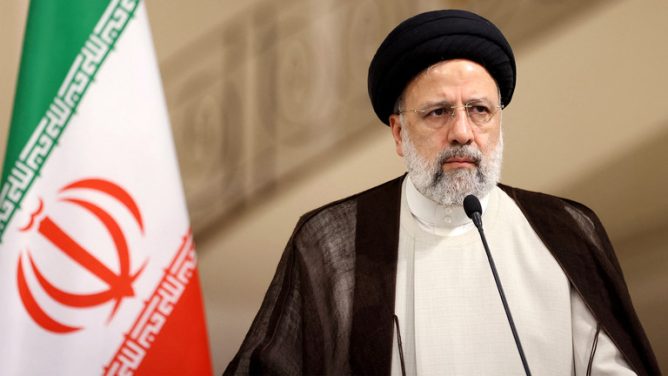
Iran’s President Ebrahim Raisi giving a joint press conference. © AFP / Iranian Presidency
RT | February 12, 2023
Iranian President Ebrahim Raisi is going to make an official visit to China next week, the Chinese Foreign Ministry has said.
Raisi’s planned visit will take place between February 14 and 16 and is at the invitation of Chinese leader Xi Jinping, the ministry announced in a statement on Sunday.
The three-day trip will, among other elements, include talks between Raisi and Xi, a joint meeting of the leaders with Iranian and Chinese businessmen, and the signing of cooperation documents between the delegations of the two countries, according to Iran’s state-run news agency IRNA.
Also reporting on the upcoming visit, US outlet Politico said that it’s “expected to deepen ties between the two political and economic partners that are opposed to the US-led Western domination of international affairs.”
Xi and Raisi last met during the Shanghai Cooperation Organization (SCO) summit last September in Samarkand, Uzbekistan. During those talks, the Chinese leader insisted that consolidating their strategic partnership was a common choice for both Beijing and Tehran.
In December, Chinese Vice President Hu Chunhua visited Iran and met with Raisi, with both sides expressing eagerness to boost bilateral ties further.
China is Iran’s largest trading partner and the main buyer of its oil amid US sanctions on Tehran. According to Iranian data, its exports to China reached $12.6 billion in the last ten months. The country also bought $12.7 billion worth of Chinese goods during the period.
Last year, Iran was formally included into the SCO as a permanent member and also applied to join BRICS – the two international organizations in which China and Russia play a major role.
Zionists angry after Australian govt. refuses to blacklist Iran’s IRGC
Press TV – February 10, 2023
A recent report has exposed that the Australian Senate committee is facing a serious legal setback in its attempt to blacklist Iran’s Islamic Revolution Guards Corps (IRGC), as the force cannot be designated as a foreign terrorist organization under the country’s criminal code.
According to the Australian Jewish News website, the Attorney General’s Department (AGD), which responded to the recommendation by the Foreign Affairs, Defense and Trade Committee, told the panel that current legislation does not provide for a pathway to proscribing the IRGC.
“As an organ of a nation-state, the Islamic Revolution Guard Corps is not the kind of entity that is covered by the terrorist organization provisions in the Criminal Code,” the AGD said on Tuesday.
The Zionist Federation of Australia (ZFA) urged the Australian government to amend the criminal code to allow for the blacklisting of the IRGC.
“We … urge the Australian government to amend legislation to allow the IRGC to be proscribed here, as it is in other countries,” ZFA public affairs director Bren Carlill said.
However, other countries have also backed down on their initial proclamations to ban the official Iranian force.
The UK government has already stopped plans to blacklist Islamic Revolution Guards Corps as reports say Foreign Office fears that the move would block communications channels with Iran.
The UK Foreign Office’s about-face on proscribing the IRGC as a so-called “terrorist” entity comes despite its approval by the Home Office, The Times reported on February 2.
Citing sources in the government, the report said there are also concerns about how to blacklist the IRGC because, unlike other proscribed bodies, the Iranian force is an official government agency.
“Foreign Office officials have real concerns about proscription because they want to maintain access. The Home Office, and the government more broadly, supports the move. The IRGC should have been proscribed by now but the whole process is on ice,” a Whitehall source said.
European Union foreign policy chief Josep Borrell said on January 23 that the block could not list the IRGC as a “terrorist” entity without an EU court decision.
Speaking before a meeting of EU foreign ministers in Brussels, Borrell said a court ruling with a “concrete legal condemnation” had to first be handed down before the bloc itself could apply any such designation.
“It is something that cannot be decided without a court, a court decision first. You cannot say I consider you a terrorist because I don’t like you,” Borrell told reporters, stressing that the court of an EU member state had to issue a concrete legal condemnation before the bloc could act.
A week earlier, the European Parliament adopted an amendment, calling on the EU and its member states to include the IRGC on their terror list. It also passed another resolution later, calling for more sanctions against Iranian individuals and entities and putting the IRGC on the EU terrorist list over alleged human rights violations during the recent riots.
The European Union, however, imposed sanctions against a number of Iranian individuals and entities for what it claimed to be a crackdown on the recent foreign-backed riots, which were triggered after the death of a young Iranian woman of Kurdish descent in Tehran in September.
IAEA head must visit Iran with ‘specific objective’, says Iran’s nuclear chief
Press TV – February 1, 2023
The chief of Iran’s nuclear agency says any visit by the head of the International Atomic Energy Agency (IAEA) to the country needs to have a “specific objective”, in an oblique reference to the UN nuclear watchdog’s political approach.
“This trip needs preparations and content and the aims and schedule of this trip should be determined,” Mohammad Eslami, who heads the Atomic Energy Organization of Iran (AEOI), said on the sidelines of a cabinet meeting in Tehran on Wednesday.
IAEA chief Rafael Grossi last week said he intends to go to Tehran in February for “much-needed dialogue” over Iran’s cooperation with the UN nuclear agency and to discuss outstanding issues.
Grossi claimed that the suspension of talks aimed at the revival of the Joint Comprehensive Plan of Action (JCPOA) and Iran’s recent measures to reduce its compliance with the 2015 deal meant that the IAEA could no longer effectively monitor the country’s nuclear program.
He also touched on IAEA’s so-called probe into what the agency claims are the presence of “undeclared uranium particles” at some nuclear sites in Iran.
Iran has already rejected the probe, saying it’s based on forged evidence provided to the IAEA by the Israeli regime, slamming the agency for adopting a political approach and forsaking its technical mandate.
Eslami said the West is waging a psychological warfare operation by accusing Iran of failing to honor its commitments under the JCPOA, while the fact remains that the Islamic Republic met all its commitments under the deal.
He reiterated that Iran is committed to its obligations under the 2015 nuclear deal and as the signatory of the Nuclear Non-Proliferation treaty (NPT), which is evident from numerous inspections of its nuclear facilities by the UN agency inspectors.
“The agency has carried out around two-thousand inspections [of countries’ nuclear facilities] between 2020 and 2022, and over these three years, five hundred inspections — that is one-quarter of all inspections — were conducted in Iran,” he said.
“They still feel concerned [about Iran’s nuclear work] and this shows their language is the one used by enemies and aimed at a sabotage operation, [but] we won’t be affected by them.”
He stressed that the Israeli regime’s influence over the UN nuclear agency and hostile moves against Iran over its nuclear work must end.
Iran rolled back its compliance with the 2015 nuclear accord after the US unilaterally withdrew from the pact and reimposed sanctions on Iran.
Tehran and the remaining signatories to the pact have held talks on reviving the accord since April 2021, after Joe Biden came to power in the US. But those talks have been stalled for months amid Washington’s procrastination and refusal to provide guarantees.
Iran says an agreement on the revival of the deal hinges on the settlement of issues between Tehran and the IAEA, as well as the removal of all US sanctions on the country.
Irish MEP: US yielding to Israeli pressures over 2015 Iran nuclear deal
Press TV – February 1, 2023
A member of the European Parliament says the United States has bowed to Israeli pressures over the 2015 Iran nuclear deal as negotiations for reviving the agreement have been stalled due to Washington’s excessive demands.
In a post on his Twitter account on Wednesday, MEP Mick Wallace criticized the US and some “hawks” in the European Parliament over the stalled talks on reviving the deal, officially known as the Joint Comprehensive Plan of Action (JCPOA).
“Biden promised to get #JCPOA with #Iran back on track but negotiations have stalled,” he wrote, adding, “[it] seems #US have caved to pressure from #Israel.”
The “hawks in EU Parliament want to abandon” the JCPOA, however, European Union foreign policy chief Josep Borrell “is right to keep dialogue open with Iran,” Wallace added.
The remarks come as negotiations, which started in April last year in Vienna, remain stalled since August as Washington refuses to remove the sanctions that were slapped on the Islamic Republic by the previous US administration of Donald Trump.
This is while after taking office, the Biden administration had criticized his predecessor’s decision to scrap the deal and vowed to reverse the measure.
On the contrary, the Biden administration officials have upped the so-called maximum pressure campaign against Iran and on several occasions announced that the talks to revive the 2015 nuclear deal are no longer their main focus.
The White House, meanwhile, is leveling accusations against Iran over human rights issues during recent foreign-backed riots and drone delivery to Russia to be used in the Ukraine war. Tehran has strongly rejected the allegations in both cases.
Observers believe Washington is trying to use these baseless accusations against Iran to gain leverage in talks and negotiate from a position of strength.
Meanwhile, the Israeli regime has openly expressed opposition to the deal since it was signed back in 2015. The regime, which is the only possessor of nuclear warheads in the region without being a member of the Non-Proliferation Treaty, has made various efforts in the past years to hamper Iran’s peaceful nuclear program, from assassinating Iranian scientists to carrying out acts of sabotage in Iranian facilities and trying to push others away from the deal.
Goodbye empire? US sanctions are failing in the face of multipolarity
By Felix Livshitz | RT | January 25, 2023
Foreign Affairs, a highly influential US magazine – effectively a US empire house journal – has published an article detailing how sanctions are quickly losing their efficiency as a weapon in Washington’s global arsenal.
Published by the Council on Foreign Relations NGO, Foreign Affairs provides space for officials within the US military industrial complex to communicate with one another on matters they believe to be of the utmost significance. Therefore, it is important to pay attention when the magazine makes major pronouncements on any issue.
It recently published an appraisal of US sanctions – the conclusion being that they are increasingly ineffective, have prompted Beijing and Moscow to create alternative global financial structures to insulate themselves and others from punitive actions, and that Washington and its acolytes will no longer be able to force countries to do their bidding, let alone destroy dissenting states, through such measures in the very near future.
The article begins by noting that “sanctions have long been the US’ favored diplomatic weapon,” which “fill the void between empty diplomatic declarations and deadly military interventions.” Despite this, it predicts “the golden days of US sanctions may soon be over.”
These “golden days” were the immediate post-Cold War era, when Washington was “still an unrivaled economic power,” and therefore could at the press of a button cripple each and every overseas economy, in theory. This was due to “primacy of the US dollar and the reach of US oversight of global financial channels.”
As international trade was overwhelmingly conducted using dollars, Washington could stop any country from exporting or importing any and all goods it wished, whenever it liked. Even then, Foreign Affairs recalls, US leaders themselves worried if sanctions were applied too liberally. In 1998, then-President Bill Clinton claimed his government was “in danger of looking like we want to sanction everybody who disagrees with us.”
The Foreign Affairs article says Clinton’s fears were “overblown,” but this is precisely what came to pass. Governments, and the countries they represented, have been sanctioned for pursuing the wrong policies, refusing to be overthrown in US-backed coups and military interventions and showing any degree of independence in their domestic or foreign dealings whatsoever. In the process, millions have died, and even more lives have been ruined for no good reason.
This approach has backfired, and badly. In response, states “have begun to harden their economies against such measures.” For example, after the US cut off Iran from the SWIFT global banking system, many other countries took note. Restricting China’s access to numerous technologies as part of the new Cold War has also served to place both Washington’s allies and adversaries alike “on notice their access to crucial technology could be severed.”
Beijing and Moscow lead the way in the push to create “financial innovations that diminish US advantage,” creating a raft of “currency swap agreements, alternatives to SWIFT, and digital currencies” that serve as “preemptive measures” against any “potential penalties” down the line.
Currency swaps, which connect central banks directly to each other and eliminate the need for trades between them to be dollar-backed, have been eagerly embraced by China. It has signed deals of this kind with more than 60 countries across the world, thereby enabling its companies “to circumvent US financial channels when they want to.”
In 2020, Beijing settled more than half its annual trade with Moscow in currencies other than the dollar, making the majority of these transactions totally immune to US sanctions, and that figure has only risen ever since. In March that year also, the China and Russia-led Shanghai Cooperation Organization officially prioritized development of payments in the local currencies of its members.
Beijing and Moscow are also, Foreign Affairs reports, “busily preparing their own alternatives” to various Western-dominated international systems. Their alternative to SWIFT, the Cross-Border Interbank Payment System, isn’t yet a match in terms of transaction volume, but that’s not the point. It prevents them, and any state or organization enrolled in the framework – 1,300 banks in over 100 countries already – from being unable to make international financial transactions, should they be cut out of SWIFT.
Similarly, China is expanding the reach of the digital renminbi, the currency issued by Beijing central bank, at home and overseas. More than 300 million of its citizens already use it, and a billion are forecast to by 2030. The currency is completely sanctions-proof as the US has no ability to prevent its use, and Beijing has encouraged several countries to pay for its exports exclusively using it – “other such deals will probably follow,” Foreign Affairs predicts.
The American empire’s obsessive reliance on sanctions has now created a Catch-22 situation, by the magazine’s reckoning. The already hostile relations between the USA, China and Russia mean Moscow and Beijing are pushing ahead with this revolutionary effort no matter what. If “things get worse,” they’ll simply “double down on their sanctions-proofing efforts,” taking more and more countries with them.
“These innovations are increasingly giving countries the ability to conduct transactions through sanctions-proof channels. This trend appears irreversible,” the article bitterly concludes. “All this means that within a decade, US unilateral sanctions may have little bite.”
It is all these developments, along with Moscow’s economic pivot eastwards after the 2014 Ukraine coup, and move towards self-sufficiency in energy and food and in other vital resources, which account for the embarrassing failure of US-led sanctions against Russia.
Western leaders, academics, journalists, pundits and economists promised when these sanctions were imposed that they would soon lead to Russia’s total political, economic and military collapse. They have not, demonstrating that elites in Europe and North America do not understand the global economy they claim to rule. They should get to grips with the new reality they inhabit in short order, though – for a multipolar world has begun to emerge in 2022, and it is here to stay.
How rapidly US elites are reckoning with the radically different reality in which they are now forced to operate is ironically underlined by how quickly the author of the Foreign Affairs article, Agathe Demarais, seems to have completely changed her tune on the subject of sanctions. On 1 December, less than a month earlier, she authored a piece for Foreign Policy – another US empire in-house journal – that offered a radically different take on the matter.
Boldly declaring “sanctions on Russia are working” in the headline, Demarais dismissed suggestions punitive Western measures were intended to “force Putin to back down and pull out of Ukraine,” or to provoke “regime change” in Moscow, or to prompt “a Venezuela-style collapse of the Russian economy,” despite the fact every single one of these outcomes was explicitly cited as a motivating factor behind the sanctions by Western officials, pundits, and journalists at the time.
Instead, she argued, sanctions were effective in the quest to “send a message to the Kremlin” that “Europe and the United States are standing with Ukraine.”
Whether or not Kiev will be thrown under a bus by its Western backers in due course, and the anti-Russian measures will endure after the war is over, seems to not matter so much, though – for, as Demarais was herself forced to acknowledge less than four weeks later, the effectiveness of sanctions is rapidly diminishing. The speed of this about-face could well be an indication of how irresistibly the multipolar world is coming to be.
US renews waiver for gas field shared by Iran and UK
Press TV – January 24, 2023
The US government has renewed a sanctions waiver for the Rhum gas field in the UK North Sea in which Iran has a 50% stake.
Iran is heavily sanctioned by the United States, but Britain’s Serica Energy which owns another 50% of the field has repeatedly secured waivers to maintain production from the field.
In a statement, Serica said it had secured another waiver extension that ensures that all companies linked to the field can provide services and goods without fear of US penalties.
“We are grateful to the UK government and regulatory authorities who have supported us in this process,” Serica Chief Executive Mitch Flegg was quoted as saying.
Serica Energy is responsible for 5% of the gas produced in the UK which is currently in turmoil over runaway prices of energy in the wake of the Ukraine war.
The UK firm expects its net production to increase by between 50 and 80 percent this year and that level of production to continue into 2025.
This would mean that the company would be producing up to 40,000 barrels of oil equivalent per day, reports said.
Rhum, a gas filed located 240 miles (390 km) northeast of Aberdeen in Scotland, is one of the largest on the UK Continental Shelf.
Iran owns half of the stakes at the gas field based on a deal signed before the Islamic Revolution of 1979. The field is believed to be capable of producing more than five million cubic meters of natural gas.
Washington has imposed a series of harsh sanctions on Iran’s energy sector since 2018 when it pulled out of an international nuclear deal.
Pressure hardening
The Biden administration, however, is hardening its position. The Iraqi government is reportedly under immense pressure from Washington to stem the alleged flow of dollars into Iran.
In recent weeks, Iraq’s currency market has been wracked by turmoil after the US introduced tighter controls on international dollar transactions by commercial Iraqi banks in November.
Reports said the move was designed to curb the alleged siphoning of dollars to Iran and apply more pressure along with US sanctions imposed on the Islamic Republic.
Iraqi MP Aqeel al-Fatlawi, however, said Washington was deliberately using the new regulations as a political weapon.
“Americans are using the dollar transfer rigid restrictions as warning messages to Prime Minister Sudani to stay tuned with the American interests. ‘Working against us could lead to bringing down your government’ – this is the American message,” the lawmaker said.
The price of consumer goods has increased and the Iraqi currency has taken a beating in the wake of the US restrictions.
And it has deepened anti-American sentiment among politicians in Iraq, which remains unstable nearly 20 years after a US-led invasion toppled Saddam Hussein.
The US is also targeting Iran’s other major trade partners. On Monday, the Biden administration’s top Iran envoy said it will increase pressure on China to cease imports of Iranian oil.
China is the main destination of exports by Iran, and talks to dissuade Beijing from the purchases are “going to be intensified,” US Special Envoy for Iran Robert Malley told Bloomberg Television.
The US reimposed sanctions on the Islamic Republic and its petroleum exports in 2018 after pulling out of the nuclear agreement, with then president Donald Trump pledging that Washington was set to bring Iran’s oil exports down to zero.
That goal never realized, with Iranian sales continuing to reach the market despite the US “maximum pressure” to curb them.
“We have not lessened any of our sanctions against Iran and in particular regards to Iran’s sale of oil,” Malley said.
Iranian crude shipments have surged in recent months, including to China, the world’s biggest importer.
Malley said the US will “take steps that we need to take in order to stop the export of Iranian oil and deter countries from buying it”.
FM: Iran to Possibly Quit NPT if Europe Not Stop Hostile Stances
Al-Manar | January 22, 2023
If the Europeans do not change their anti-Iran positions, Iran will possibly withdraw from the NPT as a countermeasure, the Iranian Foreign Minister said on Sunday.
Reacting to a recent move by the European Union to designate the IRGC as a “terrorist” entity, Hossein Amir-Abdollahian told reporters on Sunday, “Parliament’s Sunday measure that binds the government to designate the armies of the European countries as terrorist is a countermeasure.”
Referring to his conversations with EU Foreign Policy Chief Josep Borrell, Amir-Abdollahian said that the resolution is not binding and it’s just an expression of the feelings of a part of the European Parliament representatives.
Answering a question about whether withdrawal from the NPT would be one of Iran’s countermeasures, Amir-Abdollahian said, “A small number of European political leaders, including the German Foreign Minister, have no experience in the field of diplomacy.”
Therefore, if they do not move in the direction of rationality and do not correct their positions, any measure is possible, he noted.
Violating international law, European Parliament urges EU to add IRGC to terror list
Press TV – January 18, 2023
In violation of international law, the European Parliament has voted to call on the European Union and its member states to place Iran’s Islamic Revolution Guard Corps (IRGC) on the bloc’s terror list.
On Wednesday, the parliament members backed an amendment added to an annual foreign policy report, calling for “the EU and its member states to include the IRGC in the EU’s terror list.”
The hostile move passed by a vote of 598 in favor and nine against, with 31 abstentions.
The amendment will urge Brussels to blacklist the IRGC military force, the voluntary Basij force as well as the Quds Force.
And it would hit “any economic and financial activity involving businesses and commercial activities related to, owned, wholly or in part, by, or fronting for, the IRGC or IRGC-affiliated individuals, regardless of their country of operation.”
The vote does not oblige the European Union to act, but it comes as foreign ministers are already due to discuss tightening sanctions on Tehran at a meeting in Brussels next week.
“The EU Parliament has today voted to call for the EU and its Member States to include the IRGC on the EU’s terrorist list. The amendment… was passed with an overwhelming majority,” European Parliament member Charlie Weimers of Sweden tweeted on Wednesday.
He added, “Tomorrow, I hope members will take the next step & call to suspend the JCPOA.”
The JCPOA stands for the Joint Comprehensive Plan of Action, which is the official name of the 2015 Iran nuclear deal.
The marathon talks in the Austrian capital of Vienna aimed at the removal of anti-Iran sanctions and revival of the nuclear deal, underway since April last year, have remained stalled since August over foot-dragging by the United States and refusal to provide necessary guarantees to Iran.
The “politically manipulated” actions of the UN nuclear agency and the probe into so-called “uranium traces” found at “three undeclared sites” have also emerged as a key obstacle.
Iran maintains that the measures taken by the International Atomic Energy Agency (IAEA) have been at the behest of the Israeli regime and the Western states to seek leverage in ongoing nuclear talks.
Israeli foreign minister Eli Cohen welcomed the European Parliament’s decision to blacklist the IRGC.
Earlier on Wednesday, Iranian Interior Minister Ahmad Vahidi censured “some Europeans” for their attempts to designate IRGC as a foreign terrorist organization, stating that the move clearly attests to the mental and political weakness of its architects.
“There is no room for concern about the plan, and Iran’s Islamic Revolution Guards Corps (IRGC) will strongly press ahead with its path,” Vahidi told reporters after weekly cabinet meeting in the capital Tehran.
He underlined that the decision by a number of Western governments to blacklist the elite force as a terrorist organization contravenes the international regulations, and is a testimony to the mental, moral and political weakness of its engineers.
Gross distortion of facts on Mahsa Amini’s death in Western media
By Damian Lenard | Press TV | December 30, 2022
In his recent article Seven people with British links arrested in Iran over protests, freelance journalist for The Guardian, Nadeem Badshah, relates to the audience an interesting and all-too-familiar Western media version of the death of Mahsa Amini in Iran.
It is educational to dissect the article because it is representative of the propagandistic way in which foreign media have covered the tragic event for the past few months:
The 22-year-old Kurdish Iranian had been arrested for wearing “inappropriate attire” under Iran’s Islamic dress code for women.
Witnesses said Amini was beaten while inside a police van when she was picked up in Tehran. Police have denied the allegations, saying she “suddenly suffered a heart problem”.
I would refer to these short paragraphs as contextual snippets, repeated ad nauseam in media reports to drill propaganda points into the unprepared minds of the audience (yes, and we claim to abhor the widely misquoted “If you tell a lie big enough and keep repeating it, people will eventually come to believe it,” as if our own media was not an active part of that very machinery).
Let’s dig into this illustrative contextual snippet used by Badshah. I am by no means attempting to shame him, as it probably is a snippet offered by his employer/editor to make his job easier and — more importantly in this specific case — to make sure that key state propaganda is duly reinforced:
- Iran’s Islamic dress code for women
Iran’s Islamic dress code, like Western and Eastern secularist dress codes, exists not only for women but for all people in society.
Such dress codes are indeed applied differently for men and women not just in Iran, but everywhere around the world. The exception being the one or two countries on the face of the planet where public nudity or female toplessness is indiscriminately allowed in the majority of the territory.
This first part of the Guardian’s contextual snippet used by Badshah aims to brainwash readers by repetition with the notion that Iran is the only country in the globe with a dress code or the only one which enforces it. Worse, it is exclusively so for women in Iran. And that this “abhorrence” is the result of religion (and even worse, Islam) applied to politics.
The well is poisoned for the acceptance of the central part which follows:
- Witnesses said
Since no evidence whatsoever exists to support the hypothesis of Mahsa Amini having been brutally beaten to death, Western media is forced to rely exclusively on “witnesses/family said” assertions as their top proof to attempt to causally link Amini’s brief detention with her death.
The reader might already be willing to accept such a weak hearsay kind of proof (which would be disregarded or even mocked as poor journalism should it apply to an event in their own countries) because, after all, Iran is exceptionally evil as “proven” in point 1.
- Police have denied the allegations
This segment is typically dedicated to the antithesis of the previous premises, supposedly for balance and to pretend journalistic honesty. What does the other side have to defend itself? In this case, what does it have? Claims by the police. Pretty weak, isn’t it? Is that all you’ve got Iran? So it’s the word of noble witnesses (do we care how it was established that they even exist?) against that of the evil Iranian police.
The claim that “police have denied the allegations” implies the denial of the hypothesis (brutally beaten to death) is only supported by a police statement (the directly involved party and, we must remember, any authority in Iran is evil). Combined with them saying she “suddenly suffered a heart problem,” (note the cherry-picking of a quote with an inaccurate medical description to further undermine the credibility of the party) while totally omitting:
(a) The existence of a clear CCTV camera video recording at the police station in which Amini collapses on her own without the aid of any external agent and,
(b) The “leaked” hospital photographs of Amini showing no sign of trauma or blood consistent with a fatal beating (or debatable signs if one possesses a powerful imagination), expose the utter disregard for journalistic integrity, and full commitment to pedaling state propaganda regardless of the damage it causes.
The reason why I find this rather fascinating is because of the vicious circle that is built around these structures of reporting about a country like Iran:
The premises of point 1. (the exceptional evilness of religion applied in politics, the exceptional evilness of Iran’s dress code, the exceptional oppression Iran crushes women with) bias the evaluation of the following points, and at the same time tend to be “proven” with non-facts analogous — in terms of objective weakness — to those of points 2. and 3.
Thanks to meticulously-crafted reality distortion of this sort, the Western public, which believes itself to be professionally informed and impervious to manipulation, unsuspectingly swallows dogma after dogma of misrepresented reality.
The result is the installation of moral shock and the reaffirmation of solid prejudices useful to rally sufficient public support for the foreign policy of the day: usually the collective punishment of entire nations by war or economic sanctions.
Iraq has weapons of mass destruction, so getting half a million Iraqi children killed by sanctions and millions more by war can be deemed “worth it” or at least as just an honest mistake, as opposed to punishable war crimes and crimes against humanity.
If only there was a way to poll the staunch defenders of freedom and democracy (a noble utopia that could only separate itself from tyranny with a perfectly well-informed public), asking how many of them were offered to watch the CCTV footage and “leaked” hospital photos of Mahsa Amini (as opposed to handed only hearsay rumors) that would have otherwise allowed them to decide for themselves.
Goethe was certainly on to something big when he wrote in his Elective Affinities: None are more hopelessly enslaved than those who falsely believe they are free.
Damian Lenard, Ph.D., is a political commentator with focus on Eurasian politics. He speaks fluent Persian and occasionally writes for Iranian publications.
Ukraine presidential aide calls for destruction of Iranian weapon factories
The Cradle | December 24, 2022
A presidential aide for Ukrainian leader Volodymyr Zelensky on 24 December called for the “liquidation” of Iranian weapons and drone manufacturing facilities and the arrest of those supplying the Islamic Republic with raw materials.
“Important to abandon nonworking sanctions, invalid UN resolutions concept, [and] move to more destructive tools,” Mykhailo Podolyak tweeted early Saturday.
Since September, Kiev has accused Tehran of supplying the Kremlin with hundreds of kamikaze drones allegedly used to hit Ukrainian infrastructure.
On Friday, the head of Ukraine’s spy agency claimed Russia had already launched around 540 drones at military and energy targets. For its part, Iran denies supplying Russia with drones since the start of the war.
The call for military action against Iran by Zelensky’s aide comes just days after officials in the Islamic Republic warned that its “strategic patience” towards Ukraine was running out.
“Iran’s patience will not be limitless,” Foreign Ministry spokesperson Nasser Kanaani said in a statement published by the state-run IRNA news agency on 22 December, where he also reiterated Tehran’s official position of “never supplying military equipment to any side to be used in the Ukraine war.”
“Mr. Zelenskyy should better learn a lesson from the fate of other world leaders who have invested hope on America’s support,” Kanaani concluded.
This statement was released hours after President Zelensky delivered an address at the US Capitol building, where he rebuked Iran for being an ally in Russia’s “genocidal policy” before describing Tehran as a “terrorist” state.
“Russia found an ally in this genocidal policy — Iran … Iranian deadly drones sent to Russia in the hundreds became a threat to our critical infrastructure. That is how one terrorist has found the other,” the Ukrainian leader told an exuberant gathering of US lawmakers before demanding Washington deliver more financial aid to fuel the war against Russia.
Since the start of the war, the White House has approved approximately $113 billion in economic and military assistance to Kiev. According to government spending data, over the last 12 months, Ukraine has been awarded more US taxpayer dollars than 40 US states.
Featured Video
Racist Seinfeld Dances for Joy as Bibi Unveils His New Map
or go to
Aletho News Archives – Video-Images
TV Drama Review
Japanese drama projects Japan’s wartime atrocities onto Chinese characters

Global Times | October 25, 2026
By portraying Chinese characters as perpetrators of ruthless violence while casting Japanese Self-Defense Forces (SDF) intelligence operatives as defenders, the season 2 of the Japanese drama Vivant has recently drawn criticism from Chinese netizens, who argue that its depiction turns historical reality on its head while ignoring Japan’s wartime atrocities.
The TBS drama series – a spy suspense story in which an alleged unofficial intelligence unit of the SDF operates across the globe — has attracted a passionate fanbase. Its currently airing season 2 opened with a household rating of 18.8 percent, the highest for a TV drama this year, according toa commentary article by Japanese media Toyo Keizai.
What draws attention is the portrayal of the enemies in the series, the article noted. Scenes in which the Chinese organization subjects kidnapped members of the SDF unit to brutal torture are repeated with unrelenting intensity.
It is rare for Japanese TV dramas to explicitly portray a real-life country as the enemy, the article noted.
Japanese Prime Minister Sanae Takaichi also made a reference to the drama, saying that she has been recording Vivant and hopes to binge-watch it over the year-end and New Year holidays, according to Japanese media outlets.
China’s CCTV News report on Sunday revealed that the drama features scenes in which Chinese personnel cut off the fingers of and stab Japanese intelligence operatives in the abdomen. Such acts bear striking similarities to the torture inflicted on Chinese nationals by invading Japanese troops during the World War II.
The drama distorts the truth by attributing these atrocities to modern Chinese characters. Beneath the surface, it subtly glorifies Japan’s cross-border overseas operations, blurs the functional boundaries of the SDF and implicitly promotes an expansionist narrative, per CCTV News. … continue
Blog Roll
 Aletho News
- Iran FM Araghchi: “Hormuz Will No Longer Be the Same”
- EU facing trillion-euro debt hole while seeking more cash for Kiev
- How US, Europe, Persian Gulf states exhausted missile stockpiles, splurged billions to defend Israel
- Up in arms… Koreans reject U.S. empire’s plan to make South Korea the next Ukraine
- Iran, Turkey, Pakistan, Saudi Arabia could advance region-led security framework in Tehran: FM spox
- Netizens condemn Japanese drama for projecting Japan’s wartime atrocities onto Chinese characters
- Racist Seinfeld Dances for Joy as Bibi Unveils His New Map
- A West Bank War for Netanyahu’s Election Campaign, Could It Backfire?
- Yemen denounces European Parliament’s ‘hypocritical’ push to blacklist Ansarullah
- Qalibaf: UAE’s UN bid aims to ‘clear the runway’ for ‘Greater Israel’, whitewash genocide
- If Americans Knew
- Israel punishes Palestinian prisoners with solitary confinement for making a cake
- US midterms: Where do candidates in key Senate races stand on Israel, Gaza, and Iran?
- Israeli forces demolish Hebron homes, displace thousands of Palestinians as raids expand
- Their Son Died in Israeli Prison. No Answers. No Body
- Biden’s Israel Catastrophe
- Why Israel’s latest assault on Hebron is so significant for the West Bank
- Israel Used “Where’s Daddy?” AI to Relentlessly Murder Palestinian Journalists and Their Families in Their Homes from October to December 2023
- DAILY UPDATE: Latest essential news on Palestine, Israel, & region
- Netanyahu Says Israel Must Prepare for Banking Sanctions, Floats Crypto as a Possible Bypass
- Latest updates from Israeli assault on West Bank
- No Tricks Zone
- Sudden Stratospheric Warming, Powerful El Niño Combination May Lead To Extreme Europe Cold, Energy Crisis!
- Two New Studies Find Thwaites Glacier Melt Cannot Be Driven By Human Activity Or A Warming Ocean
- E-Cars Reduce CO2 Emissions By Only 41% Compared To Internal Combustion Engine Vehicles
- Predictions Made By Renowned Climate Professor Over Past Decades Have Been Proven To Be Poor
- New Study Suggests Large Regions Of The Pacific Ocean Have Been Cooling For The Last 80 Years
- Germany’s Green Energy Debacle: High Energy Costs Force Kahla Porzellan to Close After 182 Years!
- New Study: 50 Years Of The Most Aggressive ‘Net Zero’ Policies Can Only Affect The Global Climate By 0.03°C
- US September “Heat” Was No Record…Many Records Set Decades Ago
- Latest European Green Energy Debacle; Portugal’s Largest Flagship Solar Park Insolvent!
- Green Energy Debacle: German Expert Professor Fritz Vahrenholt Warns Of Severe Economic And Social Consequences

