Western sanctions prevent dozens of food shipments from reaching Iran
The Cradle | December 21, 2022
At least 40 merchant ships carrying grains and sugar are stranded off the coast of Iran due to delays in payments that have been ongoing for weeks, according to shipping data reviewed by Reuters.
Ship tracking data shows that the carrier ships are currently stuck outside the major Iranian ports of Bandar Imam Khomeini and Bandar Abbas.
The Iranian Ports and Maritime Organization said in late November that 37 ships loaded with 2.2 million tons of goods had not been able to unload their cargo due to “documentation and hard currency payment issues.”
One western trade source quoted by Reuters estimated that the cargoes stuck outside Iran are worth more than $1 billion, with charterers facing delay costs known as demurrage.
While western sanctions on Iran allegedly exempt food and medicine purchases, the weight of the punitive measures on the country’s financial system greatly restricts payment methods, forcing authorities to rely on complex and erratic arrangements with international companies.
Iran counts among the driest countries in the world, with an average rainfall of only 250mm a year. Despite its nearly 165 million hectares of land, only about 50 million is arable, with just 18 million hectares used for farming.
According to data compiled by the US Department of Agriculture, due to severe droughts, Iran is expected to import 5.5 million tons of wheat during the 2022/23 season, down from 8.0 million during the previous season, but still well above normal levels.
Iranian authorities have, in recent years, prioritized boosting food security in the country to confront western sanctions.
In September, Venezuela offered millions of hectares of agricultural land to Iranian producers. Other reports indicated that Russia had also offered 100,000 hectares of land – an attestation to how Tehran has been pursuing its plans of trans-territorial farming in various countries.
The idea of trans-territorial farming surfaced in Iran over two decades ago. However, it was not until 2016 that officials started implementing measures to achieve this as part of their strategy to secure food supplies for the country.
Tehran, which between 2004 and 2017 celebrated its self-sufficiency in strategic products like wheat, and even exported part of its wheat surplus in 2017, now needs to import grains to make up for shortfalls in production.
Russia categorically rejects UK foreign secretary’s claim of military deal with Iran
Press TV – December 12, 2022
The Russian embassy in London has roundly dismissed the “inappropriate statements” of British Foreign Secretary James Cleverly, who spuriously claimed Iran was sending armament and munitions to Russia for its military campaign in neighboring Ukraine.
“We categorically reject recent comments by Cleverly, who followed in the footsteps of US authorities and accused the Russian Federation and Iran of some ‘sordid’ deals concerning the Ukraine crisis. The United Kingdom is well aware of the fact that the allegations about Iran’s military supplies to Russia lack any factual basis,” the diplomatic mission said in a statement released on Monday.
“Russia, unlike certain Western governments, is invariably committed to compliance with national legislations as well as international principles as regards its cooperation with third countries,” it added.
The Russian embassy also emphasized that the top British diplomat should be reminded of London’s and its Western allies’ massive military, technical, financial and propaganda assistance to Ukraine when talking about “sordid” transactions between Moscow and Tehran.
The embassy underlined that supplying Ukraine with Western weapons, which is taking place in clear breach of fundamental norms of export control, only led to prolongation of hostilities and an increase in civilian casualties as Ukrainian army forces used the military equipment to launch “de-facto terrorist strikes against civilian targets” on Russian territory.
“We are carefully recording all cases of London’s and its Western allies’ financial and military supplies to the Kiev regime, as well as planned military operations against Russian facilities and military personnel. Such criminal acts will naturally have specific legal consequences for all those involved,” the statement said.
The embassy also drew attention to Cleverly’s “utterly unfounded speculations” that Tehran violated UN Security Council Resolution 2231, which endorses the 2015 Iran nuclear deal – officially known as the Joint Comprehensive Plan of Action (JCPOA).
“If London is really concerned about implementation of the resolution, British authorities should pay meticulous attention to its true violator, the United States, whose unilateral withdrawal from the nuclear deal [in May 2018] has created serious challenges for global security,” the statement added.
Earlier this month, Iranian Foreign Minister Hossein Amir-Abdollahian rejected claims about the Islamic Republic’s arms sales to Russia to be used in the ongoing war against Ukraine, saying such allegations are aimed at legitimizing the West’s military assistance to Kiev.
In a phone conversation with Secretary General of the United Nations Antonio Guterres on December 2, Amir-Abdollahian said the ongoing conflict between Russia and Ukraine is rooted in the wrong policies of the North Atlantic Treaty Organization (NATO), namely its expansion toward the east.
The top diplomat reiterated Iran’s opposition to the dispatch of weapons to the parties involved in the war which he said would only increase human losses and financial costs for both sides.
He said Tehran would continue its efforts to stop the war and promote lasting peace in Europe.
Both Iran and Russia have repeatedly denied claims that Tehran has provided Moscow with drones to be used in the war in Ukraine.
The anti-Iran claims first emerged in July, with US National Security Advisor Jake Sullivan alleging that Washington had received “information” indicating that the Islamic Republic was preparing to provide Russia with “up to several hundred drones, including weapons-capable UAVs on an expedited timeline” for use in the war.
Can Hungary act as a bridge between Iran and Europe?
By Mohammad Salami | The Cradle | December 7, 2022
Upon signing the protocol of the third session of the joint commission for economic cooperation between Iran and Hungary on 16 November, Hungarian Foreign Minister Péter Szijjártó expressed support for Iran’s right to the peaceful use of nuclear energy.
He also wrote on his Facebook page that the Hungarian government intends to integrate Iran into the international cooperation system and that Budapest plans to expand economic cooperation with sanctioned Iran with the aim of “normalizing the situation.”
After regaining power in 2010 and forming a government, Hungary’s ruling Fidesz Party defined its main priority as improving the nation’s economy, creating jobs, and attracting foreign direct investment (FDI). Budapest gradually moved to provide the necessary legal platforms through which foreign companies could make investments, especially in the industrial sector.
Arguably, Hungary’s foreign policy is therefore heavily focused on the development of economic relations with foreign partners to maintain and continue economic growth and attract more FDI.
Between 1989 and 2019, Hungary received approximately $97.8 billion in FDI, mainly in the banking, automotive, software development, and life sciences sectors. The EU accounts for 89 percent of all in-bound FDI.
Hungary’s “Eastern Opening” policy
However, the presence of eastern countries and the increase in the volume of trade and investment in Hungary is particularly noteworthy. This presence is due to Hungary’s “Eastern Opening” policy, which has become one of the principles of the country’s foreign policy and economy since 2012.
The global financial and economic crisis of 2007-2009 and its impact on the European economy was one of the catalysts for the Hungarian government in launching this initiative. As a result of this policy, China has become Hungary’s fifth most important trade partner with bilateral trade volume in 2020, having increased by more than 25 percent year-on-year.
Regardless of the debatable success of this policy, there are two points which make Hungary willing to continue this policy resolutely:
First, Hungary’s location as the gateway to Western Europe positions Budapest as an important access point to those markets, even potentially a logistics and transportation hub between the EU and Asia.
Second, is Budapest’s assumption that a genuine representation of Hungarian national interests is only possible once the country attains more global visibility and is able to parlay that into support from relevant international and regional players.
Iran and Hungary
Iran-Hungary relations cannot be separated from Budapest’s key “Look to the East” policy. Hungary has a special view of the east, including West Asia, and considers Iran to be an important strategic player in the region.
“The Hungarian government has always supported Iran’s balanced approach in international forums and the further development of bilateral ties,” Péter Szijjártó said in July.
The cooperation between Budapest and Tehran has been prioritized in several fields: energy, trade, migration, student exchanges, and support for Iran’s nuclear negotiations.
In the economic sector, Iran and Hungary have signed three economic cooperation protocols to date. Most of the cooperation is in the field of agriculture, animal husbandry, and healthcare. Moreover, the volume of economic trade between the 2nd and the 3rd Joint Economic Cooperation Commission has increased by 55 percent.
Following a recent meeting in Budapest, Iran’s Finance and Economic Affairs Minister Ehsan Khandouzi announced the two countries’ plans for boosting their annual bilateral trade to €100 million. In addition, Iran and Hungary signed a memorandum of understanding in late 2021 to expand economic cooperation in the fields of water treatment, seeds, power plants, animal feed and building materials, and joint investment opportunities.
“We would like Iran to return to the system of peaceful collaboration within the international community as soon as possible. We believe that economic cooperation may be the first step in this return,” Szijjártó said on his last visit to Iran.
In addition to economic cooperation, there are 2000 Iranian students in Hungary, and the government plans to grant scholarships to 100 Iranian students. Budapest also appreciated Iran’s role in preventing the flow of migrants to Hungary, especially Afghans, and politically supports Iran’s acquisition of peaceful nuclear technology.
Capitalizing on Budapest’s strained EU ties
From Iran’s point of view, Hungary can help it to bypass sanctions, enter global markets, and act as a mediator in easing belligerent European policies against Iran. Budapest’s tension with the EU in adopting policies that, in some cases, violate the EU’s own procedures and regulations, also incentivizes Iran to deepen its strategic partnership with Hungary to help further Tehran’s interests in Europe.
Hungary and the EU have been clashing for years on issues ranging from judicial independence to media freedoms and refugee rights. In September, several EU lawmakers declared that Hungary had become “a hybrid regime of electoral autocracy.”
In turn, Budapest has repeatedly accused Brussels of undermining its national interests and meddling in its internal politics. In 2018, Hungary passed a law in that criminalized helping illegal asylum seekers, which punishes violators with up to a year in prison. The EU strongly condemned the new legislation, but Hungary stood firm.
An eastward outlook
The opposition of the EU to Hungary and the adoption of its closer alignment with the east has prompted Budapest to take a positive, more proactive view toward countries like China, Russia, Iran, and to some extent, Turkey.
Currently, Hungary enjoys strong economic and energy relations with Russia. By opposing a visit by the special rapporteur on human rights to Russia, Budapest became the only European capital to take this stance.
While Hungary voted in favor of two 2014 resolutions against Russia over Ukraine, it has also opposed an €18 billion EU aid package to the embattled state.
Budapest is highly dependent on Moscow for energy supplies with 85 percent of the country’s gas and 65 percent of its oil supplied by Russia. Unlike the other energy dependent EU members, Hungarian authorities are strongly and openly opposed to sanctions against Russia, particularly in the energy sector.
In regard to 2022 energy shortages, Hungary’s foreign minister has even encouraged Europe to look to Tehran: “Iran’s stronger entry to the global energy market is in line with the interests of the world’s entire countries and nations.”
On the issue of Sweden and Finland joining NATO, Hungary – like Turkey – has declared its opposition to the plan, which is essentially opposition to the expansion of NATO in Europe or to the east.
Hungary’s common positions with Russia and the eastern bloc inevitably overlaps with some of Iran’s policies. By coordinating with both Europe and West Asia, deepening strategic relations between Budapest and Tehran can become a means to advance their mutual goals and interests.
At the same time, Hungary will be wary of potential western sanctions if it is viewed as growing too close to Iran.
Iran, India recalibrating ties amid geopolitical shifts
‘Not a choice, but necessity’
By Zafar Mehdi | The Cradle | December 1, 2022
“Not a choice, but a necessity.” That’s how Iran’s Deputy Foreign Minister Ali Bagheri Kani stressed the importance of closer strategic and economic ties between Tehran and New Delhi during his visit to India in November.
Kani had a message for Prime Minister Narendra Modi from Tehran – strategic synergy is a win-win proposition for the two sides amid the shifting geopolitical and geo-economic landscape in the wake of the Ukraine war and the new world order.
Before the Trump administration reinstated sanctions on Iran in 2018, Iranian oil comprised nearly 11 percent of India’s total oil basket. However, New Delhi buckled under US pressure and stopped importing oil from Tehran in a move that hampered their cooperation in other strategic areas.
Three years down the line, amid rapidly changing geopolitical power dynamics and the end of “the era of the unipolar world,” as announced by Russian President Vladimir Putin in June, India has become keen on recalibrating its ties with Iran, a traditional ally, in the midst of an energy crisis gripping the world.
It is worth noting that Russia became the biggest oil supplier to India in October, supplying 935,556 barrels of crude oil per day, according to energy cargo tracker Vortexa, making up for 22 percent of the energy-dependent country’s total crude imports, ahead of Iraq’s 20.5 percent and Saudi Arabia’s 16 percent.
Iran as an alternative energy supplier
Faced with a burgeoning demand for oil and gas amid the global energy crisis and recent oil cuts by the OPEC+, India now looks poised to resume oil imports from Iran, defying US sanctions, The Cradle learned from sources in Tehran and New Delhi.
Interestingly, India’s petroleum minister Hardeep Puri hinted at it during his visit to Washington in October, saying New Delhi will buy oil from wherever it has to. Russia, as we know, is already shipping oil to India, despite strong US pressures.
Talks are currently underway between India and Venezuela, especially with the US easing oil-related sanctions against Caracas. This, by extension, has opened a window of opportunity for India and Iran to revive their energy trade. The good news is that both sides look interested.
Iran has already expressed its readiness to resume energy trade with India. Last month, newly-appointed Iranian ambassador to New Delhi, Iraj Elahi, announced that Iran is willing to provide low-cost crude oil to India to ensure the country’s energy security, something top Indian officials have in recent months cited as the government’s priority.
A win-win proposition
In 2018-2019, India purchased $12.11 billion worth of crude oil from Iran, which plummeted to zero in May 2019 after the significant reduction exemption (SRE) period ended.
Likewise, trade between the two countries dropped from $17.3 billion in 2018-2019 to $4.77 billion in 2019-2020. Although it has ultimately failed to achieve its objectives, Washington’s “maximum pressure” campaign had a negative impact on India-Iran relations.
However, ties have since markedly improved, as evidenced by Bagheri Kani telling the Indian press that the Islamic Republic is ready to meet the country’s growing energy needs, while India can in turn contribute to Iran’s food security as a major food producer.
This, he asserted, would help in boosting the process of multilateralism in the international system, which essentially means the death of US unilateralism more than three decades after the end of the Cold War and the collapse of the former Soviet Union that paved the way for the era of the unipolar world.
Suhasini Haidar, diplomatic affairs editor at The Hindu and a leading Indian analyst, termed Bagheri Kani’s visit to India as “significant,” saying it “shows a commitment to India-Iran ties by both governments despite geopolitical divides in the world on issues like the Ukraine war.”
Penalized by US sanctions
Haidar described Iranian crude as “sweeter, lighter, cheaper, and easier to transport to India than other options,” calling the Indian government’s decision to cut Iranian imports “irrational.”
“It was irrational of the Modi government to have canceled India’s imports of Iranian oil under threat from the Trump administration, and it would make sense if they decided to restore the oil trade between the two countries,” she told The Cradle.
Haidar said it remains to be seen if the Modi government will be willing to resume oil imports from Iran, “despite several signals that both sides are exploring their options,” especially after the latest sanctions on an Indian company transporting Iranian oil.
Mumbai-based Tibalaji Petrochem Private Limited was sanctioned in late September for shipping Iranian petrochemical products to China. It was the first time an Indian company was sanctioned by the US for dealing with Iran.
In his meeting with his Indian counterpart Vinay Mohan Kwatra, Bagheri Kani pointed to the “necessity” of regional cooperation between the two countries, which he said would “take away the opportunity from foreigners to exploit the lack of cooperation.”
The sentiments were mutual as India’s foreign ministry spokesman, in a statement following Bagger Kani’s meeting with Kwatra, said the two officials “discussed bilateral relations, including the development of Chabahar Port” and “regional and international issues of mutual interest.”
Time to shore up ties
According to observers, the time is now ripe for the two sides to shore up bilateral ties and multilateral cooperation, with Tehran set to become a full member of the Shanghai Cooperation Organization (SCO) as well as the BRICS group, given its close ties with Russia and China.
Notwithstanding existing challenges, Iran and India share mutual interests in trade and connectivity. Iran’s full SCO membership could prompt the two sides to focus more on connectivity projects like the Chabahar Port, which links with the International North-South Transport Corridor (INSTC), the multi-mode network of ships, rail and roads for moving freight between India and Iran, among other countries.
“India and Iran have important trade needs, including in wheat, pulses and commodities, as well as oil reserves. And the connectivity engagement is very important for India through Chabahar and through the INSTC,” Haidar explained.
Importantly, in recent years, Chabahar Port in Iran’s southeastern Sistan-Baluchestan province has emerged as a key area of cooperation between Tehran and New Delhi, which will provide India access to Afghanistan and Central Asia through Iran, ending its reliance on arch-rival Pakistan.
Rezaul Hasan Laskar, the foreign affairs editor at Hindustan Times, says the strategic port has “become more important following its growing use” but that “it needs to be connected to Iran’s railway network.”
While the first section of the Zahedan-Chabahar railway line is nearing completion, official sources in Tehran said the agreement between the two sides to construct the 628-kilometer (390 miles) railway line had faced “serious impediments” due to New Delhi’s reluctance to start work fearing US sanctions.
“Despite India’s close ties with the US and Israel, its decision to build strategic ties with Iran, and Iran’s according special projects to India like Chabahar Port despite its ties with China are a constant reminder of this special relationship,” Haidar told The Cradle.
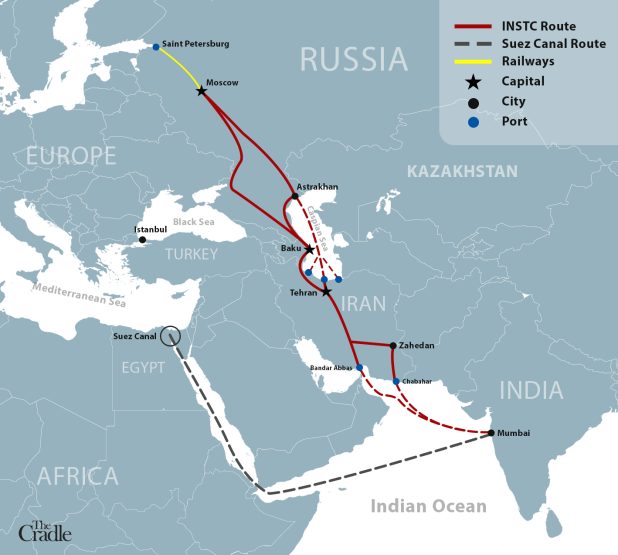
Map of the International North-South Transport Corridor (INSTC)
Joint cooperation with Beijing and Moscow
Sources in Tehran and New Delhi said the use of rupee-rial trade was also “seriously considered” during Bagheri Kani’s New Delhi visit, with both sides agreeing that a banking mechanism that is not tied to the west is key to strengthening the process of multilateralism, and paving the way for the resumption of trade.
Laskar of Hindustan Times confirmed that the senior Iranian diplomat “reiterated Iran’s offer to resume oil supplies and raised the issue of trade in national currencies.”
The changing geopolitical landscape in the wake of growing anti-western mechanisms, including SCO and BRICS, led by China and Russia, is also likely to propel increased cooperation between Tehran and New Delhi.
Laskar, however, believes that the SCO has not been a particularly crucial grouping for India in recent years, “largely because of the tensions with China,” adding that India’s biggest concern about the expansion of BRICS is that “it shouldn’t become a China-centric grouping,” underlying Sino-India tensions.
Meanwhile, Russia remains a common ally of India and Iran, which is evident in Moscow and New Delhi looking to ramp up trade via Tehran along the INSTC – the strategic route that has assumed tremendous significance since the start of the Ukraine war.
The decision to boost INSTC trade, according to reports in Indian media, was high on the agenda during Bagheri Kani’s India visit, as Russia now looks set to invest in the Chabahar Port. According to sources, the war in Ukraine also figured prominently in Bagheri Kani’s talks with Indian officials. Both sides agreed on maintaining a “neutral stance” on the war and increased engagement with Moscow.
“Russia is the new game-changer in the region, especially after the realignment of power centers, and that is good news for India-Iran ties,” an Iranian diplomat stationed in South Asia told The Cradle.
Russian Foreign Ministry: No Evidence That Tehran Wants to Develop Nuclear Weapons
Samizdat – 30.11.2022
MOSCOW – There is no evidence that Tehran intends to develop nuclear weapons, reviewing its participation in the Nuclear Non-Proliferation Treaty (NPT), Vladimir Yermakov, director of the Russian Foreign Ministry’s Non-Proliferation and Arms Control Department, said in an interview with Sputnik.
“Iran has been and remains a conscientious participant in the Treaty on the Non-Proliferation of Nuclear Weapons. The conclusion of the JCPOA in 2015 helped to finally and irrevocably remove all the questions that the [International Atomic Energy Agency] had to Tehran at that time.”
“After that, for several years Iran remained the most verified state among agency members. No deviations from its obligations were identified,” Yermakov said. “There is no evidence that would indicate Tehran’s intention to ever reconsider its participation in the NPT and start developing a nuclear explosive device.”
Yermakov’s remarks come as the US undertakes joint military drills with Israel, complete with fighter jet simulations on strikes against Iran’s nuclear program infrastructure. Earlier announcements detailed the drills would be held in the Mediterranean Sea starting November 29, and lasting through December 1.
At the time, Israeli Defense Minister Benny Gantz stressed that the drills were needed in order for Israel to “prepare” its service members for any “possibility.”
Days before the drills kicked off, US media reported that Tehran was inching toward achieving a weapons-grade enrichment, paving the way for Iran to acquire the technology to assemble nuclear weapons.
However, it’s worth noting that Iran has repeatedly indicated it has no intention to create nuclear arms; in fact, Iranian leadership imposed a fatwa in 2003 on the production or usage of any form of nuclear weapons.
Tension between Iran, Israel and the US has remained high for years. Under the Trump administration, however, escalations were at near-boiling after the US withdrew from the 2015 Joint Comprehensive Plan of Action, reimposed past sanctions and continued on a “maximum pressure” campaign against Tehran.
Talks to restore the agreement under the Biden White House have remained stalled for months. Iran earlier dispatched a “constructive” response to Washington’s proposals but was ultimately shut down by administration officials who deemed the messages “not constructive.”
European parliament severs ties with Iran over sanctions against EU

The Cradle | November 22, 2022
The EU parliament announced on 21 November its decision to sever ties with Iran. The announcement comes in response to the Islamic Republic’s recent decision to place sanctions on the European governing body, which has been slapping its own sanctions against Tehran throughout the ongoing unrest in the country.
“We will not look away from those who look to us from the streets of Iran. Iran must stop its oppression of legitimate protests. In response to Iran’s [sanctions] on members of the European Parliament, [it] will no longer engage with Iranian authorities,” President of the EU parliament, Roberta Metsola, said in a statement via Twitter with the popular Iranian protest slogan “Women, life, freedom” written in Persian at the end of the tweet.
At the opening of its November plenary session on the same day, Metsola said that there would be “no direct contact” between the parliament and Iranian officials “until further notice.”
As Iran continues to face large waves of violent riots – which have resulted in the deaths of several members of the security forces and the destruction of public property – western media has framed the response by authorities as nothing more than a brutal crackdown on peaceful protestors.
In addition to the propagation of misinformation by mainstream, western European media, the EU has repeatedly placed several rounds of sanctions against Iran.
Accusing European states of interventionist policies and “supporting terrorism and violence” on Iranian soil, Tehran on 26 October announced the implementation of its own sanctions against several individuals and institutions associated with the EU.
Earlier that month, the Islamic Republic had sent several letters to European diplomats warning them that the aggressive EU sanction policy against Tehran could result in a “rupture” of relations between them.
As European, Saudi, British, and US media outlets lead the misinformation campaign against Tehran, violent attacks against the country’s security personnel are on the rise, and internationally-backed armed separatists continue to push for the illegal overthrow of the Islamic Republic.
Iran retaliates against UN nuclear resolution – media
RT | November 22, 2022
Tehran has for the first time started enriching uranium to 60% fissile purity at the Fordow facility, Iranian media reported on Tuesday. Such a move would be seen as a response to a critical resolution adopted by the UN’s nuclear watchdog last week.
Iran is already enriching uranium at Natanz, its other major production site, to below weapons-grade 90% enrichment, but well above the 3.67% limit specified in the 2015 Iran Nuclear Deal, or JCPOA. The US abandoned the deal with Tehran during the administration of Donald Trump, leading to its erosion and effective collapse.
Other reported moves by Iran include upgrading cascade lines with more advanced gas centrifuges to boost production capacity at Fordow, as well as firing up additional chains at Natanz.
Tehran’s action was described as retaliation for a resolution passed last Thursday by the Board of Directors of the International Atomic Energy Agency (IAEA). The document, which was drafted by the US, Britain, France and Germany, decried “insufficient substantive cooperation by Iran” on the issue of uranium traces found in 2019 by inspectors at three undeclared sites. It demanded “credible explanations” and full cooperation from Tehran.
The four sponsoring nations are also signatories of the JCPOA. China and Russia, two other participants of the landmark deal, reportedly voted against the draft document during the closed-door session last week.
The Iranian Foreign Ministry rejected the resolution, calling it a form of political pressure by the US and its allies. Spokesman Nasser Kanaani said on Monday that the country had taken “initial measures” in response to it on Sunday night.
“The implementation of these measures was realized today in the presence of IAEA inspectors in the Natanz and Fordo enrichment complexes,” the diplomat added, without specifying what had happened.
The JCPOA was meant to exchange an Iranian commitment to limit its nuclear program for relief of economic sanctions imposed on the country. The goal was to prolong the time Tehran would need to create a nuclear weapon, an ambition that Iran officially denies fostering in the first place.
The Trump administration unilaterally pulled out of the Iran Nuclear Deal as part of its “maximum pressure” campaign against Tehran. President Joe Biden has been negotiating a possible revival of the JCPOA, but no breakthrough has been achieved so far.
IAEA primary instrument of pre-aggression, sets scene for US, Israeli unilateral actions: Analyst
Press TV – November 22, 2022
works before a news conference attended by IAEA Director Rafael Grossi during an IAEA Board of Governors meeting in Vienna, Austria, September 13, 2021. (Photo by Reuters)
A political analyst has described the International Atomic Energy Agency (IAEA) as a primary “instrument of pre-aggression” which paves the way for Israel and the US to take unilateral actions against Iran.
“The IAEA has become a primary instrument of pre-aggression. In other words, they create a scenario, they make the false charges, they do not prove the charges, and then they use the false unproven charges, to stoke the fires of aggression against you,” John Bosnitch told Press TV on Monday while commenting on recent tensions between Iran and the IAEA following a resolution passed by the UN nuclear body’s Board of Governors.
The politically motivated draft resolution, ratified on Thursday, has criticized Iran for what it called a lack of cooperation with the agency. It was put forward by the United States, Britain, France, and Germany, in continuation of their political pressures on Iran.
Bosnitch added that the “trend” that has been going on for years against Iran is rooted in the Israeli lobby and its influence on the US government and American personnel inside the IAEA.
“It looks like yet another provocation to create false grounds for aggressive action against Iran,” he said.
The political analyst further pointed to the “invented” excuses and provocations against Iran, saying that the US uses the IAEA as a tool “to make it a little bit more believable to those naive people around the world who still hold trust in such institutions.”
Once the fires of aggression are lit, Bosnitch said, Israel and the US can act unilaterally and illegally based on the so-called reports by the IAEA.
“And that is the formula for aggression. And I have to say that Iran, as I’ve said, through all discussions on this topic, must be ready for the worst,” he cautioned.
‘IAEA a spying organization’
Bosnitch also called the IAEA a “spying organization” that only spies on enemies of the United States and Israel.
In order to ease concerns about its nuclear program, Iran has agreed to install surveillance cameras in its nuclear facilities and has provided the IAEA with physical monitoring and satellite images. According to Bosnitch, however, “nothing works because the lies perpetrated by the lying mainstream media are bigger to the common person’s eye than the truth.”
Head of the Atomic Energy Organization of Iran Mohammad Eslami said on Sunday that the Islamic Republic will give a “firm response” to the IAEA Board of Governors’ anti-Iran resolution.
“The nuclear programs of the Islamic Republic of Iran are moving forward according to the strategic action plan of the parliament, and the issuance of multiple resolutions against Iran will not cause any disruption in the progress of these programs,” the AEOI chief added.
According to a report published on Tuesday, Iran has started enriching uranium to the purity level of 60% at its Fordow nuclear facility. The country has also installed two new IR2M and IR4 cascades at the Natanz and Fordow facilities.
The report added that Iran has fitted and launched new centrifuges at two empty halls in Fordow and Natanz nuclear sites and replaced IR1 centrifuges at Fordow with IR6 which will increase enrichment at the site by 10 times.
Tehran informed the IAEA of that decision via a letter. It described the move as a strong message to the recent anti-Iran resolution passed by the IAEA’s Board of Governors.
‘US provoking protests in Iran’
Elsewhere in his remarks, Bosnitch mentioned the recent violent riots across Iran, warning that US agents are working inside Iran “right now” to provoke protests.
“Whatever grievance there might have been, it has been amplified by the US State Department and by the CIA inside your country already.”
He added that the US is not only attacking Iran on the IAEA side but also organizing protest expansion inside the country.
“They definitely try new tactics, and the only protection against American militarism and unilateralism is to tie up with other countries that are threatened by the same thing,” he concluded.
Riots have broken out in Iran since 22-year-old woman Mahsa Amini died in hospital on September 16, three days after she collapsed in a police station. An investigation has attributed Amini’s death to her medical condition, dismissing allegations that she was beaten by police forces.
In the last two months, using the protests as a cover, rioters, and thugs — many of whom were later found to have links with foreign parties — went on a rampage, engaging in savage attacks on security officers, vandalism, desecration of sanctities, and false-flag killings of civilians to incriminate the Iranian police.
Iran bans imports of French cars unless damage redressed
Press TV – November 21, 2022
Iran has banned the imports of French cars until France’s automobile manufacturers, namely Renault, Peugeot and Citroen, compensate the damage caused by leaving the Islamic Republic.
The withdrawal imposed a lot of costs on Iran’s automobile and parts manufacturing industry and left many investments in ruins after the US imposed new sanctions in August 2018, targeting the Islamic Republic’s car industry, trade in gold and other precious metals, and purchases of US dollars.
Although the withdrawal forced Iranian manufacturers to pool their resources and produce locally-made cars, compensation for the damage caused by the pullout is a central demand.
The ban announced by Ministry of Industry, Mining and Trade spokesman Omid Qalibaf comes as Iran is reintroducing foreign car imports in order to both improve the pool of quality automobiles and meet consumer demand.
Iran prohibited the import of Western cars in 2017 to counter the impending reimposition of US sanctions. The idea was part of Tehran’s efforts to develop a “resistance economy” that could both serve Iranians’ demands for cars, lessen dependence on foreign technology, and potentially boost export revenue.
“Those in the process of importing cars are dealing with the related issues and are concluding their contracts one by one, with the first cars expected to enter the country with the conditions that have been announced to the importers.
“However, what is certain is that French cars will not find a way to our market for now, because French companies such as Renault and Peugeot do not have a good history during the time of sanctions, when they easily left our country despite having committed to joint ventures and investments,” Qalibaf said.
Before the sanctions, French carmaker PSA Group had signed a framework deal with Iranian counterpart SAIPA to produce and sell vehicles for its Citroen brand in the country.
Under the agreement, Citroen and its Iranian partner would invest 300 million euros ($330 million) over five years in manufacturing, research and development, with the first of three planned new Citroen models due to be launched in Iran in 2018.
PSA Group, the maker of Peugeot and Citroen cars, had finalized a similar production deal with major Iranian automaker Iran Khodro under a 50-50 joint venture to invest up to 400 million euros ($451 million).
Renault had signed a new joint venture deal that included an engineering and purchasing center to support the development of local suppliers as well as a plant with an initial production capacity of 150,000 vehicles a year.
“In the middle of the road, however, they left the Iranian automakers alone and caused a lot of damage to our country’s automobile industry,” Qalibaf said.
“As long as the French car manufacturers do not compensate for these damages, they will not have any share in the large car market of our country, and the import of any car from France will be prohibited,” he added.
The ban, however, will not include South Korea, Japan and other countries, because they were not involved in any joint projects with Iranian industrialists when the new sanctions were imposed, Qalibaf stated.
The auto industry forms the second biggest sub-sector of the economy behind oil, accounting for some 10 percent of the gross domestic product and 4 percent of employment.
When the former Trump administration reimposed sanctions on Iran in August 2018, it reserved Washington’s first hammer blow for the car industry to hurt as many Iranians as possible.
However, the US pressures forced domestic manufacturers to mobilize their resources to fulfill some of the tasks which were an exclusive competence of foreign companies.
Last week, Venezuelan Minister of Transport Ramón announced the shipment of 1,000 cars built in Iran to Venezuela, stating that they were among 80,000 requests registered for the products of an Iranian car manufacturer in his country.
“We have a very high demand for Iranian car products, where we were able to register about 80,000 requests in the first stage,” he said in Tehran where he was at the head of a large delegation.
With the exports, Iran is staking out a niche in South America’s automotive marketplace which has a lot of space for growth and expansion, given the uneasy relationship of some of the countries of the region with the United States.
It followed the Iran-Venezuela 2022 Expo Fair held on Sept. 14-18 in Caracas where President Maduro announced the assembly of four Iranian models at Venirauto car manufacturing plant, a joint venture between the Venezuelan government and Iran Khodro.
Iran confirms it released Greek tankers after Athens did same
Press TV – November 16, 2022
Iran has confirmed reports it released two Greek-flagged tankers that had been confiscated in the country’s waters in the Persian Gulf in May after an Iranian-flagged tanker was allowed to leave Greece.
In a statement issued on Wednesday, the Iranian Foreign Ministry said the Greek tankers had left Iranian waters earlier in the day based on an understanding reached between maritime authorities of Iran and Greece.
The statement indicated that Iranian-flagged tanker Lana had set sail from Greece hours earlier and seven months after it was seized in the country because of US pressure.
Tanker tracking services said on Wednesday that Lana was underway from Greece and Istanbul was listed as its destination.
Data from those services showed Greek tankers Delta Poseidon and Prudent Warrior were underway from Iran and were sailing to ports in the United Arab Emirates for inspections before returning to Greece.
The Iranian Foreign Ministry said in its statement that Iranian and Greek maritime authorities had signed a memorandum of understanding to increase their cooperation in order to improve maritime security.
It said the agreement came following months of intensive negotiations between the two countries and allowed the confiscated vessels to leave on the same day.
The statement highlighted the fact that the United States had sought to confiscate an oil cargo on Lana under false accusations that it violated the unilateral American sanctions on Iran.
It described the move as a piracy and said it was in line with previous US attempts to confiscate Iranian oil in international or territorial waters.
The West bullies Iran, again
BY M. K. BHADRAKUMAR | INDIAN PUNCHLINE | NOVEMBER 7, 2022
The manner in which Tehran handled its drone deal with Russia has been somewhat clumsy. The fact that the first ‘leak’ on this topic originated from none other than President Biden’s National Security Advisor Jake Sullivan should have alerted Tehran that something sinister was afoot.
Instead, for whatever reasons, Tehran went into a flat denial mode. And now in a turnaround, we are given to understand that Iran’s denial was factually correct, albeit not wholly true in content. Foreign Minister Hossein Amirabdollahian has acknowledged that the “drone part is true, and we provided Russia with a small number of drones months before the Ukraine war.”
The minister added the caveat that “This fuss made by some Western countries, that Iran has provided missiles and drones to Russia to help the war in Ukraine — the missile part is completely wrong.”
Howsoever good Iran’s drone technology might be, it has not been a game changer for Russia in the war in Ukraine. Russia’s own missile capability is surprising even the western experts who had predicted months ago that it was “running out” of its inventory. In fact, the missile strikes may continue until Ukraine collapses and the West has no meaningful interlocutor left in Kiev’s rubble.
Russia and Iran seem to have got mired in a controversy unnecessarily. What seems to have happened is that just as Iran did reverse engineering on US’ drone technology, Russians also did a good job to remake the Iranian kamikaze drones that were in its inventory prior to the special military operation in Ukraine. Kiev now says, after examining the debris of the Russian drones that it shot down, that they had Ukrainian parts, too!
It stand to reason that the Russian defence industry picked something from Iran’s technology, something else from Ukraine’s, and came up with a startling “Russian model”. That probably explains the sophistry in Moscow’ consistent stance that it didn’t use Iranian drones.
Amirabdollahian revealed that Iran offered to explain the situation to Ukrainian authorities and a meeting was even set up in Poland to clear the misunderstanding and restore Iran’s diplomatic ties with Kiev, but the Americans got it scuttled. Evidently, the US is not interested in a normalisation of Ukraine-Iran relations. Israel too would have an interest in keeping Iran at arm’s length from Kiev. The US and Israel would apprehend that a strong Iranian diplomatic presence in Kiev might work to Russia’s advantage.
Be that as it may, Amirabdollahian’s candid admission will have consequences. Iran possibly got carried away by the exhilarating feeling that a superpower stooped to source its military technology, and furthermore, relished the high publicity its drones received — not to mention the embarrassment caused to Ukraine’s western patrons who watched helplessly when the Russian drones created panic on such a scale.
However, belatedly, Iran realised the potential political and diplomatic fallout. In reality, all this “fuss,” as Amirabdollahian put it, stems from Tehran’s refusal to sign the EU draft nuclear agreement at Vienna, which infuriated Brussels and Washington, dashing their hopes that Iranian oil would come to the rescue of Europe by replacing the Russian oil imports that are being terminated w.e.f December 5.
Again, Iran’s increased oil production was what the US was counting on to introduce tensions within the OPEC and split the cartel.
According to a Spiegel report, Germany and eight other EU states have put together a new package of sanctions against Iran in Brussels on Wednesday, which contains 31 proposals targeting officials and entities in Iran connected with security affairs as well as companies, for their alleged “violence and repressions” in Iran. The alibi is human rights violations.
Evidently, the West has reverted to its bullying tactic. President Biden has pledged to “free Iran” from its present political system — although the Americans know from past experience that public protests are nothing unusual for Iran but regime change remains a pipe dream.
Why is the West resuscitating the “Iran question” at this point? There are two underlying reasons — perhaps, three. One is, Benjamin Netanyahu’s victory in the Israeli election last Sunday virtually guarantees that Israel’s existential rivalry with Iran is once again in the centre stage of West Asian politics. Without that happening, Netanyahu will come under pressure to address the core issue in West Asia, namely, the Palestinian problem.
As things stand, the “Iran question” will return to the centre stage of West Asian politics. There is a congruence of interests between Tel Aviv and Washington on that score at a time when there is going to be some friction inevitably in US-Israel relations, as the racist anti-Arab Religious Zionism alliance, Netanyahu’s latest coalition parters, contains elements that the US once regarded as terrorists. Whipping up a frenzy over Iran comes in handy for both Israel and the US.
But on the other hand, Netanyahu is realistic enough to know that it will be suicidal for Israel to attack Iran militarily without American support and second, that the Biden Administration has not yet entirely given up hope on a nuclear deal with Iran.
Therefore, in the event of the midterms radically changing the profile of Congress to the detriment of the Biden Administration, trust Netanyahu to insert the Iran nuclear issue as a key template of US domestic politics and the US-Israel relations.
A second factor is the trajectory of the war in Ukraine. Although the proxy war is in the home stretch and the US and NATO are staring at the defeat and destruction of Ukraine, the Biden Administration cannot simply walk away in humiliation, since this is Europe and not the Hindu Kush, and the fate of the western alliance system is at a crossroads.
Most certainly, US troops have appeared on Ukrainian soil and they can only be regarded as an “advance party.” Will Ukraine turn out to be another Syria, with the regions to the west of the Dnieper River — “the Rump” denuded of natural resources — coming under US occupation so that its NATO allies in the periphery do not jump into the fray of dormant ethnic tensions inherited from history to carve out their pieces out of the carcass? Or, will a US-led “coalition of the willing” be preparing to actually fight the Russian forces in eastern and southern Ukraine?
Either way, the point is, the strategic ties developing between Iran and Russia will remain a focal point for the West, Amirabdollahian’s “clarification” notwithstanding. It is only natural that in the conditions under sanctions, Russia’s external relations are in the cross-hairs of the US. Iran has a stellar record of rubbishing the “maximum pressure” strategy.
Put differently, having Iran as an ally will be a strategic asset for Russia in a multipolar setting. Iran and the Eurasian Economic Union have decided to negotiate a Free Trade Agreement while Tehran is also working out swap deals involving Russian oil. Simply put, Europeans can keep their SWIFT for whatever it is worth and that is not going to make any difference to Russia or Iran — and the rest of the world is watching this happening in real time, especially in Iran’s neighbourhood where oil is traded in dollars.
By now it is also clear to the US and its allies that JCPOA or no JCPOA, the overarching tilt toward Russia and China is Tehran’s version of the Israeli Iron Dome, in diplomacy. The bottom line is that Iran is becoming a role model for the Persian Gulf region, as is evident from the queue lengthening for membership of the Shanghai Cooperation Organisation, even as the parallel track of the Abraham Accords has disappeared in the endorheic basin of the Arabian Peninsula.
Featured Video

Racist Seinfeld Dances for Joy as Bibi Unveils His New Map
or go to
Aletho News Archives – Video-Images
TV Drama Review
Japanese drama projects Japan’s wartime atrocities onto Chinese characters

Global Times | October 25, 2026
By portraying Chinese characters as perpetrators of ruthless violence while casting Japanese Self-Defense Forces (SDF) intelligence operatives as defenders, the season 2 of the Japanese drama Vivant has recently drawn criticism from Chinese netizens, who argue that its depiction turns historical reality on its head while ignoring Japan’s wartime atrocities.
The TBS drama series – a spy suspense story in which an alleged unofficial intelligence unit of the SDF operates across the globe — has attracted a passionate fanbase. Its currently airing season 2 opened with a household rating of 18.8 percent, the highest for a TV drama this year, according toa commentary article by Japanese media Toyo Keizai.
What draws attention is the portrayal of the enemies in the series, the article noted. Scenes in which the Chinese organization subjects kidnapped members of the SDF unit to brutal torture are repeated with unrelenting intensity.
It is rare for Japanese TV dramas to explicitly portray a real-life country as the enemy, the article noted.
Japanese Prime Minister Sanae Takaichi also made a reference to the drama, saying that she has been recording Vivant and hopes to binge-watch it over the year-end and New Year holidays, according to Japanese media outlets.
China’s CCTV News report on Sunday revealed that the drama features scenes in which Chinese personnel cut off the fingers of and stab Japanese intelligence operatives in the abdomen. Such acts bear striking similarities to the torture inflicted on Chinese nationals by invading Japanese troops during the World War II.
The drama distorts the truth by attributing these atrocities to modern Chinese characters. Beneath the surface, it subtly glorifies Japan’s cross-border overseas operations, blurs the functional boundaries of the SDF and implicitly promotes an expansionist narrative, per CCTV News. … continue
Blog Roll
 Aletho News
- Iran FM Araghchi: “Hormuz Will No Longer Be the Same”
- EU facing trillion-euro debt hole while seeking more cash for Kiev
- How US, Europe, Persian Gulf states exhausted missile stockpiles, splurged billions to defend Israel
- Up in arms… Koreans reject U.S. empire’s plan to make South Korea the next Ukraine
- Iran, Turkey, Pakistan, Saudi Arabia could advance region-led security framework in Tehran: FM spox
- Netizens condemn Japanese drama for projecting Japan’s wartime atrocities onto Chinese characters
- Racist Seinfeld Dances for Joy as Bibi Unveils His New Map
- A West Bank War for Netanyahu’s Election Campaign, Could It Backfire?
- Yemen denounces European Parliament’s ‘hypocritical’ push to blacklist Ansarullah
- Qalibaf: UAE’s UN bid aims to ‘clear the runway’ for ‘Greater Israel’, whitewash genocide
- If Americans Knew
- An error has occurred; the feed is probably down. Try again later.
- No Tricks Zone
- Sudden Stratospheric Warming, Powerful El Niño Combination May Lead To Extreme Europe Cold, Energy Crisis!
- Two New Studies Find Thwaites Glacier Melt Cannot Be Driven By Human Activity Or A Warming Ocean
- E-Cars Reduce CO2 Emissions By Only 41% Compared To Internal Combustion Engine Vehicles
- Predictions Made By Renowned Climate Professor Over Past Decades Have Been Proven To Be Poor
- New Study Suggests Large Regions Of The Pacific Ocean Have Been Cooling For The Last 80 Years
- Germany’s Green Energy Debacle: High Energy Costs Force Kahla Porzellan to Close After 182 Years!
- New Study: 50 Years Of The Most Aggressive ‘Net Zero’ Policies Can Only Affect The Global Climate By 0.03°C
- US September “Heat” Was No Record…Many Records Set Decades Ago
- Latest European Green Energy Debacle; Portugal’s Largest Flagship Solar Park Insolvent!
- Green Energy Debacle: German Expert Professor Fritz Vahrenholt Warns Of Severe Economic And Social Consequences

