Anti-Iranian Boomerang Policies: How America Celebrated the Pandemic and Incited the Oil Crisis, and Got Stuck by Both
By Ivan KESIĆ | Strategic Culture Foundation | May 7, 2020
Two months after the coronavirus pandemic broke out in Iran, we are seeing signs of a significant improvement for the total situation. The number of daily deaths has dropped below one hundred for a week in a row, the number of new COVID-19 cases has been on a continuous decline for more than three weeks, the restrictions are gradually being lifted and the streets are again vibrant. Iran’s success in combating the pandemic is the result of mobilizing all available governmental organizations and relying on its own know-how and industrial production. Alone and under the harshest sanctions seen in history, Iran has proven to be extremely effective, compared to the leading Western countries. In the face of global disasters and the vulnerability of civilians, it is traditionally common for nations to help one another, but recently we see something quite different from the U.S. regime.
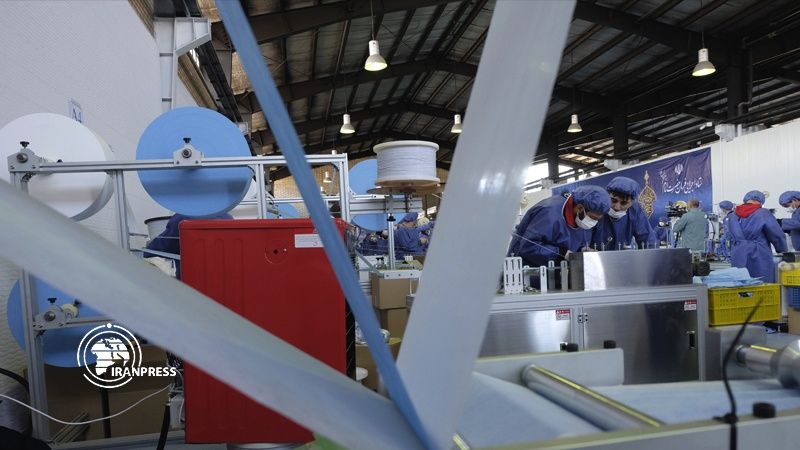
The largest mass-produced face masks factory in Southwest Asia was put into operation in Eshtehard Industrial Town of Alborz province, west of Tehran. The head of the Execution of Imam Khomeini’s Order, Mohammad Mokhber said the factory will produce every day four million masks equipped with a nano filter, which guarantees a high level of protection.
Accusations, lies, more sanctions, and warmongering
The outbreak of the pandemic in Iran and China, two largest rival countries in Asia, had come as a refreshing for American politicians. In the Chinese case, they hoped for their economic slowdown and the deterioration of their international reputation, thus opening space for expanding and strengthening America’s international policies and position. In the case of Iran, expectations were much higher. Before coronavirus fully took hold in the U.S., the Trump administration appeared to be viewing the outbreak as an opportunity to gain advantage by amplifying its maximum pressure strategy, the view that by squeezing Iran’s economy crippling sanctions will force Tehran to choose between its own economic viability and geopolitical independence.
When Iran asked for international medical assistance, lifting sanctions and a loan from the IMF, the Trump administration saw it as a confirmation of the success of their policies. Instead of showing signs of goodwill for Iranian demands, the proudly compassionate United States responded by announcing a new round of economic sanctions aimed at closing loopholes that might allow Iran to export its products and leave it in scarcity of money then desperately needed for respirators, face masks, and other medical equipment. Formerly called blockade or embargo, now rebranded as “economic sanctions,” embody the beloved fantasy that coercive pressure alone can make countries submit to America’s will.
The U.S. Treasury says its sanctions do not prohibit humanitarian contributions that ease coronavirus pressure on Iran, a claim the Iran’s Foreign Ministry has called deception. Even though the U.S. claims that its sanctions don’t prevent the sale of medicine and medical devices, the secondary sanctions on financial institutions and businesses have prevented Iran from buying necessary items like ventilators that could save the lives of coronavirus patients. The problems do not stop there, for example the Iranian government released an official coronavirus app for Iranians, but Google pulled it from its app store due to U.S. sanctions. Basically, the U.S. government has taken the same approach as during the last year’s floods in Iran, when they prevented international aid.
In addition to preventing international aid to Iran, we have also seen crocodile tears and false mercy from Trump and his administration, allegedly offering their own coronavirus aid “if Iranians ask for it.” Only someone extremely naive can believe in the sincerity of this offer, considering that they have prevented the aid of other countries, and even stolen medical equipment from Italy, France, Germany and Canada. There is no trace of U.S. aid collection for Iran, which, after all, could have been sent quietly. For example, even though they were in a more difficult situation at the end of March, the Iranians collected medical aid for the American people and sent it through the Swiss Embassy, without media noise. The truth is that Trump had no intention of sending any aid, in fact he just wanted to hear Iranian begging and then use it for propaganda purposes. Of course, Iranians did not bite it and rejected the offer. Still, the fake aid offer and Iran’s refusal were later reported in many Western media as key evidence of U.S. benevolence and Iranian cruelty.
After putting Iran in an unpleasant situation, U.S. politicians began pouring bizarre accusations against the Iranian authorities. Mike Pompeo, Brian Hook and Morgan Ortagus accused Iran of “lying” about the coronavirus outbreak and “stealing” funds intended for the fight against pandemic. “It’s not the sanctions, it’s the regime,” Ortagus claimed. Aggressive elements within the U.S. government have even begun calling for war on Iranian-backed militias in Iraq, thinking that Iran is in too difficult a crisis to respond adequately.
The alleged Iranian incompetence required some kind of evidence, so the new U.S. disinformation campaign was launched. Anti-Iranian propaganda has mostly focused on exaggerating the numbers of infected and dead, despite the fact that the World Health Organization confirms Iranian reports as credible. The Washington Post has turned to publishing fake news, claiming that Iran has dug mass “burial pits” in Qom for victims of the disease. Netanyahu went even further, sharing a video clip from a 2007 TV mini-series, as the evidence of Iranian trying to hide the true number of fatalities.
Numerous Western media have kept up with similar nonsense and hateful claims. One of the finest examples is the op-ed piece by Graeme Wood for The Atlantic. “Iran cannot handle the coronavirus,” he claims in the title, further representing Iran as the Orientalist dystopia. The city of Qom, with over 1.2 million inhabitants, for Wood is “a small city” with “cramped hotels, communal toilets, junk food and unhygienic scenes,” a sort of “Shiite Disneyland,” assuring his audience “that comparison might be the best way for Americans to understand the gravity of this outbreak.” Then he jumps to the ideological patriotism, claiming China’s authoritarianism has the advantages in dealing with a disaster like this, while Iran’s authoritarianism has none. He claims that Iran has no intention of closing the holy shrines, despite the fact that they were closed shortly after.
Wood also shows video of Iraj Harirchi, a top Iranian health official who has contracted the coronavirus, describing it as “incredible” and “comic,” calls Iranian officials “notoriously cruel,” and the country as the place where “incompetence and evil become indistinguishable.” This op-ed perfectly summarizes the distorted vision given by everyone from the American leadership to the authors of racist cartoons on social networks: Iran is bad, dirty, everything opposite to the U.S., and it will fall. After all, deadly disasters occur only in far off Oriental despotates, never in famed liberal democracies. Except Italy. And except for the post-March 2020 period.
Coronavirus knocks at the U.S. door
In mid-March, the coronavirus knocked heavily on the U.S. door and from the wealthiest country in the world, whose president boasts with the best institutions and whose government enjoys giving lessons to other countries, it was expected that pandemic would be a piece of cake. But what do we see, and what’s the difference between the U.S. and Iran? Inside Iran, we don’t see massive dissatisfaction or protests over the Khamenei’s and Rouhani’s crisis management, but according to a Gallup Poll conducted on 14 April, Trump’s approval rating is down significantly, now standing at 43%. We also see thousands of protesters in many U.S. states, with truly inspiring slogans demanding freedom and liberation. We don’t see chaos in Iranian hospitals either, but we do see large-scale theft of equipment in U.S. hospitals, as well as U.S. nurses refusing to work due to lack of protective equipment. While the story of Qom’s mass burial pits is refuted to the last detail, it remains for Americans to explain burials of unclaimed bodies on Hart Island and in New York city parks.
The New York City itself today looks like Chernobyl or a “never-in-liberal-democracy” thing, a sort of Orientalist dystopia from Hollywood movies or unhygienic Disneyland from The Atlantic’s agitprop-eds. With junk food, or no food on the shelves at all. We don’t see hungry Iranians begging the Trump administration for help, but we see such moans on the multi-billion-dollar U.S. aircraft carriers. We don’t see any regime change in Tehran, but we do see dismissal of the U.S. aircraft carrier’s captain, only because he dared to seek help for his infected sailors. There’s no trace of the alleged Iranian government’s “lying” or “theft,” but there is overwhelming evidence of U.S. piracy of protective masks around the world. This evidence comes from the governments of Italy, Germany, France and Canada. If U.S. authorities cooperated with Iranian experts at the outbreak of the pandemic, they would surely have had fewer casualties at home. But they did not want to cooperate, as with Chinese experts, they just looked like scavengers. Now, Trump is blaming the WHO, which has replaced Iran as a bogeyman.
We also don’t see the collapse of the Iranian economy, although by 18 April around 600,000 people had registered as unemployed. By comparison, over 22 million Americans had lost their jobs by the same date, proportionally ten times more. Moreover, we don’t see the collapse of the Iranian oil industry, nor their tankers floating hopelessly alone on the sea. During the pandemic, Iran has launched 25 new electricity projects in five provinces worth nearly half a billion dollars, successfully installed a giant oil drilling platform at Salman oilfield, as well as a gas drilling rig in the Persian Gulf. All domestically produced, and all for the domestic market. In contrast, we are witnessing a historic oil crisis in the West, the collapse of the North American shale industry, and a crowd of full oil tankers parked off the U.S. coast with nowhere to unload. In other words, in their backyard they are looking at a scenario they intended for Iran two years ago, or one that they had hoped for when a pandemic broke out in that country. Yet Iran has proven to be much more resilient and effective.
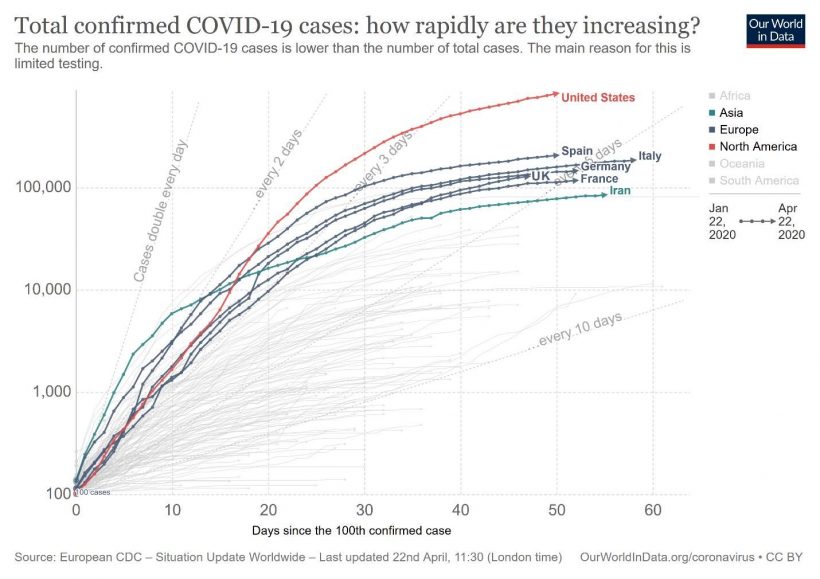
Everything seen before
Despite all the obstacles and wet dreams of its enemies, Iran has not fallen, and it will not fall. Its initial perceived weakness subsequently proved to be false. Iran did not ask for aid and the IMF loan because it could not cope alone with the crisis, but to accelerate the fight against the pandemic. Negative responses to Iran’s demands and attempts to block other countries from sending aid are a wake-up call for the last naives who think the U.S. government has compassion for anyone’s civilian population. Or even their own. The mask thefts from their own allies also prove that the U.S. government will treat everyone the same way as Iran. As a nation with a strong sense of identity and group responsibility, Iran has proven to be extremely enduring in similar historical situations. In the 1980s, Iran withstood the aggression of the fourth largest army, backed by America and all the world powers, and a decade later it rebuilt the country despite being more isolated and weaker than today.
Even deadly disasters, accompanied by aid refusals and military aggression, are not unseen in Iranian history. Going back a century, Iran has been hit by an epidemic and mass famine that has claimed two million lives, or 20% of the total population. In 1918 the Iranian government asked the U.S. for a multi-million-dollar loan to be used solely for famine relief, but Washington refused. Furthermore, the British recognized the perfect circumstance to temporarily occupy the western parts of Iran and impose a humiliating agreement that was terminated by the Iranian parliament in June 1921. This is also a lesson for those who think that Anglo-American vulturous policy towards Iran began in 1979 or 1953. Going back a century or two more, in 1820 and 1721 northwestern Iran was hit by catastrophic earthquakes, and the city of Tabriz recorded tens of thousands dead. Just a few months after both events, the Ottomans invaded Iran, but were repulsed soon after both times. Today we are witnessing the centennial repetition of history, with new fools repeating old mistakes and expecting different results.
China Rejects Illegal, Violent Actions Against Venezuela, Cuba
teleSUR | May 6, 2020
China Wednesday condemned the recent rifle attack at the Cuban embassy in the United States, a mercenary forces’ invasion plan of Venezuela, and all the interventionist maneuvers against the sovereignty of any country.
China’s Foreign Ministry spokeswoman Hua Chunying said that her government firmly opposes any violent action perpetrated against official representations.
She urged Washington to take the necessary measures to protect the Cuban embassy from any damage, as provided for in the 1961 Vienna Convention.
In this way, China joined other nations in the world that repudiated the shooting launched last Thursday against the Cuban embassy in the U.S. capital. The Cuban mission officials suffered no damage, but there were material deteriorations in the building as a result of the attack.
Hua also deplored the attempted maritime invasion of Venezuela by mercenary forces seeking to carry out a coup against President Nicolas Maduro.
She stressed the Chinese government’s rejection of the violation of the sovereignty of the South American country by any means or excuse.
The diplomat called for prioritizing the well-being of the Bolivarian people and promoting the peaceful resolution of the political impasse in Venezuela.
China has been in favor of respecting the United Nations Charter and the basic norms governing international relations in the face of the U.S. policy of hostility towards the Maduro administration.
The Asian nation recently criticized Washington for applying more extraterritorial sanctions to Venezuela, Cuba, and Iran to the detriment of the public health of the people just as the COVID-19 pandemic spreads.
US House war hawks write to Pompeo over UN arms embargo on Iran
Press TV – May 3, 2020
US lawmakers have written a letter to Secretary of State Mike Pompeo, urging him to take “increased diplomatic action” not to allow a United Nations arms embargo on Iran to expire in October.
“We write to urge increased diplomatic action by the United States to renew the expiring United Nations arms embargo against Iran and United Nations travel restrictions on those Iranian individuals involved with dangerous proliferation activities,” Hundreds of House lawmakers claimed in a letter released by The Hill. “America must continue its longstanding, bipartisan leadership in order to limit Iran’s destabilizing activities throughout the world… We look forward to working with you to reauthorize these expiring UN restrictions, which are essential to protecting our national security and the American people.”
The US claims that Washington has not quit the Iran nuclear deal and technically remains a “participant state.” The scheme is aimed at using a mechanism embedded within the Iran nuclear deal to make the UN restore a previously lifted arms embargo on Tehran.
The latest anti-Iran scheme was spearheaded by Democratic House Foreign Affairs Committee Chairman Eliot Engel and committee ranking member Michael McCaul.
“Nearly every member of the US House of Representatives is in agreement: Iran must not be allowed to buy or sell weapons,” McCaul claimed in a statement. “This isn’t a Republican or Democrat issue, or even just an American issue. We need to extend the UN arms embargo on Iran for the sake of international peace and security. I am proud the House is speaking with one voice to protect the world against Iran’s aggressive and destabilizing behavior.”
President Donald Trump unilaterally withdrew the US from the Iran nuclear deal in 2018 and re-imposed harsh sanctions on Iran.
“US Security Council Resolution 2231 is unambiguous where the United States is a participant,” Pompeo claimed at a press briefing Wednesday. “We are going to make sure that come October of this year, the Iranians aren’t able to buy conventional weapons that they would be given what President Obama and Vice President Biden delivered to the world in that terrible deal.”
Tehran has called the allegation that the US is still a member of the Joint Comprehensive Plan of Action “a joke.”
Moscow: UN Weapons Embargo on Iran Can’t Be Prolonged Despite US Efforts
Sputnik – April 30, 2020
The UN embargo on conventional weapons sales to Iran, which expires in October 2020, can’t be extended despite US efforts to prevent its expiration, the Russian Deputy Foreign Minister has stated.
“For us, the case of the existing ban on arms deliveries to and from Iran was closed with the adoption of Resolution 2231. The embargo regime expires in October this year”, Deputy Foreign Minister Sergei Ryabkov stated.
Ryabkov went on to blame the US for its selective approach to Resolution 2231. He recalled that Washington itself had stopped adhering to its provisions two years ago and has since spared no effort to prevent other nations from remaining in compliance with the resolution by introducing unilateral sanctions.
“Instead of discussing which provisions of Resolution 2231 could be used to achieve certain political goals, the US would be better off ensuring the full and comprehensive implementation of the provisions of this resolution, and return to full compliance with the JCPOA”, the Deputy Foreign Minister added.
UN Resolution 2231 adopted back in 2015 alongside the Iran nuclear deal, prohibited the sale of conventional weapons to the Islamic Republic until 18 October 2020 and separately the sale of missiles until 2023. However, US Secretary of State Mike Pompeo stated yesterday that Washington is planning to do anything in its power to extend the ban beyond October 2020 and will apply to the UN to do that.
Pompeo mulled resorting to a mechanism that renews international sanctions against the Islamic Republic by declaring that it violated the nuclear deal inked in 2015, but was later abandoned by the US in 2018. The secretary of state claims the US is still formally a party to the deal and that Washington will seek help from its European allies, signatories to the deal, in this matter. UN inspections, however, revealed that Iran complied with the deal as it promised in 2015.
Iran breaks through US-led blockade to deliver record amount of oil to Syria
Al-Masdar News | April 28, 2020
Iran has managed to break through the U.S. blockade to deliver a large amount of oil to the Syrian Arab Republic, TankerTrackers website has revealed.
According to the website Tanker Trackers, Iran has significantly increased their oil exports to Syria, with several cargoes reportedly reaching the Port of Baniyas in the Tartous Governorate.
The website reported that Iran is currently delivering more than three times the normal amount they export to Syria, which is a significant increase to the Arab Republic, who relied heavily on the Islamic Republic’s oil last year.
“There can be several reasons why this is happening. Excess oil stocks in the midst of sanctions and a global oil glut is forcing Iran to ship and perhaps store the oil in a friendly country. Another reason is that Bashar Assad’s government and Hezbollah can be conduits to sell the oil on the black market. One place Hezbollah can manage to do this is Lebanon, where it has sway over the government,” the website Radio Farda reported.
However, despite these claims, the large oil exports to Syria have less to do with selling the petrol and more to do with the Arab Republic providing relief to its people.
Since the U.S. currently occupies some of Syria’s largest oil fields, the Arab Republic has been forced to find alternatives to meet the civil demand for this resource.
US return to JCPOA can end impasse over Iran
By M. K. BHADRAKUMAR | Indian Punchline | April 28, 2020
In business transactions and international diplomacy alike, there could be constant variables and dependent variables. Constant variable is where the value cannot be changed once it has been assigned a value. But it becomes a dependent variable if it is susceptible or open to the effect of an associated factor or phenomenon. Then, there is also a third independent variable, which is a factor or phenomenon whose value is given or set already that can cause or influence a dependent variable.
A big question for international security has arisen: What type of variable is at work as the US prepares a legal argument that it still remains a “participant” in the 2015 Iran nuclear accord known as JCPOA?
Both New York Times and Fox News, which reported on this development on Sunday maintained that the Trump administration’s ploy to reenter the JCPOA is riveted on a strategy to invoke the “snapback” clause, which would restore the comprehensive pre-2015 UN sanctions on Iran.
Much depends on the UN Security Council members. What if they come up with a dependent / independent variable that accedes to the US status as “participant”, provided Washington agrees to ‘X’, ‘Y’, ‘C’ factor or phenomenon? Trade-offs are more the rule than the exception in the UN SC; constant variable is a rare occurrence at the horseshoe table.
A Reuters report today, in fact, highlights that the Trump administration can expect “a tough, messy battle if it uses a threat to trigger a return of all United Nations sanctions on Iran as leverage to get the 15-member Security Council to extend and strengthen an arms embargo on Tehran.”
The report quoted a European diplomat: “It’s very difficult to present yourself as a compliance watcher of a resolution you decided to pull out of. Either you’re in or either you’re out.” This is the crux of the matter.
Tehran has already notified the European Union that any move to re-impose UN sanctions through the back door will trigger a vehement reaction — including, possibly, Iran exiting the Nuclear Non-Proliferation Treaty.
The EU and the three European signatories of the JCPOA (UK, France and Germany) are extremely wary of the JCPOA being abandoned. Their sincerity of purpose is self-evident in the IMPEX mechanism (which enables limited trade between European companies and Iran despite US sanctions.)
The EU’s foreign policy chief Josep Borrell recently expressed regret about the US’ opposition to the IMF lending money to Iran against the backdrop of the coronavirus pandemic. The German Foreign Minister Heiko Maas publicly shared Borrell’s view.
Having said that, it is an entirely different ball game if the US were to walk back as “participant” in the JCPOA as original signatory. If that happens, everything else becomes negotiable — including fresh talks to renegotiate the terms of JCPOA. Tehran has laid down Washington’s return to the JCPOA as the sole precondition for talks.
Today, Radio Farda, the Persian service of the US government-funded Radio Free Europe/Radio Liberty beamed to Iran, has carried a report US May Be Prepared To Rethink Stance On Sanctions, Nuclear Accord with Tehran which speculates precisely that on the “pretext” of extending the arms embargo against Iran, Washington could be principally “thinking of returning to the nuclear accord” and engaging with Iran in talks.
Radio Farda quoted a “usually well-informed Iran analyst in Scotland” to this effect. The report hinted that back channels are at work. Possibly, some kite-flying is going on here.
Indeed, Iranian media had reported recently that President Hassan Rouhani told a cabinet meeting in Tehran on March 25 that the “leader of a non-permanent member of the Security Council” had told him about the UN Security Council currently weighing plans for the removal of all sanctions against Iran.
Rouhani was quoted as saying at the cabinet meeting, “We are also trying to have our blocked money unfrozen.” (Rouhani was probably referring to a conversation with Kais Saied, President of Tunisia, which is a non-permanent member of the UN Security Council.)
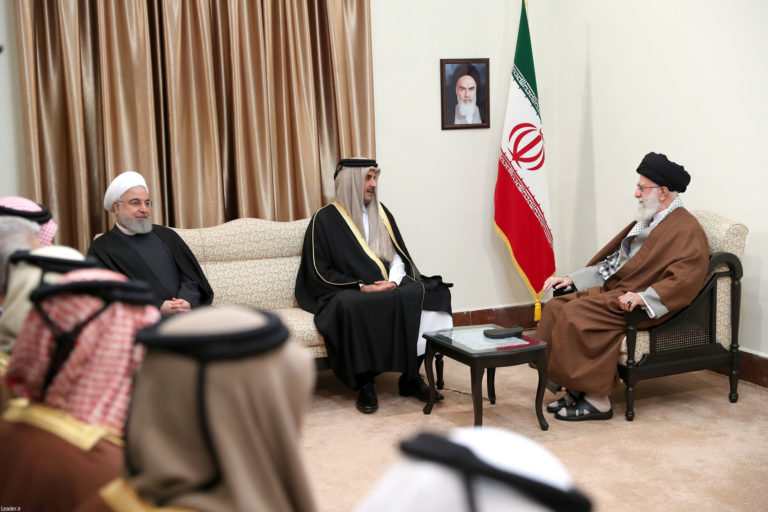
Iran hasn’t reacted to the New York Times and Fox News reports. Meanwhile, in what could well be a related development, Rouhani had a phone conversation on April 21 with the Emir of Qatar Sheikh Tamim bin Hamad Al Thani where the sanctions issue figured.
Interestingly, an Iranian Foreign Ministry statement later verbatim quoted from the conversation. Rouhani told Sheikh Tamim:
“The US pressure and sanctions against Iran are not only a violation of international law, but also they are violating human principles by intensifying their behaviour in these difficult circumstances, including preventing the International Monetary Fund from lending to Iran”.
“We believe that in this special situation, all countries in the world must stand together to fight coronavirus and clearly state their positions against the hostile actions of the United States”.
“Unfortunately, they are still reluctant to end their inhumane acts, but we have no doubt that sooner or later they will have to change course.”
The Emir responded,
“Today, the world is in a special situation and we believe that in this situation, the United States must lift its sanctions and all countries must move in line with the new conditions.”
Subsequently, there has also been a conversation between the two foreign ministers. Now, Qatar, which hosts the US Central Command Hqs, is a close ally of the US. Sheikh Tamim and Trump have a warm relationship.
During the emir’s visit to the White House last July, Trump remarked, “Tamim, you’ve been a friend of mine for a long time, before I did this presidential thing, and we feel very comfortable with each other.” No doubt, if ever Trump needed a back channel with the Iranian leadership, he wouldn’t need to look beyond Sheikh Tamim. (Significantly, Sheikh Tamim made a rare visit to Tehran in January this year.)
Curiously, the day after Sheikh Tamim spoke to Rouhani, he also held a phone conversation with Trump. The White House readout said, “The president and the (emir) discussed the coronavirus response… The president encouraged the emir to take steps toward resolving the Gulf rift in order to work together to defeat the virus, minimise its economic impact and focus on critical regional issues.”
The bottom line is that the UN arms embargo is not really a big ticket item but the sanctions is. Even if the ban gets lifted in October, it is only for small arms, whereas transfer of advanced technology such as missiles will have to wait another 3 years. Iran is largely self-reliant in defence. And its asymmetric capability to generate deterrence against US aggression is legion.
The Trump administration realises that its sanctions policy has failed. The murder of the charismatic Iranian general Qassem Soleimani only hardened Tehran’s resolve to press ahead with the “axis of resistance”. And the world opinion militates against continued US sanctions against Iran.
In this backdrop, the forthcoming summit of the founding members of the UN may address the issue of sanctions. From such a perspective, the Trump administration’s seemingly belligerent move to return as “participant” in the JCPOA may turn out to be a dependent variable open to influence from one or more independent variables.
US to face tough battle in pushing plan to extend UN Iran arms embargo: Diplomats
Press TV – April 28, 2020
Diplomatic sources at the United Nations say Washington has a tough challenge ahead at the Security Council (UNSC) if it pushes for an extension of the world body’s arms embargo against Iran through recourse to a process set out in a multilateral nuclear deal that the US controversially abandoned in 2018.
The agreement — officially called the Joint Comprehensive Plan of Action (JCPOA) — was signed in 2015 between Iran and six major world states and endorsed by UNSC Resolution 2231.
However, the US unilaterally withdrew from what President Donald Trump called “the worst deal ever” in May 2018 and re-imposed anti-Iran sanctions. It has also been coercing the remaining signatories to the JCPOA to follow suit.
Under UNSC Resolution 2231, the UN arms embargo on Iran — in place since 2006/2007 — will be lifted in October 2020. The US has repeatedly expressed its anger at the possible termination of restrictions on Iran’s import and export of arms.
On Tuesday, diplomats told Reuters that Washington is planning to use a threat to trigger a return of all UN sanctions against Iran as leverage to get the Security Council to prolong the arms embargo on Tehran.
A US official, who was speaking on condition of anonymity, said Washington has shared its strategy with Britain, France and Germany, who are permanent Security Council member states and parties to the Iran deal.
The diplomats said the scheme has not been shared with the remaining 11 council members, including veto-wielders Russia and China, the two other signatories to the JCPOA that are deemed certain to oppose the arms embargo on Iran.
Reports say if the Security Council refuses to revive the embargo, the US will try to trigger a so-called snapback of all UN sanctions on Iran by claiming that it is still a party to the JCPOA and that Iran is in significant violation of the nuclear pact.
The New York Times said on Sunday that US Secretary of State Mike Pompeo was laying the groundwork to present a legal argument to the UN that Washington remains a “participant state” in the JCPOA.
It is “part of an intricate strategy to pressure the United Nations Security Council to extend an arms embargo on Tehran,” the report said.
Reuters, however, cited the UN diplomats as saying that Washington’s plan will likely be challenged since the US is no longer a party to the deal.
“It will be dead on arrival,” a Security Council diplomat predicted. “It’s very difficult to present yourself as a compliance watcher of a resolution you decided to pull out of,” a European diplomat said. “Either you’re in or either you’re out.”
Another European official said, “It’s going to be messy from a Security Council standpoint because, regardless of what (Britain, Germany and France) think, Russia and China are not going to sign up to that legal interpretation.”
Iranian Foreign Minister Mohammad Javad Zarif has dismissed Pompeo’s reported scheme, saying the plan to return to the JCPOA is rooted in the failure of Washington’s “maximum pressure” campaign against the Iranian nation.
‘US cannot cherry-pick UN resolutions’
Meanwhile, a Western diplomat, speaking on condition of anonymity, told AFP, “You cannot cherry-pick a resolution saying you implement only parts of it but you won’t do it for the rest.”
Similarly, Kelsey Davenport, director for non-proliferation policy at the US-based Arms Control Association, said “if Pompeo goes through with this plan, snapping back sanctions on Iran collapses the JCPOA.”
Even more significant, she added, the US measure could lead Iran to make good on threats to exit the nuclear Non-Proliferation Treaty (NPT).
“This is just another step that would undermine US credibility, make future negotiations with Iran more difficult and increase the risk of a nuclear crisis in the region,” she said.
‘US placing world in Catch-22 situation’
Russia also slammed the US plan, with Permanent Representative to International Organizations in Vienna Mikhail Ulyanov tweeting, “The country which officially ceased its participation in the #IranDeal cannot remain its participant by definition.”
The Russian Mission Vienna also said in a post on Twitter, “May 8, 2018 the #US says it “ends” and “terminates” its participation in the #JCPOA. Now there are claims that it still considers itself a participant. Is this a “Catch-22” sort of situation for Iran, UNSC and the whole world?”
South Korean bank submits to US fine over Iran transactions
Press TV – April 21, 2020
South Korea’s Industrial Bank of Korea (IBK) says it has submitted to the US demand to pay $86 million in fine for processing Iranian transactions.
The compromise includes paying $51 million to US prosecutors and $35 million to the New York State Department of Financial Services, the lender said Tuesday.
South Korea’s Yonhap news agency cited Geoffrey S. Berman, the US attorney for the Southern District of New York, as saying that IBK’s branch in New York had failed to detect and report $10 million in US dollar payments from South Korean entities to Iranian banks.
Authorities said IBK entered a two-year deferred prosecution agreement with the US Department of Justice and a nonprosecution agreement with New York Attorney General Letitia James.
South Korea was among Iran’s major trade partners before falling in line with US guidelines after Washington withdrew from an international nuclear deal with Tehran in 2015 and imposed unilateral sanctions on the Islamic Republic.
Iran was South Korea’s third biggest export market in the Middle East and companies such as Samsung and LG Electronics were among popular brands for TV sets, air conditioners, telecommunications equipment and washing machines.
Samsung’s sales also notably covered about half of Iran’s lucrative android phone market, with almost 18 million Iranians having Samsung devices as of February 2018, according to a report published by Iran’s largest app market Café Bazaar.
In February, Iran’s Foreign Ministry warned that foreign companies leaving the country due to the US sanctions would not be able to return to the country’s market easily after Samsung and LG Electronics pulled down their last advertisement banners in Iran.
According to a statement by the Ministry of Trade, Industry and Energy in Seoul, Iran was once the sixth largest market in terms of orders won by South Korean builders before the 2011 sanctions.
South Korea was also the biggest client of Iranian condensate with 300,000 barrels per day (bpd) on top of 100,000 bpd of crude oil, but it stopped shipments two months before the sanctions kicked in.
South Korean companies have mostly even refused to fulfill Iran’s orders for medicine and medical equipment which is supposedly not subject to the US sanctions.
According to Iranian companies, South Korean banks are refusing to process payments related to Iran’s imports of pharmaceuticals for fear of falling foul of the sanctions.
Iran’s Health Ministry said Saturday South Korea had rejected a SWIFT payment request by Tehran for purchase of coronavirus testing kits.
Ministry spokesman Kianoush Jahanpour disclosed an international financial message recently sent by South Korea’s Woori Bank to Iran’s Keshavarzi Bank, noting that it could not take over an import letter of credit for 5.3 billion won issued by the Iranian bank.
As a result Iran was unable to import the kits because the Korean exporter could not receive payment after Woori Bank’s refusal to take over the import letter of credit.
“This shows claims of medicine and medical equipment not being subject to sanctions are lies. The bank has officially stated that the purchase is not possible due to the sanctions,” Jahanpour said.
The US government has intensified its sanctions on Iran despite international calls on Washington to suspend them to allow the Islamic Republic to secure necessary medicine and equipment in the midst of the coronavirus fight.
Washington claims the sanctions do not target medicine for Iran, but they make it all but impossible for importers to obtain letters of credit or conduct international transfers of funds through banks.
Last week, Iran’s Permanent Mission to the United Nations in New York dismissed the Swiss Humanitarian Trade Arrangement (SHTA) which the Europeans belatedly announced with much fanfare to have made operational in coordination with the US to barter medicine and food with Iran.
The mission said the United States has forced SHTA to pursue a very tight and tough procedure, making it practically very difficult for companies to trade with Iran.
According to the mission, several companies that supply the medical equipment required to fight the coronavirus have recently stopped shipping to Iran because the current US sanctions regime makes the shipping of such items to Iran almost impossible.
The only message the US is sending with intensifying its sanctions amid the coronavirus is that companies must avoid doing any business with Iran, even if their work is humanitarian in nature, it said.
South Korea blocks test kits for Iran on Saudi-funded TV’s request
Press TV – April 19, 2020
Iran says South Korea has rejected a SWIFT payment request by Tehran for purchase of coronavirus testing kits over the US sanctions.
Iran’s Health Ministry spokesman Kianoush Jahanpour late Saturday released a document that shows a Saudi-funded TV had asked a Korean bank to reject the request.
“As a result, the Korean bank rejected Iran’s request and the kits were not delivered to Iran,” he said.
According to the document, London-based Iran International television channel falsely claimed that the SWIFT request had been made by a software company which sought to export non-medical goods to Iran.
Jahanpour released a second document which shows South Korea’s Mico BioMed, which develops and sells medical kits, had in fact presented the SWIFT request to the bank.
“The SWIFT request related [to Iran’s purchase of test kits] has been rejected by the Korean bank under the pretext of sanctions,” he said.
“This shows claims of medicine and medical equipment not being subject to sanctions are lies. The bank has officially stated that the purchase is not possible due to the sanctions,” Jahanpour added.
Belgium-based SWIFT, the Society for Worldwide Interbank Financial Telecommunication, is used to transmit payments and letters of credit.
The US government has intensified its sanctions on Iran despite international calls on Washington to suspend them to allow the Islamic Republic to secure necessary medicine and equipment in the midst of the coronavirus fight.
Washington claims the sanctions do not target medicine for Iran, but they make it all but impossible for importers to obtain letters of credit or conduct international transfers of funds through banks.
Last week, Iran’s Permanent Mission to the United Nations in New York dismissed the Swiss Humanitarian Trade Arrangement (SHTA) which the Europeans belatedly announced with much fanfare to have made operational in coordination with the US to barter medicine and food with Iran.
The mission said the United States has forced SHTA to pursue a very tight and tough procedure, making it practically very difficult for companies to trade with Iran.
“Additionally, almost impossible or cumbersome nature of transferring Iran’s reserves blocked outside the country to the designated Swiss bank, not only does not allow the SHTA to function properly now but may actually render it redundant in a matter of few months,” it said.
According to the mission, several companies that supply the medical equipment required to fight the coronavirus have recently stopped shipping to Iran because the current US sanctions regime makes the shipping of such items to Iran almost impossible.
Washington has imposed new sanctions in the midst of the coronavirus, targeting trade with Iran, even as President Donald Trump has claimed that the US was ready to help with the outbreak if Tehran asked for it.
The Islamic Republic has rejected the offer as hypocritical while the US is refusing to lift the sanctions and even intensifying them. Officials have said Washington’s demand that Tehran make a direct plea for the removal of sanctions shows the United States seeks “nothing short of surrender”.
Iran’s UN mission said last week the only message the US is sending with intensifying its sanctions amid the coronavirus is that companies must avoid doing any business with Iran, even if their work is humanitarian in nature.
Meanwhile, certain sections of mainstream media act as a virtual arm of the Office of Foreign Assets Control (OFAC) which is responsible for administering the US sanctions regime.
They have been on a witch hunt to identify Iran’s financial institutions and report them to the US government for possible sanctions.
Iran International, launched in May 2017, is a regular megaphone for separatists and terrorist groups operating against Iran. It is best known for airing disparaging reports about Iran and trying to stoke unrest in the country.
In October 2018, The Guardian cited a source close to the Saudi government as saying that Iran International had received an estimated $250 million from the Saudi royal court for its launch.
Why the US wouldn’t Ease Iran Sanctions
By Salman Rafi Sheikh – New Eastern Outlook – 09.04.2020
The past two weeks have seen US officials moving first from issuing an alert to their military commanders to make plans for a retaliatory strike against Iranian targets to talking about ‘easing’ sanctions on Iran if Iran ‘wants it.’ It’s obvious that there is no reason why the Iranians wouldn’t want to see sanctions against them being eased up. Yet, Trump’s desire for a formal request about this issue shows the latent intention of ignoring it, while using the whole scenario to its advantage i.e., let the situation exacerbate to an extent whereby the Iranian regime becomes unstable and incapable of rescuing its people from the virus, and thus collapse ultimately.
This would surely serve US interests, along with those of Saudi Arabia and Israel, which have been pushing hard to do a “regime change” in Tehran. In their calculation, the unprecedented crisis caused by the COVID-19 seems to have given them yet another opportunity to attain their ultimate objective.
Indeed, this was the intention when the US asked its military commanders to make plans for a retaliatory strike on Iran in response to an imaginary Iranian attack on US military bases—an attack that had neither been planned nor was it foreseen by anybody. But the fact that the US was going to ‘directly attack the Iranian forces’ in the wake of Iran supported militias attacking US troops shows that the intention was, as Trump himself said, to go “up the food chain”, thus creating a scenario that would be extremely difficult for Tehran to address.
Accordingly, as a part of US ‘war preparations’, the US military officials disclosed, seemingly on purpose, to the western media that Patriot air defence systems have been deployed to two Iraqi military bases and that the same systems were going to be deployed across two more bases.
While manufacturing a military crisis is one thing, executing it is another. Accordingly, even if the US ‘had a plan’, it doesn’t mean it was going to work due to multiple factors, including lack of support from US allies in Europe, who were already in the middle of operationalising Instex to start economic and financial transactions with Iran, bypassing US sanctions and showcasing their ‘independent’ approach towards Iran in the wake of widening gap between the US and Europe/NATO.
But the US sanctions are still intact; for easing sanctions will allow, in the US calculation, the Iranian regime to better tackle the COVID-19 crisis and thus stabilise itself politically and economically. This would thus undermine the very purpose of the US sanctions i.e., forcing the Iranian regime to implode and collapse.
Indeed, a collapse followed by a massive crisis in the Middle East, particularly one that involves Iran, is something that the US would welcome rather than desist. It shows why the US imposed new sanctions on Iran instead of removing the old ones.
It has happened recently when Iran, out of the necessity to cope with monetary shortfall, requested 5 billion dollars from the International Monetary Fund (IMF). While this was always obvious that the request will not be granted without US acquiescence, the US actually responded by announcing new sanctions on Iran’s oil industry, one of its very few remaining foreign exchange earners. The intention was to make life even more difficult for the Iranians.
Also, it explains why Washington has so far taken no serious steps to actually ease the sanctions on its own, even though sufficient conditions for doing so undoubtedly exist, including Iran’s response whereby they called for a halt to “warmongering during the coronavirus outbreak” and further warned that US military activities could create “instability and disaster”. On April 2, Foreign Minister Javad Zarif, addressing the US president, tweeted, “Don’t be misled by usual warmongers, AGAIN. Iran starts no wars, but teaches lessons to those who do.”
Notwithstanding the ‘progressive’ US rhetoric about easing sanctions if Iran asks for it, the fact of the matter remains that the US strategic aim in this part of the world remains a “regime change” in Iran, although it is also becoming clear with every day passing that this objective can never be achieved.
Europe has already started Instex, although it is yet to produce productive economic results and engage in economic and financial activity beyond the support for COVID-19. The Chinese have yet again come out against US war aggression, and the Russians remain a bulwark against any US adventure in the Middle East, particularly against Iran.
None of this, of course, means that the US will end its sanctions. On the other hand, it will continue to add more to the pool as it did a few days ago; after all, ‘Iranian crisis’ is the linchpin of the US military presence in the region and the key source of wealth for its military-industrial complex.
Salman Rafi Sheikh is a research-analyst of International Relations and Pakistan’s foreign and domestic affairs.
Targeting Iran While America Locks Down
A national health crisis does not stop the beat of the war drums
By Philip Giraldi • Unz Review • April 7, 2020
The United States has just declared war against the coronavirus, with President Donald Trump self-proclaiming that he is now a “wartime president.” Whether one believes that the virus must be confronted with maximum aggression by effectively shutting down the country or that the measures already in place are already an overreaction hardly seems to matter as developments over the next several months will likely demonstrate what could have/might have/should have been done. But meanwhile extreme views are proliferating, with Rush Limbaugh detecting a conspiracy by Democrats and communists to destroy capitalism under “the guise of saving lives” while a more restrained but ideologically driven libertarian Ron Paul meanwhile chose to pen an article entitled “Coronavirus Hoax” that personally pilloried as a “chief fearmonger” the government’s widely respected expert on the origin and spread of the disease Dr. Anthony Fauci.
Stalin famously said that the death of one person was a tragedy while the death of a million is a statistic. For both Limbaugh and Paul an epidemic that could kill tens or even hundreds of thousands Americans produces a statistic, of lesser importance than retaining a completely corrupt Wall Street and the individual’s “liberty” to go shopping. Indeed, if greed driven American “vulture” capitalism must be preserved in its current form to protect and empower the rich, radical change might be welcomed by most Americans to include a long overdue genuine health infrastructure safety net.
Meanwhile, more rational and legitimate concerns are being raised by those who are worried about what kind of American democracy and economy will emerge on the other side. They urge the public to be particularly alert to the continuation of emergency practices at both the federal and state levels, permitting respective governments to act autocratically with little in the way of transparency or accountability.
One particular step that has been implemented is the use of cell phone tracking, without the permission of the device owners, to monitor whether separation and isolation measures are being observed by individuals who are out and about, determining whether or not they are obeying the rules in place to penalize congregating in public. It appears that the government and even at least one private presumably Israeli company now have the capability to track hundreds of thousands if not millions of phones simultaneously. This “emergency” abuse of privacy rights amounts to an illegal search and should be challenged on its constitutionality, but the real danger is that the tools used to monitor locations of phones can also be used after the claimed crisis is over to monitor perfectly legal activities of citizens. There should also be the concern that once the technology is developed to track phones a bit more tweaking might well integrate that feature into the National Security Agency’s well-established ability to intercept and record private conversations.
To be sure a different world will emerge post-coronavirus, but one might observe ruefully that some things never seem to change even in the midst of a full-blown global health crisis. Indeed, one might actually suspect that the United States, far from putting its own house in order, has actually used the virus as cover for intensifying its aggressive activities in Asia and Latin America. Along the way, it has also deliberately exploited the disease to punish those countries with which is has an adversarial relationship.
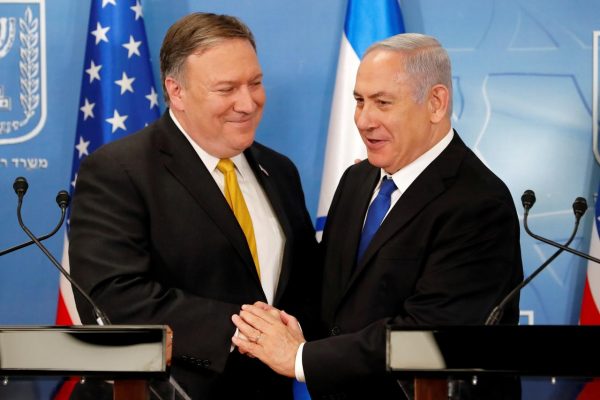
Those promoting the Trump administration’s preferred regime change “maximum pressure” policies are the top White House civilians, namely Secretary of State Mike Pompeo and National Security Adviser Robert O’Brien. The generals, to include Secretary of Defense Mike Esper and the Joint Chiefs of Staff, view the military as already overextended and have so far resisted some of the crazier suggestions but that does not mean that the jingoistic proposals have gone away. They are still on the table being pushed most particularly by Pompeo, and as the president is remarkably easily convinced to take military action, they should be considered to be still viable.
The two proposed courses of action that recently surfaced that must be considered borderline insane both relate to Iran. One of them is remarkable in that it creates two new active enemies simultaneously. It consists of a Pentagon order to regional commanders to make preparations to attack and destroy the Iraqi Shi’ite militia Kataib Hezbollah that the O’Brien/Pompeo twofer believe to be tied to Iran and responsible for recent attacks on U.S. bases in Iraq.
Lt. General Robert P. White, the U.S. top commander in Iraq responded immediately to the order, objecting that such a move would risk war with Iran while also increasing pressure on the government in Baghdad to expel American forces from the country. White also observed that he did not have sufficient forces in Iraq and any attack on an Iraqi militia that is technically part of the Iraqi Army would produce open warfare within the borders of a country that is technically an ally. If other militias, to include the numerous and well-armed Badr Army, were to join in the attacks on U.S. bases there would be no way to defend them.
The order is a compromise due to strong disagreements inside the Trump administration over how to punish Iran and its proxy Iraqi militias. Pompeo and O’Brien see the coronavirus, which has hit Iran hard, as an opportunity to destroy the militias while Iran is in no position to react. Per the New York Times, Esper approved the planning only to create options for dealing with Iraq and Iran based on the possibility that attacks against U.S. forces will increase. So far, Donald Trump has warned that Iran or a proxy militia is planning a “sneak attack” on American bases in Iraq and has stated that Iran itself would “pay a very heavy price” if it were carried out. Nevertheless, the president has only agreed to letting the planning continue, though he has also threatened to “go up the food chain,” implying that he is prepared to attack Iran directly if there is any escalation against American troops.
Pompeo and O’Brien, joined by recently appointed Director of National Intelligence Richard Grenell, have also been promoting a more serious endeavor, namely attacking Iran without warning and without any pretext while it is in its weakened state from the health crisis. Pompeo, O’Brien and Grenell argued that a direct attack on Iran, possibly to include hitting its naval vessels, would so weaken the regime over its inability to defend the country that its leaders would be forced to open negotiations, i.e. to surrender to Washington.
Washington has both increased sanctions and denied medicines to Iran, as well as to Venezuela, to put additional pressure on their governments vis-à-vis the coronavirus pandemic. The Trump Administration has been able to block $5 billion emergency International Monetary Fund loans to both countries while also sending warships to the Caribbean and Persian Gulf to back up the message with force if necessary. The argument being used to punish Venezuela is that it is not clear who represents the legitimate government in the country, whether it is Nicolas Maduro, the president, whom Pompeo has labeled a “drug trafficker,” or Juan Guaido, the aspirant to the position of head of state being promoted by the State Department.
Much of Washington’s maneuvering has been taking place under the radar given the cover provided by the crisis over coronavirus. Venezuela aside, most of the planning has focused on Iran, the Trump White House’s most hated adversary and also, perhaps not coincidentally, the perpetual number one enemy of Israel. In another move, on March 27th, the U.S. State Department’s Defense Security Cooperation Agency has announced approval of an $2.4 billion deal with Israel to buy eight KC-46A Pegasus aerial tankers.
The agreement is the first time the United States has sold actual purpose-built tanker aircraft to Israel. The KC-46A Pegasus can carry 106 tons of fuel to refuel jet fighters and has a range of more than 6,000 miles. It will enable the Israeli Air Force to have sufficient refueling capability to directly attack Iran, its principal regional target. Israel has frequently stated its willingness to attack Iranian nuclear sites and might also exploit the opportunity afforded by the coronavirus and its aftermath to do so.
So, at a time when the American public is clamoring for assurances that everything possible is being done to deal with the coronavirus, some officials in the White House are planning new wars. If one were seeking evidence of just how dysfunctional the Trump Administration is, it would not be necessary to look any further.
Philip M. Giraldi, Ph.D., is Executive Director of the Council for the National Interest, a 501(c)3 tax deductible educational foundation (Federal ID Number #52-1739023) that seeks a more interests-based U.S. foreign policy in the Middle East. Website is councilforthenationalinterest.org, address is P.O. Box 2157, Purcellville VA 20134 and its email is inform@cnionline.org.
Featured Video
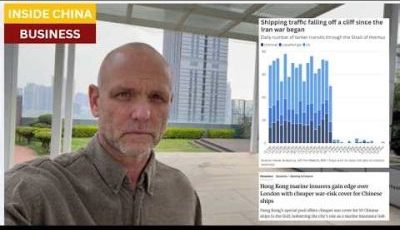
More Iran War fallout: Maritime insurance industry shifts from London to China
or go to
Aletho News Archives – Video-Images
From the Archives
The Biggest Threat to Peace in Middle East
By Dr. Elias Akleh* | Sabbah Report | May 24, 2010
A build up of heightened tension in the Middle East is escalating in the last few weeks. American and Israeli postures towards Lebanon, Syria, and Iran have become more threatening. Listening to speeches of political leaders one hears talks only about war not peace. Iranians and Israelis are continuously training hard for a possible showdown. Both sides are conducting extensive war games every month. This led Syrians to claim that Israel is preparing for a soon-to-come another war. The Jordanians also are warning that current stalemate of the peace process is an indication of a war breaking out this summer. The Russian President and his army chief hinted, a few months ago, that the US and Israel were planning for an attack on Iran.
Indeed Iran is, as it has been for last few years, the target of most of the threats and accusations of supporting terrorism. Escalating incitement against Iran the American Defense Department sent last month (April) to Congress a report on Iran’s military claiming Iran could develop intercontinental ballistic missiles capable of reaching the US by 2015.
Ignoring the fact that N. Korea, India, Pakistan, and Israel are proven to have nuclear weapons while Iran does not, the US Secretary of State Hillary Clinton chose in her speech, to the nuclear Non-Proliferation Treaty review conference at the UN, to focus on Iran’s alleged nuclear ambitions putting the whole world at risk as she put it. According to Clinton Iran’s acquisition of nuclear weapons, rather than Israel’s more than 200 nuclear bombs, is destabilizing the Middle East. She called on the world’s nations to rally around US efforts to hold Iran, not other nuclear countries, to account.
The accusation that Usama Bin Laden is living comfortably in Iran had received a boost after the broadcast of a documentary called “Feathered Cocaine”. This echoed the June 2003 claims of the Italian newspaper Corre de la Sierra that Bin Laden was in Iran according to some intelligence report, and according to Richard Miniter’s book “Shadow War”. … continue
Blog Roll
 Aletho News
- Hamas official rejects Mladenov Plan linking disarmament to Gaza reconstruction
- Two Primary Elections for the Soul of ‘America First’
- Japan Clings to US Vassalage Despite Energy Crunch Caused By Iran War
- US Seeks Control Over Global Energy Infrastructure – Kremlin
- US senators target Orban government for standing up to Zelensky
- The deep-rooted culture of corruption in Ukraine
- Iran mobilizing one million soldiers to ‘create hell’ for any US ground assault: Report
- The coming military and psychological unravelling?
- Iran has the last laugh
- More Iran War fallout: Maritime insurance industry shifts from London to China
- If Americans Knew
- Reports: Iran mobilizing 1M fighters, Israel-US run low on ammo, Israeli army faces shortage – Not a ceasefire Day 168
- ‘No Innocent Children’: Far-right Israeli Lawmaker Defends Killing of Palestinian Family
- Mossad’s promises helped Netanyahu convince Trump that Iran could be toppled
- US Arms Control Official Refuses To Comment When Asked If Israel Has Nuclear Weapons
- Veterans warn US landing could be ‘more Gallipoli than Vietnam’
- Israel may be committing war crimes in Lebanon – Not a ceasefire Day 167
- In the West Bank, life is a constant battle – 3 articles
- Jacob Reses, one of the most powerful pro-Israel operatives in Trump’s Washington
- Israeli-US assaults kill or injure 87 children a day – Not a ceasefire Day 166
- ‘Forever live by the sword’: Understanding Israelis’ massive support for Iran war
- No Tricks Zone
- Devastating Assessment Of Comirnaty Vaccine By Former Senior Pfizer Europe Toxicologist
- New Study: CO2 Is ‘Effectively Negligible’ As An Explanatory Climate Change Factor Since 2000
- Former Pfizer Toxicologist Dr. Helmut Sterz Tells Bundestag Hearing Pfizer Vaccine Should Have Never Been Approved
- Energy Expert: Germany’s Nuclear Phaseout Was A “500 Billion Euro Mistake”
- New Research: South Australia’s Mid-Holocene Sea Surface Temperatures Were 4°C Warmer Than Today
- Storing Green Energy To Last Germany 10 Days Would Require A 60-Million Tonne Battery
- New Studies: UK Sea Levels Were 4 Meters Higher Than Today During The Mid-Holocene
- Destructive Green New Deal: German Energy And Metal Group Warns Of Drastic Crisis
- New Study Documents A 20-Year Pause In Arctic Sea Ice Decline – Driven By Internal Variability
- Wake-up Call: Survey Shows Majority Of Germans Now Favor Postponing Climate Targets!
 Aletho News