Rep. Ilhan Omar Surrenders to Israel Lobby

By Philip Giraldi | American Free Press | June 1, 2020
The nearly complete corruption of the U.S. republican form of government has largely come about due to the Citizens United decision by the Supreme Court in January 2010 that basically permitted unlimited donor-spending on political campaigns based on the principle that providing money, normally through a political action committee (PAC), is a form of free speech. The decision paved the way for agenda-driven plutocrats and corporations to largely seize control of the formulation process for certain policies being promoted by the two national parties.
No one has benefited from the new rules more than the state of Israel, whose hundreds of support organizations and principal billionaire funders euphemized as the “Israel Lobby” have entrenched pro-Israel donors as the principal financial resources of both major political parties. Las Vegas casino magnate Sheldon Adelson has become relatively well known as the major funder of the Republican Party, having contributed an estimated $100 million to the 2018 midterm election, while Haim Saban, a billionaire Israeli/ American movie producer has filled a similar role for the Democrats. Adelson, who once upon a time served as a draftee in the U.S. Army, has described how he wishes it had been the Israel Defense Force instead. He has also stated that he would be proud to have a son who is an Israeli Army sniper. Haim Saban in a somewhat similar vein has said that he is a one-issue guy, and his issue is Israel.
No one should be surprised that the Jewish donor and activist base is paying particular attention to certain congressional races in 2020, most particularly of the three of the four women comprising the so-called “squad,” namely Rashida Tlaib, Ilhan Omar, and Alexandria Ocasio- Cortez, who have been most critical of the U.S.- Israeli connection. Tlaib, a congresswoman representing Detroit who is of Palestinian descent, is already being targeted by fellow Democrat Brenda Jones, who is currently the Detroit City Council president.
Jones almost certainly has made her positive views of Israel known to Anti-Defamation League (ADL) inquisitors, and she will be showered with money and favorable press in a possibly successful bid to overthrow Tlaib. Prospective candidates for Congress and even state level offices are approached by supporters of Israel and are routinely asked to fill out a form explicitly detailing their view of Israel. It is frequently fatal in political terms to respond incorrectly. Play the game and one has money and press support. Do otherwise, and all that vanishes.
The highly controversial Alexandria Ocasio-Cortez, also no friend of the Israel Lobby, is likewise being challenged by her own party in the Bronx. She is being confronted by no fewer than five Democratic Party challengers but is well placed to prevail due to her popularity in her district.
The red lines established around the issue of Israel are something that every American politician understands. But perhaps the biggest surprise, and an indication of the reach of Jewish power in the United States, is the flip-flop recently performed by Ilhan Omar, the ethnic Somali congresswoman who represents Minneapolis.
Omar clearly would like to remain in Congress but, not surprisingly, a strong and well-funded Democratic primary candidate named Antone Melton-Meaux, an African-American lawyer, has surfaced. He has raised $500,000 for his campaign chest, much of it coming from outside sources. He has publicly stated that Omar is not connected to her district, has done nothing for Minnesota, and, perhaps the biggest sin of all, she “… has repeatedly made divisive statements that have been hurtful to members of our Jewish community. She creates distraction and drama, not results. Rep. Omar believes that sanctions are economic warfare and is a vocal advocate for abolishing them, particularly for Iran. Yet she supports sanctions on Israel. She has repeatedly refused to explain this inconsistency. That doesn’t work for us.”
Not surprisingly, Melton-Meaux has been described by the Jewish Insider as having the endorsement of “pro-Israel America.” Decisively progressive Muslim-American Omar is indeed a magnet for controversy. She is certainly not everyone’s cup of tea on specific issues, but she has up until now been one of the most powerful voices criticizing the lopsided relationship of the United States with the Jewish state. She was the one who coined the phrase “It’s the Benjamins” when linking Israel’s grip over Congress to hundred-dollar bills, implying very clearly that it is Jewish money that has bought America’s legislators as well as the White House. Omar also dared to condemn her fellow congressmen as having “dual loyalty” when they supported legislation abridging freedom of speech for anyone who criticizes Israel. For her pains, she was accused of being an anti-Semite by both President Trump and Nancy Pelosi as well as by numerous Republicans and other members of her own party in Congress. Under intense pressure, she apologized to Pelosi and expressed appreciation to her “Jewish allies and colleagues who are educating me on the painful history of anti-Semitic tropes.”
To her discredit, Omar has recently surrendered to force majeure, joining 389 of her colleagues in signing on to a House of Representatives letter supported by the American Israel Public Affairs Committee (AIPAC) that demands the continuation of the United Nations sanctions regime against Iran, a policy that essentially treats the Persians as if they were a country having no rights beyond what Washington will allow them. Secretary of State Mike Pompeo has called the overall policy one of “maximum pressure,” punishment of the Iranian people to compel them to rise up against their rulers.
Ironically, the continuation of the embargo on arms sales, which is what the letter deals with, would seem to be superfluous currently, as Iran has been suffering for some time due to U.S. pressure, a process that has been exacerbated by the arrival of the COVID virus. The U.S. has already effectively blocked Iranian oil sales, the country’s only major source of income, and the medical system is broken, with no money for medical equipment and pharmaceuticals as the virus continues to rage.
Omar’s reversal, for such it is, is particularly remarkable as she denounced on humanitarian grounds the U.S. use of sanctions to pressure other governments as recently as late April. After the story of the letter broke, Omar tried to justify her action by stating that she “has consistently, for a long time, supported arms embargoes against human rights abusers. . . . It was just a narrow ask that we couldn’t find anything wrong with.”
What is wrong with the narrow ask is that it is aimed at allowing the U.S. to intercede to block the sunset provision of the Joint Comprehensive Plan of Action (JCPOA) that kicks in this fall, which will again allow Iran to buy weapons. Ironically, of course, the U.S. withdrew from the agreement in 2017 but Secretary of State Mike Pompeo is now claiming that it is still part of the arrangement, allowing it to press a case against Iran for non-compliance. Even if the U.S. fails in its gambit to interfere directly, the JCPOA will likely come apart, leaving the sanctions in place. Either way AIPAC and Israel win.
Omar’s signature on the AIPAC letter was in reality little more than a surrender to the Israel Lobby by a congresswoman who is under siege and wants to get re-elected. She has undoubtedly done so against her better judgement, as do many of the congressmen who blindly support Israel, because she doesn’t want any problems. In this case, she is aiding the hawks in Congress and the administration who want unrelenting extreme pressure on the Iranian people until the government falls. Or alternatively, an Iran driven against the wall to the point where it does something foolish, enabling the United States and Israel to attack and destroy it. Either way, Ilhan Omar will almost certainly regret placing her signature on the AIPAC letter.
Iran Can Supply Itself With Nuclear Fuel Without Russia’s Help – Atomic Energy Body
Sputnik – 28.05.2020
TEHRAN – Iran is capable of supplying itself with nuclear fuel even without Russia’s assistance, Iran’s Atomic Energy Organization (AEOI) spokesman, Behruz Kamalvandi, said on Thursday.
“Fuel is delivered from Russia each time we need it, without any problems. If we run out of fuel, we will be capable of producing it, without resting on any other country,” Kamalvandi told the ISNA news agency.
His comment came soon after the United States announced ending sanction waivers covering Iran’s nuclear projects.
In late April, Russia delivered a fresh batch of nuclear fuel to Iran’s Bushehr Nuclear Power Plant, necessary for efficient functioning of the reactor.
Iran surges in Venezuela in defiance of US sanctions
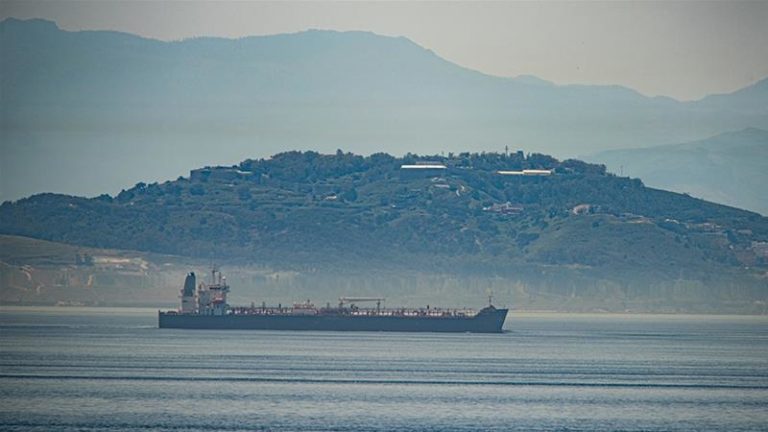
Iranian oil tanker Clavel crossing the Gibraltar stretch heading for Venezuela, May 20, 2020
By M. K. BHADRAKUMAR | Indian Punchline | May 25, 2020
Escorted by the Venezuelan navy and air force, an Iranian oil tanker named Fortune has entered that country’s waters on Sunday, amidst intense speculation whether the US would interfere with the delivery. The US has imposed oil sanctions against Venezuela and Iran and had said it is monitoring the Iranian tanker.
In fact, five Iranian tankers carrying about 1.5m barrels of fuel passed through the Suez Canal earlier this month, according to shipping data on Refinitiv Eikon, and were heading for Venezuela. The other four Iranian tankers — Forest, Petunia, Faxon and Clavel — are approaching the Caribbean en route to Venezuela.
A flotilla of US Navy and Coast Guard vessels is patrolling the Caribbean Sea on a mission to counter illicit drug trafficking. But the Pentagon has stated that there are no plans to stop the Iranian tankers.
At the same time, a Pentagon spokesman, Jonathan Hoffman, while saying on Thursday he was not aware of any operations related to the Iranian cargoes, also added, “We have continued to say that Iran and Venezuela – both two outliers in the international order – [are] clearly violating international sanctions on both nations with this transaction.”
The US sanctions on Venezuela are aimed at increasing pressure on President Maduro to step down. Thus, arguably, Iran is frontally challenging the Trump administration’s stated policy of ‘regime change’ in Venezuela. The Iranian move comes just three weeks after the abortive coup attempt masterminded by the White House on May 1 with the participation of two former US Green Berets aimed at capturing Maduro and transport him to the US in American helicopters to be put on trial on fake drug trafficking charges.
The coup attempt showed the extent of desperation in Washington to overthrow the Maduro government before the US presidential election in November, which President Trump hopes would help him garner Hispanic votes. Iran has now offered a lifeline to Venezuela.
In an historical context, this becomes a frontal assault by Iran on the Monroe Doctrine dating back to the 19th century, which in US foreign policy calculus regarded the Western Hemisphere as its sphere of influence. According to a Reuters report, the Trump administration said earlier this month it was “considering measures” it could take in response to the Iranian shipments, without providing specifics.
No doubt, this is a deliberate sanctions-busting enterprise by Iran. Venezuela desperately needs fuel for up to 1,800 gasoline stations that have been partially closed for weeks due to insufficient supply from state-run refineries.
Venezuela’s gasoline output is now limited to a single facility, the Amuay refinery, but most fuel produced is low octane as most of the country’s alkylation units are out of service. Imported alkylate could improve the quality of domestic gasoline. Venezuela’s refineries are in poor condition. Shipments of equipment in flights by Iran’s Mahan Air have arrived in Venezuela in recent weeks to start repair work.
It will be interesting to see whether the US Navy would interdict any of the other four Iranian tankers before they enter Venezuelan waters. Tehran has sternly warned the US that it would retaliate if any such attempt is made. On Saturday, Tehran raised the ante with President Hassan Rouhani explicitly warning, “If our oil tankers in the Caribbean Sea or anywhere else in the world get into trouble caused by the Americans, they (US) will run into trouble reciprocally.”
Washington is well aware of Iran’s capability to create big problems for the US Navy deployed in the Persian Gulf, especially the Strait of Hormuz. Last week, in a precautionary step, US Navy, via the Maritime Safety Office run by the National Geospatial-Intelligence Agency, alerted all international maritime traffic to maintain a safe distance of at least 100 meters from US naval vessels in international waters and straits. Pentagon officials separately confirmed that the stay-away warning to marine traffic in the Persian Gulf, the Arabian Sea and the Gulf of Oman was actually intended for Iran.
In geopolitical terms, Iran’s strategic defiance of the US in the Western Hemisphere makes an interesting case study not only of the decline in American influence in its backyard to the south but the entire efficacy of the “sphere of influence” concept in contemporary world politics. This is one thing.
More importantly, in the backdrop of the Iranian tanker reaching Venezuela, Caracas has described Iran as a “revolutionary partner” in the struggle against US imperialism. From the Iranian viewpoint, Venezuela becomes a part of the “axis of resistance” against the US. To be sure, the audacity of the two countries will irritate Washington to no end.
How far the Iran-Venezuela axis will deepen and expand will bear watch. Importantly, the UN Security Council embargo against Iran exporting arms to other countries is expiring in October. The US move to extend the timeline of the embargo is unlikely to succeed, given the strong negative reaction by Russia and China. It is entirely conceivable that a matrix of military cooperation may commence in a near future involving Iran and Venezuela.
Iran’s indigenously developed missile capability acts as a deterrent against US aggression. Iran has transferred missile technology to Hezbollah, which is estimated to have the capability today to inflict significant damage to Israel in the event of any aggression by the latter on Lebanon. Significantly, the deterrence is working and Israel no longer stages attacks on Lebanon.
A similar shift in the strategic balance with Iran’s help can create more space for Venezuela to push back at the US. All in all, Iran appears to be working on a strategy to help Venezuela to maintain its strategic autonomy. There is enormous potential for cooperation and coordination between Iran and Venezuela. If Venezuela has the largest known oil reserves in the world, Iran too has massive reserves of oil and gas.
The despatch of oil to lubricate the beleaguered Venezuelan economy may prove to be the harbinger of an assertive Iranian power projection elsewhere in Latin America too. Surely, in the near term, it is a rebuff to the Trump administration’s maximum pressure strategy against Iran. In a longer-term perspective, a concerted regional strategy in Latin America by Russia, China and Iran can seriously erode the US influence in the continent.
Will Trump Really Start Two Wars Instead of “Just” One?
The Saker | Unz Review | May 20, 2020
Amidst the worldwide pandemic induced scare most of us have probably lost track of all the other potential dangers which still threaten international peace and stability. Allow me to list just a few headlines which, I strongly believe, deserve much more attention than what they got so far. Here we go:
- Military Times : “5 Iran tankers sailing to Venezuela amid US pressure tactics“
- Time : “5 Iranian Tankers Head to Venezuela Amid Heightened Tensions Between U.S. and Tehran“
- FoxNews: “Iran tankers sailing to Venezuela in effort to undermine US sanctions“
Notice that Military Times speaks of “US pressure tactics”, Time of “tensions” and FoxNews of “efforts to undermine US sanctions”?
I don’t think that this is a coincidence. Folks in the US military are much more in touch with reality than the flag-waving prostitutes which some people call “reporters” or “journalists”.
Furthermore, the US has embarked on a new policy to justify its acts of piracy on the high seas with something called Visit, Board, Search and Seizure (VBSS) all under the pretext of the war on drugs. To get a better understanding of the context of these developments I asked a specialist of Maritime issues of our community, NatSouth, who replied the following: (stress added)
If a ship does not comply with the request to be boarded, it is usual that the pursuing authorities must gain the permission of the ‘flag’ state prior to boarding, on the high seas and the pursuit has to have started in the coastal state’s jurisdictional waters. The caveat here is that in the Caribbean – Caribbean Regional Maritime Agreement (CRA) – (long name: Agreement Concerning Co-operation in Suppressing Illicit Maritime and Air Trafficking in Narcotic Drugs and Psychotropic Substances in the Caribbean Area). So, there is an agreement with participating coastal states on boardings and pursuits in EEZs and the like. You can find more on the legal aspects of boardings at sea here: and more info on so-called “consensual boardings” here.
The anti-drug/ counterterrorism angle allows the U.S. Navy and the USCG to carry out interdictions on the high seas. Important point to note whether this approach will be taken to interdict the tankers, given that Venezuela is a declared narco-State. The absurdity is that Venezuela isn’t the primary transit point in the region, Colombia holds that honour.
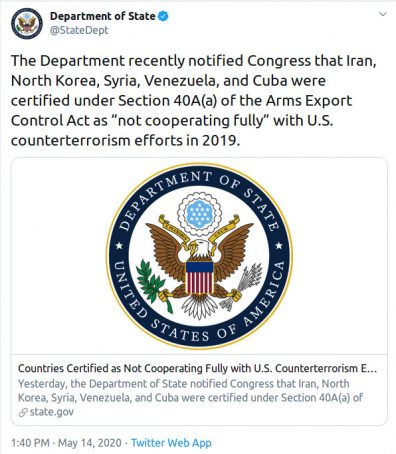
If I could add at this point, the origins are that Venezuela didn’t wish to play ball with Washington anymore, specifically with the DEA back in 2005, squaring the circle of sorts, (or should that be a vicious circle cunningly used by Washington, because who is going to argue with that narrative, aka the war on terror). March: SOUTHCOM’s Adm. Faller: “There will be an increase in US military presence in the hemisphere later this year. This will include an enhanced presence of ships, aircraft, & security forces to reassure our partners… & counter a range of threats to include illicit narco-terrorism.” At the same time, the State dept released this tweet, so the US could effectively carry out boardings under the guise of counterterrorism as well.
While the Iranian tankers were in the Mediterranean, Washington released a (delayed) “Global Maritime Sanctions Advisory”, to the maritime industry, setting out guidelines to shipowners and insurers to enable them to avoid the risks of sanctions penalties related to North Korea, Syria and Iran. This also concerns oil exports from Iran, (but doesn’t apply to Iranian flagged ships). This came after the State Dept gave warning notice to oil companies to stop operations, including Rosneft (Russia), Reliance (India) and Repsol (Spain).
Then NatSouth concluded the following:
Under international law, every merchant ship must be registered with a flag state, which has jurisdiction over the vessel. Hence, this time, the use of Iranian-flagged tankers, as a direct response from Washington’s latest version of restating “maximum pressure” campaign on enforcement of Iran and Venezuela sanctions, (back in Feb, literally the same language as in Aug 2019). There was talk back then of a naval embargo, which would a serious notch up in tensions. There was mention of the 4 U.S. warships in the Caribbean, the U.S. Navy tweeted about, but one the Preble went through the Panama Canal into the Pacific).
Pretty clear, isn’t it?
What the US is doing is substituting itself for the United Nations and it is now openly claiming the right to board any vessel under whatever kind of pious pretext like, say, narco-trafficing, nuclear proliferation, sanctions against so-called “rogue states”, etc. Clearly, the AngloZionists expect everybody to roll over and take it.
How likely is that?
Let’s look at a few Iranian headlines, all from PressTV:
- PressTV, May 16th: “Iran’s fuel shipment to Venezuela guaranteed by its missile power“
- PressTV, May 17th: “US aware Iran will respond ‘very strongly’ if Venezuela-bound ships attacked: Analyst“
- PressTV, May 18th: “Iran: US bears responsibility for any foolish act against tankers heading to Venezuela“
Three days in a row. I think that it is fair to assume that the Iranians are trying very hard to convince Uncle Shmuel not to mess with these tankers. Does anybody seriously believe that the Iranians are bluffing?
Before we look at some of the aspects of this potential crisis, let’s just mention a few things here.
First, the US is acting in total and official illegality. Just like the bombing of Syria, the threats to Iran, or the US murderous sanctions Uncle Shmuel imposes left and right – the blockade of Venezuela is a) totally illegal and b) an act of war under international law.
Second, if USN commanders think they can operate with impunity only because the Caribbean is far away from Iran, they are kidding themselves. Yes, Iranian forces cannot defend these tankers so far away from home, nor can they take any action against the USN in the Atlantic-Caribbean theater of naval operations. But what they can and will do is retaliate against any AngloZionist target in the Middle-East, including any oil/gas tanker.
Third, while Venezuela’s military is tiny and weak compared to the immensely expensive and bloated US military, being immensely expensive and bloated is no guarantee of success. In fact, and depending on how the Venezuelan leadership perceives its options, there could be some very real risk for the USA in any attempt to interfere with the free passage of these ships.
What do I mean by that?
Did you know that Venezuela had four squadrons of Su-30MKV for a total of 22 aircraft? Did you know that Venezuela also had an unknown number of Kh-31A supersonic anti-shipping missiles? And did you know that Venezuela had a number of S-300VM and 9K317M2 Buk-M2E long range and medium range SAMs?
True, that is nowhere near the amount of weapons systems Venezuela would need to withstand a determined US attack, but it is more than enough to create some real headaches for US planners. Do you remember what the Argentinian Air Force did to the British Navy during the Malvinas war? Not only did the Argentinians sink two Type 42 guided missile destroyers (the HMS Sheffield and the HMS Coventry) which were providing long-range radar and medium-high altitude missile picket for the British carriers, they also destroyed 2 frigates, 1 landing ship, 1 landing craft, 1 container ship. Frankly, considering how poorly defended the British carriers were, it is only luck which saved them from destruction (that, and the lack of sufficient number of Super Étendard strike aircraft and Exocet missiles). I would add here that the British military, having been defeated on many occasions, has learned the painful lessons of their past defeats and does not suffer from the cocky-sure attitude of the US military. As a result, they were very careful during the war against Argentina and that caution was one of the factors which gave a Britain well-deserved the victory (I mean that in military terms only; in moral terms this was just another imperialist war with all the evil that entails). Had the Argentinians had a modern air force and enough anti-shipping missiles, the war could have taken a very different turn.
Returning to the topic of Venezuela, war is a much more complex phenomenon than just a struggle of military forces. In fact, I strongly believe that political factors will remain the single most important determinant factor of most wars, even in the 21st century. And chances are that the Venezuelans, being the militarily weaker side, will look to political factors to prevail. Here is one possible scenario among many other possible ones:
Caracas decides that the US seizing/attacking the Iranian tankers constitutes an existential threat to Venezuela because if that action goes unchallenged, then the US will totally “strangle” Venezuela. Of course, the Venezuelan military cannot take on the immense US military, but what they could do is force a US intervention, say by attacking one/several USN vessel(s). Such an attack, if even only partially successful, would force the US to retaliate, bringing US forces closer not only to Venezuelan air defenses, but also closer to the Venezuelan people which will see any US retaliation as an illegitimate counter-counter-attack following the fully legitimate Venezuelan counter-attack.
Then there is the problem of defining victory. In the US political “culture” winning is usually defined as pressing a few buttons to fire off some standoff weapons, kill lots of civilians, and then declare that the “indispensable nation” has “kicked the other guy’s ass”. The problem with that is the following one: if they other guy is very visibly weaker and has no chance for a military victory of his own, then the best option for him is to declare that “surviving is winning” – meaning that if Maduro stays in power, then Venezuela as won. How would the USA cope with that kind of narrative? Keep in mind that Caracas is a city of over two million people which even in peacetime is rather dangerous (courtesy of both regular crime and potential guerilla activities). Yet, for Maduro to “win” all he has to show is that he controls Caracas. Keep in mind that even if the US forces succeed in creating some kind of “zone of real democracy” somewhere near the Colombian border, that will mean nothing to Maduro, especially considering the terrain between the border and the capital city (please check out this very high resolution map of Venezuela or this medium resolution one). As for the notion of a USN landing on the shores of Venezuela, all we need to do is to remember how the immense Hodgepodge of units which were tasked with invading Grenada (including 2 Ranger Battalions, Navy Seals, most of an Airborne Division, etc. for a total of over 7,000 soldiers(!) against a tiny nation which never expected to be invaded (for details, and a good laugh, see here for a full list of participating US forces!) was defeated by the waves of the Caribbean and the few Cuban military engineers who resisted with small-arms fire (eventually, most of the 82AB was calling in to fix this mess).
In other words, if Maduro remains in power in Caracas then, in political terms, Venezuela wins even though it would loose in purely military terms.
This phenomenon is hardly something new, as shown by the following famous quote by Ho Chi Minh: “You can kill ten of my men for every one I kill of yours. But even at those odds, you will lose and I will win.”
By the way, this is exactly the same problem the Empire faces with Iran: as long as the Islamic Republic remains an Islamic Republic it “wins” in any exchange of strikes with the USA and/or Israel.
Still, it is pretty obvious that the US can turn much of Venezuela into a smoking heap of ruins. That is true (just like what the USA did to Korea, Vietnam, Iraq or Serbia and Israel what did to Lebanon in 2006). But that would hardly constitute a “victory” in any imaginable sense of the word. Again, in theory, the US might be able to secure a number of landing locations and then send in an intervention force which could try to take key locations in Caracas. But what would happen after that? Not only would the hardcore Chavistas trigger a guerilla insurrection which would be impossible to crush (when is the last time the USA prevailed in a counter-insurgency war?), but many Venezuelans would expect the US to pay for reconstruction (and they would be right, according to the rules of international law, “once you take it, you own it” meaning that the USA would become responsible for the socio-economic situation of the country). Finally, there is always the option of an anti-leadership “decapitating” strike of some kind. I believe that in purely military terms, the US has the know-how and resources to accomplish this. I do not believe that this option would secure anything for the USA, instead – it would further destabilize the situation and would trigger some kind of reaction by the Venezuelan military both outside and inside Venezuela. If anything, the repeated failures of the various coup attempts against Chavez and Maduro prove that the the bulk of the military remains firmly behind the Chavistas (and the failed coup only served to unmask the traitors and replace them anyway!).
The bottom line is this: if Uncle Shmuel decides to seize/attack the Iranian tankers, there is not only a quasi certitude of a war between the US and Iran (or, at the very least, an exchange of strikes), but there is also a non-trivial possibility that Maduro and his government might actually decide to provoke the USA into a war they really can’t win.
Is Trump capable of starting a process which will result in not one, but two wars?
You betcha he is! A guy who thinks in categories like “my button is bigger than yours” or “super-dooper weapons” obviously understands exactly *nothing* about warfare, while the climate of messianic narcissism prevailing among the US ruling classes gives them a sense of total impunity.
Let’s hope that cooler heads, possibly in the military, will prevail. The last thing the world needs today is another needless war of choice, never mind two more.
Iran’s fuel shipment to Venezuela guaranteed by its missile power
Press TV – May 16, 2020
Iran is shipping tons of gasoline to Venezuela in defiance of US sanctions on both countries in a symbolic move guaranteed by Tehran’s missile prowess.
Unconfirmed reports and tanker monitoring groups suggest that at least five Iranian-flagged tankers are transporting fuel to Venezuela through the Atlantic Ocean despite the US sanctions on both Tehran and Caracas.
Iran has intentionally hoisted its own flag over the huge tankers which are navigating through the Atlantic before the eyes of the US Navy.
Iran is shipping large consignments of gasoline to Venezuela even though the US would try to intercept the shipments and seize the tankers.
There are unconfirmed reports that the US Navy has deployed its USS Detroit (LCS-7), USS Lassen (DDG-82), USS Preble (DDG-88), and USS Farragut (DDG-99) to the Caribbean along with its patrol aircraft Boeing P8-Poseidon for possible encounter with the Iranian vessels.
However, analysts say it is very unlikely that the US makes such a mistake, as it would have serious repercussions for the Trump administration ahead of the November elections.
The US would not dare to seize the Iranian vessels especially after Iran’s reaction to a similar move by the United Kingdom, a close ally of Washington.
Iran also has the upper hand thanks to its missile power, which was shown to the US in the IRGC’s retaliatory missile attacks on the Ain al-Assad Airbase in Iraq, which accommodated American troops.
The US was also reminded of the Islamic Republic’s missile prowess following the recent successful launch of Nour-1 military satellite, which reached its orbit using the Qased satellite carrier. Some Western analysts claim the satellite achievements are a prelude to Iran’s program to develop intercontinental ballistic missiles (ICBMs).
Confident about its missile capabilities, Iran is going on with the gasoline shipment to its ally in Latin America, mocking the US sanctions on the oil sectors of both countries.
The US seems to be between the rock and hard place. While it is unlikely for Washington to dare to intercept the tankers, if they reach their destination safe and sound, it may tarnish the “superpower” forever.
The fuel shipment also shows Iran’s success in turning into an exporter of gasoline after years of importing the fuel.
A senior official in US President Donald Trump’s administration told Reuters on Thursday that the United States was considering measures against Iran in response to the fuel shipment.
The official said Washington has a “high degree of certainty” that the Venezuelan government is paying Iran in gold for the fuel.
If these claims are confirmed, the “fuel for gold” exchange is also a great achievement for the Islamic Republic amid the US’ maximum pressure policy, which deprives the country’s economy of billions of dollars’ worth of oil revenues.
There are reports that Iran is receiving nine tons of gold in exchange for the fuel its ships transport to Venezuela. Under the cruel sanctions imposed by the US after its withdrawal from the 2015 nuclear deal in 2018, nine tons of gold can be a very precious asset for the Iranian economy.
However, we must still wait and see whether the US administration would let the Iranian tankers go and strip Washington of its “superpower” title, or it would dare to intercept the vessels and endanger Donald Trump’s campaign ahead of the November elections.
Earlier in the day, Iranian government spokesman Ali Rabiei said Venezuela and Iran are both independent states that have had and will continue to have trade relations with each other.
“We sell goods and buy goods in return. This trade has nothing to do with anyone else. We have to sell our oil and we have ways to do it,” Rabiei said in reaction to reports of the fuel shipment to the Latin American country.
See also:
US interception of Iran vessel to Venezuela would be ‘completely illegal
Swiss humanitarian channel yet to process a single deal for Iran: Report
Press TV – May 8, 2020
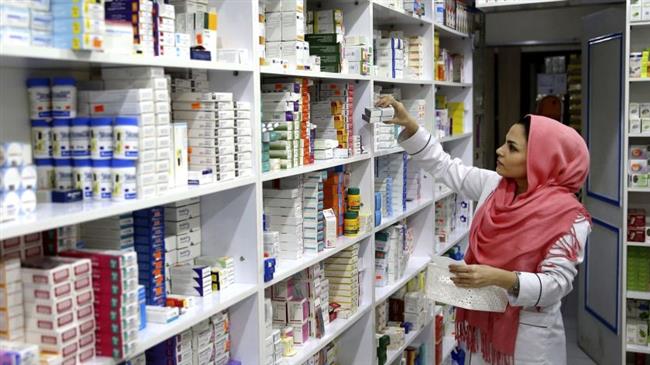
A new report published in the American media shows a Swiss trade channel much publicized by Washington as a secure way of delivering humanitarian assistance to Iran at a time of sanctions has failed to process any single deal on Iranian medicine imports.
The Daily Beast reported that Iranians have got almost nothing from the Swiss Humanitarian Trade Agreement (SHTA) since it was launched in January with the support and consent of the US.
The channel was meant to find a way around the US sanctions to use Iranian funds deposited abroad to buy food and medicine for the country via the Swiss bank BCP.
However, companies seeking to participate in the scheme have found it very difficult to comply with the criteria set by the US government to avoid violating the general rules governing the sanctions, said the report.
Fabian Maienfisch, a spokesman for Switzerland’s State Secretariat for Economic Affairs (SECO), which oversees the channel, admitted in comments made to the Daily Beast that the initiative had effectively failed to meet its objectives.
“No transactions have yet been carried out. Unfortunately, this whole process has been slower than expected…,” said Maienfisch.
The comments prove statements by the Iranian government saying that US officials have been disingenuous in claiming that Iran’s humanitarian needs are exempt from the harsh regime of sanctions imposed on the country.
Iran has made it clear that the sanctions have not affected its robust response to a new coronavirus pandemic that has infected more than 100,000 people and led to over 6,000 deaths in the country.
However, governments and rights organizations have criticized the US for its refusal to lift the sanctions at the time the Iranian health system is under pressure, saying the bans violate the most basic principles of human rights.
Anti-Iranian Boomerang Policies: How America Celebrated the Pandemic and Incited the Oil Crisis, and Got Stuck by Both
By Ivan KESIĆ | Strategic Culture Foundation | May 7, 2020
Two months after the coronavirus pandemic broke out in Iran, we are seeing signs of a significant improvement for the total situation. The number of daily deaths has dropped below one hundred for a week in a row, the number of new COVID-19 cases has been on a continuous decline for more than three weeks, the restrictions are gradually being lifted and the streets are again vibrant. Iran’s success in combating the pandemic is the result of mobilizing all available governmental organizations and relying on its own know-how and industrial production. Alone and under the harshest sanctions seen in history, Iran has proven to be extremely effective, compared to the leading Western countries. In the face of global disasters and the vulnerability of civilians, it is traditionally common for nations to help one another, but recently we see something quite different from the U.S. regime.
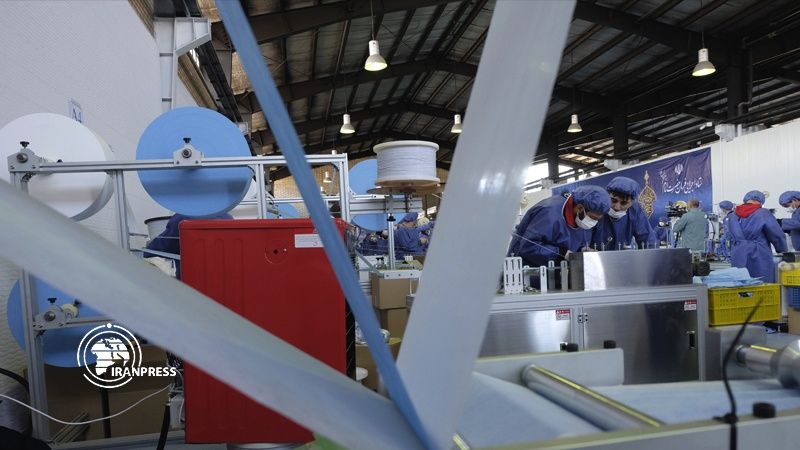
The largest mass-produced face masks factory in Southwest Asia was put into operation in Eshtehard Industrial Town of Alborz province, west of Tehran. The head of the Execution of Imam Khomeini’s Order, Mohammad Mokhber said the factory will produce every day four million masks equipped with a nano filter, which guarantees a high level of protection.
Accusations, lies, more sanctions, and warmongering
The outbreak of the pandemic in Iran and China, two largest rival countries in Asia, had come as a refreshing for American politicians. In the Chinese case, they hoped for their economic slowdown and the deterioration of their international reputation, thus opening space for expanding and strengthening America’s international policies and position. In the case of Iran, expectations were much higher. Before coronavirus fully took hold in the U.S., the Trump administration appeared to be viewing the outbreak as an opportunity to gain advantage by amplifying its maximum pressure strategy, the view that by squeezing Iran’s economy crippling sanctions will force Tehran to choose between its own economic viability and geopolitical independence.
When Iran asked for international medical assistance, lifting sanctions and a loan from the IMF, the Trump administration saw it as a confirmation of the success of their policies. Instead of showing signs of goodwill for Iranian demands, the proudly compassionate United States responded by announcing a new round of economic sanctions aimed at closing loopholes that might allow Iran to export its products and leave it in scarcity of money then desperately needed for respirators, face masks, and other medical equipment. Formerly called blockade or embargo, now rebranded as “economic sanctions,” embody the beloved fantasy that coercive pressure alone can make countries submit to America’s will.
The U.S. Treasury says its sanctions do not prohibit humanitarian contributions that ease coronavirus pressure on Iran, a claim the Iran’s Foreign Ministry has called deception. Even though the U.S. claims that its sanctions don’t prevent the sale of medicine and medical devices, the secondary sanctions on financial institutions and businesses have prevented Iran from buying necessary items like ventilators that could save the lives of coronavirus patients. The problems do not stop there, for example the Iranian government released an official coronavirus app for Iranians, but Google pulled it from its app store due to U.S. sanctions. Basically, the U.S. government has taken the same approach as during the last year’s floods in Iran, when they prevented international aid.
In addition to preventing international aid to Iran, we have also seen crocodile tears and false mercy from Trump and his administration, allegedly offering their own coronavirus aid “if Iranians ask for it.” Only someone extremely naive can believe in the sincerity of this offer, considering that they have prevented the aid of other countries, and even stolen medical equipment from Italy, France, Germany and Canada. There is no trace of U.S. aid collection for Iran, which, after all, could have been sent quietly. For example, even though they were in a more difficult situation at the end of March, the Iranians collected medical aid for the American people and sent it through the Swiss Embassy, without media noise. The truth is that Trump had no intention of sending any aid, in fact he just wanted to hear Iranian begging and then use it for propaganda purposes. Of course, Iranians did not bite it and rejected the offer. Still, the fake aid offer and Iran’s refusal were later reported in many Western media as key evidence of U.S. benevolence and Iranian cruelty.
After putting Iran in an unpleasant situation, U.S. politicians began pouring bizarre accusations against the Iranian authorities. Mike Pompeo, Brian Hook and Morgan Ortagus accused Iran of “lying” about the coronavirus outbreak and “stealing” funds intended for the fight against pandemic. “It’s not the sanctions, it’s the regime,” Ortagus claimed. Aggressive elements within the U.S. government have even begun calling for war on Iranian-backed militias in Iraq, thinking that Iran is in too difficult a crisis to respond adequately.
The alleged Iranian incompetence required some kind of evidence, so the new U.S. disinformation campaign was launched. Anti-Iranian propaganda has mostly focused on exaggerating the numbers of infected and dead, despite the fact that the World Health Organization confirms Iranian reports as credible. The Washington Post has turned to publishing fake news, claiming that Iran has dug mass “burial pits” in Qom for victims of the disease. Netanyahu went even further, sharing a video clip from a 2007 TV mini-series, as the evidence of Iranian trying to hide the true number of fatalities.
Numerous Western media have kept up with similar nonsense and hateful claims. One of the finest examples is the op-ed piece by Graeme Wood for The Atlantic. “Iran cannot handle the coronavirus,” he claims in the title, further representing Iran as the Orientalist dystopia. The city of Qom, with over 1.2 million inhabitants, for Wood is “a small city” with “cramped hotels, communal toilets, junk food and unhygienic scenes,” a sort of “Shiite Disneyland,” assuring his audience “that comparison might be the best way for Americans to understand the gravity of this outbreak.” Then he jumps to the ideological patriotism, claiming China’s authoritarianism has the advantages in dealing with a disaster like this, while Iran’s authoritarianism has none. He claims that Iran has no intention of closing the holy shrines, despite the fact that they were closed shortly after.
Wood also shows video of Iraj Harirchi, a top Iranian health official who has contracted the coronavirus, describing it as “incredible” and “comic,” calls Iranian officials “notoriously cruel,” and the country as the place where “incompetence and evil become indistinguishable.” This op-ed perfectly summarizes the distorted vision given by everyone from the American leadership to the authors of racist cartoons on social networks: Iran is bad, dirty, everything opposite to the U.S., and it will fall. After all, deadly disasters occur only in far off Oriental despotates, never in famed liberal democracies. Except Italy. And except for the post-March 2020 period.
Coronavirus knocks at the U.S. door
In mid-March, the coronavirus knocked heavily on the U.S. door and from the wealthiest country in the world, whose president boasts with the best institutions and whose government enjoys giving lessons to other countries, it was expected that pandemic would be a piece of cake. But what do we see, and what’s the difference between the U.S. and Iran? Inside Iran, we don’t see massive dissatisfaction or protests over the Khamenei’s and Rouhani’s crisis management, but according to a Gallup Poll conducted on 14 April, Trump’s approval rating is down significantly, now standing at 43%. We also see thousands of protesters in many U.S. states, with truly inspiring slogans demanding freedom and liberation. We don’t see chaos in Iranian hospitals either, but we do see large-scale theft of equipment in U.S. hospitals, as well as U.S. nurses refusing to work due to lack of protective equipment. While the story of Qom’s mass burial pits is refuted to the last detail, it remains for Americans to explain burials of unclaimed bodies on Hart Island and in New York city parks.
The New York City itself today looks like Chernobyl or a “never-in-liberal-democracy” thing, a sort of Orientalist dystopia from Hollywood movies or unhygienic Disneyland from The Atlantic’s agitprop-eds. With junk food, or no food on the shelves at all. We don’t see hungry Iranians begging the Trump administration for help, but we see such moans on the multi-billion-dollar U.S. aircraft carriers. We don’t see any regime change in Tehran, but we do see dismissal of the U.S. aircraft carrier’s captain, only because he dared to seek help for his infected sailors. There’s no trace of the alleged Iranian government’s “lying” or “theft,” but there is overwhelming evidence of U.S. piracy of protective masks around the world. This evidence comes from the governments of Italy, Germany, France and Canada. If U.S. authorities cooperated with Iranian experts at the outbreak of the pandemic, they would surely have had fewer casualties at home. But they did not want to cooperate, as with Chinese experts, they just looked like scavengers. Now, Trump is blaming the WHO, which has replaced Iran as a bogeyman.
We also don’t see the collapse of the Iranian economy, although by 18 April around 600,000 people had registered as unemployed. By comparison, over 22 million Americans had lost their jobs by the same date, proportionally ten times more. Moreover, we don’t see the collapse of the Iranian oil industry, nor their tankers floating hopelessly alone on the sea. During the pandemic, Iran has launched 25 new electricity projects in five provinces worth nearly half a billion dollars, successfully installed a giant oil drilling platform at Salman oilfield, as well as a gas drilling rig in the Persian Gulf. All domestically produced, and all for the domestic market. In contrast, we are witnessing a historic oil crisis in the West, the collapse of the North American shale industry, and a crowd of full oil tankers parked off the U.S. coast with nowhere to unload. In other words, in their backyard they are looking at a scenario they intended for Iran two years ago, or one that they had hoped for when a pandemic broke out in that country. Yet Iran has proven to be much more resilient and effective.
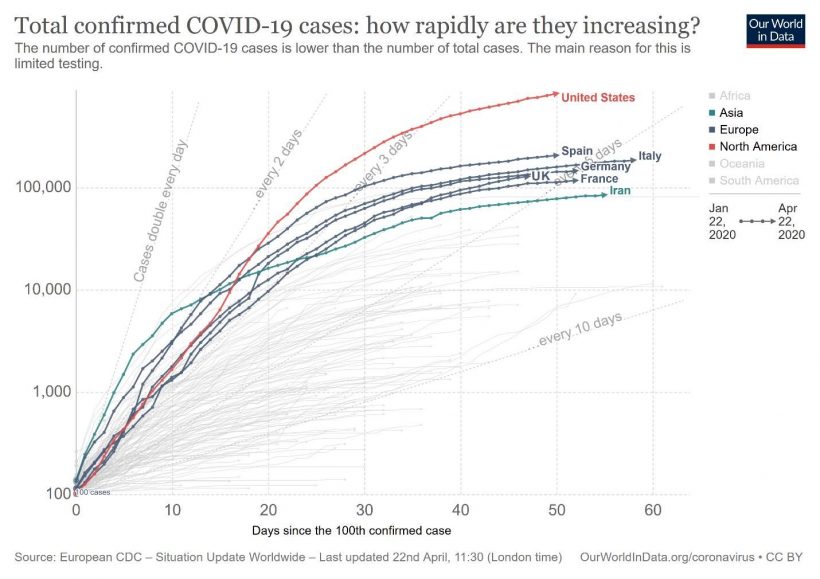
Everything seen before
Despite all the obstacles and wet dreams of its enemies, Iran has not fallen, and it will not fall. Its initial perceived weakness subsequently proved to be false. Iran did not ask for aid and the IMF loan because it could not cope alone with the crisis, but to accelerate the fight against the pandemic. Negative responses to Iran’s demands and attempts to block other countries from sending aid are a wake-up call for the last naives who think the U.S. government has compassion for anyone’s civilian population. Or even their own. The mask thefts from their own allies also prove that the U.S. government will treat everyone the same way as Iran. As a nation with a strong sense of identity and group responsibility, Iran has proven to be extremely enduring in similar historical situations. In the 1980s, Iran withstood the aggression of the fourth largest army, backed by America and all the world powers, and a decade later it rebuilt the country despite being more isolated and weaker than today.
Even deadly disasters, accompanied by aid refusals and military aggression, are not unseen in Iranian history. Going back a century, Iran has been hit by an epidemic and mass famine that has claimed two million lives, or 20% of the total population. In 1918 the Iranian government asked the U.S. for a multi-million-dollar loan to be used solely for famine relief, but Washington refused. Furthermore, the British recognized the perfect circumstance to temporarily occupy the western parts of Iran and impose a humiliating agreement that was terminated by the Iranian parliament in June 1921. This is also a lesson for those who think that Anglo-American vulturous policy towards Iran began in 1979 or 1953. Going back a century or two more, in 1820 and 1721 northwestern Iran was hit by catastrophic earthquakes, and the city of Tabriz recorded tens of thousands dead. Just a few months after both events, the Ottomans invaded Iran, but were repulsed soon after both times. Today we are witnessing the centennial repetition of history, with new fools repeating old mistakes and expecting different results.
China Rejects Illegal, Violent Actions Against Venezuela, Cuba
teleSUR | May 6, 2020
China Wednesday condemned the recent rifle attack at the Cuban embassy in the United States, a mercenary forces’ invasion plan of Venezuela, and all the interventionist maneuvers against the sovereignty of any country.
China’s Foreign Ministry spokeswoman Hua Chunying said that her government firmly opposes any violent action perpetrated against official representations.
She urged Washington to take the necessary measures to protect the Cuban embassy from any damage, as provided for in the 1961 Vienna Convention.
In this way, China joined other nations in the world that repudiated the shooting launched last Thursday against the Cuban embassy in the U.S. capital. The Cuban mission officials suffered no damage, but there were material deteriorations in the building as a result of the attack.
Hua also deplored the attempted maritime invasion of Venezuela by mercenary forces seeking to carry out a coup against President Nicolas Maduro.
She stressed the Chinese government’s rejection of the violation of the sovereignty of the South American country by any means or excuse.
The diplomat called for prioritizing the well-being of the Bolivarian people and promoting the peaceful resolution of the political impasse in Venezuela.
China has been in favor of respecting the United Nations Charter and the basic norms governing international relations in the face of the U.S. policy of hostility towards the Maduro administration.
The Asian nation recently criticized Washington for applying more extraterritorial sanctions to Venezuela, Cuba, and Iran to the detriment of the public health of the people just as the COVID-19 pandemic spreads.
US House war hawks write to Pompeo over UN arms embargo on Iran
Press TV – May 3, 2020
US lawmakers have written a letter to Secretary of State Mike Pompeo, urging him to take “increased diplomatic action” not to allow a United Nations arms embargo on Iran to expire in October.
“We write to urge increased diplomatic action by the United States to renew the expiring United Nations arms embargo against Iran and United Nations travel restrictions on those Iranian individuals involved with dangerous proliferation activities,” Hundreds of House lawmakers claimed in a letter released by The Hill. “America must continue its longstanding, bipartisan leadership in order to limit Iran’s destabilizing activities throughout the world… We look forward to working with you to reauthorize these expiring UN restrictions, which are essential to protecting our national security and the American people.”
The US claims that Washington has not quit the Iran nuclear deal and technically remains a “participant state.” The scheme is aimed at using a mechanism embedded within the Iran nuclear deal to make the UN restore a previously lifted arms embargo on Tehran.
The latest anti-Iran scheme was spearheaded by Democratic House Foreign Affairs Committee Chairman Eliot Engel and committee ranking member Michael McCaul.
“Nearly every member of the US House of Representatives is in agreement: Iran must not be allowed to buy or sell weapons,” McCaul claimed in a statement. “This isn’t a Republican or Democrat issue, or even just an American issue. We need to extend the UN arms embargo on Iran for the sake of international peace and security. I am proud the House is speaking with one voice to protect the world against Iran’s aggressive and destabilizing behavior.”
President Donald Trump unilaterally withdrew the US from the Iran nuclear deal in 2018 and re-imposed harsh sanctions on Iran.
“US Security Council Resolution 2231 is unambiguous where the United States is a participant,” Pompeo claimed at a press briefing Wednesday. “We are going to make sure that come October of this year, the Iranians aren’t able to buy conventional weapons that they would be given what President Obama and Vice President Biden delivered to the world in that terrible deal.”
Tehran has called the allegation that the US is still a member of the Joint Comprehensive Plan of Action “a joke.”
Moscow: UN Weapons Embargo on Iran Can’t Be Prolonged Despite US Efforts
Sputnik – April 30, 2020
The UN embargo on conventional weapons sales to Iran, which expires in October 2020, can’t be extended despite US efforts to prevent its expiration, the Russian Deputy Foreign Minister has stated.
“For us, the case of the existing ban on arms deliveries to and from Iran was closed with the adoption of Resolution 2231. The embargo regime expires in October this year”, Deputy Foreign Minister Sergei Ryabkov stated.
Ryabkov went on to blame the US for its selective approach to Resolution 2231. He recalled that Washington itself had stopped adhering to its provisions two years ago and has since spared no effort to prevent other nations from remaining in compliance with the resolution by introducing unilateral sanctions.
“Instead of discussing which provisions of Resolution 2231 could be used to achieve certain political goals, the US would be better off ensuring the full and comprehensive implementation of the provisions of this resolution, and return to full compliance with the JCPOA”, the Deputy Foreign Minister added.
UN Resolution 2231 adopted back in 2015 alongside the Iran nuclear deal, prohibited the sale of conventional weapons to the Islamic Republic until 18 October 2020 and separately the sale of missiles until 2023. However, US Secretary of State Mike Pompeo stated yesterday that Washington is planning to do anything in its power to extend the ban beyond October 2020 and will apply to the UN to do that.
Pompeo mulled resorting to a mechanism that renews international sanctions against the Islamic Republic by declaring that it violated the nuclear deal inked in 2015, but was later abandoned by the US in 2018. The secretary of state claims the US is still formally a party to the deal and that Washington will seek help from its European allies, signatories to the deal, in this matter. UN inspections, however, revealed that Iran complied with the deal as it promised in 2015.
Iran breaks through US-led blockade to deliver record amount of oil to Syria
Al-Masdar News | April 28, 2020
Iran has managed to break through the U.S. blockade to deliver a large amount of oil to the Syrian Arab Republic, TankerTrackers website has revealed.
According to the website Tanker Trackers, Iran has significantly increased their oil exports to Syria, with several cargoes reportedly reaching the Port of Baniyas in the Tartous Governorate.
The website reported that Iran is currently delivering more than three times the normal amount they export to Syria, which is a significant increase to the Arab Republic, who relied heavily on the Islamic Republic’s oil last year.
“There can be several reasons why this is happening. Excess oil stocks in the midst of sanctions and a global oil glut is forcing Iran to ship and perhaps store the oil in a friendly country. Another reason is that Bashar Assad’s government and Hezbollah can be conduits to sell the oil on the black market. One place Hezbollah can manage to do this is Lebanon, where it has sway over the government,” the website Radio Farda reported.
However, despite these claims, the large oil exports to Syria have less to do with selling the petrol and more to do with the Arab Republic providing relief to its people.
Since the U.S. currently occupies some of Syria’s largest oil fields, the Arab Republic has been forced to find alternatives to meet the civil demand for this resource.
Featured Video
Iran FM Araghchi: “Hormuz Will No Longer Be the Same”
or go to
Aletho News Archives – Video-Images
From the Archives
Sam Husseini: The entire US establishment helped lie their way into the Iraq war
By Slava Zilber | American Herald Tribune | October 14, 2019
Sam Husseini is a senior analyst with the Institute for Public Accuracy, independent journalist and contributor to The Nation and FAIR.
Slava Zilber: Sam, three years ago, you appeared on Talk Nation Radio with David Swanson and spoke about the case of the GCHQ whistleblower Katharine Gun. You pointed out that the people involved in the spying on the UN and the people authorizing the Iraq War were not held accountable:
“Virtually everybody who went along with the war, whether it is Kerry or Clinton, of course, the Bush administration themselves has falsified their own records in terms of why, what they did, when they did, why they did it, to the extent that they’ve been scrutinised at all.”
You also address it in a recent article. And recently, Joe Biden has been lying about his position on the Iraq War. How can such an important issue escape meaningful scrutiny? … continue
Blog Roll
 Aletho News
- Oman FM: Persian Gulf states, Iran, Iraq should form security pact excluding US
- Trump peddles fresh falsehoods, claims Iran ‘started the war’ as US aggression drags on
- Ukraine quagmire? Yes, but it’s for NATO, not Russia
- US intelligence hypes Chinese, Russian space threats while accelerating its own military buildup in orbit
- Iran FM Araghchi: “Hormuz Will No Longer Be the Same”
- EU facing trillion-euro debt hole while seeking more cash for Kiev
- How US, Europe, Persian Gulf states exhausted missile stockpiles, splurged billions to defend Israel
- Up in arms… Koreans reject U.S. empire’s plan to make South Korea the next Ukraine
- Iran, Turkey, Pakistan, Saudi Arabia could advance region-led security framework in Tehran: FM spox
- Netizens condemn Japanese drama for projecting Japan’s wartime atrocities onto Chinese characters
- If Americans Knew
- An error has occurred; the feed is probably down. Try again later.
- No Tricks Zone
- Sudden Stratospheric Warming, Powerful El Niño Combination May Lead To Extreme Europe Cold, Energy Crisis!
- Two New Studies Find Thwaites Glacier Melt Cannot Be Driven By Human Activity Or A Warming Ocean
- E-Cars Reduce CO2 Emissions By Only 41% Compared To Internal Combustion Engine Vehicles
- Predictions Made By Renowned Climate Professor Over Past Decades Have Been Proven To Be Poor
- New Study Suggests Large Regions Of The Pacific Ocean Have Been Cooling For The Last 80 Years
- Germany’s Green Energy Debacle: High Energy Costs Force Kahla Porzellan to Close After 182 Years!
- New Study: 50 Years Of The Most Aggressive ‘Net Zero’ Policies Can Only Affect The Global Climate By 0.03°C
- US September “Heat” Was No Record…Many Records Set Decades Ago
- Latest European Green Energy Debacle; Portugal’s Largest Flagship Solar Park Insolvent!
- Green Energy Debacle: German Expert Professor Fritz Vahrenholt Warns Of Severe Economic And Social Consequences

