Iran’s shock therapy breaks JCPOA stalemate
By M. K. BHADRAKUMAR | Indian Punchline | July 8, 2019
A series of announcements in Tehran through the past week took the situation around the 2015 Iran nuclear deal (known as the JCPOA) — and the US-Iranian standoff — to an inflection point.
On July 1, it transpired that Iran has exceeded the limit of enriched uranium stockpile under the JCPOA, which is 300 tons. On July 8, Tehran announced a rollback in its obligations under the JCPOA by starting to enrich uranium to a higher purity than 3.67% that would fulfil the needs of its power plants. (Iran had previously said that it needed 5% enrichment for its Bushehr Nuclear Power Plant (NPP) and 20% for Tehran research reactor.)
A criticality has been reached. The Iranian Foreign Ministry’s Fact Sheet outlines how this came about.
Tehran has characterised the past week’s moves as remedial steps under Para 36 of the JCPOA, which it is entitled, to protect its interests. Tehran also says these are reversible steps if only the E3 (Britain, France and Germany) comply with the JCPOA.
Tehran has forewarned that every 60 days, it might otherwise make further moves to jettison its commitments under the JCPOA. Nonetheless, Tehran also acknowledges that although the E3 are yet to meet Iran’s demands, especially in regard to a non-dollar direct payment channel known as INSTEX, certain efforts in that direction are continuing, and they could still bear fruit.
Equally, talks are going on with China and the UK regarding the redesign of Arak reactor (which the US had originally undertaken to carry out under the JCPOA) although Iran has the technology to redesign the reactor on its own if these talks do not show results.
All in all, Tehran has taken certain modest steps that do not even remotely amount to a surreptitious dash for nuclear weapons. On the contrary, these moves are transparent and there is no attempt to restrict the IAEA inspectors’ access to Iran’s nuclear facilities. Nor is Tehran challenging the IAEA intrusive safeguards.
This is crucial. In sum, Tehran has given a two-fold signal. One, the costs for the US’‘maximum pressure’ policy is going to steadily rise, as Tehran will steadily counter-escalate. Two, the remaining signatories to the JCPOA (E3, Russia and China) cannot waffle any longer and must reciprocate Iran’s impeccable compliance with the JCPOA by providing it with an economic lifeline.
Again, there is a hidden message too. Much as Iran is inch by inch distancing itself from the JCPOA — although reluctantly and with caveats — it is not conspiring to kill the 2015 deal. Curiously, Iran’s principal drive still is to somehow bring the US back into the JCPOA. And Tehran takes seriously Trump’s stated aversion to war.
The bottom line, therefore, remains where it was: Does the Trump administration have the intellectual capacity and sensitivity to fathom the Iranian (Persian) culture and psyche? Does it get the point that Iranians never negotiate under threats?
The good part, paradoxically, is that Trump has overplayed his cards and is left with few options today aside a military strike that would have incalculable and catastrophic consequences. The US’ maximum pressure strategy has effectively driven Iran to the pre-2015 position. On the other hand, the regime-change project piloted and uttered by National Security Advisor John Bolton and extravagantly funded by the State Department has flopped.
There is no sign of an uprising in Iran against the authorities. Of course, there is dissent within Iran, but then, it was always there and will always be there — but is far from life-threatening for the regime.
Unfortunately, it is being overlooked that the negotiations leading to the 2015 deal were only possible after the US unequivocally jettisoned the ‘regime change’ agenda towards Iran and, secondly, after the US conceded that Iran shall have the right to enrich uranium like any non-weapon member state of Nuclear Non-Proliferation Treaty.
That is to say, if President Trump is serious about negotiating with Tehran, he needs to abandon the ‘maximum pressure’ approach by at least freezing the escalation ladder and offering economic reprieve by suspending some of the sanctions. One way could be by allowing the INSTEX — Europe’s trade channel for doing business with Iran despite US sanctions — to become really functional in the coming days. Trump can do this if he wants to, by simply feigning indifference to the INSTEX providing the mechanism for European, Russian, Turkish, Chinese or Indian companies to resume trading activities with Iran.
This brings us to the phone conversation between French President Emmanuel Macron and Iranian President Hassan Rouhani on Saturday. For sure, Macron is acting as an intermediary between Trump and Rouhani to facilitate negotiations. The French have clarified that there is no move to trigger the nuclear deal’s dispute resolution mechanism for now — “It’s not an option at this moment” — although Macron said Tehran’s announcement on Sunday amounted to a ‘violation’ of the JCPOA.
Hectic behind-the-scenes consultations are taking place even as an emergency meeting of the IAEA is scheduled in Vienna on Wednesday at US request. Iran’s cooperation with the highly intrusive IAEA inspections of its nuclear facilities is the focal point. Iran will attend the meeting.
Macron sounded out Rouhani on Saturday about American officials being present during the future talks between Iran and the remaining parties to the JCPOA — ‘4+1’ (China, Russia, Britain, France and Germany). Rouhani concurred with the rider that it shouldn’t mean re-negotiation of the JCPOA. He added that Tehran will not object to the US participation in 4+1 meetings, provided the Trump administration removes the sanctions.
The chances are that these high-level exchanges and discussions on new ideas and initiatives may open the door to the pathway leading to the formation of new talks involving the US and Iran.
Cory Booker’s Foreign Policy Echoes His Biggest Donors
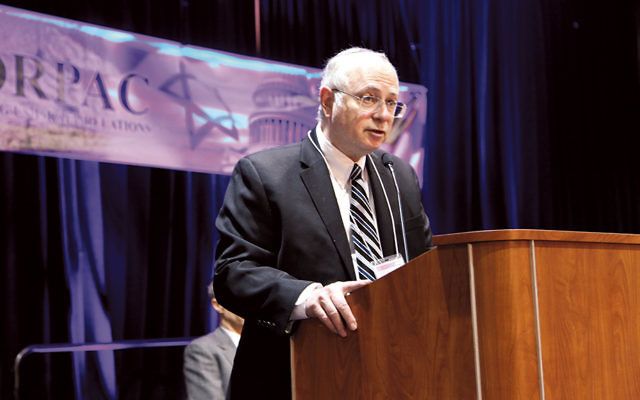
Ben Chouake
By Eli Clifton | LobeLog | July 2, 2019
In last Wednesday’s Democratic debate, Sen. Cory Booker (D-NJ) stood apart from the other candidates on the stage by declining to commit to return to the Iran nuclear deal. Videos viewed by LobeLog show that Booker’s unusual position is shared by NORPAC, a pro-Israel PAC aligned with the American Israel Public Affairs Committee (AIPAC). As Booker’s biggest donor, NORPAC contributed $185,871 to Booker’s campaign committee in 2018, a cycle in which Booker wasn’t even up for election.
During the first Democratic debate, the candidates were asked whether they would commit to returning to the nuclear deal. Every candidate on the stage except Booker raised their hand.
When questioned, Booker said:
We need to renegotiate and get back into a deal, but I’m not going to have a primary platform to say unilaterally I’m going to rejoin that deal… I am going to do the best I can to secure this country and that region and make sure that if I have an opportunity to leverage a better deal I’m going to do it.
That language closely parrots Trump’s claims that he can use the leverage of abrogating the Iran deal to negotiate a better deal with Iran. Under the guidance of Iran hawks like John Bolton and Mike Pompeo, this strategy has brought the United States 10 minutes away from a war with Iran and no closer to a better deal.
But Booker’s language didn’t just echo Trump. He also echoed NORPAC, a group that normally puts out very little documentation on their positions, talking points, and agenda.
A training video published on YouTube in May 2019, showed NORPAC leadership preparing members for a “NORPAC Mission” to Washington, in which the group’s members meet with members of Congress to advance the group’s agenda.
Ben Chouake, NORPAC’s biggest donor in the 2018 cycle, gave introductory remarks on what the mission should convey to members of Congress regarding Iran. He emphasized the volatile situation in the Gulf and offered a litany of the ways that he sees Iran posing a threat to the United States, Israel, and their allies in the Gulf. Chouake rolled out the talking points that Iran is an “existential threat to all our allies in the area” and “an 800-pound gorilla in the room which is causing all kinds of problems.”
But Chouake made clear that NORPAC only wants to highlight the alleged dangers posed by Iran, not be held accountable for advocating for war.
“The last thing we want is to be accused of facilitating the initiation of a war,” said Chouake. “We don’t want a war but we want to tell our leaders this is a very, very big problem and one way or another you have to address it.”
Laurie Baumel, co-chair of the 2019 Mission, went on to add, “… [T]o just reenter the JCPOA as many in Congress have suggested does not seem to be a winning formula to me and I think we can certainly tell [members of Congress] about that.”
Indeed, Booker’s comments were not identical to Baumel’s, but the meaning was the same. NORPAC and Booker oppose upholding the commitments made by the Obama administration and the P5+1 via the Joint Comprehensive Plan of Action (JCPOA), a deal that Booker actually ended up supporting in 2016.
Either Booker is echoing his biggest donors or he is coincidentally out of step with the Democratic Party and aligned with NORPAC, which just happens to be based in his home state of New Jersey.
With candidates looking to distinguish themselves in a crowded Democratic primary, Booker may have done just that and secured himself valuable campaign cash to fuel his presidential campaign. But Democratic voters aren’t with him on Iran. A May 2019 J Street poll found that 72 percent of Democratic voters support reentering the JCPOA while only 18 percent oppose reentering.
Booker is clearly the candidate catering to that 18 percent.
Trump outflanks Iran to the west and east
By M. K. BHADRAKUMAR | Indian Punchline | July 5, 2019
The Turkish state news agency Anadolu has featured an analysis titled US sanctions on Iran increasing public unease, which is highly critical of the Iranian ruling elite’s approach to the current standoff with the US. The thrust of the commentary is that the Iranian ruling elites are deliberately provoking a showdown with the US by spurning President Trump’s repeated offers for unconditional negotiations because Tehran harbours the notion that it can lethally damage his bid for a second term in the 2020 election by entangling the US in an asymmetrical war and creates a Middle Eastern quagmire for him. The sub-text of the commentary is that the newfound belligerence in Tehran is attributable to the Supreme Leader and is not in the interests of the Iranian nation.
The opinion piece comes at a time when Turkey is quietly pleased with President Trump’s pragmatism in accommodating its purchase of the S-400 ABM system from Russia. It reinforces the impression from Trump’s extraordinary remarks at the press conference in Osaka on June 29 on Turkish President Erdogan that some sort of a deal has been struck by the two leaders. Trump had gone out of the way to defend Erdogan’s decision on purchase of the S-400 missiles (because “he got treated very unfairly” by the Obama administration), which is “not really Erdogan’s fault”. Trump had said he’s “working on it (S-400 deal). We’ll see what we can do.”
Erdogan claimed later that Trump told him at their meeting in Osaka that the US will not impose sanctions against Turkey on account of the S-400 deal with Russia. Meanwhile, the actual delivery of the S-400 system in Turkey is expected next week. (Erdogan had also said recently that a visit by Trump to Turkey in July “is being talked about”.)
Some sort of an understanding between Trump and Erdogan with regard to Iran cannot be ruled out. Of course, Turkey is in a position to render invaluable help to Iran to bust the US sanctions (which it actually did in the past under the infamous oil-for-gold deal between Turkish and Iranian business elites during the Obama presidency.) Trump would know that if Turkey denies “strategic depth” to Iran, it can be a game changer for the “maximum pressure” strategy against Tehran.
Significantly, Pakistan Prime Minister Imran Khan is also due to visit the US to meet Trump on July 22. Turkey and Pakistan aren’t exactly comparable but there are common elements here. Turkey is an estranged NATO ally which is open to reconciliation, whereas Pakistan is keenly seeking the resuscitation of its moribund strategic ties with the US.
The bottom line is that the US stands to gain out of “win-win” cooperation with both these Cold War allies over the vexed Iran problem.
Turkey’s cooperation is vital for the US to plug Iran’s land route to Syria’s ports in eastern Mediterranean and the US bases in eastern Turkey are key intelligence outposts eavesdropping on Iran. Similarly, the US hopes to keep a “very large” intelligence presence in the Afghan bases, which requires Pakistan’s acquiescence. Certainly, these US intelligence assets are not merely focused on the terrorism problem but also target Russia, China and Iran. In sum, the US intelligence assets in Turkey and Pakistan will play a crucial role in any military confrontation with Iran.
Fundamentally, in regard of both Turkey and Pakistan, their estrangement as allies happened due to the US’ flawed policies that failed to adequately accommodate their legitimate interests. In both cases, the degradation of the relationships and the ensuing nosedive took place under President Obama. The alienation of Turkey when the Obama administration began soft-pedalling on the regime project in Syria in 2012 and it exacerbated following the failed coup attempt in 2016 to overthrow Erdogan.
In the case of Pakistan also, that watershed moment was reached in 2011 when a series of incidents took place that rocked the US-Pakistan ties — the detention of ex-CIA employee Raymond Allen Davis in Lahore in January that year, the Abbottabad operation to kill Osama bin Laden in May and the slaughter of 28 Pakistani troops at two Pakistani border posts in Mohmand tribal agency by NATO Apache helicopters, an AC-130 gunship and fighter jets in November.)
Unsurprisingly, Trump didn’t say at the press conference in Osaka as to what Erdogan’s side of the bargain might be. But the Anadolu commentary hints that Turkey won’t erode the US’ “maximum pressure” on Iran. Turkey has closed its ports to Iranian oil, fully complying with US sanctions against its main supplier — although Erdogan had previously slammed the sanctions, saying they are destabilising for the region. Prior to May 2018, when the US pulled out of the Iran nuclear accord, Turkey imported an average of 912,000 tonnes of oil a month from Iran, or 47% of its total imports.
Again, last Tuesday, the US put the Baluchistan Liberation Army on its global terrorist watchlist and on Thursday, Islamabad made the formal announcement on Imran Khan’s visit to the US. Pakistan comes under the US Central Command theatre of operations. (So does Iran.) Currently, there are no US bases in Pakistan.
But Pakistan, like Turkey, also has a long history of hosting American military bases. In Baluchistan alone, there were several US drone bases — Shamsi Airfield, shrouded in secrecy, which exclusively used to conduct drone operations and housed US military personnel; PAF base on the Sindh-Baluchistan border, which was also used for CIA drone operations; Pasni Airport where US spy planes used to be based, and so on.
Arak reactor to resume pre-deal activities if EU fails to meet pledges: Rouhani
Press TV – July 3, 2019
President Hassan Rouhani says Iran’s Arak heavy water nuclear reactor — which was agreed to be redesigned under a 2015 nuclear agreement — will resume its previous activities after July 7 if the other signatories to the deal fail to uphold their end of the bargain.
“As of July 7, the Arak reactor would be restored to its former condition, which they (other parties) used to claim was ‘dangerous’ and could produce plutonium” if the other deal partners fail to fully act on their commitments under the accord, Rouhani said at a Wednesday cabinet meeting.
The agreement was initially reached between the P5+1 group of states — the United States, the UK, France, Russia, and China plus Germany — and Iran in Vienna in July 2015. It is officially known as the Joint Comprehensive Plan of Action (JCPOA).
Under the JCPOA, Iran agreed to redesign the 40-megawatt research reactor, which is located in the central Iranian Markazi Province, to cut its potential output of plutonium.
Rouhani said Iran’s decision concerning the reactor could only be reversed “if they (the other signatories) act on all of their commitments concerning the facility.”
The fate of the deal has been in doubt since last May, when the US pulled out and reinstated the anti-Iran sanctions that it had lifted under the document.
Bowing to Washington’s pressure, Europe has been throwing only verbal support behind the agreement ever since, refusing to guarantee the Islamic Republic’s business interests in the face of American bans despite being contractually obliged to do so.
The decision concerning the reactor is among the countermeasures, which Iran began this May in reaction to the US’s withdrawal and the other parties’ failure to keep their side of the agreement.
Rouhani further said Iran would, in addition, surpass the limit placed by the nuclear agreement on the level of purity of the uranium it produces when the July 7 deadline set by Tehran for the remaining deal partners expires.
“The level of uranium enrichment will no longer stay at 3.67 percent,” he said. “This commitment [taken under the nuclear deal] will be set aside, and we will enhance [the enrichment level] to whatever amount, which we deem necessary and need.”
‘Fear fire? Don’t start a flame!’
The chief executive also commented on US President Donald Trump’s reaction to Iran’s recent move to exceed the 300-kilogram limit on its low-enriched uranium production as part of its nuclear responses.
Reacting to the nuclear measure, Trump had said Tehran was “playing with fire.”
“If the US is so afraid of the word ‘fire,’ it should not start a flame then,” Rouhani said, reminding, “This fire could only be doused by returning to commitments and United Nations Security Council resolutions.” The JCPOA was ratified in the form of Security Council Resolution 2231 upon conclusion.
‘Worst deal? Why blame Iran then?’
He also referred to Trump’s hostile stance on the JCPOA, which the US president has, on several occasions, called the “worst deal ever.”
If Washington considers the nuclear deal to be a bad one, what was the reason behind its unease at Iran’s suspending its commitments to it? Rouhani asked. Similarly, if the deal can be rated as a good pact and Iran is advised to remain a part of it, “why do the US and Europe [themselves] fail to observe it?” he also questioned.
Rouhani further said Iran’s retaliatory actions were “never emotional” in nature, but meant to preserve the deal by prompting others to honor their obligations.
The countermeasures would be reversed as soon as the other partners begin to observe to their contractual commitments, he added.
Zarif: Europe duties far exceed INSTEX
Foreign Minister Mohammad Javad Zarif, who had also joined the meeting, told reporters afterwards that the Europeans have undertaken 11 commitments to the country under the JCPOA.
These include Iran’s oil sales, which the US has been trying to block through the sanctions, secure financial returns from the sales and investment in Iran, as well as facilitation of transport, aviation, and shipping activities involving the country, he noted.
Zarif described the Instrument in Support of Trade Exchanges (INSTEX)— which Britain, France, and Germany announced in January to enable non-dollar trade with Iran — as just a prelude to implementation of the 11-fold commitments.
The JCPOA obliges the European partners to prove their commitment to the nuclear deal in action, Zarif said, adding that the Islamic Republic would commit to the agreement in exactly the same way as those countries would.
“If Europe commits to the JCPOA, we will do so, too,” he stated.
The top diplomat also commented on Trump’s “playing with fire” remarks.
“If he (Trump) feels entitled to issue such a reaction, he should first reverse [the US’s] violation of the JCPOA and its withdrawal from it as well as the illegal sanctions that are tantamount to economic terrorism against 82 million Iranians,” Zarif said.
Kushner behind Trump’s withdrawal from Iran nuclear deal: Writer
Press TV – June 28, 2019
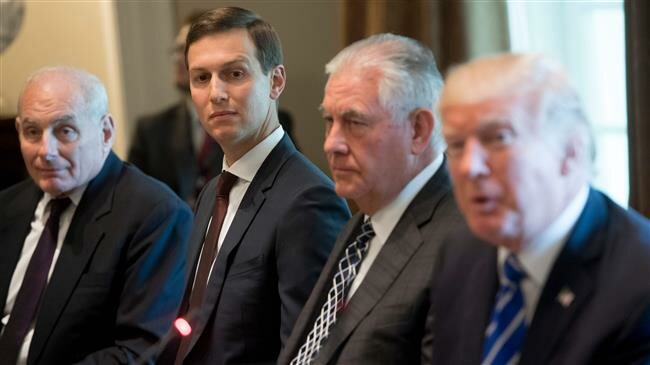
Donald Trump’s son-in-law and advisor Jared Kushner represents Jewish interests in the United States that basically caused the US president to withdraw Washington from the Iran nuclear agreement, says an American writer and former professor.
E Michael Jones, the current editor of Culture Wars magazine, made the remarks in an interview with Press TV on Friday while commenting on a statement by former US Secretary of State Rex Tillerson who said that Kushner conducted diplomacy without his knowledge when he was in the administration, leading to several embarrassing incidents.
Tillerson, who was fired by Trump in March 2018, recounted the incidents during a testimony last month at the US House of Representatives Foreign Affairs Committee, according to a transcript of a congressional hearing released on Thursday.
The former top US diplomat and CEO of ExxonMobil described his frustration with Kushner conducting his own diplomacy from the White House, at times without informing the US State Department and the Pentagon.
“This is illegal according to American political system. It violates – I believe – a Logan Act. But in this instance it is going to go unpunished because the part of the story that’s not reported here is Jared Kushner is representing Jewish interests here,” Jones said.
“And no one is allowed to question Jewish interests, if you bring it up you will be called an anti-Semite. There are Jewish interests. It is obvious but no one is allowed to talk about them,” he added.
“So the real significance of the story will be covered over by the mainstream media who were limited to the two areas of insignificance. This of course has direct relevance to Iran because it was Jewish interests that basically caused Donald Trump to abandon the Iran nuclear agreement,” the analyst noted.
“It’s Jewish interests that are once again pushing America into war in the Middle East this time with Iran,” he said.
“Donald Trump I think — recent events have shown – that he does not want war with Iran. He is using the military power to threaten Iran,” Jones noted.
‘Dialogue at gunpoint’: Bolton says Iran’s ‘silence’ is DEAFENING while it’s actually pretty vocal
RT | June 25, 2019
US National Security Advisor John Bolton has said that defiant Iran stays silent over meaningful talks with Washington, when, in fact, Tehran repeatedly argued that a barrage of threats and sanctions has made talks impossible.
Bolton blamed Iran for avoiding dialogue with the US during his visit to Jerusalem on Tuesday.
“As we speak, American diplomatic representatives are surging across the Middle East, seeking a path to peace. In response, Iran’s silence has been deafening.”
The official insisted that Washington “has held the door open for real negotiations,” and all Iran needs to do is to “walk through that open door.” Bolton explained that by doing so Iran must fulfill a laundry list of demands put forward by the US, including the one to “completely and verifiably” eliminate its “nuclear weapons program” and end “malignant behavior worldwide.”
Iran, meanwhile, has been anything but silent about the prospect of negotiating with the US. The country had consistently maintained that it is ready to talk if Washington refrains from issuing threats and slapping new sanctions on Tehran.
Iran stands ready for dialogue, given that it goes on “equal footing and mutual respect,” Foreign Minister Mohammad Javad Zarif said in January. The minister often blamed Bolton and other foreign policy hardliners at the White House for pushing President Donald Trump from peaceful solutions towards a more bellicose stance.
The Islamic Republic also made it clear that meaningful talks cannot go in hand with the Trump administration’s strategy of applying “maximum pressure” on Iran. On Monday, the US announced plans to blacklist Zarif along with Supreme Leader Ali Khamenei in retaliation to Iran downing a US drone it claims violated its airspace last week. Tehran responded by saying that sanctions against the nation’s top leadership effectively close “the path of diplomacy” and do not create the right atmosphere for talks.
Iran’s President Hassan Rouhani put it more bluntly, saying that the new sanctions are a sign of Washington’s “desperation” and “the White House actions show it is mentally retarded.”
“You [the Americans] call for negotiations. If you are telling the truth, why are you simultaneously seeking to sanction our foreign minister, too?”
The promise to enact new sanctions shows that the US is “lying” in the offer of talks with Tehran, Rouhani stressed.
Moscow, whose senior security official Nikolai Patrushev met with Bolton on Tuesday, had also blasted the new round of US sanctions on Iran. The restrictions “negate all of the repeatedly-sent signals that Washington is open and ready to engage in dialogue,” Deputy Foreign Minister Sergey Ryabkov said.
“You can’t have dialogue at gunpoint, literally and figuratively speaking.”
All the recent diplomatic maneuvers by the US have been “aimed at mobilizing an anti-Iranian front,” Ryabkov stated.
The decades-long row between Tehran and Washington escalated dramatically last year when the US unilaterally abandoned the 2015 nuclear deal, known as the JCPOA, while accusing Iran of secretly violating the agreement. Iran denied this, and the nuclear watchdog, the International Atomic Energy Agency (IAEA), in its latest reports had confirmed that the nation was following the deal.
Trump: War President or Anti-Interventionist?
By Patrick J. Buchanan • Unz Review • June 25, 2019
Visualizing 150 Iranian dead from a missile strike that he had ordered, President Donald Trump recoiled and canceled the strike, a brave decision and defining moment for his presidency.
Secretary of State Mike Pompeo, John Bolton and Vice President Mike Pence had signed off on the strike on Iran as the right response to Tehran’s shootdown of a U.S. Global Hawk spy plane over the Gulf of Oman.
The U.S. claims the drone was over international waters. Tehran says it was in Iranian territory. But while the loss of a $100 million drone is no small matter, no American pilot was lost, and retaliating by killing 150 Iranians would appear to be a disproportionate response.
Good for Trump. Yet, all weekend, he was berated for chickening out and imitating President Barack Obama. U.S. credibility, it was said, has taken a big hit and must be restored with military action.
By canceling the strike, the president also sent a message to Iran: We’re ready to negotiate. Yet, given the irreconcilable character of our clashing demands, it is hard to see how the U.S. and Iran get off this road we are on, at the end of which a military collision seems almost certain.
Consider the respective demands.
Monday, the president tweeted: “The U.S. request for Iran is very simple — No Nuclear Weapons and No Further Sponsoring of Terror!”
But Iran has no nuclear weapons, has never had nuclear weapons, and has never even produced bomb-grade uranium.
According to our own intelligence agencies in 2007 and 2011, Tehran did not even have a nuclear weapons program.
Under the 2015 nuclear deal, the JCPOA, the only way Iran could have a nuclear weapons program would be in secret, outside its known nuclear facilities, all of which are under constant U.N. inspection.
Where is the evidence that any such secret program exists?
And if it does, why does America not tell the world where Iran’s secret nuclear facilities are located and demand immediate inspections?
“No further sponsoring of terror,” Trump says.
But what does that mean?
As the major Shiite power in a Middle East divided between Sunni and Shiite, Iran backs the Houthi rebels in Yemen’s civil war, Shiite Hezbollah in Lebanon, Alawite Bashar Assad in Syria, and the Shiite militias in Iraq who helped us stop ISIS’s drive to Baghdad.
In his 12 demands, Pompeo virtually insisted that Iran abandon these allies and capitulate to their Sunni adversaries and rivals.
Not going to happen. Yet, if these demands are nonnegotiable, to be backed up by sanctions severe enough to choke Iran’s economy to death, we will be headed for war.
No more than North Korea is Iran going to yield to U.S. demands that it abandon what Iran sees as vital national interests.
As for the U.S. charge that Iran is “destabilizing” the Middle East, it was not Iran that invaded Afghanistan and Iraq, overthrew the Gadhafi regime in Libya, armed rebels to overthrow Assad in Syria, or aided and abetted the Saudis’ intervention in Yemen’s civil war.
Iran, pushed to the wall, its economy shrinking as inflation and unemployment are rising, is approaching the limits of its tolerance.
And as Iran suffers pain, it is saying, other nations in the Gulf will endure similar pain, as will the USA. At some point, collisions will produce casualties and we will be on the up escalator to war.
Yet, what vital interest of ours does Iran today threaten?
Trump, with his order to stand down on the missile strike on Iran, signaled that he wanted a pause in the confrontation.
Still, it needs to be said: The president himself authorized the steps that have brought us to this peril point.
Trump pulled out of and trashed Obama’s nuclear deal. He imposed the sanctions that are now inflicting something close to unacceptable if not intolerable pain on Iran. He had the Islamic Revolutionary Guard declared a terrorist organization. He sent the Abraham Lincoln carrier task force and B-52s to the Gulf region.
If war is to be avoided, either Iran is going to have to capitulate, or the U.S. is going to have to walk back its maximalist position.
And who would Trump name to negotiate with Tehran for the United States?
The longer the sanctions remain in place and the deeper they bite, the greater the likelihood Iran will respond to our economic warfare with its own asymmetric warfare. Has the president decided to take that risk?
We appear to be at a turning point in the Trump presidency.
Does he want to run in 2020 as the president who led us into war with Iran, or as the anti-interventionist president who began to bring U.S. troops home from that region that has produced so many wars?
Perhaps Congress, the branch of government designated by the Constitution to decide on war, should instruct President Trump as to the conditions under which he is authorized to take us to war with Iran.
Copyright 2019 Creators.com.
Boxed in by Neocons and the Media, Will Trump Launch Iran War?
By Ron Paul | June 24, 2019
President Trump did the smart thing last week by calling off a US airstrike on Iran over the downing of an American spy drone near or within Iranian territorial waters. According to press reports, the president over-ruled virtually all his top advisors – Bolton, Pompeo, and Haspel – who all wanted another undeclared and unauthorized US war in the Middle East.
Is Iran really the aggressive one? When you unilaterally pull out of an agreement that was reducing tensions and boosting trade; when you begin applying sanctions designed to completely destroy another country’s economy; when you position military assets right offshore of that country; when you threaten to destroy that country on a regular basis, calling it a campaign of “maximum pressure,” to me it seems a stretch to play the victim when that country retaliates by shooting a spy plane that is likely looking for the best way to attack.
Even if the US spy plane was not in Iranian airspace – but it increasingly looks like it was – it was just another part of an already-existing US war on Iran. Yes, sanctions are a form of war, not a substitute for war.
The media are also a big part of the problem. The same media that praised Trump as “presidential” when he fired rockets into Syria on what turned out to be false claims that Assad gassed his own people, has been attacking Trump for not bombing Iran. From Left to Right – with one important exception – the major media is all braying for war. Why? They can afford to cheer death and destruction because they will not suffer the agony of war. Networks will benefit by capturing big ratings and big money and new media stars will be born.
President Trump has said he does not want to be the one to start a new war in the Middle East. He seemed to prove that by avoiding the urgings of his closest advisors to attack Iran. It is hard to imagine a president having top advisors who work at cross-purposes to him, planning and plotting their wars – and maybe more – behind his back. Even Trump seems to recognize that his national security advisor is not really serving his administration well. Over the weekend he said in an interview, “John Bolton is absolutely a hawk. If it was up to him he’d take on the whole world at one time, okay?”
I think when you have a national security advisor who wants to fight the whole world at once, you have a problem. Does anyone believe we will be more secure after spending a few trillion more dollars and making a few hundred million more enemies? What does “victory” even look like?
President Trump is in a bind and it is of his own making. Iran has shown that it is not willing to take its marching orders from Washington, which means “maximum pressure” from the US will not work. He has two options remaining in that case: risk it all by launching a war or make a gesture toward peace. A war would ruin his presidency – and a lot more. I would urge the president to issue waivers to China, India, Turkey, and the others who wish to continue buying Iranian oil and invite the Iranian leadership to meet at a neutral location. And fire Bolton and Pompeo.
Trump Has a $259 million Reason to Bomb Iran
By Eli Clifton | LobeLog | June 22, 2019
On Thursday, the United States came perilously close to a military confrontation with Iran after it downed a U.S. drone that may or may not have entered the country’s air space. President Donald Trump reportedly ordered a retaliatory military strike on Iran but called it off, according to Trump’s own tweets on Friday morning, because a general told him that “150 people” might die in the strike.
Much analysis of Trump’s slide toward war with Iran has focused on his hawkish national security adviser, John Bolton, who, reportedly requested options from the Pentagon to deploy as many as 120,000 troops to the Middle East and hit Iran with 500 missiles per day. Bolton is the loudest voice inside the White House pushing for a military escalation to the administration’s “maximum pressure” strategy.
Secretary of State Mike Pompeo, for his part, is staking out the position that the 2001 Authorization for Use of Military Force allows the administration to take military action against Iran without congressional approval, an unusual and broadly criticized interpretation of congressional oversight.
Yet, there’s another omnipresent influence on Trump: $259 million given by some of the GOP’s top supporters to boost his campaign in 2016 and support Republican congressional and senate campaigns in 2016 and 2018.
Those funds came from Sheldon and Miriam Adelson, Paul Singer and Bernard Marcus, donors who have made no secret, both through public statements and funding think tanks that support military action against Iran, of their desire for the United States to destroy the Islamic Republic.
Adelson, who alongside his wife Miriam are the biggest donors to Trump and the GOP, contributed $205 million to Republicans in the past two political cycles and reportedly sent $35 million to the Future 45 Super PAC that supported Trump’s presidential bid. His role as the biggest funder of Republican House and Senate campaigns makes him a vital ally for Trump—who relied on Adelson’s campaign donations to maintain a Republican majority in the Senate and curb Republican losses in the House in the 2018 midterm election—and any Republican seeking national office.
Adelson publicly suggested using nuclear weapons against Iran and pushed for Trump to replace then-national security adviser H.R. McMaster with Bolton, partly due to the former’s perceived unwillingness to take a harder line on Iran. In 2017, the Zionist Organization of America, which receives much of its funding from the Adelsons, led a public campaign against McMaster, accusing him of being “opposed to President Trump’s basic policy positions on Israel, Iran, and Islamist terror.”
In 2015, Trump mocked his primary opponent, Sen. Marco Rubio (R-FL), for seeking Adelson’s financial support, warning that Adelson expects a degree of control over candidates in exchange for campaign contributions. Trump tweeted:
Sheldon Adelson is looking to give big dollars to Rubio because he feels he can mold him into his perfect little puppet. I agree!
And Adelson isn’t alone.
Billionaire Home Depot co-founder Bernard Marcus is the second largest contributor to Trump’s campaign, providing $7 million. He also champions John Bolton, contributing $530,000 to John Bolton’s super PAC over its lifetime. And he’s a major contributor to GOP campaigns, contributing over $13 million to Trump’s presidential campaign and GOP congressional campaigns in 2016 and nearly $8 million to GOP midterm efforts in 2018.
Marcus, like Adelson, makes no qualms about his views on Iran, which he characterized as “the devil” in a 2015 Fox Business interview.
Unlike Adelson and Marcus, hedge fund billionaire Paul Singer was a “never Trump” conservative until Trump won the election. Then he donated $1 million to Trump’s inauguration. Singer is far more careful with his words than Marcus and Adelson, but his money supports some of the most hawkish think tank experts and politicians in Washington.
Singer, alongside Marcus and Adelson, has contributed generously to the hawkish Foundation for Defense of Democracies, whose experts have spent the past decade regularly promoting policies to pressure Iran economically and militarily, including most recently Trump’s “maximum pressure” approach.
According to donor rolls of FDD’s biggest supporters by the end of 2011, a year that saw a sharp rise in tensions and rumors of war by Israel against Iran, Adelson contributed $1.5 million, Paul Singer contributed $3.6 million, and Bernard Marcus, who sits on FDD’s board, contributed $10.7 million.
(FDD says that Adelson is no longer a contributor, but Marcus continues to give generously, contributing $3.63 million in 2017, over a quarter of FDD’s contributions that year.)
Employees of Singer’s firm, Elliott Management, were the second largest source of funds for the 2014 candidacy of the Senate’s most outspoken Iran hawk, Sen. Tom Cotton (R-AR), who urged Trump to conduct a “retaliatory strike” against Iran for purportedly attacking two commercial tankers last week.
Singer donated $26 million to Republicans in the 2016 election and $6.4 million to the GOP’s midterm campaigns.
The billionaire Iran hawks—the Adelsons, Singer, and Marcus—made combined donations of over $259 million to GOP politicians in the past two cycles, making them some of the Republican Party’s most important donors. That quarter-billion-dollars doesn’t include contributions to dark money 501c4 groups and donations to 501c3 nonprofits, such as think tanks like FDD.
News coverage of Trump’s slide toward war frames the discussion as a competition between his better instincts and a national security advisor and secretary of state who, to varying degrees, favor military action.
But the $259 million that helped elect Trump and Trump-friendly Republicans must loom large over the president.
As Trump evaluates his options with Iran and turns his attention to the 2020 election, he knows he’ll need to rely on the Adelsons, Singer, and Marcus to boost his campaign, maintain a narrow majority in the Senate, and attempt a takeback of the House.
These donors have made their policy preferences on Iran plainly known. They surely expect a return on their investment in Trump’s GOP.
Iran ‘Violates’ Nuclear Deal, After US ‘Withdraws’

By Joshua Cho | Fair | June 21, 2019
Quick question: Does the US ever break, breach or violate its international agreements?
Apparently not, according to US coverage of Iran’s recent announcement that it intended to go beyond the limits of the 2015 Iran nuclear deal in enriching uranium for its civilian nuclear program (frequently mischaracterized as a nuclear weapons program in media coverage). Reading corporate media’s inversion of reality, it’s hard to escape the impression that while Iran betrays its international agreements, the US just leaves them behind.
An Associated Press report carried by USA Today (6/17/19) was headlined: “Iran Says It Will Break Uranium Stockpile Limit in 10 Days,” and reported that Iran’s announcement indicated its “determination to break from the landmark 2015 accord,” while noting that “tensions have spiked between Iran and the United States,” partly because the US “unilaterally withdrew” from the landmark agreement. Note that the US rejection of its obligations under the deal is referred to in neutral terms—Washington “withdrew”—while Iran’s response to US nonobservance gets negatively characterized as a “break”—a pattern that persists throughout the coverage.
There was no indication in the AP piece that Iran offered conditions under which it would continue to comply with the Iran Deal (formally known as the Joint Comprehensive Plan of Action), which gives the false impression that Iran’s decision to end compliance with the JCPOA is settled and unconditional.
The Wall Street Journal (6/17/19) offered the same kind of misleading headline: “Iran to Breach Limits of Nuclear Pact, as US to Send More Troops to the Middle East.” Again, Iran’s potential departure from the pact whose terms the US has vitiated is portrayed as a “breach,” while the US’s actual violation of the deal is labeled a “pullout” in the accompanying piece.
The Journal, unlike the AP, did note that Iran offered conditions under which it would continue to comply with the JCPOA’s terms:
The spokesman for Iran’s atomic energy agency, Behrouz Kamalvandi, said that by June 27—10 days from Monday—the country would surpass its enriched-uranium limits. He said Iran would further increase its production in early July, but could reverse both steps if Europe provided relief from [US] sanctions.
CNN (6/17/19) went with “Iran says it will break the uranium stockpile limit agreed under nuclear deal in 10 days,” as their headline. Only people who read past the headline, which most people don’t, would’ve known that that’s not really what Iran is saying:
Iran has reiterated that it could reverse the new measures should the remaining European signatories in the nuclear deal (France, Germany and the United Kingdom) step in and make more of an effort to circumvent US sanctions.
To its credit, CNN added “withdraw” in addition to the usual “violate,” “break” and “breach” in its list of words to describe Iran’s potential departure compared with just “withdrew” to describe the US’s actions.
The New York Post (6/17/19) chose “Iran Will Violate Nuclear Deal, Boost Uranium Stockpile” as the headline to mislead readers, and kept with the pattern of describing the US’s JCPOA breach as “pulling out of the deal.” However, unlike other reports, it didn’t feature any sources skeptical of Iran’s responsibility for the recent Gulf of Oman attacks on Japanese and Norwegian commercial oil tankers, despite crew members aboard the Japanese Kokuka Courageous contradicting US allegations of an Iranian mine attack by claiming to have been hit by a “flying object,” and European officials calling for further investigation and urging “maximum restraint.”
The New York Times’ headline (6/17/19): “Trump Adds Troops After Iran Says It Will Breach Nuclear Deal,” not only continued the above trends by not giving any hint that Iran might not depart from the pact, and characterizing the US’s JCPOA violations as a mere “withdrawal,” it also reported on US sanctions on Iran without mentioning that the sanctions themselves are violations of international law (Guardian, 10/3/18).
The Times uncritically cited Secretary of State Mike Pompeo’s statements that the US is “considering a full range of options”—including military strikes—without mentioning that these would be violations of international law because they go against UN Security Council Resolution 1887, which requires peaceful resolutions to disputes regarding nuclear issues, in accordance with the UN Charter and the Non-Proliferation Treaty, which both the US and Iran are parties to.
In fact, virtually all coverage fails to address the JCPOA in light of the NPT, because none of it challenges the legitimacy of the US’s prerogative to impose limits on Iran’s civilian nuclear program to begin with. Article IV of the NPT supports the “inalienable right of all the Parties to the Treaty to develop research, production and use of nuclear energy for peaceful purposes,” in accordance with Articles I and II forbidding the transfer and receiving of nuclear weapons from nuclear-weapon states.
FAIR (10/17/17) has observed that corporate media frequently attribute malicious intentions to Official US Enemies without going through the bother of presenting evidence. Iran is often accused of sneakily plotting to develop nuclear weapons, the way US ally Israel actually did when it built the only nuclear weapons arsenal in the Middle East (Guardian, 1/15/14).
This is ironic, because Iran has actually been a consistent leader in the nuclear disarmament movement. Foreign Minister Javad Zarif, when Iran was the chair of the Non-Aligned Movement, critiqued the JCPOA because it didn’t go far enough to ensure peace in the Middle East by not establishing a Nuclear Weapons–Free Zone there. Iran was also one of the first countries to propose making the Middle East a NWFZ, bringing up the proposal to the UN General Assembly in 1974 (CounterPunch, 12/13/13).
Journalist Gareth Porter (Foreign Policy, 10/16/14), reporting on Iran’s little-understood theocratic system, noted that Supreme Leader Ayatollah Khomeini’s fatwa against building any kind of WMDs in the 1990s is a formal ruling on Islamic jurisprudence, holding a legal status above mere legislation. He also pointed to Khomeini’s refusal to develop WMDs when up to 20,000 Iranians were killed by chemical weapons by then–US ally Saddam Hussein in the 1980s (Reuters, 9/16/13)—with an additional 100,000 survivors developing chronic diseases. Current US sanctions aiming to bring Iran’s “oil exports to zero” are exacerbating those chronic diseases, in addition to further strangling Iran’s economy, by restricting access to necessary medicine (Guardian, 9/2/13).
Of course, none of this can be mentioned, because it contradicts the corporate media narrative of Iran being an enemy that must be confronted, with US aggression against Iran being portrayed as defensive countermeasures (FAIR, 5/19/19, 6/6/19). For US media, Iran is the only JCPOA party with commitments that can be “breached,” “violated” or “broken,” with the US free to leave them whenever it wants to, without harming its reputation as a trustworthy party to international agreements.
Germany vs. Iran – Has Germany Sold Out to the Devil?
By Peter Koenig – New Eastern Outlook – 22.06.2019
Madame Angela Merkel – the head of Europe’s strongest economy, of the leader of the European Union, said that there was strong evidence that Iran attacked the two tankers in the Gulf of Oman. Ten days ago, German Foreign Minister, Heiko Maas, travelled to Tehran, officially to “save” the Nuclear Deal (Joint Comprehensive Plan of Action – JCPoA), but in reality, to ‘negotiate’ with Tehran ways so Germany and by association other EU members, might still do business with Iran, against some “concessions” by Iran, in order to appease Washington.
Iran’s President Rouhani reacted quickly. FM Maas got the cold shoulder and was dismissed. And rightly so. Maas was not really representing Germany – but the United States. Iran gave the EU an “ultimatum” of 60 days to stick to their commitments on trading with Iran according to the Nuclear Deal – despite the US reneging on it – or else, Iran may bypass some of the conditions under the JCPOA accord. The EU – not being independent and her member countries having lost all sovereignty by submitting to the dictate first from Brussels, second from the tyranny of Washington, didn’t like the ultimatum, and said so in a joint statement. They added a weak and meek phrase, “We call on countries not party to the JCPoA to refrain from taking any actions that impede the remaining parties’ ability to fully perform their commitments;” not even daring calling the country by name, for whom the statement was destined, i.e. the US of A.
Germany’s position is as absurd as it has ever been since Merkel and the entire Bundestag accepted the sanctions imposed by Washington on Russia in 2014 – and replicated them along with the rest of the EU – even to their own detriment and to the detriment of the entire EU. Chancellor Merkel and apparently the entire Bundestag, again, go along with Washington’s equally absurd and false accusation that Iran has attacked the two tankers, one Japanese owned, the other Norwegian. The latter belonging to a close friend of Iran’s, and the Japanese one, hardest hit – exactly at the time when Japan’s PM Shinzō Abe, was visiting the Ayatollah in Tehran to discuss how to maintain the Nuclear Deal – trading – despite the sanctions and threats of Washington, hence, a friendly visit.
—
A blind person can see that these were two false flags – so thinly masked, with badly fabricated US ‘video evidence’ that even according to CIA and US military brass did not deliver conclusive evidence. In fact, none at all. Madame Merkel – why do you not first ask the obvious question “Cui bono?”— Who benefits? Certainly not Iran – but the aggressor, the US which has been planning and preparing for war with Iran for decades, ever since the first Iraq war under Father Bush, in 1991. At the 2003 invasion of Iraq – Bolton openly expressed his dreams to demolish Iran. He and Pompeo are liars and war criminals, who run the White House and pretend to run the Pentagon – and who act in impunity. Their power seems limitless. Trump – seems to be a mere puppet.
Getting Merkel on board of the flagrant US lie that Iran was attacking two tankers in the Gulf of Oman, is a strategic hit, enhancing the lies’ credibility and, thus, making a US attack on Iran more palatable to the rest of the world. Yet, apparently this was not enough. The Pentagon sent an unmanned high-altitude Global Hawk drone into Iranian airspace, a provocation Iran could not resist and shot the drone down, but not before sending warning signals, about which today nobody talks. The world shouldn’t know that Iran had the noblesse to warn the US about the drone being in their airspace. As can be expected the White House gnomes deny that the drone was invading Iranian airspace, but pretend it was in international air space, when it was shot down.
This raised the ante for Washington to launch an attack on Iran. All was planned to be carried from Thursday to Friday (20 to 21 June), and at last minute Trump stopped it. Is it true? – It could be, because somebody a bit ‘higher up’ than Trump and his warrior minions, must have realized the danger that such an attack may pose to the rest of the world – or actually that it could trigger a nuclear conflict. However, that the attack plan was stopped doesn’t mean it was canceled. Maybe it was just postponed.
In the meantime, the US Federal Aviation Administration (FAA) has ordered all US airlines to avoid the Gulf of Oman and the Gulf of Hormuz. And, as could be expected, the airlines of Washington’s “true” puppet allies have followed suit, i.e. Australia’s Qantas Airways Ltd, Singapore Airlines Ltd, Germany’s Lufthansa, British Airways, Air France and its Dutch KLM affiliate, as well as Malaysia Airlines, said they were re-routing flights to avoid the area. Others may follow under direct or tacit pressure of the US. The Japanese airline ANA said they were considering alternative routings. Effectively, the US was able to declare a no-fly zone over a significant area of Iran.
Let’s make no mistake, all the visible key figures at the helm of the White House – are run in the back by Israel, by Netanyahu and the Chosen People he represents, those who also run Wall Street and the western world’s banking and financial system. Israel would like to see Iran in rubbles, or better, in eternal chaos, the goal that was set for Iraq, Afghanistan and that the US was and still is dreaming for Syria. This bunch of evil elite pulls the strings and hopes to soon pull just ONE string for global hegemony, under a ONE World Order.
—
Back to Germany. Instead of jumping off the sinking ship of Washington and its faithful entourage of the willing, as rats would do, and as the vast majority of the German people would prefer, let alone German and European business, Madame Merkel and apparently all her circles, including Berlin’s Parliament, follow the US flagrant lie propaganda. Why? – Well, this is the deal: There are many ways to “buy” top politicians, with threats or with money or by outright inflicting fear through ‘proxy-assassinations’.
Once Germany is on board – the rest of Europe will follow suit. In that case, Washington – Trump and consortia – think they have Iran totally strangled, by blocking all trade and all financial transactions, plus confiscating Iranian assets abroad – on top of imposing stiff tariffs, so that Iran can no longer afford importing vital goods for manufacturing – or for sheer survival from the west. Once a country is weak, it can be taken over easily. So, the western, AngloZionist thinking goes.
Iran – her Fifth-Columnists aside – is strong and has already proven that it is detaching from the west. Even trying to adhere and fight for the Nuclear Deal which the west, i.e. Europe is incapable of respecting for lack of backbone, is a waste of time. To demonstrate that Iran has alternatives, Mr. Rouhani was attending the Shanghai Cooperation Organization (SCO) summit in Bishkek, Kyrgyzstan, on 13 and 14 June 2019, by invitation of China, the leader of the 8-member “club”.
SCO stands for promoting peace, trade and a non-aggressive defense strategy (the antidote to the NATO-type military aggression). As of now, Mr. Rouhani is an observer for his country, Iran which is in an advanced stage in the process of entering the SCO as a full member. This could happen later this year or in 2020. Iran would recover her sovereignty, her economic potential and would – and will – be able to detach from the west, pretty much as did Russia and China, the two super-powers under constant assaults of sanctions, denigration and false accusations.
Turkey – is in a similar situation. If Turkey is admitted by the SCO – also very likely – their NATO exit will be imminent. What that will mean for the rest of NATO, at this point we can only guess and dream of, especially since there is an ever-stronger people’s movement throughout Europe to exit NATO. It is particularly strong in Italy and paradoxically also in Germany. The vast majority of Germans want to exit NATO, but the government doesn’t listen. “So far” doesn’t listen. The German anti-NATO movement has been gaining strength ever since the anti-nuclear energy protests in the early seventies which were followed and intensified in the late 1970’s early 1980s against nuclear arms stockpiled in Germany by the US, particularly those stored at the US Air Force base of Ramstein, near Kaiserslautern.
The “so-far” is a precursor to a break with NATO, as the pressure against the USAF base Ramstein, against NATO, is mounting, and that, when Madame Merkel decides firmly to go with the sinking ship – risking to pull Germany and her people down the drain for sheer senseless and outdated obedience to the succumbing tyrant. How absurd!
While Iran is making smart moves, gradually away from western economics, from trading with the west – and moving eastwards – where the future is – Germany backtracks, literally into the orbit of a dying beast, into what is ever-more detectible – a decaying empire.
When will Germany wake up? When the first bombs fall on her cities – a WWI and WWII redux? Except this time, it may not be just the falling of conventional bombs. It may be nuclear meeting nuclear at Ramstein. Madame Merkel, your obligation to the people who apparently elected you is larger than you think and larger than yourself – and much larger than whatever goes on in your mind to follow a defeated warrior and rogue nation into hell.
Peter Koenig is an economist and geopolitical analyst. After working for over 30 years with the World Bank he penned Implosion, an economic thriller, based on his first-hand experience.
Featured Video
Bombing Hitler’s Hometown
or go to
Aletho News Archives – Video-Images
From the Archives
The Biggest Threat to Peace in Middle East
By Dr. Elias Akleh* | Sabbah Report | May 24, 2010
A build up of heightened tension in the Middle East is escalating in the last few weeks. American and Israeli postures towards Lebanon, Syria, and Iran have become more threatening. Listening to speeches of political leaders one hears talks only about war not peace. Iranians and Israelis are continuously training hard for a possible showdown. Both sides are conducting extensive war games every month. This led Syrians to claim that Israel is preparing for a soon-to-come another war. The Jordanians also are warning that current stalemate of the peace process is an indication of a war breaking out this summer. The Russian President and his army chief hinted, a few months ago, that the US and Israel were planning for an attack on Iran.
Indeed Iran is, as it has been for last few years, the target of most of the threats and accusations of supporting terrorism. Escalating incitement against Iran the American Defense Department sent last month (April) to Congress a report on Iran’s military claiming Iran could develop intercontinental ballistic missiles capable of reaching the US by 2015.
Ignoring the fact that N. Korea, India, Pakistan, and Israel are proven to have nuclear weapons while Iran does not, the US Secretary of State Hillary Clinton chose in her speech, to the nuclear Non-Proliferation Treaty review conference at the UN, to focus on Iran’s alleged nuclear ambitions putting the whole world at risk as she put it. According to Clinton Iran’s acquisition of nuclear weapons, rather than Israel’s more than 200 nuclear bombs, is destabilizing the Middle East. She called on the world’s nations to rally around US efforts to hold Iran, not other nuclear countries, to account.
The accusation that Usama Bin Laden is living comfortably in Iran had received a boost after the broadcast of a documentary called “Feathered Cocaine”. This echoed the June 2003 claims of the Italian newspaper Corre de la Sierra that Bin Laden was in Iran according to some intelligence report, and according to Richard Miniter’s book “Shadow War”. … continue
Blog Roll
 Aletho News
- Bombing Hitler’s Hometown
- German journalist threatened with homelessness as German court upholds EU sanctions in landmark free speech case
- US Tells Allies That Ukraine-Bound Arms Could be Sent to Middle East
- Organized terrorism: Iran condemns killing of its diplomats in Lebanon
- Why could Gaza enter the regional war?
- Hamas official rejects Mladenov Plan linking disarmament to Gaza reconstruction
- Two Primary Elections for the Soul of ‘America First’
- Japan Clings to US Vassalage Despite Energy Crunch Caused By Iran War
- US Seeks Control Over Global Energy Infrastructure – Kremlin
- US senators target Orban government for standing up to Zelensky
- If Americans Knew
- Researchers at Human Rights Watch Resign Over Blocked Report on Palestinian Refugee Return
- Jewish Groups Are Backing a War Americans Don’t Want
- Eric Fingerhut Thinks He’s the President of the Jews
- Top Jewish Philanthropists, Rabbis Urge Israeli President to Take Action Against ‘Jewish Extremists’
- Don’t Be Fooled. Zionist Leaders Have Always Wanted to Control Southern Lebanon
- Israel’s widespread use of torture is a core element of its genocide against the Palestinian people
- In Israel’s War on Iran, Many Middle East US Bases Rendered “All But Uninhabitable”
- ‘Burn the lawn’: Israel pursues ‘Rafah model’ in southern Lebanon
- A genocide here, an amputation there
- Reports: Iran mobilizing 1M fighters, Israel-US run low on ammo, Israeli army faces shortage – Not a ceasefire Day 168
- No Tricks Zone
- Devastating Assessment Of Comirnaty Vaccine By Former Senior Pfizer Europe Toxicologist
- New Study: CO2 Is ‘Effectively Negligible’ As An Explanatory Climate Change Factor Since 2000
- Former Pfizer Toxicologist Dr. Helmut Sterz Tells Bundestag Hearing Pfizer Vaccine Should Have Never Been Approved
- Energy Expert: Germany’s Nuclear Phaseout Was A “500 Billion Euro Mistake”
- New Research: South Australia’s Mid-Holocene Sea Surface Temperatures Were 4°C Warmer Than Today
- Storing Green Energy To Last Germany 10 Days Would Require A 60-Million Tonne Battery
- New Studies: UK Sea Levels Were 4 Meters Higher Than Today During The Mid-Holocene
- Destructive Green New Deal: German Energy And Metal Group Warns Of Drastic Crisis
- New Study Documents A 20-Year Pause In Arctic Sea Ice Decline – Driven By Internal Variability
- Wake-up Call: Survey Shows Majority Of Germans Now Favor Postponing Climate Targets!
 Aletho News