Iran’s Rouhani Rules Out Any Bilateral Talks with US
Al-Manar | September 3, 2019
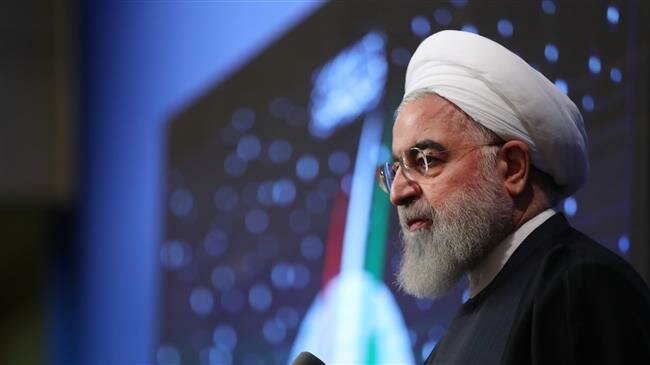
Iranian President Hassan Rouhani said Tuesday that holding bilateral talks with the United States is not on the table.
“We’ve said it before time and again, and we say it again: We have no intention to hold bilateral talks with the United States. We never did and never will. It has been the case in the past year and a half, and even in previous years. There have been calls for talks, but we never responded to them,” the Iranian President Hassan Rouhani said in a Parliament session on Tuesday.
Rouhani was attending the session to defend his two candidates for the ministry of education and the ministry of tourism and cultural heritage.
Stressing that holding bilateral talks with the US is not on the table, Rouhani added “we said that the US, as part of the 5+1, held talks with us and we took part in the talks. If the US lifts all of its sanctions against Iran, whether it returns to the JCPOA or not, it does not matter to us, but if it lifts all sanctions, it is still possible for the US to be part of the 5+1; granted that it first removes all sanctions.”
“When we talk about negotiations, we only mean it under the situation where all sanctions have been lifted; that is, the situation we previously had under the JCPOA. Our stance is clear,” Rouhani stressed.
Tensions started to build up between the US and Iran after President Trump withdrew Washington from the 2015 nuclear deal, officially known as the Joint Comprehensive Plan of Action (JCPOA) in May 2018, and imposed sanctions against Tehran in a bid to restrict the country’s trade transactions with the world. The Trump administration has been making empty calls for talks, but the Islamic Republic stresses that as long as sanctions are in place and the US refuses to return to the JCPOA, negotiations will be meaningless.
“Our progress is a testament to the fact that resisting [against pressure] works. On the other hand, an active diplomacy can pave the way for us. We have never closed the doors of diplomacy and never will do so…we don’t believe that only one of these two tools should be used,” said Rouhani.
About Iran’s measures to scale down commitments to the JCPOA, Rouhani said “If the remaining signatories to the nuclear deal can live up to a part of their commitments, we may reconsider reducing our commitments. But if they fail to take any solid step, we will definitely take the third step in a few days.”
As a first step, Iran increased its enriched uranium stockpile to beyond the 300 kilograms set by the JCPOA. Next, it announced that it had begun enriching uranium to purity rates beyond the JCPOA-limit of 3.76 percent.
Rouhani went on to add, “the further we move along this path, it may make solving the issue more difficult, but since our steps are designed in a way that we can return to the starting point at any given time we desire, it will not take any time, and we will continue our talks even after taking the third step.”
“The basis of our talks with the European side is that we want them to preorder our oil and the revenues to be in our possession. This will ease the situation for us to decide against making more cuts to our commitments to the JCPOA,” Rouhani added.
“We haven’t reached a final agreement yet, but negotiations are still underway. If we fail to reach a conclusive result by Thursday, we will announce the third stage of our cuts to the JCPOA commitments,” Rouhani concluded.
Some officials have noted that Iran’s measures for the third step may include installing a new generation of centrifuges, increasing the stockpile of enriched uranium, or restoring the Arak heavy water reactor to its previous design.
It’s Necessary to Find Way to Counter US, Otherwise Nuclear Deal Won’t Be Only Loss: Zarif
Sputnik – September 3, 2019
Iranian Foreign Minister Javad Zarif said on Monday that Washington’s actions regarding the Joint Comprehensive Plan of Action are a blow to international law, and if the accord is not preserved, the nuclear deal “will not be the only loss”.
On Sunday, Tehran said it would make a third reduction of commitments agreed to under the deal and that this round would be the harshest yet. A spokesman for the Iranian government, Ali Rabiei, said on Monday that Iran would wait until Thursday for the deal’s signatories to take steps toward implementing the accord and make a decision on whether to further scrap its commitments depending on these actions.
“America’s actions are not only a blow to the JCPOA, but to the whole framework of international law. That is why, if we do not find a way to counteract the United States, the JCPOA will not be the only loss. Therefore, we share the same views with Russia on this issue”, Zarif told the Rossiya 24 broadcaster.
Earlier in the day, Zarif said that Tehran would return to full implementation of the deal, if there was progress in negotiations on the implementation by Europeans of their part of the agreement.
The JCPOA was signed in 2015 by Iran, China, France, Germany, Russia, the United Kingdom, the United States, and the European Union. It required Iran to scale back its nuclear programme and severely downgrade its uranium reserves in exchange for sanctions relief. In 2018, the United States abandoned its conciliatory policy on Iran, withdrawing from the JCPOA and hitting Iranian petroleum industries with sanctions.
Moratorium on US oil sanctions to open talks with Iran
By M. K. BHADRAKUMAR | Indian Punchline | September 2, 2019
The diplomatic manoeuvrings over the situation around Iran are entering a crucial phase with an Iranian delegation led by Deputy Foreign Minister Abbas Araqchi leaving from Tehran for Paris today to pick up the threads of the 3-way discussions involving France, Iran and the United States at Biarritz a week ago on the sidelines of the G7 summit.
Araqchi is Iran’s chief negotiator with the E3 — France, UK and Germany — on the nuclear issue. Interestingly, Araqchi openly acknowledged on Saturday that the US has “shown some flexibility on the licensing of Iranian oil sales.”
The formula that was tossed around in Biarritz that the US will not oppose income being generated for Iran through oil sales is being finessed and linked to the working of the European Union’s trade mechanism for legitimate trade with Iran known as INSTEX. In essence, the formula is based on the French proposal of “freeze for freeze” — US freezing oil sanctions against Iran while Iran will freeze its steady pullback from the JCPOA commitments.
Araqchi said Iran and its European partners in the nuclear deal faced “difficult and complex” talks towards salvaging the pact. But a note of cautious optimism is apparent in Foreign Minister Javad Zarif’s remark in Tehran following a meeting of the National Security and Foreign Policy Committee at the Iranian parliament on Sunday afternoon that Iran may review the decision to further reduce JCPOA commitments if the European countries take action on INSTEX to live up to their own obligations. Tehran expects the Europeans to take a final decision by Thursday.
In the above backdrop, Iranian President Hassan Rouhani telephoned French President Emmanuel Macron on Saturday to convey Tehran’s interest in resuming the discussions under the latter’s mediation. Macron welcomed the move. Rouhani also assured Macron that Iran is supportive of a political settlement in Yemen and is willing to guarantee the security of the shipping lanes in the Persian Gulf and the Strait of Hormuz.
Perhaps, in an indirect alert to the US President Trump, Rouhani conveyed to Macron Iran’s misgivings that Israel is pulling all stops to derail the current negotiations which are at a delicate stage. Rouhani specifically referred to the Israeli attempt to provoke a flare-up involving Iran somehow, as evident in its recent air attacks on Lebanon, Syria and Iraq successively. The Hezbollah retaliated on Sunday by attacking Israel’s military vehicles, leaving a number of Israeli forces reportedly dead or injured.
In a sure sign that a broad settlement of the situation around Iran is under discussion, Zarif has travelled to Moscow with a high-level delegation aimed at coordinating the Iranian and Russian positions. Iran’s special envoys for Afghanistan, Yemen, and Syria are accompanying him. (Interestingly, Zarif referred to “serious developments” in Afghanistan, hinting at imminent US-Taliban deal this week.) Indeed, Iran is across the board addressing the western disquiet over Iran’s role in the conflicts in Yemen, Syria and Afghanistan. Tehran’s diplomatic priority will be to underscore that it can be a factor of regional security and stability.
From all appearance, Macron is steering the negotiations along three parallel tracks: a) forestall any precipitate crisis in the implementation of the 2015 nuclear deal by enabling Tehran to generate income out of oil sales that helps alleviate the hardships in the Iranian economy; b) persuade the Trump administration to concede Iran’s prerogative to resume trade relations with Europe and generate income through oil sales; and, c) defuse and de-escalate the various ‘hotspots’ in the Middle East where Iran’s role is regarded as critical — principally, Yemen, Syria and Afghanistan.
A convergence of the three tracks can be expected to lead to a new understanding between Tehran and Washington, possibly even a near-future summit involving the US and Iranian presidents. The clock is ticking and there is urgency to generate momentum for Macron’s efforts, as Trump and Rouhani are due to attend the UN General Assembly in September. A meeting is entirely conceivable as things stand.
Indeed, a deeply troubled relationship such as the Iranian-American is bedeviled with a lot of signalling and grandstanding, especially on the part of Tehran where Rouhani has to overcome significant resistance to the very idea of engaging with the US. The Supreme Leader Ali Khamenei has not said a word so far on Zarif’s visit to Biarritz or the 3-way France-Iran-US discussions under way. Tehran keeps repeating the demand on the lifting of the US sanctions as a pre-requisite for a face-to-face meeting between Rouhani and Trump.
However, it is possible to discern that Tehran is open to negotiations without preconditions and to strive for a meaningful breakthrough by optimally resorting to creative and flexible diplomacy. This flexibility factors in the assessment that Washington too is in a chastened mood.
Trump will not brook disruption by “hardliners”. Several Israeli attempts to have a phone conversation between PM Benjamin Netanyahu and Trump at Biarritz failed to materialise. Trump understands that all attempts by the US to create an international coalition against Iran have failed.
The law of diminishing returns is at work. The maximum pressure strategy against Iran is opening the window for an unprecedented expansion of Russian and Chinese influence in Tehran which may damage American regional interests in the long-term. The planned first-ever naval exercises between Iran and Russia in the Persian Gulf has rattled the US.
All in all, we may expect a moratorium on US oil sanctions in exchange for Iran’s compliance with its JCPOA obligations, which would be followed by direct negotiations for a historic thaw in the US-Iran relations.
Offer from Biarritz not good enough for Iran
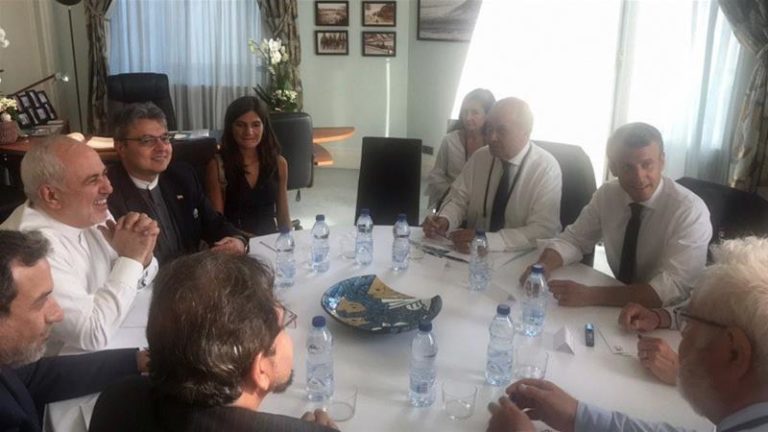
Iran’s Foreign Minister Javad Zarif (L) held talks in Biarritz on Sunday Aug. 25, 2019 with France’s President Macron (R) and Foreign Minister Jean-Yves Le Drian.
By M. K. BHADRAKUMAR | Indian Punchline | August 29, 2019
From all accounts, Tehran is struggling to cope with the startling news in the weekend from the G7 summit at Biarritz that a meeting between the presidents of the US and Iran is to be expected in the “coming weeks”.
The cautiously optimistic tone struck by the French President Emmanuel Macron and the conspicuously positive attitude adopted by President Trump along with the fact that the Iranian Foreign Minister Javad Zarif was actually present at Biarritz (with the prior knowledge and tacit concurrence of POTUS) — all these signalled that France’s back-to-back peace initiatives in the recent weeks with Washington and Tehran have come to a defining moment.
From Biarritz, Zarif took off for Tehran ostensibly to change planes for an onward journey to China as part of a previously scheduled Asian tour. Presumably, he briefed Rouhani on what transpired at Biarritz. Zarif is still on the Asian tour — China, Japan, Malaysia, etc., which are, interestingly, major buyers of Iranian oil.
If the Biarritz formula gains traction, these Asian countries have a key role to play in generating income for Iran out of oil sales, which apparently would incentivise Tehran to get into negotiations with the US.
En route to Beijing, Zarif tweeted, “Iran’s active diplomacy in pursuit of constructive engagement continues. Road ahead is difficult. But worth trying.” China’s foreign minister Wang Yi also spoke to Emmanuel Bonne, diplomatic adviser to French President Emmanuel Macron, by telephone on Monday. Bonne said France wanted to coordinate and cooperate with China to ease tensions over Iran and to maintain the 2015 nuclear deal, according to a report by official Chinese news agency Xinhua.
The initial reaction from Tehran at the level of Rouhani also suggested that he may be open to the idea of meeting Trump. Notably, Rouhani said on Monday, “I believe we should use any tool to protect our country’s national interests. If I think that meeting someone helps solve the people’s problems, I will not hesitate. The principle is our national interests.”
Two days later, however, Rouhani’s Chief of Staff and key aide Mahmoud Vaezi, who is an influential figure in the foreign policy establishment, conspicuously moderated what the president had said. Speaking to reporters in Tehran on Wednesday, Vaezi said any meeting with the US officials will solve no problem and the US must come back to the P5+1 negotiation table and respect its commitments to the Joint Comprehensive Plan of Action.
Vaezi didn’t altogether reject the idea of a Rouhani-Trump meeting, but added a template that the negotiations must also involve other guarantor states — E3, Russia and China. On the other hand, an Iranian economic delegation is proceeding to France next week. It could be that Tehran is strengthening its bargaining chip as well as insulating itself from the risk of engaging an interlocutor such as Trump who is fickle-minded, lacks consistency and has no coherent policies — and, above all, is surrounded by a team that includes notorious anti-Iran hawks, especially the National Security Advisor John Bolton.
Meanwhile, we see a significant hardening of Tehran’s stance in an interview with the state TV given by the Iranian Deputy Foreign Minister for Political Affairs Seyed Abbas Araqchi. Araqchi simply ruled out any negotiations with Washington so long as the sanctions remained in place.
In his words, “We are only talking with the European countries over our specific 11 demands (based on the JCPOA) and we will not negotiate with the US.” Vaezi’s remarks must be taken seriously, as he was one of the key negotiators of the 2015 nuclear deal and is an authoritative voice. Vaezi underlined that that no country would accept to enter negotiations while being under “maximum pressure” because doing so would mean “surrender”.
The offer held out in Biarritz appears to be simply not good enough for Tehran. Why should Tehran “surrender” after successfully countering the US’ regime change agenda and “maximum pressure” strategy and while the US has failed to reach the objectives behind its unilateral move to abandon the 2015 nuclear deal?
On Wednesday, Iran’s top military commander Chief of Staff of the Iranian Armed Forces Major General Mohammad Hossein Baqeri pointedly reminded everyone that it has been the country’s deterrence power that effectively stopped the US from going ahead with its plans to wage a war against Iran.
Quite obviously, a lot of churning has been going on within the top echelons of the Iranian establishment, which involve multiple agencies at an institutional level and even factions that would have congruent political interests or different priorities at any given time. The influential Majlis has not voiced an opinion. The bottom line is that all power centres would be waiting for the Supreme Leader Ayatollah Ali Khamenei to speak publicly.
Iran tourist arrivals neared 8 million in early 2019: Tourism chief
Press TV – August 26, 2019
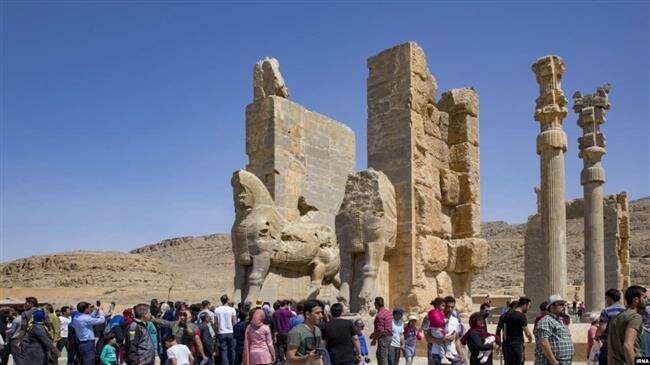
Head of Iran’s government department on tourism says around eight million foreigners visited the country in the last Iranian calendar year ending in March 2019.
“Some 7.8 million foreign tourists arrived in the country last year,” said Ali Asghar Mounessan, adding that the figure shows a 40-percent increase compared to the previous year.
Mounessan, who heads the Cultural Heritage, Handicrafts and Tourism Organization of Iran (ICHTO), said each tourists coming to the country spends an average sum of $1,400 during his stay, adding that almost all the money earned from tourists should be viewed as pure income as investment has been very low compared to the revenues generated in the sector.
He said the boom in tourism arrivals and revenues have come despite sanctions imposed by the United States in the past year, adding that major accommodation places across the country have been booked up for months to come.
Mounessan, a deputy president whose department is planned to be turned into a ministry in the coming months, said the government would double the budget earmarked to the tourism and handicraft management as the sectors keep attracting massive foreign currency into the country.
The official also said that Iran eyes $2 billion worth of exports of handicraft, saying that all provinces across the country had huge potentials that could be used to meet the target.
Mounessan said the decision to turn the ICHTO to a ministry would also allow the government to have a better policy for protection of historic monuments and artifacts existing across the country, saying that would further boost arrivals of the tourists who are mainly interested in visiting Iran’s cultural heritage.
US praises sanctions for killing Iran’s economy, then blames Tehran for people’s suffering
RT | August 20, 2019
The US State Department can’t seem to make up its mind about the cause of Iran’s economic woes, claiming Tehran’s “Marxist economy” is to blame even as it celebrates the devastation US sanctions have wrought on the country.
Speaking to reporters in New York on Tuesday, US special envoy for Iran Brian Hook assailed the Islamic Republic, demanding an end to its “lethal assistance…to terrorist organizations,” and running down a list of economy-ruining American sanctions currently imposed on the country.
“We have effectively zeroed-out Iran’s export of oil,” Hook said. “We have sanctioned Iran’s export of petro-chemicals, industrial metals, precious metals.”
“We have collapsed foreign direct investment. We have seen significant asset flight leaving the country. Iran is in a recession. Inflation is creeping up near 50 percent.”
However, Hook went on, it would be wrong to suggest that Washington is behind Iranian people’s struggles – despite having just argued precisely that. Instead, the fault was with Iran’s “Marxist economy” and ideological fervor, the envoy said. Sanctions? What sanctions?
Secretary of State Mike Pompeo also weighed in on the effects of US sanctions on Tuesday, but was more willing to take credit for their ruinous effects on Iran’s oil-dependent economy. Pompeo bragged to MSNBC that the sanctions continue to remove 2.7 million barrels of Iranian oil from the global market on a daily basis.
Unlike oil, Washington insists its sanctions do not target Iran’s healthcare system. In a propaganda video created by the State Department last month and addressed to the Iranian people, Hook claimed the idea was a “myth” pushed by the government. That is not to say the sanctions are not having a devastating effect, however. A recent report by Abbas Kebriaeezadeh, professor of pharmacology at the Tehran University of Medical Sciences, found that US sanctions “are killing cancer patients in Iran” indirectly, creating dire drug shortages and skyrocketing prices.
Tension between Iran and the United States has soared in recent months, with US sanctions ratcheted back up after US President Donald Trump abrogated Washington’s part of a nuclear pact signed between Iran and world powers in 2015. The US sought to pin on Iran a series of suspicious attacks on commercial shipping in the Persian Gulf earlier this summer, while the shootdown of an American spy drone over Iranian airspace in June nearly triggered a US military response. Washington has since deployed a veritable arsenal to Iran’s doorstep – purely for ‘defensive’ reasons, of course.
Why the World Is Watching the Fate of an Iranian Tanker in the Mediterranean
Will the Greeks seize it on a US warrant?
By Vijay Prashad – Monthly Review – August 19, 2019
At 11:30 p.m. on August 18, the Iranian tanker Adrian Darya 1 left the shores of Gibraltar at the mouth of the Mediterranean Sea. This ship had been detained 46 days ago by British Royal Marines and Gibraltar’s officials. The British claimed that the ship—then named Grace 1—was taking its cargo of 2.1 million barrels of oil to Syria. There are European Union sanctions against trade with the Syrian government. It is based on these sanctions that the British seized the Iranian vessel.
Last Thursday, on August 15, Gibraltar’s Chief Minister Fabian Picardo ordered the release of the ship after the Iranian authorities said it would not be going to Syria. The immediate destination for Adrian Darya 1 is the Greek port of Kalamata.
Sanctions on Iran
The British, it is clear, seized the Iranian tanker at the urging of the United States. There was no previous British warning that it might enter in such a muscular way into the U.S. attempt to suffocate Iran. Even the location of the seizure unnecessarily raised tensions for the United Kingdom. The waters around Gibraltar are contested between Britain and Spain, with the latter making noises about a formal complaint about the British action.
Gibraltar’s government has been trying to find a middle course between the claims of Britain and Spain. It seeks some form of independence, although with close ties with both its large neighbor and its formal occupant. When the UK asked Gibraltar’s authorities to get involved in the seizure of the Iranian tanker, Gibraltar’s government complied because the request was in line with European Union sanctions against trade with the Syrian government.
In Gibraltar’s courts, the British were largely silent. The case against the Iranian vessel was made by the United States, which changed the basis for the seizure. The U.S. argued that the vessel had to remain impounded as part of its new and harsh sanctions regime against Iran. When Gibraltar was preparing to release the ship, the U.S. District Court in Washington, D.C., issued a warrant for the ship. This emergency warrant alleged that the ship was owned by the Iranian Revolutionary Guards and therefore must not be allowed to sail.
Gibraltar did not agree. The U.S. tried to use its 1977 International Emergency Economic Powers Act, and the new sanctions regime by the Trump administration. None of this appealed to the judiciary in Gibraltar. The government of Gibraltar said that it did not accept the new U.S. sanctions regime on Iran. It had held the vessel based on the European Union sanctions on Syria, not on any EU sanctions on Iran. Therefore, it has allowed Adrian Darya 1 to sail.
Iran’s Reaction
New statistics show that Iran’s economy has been decelerating at a rapid pace. The numbers from the Statistical Center of Iran show that Iran’s GDP shrank by 4.9 percent in 2018-19. Economic growth is slipping backwards, as the sectors of oil, industry, and agriculture post negative numbers. Inflation continues, with the inflation rate now at the highest it has been in a quarter of a century. Iranian traders have been moving their goods to Iraq, which results in the rise of prices within Iran. Most stunningly, the prices of non-trade goods and services—such as health and housing—are rising. All this has put enormous pressure on the government of Hassan Rouhani, although his spokesman Ali Rabiei said on Monday that Iran’s economy is experiencing “positive signs.”
Confidence from the Iranian government is remarkable. Officials in Tehran refuse to be cowed by the pressure from Washington, D.C. When the Adrian Darya 1 left Gibraltar, senior Iranian parliamentarian Alaeddin Boroujerdi said that its release was a result of “the revolutionary diplomacy of resistance.” He pointed to the seizure by Iran of the British ship Stena Impero, which continues to be detained in Iran. The British ship, Boroujerdi said, was being held for its violation of basic maritime rules in the Strait of Hormuz. The seizure of the Iranian ship—he pointed out—“was an act of piracy by England.”
Based on this assessment that the UK had indulged in piracy at the urging of the United States, Iran’s chief judge Ebrahim Raeisi said that the release of Adrian Darya 1 is not sufficient. Compensation must be paid to Iran. What compensation will be demanded from the UK is not clear, and it is further unclear where Iran will formally raise the issue of compensation. Iranian diplomats say that they might approach the United Nations based on the 1982 UN Convention on the Law of the Sea.
Will Greece Hold the Tanker?
Within the Trump administration there is appetite to further block the passage of Adrian Darya 1, and make it a flashpoint toward war. That is what Trump’s adviser John Bolton indicated when Gibraltar held the ship. Make your move, he seemed to suggest to Tehran. Iran told the U.S.—through the Swiss authorities—that it must allow the ship free passage. If the Adrian Darya 1 is blocked, it would set a terrible precedent for international shipping.
When the tanker enters Kalamata, it will likely take on a new crew and then set its next destination. There is no indication as to what the ship will do with its 2.1 million barrels of crude oil. It is likely that it will unload its cargo onto another ship in international waters.
Last week, the U.S. government asked Greece to contribute to its naval force in the Persian Gulf. Greece, with its new conservative prime minister, declined—as did France and Germany—to this new U.S. initiative. The Greek government, led by Kyriakos Mitsotakis, is eager for a close relationship with Washington, but it is not willing to enter a frontal clash with Iran. Greece is already in a heated situation with Turkey. To rattle Iran would only further complicate Greece’s fragile dance in the eastern Mediterranean. *
Greece, unlike the U.S., has taken the position that Iran has “the right to develop nuclear technology for peaceful purposes alone.” This is Iran’s position. The United States, as Professor Seyed Mohammad Marandi told Tricontinental: Institute for Social Research, opposes even a peaceful nuclear project for Iran. This is why Trump walked out of the 2015 nuclear deal. This is precisely why the U.S. has been putting immense pressure on Iranian shipping. And this is what led us to the story of the Adrian Darya 1.
*[Actually it is because of its “heated situation with Turkey” that Greece has sought US support at a high cost.]
Iran official calls for compensation for tanker seizure
Press TV – August 20, 2019
Judiciary chief Ebrahim Raisi says Iran should be compensated for the seizure of an oil supertanker off the coast of Gibraltar after it was released on Thursday.
Britain’s naval forces seized the Grace 1 and its cargo of 2.1 million barrels of oil in the Strait of Gibraltar on July 4 under the pretext that the vessel might be carrying crude oil to Syria in violation of EU sanctions on Damascus.
Iran says the UK’s reason for confiscation is not valid because Tehran is not a member of the EU and therefore its sanctions do not apply to the country. Moreover, the tanker was never headed to Syria, according to Iranian officials.
The tanker, renamed the Adrian Darya 1, left anchorage off Gibraltar on Sunday after being released.
Raisi, however, said the release is not enough and Iran has to be compensated by those behind the seizure which Iranian officials have described as “state piracy”.
“The amount of time that it was seized will not be compensated just by it being freed,” the judiciary chief was quoted as saying Monday. “Damages must be paid so that it becomes a lesson for all those who act contrary to international regulations,” he added.
Reports said the vessel was heading to Greece after the release which Washington called unfortunate and warned Mediterranean ports against receiving it.
Iran has warned the US against trying to seize the vessel again. Since Gibraltar released the tanker on Thursday, Washington had launched a flurry of efforts to keep the tanker from leaving.
The US Justice Department even issued a warrant on Friday to seize the tanker, claiming that it had links to Iran’s Islamic Revolution Guards Corps (IRGC), which the US has designated a terrorist organization.
The Gibraltar government ignored the warrant, noting that the IRGC is not blacklisted in Gibraltar, the UK or in most of the EU generally.
“It’s unfortunate that that happened,” US Secretary of State Mike Pompeo told Fox News Channel about the ship’s release.
The US State Department said Washington had conveyed its “strong position” to the Greek government, as well as to all ports in the Mediterranean about facilitating the tanker.
Iran’s Navy commander Rear Admiral Hossein Khanzadi said on Sunday his force is ready to send a flotilla to escort the tanker.
Iranian Foreign Ministry spokesman Abbas Mousavi also warned of “heavy consequences” if the United States renewed its seizure request.
“Such an action, and even the talk of it would endanger shipping safety in open seas,” he said.
“Iran has issued the necessary warnings through official channels, especially the Swiss embassy, to American officials not to commit such an error because it would have heavy consequences,” Mousavi added.
The Swiss embassy in Tehran represents US interests in the Islamic Republic in the absence of diplomatic relations between Iran and the United States after the 1979 Islamic Revolution.
Tensions have escalated since US President Donald Trump pulled out of a 2015 nuclear deal with Iran in May last year. Washington wants to reduce Iran’s oil exports to zero under unilateral sanctions which it imposed on Tehran.
The tanker’s seizure is seen in line with Washington’s “maximum pressure” campaign to bend Iran. When the ship was originally seized, Spanish and even Gibraltar officials admitted that it had come on the US request.
Iran’s Foreign Minister Mohammad Javad Zarif said on Monday because of US sanctions, Iran could not disclose where the oil would go.
Iranian MP Heshmatollah Falahatpisheh called on Britain to help the tanker reach its destination.
Iran still holds in its custody a British-flagged tanker which the IRGC impounded on July 19 for “violating international maritime law” in the Persian Gulf.
“The crisis with Britain is not over. Britain has the primary responsibility for ending the oil tanker crisis,” said Falahatpisheh who is the head of the Iranian parliament’s national security and foreign affairs committee.
“Until the Iranian oil tanker arrives at its destination the British must help end the crisis,” he said.
US tells Greece any help to Iranian tanker may be ‘terrorism support’
RT | August 19, 2019
The US State Department has informed the Greek government of its ‘strong position’ regarding foreign states providing any assistance to Iranian oil tanker that was recently released by Gibraltar despite all Washington’s pressure.
Any attempts to assist the vessel, which was renamed from ‘Grace 1’ to ‘Adrian Darya 1’ and is now reportedly heading towards Greece, could be considered as “providing material support to a US-designated foreign terrorist organization,” a State Department official told Reuters.
Secretary of State Mike Pompeo, meanwhile, criticized Gibraltar’s ‘unfortunate’ decision to ignore US pressure. After it became clear last week there were no reasons to hold the vessel any longer, the US issued own warrant for its seizure, claiming the ship was involved in money laundering and financing the Islamic Revolutionary Guard Corps (IRGC), which the Washington had designated as a terrorist organization.
The British territory explained it was not bound by US laws, pointing out that EU sanctions against Iran are far less sweeping than Washington’s own “maximum pressure” sanctions regime and that the vessel is complying with EU laws.
The Royal Marines seized the Iranian supertanker last month as it passed Gibraltar, accusing the vessel of illegally attempting to transport oil to Syria. Tehran emphatically denied the claim, calling the seizure an act of “piracy” undertaken at Washington’s direction. The Iranian navy has warned it is “ready to escort our tanker” should the US attempt to retake the Adrian Darya.
The Deeper Meaning in a Lost War
By Alastair Crooke | Strategic Culture Foundation | August 19, 2019
It’s pretty clear. Saudi Arabia has lost, and, notes Bruce Riedel, “the Houthis and Iran are the strategic winners”. Saudi proxies in Aden – the seat of Riyadh’s Yemeni proto-‘government’ – have been turfed out by secular, former Marxist, southern secessionists. What can Saudi Arabia do? It cannot go forward. Even tougher would be retreat. Saudi will have to contend with an Houthi war being waged inside the kingdom’s south; and a second – quite different – war in Yemen’s south. MbS is stuck. The Houthi military leadership are on a roll, and disinterested – for now – in a political settlement. They wish to accumulate more ‘cards’. The UAE, which armed and trained the southern secessionists has opted out. MbS is alone, ‘carrying the can’. It will be messy.
So, what is the meaning in this? It is that MbS cannot ‘deliver’ what Trump and Kushner needed, and demanded from him: He cannot any more deliver the Gulf ‘world’ for their grand projects – let alone garner together the collective Sunni ‘world’ to enlist in a confrontation with Iran, or for hustling the Palestinians into abject subordination, posing as ‘solution’.
What happened? It seems that MbZ must have bought into the Mossad ‘line’ that Iran was a ‘doddle’. Under pressure of global sanctions, Iran would quickly crumble, and would beg for negotiations with Trump. And that the resultant, punishing treaty would see the dismantling of all of Iran’s troublesome allies around the region. The Gulf thus would be free to continue shaping a Middle East free from democracy, reformers and (those detested) Islamists.
What made the UAE – eulogised in the US as tough ‘little Sparta’ – back off? It was not just that the Emirs saw that the Yemen war was unwinnable. That was so; but more significantly, it dawned on them that Iran was going to be no ‘doddle’. But rather, the US attempt to strangulate the Iranian economy risked escalating beyond sanctions war, into military confrontation. And in that eventuality, the UAE would be devastated. Iran warned explicitly that a drone or two landed into the ‘glass houses’ of their financial districts, or onto oil and gas facilities, would set them back twenty years. They believed it.
But there was another factor in the mix. “As the world teeters on the edge of another financial crisis”, Esfandyar Batmanghelidj has noted, “few places are being gripped by anxiety like Dubai. Every week a new headline portends the coming crisis in the city of skyscrapers. Dubai villa prices are at their lowest level in a decade, down 24 percent in just one year. A slump in tourism has seen Dubai hotels hit their lowest occupancy rate since the 2008 financial crisis – even as the country gears up to host Expo 2020 next year. As Bloomberg’s Zainab Fattah reported in November of last year, Dubai has begun to “lose its shine,” its role as a center for global commerce “undermined by a global tariff war—and in particular by the US drive to shut down commerce with nearby Iran””.
An extraneous Houthi drone landing in Dubai’s financial zone would be the ‘final nail in the coffin’ (the expatriates would be out in a flash) – a prospect far more serious than the crisis of 2009, when Dubai’s real estate market collapsed, threatening insolvency for several banks and major development companies, some of them state-linked – and necessitating a $20 billion bailout.
In short, the Gulf realised MbS’ confrontation project with Iran was far too risky, especially with the global financial mood darkening so rapidly. Emirati leaders faced off with MbZ, the confrontation ideologue – and the UAE came out of Yemen formally (though leaving in situ its proxies), and initiated outreach to Iran, to take it out of that war, too.
It is now no longer conceivable that MbS can deliver what Trump and Netanyahu desired. Does this then mean that the US confrontation with Iran, and Jared Kushner’s Deal of the Century, are over? No. Trump has two key US constituencies: AIPAC and the Christian Evangelical ‘Zionists’ to ‘stroke’ electorally in the lead up to the 2020 elections. More ‘gifts’ to Netanyahu in the lead into the latter’s own election campaign are very likely also, as a part of that massaging of domestic constituencies (and donors).
In terms of the US confrontation with Iran, it seems that Trump is turning-down the volume on belligerence toward Iran, hoping that economic sanctions will work their ‘magic’ of bringing the Islamic Republic to its knees. There is no sign of that however – and no sign of any realistic US plan ‘B’. (The Lindsay Graham initiative is not one).
Where does that leave MbS in terms of US and Israeli interests? Well, to be brutal, and despite the family friendships … ’expendable’, perhaps? The scent of an eventual US disengagement from the region is again hanging in the air.
The deeper meaning in the ‘lost Yemen war’, ultimately, is an end to Gulf hopes that ‘magician’ Trump would undo the earlier Gulf panic that the West would normalise with Iran (through the JCPOA), thus leaving Iran as the paramount regional power. The advent of Trump, with all his affinity towards Saudi Arabia, seemed to Gulf States to promise the opportunity again to ‘lock in’ the US security umbrella over Gulf monarchies, protecting these states from significant change, as well as leaving Iran ‘shackled’, and unable to assume regional primacy.
A secondary meaning to Yemen is that Trump and Netanyahu’s heavy investment in MbS and MbZ has proved to be chimeric. These two, it turned out were ‘naked’ all along. And now the world knows it. They can’t deliver. They have been bested by a ragtag army of tough Houthi tribesmen.
The region now observes that ‘war’ isn’t happening (although only by the merest hair’s breadth): Trump is not – of his own volition – going to bomb Iran back to the 1980s. And Gulf States now see that if he did, it is they – the Gulf States – who would pay the highest price. Paradoxically, it has fallen to the UAE, the prime agitator in Washington against Iran, to lead the outreach toward Iran. It represents a salutary lesson in realpolitik for certain Gulf States (and Israel). And now that it has been learned, it is hard to see it being reversed quite so easily.
The strategic shift toward a different security architecture is already underway, with Russia and China proposing an international conference on security in the Persian Gulf: Russia and Iran already have agreed joint naval exercises in in the Indian Ocean and Hormuz, and China is mulling sending its warships there too, to protect its tankers and commercial shipping. Plainly, there will be some competition here, but Iran has the upper hand still in Hormuz. It is a powerful deterrent (though one best threatened, but not used).
Of course, nothing is assured in these changing times. The US President is fickle, and prone to flip-flop. And there are yet powerful interests in the US who do want see Iran comprehensively bombed. But others in DC – more significantly, on the (nationalist) Right – are much more outspoken in challenging the Iran ‘hawks’. Maybe the latter have missed their moment? The fact is, Trump drew back (but not for the stated reasons) from military action. America is now entering election season – and it is fixated on its navel. Foreign policy is already a forgotten, non-issue in the fraught partisan atmospherics of today’s America.
Trump likely will still ‘throw Israel a few bones’, but will that change anything? Probably, not much. That is cold comfort – but it might have been a lot worse for the Palestinians. And Greater Israel? A distant, Promethean hope.
US slaps crew of Iranian supertanker with visa ban after it set sail from Gibraltar
RT | August 16, 2019
Hours after Washington failed to persuade the Gibraltar authorities to not release the Iranian oil tanker, the State Department warned that anyone linked to the vessel will not be able to travel to the US.
Unable to stop the Iranian supertanker Grace 1 from leaving Gibraltar, the US will target its crew, comprised of Indian, Filipino, Latvian, and Russian citizens. The sailors are now accused of aiding Iran’s elite Islamic Revolutionary Guard Corps (IRGC), labeled as a “terrorist organization” by the US.
“Crewmembers of vessels assisting the IRGC by transporting oil from Iran may be ineligible for visas or admission to the United States under the terrorism-related inadmissibility grounds,” a statement released by the State Department reads.
On Thursday, Washington unsuccessfully sought the seizure of the Grace 1, filing a request that formally postponed the lifting of Gibraltar’s detention order by a few hours. Iran’s ambassador to the UK, Hamid Baeidinejad, called Washington’s move “its desperate, last-minute efforts, intended to prevent the release of the [Grace 1] oil tanker from detention,” which ended in “humiliation.”
Nevertheless, the authorities chose not to bow to the US pressure and allowed the Panamanian-flagged ship to finally set sail.
The Grace 1 was seized by the British Royal Marines outside of Gibraltar in early July, prompting Tehran to retaliate in kind by capturing a British-flagged vessel in the Persian Gulf two weeks later. The seizures added fuel to the simmering feud between Iran and the West, prompting the UK to seek to defuse the tensions.
Featured Video

Iran FM Araghchi: “Hormuz Will No Longer Be the Same”
or go to
Aletho News Archives – Video-Images
From the Archives
Sam Husseini: The entire US establishment helped lie their way into the Iraq war
By Slava Zilber | American Herald Tribune | October 14, 2019
Sam Husseini is a senior analyst with the Institute for Public Accuracy, independent journalist and contributor to The Nation and FAIR.
Slava Zilber: Sam, three years ago, you appeared on Talk Nation Radio with David Swanson and spoke about the case of the GCHQ whistleblower Katharine Gun. You pointed out that the people involved in the spying on the UN and the people authorizing the Iraq War were not held accountable:
“Virtually everybody who went along with the war, whether it is Kerry or Clinton, of course, the Bush administration themselves has falsified their own records in terms of why, what they did, when they did, why they did it, to the extent that they’ve been scrutinised at all.”
You also address it in a recent article. And recently, Joe Biden has been lying about his position on the Iraq War. How can such an important issue escape meaningful scrutiny? … continue
Blog Roll
 Aletho News
- The Mecca Pact Courts Iran: Containment Comes Full Circle
- Oman FM: Persian Gulf states, Iran, Iraq should form security pact excluding US
- Trump peddles fresh falsehoods, claims Iran ‘started the war’ as US aggression drags on
- Ukraine quagmire? Yes, but it’s for NATO, not Russia
- US intelligence hypes Chinese, Russian space threats while accelerating its own military buildup in orbit
- Iran FM Araghchi: “Hormuz Will No Longer Be the Same”
- EU facing trillion-euro debt hole while seeking more cash for Kiev
- How US, Europe, Persian Gulf states exhausted missile stockpiles, splurged billions to defend Israel
- Up in arms… Koreans reject U.S. empire’s plan to make South Korea the next Ukraine
- Iran, Turkey, Pakistan, Saudi Arabia could advance region-led security framework in Tehran: FM spox
- If Americans Knew
- An error has occurred; the feed is probably down. Try again later.
- No Tricks Zone
- Sudden Stratospheric Warming, Powerful El Niño Combination May Lead To Extreme Europe Cold, Energy Crisis!
- Two New Studies Find Thwaites Glacier Melt Cannot Be Driven By Human Activity Or A Warming Ocean
- E-Cars Reduce CO2 Emissions By Only 41% Compared To Internal Combustion Engine Vehicles
- Predictions Made By Renowned Climate Professor Over Past Decades Have Been Proven To Be Poor
- New Study Suggests Large Regions Of The Pacific Ocean Have Been Cooling For The Last 80 Years
- Germany’s Green Energy Debacle: High Energy Costs Force Kahla Porzellan to Close After 182 Years!
- New Study: 50 Years Of The Most Aggressive ‘Net Zero’ Policies Can Only Affect The Global Climate By 0.03°C
- US September “Heat” Was No Record…Many Records Set Decades Ago
- Latest European Green Energy Debacle; Portugal’s Largest Flagship Solar Park Insolvent!
- Green Energy Debacle: German Expert Professor Fritz Vahrenholt Warns Of Severe Economic And Social Consequences

