Why the US & Saudi Arabia fear Iran-Pakistan cooperation
© AFP / IRANIAN PRESIDENCY
By Darius Shahtahmasebi | RT | April 23, 2019
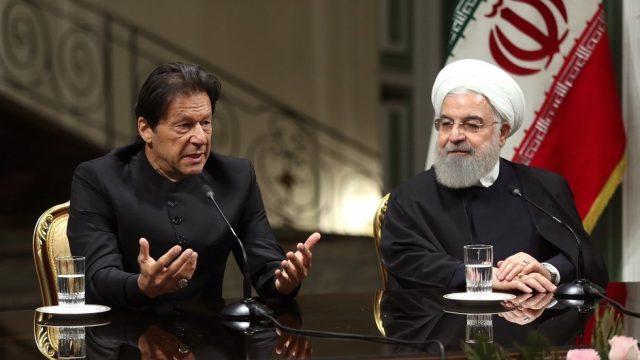
Pakistani Prime Minister Imran Khan’s visit to Tehran has been marred by two recent deadly attacks. Despite an apparent willingness to cooperate, there remain many outside players who will push for this alliance to fail.
Someone clearly hates the idea of peaceful dialogue between Iran and Pakistan. Whether a coincidence or not, the timing of an attack in Pakistan within barely a day or two of a planned visit to Iran’s capital by Pakistani Prime Minister Imran Khan is certainly perfect timing for those who view an increasing relationship between the two nations through negative terms. The attack in question saw at least 14 Pakistani security forces personnel killed in a bus ambush. Not helping the issue, is the fact that Pakistan’s foreign office instantly blamed the attack on Iran, accusing Iran of inaction against ethnic Baloch separatist groups, even as Khan was set to visit Tehran.
In February, there was similarly an attack in eastern Iran that killed at least 27 Iranian security personnel. Tehran warned Islamabad it would “pay a heavy price” for allegedly harboring the militants who planned the suicide bombing, which was claimed by the Pakistan-based Jaish al-Adl group.
Now, I am not saying that there is any conspiracy behind the attacks. I mean, why would I need to bother? Whether there are attacks or not, the media and a handful of notable leaderships will continue to portray Iran-Pakistan relations as the worst possible form of détente imaginable.
All this being said, the two countries were able to have a somewhat fruitful and productive engagement during Khan’s visit. The news that is likely to infuriate some other major players on the world stage is the announcement of a creation of a joint rapid reaction force along the shared border of Iran and Pakistan.
Ironically, the recent attacks against Iranian and Pakistani personnel may have brought these two nations closer together, as Khan announced that Pakistan will not allow any militant groups to operate from Pakistani soil, vowing to dismantle any militant group inside the country.
On a side note, WikiLeaks documents have shown that Saudi Arabia financed militant groups inside Pakistan. Even Deutsche Welle notes that most of the Pakistani based militant groups “unleashing terror” on Pakistan’s minority Shiite population “take inspiration from the hardline Saudi-Wahhabi Islamic ideology”.
Khan’s visit also magically coincided with US Secretary of State Mike Pompeo’s announcement that it was clamping down hard on countries who sought to buy Iranian oil, namely, India, Japan, South Korea, Turkey and of course, China, who account for about half of Iranian oil exports. This would undoubtedly send a clear picture to Pakistan about what will happen if it continues down its current trajectory.
Undeterred, Pakistan and Iran have agreed to establish a so-called barter committee to help in a planned increase in trade, with an eye for bypassing US-enforced sanctions.
Despite the picture the media wants to paint of a hostile Pakistan weary of an aggressive, terrorist-supporting Iran, the truth is that Iran and Pakistan are not really traditionally that adversarial.
Historically speaking, the two countries have had relatively friendly relations. Iran was one of the first countries to recognise and reach out to Pakistan after its creation in 1947. In fact, then-Shah Mohammad Reza Pahlavi was the first head of a foreign nation to visit the newly created country. Iran also provided moral and material support to Pakistan during its infamous conflicts with India in 1965 and 1971.
The countries only really split along a Sunni-Shia divide after the Islamic revolution in Iran in 1979. Aside from strengthening its relations with Saudi Arabia, Iran’s major rival, Pakistan also became a major US ally, particularly during the Afghan-Soviet war in the 1980s. Iran then viewed Pakistan as nothing but a lackey state of the United States.
Even though, Khan has made it clear that Pakistan holds no ill will to Iran following the revolution, purportedly stating that “I came here [to Iran] in 1972. I saw a big difference between the rich and the poor, a big cultural difference. Iran has become a more egalitarian society that is what the revolution has done.”
Despite the fact these two countries have many long standing differences and areas of competition, they still have many avenues of cooperation that they have felt the need to pursue.
One such avenue is the question of Afghanistan. For example, India has increased its interest in the war-ravaged nation, which puts Pakistan in a very compromising position indeed given it is essentially on the verge of a major war with its Indian neighbour.
According to Khan, both Pakistan and Iran have been affected by the conflict in Afghanistan, hosting millions of refugees between the two nations.
Iran and Pakistan have also been in the line of fire of Donald Trump’s hawkish administration. While Trump’s desire to annihilate Tehran is much more apparent than any such desire to go to war with Pakistan, we cannot ignore the major blows to US-Pakistan relations that have occurred under the watch of Trump.
The two nations further share close relations with China, the formulation of which has been termed as a trilateral nexus by the Asia Times. Pakistan and Iran also have a pipeline of their own capability of pursuing, which will most likely entail the deepening of cooperation even in spite of their major differences.
Another interesting aspect that comes into play in this dynamic – which I guarantee you, you will never see highlighted in a corporate media outlet – is that Iranian President Rouhani actually enjoys the support of the local ethnic Sunni population of Iran. Therefore, it is not beyond the administration of Rouhani to work more closely with its predominantly Sunni neighbours (if you don’t believe me, I wrote an extensive article highlighting the notable attempts by Iran to reach out to Sunni Saudi Arabia over the last few years).
The major problem that Pakistan faces is that while it can find common ground with Iran, including on matters in relation to economic ties and security, it does not want to irk Saudi Arabia too much, a nation which just pledged $20 billion in investments to Pakistan. Islamabad is likewise not impressed by Iran’s growing relationship with India. This is why Pakistan put itself in a questionable position whereby its former Chief of Army staff was appointed to what is essentially the head of a Saudi-led Arab NATO, which does not include Iran (indeed, it seems as though its existence is based on the idea that it needs to counter Iran).
At the end of the day, the optimist in me reckons that there are enough areas of cooperation between the two countries which can help to balance out the devastating rivalries between Iran and Saudi Arabia and prevent a deadly war. But in all honesty, if you were to compare the outcomes between Saudi Crown Prince Mohammed bin Salman’s (MBS) visit to Pakistan and Khan’s visit to Tehran, the latter seems a bit weak in substance. It seems as though no matter how far Iran reaches its hand out to Pakistan, its loyalty to Saudi Arabia will continue to prevail ($20 billion will always be worth more than anything Iran can ever offer to its neighbour). Not to mention the money that Pakistan is offered from the United Arab Emirates (UAE), which also views Tehran mostly in hostile terms.
Perhaps Khan can act as a mediator between Iran and Saudi Arabia, but the available evidence suggests there is nothing to mediate. Since 2015, Saudi Arabia has destroyed an entire country on its border simply on the suspicion that Iran could be backing the rebel movement inside Yemen. Even the possibility that a rebel-controlled government installed on its border could align itself with Tehran is a major deal-breaker for the Saudi Kingdom, worth starving over 85,000 children to death and threatening behind closed doors that Yemen should “shiver” for generations when they hear Saudi Arabia uttered.
The optimist in me is going to have to be a bit more realistic.
Read more:
Iranian President Rouhani declares joint border ‘reaction force’ with Pakistan
What you won’t hear from US govt: Iran is open to working with Saudi Arabia
Italian banking major to pay hefty US fine for Iran sanctions-busting
RT | April 16, 2019
European subsidiaries of Italy’s biggest bank UniCredit have pleaded guilty to US charges of violating sanctions against Iran and other countries. The lender has agreed to pay $1.3 billion to settle the six-year probe.
UniCredit’s units in Germany, Austria and Italy admitted to illegally moving of hundreds millions of dollars via the US financial system on behalf of sanctioned entities, according to the US Treasury Department. The violations reportedly included sanctions programs against [alleged] weapons of mass destruction proliferation.
The resolution, which is among the largest ever related to US sanctions laws, followed last week’s $1.1 billion settlement reached by London-based banking multinational Standard Chartered with American and British authorities over similar misconduct.
The latest case revealed that UniCredit’s subsidiary in Germany processed more than 2,000 payments totaling over $500 million through US financial institutions. In addition, over two years through 2012 all the three of the bank’s units reportedly carried out transactions, withholding information on sanctioned persons or countries from the US authorities.
The US Treasury Department noted that the illegal cash proceedings were carried out to several states subject to US penalties, including Burma, Cuba, Libya, Sudan, and Syria.
Since 2004, some 15 European lenders paid about $18.5 billion to US authorities to resolve claims over violating Washington’s sanctions programs. A record $8.9 billion settlement was reached by French international banking group BNP Paribas in 2015.
Zarif’s reminder to E3: No prohibition on enrichment under JCPOA
Press TV – April 15, 2019
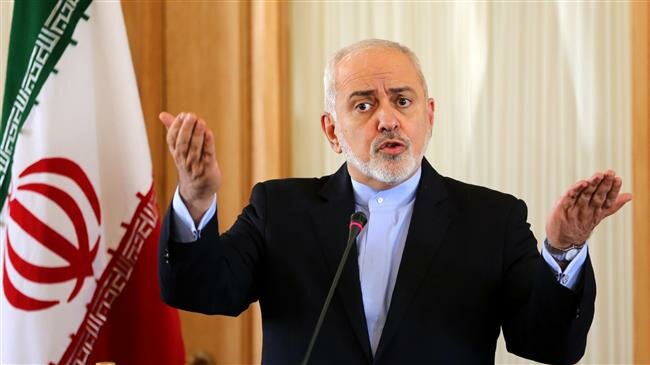
Iran’s Foreign Minister Mohammad Javad Zarif has reminded the Europeans that a 2015 nuclear deal, known as the JCPOA, does not prohibit the country from enriching uranium.
Zarif’s reprimand in a Monday tweet came after French Ambassador to the US Gerard Araud said Tehran should not need to be “massively enriching uranium after the JCPOA.”
“Reminder to our E3 partners in #JCPOA: There is NO prohibition on the enrichment of uranium by Iran under #NPT, JCPOA or UNSCR 2231,” Zarif tweeted, addressing France, Germany and Britain.
The three European countries opted to remain in the nuclear deal after US President Donald Trump abandoned it last May and reimposed sanctions on the Islamic Republic.
Araud tweeted Saturday that “sanctions could be reimposed” on Iran once the nuclear deal expires after 10 years, prompting the Islamic Republic to summon France’s ambassador to Tehran.
“Neither now, nor in 2025 or beyond. Might be useful for European partners to actually read the document they signed on to, and pledged to defend,” Zarif retorted on Monday.
In January, France’s Foreign Minister Jean-Yves Le Drian threatened Iran with sanctions if it did not address what he alleged as international concerns over Tehran’s ballistic missile program.
“We are ready, if the talks don’t yield results, to apply sanctions firmly, and they know it,” Le Drian said.
Earlier this month, Britain, France and Germany accused Iran of “developing missile technology in violation of UN resolution,” and called for a full UN report in a letter delivered to UN chief Antonio Guterres.
The EU trio also claimed that Iran’s launch of a space vehicle and unveiling of two new ballistic missiles in February were inconsistent with UN Security Council Resolution 2231, which was adopted just after the signing of the 2015 nuclear agreement.
Resolution 2231 calls on Iran “not to undertake any activity related to ballistic missiles designed to be capable of delivering nuclear weapons.”
Iran denies having any such program and the International Atomic Energy Agency (IAEA) has repeatedly confirmed the peaceful nature of Tehran’s nuclear activities.
In his Saturday tweet, deleted later, Araud said, “As we said in 2002 that enriching uranium without a credible civilian program was illegal under the NPT, we’ll be able to react likewise in 2025 if necessary. Sanctions were imposed. Sanctions could be reimposed.”
Iran’s Foreign Ministry called Araud’s remarks “unacceptable” and in “open violation” of the nuclear deal.
The ministry’s Hossein Sadat Meidani called for an explanation from Paris, saying that if the case is not addressed, Tehran will pursue it based on the mechanisms envisaged in the JCPOA.
Iranian Deputy Foreign Minister Abbas Araqchi also warned France of adverse effects of Araud’s remarks, saying such statements amount to blatant violation of the nuclear accord.
Under the JCPOA, Iran undertook to put limits on its nuclear program in exchange for the removal of nuclear-related sanctions imposed against the country.
Last month, IAEA head Yukiya Amano once again reaffirmed Iran’s compliance with its commitments under the deal.
Zarif Slams EU over Not Fulfilling Nuclear Deal Commitments
Iranian Foreign Minister Mohamamd Zarif
Al-Manar | April 14, 2019
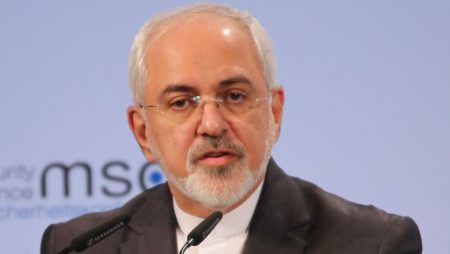
Iran’s Foreign Minister Mohamamd Javad Zarif slammed the EU on Sunday over delays in the implementation of the new mechanism for non-dollar trade with the Islamic Republic.
In comments on Sunday, the top Iranian diplomat deplored the European signatories to the 2015 Iran nuclear deal for failing to fulfill their commitments under the agreement, saying it is long overdue.
The Europeans are far behind on fulfilling their commitments under the Joint Comprehensive Plan of Action (JCPOA), Zarif said, adding: “They (EU) should not assume that the Islamic Republic of Iran will be waiting for them.”
Describing INSTEX -a payment channel that the three EU signatories to the JCPOA have set up to maintain trade with Iran- as a preliminary measure, Zarif said the Europeans need to work hard for a long time to honor their commitments.
The Iranian minister further noted that Iran has maintained close ties with its neighbors and has launched mechanisms similar to the INSTEX with many other countries.
“While the European countries have proposed INSTEX to maintain business ties with Iran in defiance of the US sanctions, the payment channel has not been put into practice yet,” he added.
On the other hand, Zarif said Iran will ask the international community to take a position on the US designation of its Revolutionary Guards as a terrorist organization.
“Today … we will send messages to foreign ministers of all countries to tell them it is necessary for them to express their stances, and to warn them that this unprecedented and dangerous U.S. measure has had and will have consequences,” Zarif was quoted as saying by state news agency IRNA.
The Iranian diplomat said he had also sent letters to United Nations Secretary-General Antonio Guterres and the United Nations Security Council to protest against “this illegal U.S. measure”.
Don’t expect US-Iran war before 2021
By M. K. BHADRAKUMAR | Indian Punchline | April 10, 2019
There is no reason to disbelieve the boast by Israeli Prime Minister Benjamin Netanyahu claiming credit personally for US President Donald Trump’s decision to designate Iran’s elite Islamic Revolutionary Guards (IRGC) as a “foreign terrorist organisation” under American law. It is common knowledge that all major decisions and most minor decisions by Trump regarding the West Asian situation are dictated by Israel’s interests.
Deep-pocketed Jewish billionaires such as Sheldon and Miriam Adelson, far-right Christian evangelicals and the well-known Israeli lobby wield enormous influence over Trump whose son-in-law Jared Kushner is also known to be an ardent Zionist who has funded West Bank settlements. Both decisions by Trump in recent weeks — granting US recognition to the illegal Israeli annexation of Syria’s Golan Heights region as well as yesterday’s move against Iran’s IRGC — are to be seen as motivated by the desire to bolster Netanyahu’s campaign seeking a fresh term in Israel’s parliamentary election on April 9.
The Pentagon and the State Department had reportedly expressed misgivings over Trump’s decision branding IRGC as a terrorist organisation. Indeed, Trump’s announcement on April 8 says clearly that the US state department will take the lead role in implementing this decision. Trump avoided voicing any intention to confronting the IRGC militarily and instead underscored his decision is to impose economic sanctions against the Iranian security organisation.
Considering that the IRGC has a long reach in the economic arena, especially in vital sectors such as energy, telecommunications, etc., in effect, Trump’s decision amounts to an extension of the US sanctions against Iran. Therefore, as Trump put it, the decision becomes a template of his “maximum pressure” strategy against Iran, which has been under implementation.
Tehran’s reaction has been surprisingly restrained under the circumstances. To be sure, Tehran has retaliated by naming the US Central Command (which is headquartered in Doha and covers the so-called Greater Middle East stretching from the Levant to Central Asia) as a terrorist organisation. Interestingly, Iranian reports highlighted that it is a “tit-for-tat” measure — that is, a move Iran had no choice but to make. The overall mood is one of resignation that the Trump administration is under the Israeli spell and has taken a step that is not exactly in American interests.
There have been no threatening statements from Tehran directed at the US, either. In a highly nuanced remark, the influential chairman of the National Security and Foreign Policy Commission of the Iranian Parliament, Heshmatollah Falahatpisheh hastened to clarify that Iran’s measures against the US Central Command, in response to US anti-IRGC move, is defensive, not a declaration of war.
Again, Iran’s powerful Supreme National Security Council, which is the apex executive body on foreign and security policies, has also restricted itself to saying in a statement, “Undoubtedly, the US regime will bear all the responsibilities for the dangerous consequences of its adventurist move.” This must be noted carefully as a signal to the US defence and security establishment.
Most important, Iran’s Supreme Leader Ayatollah Ali Khamenei estimated Trump’s move as only to be expected, given the IRGC’s pivotal role in countering Iran’s enemies. He said the US move will fall flat. The head of Iran’s Revolutionary Guards, Gen. Mohammad Ali Jafari was quoted as saying, “This U.S. move was quite laughable since the Revolutionary Guards are in people’s hearts … The Revolutionary Guards will increase its defensive and offensive capabilities in coming year.”
On the political plane, however, Tehran will step up its “resistance”. More Iranian support for Hamas can be expected. Similarly, the US move, coming hot on the heels of recognising the Israeli occupation of the Golan Heights, will only further further consolidate the “resistance”. The known unknown is going to be the impact on Afghanistan. Tehran has links with the Taliban. But it has been voicing strong backing for President Ashraf Ghani’s insistence that the peace talks should be “Afghan-led, Afghan-controlled.” Iran’s overriding concern is the stability of Afghanistan and the welfare of the Shi’ite communities. Conceivably, the US must be factoring in the imperative need to discourage Iran from playing a spoiler role in Afghanistan.
Among the Iranian security agencies, it is the IRGC that is in the driver’s seat in steering policies in Syria, Iraq and Afghanistan. The point is, the US Central Command and the IRGC (plus various Iran-backed militia forces) “co-habitate” these theatres. It is inconceivable that the US would precipitate any hostile moves against the IRGC that draw forth retaliation and jeopardise the safety and security of American personnel. Iran has the capacity to infect pain and give sleepless nights to the US personnel deployed under the Central Command and, to be sure, the Pentagon and the CIA are well aware of that.
We may, therefore, expect a tacit understanding by the two antagonistic parties to stay out of each other’s path. Of course, that is easier said than done, since these are high kinetic theatres witnessing acute confrontation. But then, the US-Iran tango has a 40-year history of shadow boxing.
Some shrill rhetoric can be expected from the US side, especially from US secretary of state Mike Pompeo and National Security Advisor John Bolton. Both are stridently “anti-Iran”. Bolton had been in the payroll of Iranian dissident groups based in the West. Both Pompeo and Bolton are passionately devoted to serving Israeli interests. But, in the final analysis, it is Trump — and Trump alone — who matters.
Quite obviously, Trump will be extremely wary of getting into a shooting war with Iran. Trump knows only too well that a war with Iran will have regional ramifications and can hurt his presidency. His game plan through this year and the next will be to ensure that his “maximum pressure” strategy deters Iran from causing any serious political embarrassment during his campaign, which is due to start later this year, for his re-election bid in 2020.
Suffice to say, Trump’s IRGC designation is unlikely to lead to any shooting war with Iran — till end-2020, at least. Having said that, there will be no let-up in Tehran’s pursuit of “resistance” in Syria and Iraq. And, given the pivotal role of the IRGC in Iran’s foreign and security policies, any form of direct engagement politically or at the diplomatic level between Washington and Tehran can be ruled out. Having said that, make no mistake that the US’ regional strategies in Syria and Iraq will come under severe challenge. To be sure, a strategic stalemate is Israel’s objective too as the guarantee against US retrenchment from the Middle East.
US Secretary of State Mike Pompeo’s anti-Iranian Rhetoric
By Viktor Mikhin – New Eastern Outlook – 24.03.2019
The administration of the US President, Donald Trump, is currently using severe economic sanctions in an unsuccessful, and illegal, attempt to pressurize Tehran into dismantling its rocket program, and weaken its regional influence. The present US leadership is not trying to hide its implacable opposition to any form of political contacts, trade or cultural links between Iran and its neighbors. Washington reacted in an almost hysterical manner to the very successful recent visit to Iraq by Hassan Rouhani, the Iranian President, which was entirely devoted to talks on trade and investment. The volume of trade between the two countries currently amounts to $12 billion a year, and there is every reason to believe this will increase to $20 billion, which would be very welcome for Tehran, given the severity of the US sanctions.
And although the harsh sanctions are aimed at restricting Tehran’s relations with other countries in the region, and despite the fact that Washington is taking great pains to impose so-called secondary sanctions on countries which trade with Iran, the latest statistics show that things are actually moving in the opposite direction: Tehran, blocked off from international markets, is starting to focus on its close neighbors. The recent fall in the value of the riyal means that Iranian goods and services are now much more competitive. As a result, Iraq has been able to overtake China as Iran’s main export market for all goods except for oil.
According to IRNA, the Iranian news agency, as a result of Hassan Rouhani’s successful visit to Iraq the two countries signed 22 agreements on trade and cooperation in industrial projects. The agreements are aimed at increasing trade between Iran and Iraq. The new agreements cover such matters as the development of cooperation between border provinces of both countries, the reduction of trade tariffs, and the simplification of the visa regime for citizens of the two countries. The Iraqi Minister of trade, Mohammad Hashim al-Ani, has announced that under the new agreements a number of infrastructure construction projects are to be launched, and working groups and committees are to be set up to discuss further cooperation between the two countries in a range of different areas.
Arabic media outlets have reported that Iraq and Iran have agreed to set up a barter system, in which manufactured goods from Iraq will be exchanged for Iranian gas and electricity. In this way Baghdad hopes to continue importing energy and fuel from Iran, in exchange for Iraqi products. Economists consider that supplying energy to Baghdad, which does not have enough energy resources to meet its needs, will not only help the country to build new factories but also provide the population with cheap electricity, especially in the summer, when the temperature frequently exceeds 50 degrees and air conditioning is essential.
The Iranian premier’s visit to Iraq, in which the two countries limited themselves to discussing trade and investment-related matters, was greeted positively by the international community, with the notable exception of the USA and the Trump Administration. The facts show that the USA is dedicated to a policy of unleashing conflicts and sowing enmity between countries. This was clearly demonstrated by the recent hostilities between India and Pakistan in Kashmir. An example of this is the many inflammatory comments and groundless predictions by the US “free” media, which filled the country’s newspapers and TV with fake news reports from Kashmir.
But, notwithstanding the unfortunate events in Kashmir, the US administration, and US Secretary of State Mike Pompeo in particular, has not forgotten about Iran. Speaking in the CERAWeek conference, the US Secretary of State, who is far more comfortable with the language of threats than that of diplomacy, declared that if Iran did not behave “like a normal nation” the sanctions regime would last for a long time. It is completely natural that the USA, which has set itself up as an international policeman, should use its own conduct as a standard for other countries.
So it is worth looking at the way that the USA, a “normal country”, behaves. It bombed the helpless population of the German city of Dresden, dropped atomic bombs on the cities of Hiroshima and Nagasaki, where no Japanese troops were based, sprayed Vietnam intensively with chemical weapons (defoliants), carpet bombed North Korea (1950-1953) and destroyed the states of Syria, Libya, Iraq and Afghanistan. That is the conduct of the USA, a “normal” country. And it advises other countries to behave in the same way.
It is not surprising that the so-called “White Helmets”, an organization protected by the US, follows its example, by initiating chemical attacks in Syria. And what about the International Court of Justice, and other international organizations whose staff are paid high salaries in order to bring the perpetrators of such provocations to justice: where are they looking?
The Secretary of State has, once again, outdone himself: he has ordered a total ban on exports of Iranian oil: “We have every intention of driving Iranian oil exports to zero”. If we take into account the fact that oil is the country’s main export and that the basic needs of the whole population depend on the proceeds from this trade, then Mike Pompeo’s declarations sound rather like the joyful shrieks of a cannibal as he gloats over his helpless victim.
The choice of Mike Pompeo as US Secretary of State, in effect the country’s Foreign Minister, has been greeted with criticism, ridicule and contempt by countries around the world. Many have compared him, unfavorably, with Sergey Lavrov, the Russian diplomat and Foreign Minister, who deals very well with the wide range of global problems that Russia finds itself faced with. One might ask: how can a former unsuccessful spy who was tasked with overthrowing the international order possibly operate on the same level as him? That is why, lacking support from diplomats and himself feeling nothing but contempt for that profession, he decided to “transfer” many of his former henchmen to the diplomatic service.
These one-time spies are attempting, in everything they do, to justify the high level of trust that their guru has placed in them, but they lack the slightest experience of diplomacy, and, hopelessly out of their depth, are doing their country far more harm than good. It is hard to see how else we are to understand the recent incident in Moscow’s Sheremetyevo airport, in which a US diplomat – that, at least, was his job title – tried to bring a bomb through customs in his luggage. The Russian Foreign Ministry has stated directly that it saw the incident as a provocation. As the TASS news agency reported, citing Russian diplomatic staff, “given the heightened attention the USA itself has paid to security on aircraft since the 9/11 attacks, he simply could not be unaware that a bomb in a bag is very serious. That means he was aware of taking such a step.” Obviously a real diplomat would never carry out a provocation of that sort without clear “instructions” from above – that goes without saying. Many global media outlets speculated, rather boldly, that the diplomat was, in a very underhand way, trying to “test Sheremetyevo airport’s security system”.
Looking back over the energetic but fruitless, and in fact extremely dangerous actions of Secretary of State Mike Pompeo, we would wish to advise the US President to take more care with his choice of staff, especially at such a senior position. Because absolutely everything he does in his post – a post for which he is completely unqualified – harms his own country and he makes himself a laughing stock for people all over the world when he comes out with his latest “pearls of wisdom” concerning Iran, Russia or any other country. At this point it is worth remembering the words of the great Mark Twain (a writer who may well, we suspect, be unknown to the Secretary of State) in his superb book, Letters from the Earth. Specifically, Letter Eight, in which Twain has nothing good to say about people such as Mike Pompeo.
Trump’s Golan move shows US contempt for international law and rules-based order
By M. K. BHADRAKUMAR | Indian Punchline | March 22, 2019
US President Donald Trump’s tweet on Thursday that the United States should back Israeli sovereignty over the Golan Heights, seized from Syria in 1967, didn’t quite come like a bolt from the blue. There has been talk about such a thing for sometime. Last December, the US Congress had begun pioneering a resolution expressing the sense of the Senate that the US should recognise Israel’s sovereignty over the Golan Heights.
Last month, new legislation was proposed in both houses of the Congress which called for recognising Israel’s sovereignty over the Golan Heights as part of the strategy to counter Iran and Syria. A copy of the Senate version of the bill stated, “It shall be the policy of the United States… to recognise Israel’s sovereignty over the Golan Heights.” The resolution stated that such a move is critical in the light of new realities on the ground including Iran’s presence in Syria. The resolution argued that Israel’s security from attacks from Syria and Lebanon cannot be assured without control over Golan Heights.
In addition, the bill said it is in US interest that Israel retains control over this territory to ensure that the Syrian government faces “diplomatic and geopolitical consequences” for killing civilians and allegedly using chemical weapons.
The sophistry aside, the fact of the matter is that the influential Jewish lobby began canvassing for such legislation once it became clear that Israel had lost the war in Syria. The primary purpose of the Israeli intervention in the Syrian Conflict by way of equipping and supporting extremist groups to overthrow the government led by President Bashar al-Assad was that a weakened and preferably dismembered Syria would never be in a position to demand the vacation of the Israeli occupation of Golan Heights.
Simply put, Tel Aviv is pulling strings in Washington to get US recognition of the Golan Heights as Israeli territory with the hope that the lone superpower’s opinion would somehow help legitimise the illegal occupation of Syrian territory since the 1967 war. Prime Minister Benjamin Netanyahu had pinned hopes that any Syrian political settlement would also include provisions legitimising the Israeli occupation of Golan.
A sub-plot here is about the timing of the tweet by Uncle Trump. Quite obviously, he is boosting the profile of nephew Netanyahu who is in dire straits at the moment fighting an election where he is trailing and staring at the prospect of a prison term for corruption. What are uncles for, after all, if they don’t help when nephew is in trouble — and big trouble at that?
But then, there is still more to it than meets the eye. The fact of the matter is that Golan Heights is believed to have vast oil reserves that could supply all of Israel’s needs. In fact, Israel began drilling for oil already by 2015 in anticipation of the ouster of President Assad.
US foreign policy is reaching an historic low point in this episode by helping to legitimise the illegal occupation of territories belonging to another sovereign country. Trump is plainly ignoring international law and the UN Charter. Yet, the US pontificates about a rules-based world order. In 2006, the United Nations General Assembly actually had passed a resolution affirming the “inalienable rights” of the Arab population in the Golan over its natural resources. The 1907 Hague Regulations, which is a cornerstone of international law, unambiguously states that an occupying power must “safeguard the capital of these properties.” Stealing resources from an occupied territory constitutes the crime of pillage.
Where such an act of pillage will ultimately lead to, time only can tell. Make no mistake, Syria will never accept the occupation of a part of the country. The US-Israeli conspiracy will meet with Syrian resistance. In fact, Trump is virtually pushing Syria into the resistance camp in the Muslim Middle East. A weakened Syria cannot challenge Israel militarily. But in the fullness of time, Israel is getting surrounded by a circle of hostile nations.
There are strong indications already that a resistance front against the US and Israel is forming in the northern tier of the Middle East stretching from Iran westward to the Mediterranean coast. Assad’s visit to Tehran, Iran’s Supreme Leader Al Khamenei conferring the highest military honour on the commander of Iran’s Quds Force Gen. Qassem Soleimani, Iranian president Hassan Rouhani’s high-profile visit to Iraq, the meeting of the commanders of the armed forces of Iran, Iraq and Syria in Damascus — all these developments in the most recent weeks underscore the emergence of a new strategic alliance that will work toward the purge of US influence in the region.
This trend is also reflected in a pronounced shift in the Iranian foreign policies, which no longer prioritise Iran’s integration into the Western world and would instead attribute centrality to resistance. Ironically, Trump’s cynical move on Golan — as per the wishes of his deep-pocketed Jewish donors such as casino magnate Sheldon Adelson and wife Miriam, influential lobby groups, and far-right Christian fringe — will end up providing strategic depth to Iran in its region to push back at the US’ containment policy.
With eye on US, Iran revs up ‘resistance front’
By M. K. BHADRAKUMAR | Indian Punchline | March 19, 2019
A new phase is beginning in Iran’s approach to the situation since last May when the US withdrew from the 2015 nuclear deal. Tehran had thus far prioritised the consolidation of Western opinion against President Trump’s decision with a view to effectively counter the US sanctions. But with hindsight, it appears that Europeans might posture against the US sanctions, but business interests ultimately prevail and the hard reality is that European companies that have exposure to the American market will not risk US sanctions.
Certainly, the drop in oil income following the US sanctions has hurt the Iranian economy and Tehran admits it openly. The Trump administration now plans to unveil an even harsher sanctions regime in May. According to reports, Washington aims to bring down Iran’s oil exports further.
Meanwhile, the US-Israel-Saudi-UAE nexus against Iran is actively working to create instability within Iran, weaken the regime and incapacitate it from playing a regional role. Saudi money is challenging Iran’s towering multi-dimensional presence in Iraq.
Although the US is notionally withdrawing troops from Syria, the efforts continue to roll back Iran’s presence in Iraq and Syria. Iran mentors the battle-hardened Shi’ite militia forces numbering tens of thousands in Iraq and Syria, which fought against the ISIS. Iran’s continuing presence in Syria poses an insurmountable obstacle to Israel’s designs to weaken and dominate Syria and to legitimise its illegal occupation of the Golan Heights.
Suffice to say, Tehran finds itself besieged. Of course, Iran’s regime has lived through dangerous periods through the past 4 decades and there is no question of capitulation. But an inflection point has been reached and a new trajectory has become necessary in terms of Iran’s political economy as well as to overcome the geo-strategic challenges.
There have been incipient signs change in the most recent months — in various statements by the Supreme Leader Ali Khamenei, in particular — indicative of a new pathway that would jettison the earlier obsession with the Western countries and abandon the strategy to put eggs in the EU basket. Khamenei repeatedly stressed Iran’s inner strength and the resilience of ‘resistance’.
Without doubt, the unannounced visit by Syrian President Bashar al-Assad to Tehran on February 27 augured that a Syrian-Iranian alliance with far-reaching geopolitical significance is taking shape. Khamenei stated during his meeting with Assad: “The Islamic Republic of Iran regards helping the Syrian government and nation as assisting the Resistance movement, and genuinely takes pride in it… Syria, with its people’s persistence and unity, managed to stand strong against a big coalition of the US, Europe and their allies in the region and victoriously come out of it… Iran and Syria are strategic allies and the identity and power of Resistance depend on their continuous and strategic alliance, because of which, the enemies will not be able to put their plans into action.”
Khamenei repeatedly used the metaphor of the resistance to characterise the Iran-Syria alliance. The charismatic commander of the Quds Force Gen. Qassem Soleimani neatly summed up that Assad’s visit was a “celebration of victory” for the resistance front.
Indeed, Khamenei has since decorated Soleimani with Iran’s most prestigious medal of honor, the Order of Zulfiqar. There is much symbolism here, since Soleimani happens to be the first Iranian commander to receive the Order of Zulfiqar after the 1979 Islamic revolution. Iran is applauding Soleimani’s profound contribution to the resistance. To be sure, Iran is returning to its revolutionary moorings.
Thus, the meeting between the top commanders of the armed forces of Iran, Iraq and Syria which took place in Damascus on Sunday was geared to flesh out a coordinated plan to meet the challenges in regional security. Some reports mentioned that Soleimani too was in Damascus on Sunday.
While receiving the three army commanders in Damascus, Assad reportedly said that the blood of Syrians, Iranians, and Iraqis “have mixed in the battle against terrorism and its mercenaries, who are considered as a mere façade for the countries that support them.”
Equally, Iranian president Rouhani’s recent visit to Iraq can be put in perspective. As a senior Chinese expert on West Asia has noted, Rouhani’s visit has “long-term geopolitical implications” in terms of expansion of Iran’s regional influence, apart from giving traction to the “resistance” politics (against US and Israel.)
The Chinese expert wrote that Iraq is refusing to be part of US’ containment strategy against Iran and Rouhani’s visit consolidates Iran’s influence in Iraq, which in turn also enhances its capacity to offer a “stark counterbalance” to US influence over Iraq. Again, Iran sees Iraq as a gateway to bust the US sanctions. Geopolitically, the expert underscored, the new dynamic strengthens Tehran’s strategy to create a regional axis between Iran, Iraq, Syria and Lebanon, which would have an edge over Saudi Arabia. Incidentally, Rouhani is likely to visit Syria as well in the near future.
Clearly, resistance politics creates strategic depth for Iran to push back at the US. But there is also a bigger dimension to it. Tehran plans to step up its participation in Syrian infrastructure construction. Ultimately, Iran’s economic relations with Iraq and Syria will be further strengthened in addition to its political and strategic relations with the two countries.
Very few details of yesterday’s meeting of army commanders in Damascus have emerged but one concrete outcome is the reopening of the Syrian-Iraqi border in the “coming days”, which of course, will facilitate a road link connecting Iran with Syria and Lebanon via Iraq. This is a major development insofar as a direct road link becomes possible connecting Iran with Syria and Lebanon. One main objective of the US military presence in Syria was to thwart such a transportation route that would significantly boost Iran’s influence and presence in the Levant. There have been reports that Iran may use Latakia port in Syria to access the world market.
‘A crime against humanity’: Rouhani says Iran will file legal case against US over sanctions
RT | March 18, 2019
President Hassan Rouhani announced that Tehran will pursue legal action against US officials who imposed sanctions on Iran, adding that the dispute could be brought before an international court.
The Iranian president said that he had ordered the ministries of foreign affairs and justice to “file a legal case in Iranian courts against those in America who designed and imposed sanctions on Iran.”
Describing the unilaterally imposed sanctions as a “crime against humanity,” Rouhani said that if Iranian courts believe there is a strong case against Washington, Tehran would then pursue the legal challenge in international courts of justice. He said that the United States is seeking to “come back to Iran and rule the nation again.”
While dragging US Secretary of State Mike Pompeo before an Iranian court may be far-fetched, Tehran has had past success arguing against US sanctions on the international stage. In October, the International Court Of Justice (ICJ) ordered the United States to ensure that its sanctions do not target humanitarian aid or civil aviation safety.
Washington re-imposed sanctions on Tehran after US President Donald Trump decided in May to abandon the 2015 nuclear accord with Iran. Trump’s decision to back out of the deal – which was negotiated with five other world powers – has strained relations between Washington and its European allies, who are now looking to bypass the US-imposed sanctions.
In February, the International Atomic Energy Agency said that despite the US withdrawal from the 2015 accord, Iran was still in full compliance with its commitments towards non-proliferation.
Iran has scoffed at Washington’s stated aim of reducing the country’s oil exports to “zero,” and has repeatedly warned that it is prepared to take military action to protect its oil tankers from US interference.
Featured Video
Bombing Hitler’s Hometown
or go to
Aletho News Archives – Video-Images
From the Archives
‘Conspiracy Theory’ Now Fact: Greater Israel Has Arrived
By Kit Klarenberg | Mint Press News | January 28, 2025
Ever since Tel Aviv’s 1948 creation, much has been said and written about ‘Greater Israel’ – the notion Zionism’s ultimate end goal is the forcible annexation and ethnic cleansing of vast swaths of Arab and Muslim lands for Jewish settlement, based on Biblical claims this territory was promised to Jews by God. The mainstream media typically dismisses this concept as antisemitic conspiracy theory, or at most the fringe fantasy of a minuscule handful of extremist Israelis.
In reality … continue
Blog Roll
 Aletho News
- Yemen joins fight against US, Israel by firing missiles at occupied territories
- Seizing the Kharg: Washington’s path to defeat in the Persian Gulf
- Iran reports 500 US casualties in strikes on covert US military sites
- Pro-Israel terrorist arrested before assassination of pro-Palestinian activist
- Bombing Hitler’s Hometown
- German journalist threatened with homelessness as German court upholds EU sanctions in landmark free speech case
- US Tells Allies That Ukraine-Bound Arms Could be Sent to Middle East
- Organized terrorism: Iran condemns killing of its diplomats in Lebanon
- Why could Gaza enter the regional war?
- Hamas official rejects Mladenov Plan linking disarmament to Gaza reconstruction
- If Americans Knew
- Researchers at Human Rights Watch Resign Over Blocked Report on Palestinian Refugee Return
- Jewish Groups Are Backing a War Americans Don’t Want
- Eric Fingerhut Thinks He’s the President of the Jews
- Top Jewish Philanthropists, Rabbis Urge Israeli President to Take Action Against ‘Jewish Extremists’
- Don’t Be Fooled. Zionist Leaders Have Always Wanted to Control Southern Lebanon
- Israel’s widespread use of torture is a core element of its genocide against the Palestinian people
- In Israel’s War on Iran, Many Middle East US Bases Rendered “All But Uninhabitable”
- ‘Burn the lawn’: Israel pursues ‘Rafah model’ in southern Lebanon
- A genocide here, an amputation there
- Reports: Iran mobilizing 1M fighters, Israel-US run low on ammo, Israeli army faces shortage – Not a ceasefire Day 168
- No Tricks Zone
- Devastating Assessment Of Comirnaty Vaccine By Former Senior Pfizer Europe Toxicologist
- New Study: CO2 Is ‘Effectively Negligible’ As An Explanatory Climate Change Factor Since 2000
- Former Pfizer Toxicologist Dr. Helmut Sterz Tells Bundestag Hearing Pfizer Vaccine Should Have Never Been Approved
- Energy Expert: Germany’s Nuclear Phaseout Was A “500 Billion Euro Mistake”
- New Research: South Australia’s Mid-Holocene Sea Surface Temperatures Were 4°C Warmer Than Today
- Storing Green Energy To Last Germany 10 Days Would Require A 60-Million Tonne Battery
- New Studies: UK Sea Levels Were 4 Meters Higher Than Today During The Mid-Holocene
- Destructive Green New Deal: German Energy And Metal Group Warns Of Drastic Crisis
- New Study Documents A 20-Year Pause In Arctic Sea Ice Decline – Driven By Internal Variability
- Wake-up Call: Survey Shows Majority Of Germans Now Favor Postponing Climate Targets!
 Aletho News