As US Government Strangles Iran’s Economy, Google ‘Suffocates’ Iranian Media
Sputnik – April 25, 2019
The recent shutdown of PressTV and HispanTV’s YouTube and Gmail accounts are more examples of the continued effort by the US government to silence Iranian media outlets, Alex Rubinstein, a journalist for MintPress News, told Sputnik.
“I think that this is part of a larger trend of cracking down on Iranian media,” Rubinstein told Radio Sputnik’s By Any Means Necessary on Wednesday. “Just as this was happening, the United States was saying that we want to bring down Iranian oil exports to zero. Well, it seems like they’re also trying to bring down Iranian expression down to zero through these kinds of moves.”
“It’s a message which both strangles their economy and also suffocates their voice,” he added.
Google barred PressTV and HispanTV, an Iranian Spanish-language outlet, from accessing their respective YouTube and Gmail accounts without notice and without an explanation detailing what Google policies were violated, the outlets recently reported.
Although content from both outlets is still viewable, the organizations are unable to upload new content.
Israeli media outlets have speculated that the order was handed down by Google after HispanTV issued a report claiming imprisoned Palestinians were being used for medical experiments.
“On its face, that sounds like that could be questionable,” Rubinstein said of the speculation. “But there have been a number of other outlets to carry this report, and it wasn’t like they were pulling this information out of thin air — it came from a Palestinian politician in Israel… he made this allegation, and they were citing him properly.”
The journalist told hosts Eugene Puryear and Sean Blackmon that while it’s unclear what initiated Google’s action, it seems in line with the behavior of tech companies vying to “stifle Iranian media” at the behest of the US government.
“These tech companies are basically extensions of the US empire. You look at all that’s going on with NATO and the US government trying to push back on Chinese 5G — well, the point of that is that [the US] can’t spy so well if [the 5G grid is] Chinese,” Rubinstein said.
“The American government has a dominance over these companies, and we see that with the ban on PressTV, and we see that with the other countries that have been targeted, which are primarily Russia and Venezuela.”
“It’s hard to imagine that this is just a coincidence,” he added.
Earlier this month, after the US formally designated Iran’s Islamic Revolutionary Guard Corps a terrorist organization, popular photo and video-sharing platform Instagram began banning pages belonging to various Iranian military officials. The site later explained that the move was in line with the US’ designation.
“I understand to have a policy against spreading terrorist messages on a social media platform… but we didn’t see these crackdowns for terrorist organizations like the Free Syrian Army, or any of the other supposedly moderate rebels in Syria,” Rubinstein told Blackmon.
“We see them [crackdowns] for the supposed terrorist that are enemies of the United States… It seems like the tech companies are all too happy to follow in lockstep.”
See also:
Google’s Campaign Against Iranian Media Outlets Sets ‘Dangerous Precedent’
Facebook Takes Down Iranian Media Pages in Continued War on Alternative News
Modi government caves in to US diktat on Iran oil
By M. K. BHADRAKUMAR | Indian Punchline | April 24, 2019
Prime Minister Narendra Modi travels around the country every day claiming to be the defender of national interests in Pulwama, Balakot, ASAT and so on. But he’s keeping deafening silence on the one issue that has come up in the foreign policy that is going to have devastating impact on the Indian economy and affect the lives of common people — US diktat to India to stop oil imports from Iran.
The White House diktat is certain to lead to a spike in India’s oil bill. And, yet, only the Communist Party of India (Marxist) has voiced concern. If foreign policy is about enabling the country’s development, Modi government should show the political courage to tell the Trump administration that its attempt to hurt India’s economic interests will be resisted.
Instead, alas, the media reports suggest that the government is meekly caving in to the White House decision on Monday to block other countries from trading in Iranian oil. Most regrettably, what we see here is an abject surrender of national interests by our government, which is completely contrary to Modi’s claims of being the custodian of India’s development and prosperity.
The government has given a spin that it has arranged “alternate sources” of supply of oil. This is plain sophistry. The real issue is that Iran has been supplying oil to India in highly concessional terms — and not about the availability of oil as such. Buying oil from the spot market has always been an option, but the government could significantly reduce its import bill by availing of Iran’s favourable terms. Not only that, oil trade is a sleazy affair and only middle men stand to gain if India switches to the spot market. The common man will bear the burden of hidden kickbacks. Iran was keen on long-term arrangements with India.
The White House announcement on Monday claimed that Saudi Arabia and the UAE have agreed to offset lost barrels from Iran. However, Saudi Arabia has since given a measured response, saying only that it would add supply if needed. The point is, Saudi Arabia also has to keep output below its ceiling as part of the OPEC+ deal (with Russia), which means that while in theory it could add a few hundred thousand barrels per day above current levels (approximately, 500,000 bps), that may not be enough to compensate for outages in Iran. (And this doesn’t take into account other disruptions in oil supply due to US sanctions against Venezuela and the civil war in Libya.)
The Saudi oil minister Khalid al-Falih has already gone to lengths to try to assuage the concerns of the OPEC+ group, stating that Riyadh would “coordinate with fellow oil producers to ensure adequate supplies are available to consumers while ensuring the global oil market does not go out of balance.” In sum, Saudi Arabia won’t act unilaterally and won’t act preemptively.
Furthermore, aside the strategic goal of keeping the OPEC+ group together, Riyadh also has budgetary concerns to keep oil price as high as possible. The IMF estimates that Saudi Arabia would need oil prices at US$ 80-85 per barrel in order to balance its 2019 budget. According to OPEC figures, the oil and gas sector generates around 50 percent of Saudi Arabia’s GDP, and accounts for some 70 percent of its export earnings. Besides, Saudi Arabia relies on proceeds from oil to fund its hugely ambitious transformation programme known as Vision 2030, the Crown Prince Mohammed bin Salman’s grand project to channel billions upon billions of US dollars in investments to diversify the Saudi economy.
Therefore, all factors taken into account, the oil price is bound to shoot up in the months ahead, vastly increasing India’s import bill. The government’s calculation would be that if the BJP is returned to power, the increase in oil price can be simply passed on to the consumer, which was what the Modi government has been doing through the past 5-year period. Of course, the danger of a worldwide economic recession due to high oil prices is already talked about.
The Modi government caved in under American pressure without even token resistance. Two countries similarly placed as India with high dependence on Iranian oil — China and Turkey — have shown the grit to stand up to Washington. At a news briefing in Beijing on Tuesday, Geng Shuang, a spokesperson for the foreign ministry, used harsh words to criticise the US decision and suggested that China has already taken pre-emptive actions. He said, “The Chinese side urges the US to seriously respect China’s interests and concerns and refrain from taking wrong actions that damage China’s interests. China has already made representations to the US side.” Geng added that China “firmly opposed” the US actions and cooperation between Iran and the international community, including China, “must be respected and protected.” (China steps up criticism of US sanctions in Iran oil, Global Times )
The Turkish Foreign Minister Mevlüt Çavuşoğlu asked in indignation: “Why are you (US) putting pressure on other countries? Take your own measures. Why do other countries have to obey your unilateral decisions?” He said, “We support an international system and multilateralism established through legal rules. The fact that a country alone disrupts this and puts pressure on everyone to comply with its decisions is damaging and jeopardising the international legal system.”
In comparison, Modi and his cabinet colleagues will not join issue with the American bully. The really bizarre part is that Washington is linking India’s compliance with its diktat on Iran with its symbolic support for India’s case on Masood Azhar! This is blackmail. An appropriate quid pro quo should have been that the US blacklisted Pakistan as a state sponsoring terrorism? Will Trump dare to do that? No, he won’t, because the US bases in Afghanistan are critically dependent on supply lines via Pakistan.
Trump apparently thinks Modi is a man of straw, contrary to the latter’s self-projection. Indeed, he says insulting things about Modi every now and then but the latter simply ducks and ingratiates himself even more. Trump hikes tariffs on India’s exports to the US but Modi won’t take reciprocal measures. Trump demands duty reduction for Harley Davidson motorbikes, and Modi not only complies but phones up POTUS to personally convey the good news that he complied. Modi invited Trump as Republic Day chief guest but Trump declined disdainfully.
Does it come as a surprise that the US decided to squash Modi’s grand vision to expand and deepen economic cooperation with Iran via a payment mechanism that bypasses dollar? Washington estimated correctly that Delhi would chicken out and surrender. Such shameful behaviour must be in our Hindu DNA — prostrating before the superior power while kicking the lowly underdog?
‘Lift sanctions & apologize if you want to talk,’ Iran’s Rouhani tells Washington
RT | April 24, 2019
The US should first drop sanctions and apologize, if it wants to sit down for negotiations, Iran’s President Hassan Rouhani said, after Washington stepped up “maximum pressure” on Tehran.
“Negotiation is only possible if all the pressures are lifted, they apologize for their illegal actions and there is mutual respect,” Rouhani said on Wednesday.
He stated that Tehran is open to talks with Washington, but the US is simply “not ready for any dialogue” and only seeks to “subdue the people of Iran.”
Iran’s Supreme Leader, Ali Khamenei, meanwhile, said that the country will thwart any attempts of the US to block its oil trade.
“The efforts to boycott the sale of Iran’s oil won’t get them anywhere. We will export our oil as much as we need and we intend,” Khamenei wrote on Twitter.
“They should know that their hostile measure won’t be left without a response.”
The warning came after US Secretary of State, Mike Pompeo, announced that Washington will stop issuing sanction waivers for the buyers of Iranian oil. It was done as part of the campaign to apply “maximum pressure” on Tehran, he said.
The two states remained in a diplomatic standoff after President Donald Trump unilaterally pulled the US out of the Joint Comprehensive Plan of Action (JCPOA) on the Iranian nuclear program last year. The US then re-imposed sanctions on Iran’s energy and banking sectors.
Iran blasted the sanctions as illegal under international law and vowed to retaliate should Washington make moves to attack its oil shipment.
Earlier this month, the US listed Iran’s Islamic Revolutionary Guard Corps (IRGC) as a “terrorist organization.” Tehran responded in kind by doing the same with the US Central Command (CENTCOM).
Netanyahu ordered Trump to end sanctions waivers on Iranian oil: Analyst
Press TV – April 22, 2019
Israeli Prime Minister Benjamin Netanyahu has ordered US President Donald Trump to end exemptions from sanctions for several countries buying oil from Iran, says an American political analyst
Rodney Martin, a former congressional staffer based in Scottsdale, Arizona, made the remarks in an interview with Press TV after Netanyahu praised Trump for not renewing waivers that allowed eight countries to buy oil from Iran without getting sanctioned.
Last November, the US enforced sanctions targeting the Islamic Republic’s banking and energy sector. However, it agreed to grant waivers to China, India, Japan, Turkey, Italy, Greece, South Korea and Taiwan, allowing them to continue buying Iranian oil.
Netanyahu said on Monday that Trump’s decision “is of great importance for increasing pressure” on Iran.
The White House made the announcement earlier in the day saying “Trump has decided not to reissue Significant Reduction Exceptions (SREs) when they expire in early May.”
“This decision is intended to bring Iran’s oil exports to zero,” White House press secretary Sarah Huckabee Sanders said in a statement.
The waivers were scheduled for renewal on May 2.
“I have no doubt that Netanyahu requested if not outright ordered the US State Department via Donald Trump vie AIPAC, via Trump’s Jewish Zionist donors and supporters. And I think he ordered that this policy be implemented. So Israel and Netanyahu are very pleased,” Martin said.
“On a broader scale, it further exposes the fact that Israel has a greater network of influencers in US political system, and not Russia,” he stated.
The analyst said that it’s “a glaring example” that Israel meddles in US policy.
After Trump’s announcement, oil prices on Monday spiked to their highest levels since October. Brent crude rocketed past $74 a barrel, its highest point this year.
US Iran sanctions amount to aggression against entire world: Nasrallah
Press TV – April 22, 2019
The secretary general of the Lebanese Hezbollah resistance movement has denounced US economic sanctions against Iran, describing the punitive measures as “an act of aggression” against all world nations.
“US efforts to increase economic pressure on Iran, especially its pledge to drive the country’s oil exports to zero, will have negative repercussions and will affect the entire world, including the US itself,” Sayyed Hassan Nasrallah said as he addressed his supporters via a televised speech broadcast live from the Lebanese capital Beirut on Monday evening.
He then called on world nations to stand up against “US arrogance,” pointing out, “The tyrannical US government has no respect whatsoever for international law and regulations.”
Nasrallah also lashed out at Saudi Arabia and the United Arab Emirates for following in US footsteps and joining Washington’s economic pressure campaign against Iran.
The Hezbollah chief also roundly rejected media allegations that the Israeli regime is planning to launch a surprise war against Lebanon this summer.
“There is very little likelihood that Israel would launch another war on Lebanon. The Israeli army is not prepared for any aggression against the country. I personally don’t think such a thing would happen,” Nasrallah highlighted.
The Hezbollah chief also dismissed claims of infighting between Russian and Iranian forces in Syria’s eastern province of Dayr al-Zawr as well as the northern province of Aleppo, stating that Saudi-owned al-Arabia television news network has “disseminated such lies.”
“Saudi-backed media outlets are spreading lies and fallacies about Hezbollah, Iran and the region to a large extent,” Nasrallah said.
The Hezbollah secretary general then slammed Saudi Arabia and the UAE for spreading terrorism and chaos in countries like Yemen, Sudan and Libya.
Nasrallah also blamed Wahhabism for the emergence of regional terrorism and Takfiri terrorist groups like al-Qaeda and Daesh.
Wahhabism is the radical ideology dominating Saudi Arabia, freely preached by government-backed clerics there, and inspiring terrorists worldwide. Daesh and other Takfiri terror groups use the ideology to declare people of other faiths as “infidels” and then kill them.
“There are many agents in the Middle East, who are pushing for sectarian strife to serve the interest of the Zionist regime (of Israel). All those seeking to colonize the region will only raise public awareness,” the Hezbollah chief said.
Elsewhere in his remarks, Nasrallah touched upon the economic crisis in Lebanon, demanding greater cooperation and unity among Lebanese political factions.
“All Lebanese parties agree that Lebanon is suffering from serious financial woes. They are all involved in coping with the economic crisis. Resolving Lebanon’s problems requires patience and efforts by all political parties. Ministers affiliated to Hezbollah, lawmakers as well as specialists have already prepared a number of draft solutions for Lebanon’s economic crisis,” Nasrallah underlined.
Maximum Pressure on Iran Still Isn’t Working
By Paul R. Pillar | LobeLog | April 2, 2019
Almost a year after President Trump reneged on U.S. commitments in the Joint Comprehensive Plan of Action (JCPOA), otherwise known as the Iran nuclear deal, there is not the slightest sign that this move is achieving the declared objective of Iran crawling back to the negotiating table to negotiate a “better deal.” Tehran instead has been exuding perseverance and hardline resistance. The most recent high-level Iranian statement, a speech by Supreme Leader Ali Khamenei marking the Persian new year, was full of recalcitrance. Khamenei’s themes included self-sufficiency and boosting Iran’s defense capabilities.
It is not surprising that determined opponents of the JCPOA—the most vocal of whom are determined opponents of any agreement with Iran—have been trying hard to spin this situation to make it look as if something positive is being accomplished. Patrick Clawson of the Washington Institute for Near East Policy, for example, suggests that the new year’s speech was “not the confident Khamenei of days past” and that the speech indicated that “the Trump administration has had considerable success convincing Khamenei that the pressure will continue, and that Iran cannot count on outlasting U.S. hostility.”
It also is not surprising that when The New York Times ran a story by Ben Hubbard, reporting from Beirut, about the financial strains that Hezbollah and other Iranian clients are feeling, columnist Bret Stephens jumped into action. “Heavens to Betsy,” Stephens exclaimed in a column in the next day’s Times, arguing that this must mean President Barack Obama was wrong when he said sanctions relief “wouldn’t make much difference in terms of Iran’s capacity to make mischief in the Middle East.”
Actually, Obama was right. The fallacy that Stephens, and others who defend the Trump administration’s re-imposition of nuclear sanctions, are promoting is that making life more difficult, costly, or painful for someone else somehow advances U.S. interests—at least if the U.S. government sufficiently hates whoever that someone else is. That would be true only if schadenfreude were a U.S. national interest, which it isn’t. Pain infliction serves U.S. interests only if it changes the targeted country’s behavior in a desired direction, by either limiting its capabilities or inducing it to change its policies. Regarding Iran over the past year, this is not happening.
It’s Not All About the Money
Most of Hubbard’s article—the part Stephens doesn’t mention—describes how and why Iran and its clients are not changing their policies and operations despite the financial pinch. The reporter notes that the client groups “are relatively inexpensive, remain ideologically committed to Iran’s agenda and can promote it through local politics in ways that the United States struggles to thwart.” Many of the groups “have income streams that give them some financial independence.” That certainly is true of Lebanese Hezbollah, which also benefits from having achieved broad acceptance as a political actor. Hubbard recalls how much pushback Secretary of State Mike Pompeo received on this point when he recently met with senior Lebanese officials. Foreign Minister Gibran Basil, standing next to Pompeo at a subsequent public appearance, said, “From our side, for sure, we reiterated that Hezbollah is a Lebanese party, not terrorist. Its deputies are elected by the Lebanese people with great popular support.”
The article mentions that, to the extent Iran is scaling back militia operations in Syria, this may be due less to financial reasons than to the fact that Iran’s ally Bashar al-Assad has largely won the war. In Iraq, financial stringency has led Iran not to curtail involvement but instead to seek stronger economic ties with its next-door neighbor. Militias that Iran sponsored “are now paid by the Iraq government, giving Iran leverage in Iraqi politics at little cost to itself.”
Hubbard quotes an anonymous Hezbollah fighter as saying that a financial pinch would not push members away from the organization. “You’re not in Hezbollah for the money,” he said. Something similar could be said about Iran in the Middle East. Iran’s activity in the region is shaped not by the money but instead by Tehran’s perception of what is in Iran’s security interests.
None of this should be surprising. Hubbard notes that “recent history suggests that financial pressure on Iran does not necessarily lead to military cutbacks.” As multiple independent studies have concluded, that also is true of the recent and not-so-recent history of Iran’s overall activity in the Middle East, including activity that the United States finds objectionable.
Continued Iranian Compliance with the JCPOA
Stephens tries to milk another supposed accomplishment out of the administration’s pressure campaign by pointing to the fact that Iran is still observing its obligations under the JCPOA despite the United States having reneged on its own commitments. While acknowledging that Iran outwaiting Trump has something to do with this, Stephens also says the Iranian compliance “suggests an edge of fear in Tehran’s calculations. The U.S. can still impose a great deal more pain on the Islamic Republic if it chooses to do so.”
Reflect first on the irony of an anti-JCPOA voice like Stephens pointing to Iran’s continued rigorous observance of its obligations under the JCPOA—the terms of which Stephens and other opponents have been excoriating for three years—as a supposed accomplishment of the Trump administration’s pressure campaign. Reflect further on how much Iran’s compliance with those obligations undermines opponents’ rhetoric about how Iran supposedly has been hell-bent on getting nuclear weapons, with the JCPOA just a way-station where it gets an economic fillip. If that really were Iran’s intention all along—and given that it is not now getting the fillip—Iran would have renounced the JCPOA as soon as the United States reneged.
Think also about what sort of diplomacy Stephens’s suggestion implies: that the way to get another state to stick to agreed terms is not to stick to them oneself but instead to renege and then to threaten something worse. That would be a bizarre brand of diplomacy, to put it mildly, and one that neither the United States nor anyone else could use to get much business done.
“Tehran’s calculations” are unlikely to be anything like what Stephens suggests they are. The Trump administration, through both its actions and its rhetoric, has given Iranian leaders ample reason to conclude that the administration is determined to punish Iran as much as possible no matter what Iran does. Any hesitation within the administration not to push the sanctions pedal all the way to the metal appears to be a reaction not to Iranian restraint but instead to economic concerns about how elimination of waivers for importing Iranian oil would affect the world oil market and ultimately the price of gasoline at the pump.
Iranian Patience Not Unlimited
Iran’s continued compliance with the JCPOA despite U.S. reneging definitely involves an Iranian decision to outwait Trump. This is partly, but not solely, a matter of some Democratic presidential candidates, as Stephens correctly notes, stating their intention if elected to bring the United States back into compliance with the agreement. Iran is making its decisions about nuclear policy within a larger context in which not Iran, but instead the United States under Trump, is the isolated actor. It is not just Iran but all the non-U.S. parties to the JCPOA that are committed to its preservation. So is the larger world community, as expressed in the unanimously adopted United Nations Security Council Resolution 2231.
Iran may continue to outwait Trump, despite not getting the economic relief it bargained for, until the end of the current U.S. presidential term. Politics inside Tehran probably would make it impossible to wait any longer. This is where the 2020 U.S. presidential election comes into play. Former Deputy Secretary of State William Burns, when asked about this subject recently, replied, “My sense right now is that this Iranian regime would like to try and wait out the Trump administration. But if the president was elected to a second term, then their interest in doing that probably goes out the window.”
If that happens, the damage from the pressure campaign will not be limited to the consequences that Stephens ignores, such as how economic warfare against Iran has become economic warfare against Western allies and has contributed to the poisoning of U.S. relations with them. The damage will include a new Iranian nuclear crisis that was totally avoidable if only the administration had not embarked on its destructive course a year ago.
Why the US & Saudi Arabia fear Iran-Pakistan cooperation
© AFP / IRANIAN PRESIDENCY
By Darius Shahtahmasebi | RT | April 23, 2019
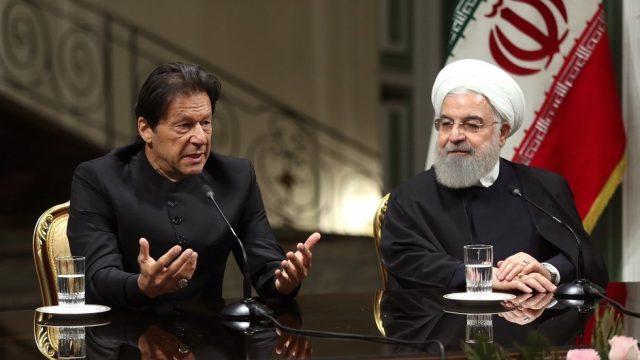
Pakistani Prime Minister Imran Khan’s visit to Tehran has been marred by two recent deadly attacks. Despite an apparent willingness to cooperate, there remain many outside players who will push for this alliance to fail.
Someone clearly hates the idea of peaceful dialogue between Iran and Pakistan. Whether a coincidence or not, the timing of an attack in Pakistan within barely a day or two of a planned visit to Iran’s capital by Pakistani Prime Minister Imran Khan is certainly perfect timing for those who view an increasing relationship between the two nations through negative terms. The attack in question saw at least 14 Pakistani security forces personnel killed in a bus ambush. Not helping the issue, is the fact that Pakistan’s foreign office instantly blamed the attack on Iran, accusing Iran of inaction against ethnic Baloch separatist groups, even as Khan was set to visit Tehran.
In February, there was similarly an attack in eastern Iran that killed at least 27 Iranian security personnel. Tehran warned Islamabad it would “pay a heavy price” for allegedly harboring the militants who planned the suicide bombing, which was claimed by the Pakistan-based Jaish al-Adl group.
Now, I am not saying that there is any conspiracy behind the attacks. I mean, why would I need to bother? Whether there are attacks or not, the media and a handful of notable leaderships will continue to portray Iran-Pakistan relations as the worst possible form of détente imaginable.
All this being said, the two countries were able to have a somewhat fruitful and productive engagement during Khan’s visit. The news that is likely to infuriate some other major players on the world stage is the announcement of a creation of a joint rapid reaction force along the shared border of Iran and Pakistan.
Ironically, the recent attacks against Iranian and Pakistani personnel may have brought these two nations closer together, as Khan announced that Pakistan will not allow any militant groups to operate from Pakistani soil, vowing to dismantle any militant group inside the country.
On a side note, WikiLeaks documents have shown that Saudi Arabia financed militant groups inside Pakistan. Even Deutsche Welle notes that most of the Pakistani based militant groups “unleashing terror” on Pakistan’s minority Shiite population “take inspiration from the hardline Saudi-Wahhabi Islamic ideology”.
Khan’s visit also magically coincided with US Secretary of State Mike Pompeo’s announcement that it was clamping down hard on countries who sought to buy Iranian oil, namely, India, Japan, South Korea, Turkey and of course, China, who account for about half of Iranian oil exports. This would undoubtedly send a clear picture to Pakistan about what will happen if it continues down its current trajectory.
Undeterred, Pakistan and Iran have agreed to establish a so-called barter committee to help in a planned increase in trade, with an eye for bypassing US-enforced sanctions.
Despite the picture the media wants to paint of a hostile Pakistan weary of an aggressive, terrorist-supporting Iran, the truth is that Iran and Pakistan are not really traditionally that adversarial.
Historically speaking, the two countries have had relatively friendly relations. Iran was one of the first countries to recognise and reach out to Pakistan after its creation in 1947. In fact, then-Shah Mohammad Reza Pahlavi was the first head of a foreign nation to visit the newly created country. Iran also provided moral and material support to Pakistan during its infamous conflicts with India in 1965 and 1971.
The countries only really split along a Sunni-Shia divide after the Islamic revolution in Iran in 1979. Aside from strengthening its relations with Saudi Arabia, Iran’s major rival, Pakistan also became a major US ally, particularly during the Afghan-Soviet war in the 1980s. Iran then viewed Pakistan as nothing but a lackey state of the United States.
Even though, Khan has made it clear that Pakistan holds no ill will to Iran following the revolution, purportedly stating that “I came here [to Iran] in 1972. I saw a big difference between the rich and the poor, a big cultural difference. Iran has become a more egalitarian society that is what the revolution has done.”
Despite the fact these two countries have many long standing differences and areas of competition, they still have many avenues of cooperation that they have felt the need to pursue.
One such avenue is the question of Afghanistan. For example, India has increased its interest in the war-ravaged nation, which puts Pakistan in a very compromising position indeed given it is essentially on the verge of a major war with its Indian neighbour.
According to Khan, both Pakistan and Iran have been affected by the conflict in Afghanistan, hosting millions of refugees between the two nations.
Iran and Pakistan have also been in the line of fire of Donald Trump’s hawkish administration. While Trump’s desire to annihilate Tehran is much more apparent than any such desire to go to war with Pakistan, we cannot ignore the major blows to US-Pakistan relations that have occurred under the watch of Trump.
The two nations further share close relations with China, the formulation of which has been termed as a trilateral nexus by the Asia Times. Pakistan and Iran also have a pipeline of their own capability of pursuing, which will most likely entail the deepening of cooperation even in spite of their major differences.
Another interesting aspect that comes into play in this dynamic – which I guarantee you, you will never see highlighted in a corporate media outlet – is that Iranian President Rouhani actually enjoys the support of the local ethnic Sunni population of Iran. Therefore, it is not beyond the administration of Rouhani to work more closely with its predominantly Sunni neighbours (if you don’t believe me, I wrote an extensive article highlighting the notable attempts by Iran to reach out to Sunni Saudi Arabia over the last few years).
The major problem that Pakistan faces is that while it can find common ground with Iran, including on matters in relation to economic ties and security, it does not want to irk Saudi Arabia too much, a nation which just pledged $20 billion in investments to Pakistan. Islamabad is likewise not impressed by Iran’s growing relationship with India. This is why Pakistan put itself in a questionable position whereby its former Chief of Army staff was appointed to what is essentially the head of a Saudi-led Arab NATO, which does not include Iran (indeed, it seems as though its existence is based on the idea that it needs to counter Iran).
At the end of the day, the optimist in me reckons that there are enough areas of cooperation between the two countries which can help to balance out the devastating rivalries between Iran and Saudi Arabia and prevent a deadly war. But in all honesty, if you were to compare the outcomes between Saudi Crown Prince Mohammed bin Salman’s (MBS) visit to Pakistan and Khan’s visit to Tehran, the latter seems a bit weak in substance. It seems as though no matter how far Iran reaches its hand out to Pakistan, its loyalty to Saudi Arabia will continue to prevail ($20 billion will always be worth more than anything Iran can ever offer to its neighbour). Not to mention the money that Pakistan is offered from the United Arab Emirates (UAE), which also views Tehran mostly in hostile terms.
Perhaps Khan can act as a mediator between Iran and Saudi Arabia, but the available evidence suggests there is nothing to mediate. Since 2015, Saudi Arabia has destroyed an entire country on its border simply on the suspicion that Iran could be backing the rebel movement inside Yemen. Even the possibility that a rebel-controlled government installed on its border could align itself with Tehran is a major deal-breaker for the Saudi Kingdom, worth starving over 85,000 children to death and threatening behind closed doors that Yemen should “shiver” for generations when they hear Saudi Arabia uttered.
The optimist in me is going to have to be a bit more realistic.
Read more:
Iranian President Rouhani declares joint border ‘reaction force’ with Pakistan
What you won’t hear from US govt: Iran is open to working with Saudi Arabia
Italian banking major to pay hefty US fine for Iran sanctions-busting
RT | April 16, 2019
European subsidiaries of Italy’s biggest bank UniCredit have pleaded guilty to US charges of violating sanctions against Iran and other countries. The lender has agreed to pay $1.3 billion to settle the six-year probe.
UniCredit’s units in Germany, Austria and Italy admitted to illegally moving of hundreds millions of dollars via the US financial system on behalf of sanctioned entities, according to the US Treasury Department. The violations reportedly included sanctions programs against [alleged] weapons of mass destruction proliferation.
The resolution, which is among the largest ever related to US sanctions laws, followed last week’s $1.1 billion settlement reached by London-based banking multinational Standard Chartered with American and British authorities over similar misconduct.
The latest case revealed that UniCredit’s subsidiary in Germany processed more than 2,000 payments totaling over $500 million through US financial institutions. In addition, over two years through 2012 all the three of the bank’s units reportedly carried out transactions, withholding information on sanctioned persons or countries from the US authorities.
The US Treasury Department noted that the illegal cash proceedings were carried out to several states subject to US penalties, including Burma, Cuba, Libya, Sudan, and Syria.
Since 2004, some 15 European lenders paid about $18.5 billion to US authorities to resolve claims over violating Washington’s sanctions programs. A record $8.9 billion settlement was reached by French international banking group BNP Paribas in 2015.
Zarif’s reminder to E3: No prohibition on enrichment under JCPOA
Press TV – April 15, 2019
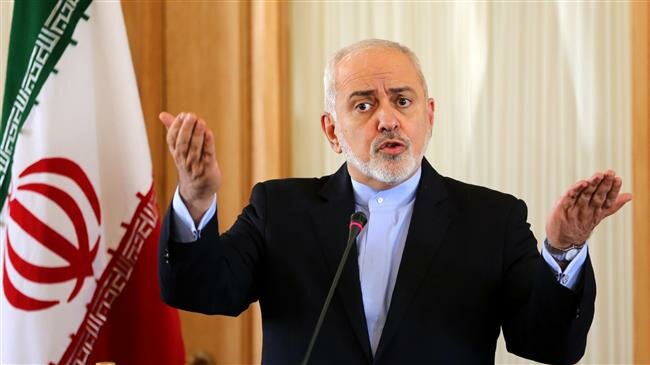
Iran’s Foreign Minister Mohammad Javad Zarif has reminded the Europeans that a 2015 nuclear deal, known as the JCPOA, does not prohibit the country from enriching uranium.
Zarif’s reprimand in a Monday tweet came after French Ambassador to the US Gerard Araud said Tehran should not need to be “massively enriching uranium after the JCPOA.”
“Reminder to our E3 partners in #JCPOA: There is NO prohibition on the enrichment of uranium by Iran under #NPT, JCPOA or UNSCR 2231,” Zarif tweeted, addressing France, Germany and Britain.
The three European countries opted to remain in the nuclear deal after US President Donald Trump abandoned it last May and reimposed sanctions on the Islamic Republic.
Araud tweeted Saturday that “sanctions could be reimposed” on Iran once the nuclear deal expires after 10 years, prompting the Islamic Republic to summon France’s ambassador to Tehran.
“Neither now, nor in 2025 or beyond. Might be useful for European partners to actually read the document they signed on to, and pledged to defend,” Zarif retorted on Monday.
In January, France’s Foreign Minister Jean-Yves Le Drian threatened Iran with sanctions if it did not address what he alleged as international concerns over Tehran’s ballistic missile program.
“We are ready, if the talks don’t yield results, to apply sanctions firmly, and they know it,” Le Drian said.
Earlier this month, Britain, France and Germany accused Iran of “developing missile technology in violation of UN resolution,” and called for a full UN report in a letter delivered to UN chief Antonio Guterres.
The EU trio also claimed that Iran’s launch of a space vehicle and unveiling of two new ballistic missiles in February were inconsistent with UN Security Council Resolution 2231, which was adopted just after the signing of the 2015 nuclear agreement.
Resolution 2231 calls on Iran “not to undertake any activity related to ballistic missiles designed to be capable of delivering nuclear weapons.”
Iran denies having any such program and the International Atomic Energy Agency (IAEA) has repeatedly confirmed the peaceful nature of Tehran’s nuclear activities.
In his Saturday tweet, deleted later, Araud said, “As we said in 2002 that enriching uranium without a credible civilian program was illegal under the NPT, we’ll be able to react likewise in 2025 if necessary. Sanctions were imposed. Sanctions could be reimposed.”
Iran’s Foreign Ministry called Araud’s remarks “unacceptable” and in “open violation” of the nuclear deal.
The ministry’s Hossein Sadat Meidani called for an explanation from Paris, saying that if the case is not addressed, Tehran will pursue it based on the mechanisms envisaged in the JCPOA.
Iranian Deputy Foreign Minister Abbas Araqchi also warned France of adverse effects of Araud’s remarks, saying such statements amount to blatant violation of the nuclear accord.
Under the JCPOA, Iran undertook to put limits on its nuclear program in exchange for the removal of nuclear-related sanctions imposed against the country.
Last month, IAEA head Yukiya Amano once again reaffirmed Iran’s compliance with its commitments under the deal.
Zarif Slams EU over Not Fulfilling Nuclear Deal Commitments
Iranian Foreign Minister Mohamamd Zarif
Al-Manar | April 14, 2019
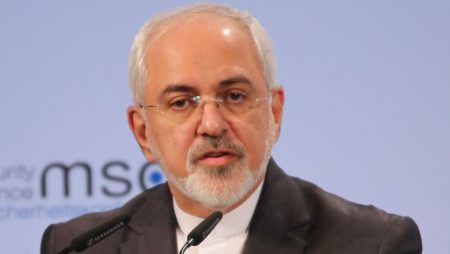
Iran’s Foreign Minister Mohamamd Javad Zarif slammed the EU on Sunday over delays in the implementation of the new mechanism for non-dollar trade with the Islamic Republic.
In comments on Sunday, the top Iranian diplomat deplored the European signatories to the 2015 Iran nuclear deal for failing to fulfill their commitments under the agreement, saying it is long overdue.
The Europeans are far behind on fulfilling their commitments under the Joint Comprehensive Plan of Action (JCPOA), Zarif said, adding: “They (EU) should not assume that the Islamic Republic of Iran will be waiting for them.”
Describing INSTEX -a payment channel that the three EU signatories to the JCPOA have set up to maintain trade with Iran- as a preliminary measure, Zarif said the Europeans need to work hard for a long time to honor their commitments.
The Iranian minister further noted that Iran has maintained close ties with its neighbors and has launched mechanisms similar to the INSTEX with many other countries.
“While the European countries have proposed INSTEX to maintain business ties with Iran in defiance of the US sanctions, the payment channel has not been put into practice yet,” he added.
On the other hand, Zarif said Iran will ask the international community to take a position on the US designation of its Revolutionary Guards as a terrorist organization.
“Today … we will send messages to foreign ministers of all countries to tell them it is necessary for them to express their stances, and to warn them that this unprecedented and dangerous U.S. measure has had and will have consequences,” Zarif was quoted as saying by state news agency IRNA.
The Iranian diplomat said he had also sent letters to United Nations Secretary-General Antonio Guterres and the United Nations Security Council to protest against “this illegal U.S. measure”.
Don’t expect US-Iran war before 2021
By M. K. BHADRAKUMAR | Indian Punchline | April 10, 2019
There is no reason to disbelieve the boast by Israeli Prime Minister Benjamin Netanyahu claiming credit personally for US President Donald Trump’s decision to designate Iran’s elite Islamic Revolutionary Guards (IRGC) as a “foreign terrorist organisation” under American law. It is common knowledge that all major decisions and most minor decisions by Trump regarding the West Asian situation are dictated by Israel’s interests.
Deep-pocketed Jewish billionaires such as Sheldon and Miriam Adelson, far-right Christian evangelicals and the well-known Israeli lobby wield enormous influence over Trump whose son-in-law Jared Kushner is also known to be an ardent Zionist who has funded West Bank settlements. Both decisions by Trump in recent weeks — granting US recognition to the illegal Israeli annexation of Syria’s Golan Heights region as well as yesterday’s move against Iran’s IRGC — are to be seen as motivated by the desire to bolster Netanyahu’s campaign seeking a fresh term in Israel’s parliamentary election on April 9.
The Pentagon and the State Department had reportedly expressed misgivings over Trump’s decision branding IRGC as a terrorist organisation. Indeed, Trump’s announcement on April 8 says clearly that the US state department will take the lead role in implementing this decision. Trump avoided voicing any intention to confronting the IRGC militarily and instead underscored his decision is to impose economic sanctions against the Iranian security organisation.
Considering that the IRGC has a long reach in the economic arena, especially in vital sectors such as energy, telecommunications, etc., in effect, Trump’s decision amounts to an extension of the US sanctions against Iran. Therefore, as Trump put it, the decision becomes a template of his “maximum pressure” strategy against Iran, which has been under implementation.
Tehran’s reaction has been surprisingly restrained under the circumstances. To be sure, Tehran has retaliated by naming the US Central Command (which is headquartered in Doha and covers the so-called Greater Middle East stretching from the Levant to Central Asia) as a terrorist organisation. Interestingly, Iranian reports highlighted that it is a “tit-for-tat” measure — that is, a move Iran had no choice but to make. The overall mood is one of resignation that the Trump administration is under the Israeli spell and has taken a step that is not exactly in American interests.
There have been no threatening statements from Tehran directed at the US, either. In a highly nuanced remark, the influential chairman of the National Security and Foreign Policy Commission of the Iranian Parliament, Heshmatollah Falahatpisheh hastened to clarify that Iran’s measures against the US Central Command, in response to US anti-IRGC move, is defensive, not a declaration of war.
Again, Iran’s powerful Supreme National Security Council, which is the apex executive body on foreign and security policies, has also restricted itself to saying in a statement, “Undoubtedly, the US regime will bear all the responsibilities for the dangerous consequences of its adventurist move.” This must be noted carefully as a signal to the US defence and security establishment.
Most important, Iran’s Supreme Leader Ayatollah Ali Khamenei estimated Trump’s move as only to be expected, given the IRGC’s pivotal role in countering Iran’s enemies. He said the US move will fall flat. The head of Iran’s Revolutionary Guards, Gen. Mohammad Ali Jafari was quoted as saying, “This U.S. move was quite laughable since the Revolutionary Guards are in people’s hearts … The Revolutionary Guards will increase its defensive and offensive capabilities in coming year.”
On the political plane, however, Tehran will step up its “resistance”. More Iranian support for Hamas can be expected. Similarly, the US move, coming hot on the heels of recognising the Israeli occupation of the Golan Heights, will only further further consolidate the “resistance”. The known unknown is going to be the impact on Afghanistan. Tehran has links with the Taliban. But it has been voicing strong backing for President Ashraf Ghani’s insistence that the peace talks should be “Afghan-led, Afghan-controlled.” Iran’s overriding concern is the stability of Afghanistan and the welfare of the Shi’ite communities. Conceivably, the US must be factoring in the imperative need to discourage Iran from playing a spoiler role in Afghanistan.
Among the Iranian security agencies, it is the IRGC that is in the driver’s seat in steering policies in Syria, Iraq and Afghanistan. The point is, the US Central Command and the IRGC (plus various Iran-backed militia forces) “co-habitate” these theatres. It is inconceivable that the US would precipitate any hostile moves against the IRGC that draw forth retaliation and jeopardise the safety and security of American personnel. Iran has the capacity to infect pain and give sleepless nights to the US personnel deployed under the Central Command and, to be sure, the Pentagon and the CIA are well aware of that.
We may, therefore, expect a tacit understanding by the two antagonistic parties to stay out of each other’s path. Of course, that is easier said than done, since these are high kinetic theatres witnessing acute confrontation. But then, the US-Iran tango has a 40-year history of shadow boxing.
Some shrill rhetoric can be expected from the US side, especially from US secretary of state Mike Pompeo and National Security Advisor John Bolton. Both are stridently “anti-Iran”. Bolton had been in the payroll of Iranian dissident groups based in the West. Both Pompeo and Bolton are passionately devoted to serving Israeli interests. But, in the final analysis, it is Trump — and Trump alone — who matters.
Quite obviously, Trump will be extremely wary of getting into a shooting war with Iran. Trump knows only too well that a war with Iran will have regional ramifications and can hurt his presidency. His game plan through this year and the next will be to ensure that his “maximum pressure” strategy deters Iran from causing any serious political embarrassment during his campaign, which is due to start later this year, for his re-election bid in 2020.
Suffice to say, Trump’s IRGC designation is unlikely to lead to any shooting war with Iran — till end-2020, at least. Having said that, there will be no let-up in Tehran’s pursuit of “resistance” in Syria and Iraq. And, given the pivotal role of the IRGC in Iran’s foreign and security policies, any form of direct engagement politically or at the diplomatic level between Washington and Tehran can be ruled out. Having said that, make no mistake that the US’ regional strategies in Syria and Iraq will come under severe challenge. To be sure, a strategic stalemate is Israel’s objective too as the guarantee against US retrenchment from the Middle East.
Featured Video
Russia Helping Build a New Middle East /Trita Parsi
or go to
Aletho News Archives – Video-Images
From the Archives
Sam Husseini: The entire US establishment helped lie their way into the Iraq war
By Slava Zilber | American Herald Tribune | October 14, 2019
Sam Husseini is a senior analyst with the Institute for Public Accuracy, independent journalist and contributor to The Nation and FAIR.
Slava Zilber: Sam, three years ago, you appeared on Talk Nation Radio with David Swanson and spoke about the case of the GCHQ whistleblower Katharine Gun. You pointed out that the people involved in the spying on the UN and the people authorizing the Iraq War were not held accountable:
“Virtually everybody who went along with the war, whether it is Kerry or Clinton, of course, the Bush administration themselves has falsified their own records in terms of why, what they did, when they did, why they did it, to the extent that they’ve been scrutinised at all.”
You also address it in a recent article. And recently, Joe Biden has been lying about his position on the Iraq War. How can such an important issue escape meaningful scrutiny? … continue
Blog Roll
 Aletho News
- Russia Helping Build a New Middle East /Trita Parsi
- Barghouti: ‘Netanyahu has fallen,’ era of Smotrich, Ben-Gvir over
- China slams US policy on Iran as Russia rejects legality of nuclear meeting at UN
- The Mecca Pact Courts Iran: Containment Comes Full Circle
- Oman FM: Persian Gulf states, Iran, Iraq should form security pact excluding US
- Trump peddles fresh falsehoods, claims Iran ‘started the war’ as US aggression drags on
- Ukraine quagmire? Yes, but it’s for NATO, not Russia
- US intelligence hypes Chinese, Russian space threats while accelerating its own military buildup in orbit
- Iran FM Araghchi: “Hormuz Will No Longer Be the Same”
- EU facing trillion-euro debt hole while seeking more cash for Kiev
- If Americans Knew
- An error has occurred; the feed is probably down. Try again later.
- No Tricks Zone
- Sudden Stratospheric Warming, Powerful El Niño Combination May Lead To Extreme Europe Cold, Energy Crisis!
- Two New Studies Find Thwaites Glacier Melt Cannot Be Driven By Human Activity Or A Warming Ocean
- E-Cars Reduce CO2 Emissions By Only 41% Compared To Internal Combustion Engine Vehicles
- Predictions Made By Renowned Climate Professor Over Past Decades Have Been Proven To Be Poor
- New Study Suggests Large Regions Of The Pacific Ocean Have Been Cooling For The Last 80 Years
- Germany’s Green Energy Debacle: High Energy Costs Force Kahla Porzellan to Close After 182 Years!
- New Study: 50 Years Of The Most Aggressive ‘Net Zero’ Policies Can Only Affect The Global Climate By 0.03°C
- US September “Heat” Was No Record…Many Records Set Decades Ago
- Latest European Green Energy Debacle; Portugal’s Largest Flagship Solar Park Insolvent!
- Green Energy Debacle: German Expert Professor Fritz Vahrenholt Warns Of Severe Economic And Social Consequences

