Tehran Slams French FM’s Remarks on Iranian Missile Program
Al-Manar | August 31, 2018
Iranian Foreign Ministry Spokesman Bahram Qassemi criticized French Foreign Minister Jean-Yves Le Drian’s Thursday remarks about Iran’s missile program and said such “unwarranted concerns” are rooted in his “wrong perceptions” of the program.
“The Islamic Republic of Iran has repeatedly declared its clear and transparent stance on unwarranted concerns rooted in some countries’ wrong perceptions and ignorance,” Qassemi said in a statement on Friday.
“The Islamic Republic of Iran has always shown that it has never been fearful of dialogue and negotiation and that it believes in it,” he said.
However, in a situation that the outcome of all efforts of Iran and other world powers (the 2015 nuclear deal) is violated by “the bullying and excessive demands” of France’s partners, there is no reason for Iran to trust and negotiate on “unnegotiable issues”, the spokesman added.
“The world and the French statesmen are well aware that Iran’s regional policy is in line with regional and international peace and security and the fight against terrorism and extremism, and if such a campaign is not pleasant to some countries that basically create tensions and crises, they can reform their policies,” he went on to say.
The remarks came after Le Drian warned Thursday that Iran “cannot avoid” talks on its ballistic missile program and role in Middle East conflicts, as European powers work to rescue the 2015 nuclear deal with Tehran known as the Joint Comprehensive Plan of Action (JCPOA).
Iranian officials have repeatedly underscored that the country will not hesitate to strengthen its military capabilities, including its missile power, which are entirely meant for defense, and that Iran’s defense capabilities will be never subject to negotiations.
The European Union has vowed to counter US President Donald Trump’s renewed sanctions on Iran, including by means of a new law to shield European companies from punitive measures.
Trump on August 6 signed an executive order re-imposing many sanctions on Iran, three months after pulling out of the Iran nuclear deal.
He said the US policy is to levy “maximum economic pressure” on the country.
Trump also restated his opinion that the 2015 Iran nuclear deal was a “horrible, one-sided deal”.
On May 8, the US president pulled his country out of the JCPOA, which was achieved in Vienna in 2015 after years of negotiations among Iran and the Group 5+1 (Russia, China, the US, Britain, France and Germany).
Following the US exit, Iran and the remaining parties launched talks to save the accord.
Iran hauls US before international court over ‘illegal’ sanctions
Press TV – August 27, 2018
The International Court of Justice has begun hearing a lawsuit brought by Iran against new US sanctions ordered by the Trump administration.
Iran last month lodged a complaint with the Hague-based tribunal, arguing that the sanctions violate the terms of a 1955 friendship treaty between the two countries.
The country opened a lawsuit Monday demanding the UN’s top court order the suspension of the renewed US sanctions.
“The United States is publicly propagating a policy intended to damage as severely as possible Iran’s economy and Iranian nationals and companies,” Iran’s lawyer Mohsen Mohebi told the court.
“This policy is nothing but naked economic aggression against my country,” he said, adding “Iran will put up the strongest resistance to the US economic strangulation, by all peaceful means.”
Tehran has called on the United Nations court to order the immediate lifting of the sanctions, and demanded compensation for damages incurred in their wake.
Sanctions had been lifted under a 2015 nuclear agreement between Iran and six other countries – the US, Germany, France, Britain, China and Russia.
President Donald Trump unilaterally pulled the US out of the deal with Iran in May and pledged to reimpose the most restrictive sanctions on the country.
Washington reinstated the first batch of sanctions in early August and will re-impose the second batch in November which will primarily be meant to undermine Tehran’s oil exports.
The United States’ lawyers will present their arguments on Tuesday. They are expected to argue that the ICJ should not have jurisdiction in the dispute.
The oral arguments, essentially a request by Iran for a provisional ruling, will last for four days, with a decision to follow within a month.
The ICJ was set up in 1946 to resolve international disputes. Its rulings are binding but on rare occasions they have been ignored by certain countries, chiefly the United States.
The US will respond formally in oral arguments on Tuesday, reportedly arguing that the United Nations court should not have jurisdiction in the dispute.
US lawyers will reportedly claim that the friendship treaty signed before the Islamic Revolution in 1979 is no longer valid and that the sanctions Washington has levied against Tehran, do not violate it anyway.
Baghdad grapples with ‘curse’ of US sanctions on Iran
By Omar al-Jaffal | Asia Times | August 17, 2018
Iraqi Prime Minister Haider al-Abadi has raised the level of uncertainty over how Iraq will handle long-expected US sanctions on Iran.
In the span of less than a week, Abadi went from pledging to abide by the sanctions the day after they were imposed, to backtracking on his statement.
“I said yes, we will abide … but abide when it comes to dollar transactions,” Abadi told reporters Monday. The confusion for Iraqi citizens and political parties is even greater for the Central Bank of Iraq.
“Dealing in dollars with Iran has been banned for a very long time,” the bank’s director general of financial operations, Mahmoud Dagher, told the media. “Neither the bank nor the banking system deals with Iran in dollars when it comes to foreign trade.”
Iran is not only a neighbor to Iraq, with a land border of more than 1,000 kilometers. It dominates the Iraqi market and political scene.
Prime Minister Abadi’s vocal opposition to the US sanctions stems from this hegemony, especially as he is seeking a second term in office. His coalition placed third in the May parliamentary elections and he will need Tehran’s support moving forward.
Politically, Iran has influence on a large number of Shiite parties in the government and parliament. Some of these parties have announced they will mount a “break the siege” campaign to counter the US sanctions on Iran.
Militarily, Tehran supports and trains dozens of militias in Iraq, and these groups sharply criticized Abadi over his initial acquiescence to the sanctions. The United States also holds major influence in the military and economic spheres.
As in the past, Abadi is walking a tightrope between Tehran and Washington, both of which have their share of clout in green lighting the next prime minister.
Iranian dairy, Iranian cars
Where there is political and military influence in Iraq, there is economic reverberation.
Hamid Hosseini, the secretary-general of the Iran-Iraq Chamber of Commerce, said in December that “Iraq, for Iran, equals the markets of three continents: Europe, America and Africa.”
Iranian goods account for about 17% of the Iraqi market, making it the second largest destination for exports after Turkey in this respect. Iranian exports to Iraq have risen exponentially over the past decade.
Before US sanctions were reimposed, Iran said it was seeking to control a quarter of the Iraqi market and increase the volume of trade from $13 billion in 2017 to $20 billion in the coming years.
In the markets of central and southern Iraq, one can clearly observe how Iranian goods dominate shop shelves and how dairy products occupy a large place in the refrigerators.
On the streets, the Iranian-made SAIPA and Samand cars are too many to count. The cheap, poor-quality vehicles have not only entered Iraq by highway — they are assembled at factories in the heart of the country.
Iraq’s power plants are heavily reliant on diesel and gas to operate, and in this regard, Tehran has an agreement to export diesel and about 25 million cubic meters of gas per day to Iraqi power plants.
Even so, Iraq continues to suffer from major power shortages, which this summer prompted major waves of protests as temperature hovered around 50 degrees Celsius. The Iraqi government since 2005 has been compelled to conclude successive deals with Iran to ease the shortfall, importing 1,500 to 2,500 megawatts of electricity per year.
For Iraq, Iranian religious tourism is a major source of income.
Each year, about three million Iranian pilgrims flock to the shrines of the descendants of the the Prophet Mohammad in the provinces of central and southern Iraq.
Baghdad charges a $40 visa fee per tourist, but Abadi’s government quickly announced it would reduce that amount for pilgrims as sanctions on Tehran came into effect.
Iranian goods are often the source of ridicule in Iraq for their lack of quality. But they are hugely popular in the central and southern provinces of the country, as a much more affordable option than goods made in Turkey. Not to mention the foodstuffs Iraqis depend on for their daily diet.
For much of the population, those low prices make a major difference in the household budget, especially with the rise of unemployment and poverty following the price of oil – the key export on which Baghdad relies to conduct about 97% of its economic activities.
Iran’s trade surplus with the Iraqi private sector is more than $7 billion.
Against this backdrop, the Iraqi government appears at a loss, with scant plans in place to deal with the first package of US sanctions against Iran, which is light compared to the second round coming in November.
Dr. Mohammed Saleh, an economic adviser to the prime minister, says Iraq faces a dilemma in the coming period.
“Given the closed border with Syria and the dangerous situation [on the border] with Jordan, for Iraq only Turkey remains” to compensate for the shortage in Iranian goods when the second tranche of US sanctions comes into force. “But also [Turkey] is in a vague position as a result of the US sanctions,” he added, with a note of desperation.
“Iraq will have to comply with the US sanctions on Iran and it will have to compensate for the loss of Iranian goods by producing some of them,” Saleh told Asia Times, adding that this goes especially for the gas sector.
“We will also have to revive the manufacturing of oil products by reactivating refineries suspended from work. The same goes for agriculture, if Iraq can persuade the Turkish side to up Iraq’s water quotas.”
Asked whether Iraq had immediate plans to implement what he had referred to, he said: “Unfortunately, so far there are no actual plans on the ground,” stressing that Iraq was still reeling from the war against ISIS and the failure to form a government after the latest elections.
Made in Iraq?
Falah al-Rubaie, professor of economics at the Faculty of Management and Economics at Mustansiriya University in Baghdad, said the sanctions should be seen as an opportunity for Iraq. An opportunity to reconsider its economic policy in the fields of industry and agriculture, and to start competing with Iranian goods through local production.
“Iraq has the space to activate such a policy,” Rubaie told Asia Times. “But such a decision requires political will and belief in achieving development.”
He said Iraq’s economic predicament was not for a lack of strategies. “There have been more than 16 strategies developed by successive governments related to industry, agriculture, trade and others sectors, in addition to the existence of four development plans since 2003.
“All these plans sit on the shelf because of the confusion of political decision-makers and many of them are linked to Iran politically, which facilitates the import of their products at the expense of Iraqi development plans.
“The absence of development and the return to oil revenue is what Iraqi politicians have been doing since 2003 in order to secure their personal benefits at the expense of the country’s interest,” Rubaie added.
Up till now, Iraq has not faced major issues with Tehran or Washington over the latest US sanctions.
“Trade between the two countries (Iraq and Iran) is proceeding normally,” said Nasir Behrouz, Iran’s trade adviser in Baghdad. “The import and export process with Iraq continues at all ports.
“Iran is determined to expand its presence in the Iraqi market to suit the interests of the two countries,” Behrouz was quoted as saying by the official IRNA news agency.
The US, for its part, has not flagged any sanctions violations by Iraq to date, despite alarmist reports in the local press.
The US embassy in Baghdad issued a statement of clarification after State Department spokesperson Heather Nauret warned Tuesday that Washington would “continue to hold countries accountable for any violations.”
The embassy said Nauret’s statement had been misinterpreted and stated categorically that there was “no breach of sanctions” by Iraq in dealing with Iran.
The economic adviser to PM Abadi described the sanctions against Iran as “the curse” and said that the second round was an impending disaster that Iran must redress.
He did not say whether Iraq would be able to tackle this curse and find a substitute for Iranian imports.
Trump’s sanctions on Iran dig deeper grave for US forces in Afghanistan
By Finian Cunningham | RT | August 16, 2018
The dramatic, and seemingly unstoppable, surge of Taliban offensives across Afghanistan is proof that the US is fast becoming the latest foreign power to succumb to failure in a land known for for being the “graveyard of empires”.
But unlike past empires defeated in Afghanistan, the US stands out as singularly contributing to its own ill-fate through excessive blundering and its legacy of criminal duplicity.
In particular, Washington’s obsession with confronting neighboring Iran and plotting regime change in Tehran could well be the tipping point in Afghanistan. The point, that is, where the US tips itself into a strategic, military grave it has been digging in Afghanistan over the past two decades.
After 17 years of US military occupation costing the US taxpayer trillions of dollars, the Taliban insurgents seem to be able to launch spectacular attacks at will against the Washington-backed government in Kabul. By any measure, that portends a historic defeat for Washington’s imperial ambitions. And not just in Afghanistan.
Over the past week, a strategic city, Ghazni, only 150 kms south from the capital was under Taliban occupation for several days before the militants appeared to make a tactical retreat to surrounding areas.
Then in the capital, Kabul, on Thursday, the Taliban mounted a gun battle on a military-intelligence training base, as if to underline the ineffectualness of US-backed security forces. A military intelligence base caught in a surprise attack?
Further north, in Faryab province, an Afghan National Army base was reportedly over-run by militants with the apparent loss of 30 troops and the remaining 70 captured. Provincial elders said the base was easily captured by the Taliban because it lacked reinforcements, ammunition and food. So much for US support.
Recall that Afghanistan was supposed to be the “Soviet Union’s Vietnam”. That was how US planners like Zbigniew Brzezinski gleefully referred to Afghanistan and their nefarious scheme to inflict on the Soviets what the US had ignominiously suffered in Vietnam only a few years earlier. In 1979, Soviet troops were lured into the Central Asian country to prop up an allied government in Kabul coming under attack from US-backed tribal fighters, the Mujahideen.
Like British imperial troops a century before, the Soviets suffered defeat in the rugged mountains of Afghanistan at the hands of fearless fighters.
Of course, the Soviets were not just up against Afghans. The CIA had weaponized the Mujahideen with Stinger anti-aircraft missiles and other sophisticated munitions. Along with Britain’s MI6, the Saudis and Pakistani military intelligence, the Afghan insurgents were turned into a jihadist army which later evolved into the Al Qaeda terror network.
The irony is, however, that the “Soviet Vietnam” has now turned into another US quagmire – an American Vietnam redux.
Following the September 11 terror attacks in 2001 on New York City and Washington DC, the George W Bush administration rushed into Afghanistan in an act of revenge against Al Qaeda – the very organization that the Americans had earlier helped create.
Nearly 17 years later, the US military is still bogged down in Afghanistan with no viable exit plan in sight. The war is officially America’s longest war, surpassing the duration of the Vietnam War (1964-75).
Although US casualties are much less than was incurred in Southeast Asia, the financial cost of Afghanistan to the US economy is crippling, estimated to be up to $5 trillion, along with the Iraq war. That’s a quarter of the US total national debt of $21 trillion.
US military operations were officially supposed to end in 2014 during the Obama administration. When Donald Trump ran for the presidency in 2016, one of his winning pledges to voters was to scale back US wars. Last year, however, Trump acceded to Pentagon advice to revamp military involvement in Afghanistan, albeit under the guise of “training and support” for local forces.
As this past week’s audacious attacks by the Taliban demonstrates, the US-backed government forces are fighting a losing war. Vast areas of the country are outside of their control. Even the capital appears vulnerable to heavily-mounted raids.
Moreover, the situation can only get worse for the US and its Afghan surrogates.
What may be a decisive factor is the Trump administration’s criminal policy of aggression towards neighboring Iran. In myopic fashion, Washington’s desire to squeeze Iran with “crushing” economic sanctions is liable to rebound, by significantly worsening the security conditions in Afghanistan for US-backed forces.
That’s because as the US imposes tougher sanctions on Iran, following Trump’s abandonment of the international nuclear treaty in May this year, the deteriorating Iranian economy will have a direct deleterious impact on Afghanistan. Thousands of migrant Afghan workers rely on Iran for employment. Their salary remittances are reportedly a major lifeline for families back in Afghanistan.
With the Iranian economy already faltering under US sanctions, droves of unemployed expatriate Afghan workers can be expected to pack up and leave, cutting off the remittances that sustain much of Afghanistan’s economy.
A further impact from Washington’s sanctions on Iran is that landlocked Afghanistan will not be able to avail of Iranian sea ports for imports and exports. Trump is threatening secondary sanctions on any country continuing to do business with Iran. Unless, the US gives Afghanistan a waiver, it will be cut off from commercial ties with Iran and its trading routes to the Indian Ocean.
So, as the US-imposed economic pressure on Iran intensifies through ratcheting up of sanctions – Washington wants a total oil embargo by November – the inevitable result will be worsening social conditions in Afghanistan for the general population there. That lamentable outcome, it is reasonable to assume, will only boost popular support for the Taliban, making the US-backed Afghan forces even more insecure and ineffectual in their operations.
A third factor is that Iran could exercise a more malicious option by increasing military support covertly to the Taliban. Iran is reckoned to have developed a formidable arsenal of advanced missile technology. This week, for example, Tehran showcased a new radar-evading ballistic missile.
Given that the Americans are trying to destroy the Iranian government through vicious economic measures, it would not be at all surprising if Tehran fought back by supplying the Taliban fighters with devastating fire power to hit US forces.
Thus, by running a sanctions vendetta against Iran in the calculation that the economic pain might elicit social unrest and regime change, Washington is likely to end up inflicting serious blowback on its military campaign in Afghanistan.
America’s longest overseas war could turn out to be its most ignominious and wasteful. That’s saying something given the dozens of dirty wars that the US has engaged in over the past century. The repercussions for US global standing cannot be underestimated.
It not only ran a nearly two-decade war in Afghanistan, which was arguably illegal from the very outset, resulted in tens of thousands of casualties and was financially ruinous for the US economy, but the supposed almighty US power will have been defeated in the graveyard of empires largely by its own criminality, stupidity and arrogance.
Finian Cunningham (born 1963) has written extensively on international affairs, with articles published in several languages. Originally from Belfast, Northern Ireland, he is a Master’s graduate in Agricultural Chemistry and worked as a scientific editor for the Royal Society of Chemistry, Cambridge, England, before pursuing a career in newspaper journalism. For over 20 years he worked as an editor and writer in major news media organizations, including The Mirror, Irish Times and Independent. Now a freelance journalist based in East Africa, his columns appear on RT, Sputnik, Strategic Culture Foundation and Press TV.
‘US Creating Huge Amount of Antagonism Toward Itself in Iran’
Sputnik – August 13, 2018
Last week the US reimposed its first round of sanctions on Iran with more economic sanctions aimed at Iran’s oil industry to follow in November. This comes after US President Donald Trump announced his decision in May to pull out of the Iran nuclear agreement.
Professor Seyed Mohammad Marandi, from the University of Tehran, told Sputnik that the US will isolate itself on the international stage by introducing more anti-Iranian sanctions.
Sputnik: I’d like to begin by asking you about the effect these new sanctions are likely to have on Iran, on Iran’s economy?
Seyed Mohammad Marandi: They will have a substantial effect, especially in November. The sanctions that take effect today (last week) have a more limited impact and the psychological impact has already shown itself over the past two weeks. So I don’t think that today is a major event, but in general I think, though, that the United States is miscalculating because by trying to strangle the Iranian economy and by trying to make ordinary Iranians suffer: men, women, children, young, old, the United States is creating a huge amount of antagonism towards itself.
Contrary to what the Americans would like to think it has unified not only the political establishment but the population as a whole. There is, of course, dissatisfaction among people because of the economic situation, the fall of the Iranian rial but a lot of blame is being directed towards Trump.
I also think that at the international level the United States has isolated itself because the international community sees the United States weaponizing financial institutions and the dollar. This is the sort of new way the United States carries out warfare.
In the past, they would bomb countries, they’d destroy countries, they’d kill hundreds of thousands of people through airstrikes, and through invasion. Now they no longer have that capability because of the sheer amount of money that they have to spend and the damage that it causes to the US economy, so they’re using financial warfare, but financial warfare has its own problems, and that is that gradually countries begin to create defense mechanisms.
The more they’re used, the more countries are encouraged to move away from the US dollar and to use alternative methods of trade and financial transaction to become less vulnerable.
Sputnik: When the November sanctions hit, what do you see happening? What industries will be affected the most?
Seyed Mohammad Marandi: Well it depends, I think that in some respect some industries will benefit because one of the mistakes that the Iranian administration, the current administration made, and it’s not just their mistake, previous administrations have done the same, (is to depend on oil revenues).
Because of Iran’s addiction, the addiction of all oil-producing countries to oil and oil wealth, they regularly use oil money to boost up the local currency, and the Iranian currency has always been boosted or supported by this oil wealth. So while people’s wages increase and liquidity rises, the rate between the Iranian currency and the dollar stays about the same, and this gradually creates a bigger and bigger bubble. Not only does it create a bubble, it also makes local production very difficult.
Many factories over the past few years, because of this bubble in Iran, have been shut down or they’re facing major problems. Iranian goods have been becoming more expensive than imported goods, so the fall of the rial to a more realistic rate does have its benefits, it hurts Iranians, obviously, and it creates inflation but it has made Iranian products more competitive, much more competitive. So if the government manages the situation, there could be a rise in employment and the local industries could benefit enormously from it.
The industries that will be hit are those that are linked to foreign investment, especially, from Europe and South Korea, and Japan, but their investments really haven’t been all that great, because ever since the JCPOA was signed, the United States never really implemented it. So the JCPOA, the nuclear deal, wasn’t even implemented under Obama.
So, for example, in the last three years, if I wanted to send you a single dollar to your bank account or you wanted to send me a single dollar, you couldn’t, even though Iran was supposed to be re-integrated into the global banking system. Obama prevented this from happening. So the JCPOA was never implemented in full and therefore it was very difficult for foreign investors to come in, and the United States behind the scenes was also putting pressure on foreign companies not to do trade or business, or to carry out investment in the country. So there wasn’t a great deal of investment in the first place, but this is one sector that will be hit.The second, of course, is the oil industry, where the United States will attempt to prevent Iran from exporting oil. I’m not sure how this is going to play out, but the Iranians are trying to devise mechanisms where they will continue to be able to export oil, and that is by selling oil to private companies.
As oil goes through these companies it would be more difficult for the United States to monitor where it goes and also the Iranians will be using, I think, the yuan more extensively, so they will not be reliant on the US dollar, and probably to a degree they’ll be trying to be less reliant on the euro as well, because to the Europeans it’s not clear how capable they are in standing up to the United States.
I think the Iranians will, probably, be trying to keep their oil production as high as possible, or they will probably will be able, to a large degree, to keep exporting oil at a relatively significant high amount, perhaps, closer to the current levels, but they’ll probably have to give discounts to those private companies who want to take the oil.
For more information listen to this edition of Weekend Special with Professor Seyed Mohammad Marandi:
READ MORE:
China’s Energy Giant CNPC Takes Over Total’s Share in Iran Gas Project — Reports
Neocons Concoct Threat of “Iranian Hackers” to Justify Preemptive “Counterattack” Against Iran
By Whitney Webb | Mint Press News | August 10, 2018
WASHINGTON — Several reports in both American and Israeli media have recently been circulating the claim that Iran is increasingly likely to respond to draconian U.S.-imposed sanctions by conducting “cyberattacks” against the United States. According to this narrative, “Iranian hackers have laid the groundwork to carry out extensive cyberattacks on U.S. and European infrastructure and on private companies,” prompting the U.S. to consider launching a preemptive “counterattack” in response.
Quoting anonymous U.S. government officials, think tanks and “experts,” these articles assert that the sanctions the U.S. re-imposed on Iran this Tuesday are “likely to push that country to intensify state-sponsored cyber-threat activities,” activities that one expert called “the most consequential, costly and aggressive in the history of the internet, more so than Russia.”
However, upon closer examination, it is clear that these warnings of an imminent Iranian cyberattack are dubious at best — aimed at ending the U.S.’ isolation on the issue through dishonest intelligence, while also justifying a U.S. “preemptive counterattack” on Iran’s infrastructure in a bid to further destabilize the nation, in service to the Trump administration’s overall goal of regime change in Iran.
Chatter by whom?
Most of these articles, in introducing the “threat” posed by Iranian state-sponsored hackers, state that they originated with “cybersecurity and intelligence experts.” However, just sentences later, when these experts are quoted they specifically state that no evidence of such a threat even exists.
For instance, an Associated Press story, which begins with the statement that “the United States is bracing for cyberattacks Iran could launch in retaliation for the re-imposition of sanctions,” quotes Priscilla Moriuchi — director of strategic threat development at Recorded Future, a cyber-threat intelligence company — as saying the following just two sentences later:
While we have no specific threats, we have seen an increase in chatter related to Iranian threat activity over the past several weeks.”
In saying so, Moriuchi essentially admits that there is no threat from Iranian hackers, merely stating that there has been a jump in “chatter” related to Iranian threat activity. Notably, the “chatter” is not attributed, meaning that this increase could be a result of U.S. or Israeli intelligence hyping the possibility of a threat, not necessarily Iranians or their allies threatening a cyberattack.
Considering the source
Furthermore, Moriuchi is hardly unbiased, as her company, Recorded Future, counts among its clients several U.S. weapons manufacturers like Raytheon, and also regularly collaborates with the U.S. Department of Homeland Security as well as technology companies that double as U.S. military contractors, such as Google and Palantir. Notably, Recorded Future was initially funded by both Google and In-Q-Tel, the venture-capitalist arm of the Central Intelligence Agency (CIA).
In addition, this report and others rely on the analysis of equally flawed “experts” to make their case. For instance, NBC cites “Iran expert” Behnam Ben Taleblu, who states that “Iran has a penchant for using such tools against the West.” However, Taleblu is a fellow at the Foundation for Defense of Democracies (FDD), the hawkish neo-conservative think tank that has long championed preemptive bombings against Iran.
The FDD is so stacked with notorious neo-conservatives that it has long been called the successor to the now-defunct think tank Project for a New American Century (PNAC), which was instrumental in promoting the invasion of Iraq under false pretenses. The FDD is also closely associated with National Security Adviser John Bolton, who promised just last year that the Iranian government would be toppled before 2019. However, NBC left out this important context, merely calling the FDD “a conservative think tank in Washington.”
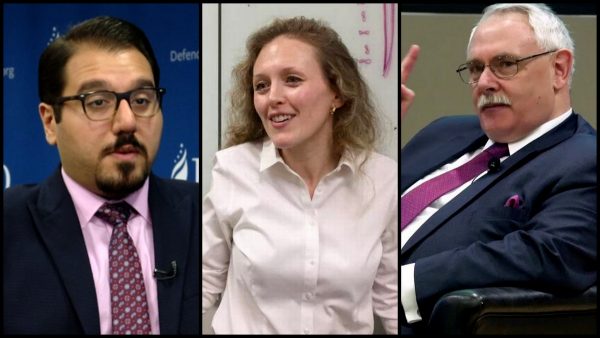
From left to right: Behnam Ben Taleblu, Priscilla Moriuchi, Nomran Roule
Another “expert” quoted in these articles was Norm Roule, who was introduced as “the former Iran manager for the office of the Director of National Intelligence.” Roule, who recently told the press that he believes that Iran “will muster its cyberforces in response” to U.S. sanctions, is a 34-year veteran of the CIA and, more importantly, a senior adviser to the group United Against Nuclear Iran (UANI).
UANI is a think tank stuffed to the brim with Iran hawks, counting among its current members former Senator Joseph Lieberman; Richard Dearlove, former head of the UK’s MI6; Tamir Pardo, former general director of Israel’s Mossad; and Jeb Bush. UANI was originally co-founded by Richard Holbrooke, John Bolton and Meir Dagan — another former general director of the Mossad. Thus, given their associations to organizations that have long promoted the destruction of the Iranian state, Roule’s analysis, much like Taleblu’s, can hardly be considered impartial or objective.
Self-isolated U.S. seeks a way out of the trap
The U.S.’ warning of an imminent Iranian cyber-threat in response to the U.S.’ decision to withdraw from the Joint Comprehensive Plan of Action (JCPOA), better known as the Iran nuclear deal, and its subsequent decision to reimpose harsh sanctions against the Islamic Republic, comes at a crucial time, as many key countries, including many important U.S. allies, have declined to follow the U.S.’ lead on isolating Iran and have even rejected it outright.
Indeed, as opposed to isolating Iran, the U.S. has become isolated itself, as E.U. countries have banned companies from complying with U.S. sanctions efforts and other key nations like China have refused to halt Iranian oil imports despite U.S. threats. However, were U.S. warnings of an “Iranian cyber-threat” to convince these countries, particularly Europe, that Iran was indeed on the offensive despite its desperate efforts to keep JCPOA alive, the U.S.’ isolation in terms of its Iran policy could well end.
The Iranian government seems to have caught on to the U.S.’ game but seemed to think that rather than simply being intended to intensify Washington’s isolation campaign, the fear mongering over “Iranian hackers” was aimed at justifying imminent U.S. aggression against Iran.
In a statement given to NBC by Alireza Miryousefi, spokeswoman for Iran’s UN delegation, she stated that “Iran has no intention of engaging in any kind of cyber war with the U.S.,” adding, “from our perspective, it’s more likely the U.S. wants the supposed suspicion of an attack as rationalization for a cyberattack against Iran.” Miryousefi went on to call the U.S. “the most belligerent cyber-attacker of any nation in the world, repeatedly attacking military and civilian targets across the world, including in Iran.”
Indeed, the U.S. famously targeted Iran’s civilian nuclear program with the Stuxnet virus it had jointly developed with Israel. It infected over 200,000 machines and destroyed around 20 percent of Iran’s nuclear centrifuges.
Perhaps unsurprisingly, even the media reports themselves hint that this is the case, stating that while “the U.S. has not yet decided whether it will retaliate in the event of an attack,” it is already preparing new sanctions to impose on the country whether or not an attack occurs and is also building “a case for its more confrontational stance” in a bid to convince its wary allies to join its aggressive Iran policy.
The reports also openly state that a “preemptive attack” against Iran is currently being debated by the Trump administration, but notes that officials are “divided” over the measure. However, given the increasing likelihood that Secretary of Defense James Mattis, who had supported JCPOA, is on the way out of the administration, the growing chorus of Iran war-hawks in the White House could soon make such “divisions” a thing of the past.
Whitney Webb is a staff writer for MintPress News and a contributor to Ben Swann’s Truth in Media. Her work has appeared on Global Research, the Ron Paul Institute and 21st Century Wire, among others. She has also made radio and TV appearances on RT and Sputnik. She currently lives with her family in southern Chile.
The knife in Iran’s back: Trump opens door to chaos
By Vijay Prashad | Asia Times | August 9, 2018
On Tuesday night, Iranian President Hassan Rouhani went on television to talk about the reinstatement of sanctions by the United States against his country. He prepared the country for more privations as a result of the sanctions. Responding to US President Donald Trump’s offer of a meeting, Rouhani said pointedly, “If you stab someone with a knife and then say you want to talk, the first thing you have to do is to remove the knife.”
It is clear to everyone outside the US government that Iran has honored its side of the 2015 nuclear deal that it made with the governments of the five permanent members of the United Nations Security Council (the US, the UK, France, China and Russia) as well as the European Union. In fact, quite starkly, EU foreign-policy chief Federica Mogherini said, “We are encouraging small and medium enterprises in particular to increase business with and in Iran as part of something that for us is a security priority.”
In other words, Mogherini is asking companies to resist Trump’s policy direction. What she is saying, and what Rouhani said, is that it is the United States that has violated the nuclear deal, and so no one needs to honor the US sanctions that have been reinstated.
Mogherini pointed to “small and medium enterprises” because these would not be the kind of multinational corporations with interests in the United States. But it is more than small and medium-sized enterprises that are going to challenge the US sanctions. China, Russia and Turkey have already indicated that they will not buckle under US pressure.
China
“China’s lawful rights should be protected,” said the Chinese government. China has no incentive to follow the new US position.
First, China imports about US$15 billion worth of oil from Iran each year and expects to increase its purchases next year. State energy companies such as China National Petroleum Corporation (CNPC) and Sinopec have invested billions of dollars in Iran.
CNPC and Sinopec also have shares in Iran’s major oil and gas fields – CNPC has a 30% stake in the South Pars gas field and has investments in the North Azadegan oilfield, while Sinopec has invested $2 billion in the Yadavan oilfield.
China’s Export-Import Bank, meanwhile, has financed many large projects in Iran, including the electrification of the Tehran-Mashhad railway. Other Chinese investment projects include the Tehran metro and the Tehran-Isfahan train. These projects are worth tens of billions of dollars.
Second, China is in the midst of a nasty trade war with the United States. In late August, Trump’s government slapped 25% tariffs on $16 billion worth of Chinese imports into the United States. China responded with its own tariffs, with its Commerce Ministry saying that the US was “once again putting domestic law over international law,” which is a “very unreasonable practice.”
The “once again” is important. China is seized by the unfairness of the reinstatement of sanctions on Iran, not only for its own economic reasons but also because it sees this as a violation of international agreements and a threat to Iranian sovereignty – two principles that China takes very seriously.
Sinopec, knee-deep in Iran’s oil sector, has now said that it would delay buying US oil for September. Iran has now been drawn into the US “trade war” (on which, read more here).
The Chinese have been quite strong in their position. The Global Times, a Chinese government paper, wrote in an editorial, “China is prepared for protracted war. In the future, the US economy will depend more on the Chinese market than the other way around.” This fortitude is going to spill over into China’s defense of Iran’s economy.
Russia
Russia and Iran do not share the kind of economic linkages that Iran has with China. After the 2015 sanctions deal, Iran did not turn to Russian oil and gas companies for investment. It went to France’s Total – which signed a $5 billion deal. Russia and Iran did sign various massive energy deals ($20 billion in 2014), but these did not seem to go anywhere.
Russia’s Gazprom and Lukoil have toyed with entry to Iran. In May, Lukoil directly said that it would be hesitant to enter Iran because of the proposed US reinstatement of sanctions. Lukoil’s hesitancy came alongside that of European companies such as Peugeot, Siemens and even Total, which decided to hold off on expansion or cut ties with Iran. Daimler has now officially halted any work in Iran.
It was a surprise this year when the Iranian Dana Energy company signed a deal with the Russian Zarubezhneft company to develop the Aban and West Paydar oilfields. The contract is for $740 million, which in the oil and gas business is significant but not eye-opening.
In July, senior Iranian politician Ali Akbar Velayati met with Russian President Vladimir Putin in Moscow. He left the meeting saying, “Russia is ready to invest $50 billion Iran’s oil and gas sectors.” Velayati specifically mentioned Rosneft and Gazprom as potential investors – “up to $10 billion,” he said.
When Putin was in Tehran last November, Russian companies signed preliminary deals worth $30 billion. Whether these deals will go forward is not clear. But after Trump’s reinstatement of sanctions, Russia’s Foreign Ministry said it would “take appropriate measures on a national level to protect trade and economic cooperation with Iran.” In other words, it would see that trade ties were not broken.
Turkey
Both Iran and Turkey face great economic challenges. Neither can afford to break ties. Turkish Foreign Minister Mevlut Cavusoglu has said that his government will only honor international agreements, and that the US reinstatement of sanctions is not part of an international framework. Turkey, therefore, will continue to trade with Iran.
Iranian oil and gas are crucial for Turkey, whose refineries are calibrated to Iran’s oil and would not be able to adjust easily and cheaply to imports from Saudi Arabia. Almost half of Turkey’s oil comes from Iran.
Turkish-US relations are at a low. Conflict over the detention of an American pastor, Andrew Brunson, has led to the US sanctioning two Turkish cabinet ministers, Justice Minister Abdulhamit Gul and Minister of Interior Suleyman Soylu. Gul is a leader of the ruling Justice and Development Party (AKP), while Soylu came to the party at the personal invitation of President Recep Tayyip Erdoğan. These are not men to be intimidated by US pressure.
A US mission led by Marshall Billingslea, assistant secretary of the US Treasury, went to Turkey to persuade the government to join the US sanctions. Meanwhile, the US has begun to put pressure on Turkey’s Halkbank, one of whose senior officials was found guilty of violation of the US sanctions on Iran by a court in the United States this year. This kind of pressure is not sitting well with the Turkish government.
Inside Iran
Pressure is mounting inside Iran. Protests have begun across the country, a reflection of the distress felt by the population as the country’s currency, the rial, slides and as fears of inflation mount.
Last week, the Iranian government fired the head of the central bank, Valiollah Seif, and replaced him with Abdolnasser Hemati. It reversed the foreign-exchange rules, including the failed attempt to fix the value of the rial that was put in place in April.
Hemati had been the head of Iran’s state insurance firm and before that of Sina Bank and Bank Melli. He is highly trusted by the government, which had already appointed him as ambassador to China before hastily rescinding that offer and moving him to the central bank. Whether Hemati will be able to balance the stress inside the Iranian economy is yet to be seen. Faith in the currency will need to be strengthened.
As part of that, Iran’s government has cracked down harshly against financial fraud, particularly scandals over foreign exchange. The man who signed the 2015 nuclear deal, Deputy Foreign Minister Abbas Araghchi, had to watch as his nephew Ahmad Araghchi, the central bank’s vice-governor in charge of foreign exchange, was arrested along with five other people as part of an inquiry over fraud. The message: No one, not even the Araghchi family, is immune from the long arm of the law.
Trump’s belligerence, the refusal of key countries to abide by Trump’s sanctions (including the European Union, but mainly Russia and China), as well as the internal pressure in Iran could very likely create the conditions for a military clash in the waters around Iran. This is a very dangerous situation. Sober minds need to push against the reinstatement of these sanctions – which the Iranians see as economic warfare – as well as escalation into military war.
This article was produced by Globetrotter, a project of the Independent Media Institute.
Trump’s Art of the Deal and Iran sanctions
By M K Bhadrakumar | Indian Punchline | August 4, 2018
An amicable formula seems to be emerging between the Trump administration on the one hand and China and India on the other hand as regards the impending US sanctions on Iran’s oil exports. Below-the-radar consultations are going on between Washington and Beijing and New Delhi.
The Trump administration initially threatened collateral damage to countries such as China and India unless they fell in line with the US diktat to stop all oil imports from Iran to zero by November 4. Oil is at the core of Trump’s containment strategy against Iran, since oil exports are a major source for income for Tehran and the American game plan is all about hurting the Iranian economy until its leadership capitulates and begs him for a meeting.
It’s a hackneyed notion to bully Tehran to make it bend. It never worked in these 40 years – not even under Barack Obama who enjoyed vast political capital in the international community. But the good thing about Trump is that behind the fire and fury, he’s a realist. (By the way, Iranians know it, too, as this utterly fascinating tongue-in-cheek commentary yesterday implies.)
So, after some rounds of diplomacy in world capitals (to test the waters, basically) – Beijing, New Delhi, Ankara, in particular, which are big-time buyers of Iranian oil – Washington began signaling that sanctions can also provide for ‘waivers’ – that is, Trump administration will selectively exercise the great privilege of deciding not to punish countries that may still want to buy Iranian oil after the November 4 cutoff date.
Quite obviously, from the feedback received from American diplomats, Washington senses great reluctance to pay heed to the US demarche. In particular, China and India (which account for over half of Iranian oil exports) are heavily dependent on Iranian oil – and, for good reason too. At least in the case of India, Iran offers oil at a discounted price on deferred payment basis with substantial reduction in freight and insurance costs.
Now, the US cannot possibly sanction the oil industry in China or India because Big Oil is also hoping to do business with them. (For shale oil, Asian market is the preferred destination.) Some analysts predict that Russia, which like America is also an energy superpower, will be a net gainer. Russia can cash in on the needs of China and India for oil; Russia can buy Iranian oil and sell it through swap deals and so on (and make some money in the bargain); or, Russia may even move into the Iranian oil industry in a big way and make investments there. At any rate, it is foolhardy for the US to imagine that it can control the world energy market in terms of price elasticity of supply.
In view of the above factors, the Trump administration is finessing an understanding with China and India whereby the US sanctions policy against Iran does not become an acrimonious issue. The interests to be reconciled are: a) China and India have legitimate interests in sourcing Iranian oil and it is unrealistic and counterproductive to coerce them; and, b) the US too has an abiding interest not to sanction the oil companies of China and India, which are prospective buyers of US oil.
The Bloomberg report, here, says that China has point blank refused to cut Iranian oil imports but may agree to keep imports at the existing level as of November 4. Interestingly, the report cites US officials heaving a sigh of relief: “That would ease concerns that China would work to undermine U.S. efforts to isolate the Islamic Republic by purchasing excess oil.” Plainly put, Washington is relieved that Beijing will not take advantage of the US sanctions against Iran.
On the other hand, the Reuters report on India, here, assesses that Indian imports of Iranian crude oil are dramatically increasing in recent months. A 30% increase is reported in July with crude imports from Iran touching record level of 768,000 barrels per day. (This is a whopping 85% jump over the corresponding period in July 2017, which was 415,000 bpd)!
Of course, if the US can allow China to keep its import of Iranian oil at the existing level as of November 4, it cannot deny a similar formula to India. And, therefore, doesn’t it make eminent sense that India keeps ramping up its oil imports from Iran to the maximum level possible by November 4?
Evidently, this is Trump’s Art of the Deal at work. By the way, for Iran too, this would provide some ‘sanctions relief’. Which in turn may even ‘incentivize’ Tehran to talk to Trump. If there is anything like a workable “win-win” in politics, this is it, this is it.
US Congress Passes $716Bln Defense Spending Bill for 2019
Sputnik – 01.08.2018
WASHINGTON – The US Senate on Wednesday passed the $716 billion National Defense Authorization Act for the fiscal year 2019. The measure passed with an 87-10 vote and now heads to US President Donald Trump’s office to be signed into law.
Last week, the House of Representatives passed the measure in a 359-54 vote. The measure also funds the Trump administration’s request for Ukraine, which included $250 million for lethal defensive items.
In addition, the bill adds $150 million to accelerate US efforts to field a conventional prompt strike capability before fiscal year 2022, in response to the critical advances Russia and China have made in developing their prompt strike hypersonic weapons.
The bill also funds the Trump administration’s request for $6.3 billion for the European Deterrence Initiative (EDI) to further increase the number of US troops in Europe and deter what it calls “Russian aggression.” The bill, in addition, prohibits military-to-military cooperation with Russia.
The bill obligates US Defense Secretary James Mattis to submit a plan to Congress to ban Turkey from acquiring the F-35 aircraft to punish it for purchasing Russian S-400 air defense systems and for detaining US Pastor Andrew Brunson.
The bill will also include Countering America’s Adversaries Through Sanctions Act (CAATSA) waivers for India, Vietnam and Indonesia.
The United States and NATO have significantly increased their presence in Eastern Europe since the eruption of the Ukrainian crisis in 2014. Moscow has repeatedly voiced its protest over the military buildup, saying that it will undermine regional stability and result in a new arms race.
Trump Duped by Saudis on Iran Oil Sanctions – Tehran Official
Sputnik – 01.08.2018
President Trump’s offer of “no preconditions” talks with Iran’s comes as a surprise break from months of escalating rhetoric in the wake of his walkout from the landmark Iran nuclear deal.
US President Donald Trump has apparently been hoodwinked by Saudi Arabia into believing that the kingdom will be able to make up for a projected drop in Iranian oil exports after the US sanctions take effect in November, Iran’s Press TV reported citing the head of the country’s OPEC governor.
“It seems President Trump has been taken hostage by Saudi Arabia and a few producers when they claimed they can replace 2.5 million barrels per day of Iranian exports, encouraging him to take action against Iran,” Hossein Kazempour Ardebili said.
US Back and Forth on Iran Oil Trade
The White House said last month that Saudi Arabia’s King Salman had promised Trump to raise oil production and that the kingdom had two million barrels per day of spare capacity to boost output to offset a decline Iranian oil supplies.
Iran insists that President Trump’s hope that certain oil producers can fill the gap created as a result of cutting off Iranian oil supplies is based on a “miscalculation.”
Late last month, a senior US State Department official said that countries buying Iranian oil should bring their Iranian crude imports down to zero by the time Washington re-imposes sanctions against the Islamic Republic’s banking and petroleum sectors.
Washington later backed off a bit with Secretary of State Mike Pompeo saying in July that the United States might grant waivers to countries seeking relief from sanctions the US has threatened to impose.
Trump’s U-Turn on Iran
On Monday, President Trump said he would be willing to meet his Iranian counterpart, Hassan Rouhani without preconditions to discuss how to improve ties, but Tehran flatly turned down Trump’s offer dismissing it as worthless and “a humiliation” after he acted to re-impose sanctions on Tehran following the withdrawal from the 2015 landmark nuclear deal.
“Sanctions and pressures are the exact opposite of dialogue,” Iran’s Foreign Ministry spokesman Bahram Qassemi said on Tuesday.
Trump’s overture towards Iran came a week after he threatened the country with “consequences the likes of which few throughout history have ever suffered before,” in an all caps tweet.
On May 8, President Donald Trump said he was withdrawing the US from the 2015 nuclear agreement with Tehran and promised to impose the “highest level” of sanctions on the country’s energy, petrochemical and financial sectors despite objections from Europe as well as Russia and China — the other parties to the deal, known as the Joint Comprehensive Plan of Action (JCPOA).
An Iran War Would Destroy the United States
By Philip Giraldi | American Herald Tribune | July 30, 2018
The establishment of a military force to go abroad and overthrow governments does not appear anywhere in the Constitution of the United States, nor does calling for destruction of countries that do not themselves threaten America appear anywhere in Article 2, which describes the responsibilities of the President. Indeed, both Presidents George Washington and John Quincy Adams warned against the danger represented by foreign entanglements, with Adams specifically addressing what we now call democracy promotion, warning that the United States “should not go abroad to slay dragons.”
Since the end of the Second World War, the United States has proven to be particularly prone to attacking other countries that have only limited capability to strike back. North Korea was the exception that proved the rule when the Chinese intervened to support its ally in 1950 to drive back and nearly destroy advancing U.S. forces. Otherwise, it has been a succession of Granada, Panama, Afghanistan, Iraq, Somalia, Serbia, and Libya, none of which had the capability to hit back against the United States and the American people.
Iran just might prove to be a harder nut to crack. There has been a considerable escalation in tension between Washington and Tehran since the White House withdrew from the Joint Comprehensive Plan of Action (JCPOA) in May. The JCPOA was intended to monitor Iran’s nuclear program to ensure that it would not be producing a nuclear weapon. Since that time, the U.S. and Israel have been threatening the Iranians and accusing them of both having a secret nuclear program and engaging in widespread regional aggression. In the latest incident, President Donald Trump tweeted in response to comments made on July 21st by Iranian President Hassan Rouhani, who had told a meeting of Iranian diplomats that war between America and Iran would be a misfortune for everyone, saying “Mr. Trump, don’t play with the lion’s tail, this would only lead to regret. America should know that peace with Iran is the mother of all peace, and war with Iran is the mother of all wars.”
Trump responded in anger all in capital letters, “NEVER, EVER THREATEN THE UNITED STATES AGAIN OR YOU WILL SUFFER CONSEQUENCES THE LIKES OF WHICH FEW THROUGHOUT HISTORY HAVE EVER SUFFERED BEFORE. WE ARE NO LONGER A COUNTRY THAT WILL STAND FOR YOUR DEMENTED WORDS OF VIOLENCE & DEATH. BE CAUTIOUS!”
Interventionist U.S. national security adviser John Bolton added fuel to the fire with a statement on the following day that “President Trump told me that if Iran does anything at all to the negative, they will pay a price like few countries have ever paid before.”
President Trump’s warning that he would annihilate Iran missed the point that Rouhani was offering peace and urging that both sides work to avoid war. The Administration has already announced that it will reinstate existing sanctions on Iran and will likely add some new ones as well. After November 4th, Washington will sanction any country that buys oil from Iran, markedly increasing the misery level for the Iranian people and putting pressure on its government.
Iran, while recognizing the overwhelming imbalance in the forces available to the two sides, has not taken the threats from Washington and Tel Aviv lightly. Its Quds Revolutionary Guards Special Forces chief Major Generral Qassem Soleimani has now warned Trump that “We are near you, where you can’t even imagine … Come. We are ready … If you begin the war, we will end the war. You know that this war will destroy all that you possess.”
Iran’s Guards commanders have in the past threatened to target and destroy U.S. military bases across the Middle East, and also target Israel, within minutes of being attacked. Military targets would be defended by both Israeli and U.S. counter-missile batteries but civilian targets would be vulnerable, particularly if Hezbollah, with an estimated 100,000 rockets of various types, joins in the fighting from Lebanon.
Washington argues that its pressure on Iran is intended to force its government to end its nuclear program as well as its support for militant groups in the Middle East, where Iran, so the claim goes, is engaged in proxy wars in both Yemen and Syria. The arguments are, however, largely fabrications as Iran has no nuclear weapons program and its engagement in Syria is by invitation of the legitimate government in Damascus while aid to Yemen’s Houthi’s is very limited. And there is no Iranian threat to the United States or to legitimate American interests.
Given the size of Iran, its large population, and clear intention to resist any U.S. attack, military action against the country, which many in Washington now see as inevitable, would be by missiles and bombs from the air and sea. But it would not be a cakewalk. In the past year, Iran has deployed the effective Russian made SA-20c SAM mobile air defense units as well as the S-300 VM missile system, which together have a range of more than 100 miles that could cover the entire Persian Gulf. Radar has also been upgraded. They are the centerpieces of an air defense system that could prove formidable against attacking U.S. aircraft and incoming missiles while ballistic missiles in large numbers in the Iranian arsenal could cause major damage to U.S. bases, Israel, the Gulf States and Saudi Arabia.
All of which means that Americans will die in a war with Iran, possibly in substantial numbers, and the threat by Iran to close the strategic Strait of Hormuz is no fantasy. It has threatened to do so if its own oil exports are blocked after November 4th, even if there is no war. And if there were war, even if subjected to sustained attack, Iran would be able to threaten ships trying to use the Strait with its numerous batteries of anti-ship missiles hidden along the country’s rough and mountainous coastline, to include the Russian made SS-N-22 Sunburn, which is the fastest and most effective ship killing missile in anyone’s arsenal. Fired in volleys, it would be able to overwhelm the defenses of U.S. warships, to include aircraft carriers, if they get too close. With the Strait closed in either scenario, oil prices would go up dramatically, damaging the economies of all the major industrialized nations, including the United States. A major war would also add trillions to the national debt.
Iran also has other resources to strike back, including cadres ready and able to carry out terror attacks in the United States and Western Europe. American tourists in Europe will be particularly vulnerable. The reality is that the United States has no motive to go to war with Iran based on its own national interests but seems to be prepared to do so anyway under pressure from Israel and Saudi Arabia. If it does do so, Iran will certainly lose, but the damage to the United States at every level might possibly be very high.
Featured Video
Bombing Hitler’s Hometown
or go to
Aletho News Archives – Video-Images
From the Archives
‘Conspiracy Theory’ Now Fact: Greater Israel Has Arrived
By Kit Klarenberg | Mint Press News | January 28, 2025
Ever since Tel Aviv’s 1948 creation, much has been said and written about ‘Greater Israel’ – the notion Zionism’s ultimate end goal is the forcible annexation and ethnic cleansing of vast swaths of Arab and Muslim lands for Jewish settlement, based on Biblical claims this territory was promised to Jews by God. The mainstream media typically dismisses this concept as antisemitic conspiracy theory, or at most the fringe fantasy of a minuscule handful of extremist Israelis.
In reality … continue
Blog Roll
 Aletho News
- Trump admits Iran hit USS Ford carrier: ‘We ran for our lives’
- Battle for Hungary: EU attacks on Orban are a sign of worse things to come
- Iraqi resistance conducts drone strike on US-run base in Syria
- Failing to Defeat Hezbollah, Israel & US Pressure Syria’s Ahmed al-Sharaa to Join War
- US-Israeli war on Iran drives global fertilizer prices up 40%
- Hezbollah’s Surprise Weapons Redefine Ground Battle with Israel
- Yemen joins fight against US, Israel by firing missiles at occupied territories
- Seizing the Kharg: Washington’s path to defeat in the Persian Gulf
- Iran reports 500 US casualties in strikes on covert US military sites
- Pro-Israel terrorist arrested before assassination of pro-Palestinian activist
- If Americans Knew
- Researchers at Human Rights Watch Resign Over Blocked Report on Palestinian Refugee Return
- Jewish Groups Are Backing a War Americans Don’t Want
- Eric Fingerhut Thinks He’s the President of the Jews
- Top Jewish Philanthropists, Rabbis Urge Israeli President to Take Action Against ‘Jewish Extremists’
- Don’t Be Fooled. Zionist Leaders Have Always Wanted to Control Southern Lebanon
- Israel’s widespread use of torture is a core element of its genocide against the Palestinian people
- In Israel’s War on Iran, Many Middle East US Bases Rendered “All But Uninhabitable”
- ‘Burn the lawn’: Israel pursues ‘Rafah model’ in southern Lebanon
- A genocide here, an amputation there
- Reports: Iran mobilizing 1M fighters, Israel-US run low on ammo, Israeli army faces shortage – Not a ceasefire Day 168
- No Tricks Zone
- Devastating Assessment Of Comirnaty Vaccine By Former Senior Pfizer Europe Toxicologist
- New Study: CO2 Is ‘Effectively Negligible’ As An Explanatory Climate Change Factor Since 2000
- Former Pfizer Toxicologist Dr. Helmut Sterz Tells Bundestag Hearing Pfizer Vaccine Should Have Never Been Approved
- Energy Expert: Germany’s Nuclear Phaseout Was A “500 Billion Euro Mistake”
- New Research: South Australia’s Mid-Holocene Sea Surface Temperatures Were 4°C Warmer Than Today
- Storing Green Energy To Last Germany 10 Days Would Require A 60-Million Tonne Battery
- New Studies: UK Sea Levels Were 4 Meters Higher Than Today During The Mid-Holocene
- Destructive Green New Deal: German Energy And Metal Group Warns Of Drastic Crisis
- New Study Documents A 20-Year Pause In Arctic Sea Ice Decline – Driven By Internal Variability
- Wake-up Call: Survey Shows Majority Of Germans Now Favor Postponing Climate Targets!
 Aletho News