US Destabilizes Iraq for Decades, US House of Representatives Has New Plan for Stabilization
By Adam Dick – Ron Paul Institute – November 28, 2018
The United States attacked Iraq in the Gulf War in 1990, followed by years of US bombing of Iraq. Then, in 2003, the US invaded and conquered Iraq in the Iraq War. Since then, many US troops have been stationed in Iraq, along with a huge contingent of US government employees and contractors from a variety of agencies, seeking to mold the country to US wishes. Still, 28 years since all this began (and longer since the previous US assistance for the Iraq government it later overthrew), the US House of Representatives approved on Tuesday a bill titled the Preventing Destabilization of Iraq Act (HR 4591).
The only way this bill title would make sense given the long history of massive US intervention failing to improve the situation in Iraq is if the bill required the end of US intervention. Instead, the bill seeks more intervention.
In particular, the Preventing Destabilization of Iraq Act calls on the US president to impose sanctions on any foreign people he determines knowingly commit “a significant act of violence that has the direct purpose or effect of — (1) threatening the peace or stability of Iraq or the Government of Iraq; (2) undermining the democratic process in Iraq; or (3) undermining significantly efforts to promote economic reconstruction and political reform in Iraq or to provide humanitarian assistance to the Iraqi people.” Further, the bill charges the US Secretary of State to determine if listed individuals should be sanctioned and if people connected to certain organizations should be considered terrorists or sanctioned. In other words, the bill calls for ramping up proven destructive policies for reshaping Iraq.
Also included in the bill is a call for action that would help push for escalating the US government’s destabilization project in Iran. The bill says the Secretary of State “shall annually establish, maintain, and publish a list of armed groups, militias, or proxy forces in Iraq receiving logistical, military, or financial assistance from Iran’s Revolutionary Guard Corps or over which Iran’s Revolutionary Guard Corps exerts any form of control or influence.” Thus, claims of Iran’s intervention in its neighboring country can be used to build the case for massive intervention in Iran, up to invasion and conquest of Iran, by a nation thousands of miles away. Not to worry, 28 years from now, the US Congress can approve a Preventing Destabilization of Iran Act.
Iran rejects ‘ridiculous’ US claims against its missile program
Press TV – December 2, 2018
Iran has rejected US Secretary of State Mike Pompeo’s claims against its missile capabilities, saying the program is defensive and does not violate the international agreement on Tehran’s nuclear program.
“Iran’s missile program has a defensive nature and is designed according to the needs of the country,” Foreign Ministry spokesman Bahram Qassemi said Sunday, responding to Pompeo’s claim that Tehran had tested a medium-range ballistic missile.
Pompeo claimed in a statement released on Twitter Saturday that Iran was increasing its “testing and proliferation” of missiles and called on the Islamic Republic to “cease these activities.”
The test, he said, “violates UNSCR 2231,” citing the United Nations Security Council’s endorsement of the international nuclear agreement which the United States abandoned in May.
“No resolution at the Security Council has banned Iran’s missile program or missile tests,” Qassemi said as he roasted Washington over its decision to pull out of the Joint Comprehensive Plan of Action (JCPOA).
“What is interesting and, of course, ridiculous is that you are citing a resolution which you have not only violated with your unilateral and illegal withdrawal from the JCPOA, but also are encouraging others to violate it or even threaten to punish and sanction those who implement it,” he added.
UN Security Council Resolution 2231 “calls on” Iran “not to undertake any activity related to ballistic missiles designed to be capable of delivering nuclear weapons, including launches using such ballistic missile technology.”
Tehran has always emphasized that it has no nuclear warheads and that none of its missiles have been designed to carry nuclear weapons.
The International Atomic Energy Agency (IAEA) has repeatedly confirmed Iran’s compliance with the accord.
Back in May, US President Donald Trump pulled his country out of the JCPOA despite objections from the other signatories to the nuclear deal.
Since then, Washington has imposed “toughest ever” sanctions against Iran. It has also warned of severe penalties for the companies that evade the bans and engage in business with Iran.
However, the European parties to the JCPOA have vowed all-out efforts to save the agreement and protect their firms in the face of American bans.
They are now working to set up the so-called Special Purpose Vehicle (SPV) in a bid to circumvent the US sanctions against Iran and facilitate non-dollar trade with Tehran.
US creates new facts on the ground in Syria
By M. K. BHADRAKUMAR | Indian Punchline | November 24, 2018
The Trump administration is making a determined effort to engage with Turkey, which used to be the anchor sheet of American regional strategies in the Middle East for several decades. Without a robust partnership with Turkey, US policies remain ineffectual on several regional fronts – ranging from the Black Sea and Eastern Mediterranean to post-conflict Syria, Iran oil sanctions and Gulf security — and even Khashoggi affair.
Turkey has a long list of grievances – real, feigned or imaginary. But President Trump senses that Turkish president Erdogan prioritizes two core issues – demand that a) Washington should extradite his arch political rival Islamist preacher Fetullah Gulen (who he alleges plotted the failed coup against him in 2016); and, b) that the so-called Halkbank case in a Manhattan court should be wound up.
Trump has lately signaled that he is acting on both issues. Gulen is a tough call for Trump insofar as he has been an “asset” of the CIA. The Halkbank file may be relatively easy to handle.

(Fetullah Gulen’s ‘retreat center’ in Pennsylvania)
In turn, Erdogan is holding the trump card in the Khashoggi affair, which has potential to undermine the US’ grand Middle East strategies. A top Saudi establishment commentator Abdulrahman Al-Rashed wrote in the Saudi daily Asharq Al-Awsat, “Turkey has been using the (Khashoggi) crime to push Trump to make concessions to release a convicted Turkish banker or hand over an opposition figure in exchange of stopping its campaign against Saudi Arabia.” Clearly, Trump expects Erdogan to stop fueling the Khashoggi affair.
Erdogan has now let it be known that he is open to meeting with the Saudi Crown Prince Mohammed bin Salman on the sidelines of the G20 summit in Argentina on November 30.
However, the Turkish-American engagement has a much bigger backdrop — Syrian conflict. How far the tango over Khashoggi helped US to address the Syrian situation is hard to tell, but American diplomacy has a way of juggling several balls. In particular, the Pentagon’s alliance with Syrian Kurdish groups worries Turkey and Erdogan has been threatening to move against them.
Now, the US has come up with an innovative idea to work with Turkish military apropos any terrorist threats from Syria. Two days ago, US defence Secretary James Mattis unveiled the idea with disarming simplicity during an interaction with the media:
“Turkey is a NATO ally and they have legitimate concerns about terror threats… from Assad’s Syria… And Turkey has a lot of reasons for concerns, being the NATO country with a border right along Syria. And we don’t dismiss any of their concerns. We are putting in OPs up in northern Syria, this is the change now, okay? We are putting in observation posts in several locations up along the Syria border — northern Syria border because we want to be the people who call the Turks and warn them if we see something coming out of an area that we’re operating in. This is closely collaborated – we are consulting closely with Turkey, military and State Department. Both were consulting with them.”
“We are going to track any threat that we can spot going up into Turkey. That means we will be talking to Turkish military across the border. They will be very clearly marked locations day and night so that the Turks know where they’re at.”
Meanwhile, Voice of America also reported on November 22 that “a large military convoy from an Arab country was deployed last week to the eastern Syrian province of Deir el-Zour” in the region under US control.
Prima facie, the US is pre-empting any excuse by Turkey to attack the Kurdish groups by offering a CBM. But the bottom line is that the US is marking as its exclusive preserve a vast swathe of territory in Syria’s northeastern region — roughly one-third of entire Syria — which is rich in hydrocarbon reserves and water resources, and it expects Turkey to respect the ground reality.
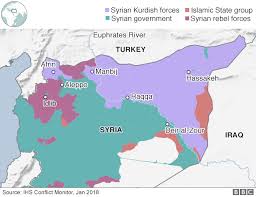
(Who controls what in Syria.)
Without doubt, an entity is being carved out of Syria that is beyond the reach of Damascus, with the Arab Forces providing the “steel frame” for internal security and acting as deterrent against any Turkish attacks against the Kurdish militia, while the US monitors the border region with Turkey.
Mattis claimed that Turkey is on board. But Turkey strongly supports Syria’s unity. Turkish Defence Minister Hulusi Akar has openly voiced disquiet over the US move to set up observation posts on Turkish-Syrian border. Akar disclosed that Turkey conveyed its “discomfort” to the Pentagon:
“We have stated that the observation points to be established by the US troops on the Syrian border will have a very negative impact… and in the course of our discussions we expressed that it could lead to a perception that US soldiers are somehow protecting terrorist YPG (Syrian Kurdish) members and shield them.”
Equally, could an Arab force’s – most likely Saudi and Emirati troops – deployment (just when the war is ending) have been without prior consultation between Washington and Ankara? The point is, Turkey has troubled relations with both Saudi Arabia and the UAE and will resent their deployment of troops to its border regions with Syria.
In sum, the US’ newfound role as the gatekeeper of the Turkish-Syrian border means the Pentagon is creating new facts on the ground, which signals a long-term US occupation of northern Syria. There are serious implications for Syria’s unity and territorial integrity. Indeed, the last thing that Turkey wants is an independent entity along its border with Syria where the Kurds enjoy autonomy. Turkey has a congruence of interests with Russia and Iran in this regard.
Russia: US Sanctions over Alleged Oil Supply to Syria Looks Like “Statement of Support for Terrorists”
Sputnik – 21.11.2018
MOSCOW – Regular US anti-Russian sanctions are routine, the Russian Foreign Ministry said in a statement on 21 November.
“Washington continues to impose sanctions on Russia at an increasing rate. Their recent expansion has become the 11th in the last three and a half months, and is increasingly becoming a routine,” the ministry said.
The ministry noted that the main reasons for the introduction of sanctions lay in the internal political discord in the United States when each of the parties sought to “earn points” by any means.
“Attempts to accuse [some states] of supplying oil to Syria, whose armed forces have been fighting terrorist aggression for eight years, look like a statement of support for terrorists and at the same time a desire to prevent the restoration of a devastated country, many of whose inhabitants are deprived of light and heat. Is that what the US wants?” the statement read.
The ministry stressed that by trying to put pressure on Russia, Washington had repeatedly demonstrated its inability to force Moscow to change its independent line in the international relations.
The statement has been voiced a day after the United States announced the introduction of new sanctions against Syria, Iran and Russia. The reason for the restrictive measures was alleged secret supplies of Iranian oil to Damascus with the “assistance” of the Russian side.
This is the last package of sanctions against Russia that have been introduced by the United States for several years, blaming Moscow for meddling other countries’ elections and poisoning people, with all the accusations denied by Russian officials.
US Threatens ‘Grave Consequences’ for Those Who Supply Oil to Syria
Sputnik – 21.11.2018
The United States claims that an illegal scheme is in place to support Syrian President Bashar Assad and provide financial assistance to Hezbollah and Hamas.
US Secretary of State Mike Pompeo has promised severe consequences for anyone who is supplying oil to Syria or trying to circumvent US sanctions against Iran.
“Today’s US Treasury’s action targeting the Russia-Iran oil scheme to prop up [Syrian President Bashar] Assad, and finance Hizballah & Hamas, sends a clear message: there are grave consequences for anyone shipping oil to Syria, or trying to evade U.S. sanctions on the Islamic Republic’s terrorist activities,” Pompeo wrote on Twitter on Tuesday.
He added that Iran’s spiritual leader, Ayatollah Ali Khamenei, “should decide if spending the Iranian people’s money on the Iranian people is more important than inventing schemes to fund Assad, Hizballah, Hamas, and other terrorists”.
On Tuesday, Washington added six individuals and three organisations to its sanctions list claimed by the Treasury to be involved in oil shipments to the Syrian government, among them the Russian companies Global Vision Group and Promsyryeimport, and the latter company’s first deputy director Andrei Dogayev.
The list also features two Iraqi nationals, a Lebanese, a Syrian and an Iraqi,as well as the Iranian-registered Tadbir Kish Medical and Pharmaceutical Company.
According to the US Treasury Department, the Global Vision Group and Syrian citizen Mohammed Amer Alshviki, who, according to Washington, is the company’s owner, allegedly play a key role in a scheme for petroleum shipments to Syria and financial transfers to the Quds Force special unit of Iran’s Revolutionary Guards Corps.
Shortly before that, US Special Representative for Syria James Jeffrey stated that the recently imposed second batch of US sanctions against Iran are aimed at forcing Tehran to reduce its ‘presence’ in Syria.
Russia and Iran are yet to comment on these accusations and sanctions.
French bank pays huge US fine for doing business in Cuba, Iran
RT | November 20, 2018
Societe Generale has agreed to pay $1.34 billion to US federal and state authorities to settle a pending legal dispute over violations of US trade sanctions against Iran and other countries.
One of France’s largest banks has also pledged to pay $95 million to resolve another dispute over violations of anti-money laundering regulations.
“We acknowledge and regret the shortcomings that were identified in these settlements, and have cooperated with the US authorities to resolve these matters,” the group CEO Frederic Oudea said in a statement.
“These resolutions, following on the heels of the resolution of other investigations earlier this year, allow the bank to close a chapter on our most important historical disputes.”
The bank, informally known as SocGen, reportedly violated the Trading with the Enemy Act by illegally transferring billions of dollars to partners registered or located in countries targeted by US embargos, including Iran, Sudan, Cuba and Libya.
The banking giant said the settlement wouldn’t have an extra impact on its results for the current financial year. SocGen had previously agreed to $1.3 billion (€1.14 billion) in the US and France to settle investigations over transactions with Libya, and over the suspected rigging of Libor, a benchmark rate tied to finance products and debts. Last year, the bank had paid €963 million ($1.1 billion) over another dispute with the Libyan Investment Authority.
According to the Manhattan US Attorney’s office, the latest fine imposed on SocGen is the second biggest financial penalty issued on a bank for breaching US sanctions. In 2015, French international banking group BNP Paribas agreed to pay $8.9 billion to settle a probe on sanctions violations.
EU Mulls Iran Sanctions in Light of Alleged Plots in France, Denmark – Reports
Sputnik – 20.11.2018
Until now the EU has been unwilling to join the US sanctions on Iran preferring to maintain close trade ties with the Islamic Republic.
In a most recent policy U-turn, European Union foreign ministers hinted on Monday that their countries could be prepared to impose new economic sanctions on Iran, Reuters reported.
The sudden shift of policy came after France and Denmark accused Tehran of being allegedly behind a series of plots to carry out attacks on their soil. During a meeting in Brussels French and Danish foreign ministers filled in their fellow EU counterparts on the details of the alleged Iranian plots, although no details or names were discussed, Reuters quoted diplomats as saying on Tuesday.
France has imposed sanctions on two Iranians and Iran’s intelligence service over what it says was a botched attempt to stage a bomb attack at a rally near Paris organised by an exiled Iranian opposition group.
In October, France said it was certain about the Iranian intelligence ministry’s role in the June plot to attack a demonstration by Iranian exiles near Paris.
Also in October, Denmark said it suspected an Iranian government intelligence service of plotting an assassination on its territory and is also ready to join possible EU-wide sanctions against the Islamic Republic.
Iran has denied any involvement in either alleged plot and warned that it could pull out of the nuclear deal if EU powers do not stand up for its trade and financial benefits.
The readiness to punish Tehran would be the first such move in years by the EU, which has been trying keep in place the 2015 nuclear accord with Iran. Brussels has been unwilling to consider sanctions, instead seeking talks with Tehran.
In March, a joint proposal by Britain, France and Germany to sanction Iran over its development of ballistic missiles and its role in the Syrian war failed to gather sufficient support across the EU, including from Italy which wants to maintain business ties with Iran.
During the meeting on Monday, the EU foreign ministers tried to balance the EU’s policy towards Iran by speeding up the creation of a special mechanism to trade with Tehran that could be under EU, not national, law.
Dubbed the Special Purpose Vehicle (SPV), this mechanism could be used to help match Iranian oil and gas exports against purchases of EU goods as part of a barter arrangement, thus circumventing US sanctions, which are based on global use of the dollar for oil sales.
Despite technical difficulties and delays, the EU hopes this arrangement could protect individual member states from being hit by the sanctions Washington has threatened to use against countries that continue doing business with Iran.
John Bolton Wins “Defender of Israel” Award From Zionist Lobby Group That Helped Appoint Him
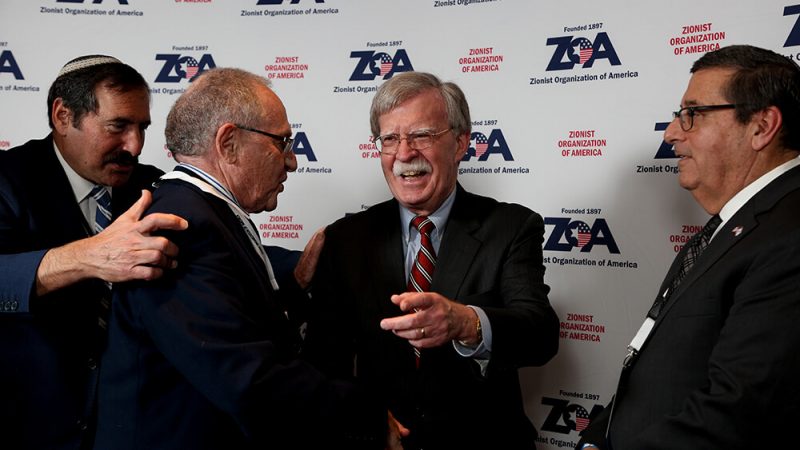
Pictured left to right: Joseph Frager, Alan Dershowitz, and John Bolton at the 2018 Zionist Organization of America awards. Photo | ZOA
By Whitney Webb | MintPress News | November 12, 2018
The ZOA, Bolton’s enthusiastic sponsor, led the campaign to remove former National Security Adviser H.R. McMaster from his post after railing against McMaster’s “anti-Israel” positions, most notably his support for the Joint Comprehensive Plan of Action (JCPOA), better known as the Iran nuclear deal.
The Zionist Organization of America (ZOA) recently awarded U.S. National Security Adviser John Bolton the “Defender of Israel Award” during its annual awards dinner, which took place in New York on Sunday night.
Other awardees included U.S. Ambassador to Germany Richard Grenell as well as Fox News television host Mark Levin. Both Grenell and Levin are close to Bolton, with the former having served as Bolton’s spokesman and the latter having worked closely with Bolton at the Department of Justice in the Reagan administration.
Though Bolton has received several awards from the Israel lobby in the past, due to his fervent promotion of Zionism and Israeli government policy, this more recent award is notable, as the ZOA is largely responsible for Bolton’s appointment as National Security Adviser within the Trump administration.
Indeed, beginning in August 2017, the ZOA – under the leadership of its president, Morton Klein – led the campaign to remove former National Security Adviser H.R. McMaster from his post after railing against McMaster’s “anti-Israel” positions, most notably his support for the Joint Comprehensive Plan of Action (JCPOA), better known as the Iran nuclear deal.
However, McMaster had also earned the ire of American Zionists for allegedly referring to Israel as an “occupying power” and acknowledging the existence of Palestine — as Zionists at ZOA and like-minded organizations support a revisionist history of the creation of the Israeli state that asserts that Palestine as a state never existed prior to Israel’s establishment in 1948.
Leaked emails reported on by MintPress earlier this year revealed that ZOA’s campaign to remove McMaster soon won the support of Trump’s top political donor, Zionist billionaire Sheldon Adelson. It was later revealed that Adelson had been instrumental in placing Bolton in the position McMaster vacated, as Bolton had long been a confidant of the politically influential casino magnate and Adelson had previously lobbied Trump – then president-elect – to include Bolton in his cabinet.
Bolton has not disappointed his sponsors
Since his appointment in April, Bolton has promoted and helped bring to fruition policies long supported by Adelson and the ZOA – which Adelson helps fund – as well as related groups. Under Bolton’s influence, President Trump unilaterally withdrew the U.S. from the JCPOA and imposed harsh sanctions against Iran, which disproportionately affect Iranian civilians. Secretary of State Mike Pompeo recently stated that Iranian leaders would need to fall in line if “they want their people to eat,” underscoring the fact that the Iranian people are by and large the target of the U.S. sanctions targeting Iran.
In addition, Bolton has also used his role as National Security Adviser to advocate for other troubling policies in the Middle East to the benefit of Israel, such as the continuation and expansion of the U.S.’ occupation of around 30 percent of Syrian territory.
Bolton announced in July that the U.S. would maintain its military presence in Syria until the “Iranian menace was wiped off the map.” Bolton’s announcement became administration policy just two months later in September. However, just days before Bolton took over for McMaster, Trump had announced that he wanted to remove U.S. troops from Syria “very quickly.”
Ultimately, Bolton’s recent award from the Adelson-backed ZOA for “defending Israel” is the result of events that ZOA itself helped made possible. Now that Bolton – who they helped install into power – has helped bring about the very policies they had hoped he would manifest, ZOA has granted him a “prestigious” award. Perhaps it is only fitting that he receive such thanks for the service to Zionism he was installed to provide. Indeed, it is a cause and ideology that Bolton has repeatedly supported – often at the expense of U.S. government interests and even U.S. national security.
Whitney Webb is a staff writer for MintPress News and a contributor to Ben Swann’s Truth in Media. Her work has appeared on Global Research, the Ron Paul Institute and 21st Century Wire, among others. She has also made radio and TV appearances on RT and Sputnik. She currently lives with her family in southern Chile.
See also:
Bolton’s Past Advocacy for Israel at US Expense Heralds Dangerous New Era in Geopolitics
Copyright © Whitney Webb, MintPress News, 2018
US Blocks $199Mln in Assets Belonging to Iran, Syria, N Korea in 2017 – Treasury
Sputnik – 07.11.2018
WASHINGTON – The United States blocked nearly $200 million in assets belonging to Syria, Iran, and North Korea in 2017 as a result of the sanctions imposed on the three countries, the Treasury Department said in its annual report to Congress released on Wednesday.
“Approximately $199 million in assets relating to the three designated state sponsors of terrorism in 2017 have been identified by OFAC as blocked pursuant to economic sanctions imposed by the United States,” the report said.
The statement comes days after the US fully reinstated sanctions against Iran, including measures that curb Tehran’s oil industry. At the same time, the United States temporarily exempted eight nations — China, Greece, India, Italy, Japan, South Korea, Taiwan and Turkey — from the sanctions on importing oil from Iran.
In May, US President Donald Trump announced that the United States would withdraw from the Iran nuclear agreement, officially known as the Joint Comprehensive Plan of Action, and reimpose sanctions against Tehran that were previously lifted under the accord, including secondary restrictions.
The first round of the US sanctions was reimposed in August, while the second round, targeting over 700 Iranian individuals, entities, banks, aircraft and vessels, came into force this week.
Lavrov Calls US Sanctions on Iran ‘Illegitimate’, Slams Pressure on SWIFT
Sputnik – 06.11.2018
Washington implemented tough unilateral sanctions against the Islamic Republic on Monday following President Trump’s withdrawal from the Iran nuclear deal in May.
Russian Foreign Minister Sergei Lavrov has condemned Washington’s decision to slap Tehran with sanctions, calling the restrictions “absolutely illegitimate” and deeply disappointing, and saying that it was “unacceptable” to hold dialogue in the language of ultimatums.
“As far as the US measures against Iran are concerned, they are absolutely illegitimate,” Lavrov said on Tuesday in Madrid following a meeting with Spanish officials.
“They are being implemented in flagrant violation of the decisions of the UN Security Council, and the way in which these measures are announced and implemented cannot but cause a deep sense of disappointment. We proceed from the idea that the norms of not only international law, but of international dialogue, have not been repealed,” Lavrov stressed.
“Pursuing a policy based on ultimatums and one-sided demands is hardly permissible in our times,” according to the Russian foreign minister.
Pressure on SWIFT Also Unacceptable
Commenting on suspected US pressure on international financial messaging system SWIFT, which implied Monday that it would comply with US sanctions against Iranian financial institutions, Lavrov said that such pressure was also illegitimate.
“Within the framework of the participants of the Joint Comprehensive Plan of Action (JCPOA) agreement, mechanisms are being developed which will allow for the continued implementation of the provisions of this document, first of all as regards [nations’] economic ties to Iran without US participation, and this is not a simple matter,” the foreign minister explained. “You can see how, using unacceptable methods, pressure has been placed on the operators of the SWIFT system. But experts are actively engaged in these issues, and they have a sufficiently stable understanding that this is possible and that such measures will be found.”
On Monday, Washington followed through with plans to renew sanctions against Iran following President Trump’s exit from the JCPOA Iran nuclear deal. The tough sanctions target Iran’s energy, banking and sea-based transport sectors, and threaten so-called secondary sanctions against foreign companies and countries doing business with the Islamic Republic.
The Belgium-based SWIFT financial messaging service announced that it would be suspending some Iranian banks’ access to the system, making no mention of US sanctions. Calling the move “regrettable,” SWIFT’s statement said it had taken the step “in the interest of the stability and integrity of the wider global financial system.”
All of the JCPOA’s other signatories, including Iran, Russia, China and several European powers, have made an effort to save the landmark nuclear deal and bypass the US sanctions or otherwise limit their impact. This has included the development of a Special Purpose Vehicle (SPV) on trade. China and India, the largest importers of Iranian crude oil, have resisted US secondary sanctions threats, and were granted exemptions along with five other oil-importing countries plus Taiwan.
India should stay the course on Iran oil
By M. K. BHADRAKUMAR | Indian Punchline | November 5, 2018
The new kids on the block are unaware that not a year had passed since the Islamic Revolution in Iran 40 years ago when US sanctions against that country wasn’t a fact of life. Iran has weathered multiple rounds of sanctions before.
As a BBC commentary put it, “Iranians will be forced into finding creative ways to sell oil, relying on their years of experience of life under previous sanctions. And to fill the gap left by lost European investment, Iran will be looking east to forge new links with Russia and China.”
This is also the signal one gets from the Iranian reaction to the Trump administration’s re-imposition of sanctions. At the most authoritative level, Supreme Leader Ali Khamenei has been plainly dismissive. Some excerpts from his remarks on Saturday:
“The enemy made every attempts against us, with a variety of actions; the US engaged in military, economic, and media warfare against us. Via all these actions, the US aspired, in vain, to regain its previous domineering status over Iran — that it enjoyed during the Pahlavi Regime.”
“Today, an overview of the situation of the US shows that the US’s power is declining. The US is today much weaker than it was forty years ago… US’s soft power has degraded… US’s hard power — that is, its economic and military power — is also declining… It suffers from more than $15 trillion dollars public debt and $800 billion budget deficit… The US is declining. Everyone should know this.”
Clearly, for Tehran, talks with the US will be simply out of the question.
On the other hand, there are no knee-jerk reactions, either – such as that Iran is going to dump the 2015 nuclear deal. As the Iranian ambassador to the UK Hamid Baeidinejad (who was a leading member of Iran’s negotiating team with the US during 2013-2015) put it, “The aspiration that we have with the European Union, Britain, France and Germany, China and Russia, is that we keep the Iran Nuclear Deal alive and give time to the U.S. to rethink and revise its position.”
Baeidinejad added, Tehran will not accept any idea of changing or renegotiating the nuclear deal, because if one word is changed other aspects of the deal will either be changed or compromised. “We have a total loss of confidence” in negotiating with the US, but “we are trying very hard with European countries, with China and Russia, to find mechanisms that this deal could (still) be effectively implemented.”
The ambassador said, “There will be pressure against some countries, particularly European countries, and economic and trade institutions from attempting to enter into working with Iran, there will probably be some risks.” However, there is “total determination” by European countries and other world partners to find “practical solutions” so that the deal will be kept alive.
These remarks sum up the Iranian position. Tehran estimates that it has much elbowroom left to force a rethink on the Trump administration.
Curiously, this is also the assessment of some Israeli experts. A commentary in the Jerusalem Post gives the expert opinion that while the US’ oil sanctions will no doubt hurt Iran, “Tehran maintains key support from Asia,” which means that the sanctions are “insufficient to compel Iran to accept a new tougher nuclear deal.” Equally, support for Iran from China, Russia, India and South Korea would be too strong too [sic] sufficiently isolate the Islamic Republic’s economy… the fundamental dynamics protecting Iran from a total collapse if anything are even more solid (today).”
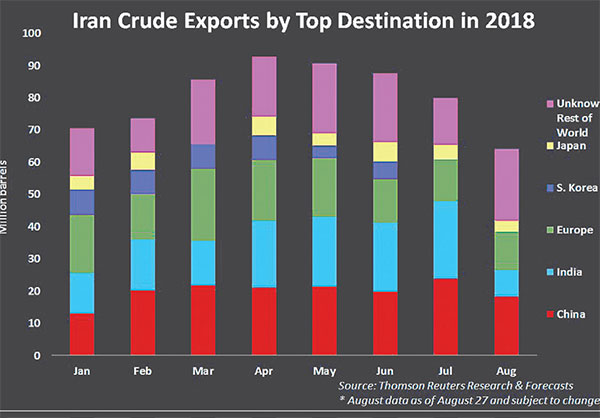
Interestingly, Tehran is not perturbed about the US threat to cut Iran off from the SWIFT. The fact of the matter is that Iran has an alternative to SWIFT – Russia’s SPFS. By the way, SPFS’ clients already include three of the top importers of Iranian oil – China, India and Turkey. (India probably used it recently to make payments for its purchase of the Russian S-400 ABM system!)
Suffice to say, Washington not only needs to accept that SPFS is a viable workaround for countries to import Iranian oil, but also a factor in the long-term implications of the emergence of such a new and parallel monetary system.
Therefore, the Trump administration’s decision to give the ‘waiver’ on import of Iranian oil is understandable. It is only prudent not to jeopardize the US’ relations with countries such as India or Turkey on account of the Iran oil sanctions when these countries are in any case going to find ingenious ways to import Iranian oil.
Then, there are other factors at work. One, as mentioned above, the US realizes that it lacks the ability to bring Iran’s oil exports to anywhere near zero level, as it once boasted. Two, oil sanctions against Iran will impact the world oil prices. Can Trump afford the political cost of oil prices cascading to, say, $100 bpd or more when he gears up for his re-election bid in 2020?
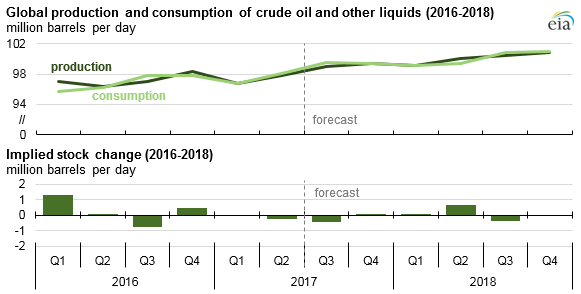
Third, there is great uncertainty about US-Saudi relations in the aftermath of the murder of Jamal Khashoggi. It is turning out to be a high stakes game of rogue operation by intelligence agencies for regime change in Saudi Arabia, which went horribly wrong. The searing experience seriously damages US-Saudi relations. And Saudi Arabia happens to be the only OPEC country that has the means to boost oil production to make up for shortfalls due to US’ oil sanctions against Iran. (Even Saudi surplus capacity is severely restricted.)
The bottom line is that New Delhi must stay the course, no matter what the American lobby in Delhi may say. The point is, the Trump administration is heading toward a cul-de-sac. When this realization dawns on Trump, he’ll, typically, make the course correction. As Ambassador Baeidinejad explained, Iran’s plan is to isolate the US and give it time to rethink. In this wise approach, Iran is getting strong support from the EU and Russia and China. Read the joint statement by the EU + EU-3 foreign ministers here.
Featured Video
Houthis Keep Advancing as the Red Sea Crisis Deepens
or go to
Aletho News Archives – Video-Images
From the Archives
Clash of Civilization, Iran Part II
By Jamal Kanj – Intifada-Palestine.com – January 14, 2011
Israel’s survival kit is: perpetuate conflict, insecurity to rationalize collective hate and finally playing victim.
Devoid of conflict, Israel implodes internally; without hate, Zionism loses its justification; and playing eternal victim to continue blackmailing the West. Absence of this holy trinity, Israel ceases to exist. … continue
Blog Roll
 Aletho News
- ‘We are not like everyone else’ laws that bind other nations do not apply to Israel, says Likud lawmaker
- Report: Saudi Arabia seeks allies’ assistance as missiles deplete amid war on Yemen
- Fuel Crisis Deepens: Pakistan Warns Tanker Attack in Red Sea Would Be an ‘Act of War’
- ‘Bucha massacre’ a false flag orchestrated by UK – Moscow
- China Rejects Outside Pressure on Trade Ties After New US Russia Sanctions Bill
- Houthis Keep Advancing as the Red Sea Crisis Deepens
- Iran spent $1 million to wipe out $30 billion in data center plans, and take down Amazon in the ME
- Zionist billionaire pressure to silence Macklemore sparks exodus from Ed Sheeran tour
- House Votes to End Iran War for Third Time
- North Korea Slams US Plan for ‘AUKUS 2.0’ with South Korea and Japan
- If Americans Knew
- Biden’s Genocide Accomplices Targeted by New Accountability Campaign
- AIPAC’s Network Has Already Spent $67.2 Million to Shape the Midterm Elections
- Jewish Supremacist Manufacturing a Civilizational Threat to License Bigotry
- US bans Palestinian president from speaking at the UN
- Israeli Forces Detain Journalist Alaa al-Rimawi amid Widespread West Bank Raids
- Even a pro-Israel Congress member has put a hold on 40,000 one-ton bombs to Israel
- As Gaza crumbles, Israel preps new ground invasion – Daily Update
- ‘We are not like everyone else’ laws that bind other nations do not apply to Israel, says Likud lawmaker
- Trump’s govt makes ‘treasonous’ claim of weapons shortages
- Palestinian-American Journalist Naqaa Hamed Imprisoned by Israeli Forces After Settlers Targeted Her
- No Tricks Zone
- New Study: ‘Global Drought Shows No Detectable Recent Acceleration Under Climate Warming’
- Economic Masterminds: German Socialists Suggest Taxing Productivity Gains Stemming From Using AI
- The South China Sea Has Not Been Cooperating With The Climate Change Narrative
- Energy Crisis: Germany Enters Heating Season With Historically Low Gas Reserve Fill Levels
- New Study: The Antarctic Ice Sheet Gained Mass From 2020-2024 Due To Staggering Snow And Ice Accumulation
- Study: Ocean Heating Rates From Thousands Of Years Ago ‘Dwarf’ Modern Ocean Heating Rates
- Climate Extremists Target, Attack Large-Scale Power Grid Infrastructure In Germany!
- New Study: Antarctic Ice Melt Has Contributed Less Than 1 Centimeter To Sea Level Rise In The Last 30 Years
- Fear Of Debate: Alarmist German Climate Scientist Calls On Mainstream Media To Discredit Skeptic Voices
- End-Of-August Arctic Sea Ice Extent Hasn’t Fallen In 20 Years, Official Data Show!
 Aletho News