Iran to boost production of uranium enrichment material – state atomic agency
RT | June 5, 2018
Iran has begun preliminary work on infrastructure for advanced centrifuges, the country’s Atomic Energy Organization has confirmed. The announcement comes after Tehran said it would revamp its uranium enrichment program.
The infrastructure project is being carried out at a facility in Natanz. Iran also plans to boost production of UF6, a gas needed to produce fuel for nuclear reactors and weapons. But the country’s nuclear activities will remain within the framework of the 2015 nuclear deal, Ali Akbar Salehi, the director of Iran’s Atomic Energy Organization (AEOI), has stated.
A spokesman for the organization said that the International Atomic Energy Agency (IAEA), which oversees Iran’s compliance with the 2015 JCPOA deal, will be notified of Iran’s activities on Tuesday.
“In a letter that will be handed over to the International Atomic Energy Agency … Iran will announce that the process of increasing the capacity to produce … UF6 (uranium hexafluoride) … will start on Tuesday,” he said.
The spokesman said it was being done on the orders of Iranian Supreme Leader Ayatollah Ali Khamenei, who said in a speech on Monday that AEOI must promptly prepare to start uranium enrichment “up to a level of 190,000 SWU for the time being within the framework of the JCPOA (Joint Comprehensive Plan of Action).”
SWU or “separative work unit” is a standard measure of the effort needed to separate isotopes of uranium during an enrichment process. 1 SWU equals 1 kg of such effort.
Previously, Iran’s Atomic Energy Agency estimated that its enrichment capacity will reach 190,000 SWUs by the 15th year after the deal comes into effect. For that purpose, Iran planned to gradually increase its number of centrifuges, while staying within the scope of the deal.
Speaking to ISNA, Kamalvandi stressed that, by boosting its nuclear program, Iran does not seek to develop nuclear weapons. “Our goals are not to achieve a nuclear weapon, and it’s against our religious stance.”
“The message of our actions is that we will maintain our capacity for activation at a high level, and if we agreed to limit it now, it is because the parties must adhere to their commitments,” he said.
After the US exit from the deal on May 8, other parties to the landmark agreement, including France, the UK, and Germany vowed to abide by the deal and keep it intact, despite the US withdrawal. However, European nations followed the lead of Washington in demanding that Iran’s missile program and its regional posture must be a part of any future negotiations for a post-deal security framework. Iran has vehemently refused to tie its ballistic missile program, which has not been a part of the original agreement, to the deal and has called on Europe to compensate it for the impact that the reimposed US sanctions will have on its economy. On Monday, Khamenei said Europe should not expect Teheran to stay in the deal if it does nothing to shield it from the brunt of punitive measures coming its way.
“It seems from what they say that some European governments expect the Iranian nation to both put up with sanctions and give up its nuclear activities and continue to observe limitations [on its nuclear program]. I tell those governments that this bad dream will never come true,” he said.
He again ruled out that Iran might agree to curtail its ballistic missile development, saying that it’s wishful thinking by Europe if it believes otherwise.
“I am telling the Europeans, ‘Limiting our missile work is a dream that will never come true,” Khamenei stressed.
One of the major points of Iran’s ultimatum to Europe is that it must offset the damage inflicted on its energy industry by buying Iranian oil and protecting trade with the Islamic Republic by providing banking guarantees.
Last week, a senior adviser to Khamenei, Ali Akbar Velayati, told Iranian media that the continuation of the talks would depend on Europe’s readiness to meet these demands.
“We will preserve Iran’s regional and missile power to kill US with envy,” he added.
Israel intelligence minister proposes ‘military coalition’ against Iran
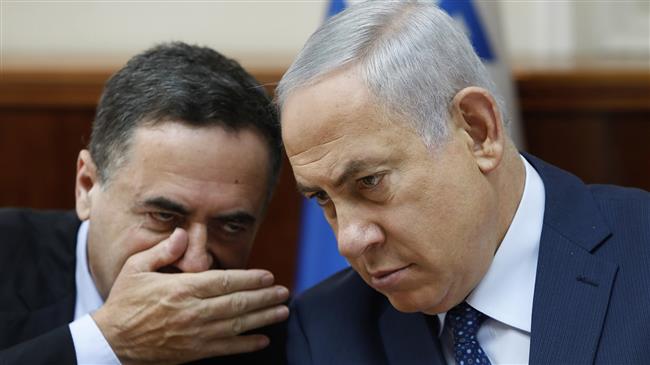
Israeli Intelligence Minister Yisrael Katz (L) and Israeli Prime Minister Benjamin Netanyahu
Press TV – June 5, 2018
Israel has proposed that “a military coalition” be formed against Iran in case Tehran pursues “military-grade” uranium enrichment, suggesting that the military force would comprise of the Israeli regime, the US, the Western states and their Arab allies.
Speaking to media on Tuesday, Israeli Intelligence Minister Yisrael Katz claimed that Iran had once been running an “unsupervised” enrichment scheme with the potential of arming the country with nuclear weapons.
The allies will need to issue a statement against the Islamic Republic “if the Iranians don’t surrender now, and try to return,” he said, adding that the statement would be threatening Iranians that “a military coalition will be formed against them.”
“There should be a clear statement by the president of the United States and all of the Western coalition” if Iran returns to enriching “military-grade” uranium, the minister said. “The Arabs and Israel surely would be there too,” he added.
Washington and Tel Aviv, and to a lesser extent their Western and Arab partners, have claimed that Tehran’s nuclear energy program harbors military aspects.
Iran has strictly and in all circumstances denied pursuing any military ambitions through its nuclear work.
The country asserts that under a fatwa (religious decree) issued by Leader of the Islamic Revolution Ayatollah Seyyed Ali Khamenei, its long-established policy is to oppose the acquisition, production, stockpiling, and use of nuclear weapons.
In December 2015, the International Atomic Energy Agency’s governing board voted overwhelmingly in favor of a draft resolution, which closed the so-called possible military dimensions (PMD) case in Iran’s nuclear program.
The vote brought an end to a 12-year investigation into the “past and present issues” regarding Iran’s nuclear activities, which the United Nations nuclear watchdog had been probing under pressure from the Israeli regime, the US and their allies.
The vote came after Iran and the P5+1 group of countries signed a nuclear agreement in 2015.
The US, however, withdrew from the accord last month, emboldening Israel in its efforts to try to kill the deal and rally more support for its anti-Iran campaign.
Despite Tel Aviv and Washington’s hostile endeavors, European states have vowed to keep respecting the deal and try their utmost to preserve it.
The Israeli minister’s comments come as Prime Minister Benjamin Netanyahu has embarked on a tour of Europe to persuade European leaders to follow the US and ditch the Iran deal.
This is while Iran is currently in talks with the other signatories on the future of the deal. Tehran has said it will stay in the JCPOA if the Europeans give guarantees that a deal without the US would still protect the Iranian interests.
Russia pushes back at US on North Korea
By M.K. Bhadrakumar | Asia Times | June 4, 2018
The visit by the Russian Foreign Minister Sergey Lavrov to Pyongyang on May 31 was a poignant moment for both countries. This was a rare meeting between a senior Russian official and a member of the Kim dynasty. Yet, Russia has been the oldest friend and mentor of the ruling family in Pyongyang.
Kim’s family escaped from Japanese-occupied Korea to the Soviet Union in 1920 when the revered founder of North Korea, Kim Il Sung, was only eight years old. He grew up in Russia, joined the Red Army and fought the Japanese in Manchuria. When World War II ended, Kim returned to his country and with some Soviet backing, went on to lead North Korea’s Communist Party and lay the foundations of the new state north of the 38th parallel.
Make no mistake, it was not a coincidence that Kim received Lavrov on the same day his deputy Vice-Chairman Kim Yong-chol met US President Donald Trump at the White House. Kim told Lavrov in front of TV cameras: “I highly value the fact that Putin’s administration strictly opposes the US’ hegemony. You strictly oppose, and we are always ready to conduct negotiations and a profound exchange of opinions with the Russian side on this issue.” Russia’s Cold War ally is picking up the threads with ease.
Unsurprisingly, Lavrov gave whole-hearted backing for the North Korean stance on the vexatious issue of denuclearization. In Lavrov’s words: “We assume that a complete resolution cannot be achieved until all the sanctions are lifted. It is up to the negotiators to make this happen, but in any case, it would be impossible to achieve this in a single round. The same applies to denuclearization. For this reason, this should be a step-by-step process with reciprocal moves at each of the stages.”
Denuclearization not a stand-alone issue
Lavrov called for a “judicious approach” not to rush things and cautioned against any “rash actions”, bearing in mind the need for “careful consideration and coordination of all elements of a package decision.” The carefully-chosen expression “package decision” implies that denuclearization is not a stand-alone issue.
He underscored: “Russia and North Korea hold a common view… We know that this is an extremely complicated problem and that the goal of denuclearization is inseparably connected with the eventual restoration of peace, stability and a system of interaction, cooperation and equal and indivisible security in Northeast Asia.” Simply put, Lavrov asserted Russia’s role in the current process as a stakeholder in the stability and security of its region. Interestingly, Lavrov flagged the need at some point to revive the format of six-party talks (involving the two Koreas, US, China, Japan and Russia.)
The Russian Foreign Minister also discussed substantive issues of bilateral cooperation in the economic sphere in anticipation of a post-sanctions future. In particular, he brought up the languishing 10-year-old idea of linking the Trans-Siberian and Trans-Korean railway systems to connect Moscow with Seoul via Pyongyang and to build a parallel gas pipeline.
Meeting between Putin and Kim soon?
Meanwhile, the speaker of the upper house of the Russian parliament, Valentina Matviyenko, is expected to visit North Korea soon. Most importantly, a meeting between Putin and Kim is on the cards. Reports speculate that the meeting may take place as early as next week during Putin’s state visit to China following the Shanghai Cooperation Organization summit in Qingdao (June 9-10).
The Russian Deputy Foreign Minister Igor Morgulov who accompanied Lavrov to Pyongyang was in Beijing on May 29 and would have discussed the forthcoming trip with Chinese officials. While in Beijing, Morgulov made some highly critical remarks about US policies in the Asia-Pacific, which reflected the thrust of Lavrov’s mission:
“I am referring… to the idea of the Indo-Pacific region, which the United States and Japan are actively advocating. Essentially, it is designed to divide the regional countries into friends and foes… Both Russia and China hold a diametrically opposite view. They are against creating blocs and believe that an effective and system-wide response to security challenges in the Asia Pacific must include a comprehensive military and political détente and uniform rules of the game… This architecture must be based on the universal principles of indivisible security and the supremacy of international law, as well as non-use of force or threat of force.”
Beijing has welcomed “Russia’s positive role” and said high-level exchanges between Russia and North Korea are “conducive to promoting the political settlement process of Korean Peninsula issue and upholding the peace and stability of the peninsula and Northeast Asia.” Russia is airing opinions supportive of North Korean concerns and vital interests, which Beijing shares but for obvious reasons is not in a position to voice openly.
Process will be a long haul
Clearly, Lavrov’s mission is making it more difficult for Washington to pressure the North Korean leadership or dictate the dynamics of the current process. Moscow is signaling that it will not remain a passive bystander (as in the negotiations over the Iran nuclear issue). And, it has taken a common position with Beijing that the denuclearization of North Korea impacts on the regional security matrix in Northeast Asia. Given this developing situation, the final outcome is almost certainly going to be a long haul.
Simply put, the US’ containment strategy against Russia and China has created a complex regional security environment in Northeast Asia. On one side there is talk of a new US military base in Poland and additional deployment of 30,000 NATO troops to Central Europe on Russia’s western fringe, while on the other side US Secretary of Defence James Mattis promised at the Shangri-La Dialogue in Singapore on the weekend to step up military pressure on China in the South China Sea, and Trump is beating the drums of a trade war with Beijing.
However, somewhat incredibly, in this milieu of growing big-power tensions, Washington still expects Moscow and Beijing to remain docile as Trump and his team go about denuclearizing North Korea and reset the regional security calculus. This expectation is plainly unrealistic. Moscow has signaled that as a stakeholder, it will push back and will not allow a replay of what happened over the Iran nuclear deal.
Significantly, Lavrov disclosed that the North Korean leadership is “fully aware” of developments relating to the US’ exit from the Iran nuclear deal, and “will determine its position taking into consideration all these factors.”
Italy: The Center Cannot Hold
By Diana Johnstone | Consortium News | June 3, 2018
The traditional governing parties, center “left” and center “right” all follow the same neoliberal policies and constitute the self-designated “center.” Mainstream media enforce center right claims to authority on the base of orthodox economic expertise, while the center left derives its authority from its “values,” centered on an identity politics version of human rights. “Center” sounds so reasonable, so safe from dangerous “extremes” and unpredictable populism. Against such threats, the Center presents itself as the champion and safeguard of “democracy.”
How true is this?
World Values Survey results indicate that in Europe and the United States, people who describe themselves as “centrist” on the average have less attachment to democracy (e.g. free and fair elections) that those on the left, and even those on the far right. This is not as surprising as it may seem at first, since “centrists” are by definition attached to the status quo. In European countries, the authoritarian neoliberal “center” is institutionalized in the European Union, which imposes economic policy over the heads of the parliaments of the member countries, dictating measures which conform to the choices of Germany and northern Europe, but are increasingly disastrous for the Southern EU members.
The Centrist fear of democracy was resoundingly confirmed by March 4 legislative elections in Italy. The Center was relegated to the margins and outsiders burst in. The winner, with 32 percent of the votes, was the Five Star Movement (M5S) whose campaign “against corruption” won popular support in the impoverished South. In second place, with 17 percent, was “the League”, formerly the Northern League – that is, a party of rich north Italy chauvinists ready to secede from the “lazy good-for-nothing” south. It took almost three months for this extremely odd couple to agree to a coalition government.
The mystique of the European Union is anti-nationalist, based on the theory that “nations” are bad because they caused the devastating wars of the twentieth century, while European unification is the sole guarantee of “peace.” Convinced of their mission, the Eurocentrists have had no qualms in throwing out the baby of democratic choice along with the nationalist bathwater.
The notion that “peace” depends on “Europe” persists despite the NATO bombing of Serbia and European participation in U.S. wars in Afghanistan, Iraq, Libya and Syria, not to mention EU participation in the current major military buildup in the Baltic States against “the Russian enemy.” Indeed, thanks to NATO, the EU is gearing for a war even worse than the previous ones.
Since the “nation-state” is blamed for evil in the world, the Eurocentrists react with horror at growing demands in Member States for a return to “national sovereignty.” This, however, is a natural reaction to the economic and social disasters resulting from policies dictated by EU institutions in Brussels. The 1992 Maastricht Treaty legally bound member countries to centralized neoliberal monetarist policies; not only “socialism” became illegal – even Keynesianism was ruled out. Promised endless peace and prosperity, citizens of European countries were cajoled into giving up their sovereignty to EU institutions, and many now want it back.
Disillusioned Italy
Italian disillusion is particularly significant. Italy was an exceptionally enthusiastic founding member of the unification begun with the 1957 Treaty of Rome. And yet, Italy’s own history illustrates what can go wrong with such unification, since the 19th century political creation of a unified Italy centered in Turin led to the enrichment of the industrial north at the expense of southern Italy, where the splendor of Naples declined into chronic poverty, crime and corruption. Now Italy itself is “the south” in the periphery of a European Union centered around Germany.
Antagonism between northern and southern Italy has given way to a much stronger antagonism between Italy and Germany – each blaming the other for the crisis.
It is only fair to recall that Germans were very attached to their Deutsche Mark and to their own austere financial policies. Germany could only be lured into the common currency by agreeing to let the euro follow German rules. France eagerly supported this concession based on the notion that the common currency would unify Europe. It is doing quite the opposite.
Germany is a major exporting nation. Its trade with the rest of the EU is secondary. It uses the EU as its hinterland as it competes and trades globally with China, the United States and the rest of the world. The proceeds of Germany’s favorable EU trade balance is less and less invested in those countries but in Germany itself or outside the EU. In the official German view, the main function of the Southern EU members is to pay back their debts to Germany.
Meanwhile, Italy’s once flourishing industrial network has lost its competitive edge due to the euro. It cannot save its exports by devaluation, as it was accustomed to doing. Italy’s debt is now 132 percent of its GNP, whereas the Maastricht Treaty governing the monetary union puts a ceiling of 60 percent on national debt. And to continue paying the debt, public services are cut back, the middle class is impoverished, the domestic market declines and the economy gets even weaker.
This is precisely the situation that has plunged Greece into ever deepening poverty.
But Italy is not Greece. Greece is a small peripheral country, which can be pounded to death by creditors as a warning of what can happen to others. Italy, on the contrary, is too big to fail. Its collapse could bring the whole EU crashing down.
Italy’s Potential Strength Through Weakness
The traditional Italian parties had no solution beyond those that have ruined Greece: cut back social spending, impoverish workers and pensioners, and pay back the foreign banks, with interest.
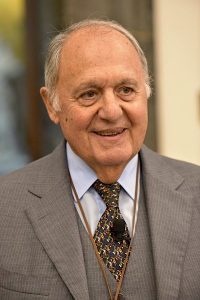
The odd coalition of the League and the M5S was obliged to try something different: basically, to invest in the economy rather than abandon it to its creditors. Their program combines lower taxes with Keynesian stimulation of investment. Since the leader of the League, Matteo Salvini, and Luigi Di Maio of M5S do not like each other, they selected law professor Giuseppe Conte to be Prime Minister in their coalition cabinet. The interesting choice was that of Paolo Savona for the key post of Minister of Economy and Finance. Savona, whose long career has taken him across the summits of Italian and international finance, was certainly the most qualified choice imaginable. Savona knows everything there is to know about the Italian economy and international currency creation.
And yet, it was the appointment of this 81-year-old expert that created outrage in the Eurocenter.
The uproar was spurred by the fact that in one of his books Savona had described the euro as “a German prison.” Savona had also said it was necessary to prepare a Plan B, to leave the euro if there is no other choice. “The alternative is to end up like Greece.”
This hint of disloyalty to the euro was totally unacceptable to the European establishment.
The Center struck back in the person of the largely figurehead President of Italy, Sergio Mattarella, who used, or misused, his unique constitutional power by refusing to approve the government. On May 28, he designated as prime minister Carlo Cottarelli of the International Monetary Fund – a man who represented everything the Italians had just voted against. Known in Italy as “Mr. Scissors” for his advocacy of drastic government spending cuts, Cottarelli was supposed to run an apolitical “technical” government until new elections could be held in the fall.
This coup against the Italian voters caused momentary rejoicing in the Authoritarian Center. The European Budget Commissioner (a German of course), Günther Oettinger, was reported to be gloating over the prospect that “the markets” (meaning the financial markets) would soon teach Italians how to vote. Italy’s economy “could be so drastically impacted,” he said, as to send a signal to voters “not to vote for populists on the right and left.”
This simply intensified Italian indignation against “German arrogance.”
Savona: Plan B just a negotiating tactic
Meanwhile Savona wrote a letter to President Mattarella which introduced a bit of cold reason into an increasingly hysterical situation. He reminded the president that an important meeting of EU heads of state was to be held at the end of June; without a political government, Italy would be absent from negotiations which could seal the fate of the EU. Italy’s plea for economic change could expect French support. Savona denied having called for leaving the euro; in the spirit of game strategy, he had mentioned the need for Plan B in order to strengthen one’s position before negotiations. He made it clear that his strategy was not to leave the euro but to transform it into a genuine rival to the dollar.
“Germany prevents the euro from becoming ‘an essential part of foreign policy’, as the dollar is for the United States”, wrote Savona. But change becomes necessary, as the dollar is less and less suitable for its role as world currency.
Indeed, the Italian crisis merges with a mounting trans-Atlantic crisis, as the U.S. uses sanctions as a weapon in competition with its European “partners.” The paradox is that Italy could use its very weakness to oblige Germany to reconsider its monetary policy in a moment when the German economy is also facing problems due to U.S. sanctions on deals with Russia and Iran, as well as protectionist measures. Savona’s message was that clever diplomacy could work to Italy’s advantage. In its own interest, Germany may need to accept transformation of the euro into a more proactive currency, able to defend European economies from U.S. manipulation.
It was a matter of hours before Cottarella stepped back and a new M5S-League government was formed, with Savona himself back as Minister of Relations with the European Union.
Italy’s Double Jeopardy
The new Italian cabinet sworn in on June 1 is riven with contradictions. Despite all the released anti-EU sentiment, it is definitely not an “anti-EU” government. Conte is back as prime minister. The new foreign minister, Enzo Moavero Milnesi, is a staunch pro-European. As interior minister, the northern Italy chauvinist Salvini – who doesn’t particularly care for southern Italians – will get tough with migrants. As minister of economic development M5S’ Di Maio will try to find ways to improve conditions in the southern regions that elected him. Since Salvini is the more experienced of the two, the League is likely to profit from the experiment more than the M5S.
Some Italians warn that by leaving the “German prison” Italy would simply find itself even more dependent on the United States.
One should never forget that ever since the end of World War II, Italy is an occupied country, with dozens of U.S. military bases on its territory, including air bases with nuclear weapons poised to strike the Middle East, Africa or even Russia. The Italian Constitution outlaws participation in aggressive war, and yet Italian bases are freely used by the United States to bomb whichever country it pleases, regardless of how Italians feel about it.
Worst of all, the U.S. used its Italian “NATO bases” to destroy Libya, a disaster for Italy which thereby lost a valuable trade partner and found itself inundated with African refugees and migrants. While international financial experts exhort Italy to cut government expenses, the country is obliged by NATO to spend around 13 billion euros to buy 90 U.S. F-35 fighters and to increase its military spending to around 100 million euros per day.
Italy’s economic prospects have also been badly hit by U.S.-enforced sanctions against trade with Russia and Iran, important potential energy sources.
U.S. economic aggression, in particular Trump’s rejection of the Iranian nuclear deal, is the issue with the potential to bring European leaders together at a time when they were drifting apart. But at present, the Europeans are unable to defy U.S. sanctions in punishment for trade with those countries because their international dealings are in dollars.
This has already led to the U.S. exacting billions of dollars in fines from the biggest French and German banks, the BNP and Deutsche Bank, for trading that was perfectly legal under their own laws. The French petroleum giant has been obliged to abandon contracts with Iran because 90% of its trade is in dollars, and thus vulnerable to U.S. sanctions. And that is why the idea is growing of building financial instruments around the euro that can protect European companies from U.S. retaliation.
The Disappearance of the Left
The disappearance of left political forces has been almost total in Italy. There are many reasons for this, but a curable part of the problem has been the inability of what remains of the left to face up to the two main current issues: Europe and immigration.
The left has so thoroughly transformed its traditional internationalism into Europism that it has been unable to recognize EU institutions and regulations as a major source of its problems. The stigmatization of “the nation” as aggressively nationalistic has held back the left’s ability to envisage and advocate progressive policies at the national level, instead putting its hopes forever in a future hypothetical “social Europe.” Such a transformation would require unanimity under EU rules – politically impossible with 28 widely differing Member States.
Without such inhibitions, the far right capitalizes on growing discontent.
Another related handicap of the left is its inability to recognize that mass immigration is indeed “a problem” – especially in a country like Italy, with a flagging economy and 20 percent official unemployment (although this figure is probably too high, considering undeclared labor). There is resentment that prosperous Germany issued a general invitation to refugees, which for geographic reasons pile in Mediterranean countries unable to cope. The mass influx of economic migrants from Africa is not even “taking jobs away from” Italians – the jobs are not there to take. These migrants fled war and misery to come to Europe in order to earn money to send back to their families, but how can they possibly meet these expectations?
It is all very well to extol the glorious hospitality of America entreating the world to “Give me your tired, your poor, Your huddled masses yearning to breathe free, The wretched refuse of your teeming shore. Send these, the homeless, tempest-tossed to me…”. Such generosity was suited to a new nation with huge empty spaces and rapidly growing industry in need of a work force. The situation of a “full” nation in a time of economic downturn is quite different. What is to become of the tens of thousands of vigorous young men arriving on Italian shores where there is nothing for them to do except sell African trinkets on the sidewalks of tourist centers? To make matters worse, the great contemporary thrust of technical innovation aims at replacing more and more workers with robots. Leftist denial of the problem leaves its exploitation and resolution to the extreme right.
Some leftist politicians in Italy, such as Stefano Fassina of the Sinistra Italiana are waking up to this need. A left that dogmatically ignores the real concerns of the people is doomed. A bold, honest, imaginative left is needed to champion Italians’ independence from both German-imposed austerity and the expensive military adventurism demanded by the United States. But the interlaced problems created by unregulated globalization do not lend themselves to easy solutions.
Diana Johnstone is a political writer, focusing primarily on European politics and Western foreign policy. She received a Ph.D. at the University of Minnesota and was active in the movement against the Vietnam War. Johnstone was European editor of the U.S. weekly In These Times from 1979 to 1990, and continues to be a correspondent for the publication. She was press officer of the Green group in the European Parliament from 1990 to 1996. Her books include Queen of Chaos: The Misadventures of Hillary Clinton, CounterPunch Books (2016) and Fools’ Crusade: Yugoslavia, NATO and Western Delusions, Pluto Press (2002).
Pompeo Challenged at Senate Foreign Relations Committee
By Renee Parsons | OffGuardian | June 3, 2018
Newly appointed Secretary of State Mike Pompeo had every reason to expect that his first official appearance before the Senate Foreign Relations Committee would be the usual slam-dunk as mostly obedient, respectful Senators aligned with his testimony.
Instead of the typically gratuitous compliments and undeserved deference, there was a display (albeit a minority) of some moral courage with a rare slice of truth on Capitol Hill, epitomizing the real-time requirements of a Senator’s job: to be skeptical, provide oversight and demand accountability from every Federal government witness, no matter the rank – once referred to as ‘grilling the witness.”
Besides fraternizing with America’s most privileged citizens, endless rounds of lavish Capitol Hill receptions, wide ranging international travel opportunities (aka junkets), a liberal vacation policy and exorbitant benefits out of step for the minimal accomplishments actually achieved, the current Senate paradigm has allowed too many Members to degenerate into a protuberance of greedy, sniveling, weak-minded buffoons with no genuine regard for their constituents or what was once the greatest democracy on the planet.
Days earlier, as the nation’s top diplomat, Pompeo delivered the Trump Administration’s controversial “After the Deal: A New Iran Strategy” in a decidedly undiplomatic speech to a less than enthusiastic audience at the Heritage Foundation. That aggressive strategy included a dozen doomed-to-fail, untenable demands that were little more than a precursor for military intervention and regime change.
Before the hearing began, Pompeo unexpectedly read a crude letter from President Trump to North Korean leader Kim Jong Un cancelling the June 12th summit citing “tremendous anger and open hostility” and concluded with the moronic “If you change your mind …, please do not hesitate to call or write me.” To date, Trump has softened his stance against a meeting and hints the June summit may occur on schedule.
As the hearing began, most Senators expended their allotted time by steadfastly avoiding the massive foreign policy blunder that had just been dropped in their laps. The following excerpts focus on two Members, Sen. Rand Paul (R-SC) (1:58) and Sen. Ed Markey (D-Mass) (2:19/3:27) since they had the most extensive dialogue with Pompeo and because they gave Pompeo the most grief. Sen. Jeff Merkley (D-Or) (3:34) and Sen. Tom Udall (D-NM) (3:15) questioned implications of the upcoming Authority for Use of Military Force (AUMF).
Sen. Paul launched into a rapid-fire critique exposing the inadequacies of Pompeo’s Iran Plan with a much needed dose of reality as he methodically decimated the strategy, beginning with the requirement that Iran reveal the ‘military dimensions’ of its nuclear program:
Let’s substitute Israel for Iran. Does anyone believe that Israel is going to reveal the military dimensions of their nuclear program? ” Paul inquired whether the Saudi’s would be willing to discuss “anything they’ve done to develop nuclear weapons or reveal the military dimensions of their nuclear program. So really what you’re asking for is something they (Iranians) are never going to agree to.”
Regarding the requirement that Iran end its proliferation of ballistic missiles, Paul explained that
… when we supply weapons, the Saudis buy weapons, the Saudis have a ballistic weapon program, they (Iran) respond to that. The Saudis and their allies … spend more than eight times Iran so when you tell Iran that you have to give up your ballistic missile program but you don’t say anything to the Saudis, you think they are ever going to sign?”
If you leave Saudi Arabia and Israel out of it and look at Iran in isolation, that’s not how they (Iran) perceive it. We want Iran to do things that we’re not willing to ask anybody else to do and that we would never do.”
Regarding Pompeo’s demand to end military support for the Houthi rebels:
Once again, you’re asking them to end it but you’re not asking the Saudis to end their bombardment of Yemen. If you look at the humanitarian disaster that is Yemen, it is squarely on the shoulders of the Saudis.”
Paul then drew attention to the demand for Iran to withdraw all its forces from Syria noting that
ISIS is getting weapons from Qatar and Saudi Arabia” and that “Saudi Arabia and Qatar are ten times the problem. The people who attacked us came from Saudi Arabia. We ignore all that and lavish them with bombs.”
It was naïve to pull out of the Iran Agreement and in the end, we’ll be worse off for it.”
Pompeo was Stunned and the Silence was Deafening. Pompeo had absolutely no reaction to Paul’s devastating analysis of US foreign policy in the Middle East, offering no explanation, no excuse, no correction or thoughtful response; nor did any other Senator present dare step into the swamp.
Next up was Sen. Markey citing Trump’s reference to North Korea’s ‘tremendous anger and open hostility” and inquiring:
How did you expect North Korea to react to comparisons between Libya and North Korea, between the fates of Kim Jong Un and Qaddafi. Why would you expect anything other than anger and hostility in reaction to these comparisons?”
Markey was referring to Vice President Mike Pence’s comment that “Kim Jong Un will end up like Qaddafi if he does not make a deal” and National Security Advisor John Bolton’s “we have very much in mind the Libya model of 2003-2004.”
As background, in 2003 Libyan President Muammar Qaddafi relinquished his nuclear, biological and chemical weapons allowing inspectors to oversee and verify the process. By 2011, with US and NATO instigation, Libya experienced a violent overthrow of its government with Qaddafi brutally murdered. And who can ever forget former Secretary of State Hillary Clinton’s macabre glee “we came, we saw, he died.”
Pompeo expressed “misunderstanding taking place with this idea of a Libya model” and that he “hadn’t done the work to find out what that was…when Libyans chose to give up their nuclear weapons in 2003. That’s the Libya model.”
Markey explained:
The Libya model, as Kim Jong Un has been interpreting it, is that the leader of the country surrenders their nuclear capability only to then be overthrown and killed. Why would you not think that Kim would not interpret it that way as it continued to escalate with Bolton and Vice President talking about the Qaddafi model? .… why would you think there would be any other interpretation at what happened to Qaddafi at the end of his denuclearization which is that he wound up dead? Why would that not elicit hostility from a negotiating partner three weeks prior to sitting down..”
From there Markey and Pompeo bantered back and forth with Pompeo consistently failing to grasp the connection between Qaddafi’s 2003 disarmament agreement and US military interference in Libya in 2011 that resulted in Qaddafi’s death as sufficient reason for North Korea to feel threatened. No matter how precise the clarification, Pompeo continued to respond as a dense, one-dimensional thinker unable to wrap his mind around logic that challenged his view of a simulated reality, as if looking at the same object through a different lens.
Committee chair Sen. Bob Corker (R-Tenn) agreed with Markey.
I opposed so strongly what the Obama administration did in Libya was exactly the argument you are laying out right now… to have someone like Qaddafi who gave up their nuclear weapons and then go kill him to me sent exactly the signal that you are laying out right now.”
Corker then announced that he
just had discussion with Secretary’s staff and he is now 15 minutes late for a meeting. I’m going to allow a couple of comments but going to stop it in five minutes.”
Markey immediately inquired:
Who is the meeting with Mr. Secretary… if you are not going to stay here and answer questions from us… can you not push that meeting back another 15 minutes…”
Corker:
… this is getting a little bit, this type of discourse, I’m sorry, I’m the one doing this. I’ve been very generous”
Markey:
… but we agreed to two seven- minute question periods and it is being ended here for two members…”
Markey continued until Sen. Corker gaveled his time had expired.
As the Foreign Relations Committee contemplates an upcoming markup and vote on a Forever AUMF next week, it will be a time for other Committee Senators to step outside the Matrix and dig deep to find their own moral fortitude.
US to claim $1.7bn penalty from China’s ZTE
Press TV – June 2, 2018
The administration of US President Donald Trump is reportedly planning to seek a penalty of $1.7 billion from China’s telecommunications major ZTE Corporation.
The move – as revealed by people familiar with the matter – would be meant to punish and tighten control over the company before allowing it back into business.
Reuters said in a report that the US Commerce Department would also seek “unfettered site visits” to verify US components are being used as claimed by ZTE.
One source was also reported as saying that Washington also wanted the Chinese company to replace its board and executive team as soon as 30 days.
Nevertheless, a deal still had not been finalized and the sources cautioned that the penalties were fluid and the terms could change, Reuters added.
ZTE has been crippled by a ban imposed in April on buying US technology components for seven years for breaking an agreement reached after it was caught illegally shipping goods to Iran and North Korea.
The US accordingly forced the company to pay as much as $1.2 billion in March 2017 for allegedly shipping telecommunications equipment to Iran and North Korea in violation of unilateral American sanctions.
American companies provide an estimated 25 percent to 30 percent of components in ZTE’s equipment, which includes smartphones and gear to build telecommunications networks.
The company’s status has become an important bargaining chip in high-level trade talks between China and Washington amid reports that if the United States eases up on ZTE, China will buy more American agricultural goods.
Russia censures Iran, expects Israel to help restore ties with US
Vladimir Putin surprised many at the event known as Russia’s Davos with his comments on the Iran nuclear deal and Russia’s relations with the US
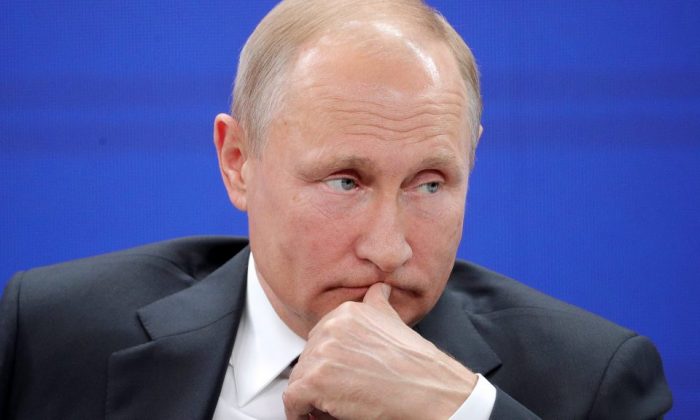
Russian President Vladimir Putin at the St Petersburg International Economic Forum on May 25, 2018. Photo: Reuters/Sergei Bobylev/TASS
By M.K. Bhadrakumar | Asian Times | June 1, 2018
The annual meeting of the St Petersburg International Economic Forum – dubbed as “Russia’s Davos” – on May 25, which traditionally promotes foreign investment in the Russian economy, ended this time around as a major political event signaling a renewed bid by President Vladimir Putin for détente with the West.
In wide-ranging remarks at the forum, Putin made an explicit overture to Washington for dialogue. The US decision to quit the Iran nuclear deal was the leitmotif of the Q&A at St Petersburg – which are generally choreographed by the Kremlin in advance – and Putin seized the opportunity to articulate a highly nuanced position on the topic with an eye on the overall Russian-American relationship.
Unsurprisingly, Putin criticized the US’ rejection of the Iran nuclear deal as a unilateralist move which would have negative consequences. But then, Putin also expressed understanding for President Donald Trump’s domestic compulsion in taking such a decision.
Putin also proposed that the US and Iran, which had negotiated the 2015 pact directly, could resume their negotiations to settle the differences: “Even now, the US President is not closing the door on talks. He is saying that he is not happy about many of the terms of the deal. But in general, he is not ruling out an agreement with Iran. But it can only be a two-way street. Therefore, there is no need for unnecessary pressure if we want to preserve something. Doors must be left open for negotiation and for the final outcome. I think there are still grounds for hope.”
Putin probably sees Russia as a facilitator-cum-moderator between the US and Iran, but at any rate, he has deflected the focus from the EU’s approach, which single-mindedly focuses on the downstream impact of US sanctions against Iran. It is smart thinking on Putin’s part to signal that Moscow does not propose to wade into any transatlantic rift over the Iran issue. He probably doubts if the rift is real enough for outsiders to exploit.
Putin and the Iran nuclear deal
But the really intriguing part was that Putin also brought into the matrix the “good, trust-based relations between us (Russia and Israel).” Significantly, the interpolation occurred while Putin was arguing that the preservation of the Iran nuclear deal was also in Israel’s interests.
Neither Moscow nor Tel Aviv has divulged the details of the recent meeting between Putin and Israeli Prime Minister Netanyahu in Moscow in early May. But Israeli sources have since divulged in bits and pieces that a major understanding might have been reached as regards the imperative need for an holistic approach toward the whole situation surrounding the “Iran question,” including Iran’s presence in Syria, which Israel indeed sees as existential threat.
Interestingly, three days after Putin spoke at St Petersburg, an influential Moscow think tank came up with a commentary regarding the emergent trends in the Syrian situation. Basically, the commentary stressed that Russian policy was switching tack and giving primacy to the search for political settlement and reconstruction of Syria. But it went on to discuss the rising tensions between Iran and Israel in Syria and blamed Iran for using Syria for the “export” of its policy of Resistance against Israel.
Hinting at growing resentment within the Sunni majority in Syria against Iran’s activities, the commentary contextualized Putin’s recent call for the withdrawal of all foreign forces from Syrian soil. It openly rapped the Iranians on the knuckle: “Iran’s operations in Syria go far beyond fighting terrorists and are hardly welcomed by anyone within the region and beyond. This heightens tensions in Israel’s relations with its bitter rivals … Serving as a platform for fighting the ‘Zionist’ enemy is something Syria needs the least.”
Indeed, these are extraordinary statements for an establishment think tank known to be close to the Kremlin. The key elements were: a) Russia holds Iran as responsible for ratcheting up tensions with Israel; b) Russia thoroughly disapproves of Syria being turned into a turf for Iran’s policy of “Resistance” against Israel; and, c) Moscow expects the Assad regime to distance itself from Iran’s anti-Israeli activities.
The patent shift in the Russian stance implies Moscow’s acknowledgment that the fate of the Iran nuclear deal is also linked to Iran’s regional policies. Arguably, this Russian stance harmonizes with what Trump and Netanyahu have been saying all along. Perhaps, Russia hopes to cajole Tehran to walk toward the negotiating table where Trump is waiting. Perhaps, Putin also calculates that such a helpful stance cannot but have positive fallout on US-Russia relations as a whole. Time will tell.
The bottom line is that the close ties between Russia and Israel are sailing into full view. Interestingly, Israel just obliged a famous Russian oligarch who is perceived as close to Putin, by granting him citizenship, which would enable him to visit Britain – although London refuses to renew his residence permit. The influential Kremlin-linked Russian oligarch now de facto becomes the wealthiest Israeli citizen, too.
Suffice to say, it all does seem a cozy condominium between Putin and Netanyahu. The big question will be how far Netanyahu can help Putin to bring about a Russian-American “thaw” under this complex set of circumstances.
US imposes new sanctions against Iran
Press TV – May 30, 2018
The United States has imposed sanctions on several Iranian individuals and organizations, including Evin Prison and the Islamic Republic of Iran Broadcasting (IRIB), over “human rights abuses” and “censorship.”
The US Treasury Department announced the sanctions Wednesday on its website, saying the listed persons and entities will be blocked from the US financial system.
Individuals and companies who do business with the targeted Iranians could face sanctions from Treasury as well.
“Iran not only exports terrorism and instability across the world, it routinely violates the rights of its own people. The Iranian regime diverts national resources that should belong to the people to fund a massive and expensive censorship apparatus and suppress free speech,” Treasury Secretary Steven Mnuchin said in a statement.
Iran has rejected US and Western accusations of human rights abuses in the Islamic Republic as “untrue” and “politically-motivated.”
On Thursday, the US Treasury imposed new sanctions against nine Iranian and Turkish individuals and companies as well as a number of aircraft providing goods and services to four Iranian airlines.
The move by Washington was part of President Donald Trump’s plans to impose harsh sanctions against Tehran after pulling out of the 2015 Iran nuclear deal.
Many countries, including America’s European allies, have said that they would not back Trump’s new plan.
The UK, France and Germany– all signatories to the deal– are already in talks with Iran to protect their businesses from possible punishment by the US.
Russia and China have also expressed willingness to back the deal and even fill the void should any European companies leave Iranian markets.
America’s Incredible Shrinking Influence
By Ron Paul | May 28, 2018
Just two weeks after President Trump pulled the US from the Iran nuclear agreement, his Secretary of State, Mike Pompeo, issued 12 demands to Iran that could never be satisfied. Pompeo knew his demands would be impossible to meet. They were designed that way. Just like Austria-Hungary’s ultimatum to Serbia in July, 1914, that led to the beginning of World War I. And just like the impossible demands made of Milosevic in 1999 and of Saddam Hussein in 1991 and 2003, and so many other times when Washington wanted war. These impossible demands are tools of war rather than steps toward peace.
Secretary Pompeo raged at Iran. The mainstream news media raged at Iran. Trump raged at Iran. But then a strange thing happened: nothing. The Iranians announced that they remained committed to diplomacy and would continue to uphold their end of the nuclear agreement if the Europeans and other partners were willing to do the same. Iranian and European officials then sought out contacts in defiance of Washington in hopes of preserving mutually-beneficial emerging commercial relations.
Washington responded to the European snub by threatening secondary sanctions on European companies that continued doing business with an Iran that had repeatedly been found in compliance with its end of the bargain. Any independent European relationship with Iran would be punished, Washington threatened. But then, again, very little happened.
Rather than jump on Washington’s bandwagon, German Chancellor Angela Merkel made two trips to Russia in May seeking closer ties and a way forward on Iran.
Russia and China were named as our prime enemies in the latest National Security Strategy for the United States, but both countries stand to benefit from the unilateral US withdrawal from the Iran deal. When the French oil company Total got spooked by Washington threats and pulled out of Iran, a Chinese firm eagerly took its place.
It seems the world has grown tired of neocon threats from Washington. Ironically the “communist” Chinese seem to understand better than the US that in capitalism you do not threaten your customers. While the US is threatening and sanctioning and forbidding economic relations, its adversaries overseas are busy reaping the benefits of America’s real isolationism.
If President Trump’s canceled meeting with North Korea’s Kim Jong-Un remains canceled, North and South Korea have shown that they will continue with their peacemaking efforts. As if Washington was no longer relevant.
I’ve often spoken of the unintended consequences of our aggressive foreign policy. For example, President Bush’s invasion of Iraq only helped Iran – our “enemy” – become more dominant in the Middle East. But it seems new consequences are emerging, and for the neocons they must be very unintended: for all of its bellicosity, threats, demands, sanctions, and even bombs, the rest of the world is increasingly simply ignoring the demands of Washington and getting on with its own business.
While I am slightly surprised at this development, as a libertarian and a non-interventionist I welcome the growing irrelevance of Washington’s interventionists. We have a far better philosophy and we must work hard to promote it so that it can finally be tried after neocon failure becomes obvious to everyone. This is our big opportunity!
Russia Says US Demands Unacceptable for Iran, Vows to Help Maintain JCPOA
Al-Manar | May 23, 2018
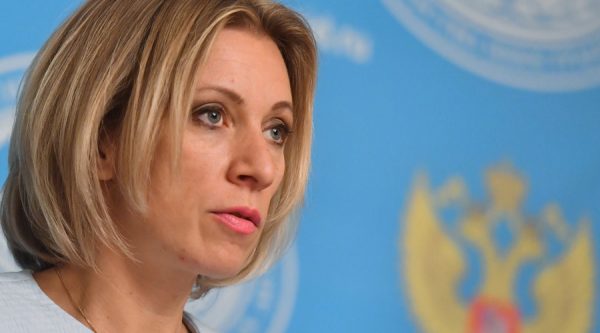
The Russian Foreign Ministry spokeswoman says new US demands from Iran are totally unacceptable, vowing that Moscow will continue to work towards maintaining the Iran nuclear deal, officially known as the Joint Comprehensive Plan of Action (JCPOA).
“We are concerned about the fact that the anti-Iranian campaign is on the rise in Washington. It seems that the United States has made a final decision to use the tactics of ultimatums and threats in respect to Iran. It contradicts the spirit of the JCPOA and does not fall within the normal inter-state relations,” Russian Foreign Ministry spokeswoman Maria Zakharova told a briefing on Wednesday.
“Not only did the US administration withdraw from the agreement in violation of international norms, it is putting forward demands that are a priori unacceptable for Tehran,” she added.
In his first major foreign policy address since moving to the State Department from the CIA, Secretary of State Mike Pompeo said Washington would increase the financial pressure on Iran by imposing the “strongest sanctions in history” on the Islamic Republic if Tehran refused to change the course of its foreign and domestic policy.
Pompeo also outlined 12 US tough demands for Iran, including halting its uranium enrichment and closing its heavy water reactor, for any “new deal” with Tehran.
The Russian spokesperson said that while the US pulled out of the JCPOA, “other participants in the deal are determined to maintain the agreement, adding, “We will continue working to that end. The important thing is that Tehran also abides by its obligations, as confirmed by the IAEA (International Atomic Energy Agency).”
Zakharova said the fate of the Iran deal would be decoded at a new meeting of the Joint Commission monitoring the implementation of the agreement in Vienna on May 25, which will not include the US for the first time.
The Russian official also once again expressed Moscow’s opposition to unilateral sanctions.
Featured Video

Bombing Hitler’s Hometown
or go to
Aletho News Archives – Video-Images
From the Archives
‘Conspiracy Theory’ Now Fact: Greater Israel Has Arrived
By Kit Klarenberg | Mint Press News | January 28, 2025
Ever since Tel Aviv’s 1948 creation, much has been said and written about ‘Greater Israel’ – the notion Zionism’s ultimate end goal is the forcible annexation and ethnic cleansing of vast swaths of Arab and Muslim lands for Jewish settlement, based on Biblical claims this territory was promised to Jews by God. The mainstream media typically dismisses this concept as antisemitic conspiracy theory, or at most the fringe fantasy of a minuscule handful of extremist Israelis.
In reality … continue
Blog Roll
 Aletho News
- Trump admits Iran hit USS Ford carrier: ‘We ran for our lives’
- Battle for Hungary: EU attacks on Orban are a sign of worse things to come
- Iraqi resistance conducts drone strike on US-run base in Syria
- Failing to Defeat Hezbollah, Israel & US Pressure Syria’s Ahmed al-Sharaa to Join War
- US-Israeli war on Iran drives global fertilizer prices up 40%
- Hezbollah’s Surprise Weapons Redefine Ground Battle with Israel
- Yemen joins fight against US, Israel by firing missiles at occupied territories
- Seizing the Kharg: Washington’s path to defeat in the Persian Gulf
- Iran reports 500 US casualties in strikes on covert US military sites
- Pro-Israel terrorist arrested before assassination of pro-Palestinian activist
- If Americans Knew
- Over 300 US service members wounded, majority have brain injuries – Not a ceasefire Day 169
- Researchers at Human Rights Watch Resign Over Blocked Report on Palestinian Refugee Return
- Jewish Groups Are Backing a War Americans Don’t Want
- Eric Fingerhut Thinks He’s the President of the Jews
- Top Jewish Philanthropists, Rabbis Urge Israeli President to Take Action Against ‘Jewish Extremists’
- Don’t Be Fooled. Zionist Leaders Have Always Wanted to Control Southern Lebanon
- Israel’s widespread use of torture is a core element of its genocide against the Palestinian people
- In Israel’s War on Iran, Many Middle East US Bases Rendered “All But Uninhabitable”
- ‘Burn the lawn’: Israel pursues ‘Rafah model’ in southern Lebanon
- A genocide here, an amputation there
- No Tricks Zone
- Devastating Assessment Of Comirnaty Vaccine By Former Senior Pfizer Europe Toxicologist
- New Study: CO2 Is ‘Effectively Negligible’ As An Explanatory Climate Change Factor Since 2000
- Former Pfizer Toxicologist Dr. Helmut Sterz Tells Bundestag Hearing Pfizer Vaccine Should Have Never Been Approved
- Energy Expert: Germany’s Nuclear Phaseout Was A “500 Billion Euro Mistake”
- New Research: South Australia’s Mid-Holocene Sea Surface Temperatures Were 4°C Warmer Than Today
- Storing Green Energy To Last Germany 10 Days Would Require A 60-Million Tonne Battery
- New Studies: UK Sea Levels Were 4 Meters Higher Than Today During The Mid-Holocene
- Destructive Green New Deal: German Energy And Metal Group Warns Of Drastic Crisis
- New Study Documents A 20-Year Pause In Arctic Sea Ice Decline – Driven By Internal Variability
- Wake-up Call: Survey Shows Majority Of Germans Now Favor Postponing Climate Targets!
 Aletho News