Biden will ‘beg’ American Jewish leaders for Iran agreement: Analyst
Press TV – August 28, 2015
US Vice President Joe Biden will go to Florida to “beg” American Jewish leaders to allow Washington to have its nuclear agreement with Iran, says a political commentator.
“Something this critically important to American foreign policy means only one thing… begging to powerful Jews to let America have its deal,” said David Christie, a broadcast journalist based in New York.
Christie made the remarks in an interview with Press TV on Friday while commenting on Biden’s plan to visit Jewish leaders in Miami next week.
Biden’s office said in a statement that he will “participate in a discussion organized by [chairwoman of the Democratic National Committee] Debbie Wasserman Schultz to discuss the Iran deal with leaders in the Jewish community.”
The vice president, who has played an important behind-the-scenes role in the Obama administration’s lobbying push for the agreement approval by Congress in September, hopes to win support from Wasserman Schultz who has not announced her position on the issue.
“The best way to do that is for Joe [Biden] to make a pilgrimage to Miami so he can pay homage to the one group that has been at the core of our bizarre obsession with forging a nuclear deal with a country that can never be a threat to us in the first place,” said Christie.
Iran and the P5+1 group of countries — the US, Britain, France, Russia, China, and Germany – announced the conclusion of nuclear negotiations in the Austrian capital, Vienna, on July 14. The US Congress will vote on the agreement in September.
Under the agreement, known as the Joint Comprehensive Plan of Action, restrictions will be put on Iran’s nuclear activities in exchange for, among other things, the removal of all economic sanctions against the Islamic Republic.
“Indeed, none of our hysterical pre-occupation within an Iranian deal would even exist if it weren’t for what has become the mission in life for all US politicians and of course, that is to serve and protect Israel at all—and I mean—all costs,” said the journalist.
Israel’s JINSA Earns Return on Investment: 190 Americans Admirals and Generals Oppose Iran Deal
By John Stanton | CounterPunch | August 28, 2015
According to Carol Greenwald writing at American Thinker on 27 August 2015, Washington Post writer “[Carol] Morello does not mention how incredible it was that a few people, mostly a woman named Marsha Halteman from New Orleans, in one week could get 190 flag officers to sign a public letter stating that “the JCPOA [Iran Deal] would threaten the national security and vital interests of the United States and, therefore, should be disapproved by the Congress.”
Well not so incredible at all thanks to the Jewish Institute of National Security Affairs (JINSA) very successful Generals and Admiral Program that has been in operation for many years. It has been the pipeline for 400 American military officers to visit Israel. Israel also runs similar programs for US military academy students and US law enforcement personnel.
The purpose of bringing American military personnel—and military academy students—is to maintain “Continued and robust military-to-military dialogue between the American and Israeli defense establishments is central to JINSA’s philosophy. The annual Generals and Admirals Program to Israel, in which recently retired American generals and admirals are invited to visit Israel with JINSA to meet the top echelon of the Israeli military and political leadership, ensures that the American delegation is well briefed on the security concerns of Israel, as well as the key role Israel plays as a friend and ally of the U.S. To date, JINSA has taken close to 400 retired officers to Israel, many of whom serve on JINSA’s Board of Advisors.”
As of this writing the Washington Post does not appear to have updated its story on the incredible effort of Marsha Halteman who is the recipient of a prestigious award from a US combatant command.
“It gives us great pleasure to announce that JINSA’s Marsha Halteman will be honored by the United States Special Operations Command (USSOCOM) with their Outstanding Civilian Service Medal for her tireless work on JINSA’s Soldiers Appeal, which raises funds for military members and their families who are in need of financial assistance. Her selfless and hard work is instrumental in actively supporting a USSOCOM priority – enhancing the quality of life of the individual warrior and family. Established by the Commander of USSOCOM in September 1998, the Outstanding Civilian Service Medal recognizes civilians who have provided outstanding support or service. For Marsha, this work has been both an act of love and admiration for our men and women in uniform, as well as above and beyond the call of duty. She has truly made a difference in the lives of so many soldiers and their families and she is most deserving of this award. This prestigious award will be presented to Marsha by a senior member of the USSOCOM Command at JINSA’s Spring 2014 Leadership Conference. Details of this meeting and a formal “Save the Date” will be released soon. We hope that many of you will be able to join us for the meeting and to honor Marsha.”
If the US national security and political establishment had the dedication, tenacity and thoroughness of the Israeli’s—in their pursuit of their national security interests, the USA would be a far more powerful country abroad and maybe at home. Israel’s interests are represented in every nook and cranny in the United States at the local, state and federal levels. They believe in Israel, nothing else. That deserves respect. American leaders, comparatively, are pathetic.
iSideWhiff: Presidential Poll Site Gets Iran Deal Totally Wrong

By Nima Shirazi | Wide Asleep In America | August 27, 2015
You’ve probably heard of iSideWith.com; it’s the site with that helpful quiz that tells you which of the presidential candidates you most agree (and disagree) with on a range of political and social issues.
The efficacy of the quiz, however, requires the asking of questions based on accurate information. Unfortunately, the single Iran-related query in the poll and the accompanying explanatory information are rife with factual errors. These errors and misinformation undoubtedly shape the ways in which less-informed users understand the issue and how they will respond.
Here’s the Iran question:
Should the U.S. conduct targeted airstrikes on Iran’s nuclear weapons facilities?
The iStandWith poll, in its framing of the Iran question, repeats an egregious error. Iran does not have any “nuclear weapons facilities,” quite simply because – as affirmed by all American, European and Israeli intelligence communities and others for years now, including the International Atomic Energy Agency (IAEA) – Iran has no nuclear weapons program. All 16 U.S. intelligence agencies have collectively concurred since 2007 that, even if Iran had conducted research into nuclear weaponry in the past, this research (which is not itself prohibited under international law) ceased in 2003 and has not resumed. This assessment has been reaffirmed multiple times since.
Not only this, the Iranian leadership is judged time and again not to have even made a decision on whether to embark on a nuclear weapons program (unless, of course, you count the decades-long repetition by the Iranian government that they have indeed made such a decision: and that decision is to never build or acquire a nuclear weapon).
So iStandWith’s entire contention is faulty from the start. The U.S. can’t bomb Iran’s “nuclear weapons facilities” because they don’t actually exist. Such a flawed question is sure to elicit mistaken comprehension by respondents unfamiliar with these facts, who are led to believe that Iran is doing something it’s not actually doing at all.
For those less informed on this issue, however, iStandWith provides a brief primer for interested users. By clicking a “learn more” button, this paragraph of text is revealed:
In July 2015 the U.S. reached an accord with Iran to limit their ability to put uranium or plutonium in weapons. Iran agreed to turn one nuclear plant into a scientific research facility and shut another one down. Iran agreed to let the International Atomic Energy Agency inspect these sites. Critics argue that the deal gave too many concessions to the Iranians including a provision that gives them up to 24 days to grant inspectors access to their facilities. Proponents argue that the deal makes the possibility of Iran developing a nuclear weapon in the next 25 years extremely remote.
The first sentence – like the last – is reductive, speculative, and incomplete, but okay, fine. It’s the stuff in the middle that’s extremely problematic and, unfortunately, the mistakes compound rapidly.
iSideWith says: Iran agreed to turn one nuclear plant into a scientific research facility and shut another one down.
The facility at Fordow, which iStandWith describes as a “nuclear plant,” is actually a uranium enrichment facility, which, yes, Iran has agreed to convert into an international nuclear, physics, and technology research lab. The installed and operational centrifuges at Fordow will no longer enrich uranium, but will be used for experiments involving non-fissile material.
The other facility referenced above is the Arak heavy-water research reactor, which will not be “shut down,” as iStandWith claims. Actually, it is still under construction and, as such, has never been operational, so there’s nothing to “shut down.” The Arak reactor, far from being shuttered or dismantled under the agreement, will be reconfigured with international support and will operate under full safeguards as planned.
iSideWith says: Iran agreed to let the International Atomic Energy Agency inspect these sites.
The sites mentioned by iStandWith above – Fordow and Arak – have already been inspected regularly by the IAEA for years: Fordow since it was declared in 2009 and Arak since it was declared in 2002. They are fully-safeguarded facilities, under constant IAEA containment and surveillance. Inspections are not the result of the new deal. Many other sites related to Iran’s nuclear program are also routinely inspected and have been for years. All nuclear material remains under agency seal, containment and surveillance and no diversion of nuclear material to military purposes has ever been reported.
iSideWith says: Critics argue that the deal gave too many concessions to the Iranians including a provision that gives them up to 24 days to grant inspectors access to their facilities.
This is just all kinds of wrong. All of Iran’s declared nuclear facilities and sites (including hospitals that use radioisotopes to treat cancer patients) are already open and accessible to inspectors at all times. This is not a function of the agreement, this is standard practice under Iran’s safeguards protocol with the IAEA, in place since 1974. This constant and consistent access now includes, under the new deal, inspections and monitoring of all aspects of Iran’s nuclear supply chain, such as centrifuge workshops and uranium mines and mills. These kinds of non-nuclear facilities are not safeguarded anywhere else on Earth. Inspectors have daily access to all of these sites; no provision in the deal limits this. This fact alone is proof of the massive concessions Iran has agreed to to try and end this absurd decades-long charade.
(By the way, no other nation involved in these negotiations has relinquished any aspect of their own sovereignty, inalienable rights or self-determination to achieve this deal. The lifting of sanctions, designed specifically to force Iranian capitulation to American demands, the abrogation of internationally-recognized and guaranteed national nuclear rights, and exact suffering upon the Iranian people, is not a concession – it is the inevitable, and theoretically desired, result of successful diplomacy and voluntary Iranian compromise.)
The specific bone of contention mentioned by iSideWith – the so-called 24-day delay – is also completely misunderstood. For one, the claim has to do with undeclared sites where the IAEA may suspect Iran is conducted proscribed activities. Undeclared sites, such as military bases and research installations, are legally off-limits to inspectors. The seven parties to the deal – Britain, China, France, Germany, Russia, the United States and Iran – have attempted to square this circle through a reasonable review process.
Jeffrey Lewis, director of the East Asia Nonproliferation Program at the James Martin Center for Nonproliferation Studies, has explained that, rather than 24 days, “the IAEA will need to give only 24 hours’ notice before showing up at a suspicious site to take samples. Access could even be requested with as little as two hours’ notice, something that will be much more feasible now that Iran has agreed to let inspectors stay in-country for the long term. Iran is obligated to provide the IAEA access to all such sites…”
“What happens if Iran tries to stall and refuses to provide access, on whatever grounds?” Lewis continues, before laying out the parameters of the process:
There is a strict time limit on stalling. Iran must provide access within two weeks. If Iran refuses, the Joint Commission set up under the deal must decide within seven days whether to force access. Following a majority vote in the Joint Commission — where the United States and its allies constitute a majority bloc — Iran has three days to comply. If it doesn’t, it’s openly violating the deal, which would be grounds for the swift return of the international sanctions regime, known colloquially as the “snap back.”
This arrangement is much, much stronger than the normal safeguards agreement, which requires prompt access in theory but does not place time limits on dickering.
What opponents of the deal have done is add up all the time limits and claim that inspections will occur only after a 24-day pause. This is simply not true.
Unfortunately, the guys running iSideWith – Taylor Peck and Nick Boutelier – don’t seem to know any of this. But they should, especially since they’re claiming to be providing context upon which their users can make informed decisions about supporting an unprovoked and illegal military assault on a country of 80 million people.
It appears that iSideWith should first inform itself before siding with discredited allegations and base propaganda over clear facts. Without a doubt, the Iran poll question should be updated to reflect reality.
Bernie Sanders’ Conservative Foreign Policy

By Margaret Kimberley | Black Agenda Report | August 26, 2015
It is obvious that Bernie Sanders functions as the political “sheepdog” of the 2016 presidential election. The sheepdog makes certain that otherwise disillusioned Democrats are energized enough to stay in line and support the eventual candidate, in this case Hillary Clinton. That is reason enough to oppose his campaign but it isn’t the only one. A hard look at Sanders on foreign policy issues shows that he is a progressive poseur, a phony, a conservative Democrat, and not a socialist by any means.
The Sanders website looks like every other candidate’s with a bio, donation information and of course “Bernie on the issues.” But it seems that Bernie doesn’t have any opinions on foreign policy because they are nowhere to be found. How can he be a serious presidential contender if he doesn’t discuss foreign policy? How does he differentiate himself from Hillary Clinton or Republicans if he won’t state for the record how his foreign policy differs from theirs? The truth is obvious. He isn’t a serious contender and his foreign policy views are no different from those of the other candidates.
Sanders’ candidacy is as grave a danger to the rest of the world as that of his rivals. In no way does he challenge the belief that the United States has the right to determine the fates of millions of people without regard to their human rights. He doesn’t believe that other nations have the right to oppose what the United States chooses to impose upon them.
Sanders makes quite a big deal about voting against the invasion of Iraq in 2002 and says he wants United States troops to leave that nation for good. But he never says that this intervention was wrong. He never said that the United States had no right to destroy that country or kill its people. He never said that these interventions are war crimes and violations of international law. Instead he speaks of the efficacy of particular interventions and how they impact Americans.
A presidential campaign should be an opportune moment to say that the Islamic State, ISIS, is a creation of the United States. Instead Sanders repeats that the United States must defeat this force but he only differs slightly in saying that he wants the Saudis to spend their money doing it. “I’ll be damned if kids in the state of Vermont – or taxpayers in the state of Vermont – have to defend the royal Saudi family, which is worth hundreds of billions of dollars.” That mealy mouthed opinion does nothing to end the premise of an American right to do what it wants anywhere in the world. Imagine if Sanders was willing to talk about support for jihadists going back nearly forty years and how each one delivers a more terrifying result.
In 2011 Obama was bombing Libya and planning to kill its president but Sanders didn’t see it as being particularly problematic. He repeated almost verbatim the rationales that assassinated a president and destroyed a nation. “Look, everybody understands Gaddafi is a thug and murderer. We want to see him go, but I think in the midst of two wars, I’m not quite sure we need a third war, and I hope the president tells us that our troops will be leaving there, that our military action will be ending very, very shortly.” Libya’s obliteration was no problem for Sanders as long as the process didn’t take very long.
In 2015 the Bernie Sanders foreign policy still does not digress from American political orthodoxy. He doesn’t question American policy towards Russia. “Well you totally isolate him [Putin] politically. You totally isolate him economically.” “Freeze assets that the Russian government has all over the world.” At no time did Sanders oppose the American policy of intervening in Ukraine and expanding NATO in eastern Europe, the actions which created the current confrontation with Russia. He doesn’t question why the United States has the right to dictate policy to another nation or interfere in its sphere of influence.
Sanders supports the Iran nuclear energy agreement with the P5+1 nations, but issues the same dishonest rationales about it expressed by president Obama. Sanders doesn’t say that Iran was never a nuclear power, an easily provable fact. He doesn’t question the sanctions which forced Iran to the table or point out that the 25 years of inspections called for in the agreement are a violation of Iran’s sovereignty. Instead he repeats the discredited mantra that the United States must make war in order to prevent Iran from becoming a nuclear nation when even the CIA said that it never had that capability.
The big elephant in the room, Israel, gets the standard Bernie Sanders treatment. When Israel killed 2,000 people in Gaza in 2014 he would only say that Israel “over reacted.” He didn’t like being questioned about his stance either. When protesters interrupted a speech he told them to shut up and repeated nonsense about Hamas missiles that rarely hit their targets while Israel massacred a civilian population.
When Sanders speaks out against American interventions he couches his opposition in terms of spending money at home instead of abroad. That is somewhat admirable, but there is no reason to cut the defense budget as he says he wants to do, if there is no change in how this country attempts to dominate the rest of the world.
The Sanders campaign may be an interesting footnote, but it won’t bring about needed conversation about United States imperialism. The supposedly socialist senator never even uses that word. There is blatant dishonesty in claiming to want a changed domestic policy in the United States without also changing foreign policy. The two are linked, and American workers can’t have a living wage or health care as long as imperialism goes unchecked. Liberals can’t claim superiority to followers of Donald Trump if they consent to war crimes and human rights violations. Their only requirement seems to be that Democrats ought to be in charge of the carnage. Sanders wouldn’t be a very good sheepdog if there weren’t so many willing sheep.
Margaret Kimberley can be reached via e-Mail at Margaret.Kimberley(at)BlackAgendaReport.com.
Lebanon’s Future is on the Line, and It Directly Affects Syria
By Andrew Korybko – Sputnik – 24.08.2015
Protests about the lack of proper city sanitation services have quickly escalated into full-blown calls for regime change.
Lebanese protesters demonstrated in Beirut this weekend as part of the “You Stink” movement, which was organized by citizens fed up with the garbage that had been piling up in their streets for weeks.
What began as an expression of legitimate grievances, however, quickly spiraled into the world’s latest Color Revolution attempt.
Some radical youth started throwing rocks and petrol bombs at police officers (uncannily reminiscent of the earlier hijacking of the peaceful-intentioned “Electric Yerevan” protests), which resulted in a forceful counter-response that was then immediately used to ‘justify’ the movement’s transformation into one of open regime change ends.
The thing is, however, Lebanon doesn’t really have a functioning government to begin with, having been without a President for over a year. If the Prime Minister steps down as he threatened to do, then it would create an unprecedented constitutional crisis that might bring the formerly civil war-torn and multi-confessional state back to the brink of domestic conflict.
Any significant destabilization in Lebanon is bound to have a serious impact on Syria, which would be put in a difficult position by the potential cutoff of the strategic Beirut-to-Damascus highway and the possible redeployment of valuable Hezbollah fighters back to their homeland.
A Little About Lebanon
The tiny Middle Eastern state of about four and a half million people is marked by a demographic and political complexity that could hinder a speedy resolution to the current crisis. It’s necessary to be aware of some of its specifics in order to better understand the origins of the current stalemate and where it might rapidly be headed.
Unilaterally sliced out of Syria during the early years of the French mandate, the territory of Lebanon hails what is generally recognized as the most diverse population in the Mideast. Eighteen religious groups are recognized in the country’s constitution, including Alawites, Druze, Maronite Catholics, Sunnis, and Shiites.
This eclecticism of religious communities is presided over by something referred to as the National Pact, an unwritten understanding that the President will always be Maronite, the Prime Minister will be Sunni, and the Speaker of Parliament will be Shiite, among other stipulations (and with a few historical exceptions).
Complementary to this concept is the country’s unique political system called confessionalism, whereby Christians and Muslims share equal seats in the unicameral parliament, but each group’s respective composition is determined proportionally by sect. Originally meant to be a temporary solution when it was first enacted in the 1920s, it was later refined by the 1989 Taif Agreement that ended the lengthy civil war and has remained in place to this day.
Crawling To A Crisis
The current crisis in Lebanon was long in the making, and it’s the result of many embedded problems that spilled over with the garbage protests. The economy has always been fragile, in that it’s highly dependent on tourism and banking – hardly the prerequisites for a stable system.
The overwhelming influx of over 1 million Syrian refugees over the past couple of years (on top of the nearly half a million Palestinian ones already present in the country) contributed to the country’s economic malaise, with the International Labor Organization quoting a 34% unemployment rate for youth between the ages of 15-24. It’s thus of no surprise then that there were plenty of disaffected young people eager and available to protest when the “You Stink” opportunity finally arose.
Lebanon’s economic troubles have been exacerbated by its enormously high debt-to-GDP ratio that has the dubious honor of being one of the world’s worst at 143%. It’s of such magnitude that Prime Minister Tammam Salam just announced that the government might not be able to pay salaries next month.
This economic dysfunction persists despite the discovery of large amounts of offshore oil and gas that have yet to be extracted. Part of the reason for this is that the country is in the midst of a political impasse stemming from parliament’s inability to agree upon a new president after the former one finished his term in May 2014.
Since the president appoints the prime minister, if Salam resigns like he threatened to do if Thursday’s upcoming Cabinet meeting yields no results, then the country would enter completely uncharted territory that might prompt more pronounced unrest and guarantee a period of heightened uncertainty.
The arrangement of political forces is thus that two men have the possibility to be president – Michel Aoun and Samir Geagea. Each represents one of the two main trans-religious political coalitions, the 8 March Alliance and the 14 March Alliance, respectively, and both want parliament to end its impasse as soon as possible.
Their similarities end there, however, since Aoun is in an alliance with multipolar-oriented Hezbollah, while Geagea is closely tied to former Prime Minister and dual Lebanese-Saudi billionaire powerbroker Saad Hariri.
Wikileaks’ latest releases from the Saudi Foreign Ministry prove that Hariri still has intimate contacts with the Saudi royal family and intelligence services, and that Geagea once begged the kingdom to bankroll his party’s finances. Therefore, although the presidency itself is largely ceremonial, it’s the diametrically competing visions of these two parties and the potential for street clashes between their supporters during the Color Revolution tumult that creates serious concern about Lebanon’s future, and consequently, could be expected to have negative repercussions for Syria.
Sabotaging Syria
The regional backdrop in which all of this occurs is that the US and its allies are in a ‘race to the finish’ to ‘win’ their various Mideast wars before the tens of billions of dollars of frozen Iranian funds are returned to Tehran, which would then partially disseminate it to its regional allies Hezbollah and Syria.
Additionally, Russia has made remarkable diplomatic progress in trying to reconcile all sides in Syria and assemble a coordinated anti-ISIL coalition, raising the US’ fears that its window of ‘opportunity’ for accomplishing regime change there may unexpectedly be drawing to a close.
It’s thus under these conditions that the organic protests in Beirut were almost immediately hijacked by radical Color Revolutionaries in order to create chaos along Syria’s western border.
The intent behind the calculated state collapse being attempted at the moment in Lebanon is to disrupt the Beirut-to-Damascus highway that serves as one of the two main lifelines to the Syrian capital, the other being the Damascus-to-Latakia highway. Shutting down the Lebanese route would make Syria wholly dependent on the Latakian one that’s vulnerable to an “Army of Conquest” offensive, which if successful, would cripple the country by de-facto blockading the capital.
At the same time, in the event that Beirut reaches its breaking point, some Hezbollah units currently deployed to Syria would be compelled to return back to the home front to assist in the inevitable power struggle there. The withdrawal of part (or all) of this valuable fighting contingent would make the military situation much more difficult for the Syrian Arab Army, both in defending the Damascus-to-Latakia corridor and in securing the Lebanese border from becoming a ‘second Turkey’ of terrorist infiltration.
Conclusively, it’s for these strategic reasons why it strongly appears that externally directed forces were ordered to exploit Lebanon’s existing tensions at this specific time. They engineered a Color Revolution attempt by using the “You Stink” protests as a semi-plausible cover, and this was timed to coincide with the ‘race to the finish’ being played out all across the Mideast.
Lebanon can still pull away from the brink, provided that Thursday’s upcoming Cabinet meeting resolves the presidential crisis and placates the country’s main political parties, but it will have to tread very carefully in containing sectarian temptations and avoiding the trap of escalatory Color Revolution provocations.
Read more:
‘Middle Eastern Union’: West Redrawing Map of Middle East at Will
Russia Succeeds in Middle East Policy – Lebanon Presidential Candidate
Lebanese Police Use Water Cannons to Disperse Beirut Protesters (VIDEO)
Misleading AP tales can’t damage ‘Teflon Iran’
By Sharmine Narwani | RT | August 22, 2015
When a US media outlet broke a misleading story on the Iran nuclear file this week, many in the West found themselves rushing to defend the Iranian position. Only a few months ago, they would have been the ones to leak, seed and spread the disinformation.
The Associated Press (AP) on Wednesday published an “exclusive,” claiming to have seen a draft of a hotly debated ‘confidential agreement’ between Iran and the International Atomic Energy Agency (IAEA), the monitoring organization that safeguards the peaceful nature of member-states’ nuclear programs.
AP’s “unsigned draft” heavily suggests that Iran will, in effect, be investigating its own controversial military facility – Parchin – on behalf of the IAEA.
This made the deal’s critics howl with outrage. US politicians and pundits opposing the Vienna agreement between the UN Security Council P5+1 and Iran, quickly hit the media circuit – with AP’s sketchy details – to cement their case against the historic nuclear deal.
But then what followed was quite instructive on The New Order Of Things.
US administration officials, the director general of the IAEA, former IAEA officials and a whole host of American media outlets stepped in to make the counter-argument. On behalf of the Iranians, mind you.
Not much was heard from the Islamic Republic itself.
Before the Joint Comprehensive Plan of Action (JCPOA) was concluded on July 14, Iran stood alone in what amounted to a global ‘public diplomacy’ onslaught against its peaceful nuclear program. No matter what information, data points, sampling or intrusive inspections Tehran offered up since 2002, it was always one more ‘question mark’ behind its accusers.
I recall a frustrated letter penned by Iran’s permanent representative to the IAEA, Ali Asghar Soltanieh, to the Agency’s board of governors on June 17, 2009, in which he argued:
“After six years of the most robust and intrusive inspection in the history of the Agency, and in spite of the continuous declaration of the Director General (of the IAEA) in over 20 reports to the Board of Governors, that there is no evidence of diversion of nuclear materials and activities to prohibited purposes (i.e., weaponization), the issue is still on the agenda. The simple question is: Why?”
He goes on to allege that the issue of Iran’s nuclear program remains on the table because of the political motivations of a few nations, who would like to turn the Agency into a “watchdog, with maximum intrusiveness in safeguards in order to interfere in the national security… of member states, under the pretext of proliferation.” Read his September 4 letter which outlines Iran’s grievances in detail.
Laptops, dossiers, dodgy foreign scientists, secret nuclear sites… the whole gamut of Hollywood-inspired smoking guns were tossed Iran’s way – usually seeded by the Israelis, Americans, Brits or the Mujaheddin-e Khalq (MEK), a formerly US-designated terrorist group now happily embraced by Congress.
The problem with much of this manufactured evidence on Iran’s nuclear program was that the IAEA would use it as a pretext for more questions – often without allowing the Iranians to review the material in order to “protect” their sources. How could the Iranians respond to something they couldn’t examine?
All this changed when the JCPOA was agreed upon in Vienna in July. But the Americans have spent over a decade creating a cottage industry of flimsy evidence focused on Iranian “nuclear bombs” and “terrorism,” and Washington is now facing the monster it spawned.
An Iranian official explained this to me in Vienna, before the deal: “These are not real issues. This is more a matter of the US trying to prove the credibility of past issues. It was wrong, they know they were wrong, but they have a need to stick to the script.”
Twelve years of American credibility on the Iran ‘story’ is on the line, after all.
Some Facts about the IAEA and Parchin
On the issue of inspections at Parchin – this is a military facility that allegedly, pre-2003, dabbled in something the Americans ‘find suspect.’ In 2005, on two separate occasions, the Islamic Republic “voluntarily provided access” to the IAEA to inspect the site.
Since then, Western sources allege that Parchin has been “swept” and remodeled. So, either way, there is nothing anybody is going to find there 10 years later. Access to the site for a final inspection is more an exercise for Washington to tick a box for public consumption.
Nevertheless, the IAEA is a technically professional agency that has politically served western P5 (US, UK, France) interests for much of the past decade, and so it isn’t going to do this job haphazardly.
The IAEA says it has “hundreds” of confidential agreements with member-states. They manage access to non-standard sites all the time – the difference is only in how the access is customized to suit the needs of both parties. The Agency’s head Yukiya Amano, says:
“I can state that the arrangements (with Iran) are technically sound and consistent with our long-established practices. They do not compromise our safeguards standards in any way. The Road-map between Iran and the IAEA is a very robust agreement, with strict timelines, which will help us to clarify past and present outstanding issues regarding Iran’s nuclear programme.”
Whatever the process, the IAEA will obtain Parchin environmental samples whose origins and sanctity are unimpeachable. IAEA Inspectors could oversee the sampling, GPS-tracking devices could be strapped onto local inspectors – who knows? The Agency is bound by confidentiality to its agreements with members. Those are the rules.
Where’s the media interest in IAEA safeguards outside of the Iran inspections regime? The Agency has, over the years, amassed considerable tools and networks to ensure the quality of its results. These include a sprawling inventory of 45,000 pieces of equipment of 140 different varieties, 20 qualified laboratories worldwide, access to satellite data to supplement physical analysis, and 850 staff members from 95 different countries. Furthermore, the Agency has 182 safeguard agreements in force with member-states, has conducted more than 2,700 inspections, generated 3,000 safeguards statements and reports, and currently has more than 193,500 ‘significant quantities’ of nuclear materials under safeguard.
So the AP story claiming ‘self-inspection’ has already been challenged by experts galore this week – by former IAEA officials and inspectors here and here, and by Amano himself, who expressed dismay at the “misleading” information circulating about the Parchin inspection in a rare public statement on this issue.
The IAEA safeguards practices continue to evolve, both according to the challenges they confront and to improve efficiencies. A member of an IAEA team assembled to test the viability of off-site environmental sampling told me recently that they had conducted an exercise in a Mideast state to take samples from outside the perimeter of a target facility. Perhaps some of those lessons will have already been applied to the Parchin inspection protocol – but likely only if the process was found to meet IAEA standards.
More facts, less spin
Hot button issues like Parchin and other ‘possible military dimensions’ (PMDs) of Iran’s nuclear program will not go away anytime soon. But the debate has changed already with the entrance of atypical ‘deal defenders’ – a crop of elite, Western establishment politicians, journalists and analysts – who are pitching the arguments that Iran has previously been unable to make heard.
JCPOA opponents are short of material to fling at deal defenders these days. The Vienna agreement is basically a fair one (if implemented according to its stated intent) that has been scrutinized ad infinitum by six world powers and the Islamic Republic of Iran, after all.
So silly minutiae, non-issues that play well to the suggestible masses, grabs the headlines instead. Take another issue that has had some airtime on social media and in the US press recently: Three weeks ago, another AP report headlined that Iran will not allow US (and Canadian) IAEA inspectors to visit its nuclear facilities. Newsweek magazine said, for JCPOA opponents, this step “will only compound doubts over whether the IAEA will be able to oversee the terms of the deal.”
But Iran’s Deputy Foreign Minister Abbas Araghchi insisted the Vienna agreement mentions that inspectors “should be from countries that have diplomatic relations with the Islamic Republic of Iran.”
And an IAEA spokesperson provided further context by referencing an August 28, 1961 memorandum by the Agency’s director general on “inspectors,” which states:
“The (member) State shall inform the Director General, within 30 days of receipt of such a proposal, whether it accepts the designation of that inspector… If a State, either upon proposal of a designation or at any time after a designation has been made, objects to the designation of an Agency inspector for that State, it shall inform the Director General of its objection. In this event, the Director General shall propose to the State an alternative designation or designations.”
This is standard procedure for member states of the IAEA – nothing suspect or unusual here. It is common sense that a nation will not allow nationals from adversarial or hostile states to inspect its national security-related or prized technological sites.
It is highly unlikely that Iran will veer from the letter and intent of the JCPOA now or in the foreseeable future. The Islamic Republic has been subject to the most intrusive inspections in the history of the IAEA and has taken tremendous hits from an international sanctions regime that sought to strangle Iran’s economic and political systems – all in service of cleaving to its “inalienable right” to pursue an indigenous civilian nuclear program.
In Iran’s view, “international law” serves the country best – and Tehran’s public and private fights are mostly about foreign actions that circumvent the rule of law as applied to relations between states – via illegal or unjust sanctions, sabotage, propaganda, blackmail, assassination, etc.
The JCPOA helps Iran plod along its desired nuclear and economic trajectory with legally-binding ‘safeguards’ against the external trickery and ploys it has been subjected to in the past. Providing, of course, those same Western parties don’t exploit loopholes and revert back to their old tricks, as Iranian conservatives constantly warn.
In its past nuclear-file battles, Tehran usually lacked two key weapons: the ability to fight back against evidence it was not allowed to see, and the ability to communicate its messages to a global audience.
In one fell swoop, the Vienna agreement provided both tools. Buried in the details of the JCPOA is one line regarding any concerns the IAEA has about undeclared nuclear materials, activities or locations: “The IAEA will provide Iran the basis for such concerns and request clarification.”
An Iranian negotiator privately told me in Vienna that the deal must provide Tehran with direct access to any evidence suggesting inconsistency in its nuclear activities. Iran has been denied this in the past. With evidence to touch and feel, it will be much easier for Iran to refute or disprove allegations against it.
Post-deal – and as long as US administration calculations remain pro-deal – Iran’s opponents no longer have an unfettered ability to use the UNSC P5 and IAEA to float unsubstantiated charges against Tehran. This is why we can expect the charges to now come hard and fast through media channels and “leaks.”
And that brings us to Iran’s second “gain” in the aftermath of the Vienna agreement. Having bought into and become fully vested in the JCPOA, the six powerful members of the P5+1 will act, in a sense, as a communications channel for the Iranians, whose ‘facts’ have long been ignored in the media. It is currently in the interest of the P5+1 to make this deal ‘stick’ – and so Iran has experienced enormous relief in its counter-messaging activities related to its nuclear file.
The Islamic Republic just became ‘Teflon Iran.” And Western punditry and establishment figures seeking to spoil the JCPOA environment can now expect a lot more mutiny from within.
Until the Western political pendulum swings back the other way.
Sharmine Narwani is a former senior associate at St. Antony’s College, Oxford University and has a master’s degree in International Relations from Columbia University.
Escalating the Anti-Iran Propaganda
By Jonathan Marshall | Consortium News | August 13, 2015
The United States and five other powers that negotiated the nuclear deal with Iran based it on verification, not on trust. The media need to start applying to same standard rather than trusting the often questionable claims of their favorite expert on nuclear proliferation, David Albright.
Albright, who is president of the Washington-based Institute for Science and International Security, has long been a loud and oft-quoted critic of Iran’s nuclear intentions. His latest salvo was his widely reported claim that Iran is engaging in suspicious activity at Parchin, a military facility in northern Iran, that “could be related” to “sanitization efforts” to defeat verification efforts by the International Atomic Energy Agency (IAEA).
Albright’s suspicions were buttressed by two anti-Iran-deal columnists who reported that the “U.S. intelligence community” was also studying recent photos of the site for possible evidence of clean-up work ahead of planned inspections. His claims were touted by the Washington Post’s right-wing blogger Jennifer Rubin as one more reason to reject the Iran nuclear deal. The Post’s neoconservative-leaning opinion page also gave Albright a column to repeat his assertions, and to ridicule as “mirthful” Iran’s denials.
But credible experts with much more serious credentials than Albright have undercut his latest report along with many of his earlier warnings about Iran’s nuclear plans. Needless to say, they have received much less media attention.
Albright’s Aug. 5 report — a mere one page of text along with three photos — began by describing Parchin as a facility “that is linked to past high explosive work on nuclear weapons.” That unqualified phrase should have concerned reporters right from the start.
Yes, there have been unproven claims that Iran tested non-nuclear high-explosive devices at Parchin — but they have been debunked by no less an authority than Robert Kelley, former director of the Department of Energy’s Remote Sensing Laboratory and former director of the IAEA’s nuclear inspections in Iraq. Moreover, IAEA found nothing amiss during two unrestricted visits to Parchin in 2005, though Iran has rebuffed its requests for return visits.
Albright’s report then analyzed several recent satellite photos, which show something happening on the roofs of two buildings, several “possible oil spills,” and a couple of vehicles, possibly including a bulldozer. In contrast, a photo taken before the signing of the agreement showed “little activity” and no vehicles. In addition, two new structures “of unknown purpose” had been erected since May. All of this pointed, in Albright’s fevered imagination, to a “last ditch effort to try to ensure that no incriminating evidence will be found.”
He offered not a shred of evidence to link the mundane visual clues to his dramatic conclusion. One wonders if any reporters actually looked at his photo evidence critically.
Iran’s foreign minister, Mohammad Javad Zarif, stated in response that the activities at Parchin were related to road construction. Opponents of the deal “have spread these lies before,” he added. “Their goal is to damage the agreement.”
In his Washington Post column, Albright twisted Zarif’s words to claim that he “chose to deny the visible evidence in commercial satellite imagery. Iran’s comments would be mirthful if the topic were not so serious.” Of course, Zarif was disputing not the imagery but the tendentious conclusions that Albright drew from it.
Albright’s conclusions were also disputed by Kelley, the American nuclear weapons scientist and inspector, who studied a much larger sample of satellite photos over the past five years and found no evidence of any unexplained activity. He also took issue with a subsequent Albright “imagery brief” calling suspicious attention to more than 20 cars parked between Parchin and a nearby dam.
“The ‘parking lot of death’ has been imaged dozens of times and there are clear patterns of passenger cars parked there,” Kelley told Bloomberg News. “There have been no indicators of a change in Iranian activities of any significance — no earth moving or sanitization whatsoever.”
Other experts also derided Albright’s overheated conclusions. “Parchin is an active site and movement is inevitable,” said Paul Ingram, executive director of the British American Security Information Council. “Attempting an impossible cleanup in full view of satellites and just before Congressional votes would be stretching conspiracy theories beyond breaking point.”
Who should one believe? Expert nuclear inspectors like Kelley, or Albright, who apparently has no advanced training as a nuclear engineer or photographic interpreter?
Scott Ritter, the former chief United Nations weapons inspector and IAEA consultant, unloaded on Albright several years ago, saying he has “a track record of making half-baked analyses derived from questionable sources seem mainstream. He breathes false legitimacy into these factually challenged stories by cloaking himself in a résumé which is disingenuous in the extreme. Eventually, one must begin to question the motives of Albright and ISIS” (the unfortunate acronym of Albright’s organization).
Ritter cited example after example of Albright peddling misinformation: “On each occasion, Albright is fed sensitive information from a third party, and then packages it in a manner that is consumable by the media. The media, engrossed with Albright’s misleading résumé (“former U.N. weapons inspector,” “Doctor,” “physicist” and “nuclear expert”), give Albright a full hearing, during which time the particulars the third-party source wanted made public are broadcast or printed for all the world to see. More often than not, it turns out that the core of the story pushed by Albright is, in fact, wrong.”
Ritter concluded his blast, “It is high time the mainstream media began dealing with David Albright for what he is (a third-rate reporter and analyst), and what he isn’t (a former U.N. weapons inspector, doctor, nuclear physicist or nuclear expert). It is time for David Albright, the accidental inspector, to exit stage right. Issues pertaining to nuclear weapons and their potential proliferation are simply too serious to be handled by amateurs and dilettantes.”
Judging by the latest dust-up, Albright remains a media darling, able to garner headlines whenever he lobs new charges into the political battlefield. The issues at stake in the Iran nuclear deal, to echo Ritter, are simply too serious to be muddied by such irresponsible speculation. It’s high time the media began subjecting Albright — and all quoted experts — to more careful verification of their credentials and claims.
For more on Albright and other fake experts on Iran’s nuclear program, see Consortiumnews.com’s “Israel Clears the Bench in Iran Fight.”
US warns Swiss companies about Iran sanctions
Press TV – August 13, 2015
The United States has cautioned Swiss companies against dealing with Iran until the implementation of the nuclear agreement reached between Tehran and the P5+1 group of countries.
State Department spokesman Mark Toner said on Wednesday that US sanctions against Iran will remain in place until the International Atomic Energy Agency (IAEA) verifies the Joint Comprehensive Plan of Action (JCPOA).
His remarks came after the Swiss government announced that it’s going to lift sanctions against Iran on Thursday.
The Swiss government said it wants the decision to be seen as a sign of support for the Iran nuclear agreement reached in Vienna last month.
“This agreement opens up new political and economic prospects with Iran, including bilateral relations,” the government said in a statement.
The decision underscores Switzerland’s “support for the ongoing process to implement the nuclear agreement, and its confidence in the constructive intentions of the negotiating parties,” it said.
The sanctions had been suspended since January 2014 following an interim nuclear deal between Tehran and the P5+1 group of countries – the US, Britain, France, Russia, China, and Germany.
Other European countries are awaiting the final approval of the conclusion of nuclear talks by Tehran and the P5+1.
The illegal sanctions on Iran were imposed based on the unfounded accusation that Tehran is pursuing non-civilian objectives in its nuclear energy program.
Iran rejects the allegation, arguing that as a committed signatory to the nuclear Non-Proliferation Treaty (NPT) and a member of the IAEA, it has the right to use nuclear technology for peaceful purposes.
Saudi Arabia repeating Israel stance on JCPOA: Iran
Press TV – August 11, 2015
Iran has dismissed Saudi Arabia’s anger about Tehran’s recent nuclear agreement with the six world powers, saying the Arab kingdom is rehashing the Israeli regime’s stance against the Joint Comprehensive Plan of Action (JCPOA).
Iranian Foreign Ministry spokeswoman, Marzieh Afkham, said on Tuesday that remarks by Saudi Arabia’s Foreign Minister Adel al-Jubeir in a joint press conference with his German counterpart, Frank-Walter Steinmeier, in Berlin on Monday showed that the JCPOA, which is aimed at ending an “unnecessary crisis,” has incurred the Saudi official’s “irrational wrath.”
“When the senior representative of a regional government is infuriated to such extent by the political settlement of issues in the region and at the international level, it leaves no doubt that he has chosen a life of problems and crisis,” she said.
She expressed regret that the Saudi minister’s remarks about the JCPOA were an “echo of the Zionist regime’s stance.”
The Saudi foreign minister on Monday claimed that despite the Vienna agreement between Iran and the six global powers in July, Iran would go ahead and manufacture nuclear weapons because Tehran has consistently refused to allow nuclear inspectors to visit some of its military sites.
On July 14, Iran and the P5+1 countries finalized the text of the nuclear agreement in Vienna.
Under the JCPOA, limits will be put on Iran’s nuclear activities in exchange for, among other things, the removal of all economic and financial bans against the Islamic Republic.
Iran has repeatedly stated that it has not and will not have a non-civilian nuclear program, irrespective of the JCPOA.
The UN Security Council on July 20 unanimously endorsed a draft resolution turning the JCPOA into international law. All 15 members of the UN body voted for the draft UN resolution in New York, setting the stage for the lifting of the Security Council sanctions against Iran.
Afkham further pointed to the Saudi foreign minister’s claims about Iran’s uranium enrichment activities, saying, “Such remarks indicate an incorrect comprehension of international relations and the competence of countries.”
In his joint press conference with the German foreign minister, Jubeir aslo claimed that Riyadh is closely monitoring Iran’s uranium enrichment program.
Featured Video
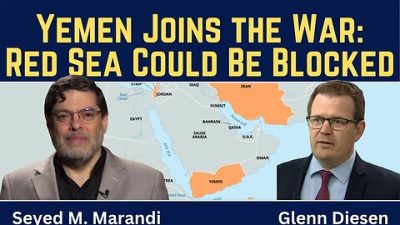
Yemen joins the war – Red Sea could be blocked next – Saudi regime at risk
or go to
Aletho News Archives – Video-Images
From the Archives
A superpower and “the world’s sickest warrior state”
By Paul J. Balles | March 8, 2010
Living through five or six major wars has hardened me to what I thought were the extremes of inhuman cruelty and brutality.
Two things made those extremes almost bearable: the brutality always revealed – at least according to the media coverage – the viciousness of the enemy. It was therefore quite understandable when our “brave men and women” pulverized the enemy.
Films of Japanese torturing captive Americans somehow justified holding Japanese Americans in internment camps during World War II; and only a small percentage of Americans found the bombing of Hiroshima and Nagasaki unreasonably vengeful at best, at worst, depraved.
The media giants in America portrayed the North Koreans as barbaric beasts with their captives, quite unlike their southern counterpoints – our allies during the Korean War. No one ever felt the need to explain how the South Koreans were a civilized breed while the North Koreans were absolute savages, at least according to the official line.
In Vietnam, our warriors justifiably (or so the media made us believe) dropped napalm on the North Vietnamese who had the gall to hide in villages and tunnels to ravage our invaders. At least it was accepted practice until some rogue photojournalist filmed a young girl screaming down a Vietnamese road in flames. … continue
Blog Roll
 Aletho News
- Russian tanker approaches Cuba despite US oil blockade
- Marandi: Yemen joins the war – Red Sea could be blocked next – Saudi regime at risk
- Pro-Palestinian French member of European Parliament denied entry to Canada
- Pakistan to Host US-Iran Talks
- How Indonesia’s tilt toward the US left it stranded in the Strait of Hormuz
- US has no choice but to retreat from Iranian borders: Top commander
- Iran Retaliation Strikes Chemical Plant Near Dimona
- AWACS’ Destruction is a Major Loss for US Military – Ex-DoW Analyst
- Israel’s Iran Strategy Uses US Military & Gulf States as Its Pawns
- Iran: Trump wanted regime change, now just begging for Hormuz to open
- If Americans Knew
- Israeli police block Catholic cardinal from entering Church of the Holy Sepulchre on Palm Sunday
- Israel is assassinating journalists again, more than any other nation, anywhere, ever – Not a ceasefire Day 170
- Over 300 US service members wounded, majority have brain injuries – Not a ceasefire Day 169
- Researchers at Human Rights Watch Resign Over Blocked Report on Palestinian Refugee Return
- Jewish Groups Are Backing a War Americans Don’t Want
- Eric Fingerhut Thinks He’s the President of the Jews
- Top Jewish Philanthropists, Rabbis Urge Israeli President to Take Action Against ‘Jewish Extremists’
- Don’t Be Fooled. Zionist Leaders Have Always Wanted to Control Southern Lebanon
- Israel’s widespread use of torture is a core element of its genocide against the Palestinian people
- In Israel’s War on Iran, Many Middle East US Bases Rendered “All But Uninhabitable”
- No Tricks Zone
- New Study Finds Warming Saves Lives…Cold Temperatures 12 Times More Deadly Than Excess Heat
- German Science Blog Accuses PIK Climate Institute Of Hallucinating Climate Tipping Points
- Devastating Assessment Of Comirnaty Vaccine By Former Senior Pfizer Europe Toxicologist
- New Study: CO2 Is ‘Effectively Negligible’ As An Explanatory Climate Change Factor Since 2000
- Former Pfizer Toxicologist Dr. Helmut Sterz Tells Bundestag Hearing Pfizer Vaccine Should Have Never Been Approved
- Energy Expert: Germany’s Nuclear Phaseout Was A “500 Billion Euro Mistake”
- New Research: South Australia’s Mid-Holocene Sea Surface Temperatures Were 4°C Warmer Than Today
- Storing Green Energy To Last Germany 10 Days Would Require A 60-Million Tonne Battery
- New Studies: UK Sea Levels Were 4 Meters Higher Than Today During The Mid-Holocene
- Destructive Green New Deal: German Energy And Metal Group Warns Of Drastic Crisis
 Aletho News