Iran, Israel and U.S. Subservience
By Robert Fantina | CounterPunch | September 11, 2015
As the United States Congress debates whether or not to accept an agreement that the U.S. and five other nations reached with Iran, regulating that nation’s nuclear program, the media keeps a less-than-rapt public informed. Each day, news pundits first speculate on how this or that senator may vote, and then when some senator announces his or her position, it is tallied up as a ‘yes’ or ‘no’, and a victory or defeat for President Barack Obama.
As all this takes place, some odd but revealing statements have been made. Let us first look at just two, both from Democrats, one from a senator voting for the deal, and one who opposes it, and see what they tells us.
Colorado Senator Michael Bennett, in endorsing the deal, made this astonishing statement: “Our primary objectives are to prevent Iran from having a nuclear weapon, make sure Israel is safe and, if possible, avoid another war in the Middle East.”
As this writer is wont to do, let us break this statement down to its component parts. We will look at Mr. Bennett’s ‘primary objectives’.
“Prevent Iran from having a nuclear weapon”. Well, the fewer nuclear weapons in the world, the better. But why are some countries allowed to have them, and others not? The only nation in the world ever to have used nuclear weapons, the U.S., has a large stockpile, and has done nothing to reduce it. Please note that the U.S. has been at war with one country or another for most of its long and bloody history, so the fact that it has nuclear weapons is certainly a great risk to the world. Former President Richard Nixon is said to have considered using nuclear weapons in Vietnam. Why is Iran being singled out as not allowed to have such weapons when the U.S. can have them?
“Make sure Israel is safe”. See how quickly we get to the crux of the matter? Israel’s safety, for Mr. Bennett, is of paramount importance. And if Iran were to develop nuclear weapons, then Israel wouldn’t be the only Middle East country with them.
There is always so much concern about Israel’s safety! Does the U.S. not care about the safety and security of other Middle Eastern nations? We know that Iraq’s security is not of any interest to the U.S., or it wouldn’t have destabilized Iraq by invading it in 2003. And with Israel assassinating Iran’s nuclear scientists, there can’t be too much concern about that nation’s internal security.
And what about Palestine? Israel increasingly steals Palestinian land, but no U.S. politician ever talks about the national security of Palestine.
U.S. spokespeople always proclaim that Israel is the U.S.’s only ally in the Middle East. Perhaps if the U.S. would stop bombing the men, women and children of other Middle Eastern countries, and would be a little more equitable in its foreign aid distribution (currently, Israel gets more foreign aid from the U.S. than all other countries combined), it might find that it suddenly would have more friends in the Middle East. It has been said that before the bloody, murderous and genocidal establishment of Israel in 1948, the U.S. had no enemies in the Middle East.
Why, then, might Mr. Bennett be so concerned about Israel? Could it be the $108,766.00 in donations from Israeli lobbies that he received between 2009 and 2015? Perhaps we will dismiss that notion, and say that Mr. Bennett is a statesman, rising above such petty things as campaign contributions, and only doing what he feels, in his heart of hearts, is best for the U.S. citizenry, come what may. When pigs fly.
“If possible, avoid another war in the Middle East.” So, as an afterthought, after concerns about Israel’s security have been addressed, perhaps avoiding a war isn’t such a bad idea. This is not the usual U.S. way; diplomacy isn’t high on the list of characteristics held by most of Congress. There isn’t a lot of muscle-flexing and chest-thumping involved in diplomacy, and what’s a little blood of U.S. citizens, and lots of it of foreign citizens, when such macho displays of power are to be demonstrated?
Now, to the opposition. Democratic Senator Ben Cardin of Maryland, who greatly distrusts Iran, said this: “There cannot be respect for a country that actively foments regional instability, advocates for Israel’s destruction, kills the innocent and shouts ‘Death to America.’” Again, we will look at the component parts.
Mr. Cardin is critical of nations that
1 ‘Actively foment regional instability’. The U.S. is causing untold suffering and ‘regional instability’ through drone strikes and support for repressive regimes or rebel groups throughout the region. One would like to hear Mr. Cardin oppose such active fomenting of regional instability.
2 ‘Advocate for Israel’s destruction’. Once again, Israel is foremost in the mind of another senator, as he looks at the nuclear agreement with Iran. Israel, of course, acts to destroy Palestine with full U.S. support, but that, as mentioned above, isn’t a concern.
Between 2009 and 2015, Mr. Cardin received $241,293.00 from Israeli lobbies. We will wonder again if this, perhaps, didn’t factor in strongly in Mr. Cardin’s deliberations.
As might be expected, the multitudinous Republican presidential candidate wannabes were universally opposed to the agreement. Oddly (not!), Israel was a major factor in their criticisms. The following are just a few of their comments.
Wisconsin Governor Scott Walker: “The deal rewards the world’s leading state sponsor of terrorism with a massive financial windfall, which Iran will use to further threaten our interests and key allies, especially Israel.” No, Mr. Walker, by any objective means, it is the U.S., not Iran, that is the world’s leading state sponsor of terror.
Former Arkansas Governor Mike Huckabee: “As president, I will stand with Israel and keep all options on the table, including military force, to topple the terrorist Iranian regime.” It sounds as if Mr. Huckabee wants ‘regime change’: when have we heard this before? Oh yes, that was President George W. Bush’s mantra when he sent soldiers in to ‘fix’ Iraq. We all know how well that turned out. Mr. Huckabee further said: “A threat to Israel is a threat to America.” No, it simply is not. Also, preventing Iran from developing nuclear weapons doesn’t seem to constitute a threat to any nation, with the possible exception of Iran.
Senator Lindsay Graham weighed in with these pearls of wisdom: “You’ve put Israel in the worst possible box. This will be a death over time sentence to Israel if they don’t push back.” It is interesting to note that between 2009 and 2015, Mr. Graham received $286,350.00 from Israeli lobbies.
It is no secret where this great anxiety for Israel originates; money talks in the U.S., and Israeli lobby groups speak loudly. What is disturbing is how it takes precedence over every other concern, to the point where elected officials are willing to wage war to protect an apartheid nation, censured more by the United Nations than any other country on the planet. This is the nation whose interests the U.S. puts front and center, before its own. This is the nation that receives billions of dollars in U.S. aid annually, as U.S. cities decay. This is the nation for which the U.S. will jeopardize the lives of its young citizens, by disdaining diplomacy and using war as the dominant means of ‘leading’ in the world.
That leading politicians so blatantly state their adoration for Israel should give every U.S. citizen cause for concern. It is time for justice and human rights to be enshrined as the hallmarks of U.S. foreign policy. As that has never been the case, it will be difficult to introduce it now. But it must be done; the world has suffered for too long because of the U.S.
Iran’s Growing Questions About The Sanctions
By Kaveh L. Afrasiabi | Eurasia Review | September 5, 2015
Iran’s Supreme Leader, Ayatollah Seyed Ali Khamenei, has instructed the Parliament (Majlis) to review and vote on the nuclear deal reached between Iran and the world powers in July, and has also questioned the parts of the deal, known as Joint Comprehensive Plan of Action (JCPOA) that refer to the suspension rather than annulment of Iran sanctions.
Khamenei’s latest statement, raising questions about the JCPOA, comes at a time when various US officials devote most of their energy assuring the skeptics about the “snap back” and the like, instead of clarifying the nature and timeline of their removal of Iran sanctions; this is not to mention the unpleasant language of military threat that has resurfaced in full fury since the breakthrough agreement in Vienna.
With respect to Iran’s parliamentary approval, Ali Larijani, the powerful speaker of Majlis who was recently in New York for an inter-parliamentary meeting, told an Iranian audience that he foresees a more energetic role by Majlis on the nuclear issue in the near future. Larijani, who backs the deal and is considered an important ally of President Hassan Rouhani, will have his work cut out for him, in light of the strong reservations toward the deal by the majority faction known as the Principalists, some of whom have clashed with the members of the negotiation team who have testified at Majlis.
Henceforth, while President Obama has declared victory by securing the Congressional votes that safeguards the nuclear deal from any derailment by the opponents of the deal, the situation in Iran is turning more complicated and casts a cloud of uncertainty on the JCPOA’s future.
One of the thorny issues is the separate agreement between Iran and the International Atomic Energy Agency (IAEA), which is confidential and is key to resolving the disputes over the so-called “Possible Military Dimension” (PMD) issues and concerns raised by the agency. Since this agreement is confidential, it is unclear if the members of Majlis will be privy to information about it, which might be essential to their ultimate verdict on the agreement.
According to the head of IAEA, Yukiya Amano, the PMD agreement is moving forward with Iran’s submission of substantial new information, and the issue is set to be resolved before the year’s end, assuming a smooth progress. Should the IAEA press for access to certain military sites, then this would certainly complicate the prospect of PMD’s resolution in the next three months. And since the IAEA’s certification of Iran’s compliance is key to the removal of sanctions, the whole issue has raised concerns in Iran that the IAEA might be manipulated by certain powers to refrain from giving Iran a ‘clean bill of health’ in order to linger the cloud of suspicion on Iran’s head and also to delay the sanctions’ relief, which is badly needed for the struggling Iranian economy, in light of the declining oil prices.
From Tehran’s vantage point, it is imperative that the other side provides further guarantees that it will stick to the terms of its obligations under the JCPOA and avoid bad-faith implementation that would erode the trust-building between the two sides. Tehran is certainly disquieted by the “liberal imperialist” American discourse that reinterprets the JCPOA as a means of “containing Iran” and uses it as a hammer to knock down Iranian power in the region.
The earlier expectations of the JCPOA as a prelude for the normalization of US-Iran relations has been to some extent evaporated, replaced instead by a new mood of mutual hostility — that is disfunctional for the vested interests of both sides, given the potential for incremental improvement and even select US-Iran cooperation on regional issues provided by the landmark agreement. Khamenei has questioned the hawkish anti-Iran pronouncements of US officials and former officials, which some view as directed for “domestic consumption” only, stating that such statements carry consequences and must be rebuffed by Iran.
In light of the above-said, the adoption and implementation of JCPOA faces many hurdles including in Iran, where the coming parliamentary elections have added sprinkles of political factionalism to the issue. While it remains to be seen how the critics of JCPOA inside the Majlis will utilize the green light by the Supreme Leader, what is clear however is that U.S. policy-makers have yet to jailbreak from the confines of “containment” strategy and its binary divisions, as a result of which the prospects for a genuine evolution of Iran-U.S. relations continues to remain suspended.
Slaughtering the Truth and the False Choice of War on Iran
By Nima Shirazi | Wide Asleep In America | September 2, 2015
Even outspoken supporters of the nuclear deal signed between Iran and the P5+1 (the US, UK, France, China, Russia and Germany) rely on myriad entrenched myths and falsehoods about Iran’s nuclear program to make their case. For instance, the constant claim that the agreement “prevents Iran from building a nuclear weapon” is a facile talking point that assumes an Iranian drive for a bomb that has never actually existed.
What the deal – known formally as the Joint Comprehensive Plan of Action – does is, in exchange for removing sanctions, verifiably limit Iran’s nuclear infrastructure by restricting enrichment levels, expanding monitoring access beyond the legal requirements of the Nuclear Nonproliferation Treaty (NPT) and Iran’s safeguards agreements to affirm the peaceful nature of Iran’s nuclear program, a program that has never been found to have ever been militarized.
Nevertheless, advocates of the accord have consistently argued that without this deal, Iran would inevitably race toward producing the bomb it’s never wanted and has prohibited for decades, and as a result, the United States (or Israel) would be forced to bomb Iranian nuclear and military facilities to save the world from the clutches of evil atomic mullahs.
We’ve heard the same thing for decades, that the “clock is ticking” and “time is running out” to attack Iran or force it to capitulate on its legal nuclear program, lest Iran acquire the atomic arsenal that we’ve been told since the mid-1980s is only “a few screwdriver turns” away and right around the corner.
These are bad facts, built upon a two-pronged foundation of alarmism that promotes the supposed inevitably of two things that will never happen: Iran acquiring a nuclear weapon and a U.S./Israeli military attack on Iran. And with bad facts come worse analysis.
In essence, even the deal’s own supporters buy into ahistorical, Netanyahu-inspired narratives of malevolent Iranian intent and prepare their appeals from there. One of the most striking examples of this egregious practice is a recent opinion piece by Anne-Marie Slaughter in USA Today, a publication with a history of terrible reporting and commentary on Iran.
Slaughter surely has impressive credentials. She’s taught at elite universities, including Harvard and Princeton, served for two years as Hillary Clinton’s director of policy planning in the U.S. State Department and currently heads the New America Foundation, an influential center-left think tank in Washington D.C.
With this résumé, it is both shocking and illuminating how little she seems to understand about Iran’s nuclear program. Slaughter refers to “Iran’s illegal nuclear program,” despite the fact that Iran has the inalienable right to a domestic nuclear program as affirmed by the Nuclear Nonproliferation Treaty (NPT). She is also apparently convinced Iran is engaged in a “quest for a nuclear weapon” (alternatively rendered as “Iran’s illegal pursuit of a nuclear weapon”), which it decidedly is not and for which there is no credible evidence.
And that’s not all. Slaughter’s analysis gets a lot more wrong.
Slaughter’s Imaginary Stockpiles
Here’s Slaughter’s opening gambit:
The opponents of the Iran deal are absolutely right about the existence of an alternative. We could bomb Iran. A sustained attack could destroy its nuclear facilities and presumably a large part of its stockpiled plutonium and highly enriched uranium.
For starters, the argument of either a “deal or war” is a wholly false choice, despite Slaughter’s conclusion that, “Like it or not, those are the only two choices we have.”
In fact, with no deal, Iran would still be a member of the NPT, have a comprehensive safeguards agreement with the IAEA, and continue to call for a nuclear weapons free zone in the Middle East, as it has done for decades. An attack on Iran, a sovereign nation that virtually all intelligence agencies on the planet have determined is not pursuing nuclear weapons, would be a undeniable war crime.
But in her second sentence, Slaughter makes a gigantic, and completely inexplicable, error. Iran has exactly zero “stockpiled plutonium and highly enriched uranium.” This is not a controversial issue; anyone who knows absolutely anything about Iran’s nuclear program knows this.
Before it can be stockpiled, plutonium must first be extracted and reprocessed from the spent uranium fuel of an operational nuclear reactor. Iran has never done this and doesn’t even have a reprocessing plant. Iran has literally never extracted plutonium from a reactor core, let alone stockpiled it, as Slaughter claims.
Iran has also never produced, let alone stockpiled, any “highly enriched uranium” (HEU), which is defined by the IAEA as “uranium containing 20% or more of the isotope 235U.” Only when uranium is enriched to about 90% does it become suitable for weaponization. Prior to the implementation of the November 2013 Joint Plan of Action (JPOA), Iran had been enriching uranium to between 3.5% and 5% 235U for use as fuel in nuclear power plants and to about 19.75% 235U for use in medical research reactors. Since the plan went into effect, Iran ceased all enrichment above 5%, diluted or disposed of its entire stockpile of 19.75% LEU, and converted the vast majority of its remaining stockpile of LEU to a form incapable of being weaponized.
Even the Israeli intelligence community, perhaps the entity most hostile to Iran and likely responsible for the murder of five Iranian scientists, doesn’t claim Iran has any stockpiled plutonium or HEU. In a top-secret 2012 memo, the Israeli Mossad assessed that, although Iran maintained a declared stockpile of LEU, “it does not appear to be ready to enrich it to higher levels.” Furthermore, the cable noted that, without a plutonium reprocessing plant in Iran, the plutonium produced as a byproduct of running the heavy water research reactor in Arak (still under construction), “will not be able to be used for weapons.”
No amount of criminal airstrikes can bomb away material that does not exist. With this little grasp of the issues at stake, the fact that Slaughter was a policy adviser to a Secretary of State for two years is a harrowing thought.
Slaughter’s Bad Facts on the Iran Deal
Slaughter’s comprehension of the deal itself – the deal she herself supports – is similarly tenuous. Regarding sanctions relief and specifically the unfreezing of Iranian assets abroad, she writes, “If, in fact, Iran complies with the terms of this deal, stops pursuing a weapon and completely dismantles its nuclear supply chain, then it is entitled to recover the funds.”
Ok, no. This is wrong. As noted already, since Iran isn’t “pursuing a weapon,” it doesn’t actually have anything to stop doing in that regard.
Beyond this, Iran will absolutely not be “dismantling its nuclear supply chain,” which extends from the mining and milling of natural uranium ore to yellowcake conversion to centrifuge manufacturing and storage facilities to enrichment and fuel production. None of these elements of Iran’s program is being dismantled under the deal; rather, unprecedented monitoring and surveillance access is being granted by Iran to the IAEA at every step of the way, a level of inspections and insight unmatched anywhere in the world.
Slaughter’s Obfuscation of U.S. Role in Failed Iran Diplomacy
Later on in her oped, Slaughter engages in quite a bit of fictional storytelling about her past experience in the State Department:
George W. Bush’s administration spent eight years just trying to get Iran to come to the table to negotiate, without success. In 2010, during my first year working as director of Policy Planning under Secretary of State Hillary Clinton, we thought we had a deal with the Iranians to ship most of their highly enriched uranium to Russia, but it promptly collapsed when the Iranian negotiators took it back to the supreme leader, Ayatollah Khamenei. And all the while, the Iranians moved from hundreds of centrifuges to about 20,000, of ever more sophisticated design. Their supply of highly enriched uranium, just one step away from the fuel needed for a bomb, went up and up.
Again, Slaughter pretends that Iran has produced and maintained a supply of “highly enriched uranium.” It hasn’t, and never has. Also, the link she provides to support the absurd claim that the Bush administration was desperate for diplomacy with Iran is a piece of utter propaganda written by Stephen Hadley, a stalwart neocon who served as Bush’s national security adviser.
Slaughter omits the fact that, in 2002 and 2003, diplomacy between Iran and the EU-3 (Britain, France and Germany) resulted in the suspension of Iran’s nascent enrichment program and voluntary adoption of the stringent Additional Protocol, which allowed the IAEA extensive access to Iran’s program for over two years. In that time, the IAEA consistently affirmed that Iran had never diverted any nuclear material to military purposes.
It was only after Iran’s European negotiating partners, at the behest of the Americans, reneged on their promise to offer substantive commitments and respect Iran’s inalienable right to a domestic nuclear infrastructure that talks dissolved and Iran resumed enrichment. The proposal eventually brought to Iran by Western negotiators on August 5, 2005 has been described as “vague on incentives and heavy on demands,” and even dismissed by one EU diplomat as “a lot of gift wrapping around an empty box.”
Nevertheless, since late 2005, Iran has proven willing time and again to engage in negotiations over its nuclear program and the international sanctions regime. Its numerous proposals over the years have consistently reiterated its willingness to officially ban nuclear weapons development through legislation, cap its level and scope of enrichment, immediately convert its enriched uranium to fuel rods “to preclude even the technical possibility of further enrichment” towards weapons-grade material, “to provide unprecedented added guarantees” to the IAEA that its program would remain peaceful, and open its enrichment program to international partnership.
Iran’s offers were routinely rejected by the United States government, which long maintained the irrational position that Iran capitulate to the American demand of zero enrichment on Iranian soil. “We cannot have a single centrifuge spinning in Iran,” declared George W. Bush’s undersecretary of state for arms control Robert Joseph in early 2006. As recently as this past March, Slaughter’s former boss Hillary Clinton was still indicating her preference for “little-to-no enrichment” in Iran.
What made successful diplomacy with Iran possible was not, as so many still erroneously claim, the devastating sanctions imposed on the Iranian people or even the 2013 election of Hassan Rouhani, it was the Obama administration’s eventual abandonment of the “zero enrichment” demand, opening the door for acknowledging (albeit implicitly) Iran’s right to enrich and for negotiations to move forward productively.Perhaps the most curious comment Slaughter makes, however, is about the 2009 P5+1 nuclear swap proposal, in which she claims the United States and its partners offered “to ship most of [Iran’s] highly enriched uranium to Russia.”
Forgive the repetition, but remember, Iran never had any “highly enriched uranium,” so Slaughter is beginning with a completely false premise. Placing the blame on the Iranian leadership for the failure to implement the deal is also disingenuous. Here’s what really happened:
In June 2009, while it was enriching uranium up to 5% LEU only, Iran announced publicly that it required a new stock of nearly 20% LEU to keep the U.S.-built Tehran Research Reactor (TRR) operational and producing vital medical radioisotopes used to treat nearly a million Iranian cancer patients. In advance of the depletion of its reactor fuel, Iran tried to purchase more enriched uranium on the open market under full IAEA supervision.
Despite the safeguarded TRR presenting no proliferation threat, the United States and its European partners prevented any discussion of such a commercial sale. Instead, in October 2009, they offered a “swap” proposal whereby Iran would ship out most of its stockpiled low-enriched uranium to Russia to be enriched to the requisite 19.75%. This would then be shipped to France where fuel rods that could power the TRR would be produced. Iran would then, theoretically, receive those rods a year after shipping out its stockpile.
Iran agreed in principle to this arrangement, with the intention of hammering out mutually acceptable details at a later date. In late 2009, the deal was still in the works. Iran’s then foreign minister Manouchehr Mottaki reiterated that Iran was “willing to exchange most of its uranium for processed nuclear fuel from abroad” in a phased transfer of material with full guarantees that the West “will not backtrack an exchange deal.”
In reviewing the P5+1 offer, the Iranian press reported, “technical studies showed that it would only take two to three months for any country to further enrich the nuclear stockpile and turn it into metal nuclear rods for the Tehran Research Reactor, while suppliers had announced that they would not return fuel to Iran any less than seven months.”
As the parties discussed final terms, Mottaki suggested Iran initially hand over a quarter of its enriched uranium stockpile in a simultaneous exchange on Iranian soil for an equivalent amount of processed fuel for use in the medical research reactor. The remainder of the uranium would then be traded over “several years,” under an agreed upon and internationally supervised framework.
This proposed timetable was immediately rejected by Western powers. An unidentified senior U.S. official was quoted by Voice of America as claiming that the Iranian counter-proposal was inconsistent with the “fair and balanced” draft agreement. Meanwhile, Secretary of State Hillary Clinton, Slaughter’s boss at the time, urged Iran to “accept the agreement as proposed because we are not altering it,” which is the definition of an ultimatum, not a negotiation. Talks predictably fell apart.
When Iran later renegotiated the swap arrangement with Brazil and Turkey in May 2010, the Obama administration angrily rejected the terms and aggressively pushed more sanctions through the UN Security Council.
Slaughter’s History of Support for Military Intervention
Despite her distressing lack of accurate information about Iran’s nuclear program, Anne-Marie Slaughter’s uneasy embrace of the Iran deal is, at minimum, still a welcome departure from her usual militarist posture.
Five years after supporting the invasion of Iraq, Slaughter was annoyed by the “gotcha politics” of being held accountable for her bad judgment, grousing in The Huffington Post that “debate is still far too much about who was right and who was wrong on the initial invasion.”
In 2011, after leaving the State Department, Slaughter lent her full-throated support to the NATO bombing campaign in Libya, extolling herself as a champion of humanitarianism and democracy and then hailing the operation as an unmitigated success. It’s been anything but.
A year later, she was calling for U.S. allies to arm rebel forces against the Assad government in Syria, writing in The New York Times, “Foreign military intervention in Syria offers the best hope for curtailing a long, bloody and destabilizing civil war.”
In 2013, Slaughter openly lamented her support for the invasion of Iraq a decade earlier. “Looking back, it is hard to remember just how convinced many of us were that weapons of mass destruction would be found,” she wrote in The New Republic. “Had I not believed that, I would never have countenanced any kind of intervention on purely humanitarian terms.”
Slaughter said she had learned her lesson. “Never again will I trust a single government’s interpretation of data when lives are at stake, perhaps especially my own government,” Slaughter resolved. “And I will not support the international use of force in a war of choice rather than necessity without the approval of some multilateral body, one that includes countries that are directly affected by both the circumstances in the target country and by the planned intervention.”
Nevertheless, after penning this mea culpa, Slaughter continued busily advocating unilateral American airstrikes on Syria and pushing for Obama to at least threaten military action against Russia in Ukraine. “A US strike against the Syrian government now would change the entire dynamic,” she wrote for Project Syndicate. “It would either force the regime back to the negotiating table with a genuine intention of reaching a settlement, or at least make it clear that Assad will not have a free hand in re-establishing his rule.” Her calls for the U.S. bombing of Syria, and also Iraq, have since intensified.
Just last week, Slaughter again pressed her case for imposing a no-fly zone over Syria, citing “both moral and strategic reasons.” The direct American military intervention, Slaughter suggests, could be conducted “using sea-based missile systems” and “would force Mr. Assad to reconsider his long-term prospects and, most likely, force him to the negotiating table.”
Claiming that military strikes would inevitably follow the (increasingly impossible) Congressional rejection of the Iran deal is its own form of bellicosity. Deal opponents falsely argue that a “better deal,” not bombing and regime change, is their real goal, but that too is ridiculous.
It is indeed unfortunate that intelligent and influential commentators like Slaughter feel the need to resort to their own fear-mongering and false narratives to support a diplomatic initiative whose benefits need no such bludgeon. Real threat reduction over the Iranian nuclear issue would be far better served by an honest appraisal of the facts, examination of hard evidence and a refusal to engage in selective history.
Without these facts at her fingertips, Slaughter winds up promoting the very thing she supposedly seeks to prevent. She supports the deal, but for all the wrong reasons. If her former boss becomes the next commander-in-chief, Slaughter will almost certainly return to a high-powered position in government. Let’s hope she gets her facts straight before then.
AIPAC’s Plan B?
By Jim Lobe | LobeLog | September 3, 2015
*Editor’s Note: Read an accompanying post to this article here.
A number of readers have complained that I buried the important news in my last post marking Mikulski’s announcement Wednesday. So I’m reposting below that part of the Mikulski piece that dealt with what appears to be AIPAC’s and the opposition’s most likely “Plan B” for congressional action, aimed chiefly at those Democrats who feel queasy about their decision to support the White House and vote against the pending resolution to reject the JCPOA.
A summary of a draft bill, which I obtained from a source who asked to remain anonymous, is circulating that is designed (almost certainly by AIPAC) to appeal to those Democrats eager to “kiss and make up” after their defiance of the most powerful Israel lobby group (whose reputation for omnipotence just took a very heavy hit) and its donors. Although most of the bill appears to be innocuous and consistent with the administration’s own intentions, it also contains a number of “poison pills,” which, if approved, appear calculated to raise new obstacles to implementation and Tehran’s confidence that the U.S. will fully comply with both the spirit and the letter of the JCPOA.
With proposed banking sanctions, for example, it appears to do what Kagan and the policy director of the neoconservative Foreign Policy Initiative (FPI), Juan Zarate, have urged with respect to codifying existing non-nuclear sanctions and reducing or eliminating the president’s waiver authority. It also would set up a process for “expedited procedures” for Congress to pass new terrorism sanctions against Iran under certain circumstances, and also create a coordinator for compliance whose responsibilities would not only be to oversee Iran’s implementation of the JCPOA but also report on non-nuclear issues outside the scope of the agreement.
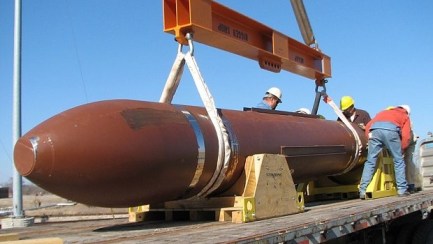
Yet another provision would authorize the delivery to Israel of Washington’s most powerful Massive Ordinance Penetration munitions (MOPs) and the means to deliver them against Iran’s nuclear facilities, a move that administration officials have long said they strongly oppose. This would be one part of a much- enhanced package of military assistance for Israel.
Other provisions appear designed to “renegotiate” certain provisions of the JCPOA; for example, by eliminating the exemption of any contracts agreed to between Iran and foreign companies during the implementation phase in the event that sanctions are “snapped back.” It also requires Iran to abide by the Nuclear Non-Proliferation Treaty’s (NPT) Additional Protocol as of “adoption day,” even if the Iranian parliament has not yet ratified the Protocol.
We hear that the sponsors intend to push this through Congress as a companion to the disapproval resolution. The idea is to enable nervous Democrats to demonstrate their strong support for Israel and their undiluted distrust and hostility toward Iran. The fear is that if this measure isn’t passed now, then it could prove much more difficult to pass once Iran begins to implement the agreement.
Here is a summary of the draft bill which, as I understand it, is still very much a work in progress.
The Iran Policy Oversight Act of 2015
Building on the bipartisan commitment to oversight outlined in the Iran Nuclear Agreement Review Act of 2015 – PL 114-17
Sets the U.S.’s going-forward Iran policy regarding the nuclear issue: The United States will never permit Iran to obtain a nuclear weapon, and all options available to the United States, including the military option, remain available.
Clarifies key interpretive issues in the JCPOA, which would also apply to subsequent agreements, including:
No sanctions relief will be provided to Iran until it meets its commitments related to resolution of PMD [possible military dimensions] issues.
Any production of HEU by Iran would be a violation of the JCPOA.
Nothing in the JCPOA limits or curtails Congress’ ability to pass sanctions legislation addressed to legitimate foreign policy purposes, including sanctions related to terrorism, human rights, and Iran’s ballistic missile activities.
There is no “grandfather clause” that would shield ongoing sanctionable activities by foreign firms in the event of a snap-back of Iran sanctions.
The JCPOA commits Iran to abide by all the provisions of the Additional Protocol of the NPT as of “adoption day,” regardless of whether the Iranian parliament approves the Additional Protocol.
Requires the Administration to submit:
A ten-year regional strategy for Countering Conventional and Asymmetric Iranian Activity and Threats in the Middle East and North Africa within six months, and every two years thereafter,
Report[s] detailing Iran’s use of funds received through sanctions relief and changes in funding for regional activities and support for terrorism,
Reports detailing Iran’s R&D activities as well as estimated nuclear weapons capability breakout time, and
A report addressing the IAEA’s resolution of the PMD issue.
Explicitly authorizes additional, specific security assistance to Israel, including bunker-busting MOPs, to ensure the President can and should take all necessary and appropriate measures to ensure Israel has the means and capacity to defend itself against nuclear and other threats from Iran.
Continues in effect banking sanctions addressed to ballistic missile proliferation and terrorism sanctions, unless the President certifies that designated financial institutions have ceased their support for missile proliferation and terrorism. Also continues in effect sanctions related to human rights abuses.
Requires the President to seek multilateral arrangements to both maintain control of exports related to conventional arms and ballistic missiles to Iran, and ensure an effective snap-back policy to respond to any non-compliance incidents as well as breach of the JCPOA by Iran.
Puts into place expedited procedures for consideration of new terrorism sanctions against Iran if Iran:
1) directs or conducts an act of terrorism against the U.S., or
2) substantially increases its operational or financial support for a terrorist organization that threatens U.S. interests or allies.
Requires the President to appoint a Coordinator for Compliance within the Department of State to:
1) coordinate all activities related to implementation of the JCPOA and any subsequent related agreements, and
2) monitor human rights abuses and activities relating to support for acts of international terrorism by the government of Iran.
Bribing Bibi and His Proxies to Behave
They won’t anyway and it will cost us much more
By Philip Giraldi • Unz Review • September 1, 2015
There are a lot of expressions about standing up to bullies being the best policy. Unfortunately the White House has difficulty in following that sound advice when it comes to Israeli Prime Minister Benjamin Netanyahu and his governing coalition of racists and thugs. And one might also add that the reticence also applies to dealing with Israel’s many friends in Congress, some of whom have apparently extorted their pound of flesh in exchange for their votes on the Iran deal.
Israel is already the military colossus in the Middle East, with formidable high tech ground, sea and air forces backed up by a semi-secret nuclear arsenal with modern delivery systems and several defensive missile system referred to as Iron Dome, Arrow 4 and David Sling. The defense systems were developed and deployed using $3 billion of U.S. Treasury special “grants” while roughly 20% of Israel’s annual total defense budget comes directly from the American taxpayer. This is all justified on the basis of sustaining Israel’s “Qualitative Military Edge,” an expression that has its own acronym QME and that is much loved by America’s national legislators, the White House and the media. In reality, Israel possesses an enormous military superiority relative to all its neighbors combined and has benefited from that capability for many years, all thanks to the United States of America.
But for some, too much is never enough. President Barack Obama is struggling to line up sufficient Democratic votes to block any congressional veto of his Iran agreement. At this point it looks like he will succeed, but the effort has brought with it the type of backstage politicking that most Americans have come to despise. Both Netanyahu and select Congressmen are being treated to a package of bribes for Israel that defies all reason, particularly given the fact that even the Israeli defense and intelligence establishments have split with Bibi’s government and sensibly declared the agreement with Iran to be better than any alternative. So even though defanging Iran is good for Israel, Washington nevertheless feels compelled to sweeten the pot, with actual American interests as usual ignored or not even considered.
How it all works has been revealed by Walter Pincus of the Washington Post, who apparently has seen a copy of a personal letter from President Obama that was sent to Democratic Congressman Jerrold Nadler, a representative from New York who was hesitating over how to cast his vote regarding Iran. Nadler’s district is reported to be heavily Jewish and the congressman, himself Jewish, has long been an outspoken advocate for Israel. The letter he received may have been similar or even identical to letters presumably sent to other Congressmen who have also been sitting on the fence over the Iran deal.
Obama, to give him his due, cleverly focuses on “our enhanced support for Israel” as the way to get to Nadler’s vote, thereby enabling the Congressman to cite what Israel will be getting out of it as he explains to his angry constituents why he is defying the call by Netanyahu to vote down the deal.
President Obama, boasting in the letter that “no administration has done more for Israel’s security than mine,” adds that he is “prepared to further strengthen the relationship.” Indeed he does. He commits the United States to extend the U.S. commitment to provide Israel with $3.5 billion per year for purchasing military equipment for an additional decade after the current George W. Bush era program expires in 2018. The letter notes a “unique element” in the purchase agreement which allows Tel Aviv to spend up to 26.3% of the money on Israeli manufactured equipment.
Beyond the $3 billion plus per annum, Obama also pledged to continue extra funding for “collaborative research and development for tunnel detection and mapping technologies,” a program that only benefits Israel. Israel will also be the only country in the Middle East to receive the new advanced F-35 fighter when it finally becomes operational next year, all paid for by the American taxpayer.
Apart from the fact that the United States is inexplicably giving billions to an Israel that has a thriving economy with Western European levels of income, there are a number of problems with this Obama deal and the nature of the “special relationship” that it represents. For Washington, Israel is the squeaking wheel that is constantly requiring applications of grease to keep quiet. The grease is liberally applied, but the wheel keeps squeaking, the noise generally emanating from the office of Prime Minister Benjamin Netanyahu, who has been directly interfering in U.S. politics since 2012.
One problem is that the United States is allowing Israel to use the money to be armed and equipped in a fashion which is directly contrary to American interests. A May offering of $1.88 billion in new equipment to Israel included 50 BLU-113 5,000 pound bombs with special penetrating nose cones that can be used against underground targets. Those targets would include Iran’s nuclear facilities, most notably its Fodrow underground uranium enrichment plant. Israel’s friends have also been agitating for the much larger 30,000 pound version of the bomb together with the heavy bombers needed to drop it on target. If past history is anything to go by it is merely a matter of time before they are granted their wish.
Bombing Iran is not exactly a U.S. interest at the moment – quite the contrary. Is it far-fetched to imagine Netanyahu staging such an attack to upset the apple cart and destroy any chance of Iranian rapprochement with Washington? A month ago I would have said no, but last week former Israeli Prime Minister and Defense Minister Ehud Barak revealed that both he and Netanyahu did indeed want to bomb Iran in 2010-2012 but backed down because of technical issues and also due to the refusal of key cabinet members and military officers to support the decision.
A second problem is the authorization for Israel to spend American taxpayer money on equipment produced locally. Israel is a major weapons supplier worldwide, sometimes both selling and providing training to regimes that many consider unsavory. Its own military industrial complex was built up using the largesse coming from the United States and it now competes with American companies. It also has a well-established record of stealing United States developed military technology and then re-exporting it under its own label, a win-win for Israel but a lose-lose for American companies.
While I am far from a fan of America’s military industrial congressional complex, using American tax dollars to subsidize a foreign competitor is the height of insanity. It will cut into exports and cost American jobs. Combining that reality with the fact that no amount of bribery will make Netanyahu shut up and that Israel will likely use some of the gifted weapons in ways that will cause difficulties for Washington the constant introduction of more money and more arms for Israel is just not a good idea. Kudos to Obama for having proceeded as far as he has with the Iran agreement but if a Congressman from New York cannot for once perceive that a deal is good for America he should resign his seat and go home. Constantly playing the Israel card has not been good for politics in the United States and it has also not been good for Israel itself as well as for the Middle East region. It is time to cut the tie that binds.
Biden will ‘beg’ American Jewish leaders for Iran agreement: Analyst
Press TV – August 28, 2015
US Vice President Joe Biden will go to Florida to “beg” American Jewish leaders to allow Washington to have its nuclear agreement with Iran, says a political commentator.
“Something this critically important to American foreign policy means only one thing… begging to powerful Jews to let America have its deal,” said David Christie, a broadcast journalist based in New York.
Christie made the remarks in an interview with Press TV on Friday while commenting on Biden’s plan to visit Jewish leaders in Miami next week.
Biden’s office said in a statement that he will “participate in a discussion organized by [chairwoman of the Democratic National Committee] Debbie Wasserman Schultz to discuss the Iran deal with leaders in the Jewish community.”
The vice president, who has played an important behind-the-scenes role in the Obama administration’s lobbying push for the agreement approval by Congress in September, hopes to win support from Wasserman Schultz who has not announced her position on the issue.
“The best way to do that is for Joe [Biden] to make a pilgrimage to Miami so he can pay homage to the one group that has been at the core of our bizarre obsession with forging a nuclear deal with a country that can never be a threat to us in the first place,” said Christie.
Iran and the P5+1 group of countries — the US, Britain, France, Russia, China, and Germany – announced the conclusion of nuclear negotiations in the Austrian capital, Vienna, on July 14. The US Congress will vote on the agreement in September.
Under the agreement, known as the Joint Comprehensive Plan of Action, restrictions will be put on Iran’s nuclear activities in exchange for, among other things, the removal of all economic sanctions against the Islamic Republic.
“Indeed, none of our hysterical pre-occupation within an Iranian deal would even exist if it weren’t for what has become the mission in life for all US politicians and of course, that is to serve and protect Israel at all—and I mean—all costs,” said the journalist.
Israel’s JINSA Earns Return on Investment: 190 Americans Admirals and Generals Oppose Iran Deal
By John Stanton | CounterPunch | August 28, 2015
According to Carol Greenwald writing at American Thinker on 27 August 2015, Washington Post writer “[Carol] Morello does not mention how incredible it was that a few people, mostly a woman named Marsha Halteman from New Orleans, in one week could get 190 flag officers to sign a public letter stating that “the JCPOA [Iran Deal] would threaten the national security and vital interests of the United States and, therefore, should be disapproved by the Congress.”
Well not so incredible at all thanks to the Jewish Institute of National Security Affairs (JINSA) very successful Generals and Admiral Program that has been in operation for many years. It has been the pipeline for 400 American military officers to visit Israel. Israel also runs similar programs for US military academy students and US law enforcement personnel.
The purpose of bringing American military personnel—and military academy students—is to maintain “Continued and robust military-to-military dialogue between the American and Israeli defense establishments is central to JINSA’s philosophy. The annual Generals and Admirals Program to Israel, in which recently retired American generals and admirals are invited to visit Israel with JINSA to meet the top echelon of the Israeli military and political leadership, ensures that the American delegation is well briefed on the security concerns of Israel, as well as the key role Israel plays as a friend and ally of the U.S. To date, JINSA has taken close to 400 retired officers to Israel, many of whom serve on JINSA’s Board of Advisors.”
As of this writing the Washington Post does not appear to have updated its story on the incredible effort of Marsha Halteman who is the recipient of a prestigious award from a US combatant command.
“It gives us great pleasure to announce that JINSA’s Marsha Halteman will be honored by the United States Special Operations Command (USSOCOM) with their Outstanding Civilian Service Medal for her tireless work on JINSA’s Soldiers Appeal, which raises funds for military members and their families who are in need of financial assistance. Her selfless and hard work is instrumental in actively supporting a USSOCOM priority – enhancing the quality of life of the individual warrior and family. Established by the Commander of USSOCOM in September 1998, the Outstanding Civilian Service Medal recognizes civilians who have provided outstanding support or service. For Marsha, this work has been both an act of love and admiration for our men and women in uniform, as well as above and beyond the call of duty. She has truly made a difference in the lives of so many soldiers and their families and she is most deserving of this award. This prestigious award will be presented to Marsha by a senior member of the USSOCOM Command at JINSA’s Spring 2014 Leadership Conference. Details of this meeting and a formal “Save the Date” will be released soon. We hope that many of you will be able to join us for the meeting and to honor Marsha.”
If the US national security and political establishment had the dedication, tenacity and thoroughness of the Israeli’s—in their pursuit of their national security interests, the USA would be a far more powerful country abroad and maybe at home. Israel’s interests are represented in every nook and cranny in the United States at the local, state and federal levels. They believe in Israel, nothing else. That deserves respect. American leaders, comparatively, are pathetic.
iSideWhiff: Presidential Poll Site Gets Iran Deal Totally Wrong

By Nima Shirazi | Wide Asleep In America | August 27, 2015
You’ve probably heard of iSideWith.com; it’s the site with that helpful quiz that tells you which of the presidential candidates you most agree (and disagree) with on a range of political and social issues.
The efficacy of the quiz, however, requires the asking of questions based on accurate information. Unfortunately, the single Iran-related query in the poll and the accompanying explanatory information are rife with factual errors. These errors and misinformation undoubtedly shape the ways in which less-informed users understand the issue and how they will respond.
Here’s the Iran question:
Should the U.S. conduct targeted airstrikes on Iran’s nuclear weapons facilities?
The iStandWith poll, in its framing of the Iran question, repeats an egregious error. Iran does not have any “nuclear weapons facilities,” quite simply because – as affirmed by all American, European and Israeli intelligence communities and others for years now, including the International Atomic Energy Agency (IAEA) – Iran has no nuclear weapons program. All 16 U.S. intelligence agencies have collectively concurred since 2007 that, even if Iran had conducted research into nuclear weaponry in the past, this research (which is not itself prohibited under international law) ceased in 2003 and has not resumed. This assessment has been reaffirmed multiple times since.
Not only this, the Iranian leadership is judged time and again not to have even made a decision on whether to embark on a nuclear weapons program (unless, of course, you count the decades-long repetition by the Iranian government that they have indeed made such a decision: and that decision is to never build or acquire a nuclear weapon).
So iStandWith’s entire contention is faulty from the start. The U.S. can’t bomb Iran’s “nuclear weapons facilities” because they don’t actually exist. Such a flawed question is sure to elicit mistaken comprehension by respondents unfamiliar with these facts, who are led to believe that Iran is doing something it’s not actually doing at all.
For those less informed on this issue, however, iStandWith provides a brief primer for interested users. By clicking a “learn more” button, this paragraph of text is revealed:
In July 2015 the U.S. reached an accord with Iran to limit their ability to put uranium or plutonium in weapons. Iran agreed to turn one nuclear plant into a scientific research facility and shut another one down. Iran agreed to let the International Atomic Energy Agency inspect these sites. Critics argue that the deal gave too many concessions to the Iranians including a provision that gives them up to 24 days to grant inspectors access to their facilities. Proponents argue that the deal makes the possibility of Iran developing a nuclear weapon in the next 25 years extremely remote.
The first sentence – like the last – is reductive, speculative, and incomplete, but okay, fine. It’s the stuff in the middle that’s extremely problematic and, unfortunately, the mistakes compound rapidly.
iSideWith says: Iran agreed to turn one nuclear plant into a scientific research facility and shut another one down.
The facility at Fordow, which iStandWith describes as a “nuclear plant,” is actually a uranium enrichment facility, which, yes, Iran has agreed to convert into an international nuclear, physics, and technology research lab. The installed and operational centrifuges at Fordow will no longer enrich uranium, but will be used for experiments involving non-fissile material.
The other facility referenced above is the Arak heavy-water research reactor, which will not be “shut down,” as iStandWith claims. Actually, it is still under construction and, as such, has never been operational, so there’s nothing to “shut down.” The Arak reactor, far from being shuttered or dismantled under the agreement, will be reconfigured with international support and will operate under full safeguards as planned.
iSideWith says: Iran agreed to let the International Atomic Energy Agency inspect these sites.
The sites mentioned by iStandWith above – Fordow and Arak – have already been inspected regularly by the IAEA for years: Fordow since it was declared in 2009 and Arak since it was declared in 2002. They are fully-safeguarded facilities, under constant IAEA containment and surveillance. Inspections are not the result of the new deal. Many other sites related to Iran’s nuclear program are also routinely inspected and have been for years. All nuclear material remains under agency seal, containment and surveillance and no diversion of nuclear material to military purposes has ever been reported.
iSideWith says: Critics argue that the deal gave too many concessions to the Iranians including a provision that gives them up to 24 days to grant inspectors access to their facilities.
This is just all kinds of wrong. All of Iran’s declared nuclear facilities and sites (including hospitals that use radioisotopes to treat cancer patients) are already open and accessible to inspectors at all times. This is not a function of the agreement, this is standard practice under Iran’s safeguards protocol with the IAEA, in place since 1974. This constant and consistent access now includes, under the new deal, inspections and monitoring of all aspects of Iran’s nuclear supply chain, such as centrifuge workshops and uranium mines and mills. These kinds of non-nuclear facilities are not safeguarded anywhere else on Earth. Inspectors have daily access to all of these sites; no provision in the deal limits this. This fact alone is proof of the massive concessions Iran has agreed to to try and end this absurd decades-long charade.
(By the way, no other nation involved in these negotiations has relinquished any aspect of their own sovereignty, inalienable rights or self-determination to achieve this deal. The lifting of sanctions, designed specifically to force Iranian capitulation to American demands, the abrogation of internationally-recognized and guaranteed national nuclear rights, and exact suffering upon the Iranian people, is not a concession – it is the inevitable, and theoretically desired, result of successful diplomacy and voluntary Iranian compromise.)
The specific bone of contention mentioned by iSideWith – the so-called 24-day delay – is also completely misunderstood. For one, the claim has to do with undeclared sites where the IAEA may suspect Iran is conducted proscribed activities. Undeclared sites, such as military bases and research installations, are legally off-limits to inspectors. The seven parties to the deal – Britain, China, France, Germany, Russia, the United States and Iran – have attempted to square this circle through a reasonable review process.
Jeffrey Lewis, director of the East Asia Nonproliferation Program at the James Martin Center for Nonproliferation Studies, has explained that, rather than 24 days, “the IAEA will need to give only 24 hours’ notice before showing up at a suspicious site to take samples. Access could even be requested with as little as two hours’ notice, something that will be much more feasible now that Iran has agreed to let inspectors stay in-country for the long term. Iran is obligated to provide the IAEA access to all such sites…”
“What happens if Iran tries to stall and refuses to provide access, on whatever grounds?” Lewis continues, before laying out the parameters of the process:
There is a strict time limit on stalling. Iran must provide access within two weeks. If Iran refuses, the Joint Commission set up under the deal must decide within seven days whether to force access. Following a majority vote in the Joint Commission — where the United States and its allies constitute a majority bloc — Iran has three days to comply. If it doesn’t, it’s openly violating the deal, which would be grounds for the swift return of the international sanctions regime, known colloquially as the “snap back.”
This arrangement is much, much stronger than the normal safeguards agreement, which requires prompt access in theory but does not place time limits on dickering.
What opponents of the deal have done is add up all the time limits and claim that inspections will occur only after a 24-day pause. This is simply not true.
Unfortunately, the guys running iSideWith – Taylor Peck and Nick Boutelier – don’t seem to know any of this. But they should, especially since they’re claiming to be providing context upon which their users can make informed decisions about supporting an unprovoked and illegal military assault on a country of 80 million people.
It appears that iSideWith should first inform itself before siding with discredited allegations and base propaganda over clear facts. Without a doubt, the Iran poll question should be updated to reflect reality.
Bernie Sanders’ Conservative Foreign Policy

By Margaret Kimberley | Black Agenda Report | August 26, 2015
It is obvious that Bernie Sanders functions as the political “sheepdog” of the 2016 presidential election. The sheepdog makes certain that otherwise disillusioned Democrats are energized enough to stay in line and support the eventual candidate, in this case Hillary Clinton. That is reason enough to oppose his campaign but it isn’t the only one. A hard look at Sanders on foreign policy issues shows that he is a progressive poseur, a phony, a conservative Democrat, and not a socialist by any means.
The Sanders website looks like every other candidate’s with a bio, donation information and of course “Bernie on the issues.” But it seems that Bernie doesn’t have any opinions on foreign policy because they are nowhere to be found. How can he be a serious presidential contender if he doesn’t discuss foreign policy? How does he differentiate himself from Hillary Clinton or Republicans if he won’t state for the record how his foreign policy differs from theirs? The truth is obvious. He isn’t a serious contender and his foreign policy views are no different from those of the other candidates.
Sanders’ candidacy is as grave a danger to the rest of the world as that of his rivals. In no way does he challenge the belief that the United States has the right to determine the fates of millions of people without regard to their human rights. He doesn’t believe that other nations have the right to oppose what the United States chooses to impose upon them.
Sanders makes quite a big deal about voting against the invasion of Iraq in 2002 and says he wants United States troops to leave that nation for good. But he never says that this intervention was wrong. He never said that the United States had no right to destroy that country or kill its people. He never said that these interventions are war crimes and violations of international law. Instead he speaks of the efficacy of particular interventions and how they impact Americans.
A presidential campaign should be an opportune moment to say that the Islamic State, ISIS, is a creation of the United States. Instead Sanders repeats that the United States must defeat this force but he only differs slightly in saying that he wants the Saudis to spend their money doing it. “I’ll be damned if kids in the state of Vermont – or taxpayers in the state of Vermont – have to defend the royal Saudi family, which is worth hundreds of billions of dollars.” That mealy mouthed opinion does nothing to end the premise of an American right to do what it wants anywhere in the world. Imagine if Sanders was willing to talk about support for jihadists going back nearly forty years and how each one delivers a more terrifying result.
In 2011 Obama was bombing Libya and planning to kill its president but Sanders didn’t see it as being particularly problematic. He repeated almost verbatim the rationales that assassinated a president and destroyed a nation. “Look, everybody understands Gaddafi is a thug and murderer. We want to see him go, but I think in the midst of two wars, I’m not quite sure we need a third war, and I hope the president tells us that our troops will be leaving there, that our military action will be ending very, very shortly.” Libya’s obliteration was no problem for Sanders as long as the process didn’t take very long.
In 2015 the Bernie Sanders foreign policy still does not digress from American political orthodoxy. He doesn’t question American policy towards Russia. “Well you totally isolate him [Putin] politically. You totally isolate him economically.” “Freeze assets that the Russian government has all over the world.” At no time did Sanders oppose the American policy of intervening in Ukraine and expanding NATO in eastern Europe, the actions which created the current confrontation with Russia. He doesn’t question why the United States has the right to dictate policy to another nation or interfere in its sphere of influence.
Sanders supports the Iran nuclear energy agreement with the P5+1 nations, but issues the same dishonest rationales about it expressed by president Obama. Sanders doesn’t say that Iran was never a nuclear power, an easily provable fact. He doesn’t question the sanctions which forced Iran to the table or point out that the 25 years of inspections called for in the agreement are a violation of Iran’s sovereignty. Instead he repeats the discredited mantra that the United States must make war in order to prevent Iran from becoming a nuclear nation when even the CIA said that it never had that capability.
The big elephant in the room, Israel, gets the standard Bernie Sanders treatment. When Israel killed 2,000 people in Gaza in 2014 he would only say that Israel “over reacted.” He didn’t like being questioned about his stance either. When protesters interrupted a speech he told them to shut up and repeated nonsense about Hamas missiles that rarely hit their targets while Israel massacred a civilian population.
When Sanders speaks out against American interventions he couches his opposition in terms of spending money at home instead of abroad. That is somewhat admirable, but there is no reason to cut the defense budget as he says he wants to do, if there is no change in how this country attempts to dominate the rest of the world.
The Sanders campaign may be an interesting footnote, but it won’t bring about needed conversation about United States imperialism. The supposedly socialist senator never even uses that word. There is blatant dishonesty in claiming to want a changed domestic policy in the United States without also changing foreign policy. The two are linked, and American workers can’t have a living wage or health care as long as imperialism goes unchecked. Liberals can’t claim superiority to followers of Donald Trump if they consent to war crimes and human rights violations. Their only requirement seems to be that Democrats ought to be in charge of the carnage. Sanders wouldn’t be a very good sheepdog if there weren’t so many willing sheep.
Margaret Kimberley can be reached via e-Mail at Margaret.Kimberley(at)BlackAgendaReport.com.
Lebanon’s Future is on the Line, and It Directly Affects Syria
By Andrew Korybko – Sputnik – 24.08.2015
Protests about the lack of proper city sanitation services have quickly escalated into full-blown calls for regime change.
Lebanese protesters demonstrated in Beirut this weekend as part of the “You Stink” movement, which was organized by citizens fed up with the garbage that had been piling up in their streets for weeks.
What began as an expression of legitimate grievances, however, quickly spiraled into the world’s latest Color Revolution attempt.
Some radical youth started throwing rocks and petrol bombs at police officers (uncannily reminiscent of the earlier hijacking of the peaceful-intentioned “Electric Yerevan” protests), which resulted in a forceful counter-response that was then immediately used to ‘justify’ the movement’s transformation into one of open regime change ends.
The thing is, however, Lebanon doesn’t really have a functioning government to begin with, having been without a President for over a year. If the Prime Minister steps down as he threatened to do, then it would create an unprecedented constitutional crisis that might bring the formerly civil war-torn and multi-confessional state back to the brink of domestic conflict.
Any significant destabilization in Lebanon is bound to have a serious impact on Syria, which would be put in a difficult position by the potential cutoff of the strategic Beirut-to-Damascus highway and the possible redeployment of valuable Hezbollah fighters back to their homeland.
A Little About Lebanon
The tiny Middle Eastern state of about four and a half million people is marked by a demographic and political complexity that could hinder a speedy resolution to the current crisis. It’s necessary to be aware of some of its specifics in order to better understand the origins of the current stalemate and where it might rapidly be headed.
Unilaterally sliced out of Syria during the early years of the French mandate, the territory of Lebanon hails what is generally recognized as the most diverse population in the Mideast. Eighteen religious groups are recognized in the country’s constitution, including Alawites, Druze, Maronite Catholics, Sunnis, and Shiites.
This eclecticism of religious communities is presided over by something referred to as the National Pact, an unwritten understanding that the President will always be Maronite, the Prime Minister will be Sunni, and the Speaker of Parliament will be Shiite, among other stipulations (and with a few historical exceptions).
Complementary to this concept is the country’s unique political system called confessionalism, whereby Christians and Muslims share equal seats in the unicameral parliament, but each group’s respective composition is determined proportionally by sect. Originally meant to be a temporary solution when it was first enacted in the 1920s, it was later refined by the 1989 Taif Agreement that ended the lengthy civil war and has remained in place to this day.
Crawling To A Crisis
The current crisis in Lebanon was long in the making, and it’s the result of many embedded problems that spilled over with the garbage protests. The economy has always been fragile, in that it’s highly dependent on tourism and banking – hardly the prerequisites for a stable system.
The overwhelming influx of over 1 million Syrian refugees over the past couple of years (on top of the nearly half a million Palestinian ones already present in the country) contributed to the country’s economic malaise, with the International Labor Organization quoting a 34% unemployment rate for youth between the ages of 15-24. It’s thus of no surprise then that there were plenty of disaffected young people eager and available to protest when the “You Stink” opportunity finally arose.
Lebanon’s economic troubles have been exacerbated by its enormously high debt-to-GDP ratio that has the dubious honor of being one of the world’s worst at 143%. It’s of such magnitude that Prime Minister Tammam Salam just announced that the government might not be able to pay salaries next month.
This economic dysfunction persists despite the discovery of large amounts of offshore oil and gas that have yet to be extracted. Part of the reason for this is that the country is in the midst of a political impasse stemming from parliament’s inability to agree upon a new president after the former one finished his term in May 2014.
Since the president appoints the prime minister, if Salam resigns like he threatened to do if Thursday’s upcoming Cabinet meeting yields no results, then the country would enter completely uncharted territory that might prompt more pronounced unrest and guarantee a period of heightened uncertainty.
The arrangement of political forces is thus that two men have the possibility to be president – Michel Aoun and Samir Geagea. Each represents one of the two main trans-religious political coalitions, the 8 March Alliance and the 14 March Alliance, respectively, and both want parliament to end its impasse as soon as possible.
Their similarities end there, however, since Aoun is in an alliance with multipolar-oriented Hezbollah, while Geagea is closely tied to former Prime Minister and dual Lebanese-Saudi billionaire powerbroker Saad Hariri.
Wikileaks’ latest releases from the Saudi Foreign Ministry prove that Hariri still has intimate contacts with the Saudi royal family and intelligence services, and that Geagea once begged the kingdom to bankroll his party’s finances. Therefore, although the presidency itself is largely ceremonial, it’s the diametrically competing visions of these two parties and the potential for street clashes between their supporters during the Color Revolution tumult that creates serious concern about Lebanon’s future, and consequently, could be expected to have negative repercussions for Syria.
Sabotaging Syria
The regional backdrop in which all of this occurs is that the US and its allies are in a ‘race to the finish’ to ‘win’ their various Mideast wars before the tens of billions of dollars of frozen Iranian funds are returned to Tehran, which would then partially disseminate it to its regional allies Hezbollah and Syria.
Additionally, Russia has made remarkable diplomatic progress in trying to reconcile all sides in Syria and assemble a coordinated anti-ISIL coalition, raising the US’ fears that its window of ‘opportunity’ for accomplishing regime change there may unexpectedly be drawing to a close.
It’s thus under these conditions that the organic protests in Beirut were almost immediately hijacked by radical Color Revolutionaries in order to create chaos along Syria’s western border.
The intent behind the calculated state collapse being attempted at the moment in Lebanon is to disrupt the Beirut-to-Damascus highway that serves as one of the two main lifelines to the Syrian capital, the other being the Damascus-to-Latakia highway. Shutting down the Lebanese route would make Syria wholly dependent on the Latakian one that’s vulnerable to an “Army of Conquest” offensive, which if successful, would cripple the country by de-facto blockading the capital.
At the same time, in the event that Beirut reaches its breaking point, some Hezbollah units currently deployed to Syria would be compelled to return back to the home front to assist in the inevitable power struggle there. The withdrawal of part (or all) of this valuable fighting contingent would make the military situation much more difficult for the Syrian Arab Army, both in defending the Damascus-to-Latakia corridor and in securing the Lebanese border from becoming a ‘second Turkey’ of terrorist infiltration.
Conclusively, it’s for these strategic reasons why it strongly appears that externally directed forces were ordered to exploit Lebanon’s existing tensions at this specific time. They engineered a Color Revolution attempt by using the “You Stink” protests as a semi-plausible cover, and this was timed to coincide with the ‘race to the finish’ being played out all across the Mideast.
Lebanon can still pull away from the brink, provided that Thursday’s upcoming Cabinet meeting resolves the presidential crisis and placates the country’s main political parties, but it will have to tread very carefully in containing sectarian temptations and avoiding the trap of escalatory Color Revolution provocations.
Read more:
‘Middle Eastern Union’: West Redrawing Map of Middle East at Will
Russia Succeeds in Middle East Policy – Lebanon Presidential Candidate
Lebanese Police Use Water Cannons to Disperse Beirut Protesters (VIDEO)
Misleading AP tales can’t damage ‘Teflon Iran’
By Sharmine Narwani | RT | August 22, 2015
When a US media outlet broke a misleading story on the Iran nuclear file this week, many in the West found themselves rushing to defend the Iranian position. Only a few months ago, they would have been the ones to leak, seed and spread the disinformation.
The Associated Press (AP) on Wednesday published an “exclusive,” claiming to have seen a draft of a hotly debated ‘confidential agreement’ between Iran and the International Atomic Energy Agency (IAEA), the monitoring organization that safeguards the peaceful nature of member-states’ nuclear programs.
AP’s “unsigned draft” heavily suggests that Iran will, in effect, be investigating its own controversial military facility – Parchin – on behalf of the IAEA.
This made the deal’s critics howl with outrage. US politicians and pundits opposing the Vienna agreement between the UN Security Council P5+1 and Iran, quickly hit the media circuit – with AP’s sketchy details – to cement their case against the historic nuclear deal.
But then what followed was quite instructive on The New Order Of Things.
US administration officials, the director general of the IAEA, former IAEA officials and a whole host of American media outlets stepped in to make the counter-argument. On behalf of the Iranians, mind you.
Not much was heard from the Islamic Republic itself.
Before the Joint Comprehensive Plan of Action (JCPOA) was concluded on July 14, Iran stood alone in what amounted to a global ‘public diplomacy’ onslaught against its peaceful nuclear program. No matter what information, data points, sampling or intrusive inspections Tehran offered up since 2002, it was always one more ‘question mark’ behind its accusers.
I recall a frustrated letter penned by Iran’s permanent representative to the IAEA, Ali Asghar Soltanieh, to the Agency’s board of governors on June 17, 2009, in which he argued:
“After six years of the most robust and intrusive inspection in the history of the Agency, and in spite of the continuous declaration of the Director General (of the IAEA) in over 20 reports to the Board of Governors, that there is no evidence of diversion of nuclear materials and activities to prohibited purposes (i.e., weaponization), the issue is still on the agenda. The simple question is: Why?”
He goes on to allege that the issue of Iran’s nuclear program remains on the table because of the political motivations of a few nations, who would like to turn the Agency into a “watchdog, with maximum intrusiveness in safeguards in order to interfere in the national security… of member states, under the pretext of proliferation.” Read his September 4 letter which outlines Iran’s grievances in detail.
Laptops, dossiers, dodgy foreign scientists, secret nuclear sites… the whole gamut of Hollywood-inspired smoking guns were tossed Iran’s way – usually seeded by the Israelis, Americans, Brits or the Mujaheddin-e Khalq (MEK), a formerly US-designated terrorist group now happily embraced by Congress.
The problem with much of this manufactured evidence on Iran’s nuclear program was that the IAEA would use it as a pretext for more questions – often without allowing the Iranians to review the material in order to “protect” their sources. How could the Iranians respond to something they couldn’t examine?
All this changed when the JCPOA was agreed upon in Vienna in July. But the Americans have spent over a decade creating a cottage industry of flimsy evidence focused on Iranian “nuclear bombs” and “terrorism,” and Washington is now facing the monster it spawned.
An Iranian official explained this to me in Vienna, before the deal: “These are not real issues. This is more a matter of the US trying to prove the credibility of past issues. It was wrong, they know they were wrong, but they have a need to stick to the script.”
Twelve years of American credibility on the Iran ‘story’ is on the line, after all.
Some Facts about the IAEA and Parchin
On the issue of inspections at Parchin – this is a military facility that allegedly, pre-2003, dabbled in something the Americans ‘find suspect.’ In 2005, on two separate occasions, the Islamic Republic “voluntarily provided access” to the IAEA to inspect the site.
Since then, Western sources allege that Parchin has been “swept” and remodeled. So, either way, there is nothing anybody is going to find there 10 years later. Access to the site for a final inspection is more an exercise for Washington to tick a box for public consumption.
Nevertheless, the IAEA is a technically professional agency that has politically served western P5 (US, UK, France) interests for much of the past decade, and so it isn’t going to do this job haphazardly.
The IAEA says it has “hundreds” of confidential agreements with member-states. They manage access to non-standard sites all the time – the difference is only in how the access is customized to suit the needs of both parties. The Agency’s head Yukiya Amano, says:
“I can state that the arrangements (with Iran) are technically sound and consistent with our long-established practices. They do not compromise our safeguards standards in any way. The Road-map between Iran and the IAEA is a very robust agreement, with strict timelines, which will help us to clarify past and present outstanding issues regarding Iran’s nuclear programme.”
Whatever the process, the IAEA will obtain Parchin environmental samples whose origins and sanctity are unimpeachable. IAEA Inspectors could oversee the sampling, GPS-tracking devices could be strapped onto local inspectors – who knows? The Agency is bound by confidentiality to its agreements with members. Those are the rules.
Where’s the media interest in IAEA safeguards outside of the Iran inspections regime? The Agency has, over the years, amassed considerable tools and networks to ensure the quality of its results. These include a sprawling inventory of 45,000 pieces of equipment of 140 different varieties, 20 qualified laboratories worldwide, access to satellite data to supplement physical analysis, and 850 staff members from 95 different countries. Furthermore, the Agency has 182 safeguard agreements in force with member-states, has conducted more than 2,700 inspections, generated 3,000 safeguards statements and reports, and currently has more than 193,500 ‘significant quantities’ of nuclear materials under safeguard.
So the AP story claiming ‘self-inspection’ has already been challenged by experts galore this week – by former IAEA officials and inspectors here and here, and by Amano himself, who expressed dismay at the “misleading” information circulating about the Parchin inspection in a rare public statement on this issue.
The IAEA safeguards practices continue to evolve, both according to the challenges they confront and to improve efficiencies. A member of an IAEA team assembled to test the viability of off-site environmental sampling told me recently that they had conducted an exercise in a Mideast state to take samples from outside the perimeter of a target facility. Perhaps some of those lessons will have already been applied to the Parchin inspection protocol – but likely only if the process was found to meet IAEA standards.
More facts, less spin
Hot button issues like Parchin and other ‘possible military dimensions’ (PMDs) of Iran’s nuclear program will not go away anytime soon. But the debate has changed already with the entrance of atypical ‘deal defenders’ – a crop of elite, Western establishment politicians, journalists and analysts – who are pitching the arguments that Iran has previously been unable to make heard.
JCPOA opponents are short of material to fling at deal defenders these days. The Vienna agreement is basically a fair one (if implemented according to its stated intent) that has been scrutinized ad infinitum by six world powers and the Islamic Republic of Iran, after all.
So silly minutiae, non-issues that play well to the suggestible masses, grabs the headlines instead. Take another issue that has had some airtime on social media and in the US press recently: Three weeks ago, another AP report headlined that Iran will not allow US (and Canadian) IAEA inspectors to visit its nuclear facilities. Newsweek magazine said, for JCPOA opponents, this step “will only compound doubts over whether the IAEA will be able to oversee the terms of the deal.”
But Iran’s Deputy Foreign Minister Abbas Araghchi insisted the Vienna agreement mentions that inspectors “should be from countries that have diplomatic relations with the Islamic Republic of Iran.”
And an IAEA spokesperson provided further context by referencing an August 28, 1961 memorandum by the Agency’s director general on “inspectors,” which states:
“The (member) State shall inform the Director General, within 30 days of receipt of such a proposal, whether it accepts the designation of that inspector… If a State, either upon proposal of a designation or at any time after a designation has been made, objects to the designation of an Agency inspector for that State, it shall inform the Director General of its objection. In this event, the Director General shall propose to the State an alternative designation or designations.”
This is standard procedure for member states of the IAEA – nothing suspect or unusual here. It is common sense that a nation will not allow nationals from adversarial or hostile states to inspect its national security-related or prized technological sites.
It is highly unlikely that Iran will veer from the letter and intent of the JCPOA now or in the foreseeable future. The Islamic Republic has been subject to the most intrusive inspections in the history of the IAEA and has taken tremendous hits from an international sanctions regime that sought to strangle Iran’s economic and political systems – all in service of cleaving to its “inalienable right” to pursue an indigenous civilian nuclear program.
In Iran’s view, “international law” serves the country best – and Tehran’s public and private fights are mostly about foreign actions that circumvent the rule of law as applied to relations between states – via illegal or unjust sanctions, sabotage, propaganda, blackmail, assassination, etc.
The JCPOA helps Iran plod along its desired nuclear and economic trajectory with legally-binding ‘safeguards’ against the external trickery and ploys it has been subjected to in the past. Providing, of course, those same Western parties don’t exploit loopholes and revert back to their old tricks, as Iranian conservatives constantly warn.
In its past nuclear-file battles, Tehran usually lacked two key weapons: the ability to fight back against evidence it was not allowed to see, and the ability to communicate its messages to a global audience.
In one fell swoop, the Vienna agreement provided both tools. Buried in the details of the JCPOA is one line regarding any concerns the IAEA has about undeclared nuclear materials, activities or locations: “The IAEA will provide Iran the basis for such concerns and request clarification.”
An Iranian negotiator privately told me in Vienna that the deal must provide Tehran with direct access to any evidence suggesting inconsistency in its nuclear activities. Iran has been denied this in the past. With evidence to touch and feel, it will be much easier for Iran to refute or disprove allegations against it.
Post-deal – and as long as US administration calculations remain pro-deal – Iran’s opponents no longer have an unfettered ability to use the UNSC P5 and IAEA to float unsubstantiated charges against Tehran. This is why we can expect the charges to now come hard and fast through media channels and “leaks.”
And that brings us to Iran’s second “gain” in the aftermath of the Vienna agreement. Having bought into and become fully vested in the JCPOA, the six powerful members of the P5+1 will act, in a sense, as a communications channel for the Iranians, whose ‘facts’ have long been ignored in the media. It is currently in the interest of the P5+1 to make this deal ‘stick’ – and so Iran has experienced enormous relief in its counter-messaging activities related to its nuclear file.
The Islamic Republic just became ‘Teflon Iran.” And Western punditry and establishment figures seeking to spoil the JCPOA environment can now expect a lot more mutiny from within.
Until the Western political pendulum swings back the other way.
Sharmine Narwani is a former senior associate at St. Antony’s College, Oxford University and has a master’s degree in International Relations from Columbia University.
Featured Video

Macgregor: We Haven’t Seen the Worst of the Iran War Yet
or go to
Aletho News Archives – Video-Images
From the Archives
15 Saudi ‘hijackers’ were CIA agents working for US: Scholar
Press TV – April 13, 2016
Fifteen of the 9/11 “hijackers” from Saudi Arabia were CIA agents working for the United States government, which was seeking to destroy the Middle East for Israel and to double the American military budget, says Dr. Kevin Barrett, an American academic who has been studying the events of 9/11 since late 2003…. continue
Blog Roll
 Aletho News
- Israel seeks ‘compensation’ from Washington over Saudi F-35 sale
- Saudi crown prince seeks dialogue with Ansarullah after Yemeni blows: Report
- Damascus rejects Saudi request for Syrian fighters to counter Yemen: Report
- South Korea says will not send troops to join terrorist US war on Iran
- Russia Just Struck the Eyes of NATO’s War Machine in Ukraine
- Russia summons UK charge d’affaires over Kiev drone support
- NATO member warns bloc seeking pretext for war with Russia
- Macgregor: We Haven’t Seen the Worst of the Iran War Yet
- ‘We are not like everyone else’ laws that bind other nations do not apply to Israel, says Likud lawmaker
- Report: Saudi Arabia seeks allies’ assistance as missiles deplete amid war on Yemen
- If Americans Knew
- Debunking The Claim That Macklemore Has A “History Of Antisemitism”
- CPJ demands release of arrested Palestinian-US journalist near Bethlehem
- Robert Kraft: The Billionaire Friend of Netanyahu Pulling The Strings Behind the Macklemore/Ed Sheeran Blow Up
- Columbia Administered Fund Gives Big Money to Pro-Israel Groups
- Deportation Case of Palestinian Activist Salah Sarsour Tests First Amendment
- ‘We Will Not Forget’: Palestinians Mark 44 Years since Sabra and Shatila
- Why do we let Zionists decide what we can and can’t say?
- US welcomes Israeli, Iranian delegations to UN, but not Palestinians – Daily Update
- Biden’s Genocide Accomplices Targeted by New Accountability Campaign
- AIPAC’s Network Has Already Spent $67.2 Million to Shape the Midterm Elections
- No Tricks Zone
- New Study: ‘Global Drought Shows No Detectable Recent Acceleration Under Climate Warming’
- Economic Masterminds: German Socialists Suggest Taxing Productivity Gains Stemming From Using AI
- The South China Sea Has Not Been Cooperating With The Climate Change Narrative
- Energy Crisis: Germany Enters Heating Season With Historically Low Gas Reserve Fill Levels
- New Study: The Antarctic Ice Sheet Gained Mass From 2020-2024 Due To Staggering Snow And Ice Accumulation
- Study: Ocean Heating Rates From Thousands Of Years Ago ‘Dwarf’ Modern Ocean Heating Rates
- Climate Extremists Target, Attack Large-Scale Power Grid Infrastructure In Germany!
- New Study: Antarctic Ice Melt Has Contributed Less Than 1 Centimeter To Sea Level Rise In The Last 30 Years
- Fear Of Debate: Alarmist German Climate Scientist Calls On Mainstream Media To Discredit Skeptic Voices
- End-Of-August Arctic Sea Ice Extent Hasn’t Fallen In 20 Years, Official Data Show!
 Aletho News