Report finds UK enabled ‘unlawful’ Saudi-led naval blockade of Yemen, as London resumes arms sales to Riyadh
RT | July 8, 2020
The United Kingdom has been providing naval training to members of the Saudi-led coalition fighting in Yemen, skills which may have been used to impose a widely condemned embargo on the war-torn country, according to a new report.
The Royal Navy is instructing naval personnel from Saudi Arabia and the United Arab Emirates (UAE), Declassified UK has uncovered, even as the Gulf states continue to impose a devastating sea blockade on Yemen, resulting in millions of civilians living on the brink of starvation.
In September 2015, a UAE naval officer attended a four-week training course in southern England – just months after the Saudi-led coalition began its embargo on Yemen and bombed the port of Hodeidah, destroying warehouses, cranes and other infrastructure used to unload and store badly needed humanitarian supplies. The British program included instruction in ‘counter-smuggling’ and ‘board and search’.
Six months later, according to Declassified UK, Royal Navy officers spent a week in Saudi Arabia drilling 15 sailors on how to “board and search” vessels in “international waters or territorial seas.” The Saudi personnel were taught “high-risk search techniques” as well as detention procedures. Between September 2016 and March 2017, the UK also provided Saudi and UAE forces with instruction on protecting an Exclusive Economic Zone – the area off the coast of a country containing its exclusive fishing and other resource-gathering rights. The course was followed by training exercises with the Saudi Navy.
The relationship between the Royal Navy and the Saudi-led coalition continued even as the situation in Yemen rapidly deteriorated, the investigative report revealed. In 2019, the UAE navy received instruction on how to “board and search” vessels. The same year, nine Saudis, as well as personnel from Bahrain and the UAE, attended the Royal Navy’s officer academy at Dartmouth. Meanwhile, a number of commandos from the UAE were given instruction in amphibious operations during a 60-week Royal Marines course.
The training reportedly continues to the present day. According to the UK military watchdog, the Royal Navy has five sailors, including a lieutenant commander, on loan to the Saudi Navy. Three of the individuals are listed as instructors, suggesting that they could possibly be providing regular training to Saudi personnel. Some instruction coming from the UK has been provided by the private sector; BAE Systems, Britain’s largest arms firm, has a contract to train the Saudi navy.
The Saudi-led blockade, part of the coalition’s campaign against the Houthi rebels in Yemen, has been denounced by the international community as illegal. The UN’s special rapporteur on human rights and sanctions, Idriss Jazairy, warned that the embargo was “paralyzing a nation” and amounted to an “unlawful unilateral coercive measure under international law.” Millions of Yemenis now face starvation due in part to the sea blockade.
The humanitarian catastrophe has not deterred London from increasing its involvement in the conflict. On Tuesday, International Trade Secretary Liz Truss confirmed that the UK will resume arms sales to Saudi Arabia. The UK temporarily halted weapons deliveries to Riyadh after a court ruling in June 2019 found that the practice was unlawful. The British government now claims that, although there is cause for concern, “possible” war crimes carried out by the Saudi-led forces are only “isolated incidents.”
Israel’s ambitions in south Yemen increase risk of conflict with Houthis
By Omar Ahmed | MEMO | June 29, 2020
Israel’s involvement in the Yemen war throughout its five year duration is an open secret. In 2015, when the Saudi Arabian Embassy in the capital Sanaa was seized by the Houthi forces in retaliation for the Saudi-led coalition’s aggression, a large cache of Israeli-made weapons and ammunition was discovered, in addition to documents detailing intentions by the US to establish a military base on Perim Island near the Bab Al-Mandab Strait, “to protect [America’s] interests and ensure the security of Israel”. The island has been under the coalition’s control since it was wrested from the Houthis in the same year. Foreign mercenaries fighting on behalf of coalition-partner the UAE were also said to have been trained by the Israeli military at camps in the Negev Desert.
Amid the ever-growing normalisation of relations between Israel and Gulf states, it should come as no surprise that it was reported last week that Israel and the Emirati-backed separatist Southern Transitional Council (STC) are “secret friends” with meetings facilitated by the UAE.
The STC’s vice-chairman, Hani Bin Briek, confirmed that relations with Israel are “very good” while Tel Aviv reacted positively to the prospects of a “new autonomous state in Yemen”. The fragmentation of Arab states is, of course, consistent with Zionist strategies in the region; support for separatism in the south of Yemen echoes Israel’s decades-old policy of backing Kurdish statehood.
Covert Israeli interventions in Yemen are not without precedent. During the 1962-1970 civil war Israel airlifted arms and money in support of the royalist Mutawakkilite dynasty — ironically the predecessors of the Houthis — against the Nasserite republicans. The Saudis also supported the Zaydi monarchs who ultimately lost out in the war.
Securing Israel’s southern port of Eilat and a shipping lane which grants access not only to the Suez Canal but also the Red Sea and through Bab Al-Mandab to the Indian Ocean and beyond is of vital interest to Tel Aviv, especially as a gateway to the Far East and China, which is a major trading partner. The wars with Arab neighbours in 1956, 1967 and 1973 all involved blocking Israeli shipping. In the latter, Yemen closed off the Bab Al-Mandab Strait and blockaded the Red Sea. Ever since, Israel has viewed any attempt to block access to the Red Sea as an act of war and has threatened to deploy all branches of its military in the event of Iran doing so.
As with every other party involved in the current conflict in Yemen, access to all seaways leading to the Gulf of Aden, Arabian Sea and the Indian Ocean play a significant part in the underlying agendas. It is certainly one of the charges levied against the UAE over its involvement in the recent STC “coup” of Socotra Island.
However, the revelation of Israeli support for the STC is a worrying development for the prospects of maintaining a unified Yemen, however elusive that appears to be. Any attempts by Tel Aviv to back the emergence of a break-away “independent” state in the region should be treated with suspicion. The STC has made it clear that it intends to expand further beyond its current control of Aden and parts of the Dale and Lahj provinces. Clashes continue in the Abyan province with the Saudi-backed militia and there have been calls for solidarity with the STC in Hadhramout.
The Houthi-aligned government in Sanaa is committed to the territorial integrity of Yemen and is well-aware of Israel’s destructive ambitions. “The Israeli enemy sees Yemen as a threat to it, explained Information Minister Dhaifalla Al-Shami, “especially in its strategic location, so it has worked to find a foothold in Yemen through the UAE’s role.”
Earlier this month, the leader of the Houthi movement, Sayyid Abdul-Malik Al-Houthi, criticised Saudi Arabia and the UAE for siding with “the chief enemy of the Muslim world,” Israel.
“The US and Israel seek to enslave Yemeni people,” Al-Houthi said in a televised speech. “Their plots target the entire Muslim community, and are meant to disintegrate Islamic nations from within through sowing the seeds of discord and division.” He has stated previously that the Houthis are ready to support the resistance factions in Lebanon and Palestine against Israel.
Moreover, the Houthis, who are supported by most of the Yemeni armed forces, have threatened Israel once before with “revenge” over its known involvement in the Yemen war of aggression. The Defence Minister in the National Salvation Government (NSG), General Mohammed Al-Atefi, said late last year that a “bank of military and maritime targets” have already been identified and that they will not hesitate to attack them when the leadership decides to do so.
These are security challenges that Israel takes seriously, especially with the long-range ballistic missiles and armed drones in the Yemeni army’s arsenal, which cross-border offensives against Saudi have shown to be very accurate. Israel has also expressed a willingness to attack Houthi targets near Bab Al-Mandab.
The Houthis also have a consistent stance on supporting the Palestinian cause. Al-Houthi even went as far as to offer to exchange captured Saudi pilots for the release of prominent Hamas members imprisoned in the Kingdom.
Direct military confrontation between Israel and the Houthis is unlikely and unrealistic for the time being, although both sides have voiced a willingness to take action if necessary. However, Israel is playing a dangerous game; should it become more embedded in the war in Yemen it runs the risk of conflict with the Houthis. Just as Israel has securitised its access to the Bab Al-Mandab Strait, it should not be surprised if the Houthi authorities decide to react to Israeli attempts to sow further discord and break up the already fragile Yemeni state. The chief-backer of the STC, the UAE, has also been threatened by the Houthis. “Abu Dhabi can be attacked at any time,” claimed a pro-Houthi military spokesperson.
At the moment, the main focus of the Houthis is to take control of Marib city from the Saudi-backed militia fighting on behalf of the internationally-recognised government-in-exile, which is increasingly proving to be an irrelevant mouthpiece of Riyadh. The NSG, which controls most of Yemen in terms of population density, will turn its attention to the south once Marib has been secured. When the inevitable clash with the STC comes, we will see the indirect confrontation with Israel come out into the open.
US and its allies are leading an arms race in Middle East, not Iran: Scholar
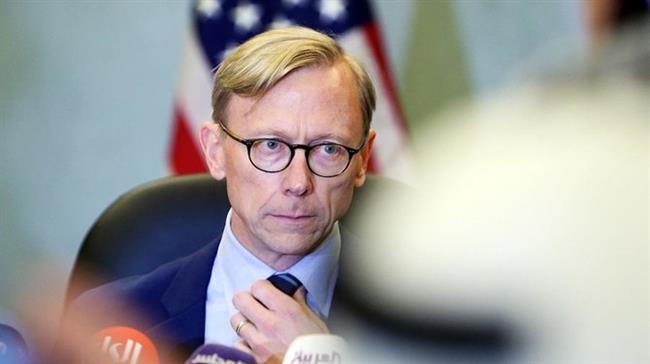
US Special Representative for Iran Brian Hook has said that lifting a UN arms embargo on Iran will trigger an arms race in the Middle East region.
Press TV – June 29, 2020
The United States and its allies, Israel and Saudi Arabia, are leading an arms race in the Middle East region, not Iran, an American scholar has said.
Kevin Barrett, an author, journalist and radio host with a Ph.D. in Islamic and Arabic Studies, made the remarks in an interview with Press TV on Monday, after US Special Representative for Iran Brian Hook said that lifting the arms embargo on Iran will trigger an arms race in the Middle East.
Speaking at a joint news conference with Saudi minister of state for foreign affairs Adel al-Jubeir in Riyadh on Monday, Hook said lifting the ban would “only embolden” Iran and destabilize the region.
“This is not an outcome that the UN Security Council can accept. The council’s mandate is clear: to maintain international peace and security,” Hook added.
Barrett said that “Brian Hook is the US Special Representative to the United Nations and he’s trying to extend the UN weapons embargo on Iran, and he’s claimed to be doing so under provisions of the JCPOA, which the US has withdrawn from.”
“So, this is quite mind-boggling. Why he thinks the US has the right to invoke the JCPOA after it exited the JCPOA is a mystery. Likewise, it’s a mystery why he thinks that the lack of an arms embargo on Iran would lead to an arms race in the Middle East region,” he stated.
“Clearly, the regimes that are arming themselves and initiating an arms race in the region are the US allies, Israel, and Saudi Arabia, and Iran is far from leading an arms race in the region. If we look at population, and so on, Iran is actually relatively under-armed, although it seems to be doing okay despite the fact that it’s essentially been embargoed and so it has to do everything itself, make its own rockets, and it’s managed to put satellites into space despite all of these sanctions, and opposition from other countries including sabotage,” he said.
“We just saw an explosion in Iran maybe some form of sabotage; certainly, we know that Iran’s enemies have been supporting terrorism in Iran, and elsewhere in the region. They’ve killed nearly 20,000 innocent civilians in Iran, through support for some of the world’s worst terrorist groups,” he noted.
“So, this is of course absurd, but it just goes to show that the US Empire is still in its arrogant phase. It has not yet been fully humbled although its reputation in the world has certainly taken a hit after the coronavirus pandemic, which many suspect is a US biological attack, or perhaps a biological attack by the Western international bankers who largely own the US and dictate policy in the US, that the US has had such a terrible response to it,” the analyst said.
“The US now has the worst coronavirus caseload in the world per capita, and it’s still growing here. And yet the US pretends that it’s going to be running around the world dictating policy and telling people what they can do in each region. And of course, if Brian hook really wants to end the arms race in the Middle East, the first thing he should do is stop selling the weapons that Saudi Arabia is using to commit genocide in Yemen and stop handing the Israelis billions of American taxpayer dollars to commit genocide in occupied Palestine,” he said.
“If the US did those two things there would be a much more peaceful Middle East or Muslim east as a result, but don’t hold your breath because decadent empires often become rabid before they die. And that seems to be what’s happening here in Washington,” he concluded.
Washington has stepped up calls for the extension of the UN arms embargo on Iran, which will expire in October under UN Security Council Resolution 2231, which endorses Iran nuclear deal, officially known as the Joint Comprehensive Plan of Action (JCPOA).
The Trump administration has threatened that it may seek to trigger a snapback of all sanctions on Iran if its attempts to extend the arms embargo fail.
Tehran, however, has firmly rejected Washington’s plans as the US is no longer a party to the nuclear deal ever since it withdrew from the multilateral agreement in 2018.
China and Russia, which are both signatories to the JCPOA, echoed Tehran’s position in their recent statements.
“US failed to meet its obligations under Resolution 2231 by withdrawing from Joint Comprehensive Plan of Action,” China’s UN mission said.
Also noting that Washington is in gross violation of Resolution 2231, Russian Deputy Foreign Minister Sergei Ryabkov stressed that “no one is allowed to implement UNSC Security Council resolutions selectively and extremely fragmentarily”.
UN Warns Many Will “Starve to Death” in Yemen as Saudi Fuel Blockade Hinders COVID-19 Battle
By Ahmed AbdulKareem | MintPress News | June 26, 2020
SANA’A, YEMEN — The streets of Sana’a have retained much of their character throughout the past six years of war. This, despite the ever-present threat of Saudi bombardment and the myriad viruses methodically working their way through the population, most recently COVID-19. The afternoon rush hour still brings out the buses, taxis and private vehicles that choke Haddah Street in northern Sana’a. Horns blare at junctions as drivers switch lanes, looking for any advantage they can find in a ritual that, until recently, brought a sense of welcome normalcy to a country faced with constant uncertainty. But six years of war have finally caught up with one of the last semblances of routine in Yemen.
In move undertaken by Saudi Arabia that is sure to exacerbate the country’s already-dire situation, the oil-rich U.S. ally is preventing oil tankers from delivering much-needed fuel to Yemen’s hospitals, water pumps, bakeries, cleaning trucks, and gas stations, plunging it, particularly its northern districts, into an acute fuel crisis.
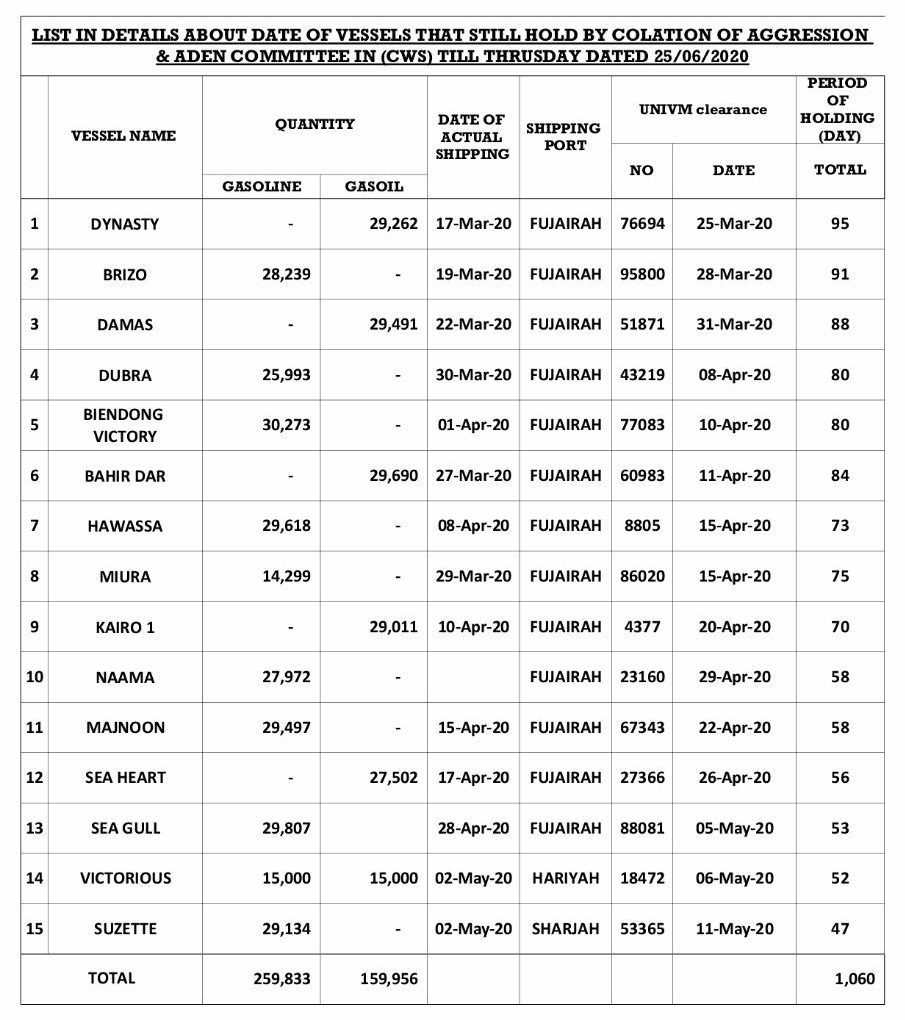
According to a statement released by the Yemen Oil Company, at least 15 tankers carrying over 419,789 tons of fuel have been trapped at sea for over a month despite being checked and issued permits by both the Saudi-led Coalition and the United Nations. Now, the situation in the war-torn country is no longer tolerable.
The CEO of Yemen Oil said in a press conference held in the front of the United Nation office in Sana’a on Wednesday that the company’s remaining reserves won’t last for more than a few days. A statement issued by the company’s branch in Hodeida confirmed that its reserve stock had reached a critical stage and is no longer sufficient to supply the most important sectors in the country.
“One of the biggest threats in the past 100 years”
This is not the first time that Saudi Arabia has triggered a fuel crisis in Yemen, however, this blockade is significantly larger than previous ones and comes at a time when Yemen is battling COVID-19, which is spreading rapidly across the country. “It is the worse than what we expected to happen,” taxi driver Mohammed Abdullah Masoud said from beneath his mask, bags under his tired eyes. He had been waiting in line for two days for petrol. His older brother died last week from COVID-19 and he is now responsible for providing his brother’s wife and children with food and medicine as they stay quarantined at home. “My brother’s family needs bread and some vegetables. Nobody except me can provide them with essential necessities to stay alive. If I don’t have the fuel by the end of the day, something bad could happen to them.” he told MintPress.
The Saudi fuel blockade has not only forced thousands of Yemenis already struggling against an unprecedented explosion of famine, disease, and epidemics to wait for days in lines as far as the eye can see, it has also left water pumps, hospital generators, and transport vehicles without fuel and that lack of fuel has accelerated the spread of the COVID-19 as empty generators shut down facilities including an oxygen factory, hospital, nurseries, and a kidney failure center, all which need uninterrupted and stable electricity 24 hours a day.
Cholera, dengue fever, and malaria rates have also spiked, particularly in Hodeida, Sadaa, and Hajjah where summer temperatures can reach 129 degrees and the lack of fuel has left residents unable to escape the heat as the generators used to power air conditioners sit idle.
The price of food and medicine is also skyrocketing and the already negligible crops in Yemen are at risk of dehydration as farmers are unable to power the wells and pumps needed o to irrigate their fields. At least 80 percent of Yemen’s 28 million-strong population is reliant on food aid to survive in what the United Nations has called the world’s worst humanitarian crisis and the decimation of the remaining agricultural sector is likely to increase that figure.
On Wednesday, Mark Lowcock, the United Nations Under-Secretary-General for Humanitarian Affairs and Emergency Relief Coordinator, told a closed UN Security Council meeting that many more people are likely to starve to death, succumb to COVID-19 and die of cholera, adding that the coronavirus was spreading rapidly across Yemen and about 25 percent of the country’s confirmed cases have died – “five times the global average.”
He added, “We have never before seen in Yemen a situation where such a severe acute domestic economic crisis overlaps with a sharp drop in remittances and major cuts to donor support for humanitarian aid – and this of course is all happening in the middle of a devastating pandemic.” For her part, UN Humanitarian Coordinator Lise Grande described COVID-19 in Yemen as “one of the biggest threats in the past 100 years.”
The Saudi blockade comes amid sustained Saudi-coalition bombing runs. Warplanes have been hovering over Sana’a and other provinces and have targeted several areas in Bydha, al-Jawf, Marib, and Sana’a, killing and injuring dozens of people. On Thursday, at least five people were killed and dozens were injured when Saudi warplanes destroyed four cars traveling on public roads in Radman and Qaneih.
The only effective option
Despite the challenges, Yemenis have strong morale and a seemingly unbreakable will to continue to withstand the Saudi ambitions for their country. “We die silently but with glory. We will never give in to Saudi Arabia,” 37-years-old Hamid told MintPress as he stood in a fuel line at a gas station in Sana’a. It has become a weekly ritual for Hamid, who queues in line for hours to get 30 liters of fuel every seven days. Hamid and the others waiting in line were gleefully checking their social media feeds and celebrating news reports that explosions were taking place in the Saudi capital following attacks bu the Houthi-led Yemeni Army.
In retaliation for the fuel embargo and the continued airstrikes on their country, the Houthi-led Yemeni army carried out large-scale attacks on a number of strategic sites in Saudi Arabia using a barrage of ballistic and winged missiles and drones which targeted the headquarters of the Saudi Defense Ministry and the General Intelligence Agency as well as King Salman Air Base, among other military targets in the capital Riyadh and the southern regions of Najran and Jizan. For many, retaliation against the Kingdom represents the only effective option to quell the Saudi attacks and blockade on their country.
Mohammed Abdulsalam, the spokesman and chief negotiator for Ansar Allah, the political wing of the Houthis, emphasized that the operation was aimed at restoring stability to the country and securing an end to the Saudi-led blockade. He said that Yemenis have no option but to confront and resist Saudi Arabia and urged international bodies to pressure the Saudi regime into ending the offensive.
The Saudi-led coalition has acknowledged the attacks but claims that the missiles and drones were intercepted and destroyed but provided no evidence to back that claim. Coalition spokesman Colonel Turki al-Malki called the strike a “deliberate and systematic operation to target civilians and civilian objects,” adding later that the coalition had “ intercepted” eight bomb-laden drones and three ballistic missiles. A high-ranking Houthi official told MintPress that the raids did indeed hit their intended targets, adding the army used a new weapon in the attack that will be soon be revealed.
The United States and other countries, including France and Britain, condemned the attack on their Saudi ally. They have thus far remained silent on the recent Saudi attacks and fuel blockade on Yemen which preceded the attacks on Saudi Arabia. Yemenis have accused Western countries of abandoning their much-touted commitment to human rights in exchange for Saudi arms deals. “We are killed by weapons belong[ing] to these countries, and get nothing from them except dirty statements that offend their [own] people,” a Yemeni tribal leader who spoke on condition of anonymity for fear of reprisals, told MintPress in response to the U.S. condemnation.
For their part, Ansar Allah censured statements condemning their retaliatory attacks. Abdulsalam said that “condemnations of our operations are no longer effective. They come within the framework of political courtesies and are in part funded by Saudi Arabia.” He insisted that Western countries should instead pressure the kingdom to stop the war. “The American administration practices the most heinous looting of Saudi money,” he added, “The statement of the American mission in Saudi Arabia following our operation is a kind of blackmail, nothing else.”
The Yemeni attacks are the tip of the iceberg as multiple high-ranking officials in the Houthi-backed Yemeni Army revealed to MintPress that they are preparing more attacks against targets in Saudi Arabia, including on oil facilities, royal palaces, military bases, airports, Saudi oil carriers, and other “sensitive targets” that they declined to mention. The consequences for Saudi Arabia will be dire until the blockade is lifted and the offensive comes to an end, they promise. “We should not let Saudi Arabia starve us and carry on enjoying stability and wealth.”
The Saud-led Coalition is heavily backed by Western countries, especially the United States, Britain, and Frace, which have used systematic economic strangulation as a weapon of war — targeting jobs, infrastructure, the agricultural sector, fuel and water pumping stations, factories, and the provision of basic services, as well as imposing a land, sea, and air embargo.
Meanwhile, as a direct result of the oil blockade, many Yemeni officials say that they are already seeking assistance from Iran, hoping that the Iranian government will come to their aid as they did in Venezuela, where six Iranian vessels carried fuel, food, and medicine to Caracas in defiance of U.S. sanctions. They asked Ansar Allah to work with Iran to circumvent the blockade and supply the vital facilities in the country with fuel. If such a move is carried out, Tehran will no doubt win the hearts and minds of Yemenis wary of any foreign intervention, all thanks to the Saudi-led coalition and the United States which in large part are carrying out the war with hopes to limit “Iranian influence” in Yemen.
Ahmed AbdulKareem is a Yemeni journalist. He covers the war in Yemen for MintPress News as well as local Yemeni media.
Despite court ban, UK continues arms sales to Saudi Arabia: Report

Smoke billows following an airstrike by Saudi-led coalition in the Yemeni capital, Sana’a, June 16, 2020. (Photo by AFP)
Press TV – June 21, 2020
The British government has apparently turned a blind eye to a landmark court ruling that restricts the sales of arms to Saudi Arabia for use against Yemen.
According to a report published by the British daily Guardian on Sunday, the court of appeals declared last year that British arms sales to the kingdom were “unlawful,” and accused ministers of ignoring whether airstrikes that killed civilians in Yemen broke humanitarian law.
At the time, the court barred the UK government from approving any new license to Saudi Arabia and ordered then Secretary of State for International Trade Liam Fox to hold an immediate review of at least 4.7 billion pounds’ worth of arms deals with Saudi Arabia.
British international trade authorities said at the time that the process would take “up to several months.”
Nevertheless, arms exports continue without properly assessing the risk to civilians, a year after the verdict, and fighter jet components as well as aircraft maintenance services are being offered to the Riyadh regime.
British multinational defense, security, and aerospace company BAE Systems, which is recognized as the UK’s largest arms exporter to Saudi Arabia, confirmed in its 2019 report that it continues to provide the kingdom with support services for twin-engine and multirole Eurofighter Typhoon warplanes under a contract struck in 2018.
Lately, Shadow Secretary of State for International Trade Emily Anne Thornberry, together with members of other opposition parties, wrote a letter to Secretary of State for International Trade Liz Truss in protest at the arms licenses that continue to operate.
“We are left to assume that – despite being ordered to review these licenses by the courts, and having 12 months to do so – your department has simply chosen not to comply,” they argued.
They warn that the British government’s expected failure to comply “creates the illogical situation where a UK company that applies for a license today will have that application rejected, but another company that was granted its license prior to 20 June last year may export exactly the same arms without restriction.”
Andrew Smith, of the Campaign Against the Arms Trade, said, “The UK government has consistently put arms company interests ahead of the rights and lives of people in Yemen. The government has proven that it cannot be trusted to implement its own rules.”
The United Kingdom has reportedly licensed the sale of arms worth over 5.3 billion pounds to Saudi Arabia ever since Riyadh and a number of its regional allies launched a devastating war on Yemen in March 2015 in order to bring former President Abd Rabbuh Mansur Hadi back to power and crush the Houthi Ansarullah movement.
The US-based Armed Conflict Location and Event Data Project (ACLED), a nonprofit conflict-research organization, estimates that the war has claimed more than 100,000 lives over the past five years.
Russia: UN chief report blaming Iran for attacks on Saudi oil facilities not based on convincing evidence
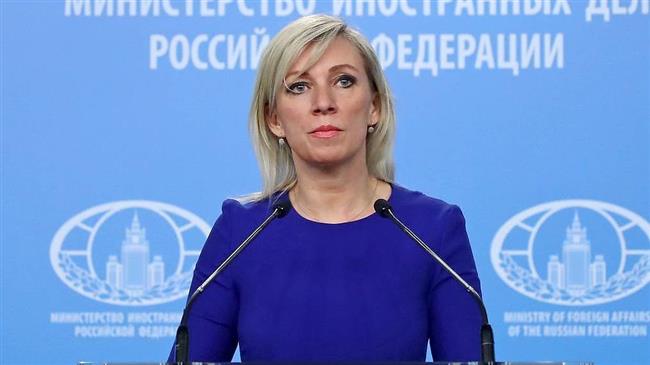
Russian Foreign Ministry spokeswoman Maria Zakharova
Press TV | June 17, 2020
The Russian Foreign Ministry says the UN chief’s report on Iran’s involvement in the last year attacks on Saudi oil facilities is biased and not substantiated by facts.
“What we surely won’t argue with is, unfortunately, that the report can hardly be called balanced and calibrated,” the ministry spokesperson Maria Zakharova said during a press briefing on Wednesday.
She added Russia will present a “detailed analysis” of the UN report during the relevant discussion at the Security Council later on June 30.
“We can also speak about a lack of impartiality and the absence of strong facts to support the accusations leveled at Iran,” she noted, stressing “Nobody has ever presented any convincing evidence of Iran’s violations to the Security Council members.”
The Russian official said that the report was not valid, arguing the “self-appointed inspectors” had claimed based on their “personal observations” that what they saw was “roughly reminiscent of what Iran had once demonstrated at arms exhibitions.”
Last week, UN Secretary General Antonio Guterres said in a report to the Security Council that cruise missiles used in attacks on oil facilities and an airport in Saudi Arabia last year were of “Iranian origin.”
He also said the “items may have been transferred in a manner inconsistent” with UN Security Council Resolution 2231, which endorses the international nuclear deal – officially known as the Joint Comprehensive Plan of Action (JCPOA) – signed between Iran and major world powers in 2015. The allegations were roundly rejected by Iran’s Foreign Ministry.
The ministry said in a statement that the claims appear to have been made under political pressure from the US and Saudi regimes.
“Preparing reports with political motivation will not change the facts and it is clear to all that the current circumstances in the region have directly resulted from the wrong policies of the United States and the child-killing Saudi regime,” the statement said.
The ministry highly recommended that the UN Secretariat not play into the hands of the US in its “pre-planned scenario to annul the cancellation of Iran’s arms embargo.” It also warned the UN against contributing to such a dangerous trend by preparing illegal reports.
Separately, Iran’s UN Mission also responded to the report on Friday, saying, “Iran categorically rejects the observations contained in the report concerning the Iranian connection to the export of weapons or their components that are used in attacks on Saudi Arabia and the Iranian origin of alleged US seizures of armaments.”
US President Donald Trump withdrew Washington from the JCPOA in 2018 and reinstated Washington’s unilateral sanctions against Tehran. His administration has also been piling up pressure on the United Nations to extend and strengthen the embargo on Iran, which is set to expire in October under the nuclear deal.
Washington seeks to restore all Security Council sanctions lifted against Iran if the 15-member body fails to preserve the UN ban on selling conventional arms to Iran.
Lebanon PM says coup attempt fell apart after violent riots
Press TV – June 14, 2020
Lebanon’s Prime Minister Hassan Diab has condemned the recent violent street protests, saying they were an attempt by opponents to overthrow his government and deepen a currency crisis in the debt-ridden country.
Diab made the remarks in a televised address late Saturday after demonstrations rocked the cities of Beirut, Tripoli and Sidon on Thursday, with participants calling for the government’s resignation.
Diab said his political opponents were stirring unrest in a bid to thwart the government’s fight against corruption.
The unrest was “a programmed campaign organized by parties known by name and method of thinking that are not deterred from using any method to shatter the image of others,” Diab said.
However, the Lebanese administration enjoys “a high percentage of citizens’ confidence, which has disturbed many of those who bet on its failure” and try to pump “lies and rumors to prevent the government from removing the rubble under which the secrets of corruption disappear,” he added.
Diab took office in January with Hezbollah’s backing, putting an end to a nine-month political deadlock amid an economic crisis and nationwide protests against the nation’s ruling class.
In his televised address Saturday, the Lebanese premier censured efforts to mount a “coup” against the government and manipulate the value of the Lebanese pound.
“The state and the people are being subjected to blackmail,” Diab said as he vowed to defeat graft in the cash-strapped country.
“The coup attempt fell apart and all secret and public meetings and orders of internal and joint operations to stop discovering of corruption failed as well,” he added.
Anti-government protests broke out in Lebanon on Thursday after a rapid devaluation of the national currency against the US dollar. The Lebanese pound has lost some 70 percent of its value over the past several months.
The crash in the Lebanese pound’s value and subsequent unrest coincided with the unveiling of the biggest-ever US sanctions package against Iran, which also targets Lebanon.
The 115-page strategy document put together by the Republican Study Committee (RSC), the largest Republican caucus in Congress, called for a halt of all US security assistance to Beirut, claiming that millions of dollars given to Lebanon were being used to aid Hezbollah.
The US gives about $160 million to the Lebanese armed forces each year.
The Republican document specifically calls for sanctions against Hezbollah allies, mentioning former foreign minister Gibran Bassil and incumbent Parliament speaker Nabih Berri by name.
Back in 2016, Saudi Arabia also declared that it was canceling $4 billion in aid to Beirut, $3 billion of which was earmarked for the Lebanese army.
Latest street rallies resembled those that broke out in Lebanon on October 17, 2019, when the government introduced a set of economic austerity measures.
Then prime minister Saad al-Hariri resigned almost two weeks later under pressure from protesters, touching off a period of political turmoil at a time of acute economic crisis.
In December 2019, Diab was tasked with forming the new administration and the following month, he managed to form a government after Hezbollah and its allies agreed on the new cabinet.
The downward political spiral for Hariri followed his humiliating saga in Saudi Arabia where he announced his surprise resignation in November 2017, apparently under the orders of Saudi rulers.
Hariri rescinded his withdrawal after returning to Lebanon, apparently putting himself on a collision course with his Saudi mentors, which culminated in his resignation amid violent riots.
According to a UN report, Hariri was verbally humiliated and beaten after being summoned to Riyadh in 2017. He was reportedly abducted and taken to the Riyadh Ritz-Carlton hotel where he was interrogated and subjected to “cruel, inhuman and degrading” treatment.
Iran dismisses UN report on missiles ‘of Iranian origin,’ says body under US, Saudi pressure
Press TV – June 12, 2020
Iran has dismissed a recent claim by the United Nations that missiles used to attack Saudi Arabia have been “of Iranian origin,” saying the organization has spoken out under political pressure from the US and the Saudi regime.
In a statement on Friday, the Iranian Ministry of Foreign Affairs said it was deeply concerned about the use of the UN Secretariat as a means to achieve political objectives.
“Preparing reports with political motivation will not change the facts and it is clear to all that the current circumstances in the region have directly resulted from the wrong policies of the United States and the child-killing Saudi regime,” the statement said.
UN Secretary General Antonio Guterres told the Security Council in a report seen by Reuters on Thursday that cruise missiles used in several attacks on oil facilities and an international airport in Saudi Arabia in November 2019 and February 2020 had been of “Iranian origin.”
He also said the “items may have been transferred in a manner inconsistent” with Security Council Resolution 2231, which enshrines the international nuclear deal – officially known as the Joint Comprehensive Plan of Action (JCPOA) – signed between Iran and world powers in 2015.
Guterres pointed out in his report that the United Nations had examined the debris of weapons used in the attacks on an oil facility in Afif in May, the Abha international airport in June and August, and the Aramco oil facilities in Khurais and Abqaiq in September.
Referring to the “examination of the weapons debris,” the Iranian Foreign Ministry censured the inattention to the sales of lethal weapons to Saudi Arabia that are used against the defenseless people of Yemen while “Saudi garbage is being checked for proof.”
“Undoubtedly, such reports will not only fail to help [promote] peace and security in the region and implement [UN] Security Council resolutions, but also completely destroy the validity and reputation of the United Nations,” the ministry warned.
It said the UN report came at a time that the United States is drafting a “dangerous” resolution to “illegally” extend an arms embargo against Iran, adding this would strengthen the likelihood of it being prepared on Washington’s order to be used at the Security Council against Iran.
The Iranian Foreign Ministry highly recommended that the UN Secretariat not play into the hands of the US in its “pre-planned scenario to annul the cancellation of Iran’s arms embargo.” It also warned the UN against contributing to such a dangerous trend by preparing illegal reports.
In May 2018, President Donald Trump unilaterally pulled the United States out of the JCPOA and later re-imposed the sanctions that had been lifted against Tehran and began unleashing the “toughest ever” bans.
Although the US is not a party to the JCPOA any longer, it recently launched a campaign to renew the Iran arms ban — in place since 2006/2007 – through a resolution at the Security Council. Russia and China are against the push, and most likely to veto it.
To circumvent the veto, the US says it will argue that it legally remains a “participant state” in the nuclear pact only to trigger the snapback that would restore the UN sanctions, which had been in place against Iran prior to the JCPOA inking.
Tehran says Washington, through its unilateral withdrawal from the deal, has forfeited all rights to have a say in the agreement.
European Union foreign policy chief Josep Borrell said on Tuesday that the US has already pulled out of the JCPOA and cannot currently use its former membership of the deal to seek a permanent arms embargo on Tehran.
“The United States has withdrawn from the JCPOA, and now they cannot claim that they are still part of the JCPOA in order to deal with this issue from the JCPOA agreement. They withdraw. It’s clear. They withdraw,” Borrell said.
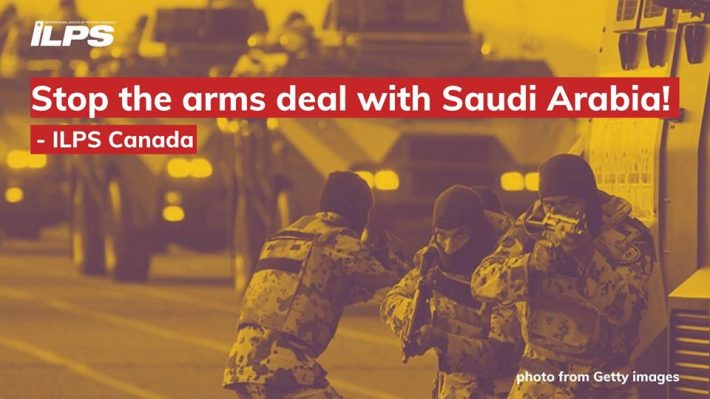
Stop Canada’s arms deal with Saudi Arabia!
International League of Peoples’ Struggle, Canada | June 12, 2020
After stalling for two years, the Canadian government has renegotiated a sale of light armored vehicles to Saudi Arabia for $14 billion. The deal was put on hold in 2018 because of political pressure against Saudi Arabia’s war on Yemen and the murder of Jamal Khashoggi, a journalist. This news is jolting because, in December 2018, Prime Minister Justin Trudeau had said he would not go ahead with the sale. However, the Minister of Foreign Affairs Francois-Philippe Champagne announced that the contract was back on the table on Thursday, April 9, 2020.
The government claims it must proceed with the deal because thousands of jobs and substantial revenues might otherwise be lost. General Dynamics is the supplier building the vehicles to be sold. The government its sales rep. General Dynamics stands to lose profits from the transaction. However, it could be involved in the manufacture of other machinery for domestic and foreign use.
In response to the objection that the items to be sold to Saudi Arabia will likely be used for war, Minister Champagne tells the people not to worry.
“Under our law, Canadian goods cannot be exported where there is a substantial risk that they would be used to commit or to facilitate serious violations of international humanitarian law, international human rights law or serious acts of gender-based violence.” (The Defense Post, April 10, 2020).
If that is the case, then, no military items should be exported. Champagne added that there are protections in that export permits be delayed or canceled if it learns of goods sold not used for the buyers’ stated purposes. Well, it is pretty clear that military items are for military use, just as it is clear that Saudi Arabia is an aggressor who will likely use military equipment in its aggression against Yemen and elsewhere. Saudi Arabia is committing human rights violations and crimes against humanity. The fact that the war inhibits health care and safety responses to COVID-19 is even more reprehensible.
The Canadian Chapter of the International League of Peoples’ Struggles has opposed all military contracts with Saudi Arabia all along. We have stood in solidarity with the people of Yemen who have been suffering under assault after assault by Saudi forces, calling for Saudi Arabia keep its hands off Yemen. According to Dr. Yahyia Mohammed Saleh Mushed of the Union of Arab Academics at Sana’a University, the war has displaced around 200,000 people and left the country in misery (Sanctions Kill webinar, May 31, 2020). We deplore the coalition states (US, UK, France and Canada) that arms and supports these assaults. Furthermore, we find no justify for the blockade against Yemen, and join in the calls for the illegal economic coercive measures against Yemen and all countries to be lifted, especially in view of the humanitarian concerns during a pandemic.
Canada has been on the war path for the past two decades. It stands by the US imperialist war machine steadfastly and plays a deadly role as its most fervent ally. It itself is an imperialist state with ambitions for market expansion abroad. Prime Minister Justin Trudeau voices intolerance against states that dare to follow an independent course away from the dictates and norms set by the US. His negative relations with Venezuela are the starkest example. Also, his government has been increasing the national military budget and expanding the Canadian armed forces, favouring more active engagement. Money for health care and housing has been siphoned for the folly of war.
Now with the determination to rise against domestic militarization and resist its racist blades, let us also decry international militarization and organize to dismantle NATO, the US military bases and imperialist military agreements, and send the troops home. Let us expose and put pressure against the arms trade that encourages instability and feeds off bloody conflict. Let us call for a reduction of military budgets and redirect more tax money into social services and regional economic development.
Stop the Sales of Arms to Saudi Arabia!
Reject the arms trade!
Stop US and Canadian imperialism!
Dismantle NATO!
Close all foreign military bases!
End the coercive economic measures against all targeted countries!
International League of Peoples’ Struggle is an an alliance of organizations and movements that promotes, supports and develops the anti-imperialist and democratic struggles of the peoples of the world against imperialism and all reaction.
Denmark summons Saudi envoy over Riyadh’s support for anti-Iran terror group
Press TV – June 11, 2020
Denmark has called in the Saudi ambassador to Copenhagen to protest the kingdom’s support for a notorious terrorist group behind a 2018 deadly attack in Iran’s southwestern city of Ahvaz, among its other terrorist crimes against Iranians.
Riyadh’s envoy was summoned to the Danish Foreign Ministry on Wednesday after terrorism charges were leveled against three leaders of the anti-Iran al-Ahvaziya terror group based in Denmark.
Danish police said they were prosecuting “three people for financing and promoting terrorism in Iran, including in collaboration with a Saudi intelligence service.”
The suspects are believed to have received funds from Riyadh, which has been pursuing a highly hostile Iran policy under Crown Prince Mohammed bin Salman.
Meanwhile, Danish Security and Intelligence Service (PET) stressed that the trio worked for the Saudi regime between 2012 and 2018.
PET chief Finn Borch Andersen said it is “completely unacceptable” that Denmark is used “as a starting point to finance and support terrorism.”
“We will not accept such activities under any circumstances and our ambassador in Riyadh has repeated the same message directly to the Saudi authorities,” Danish Foreign Minister Jeppe Kofod said in a statement.
In February, Denmark said its intelligence service had arrested and charged three members of the Saudi-backed terror group for spying on behalf of the kingdom in the Scandinavian country.
Al-Ahvaziya has committed numerous crimes against Iranian targets over the past decades, among them bomb attacks in public places, abductions, assassinations, kidnapping for ransom, shooting at tourists and blowing up oil pipelines.
Formed a few years after the 1979 Islamic Revolution in Iran, the terror group was inspired back then by the Baath regime of Iraq’s ex-dictator Saddam Hussein.
Al-Ahvaziya has been after separating the southwestern province of Khuzestan — home to the country’s Arab population — from the rest of Iran through engaging in armed conflict against the Iranian government.
In September 2018, the Saudi-backed terror outfit claimed responsibility for a deadly attack on military parade in Ahvaz, Khuzestan’s provincial capital. The assault killed 25 people, including members of Iran’s Islamic Revolutionary Guard Corps (IRGC) and civilian bystanders, and injured 70 others.
Shortly after the attack, the London-based “Iran International” television channel funded by Saudi Arabia allowed the al-Ahvaziya spokesman to go live on air to defend the bloodshed.
In parallel, the Daesh Takfiri terrorist group also claimed responsibility for the Ahvaz attack.
In response, Iran launched missiles on gatherings of the ringleaders of the terror attack Ahvaz based in an area east of the Euphrates in Syria, killing and injuring a number of them and inflicting heavy losses on their stronghold.
Riyadh is widely viewed as a key sponsor of Takfiri terrorists, who are inspired by Wahhabism, an extremist ideology preached by Saudi clerics.
Saudi Arabia exempts Western arms purchases from austerity plan: FT
Press TV – June 7, 2020
Saudi Arabia is reportedly continuing to import weapons from Western countries, especially the United States, despite austerity measures taken recently to handle the kingdom’s worst financial crisis in decades.
Saudi Arabia posted a $9 billion budget deficit in the first quarter of 2020 due to plummeting oil prices and the novel coronavirus (COVID-19) pandemic.
Riyadh announced last month that it will suspend the cost of living allowance for state workers and raise the value added tax threefold in a bid to boost state finances.
However, the Financial Times reported on Sunday that the kingdom’s military expenditure emerged unscathed from the tough austerity measures, citing military contracts signed with American arms giants.
A Western arms industry executive based in the Persian Gulf quoted top Saudi officials as saying that there would be no military cuts.
“I was fully expecting there to be a cut, but the information from very senior levels and princes is ‘no, we’re not going to do it. In fact, don’t come and ask me if your program is going to slip, keep working hard at it, because we are just carrying ahead,’” the executive said.
“We’ve got a large number of requirements popping in through the door.”
The report cited the Pentagon’s contracts worth more than $2.6 billion for the delivery of more than 1,000 air-to-surface and anti-ship missiles to Saudi Arabia.
The US arms manufacturer Lockheed Martin, which supplies THAAD missiles to Riyadh, also told the Financial Times that it had “not seen a backing off of expenditures on defense” by any of its main Middle Eastern customers.
Robert Harward, chief executive of Lockheed’s Middle East unit, said although it was too early to judge, he expected that customers, including Saudi Arabia, “will continue with their procurement”.
“Regional threats are not receding and are more unpredictable than ever,” he said. “Countries will have to make choices on budgets, as countries always have to do.”
Another Persian Gulf-based military executive confirmed that his company had not witnessed “any shift in attitudes from the customers,” but suggested that it could still change, the FT added.
Meanwhile, the Saudi Finance Ministry stressed that the kingdom would “continue to support our military needs.”
The ministry said it had been working to rationalize spending to ensure the country got military equipment “for the right cost for the right quantity with the right specification”.
Saudi Arabia was the world’s largest weapons importer in 2015–19, according to the Stockholm International Peace Research Institute (SIPRI). The regime’s imports of major arms increased by 130 percent compared with the previous five-year period.
The kingdom is stuck in a costly war on Yemen it launched in March 2015 in a bid to reinstall the former Saudi-backed regime and crush the popular Houthi Ansarullah movement.
However, over five years into the Western-sponsored war, Saudi Arabia has achieved neither of its objectives and instead plunged Yemen into what the UN says is the world’s worst humanitarian crisis.
Riyadh is the largest buyer of American-made weaponry. US President Donald Trump signed an arms deal worth $110 billion with Saudi Arabia in May 2017 on his first foreign trip since becoming president.
Before his presidency, he had described the kingdom as “a milk cow” which would be slaughtered when its milk ran out.
Saudi-led coalition conducts 47 new airstrikes on Yemen
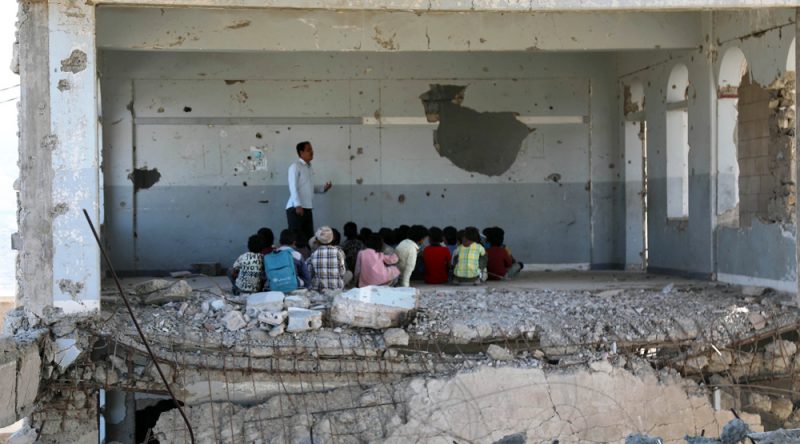
Children listen to their teacher in a destroyed classroom at a school which was heavily damaged in a Saudi-led airstrike, in Ta’izz, Yemen, on September 3, 2019. (Photo by AFP)
Press TV – May 28, 2020
Warplanes from the Saudi-led military coalition waging war on Yemen have carried out 47 airstrikes on different parts in the country, further destroying the impoverished country’s infrastructure.
Yemen’s Arabic-language al-Masirah TV cited an unnamed Yemeni military source as saying on Wednesday that the Saudi-led fighter jets had pounded localities in Yemen’s Ma’rib, Jawf, Sa’ada, and Hajjah provinces during the previous hours.
Majzar and Midghal districts in the central province of Ma’rib were struck 19 times, and Khasf Village in the Hazm district in the northern province of Jawf were pounded five times, the source said.
The airstrikes inflicted heavy damage on infrastructure in those localities.
According to the report, the Saudi-led coalition also violated a ceasefire in the western province of Hudaydah 67 times during the previous hours, killing at least one civilian.
Supported militarily by the US, the UK, and other Western countries, Saudi Arabia and a number of its regional allies launched the devastating war on Yemen in March 2015 to subdue a popular uprising that had overthrown a regime friendly to Riyadh.
The US-based Armed Conflict Location and Event Data Project (ACLED), a nonprofit conflict-research organization, estimates that the war has claimed more than 100,000 lives over the past five years.
More than half of Yemen’s hospitals and clinics have been destroyed or closed during the war by the Saudi-led coalition at a time when Yemenis are in desperate need of medical supplies to fight the COVID-19 pandemic.
At least 80 percent of the 28-million-strong population is also reliant on aid to survive in what the United Nations (UN) has called the world’s worst humanitarian crisis.
Featured Video

U.S. General Caine Warns: STRIKING IRAN is a HUGE RISK
or go to
Aletho News Archives – Video-Images
From the Archives
Stealth Bombers and Bunker Busters
A retrospective analysis of the so-called 12-Day War, and the triumphantly celebrated Operation Midnight Thunder
By William Schryver | imetatronink | November 28, 2025
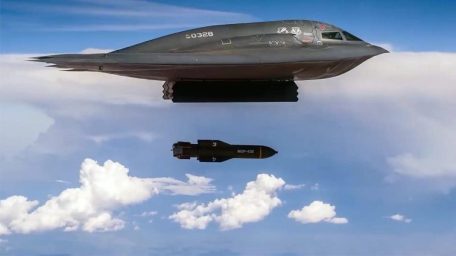
The GBU-57 is a big fat gravity bomb with fins. To achieve effective precision, a B-2 bomber must drop it on its intended target from no further than about five nautical miles — essentially right on top of the target.
Its penetration depth is claimed to be 200 feet. But that capability has NEVER been tested against a seriously hardened deep-underground target encased in layers of high-performance concrete, and topped with a few dozen meters of solid rock. In that sort of real-world scenario, the GBU-57 would be lucky to drill down 50 feet, if that.
It was always ridiculous silly talk to suggest the GBU-57 was the wonder weapon it was made out to be. There is a good reason the US only produced a couple dozen of them and then stopped: they understood its acute limitations in a non-permissive combat environment.
And, notwithstanding the hyperbolic Israeli propaganda, there was never any credible evidence that Iranian medium- and long-range air defenses against fixed-wing aircraft were attrited to any significant degree. And Iranian short-range air defenses were increasingly effective against long-range Israeli drones with each passing day.
As for the B-2: it is a big fat subsonic aircraft. It flies at airliner speeds. A strike on Fordow would entail flying at least 500 miles in and out of Iran. … continue
Blog Roll
 Aletho News
- Zelensky Refused to Discuss Druzhba Pipeline Issue – Fico
- U.S. General Caine Warns: STRIKING IRAN is a HUGE RISK /Glenn Diesen & Lt Col Daniel Davis
- Israel designates five Palestinian media outlets as ‘terrorist organizations’
- Israel, not America, first: Carlson’s Huckabee interview lays bare US foreign policy priorities
- Israeli troops executed Palestinian aid workers at ‘point blank range’: Report
- Iran war What if today’s Iran is resigned to a long, hellish war with the US?
- Why Israel Is Escalating Its War Crimes Against Lebanon
- Iran in the face of the armed diplomacy of imperialism
- The US build-up around Iran constitutes strategic war option, not ‘deterrence’
- Iran to US: Sanctions and war failed; try diplomacy and respect
- If Americans Knew
- Footage Shows Israeli Troops Waiting in Ambush, Then Opening Fire on a Palestinian Teen
- The US is on the brink of a major new war that Trump has not even bothered explaining
- Latest Epstein document dump is one more cover-up
- No Protection, No Justice: US Citizens Killed with Impunity by Israel
- Maria Farmer: Epstein Victim Reveals Explosive Information Covered Up by Media
- Average of five Palestinians killed by Israel every day in Gaza since ceasefire – Not a ceasefire Day 136
- Palestinian church leaders admonish Christian Zionist Mike Huckabee – Not a ceasefire Day 135
- Ominous messaging from Trump’s “Board of Peace” – Not a ceasefire Day 134
- ‘Christians Out’: Jerusalem Church Tagged With Hate Graffiti, Police Investigating
- Israeli Settlers Kill American Teen
- No Tricks Zone
- New Research Reaffirms Clouds, Aerosols, And Surface Solar Radiation Are ‘Driving The Climate System’
- Germany: Electric Car Catches Fire At Charging Station, Sets Off Local “Inferno”, Widespread Damage
- New Study: Canada’s New Brunswick Was 1°C Warmer Than Today During The Medieval Warm Period
- Coal Power Back In Trend As Globe Tries To Keep Pace With Growing Demand For Power
- New Study: A 4°C Warmer Beaufort Sea Had ‘No Sea Ice’ 11,700 – 8200 Years Ago
- Unfudging The Data: Dutch Meteorological Institute Reinstates Early 20th Centruy Heat Waves It Had Erased Earlier
- German Gas Crisis…Chancellor Merz Allegedly Bans Gas Debate Ahead of Elections!
- Pollen Reconstructions Show The Last Glacial’s Warming Events Were Global, 10x Greater Than Modern
- Germany’s Natural Gas Storage Level Dwindles To Just 28%… Increasingly Critical
- New Study Rebuts The Assumption That Anthropogenic CO2 Molecules Have ‘Special’ Properties
 Aletho News