OPEC: Saudis aren’t afraid of US anymore
BY M. K. BHADRAKUMAR | INDIAN PUNCHLINE | APRIL 4, 2023
The shock oil production cuts from May outlined by the OPEC+ on Sunday essentially means that eight key OPEC countries decided to join hands with Russia to reduce oil production, messaging that OPEC and OPEC+ are now back in control of the oil market.
No single oil producing country is acting as the Pied Piper here. The great beauty about it is that Saudi Arabia and seven other major OPEC countries have unexpectedly decided to support Russia’s efforts and unilaterally reduce production.
While the 8 OPEC countries are talking about a reduction of one million b/d from May to the end of the year, Russia will extend for the same period its voluntary adjustment that already started in March, by 500,000 barrels.
Now, add to this the production adjustments already decided by the OPEC+ previously, and the total additional voluntary production adjustments touch a whopping 1.6 million b/d.
What has led to this? Fundamentally, as many analysts had forewarned, the Western sanctions against Russian oil created distortions and anomalies in the oil market and upset the delicate ecosystem of supply and demand, which were compounded by the incredibly risky decision by the G7, at the behest of the US Treasury, to impose a price cap on Russia’s oil sales abroad.
On top of it, the Biden administration’s provocative moves to release oil regularly from the US Strategic Petroleum Reserve in attempts to micromanage the oil prices and keep them abnormally low in the interests of the American consumer as well as to keep the inflationary pressures under check turned out to be an affront to the oil-producing countries whose economies critically depend on income from oil exports.
The OPEC+ calls the production cuts “a precautionary measure aimed at supporting the stability of the oil market.” In the downstream of the OPEC+ decision, analysts expect the oil prices to rise in the short term and pressure on Western central banks to increase due to the possible spike in inflation.
What stands out in the OPEC+ decision is that Russia’s decision to reduce oil production by the end of the year has been unanimously supported by the main Arab producers. Independent but time-coordinated statements were made by Saudi Arabia, the UAE, Kuwait, Iraq, Algeria, Oman and Kazakhstan, while Russia confirmed its intention to extend until the end of the year its own production reduction by 500,000 barrels per day, which began in March.
Significantly, these statements have been made precisely by those largest oil producers in OPEC, who have a record of fully utilising their existing quota. Put differently, the reduction in production is going to be real, not just on paper.
Partly at least, the banking crisis in the US and Europe prompted the OPEC+ to intervene. Although Washington will downplay it, in March, Brent oil prices fell to $70 per barrel for the first time since 2021 amid the bankruptcy of several banks in the US and the near-death experience of Credit Suisse, one of the largest banks in Switzerland. The events sparked concern about the stability of the Western banking system and fear of a recession that would affect oil demand.
There is every likelihood that tensions may increase between the US and Saudi Arabia as higher oil prices will push inflation and make it even more difficult for the US Federal Reserve to find a balance between raising the key rate and maintaining financial and economic stability. Equally, the Biden administration must be furious that practical cooperation is still continuing between Russia and the OPEC countries, especially Saudi Arabia, notwithstanding the West’s price cap on Russian oil and Moscow’s decision to unilaterally cut production in March.
However, the Biden administration has only a limited range of options to respond to the OPEC+’s surprise move: one, go for another release of oil from the Strategic Petroleum Reserve; two, pressure US producers to increase domestic oil output; three, back legislation that would allow the US to take the dramatic step of suing OPEC nations; or, four, curb the US’ export of gasoline and diesel.
To be sure, the OPEC+ production cut goes against the Western demand to increase oil output even as sanctions were imposed against Russian oil and gas exports. On the other hand, the disruption in oil supplies from Russia contributed to the rising inflation in the EU countries.
The US wanted the Gulf Arab states to step in and step up oil production. But the latter did not oblige because they felt that there wasn’t enough economic activity in the West and there were clear signs of recession contrary to expectation.
Thus, as a result of the sanctions against Russia, Europe is facing the complex situation of inflation and near-recession known as stagflation. In reality, the adaptive and agile OPEC + read the situation correctly and has shown that it is willing to act ahead of the curve. At a time when the world economy is struggling to grow at a healthy rate, the demand for oil would be relatively less, and it makes sense to cut oil production to maintain the price balance.
All that the Western leaders can complain about is that the OPEC+ cut in oil output has come at an inappropriate time. But the woes of Western economies cannot be laid at the door of OPEC+ as there are inherent problems which are now coming to the surface. For instance, the large scale protests in France against pension reform or the widespread strikes in Britain for higher wages show that there are deep structural problems in these economies, and the governments seem helpless in tackling them.
In geopolitical terms, the OPEC+ move came after a meeting between Russian Deputy Prime Minister Alexander Novak and Saudi Energy Minister Prince Abdulaziz bin Salman in Riyadh on March 16 that focused on oil market cooperation. Therefore, it is widely seen as the tightening of the bond between Russia and Saudi Arabia. In fact, in May, as the largest members of OPEC join Russia in its unilateral reduction, the balance of quotas and the ratio of market shares between and amongst the participants in the OPEC + deal will return to the level set when it was concluded in April 2020.
The big question is, how Moscow might profit from the OPEC+ decision. The rise in crude oil prices particularly benefits Russia. Simply put, the production cuts will tighten up the oil market and thus help Russia to secure better prices for the crude oil it sells. Second, the new cuts also confirm that Russia is still an integral and important part of the group of oil producing countries, despite the western attempts to isolate it.
Third, the consequences of Sunday’s decision are all the greater because, unlike the previous cuts by the OPEC+ group at the height of the pandemic or last October, today, the momentum for global oil demand is up, not down — what with a strong recovery by China expected.
That is to say, the surprise OPEC+ reduction further consolidates the Saudi-Russian energy alliance, by aligning their production levels, thus placing them on equal footing. It is a slap in the face for Washington.
Make no mistake, this is another signal regarding a new era where the Saudis are not afraid of the US anymore, as the OPEC “leverage” is on Riyadh’s side. The Saudis are only doing what they need to do, and the White House has no say in the matter. Clearly, a recasting of the regional and global dynamics that has been set in motion lately is gathering momentum. The future of petrodollar seems increasingly uncertain.
OPEC+ Oil Pumping Cut Brings Market ‘Stability’ and Busts Sanctions on Russia
By James Tweedie – Sputnik – 04.04.2023
OPEC’s cut in production has undermined US-led attempts to cap the export price of Russian oil. Geopolitical analyst Mohammed Alhamed, president of the Saudi Elite group and economist, and Professor Mark Frost said the US should back off and let market forces rule.
OPEC’s latest crude oil production cut will stabilize the world market while foiling US-led attempts to impose “price cap” sanctions on Russian exports.
OPEC+, which includes the organization’s 13 member states plus 11 others, including Russia, announced a 1.66 million barrel-per-day cut in production on Monday, sending the price of crude soaring on international markets.
Russia’s deputy prime minister said Moscow may also extend its 500,000 barrel-per-day production cut until the end of this year.
The US, UK, European Union, and Japan agreed earlier this year on a $60-per-barrel price limit on Russian crude, with a $100 cap on refined gasoline and diesel and $45 on household fuel oil as part of sanctions over Russia’s military operation in Ukraine. Moscow warned that those measures would have negative consequences.
Mohammed Alhamed told Sputnik that while the US had called the production cut “ill-advised,” OPEC+ had been “instrumental in bringing stability and transparency to the oil market, which has benefited the world economy while many American banks are facing bankruptcy.”
He said threats by US congressmen and women to ban weapons sales to Saudi Arabia over the previous oil production cut were “likely seen as a stupid idea” which would “reflect negatively on US interests in the Middle East.”
“A strained relationship with the US could have negative repercussions on both countries” the analyst said, cautioning Washington not to interfere in OPEC+, which “operates independently and has the right to make decisions that benefit its members.”
The US, still a major oil producer itself, should “focus on addressing its own oil and climate change agenda before criticizing other countries,” Alhamed said.
“Saudi Arabia and OPEC+ have made significant efforts to bring stability to the oil market and should be commended for their efforts.”
Professor Mark Frost told Sputnik that the production cut was a “signal” to the US that “you’re taking us for granted.”
He noted that in “any cartel, there’s a strong incentive to cheat” — and that the rising price of oil would allow European countries to pay prices above the Western-imposed cap on seaborne crude shipments from Russia.
“I think somebody got on the phone and said, ‘hey, Biden, we’re going to buy some oil. And if you don’t like it, that’s tough,’” Frost said.
“You can’t have volatile inflation forever. Markets start to shut down. People start to lose faith,” he added. “People start to become risk averse, and at the extreme, the risk is we become Japan in the nineties, where it requires negative interest rates to get people to borrow any money.”
Frost pointed to fast-food chain McDonald’s announcement of mass lay-offs, saying: “That’s a leading indicator because whether people like it or not, capitalism is trickle-down economics.”
The academic said that the rampant inflation caused by sanctions on Russia — one of the world’s biggest food as well as energy producers — combined with the US Federal Reserve raising interest rates in “quantitative tightening” in response means “we’re going to see at least two million people directly starve to death.”
“A lot of people don’t realize a lot of the world doesn’t do that well,” Frost stressed. “And relatively small increases in crucial things like rice, cooking oil and things like that causes people to starve to death.”
Saudi, Iran, Syria envoys meet in Oman
MEMO | April 4, 2023
The ambassadors of Saudi Arabia, Iran, Syria and Iraq held a meeting in the Gulf country of Oman on Tuesday, according to Iraqi Ambassador, Qais Saad Al-Amiri, Anadolu News Agency reports.
The diplomats exchanged views about regional affairs during the meeting hosted by Al-Amiri “in an atmosphere of optimism and familiarity among the attendees,” the Iraqi Embassy in Muscat tweeted.
Last month, Saudi Arabia and Iran announced the restoration of their diplomatic relations during talks hosted by Beijing, a deal called a diplomatic coup by China.
The two sides are expected to open embassies in each other’s capitals within two months since the deal was signed on 10 March.
Talks are also under way between Saudi Arabia and Syria to resume consular services in the two countries, according to the Saudi Foreign Ministry.
US is stirring up the Syrian cauldron
BY M. K. BHADRAKUMAR | INDIAN PUNCHLINE | MARCH 26, 2023
The circumstances surrounding the flare-up in Syria between the US occupation forces and pro-Iranian militia groups remain murky. President Biden claims that the US is reacting, but there are signs that it is likely being proactive to create new facts on the ground.
The US Central Command claims that following a drone attack on March 23 afternoon on an American base near Hasakah, at the direction of President Biden, retaliatory air strikes were undertaken later that night against “facilities used by groups affiliated with Iran’s Islamic Revolutionary Guards Corps.”
However, this version has been disputed by the spokesman of Iran’s Supreme National Security Council who accused Washington of “creating artificial crises and lying.” The Iranian official has alleged that “Over the past two days, American helicopters have carried out several sorties with the aim of increasing instability in Syria and transferred Daesh (Islamic State) terrorists in the territory of this country.”
He said Washington must be held accountable for such activities. The official warned that Tehran will give a prompt response to any US attack on whatever false pretext against Iranian bases that exist on Syrian soil at the request of Damascus for fighting terrorism.
Is the US deliberately ratcheting up tensions in Syria even as the China-brokered Saudi-Iranian rapprochement is radically changing the security scenario in the West Asian region in a positive direction?
There is optimism that Syria stands to gain out of Saudi-Iranian rapprochement. Already, the Saudi Foreign Ministry revealed on Thursday that talks are going on with Syria for resuming consular services between the two countries, which will pave the way for the resumption of diplomatic relations and in turn make it possible to reinstate Syria’s membership of the Arab League.
Saudi Arabia has established an air bridge with Syria to send relief supplies for those affected by the devastating earthquake in February.
The backdrop is that the normalisation of relations between Syria and its estranged Arab neighbours has accelerated. It must be particularly galling for Washington that these regional states used to be active participants in the US-led regime change project to overthrow the government of President Bashar al-Assad. The Saudi-Iranian rapprochement badly isolates the US and Israel.
From such a perspective, it stands to reason that the US is once again stirring up the Syrian cauldron. Lately, Russian aircraft have been reported as frequently flying over the US’s military base At Tanf on the Syrian-Iraqi border where training camps for militant groups are known to exist.
Israel too is a stakeholder in keeping Syria unstable and weak. In the Israeli narrative, Iran-backed militia groups are increasing their capability in Syria in the last two years and continued US occupation of Syria is vital for balancing these groups. Israel is paranoid that a strong government in Damascus will inevitably start challenging its illegal occupation of Golan Heights.
A key factor in this matrix is the nascent process of Russian mediation between Turkiye and Syria. With an eye on the forthcoming presidential and parliamentary election in Turkiye in May, President Recep Erdogan is keen to achieve some visible progress in improving the ties with Syria.
Erdogan senses that the Turkish public opinion strongly favours normalisation with Syria. Polls in December showed that 59 percent of Turks would like an early repatriation of Syrian refugees who are a burden on Turkish economy, which has an inflation rate of 90 percent.
Evidently, Turkiye is ending up as a straggler when the West Asian countries on the whole are coasting ahead to normalise their relations with Damascus. But the catch is, Assad is demanding the vacation of Turkish occupation of Syrian territory first for resuming ties with Ankara.
Now, there are growing signs that Erdogan may be willing to bite the bullet. The consummate pragmatist in him estimates that he must act in sync with the public mood. Besides, the main opposition party CHP always maintained that an end to the Syrian conflict needs to be anchored firmly on the principles of Syria’s unity and territorial integrity.
The influential Beirut newspaper Al-Akhbar has reported citing sources close to Damascus that Erdogan is weighing options that would meet Assad’s demand with a view to restore relations. The daily reported that one possibility is that Turkiye may propose a timetable for the withdrawal of its troops in Syria.
Significantly, Erdogan telephoned Russian President Vladimir Putin on Saturday and the Kremlin readout mentioned that amongst “topics concerning Russian-Turkish partnership in various fields,” during the conversation, “the Syrian issue was touched upon, and the importance of continuing the normalisation of Turkish-Syrian relations was underlined. In this regard the President of Türkiye highlighted the constructive mediatory role Russia has played in this process.”
Earlier, on Wednesday, Turkish Defense Minister Hulusi Akar held telephone talks with his Russian counterpart Sergei Shoigu to discuss developments in Syria where he underscored that the “sole purpose” of its deployment in northern Syria is to secure its borders and fight terrorism.
It is entirely conceivable that Erdogan has sought Putin’s help and intervention to reach a modus vivendi with Assad quickly. Of course, this is a spectacular success story for Russian diplomacy — and for Putin personally — that the Kremlin is called upon to broker the Turkish-Syrian normalisation.
The China-brokered Saudi-Iranian normalisation hit Washington where it hurts. But if Putin now brokers peace between two other rival West Asian states, Biden will be exposed as hopelessly incompetent.
And, if Turkiye ends its military presence in Syria, the limelight will fall on the US’ illegal occupation of one-third of Syrian territory and the massive smuggling of oil and other resources from Syria in American military convoys.
Furthermore, the Syrian government forces are sure to return to the territories vacated by Turkish forces in the northern border regions, which would have consequences for the Kurdish groups operating in the border region who are aligned with the Pentagon.
In sum, continued US occupation of Syria may become untenable. To be sure, Russia, Turkiye, Iran and Syria are on the same page in seeking the vacation of US occupation of Syria.
Thus, an alibi is needed for the US to justify that although dialogue and reconciliation is in ascendance in West Asian politics, Syria is an exception as a battleground against “terrorism.” The US is vastly experienced in using extremist groups as geopolitical tools.
The US’ real intention could be to confront Iran on Syrian soil — something that Israel has been espousing — taking advantage of Russia’s preoccupations in Ukraine. The Russian-Iranian axis annoys Washington profoundly.
The spectre that is haunting Washington is that the stabilisation of Syria following Assad’s normalisation with the Arab countries and with Turkiye will inexorably coalesce into a Syrian settlement that completely marginalises the “collective West.”
In retrospect, the unannounced visit by General Mark Milley, chairman of the US Joint Chiefs of Staff to northern Syria in early March falls into perspective. Milley told reporters traveling with him that the nearly eight-year-old US deployment to Syria is still worth the risk!
The time may have come for the militants, including ex-Islamic State fighters, who were trained in the US’s remote At Tanf military base to return to the killing fields for “active duty.”
Tass reported that on Friday, the terrorist group known as Hayat Tahrir al-Sham tried to break into the Aleppo region which has been under Syrian government control and relatively stable in the recent years.
Tyranny on the waters: The UAE-Israeli occupation of Yemen’s Socotra Island
By Karim Shami | The Cradle | March 24, 2023
Located off the southern coast of Yemen in the Arabian Sea, the Socotra archipelago has become a focal point of regional and international interest because of its strategic proximity to one of the world’s busiest shipping lanes.
On 21 June, 2020, the Yemeni island was militarily occupied by Saudi Arabia’s Emirati coalition partner, which has aggressively pursued a policy of establishing and controlling ports throughout West Asia and the Horn of Africa since 1999.
The archipelago consists of four large islands: Socotra (3,796km2), Abd al-Kuri (130.2km2), Samhah (39.6km2), and Darsah (7.5km2), as well as three small islets.
Socotra, the biggest of the islands, lies 350 km south of the Arabian Peninsula and 95 km from Somalia. It is surrounded by the Gulf of Aden, the Indian Ocean, and the Arabian Sea, and faces the Horn of Africa from the west. Around 20,000 shipping vessels pass around Socotra each year, including 9 percent of the world’s annual global petroleum supply.
The War on Yemen
The assault on Yemen was launched on 26 March, 2015, in an announcement by Saudi Ambassador Adel al-Jubeir from Washington DC, in which he stated that a coalition of ten countries, led by Saudi Arabia and the UAE, would take military action to reinstate the government of Yemeni President Abdrabbuh Mansour Hadi.
Hadi had been ousted in popular protests in 2014, after losing the capital city, Sanaa, to the joint forces of the Ansarallah movement and their allies in the country’s armed forces. Based in northern Yemen, the Ansarallah movement had been advocating for fair representation in the government for a long time.
With US-backing, Saudi Arabia launched “Operation Decisive Storm,” and the air strikes began. Initially expected to last only a few weeks or months – and according to MbS himself, just “a few days” – the Yemeni war has now entered its eighth year and taken on a markedly different shape than the coalition initially contended.
Two years into the war, the Emiratis began pursuing their own hidden agenda of establishing a “self-styled maritime empire” in Yemen, which veered sharply from Riyadh’s objectives. To achieve this goal, Abu Dhabi sought to control the country’s southern coastline and its ports and enlisted the help of a local Yemeni proxy called the Southern Movement.
The Southern Movement was formed by secessionist tribes and groups seeking to divide Yemen along the old partition lines of 1967–1990. However, the movement had to be restructured to match the UAE’s aspirations, and in 2017 it was transformed into the Southern Transitional Council (STC).
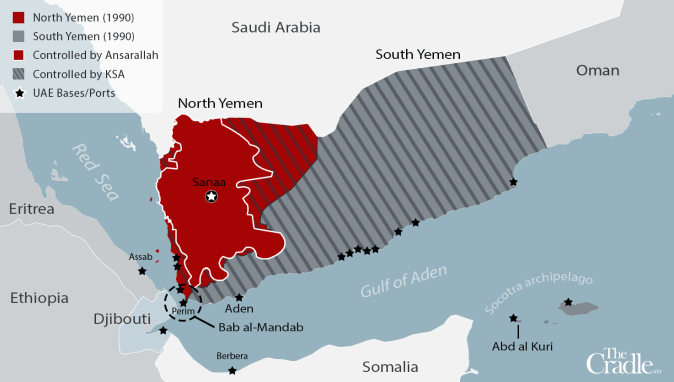
Map of the Emirati-controlled areas and ports in southern Yemen
The significance of Socotra
Socotra Island falls under the territorial jurisdiction of the exiled Hadi government, which to this day – despite his physical absence and the replacement of the “presidency” with an 8-member, Saudi-sponsored Presidential Leadership Council (PLC) – remains Yemen’s internationally-recognized government.
However, on 30 April, 2018, the UAE deployed hundreds of troops with artillery and armored vehicles on the island, which is located 350 km away from the mainland conflict, without any prior coordination with Yemeni authorities.
The Riyadh-backed Yemeni government condemned the Emirati aggression, backed by local islanders protesting against the occupation of their territory. The Saudis were forced to intervene by sending troops and training locals to deter the UAE from seizing the island.
But later that year, UAE General Khalfan al-Mazrouei arrived on Socotra Island and has since been considered its de facto ruler. Under his leadership, the Emiratis gained the loyalty of local tribes by using bribery under the guise of “humanitarian aid.” They offered Socotra residents UAE passports and promised them an improved quality of life.
The STC seizes Socotra
On the morning of 21 June, 2020, the UAE-backed STC separatists forcibly seized control of Socotra and ousted the Saudi-backed, pro-Hadi forces.
The UAE had been planning and preparing for this operation for two years, using its Yemeni proxies to gain full control over the Socotra archipelago. The Emirati flag was raised across the territory, and UAE telecommunication companies replaced Yemeni ones. Consequently, all phone calls from Socotra now register Emirati phone networks.
UAE-Israel normalization
Three months after the seizure of Socotra, the highly-controversial Abraham Accords was signed in Washington DC between Israel and the UAE, along with Bahrain, Morocco, and Sudan. On the Arab side, the normalization thrust was led by Abu Dhabi, which quickly moved to expand its diplomatic, military, and economic ties with Tel Aviv.
Shortly after the signing of the Abraham Accords, reports and images of Israeli “tourists” visiting Socotra began to emerge. According to an Al-Mayadeen report, however, the Israeli visitors were not tourists, but rather, military experts.
Abd al-Kuri Island
In February 2023, Ansarallah released a statement condemning the UAE’s eviction of residents from Abd al-Kuri, the archipelago’s second-largest island. The resistance movement accused Abu Dhabi of carrying out a long-planned operation to transform Socotra into an Israeli-Emirati military and intelligence hub.
These actions by the UAE are not isolated incidents. In another 2022 episode, Ansarallah accused Abu Dhabi of transferring fishermen from the small island of Perim (13 km2) to other parts of the Taiz Governorate. Several months later, satellite imagery revealed the construction of a military base runway on the volcanic Island. Perim is now empty of its original inhabitants, according to media reports.
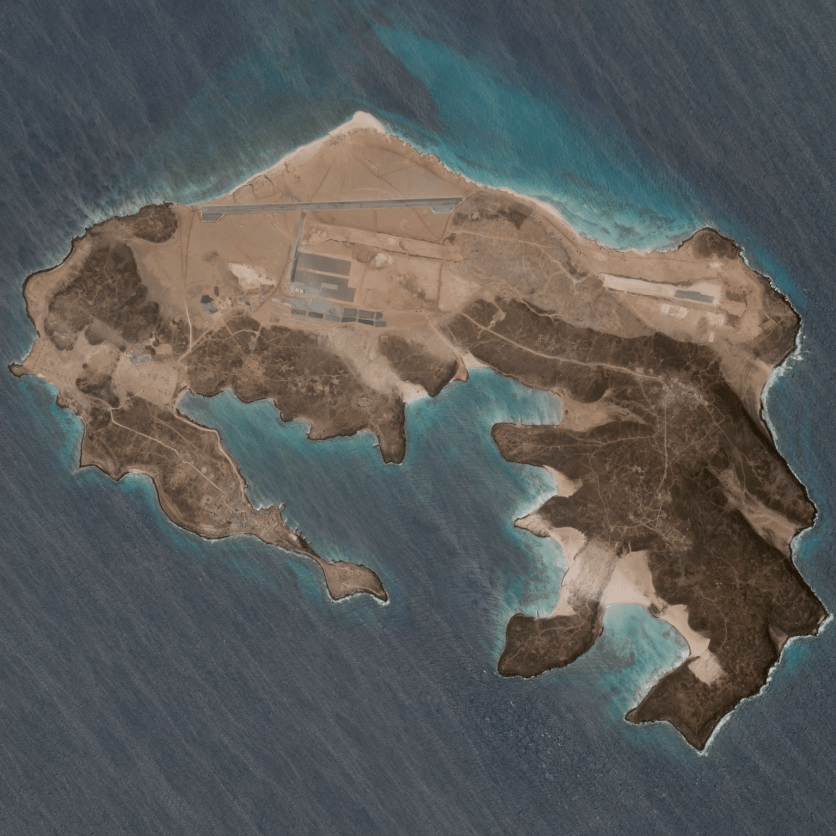
An Emirati military base on Perim Island (Mayyun in Arabic) on the Bab al-Mandab Strait
Perim Island has historically divided the Bab al-Mandab Strait into two waterways – whoever controls the island holds strategic influence over the strait. While Ansarallah’s statement about Emirati designs on Socotra was not entirely new, it raised hackles throughout the Arab world by confirming Israel’s military and intelligence presence on this key Yemeni island.
The UAE’s maritime ambitions
Many have questioned Abu Dhabi’s motivation for seizing Socotra and risking its relationships with Saudi Arabia and neighboring Oman (virtually overnight surrounded by UAE ports and bases). The UAE’s actions may be entirely attributed to the strategic vision of its President Mohammed bin Zayed (MbZ) and his no-longer secret desire to establish an Emirati maritime empire –from the Persian Gulf to the Red Sea – by controlling the region’s key waterways.
The UAE’s economic reliance on these waterways is a clear driver of MbZ’s plans: non-petroleum commodity re-exports make up almost half of Abu Dhabi’s total exports. As such, maritime security is a top priority in the country’s foreign policy calculations.
The UAE currently controls 12 ports off the coast of Yemen, including Aden, Makha, Mukalla, Al-Dabba, Bir Ali, Belhaf, Rudum, Zoubab, Al-Khawkhah, Al-Khouba, Qena, and Al-Nashima. The country is also building a new port in Al-Mahra that will cost an estimated $100 million.
By controlling these ports and the Bab al-Mandab Strait, the UAE can dominate one of the busiest shipping lanes in the world, elevating its position in global and regional trade to a strategic player.
In addition to its aggressive accumulation of Yemeni ports, the UAE also has a significant presence in the Horn of Africa, where it currently controls two ports in Eritrea and one in Somalia. It previously owned a port in Djibouti, but this became a point of territorial friction between the two countries. The UAE’s control over these ports and their strategic location in the region allow it to project its power and expand its influence in East Africa.
Why is Socotra important to Israel?
The UAE and Israel share mutual security concerns over Iran’s regional ascension over the past decade. The Islamic Republic’s naval presence is expanding into many new waterways, and its seaborne activities from the Persian Gulf to the Red Sea alarm both nations. Given Washington’s growing reluctance to engage its armed forces in West Asia, MbZ turned to the region’s military behemoth and main Iranian rival to help him execute his vision. Unlike Israel, no other regional state has the ability to garner unconditional US support – nor the willingness to cavalierly defy international law and territorial integrity.
Abu Dhabi has calculated that it stands to benefit from Israel’s intelligence network and early warning systems, particularly after its cities were subject to unprecedented Ansarallah missile and drone strikes in January 2022.
For Tel Aviv, its physical presence in any Arab state is perceived as a victory, which aligns with its ambitions for regional expansion. By establishing a base on Abd al-Kuri Island, Israel can reinforce its maritime security – around 25 percent of its trade passes through the Bab al-Mandab Strait. Another objective of the Israeli-Emirati military and intelligence hub could be to gather data or engage in espionage activities in the southern Arabian Peninsula and the Horn of Africa.
During the 1973 Arab-Israeli war, Yemen – in partnership with Egypt – blocked the passage of Israeli ships and tankers from accessing the strategic strait, leading to disastrous consequences for Israel.
The tactic could be replicated under Ansarallah Chief Abdel Malak al-Houthi’s leadership, since the movement considers Israel one of its main regional adversaries. While it may seem like a distant possibility, if the war concludes under current Riyadh-Sanaa peace efforts and Ansarallah gains control of Yemen’s south, the movement will enjoy unusual leverage to obstruct Israeli shipments whenever Tel Aviv launches regional aggressions. It should be noted that Ansarallah has already publicly threatened, on several occasions, to strike sensitive Israeli sites with its new missile capabilities.
Moreover, there has been an ongoing “ghost ship war” between Israel and Iran for several years, with occasional reports of Iranian or Israeli ships being attacked in these waterways. Israel’s presence on Socotra Island could provide it with leverage over Iran in their waterway stand-off and enable Tel Aviv to counter Ansarallah inside Yemeni territory.
NATO’s Combined Maritime Forces
It is important to note that the involvement of the US in the Israeli-Emirati collaboration and actions in Yemeni waters is not confirmed. However, it is true that the US has been a maritime security provider for the Persian Gulf monarchies for decades, and its NATO-led Combined Maritime Forces (CMF) have been present in West Asian waters since 1983 – including leading hostile actions against Iraq and Somalia.
The CMF alliance has assumed responsibility for the security of four bodies of water: The Red Sea, Persian Gulf, Arabian Sea, and the Gulf of Aden.
But with China’s rapid rise as a global economic competitor, US policy pivoted further eastward, and Washington has sought to subcontract out its West Asian security policies to its regional allies.
As such, last December, the CMF assigned command of its Red Sea task force to the Egyptian Navy, who took over from US naval forces. In this regard, the UAE, backed by Israel, may be another candidate to lead a NATO-backed naval security operation in the region.

Map of the NATO-led Combined Maritime Forces (CMF) areas of operation in West Asian waterways
Implications for Iran and Saudi Arabia
Any Israeli expansion is likely to alarm Iran and vice versa, potentially leading to direct or proxy clashes in various regional theaters. However, the presence of the UAE – Iran’s second-largest trading partner – in southern Yemen may limit Tehran’s options. Unless Iran perceives a serious security threat from the new “Arab-Israeli alliance,” it is unlikely to take any significant actions that could harm its trade relations with Abu Dhabi.
The war against Yemen has severely damaged Saudi Arabia’s image as a regional powerhouse. During the last few years, all major Saudi cities have been the subject of Ansarallah missile and drone strikes – including the country’s key oil infrastructure.
It has been humiliating for the Persian Gulf’s wealthiest and most heavily militarized state to have its vulnerabilities so completely exposed by West Asia’s poorest nation. In contrast, the UAE has thus far only benefited from the Yemen war and expanded its influence in the region.
Recently, there have been reports of a possible breakthrough in negotiations between Riyadh and Ansarallah, and observers are hoping for an early roadmap to end the conflict during the holy month of Ramadan. Obstacles are aplenty: The UAE is notably absent from the discussions, the Emirati-backed Yemeni separatists – the STC – reject any solution that doesn’t leave them in control of the south, and the US has sought to scuttle any final solution that undermines Washington’s regional leverage.
Liberating the island
Of all the stakeholders with interest in Socotra Island, none are ultimately as important as the Yemeni ones, primarily the UAE-backed STC, the Saudi-backed PLC, and Iran-backed Ansarallah.
In his most recent televised appearance, Ansarallah’s Abdel Malik al-Houthi stated: “We seek to defeat the aggression, whether on the islands, on land or at sea, and from anyone who violates our independence and the sovereignty of our country.” Unlike other leaders, al-Houthi’s threats are usually translated into action and Ansarallah will not hesitate to strike the Israeli-Emirati bases or seize their ships if the aggression continues.
Ansarallah is currently the strongest player in Yemen, controlling more than 80 percent of the country in terms of population density. On the other hand, the PLC is the most vulnerable of the three main Yemeni players, and Riyadh’s recent rapprochement agreement with Tehran has further weakened the group. If an agreement is reached between Riyadh and Sanaa, the PLC will have one of two options: to hand over their weapons or merge into Ansarallah’s armed forces.
On the other side of the spectrum, the UAE-backed STC is worried about ongoing peace talks and fears being left alone to fight head-to-head with Ansarallah-aligned armed forces.
The question now is whether there will be a peace deal between Saudi Arabia and Ansarallah that excludes the UAE and its Yemeni proxies. If that happens, Sanaa’s armed forces will almost certainly turn their big guns on the Emiratis and their Yemeni interests. The Saudis will have already calculated this outcome as they seek to advance a deal with Ansarallah. In this event, it is unlikely that Riyadh will come to Abu Dhabi’s assistance. Their common goals in Yemen ended years ago.
Yemeni prisoner exchange deal reached
The Cradle | March 20, 2023
The head of the National Committee for Prisoners’ Affairs, Abdul Qader al-Murtada, announced on Monday, 20 March, that a deal to exchange prisoners had been reached between the Ansarallah resistance movement and the Saudi-led coalition, with implementation to take place in three weeks, Al-Masirah TV reported.
Al-Murtada stated that “Today we concluded the latest round of negotiations in Switzerland regarding prisoners, and it was agreed, praise be to God, to implement a broad prisoner exchange deal that includes 706 of our prisoners in exchange for 181 prisoners of the other side, including Saudis and Sudanese.”
“The deal will be implemented after three weeks, hopefully, and another round will be held after the month of Ramadan to complete the implementation of the rest of the agreement,” Al-Murtada added.
The latest round of negotiations began 10 days ago under the auspices of the United Nations.
The prisoner exchange deal comes amid renewed hopes for a broader end to the Yemen conflict.
UN Special Envoy to Yemen Hans Grundberg told the UN Security Council on 15 March that “Intense diplomatic efforts are ongoing at different levels to bring the conflict in Yemen to an end” and that “we are currently witnessing renewed regional diplomatic momentum, as well as a step change in the scope and depth of the discussions.”
Much of this momentum has resulted from a recent agreement between rival Islamic powers Saudi Arabia and Iran to resume diplomatic relations and work toward peace in the region. As part of this reconciliation, Iranian President Ebrahim Raisi is set to visit Saudi Arabia for talks with Saudi King Salman in the coming weeks.
Since the beginning of the Saudi-led war in Yemen, which began in early 2015, an estimated 377,000 Yemenis have died, according to a UN Development Programme report issued in late 2021.
Some 60 percent of these deaths were caused by the indirect effects of the war, such as lack of safe drinking water, hunger, and disease, while fighting has directly killed more than 150,000 people.
Most of those killed by the war’s indirect effects were “young children who are especially vulnerable to under- and malnutrition,” according to the report.
During the same period, the US government provided $54.6 billion of military aid to Saudi Arabia and the United Arab Emirates, according to a report issued by the US Government Accountability Office. The report noted that the US has 140 military advisers working in Saudi Arabia on training missions and to facilitate weapons sales.
The New York Times reported that the internal government report concluded that the US State Department and Department of Defense “failed to assess civilian casualties caused by a Saudi-led coalition in the catastrophic war in Yemen and the use of American-made weapons in the killings.”
China’s success in reconciling Saudi Arabia and Iran is a huge blow to US hegemony
By Ahmed Adel | March 20, 2023
After agreeing with Saudi Arabia in December to buy its oil for Chinese yuan instead of just US dollars, while at the same time Russia is successfully cooperating with Saudi Arabia and Iran in the oil sector, Beijing is helping a historic reconciliation between the two major Muslim countries. Chinese efforts are all the more impressive when considering the persistent efforts of the US to cause conflict between the two countries instead of reconciliation.
It is hoped that reconciliation will lead to a huge blow to the hegemony of the US dollar. In Beijing on March 17, following negotiations in Iraq and Oman during the previous two years, China, Iran, and Saudi Arabia announced an agreement which includes the restoration of diplomatic relations, a confirmation of respect for the sovereignty of states and non-interference in their internal affairs, and agreements on security, economy, trade, investment, science and culture.
In short, with the mediation of China, the two regional powers, often framed as having a Sunni-Shi’a rivalry, made it official that they are embarking on a new path of improving relations instead of further spoiling them for the sake of serving Western interests that are contrary to the interests of the Islamic World.
Therefore, it is quite clear who the Chinese Ministry of Foreign Affairs had in mind when it announced that overcoming differences between Iran and Saudi Arabia will have a “beneficial effect on freeing the countries of the region from external interference” – evidently this is in reference to the US. As Beijing highlighted, these two countries have now “taken their own destiny into their own hands,” adding that their agreement “corresponds to epochal development trends.”
Chinese Foreign Minister Wang Yi, who was recently in Moscow and confirmed that Russia-China relations are reaching new frontiers in building a multipolar world, emphasised that the agreement between Riyadh and Tehran represents “a victory for dialogue and peace.”
In a China Global Television Network (CGTN) article published on March 13 and titled: “Why Iran and Saudi Arabia trust China?”, the author highlights that “dialogue between Tehran and Riyadh has unfolded as negotiations took place in Iraq, where the two countries reached an important consensus. Meanwhile, the main regional allies of Iran and Saudi Arabia, such as the United Arab Emirates and Kuwait, have restored diplomatic relations in 2022. Hence, the resumption of diplomatic relations between Iran and Saudi Arabia also is only a matter of time.”
The author’s belief in the resumption of diplomatic relations proved to be true only days after the article’s publication. The resumption signifies that a new era has dawned in the Middle East, and even more broadly when we consider the effects this could have on the hegemony of the US dollar.
The US has been the dominant force in the Middle East since the end of British and French colonialism in the 1940’s. The region has been in a constant state of war since then, with the US now maintaining 30 military bases in the Middle East – five of them in Saudi Arabia.
For the US that relies on its global network of military bases to maintain hegemony, Beijing is showing non-Western countries how a multipolar world can function with great power diplomacy based on agreements and reconciliation, and not rooted in the idea that “might is right,” like Washington adopts.
It is noted that the day before the reconciliation in Beijing, the head of Saudi diplomacy, Prince Faisal bin Farhan al Saud, visited Moscow unannounced. And a week earlier, on March 6, Russian President Vladimir Putin spoke by phone with his Iranian counterpart Ebrahim Raisi, who visited Beijing in mid-February. After that, Wang Yi was in Moscow. This suggests that although China was the main broker of peace between Saudi Arabia and Iran, Russia certainly played a role in reconciliation efforts.
Russia, Iran, and Saudi Arabia are three leading oil and gas producers and are accelerating their search for payment mechanisms to bypass the US dollar. China, for their part, is already discussing such arrangements with Saudi Arabia and Iran.
The decline of the US dollar as a world currency will weaken the American economy and military power. This in turn will cripple the US’ ability to wage perpetual wars abroad and impose its global hegemony.
Just as importantly, reconciliation between Saudi Arabia and Iran can be seen as a precursor to eventually joining BRICS in the near future. It is recalled that BRICS plans to decide this year whether to admit new members and under what conditions.
Although BRICS collectively accounts for 42% of the world’s population and 24% of the world’s gross domestic product (GDP), they collectively hold less than 15% of voting rights in both the World Bank and the International Monetary Fund, which are Western dominated. By admitting Saudi Arabia and Iran, BRICS’s global status will be elevated even higher as a symbol of not only peace and reconciliation, but also a path to prosperity independent of Western domination.
Ahmed Adel is an Cairo-based geopolitics and political economy researcher.
How does the China-brokered Saudi-Iranian normalization affect Israel?
By Robert Inlakesh | RT | March 17, 2023
A key goal of both the Israeli and American governments is to foster the normalization of ties between Israel and Saudi Arabia, and part of the strategy to make this happen was to unite the two against what has been depicted as a common enemy, Iran. The Saudi-Iranian rapprochement now appears to have thrown a spanner in the works of such efforts, and hence enraged the Israelis.
After five rounds of talks throughout the span of two years, Iran and Saudi Arabia were unable to reach a compromise for the re-establishment of diplomatic ties, something China has now managed to broker in a shocking turn of events. Based upon the long rivalry between Tehran and Riyadh, US and Israeli policy towards Saudi Arabia has been based on combating a common enemy shared between all sides. Although the US government itself has not reacted with open animosity to the sudden change in regional dynamics, the Israelis are publicly interpreting this as a negative development.
In June 2022, the Wall Street Journal reported that a previously undisclosed meeting had taken place in Sharm el-Sheikh, Egypt, whereby a number of Arab nations, including Saudi Arabia, had met with the Israeli military chief of staff at the time, Aviv Kochavi. Part of the discussions that took place was allegedly geared towards forming an Israeli-Arab defense alliance. Although no such alliance was formed, it was largely speculated at the time that US President Joe Biden’s visit to both Israel and Saudi Arabia the following month would include discussions on this topic. Despite the failure of the US and Israel so far to put together such an alliance, it is clear that part of the strategy for achieving normalization has been to secure defense interests.
Across the Israeli political spectrum, from both the coalition government and opposition, finger pointing has been taking place, in attempts to pin the blame for the perceived failure of Israel to prevent Saudi-Iranian normalization. Israeli Prime Minister Benjamin Netanyahu has attempted to shift the blame onto the former government, an idea refuted by former Israeli Mossad head Efraim Halevy as “factually incorrect.” On the other hand, former Israeli PM Naftali Bennett has called the agreement “a serious and dangerous development for Israel.” Yair Lapid, another former PM and current leader of the opposition, also said it is an “utter and dangerous failure of the Israeli government’s foreign policy.”
The big question now is whether the Chinese-brokered normalization agreement will negatively impact potential normalization between Israel and Saudi Arabia. Reuters reported that, according to an unnamed senior Israeli official, the Saudi-Iranian deal will have no significant impact on Israeli-Saudi relations. It is also not clear whether the agreement has any clauses to do with Israeli normalization. According to Carmiel Arbit from the Washington-based Atlantic Council, the Saudis could be attempting to conduct a balancing act the way the United Arab Emirates has. The UAE, which signed its own normalization deal with Israel in 2020, has since 2019 managed to de-escalate tensions with Iran and is currently maintaining cordial ties with both sides.
It is not clear, however, whether the model of Abu Dhabi will be applicable for the Saudis. Riyadh, simply put, has a lot more to lose than the Emiratis, due to its wide regional entanglements and domestic constraints, and hence it has chosen to maintain a distance from the Israelis at this time. The internal political crisis in Tel Aviv may also play a crucial role in the Saudi decision to push forward with the normalization of ties with Iran, as instability within Israel, coupled with a potential escalation in the conflict with the Palestinian people, could severely hinder a formal diplomatic breakthrough.
One crucial result of Saudi-Iranian normalization, however, is not necessarily to do with Israel’s own relations with the Saudis. Combating Iran, specifically its nuclear program through coercive measures, is an active policy position on both sides of the political divide in Israel. Netanyahu placed the issue of combating Iran, even through direct force, at the forefront of his campaign to win the election late last year. Throughout the past unity coalition of Bennett and Lapid, the anti-Iran position also proved a cornerstone of Israeli regional policy.
Performing aggressive actions, such as a direct attack against Iranian nuclear facilities, could now be much more difficult for the Israelis to pull off, with Saudi Arabia taking a non-combative approach to Iran. Although the nuclear issue is perhaps the most pervasive issue for the Israeli public, Iran’s regional alliances and defense programs are the true threats posed to Israel. If Saudi-Iranian ties are able to flourish and the Chinese-brokered deal holds, this could mean that Riyadh’s efforts in Lebanon against Hezbollah could be curtailed, and this surely represents a concern for Israel.
Iran, through its relationships with regional political parties, governments, and localized militia forces, also possesses the ability to pull strings that could benefit Saudi Arabia if it reciprocates by doing the same. This is especially the case when it comes to the conflict in Yemen. One thing that Ansarallah, also known as the Houthis, have been able to prove in their efforts against the Saudi-led coalition since 2015 when the war began, is that they are capable of overcoming US-made defense equipment. Iran, as a close ally of Ansarallah, could aid in setting up a long-term truce or even lasting peace, which the likes of the US simply cannot offer. To end this war would be in the security interests of the Saudis, who will undoubtedly suffer if the violence resumes, especially if missiles and drones begin striking their vital infrastructure again.
Just as Beijing proved capable of fostering Saudi-Iranian normalization, Tehran could offer the ability to properly negotiate a peaceful solution in Yemen. However, it is simply too early to tell whether such a development will take place. What the deal undoubtedly does is prove the weakness in Israel’s regional capabilities, along with the waning influence of the US. Israel’s security concerns regarding Syria and Lebanon may be heightened if the Chinese-brokered agreement delivers a more peaceful approach inside both of these nations. Saudi Arabia could also re-establish ties with the Syrian government, as the UAE has already done, which could help Damascus on the road to recovery from its brutal war and current state of economic ruin. A strong and united Syria could in the future also pose a strategic threat to Israel. While Saudi-Israeli normalization is by no means off the table, the Saudi-Iranian agreement could pose a serious challenge regionally for Israel’s current policy approach.
Robert Inlakesh is a political analyst, journalist and documentary filmmaker currently based in London, UK. He has reported from and lived in the Palestinian territories and currently works with Quds News.
Saudi Arabia sticks to Arab Initiative in drive for ties with Israel
MEMO | March 16, 2023
Saudi Arabia’s former intelligence chief has said that the Kingdom is sticking to the terms of the 2002 Arab Peace Initiative in its drive to normalise relations with Israel.
“The terms are well-known,” Prince Turki Al-Faisal told France 24. “The creation of a sovereign Palestinian state with recognised borders and Jerusalem is its capital, and the return of Palestine refugees.” He pointed out that these were the conditions that Saudi Arabia added to the initiative before it was adopted by the Arab League 21 years ago.
The Arab Peace Initiative has been rejected by every Israeli government since then. Moreover, several Arab states have bypassed it and forged ties with the occupation state.
Replying to a question about the potential normalisation of ties with Israel without fulfilling these conditions, Al-Faisal confirmed: “What I have said was not my opinion, but it was declared by officials. I trust the officials when they say anything, and anything made by media is nonsense.”
According to the New Khalij news website, reports in America claim that Riyadh has proposed to Washington that it will make diplomatic ties with Israel in return for a US pledge to protect the Gulf region, support a peaceful nuclear programme in the Kingdom and approve major arms sales to the Royal Saudi Armed Forces.
Israel and its US lobby Dealt Major Blow by China Saudi Iran Peace Initiative
By Grant F. Smith | Institute for Research: Middle Eastern Policy | March 12, 2023
On Thursday the New York Times ran yet another report about Saudi Arabia’s entry into an “Abraham Accord,” but if only certain conditions could be met. It quoted longtime Israel lobby heavyweight Martin Indyk and reported on the American Israel Public Affairs Committee’s think tank the Washington Institute for Near East Policy “expert” delegation’s visit to Riyadh to finalize a deal. Then on Friday explosive news broke that China had successfully concluded a secret peace agreement between Iran and Saudi Arabia.
The plan aims to restore diplomatic relations by reopening embassies within two months. They also agree to restart their April 2001 Security Cooperation. Also back on the front burner is a 1998 General Agreement covering economic, trade, investment, technology, science, culture, sports and youth ties. It is well worth reading the entire statement.
As it often does, the New York Times quickly updated its March 9 story in an attempt not to look foolish having given too much credence to Israel lobby guidance.
Too late.
Israel and its lobby have for decades attempted to steer the United States into attacking Iran. The neocon policy coup of 2001 was not only a plan to get the U.S. to attack Israel’s arch enemy Iraq, it was also designed to steer the U.S. into attacking seven countries in seven years, most prominently Iran.
When the U.S. invasion of Iraq quickly turned into a quagmire, two American Israel Public Affairs Committee executives tried to place stolen classified Department of Defense information incriminating to Iran into circulation at the Washington Post. The operation failed, the Pentagon colonel leaking classified information was prosecuted, while the longtime AIPAC officials were dismissed.
Israel’s foreign influence operation AIPAC has steadily lobbied against Iran on behalf of Israel including punishing economic warfare from the U.S. Treasury’s OTFI unit, which AIPAC lobbied to set up for just this purpose in the aftermath of 9/11.
The Trump era “Abraham Accords” were yet another attempt to isolate Iran while harnessing Arab countries to Israel’s undue foreign influence and war on Iran machine. Under the scheme, the U.S. sacrifices its remaining international reputation to compel Arab governments to sign diplomatic and commercial accords with Israel their populations overwhelmingly reject. Target governments get access to advanced U.S. weapons, or recognition of illegal land grabs in exchange for normalization.
Saudi Arabia was always the toughest prospect for sticking its head into the yoke of an Abraham Accord. The Saudi Initiative, or Arab Peace Initiative endorsed by the Arab League in 2002, re-endorsed in 2007 and 2017 was a legitimate path toward a somewhat just settlement through the creation of a Palestinian state with East Jerusalem as its capital in exchange for Arab normalization.
Under constant Israel lobby pressure, there was never any serious U.S. consideration of the Saudi led plan. Instead, Israel surrogates Jared Kushner and former real estate lawyer turned ambassador to Israel David M. Friedman among others pushed the so-called “Deal of the Century” that offered tenuous promises of economic development to Palestinians in exchange for relinquishing their rights under international law. A 2019 IRmep poll revealed that 68 percent of Americans would have rejected a similar deal if they were in Palestinians’ shoes, and the deal collapsed.
The Abraham Accords then attempted to “transcend” the Palestine question by making Palestinian claims under international law and the Arab Peace Plan irrelevant.
The new Joint Trilateral Statement signals a rejection of the Abraham Accords and yoking Saudi Arabia to Israel and its lobby’s foreign policy intrigues and domestic meddling. Saudi Arabia may not want to become as subject to Israeli prerogatives as America and has obviously been learning how to avoid it. Saudi Arabia skillfully cushioned the bad news by end-running AIPAC and placated the American military industrial congressional complex by simultaneously agreeing to purchase $35 billion in Boeing passenger jets. That is nearly the same amount as military aid the US agreed to give to Israel gratis over ten years under the Obama administration.
Israel and its lobby will not take this bad news lying down and still have many levers to pull in the region, establishment U.S. media, Congress, the State Department, and the White House. But for now, the Saudi rejection of the Abraham Accords could signal the way out for UAE, squeezed by Israel and AIPAC to invest in sketchy Israeli schemes such as “Project Jonah,” and get into a war footing with Iran. UAE may be inspired and try to disentangle themselves from the Israeli undue influence and Palestine justice minimization machine.
© 2002-2023 Institute for Research: Middle Eastern Policy, Inc.
The hidden security clauses of the Iran-Saudi deal
By Hasan Illaik | The Cradle | March 12, 2023
Under Chinese auspices, on 10 March in Beijing, longtime regional competitors Iran and Saudi Arabia reached an agreement to restore diplomatic relations, after a break of seven years.
In its most optimistic reading, the deal can be seen as a historic strategic agreement, reflecting major changes underway in West Asia and the world. At worst, it can be characterized as an “armistice agreement” between two important rivals, that will provide a valuable space for direct, regular communications.
The Sino-Saudi-Iranian joint statement on Friday carried strong implications beyond the announcement of the restoration of diplomatic relations between Tehran and Riyadh, severed since 2016.
The statement is very clear:
- The embassies of Saudi Arabia and the Islamic Republic Iran will reopen in less than two months.
- Respect for the sovereignty of States.
- Activating the security cooperation agreement between Saudi Arabia and Iran signed in 2001.
- Activating the cooperation agreement in the economic, trade, investment, technology, science, culture, sports and youth sectors signed between the parties in 1998.
- Urging the three countries to exert all efforts to promote regional and international peace and security.
At first glance, the first four clauses suggest that the Chinese-brokered deal is essentially a mending of diplomatic relations between the two longtime adversaries. But in fact, the fifth clause is far from the standard text inserted into joint statements between states.
It appears to establish a new reference for conflicts in West Asia, in which China plays the role of “peacemaker” — in partnership with Iran and Saudi Arabia — in which Beijing assumes a role in various regional conflicts or influences the relevant parties.
Sources familiar with the negotiations have revealed to The Cradle that Chinese President Xi Jinping did not merely coat-tail a deal already underway between Tehran and Riyadh. Xi has, in fact, personally paved the way for this agreement to materialize. The Chinese head of state delved deep into its details since his visit to Saudi Arabia in December 2022, and then later, during Iranian President Ebrahim Raisi’s visit to Beijing in mid-February 2023.
More than one round of negotiations was held under Chinese auspices, during which the Iranians and Saudis finalized details negotiated between them in Iraq and Oman, during earlier rounds of talks.
It was by no means a given that the two sides would arrive at an agreement in their last round of discussions (6-10 March, 2023). But the Chinese representative managed to overcome all obstacles between the two delegations, after which the parties obtained approval from their respective leaderships to announce the deal on Friday.
China as regional guarantor
In the past couple of days, much has been written about the strategic implications of a Chinese-brokered Saudi-Iranian agreement and its impact on China’s global role vis-à-vis the United States. The Persian Gulf is a strategic region for both powers, and the main source of China’s energy supply. It is likely why Beijing intervened to stem tensions between its two strategic allies. It is also something Washington, long viewed as the region’s “security guarantor,” could never have achieved.
Undoubtedly, much will be said about Saudi Crown Prince Mohammed bin Salman’s (MbS) “strategic adventurism” and his exploitation of global changes to offset the decline of US regional influence. The rise of a multipolar, post-American order allows traditional US allies some space to explore their international options away from Washington, and in service of their immediate national interests.
Saudi Arabia’s current interests are related to the ambitious political, economic, financial, and cultural targets that MbS has set out for his country, and are based on two pillars:
- Diversifying regional and global partnerships in order to adapt to global systemic changes that will help realize Riyadh’s grand plans.
- Establishing security and political stability to allow Saudi Arabia to implement its major projects, especially those outlines in MbS’ “Vision 2030,” through which Riyadh envisions itself transforming into a regional incubator for finance, business, media, and the entertainment industry – similar to the role played by the UAE in decades past, or by Beirut before the Lebanese civil war in 1975.
In short, regional and domestic security and stability are vital for Riyadh to be able to implement its strategic goals. As such, confidential clauses were inserted into the Beijing Agreement to assure Iran and Saudi Arabia that their security imperatives would be met. Some of these details were provided to The Cradle, courtesy of a source involved in the negotiations:
- Both Saudi Arabia and the Islamic Republic of Iran undertake not to engage in any activity that destabilizes either state, at the security, military or media levels.
- Saudi Arabia pledges not to fund media outlets that seek to destabilize Iran, such as Iran International.
- Saudi Arabia pledges not to fund organizations designated as terrorists by Iran, such as the People’s Mojahedin Organization (MEK), Kurdish groups based in Iraq, or militants operating out of Pakistan.
- Iran pledges to ensure that its allied organizations do not violate Saudi territory from inside Iraqi territory. During negotiations, there were discussions about the targeting of Aramco facilities in Saudi Arabia in September 2019, and Iran’s guarantee that an allied organization would not carry out a similar strike from Iraqi lands.
- Saudi Arabia and Iran will seek to exert all possible efforts to resolve conflicts in the region, particularly the conflict in Yemen, in order to secure a political solution that secures lasting peace in that country.
According to sources involved in the Beijing negotiations, no details on Yemen’s conflict were agreed upon as there has already been significant progress achieved in direct talks between Riyadh and Yemen’s Ansarallah resistance movement in January. These have led to major understandings between the two warring states, which the US and UAE have furiously sought to undermine in order to prevent a resolution of the Yemen war.
In Beijing however, the Iranian and Saudis agreed to help advance the decisions already reached between Riyadh and Sanaa, and build upon these to end the seven-year war.
Hence, although the Beijing statement primarily addresses issues related to diplomatic rapprochement, Iranian-Saudi understandings appear to have been brokered mainly around security imperatives. Supporters of each side will likely claim their country fared better in the agreement, but a deeper look shows a healthy balance in the deal terms, with each party receiving assurances that the other will not tamper with its security.
While Iran has never declared a desire to undermine Saudi Arabia’s security, some of its regional allies have made no secret of their intentions in this regard. In addition, MbS has publicly declared his intention to take the fight inside Iran, which Saudi intelligence services have been doing in recent years, specifically by supporting and financing armed dissident and separatist organizations that Iran classifies as terrorist groups.
The security priorities of this agreement should have been easy to spot in Beijing last week. After all, the deal was struck between the National Security Councils of Saudi Arabia and Iran, and included the participation of intelligence services from both countries. Present in the Iranian delegation were officers from Iran’s Ministry of Intelligence and from the intelligence arms of the Islamic Revolutionary Guard Corps (IRGC).
On a slightly separate note related to regional security — but not part of the Beijing Agreement — sources involved in negotiations confirmed to The Cradle that, during talks, the Saudi delegation stressed Riyadh’s commitment to the 2002 Arab peace initiative; refusing normalization with Tel Aviv before the establishment of an independent Palestinian state, with Jerusalem as its capital.
What is perhaps most remarkable, and illustrates the determination by the parties to strike a deal without the influence of spoilers, is that Iranian and Saudi intelligence delegations met in the Chinese capital for five days without Israeli intel being aware of the fact. It is perhaps yet another testament that China — unlike the US — understands how to get a deal done in these shifting times.
Featured Video
BRITAIN’S WARNING: PREPARE FOR WAR
or go to
Aletho News Archives – Video-Images
From the Archives
British weapons and personnel doing much of the killing in Yemen
Press TV – June 18, 2019
A detailed report published by the Guardian newspaper has shown how Britain is massively contributing to Saudi Arabia’s devastating war on Yemen as it suggests that London is not only supplying the bombs that fall on Yemenis, but it provides the personnel and expertise that keep the war going.
The comprehensive report by Arron Merat published on Tuesday showed that Britain was doing much of the killing in Yemen as the country continues to provide Saudi Arabia with everything it needs to turn its southern impoverished neighbor into a graveyard.
“Every day Yemen is hit by British bombs – dropped by British planes that are flown by British-trained pilots and maintained and prepared inside Saudi Arabia by thousands of British contractors,” said Merat in the report. … continue
Blog Roll
 Aletho News
- Yemen denounces European Parliament’s ‘hypocritical’ push to blacklist Ansarullah
- Qalibaf: UAE’s UN bid aims to ‘clear the runway’ for ‘Greater Israel’, whitewash genocide
- Pakistan reopens Iran border after boosting security: Report
- Why are so many Brazilians voting for Flávio Bolsonaro?
- Democrats Put Anti-Russia Agenda Ahead of American Workers
- Elijah Magnier: Yemen’s Strikes Are Shattering Saudi Arabia’s Long-Term Strategy
- Pentagon designates Chinese cultural centers national security threat
- Israel Demolishes Home Of Lebanese Journalist Whose Viral Film Exposed Pager Attack
- Record Oil, Empty Tanks: The UAE’s Miracle Recovery
- Burnham tackles Britain’s poverty with aggression in Yemen
- If Americans Knew
- An error has occurred; the feed is probably down. Try again later.
- No Tricks Zone
- Sudden Stratospheric Warming, Powerful El Niño Combination May Lead To Extreme Europe Cold, Energy Crisis!
- Two New Studies Find Thwaites Glacier Melt Cannot Be Driven By Human Activity Or A Warming Ocean
- E-Cars Reduce CO2 Emissions By Only 41% Compared To Internal Combustion Engine Vehicles
- Predictions Made By Renowned Climate Professor Over Past Decades Have Been Proven To Be Poor
- New Study Suggests Large Regions Of The Pacific Ocean Have Been Cooling For The Last 80 Years
- Germany’s Green Energy Debacle: High Energy Costs Force Kahla Porzellan to Close After 182 Years!
- New Study: 50 Years Of The Most Aggressive ‘Net Zero’ Policies Can Only Affect The Global Climate By 0.03°C
- US September “Heat” Was No Record…Many Records Set Decades Ago
- Latest European Green Energy Debacle; Portugal’s Largest Flagship Solar Park Insolvent!
- Green Energy Debacle: German Expert Professor Fritz Vahrenholt Warns Of Severe Economic And Social Consequences

