Who is pushing for another civil war in Lebanon?
Press TV – October 26, 2019
Secretary General of the Lebanese Hezbollah resistance movement Sayyed Hassan Nasrallah has warned that foreign elements and certain political parties are seeking to “exploit” recent protests in Lebanon and “create a political vacuum in the county.” But who are these voices of chaos in Lebanon?
“Some protests have been financed by embassies and suspicious sides. Certain elements are seeking to stir political tensions in Lebanon in a bid to create political vacuum in the country,” Nasrallah said on Friday, warning that certain factions seek to take the country to “civil war”, a reference to the country’s bloody 1975-1990 civil war.
Nasrallah, nonetheless, did not elaborate what political parties and foreign entities may be seeking to divert the major anti-corruption and economic protests which have continued for ten consecutive days.
The Hezbollah chief had previously lauded the protests as being initially “spontaneous” and independent from any foreign or domestic political influence.
Remarks similar to those by Nasrallah have been echoed among other Lebanese figures in recent days.
Last week, Lebanon’s Foreign Minister Gebran Bassil warned of a “fifth column” seeking to provoke further tension in these heady days.
Similarly, Leader of the Arab Tawhid Party We’am Wahhab said that “foreign elements” were seeking to pressure Lebanese Prime Minister Saad al-Hariri to resign and dissolve the government.
Nasrallah has said the government’s resignation is a “waste of time”.
New elections and the consequently timely formation of a new government will ultimately include the same combination of Lebanon’s various political parties already present in the cabinet, failing to address Lebanon’s “systematic” problems and further destabilizing Lebanon, Nasrallah has argued.
While many Lebanese leaders have warned against foreign and domestic parties seeking to destabilize Lebanon and weaken its government, none have specified the names of foreign entities and domestic parties seeking to benefit from the destabilization.
Certain factions among Lebanon’s political elite have, nonetheless, openly called for the resignation of the current government.
Samir Geagea, leader of the Lebanese Forces parliamentary bloc, was one of first Lebanese figures to call for Hariri to resign. He ordered his party’s four ministers in Hariri’s cabinet to submit their resignation last week.
Geagea and his party are known to have close links with Washington and Riyadh. During Lebanon’s bloody 1975-1990 civil war, Geagea led the Lebanese Forces militia which formed an alliance with Israel.
The militias are known to have facilitated the infamous Sabra and Shatila massacre in Beirut, which lead to death of up to 3,500 civilians from Palestinian and Lebanese Shia backgrounds.
In 1994, Geagea was found guilty of ordering four political assassinations, including the killing of PM Rashid Karami in 1987 and the unsuccessful attempt on the life of Defense Minister Michel Murr in 1991 while cooperating with Israeli intelligence.
Geagea was consequently held in solitary confinement in a cell below Lebanon’s defense ministry building in Beirut before being released in 2005.
Leader of Lebanon’s Progressive Socialist Party Walid Jumblatt is also another prominent political leader in Lebanon to call for new elections in Lebanon. His party currently has two ministers in the Hariri government.
Jumblatt is known to switch political affiliations and political positions in whatever way best suits his political agenda.
The politician, once an ardent backer of Syrian government, expressed tacit support for terrorist groups like the al-Qaeda-lined al-Nusra Front during the height of a foreign-backed terrorist insurgency against Damascus, effectively siding with Riyadh and Tel Aviv’s shared objective of ousting the Syrian government.
With US and Saudi-backed terrorists in Syria all but defeated after more than eight years of war, observers say a similar scenario may be pushed upon Syria’s southern neighbor of Lebanon.
UK protestors face jail for campaigning against Israel owned arms factory
MEMO | October 23, 2019
Seven people are facing the prospect of three months in prison for protesting against an Israeli-owned arms factory based in the UK.
The case against the seven activists will be heard in a Folkestone Magistrates Court Kent today. They are expected to plead not guilty of the charge of Aggravated Trespass, an offence which carries a maximum sentence of three months in prison. A number of the activists are locally connected to Kent.
The activists were arrested in August following a two-day occupation at the Elbit-Instro arms factory, which is newly situated in Discovery Park business park in Sandwich, Kent. Its parent company Elbit Systems supplies military equipment to Israel and activists claim that its products are the “backbone” of Israel’s drone fleet.
Elbit Systems also supplies weapons to a number of other countries accused of committing war crimes including Saudi Arabia. The weapons manufacturer is Israel’s largest privately-owned arms company. Campaign groups say that it provides 85 per cent of Israel’s drones which were used to attack Gaza’s civilian population repeatedly. Drones were used during Israel’s Operation Protective Edge which killed over 2,300 civilians, including over 500 children.
A statement released by the Stop Elbit-Instro Defendants Solidarity Campaign said: “The skilled engineers of Elbit-Instro could be working to make the world a better place, yet instead they are employed to build machines that incinerate children.” It added: “Shame on them all.”
According to the campaign group locals resent the arms manufacturer and relations between Elbit-Instro and Kent residents soured following its attempted take-over of an airport site.
A spokesperson for East Kent Campaign Against the Arms Trade said: “There are urgent questions about whether Instro’s specialist targeting technology is employed by Israel for targeting Gazan civilians every Friday during the Great Return March civil rights demonstrations, or in maintaining the surveillance of Palestinians along its illegal separation barrier, enabling the occupation’s apartheid infrastructure.”
Foreign agents torturing Palestinian prisoners in Saudi jails
MEMO | October 22, 2019
Palestinian prisoners inside Saudi jails are being interrogated and tortured by foreign agents, senior Hamas official Sami Abu Zuhri said yesterday.
Speaking to the Shehab News Agency, Abu Zuhri said: “Sadly, the prisoners are being interrogated and severely tortured by foreign interrogators of different nationalities.”
“There are about 60 Palestinian prisoners inside the Saudi jails, including some pro-Hamas or Hamas members,” Abu Zuhri said, noting that some of them have spent more than three decades in Saudi Arabia and contributed to building the country.
“Their detention shocked us and them because it is not justified and not understood.”
Abu Zuhri said that his movement has exerted many efforts, including contacting Saudi and non-Saudi officials through direct and indirect means but has been unable to arrange the release of the prisoners.
He stressed that his movement has not given up working to end the crisis, stating “this is not justified because Saudi has been and is still a supporter of the Palestinians and their cause.”
Last month, rights groups and Hamas revealed that Saudi Arabia has arrested around 60 Palestinians over claims of links to the Palestinian resistance movement, stating that they had disappeared for months without their families knowing anything about their whereabouts. The NGO Euro-Med Observer reported one of the freed detainees as saying that he and the others were subject to verbal and physical torture.
Hamas also revealed that its main official in the kingdom, Mohammed Al-Khodari, 81, has also been arrested.
How Russia’s Vision for the Middle East Is Rigged against Iran
By Agha Hussain | American Herald Tribune | October 22, 2019
Stanislav Ivanov writing for the prestigious Russian state-run Valdai Club recently described ‘Israel and most of the Arab countries’ as viewing Turkey’s military presence in Syria as a counterweight to that of Iran. He also added that Iran and Turkey both waged a ‘fierce struggle’ to install a ‘puppet government’ in Damascus.
The Russian perspective is usually channeled, directly or indirectly, by its assorted major think tanks and media outlets and a very clear cut yet under-noticed aspect of Russia’s views on Iran has been made clear as daylight here.
That ‘Most of the Arab countries’ consider Iran’s presence in Syria as something that requires a ‘counterweight’ is a fallacious notion for a number of reasons. Iran’s key allies in the region are Arabs, such as Hezbollah, the Syrian Arab Army and much of the Iraqi government, clerical establishment and de facto military in the form of the Popular Mobilization Units. The same goes for Hamas, Islamic Jihad and other groups in Gaza.
To describe the Gulf Arabs (GCC) and their consensus on Iran’s ‘need’ to exit Syria as the consensus of ‘most of the Arabs’ is thus disingenuous. Notwithstanding the weakness of that consensus itself, given how the UAE quickly distanced itself from the fiasco in the Persian Gulf through assuring signals to Iran as things heated up there, it is not likely that the author is unaware of these issues with the ‘Arabs’ tag.
Nor is it likely that Russian policymakers are unaware of the illogical, dishonest basis of this classification of ‘most of the Arabs’. It remains, regardless of this vital reality, a key cornerstone of Russia’s current geopolitical approach to the Middle East. This can be seen from the Russian outreach to the GCC it began – together with other extremely important yet under-discussed strategic adjustments – in what can be described the ‘post-ISIS’ scenario in Syria.
The Russian-GCC ‘rapprochement’ was lightning fast, with Russia offering to Saudi Arabia and the UAE what it never did to its Iranian or Syrian ‘allies’ constantly attacked by the Israeli airforce: its much-vaunted S-400 anti-air defense system. As one of the earlier examples of Russian preference for the GCC over their Iranian rival, the clarity of the message Russia was sending was illustrated by the fact that it even pitched the system to the small, militarily-insignificant Bahrain.
Russia has taken clear steps to prop up the brittle GCC whenever it has suffered major setbacks, demonstrating its ties with them are not just cordial but strategic. Saudi Arabia, having last month suffered a deadly missile attack on its Aramco oil processing facilities at Abqaiq, received a boost on 11 October as Russia announced plans to invest $1 billion for a petrochemical facility there.
More than 20 deals were signed between Russia and Saudi Arabia during Putin’s state visit days later, including the purchase of a 30.76% in one of Russia’s leading companies, Novomet, by the two countries’ sovereign investment funds and Aramco.
The economic honeymoon, however, started after Saudi King Salman’s historic visit to Russia in 2017. Its progress since then compares starkly to Russia, contrary to expectations of its ‘Eurasianist’ supporters, having adhered to US sanctions against Iran when they were re-imposed last year.
The strategic element which drove Russo-GCC economic ties did influence the decisions of Russian giants such as Rosneft and LUKoil regarding their Iran investments, but to Iran’s detriment as they withdrew from Iran with Russo-GCC ties being a factor as well.
A team from Russia’s MGIMO university at the Abu Dhabi Strategic Debate in November 2018 days after re-imposition of US sanctions on Iran declared in no unclear terms that Russia was not aligned with Iran. The prestigious institution, famed for having top Russian diplomats such as current Foreign Minister Sergei Lavrov among its alumni, declared political Islam problematic and Iran to be an expansionist power.
But what are these soft spots Russia tries to hit at in Iran’s geopolitical ‘Resistance Axis’ infrastructure, and is it the GCC’s subsequent empowerment [over] Iran that makes Russia’s ‘contain Iran’ policy dangerous?
The answer lies in Israel and the regional socio-political and military network Iran has forged and sustained since 1979 pivoted around the correct recognition of Israel and Israel Lobby-induced US foreign policy as the premier driver of Middle East wars.
It [Iran] has, thus, through the chaos of Middle East geopolitics since 1979 performed an important task in countering forces of destabilization. Vital to Iran has been its deep involvement in foreign affairs and disingenuously portraying this as ‘Iranian expansionism’ has been a cornerstone of Israeli and GCC propaganda against Iran.
Nobody knows the ‘start the story from the middle’ game better than the Israelis, be it claiming Israel was ‘attacked’ by ‘the Arabs’ in 1948 whilst ignoring the entire pre-planned ethnic cleansing campaign of the 1940s by the Zionists or claiming self-defense in Gaza. The GCC in recent times have latched onto this narrative as well, but with their own crude ‘Iran seeks to dominate the Arab world’ spin.
Had Iran not intervened, the Shia-dominated Lebanese resistance against Israel’s occupation would have lacked a material supporter against the modern Zionist army and Israel would have consolidated Lebanon for both its Jewish colonies scheme and seized its vital water resources. Such had been Zionist ambition as far back as 1919.
Gaza, where the armed resistance born following the First Intifada in the vacuum left by Yasser Arafat’s inept leadership (and subsequent sell-out during the Oslo ‘peace’ hoax) receives arms from Iran, would have by now been fully swallowed by Jewish colonies. It would have shared the fate of the ‘Iran-free’ West Bank, where Mahmoud Abbas carries on the legacy of Arafat’s surrender.
Instead, Lebanon today is far more stable than at any other time in its history and the bridges Hezbollah has built with other religious parties have helped augment internal cohesion. Gaza has shown in recent times increased capability to deal with Israeli military aggression, with its Iran-backed Sunni Islamist groups possessing improved weaponry and exhibiting greater unity.
It was not international mediation and ‘conflict-resolution’ attempts that stabilized – or, given the capacity of Israel’s cohorts to rig such attempts every step along the way, ever truly even could stabilize – the parts of the Arab world worst hit by war. It was Iran’s support to these states and state-less victims of Israeli expansionism that enabled them to weather the storm inflicted upon them and mount a thus-far successful resistance.
Few pundits would, retrospectively, describe past ‘peace deals’ be they Camp David 1978 or the Oslo process of the 90s as anything other than smokescreens for unhinged Israeli warmongering.
For containing Israel, Iranian forward-presence in countries near to Israel has always been a necessity. Iran’s elaborate supply chains, part covert and part overt in nature, going to allies such as Hamas and Hezbollah are transnational and involve supporters on the ground zealously committed to Iran or even just zealously committed to opposing Israel.
Syria is one such vital node. Without Syria, Iran could not supply Hezbollah. Russia is not unaware of this when it constantly pushes for Iranian withdrawal from Syria whilst passing this off as its ‘principled’ position that all foreign forces must leave the country. This most salient stance of Russia is deceptive, given that Russia has consistently implicitly excused Israel completely from adhering to this principle.
The Russian Defence Ministry right after Israel got a Russian aircraft downed in September last year reminded everyone of how Russia at Tel Aviv’s request had pushed for ‘Iran-backed groups’ to withdraw 140 km away from the Israeli-occupied Golan Heights. Israel’s behavior since then remained the same, but Russian attempts at Tel Aviv’s request to distance Syria from its Iranian ally only intensified, even including lobbying for the removal of heavily pro-Iran officials from the Syrian military and incorporation of ‘ex-rebels’ into its ranks.
The façade is crystal clear: Israel gets to continue its attacks but Iran – who along with Hezbollah contributed to the defeat of terrorism in Syria even before Russia intervened in 2015 – must depart Syria. The constant Russian favors to Israel are here are even more see-through than were the fraudulent regional ‘peace-processes’ of the past which leveraged almost no obligations upon Israel to cease its warmongering yet comprehensively de-fanged and neutralized whatever stood in its way.
Propping up the GCC, working to weaken Iran and looking the other way when Israel attacks its ‘allies’ (or even publicly fawn over the Zionist state at events hosted by financial benefactors of Israel’s military) are all part and parcel of Russia’s geopolitical bigger-picture.
Validating the notion that the GCC – the normalization with whom of Israel’s ties Jared Kushner has fast-tracked since 2016 as an anti-Iran front and plan B following al Assad’s survival in Syria – represents ‘most of the Arabs’ has a specific purpose.
That purpose is to rig the selection of stakeholders for any potential region-wide ‘peace initiatives’ against Iran, sidelining it and declaring the pro-Israel GCC the representatives of ‘the Arabs’. Israel would be the benefactor of any ‘peace deal’ to end the ‘Arab-Israeli conflict’ since both sides would have long ago accepted the need to eradicate longstanding barriers to Israeli hegemony.
What follows next is obvious and has been seen repeatedly in the Middle East ‘peace processes’ in the past: no actual reigning in of Israel, but a thorough neutralization of its foes. For resistance-oriented states like Iran, there is no place in Russia’s vision for the Middle East.
Agha Hussain is a Research Analyst at the Institute of Regional Studies, Islamabad, Pakistan, as well as an editorial contributor to the websites Eurasia Future and Regional Rapport. His writings have a particular focus on Middle Eastern affairs and history and Pakistan’s foreign policy.
Three Arab-language media interview Russia’s President Putin
RT | October 13, 2019
Excerpts:
Moscow is supporting Damascus to ensure that extremists never reach Russia’s borders
Damascus has to take responsibility for the country’s political and social problems, but these internal issues would not be resolved by allowing Syria to be overrun by extremists, Putin told RT Arabic, explaining Russia’s rationale for entering the conflict there in September 2015.
“We came to Syria to support the legitimate government… It does not mean that they do not have internal problems… It does not mean that the current leadership is not responsible for what is going on there. They are, but it does not mean that we were to allow terrorist organisations to capture Syria and to establish a terrorist pseudo-state there.”
“We still remember what happened in Russia’s North Caucasus region not that long ago,” Putin said, referring to the bloody conflicts in Chechnya and making the case for protecting Russian borders from terrorism spill-over.
“We could not allow militants to move to former Soviet republics. We do not have hard borders or a visa regime with them. We could not allow militants to infiltrate Russia from there.”
Supporting “rebels” in the Middle East and North Africa, like Washington and its Gulf and European allies has routinely done, has had disastrous effects for global security, Putin pointed out. The invasion of Iraq led to an insurgency that later created Islamic State (IS, formerly ISIL/ISIS), he said, and NATO’s “humanitarian intervention” in Libya created a “chaos and confusion” that is still seen today.
‘Syria must be free of foreign military presence’
Russia will be least affected if US exit from INF treaty brings back arms race, Putin says
A renewed arms race between the US and Russia would be bad for the world but Moscow won’t be dragged into excessive military spending, as it has already developed next gen weapons of “unmatched” capabilities, Vladimir Putin said.
The Russian president discussed Washington’s unilateral withdrawal from the Intermediate-Range Nuclear Forces (INF) Treaty at a joint interview with RT Arabic, UAE-based Sky News Arabia and Saudi Arabia’s Al-Arabiya broadcasters.
“I do understand the US concerns. While other countries are free to enhance their defenses, Russia and the US have tied their own hands with this treaty.”
However, Putin pointed out that “it was not worth ruining the deal,” which helped the US and Russia by precluding the fielding in Europe of ground-based missiles with a range of between 500km and 5,500km, and which remained the cornerstone of security on that continent since 1987. “I believe there were other ways out of the situation,” he added.
Also on rt.com Russia offers NATO a moratorium on missile deployment, but won’t sacrifice its own security to prove its goodwill
The New START Treaty, which came into effect in 1994 and limits the number of strategic nuclear missile launchers possessed by the two countries, is the final element that could “prevent us from falling back into a full-scale arms race,” Putin warned.
That deal expires in 2021 and, “to make sure it is extended, we need to be working on it right now,” he said.
But if an arms race couldn’t ultimately be avoided, the President assured interviewers that “Russia will be the least affected party because… we already have the next generation of weapons, and these are unprecedented, with unmatched capabilities. We have done our homework. We do not need to rush now and can calmly think of what can be done next.”
An arms race is a bad thing, and it will not be good for the world. However, we will not be dragged into exorbitant budget-spending games.
The reason for Russia obtaining those state-of-the-art weapons, despite being only sixth globally in terms of military spending – behind the US, China, Saudi Arabia, UK, France and Japan, is “focused research on priority areas,” he explained.
Yemen’s Ansarullah offers new prisoner swap deal to Saudi-backed ex-govt
Press TV – October 11, 2019
Yemen’s Houthi Ansarullah movement has offered the Saudi-backed former government a new deal for exchange of prisoners over a week after the popular movement unilaterally released hundreds of detainees.
Head of Yemen’s National Committee for Prisoners Affairs (NCPA), Abdulqader al-Mortada, said Friday the group had told “local mediators” that it was ready to implement a prison exchange within one week.
“We are waiting for the other side to respond,” he noted, according to a report by Al Masirah TV.
The Ansarullah official said the deal offered to the other side would cover 2,000 prisoners in the “first phase”.
The offer came days after the Houthi movement released hundreds prisoners, including three Saudi nationals, in its latest goodwill gesture.
Through the release, the Ansarullah movement and its allies in the Yemeni army said they sought to underline their commitment to peace negotiations held in Sweden last December.
The talks with Yemen’s Saudi-backed former government resulted in an agreement, which calls for a ceasefire in Hudaydah, a prisoner exchange and a statement of understanding on the southern city of Ta’izz.
The unilateral release of prisoners proved Ansarullah’s “credibility in implementing the Sweden agreement and we call on the other party to take a comparable step,” the NCPA head said at the time.
The released detainees were “included in the prisoner lists of the Sweden deal,” Mortada said in a press conference.
Mortada noted that the Ansarullah movement launched the initiative due to the big delay in the implementation of the prisoner swap deal.
It is the latest goodwill gesture from the Ansarullah movement which called for a cessation of strikes in September.
President of the Supreme Political Council in the Yemeni capital, Mahdi al-Mashat, on September 20 said the Ansarullah movement would stop targeting Saudi territories with drones and ballistic missiles, hoping Riyadh would reciprocate the gesture.
Saudi Arabia and a number of its allies launched a devastating campaign against Yemen in March 2015, with the goal of bringing the former regime of Abd Rabbuh Mansur Hadi back to power.
The US-based Armed Conflict Location and Event Data Project (ACLED), a nonprofit conflict-research organization, estimates that the war has claimed more than 91,000 over the past four and a half years.
The war has also taken a heavy toll on the country’s infrastructure, destroying hospitals, schools, and factories. The UN says over 24 million Yemenis are in dire need of humanitarian aid, including 10 million suffering from extreme levels of hunger.
Iranian oil tanker hit by two blasts in Red Sea
Press TV – October 11, 2019
Two separate explosions, possibly caused by missile attacks, have hit an Iranian oil tanker operated by the National Iranian Tanker Company (NITC) near the Saudi port city of Jeddah, in what Tehran calls a “dangerous adventure”.
The incident took place some 60 miles from Jeddah early Friday, according to a statement by the NITC.
The explosions have hit the vessel’s hull, causing heavy damages to the vessel’s two main tanks, which has resulted in an oil spill in the Red Sea. The spill is currently stopped, according to officials.
Technical experts are currently investigating the cause of the explosion. They believe it was a “terrorist attack”, unnamed sourced told the Iranian Students News Agency (ISNA).
The statement by NITC said the SABITI tanker was hit by two separate explosions at 5:00 and 5:20 am Friday, probably after being struck by missiles.
It said the crew members are currently safe and none of them has been harmed in the explosions. The tanker is currently in a stable condition, the statement added.
The NITC later dismissed the reports that the vessel had caught fire, according to the Iranian Ministry of Petroleum’s official news agency SHANA.
‘Dangerous adventure’
Iran’s Foreign Ministry spokesman later described the attack as “a dangerous adventure”, warning that all the responsibilities fall on those behind it.
“The investigations conducted by the National Iranian Tanker Company indicate the Iranian tanker has sustained damages after being targeted twice, at half-hourly intervals, from a place near its shipping route in the east of the Red Sea,” Abbas Mousavi said Friday.
He expressed concern about the maritime pollution caused by the massive oil spill in the region after damages inflicted on the vessel’s tanks, and said, “All the responsibilities for the act, including the extensive environmental pollution in the region, fall on those behind the dangerous adventure.”
He also noted that a probe is being conducted on the details of the attack and those behind it, and the results will be announced once it’s done.
Earlier in the day, the US Navy’s Bahrain-based Fifth Fleet announced it is aware of media reports about the blast but had no further information.
“We are aware of the reports but we don’t have any further information,” a spokesman said.
The blasts have caused oil prices to jump by over 2 percent, media reports said.
The explosions came a few months after Iranian oil tanker Happiness-1 faced “engine failure” and lost its control with 26 on board off the Red Sea port of Jeddah, and was later transferred to the port city for maintenance.
According to Iranian officials, the incident had occurred on April 30 while Happiness I was on its way to the Suez Canal, and that water had leaked into the tanker’s engine room.
The Saudis refused to let the vessel leave and demanded that Iran pay $200,000 a day for maintaining the vessel in the port, some $10 million in total. It was finally released on July 20 and returned home.
Iraq says all evidence points to ‘malicious hands’ in protests
Press TV – October 7, 2019
Iraqi officials say there are “malicious hands” behind the killing of both protesters and security forces during the recent spate of unrest in Baghdad and some other cities.
Interior Ministry spokesman Saad Maan confirmed for the first time on Sunday that 104 people had been killed, including eight security officers, and more than 6,000 wounded in the protests.
Maan said the ministry was working with other government institutions to find out who was behind the killings. According to medical sources, the majority of protesters killed were struck by bullets.
The protests began last Tuesday, with demonstrators calling for better living conditions. The rallies soon turned into riots as some protesters started vandalizing public properties and attempted to enter the Green Zone in the capital Baghdad — which houses government offices and foreign diplomatic missions.
On Saturday night, armed elements and violent rioters attempted to take over local TV stations in Baghdad after the government removed a days-long curfew.
Maan said protesters burned 51 public buildings and eight political party headquarters but Iraqi security forces did not confront them.
According to the spokesman, most of those killed on Friday had been shot in the head or heart, a sign that skilled snipers had carried out the killings.
Officials say there are attempts at “sedition” from “unidentified snipers” who shot police and protesters indiscriminately.
“We can’t accept the continuation of the situation like this,” Prime Minister Adil Abdul-Mahdi told his Cabinet late Saturday. “We hear of snipers, firebombs, burning a policeman, a citizen.”
Parliament speaker Mohamed al-Halbousi echoed the premier’s remarks, saying that “infiltrators” were wreaking havoc. He said the parliament had formed a committee to investigate the matter.
Iraqi security officials have made it clear that their forces would not use lethal force against protesters unless their lives were in danger.
On Sunday night, at least 13 people were killed in clashes with security forces in a district of capital, where the military admitted some forces had violated the rules of engagement.
“Excessive force outside the rules of engagement was used and we have begun to hold accountable those commanding officers who carried out these wrong acts,” the military said in a statement.
There are unconfirmed reports that some foreign diplomatic missions are trying to keep the flames of the unrest alive by sending mercenaries into the ranks of protesters to cause more violence.
Lebanese newspaper Al Akhbar reported Saturday that Saudi Arabia’s Embassy in Baghdad had been hiring paid snipers to take out people and guards alike. The report made similar allegations against the US Embassy staff.
There were no immediate official reactions to the claims.
On Sunday, the Iraqi government announced a series of reforms after an “extraordinary” session overnight in response to the sweeping unrest.
The governor of the province of Baghdad, Fallah al-Jazairi, also stepped down and members of the provincial council accepted his resignation.
Confronted by its biggest challenge since coming to power just under a year ago, Abdul-Mahdi’s cabinet issued a decree including 17 planned reforms, such as land distributions and increased welfare stipends for needy families.
Authorities have asked protesters to give them time to implement reform. Grand Ayatollah Ali al-Sistani, the top Shia cleric of Iraq, on Friday urged security forces and protesters to avoid violence.
Iraq declared victory over the Daesh terrorist group at the end of 2017 — after nearly four years of conflict.
The violence comes as millions of Shia pilgrims are preparing to travel to the Iraqi holy cities of Najaf and Karbala to attend Arba’een ceremonies, marking the fortieth day after the martyrdom anniversary of their third Imam, Hussein ibn Ali (AS).
Iraq recently reopened its al-Qa’im border crossing with Syria and accused the occupying regime of Israel of orchestrating a string of recent drone strikes on Iraqi popular mobilization forces.
Tehran-based political analyst Hussein Sheikholeslam said Saturday the unrest is a product of US efforts to weaken “the resistance axis,” which is the key pillar of rising opposition to American and Israeli plans in the Middle East.
Hashd ready protect government, punish saboteurs
Iraqi Popular Mobilization Units (PMU), or Hashd al-Sha’abi, announced Monday that it is ready to help prevent “a coup d’etat or a rebellion” in the wake of the violence.
Faleh al-Fayyad, the PMU head and Iraq’s national security Adviser, told reporters that he wanted to see “the fall of corruption, not the fall of the government.”
He was referring to demands by some protesters for Abdul-Mahdi to step down in order to perform a complete overhaul of the country’s political system.
“We tell the enemies and the conspirators that their efforts have failed,” he said in a press conference. “We will defend the constitution and the government that we have established with our blood and our lives.”
Fayyad said eradicating corruption and achieving economic prosperity is only possible if the government stays in office.
“The government and on top of it the prime minister do their best to complete the transition,” Fayyad said. “In the absence of government security is lost and it is only within this framework that a solution can be reached.”
He also pledged a crushing response to those who perpetrated violence and killed and injured people.
“We know who is behind letting some saboteurs infiltrate the demonstrations,” he said, adding “we have footage and intelligence that we will present when time is appropriate.”
Iraqi PM discusses situation with Pompeo
Abdul-Mahdi’s office issued a statement on Monday, saying the prime minister had discussed the situation with US Secretary of State Mike Pompeo.
According to the statement, Abdul-Mahdi told the US top diplomat that the government was in full control and planning to continue taking practical steps to meet people’s demands.
Later, Russian Foreign Minister Sergei Lavrov arrived in Baghdad on what Moscow said was a two-day working trip.
Yemen Is Now Saudi Arabia’s “Vietnam War”
By Paul Antonopoulos | October 1, 2019
Something does not appear right in Saudi Arabia. Although the Wahhabi Kingdom has a technological, demographical and economical advantage over Yemen, it has completely failed to break the Yemeni resistance, headed by the Houthi-led Ansarullah Movement. The Ansarullah Movement has not just been on the defensive against Saudi Arabia’s advancements, but has also taken the fight directly to them despite the Kingdom controlling the seas and the high skies.
On September 14, the Yemeni Resistance attacked a Saudi Aramco oil facility, causing billions of dollars in damage that will take months to completely fix. However, it is the capture of thousands of Saudi soldiers, including high-ranking officers, and mercenaries that has consolidated the idea that Saudi Arabia is experiencing its own so-called “Vietnam War.”
Although Saudi Arabia has the fifth biggest military budget in the world, ahead of even Russia, France and the United Kingdom, it has not been able to dislodge the Ansarullah Movement from power. With Saudi Arabia dropping bombs indiscriminately in Yemen, including on mosques, markets, schools, hospitals, wedding parties and funeral processions, the country has become the world’s biggest humanitarian crisis. Even Ansarullah leader Abdul-Malik Badreddin al-Houthi has visibly lost a significant amount of weight over the course of the war as over 10 million Yemenis are starving or on the verge of starvation.
Saudi Arabia’s state budget is fuelled by oil and the Aramco company is in the six largest corporations globally, with annual revenue of around $350 billion recently, about the GDP of Denmark. Yemen is far off from Saudi Arabia in every developmental metric, but yet, they have not been able to dislodge the Ansarullah Movement from the Yemeni capital of Sana’a.
Saudi Arabia has mobilized about 150,000 of its soldiers and mostly Sudanese mercenaries, and has used hundreds of jets with U.S.-provided weapons to attack Yemen and its infrastructure because of their defiance in not being subjugated to Riyadh’s demands. Saudi officials also went on a diplomatic mission to include Morocco, the United Arab Emirates (UAE) and Sudan in their war against Yemen. This was all in an effort to remove what Riyadh believes to be an Iranian proxy on its border, an allegation both the Ansarullah Movement and Tehran deny.
Ansarullah have not just remained passive as the Saudi-led coalition began its aggression, and have utilized rockets and drones to attack directly into Saudi Arabia’s southern regions, despite the Kingdom possessing the U.S.-made Patriot Missile Defense System. Although Saudi Arabia has air and naval superiority, it cannot convert this control into successes on the ground, and rather has relied on mercenaries, to fight its war against the Ansarullah Movement.
One is not motivated to unnecessarily die for the sake of money, but are willing to take the risk of dying, two very different things. It is for this reason, on Saturday, the Ansarullah Movement captured over a thousand soldiers from the Saudi Coalition, mostly low-ranking soldiers and Sudanese mercenaries, but also some high-ranking officers, when they were surrounded and ambushed. The mercenaries are willing to fight for money, but not die in vain, which is why they surrendered en masse when flanked by the Ansarullah fighters.
Well, comparisons with Vietnam can certainly begin to be drawn now. It is much deeper than the analogy of David and Goliath, as by all means, the odds should be further into Riyadh’s favor rather than Goliath’s was against David.
Saudi Arabia has used all their political leverage in the Arab League and the Gulf Cooperation Council, invested billions into a costly war that it had no reason to intervene in and suffered a dramatic defeat. How could the Ansarullah Movement with limited resources and on the verge of starvation do this? It was concluded by Riyadh that the only explanation for this embarrassment is that Iran orchestrated the attack against Aramco and captured the thousands of soldiers. This bares resemblance to when the U.S. refused to recognize that the Vietnamese were defeating them, and credited the Vietnamese victory directly to the Soviet Union and China, rather than the Vietnamese people.
Riyadh diverting attention away from the Ansarullah movement helps them save face as they can accredit the victories to a rival anti-U.S. and anti-Israel regional power, Iran. Therefore, this can help legitimize a U.S. intervention in Yemen as Saudi-Iranian relations are traditionally poor over theocratical, geopolitical and economic reasons.
More importantly, it could bait Washington to justify military aggression against Iran. However, for the U.S. and Israel, the possibility of waging a “proxy conflict” between Saudi Arabia and Iran would be preferable with their limited intervention. This is a risky gambit as Saudi Arabia produces about 15% of crude oil globally, and can significantly influence the world economy.
Although it would be in Saudi Arabia’s interest to avoid being bogged down in an endless war that drains its resources and manpower, as the U.S. had experienced in their invasion of Vietnam, there is little suggestion that it will disengage from what is the Arab world’s poorest country.
Simply comparing the military budgets of Saudi Arabia and/or the U.S.’ with Yemen or Iran, is not enough to predict a final outcome of this conflict, as Saudi Arabia is learning the hard way with the continued setbacks. With over a thousand soldiers and mercenaries captured, it shows Riyadh has a fighting force lacking motivation and willingness. This is completely opposite to the Ansarullah Movement that believes its engaged in an anti-imperialist struggle.
If Saudi Arabia is to avoid further economic risk and military embarrassments, it would be in the primary interest of Saudi Arabia to disengage in Yemen and accept its losses on this front in the wider Saudi-Iranian geopolitical rivalry. Just as the U.S. finally found the sense to withdraw from Vietnam after a long 18 year involvement that resulted in nearly 60,000 American deaths, Riyadh now must find its sense, much quicker than Washington’s policy towards Vietnam, and accept the situation in Yemen is untenable and unwinnable.
Paul Antonopoulos is the director of the Multipolarity research centre.
Three Saudi Brigades Annihilated in Devastating Houthi Offensive in Saudi Arabia
By Federico Pieraccini | Strategic Culture Foundation | September 30, 2019
Many may have hitherto been led to believe that the Houthis were a ragtag armed force lacking in sophistication. Many, seeing the drone and missile attacks on Saudi oil plants, may have declared it to be a false-flag attack carried out by Riyadh to boost Aramco’s market value; either that or it was an operation carried out by Iran or even Israel. On Saturday September 28, the Houthis put paid to such speculation by confirming what many, like myself, have been writing for months; that is, that the asymmetrical tactics of the Houthis, combined with the conventional capabilities of the Yemeni army, are capable of bringing the Saudi kingdom of Mohammed Bin Salman to its knees.
The Yemeni army’s missile forces are able to carry out highly complex attacks, no doubt as a result of reconnaissance provided by the local Shia population within the Kingdom that is against the House of Saud’s dictatorship. These Houthi sympathisers within Saudi Arabia helped in target identification, carried out reconnaissance within the plants, found the most vulnerable and impactful points, and passed this intelligence on to the Houthis and Yemeni army. These Yemeni forces employed locally produced means to severely degrade Saudi Arabia’s crude-oil-extraction and processing plants. The deadly strikes halved oil production and threatened to continue with other targets if the Saudi-conducted genocide in Yemen did not stop.
On Saturday 29 the Houthis and the Yemeni army conducted an incredible conventional attack lasting three days that began from within Yemen’s borders. The operation would have involved months of intelligence gathering and operational planning. It was a far more complex attack than that conducted against Aramco’s oil facilities. Initial reports indicate that the forces of the Saudi-led coalition were lured into vulnerable positions and then, through a pincer movement conducted quickly within Saudi territory, the Houthis surrounded the town of Najran and its outskirts and got the better of three Saudi brigades numbering in the thousands and including dozens of senior officers as well as numerous combat vehicles. This event is a game changer, leaving the US, Mike Pompeo and the Israelis and Saudis unable to lay the blame on Iran as all this took place a long way from Iran.
The large-scale operation was preceded by Yemeni rocket artillery targeting Jizan airport, with 10 missiles paralyzing any movements to and from the airport, including denying the possibility of air support for the encircled troops. The Houthis also hit the King Khalid International Airport in Riyadh in a key operation that targeted Apache helicopters, forcing them to leave the area. Nearby military bases were also targeted so as to cut off any reinforcements and disrupt the chain of command. This led to the Saudi forces fleeing in disorganization. Images shown by the Houthis show a road in the middle of a valley on the outskirts of Najran with dozens of Saudi armored vehicles trying to flee while being attacked from both sides by Houthi RPGs together with heavy and light weapons. Visual confirmation of the debacle can be seen in the number of casualties as well as in the number of prisoners taken. Images show lines of Saudi prisoners walking under Yemeni guard towards prison camps. This is something extraordinary to behold: the Saudi army, the third largest purchaser of weapons in the world, getting comprehensively walloped by one of the poorest countries in the world. The numbers say it all: the Houthis were able to control more than 350 kilometers of Saudi territory. Given that the Saudi military budget is almost 90 billion dollars a year, this achievement is made all the more extraordinary.
Houthi forces employed drones, missiles, anti-aircraft systems, as well as electronic warfare to prevent the Saudis from supporting their troops with aviation or other means to assist their trapped men. Testimony from Saudi soldiers suggest that efforts to rescue them were half-hearted and of little effect. Saudi prisoners of war accuse their military leaders of having left them prey to their opponents.
The Yemeni army and the Houthis were within less than 10 days able to inflict a devastating blow to both the credibility of US defense systems and the Saudi military. They did this by employing creative methods suitable for the objective at hand.
They initially revealed the internal vulnerability of the Kingdom through such a level of penetration into Saudi Arabia that they were able to conduct internal reconnaissance through the assistance of infiltrators or local collaborators so as to know exactly where to hit the oil installations for maximum effect and damage.
They subsequently demonstrated their technical and cyber capabilities through an asymmetrical operation employing drones of various types as well as electronic warfare to blind the US Patriot system’s radars, in the process halving Saudi Arabia’s oil production for a period of time Aramco is yet to determine.
Finally, the most surprising and astounding aspect of these recent events is this most recent Yemeni ground operation that was carried out in hostile territory and succeeded in surrounding three brigades consisting of thousands of men and their equipment. Thousands of Yemeni soldiers loyal to Ansarullah (Houthis) took part in this successful operation, supported by drones, ground-attack aircraft and air-defense batteries. Such capabilities are ordinarily better associated with well-trained and well-equipped militaries rather than militaries coming from the Third World.
The Houthis issued a clear message to Riyadh when they hit its oil installations. They effectively let it be known that they had the means and capability to damage the Kingdom irreparably, leading ultimately to the overthrow of the House of Saud.
The Yemeni army spokesman announced, after hitting the Saudi oil facilities, that they would stop all offensive actions using drones and missiles, leaving it up to Riyadh to decide whether things stopped there and they sat down at the negotiating table to end the conflict, or whether Saudi Arabia was in the mood for more of the same treatment.
Mohammed bin Salman would no doubt have received manifold reassurances from the Americans, explaining away the failure of the Patriot systems and assuring him that more American assistance was on the way; and that it would, moreover, be impossible to come to an agreement with the Houthis, especially given that they are considered to be a proxy of the Iranians (a debunked lie); not to mention, of course, the huge loss of prestige that would befall the Saudis, Israelis and Americans were such a capitulation to occur.
There is already talk in Riyadh of receiving new supplies of the THAAD system (similarly useless against Houthi asymmetrical warfare) and other very expensive American air-defense systems. It is too bad for the Saudis that the US has nothing like the Pantsir and the Russian BUK systems, which allow for a multi-layered air defense, ideal for defending against small, low-flying drones and missiles that are difficult to intercept with such systems as the Patriot and THAAD.
Instead of starting peace talks to stop the ongoing genocide in Yemen and being hit again by the Houthis in response, Mohammed bin Salman and his advisors seem to have seen it fit to commit further war crimes in Yemen.
Faced with such intransigence, the Houthis went ahead with a new attack even more devastating for Saudi morale and discombobulating for Western policy-makers. Thousands of men and their equipment were either killed, wounded, or taken captive in a pincer movement reminiscent of the DPR and LNR’s actions in Ukraine in 2015 where Kiev’s forces was similarly surrounded and destroyed.
Usually such pincer movements require thorough reconnaissance to determine where best to surround the enemy. Furthermore, air support and air-defense systems would be necessary to ward off American and Saudi responses. In addition to all this, troops and their equipment are needed together with the necessary training for such assaults that require coordination as well as quick and effective execution of orders. All these requirements were met as a result of the excellent preparation and knowledge of the terrain by the Yemeni army and the Houthis.
If the attack on Saudi oil facilities had such an impact, then the even more dramatic attack of this last Saturday will have forced Mohammed bin Salman and his American allies to face a very harsh reality. Saudi Arabia, it will now need to be recognized, does not have the capacity to defend its borders from Yemen, leaving the Houthis and the Yemeni army free to enter Saudi territory at will while showing little regard for the opinion and feelings of the Saudis and Americans.
This is a triple checkmate for the Houthis against Riyadh. Firstly, they showed that they had enough local support within Saudi Arabia to have ready internal saboteurs in the event of an all-out war with Iran or Yemen. Then they showed they have the capacity to cripple Saudi Arabia’s oil production. Ultimately, Yemen’s conventional forces could redraw the boundaries between Saudi Arabia and Yemen in the latter’s favor should Yemeni leaders decide to invade and occupy a strip of Saudi territory to secure a buffer zone, given that Saudi forces have been violating Yemen’s sovereignty and massacring civilians willy nilly for the last five years.
It bears reflecting on the significance of these events. The third-biggest arms spender in the world is incapable of defeating the poorest Arab country in the world. It is, moreover, incapable of protecting its national interest and borders from this impoverished Arab country. The Houthis are showing to the world what a poor but organized and motivated armed force can do using asymmetrical methods to bring one of the best-equipped militaries in the world to its knees. This conflict will be studied all over the world as an example of how a new means of warfare is possible when technological and cyber capabilities are democratized and available to those who know how to use them appropriately, as the Houthis have shown with their use of drones and electronic warfare.
With the Houthis enjoying a high level of leverage, through a combination of missile capabilities, the holding of many prisoners of war, and saboteurs spread throughout Saudi Arabia (apropos, a strange fire occurred in Jeddah on Sunday at the Al-Haramain railway station), it may be time for Riyadh to accept the tragic consequences of this useless war and sit down at the negotiating table with Ansarullah.
Washington and Tel Aviv will try in every way to prevent such negotiations. But if Mohammed bin Salman and his family wish to save their kingdom, it is better to start talking to the Houthis immediately. Otherwise it is only a matter of time before another attack by Ansarullah leads to the complete collapse and ruin of the House of Saud and the Kingdom of Saudi Arabia.
Iran nuclear issue at inflection point

French President Emmanuel Macron met Iran’s President Hassan Rouhani at UN Hqs, New York, Sept 24, 2019
By M. K. BHADRAKUMAR | Indian Punchline | September 30, 2019
The unexpected move by the Pentagon to shift the Combined Air and Space Operations Center (CAOC) at al-Udeid Air Base in Qatar to the Shaw Air Force Base in South Carolina 7,000 miles away from the Middle East took place against the backdrop of the gathering storms in the regional environment. It injects a crisis atmosphere into regional politics.
To put the Pentagon move in perspective, in addition to hosting Qatari forces, the base also hosts the 379th Air Expeditionary Wing of the US Air Force. Other US military has been active in the country as well including the US Navy SEALS. The facility is also used by the British Royal Airforce. The al-Udeid Air Base is one of the few US airbases overseas where B-52 bombers, America’s largest warplane can land due to the long runways.
This is not the first time that the US temporarily relocated the CAOC. The last time it happened was 13 years ago. When tensions erupted between Qatar and Saudi Arabia, there was even talk of relocating the Central Command out of Qatar.
However, in the current scenario, the Pentagon move is undoubtedly related to the US’ mounting tensions with Iran. If push came to shove and a full blown US-Iran conflict erupts, the CAOC would be one of Iran’s priority targets. The CAOC is so critical to providing fire power for the US forces operating in the region that the Pentagon cannot take risks. The US commander of the 609th Air and Space Operations Center has been quoted as saying, “Iran has indicated multiple times through multiple sources their intent to attack US forces.”
How serious are the prospects of a US-Iran military conflict? Iran’s President Hassan Rouhani disclosed after his return to Tehran from New York that the two sides came breathtakingly close to a summit meeting on the sidelines of the UN GA in New York last week. Rouhani said,
“They (Americans) had sent messages to almost all European and no-European leaders that they wanted one-to-one negotiations between the two Presidents, but we had rejected it, saying that negotiations had to be done in the framework of P5+1, and they accepted.”
“Of course, 3 out of the 6 countries, that is the Chancellor of Germany, Prime Minister of Britain, and President of France all insisted for the meeting to be held, saying that the US would lift all sanctions. But the problem here is that under sanctions and maximum pressure, even if we want to negotiate with the Americans within the framework of P5+1, nobody can predict about the end and upshot of the negotiation.”
Significantly, last Tuesday, during the UNGA in New York, Saudi Arabia’s Crown Prince Mohammad bin Salman (MbS) also spoke with noticeable restraint in a rare interview with CBS’ ’60 Minutes’. MbS warned, “If the world does not take a strong and firm action to deter Iran, we will see further escalations that will threaten world interests. Oil supplies will be disrupted and oil prices will jump to unimaginably high numbers that we haven’t seen in our lifetimes.” And he went on to stay that a “political and peaceful solution is much better than the military one.”
Importantly, he was categorical that there should be a US-Iranian summit meeting, and added, “this is what we all ask for.” Conventional wisdom is that Saudi Arabia is petrified that the US may engage with Iran directly. But that is apparently not the case.
No doubt, the Russian President Vladimir Putin’s visit to Saudi Arabia in October will be keenly watched. Prior to the Saudi visit, Putin will be meeting Rouhani on the sidelines of the summit meeting of the Eurasian Economic Union (EAEU) in Yerevan on October 1 when the regional situation and the Iran nuclear deal will certainly be on the agenda of discussion.
This is a defining moment in Russian-Iranian relations too, as Iran is about to sign the formal agreement to join a free trade zone with the EAEU, which of course is a prestigious Kremlin project.
Moscow is cautiously optimistic that “Possibly we will achieve some positive solution (on the 2015 nuclear deal) over several months to come, or else the situation will continue to get worse,” to quote Russia’s representative at international organisations in Vienna, Mikhail Ulyanov during a press conference on Friday to highlight that the Iran nuclear issue is approaching an inflection point.
But Iran is potentially inching its way back [?] in the nuclear weapons business, with a fourth step it is expected to take in early November to reduce its commitments under the 2015 deal. A report in the Guardian last week said the European Union has “privately warned Iran that it will be forced to start withdrawing from the nuclear deal in November if Tehran goes ahead with its threat to take new steps away from the deal… The EU told Iran that it would put the issue of Iranian non-compliance into the agreement’s formal dispute mechanism if the next Iranian move away from the deal is significant… Once the deal’s dispute mechanism is triggered, both sides have 30 days to prove significant non-compliance, and if necessary a world-wide sanctions snap-back occurs.”
The Guardian report put across the European dilemma on the following lines: “The difficulty is that Iran says the steps are reversible, but if they learn about building a nuclear bomb, that is irreversible.”
Iran is no longer finding the support it hoped for in Europe and could be susceptible to broad censure. Conversely, the US is getting the opportunity to restore a modicum of credibility with its allies and the international community, which would broaden the pressure on Iran.
On the other hand, a climb-down by Trump is becoming more difficult in the rising tumult of impeachment proceedings. But while he may appear to have boxed himself in, it is still up to him to offer to Iran that resuming compliance with the 2015 agreement would be met with concrete benefits, like the $15 billion bailout package France’s president, Emmanuel Macron, has proposed.
Such a turn to events between now and November cannot be ruled out. After the UNGA, Trump hinted at willingness to negotiate. He said on Friday, “I don’t want military conflict. We’ve offered to talk, we’ve offered to discuss things… I’ve shown great restraint and hope that Iran likewise chooses peace.”
It is within these broad parameters that events may unfold in the coming months. Meanwhile, Pentagon is doing advance planning by shifting the CAOC away from the zone of conflict.
Featured Video

U.S. General Caine Warns: STRIKING IRAN is a HUGE RISK
or go to
Aletho News Archives – Video-Images
From the Archives
Stealth Bombers and Bunker Busters
Analysis of the so-called 12-Day War, and the triumphantly celebrated Operation Midnight Thunder
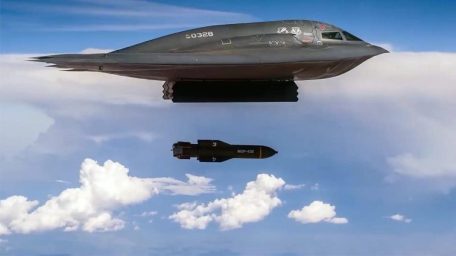
By William Schryver | imetatronink | November 28, 2025
The GBU-57 is a big fat gravity bomb with fins. To achieve effective precision, a B-2 bomber must drop it on its intended target from no further than about five nautical miles — essentially right on top of the target.
Its penetration depth is claimed to be 200 feet. But that capability has NEVER been tested against a seriously hardened deep-underground target encased in layers of high-performance concrete, and topped with a few dozen meters of solid rock. In that sort of real-world scenario, the GBU-57 would be lucky to drill down 50 feet, if that.
It was always ridiculous silly talk to suggest the GBU-57 was the wonder weapon it was made out to be. There is a good reason the US only produced a couple dozen of them and then stopped: they understood its acute limitations in a non-permissive combat environment.
And, notwithstanding the hyperbolic Israeli propaganda, there was never any credible evidence that Iranian medium- and long-range air defenses against fixed-wing aircraft were attrited to any significant degree. And Iranian short-range air defenses were increasingly effective against long-range Israeli drones with each passing day.
As for the B-2: it is a big fat subsonic aircraft. It flies at airliner speeds. A strike on Fordow would entail flying at least 500 miles in and out of Iran. … continue
Blog Roll
 Aletho News
- Drug traffickers trained in Ukraine attack state forces in Mexico
- The tragic reality of Brazilian mercenaries in the Ukrainian conflict
- Zelensky Refused to Discuss Druzhba Pipeline Issue – Fico
- U.S. General Caine Warns: STRIKING IRAN is a HUGE RISK /Glenn Diesen & Lt Col Daniel Davis
- Israel designates five Palestinian media outlets as ‘terrorist organizations’
- Israel, not America, first: Carlson’s Huckabee interview lays bare US foreign policy priorities
- Israeli troops executed Palestinian aid workers at ‘point blank range’: Report
- Iran war What if today’s Iran is resigned to a long, hellish war with the US?
- Why Israel Is Escalating Its War Crimes Against Lebanon
- Iran in the face of the armed diplomacy of imperialism
- If Americans Knew
- The NY Times on the “MAGA” Split Over Israel & USS Liberty
- In Gaza, Ramadan without mosques, imams – Not a ceasefire Day 137
- Footage Shows Israeli Troops Waiting in Ambush, Then Opening Fire on a Palestinian Teen
- The US is on the brink of a major new war that Trump has not even bothered explaining
- Latest Epstein document dump is one more cover-up
- No Protection, No Justice: US Citizens Killed with Impunity by Israel
- Maria Farmer: Epstein Victim Reveals Explosive Information Covered Up by Media
- Average of five Palestinians killed by Israel every day in Gaza since ceasefire – Not a ceasefire Day 136
- Palestinian church leaders admonish Christian Zionist Mike Huckabee – Not a ceasefire Day 135
- Ominous messaging from Trump’s “Board of Peace” – Not a ceasefire Day 134
- No Tricks Zone
- Surprising Discovery: Sahara Is Greening…Billions Of Trees Where Once Thought To Be Barren
- New Research Reaffirms Clouds, Aerosols, And Surface Solar Radiation Are ‘Driving The Climate System’
- Germany: Electric Car Catches Fire At Charging Station, Sets Off Local “Inferno”, Widespread Damage
- New Study: Canada’s New Brunswick Was 1°C Warmer Than Today During The Medieval Warm Period
- Coal Power Back In Trend As Globe Tries To Keep Pace With Growing Demand For Power
- New Study: A 4°C Warmer Beaufort Sea Had ‘No Sea Ice’ 11,700 – 8200 Years Ago
- Unfudging The Data: Dutch Meteorological Institute Reinstates Early 20th Centruy Heat Waves It Had Erased Earlier
- German Gas Crisis…Chancellor Merz Allegedly Bans Gas Debate Ahead of Elections!
- Pollen Reconstructions Show The Last Glacial’s Warming Events Were Global, 10x Greater Than Modern
- Germany’s Natural Gas Storage Level Dwindles To Just 28%… Increasingly Critical
 Aletho News