Saudi officials detain another Hamas leader in crackdown on Palestinian movement
Press TV – September 16, 2019
Saudi authorities have reportedly arrested another senior Hamas leader, as the conservative kingdom steps up its crackdown and repressive measures against the Palestinian resistance movement as well as those seeking to collect donations for people living in the impoverished Gaza Strip.
Palestinian political and family sources told Arabic-language al-Khaleej Online news website on Sunday that Saudi officials have detained Saudi Arabian citizen Abu Ubaydah Khayri Hafiz al-Agha – the son of one of the most prominent founders of Hamas, identified as Khayri al-Agha, who died of natural causes in Saudi Arabia in 2014.
The source added that Saudi authorities had put Agha in Dhahban Central Prison, which is a maximum security prison facility located near the Red Sea port city of Jeddah.
The director general of al-Zaytouna Center for Studies and Consultations, Dr. Mohsen Mohammad Saleh, told Khaleej Online that Agha is being kept behind bars for more than a year and a half, without any specific information about the reason for his detention.
On Saturday, Hamas called on Saudi authorities to immediately release its high-ranking official Muhammad al-Khudari, who was detained in the country five months ago without any clear charges.
Khudari, who has been living in Saudi Arabia for over 30 years, represented Hamas between mid-1990s and 2003 in Saudi Arabia. He has held other important positions in the Palestinian resistance movement as well.
Back on June 3, Lebanese Arabic-language daily newspaper al-Akhbar, citing informed sources who requested anonymity, reported that Saudi officials had been holding dozens of Saudi nationals and Palestinian expatriates in detention for months over affiliation to Hamas.
The report added that the most prominent figure among those arrested was Dr. Khudari.
Al-Akhbar went on to say that the campaign of arrests coincided with the closure and tight control of bank accounts, and a ban on sending any money from Saudi Arabia to the Gaza Strip.
Over the past two years, Saudi authorities have deported more than 100 Palestinians from the kingdom, mostly on charges of supporting Hamas financially, politically or through social networking sites.
The Riyadh regime has imposed strict control over Palestinian funds in Saudi Arabia since the end of 2017.
All remittances of Palestinian expatriates are being tightly controlled, under the pretext that these funds could be diverted indirectly and through other countries to Hamas.
Money transfer offices are asking the Palestinians to bring forward strong arguments for conversion, and do not allow the ceiling of one’s money transfer to exceed $3,000.
Will Trump Take Neocon Bait and Attack Iran Over Saudi Strike?
By Ron Paul | September 16, 2019
The recent attacks on Saudi oil facilities by Yemeni Houthi forces demonstrate once again that an aggressive foreign policy often brings unintended consequences and can result in blowback. In 2015 Saudi Arabia attacked its neighbor, Yemen, because a coup in that country ousted the Saudi-backed dictator. Four years later Yemen is in ruins, with nearly 100,000 Yemenis killed and millions more facing death by starvation. It has been rightly called the worst humanitarian catastrophe on the planet.
But rich and powerful Saudi Arabia did not defeat Yemen. In fact, the Saudis last month asked the Trump Administration to help facilitate talks with the Houthis in hopes that the war, which has cost Saudi Arabia tens of billions of dollars, could finally end without Saudi crown prince Mohammad bin Salman losing too much face. Washington admitted earlier this month that those talks had begun.
The surprise Houthi attack on Saturday disrupted half of Saudi Arabia’s oil and gas production and shocked Washington. Predictably, however, the neocons are using the attack to call for war with Iran!
Sen. Lindsay Graham, one of the few people in Washington who makes John Bolton look like a dove, Tweeted yesterday that, “It is now time for the US to put on the table an attack on Iranian oil refineries…” Graham is the perfect embodiment of the saying, “when all you have is a hammer, everything looks like a nail.” No matter what the problem, for Graham the solution is war.
Likewise, Secretary of State Mike Pompeo – who is supposed to represent US diplomacy – jumped to blame Iran for the attack on Saudi Arabia, Tweeting that, “Iran has now launched an unprecedented attack on the world’s energy supply.” Of course, he provided no evidence even as the Houthis themselves took responsibility for the bombing.
What is remarkable is that all of Washington’s warmongers are ready for war over what is actually a retaliatory strike by a country that is the victim of Saudi aggression, not the aggressor itself. Yemen did not attack Saudi Arabia in 2015. It was the other way around. If you start a war and the other country fights back, you should not be entitled to complain about how unfair the whole thing is.
The establishment reaction to the Yemeni oilfield strike reminds me of a hearing in the House Foreign Affairs Committee just before the US launched the 2003 Iraq war. As I was arguing against the authorization for that war, I pointed out that Iraq had never attacked the United States. One of my colleagues stopped me in mid-sentence, saying, “let me remind the gentleman that the Iraqis have been shooting at our planes for years.” True, but those planes were bombing Iraq!
The neocons want a US war on Iran at any cost. They may feel temporarily at a disadvantage with the departure of their ally in the Trump Administration, John Bolton. However, the sad truth is that there are plenty more John Boltons in the Administration. And they have allies in the Lindsay Grahams in Congress.
Yemen has demonstrated that it can fight back against Saudi aggression. The only sensible way forward is for a rapid end to this four-year travesty, and the Saudis would be wise to wake up to the mess they’ve created for themselves. Whatever the case, US participation in Saudi Arabia’s war on Yemen must end immediately and neocon lies about Iran’s role in the war must be refuted and resisted.
Winners and losers from Saudi Aramco’s travails
By M. K. BHADRAKUMAR | Indian Punchline | September 16, 2019
The US President Donald Trump’s tweet Sunday regarding the attack on two Saudi Aramco plants says as follows:
“Saudi Arabia oil supply was attacked. There is reason to believe that we know the culprit, are locked and loaded depending on verification, but are waiting to hear from the Kingdom as to who they believe was the cause of this attack, and under what terms we would proceed!”
It’s a cleverly-worded tweet with multiple audiences in view. Trump took time to react. And he’s stopped short of blaming Iran. The US lacks hard evidence. Therefore, “verification” is needed and it is Riyadh’s call to estimate “the cause of this attack, and under what terms we would proceed.”
Trump boasted that the US is “locked and loaded” to go to Saudi Arabia’s aid. Yet, only the previous day, when Trump telephoned Saudi Crown Prince Mohammed bin Salman, the latter had “underscored the Kingdom’s willingness and strength to thwart such a terrorist aggression and deal with its consequences.”
In fact, this has become the Saudi refrain — that it is within Saudi capability to handle the crisis. During a phone call from UAE Crown Prince condemning the drone attacks, MbS stressed that “the Kingdom has the ability to confront and deal with this terrorist aggression.” King Salman also told the Emir of Kuwait that “the Kingdom has the ability to confront such terrorist attack and deal with its fallout.”
None of the regional states — Egypt, UAE, Kuwait, Bahrain, Jordan, Turkey, etc. — or any foreign power has blamed Iran for staging the drone attacks on the Saudi Aramco plants. That leaves US states secretary Mike Pompeo as the solitary exception.
Interestingly, MbS received the Russian ambassador Sergei Kozlov for a one-on-one Sunday. No details have been divulged; the Saudi readout merely said, but highlighted that “a number of issues of mutual concern to the two friendly countries were discussed.”
Of course, the Russian interest lies in de-escalating regional tensions and Moscow and Tehran are in close touch. President Vladimir Putin is scheduled to meet Iran’s president Hassan Rouhani later today on the sidelines of the trilateral summit in Turkey of the Astana troika. Putin is also due to visit Saudi Arabia in October.
However, it is improbable that Saudis would want US to get involved. The trust deficit is palpable. (The Trump administration has decided to reveal the identity of the Saudi official who allegedly helped the 9/11 terrorists.)
The Saudi confidence in the US’ grit and commitment to stand by Saudi Arabia’s defence when the crunch time comes is shaky. Riyadh’s clout in the Washington Beltway has significantly diminished, especially after the murder of Jamal Khashoggi. The mood in the US Congress is hostile.
Again, there are highly sensitive aspects, which Riyadh would want to handle by itself. The Houthis claim to have had “intelligence and cooperation” from within Saudi Arabia for staging the drone attacks. If so, Houthis have contacts inside Saudi Arabia’s eastern province where the Shi’ite majority is agitating for empowerment and autonomy.
Riyadh will want to dig deep, but by itself without the CIA holding searchlights — since this ultimately concerns the Kingdom’s internal security and unity and the destiny of the royal family.
Saturday’s attacks have shown that Saudi defence is highly vulnerable. Any escalation by the US may lead to military confrontation with Iran and is fraught with the grave danger of the destruction of the Kingdom.
The UAE (and other GCC states) would also be averse to any further escalation. In the recent weeks, both Saudi Arabia and the UAE have made overtures toward Iran aimed tamping down tensions.
Yet another wrinkle is that differences have appeared between the Saudis and Emiratis over Yemen, with the latter projecting power in southern Yemen through proxy militia groups, undercutting the government headed by Mansur Hadi (whom Riyadh mentors.)
Over and above, Aramco’s IPO now hangs by a thread — and the Saudi Crown Prince’s Vision 300 programme to restructure the country’s economy and initiate much-needed reforms loses traction.
Saturday’s events have shown that the roof will come down on the world economy if any regional conflagration erupts leading to destruction of the petrodollar states. Brent Crude jumped 20% higher Sunday night.
If the Saudi outage could last for months, as seems likely, expect the Brent onslaught to continue until the price hits $80, and keeps moving higher. Suffice to say, Iran’s threat that it won’t be the only loser in a military confrontation with the US must be taken very seriously. The IRGC has reiterated this on Sunday.
In sum, the US has run out of options on Iran. If the intention behind Trump’s tweet is to unnerve Tehran and compel it to agree to a meeting between him and Rouhani in New York, that is sheer naivety. Nonetheless, the chances are there that a Trump-Rouhani meeting is likely.
Tehran never misses an opportunity to highlight that: a) it can be a factor of stability in the Persian Gulf; and, b) regional security is best handled by the regional states exclusively, through dialogue.
Rouhani’s first detailed remarks Sunday on these lines are significant. Some sort of contacts between and amongst Saudi Arabia and the UAE and Iran cannot be ruled out.
The bottom line is that the Saudis and Emiratis egged on Trump to take to the path of ‘maximum pressure’ against Iran, but as they look down the abyss today, they don’t like what they’re seeing.
The Houthis have been behind a number of assaults on Saudi pipelines, vessels and other energy infrastructure. A Houthi spokesperson explained, “We promise the Saudi regime that our future operations will expand and be more painful as long as its aggression and siege continue.” The focus should be on winding down the war in Yemen, where it becomes crucial for Riyadh and Abu Dhabi to engage with Tehran.
Prematurely assigning blame for attack on Saudi oil facilities is irresponsible, says China
RT | September 16, 2019
Beijing has warned that it would be irresponsible to guess who is the culprit behind the attacks on Saudi Arabia’s oil facilities without conducting a proper investigation. The US had immediately blamed Iran for the operation.
“Pondering who is to blame in the absence of a conclusive investigation, I think, is in itself not very responsible. China’s position is that we oppose any moves that expand or intensify conflict,” Hua said on Monday during a press briefing.
She implored all parties concerned to “restrain themselves” in order to “safeguard peace and stability” in the Middle East.
Washington wasted little time in pointing the finger at Iran. In an ominous tweet, President Donald Trump said on Sunday that his country’s military was “locked and loaded” for a potential response to the attack. Tehran has denied any involvement in the incident, accusing the Trump administration of trying to tarnish the Islamic Republic’s image in order to justify “future actions” against the country.
Contradicting the US narrative, Houthi rebels in Yemen have already admitted responsibility for the attack. The group said they used 10 armed drones to hit two Aramco oil refineries on Saturday. The attacks caused massive fires and other damage to the sites, halving Saudi Arabia’s oil output.
In a statement, the Houthis said that Aramco facilities remained a target and could be attacked again at “any moment.”
Saudi says unclear when oil output will return to normal after ‘massive’ damage
Press TV – September 15, 2019
An informed Saudi source says the damages inflicted on the Aramco oil facilities in the recent Yemeni drone attacks are so massive that it is not clear when the country’s oil output can return to normal.
Attacks by 10 Yemeni drones on Saudi Arabia’s key oil facilities in Abqaiq and Khurais have shut down about 50 percent of the kingdom’s crude and gas production, cutting the state oil giant’s crude oil supply by around 5.7 million barrels per day.
An oil industry source briefed on the developments said on Sunday it is unclear how long the oil production shutdown will continue, as it is impossible to fix the “big” damages overnight.
Aramco has given no timeline for output resumption. However, a source close to the matter told Reuters the return to full oil capacity could take “weeks, not days”.
Another source briefed on the developments said the kingdom’s oil exports would continue to run as normal this week thanks to large storage in the country.
High-resolution satellite photos of the damaged facilities “declassified” by the US administration on Sunday show the drone attacks have hit at least 19 points with great precision.
A senior US official, asked not to be named, has claimed that evidence shows the launch area was west-northwest of the targets – the direction of Iran and Iraq – not south from Yemen.
The official has also quoted Saudi officials as saying that there are signs that cruise missiles were used in the attack.
This comes as Yemen has clearly stated it used 10 drones for Saturday’s operation, which was one of their largest retaliatory attacks ever inside the kingdom.
Earlier in the day, Tehran dismissed the US’ claim of Iranian involvement in the drone attacks, saying “futile allegations and blind statements as such are incomprehensible and meaningless within the framework of diplomacy.”
Foreign Ministry spokesman Abbas Mousavi said such remarks “seem more like a plot being hatched by secret and intelligence organizations aimed at tarnishing a country’s image and setting the stage for future actions.”
He also criticized Saudi Arabia for fueling the flames of war in the region by committing various war crimes in Yemen for about five years, and hailed Yemen for putting up resistance in the face of the aggression.
Iraq has also denied reports alleging that the country was the site from where Yemeni drones were launched to attack Saudi oil installations.
The statement came from Iraqi Prime Minister Adil Abdul-Mahdi’s office on Sunday. It said Iraq would act “decisively” if anyone tried to use its territory to attack other countries, AP reported.
Iraq Denies Report Drones Attacking Saudi Oil Facilities Were Launched From Its Territory
Sputnik – September 15, 2019
On Saturday Saudi Arabia’s oil facilities were attacked by two drones, causing major fires and disrupting oil production in Abqaiq in the eastern part of the country and in Khurais, northeast of Riyadh. The attacks were claimed by Yemen’s Houthi movement but the US put the blame on Iran. Tehran has refuted the allegations.
Iraq has denied media reports claiming that its territory was used to launch the drones that attacked Saudi Arabia’s oil facilities on Saturday night, a statement from the Iraqi Prime Minister’s press-service released on Twitter says.
“Iraq denies reports in the press and on social media that its territory was used to attack oil facilities in Saudi Arabia using drones”, the statement reads.
It also says that the constitution of Iraq does not allow the use of its territory for aggressive actions towards its neighbours. The Iraqi authorities have set up a committee to monitor reports and the latest events relating to the drone attack on Saudi Arabia’s oil facilities.
Iraq also urges the warring sides in Yemen to find a peaceful solution to the conflict and refrain from “mutual attacks that cause a huge damage to facilities and claim people’s lives,” according to the statement.
Two drones attacked Saudi Arabia’s oil facilities on Saturday night, causing major fires and disrupting oil production. Yemen’s Houthis claimed responsibility for the attacks but the US has blamed Iran for the incident. Tehran has rejected the allegations.
Houthis strike at Saudi Arabia’s throbbing heart
By M. K. BHADRAKUMAR | Indian Punchline | September 15, 2019
A terrible beauty is born on the Middle East’s strategic landscape with the massive drone attacks Saturday on two Saudi Aramco refineries. Saudi Arabia, which has a record of sponsoring terrorist groups to destabilise foreign lands — Afghanistan, Chechnya, United States, Iran, Lebanon, Syria, Iraq, etc. — has become a victim of terrorism, finally. There is natural justice here, one may say. Saturday’s attacks trigger geopolitical convulsions.
The Saudi defence ministry could not thwart the attacks despite the advanced weapon systems in its inventory costing hundreds of billions of dollars. According to Stockholm International Peace Research Institute, Saudi Arabia was ranked third in military spending in 2018, below the US and China, with an expenditure of $67.6 billion (alongside India — $66.5 billion).
Evidently, the massive scale of defence expenditure did not ensure national defence, since the Kingdom’s main threat today is not one of external aggression but of blowback ensuing from flawed policies, internal or external. The Patriot missiles deployed in Saudi Arabia could not thwart Saturday’s attacks. Yemen’s Houthi movement who claimed responsibility disclosed that 10 drones were used to target the Aramco refineries at Abqaiq and Khurais.
The Houthi military spokesman said, “This was one of the largest operations which our forces have carried out deep inside Saudi Arabia. It came after careful intelligence and cooperation with honourable and free people inside Saudi Arabia.” The two oil facilities targeted are located in Saudi Arabia’s Shi’ite majority eastern province, which is a restive region.
Without doubt, the Houthis have messaged that Riyadh, having lost the war in Yemen, should cease its continuing interference and leave it to the Yemeni factions to sort out their civil war.
The ball is now in the Saudi-Emirati court. The Houthis claim to have over 200 major Saudi targets in its crosshairs. They have also separately warned the UAE that there’s going to be retribution.
US President Donald Trump spoke to the Saudi Crown Prince Mohammed bin Salman (MbS) on the phone. The Saudi readout said Trump “reasserted” Washington’s “readiness to cooperate” with Riyadh “by all means conducive to maintain its (Saudi) security and stability, reaffirming the negative effects of the attacks (on two Aramco’s facilities) on the US economy as well as the world economy”, while MbS “underscored” on his part the Saudi “willingness and strength to thwart such a terrorist aggression and deal with its consequences.”
Neither Trump nor MbS accused any party for staging the attacks. Similarly, a statement by the Official Spokesman of the Saudi-led coalition in Yemen said that “investigations are ongoing to determine the parties responsible for planning and executing these terrorist attacks.”
The US Secretary of State Mike Pompeo’s tweeted —“Iran has now launched an unprecedented attack on the world’s energy supply. There is no evidence the attacks came from Yemen.” It must be taken as a personal opinion or a knee-jerk reaction. Clearly, utmost care is being taken in Riyadh and Washington not to create alarm in the oil market.
Saudi Arabia has promised to replace any shortfall from its existing stocks. Nonetheless, considering that the attacks have disrupted half of Saudi Arabia’s oil capacity or 5.7 million barrels a day of crude oil and gas production (equivalent to 5% of daily global oil supply), the oil market will remain jittery and the stock markets across the Gulf have plunged.
Saturday’s attack deals a heavy blow to MbS’ plans to go public on the Aramco IPO. Aramco’s debut international bond sale in April has been a big success. In a move to give transparency, Saudis also recently commissioned an independent audit of the country’s oil reserves and have started publishing earnings. Over the past two weeks, MbS took direct control of Aramco by appointing a hand-picked as chairman who is close to him. The energy minister also has been replaced.
In political terms, the war in Yemen and the Saudi Aramco’s ambitious restructuring are directly attributable to MbS and, therefore, any setback in these two arenas becomes a reflection on his decision-making and leadership. This has implications for MbS’s political standing as well as the trajectory of Saudi policies.
The Trump administration gets an opportunity to prevail upon the Saudis to end the war in Yemen, which is also what the US Congress has recommended. Washington has opened direct contacts with the Houthis. Therefore, the likelihood that Saturday’s attacks may prompt a Saudi rethink on the war in Yemen cannot be brushed aside.
Indeed, the tide in regional politics and the regional balance has turned against the Saudis lately, given the unraveling of the US-led maximum pressure approach toward Iran and Trump’s keenness to engage with the leadership in Tehran. The politico-military defeat in Syria and Yemen, the break-up with Qatar and the marginalisation in the US-Taliban talks have exposed that Saudi Arabia’s imperial overstretch is unsustainable and in turn put serious limits to Riyadh’s regional influence.
Over and above, the Kingdom is in historic transition at multiple levels — political, economic and social — and reforms cannot be postponed much longer. On the other hand, the steady US retrenchment in the region creates a backdrop of huge uncertainties for Saudi Arabia’s future. It’s at a tumultuous juncture that the Houthis have struck at Aramco, the throbbing heart of Saudi Arabia with a net income of $111.1 billion in 2018.
Attacks on Saudi oil make waivers on Iran necessary: Experts
Press TV – September 14, 2019
Experts say critical oil supplies lost due to Yemeni attacks on Saudi Arabia’s production plants can only be compensated if the United States eases its sanctions on sale of crude by Iran.
Sandy Fielden, an analyst at Morningstar, a global financial services firm based in the US, said on Saturday that the current oil stocks in Saudi Arabia, the biggest oil exporter in the world, would not suffice to compensate for a loss of around 5 million barrels per day (bpd) that could be caused by attacks earlier in the day targeting the kingdom’s vital oil facilities located east of the country.
Fielden said the disruptions could cause a real jump in the global oil prices, adding that the US, a main player in the oil market and an ally of the Saudis, would have no option but to allow Iran to resume its crude exports after months of a halt that has been caused by Washington’s unilateral bans.
“By all accounts the Iranians have tankers full of storage ready to go,” he said, adding, “The obvious short-term fix would be waivers on Iran sanctions.”
Yemen’s ruling Houthi Ansarullah movement said on Saturday that its drones had successfully attacked two oil plants in Abqaiq, the heart of Saudi Arabia’s oil industry, in the kingdom’s Eastern Province.
The Houthis said the attacks were a firm response to Saudi Arabia’s relentless bombardment of Yemen, where tens of thousands of civilians have been killed since Riyadh launched its illegal military campaign four years ago.
James Krane, Middle East energy specialist at Rice University’s Baker Institute, suggested that supplies from a country like Iran would be the best option to replace the lost Saudi production as most of the Kingdom’s exports normally go to countries in Asia that are closer to Iran than any other major oil producer.
“For the United States, the main threat is in the price of oil,” said Krane, adding, “Asian countries are more at immediate risk because they are the big importers from Saudi Arabia, with 80% of Saudi exports going to East Asia.”
Analysts said Yemeni attacks on Saudi oil installations showed that Riyadh, which pumps just below 10 million bpd of oil into the global market, is effectively defenseless in the face of strikes from its impoverished neighbor.
Fielden said Washington would also find it impossible to try to solve the crisis on its own by sending tankers full of oil to Saudi customers in East Asia.
“It takes 19-20 days to ship Ras Tanura (Saudi) to Singapore, but 54 days from Houston to Singapore. So US ‘relief’ will take time,” he said.
However, US officials said right after the attack that they would try to ensure a smooth supply of oil to the global markets despite the attacks in Abqaiq.
White House spokesman Judd Deere said in a statement that Washington was committed to well-supplied oil markets while adding that US President Donald Trump had held a phone conversation with Saudi Crown Prince Mohammed bin Salman following the Saturday attacks.
The International Energy Agency (IEA) also said that in the short term was there were no real concerns about supplies to the markets.
“For now, markets are well supplied with ample commercial stocks,” it said, adding, “The IEA is monitoring the situation in Saudi Arabia closely. We are in contact with Saudi authorities as well as major producer and consumer nations.”
The United Arab Emirates, a close ally of Saudi Arabia and a major oil producer, said it would support measures adopted by the kingdom to safeguard its security following Saturday attacks.
Pompeo blames Iran for drone attack on Saudi oil facilities, Senator Graham urges US to strike it
RT | September 14, 2019
A drone attack on Saudi oil facilities claimed by Yemen’s Houthi rebels prompted Washington to blame Tehran, with US warhawk, Senator Lindsey Graham, calling for a strike against Iran.
The smoke from the huge fires at the world’s largest oil processing plant caused by the strike had barely dissipated when officials in Washington jumped at the opportunity to use the occasion to push an anti-Iranian agenda.
US Secretary of State Mike Pompeo blamed Tehran for what he called “an unprecedented attack on the world’s energy supply” but stopped short of suggesting any retaliatory measures.
Meanwhile Graham was quick to turn to Twitter to call for swift retaliation.
The senator linked the need to stop Iran’s alleged “provocations” to the seemingly ultimate goal of Washington’s policy toward Tehran – regime change – as he said that the Islamic Republic would not stop until the consequences of its “misbehavior” would be “more real, like attacking their refineries, which will break the regime’s back.”
Riyadh denounced the drone strike as a “terrorist attack” but did not immediately name a perpetrator. Houthis claimed responsibility for the Saturday morning assault, which resulted in massive blazes at the refinery in the city of Abqaiq in the kingdom’s oil-rich Eastern Province and another facility at the vast Khurais oil field, around 150km (93 miles) from Riyadh.
US President Donald Trump has already phoned Saudi Crown Prince Mohammed bin Salman and offered help to the Kingdom in ensuring its security. He also said that the attack on the Saudi oil facilities could be detrimental to the American and the global economy.
The International Energy Agency (IEA) said, though, that the attack is unlikely to affect the global oil markets as they are “well supplied with ample commercial stocks.” Yet, it also said it is closely monitoring the situation and is in contact with the Saudis and “major producer and consumer nations.”
The IEA statement came amid media reports that the attack forced Riyadh to cut oil production by as much as 5 million barrels a day, which is equivalent to roughly half of its total oil output and about five percent of the global oil supply.
The Saturday attack has become the most successful strike the Houthis have launched against the Saudis, who have been leading a bombing campaign in Yemen since it intervened in the nation’s civil war in 2015. In May, armed drones caused minor damage to two Saudi Aramco state oil companies’ pumping stations in the Eastern Province.At that time, Riyadh blamed Iran for the attack, which was claimed by the Yemeni rebels as well. Tehran denied the allegations.
The Saudi-led coalition’s military campaign in Yemen has itself been repeatedly criticized by the UN and various international human rights groups, which repeatedly pointed to the mass civilian casualties resulting from the coalition’s airstrikes
Justin Trudeau’s Subordination to Israel, USA and Saudi in Joining the Attack on Iran and China
By Prof. Tony Hall | American Herald Tribune | September 14, 2019
The US and Israeli governors of occupied Canada have authorized their current puppet, Prime Minister Justin Trudeau, to complete an anti-Iranian initiative commenced by former Canadian Prime Minister Stephen Harper. The Trudeau government completed the process of selling off about $28 million in property seized from the government from which the Harper government withdrew the Canadian embassy in 2012.
The seizure and redistribution of Iranian assets in Canada has beneath it a ruling by Judge Glenn Hainey of the Ontario Superior Court of Justice. Judge Hainey’s heavily politicized ruling in this case in 2016 has been deemed “an embarrassment both to Canada and the legal profession.”
The enactment that helped set in motion this fiasco is Canada’s Justice for Victims of Terrorism Act passed into law in 2012 (JVTA). This legislation of the Harper government together with the ruling by Judge Hainey have imported into Canada the results of a series of US court rulings. These US rulings gave a green light to sue Iran on the basis of the Foreign Sovereign immunities Act. By following the US lead in the treatment of Iran
Canada became the second state in the world to proclaim predatory jurisdictions against states that it lists on the basis of ideological criteria, contrary to the established international-law principles of state sovereignty, state immunity, and equality of states. Canada’s list contains solely Iran and Syria, two states opposing the ongoing US geopolitical machination for “regime change” by a covertly supported mercenary war against Syria.
Ottawa’s Prof. Denis Rancourt has explained that the 2012 legislation, including amendments to Canada’s own Sovereign Immunity Act, has been used
as a pretext to enforce the US rulings, while additionally making absurd interpretations of the text of the JVTA in order to enforce rulings that have nothing to do with Canada and that are limitation barred. There was not even a civil cause of action for “terrorism” in Canada at the distant time when the claimed acts occurred. Judge Hainey did not consider and misrepresented valid legal arguments of Iran.
Dr. Rancourt goes further, pointing out the joint Canada-US initiative in mounting economic warfare against Iran violated a UN Convention in a fashion that has become tragically common in the era of the Global War on Terror. Dr. Rancourt indicates, “Canada’s new laws are explicit violations of the International Convention for the Suppression of the Financing of Terrorism (ICSFT).” The UN Convention was ratified by Canada in 2002. The Convention
delimits the conditions under which domestic-court jurisdiction can be established, defines the types of funds that can be seized, and constrains the state parties to carry out their obligations “in a manner consistent with the principles of sovereign equality and territorial integrity of States and that of non-intervention in the domestic affairs of other States”.
Canada is currently in the midst of a federal election campaign with a vote to take place on October 21st. How many will remind Justin Trudeau in this season of vote chasing that in his last election campaign he promised to re-establish normal diplomatic relations with the government of the Islamic Republic of Iran.
What is the worth of Prime Minister Trudeau’s political promises? In September of 2016 Stéphane Dion, Canada’s first Foreign Affairs Minister under the new Justin Trudeau government, initiated a move to return to normal diplomatic relations with Iran. Trudeau’s half-hearted attempt to resume diplomatic relations with Muslim-majority country ran into the concerted opposition of his handlers in Canada’s Israel Lobby.
Prof. Rancourt observed. “The Israel lobby has made it clear to Dion and to the Liberal Party that there will be a heavy price to pay for détente with Iran… The Israeli lobby’s wishes against Iran are bad for Canada and bad for the world.” As often happens with Justin Trudeau, Pierre Trudeau’s son chose to serve the war-mongering agenda of the Israel government over a peace agenda for Canada and the world. Trudeau has adopted from the previous Harper government the main outlines of the pro-Israel and anti-Palestinian platforms that have prevailed in Canada especially since the Harper neoconservatives took over in 2006.
When it comes to allowing the Israeli and US governments to prevail in determining Canada’s foreign policy, Prime Minister Trudeau is turning out to be a major liability. The failure to sort out a more productive relationship with Iran is not an isolated phenomenon. Trudeau has also carelessly sabotaged the health of Canada-China relations by agreeing to the US request to arrest in Vancouver Meng Wanzhou, Chief Financial Officer of Huawei electronics.
Much like the politics underlying the federal government’s unilateral seizure of Iranian properties in Canada, the arrest of Meng Wanzhou came about based on an accusation that one of the Huawei family of companies had somehow violated US sanctions by doing business with an Iranian entity. Why did the government of Justin Trudeau order the arrest at the Vancouver airport of the high-profile Chinese businesswoman? Why did Canadian officials apprehend Meng Wanzhou based on US accusations she violated a US sanctions enactment never approved by Canadian parliamentarians as far as I know?
Trudeau’s decision to allow himself to become one of President Trump’s and John Bolton’s main enforcers on Iranian sanctions has had major implications for Canadian farmers and manufacturers. The products that these Canadians produce are gradually being shut out of larger and larger portions of the Chinese market. Trudeau’s responsibility for this commercial mess forms a marker of his political ineptitude when it comes to the highest order of international relations. To describe his police action as some sort of requirement of “the rule of Law” is very deceptive to put in kindly.
Justin Trudeau is entering this national election with a major scandal in the mix of issues he must navigate. Since January of 2019 Trudeau has had to respond to revelations by Canada’s former Attorney General and others that he and his office partnered with a large international engineering firm, SNC Lavalin, to change the law so that the company could avoid a host of criminal prosecutions.
According, for instance, to the investigations of the World Bank, SNC-Lavalin and related companies have broken international records for bribery and corruption. The array of criminal prosecution directed at SNC-Lavalin still has yet to be explained clearly and comprehensively to the Canadian electorate.
Trudeau has attempted to defend the Liberal Party from revelations that Canada’s criminal justice system is being corrupted in the effort to gain Deferred Prosecution Agreements for SNC-Lavalin’s many proven violations of law. Trudeau regularly tries to defend his political coziness with the corporate serial offenders by proclaiming his intention to protect 9,000 Canadian jobs, many of them in SNC’s Montreal headquarters. Never does Justin Trudeau mention that SNC-Lavalin also has 9,000 employees in Saudi Arabia.
While Trudeau has sometimes been pointed in his criticisms of Saudi human rights violations, the fact remains that Canada is in bed commercially and politically with Saudi Arabia. The Saudi royal dynasty is Israel’s closest ally in the Arab world. The Trudeau government goes along with the rest of the West in looking the other way when it comes to, for instance, Saudi attacks on Yemen or to Saudi violations of human rights including the torture and murder of journalist Jamal Khashoggi. Jamal’s Uncle, Adnan Khashoggi, was a CIA asset and an “arms dealer.” He was one of the primary figures who helped to set up another notoriously corrupt Canadian company, Barrick Gold, on the Toronto stock exchange.
Saudi Arabia, of course, has been a major source of funding, arms, drugs, and ideology establishing mercenary proxy armies like ISIL/Deash. The Iranian government has consistently fought to defend its own citizenry from ISIL/Daesh. The Saudi government often uses its own notorious approach to manipulating Islamic discontent to advance its own religious, ideological and foreign policy initiatives. Moreover, Iran has had to defend itself from MeK terrorists nowadays supported by many influential American and European politicians. About 35 MeK thugs attacked the Iranian embassy in Ottawa in 1992 as part of a larger effort of destructive intervention throughout the West.
Iran has been the subject of Stuxnet cyber-attacks emanating from the US National Security Agency in partnership with Unit 8200 of the Israeli Defense Force. Other facets of these attacks have targeted for assassination Iranian nuclear scientists. Why is Justin Trudeau siding so pointedly with Saudi Arabia against Iran just as he has been siding so strongly with the United States over China? Iran is a country with far more viable programs of regular national elections, women’s rights and minority rights than the Frankenstinian regime of Saudi Arabia.
As we head into this election campaign in Canada, it is not very likely that we will hear the word “Palestinian” from politicians seeking our vote. As in many Western Countries, the Israel Lobby not only closely controls the policies of governing parties. The Israel Lobby also has great influence over the policies of the opposition parties including Canada’s New Democratic Party as well as the Green Party. The Green Party’s Elizabeth May, who emigrated to Canada from the United States, fought off a bold effort from within her group to institute BDS. In doing so she basically saluted the anti-Palestinian objectives of the Israel Lobby in Canada.
The result of all this is that we have little meaningful debate in our Canadian Parliament between political parties all of whom are tightly controlled by groups like B’nai Brith Canada and the Centre for Israel and Jewish Affairs, the CIJA. This pattern prevails as well in Canada’s mainstream media where discussion of Israel-Palestinian relations is intellectually and politically impoverished.
I was reminded of the biases of the largest part of the Canadian media by the prejudices and convenient blind spots in the article that alerted me to the latest anti-Iranian moves of the Canadian government. That article by Stewart Bell appeared in a Global Television news report today, Friday Sept. 13.
Bell’s article includes the following propaganda statement without even the slightest hint of proof, explanation or background. Quoting Danny Eisen representing something called the Canadian Coalition Against Terror, Bell and Global Television assert, “The Iranian regime unwaveringly and unabashedly provides tens of billions of dollars for terrorist organizations that have destroyed innocent lives across the globe, including those of Canadians.”
This kind of journalistic excess is indicative of the dishonesty that drives much mainstream media reporting in Canada. Bell’s emphasis on the unexplained accusations of an entity calling itself the Canadian Coalition Against Terror quite clearly embodies the worst kind of propaganda aimed at instigating the ultimate terror of aggressive warfare against Iran, a country of 80 million citizens.
Such a bellicose threat on behalf of war hawks can be described as the kind of provocation Justin Trudeau might very well embrace if he thinks it will serve his personal quest for expanded power. I sincerely hope I am wrong in this assessment and that Trudeau shows his dovish side as a proponent of peace in this national election campaign.
Yemen Revolutionaries: 10 Drones Hit Saudi Aramco Oil Facilities, Range of Targets to Be Expanded
Al-Manar | September 14, 2019
Yemeni revolutionaries claimed responsibility on Saturday for drone attacks on two major facilities run by Saudi Aramco, Saudi Arabia’s state-owned oil giant.
Spokesman of Yemeni armed forces Brigadier General Yahya Saree announced that ten drones hit Abqaiq – home to the company’s largest oil processing plant – and Khurais facilities.
The attack is “one of the most large-scale operations in the Saudi depth,” and dubbed “Balance of Deterrence-2,” the spokesman said.
“These attacks are our right, and we warn the Saudis that our targets will keep expanding.”
“We have the right to strike back in retaliation to the air strikes and the targeting of our civilians for the last five years,” Saree said, referring to Saudi-led aggression taking place against Yemenis since March 2015.
The Saudi regime has no choice but to halt aggression and lift the blockade imposed on Yemeni people, Saree added in a statement carried by Yemen’s Al-Massirah TV channel.
Earlier on Saturday, Saudi interior ministry said fires broke out at two Saudi Aramco oil facilities after they were struck by drones.
Human Trafficking is Booming in Yemen as the War Enters its Fifth Year
By Ahmed Abdulkareem | MintPress | September 13, 2019
AMRAN, YEMEN — The offensive war on Yemen, the most impoverished nation in the Middle East, was launched in 2015 by a U.S.-backed coalition of Arab countries led by Saudi Arabia, the richest nation in the Middle East. It has plunged a nation already struggling to provide basic services to its citizens into chaos, a nation now ruled by a ragtag consortium of different groups all thirsting for power. The result? A complete absence of law and order that has given rise to a black Suq (market) of human trafficking on a scale never before seen in Yemen.
Thirty-five-year-old Tawfiq hails from Amran, a small city in west-central Yemen famous for its ancient mud-brick high-rises dating back two millennia to the Sabean kingdom. Tawfiq was among 17 Yemeni victims of human trafficking who agreed to speak to MintPress about their harrowing ordeals. In 2016, Tawfiq — desperate to bring money home to his family, as the then-fledgling war decimated the already shaky Yemeni economy — was told by a friend that he could earn as much as $7,000 for one of his kidneys. Days later Tawfiq was on a bus to Saudi Arabia, traveling through al-Wadeeah port on the Yemen-Saudi border.
Today, Tawfiq suffers from complications arising from his kidney extraction and is now unable to carry heavy objects. He told MintPress, “I thought that removing a kidney would be a simple arrangement, but now I live in a hell of pain and suffering.” Tawfiq’s operation was crude and involved no follow-up care.
Ismail, the owner of a small electronics store in Taiz, told MintPress, as he pointed to the place where one of his kidneys use to reside, “I needed money to feed my children.” Ismail hesitated while he recounted his story, worried that the shame of what he had done would reach his family. Yet thousands of Yemeni civilians who are living in abject poverty as a result of the ongoing war are willing to allow a part of themselves to be cut out and sold in order to be able to sustain their families.
Ali al-Jailai, head of the Yemen Organisation for Combating Human Trafficking, told MintPress that the wave of famine that hit the country in 2015, when the Saudi-led war began, has augmented Yemen’s human trafficking network and left women and children the most vulnerable.
“A while back there was a case of a man who was traveling to Egypt to sell his kidney,” al-Jailai told MintPress. “We talked to him and tried to persuade him not to go, but he refused; he needed the money.” With an economy now decimated by more than four years of war, many working-class Yemenis have abandoned hopes of working a normal job and instead turn to one of the few options that remain: to sign up for the fight against Saudi Arabia and the UAE, or to sell their organs to survive.
Over 20 million Yemenis are currently in need of humanitarian assistance, according to the United Nations. Salaries for teachers and other public-sector workers have not been paid regularly since the war began and Saudi Arabia seized control of Yemen’s Central Bank, leaving vulnerable populations at increased risk of falling victim to human trafficking.
The Yemen Organisation for Combating Human Trafficking, a Sana’a-based NGO, has documented over 10,000 cases of organ sales from the start of the war in March 2015 to 2017. According to the organization, actual figures could be much higher, as many cases go unreported owing to the illegality of the practice, religious concerns, and the associated stigma of the practice in Yemen’s conservative society.
Although he lost one of his kidneys, Tawfiq was lucky. Hundreds of Yemenis, including women and children, forced to “donate” their organs, lose their lives after their livers, kidneys, spleens, corneas, or even their hearts are removed. One Yemeni family recounted to MintPress, on condition of anonymity due to the sensitivity of the case, how they found their son after he went missing: “After his abduction we found his body thrown in the street, you could see there had been an operation on his body; we asked for an autopsy and were in shock after we found his heart was gone.”
Blockading a way out
In addition to poverty and the absence of law enforcement, there are other reasons why human trafficking flourishes in Yemen, perhaps the most prominent being the blockade levied against the country by the Saudi Coalition since 2015. Before the war, Yemenis would regularly leave the country to seek better health care, employment opportunities and safety abroad — including, somewhat ironically, in neighboring Saudi Arabia. Now — with seaports, airports, highways and especially the once-bustling Sana`a International Airport effectively shuttered by the Saudi Coalition — Yemenis are no longer able to flee the violence in their country or travel to neighboring wealthy Gulf countries for stints of work to earn some cash, leaving many with few options but to resort to selling their organs out of desperation to make ends meet.
The blockade has also left a large number of Yemenis stranded abroad, including some students and others who have managed to find a way out in hopes of receiving medical treatment. It is estimated, according to data provided by the Sana`a International Airport Media Center, that nearly 4 million Yemenis are currently stranded abroad. Many of the stranded are left in a state of legal limbo, unable to secure citizenship in neighboring countries and therefore unable to work, leaving them with no way to earn money short of begging on the street or agreeing to sell their organs
The Yemen Organisation for Combating Human Trafficking told MintPress that many Yemenis who fled when the war broke out are now stuck abroad and that the organization has recorded as many as 300 cases of Yemenis stranded abroad selling their kidneys out of desperation.
Officials work with brokers and smugglers
Maha, who wished to be identified only by her first name, and her friend, who asked to remain anonymous, recounted how a Yemeni broker had managed to secure passports for them by contacting staff members at the Yemeni Consulate in Jeddah, Saudi Arabia, who then, together with a Saudi black-market organ dealer, created a formal medical report to make the sale of Maha and her friend’s kidneys look like a legitimate donor transplant. The Yemen Organisation for Combating Human Trafficking told MintPress that collusion by government officials is rampant in Egypt thanks to the large fees government employees charge for coordinating organ sales. “I used to travel to Egypt every month along with a group of girls where we would attend concerts at the Emirati Embassy; the trips were coordinated by high-level employees at the Yemeni Embassy,” Maha told MintPress.
Last year, Musa Al-Ezaki, the editor of Yemen’s widely-circulated Al-Hayat newspaper, made a very public offer to sell one of his kidneys to the highest bidder. Al-Ezaki coordinated with his brother, who was living in Egypt at the time, to place an ad in a Cario newspaper with the caption, “Under compelling circumstances I regret to announce the sale of my kidney to pay rent; if someone wants to buy a kidney, please call me.” It’s unknown if Al-Ezak ever found a buyer.
Yemen’s penal code calls for 10 years’ imprisonment for those engaged in human trafficking. However, not only are those laws not being implemented, government officials, especially those in the Aden-based government of Saudi-backed Abdrabbuh Mansur Hadi, are often directly involved in smuggling victims abroad and issuing permits to make the sale of organs appear as legitimate donations to recipients in countries that are supposed to require the approval of the Yemeni Embassy, especially Egypt.
“[In one case] we formally contacted embassy officials to coordinate with Egyptian authorities in order to return a human trafficking victim to Yemen, but they refused to respond,” al-Jailai told MintPress. “We have accurate information about the complicity of the Yemeni Embassy [staff] in Egypt and unfortunately, organized crime has been able to penetrate it.”
Owing to the collapse of an organized health care system in Yemen, organized criminal elements are smuggling victims to Egypt, the Saudi Arabia and China, according to the Yemen Organisation for Combating Human Trafficking. Yet, of the victims and brokers who spoke to MintPress, all indicated that Egypt is still one of the most favored destinations to which brokers and smugglers bring their victims.
MintPress interviewed three Yemeni brokers who said officials in Yemen were assisting them in obtaining travel documents for their victims and connecting them with brokers in Saudi Arabia and Egypt to arrange their travel, accommodation, and surgeries in direct coordination with staff in their countries’ embassies. “The government entities here [in Yemen] and in Saudi Arabia make bringing Yemenis abroad easy for us,” one of the brokers who asked to be identified as Abu Saiyad, which translates to The Hunter in English, told MintPress.
Organ brokers in Yemen do not work under the radar as their peers do in neighboring countries. They are known to most residents and wander through camps for the internally displaced and most major slums in large cities.
Harvesting prisoners of war
Owing to the increased demand for human organs, attributable in large part to the many troops who have sustained injuries while fighting in Yemen, Saudi Arabia and the UAE have also become a sizable market for Yemeni victims of human trafficking. Even some Yemeni prisoners of war captured on Yemeni battlefields have awoken to find their kidneys removed; others have had their organs harvested and been left for dead.
A number of families of prisoners of war said their loved ones had become victims of human trafficking after being captured on the front lines. They say Saudi Arabia has thus far refused to hand over their bodies. One such family told MintPress that they had evidence that the Saudi army extracted their son Ibrahim’s spleen and cornea from him before he was killed, but MintPress was unable to independently verify the claim.
In June 2019 the United States added Saudi Arabia to a list of countries it says are not doing enough to combat human trafficking. Instead, the U.S. said, the Kingdom has often jailed, fined or deported human trafficking victims, accusing them of immigration violations or prostitution rather than providing them assistance.
Despite the blacklisting of its Saudi ally, the United States is very much complicit in the human trafficking that has come to plague Yemen, according to many Yemenis, who feel that if the United States did not offer such generous support to the Coalition, their country would not be suffering a famine and hence no one would be forced to sell their organs, or their honor, to feed their children.
While Yemen’s penal code calls for 10 years’ imprisonment for those engaged in buying or selling human beings, the U.S. State Department has done nothing to publicly reprimand its coalition allies for failing to tackle trafficking in Yemen — this despite the fact the U.S.’ own report lays much of the blame at the feet of the Coalition-backed government in Aden.
Yemen’s women and girls at risk
The trafficking of human beings involves not only human organs but also sexual exploitation, and Yemen is no exception. Trafficked Yemeni women are subjected to rape, violence, extreme cruelty, and many other forms of pressure and coercion. Female trafficking victims who spoke to MintPress reported being forced into prostitution networks in Saudi Arabia and the Emiratis.
One victim, who wished to be identified only as Samerah, told MintPress:
I traveled to Egypt in February 2018. I was taken to a party featuring the Saudi Ambassador and the head of the military police in Saudi Arabia by a Yemeni and Egyptian woman. That night I was forced into having sex and the next day I was given money and returned to the embassy.”
Another trafficking victim who was forced into sex work and who refused to be identified spoke to MintPress from a rehabilitation center run by the Houthis in Sana`a. She told MintPress that she is afraid to return to her home for fear of being killed for violating her family’s honor.
Wealthy Saudi and Emirati patrons often rely on professional brokers’ networks that send trafficked women and girls to hotels in Ethiopia, Djibouti, Egypt and Dubai in exchange for a commission, according to a number of testimonies given to MintPress by both trafficked victims and brokers.
Before the war, Saudi Arabia was already using Yemen as a hub for so-called “marriage tourism.” Saudi soldiers, businessmen, and ordinary citizens would travel to Yemen to marry young girls from poor families. Many of these girls would travel back to Saudi Arabia only to be used temporarily for sex and then simply or abandoned on the streets or sold to traffickers.
Even those who voluntarily seek to sell their organs out of desperation fall victim to smugglers and brokers. Aisha, who agreed to sell her kidney to a wealthy Bahraini woman told MintPress that the woman buying her kidney told her that she had paid $30,000 for it. Aisha received only $5,000.
Ahmed AbdulKareem is a Yemeni journalist. He covers the war in Yemen for MintPress News as well as local Yemeni media.
Featured Video

U.S. General Caine Warns: STRIKING IRAN is a HUGE RISK
or go to
Aletho News Archives – Video-Images
From the Archives
Stealth Bombers and Bunker Busters
Analysis of the so-called 12-Day War, and the triumphantly celebrated Operation Midnight Thunder
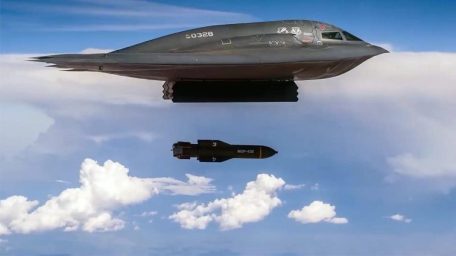
By William Schryver | imetatronink | November 28, 2025
The GBU-57 is a big fat gravity bomb with fins. To achieve effective precision, a B-2 bomber must drop it on its intended target from no further than about five nautical miles — essentially right on top of the target.
Its penetration depth is claimed to be 200 feet. But that capability has NEVER been tested against a seriously hardened deep-underground target encased in layers of high-performance concrete, and topped with a few dozen meters of solid rock. In that sort of real-world scenario, the GBU-57 would be lucky to drill down 50 feet, if that.
It was always ridiculous silly talk to suggest the GBU-57 was the wonder weapon it was made out to be. There is a good reason the US only produced a couple dozen of them and then stopped: they understood its acute limitations in a non-permissive combat environment.
And, notwithstanding the hyperbolic Israeli propaganda, there was never any credible evidence that Iranian medium- and long-range air defenses against fixed-wing aircraft were attrited to any significant degree. And Iranian short-range air defenses were increasingly effective against long-range Israeli drones with each passing day.
As for the B-2: it is a big fat subsonic aircraft. It flies at airliner speeds. A strike on Fordow would entail flying at least 500 miles in and out of Iran. … continue
Blog Roll
 Aletho News
- Drug traffickers trained in Ukraine attack state forces in Mexico
- The tragic reality of Brazilian mercenaries in the Ukrainian conflict
- Zelensky Refused to Discuss Druzhba Pipeline Issue – Fico
- U.S. General Caine Warns: STRIKING IRAN is a HUGE RISK /Glenn Diesen & Lt Col Daniel Davis
- Israel designates five Palestinian media outlets as ‘terrorist organizations’
- Israel, not America, first: Carlson’s Huckabee interview lays bare US foreign policy priorities
- Israeli troops executed Palestinian aid workers at ‘point blank range’: Report
- Iran war What if today’s Iran is resigned to a long, hellish war with the US?
- Why Israel Is Escalating Its War Crimes Against Lebanon
- Iran in the face of the armed diplomacy of imperialism
- If Americans Knew
- The NY Times on the “MAGA” Split Over Israel & USS Liberty
- In Gaza, Ramadan without mosques, imams – Not a ceasefire Day 137
- Footage Shows Israeli Troops Waiting in Ambush, Then Opening Fire on a Palestinian Teen
- The US is on the brink of a major new war that Trump has not even bothered explaining
- Latest Epstein document dump is one more cover-up
- No Protection, No Justice: US Citizens Killed with Impunity by Israel
- Maria Farmer: Epstein Victim Reveals Explosive Information Covered Up by Media
- Average of five Palestinians killed by Israel every day in Gaza since ceasefire – Not a ceasefire Day 136
- Palestinian church leaders admonish Christian Zionist Mike Huckabee – Not a ceasefire Day 135
- Ominous messaging from Trump’s “Board of Peace” – Not a ceasefire Day 134
- No Tricks Zone
- Surprising Discovery: Sahara Is Greening…Billions Of Trees Where Once Thought To Be Barren
- New Research Reaffirms Clouds, Aerosols, And Surface Solar Radiation Are ‘Driving The Climate System’
- Germany: Electric Car Catches Fire At Charging Station, Sets Off Local “Inferno”, Widespread Damage
- New Study: Canada’s New Brunswick Was 1°C Warmer Than Today During The Medieval Warm Period
- Coal Power Back In Trend As Globe Tries To Keep Pace With Growing Demand For Power
- New Study: A 4°C Warmer Beaufort Sea Had ‘No Sea Ice’ 11,700 – 8200 Years Ago
- Unfudging The Data: Dutch Meteorological Institute Reinstates Early 20th Centruy Heat Waves It Had Erased Earlier
- German Gas Crisis…Chancellor Merz Allegedly Bans Gas Debate Ahead of Elections!
- Pollen Reconstructions Show The Last Glacial’s Warming Events Were Global, 10x Greater Than Modern
- Germany’s Natural Gas Storage Level Dwindles To Just 28%… Increasingly Critical
 Aletho News