British weapons and personnel doing much of the killing in Yemen: Report
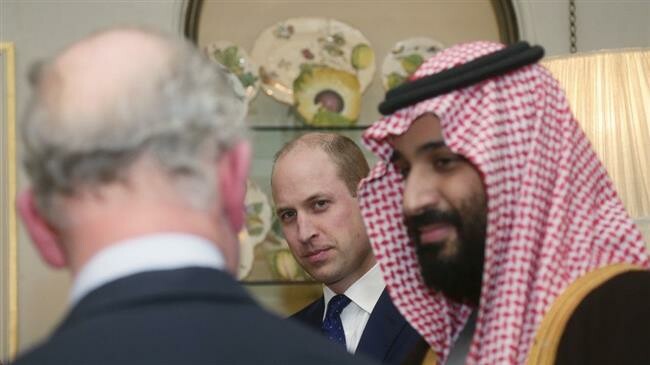
Britain’s Prince Charles, (L) and Britain’s Prince William, (C) meet with Saudi Arabia’s Crown Prince Mohammed bin Salman (R) in central London on March 7, 2018. (AFP photo)
Press TV – June 18, 2019
A detailed report published by the Guardian newspaper has shown how Britain is massively contributing to Saudi Arabia’s devastating war on Yemen as it suggests that London is not only supplying the bombs that fall on Yemenis, but it provides the personnel and expertise that keep the war going.
The comprehensive report by Arron Merat published on Tuesday showed that Britain was doing much of the killing in Yemen as the country continues to provide Saudi Arabia with everything it needs to turn its southern impoverished neighbor into a graveyard.
“Every day Yemen is hit by British bombs – dropped by British planes that are flown by British-trained pilots and maintained and prepared inside Saudi Arabia by thousands of British contractors,” said Merat in the report.
Tens of thousands of people have been killed since Saudi Arabia and a number of Arab allies launched their illegal war on Yemen in March 2015 in an attempt to restore power to a resigned and fugitive president.
Rights campaigners have repeatedly criticized Britain for its role in helping the killing of civilians in Yemen, the poorest country in the Arab world which has suffered from a major humanitarian crisis as a result of the Saudi-led war.
The report by the Guardian showed that it is effectively the United States and Britain who are leading the massive onslaught in Yemen as Saudi Arabia contracted out the vital parts of the war to the two military powers from the very beginning of the conflict.
“Britain does not merely supply weapons for this war: it provides the personnel and expertise required to keep the war going,” said the report, adding that the Royal Air Force personnel have been deployed to Saudi Arabia to work as engineers and trainers over the past four years.
It said the Britain’s biggest arms company BAE Systems has played an even larger role in the Saudi-led war on Yemen as it has been subcontracted by London to provide weapons, maintenance and engineers inside Saudi Arabia.
“The Saudi bosses absolutely depend on BAE Systems … They couldn’t do it without us,” said John Deverell, a former British defense attaché to Saudi Arabia and Yemen.
A BAE employee also said recently that if it was not for the British support, the Saudis would have not been able to continue the war on Yemen for a single week.
“If we weren’t there, in seven to 14 days there wouldn’t be a jet in the sky,” said the employee in an interview with the Channel 4 in early April.
Reports last year also suggested that Britain had even sent its troops to Yemen to help Saudis in their fight against fighters from the ruling Houthi Ansarullah movement.
In fact, there have been multiple reports in the British newspapers showing that UK special forces, known as the SAS, were wounded in battles inside Houthi-controlled territories.
The Arab Emergency Summit in Mecca: Provocative and Invective
By Elias Samo | Strategic Culture Foundation | June 18, 2019
When an Arab emergency summit is called to convene, one would naturally assume the existence of an urgent Arab crisis which requires immediate attention. So, when king Salman of Saudi Arabia called for an emergency Arab summit to convene in Mecca, the holiest Muslim city, the natural assumption was that there is an urgent Arab crisis to be dealt with, immediately.
Therefore, one had to assume the urgent Arab emergency summit meeting in Mecca on May 30, 2019, would have to do, though belatedly, with the ramifications of Arab states destroying Arab states, Muslims killing Muslims, Arabs killing Arabs. Or perhaps more specific urgent Arab matters such as the American recognition of a united Jerusalem as the eternal capital of Israel, the moving of the American embassy to Jerusalem, the declaration by Netanyahu of his intention to annex the major Israeli settlements with American acquiescence or with the American recognition of the Israeli annexation of the Syrian Golan, or the “Deal of the Century”. Surprisingly and unfortunately the summit dealt with none of the above.
On the face of it, the summit was an official Arab emergency summit, but in reality, it was a Saudi Arabian summit and the agenda was a Saudi Arabian agenda: Iran, which was practically the exclusive item on the agenda and in the final communique. No perceptive Arab affairs genius would have thought of an urgent need for an emergency Arab summit to deal with a presumed ‘Iranian threat’ to the Arabs. There is mutual animosity and perception of security threats between Iran on the one hand and Saudi Arabia and a very few Arab states, mostly in the Gulf region, on the other hand. However, there are no similar feelings between the majority of other Arab states and Iran.
The final communique was delivered by the Secretary General of the Arab League, Ahmed Aboul Gheit, at the conclusion of the summit. It starts with a preamble and ten operative paragraphs. Iran is mentioned in the preamble and the operative paragraphs no less than fifteen times. The onslaught on Iran full of provocations and invectives started with the preamble and moved on with gusto in the operative paragraphs.
The impetus for convening the emergency summit, as noted by Mr. Aboul Gheit, was “the serious repercussions of the attack by the Iranian-backed Houthi terrorist militias on two oil pumping stations in the kingdom of Saudi Arabia and the attack on commercial vessels in the territorial waters of the United Arab Emirates.”
In view of the killing and wounding of millions of Muslim and non-Muslim Arabs, the immigration and displacement of more millions, the chaos and destruction and the rendering of several Arab states as failed states, it is amazing that attacks on two oil pumping stations in Saudi Arabia, and on four commercial vessels in the territorial waters of the UAE, in which the culprit is uncertain, warranted the convening of an emergency Arab League summit to target and condemn Iran. It is made clear in the preamble, and the ten substantive paragraphs, of the communique that the culprit is Iran. But why the certainty that Iran is the culprit? Because John Bolton, American National Security Adviser, who is not known for his honesty and truthfulness, said so! Mr. Bolton said he will provide the evidence later; thus, a new legal norm: Convict then provide the evidence.
Not only the reason for convening of the emergency summit is amazing, but the content of the ten-paragraph communique is shocking.
1. Historically and traditionally, Israel and Zionism are standard features in Arab League summit communiques. Thus, the present summit communique is a first for not including the terms Israel nor Zionism once.
2. Similarly, Palestinians are a standard feature in Arab League summit communiques. Thus, the present communique is also a first for not mentioning the Palestinians once. Although, as an afterthought, the last sentence of the last paragraph ten states that the issue of Palestine is “the main Arab issue”, but it did not merit a single operative paragraph.
3. While the communique does not include the aforementioned names, it has certainly gone overboard in provocatively and invectively mentioning Iran/Iranians and often preceded by ‘condemning’ and ‘denouncing’, no less than fifteen times.
4. Syria is mentioned once in paragraph ten for the purpose of condemning Iran. It is ironic that the Arab states, who expelled Syria from the League, the majority of which were not independent states when Syria and five Arab states established the League in 1945, met in a presumed Arab League summit and have suddenly become concerned about Syria. They denounced “the Iranian interference in the Syrian crisis and its implications for Syria’s future.”
The irony is that the ‘Iranian interference’ is legitimate, because it came at the request of the legitimate Syrian government and “supported Damascus’s efforts in fighting terrorism which was supported by some of those meeting in this summit”, as noted by the Syrian Foreign Ministry.
The Arab summit in Mecca was a Saudi Arabian conference attended by Arab states to discuss Saudi Arabia’s perceived and contrived Iranian threats. Threats which are, largely, not shared by most of the Arab states, not even shared by some of the Arab Gulf states. The contention that Iran constitutes a threat to the Arab states is contentious, and irrespective of what Netanyahu, Bolton and Pompeo claim, it is Iran which is threatened by the US, Israel and Saudi Arabia.
Finally, why manufacture a new crisis, and a potential war in the Muslim Arab region which is already ravaged by a multitude of crises, conflicts and wars?
The Gulf of Credibility
By Craig Murray | June 17, 2019
I really cannot begin to fathom how stupid you would have to be to believe that Iran would attack a Japanese oil tanker at the very moment that the Japanese Prime Minister was sitting down to friendly, US-disapproved talks in Tehran on economic cooperation that can help Iran survive the effects of US economic sanctions.
The Japanese-owned Kokuka Courageous was holed above the water line. That rules out a torpedo attack, which is the explanation being touted by the neo-cons.
The second vessel, the Front Altair, is Norwegian owned and 50% Russian crewed (the others being Filipinos). It is owned by Frontline, a massive tanker leasing company that also has a specific record of being helpful to Iran in continuing to ship oil despite sanctions.
It was Iran that rescued the crews and helped bring the damaged vessels under control.
That Iran would target a Japanese ship and a friendly Russian crewed ship is a ludicrous allegation. They are however very much the targets that the USA allies in the region – the Saudis, their Gulf Cooperation Council colleagues, and Israel – would target for a false flag. It is worth noting that John Bolton was meeting with United Arab Emirates ministers two weeks ago – both ships had just left the UAE.
The USA and their UK stooges have both immediately leapt in to blame Iran. The media is amplifying this with almost none of the scepticism which is required. I cannot think of a single reason why anybody would believe this particular false flag. It is notable that neither Norway nor Japan has joined in with this ridiculous assertion.
Iran can be Trump’s nemesis
By M. K. BHADRAKUMAR | Indian Punchline | June 15, 2019
What a coincidence that a leaked document from the Organization for the Prohibition of Chemical Weapons (OPCW) just exposed that the chemical weapons attack in Douma, Syria in April, 2018 was most likely staged. In security parlance, it was a false flag operation — stage-managed cunningly to create the alibi for a ‘humanitarian intervention’ by the West in Syria.
As it happened, the US and France did stage a missile strike at Syrian government targets in July that year, alleging that Damascus was culpable for what happened in Douma, ignoring the protests by Russia.
False flag operations are not uncommon, but the US holds a PhD on that genre. The most famous one in modern history was the Gulf of Tonkin incident of August 1964 where the US government deliberately misrepresented facts to justify a war against Vietnam.
Prima facie, there is enough circumstantial evidence to estimate that the attack on two tankers in the Gulf of Oman on June 13 has been a false flag operation. The attack on the two tankers with cargo heading for Japan took place just as the Japanese PM Shinzo Abe sat down for the meeting yesterday with Iran’s Supreme Leader Ayatollah Ali Khamenei in Tehran.
The fact of the matter is that Abe was on a delicate mission to try to kickstart talks between the US and Iran. It is one of those delicate moments when a slight push can derail or even undermine the nascent move for dialogue. True, in the first round, Khamenei rejected talks with the US. But, as Abe said later, more efforts are needed for easing tensions between the US and Iran.
Therefore, as regards the incident yesterday in the Gulf of Oman, the question to be asked is: Who stands to gain? Most certainly, it cannot be Iran, which has just laid on the table in plain terms what it takes for negotiations to commence between the US and Iran — President Trump abandoning what Tehran calls the US’ ‘economic terrorism’ against it. Khamenei told Abe with great frankness that it is futile to negotiate with the US, which keeps resiling from international agreements. No doubt, Trump has been highly erratic by making overtures to Iran on the one hand and tightening the screw on the other hand. (See my blog Abe’s mediatory mission to Tehran hangs in the balance.)
Simply put, Iran has no axe to grind by undermining Abe’s mission, especially since Japan is the only western power, which, historically speaking, never ever acted against Iran but on the contrary consistently maintained friendly ties and showed goodwill. (Once in 1953, Japan even ignored the British-American embargo against Iran and went ahead to import Iranian oil.)
However, this much cannot be said about certain regional states — which Iran has called the ‘B Team’ — that are bent on perpetuating the US-Iran standoff and incrementally degrade Iran to a point that a military confrontation ensues at some point in which American power dispatches that country to the “Stone Age”, as the present US National Security Advisor John Bolton once put it.
In this rogues’ gallery, apart from Israel, there is also Saudi Arabia and the UAE. Bolton, of course, is mentored by Israel and it is an established fact that he has received money for services rendered from the Mojahedin-e Khalq, the anti-Iran terrorist group based in France, which espouses the overthrow of the Islamic regime in Tehran.
Iran has sounded warnings in recent weeks, including at the level of Foreign Minister Javad Zarif, that this ‘B Team’ would at some point stage false flag operations to ratchet up tensions and/ or precipitate a crisis situation, that would in turn prompt Trump to order some sort of military action against Iran.
To be sure, the stakes are very high for Israel, Saudi Arabia and the UAE if Abe’s mission advances further and the current tensions begin to ease. An added factor for the ‘B Team’ is that time is the essence of the matter. It increasingly seems that Bolton’s job as NSA is in danger. Trump has hinted more than once that he does not subscribe to Bolton’s warmongering. The well-known ex-CIA officer and commentator John Kiriakou wrote this week that the White House has “very quietly and discreetly begun informal meetings with a list of a half-dozen possible replacements for Bolton.” (See the commentary in Consortium News titled JOHN KIRIAKOU: Bolton’s Long Goodbye.) It is crucial for the ‘B Team’ that Bolton keeps his job in the White House. And there is no better way to hold back Trump from sacking his NSA when a crisis situation looms large in the Middle East.
Be that as it may, the US Secretary of State Mike Pompeo has announced that Iran is responsible for the incident in the Gulf of Oman. He claimed in a statement, “This assessment is based on intelligence, the weapons used, the level of expertise needed to execute the operation, recent similar Iranian attacks on shipping, and the fact that no proxy group operating in the area has the resources and proficiency to act with such a high degree of sophistication.”
Now, doesn’t Israel too have the intelligence capability, weapons and expertise to execute such a false flag operation? Read Pompeo’s statement carefully and its laboured tone gives away that the ex-CIA Director (who recently even bragged openly about the art of lying in diplomacy and politics) was far from convincing.
So, where’s the beef? Pompeo has instructed that the UN Ambassador Jonathan Cohen raise the matter in the UN Security Council. There is an eerie similarity to what once one of Pompeo’s predecessors as state secretary, Colin Powell did — manufacturing evidence of WMD program by Saddam Hussein to pave the way for the US to invade Iraq.
What needs to be factored in is that the US anticipates that in another fortnight, Iran’s 60-day deadline for the European countries to come up with concrete steps to fulfil their commitments under the 2015 Iran nuclear deal will expire. The German Foreign Minister Heiko Maas’s visit to Tehran last week was a calculated attempt to persuade Iran to accept the stark reality that it must unilaterally fulfil its commitments under the nuclear deal while there is little the EU can do in practical terms to defy the US sanctions. Maas tried to persuade Iran to accept the US’ demand that non-nuclear issues (such as Iran’s missile programme, regional policies, etc.) also be negotiated under a new pact. Quite obviously, the European powers, despite their bravado (in words), are falling in line with Trump’s strategy of ‘maximum pressure’ against Iran.
If Iran decides to reject the idea of unilaterally observing the 2015 deal (without any reciprocal acts by the international community), the US and its western allies will want to take the matter to the UNSC to revive the UN’s past (pre-2015) sanctions against Iran. The big question is whether Russia and China would allow such a turn of events. Tehran has categorically denied any involvement in yesterday’s incident. And Iran is playing it cool. President Hassan Rouhani and Foreign Minister Javad Zarif left Tehran for Bishkek on June 13, as scheduled previously, to participate in the Shanghai Cooperation summit.
Meanwhile, the US has made an additional deployment to the region. But then, the US Central Command has also signalled to Tehran in a statement: “We have no interest in engaging in a new conflict in the Middle East. We will defend our interests, but a war with Iran is not in our strategic interest, nor in the best interest of the international community.”
At this point, the logical thing to do will be to insist on an impartial investigation by the UNSC on the incident. But, curiously, no country is willing to bell the cat. Russia, which is usually quick on demanding facts before reaching any definitive opinion on such murky situations, is also not in a hurry to demand investigation. Can it be that everyone understands that this was a false flag operation and could only be Bolton’s last waltz with Netanyahu?
Trump is walking a fine line. He has blamed Iran, but refrained from saying what he proposed to do. The fact remains that a highly dangerous situation is developing in and around the Straits of Hormuz, which is a choke point for oil tankers.
An entanglement with Iran’s Pasdaran is the last thing Trump would want as he plans to announce shortly his candidacy for the 2020 election. The situation is fraught with grave political risks, if one recalls how the Iran crisis spelt doom for Jimmy Carter’s re-election campaign in 1980.
Trump has bitten more than he could chew, as the strong rebuke Iran’s Supreme Leader Ali Khamenei administered to him underscores. Iran may turn out to be Trump’s nemesis.
Read the CNN ‘analysis’ here taunting Trump to walk the talk on Iran.
‘Does Not Make Sense’: Fallout From Oil Tanker Attack Benefits Emiratis, Saudis, Not Tehran
Sputnik – 15.06.2019
In an interview with Radio Sputnik’s Loud and Clear, Mohammed Marandi, an expert on American studies and postcolonial literature who teaches at the University of Tehran, dismissed the US accusation that Iran was responsible for the attacks on two oil tankers in the Gulf of Oman Thursday, saying Tehran had nothing to gain from such a move.
“There is obviously a great deal of skepticism [in Iran], because the first attack that was carried out about a month ago on a number of ships near the port off the UAE [United Arab Emirates] coast happened almost immediately after [US National Security Adviser John] Bolton said that he had received intelligence from the Israelis that Iran wants to carry out attacks on US interests,” Marandi told hosts John Kiriakou and Brian Becker.
Bolton previously accused Iran of attacking tankers located off the coast of the Emirati port of Fujairah earlier this month. On May 12, four oil tankers — two Saudi, one Norwegian and one Emirati — were targeted by acts of sabotage in the UAE’s exclusive economic zone in the Gulf of Oman. According to Bolton, the four oil tankers were targeted by “naval mines almost certainly from Iran.”
On Thursday, the “Front Altair” oil tanker, owned by Norwegian company Frontline, and the chemical tanker “Kokuka Courageous,” owned by Japanese company Kokuka Sangyo, were attacked near the Strait of Hormuz, a narrow stretch of water between the Persian Gulf and Gulf of Oman, and one of the most important passageways for world oil supplies.
“Now as the Japanese Prime Minister comes to Iran after 41 years … he is on his way to see the [Iranian Supreme] leader [Ayatollah Ali Khamenei] in the morning, and as he’s getting ready, two ships are hit right outside that are linked to Japan,” Marandi explained. “These attacks seem, again, to be designed to harm Iranian interests, because the Iranian leader, in the meeting with the prime minister, called Japan a friend of Iran. So why would Iran attack targets affiliated or associated with Japan at a time when the prime minister is in Iran? It simply does not make sense.”
On Friday, US President Donald Trump accused Iran of attacking the tankers, claiming that a video released by the US military proves Tehran’s culpability. Just a day prior, US Secretary of State Mike Pompeo claimed that the attacks were executed with such a high degree of sophistication, with all 44 crew members of the tankers being safely evacuated, that Iran was the only power in the region that could have been behind them.
However, on Friday, Yutaka Katada, the president of Kokuka Sangyo, refuted the US version of events, claiming that crew members on the Japanese ship saw a flying object right before the attack.
“I do not think there was a time bomb or an object attached to the side of the ship. A mine doesn’t damage a ship above sea level. We aren’t sure exactly what hit, but it was something flying towards the ship,” Katada said, according to Japanese media.
“I’m glad to know that people think that when Iran carries out an attack, they’re very careful not have people killed. I guess that means that they expect the Israelis and Americans to kill innocent people in such attacks,” Marandi told Sputnik.
“But I don’t think that is a credible argument. In fact, it runs in contrast to American claims. Americans are claiming that Iranian oil exports are down to zero, which is not true, but if that’s the case, what’s the use in driving up the price of oil?” Marandi asked.
Following the attacks Thursday, oil prices rose by 4% with Brent Crude, the international benchmark for oil prices, spiking to $61.99 a barrel. The US has previously threatened to reduce Iranian crude oil exports “to zero” via sanctions.
“[The rise in oil prices] only benefits the Saudis and the Emiratis. It would make the vast amount of oil that they export more expensive,” Marandi noted.
“The most important point [that one] can make about Iranian responses to the US is a) that the Iranians will restart elements of the nuclear program, and they will decrease their commitment to the [Joint Comprehensive Plan of Action] JCPOA, and that will put pressure on the US and the Europeans; and b) I am very confident that the Iranians are helping the Yemenis in their fight against Saudi and Emirati aggression,” Marandi added. “And the amount of damage that the Yemeni armed forces are doing to the Saudis has gone up dramatically. We have seen how sophisticated the Yemeni defense capabilities have become over the last couple of years, and I think that the transfer of tech to the Yemenis has been from friendly countries like Iran.”
In May 2018, Trump announced the US’ withdrawal from the 2015 Iran nuclear deal, the JCPOA, reinstating harsh sanctions against Tehran. Last month, Iranian President Hassan Rouhani said that Iran would begin stockpiling low-enriched uranium and heavy water, which can be used to build nuclear weapons in nuclear reactors. He also said the country would start enriching uranium to higher levels than permitted under the terms of the JCPOA.
UK report on ‘human rights’ forgets to mention Saudi Arabia in section on Yemen war
RT | June 12, 2019
The UK has published its annual human rights report, but with some notable omissions in its section on Yemen’s war – namely the identity of the country bombing its civilians, and the UK’s own involvement in the conflict.
The 2018 “Human Rights & Democracy”report from the UK’s Foreign & Commonwealth Office (FCO) includes an almost 800-word section on the humanitarian situation in Yemen – but, to a reader unfamiliar with the specifics, the document offers few clues as to who bears most responsibility for the crisis, since the British report seems to have forgotten to mention some key details.
Also on rt.com Bipartisan bill aims to force votes on present & future US arms deals with Saudis
The FCO report laments that the “human rights situation worsened in Yemen in 2018” and “the conflict in the country has had a devastating effect.” It then details the estimated numbers of lives lost and displaced citizens according to UN statistics, but doesn’t seem eager to pin blame on anyone in particular, laying responsibility at the feet of “multiple parties.”
“Multiple parties across the country committed a wide range of human rights abuses and violations.”
Yet, a UN investigative report last year found that airstrikes by the Saudi-led coalition had caused “most of the documented civilian casualties” in the country – and said the indiscriminate strikes had hit “residential areas, markets, funerals, weddings, detention facilities, civilian boats and even medical facilities.”
The UN also criticized the Saudi coalition’s sea and air blockades, which, it argued, could violate international humanitarian law, and called on the “international community” to “refrain from providing arms that could be used in the conflict.”
But who is providing arms? The FCO report is quiet on that front, too.
It has been estimated that the UK sold more than £4.7 billion-worth of arms to Saudi Arabia since its bombing of Yemen began in 2015. British arms sales to Riyadh account for nearly half of the UK’s major weapons exports. Calls for an end to Britain’s direct complicity in the war have fallen on deaf ears.
Former UK foreign secretary –and frontrunner for the Tory leadership– Boris Johnson recommended that the UK sell British bomb parts to Riyadh, immediately after an airstrike had hit a potato factory, killing 14 people, UK media reported this week, after emails obtained by arms trade expert Dr Anna Stavrianakis, through an FOI request, revealed Johnson’s enthusiasm for the sale. In justifying the sale, the FCO’s Arms Policy Export Team argued that there was no “clear risk” that the weapons would be used to violate humanitarian law and said the UK had “confidence” in the Saudi’s “dynamic targeting processes.”
The day after Johnson recommended the sale, a village school was hit in another airstrike, killing 10 children and injuring 20. Johnson’s successor, current UK Foreign Secretary Jeremy Hunt, has incredibly argued that it would be “morally bankrupt” for the UK to stop arming the Saudis, because if it did, “the people of Yemen would be the biggest losers.”
Yet, the FCO report praises what it calls the UK’s“continued commitment to improving the overall human rights situation” in the country and touts its provision of “emergency cash assistance” to vulnerable displaced women and girls, as well as a UK programme aiming to “increase Yemeni women’s inclusion in the peace process.”
The one (and only) mention of Saudi Arabia came more than halfway through the section on Yemen – a tepid line on the use of secret prisons “in areas under the Saudi-led coalition’s control” – inserted without any context as to who makes up the coalition, who supports it and what it is doing.
The report then quickly switches back to self-praise mode, with the FCO promising that the UK “will continue to lead international efforts to work towards an end to the conflict.”
The section on UK ally Saudi Arabia itself begins by lauding the “positive trajectory of social reform” in the country and condemns various continued human rights violations, but makes no mention of Saudi Arabia’s actions in Yemen.
Saudi Arabia tightens grip on Palestinians, hampers remittances to Gaza: Report
Press TV – June 8, 2019
Less than a week after Saudi authorities arrested more than 60 people, including Palestinian expatriates and Saudi nationals, on charges of supporting the Palestinian Hamas resistance movement, they have now blocked money transfers between the kingdom and the Gaza Strip.
The new step taken by the Riyadh regime against Palestinians involves official and non-official money transfers as the procedure has witnessed a marked decline over the past week and during the Eid al-Fitr holiday, which marks the end of the Muslim holy fasting month of Ramadan, Arabic-language al-Khaleej Online news website reported.
The report described residents of the besieged and impoverished Gaza Strip as the main victims of the move. Most of the bank transfers that used to be carried out normally in the past, were frozen just a few days before the start of the holiday.
Remittance transactions are taking much longer time than usual – something that used to be done in a matter of few hours.
Many Palestinians have complained of the move, and termed it as “unprecedented.” They argue that the process of transferring money between Saudi Arabia and the Gaza Strip has become extraordinarily difficult.
Abu Fuad, a resident of the Gaza Strip who refused to give his last name for fear that his family could be persecuted in the Saudi Arabian port city of Jeddah, said he has experienced difficulty receiving money from his family.
“It is three days since the remittance has been made, but I have not received anything. Financial transfers used to be done in a few hours and without any obstacles in the past. But since the week before the Eid, the procedures have become complex and most of the transfers are frozen without any obvious reason,” he said.
Abu Fuad considered the measure as a “new crackdown on the Palestinian community living in Saudi Arabia,” stressing that it would aggravate their sufferings as students rely heavily on money transferred from their families living outside the kingdom.
He called upon the Palestinian Embassy in Riyadh to intervene immediately, and try to work out a quick and practical solution to the crisis, which has negatively affected the Palestinian community in Saudi Arabia.
Over the past two years, Saudi authorities have deported more than 100 Palestinians from the kingdom, mostly on charges of supporting Hamas resistance movement financially, politically or through social networking sites.
The Riyadh regime has imposed strict control over Palestinian funds in Saudi Arabia since the end of 2017.
All remittances of Palestinian expatriates are being tightly controlled, fearing that these funds could be diverted indirectly and through other countries to Hamas.
Money transfer offices are asking the Palestinians to bring forward strong arguments for conversion, and do not allow the ceiling of one’s money transfer to exceed $3,000.
Saudi Arabia to Execute 18-year-old for Allegedly “Sowing Sedition”

Al-Manar | June 8, 2019
Saudi Arabia is seeking the death penalty for an 18-year-old it detained in 2014 for protesting on his bicycle as a 10-year-old.
It would make him the fourth teenager to be executed this year.
Murtaja Qureiris was retrospectively arrested by Saudi police in 2014 for allegedly staging a number of protests during the country’s Arab Spring movement in 2011.
Saudi prosecutors claim that Qureiris’ alleged activities encouraged the “sowing of sedition” and made him part of “an extremist terror group,” which warranted the death penalty. Qureiris denies those charges.
Probe says ‘state actor’ likely behind attack on tankers off UAE, doesn’t mention Iran – report
RT | June 7, 2019
After the US put the blame squarely on Iran for sabotaging four oil tankers off the coast of the United Arab Emirates, a preliminary probe concluded that a ‘state actor’ was likely behind the raid, but made no mention of Iran.
According to reports by Reuters and Bloomberg, preliminary findings from the investigation jointly conducted by the UAE, Saudi Arabia and Norway and presented at an informal UN briefing on Thursday, describe the attack as a complex effort that required significant resources.
The investigators argue that the attackers, who inflicted damage on the tankers, but did not cause casualties or an oil spill, required “high degree sophistication”, precise intelligence and “expert navigation of fast boats” to pick the targets, get in and get out undetected. All of this, they claim, are signs a ‘state actor’ was likely responsible.
This wording allows the countries behind the report, two of which are among the US’ main allies and arms sales clients in the Middle East, to maintain a neutral image without actually contradicting Washington, which accused Iran out of hand.
US President Donald Trump’s National Security Adviser John Bolton said last month that the attacks were “almost certainly” perpetrated by Iran, accusing it of planting “naval mines” under the ships. It’s unclear if Bolton’s assertion relied on any intelligence.
The UAE emirate of Fujairah, off the cost of which the attack took place, lies outside the Strait of Hormuz, a narrow waterway that separates the Persian Gulf and the Gulf of Oman. The strait is immensely important for oil transportation, with tankers carrying crude from the oil-rich Gulf countries must pass through it.
Previously, Iran threatened to block the oil shipments through the waterway in response to the US’ intent to bring Tehran’s oil exports to ‘zero.’
In a series of sharply escalating moves, the US recently declared Iran’s elite Revolutionary Guards a terrorist organization, then sent an aircraft carrier group to the Gulf, while signaling a possible massive boost to the number of American troops in the region.
The May 12 attack came at the height of the latest round of tension and targeted four commercial tankers, including two Saudi, one Emirati and one Norwegian ship. Iran has dismissed the accusations against it, calling the Bolton’s statement “ridiculous.”
France’s arms sales to Saudis jumped by %50 in 2018: Data
Press TV – June 4, 2019
Newly-released figures show that France increased its weapons sales to Saudi Arabia by 50 percent last year despite growing international concern about the atrocities committed in a Saudi-led war on Yemen.
On Tuesday, an annual report by the French government showed that the country sold 1 billion euros’ worth of arms to Saudi Arabia in 2018, with the main item being patrol boats.
Saudi Arabia and a number of its allies — mainly the United Arab Emirates (UAE) — invaded Yemen in March 2015, with the goal of bringing a former Yemeni client regime back to power. The ongoing war has killed tens of thousands and disrupted the lives of millions by causing widespread famine as well as epidemics.
France, the third-biggest arms exporter in the world, is also among the top weapons exporters to Riyadh and Abu Dhabi.
The Saudi-led coalition has widely used French boats and at least two ships in placing a tight siege on Yemeni ports, particularly Hudaydah, a lifeline for the war-ravaged country’s crippled economy.
The French government has faced massive criticism for complicity in the war but has so far resisted pressure from rights groups to stop the lucrative arms trade with the two Persian Gulf countries, denying that the weapons are being used against the Yemenis. Paris claims that the arms are being deployed in “self defense.”
This is while in mid-April, a classified note from the French military intelligence service (DRM) estimated that over 430,000 Yemenis lived within the range of French artillery weapons on the Saudi-Yemeni border. It further estimated that French weapons had resulted in civilian casualties.
The revelation about the increased sales last year is expected to deepen mistrust in France’s position on the war.
“With such transfers revealing a geopolitical alliance with these regimes and total violation of international commitments, one can only expect worsening conflicts in Yemen or the Horn of Africa, where the United Arab Emirates and Saudi Arabia are beginning to redeploy in partnership with France,” said Tony Fortin, with the Paris-based Observatory for Armament.
The French government report is also likely to draw a sharper contrast between Paris’ public stance versus its actual one.
Late last month, Foreign Minister Jean-Yves Le Drian described the war on Yemen as a “dirty war” and said that it “has to be stopped,” even as his country continued to mostly quietly sell weapons to both Riyadh and Abu Dhabi on a large scale.
Last month, Saudi cargo ship the Bahri-Yanbu, sent to France to pick up purchased French arms, triggered a protest rally by humanitarian groups.
Apart from Paris, the United States, Britain, and other Western countries have faced criticism over arms sales to the Saudi regime and its partners over the consequences for a war that has affected 28 million Yemenis and caused what the United Nations (UN) calls “one of the worst humanitarian crises in the world.”
The war has also taken a heavy toll on the country’s infrastructure, destroying hospitals, schools, and factories. The UN has said that a record 22.2 million Yemenis are in dire need of food, including 8.4 million threatened by severe hunger. According to the world body, Yemen is suffering from the most severe famine in more than 100 years.
The Tuesday report also revealed that France’s total arms sales rose 30 percent to 9.1 billion euros in 2018, driven by a jump in sales to European countries. Its arms exports to the Middle East also rose to four billion euros from 3.9 billion the year before.
Featured Video

U.S. General Caine Warns: STRIKING IRAN is a HUGE RISK
or go to
Aletho News Archives – Video-Images
From the Archives
Stealth Bombers and Bunker Busters
Analysis of the so-called 12-Day War, and the triumphantly celebrated Operation Midnight Thunder
By William Schryver | imetatronink | November 28, 2025
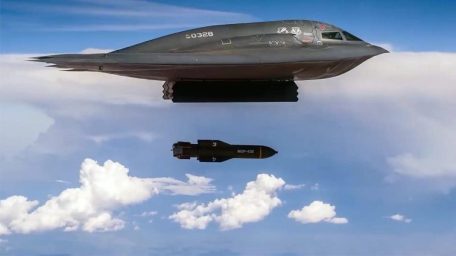
The GBU-57 is a big fat gravity bomb with fins. To achieve effective precision, a B-2 bomber must drop it on its intended target from no further than about five nautical miles — essentially right on top of the target.
Its penetration depth is claimed to be 200 feet. But that capability has NEVER been tested against a seriously hardened deep-underground target encased in layers of high-performance concrete, and topped with a few dozen meters of solid rock. In that sort of real-world scenario, the GBU-57 would be lucky to drill down 50 feet, if that.
It was always ridiculous silly talk to suggest the GBU-57 was the wonder weapon it was made out to be. There is a good reason the US only produced a couple dozen of them and then stopped: they understood its acute limitations in a non-permissive combat environment.
And, notwithstanding the hyperbolic Israeli propaganda, there was never any credible evidence that Iranian medium- and long-range air defenses against fixed-wing aircraft were attrited to any significant degree. And Iranian short-range air defenses were increasingly effective against long-range Israeli drones with each passing day.
As for the B-2: it is a big fat subsonic aircraft. It flies at airliner speeds. A strike on Fordow would entail flying at least 500 miles in and out of Iran. … continue
Blog Roll
 Aletho News
- What’s Really in the Bag: The Pet Food Industry’s Dirty Secret
- Project Artichoke: 70 Years Ago, CIA Discussed Hiding Mind-Control Drugs in Vaccines
- Drug traffickers trained in Ukraine attack state forces in Mexico
- The tragic reality of Brazilian mercenaries in the Ukrainian conflict
- Zelensky Refused to Discuss Druzhba Pipeline Issue – Fico
- U.S. General Caine Warns: STRIKING IRAN is a HUGE RISK /Glenn Diesen & Lt Col Daniel Davis
- Israel designates five Palestinian media outlets as ‘terrorist organizations’
- Israel, not America, first: Carlson’s Huckabee interview lays bare US foreign policy priorities
- Israeli troops executed Palestinian aid workers at ‘point blank range’: Report
- Iran war What if today’s Iran is resigned to a long, hellish war with the US?
- If Americans Knew
- Fourteen Countries Condemn Huckabee’s Support for Israel Taking Over Most of the Middle East
- Israeli Soldiers Killed Gaza Aid Workers at Point Blank Range in 2025 Massacre: Report
- Israel’s insidious network to propagandize American Christians
- Israel’s Best-Kept Secret: Palestinian Resistance Never Agreed to Disarm
- Trump officials plan to build 5,000-person military base in Gaza, files show
- Are MAGA restrainers pulling their punches this time on Iran?
- The NY Times on the “MAGA” Split Over Israel & USS Liberty
- In Gaza, Ramadan without mosques, imams – Not a ceasefire Day 137
- Footage Shows Israeli Troops Waiting in Ambush, Then Opening Fire on a Palestinian Teen
- The US is on the brink of a major new war that Trump has not even bothered explaining
- No Tricks Zone
- Surprising Discovery: Sahara Is Greening…Billions Of Trees Where Once Thought To Be Barren
- New Research Reaffirms Clouds, Aerosols, And Surface Solar Radiation Are ‘Driving The Climate System’
- Germany: Electric Car Catches Fire At Charging Station, Sets Off Local “Inferno”, Widespread Damage
- New Study: Canada’s New Brunswick Was 1°C Warmer Than Today During The Medieval Warm Period
- Coal Power Back In Trend As Globe Tries To Keep Pace With Growing Demand For Power
- New Study: A 4°C Warmer Beaufort Sea Had ‘No Sea Ice’ 11,700 – 8200 Years Ago
- Unfudging The Data: Dutch Meteorological Institute Reinstates Early 20th Centruy Heat Waves It Had Erased Earlier
- German Gas Crisis…Chancellor Merz Allegedly Bans Gas Debate Ahead of Elections!
- Pollen Reconstructions Show The Last Glacial’s Warming Events Were Global, 10x Greater Than Modern
- Germany’s Natural Gas Storage Level Dwindles To Just 28%… Increasingly Critical
 Aletho News