The reported plan by the United Arab Emirates to reopen its embassy in Damascus shortly leads to a startlingly new alignment on the map of the Middle East.
At the most obvious level, it signals the realization among the Gulf States that the brutal war to overthrow the Syrian government has ended. But the pragmatism is stunning. There isn’t even going to be any ‘cooling-off’ period!
What explains the urgency? Analysts may say it is to counter Iran’s influence. After all, the Saudis with UAE backing tried a similar approach in Iraq through the past year – to counter Iran’s multi-vectored influence in Iraq.
But the UAE cannot but be unaware of the exceptionally strong bonding between Damascus and Tehran. Syria may have uses for ‘green money’ to advance its reconstruction agenda but Iran’s backing has existential dimensions.
The western analysts tend to view the Iran factor as the leitmotif of Middle Eastern developments. However, in this cacophony over Iran, we are largely overlooking that simmering differences among the major Sunni states have also surged to the centre stage lately.
Through the past 2-3 year period, a Turkish-Qatari alignment has crystallized. For Qatar, Turkey’s support is invaluable for resisting the pressures on its strategic autonomy from the regimes in Saudi Arabia and the UAE. The establishment of a Turkish military base in Qatar underscores this new axis. Lately, Qatar has become a pillar of financial support for the Turkish economy.
Neither Qatar nor Turkey is flustered by Iran’s rise. Neither is seeking Iran’s isolation, either. Washington recently ‘granted’ a waiver to Turkey to continue to buy oil from Iran, but Ankara shot back saying it opposed US sanctions anyway, calling them ‘imperialistic’.
For Turkey too, Saudi Arabia and the UAE are the principal regional adversaries today. Turkey viewed with disquiet the UAE’s support of terrorist groups in Libya, Yemen and Syria. In next-door Syria, the Saudi and Emirati openly supported ISIS groups and al-Qaeda affiliates. Circles close to Turkey’s ruling elite have alleged that UAE is targeting Erdogan in a concerted way.
However, the ‘red line’ was crossed when the two Gulf oligarchies lent support to the failed coup in 2016 in Turkey to assassinate President Recep Erdogan. (After the coup failed, it took 16 hours for Riyadh to even issue a statement!) Turkey estimated that the UAE provided a staging post for the coup plotters.
As Turkey sees it, the UAE is implementing a western project to weaken it. Meanwhile, reports also appeared that the two Gulf oligarchies have been funding the Kurdish militant groups (who are the US’ allies in Syria.)
No doubt, it is a combustible mix. But what makes it really explosive is the perception in Abu Dhabi and Riyadh that Turkey and Qatar are patronizing the Muslim Brotherhood as a potent vehicle for the democratic transformation of the Muslim Middle East.
Both regimes (Saudi Arabia and the UAE) regard the Brotherhood as existential threat. Their visceral hatred of Brothers is such that they bankrolled the coup d’état against elected Egyptian President Mohamed Morsi in 2013 in a multi-billion dollar project.
Enter Syria. Given the above backdrop, the UAE and Saudi Arabia are inclined to sense a convergence with the Syrian regime on pushing back at Erdogan’s perceived aspirations of ‘neo-Ottomanism’ in general and his support of the Brotherhood as a vehicle of change in particular.
A tantalizing question will be: Where does the US stand apropos the Brotherhood? The Barack Obama administration with a sense of history saw in the Brotherhood much potential to finesse the Arab Spring toward establishment of ‘Islamic democracy’ in the Middle East. The US had dealings with the Brotherhood in Egypt based on estimation that it could do business with them and even influence them to democratize the Muslim Middle East. Of course, the premature end to the transition in Egypt in 2013 changed everything.

The Muslim Brotherhood lobbying US Congress, May 2017
Erdogan always hoped that the US (and the West as a whole) would appreciate that Turkey is uniquely placed to play the leadership role in the transition to a New Middle East. The Khashoggi affair has noticeably rekindled those hopes. (Interestingly, the spokesmen of the US intelligence establishment who have been very vocal about the Kahshoggi affair have also suddenly mellowed toward Erdogan.)
Now, this subtle shift on the part of the ‘Deep State’ in America toward Erdogan couldn’t have gone unnoticed in Riyadh and Abu Dhabi. It has probably prompted them to open a line to Damascus as early as possible.
How this delicate tango will play out remains to be seen, since there are far too many variables. With the US midterm elections over, President Trump may come under pressure to ‘do something’ on the Khashoggi affair.
Meanwhile, the Saudi and Emirati presence in Syria will be a matter of concern for Turkey in the ‘post-truth’ politics after Khashoggi’s murder.
November 8, 2018
Posted by aletho |
Economics | Middle East, Saudi Arabia, Syria, Turkey, UAE |
Leave a comment
The Houthi Ansarullah movement has opposed a US proposal for mediation in efforts to resolve the conflict in Yemen, holding Washington responsible for the Saudi-led aggression against Yemen.
Mohammed al-Bakhiiti, a member of Ansarullah’s Political Council, told Iran’s Arabic-language Al-Alam news network on Wednesday that peace would be restored to Yemen if the US ended its war on the impoverished country.
He also expressed his objection to any solution to the Yemen crisis that ignores the country’s independence and sovereignty.
On Tuesday, American officials called for a ceasefire in Yemen and demanded that the sides to the conflict come to the negotiating table within a month.
US Defense Secretary Jim Mattis said the US had been watching the conflict “for long enough,” and that he believed Saudi Arabia and the UAE were ready for talks.
“We have got to move toward a peace effort here, and we can’t say we are going to do it sometime in the future,” he said. “We need to be doing this in the next 30 days.”
Mattis’ call was later echoed by US Secretary of State Mike Pompeo, who urged the coalition to stop airstrikes in Yemen’s populated areas, saying the “time is now for the cessation of hostilities.”
Bakhiti further stressed that Washington’s proposed solution for the Yemen conflict included dividing the country.
Mattis’ plan, supported by Saudi Arabia and the UAE, is meant to achieve goals that have not been attained during the war on Yemen, he added.
The only solution to the crisis is intra-Yemeni talks and non-interference by foreign parties, the Houthi official said.
In March 2015, Saudi Arabia and its allies launched a brutal war against Yemen in an attempt to reinstall the country’s former Riyadh-allied regime and crush the Houthis.
The Western-backed war, however, has so far failed to achieve its stated goals, thanks to stiff resistance from Yemeni troops and allied Houthi fighters.
The offensive, coupled with a naval blockade, has destroyed Yemen’s infrastructure and led to famine as well as a cholera outbreak in the import-dependent state. Tens of thousands of people have also lost their lives in the conflict.
October 31, 2018
Posted by aletho |
Illegal Occupation | Saudi Arabia, UAE, United States, Yemen |
Leave a comment
The four-nation Turkey-Russia-Germany-France summit on Syria on October 27 in Istanbul had an impressive outcome. All participants – each with own interests – has some ‘takeaway’ from the summit, which itself is a measure of the success of the event. This is also important because the participants now have a reason to work together.
Such an outcome can be interpreted in the following ways. First and foremost, a major regional conflict impacting international security was addressed without US participation. A sign of our times?
Second, participants didn’t quarrel over President Bashar Al-Assad’s “fate”. The debate becomes pedantic today in terms of ground realities. The Syrian nation should decide on its future. That’s also been Assad’s demand.
Third, some serious thought has been given to the journey towards a Syrian settlement – ceasefire, drafting of new constitution followed by elections under UN supervision.
Four, the participants snubbed the US-Israeli plan to balkanize Syria into “spheres of influence” and have also squashed the Israeli dreams of getting international legitimacy for its illegal occupation of Golan Heights as part of any settlement.
Five, Germany and France have become amenable to the Russian demand pressing the urgency for rendering humanitarian aid to Syria and help in reconstruction. (The US made this conditional on Assad’s removal.) We’ll have to see how it pans out, but the summit also stressed the importance of the return of Syrian refugees (which is a key issue for European countries.)
Six, the participants recognized that the remaining terrorists in Syria must be destroyed – although, significantly, they also supported the Idlib ceasefire deal brokered by Turkey and Russia.
The bottom line is that it is the post-war Syrian order that is under discussion now. However, it must be understood as well that the proxy war is not ending but is rather morphing into the diplomatic war that lies ahead, which of course will be keenly fought, given the divergent interests of the foreign protagonists.
Generally speaking, Russia and Turkey are in command as of now. Their own equations are good but there are grey areas, too. The importance of close coordination between Russia and Turkey cannot but be stressed.
Iran cannot be happy that it has been excluded from the Istanbul summit. But it may prove an underestimation that Iran is in no position to assert its legitimate interests. The close consultations between Russia and Iran – not only regarding Syria – are of course the mitigating factor here.
Similarly, a “post-Khashoggi” Saudi attitude to Syria remains the “known unknown”. The US is in a position to blackmail Saudi Arabia to continue to bankroll its military presence in Syria, but the Saudis cannot have their heart in the overreach to project power abroad. Something has fundamentally changed – Saudis are not used to their prestige being dragged in the mud as in this past month and the traumatic experience cannot but have a sobering effect.
Besides, Saudis dare not cross swords with Turkey on the latter’s Syrian playpen. Above all, Saudis would not want to undermine Russian efforts to stabilize Syria, since Moscow’s goodwill and cooperation is extremely vital for Riyadh in the coming period, now that the raison d’etre of Riyadh’s “Look East” is beyond doubt.
Basically, France and Germany are lightweights in Syria. They had a limited agenda at the Istanbul summit. Russia must know fully well that in the final analysis, US involvement is crucial. It is entirely conceivable that at the forthcoming Russian-American summit in Paris on November 11, Syria will be a major topic of discussion.
The US policy in Syria is at a crossroad and will hinge greatly on the standing of President Trump in the aftermath of the November 6 mid-term elections in the US.
Clearly, this was far from a situation of three major allies of the US staging a mutiny on the NATO ship. Germany and France would have consulted Washington most certainly ahead of the Istanbul summit (which has been in the making for months.)
The big question is how the Turkish-American relations evolve. The Khashoggi affair has brought about certain US-Turkey “proximity”. Ironically, the Deep State in America and Trump are on the same page here – rediscovering the vital importance of Turkey for US regional strategies.
The spokesmen of the Deep State used to defame Turkish President Recep Erdogan for being “Islamist” and “authoritarian” and so on and probably even tried to overthrow him in the failed coup of 2016, but today, they laud him for espousing Islamic democracy as the panacea for the region.
Erdogan, in turn – or at least a part of him – had always hankered for recognition by the West when he sought Turkey’s historic leadership role in the Middle East and uniqueness to act as a bridge between the West and the region. Equally, Trump is eternally grateful to Erdogan to refrain from spilling the beans on the Khashoggi affair and for helping him finesse a major crisis for his presidency on the foreign-policy front.
Suffice to say, this “transition” in the US-Turkey tough love can profoundly affect the geopolitics of the Middle East – provided of course Washington plays its cards carefully in regard of Erdogan’s wish list on a host of pending issues, including some of great sensitivity.
Syria is somewhere at the top of Erdogan’s priorities. Howsoever unpalatable it may appear, Erdogan will expect the Americans to throw their Syrian Kurdish allies under the bus. Yesterday, the Turkish army bombarded Kurdish positions east of Euphrates.
Now, how Turkish policies play out in Syria is difficult to predict, since the variables are too many. A US-Turkey rapprochement is hard to reach. But then, Turks and Americans are also old allies and they have a way of knocking their heads together and start working together again.
October 29, 2018
Posted by aletho |
Illegal Occupation, Wars for Israel | Astana Peace Process, France, Germany, Middle East, Russia, Saudi Arabia, Syria, Turkey, Zionism |
Leave a comment
Oman says it will not act as a “mediator” between Israelis and Palestinians, playing down an earlier visit by Israeli Prime Minister Benjamin Netanyahu.
The sultanate was only offering ideas to help Israel and Palestinians to come together, Omani Foreign Minister Yousuf bin Alawi bin Abdullah told a security summit in Bahrain’s capital Manama on Saturday.
The remarks came a day after Netanyahu visited Oman in a rare visit, while accompanied by other senior Israeli officials, including the head of the Israeli spy agency Mossad.
“We are not saying road is now easy and paved with flowers, but our priority is to put an end to the conflict and move to a new world,” Reuters cited Abdullah as saying.
Despite apparently trying to sound impartial, Abdullah said Oman relied on the United States and efforts by US President Donald Trump in working towards the “deal of the century.”
The Trump administration has targeted the plan at the situation in the Palestinian territories.
Details are yet to emerge, but reports say it envisages a Palestinian state with limited sovereignty across about half of Israel-occupied West Bank and all the Gaza Strip. The deal also reportedly foresees potential disarming of the Palestinian resistance movement Hamas, and does not find Palestinians entitled to the eastern part of Jerusalem al-Quds as their capital.
This is while Abbas, who visited Oman before Netanyahu for three days, has renounced the plan, saying it has been devised without consulting the Palestinians. He also spurned any intermediary role by the US late last year after Washington recognized Jerusalem al-Quds as Israel’s “capital.”
In June, however, Saudi Arabia, the United Arab Emirates, Egypt, and Jordan assured the US of their support for the plan during visits to those countries by Trump’s senior adviser and son-in-law Jared Kushner, and Jason Greenblatt, the US envoy to the region.
Saudi Arabia’s Foreign Minister Adel al-Jubeir told the Manama gathering on Saturday that the kingdom believed the key to “normalizing” relations with Israel was the “peace process.”
The Omani minister also claimed Israel was “present in the region, and we all understand this, the world is also aware of this fact and maybe it is time for Israel to be treated the same and also bear the same obligations.”
Observers say Muscat has come to accommodate the US plan under pressure from Washington and Riyadh, the strongest US ally in the Persian Gulf region, which has been inching towards Tel Aviv over the past years.
Palestinian groups, however, condemned the Israeli prime minister’s visit to Oman, urging Arab countries to support the oppressed people of Palestine, instead.
Hamas warned about the dangerous consequences of Netanyahu’s visit for the people of Palestine. The Islamic Jihad movement also censured the visit, saying Oman acquitted Netanyahu of the crimes committed against innocent Palestinians by welcoming him to the country.
Commenting on Netanyahu’s visit, Paul Larudee, with the Free Palestine Movement, told PressTV, “What in the world would Netanyahu know about peace and stability, when his objectives and objectives of Israel have always been war and instability?”
“The importance is what their objectives are not. They are not about Arab unity, not about solidarity with Arabs who are suffering namely the Palestinians,” he said.
“These other countries realize that sooner or later they are potential targets of Israel… that they can be in the same place that the Palestinians are now,” Larudee said.
October 27, 2018
Posted by aletho |
Corruption, Ethnic Cleansing, Racism, Zionism | Egypt, Hamas, Jordan, Middle East, Oman, Palestine, Saudi Arabia, UAE, Zionism |
Leave a comment
The United States and Turkey are seeking to manipulate the crisis over the murder of Saudi dissident journalist Jamal Khashoggi in an attempt to change the equilibrium in the Middle East, says a political analyst.
“I think the Turkish intelligence have so many information but they want to blackmail the Saudis and they push a little part after little part of the information that they have to press and blackmail the Saudi government,” Hadi Kobaysi told Press TV in an interview on Friday.
“I think that from the beginning why [did] Khashoggi go to Turkey, there is a Saudi consulate in Washington … I think that there is a game from the beginning to put the Saudi government under pressure … So from the beginning there is a game and the manipulation was from Turkey and the United States and the goal was to change the game in the Middle East,” he added.
Khashoggi – a US resident, Washington Post columnist, and a leading critic of Crown Prince Mohammed bin Salman — entered the Saudi consulate in Istanbul on October 2 to obtain a document certifying he had divorced his ex-wife, but he did not leave the building.
Saudi officials originally insisted that Khashoggi had left the diplomatic mission after his paperwork was finished, but they finally admitted several days later that he had in fact been killed inside the building during “an altercation.”
Several countries, including European ones, Turkey and the US, a major ally of Riyadh, have called for clarifications on the murder.
October 26, 2018
Posted by aletho |
Deception | Middle East, Saudi Arabia, Turkey, United States |
Leave a comment
The Khashoggi incident continues to roll out in screaming headlines. The “confession” that the journalist died in the Saudi consulate in Istanbul is the latest twist, an indicator of the struggle to control narrative.
The manufactured crisis is being used not solely to demonise NATO’s erstwhile best buds, the house of Saud, but also to further isolate and discredit Trump in nice time for the November elections. Trump is currently being bashed by the Dems for doing what they and everyone else was doing a few weeks ago – viz cozying up to the mass-murderers and selling them weapons.
With shameless opportunism the same people who ignored the slaughter in Yemen as recently as a week ago are now appalled by it. Aware that the speed of the change might make them look like the sold-out moral blanks they actually are, Jonathan Freedland and Max Fisher (amongst others) are inventing vomit-inducing excuses for why they just hadn’t got round to noticing the dead children until the deep state told them to care.
They asked me to write on why Khashoggi’s death provoked a backlash to Saudi Arabia, when so many past transgressions did not
Here’s my answer, citing psychology, social science, the oddities of alliance politics, the history of Saudi and, yes, Bill Cosby https://t.co/vWpIWAAmD0
— Max Fisher (@Max_Fisher) October 17, 2018
They would be better off not trying. Some bits of soul-selling are beyond even the most sophistic attempts at rehabilitation.
The hypocrisy and short term memory loss currently on display is astounding, even by normal establishment/MSM standards. It’s a danse macabre. A horror show of painted corpses feigning life and love, reeking with sickly decay, nicely timed for Halloween.
The Saudis, and Trump, want this whole Khashoggi thing buried asap, and possibly think a quick fess up is the best way to do it. Whether or not it succeeds depends on the motives for creating the crisis in the first place, and how much leg work the Saudis and MBS have done behind the scenes to rehabilitate themselves in the empire’s eyes.
But let’s remember, the “confession” is no more reality-driven than anything else. It may be true. Sure. It may be completely 100% true. Or it may be entirely made up of convenience and back-pedalling. Or it may be any combination of these two opposites. We will likely never know for sure.
The fact it’s being reported, confessed, debated, analysed is not connected in any way to the question of its veridical reality.
That’s the real point, and not just about this.
The New RealityTM is an unending advertising campaign, a permanent promo reel, a PR push that never stops. No one involved is even concerned with verification or even remembers what that is. The lights are too bright. The money too good. The story self-perpetuating. The show really MUST go on. The corpses need to keep dancing. Forever.
Hard lesson. Hard to live by. Some people get annoyed and upset by it. But it’s still true.
Catte Black, co-founding editor at OffGuardian. Writer. Occasional polemicist. Lives in UK. Email at blackcatte@off-guardian.org
October 20, 2018
Posted by aletho |
Deception, Mainstream Media, Warmongering | Saudi Arabia |
Leave a comment
Those in the Western media too busy to be bothered trying to understand the complexities, intricacies and nuances of the Middle East often resort to concluding nearly all conflicts there are some kind of “proxy war” between Saudi Arabia and Iran.
This is usually out of ignorance, reducing disputes to the lowest common dominator of Sunnis versus Shiites or to that between their two most prominent patron states. Often though there is deliberate obfuscation; there must be justification for a US ally to cause regional mayhem on the pretext of containing an enemy. The easiest and most convenient scapegoat has been Iran and efforts to contain its alleged expansionism by Saudi Arabia, the United Arab Emirates and of course, Israel, go unchecked.
One of the most devastating and tragic episodes occurring in the Middle East today is in Yemen. But this is not a de facto proxy war its bankrollers hope we have all grown too weary of hearing to investigate further.
Despite the constant disclaimers by a lazy media, there is no proxy war in Yemen.
The war which has ravaged the Arab world’s poorest country since March 2015 is a Saudi-led, unilateral onslaught which has so devasted the nation, its economy, infrastructure and social services that malnutrition has become widespread and cholera epidemic.
Ostensibly, the Saudi-UAE military campaign was to oust Houthi-led rebels who unseated the deeply unpopular Saudi-backed puppet-president Abdu Rabbu Mansour Hadi in January 2015 (elected on a ballot in which he was the only candidate and who remained in power even after the expiration of a one-year mandate that had extended his term). The Houthis, a politico-religious group officially known as Ansarullah and named after their founder, Hussein Badreddin al-Houthi, initially formed in opposition to late Yemeni president Ali Abdullah Saleh.
The Houthis generally belong to the Zaidi school in Islam, a branch of the larger Shiite sect. Branding the Houthis as “Iranian-backed Shiite rebels” as is now routine, makes for easy and convenient categorization of who the “bad guys” are in Western and Gulf media. But this is disingenuous. The inconvenient fact is Zaidis are generally closer to Sunni Islam than Shiite (and the longtime military, Saudi-backed dictator Saleh was Zaidi). More significantly, other than voicing solidarity with the Houthis, there has been no substantive evidence of Iranian military intervention or that of affiliated parties in Yemen. On the contrary, and starkly so, it has been the Saudi and Emirati governments’ inhumane bombing campaign which has been the most glaring example of foreign interference in the internal affairs of another country.
When a school-bus was struck during an air raid that killed 40 children, it was initially justified as a “legitimate military target” by the Saudi coalition before international outrage finally led to the conclusion it was otherwise. On the other hand, intermittent Houthi missiles launched at Saudi military installations and considered evidence of foreign military supply belie the Houthis as a legitimate, capable, battle-hardened fighting force. Apparently, the regime cannot fathom that despite daily attack, they have had the muster to retaliate and demonstrate offensive, rather than strictly defensive, capabilities.
Yemen is not a sectarian conflict or one of proxies, but a war stemming from the fallout of removing yet another Saudi-backed ruler from power.
Since 2015, at least 10,000 Yemenis have been killed, 22 million are now in need some form of relief (out of a total population of approximately 29 million) and eight million are malnourished. These numbers can only be expected to climb after evidence has shown Saudi Arabia is targeting food supplies.
The war waged in Yemen by Saudi Arabia and its allies and their wanton use of US and UK-supplied arms is everything short of a formal invasion. It is a one-sided, vicious military adventure which has rendered millions destitute and to date, has proven completely unsuccessful in fulfilling its stated objectives. The only proxies in this struggle are the victims of its war crimes; innocent men, women and children starved or killed, stand-ins for an apparition of a foreign power waiting to be found.
October 20, 2018
Posted by aletho |
Deception, Illegal Occupation, Mainstream Media, Warmongering | Saudi Arabia, UAE, UK, United States, Yemen |
Leave a comment
Further indication of the alleged murder of Khashoggi being a narrative issued from high levels in the power structure is rolling out all the time. But this is a significant little pointer:
The Khashoggi murder narrative, true or false, is being protected and promoted aggressively by the mainstream media. I don’t think this is simply because the press are mad about the attack on “one of their own” or because the scandal is just too big to ignore. In fact I think these frequently-repeated claims are based on a fundamental and dangerous misapprehension about the relationship between the media and its masters and how narratives are currently produced.
Whatever happens with the Khashoggi story we need to keep talking about these misapprehensions because they fatally undermine people’s ability to grasp the reality of our current situation. I guess I’ll be returning to it in the future.
In the meantime, I note several articles in alt media outlets that ought to know better – all discussing what the murder of Khashoggi might mean for this or that foreign policy question, or this or that aspect of the western narrative. None, or shamefully few of them, pointing out that we have as yet seen no evidence the murder has actually happened.
This erosion of our requirement for verification is appalling. I don’t care what beneficial long term interests may be served by climbing on this bandwagon and screaming for vengeance on the Saudis, if we agree to live in a world where allegation becomes evidence simply by repetition, we are allowing the propagandists an easy victory.
Catte Co-founding editor at OffGuardian. Writer. Occasional polemicist. Lives in UK. Email at blackcatte@off-guardian.org
October 19, 2018
Posted by aletho |
Deception, Full Spectrum Dominance, Mainstream Media, Warmongering | Saudi Arabia, Twitter |
Leave a comment
There have been remarks in Israel recently expressing disappointment at Saudi Crown Prince Mohammad Bin Salman’s performance regarding the disappearance of journalist Jamal Khashoggi. This does not stem from his bloody repression of his opponents, but from the fact that this policy has reduced Israel’s ability to rely on him to draw a new map of the Middle East or to push US President Donald Trump’s plan for the Palestinian cause in a manner that serves the policies of the occupation. Reading between the lines, we can also see more of Israel’s hidden aspirations for Bin Salman.
A comment in Yedioth Ahronoth newspaper yesterday is a case in point. An Israeli journalist specialising in Arab affairs noted that the regional strategy adopted by the Trump administration and the government of Benjamin Netanyahu for the Arab region depends on two things: a close alliance with Abdel Fattah Al-Sisi’s Egypt and the anti-Iran axis in the Gulf, led by Saudi Arabia. In the journalist’s opinion, the Israel-Saudi axis was supposed to completely change the status quo in the region regarding the anti-Tehran front by achieving comprehensive open normalisation with Israel. At the same time, she stressed that many Israelis and Jews who have met with Bin Salman said that he gave them a strong impression of being “the Arab leader” capable of bringing about such change. She noted that unlike many other Arab leaders who agree with the Israelis on everything behind closed doors and then attack it publically, Bin Salman’s discourse regarding Israel in the Saudi media and social media is very positive.
In this regard, we must note that Israeli research centres have warned in the past against relying on Arab states defined as moderate by Israel to force the Palestinians to accept Trump’s plan. One institute described this assumption as “a dangerous illusion.”
This is not due to the Israeli conviction that these Arab states are keen on the Palestinian cause, but because of the Arab leaders’ limited willingness to deviate from the prevailing positions held by the general public in their countries on this issue, especially in the wake of the Arab Spring revolutions. This has been noted by the same Israeli writers.
The current remarks about Bin Salman are reminiscent of those made about the Arabs by the founder of the Zionist movement, Theodor Herzl, in his novel Altneuland (The Old-New Land). Herzl’s character, Reschid Bey, was an intellectual educated in Germany who gladly agreed with the Jews coming to Palestine, believing that they would bring blessings and civilisation and save it from underdevelopment. The author described Bey’s father as “among the first to understand the beneficent character of the Jewish immigration, and enriched himself, because he kept pace with our economic progress. Reschid himself is a member of our New Society.” Herzl also put submissive words in the character’s mouth: “Our profits have grown considerably. Our orange transport has multiplied tenfold since we have had good transportation facilities to connect us with the whole world. Everything here has increased in value since your immigration.” Furthermore, “The Jews have enriched us. Why should we be angry with them? They dwell among us like brothers. Why should we not love them?”
While Herzl did not mention the Arab issue in his novel and deliberately chose to ignore it completely, along with the indigenous Arab people, he did portray the Jews as the masters and guardians who will bring civilisation and culture with them, while portraying the Arabs as the submissive and lowly side of the equation who promote the benefits of Jewish immigration.
It is no exaggeration to say that the general Zionist view of the Arabs is still attached to this vision. Moreover, it seems that some of the Arabs have internalised it about themselves.
This article first appeared in Arabic on Al-Araby Al-Jadeed on 17 October 2018
October 18, 2018
Posted by aletho |
Ethnic Cleansing, Racism, Zionism | Israel, Middle East, Mohammad Bin Salman, Palestine, Saudi Arabia, Zionism |
Leave a comment
Our Vexed and Bitter Masters Seek Regime Change Again
Back in April of this year, a journalist in Gaza wearing a vest marked “PRESS” was deliberately shot and killed by IDF snipers. That brings the total number killed to 18 since the start of the Second Intifada. No one of consequence called for regime change in Israel.
As of July this year, there had already been six journalists killed in Mexico by drug cartels linked to Mexico’s corrupt government and our own intelligence services. The last one beaten to death in a horrific murder. Last year the number of journalists murdered set a new record for the country at 42. As far as I know, the MSM and Lindsey Graham have yet to call for sanctions and regime change.
In Columbia there have been two murdered for covering things the rulers didn’t want covered. But we like Columbia’s neoliberal government so for now, not a peep about changing it.
What makes the disappearance of Jamal Khashoggi so different? This is a question a few writers and researchers have been asking themselves and a couple of us have come to some honest, sensible, business-oriented answers… since of course the U.S. and her allies are all about Business.
Now let’s be clear. I write about Khashoggi’s disappearance because the only hard evidence that we have before us is this…

CCTV image of the missing Saudi Journalist Jamal Khashoggi entering the Saudi consulate
That is a blurry image of a middle aged man walking toward the door of the Saudi consulate in Istanbul. It is not proof of a murder. It is proof someone walked toward a door and then entered the building.
Everything else is speculation or statements from “anonymous sources close to the investigation” meaning it’s all baseless rumor, innuendo or deliberate disinformation.
It is entirely possible that the man in the image is not Jamal Khashoggi. And it is entirely possible that it is.
Therefore it is also entirely possible that Khashoggi is not dead by the hands of the Saudis and simultaneously… it is.
But it is not definitive by any stretch of the imagination in either way… unless all of a sudden you take our intelligence assets at face value as if they never lied to us before. Which is quite a leap of faith in my opinion.
All of the journalist murders I listed above have definite proof of their demise. Bodies. DNA. Causes of death. Death certificates. Coroner’s reports. Things of that nature. Here there is only that grainy image taken from a grainy video of about 4 seconds in length. And that, boys and girls, is it.
So why all the pressure being put on Saudi Arabia to essentially foment a regime change in the Kingdom of Saud over a grainy picture of a man who set up a Saudi Regime change NGO in Delaware back in January of this year? A regime change NGO promoted by the National Endowment for Democracy.
Why are MSM outlets and even so-called “alternative anti-war” (Common Dreams, Moon of Alabam and others) ones suddenly parroting the likes of Bernie Sanders and Lindsey Graham in calling for Mohammad bin Salmon’s removal from office?
Was the murder so brutal that it offended even the hardest regime change advocates in D.C. and their allies in the Washington Post? Do they not know the UAE hired a for-profit death-squad based in the U.S. to kill political rivals in Yemen in vicious brutal ways from 2015-2017?
In one case the American former Special Ops mercs put a big bomb on the door of a building they thought their one target was holding a meeting with a whole bunch of others. They hoped to kill EVERYONE in the building but were too late. So later they developed a methodology of using bikes to put bombs on cars in busy traffic intersections killing their targets that way. Them and anyone else who happened to be close.
Have you ever seen someone die slowly after a bomb goes off and blows off their legs or arms or rips open their guts? It’s horrible. And they weren’t even the target.
And yet this hit squad operated with impunity for a favored nation of ours and most involved with the operation find it hard too believe our military and political leadership didn’t know about it. Notice, it started under Obama and continued under Trump. What a shock huh?
You think the alleged abduction, torture, murder and dismemberment was so shocking to those folks they just HAD to do SOMETHING?
Or do you think it was because Khashoggi was pretending to be a journalist at the Washington Post as he fought for regime change in Saudi Arabia?
As some journalists , some news agencies and bloggers have pointed out, Khashoggi’s disappearance perfectly coincides with a number of international events that make this case rather suspect. Unfortunately that number is relatively low.
Khashoggi had extensive ties to Lockheed Martin, the old guard of Saudi royalty, the CIA and other intelligence assets… and of course… his very own regime change focused NGO.
We also know that the deal President Trump made with MbS and Saudi Arabia last year for 110 billion dollars worth of weapons sales was falling through and a deadline for them to purchase the horribly untrustworthy THAAD missile defense system came and went on Sept. 30th of this year with no purchase by MbS.
And we know that the Saudi ambassador to Russia was worried about the U.S. imposing sanctions on Saudi Arabia as recently as Sept. 21 due to them buying the Russian S-400 system instead.
Add to all that the Davos in the Desert meeting taking place this week which the risk of sanctions would seriously screw up… and you have a perfect storm of motive for someone OTHER than Saudi Arabia to either kidnap, kill or “send into early retirement” one Jamal Khashoggi. Right?
Now, 110 billion dollars in deals promised to the MIC is a lot of money, that is for sure. But the question kept rattling around in my feeble little brain… is that really enough to motivate every sector of American empire support, including the fake “alt-right and alt-left” outlets to go all out calling for YET ANOTHER regime change operation in the Middle East?
Seems like a damn good question doesn’t it?
And my answer was “no”
Then I started digging again and what I found makes that 110 billion dollars look like something I give to the local homeless guy every morning when he shows up lightly rapping, rapping upon my chamber door.
Try 4 trillion on for size. Four Trillion spread across every facet of our glorious business community and stretching into every pocket of every director sitting on both the U.S. Chamber of Commerce and the for-profit Central Bank system.
Now THAT is something that EVERYONE can get behind, huh?
Yes, MbS is on the outs as they say but it’s not entirely due to his reluctance to buy U.S. made crappy weapons of war (though that is part of it)
What is really at play here is his apparent reneging on an even bigger deal and an ideological shift that made him the darling of all neoliberals in D.C., New York, London and Tel Aviv.
You see, MbS was installed by our intelligence assets for one purpose: he was finally going to be the Saudi royal family member to fully neoliberalize Arabia on behalf of our hot money speculators and Big Business interests.
The plan was called Vision 2030 (put together by globalist neoliberal technocrats from McKinsey in 2014) and when he first signed on for it (open financial markets to hot money speculators and Wall Street, privatization of everything from nationalized oil company to healthcare) MbS immediately became the DARLING of the Middle East. Man, the right and left of the Business Party loved him to death. Lindsey Graham drooled over him right along side Chris Mathews. Obama praised him as did Trump and everyone in between.
They coupled that with some bullshit about letting women drive cars so the left would get on board and suddenly the brutal dictatorship in Saudi Arabia was something left of Sesame Street. Bert and Ernie would still get beheaded for being gay, the Grouch would have his trash-can privatized and Big Bird would still loose his head for asking too many questions… but the facade was going to hold and a Saudi Arabia would be the new Shining City on the Hill.
All was great in the land Colonel Thomas Edward Lawrence.
But then a funny thing happened on the way to neoliberalization: the vulture capitalists kept being told … to wait till the feeding frenzy could begin.
The oil company IPO was the biggest single disappointment for the masters of the universe but there were many others detailed in the Vision 2030 plan. The IPO, the largest single offering of it’s kind in history, was supposed to have already taken place, making folks like Exxon, Goldman Sachs and BP shareholder in Saudi Arabia’s massive oil business. But it never happened and from the looks of it, the owners of all things planet Earth are getting tired of waiting around for the feast.
Mohammad bin Salmon was raised up and made the heir apparent to the throne in Saudi Arabia ahead of older, more established royal family members for one reason and one reason alone: he was willing to allow the West to roll into the country and chop it up and sell it off for profits.
Keep in mind… by 2014 the glorious captains of industry and banksters had already digested their latest consumables found in places like Libya, Ukraine and Iraq. Syria was resisting and the Russians and Iranians were making it hard for them to anticipate when they would get their next mergers and acquisitions meal fed to them so they needed something to tide them over so to speak. They needed new markets to exploit and pillage and Obama apparently refused to invade Venezuela so something had to give.
Then along came a power struggle in a country they have coveted for decades. A nation with tons of state-owned property and businesses and services they could consume.
Saudi Arabia.
All they needed was a front-man on the inside they could promote and then control.
Prince Mohammad bin Salmon fit the bill perfectly.
He was young, would be their man for decades to come and his youth made him seem like something they could promote as the new face of the old kingdom.
But something has changed in him and thus, in our masters’ opinion and trust of him.
Hell hath no fury like a globalist spurned and what we see now is clearly a ramification of that love lost and turned to hatred.
Is it a coincidence that all of these things are coming to a head at the exact same time a man committed to removing MbS from power goes “missing” at the consulate in Istanbul?
Possible I assume.
But I quit believing in geo-political coincidences right around the same time I quit believing in our two party “democracy” so for me, this seems like the beginnings of another neoliberal regime change operation.
Only this one will be fueled by the fire of an unrequited love and the desperation of vulture capitalists starving for another carcass upon which too feed.
October 18, 2018
Posted by aletho |
Deception, Economics, False Flag Terrorism, Mainstream Media, Warmongering, Timeless or most popular | Saudi Arabia |
Leave a comment
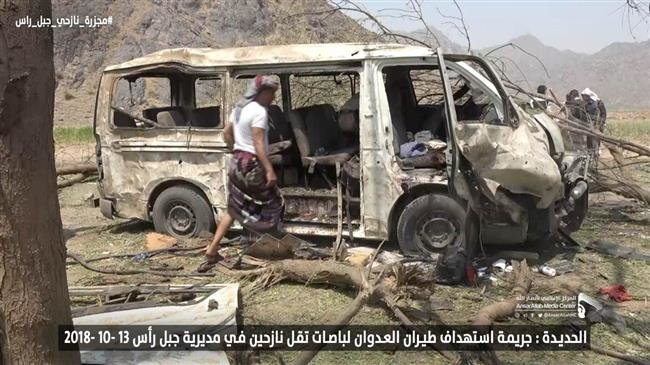
Picture, provided by Yemen’s Houthi Ansarullah movement, shows aftermath of Saudi airstrike against Gabal Ras area in Yemen’s western coastal city of Hudaydah on October 13, 2018.
The Legal Center for Rights and Developments in Yemen says the ongoing Saudi-led military campaign against the impoverished and conflict-plagued Arab country has claimed the lives of more than 15,000 civilians.
The center, in a statement released on Monday, announced that the aggression has resulted in the death of 15,185 civilians, including 3,527 children and 2,277 women.
A total of 23,822 civilians, among them 3,526 children and 2,587 women, have also sustained injuries, and are currently suffering from the lack of medicine, medical supplies and poor treatment due to the crippling Saudi siege.
The center further noted that the Saudi military aggression has also caused the death of nearly 2,200 Yemenis from cholera.
It highlighted that aerial assaults being conducted by the Saudi-led alliance have resulted in the destruction of 15 airports and 14 ports, and damaged 2,559 roads and bridges in addition to 781 water storage facilities, 191 power stations and 426 telecommunications towers.
The statement went on to say that the incessant Saudi-led bombardment campaign has destroyed more than 421,911 houses, 930 mosques, 888 schools, 327 hospitals and health facilities plus 38 media organizations, halted the operation of 4,500 schools and left more than 4 million people internally displaced.
In addition, the Saudi-led coalition has targeted 1,818 government facilities, 749 food storehouses, 621 food trucks, 628 shops and commercial compounds, 362 fuel stations, 265 tankers, 339 factories, 310 poultry and livestock farms, 219 archaeological sites, 279 tourist facilities and 112 playgrounds and sports complexes.
The Legal Center for Rights and Developments in Yemen then called on the United Nations to shoulder its responsibilities concerning protection of human rights and the rules of international humanitarian law in Yemen.
It also called on the international community to take on its legal, moral and humanitarian responsibilities, stressing the need for urgent international and regional actions to end the Saudi-led aggression against Yemen.
The center finally asked the United Nations Human Rights Council (UNHRC) to conduct a professional and impartial investigation into the crimes being perpetrated against civilians in Yemen.
Saudi Arabia and a number of its regional allies launched a devastating military campaign against Yemen in March 2015, with the aim of bringing the government of former president Abd Rabbuh Mansur Hadi back to power and crushing the country’s popular Houthi Ansarullah movement.
October 16, 2018
Posted by aletho |
Subjugation - Torture, War Crimes | Saudi Arabia, Yemen |
Leave a comment
ISTANBUL — The disappearance and alleged murder of Saudi journalist and Washington Post columnist Jamal Khashoggi continues to strain relations between the United States and Saudi Arabia. On Saturday, President Donald Trump warned the Saudis of “severe punishment” if the Saudi government was found to have been responsible for the journalist’s alleged murder.
The Saudi government has vocally denied any involvement even though Khashoggi disappeared within the Saudi Consulate in Istanbul and responded to Trump’s threats by vowing an even “stronger” response if the Gulf monarchy is ultimately targeted by the United States. The exchange of threats caused Saudi stocks to sustain their biggest one-day loss since 2016 when trading opened and has brought the upcoming three-day Future Investment Initiative (FII) in Saudi Arabia much unwanted negative publicity.
However, there is considerable evidence pointing to the fact that the U.S.’ response to the Khashoggi affair is likely to be determined, not by any Saudi government responsibility for Khashoggi’s fate, but instead whether or not the Saudis choose to follow through with their promise to purchase the $15 billion U.S.-made THAAD missile system or its cheaper, Russia-made equivalent, the S-400. According to reports, the Saudis failed to meet the deadline for their planned THAAD purchase and had hinted in late September that they were planning to buy the S-400 from Russia instead.
While the U.S.’ response to the alleged murder of the Saudi journalist is being cast as a U.S. government effort to defend press freedom and finally hold the Saudi government to account for its long litany of human-rights abuses, there is every indication that the U.S. is not in fact seeking to punish the Saudis for their alleged role in Khashoggi’s apparent murder but instead to punish them for reneging on this $15 billion deal to U.S. weapons giant Lockheed Martin, which manufactures the THAAD system.
Khashoggi’s disappearance merely provided a convenient pretext for the U.S. to pressure the Saudis over abandoning the weapons deal by allowing the U.S. to frame its retaliation as a “human rights” issue. As a result, it seems likely that, if the Saudis move forward with the latter, the U.S. and the Trump administration the Saudi government guilty of involvement in Khashoggi’s disappearance while, if they move forward with the former, the media frenzy and controversy surrounding the Saudi national will likely fizzle out and, with it, Trump’s threats of “severe punishment.”
Ultimately, the response of the U.S. political class to the Khashoggi affair is just the latest example of a U.S. government policy being motivated by the military-industrial complex but masquerading as a policy motivated by concern for “human rights.”
Why the sudden concern over the Saudi government’s atrocious human rights record?
As the Khashoggi saga has drawn on since the Saudi journalist disappeared earlier this month, some observers have noted that the corporate media and the U.S. government’s sudden preoccupation with Saudi Arabia’s human-rights record, particularly in regards to journalists. Indeed, just last Wednesday, Reporters Without Borders (RSF) announced that 15 Saudi journalists and bloggers had been arrested over the past year and noted that “in most cases, their arrests have never been officially confirmed and no official has ever said where they are being held or what they are charged with.”
In addition, Saudi Arabia has helped kill tens of thousands of Yemeni civilians in the war it is leading against that country, with most of those civilian casualties resulting from the Saudi-led coalition’s bombing campaign that routinely targets civilians. The Saudi-led coalition’s blockade of food and medicine into Yemen has also brought the country to the brink of famine, with nearly 18 million now at risk of starving to death — including over 5 million children, while thousands more are dying from preventable diseases in the country.
While murdering a journalist by “hit squad” in a diplomatic compound on foreign soil — as is alleged to have Khashoggi’s fate — would certainly set a dangerous precedent, Saudi Arabia leading the genocide against the Yemeni people is arguably a much worse precedent. However, little concern over the Saudis’ role in this atrocity in Yemen has been raised by those pushing for action to be taken against Saudi Arabia over Khashoggi’s “inhumane” fate. So, why the sudden concern?
Despite it being a well-known fact that the Saudi government routinely imprisons journalists and activists and is leading a genocidal war against its southern neighbor, the Trump administration has now adopted a harsh tone towards the Saudis, with concerns over Khashoggi’s disappearance serving as the “official” excuse.
Indeed, Trump told CBS’ 60 Minutes during an interview broadcast on Sunday that “there’s something really terrible and disgusting about that if that were the case [that Saudi Arabia had been involved in Khashoggi’s murder], so we’re going to have to see. We’re going to get to the bottom of it and there will be severe punishment.”
Other powerful figures in the U.S. political establishment have called for dramatic action to be taken against the Saudi government, particularly the Saudi Crown Prince Mohammed bin Salman (MBS). For instance, John Brennan, former CIA Director under Obama and current cable news pundit, lobbied in a recent Washington Post op-ed to dethrone MBS for his alleged role in Khashoggi’s fate.
Brennan also notably called upon the U.S. to impose “immediate sanctions on all Saudis involved; a freeze on U.S. military sales to Saudi Arabia; suspension of all routine intelligence cooperation with Saudi security services; and a U.S.-sponsored U.N. Security Council resolution condemning the murder.”
Another prominent figure in Washington pushing for action to be taken against the Saudis over Khashoggi’s disappearance is Senator Lindsey Graham (R-SC). Graham recently stated that there would be “hell to pay” if the Saudi government was found to be responsible for Khashoggi’s disappearance and alleged murder. Notably, the top contributor to Graham’s 2020 re-election campaign is U.S. weapons manufacturer Lockheed Martin.
Given that human-rights concerns among the U.S. power establishment have only emerged after the disappearance of this one journalist and such concerns regarding the Saudis other grave human-rights abuses continue to go unvoiced by these same individuals, something else is likely driving Washington’s sudden concern over alleged Saudi state-sanctioned murder.
So what has protected the Saudi government from U.S. retribution over its repeated human-rights abuses in the past? Though Saudi Arabia’s vast oil wealth is an obvious answer, a recently leaked State Department memo revealed that U.S. weapon sales to the Gulf Kingdom were the main and only factor in the Trump administration ’s continued support for the Saudi-led coalition’s disastrous war in Yemen. Those lucrative weapon sales, according to the memo, led Secretary of State Mike Pompeo to “rubber stamp” the Saudi-led coalition’s bombing campaign in Yemen despite the fact that the coalition has continued to bomb civilian buses, homes and infrastructure in recent months.
If the Saudis were to back away from a major, lucrative deal with U.S. weapon manufacturers, such an act would likely result in retribution from Washington, given that weapons sales to the Gulf Kingdom are currently the driving factor behind Washington’s “concern” with the Saudi government’s poor human-rights record.
This is exactly what happened and it took place just two days before Khashoggi disappeared inside the Saudi consulate in Istanbul.
The Saudis back out of a US deal and eye the rival’s wares
Last year, President Trump visited Saudi Arabia and praised its crown prince for finalizing a massive weapons deal with the United States at a value of over $110 billion. However, it emerged soon after that this “deal” was not contract-based but instead involved many “letters of interest or intent.” Over a year later, the Washington Post recently noted that many of the planned weapons deals have yet to be finalized.
One of those agreements was the planned $15 billion purchase of the Terminal High Altitude Area Defense System (THAAD), which is manufactured by U.S. weapons giant Lockheed Martin. The deadline for the Saudis to finalize that deal passed on September 30, just two days before Khashoggi’s disappearance on October 2. However, a Saudi official told the Post that the Saudi government is still “highly interested” in the deal but “like any military purchase, there are negotiations happening which we hope will conclude in the quickest means possible.”
Yet, not only has Saudi Arabia apparently backed out of the $15 billion deal to buy Lockheed’s THAAD, it is also actively considering buying the Russian-made S-400 missile defense system instead and has also refused U.S. government requests to disavow its interest in the Russian-made system.
Indeed, on September 21, Saudi ambassador to Russia Raid bin Khalid Krimli stated:
Our cooperation with Russia continues and grows. And during King Salman’s historic visit [to Russia] we have signed 14 agreements that began to be implemented. There were four agreements in the military field; three of them began to be implemented. As for the fourth … there is discussion of the technical issues. Because the system itself is modern and complex.”
The fourth deal to which he alludes appears to be the S-400. The Saudi ambassador also stated the he hoped “nobody will impose any sanctions on us” for making the purchases with Russia — further suggesting that the system he was discussing was the S-400, given that the U.S. sanctioned China for purchasing the system soon before the Saudi ambassador’s comments.
Interestingly, soon after the Saudis’ failure to stick to the planned deal with Lockheed, Trump began to publicly criticize the Saudis for “not paying” their fair share. Speaking at a campaign rally in Mississippi on October 3 – one day after Khashoggi’s disappearance in Istanbul and three days after Saudi Arabia “missed” the Lockheed Martin deadline, Trump stated:
“I love the king [of Saudi Arabia], King Salman, but I said: ‘King, we’re protecting you. You might not be there for two weeks without us. You have to pay for your military, you have to pay.”‘
More recently, this past Saturday, Trump told reporters that he did not want to risk the bottom line of the U.S.’ top weapons manufacturers in determining the Saudis’ “punishment:”
I tell you what I don’t want to do. Boeing, Lockheed, Raytheon, all these companies. I don’t want to hurt jobs. I don’t want to lose an order like that [emphasis added]. And you know there are other ways of punishing, to use a word that’s a pretty harsh word, but it’s true.”
However, if the Saudis do follow through with the purchase of the S-400, Lockheed Martin will lose $15 billion as a result. It will also endanger some of other potential contracts contained within the $110 billion weapons contract that Trump has often publicly promoted. With Trump not wanting to “lose an order like that,” some analysts like Scott Creighton of the Nomadic Everyman blog have asserted that the Khashoggi scandal is being used as a “shakedown” aimed at pressuring the Saudis into “buying American” and to force them to disavow a future purchase of the Russian-made S-400.
Would the U.S. use such tactics against a close ally like the Saudis over their potential purchase of the Russian-made S-400? It would certainly fit with the U.S.’ recent efforts to threaten countries around the world with sanctions for purchasing that very missile defense system. For instance, in June, U.S. Assistant Secretary of State for European and Eurasian Affairs Wess Mitchell threatened Turkey with sanctions if Turkey purchased the S-400. Those threats were followed by the September decision made by the Trump administration to sanction China for its purchase of the S-400 system.
Notably, it was right after China was sanctioned for purchasing the S-400 that the Saudi ambassador to Russia told Russian media that “I hope nobody will impose any sanctions on us” for purchasing the S-400.
However, U.S. sanctions against the Saudis may now be in the works after all, with Khashoggi’s disappearance as the pretext. Indeed, as previously mentioned, former CIA director John Brennan, among other powerful figures in Washington, is calling for sanctions against the Saudi government and Trump himself stated on Saturday that “severe punishment” could soon be in the Saudis’ future.
Yet another piece of this puzzle that cannot be ignored is the fact that Khashoggi himself has ties to the CIA, as well as to Lockheed Martin through his uncle Adnan Khashoggi, one of Saudi Arabia’s most powerful weapons dealers.
Khashoggi’s deep connections to CIA, Saudi Intelligence suggest his “disappearance” may be something more
Following his disappearance, Khashoggi has been praised by establishment and non-establishment figures alike, from Jake Tapper to Chris Hedges, for being a “dissident” and a “courageous journalist.” However, prior to his scandalous disappearance and alleged murder, Khashoggi did not receive such accolades and was a very controversial figure.
As Federico Pieraccini recently wrote at Strategic Culture :
[Khashoggi is a] representative of the shadowy world of collaboration that sometimes exists between journalism and the intelligence agencies, in this case involving the intelligence agencies of Saudi Arabia and the United States. It has been virtually confirmed by official circles within the Al Saud family that Khashoggi was an agent in the employ of Riyadh and the CIA during the Soviet presence in Afghanistan.”
Indeed, Khashoggi doubled as a journalist and an asset for the Saudi and U.S. intelligence services and was also an early recruit of the Muslim Brotherhood. He was also the protégé of Turki Faisal Al-Saud, the head of Saudi intelligence for 24 years, who also served as the Saudi ambassador to Washington and to the United Kingdom. Khashoggi was “media advisor” to Faisal Al-Saud during his two ambassadorships. Notably, Khashoggi became a regime “critic” only after internal power struggles broke out between former Saudi King Abdullah and Turki Faisal al-Saud.
Supporters of King Abdullah accused Khashoggi at the time of having recruited and paid several journalists on behalf of the CIA while he was editor of the leading English-language magazine in Saudi Arabia, Arab News, a post he held from 1999 to 2003.
More recently, Khashoggi strongly supported the Muslim Brotherhood during the “Arab Spring” and backed the Barack Obama/Hillary Clinton regime-change efforts that spread throughout the Middle East, including the regime-change effort targeting Syrian President Bashar al-Assad.
However, under King Salman, the Muslim Brotherhood’s presence in Saudi Arabia came under threat and was suppressed. This led Khashoggi to leave and seek refuge in Turkey.
Perhaps most significantly, prior to his disappearance, Khashoggi was “working quietly with intellectuals, reformists and Islamists to launch a group called Democracy for the Arab World Now.” As Moon of Alabama notes, these projects that Khashoggi was involved in prior to his disappearance “reek of preparations for a CIA-controlled color revolution in Saudi Arabia.”
Not only does Khashoggi share ties to the CIA and the Saudi intelligence services (services that often collaborate), but his family is well-connected to global power structures, including Lockheed Martin.
Indeed, as previously mentioned, Khashoggi’s uncle is none other than Adnan Khashoggi, the notorious Saudi arms dealer who was an important player in the Iran-contra affair and was once Saudi Arabia’s richest man. Adnan Khashoggi was deeply connected to Lockheed Martin, as demonstrated by the fact that, between 1970 and 1975, he received $106 million in commissions from the U.S. weapons giant with his commission rate on Lockheed sales eventually rising to 15 percent. According to Lockheed’s former Vice President for International Marketing, Max Helzel, Adnan Khashoggi “became for all practical purposes a marketing arm of Lockheed. Adnan would provide not only an entry but strategy, constant advice and analysis.”
Adnan Khashoggi also had close ties to the Richard Nixon and Ronald Reagan White Houses, with the latter likely explaining why he was acquitted for his role in the Iran-contra scandal. Also notable is the fact that Adnan Khashoggi sold his famed yacht to none other than Donald Trump for $30 million. Trump later called Adnan Khashoggi “a great broker and a lousy businessman.”
Given Jamal Khashoggi’s past and present connections to the CIA and his family’s connections to Lockheed Martin and powerful players in the U.S. political establishment, the possibility emerges that Khashoggi’s disappearance may have in fact been a set-up in order to place pressure on the Saudi government following its decision to renege on its plan to purchase Lockheed’s THAAD system. This theory is also somewhat supported by the fact that the U.S. intelligence community had known in advance of an alleged Saudi plot to capture Khashoggi but ignored its duty (via ICD 191) to warn Khashoggi of the apparent threat against him. Furthermore, the claims that Khashoggi was murdered in the Saudi consulate in Istanbul have — so far — been entirely based on claims from U.S. and Turkish intelligence and no evidence to support the now prevailing narrative of murder has been made public.
If a “set-up” were the case, Khashoggi’s CIA links and his apparent efforts at pushing a CIA-controlled “color revolution” in Saudi Arabia suggest that his disappearance could also have been intended for use as a pretext, not necessarily to punish the Saudis over the S-400, but to remove MBS from his position as crown prince and replace him with former crown prince Mohammed bin Nayef, who was ousted by MBS last year and also holds close ties to the CIA. Such a possibility cannot be ignored.
However, the Trump administration’s willingness to cooperate with the faux outrage regarding Khashoggi is much more likely to be motivated by the weapons-deal drama given the administration’s close ties to MBS.
Of course, it is equally likely that this was not a set-up given that MBS is undeniably authoritarian and relentlessly pursues his critics and perhaps thought that his close relationship with Trump would allow him to act with impunity in targeting Khashoggi. However, MBS’ pursuits of his critics in the past were more readily accepted by the West — like the so-called “corruption crackdown” last December. Either way, the Saudi government’s role in the alleged murder of Khashoggi is being capitalized on by the CIA and other elements of the U.S. political scene and military-industrial complex for its own purposes, as these groups normally turn a blind eye to Saudi government atrocities.
Tracking the political typhoon
Though the U.S. tactic to strong-arm Saudi Arabia seems clear, it is a situation that could dangerously escalate as both MBS and Trump have proven over the course of their short tenure that they are stubborn and unpredictable.
Furthermore, the timing of this situation is also troubling. In early November, the Trump administration’s efforts to punish countries importing Iranian crude oil will take effect and Trump is set to lean heavily on the Saudis to prevent a dramatic oil price increase due to the supply shock the removal of Iranian oil from the market will cause. Notably, the Saudis are working closely with Russia to keep oil prices from spiking.
Is the U.S. willing to risk the dramatic jump in oil prices, which themselves could have major domestic economic consequences, in order to keep the Saudis from buying the S-400? It’s hard to say but the coming battle of wills between Trump and MBS could well have truly global consequences.
Acknowledgment: The author of this article would like to thank Scott Creighton of the Nomadic Everyman blog for his assistance in researching aspects of this investigation.
Whitney Webb is a staff writer for MintPress News and a contributor to Ben Swann’s Truth in Media. Her work has appeared on Global Research, the Ron Paul Institute and 21st Century Wire, among others. She has also made radio and TV appearances on RT and Sputnik. She currently lives with her family in southern Chile.
October 15, 2018
Posted by aletho |
Corruption, Deception, Timeless or most popular | CIA, Jamal Khashoggi, Lockheed Martin, S-400, Saudi Arabia, THAAD, United States, Washington Post |
Leave a comment


 Aletho News