A National Defense Strategy of Sowing Global Chaos
By Nicolas J.S. Davies | Consortium News | January 23, 2018
Presenting the 2018 National Defense Strategy of the United States on Friday at the Johns Hopkins University, Secretary of Defense James Mattis painted a picture of a dangerous world in which U.S. power – and all of the supposed “good” that it does around the world – is on the decline.
“Our competitive edge has eroded in every domain of warfare – air, land, sea, space, and cyberspace,” he said. “And it is continually eroding.”
What he could have said instead is that the United States military is overextended in every domain, and that much of the chaos seen around the world is the direct result of past and current military adventurism. Further, he could have acknowledged, perhaps, that the erosion of U.S. influence has been the result of a series of self-inflicted blows to American credibility through foreign policy disasters such as 2003 invasion of Iraq.
There were also two important words hidden between the lines, but never mentioned by name, in the new U.S. National Defense Strategy: “empire” and “imperialism.”
It has long been taboo for U.S. officials and corporate media to speak of U.S. foreign policy as “imperialism,” or of the U.S.’s global military occupations and network of hundreds of military bases as an “empire.” These words are on a long-standing blacklist of “banned topics” that U.S. official statements and mainstream U.S. media reports must never mention.
The streams of Orwellian euphemisms with which U.S. officials and media instead discuss U.S. foreign policy do more to obscure the reality of the U.S. role in the world than to describe or explain it, “hiding imperial interests behind ever more elaborate fig leaves,” as British historian A.J.P. Taylor described European imperialists doing the same a century ago.
As topics like empire, imperialism, and even war and peace, are censored and excised from political debate, U.S. officials, subservient media and the rest of the U.S. political class conjure up an illusion of peace for domestic consumption by simply not mentioning our country’s 291,000 occupation troops in 183 other countries or the 39,000 bombs and missiles dropped on our neighbors in Iraq, Syria and Afghanistan since Trump took office.
The 100,000 bombs and missiles dropped on these and other countries by Obama and the 70,000 dropped on them by Bush II have likewise been swept down a kind of real time “memory hole,” leaving America’s collective conscience untroubled by what the public was never told in the first place.
But in reality, it’s been a long time since U.S. leaders of either party resisted the temptation to threaten anyone anywhere, or to follow through on their threats with “fire and fury” bombing campaigns, coups and invasions. This is how empires maintain a “credible threat” to undergird their power and discourage other countries from challenging them.
But far from establishing the “Pax Americana” promised by policymakers and military strategists in the 1990s, from Paul Wolfowitz and Dick Cheney to Madeleine Albright and Hillary Clinton, the results have been consistently catastrophic, producing what the new National Defense Strategy calls, “increased global disorder, characterized by decline in the long-standing, rules-based international order.”
Of course the drafters of this U.S. strategy document dare not admit that U.S. policy is almost single-handedly responsible for this global chaos, after successive U.S. administrations have worked to marginalize the institutions and rules of international law and to establish illegal U.S. threats and uses of force that international law defines as crimes of aggression as the ultimate arbiter of international affairs.
Nor do they dare acknowledge that the CIA’s politicized intelligence and covert operations, which generate a steady stream of political pretexts for U.S. military intervention, are designed to create and exacerbate international crises, not to solve them. For U.S. officials to admit such hard truths would shake the very foundations of U.S. imperialism.
Opposition to the Joint Comprehensive Plan of Action with Iran – the so-called nuclear deal – from Republicans and Democratic hawks alike seems to stem from the fear that it might validate the use of diplomacy over sanctions, coups and war, and set a dangerous precedent for resolving other crises – from Afghanistan and Korea to future crises in Africa and Latin America. Iran’s success at bringing the U.S. to the negotiating table, instead of falling victim to the endless violence and chaos of U.S.-backed regime change, may already be encouraging North Korea and other targets of U.S. aggression to try to pull off the same trick.
But how will the U.S. justify its global military occupation, illegal threats and uses of force, and trillion-dollar war budget once serious diplomacy is seen to be more effective at resolving international crises than the endless violence and chaos of U.S. sanctions, coups, wars and occupations?
From Bhurtpoor to Baghdad
Major Danny Sjursen, who has fought in Iraq and Afghanistan and taught history at West Point, is a rare voice of sanity from within the U.S. military. In a poignant article in Truthdig, Major Sjursen eloquently described the horrors he has witnessed and the sadness he expects to live with for the rest of his life. “The truth is,” he wrote, “I fought for next to nothing, for a country that, in recent conflicts, has made the world a deadlier, more chaotic place.”
Danny Sjursen’s life as a soldier of the U.S. Empire reminds me of another soldier of Empire, my great-great-great grandfather, Samuel Goddard. Samuel was born in Norfolk in England in 1793, and joined the 14th Regiment of Foot as a teenager. He was a Sergeant at the Battle of Waterloo in 1815. During 14 years in India, his battalion led the assault on the fortress of Bhurtpoor in 1826, which ended the last resistance of the Maratha dynasty to British rule. He spent 3 years in the Caribbean, 6 years in Canada, and retired as Commandant of Dublin Castle in 1853 after a lifetime of service to Empire.
Danny’s and Samuel’s lives have much in common. They would probably have a lot to talk about if they could ever meet. But there are critical differences. At Bhurtpoor, the two British regiments who led the attack were followed through the breech in the walls by 15 regiments of Indian “Native Infantry.” After Bhurtpoor, Britain ruled India (including Pakistan and Bangladesh) for 120 years, with only a thousand British officials in the Indian Civil Service and a few thousand British officers in command of up to 2.5 million Indian troops.
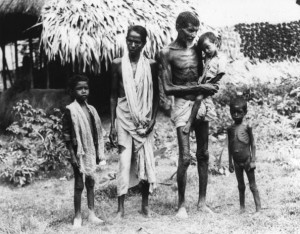 The British brutally put down the Indian Mutiny in 1857-8 with massacres in Delhi, Allahabad, Kanpur and Lucknow. Then, as up to 30 million Indians died in famines in 1876-9 and 1896-1902, the British government of India explicitly prohibited relief efforts or actions that might reduce exports from India to the U.K. or interfere with the operation of the “free market.”
As Mike Davis wrote in his 2001 book, Late Victorian Holocausts, “What seemed from a metropolitan perspective the nineteenth century’s final blaze of imperial glory was, from an Asian or African viewpoint, only the hideous light of a giant funeral pyre.”
And yet Britain kept control of India by commanding such loyalty and subservience from millions of Indians that, in every crisis, Indian troops obeyed orders from British officers to massacre their own people.
Danny Sjursen and U.S. troops in Afghanistan, Iraq and other post-Cold War U.S. war zones are having a very different experience. In Afghanistan, as the Taliban and its allies have taken control of more of the country than at any time since the U.S. invasion, the U.S.-backed Afghan National Army has 25,000 fewer troops under its command than it did five years ago, while ten years of training by U.S. special operations forces has produced only 21,000 trained Afghan Commandos, the elite troops who do 70-80% of the killing and dying for the corrupt U.S.-backed Afghan government.
But the U.S. has not completely failed to win the loyalty of its imperial subjects. The first U.S. soldier killed in action in Afghanistan in 2018 was Sergeant 1st Class Mihail Golin, originally from Latvia. Mihail arrived in the U.S. in November 2004, enlisted in the U.S. Army three months later and has now given his life for the U.S. Empire and for whatever his service to it meant to him. At least 127 other Eastern Europeans have died in occupied Afghanistan, along with 455 British troops, 158 Canadians and 396 soldiers from 17 other countries. But 2,402 – or 68%, over two-thirds – of the occupation troops who have died in Afghanistan since 2001, were Americans.
In Iraq, an American war that always had even less international support or legitimacy, 93% of the occupation troops who have died were Americans, 4,530 out of a total of 4,852 “coalition” deaths.
When Ben Griffin, who later founded the U.K. branch of Veterans for Peace, told his superiors in the U.K.’s elite SAS (Special Air Service) that he could no longer take part in murderous house raids in Baghdad with U.S. special operations forces, he was surprised to find that his entire chain of command understood and accepted his decision. The only officer who tried to change his mind was the chaplain.
The Future of Empire
The U.S. Joint Chiefs of Staff have explicitly told Congress that war with North Korea would require a ground invasion, and the same would likely be true of a U.S. war on Iran. South Korea wants to avoid war at all costs, but may be unavoidably drawn into a U.S.-led Second Korean War.
But besides South Korea, the level of support the U.S. could expect from its allies in a Second Korean War or other wars of aggression in the future would probably be more like Iraq than Afghanistan, with significant international opposition, even from traditional U.S. allies. U.S. troops would therefore make up nearly all of the invasion and occupation forces – and take nearly all of the casualties.
Compared to past empires, the cost in blood and treasure of policing the U.S. Empire and the blame for its catastrophic failures fall disproportionately – and rightly – on Americans. Even Donald Trump recognizes this problem, but his demands for allied countries to spend more on their militaries and buy more U.S. weapons will not change their people’s unwillingness to die in America’s wars.
This reality has created political pressure on U.S. leaders to wage war in ways that cost fewer American lives but inevitably kill many more people in countries being punished for resistance to U.S. imperialism, using air strikes and locally recruited death squads instead of U.S. “boots on the ground” wherever possible.
The U.S. conducts a sophisticated propaganda campaign to pretend that U.S. air-launched weapons are so accurate that they can be used safely without killing large numbers of civilians. Actual miss rates and blast radii are on the “banned topics” blacklist, along with realistic estimates of civilian deaths.
When former Iraqi foreign minister Hoshyar Zebari told Patrick Cockburn of the U.K.’s Independent newspaper that he had seen Iraqi Kurdish intelligence reports which estimated that the U.S.- and Iraqi-led destruction of Mosul had killed 40,000 civilians, the only remotely realistic estimate so far from an official source, no other mainstream Western media followed up on the story.
But America’s wars are killing millions of innocent people: people defending themselves, their families, their communities and countries against U.S. imperialism and aggression; and many more who were simply in the wrong place at the wrong time under the onslaught of over 210,000 American bombs and missiles dropped on at least 7 countries since 2001.
According to a growing body of research (for example, see the UN Development Program study, Journey to Extremism in Africa: Drivers, Incentives and the Tipping-Point for Recruitment), most people who join armed resistance or “terrorist” groups do so mainly to protect themselves and their families from the dangers of wars that others have inflicted on them. The UNDP survey found that the final “tipping point” that pushes over 70% of them to take the fateful step of joining an armed group is the killing or detention of a close friend or family member by foreign or local security forces.
So the reliance on airstrikes and locally recruited death squads, the very strategies that make U.S. imperialism palatable to the American public, are in fact the main “drivers” spreading armed resistance and terrorism to country after country, placing the U.S. Empire on a collision course with itself.
The U.S. effort to delegate war in the Middle East to Saudi Arabia is turning it into a target of global condemnation as it tries to mimic the U.S. model of warfare by bombing and starving millions of innocent people in Yemen while blaming the victims for their plight. The slaughter by poorly trained and undisciplined Saudi and Emirati pilots is even more indiscriminate than U.S. bombing campaigns, and the Saudis lack the full protection of the Western propaganda system to minimize international outrage at tens of thousands of civilian casualties and an ever-worsening humanitarian crisis.
The need to win the loyalty of imperial subjects by some combination of fear and respect is a basic requirement of Empire. But it appears to be unattainable in the 21st century, certainly by the kind of murderous policies the U.S. has embraced since the end of the Cold War. As Richard Barnet already observed 45 years ago, at the end of the American War in Vietnam, “At the very moment the number one nation has perfected the science of killing, it has become an impractical instrument of political domination.”
Obama’s sugar-coated charm offensive won U.S. imperialism a reprieve from global public opinion and provided political cover for allied leaders to actively rejoin U.S.-led alliances. But it was dishonest. Under cover of Obama’s iconic image, the U.S. spread the violence and chaos of its wars and regime changes and the armed resistance and terrorism they provoke farther and wider, affecting tens of millions more people from Syria and Libya to Nigeria and Ukraine.
Now Trump has taken the mask off and the world is once again confronting the unvarnished, brutal reality of U.S. imperialism and aggression.
China’s approach to the world based on trade and infrastructure development has been more successful than U.S. imperialism. The U.S. share of the global economy has declined from 40% to 22% since the 1960s, while China is expected to overtake the U.S. as the world’s largest economy in the next decade or two – by some measures, it already has.
While China has become the manufacturing and trading hub of the global economy, the U.S. economy has been financialized and hollowed out, hardly a solid basis for future growth. The neoliberal model of politics and economics that the U.S. adopted a generation ago has created even greater wealth for people who already owned disproportionate shares of everything, but it has left working people in the U.S. and across the U.S. Empire worse off than before.
Like the “next to nothing” that Danny Sjursen came to realize he was fighting for in Iraq and Afghanistan, the prospects for the U.S. economy seem ephemeral and highly vulnerable to the changing tides of economic history.
The Rise and Fall of the Great Powers
In his 1987 book, The Rise and Fall of the Great Powers: Economic Change and Military Conflict from 1500 to 2000, historian Paul Kennedy examined the relationship between economic and military power in the histories of the Western empires who colonized the world in the past 500 years. He described how rising powers enjoy significant competitive advantages over established ones, and how every once-dominant power sooner or later has to adjust to the tides of economic history and find a new place in a world it can no longer dominate.
Kennedy explained that military power is only a secondary form of power that wealthy nations develop to protect and support their expanding economic interests. An economically dominant power can quickly convert some of its resources into military power, as the U.S. did during the Second World War or as China is doing today. But once formerly dominant powers have lost ground to new, rising powers, using military power more aggressively has never been a successful way to restore their economic dominance. On the contrary, it has typically been a way to squander the critical years and scarce resources they could otherwise have used to manage a peaceful transition to a prosperous future.
As the U.K. found in the 1950s, using military force to try to hold on to its empire proved counter-productive, as Kennedy described, and peaceful transitions to independence proved to be a more profitable basis for future relations with its former colonies. The drawdown of its global military commitments was an essential part of its transition to a viable post-imperial future.
The transition from hegemony to coexistence has never been easy for any great power, and there is nothing exceptional about the temptation to use military force to try to preserve and prolong the old order. This has often led to catastrophic wars and it has always failed.
It is difficult for any political or military leader to preside over a diminution of his or her country’s power in the world. Military leaders are rewarded for military strategies that win wars and expand their country’s power, not for dismantling it. Mid-level staff officers who tell their superiors that their weapons and armies cannot solve their country’s problems do not win promotion to decision-making positions.
As Gabriel Kolko noted in Century of War in 1994, this marginalization of critical voices leads to an “inherent, even unavoidable institutional myopia,” under which, “options and decisions that are intrinsically dangerous and irrational become not merely plausible but the only form of reasoning about war and diplomacy that is possible in official circles.”
After two world wars and the independence of India, the Suez crisis of 1956 was the final nail in the coffin of the British Empire, and the Eisenhower administration burnished its own anti-colonial credentials by refusing to support the British-French-Israeli invasion of Egypt. British Prime Minister Anthony Eden was forced to resign, and he was replaced by Harold Macmillan, who had been a close aide to Eisenhower during the Second World War.
Macmillan dismantled the remains of the British Empire behind the backs of his Conservative Party’s supporters, winning reelection in 1959 on the slogan, “You’ve never had it so good,” while the U.S. supported a relatively peaceful transition that preserved Western international business interests and military power.
As the U.S. faces a similar transition from empire to a post-imperial future, its leaders have been seduced by the chimera of the post-Cold War “power dividend” to try to use military force to preserve and expand the U.S. Empire, even as the relative economic position of the U.S. declines.
In 1987, Paul Kennedy ended The Rise and Fall of the Great Powers with a prescient analysis of the U.S. position in the world. He concluded,
“In all of the discussions about the erosion of American leadership, it needs to be repeated again and again that the decline referred to is relative not absolute, and is therefore perfectly natural; and that the only serious threat to the real interests of the United States can come from a failure to adjust sensibly to the newer world order.”
But after Kennedy wrote that in 1987, instead of accepting the future of peace and disarmament that the whole world hoped for at the end of the Cold War, a generation of American leaders made a fateful bid for “superpower.” Their delusions were exactly the kind of failure to adjust to a changing world that Kennedy warned against.
The results have been catastrophic for millions of victims of U.S. wars, but they have also been corrosive and debilitating for American society, as the perverted priorities of militarism and Empire squander our country’s resources and leave working Americans poorer, sicker, less educated and more isolated from the rest of the world.
When I began writing Blood On Our Hands: the American Invasion and Destruction of Iraq in 2008, I hoped that the catastrophes in Afghanistan and Iraq might bring U.S. leaders to their senses, as the Suez crisis did to British leaders in 1956.
Instead, eight more years of carefully disguised savagery under Obama have squandered more precious time and good will and spread the violence and chaos of U.S. war-making even farther and wider. The new National Defense Strategy’s implicit threats against Russia and China reveal that 20 years of disastrous imperial wars have done nothing to disabuse U.S. leaders of their delusions of “superpower status” or to restore any kind of sanity to U.S. foreign policy.
Trump is not even pretending to respect diplomacy or international law, as he escalates Bush’s and Obama’s wars and threatens new ones of his own. But maybe Trump’s nakedly aggressive policies will force the world to finally confront the dangers of U.S. imperialism. A coming together of the international community to stop further U.S. aggression may be the only way to prevent an even greater catastrophe than the ones that have already befallen the people of Afghanistan, Iraq, Somalia, Honduras, Libya, Syria, Ukraine and Yemen.
Or will it actually take a new and even more catastrophic war in Korea, Iran or somewhere else to finally force the United States to “adjust sensibly to the new world order,” as Paul Kennedy put it in 1987? The world has already paid a terrible price for our leaders’ failure to take his sound advice a generation ago. But what will be the final cost if they keep ignoring it even now?
Nicolas J.S. Davies is the author of Blood On Our Hands: the American Invasion and Destruction of Iraq.
Germany stops arms sales to Saudi Arabia
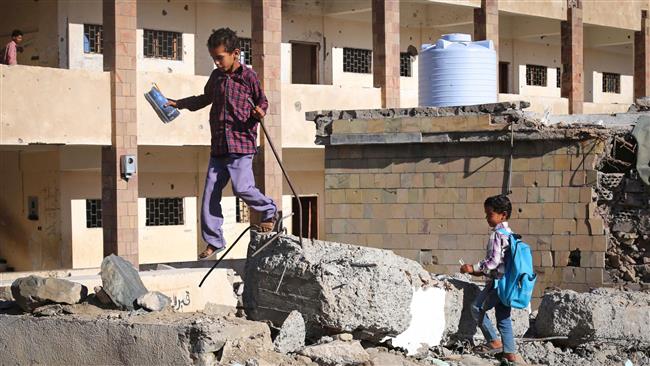
Yemeni children walk outside a school that was damaged in a Saudi air strike in the southern Yemeni city of Ta’izz. (By AFP)
Press TV – January 20, 2018
Germany has stopped selling weapons to Saudi Arabia and almost all of its allies waging war on Yemen, in a decision likely to have both an impact on the Riyadh regime and a domino effect on other Western and non-Western countries exporting arms to Saudi Arabia.
German government spokesman Steffen Seibert said on Friday that the Federal Security Council was no longer issuing export licenses that “are not in accordance with the conclusion of the exploratory talks,” Germany’s official DPA news agency reported.
The official was referring to ongoing negotiations among the German political factions of the Christian Democratic Union, the Christian Social Union, and Social Democrats on the formation of a new coalition government.
A draft paper on arms exports that came out of those talks said “the federal government, with immediate effect, will no longer export arms to countries as long as they are involved in the Yemeni war.”
Around 13,600 people have died since Saudi Arabia started leading a number of its vassal states in an invasion of Yemen in March 2015.
The war, which enlists the participation among others of the United Arab Emirates, Jordan, Egypt, Bahrain, Kuwait, Morocco, Sudan, and Senegal, has been reinforced by weapon supplies and logistical support from the United States and the United Kingdom.
Washington signed a $110-billion arms deal with Riyadh last year.
By stopping its own arms sales to Saudi Arabia, European heavyweight Germany may become a model for other Western and non-Western powers already under pressure to end their arms sales to the Riyadh regime. Rights groups have long called for an arms embargo on Saudi Arabia over potential war crimes in Yemen.
A United Nations panel recently compiled a detailed report of civilian casualties caused by the Saudi military and its allies during the war, saying the Riyadh-led coalition has used precision-guided munitions in its raids on civilian targets.
“The attacks were carried out by precision-guided munitions, so it is likely these were the intended targets,” the panel’s report said, according to Al Jazeera.
Saudi Arabia and the UAE were among the top recipients of German-made weaponry in 2016.
The DPA report said, “The German public is traditionally wary of arms deals and [Chancellor Angela] Merkel has been pressured to end sales to countries with precarious human rights records.”
The only exception to the German freeze is Jordan, which will be receiving 130 million euros’ (158 million dollars’) worth of military equipment. Jordan hosts a squadron of German Tornado fighter planes and other hardware used by German Armed Forces.
US administration approves $500mn missile system deal with Saudi Arabia
Press TV – January 18, 2018
The US State Department has approved a possible $500-million sale of missile system support services to Saudi Arabia in defiance of global calls for Washington to stop providing Riyadh with military support due to the regime’s war crimes in Yemen.
The Defense Security Cooperation Agency made the announcement in a statement on Wednesday, saying Congress had been notified of the decision.
Congress now has 30 days to review the proposed sale, but it is not required to take any action.
The potential sale follows a request by Saudi Arabia for continued technical assistance for Patriot Legacy Field Surveillance Program (FSP), the Patriot Advanced Capability 3 (PAC-3) and the Patriot Engineering Services Program (ESP).
The package also includes spare parts and logistical support for Patriot and Hawk missile systems.
Last week, the US Army awarded Sikorsky, a leading American aircraft manufacturer, a contract worth nearly $200 million to supply 17 Black Hawk helicopters to Saudi Arabia.
The deals come as the US is under pressure to suspend its arms sales to the Saudi regime, which has been waging a deadly military aggression against Yemen since 2015.
At least 13,600 people have been killed since the start of the war.
During his first trip to Saudi Arabia last year, President Donald Trump signed a $110 billion arms deal with the Saudis, with options to sell up to $350 billion over a decade.
Facilitated by Trump’s son-in-law and senior adviser Jared Kushner, the massive package includes missiles, bombs, armored personnel carriers, combat ships, terminal high altitude area defense (THAAD) missile systems and munitions.
The announcement generated backlash in Congress, with Republican Senator Rand Paul promising to work to block at least parts of the package.
The Trump administration is looking to loosen restrictions on American arms sales to boost the country’s weapons industry.
The move seeks to ease export rules for military equipment “from fighter jets and drones to warships and artillery,” according to officials familiar with the plan.
US Army awards Sikorsky to supply 17 Black Hawk helicopters to Saudi
Press TV – January 13, 2018
The US Army has awarded Sikorsky, a leading American aircraft manufacturer based in Connecticut, a contract worth nearly $200 million to supply 17 Black Hawk helicopters to Saudi Arabia.
The terms of the “firm-fixed-price” agreement between the Sikorsky Aircraft Corporation, a Lockheed Martin company, and the army were announced Thursday by the Department of Defense.
Saudi Arabia is expected to receive eight UH-60Ms for the kingdom’s National Guard, while the other nine helicopters will go to the Royal special security forces.
The UH-60M Black Hawk, a medium-lift, rotary-wing helicopter, has been in use by military forces around the world since it was first introduced in 1979.
It has multi-mission capabilities and can be used in combat search-and-rescue, airborne assault, command-and-control, medical evacuation, search-and-rescue, disaster relief and fire-fighting.
Sikorsky will begin work under the $193.8 million deal to manufacture the helicopters with an estimated completion date of the end of 2022.
The deal comes as the US is under pressure to suspend its arms sales to the Saudi regime, which has been waging a deadly military aggression against Yemen since 2015.
At least 13,600 people have been killed since the start of the war.
During his first trip to Saudi Arabia last year, President Donald Trump signed a $110 billion arms deal with the Saudis, with options to sell up to $350 billion over a decade.
Facilitated by Trump’s son-in-law and senior adviser Jared Kushner, the massive package includes missiles, bombs, armored personnel carriers, combat ships, terminal high altitude area defense (THAAD) missile systems and munitions.
The announcement generated backlash in Congress, with Republican Senator Rand Paul promising to work to block at least parts of the package.
The Trump administration is looking to loosen restrictions on American arms sales to boost the country’s weapons industry.
The move seeks to ease export rules for military equipment “from fighter jets and drones to warships and artillery,” according to officials familiar with the plan.
Hariri lauds Hezbollah, wants ‘best of relations’ with Iran
Press TV – January 12, 2018
Lebanon’s Prime Minister Saad Hariri has called for his county to be kept out of regional conflicts, lauding the Hezbollah resistance movement for doing its part to de-escalate the tensions.
In an interview with The Wall Street Journal on Wednesday, Hariri said he was open to Hezbollah continuing to participate in the government following the elections slated for May.
“Hezbollah has been a member of this government. This is an inclusive government that has all the big political parties, and that brings political stability to the country,” Hariri said during Wednesday interview, defying pressure from Saudi Arabia to confront the resistance movement.
“My main goal is to preserve this political stability for the unity of the country,” said Hariri, who reached a power-sharing deal with Hezbollah in 2016.
Hariri abruptly declared his resignation from Saudi Arabia and from Saudi-owned television on November 4, accusing Iran and Hezbollah of interfering in the region and signaling that that was his reason to quit.
But Lebanese President Michel Aoun, who suspected that Hariri had been forced to step down, refused to accept his resignation and demanded his return from Saudi Arabia first. Lebanese intelligence sources soon concluded that Hariri was under restrictions in Riyadh.
Sayyed Hassan Nasrallah, the Hezbollah secretary general, said back then that Saudi authorities had clearly and openly declared a war on Lebanon by holding Prime Minister Hariri hostage and forcing him to quit.
That drama ended when Hariri returned to Lebanon on November 22 — partially after a diplomatic intervention by France — and rescinded his resignation on December 5.
In the Wall Street Journal interview, Hariri declined to discuss the details of his stay in Saudi Arabia.
The Lebanese prime minister then outlined in his interview a vision under which Lebanon will finally focus on its own affairs and reject foreign interference.
“We cannot accept interference from anyone in Lebanese politics,” Hariri said, adding “Our relationship with Iran—or with the [Persian] Gulf —has to be the best relationship, but one that serves the national interests of Lebanon.”
Hariri further highlighted Hezbollah’s willingness to comply with a policy of “disassociating” Lebanon from regional conflicts.
Hariri, however, admitted that Hezbollah’s withdrawal from Syria will take time as the situation there is more complex.
Hezbollah has been helping the national Syrian army in the fight against terrorists in an effort to prevent the spillover of the crisis into Lebanon.
The Lebanese premier also cautioned Israel against any military action against Lebanon, saying any such war would be counterproductive.
”Every time, they say they [Israelis] want to launch a war with the purpose of weakening Hezbollah. And every single time they went to war with Lebanon, they actually strengthened Hezbollah—and weakened the state.”
Hezbollah is Lebanon’s de facto military power, and has been fighting off recurrent acts of Israeli aggression against the homeland. Riyadh, which reportedly maintains clandestine ties with Tel Aviv, however, has made no secret of its opposition to the group, and has been trying for more than a decade to weaken it.
Lebanon has repeatedly praised Hezbollah’s key role in the war against terrorism, with Lebanese President Michel Aoun defending the resistance movement’s possession of arms as essential to Lebanon’s security
Yemen says Saudi war has killed, wounded 35,000 people

Press TV – January 2, 2018
The Yemeni Ministry of Health says the Saudi-led military coalition has either killed or wounded some 35,000 people of Yemen during the ongoing war Riyadh imposed on the impoverished nation almost three years ago.
In a report read out in a press conference in the Yemeni capital of Sana’a on Tuesday, the ministry said that the appalling number of casualties occurred in just 1,000 days since the Saudi regime began its military aggression against the Yemeni people in March 2015.
The report added that nearly all of Yemen’s provinces sustained losses in the war with the northwestern province of Sa’ada, the west-central province of Sana’a and the western province of Hajjah suffering the most in a descending order.
The ministry also said that 415 health facilities were destroyed, either completely or partially, as a result of direct Saudi airstrikes, pointing out that more than 55 percent of the health facilities did not function due to the ceaseless aggression, and that the remaining 45 percent operated with a minimum capacity.
The report also revealed figures showing that more than 95,000 Yemeni patients needed to travel abroad for proper treatment, stressing that the closure of airports, due to a total blockade of the country by the Saudi-led coalition, led to the death of 32 patients every day in all provinces.
The ministry further said that, according to figures provided by the World Food Programme, more than 21 million Yemenis needed humanitarian assistance, and that more than 9 million others were expected to enter the stage of starvation.
According to the ministry’s figures, some 2 million Yemeni children suffer from some form of malnutrition, of which half a million are dying of severe malnutrition and 52,000 children died in 2016 for preventable causes.
The report also said that 2,236 people had so far lost their lives due to a cholera outbreak triggered by the Saudi war.
The international committee of the Red Cross says more than one million people have contracted cholera in Yemen amid Saudi Arabia’s war.
Saudi Arabia has been leading a deadly campaign against Yemen from the air, land, and sea since March 2015 in an attempt to reinstate former President Abd Rabbuh Mansur Hadi, a staunch ally of Riyadh, and to undermine the Houthi Ansarullah movement. Over the past two years, the Houthis have been running state affairs and defending Yemeni people against the Saudi aggression.
The campaign has also taken a heavy toll on the country’s facilities and infrastructure, destroying many hospitals, schools, and factories. The offensive has, however, achieved neither of its goals despite the spending of billions of petrodollars and the enlisting of the cooperation of Saudi Arabia’s regional and Western allies.
Who Are the Leading State Sponsors of Terrorism?
By Philip M. GIRALDI | Strategic Culture Foundation | 28.12.2017
As 2017 draws to a close, it is difficult to be optimistic about what will be coming in the new year. The American President, whose margin of victory was certainly based on his pledge to avoid unnecessary wars, has doubled down on Afghanistan, refuses to leave Syria even though ISIS has been defeated, and is playing serious brinksmanship with a psychopathic and unpredictable regime in Pyongyang. The White House has also bought into the prevailing largely fabricated narrative about a Russia and has decided to arm Ukraine with offensive weapons, which has already resulted in a sharp response from Moscow and will make détente of any kind between the two leading powers all but impossible in the upcoming year.
But, as I have observed before, the red hazard light that continues to be blinking most brightly relates to Washington’s relationship with Iran, which has unnecessarily deteriorated dramatically over the past year and which brings with it collateral problems with Russia and Turkey that could trigger a much wider conflict. I say unnecessarily because all the steps taken to poison the relationship have come out of Washington, not Tehran. The Trump administration refused to certify that the Iranians had been in compliance with the nuclear agreement negotiated in 2015 and has since escalated its verbal attacks, mostly at the United Nations, claiming that the regime in Tehran is the major source of terrorism in the world and that it is seeking hegemony over a broad arc of countries running westward from its borders to the Mediterranean Sea.
The only problem with the allegations being made is that none of them is true and, furthermore, Iran, with limited military resources, poses no serious threat to gain control over its neighbors, nor to attack the United States or Europe. The invective about Iran largely derives from Israel and Saudi Arabia, which themselves have hegemonic ambitions relating to their region. Israel’s friends in the US Congress, media and White House have not surprisingly picked up on the refrain and are pushing for military action. Israel has even threatened to bomb any Iranian permanent presence inside neighboring Syria.
A recent detailed analysis by former US intelligence officers has demonstrated just how the claim that Iran is the world’s leading sponsor of terrorism is almost completely fabricated. The analysis explains how these false narratives are contrived and how they become part of the Washington background noise. The White House’s recent National Security Strategy Report for 2018 stated that “Iran, the world’s leading state sponsor of terrorism, has taken advantage of instability to expand its influence through partners and proxies, weapon proliferation, and funding.” But another US government report, the annual Country Reports on Terrorism 2016 cites no actual terrorist incidents initiated by Iran in that year. In fact, the most recent terrorist incident attributed to Tehran was in 2012, and that was retaliatory against Israel, which was at the time assassinating Iran’s scientists and technicians and attacking its computer systems.
America’s UN Ambassador Nikki Haley’s has recently claimed that it is hard to find a “terrorist group in the Middle East that does not have Iran’s fingerprints all over it.” But in reality, the overwhelming majority of terrorist groups in the region, to include ISIS, Al-Qaeda and al-Nusra, are Sunni Muslims, who believe Iran’s Shi’ism is heretical, and are both tied to and funded by Qatar, Saudi Arabia and the United States. The Mujahedin-e-Khalq (MEK) is indeed an ethnic Iranian terrorist group, but it has been funded and supported by Washington and Tel Aviv to carry out attacks inside Iran.
The reality is that terrorism, defined by the United Nations as “criminal acts intended or calculated to provoke a state of terror in the general public,” is most employed at the state level by the United States and its allies Israel and Saudi Arabia, not by Iran. All have used violence directed against civilians in places like Afghanistan, Iraq, Syria, Yemen and Lebanon, and all three have supported organizations that fit the definition of terrorists. Iran may indeed be guilty of actions that much of the world disapproves of, but it is not the world’s leading state sponsor of terrorism as has been alleged.
New details emerge of Saudi Arabia’s treatment of Hariri
Press TV – December 25, 2017
A leading US daily has revealed new details of Saudi Arabia’s degrading treatment of Lebanese Prime Minister Saad Hariri during a recent trip to Riyadh, where the Lebanese leader was coerced into reading a prepared resignation speech under conditions similar to that of a captive.
Prime Minister Hariri abruptly declared his resignation from a then-unknown location in Saudi Arabia and from Saudi-owned television on November 4, accusing Iran and Hezbollah of interfering in the region and signaling that that was his reason to quit.

But Lebanese President Michel Aoun, who suspected early on that Hariri hadn’t resigned of his free will, refused to accept his resignation and demanded his return from Saudi Arabia first. Lebanese intelligence sources soon concluded that Hariri was under restrictions in Riyadh.
That drama ended when Hariri returned to Lebanon on November 22 — partially after a diplomatic intervention by France — and rescinded his resignation on December 5.
While some details had already emerged of the circumstances of Hariri’s three-week stay in Saudi Arabia, more appeared in a Sunday report by The New York Times, which used information from “a dozen Western, Lebanese and regional officials and associates of Mr. Hariri” to draw a better picture of what happened to him in Riyadh.
Hariri, who reached a power-sharing deal with Hezbollah in 2016 and who had formerly attempted to convince Riyadh of the need to work with Hezbollah, met with Ali Akbar Velayati, a senior Iranian adviser to Leader of the Islamic Revolution Ayatollah Seyyed Ali Khamenei, on November 3.
“That may have been the last straw for the Saudis,” the report said, adding, ” Within hours, Mr. Hariri received a message from the Saudi king — come now — ahead of a meeting that had been scheduled days later.”
A well-connected Lebanese analyst was cited as saying that Hariri was also invited to spend a day in the desert with the prince.
“But when he (Hariri) landed in Riyadh, Saudi officials took Mr. Hariri to his house and told him to wait — not for the king, but for the prince. He waited, from 6 p.m. to 1 a.m. No one came,” it said.
The next morning, he was “summoned at 8:30 a.m. to the Saudi royal offices — unseemly early, by the kingdom’s standards.”
Thinking that he would go camping with the prince, Hariri wore jeans and a T-shirt to the Saudi royal offices.
“But instead he was stripped of his cellphones, separated from all but one of his usual cluster of bodyguards, and shoved and insulted by Saudi security officers,” the report said. “Then came the ultimate indignity: He was handed a pre-written resignation speech and forced to read it on Saudi television.”
“Before going on TV, he was not even allowed to go to the house he owns there; he had to ask guards to bring him a suit.”
‘Down the hall from the prince’s office’
Information on what happened between Hariri’s arrival in Riyadh and the resignation is missing. The Times cited Lebanese officials as describing that interval as the “black box.”
“They (the Lebanese officials) said they were reluctant to press Mr. Hariri for details. When asked, one of them said, Mr. Hariri just looked down at the table and said it was worse than they knew.”
Hariri, who runs a private business in Saudi Arabia, was “manhandled” by Saudi officials and was also threatened that he would face “corruption charges,” according to one official.
He read the resignation speech he had been given “from a room an official said was down the hall from the prince’s office.”
‘Our prime minister has been detained’
“Lebanese officials,” the report said, “began making the rounds to puzzled Western diplomats with an unusual message: We have reason to believe our prime minister has been detained.”
Hariri “was eventually placed with Saudi guards in a guesthouse on his own property, forbidden to see his wife and children.”
Some Western diplomats were allowed to meet with the Lebanese prime minister there. “There were two Saudi guards in the room [during those meetings]… and when the diplomats asked if the guards could leave, Mr. Hariri said no, they could stay.”
Opposite effect
The drama was seen as a Saudi attempt to disrupt the political balance in Lebanon to the disadvantage of Hezbollah, which shared power both in the parliament and Hariri’s government with other Lebanese factions.
The Times report pointed to how Mohammed bin Salman was looking to use Hariri as a “pawn” against Iran, “as if he were an employee [of Riyadh] and not a sovereign leader.”
But instead, the Lebanese people of all political inclinations soon came out with massive support for their prime minister, demanding that he safely return and continue work. Hezbollah’s Secretary General Sayyed Hassan Nasrallah also voiced support for Hariri.
The report said Western officials were wondering what Saudi Arabia “hoped to accomplish with all this intrigue.”
“Several do not rule out the possibility that they aimed to foment internal unrest in Lebanon, or even war.”
Mohammed bin Salman has orchestrated a war on Yemen already. Since 2015, Saudi Arabia has been leading a number of its allies in pounding Yemen — already the Arab world’s poorest state — causing famine and a cholera epidemic there.
The report said Saudi [Persian] Gulf Affairs Minister Thaber al-Sabhan, who is believed to have been a key figure in the Hariri scheme, “got a withering reception” on a visit later to Washington, where US officials “demanded that Mr. Sabhan explain why Riyadh was destabilizing Lebanon.”
Prime Minister Hariri, in the meantime, has been continuing work with renewed support and stronger unity among Lebanese people and political groups.
“Now, Mr. Hariri remains in office with new popularity, and Hezbollah is stronger than before,” the Times said.
Featured Video
NATO’s War of Choice – The Sabotage of the Istanbul Negotiations
or go to
Aletho News Archives – Video-Images
From the Archives
National Security Archive Publishes Key Records on Infamous MKULTRA Program
Agency Sought Drugs and Behavior Control Techniques to Use in “Special Interrogations” and Offensive Operations
Edited by Michael Evans | National Security Archive | December 23, 2024
Washington, D.C. – Today, the National Security Archive and ProQuest (part of Clarivate) celebrate the publication of a new scholarly document collection many years in the making on the shocking secret history of the CIA’s mind control research programs. The new collection, CIA and the Behavioral Sciences: Mind Control, Drug Experiments and MKULTRA, brings together more than 1,200 essential records on one of the most infamous and abusive programs in CIA history.
Under code names that included MKULTRA, BLUEBIRD and ARTICHOKE, the CIA conducted terrifying experiments using drugs, hypnosis, isolation, sensory deprivation, and other extreme techniques on human subjects, often U.S. citizens, who frequently had no idea what was being done to them or that they were part of a CIA test.
Today’s announcement comes 50 years after a New York Times investigation by Seymour Hersh touched off probes that would bring MKULTRA abuses to light. The new collection also comes 70 years since U.S. pharmaceutical giant Eli Lilly & Company first developed a process to streamline the manufacture of LSD in late 1954, becoming the CIA’s chief supplier of the newly discovered psychoactive chemical central to many of the Agency’s behavior control efforts.
Highlights of the new MKULTRA collection include… continue
Blog Roll
 Aletho News
- Israel displaces last two families from Al Khalayel valley, Al Mughayyir
- Israeli Opposition Leader Endorses Greater Israel
- Islamic Jihad: Trump’s peace board is a “theatrical stunt detached from reality”
- The Head Of A CIA Cutout Admits To Meddling In Iran To Fuel Unrest
- Iran warns Trump against decisions based on false information
- Pentagon sets deadline for Anthropic to lift AI restrictions on autonomous weapons systems, mass domestic surveillance
- Trump’s military buildup against Iran on Netanyahu’s behalf is a gambit doomed to fail
- Big League War
- Zelensky sells false illusion of building powerful air force capable of overcoming Russia
- Glenn Diesen: NATO’s War of Choice – The Sabotage of the Istanbul Negotiations
- If Americans Knew
- Flooding in Gaza amid rumors of war; fire in West Bank – Not a ceasefire Day 138
- Fourteen Countries Condemn Huckabee’s Support for Israel Taking Over Most of the Middle East
- Israeli Soldiers Killed Gaza Aid Workers at Point Blank Range in 2025 Massacre: Report
- Israel’s insidious network to propagandize American Christians
- Israel’s Best-Kept Secret: Palestinian Resistance Never Agreed to Disarm
- Trump officials plan to build 5,000-person military base in Gaza, files show
- Are MAGA restrainers pulling their punches this time on Iran?
- The NY Times on the “MAGA” Split Over Israel & USS Liberty
- In Gaza, Ramadan without mosques, imams – Not a ceasefire Day 137
- Footage Shows Israeli Troops Waiting in Ambush, Then Opening Fire on a Palestinian Teen
- No Tricks Zone
- Surprising Discovery: Sahara Is Greening…Billions Of Trees Where Once Thought To Be Barren
- New Research Reaffirms Clouds, Aerosols, And Surface Solar Radiation Are ‘Driving The Climate System’
- Germany: Electric Car Catches Fire At Charging Station, Sets Off Local “Inferno”, Widespread Damage
- New Study: Canada’s New Brunswick Was 1°C Warmer Than Today During The Medieval Warm Period
- Coal Power Back In Trend As Globe Tries To Keep Pace With Growing Demand For Power
- New Study: A 4°C Warmer Beaufort Sea Had ‘No Sea Ice’ 11,700 – 8200 Years Ago
- Unfudging The Data: Dutch Meteorological Institute Reinstates Early 20th Centruy Heat Waves It Had Erased Earlier
- German Gas Crisis…Chancellor Merz Allegedly Bans Gas Debate Ahead of Elections!
- Pollen Reconstructions Show The Last Glacial’s Warming Events Were Global, 10x Greater Than Modern
- Germany’s Natural Gas Storage Level Dwindles To Just 28%… Increasingly Critical
 Aletho News