Israel training mercenaries for Yemen war in UAE camps in Negev: Haaretz
Press TV – February 16, 2019
Israel’s leading daily Haaretz says Tel Aviv is a partner to the Saudi war on Yemen and is “reaping the profits” from its partnership in the brutal aggression.
Haaretz revealed that Israeli officers are training foreign mercenaries, led by the Colombians and Nepalese, in UAE-funded camps situated in the Negev Desert.
Quoting sources in a US House Intelligence Committee, the report said the mercenaries have been recruited by Mohammed Dahlan, security adviser to Abu Dhabi Crown Prince Mohammed bin Zayed Al Nahyan.
Dahlan had “visited these camps on more than one occasion to check the progress of preparations and training received by mercenaries, under the personal supervision of the Israeli occupation army officers,” the report said.
The mercenaries, it added, later took part in the Saudi offensive against the port city of Hudaydah and other conflict zones in Yemen.
American sources were cited as saying that Israel has also sold bombs and missiles to Saudi Arabia, some of which are banned.
Saudi Arabia and the UAE launched the devastating military campaign against Yemen to bring the Riyadh-backed former government back to power. The invaders have, however, failed to achieve their objective in the face of Yemeni resistance.
“Israeli cyber companies, gun traders, terror-warfare instructors and even paid hit men operated by an Israeli-owned company are partners to the war in Yemen,” Haaretz said.
It further cited reports suggesting Israeli companies’ relations with Saudi Arabia and its allies.
Israeli software firm NSO Group is suspected of selling Riyadh Pegasus spyware accused of helping trace Saudi dissident journalist Jamal Khashoggi, who was killed by a hit squad inside kingdom’s Istanbul consulate last October.
Security firm AGT International, which is owned by an Israeli businessman, won in 2007 a $6 billion bid to set up surveillance systems in Abu Dhabi.
Spearhead Operations Group, another company set up by Israeli Avraham Golan, is also responsible for assassinations in Yemen.
Last October, Golan told BuzzFeed media company that there was a plan for targeted assassinations in Yemen. “I ran it. We did it. The plan was under the UAE auspices as part of the Arab coalition,” he said.
Haaretz also referred to some reports that say Israel has sold Saudi Arabia combat drones and intends to sell the kingdom Iron Dome missile systems following US-mediated secret meetings in Washington.
Israel has recently been working behind the scenes to establish formal contact with Saudi Arabia and its allies.
Critics say Saudi Arabia’s flirtation with Israel will undermine global efforts to isolate Tel Aviv and harm the Palestinian cause.
Israel and Arab nations discuss ‘common interests of war with Iran’ – Netanyahu
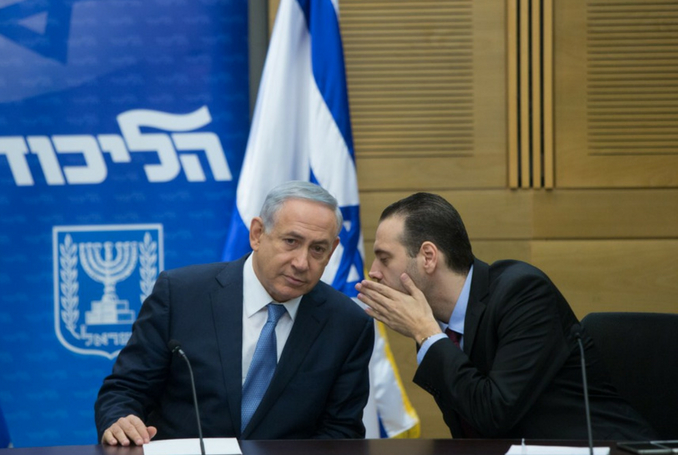
RT | February 13, 2019
Israel and Arab countries are in talks “in order to advance the common interest of war with Iran”, Prime Minister Benjamin Netanyahu has said, although the translation from Hebrew was later downgraded to mere “struggle.”
The promise of a major conflict in the Middle East was floated by the Israeli leader during his trip to Warsaw.
“From here I am going to a meeting with 60 foreign ministers and envoys of countries from around the world against Iran,” Netanyahu said as quoted by Jerusalem Post.
“What is important about this meeting – and this meeting is not in secret, because there are many of those – is that this is an open meeting with representatives of leading Arab countries, that are sitting down together with Israel in order to advance the common interest of war with Iran.”
The Israeli PM is in the Polish capital to take part in a two-day international forum on the Middle East, which starts on Wednesday. Representatives from the United States and the European Union are in attendance in addition to Netanyahu and ministers from Gulf kingdoms. The EU representation at the event however is less than impressive, with heavyweights Germany and France choosing not to send their foreign ministers.
The US delegation is headed by Vice President Mike Pence, who is accompanied by vocal Iran hawk Secretary of State Mike Pompeo and Jared Kushner, President Trump’s son-in-law and advisor. The Anti-Iranian goals of Israel and the US are apparently dominating the agenda of the forum.
“We’re trying to expand the number of nations who are engaged and have a stake in the future of a peaceful and prosperous Middle East,” Brian Hook, the State Department’s special representative for Iran, told Reuters.
The EU is on a shaky ground vis-a-vis Iran as it’s member Poland hosts the meeting. The Europeans are attempting to resist the push for confrontation with Iran coming from Washington, hoping to salvage the 2015 nuclear deal with Tehran. The Iranians still stick to the terms of the agreement even after US scrapped it under the Trump administration, but the promise of lucrative business opportunities with the EU, which was a major part of the incentive for Tehran to accept the deal, are nowhere near to materializing under the threat of American sanctions.
“Today, the Iranian people see some European countries as cunning and untrustworthy along with the criminal America. The government of the Islamic Republic must carefully preserve its boundaries with them,” Iran’s Supreme Leader Ayatollah Ali Khamenei warned ahead of the gathering in Warsaw.
Israel and Iran are already engaged in a proxy war in Syria, where Israeli military regularly attack what they call Iranian military targets encroaching on Israel. Building on the foundation of common hostility with Iran, the Jewish state also entered cozy relations with Saudi Arabia and its Gulf supporters over the past decade.
Whether the regular exchange of threats grows into an open shooting war in the Middle East, as Netanyahu seems to be promising, is anyone’s guess.
Arms purchases by Middle Eastern countries have doubled: Annual security report
Press TV – February 12, 2019
An annual international security report shows that arms sales to the Middle East doubled during the period between 2013 and 2017 compared to the previous five years.
The Munich Security Report 2019, released on Monday, also said the outsize concentration of weapons in the Middle East increased the risk of confrontation in the region.
“Between 2013 and 2017, the value of Middle Eastern countries’ arms purchases doubled compared to the previous five years, thus bearing the risk of an arms race and military confrontation,” it said.
The report did not name the top purchasers of arms, but they are believed to be the Arab countries in the Persian Gulf region, which traditionally allege that they face a “threat” from Iran and use that pretense to buy advanced weapons from eager suppliers mainly in the West.
The report did reveal the exporters, though. It said 53 percent of the total volume of the arms exports to the Middle East originated in the United States. The US was followed by France (11 percent), the United Kingdom (10 percent), and Canada (seven percent).
Italy, Germany, and Turkey were also among the leading exporters, with their share in the total volume of arms sales to the region equaling six percent, three percent, and two percent, respectively.
‘Countries reevaluating relations with Saudi Arabia following Khashoggi murder’
The report also said that “numerous US politicians and governments of other countries are reevaluating their partnership with Saudi Arabia,” following the state murder of dissident journalist Jamal Khashoggi in the Saudi consulate in Istanbul last October and Riyadh’s deadly military campaign in Yemen.
While the US administration has backed the Riyadh regime in both of those cases, other US politicians, including some of the administration’s allies in Congress, have been concerned by Saudi Arabia’s destabilizing role.
“The US Senate even passed a resolution urging the cessation of any military support to countries involved in the [Yemen] war, thus contradicting White House positions,” the report said.
The US administration on Monday threatened to veto any resolution passed in Congress against Saudi Arabia.
Saudi Arabia and a number of its allies launched a devastating military campaign against Yemen in March 2015, claiming that a popular uprising there was backed by Iran, an allegation denied both by the revolutionaries and Tehran.
According to a new report by the Armed Conflict Location and Event Data Project, a nonprofit conflict-research organization, the Saudi-led war has so far claimed the lives of around 56,000 Yemenis.
The United Nations has said that a record 22.2 million Yemenis are in dire need of food, including 8.4 million threatened by severe hunger. According to the world body, Yemen is suffering from the most severe famine in more than 100 years.
The Munich Security Report 2019 also warned of a possible “risk of an accidental clash” between Saudi Arabia, the US, Israel, and Iran in the region, stressing that the confrontation “cannot be discounted.”
The report comes days ahead of the 55th edition of the Munich Security Conference, which is scheduled to take place in the German city of Munich on February 15-17. Heads of state and defense ministers of more than 80 countries from across the globe attend the event every year.
With 3.8 Million Yemenis Displaced Last Year, New Report Shows Country’s Crisis Growing Worse
By Whitney Webb | Mint Press News | February 11, 2019
SANA’A, YEMEN — A report from the Sana’a-based Yemeni government has revealed that the conflict in Yemen — sometimes called the “Forgotten War,” owing to sparse international media coverage — continues to grow more dire with each passing day.
Among the report’s most troubling findings are the staggering number of people who were displaced by fighting last year, with 3.8 million people forced to flee their homes, many of them from the still-besieged port of Hodeida, over the course of 2018. Many of these refugees have sought refuge in or near the Yemeni capital of Sana’a, whose international airport remains under blockade from the Saudi Arabia-led and U.S.-supported coalition.
Another highly troubling aspect of the situation in Yemen, as revealed by this recently released report, is the continued closure of key food warehouses – including those controlled by the World Food Program and the World Health Organization – that are storing food for as many 3.5 million people. While these facilities remain closed, an estimated 18 million Yemenis face severe food insecurity and starvation, including 5 million children. Worse still, the report noted that the Saudi-led coalition bombed four such food warehouses in addition to two trucks carrying food aid, just during the month of December.
The statistics released by the government in Sana’a also reveal the continuation of the Saudi-led coalition’s targeting of critical civilian infrastructure, such as farms and water pumps. According to government figures, during December 2018, the coalition razed 94 farms and damaged another 128 while destroying 68 water pumps and water storage tanks. One hundred and thirty two livestock were also killed by coalition bombs. The U.S. military intelligence has been “fine tuning” the coalition’s airstrike target list since last June, making the U.S. complicit in these crimes against Yemeni civilians.
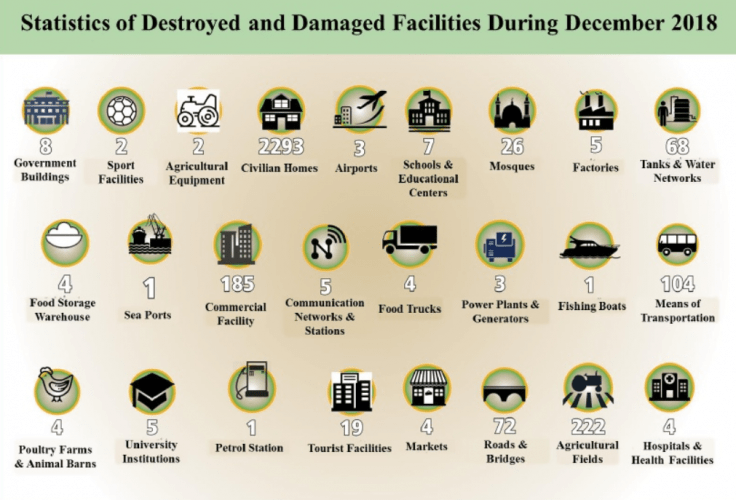
A graphic from the report shows Dec. 2018, targets of the Saudi Coalition in Yemen
What ceasefire?
These figures corroborate the findings of Martha Mundy, Professor Emeritus of Anthropology at the London School of Economics, who recently published a report that asserted that the coalition sought to halt Yemen’s remaining food production as well as its food distribution capacity. This claim is also supported by the fact that, despite the coalition publicly claiming that it has “lifted” the naval blockade of Yemen, 90 percent of importers cannot bring goods into the port of Hodeida, through which the majority of Yemen’s imported food and essential goods passes.
The coalition has justified its targeting of critical food production and water sanitation infrastructure by claiming that Yemeni resistance fighters were hiding weapons in those areas, but have never provided evidence of weapons being found in targeted installations.
The report also notes that the bombing campaign targeting Yemen continues to result in a dizzying number of airstrikes, with a total of 1,509 airstrikes in resistance-held Yemen during last December. The government in Sana’a had previously stated that Yemen, over the course of last year, suffered over 52,000 attacks — including airstrikes, naval bombardments and artillery operations, as well as an average of 50 airstrikes per day.
However, what makes the December figure so striking is the fact that “peace negotiations” took place early on in that month, which ostensibly led to a ceasefire that the Saudi coalition went on to violate over 800 times. During the month of peace negotiations and alleged ceasefire, 61 civilians were killed by coalition attacks, including 15 children. Another 109 civilians were wounded and 2,293 civilian homes — many likely unoccupied, with their former residents now displaced refugees — were destroyed or severely damaged.
While many continue to hope for a swift and peaceful outcome to the atrocious and genocidal war against Yemen, the Saudi-led coalition’s choice to continue raining bombs down on key civilian infrastructure — specifically areas involved in food production during a time of unprecedented famine — shows that these powerful governments and their allies remain determined, in their pursuit of regional geopolitical dominance, to push the Yemeni people to the brink of annihilation by starvation, preventable disease and bombs.
Read | The December 2018 Report on the Situation in the Republic of Yemen
Whitney Webb is a staff writer for MintPress News and has contributed to several other independent, alternative outlets. Her work has appeared on sites such as Global Research, the Ron Paul Institute and 21st Century Wire among others. She also makes guest appearances to discuss politics on radio and television. She currently lives with her family in southern Chile.
Hopes Fade for EU to Rescue Iran Via Banking Scheme to Bypass Sanctions – but Was It Ever a Serious Plan?
By Martin JAY | Strategic Culture Foundation | 08.02.2019
At the end of September, the European Union unveiled plans to help Iran bypass sanctions imposed by the US, so that it could sell oil and even trade with EU countries. The move followed Trump finally losing his patience over the so-called Iran Deal – a treaty drafted by Barak Obama which effectively prevented Iran from developing nuclear weapons in return for opening up Iran’s economy to the West and unblocking funds held outside of the country – which he dismisses as a bad deal for American interests in the region.
In reality, Trump’s real problem with the Joint Comprehensive Plan of Action (JCPA), is the same one which vexed America’s two strongest allies in the Middle East, which is that it did nothing to curtail Iran’s real strength against any external threat: its ballistic missiles program.
And so, to appease these two partners, who felt betrayed by Obama, sanctions were imposed against Iran – along with secondary sanctions, imposed via other countries (although this has not been as successful as Trump would have hoped) – and a new ‘war’ against Iran began, aimed at largely toppling its moderate government, while Saudi Arabia gains time to move ahead with its own ballistic missile program.
A key part of spurring a downfall of the present regime in Tehran, was both secondary sanctions wielded against Turkey, China and India, threatening them against buying Iran’s cheap oil, along with forcing the EU to stop trading altogether with Tehran. At one point, Trump’s plan looked like it was working with Europe as all the main investors inside Iran packed their bags and promptly left Iran within weeks of his sanctions plan being announced.
But there was great optimism about Iran finding a clever go-around and still sell its oil to EU governments as well as foster trade with European companies who were not afraid of the threats from the US via its banking system to shut companies off from the US market.
The European Union’s own foreign policy damsel, Federica Mogherini, who stole a lot of the credit for the Iran Deal being signed in the first place (when in reality the Iranians humored her with this idea all along) had a plan. She soon announced that a new banking system to be called INSTEX would be created specifically to allow EU governments and companies to trade with Iran. Although on paper it seemed pretty simple, there were warnings from experts that it might be a difficult task to pull off, given the complexities of international banking, not to mention international laws; moreover, the EU has no real track record of pulling off anything so bold as this before as the so-called ‘foreign policy’ initiatives it has are largely grand ideas on paper – fantasies of what it might be one day rather than the present day European External Action Service which employs over a 100 ‘ambassadors’ who largely live in Djin palaces and keep the dream alive around the world in exotic locations whose governments are happy to give Brussels the cash-for-hegemony deal anytime.
Sadly, it seems that Mogherini’s plan for the banking scheme which was to send a clear signal to Trump as well as keep the Iran Deal alive, is folly and delusional – given that, for Mogherini and her colleagues, the Iran Deal is seen as their great success to exercise EU foreign policy into concrete terms and to create the first ever international treaty drafted by Brussels. It is more or less sacrosanct and considered to be a treaty which now can be used to exert EU hegemony against Trump’s new world order which they consider geopolitical heresy.
Yet the Iran Deal has so much fake news and false prophesies – like Trump’s claims that the Iranians got 150 billion dollars from it, when in reality they only got just over 30 and it was their money in the first place – and the EU’s idea seems just that. Just more fake news.
For the first time, there are growing doubts about both whether it can be pulled off and whether it was a genuine offer in the first place as Brussels appears to be at odds with the giants of the EU, who are cranking up the sanctions to new levels.
Just recently, France’s foreign minister warned Tehran of new sanctions if Tehran would not agree to curbs its ballistic missiles program, regardless of the fact that ballistics were never part of the Iran Deal. France, a founding member of the European Union itself and a country with real clout in Brussels seems to be at odds with the EU’s plans, to say the least. Or was the Brussels plan the real deal in the first place?
Concurrent to this, are also the first real signals from Tehran that it doubts the EU’s sincerity in the draft banking plan. Politicians there, feeling the heat from sanctions and living with daily rumours of a possibility of a military coup engineered by the charismatic, anti-US military figure Qasem Soleimani, are starting to cry foul.
In reality, we shouldn’t get too excited about the scheme, as Tehran clearly isn’t holding out too much hope. In addition to there being many doubts about whether European firms will sign up to it, even if it gets off the ground it will only appeal to smaller companies that are flying under the US radar anyway. Additionally, earlier hopes that it could be used to sell Iran’s oil to Europe, have been dashed.
The EU is living in dangerous times. With its own elections this May expected to give record wins to nationalist, populist parties – in particular in France – it is facing its worst ever credibility crisis, which explains the fear mongering led by President Macron with his latest Brexit speech. But if Brussels can’t deliver on Iran’s rescue package, then it won’t matter if far right parties dominate the European parliament, signaling the demise once and for all, of the EU as we know it. Brussels will never be taken seriously again around the world where it practices its fake hegemony as no one will forget the farce of the EU and the Iran Deal. INSTEX may well be the sword that the EU falls on, certainly on the world’s stage, when the hype dies down and it is dispatched to the press room floor as folly for a wannabee superpower.
Yemen: Hodeida Truce in New Hands as UN Replaces Biased and Ineffective Monitor
By Ahmed Abdulkareem – MintPress News – February 5, 2019
SANA’A, YEMEN — The newly-appointed head of the United Nations mission to monitor Yemen’s truce agreement between the Houthis and the U.S.-backed Saudi coalition, Danish Lt. Gen. Michael Anker Lollesgaard, arrived in Yemen’s capital Sana’a on Tuesday, along with a five-member team, to assume his duty in the country’s Red Sea port city of Hodeida. Lollesgaard succeeds retired Maj. Gen. Patrick Cammaert.
The development comes after MintPress News revealed on January 24 that the United Nations promised to replace Cammaert, who was leading a UN joint committee tasked with overseeing the truce in Hodeida, a conduit for the delivery of desperately needed humanitarian aid. The replacement of the joint committee’s head was promised in order to save the fragile truce after the Houthis accused Cammaert of pursuing an agenda favoring the Saudi-led coalition, according to a high-ranking Houthi official.
Prior to his replacement, the Houthis boycotted a meeting chaired by Cammaert in Hodeida, accusing him of pushing the Saudi coalition’s agenda after he requested that Houthi forces withdraw eight kilometers outside of Hodeida while asking Saudi coalition forces to withdraw only half a kilometer — giving the coalition an opportunity to quickly occupy Hodeida unopposed, according to a source in the negotiating committee.
In an attempt not to portray the change as a victory for the Houthis, U.N. spokesman Stephane Dujarric, who announced Lollesgaard’s appointment on January 31, said Cammaert was on a temporary one-month contract and did not resign. However, the decision to appoint a new monitoring chief in Yemen’s key port may give UN envoy Martin Griffiths a chance to succeed, according to observers who spoke to MintPress.
Monday on a UN-hired ship off Hodeida, Cammaert held his final meeting between the Houthis and coalition representatives in an effort to end a month-long stalemate over the implementation of a mutual troop withdrawal from the port city.
Yemenis still see the agreements reached in Sweden as the best chance yet of ending the Saudi war against the poorest country the Middle East, a war that has killed thousands of people since it began in 2015 and pushed 14 million to the brink of famine, according to the United Nations.
In the view of Yemeni analysts who spoke to MintPress, if Saudi Arabia persists in its behavior, no UN envoy or monitor will be able to help reach a peace agreement in Yemen; and, without pressure on the Kingdom, the UN will go on playing a feeble role. Accordingly, the replacement of the head of the UN monitoring mission is regarded as effectively meaningless by many Yemenis.
The Saudi-led coalition appears willing to commit to war as a solution and further fighting will give rise to more disease, famine, and lack of access to humanitarian aid and food commodities. The repercussions will be fast and conspicuous across Yemen.
“Hanging in the balance”
Representatives of the Saudi coalition and the Houthis met in Jordan on Tuesday for a new round of UN-brokered talks on a troubled prisoner-swap deal that was initially agreed on in Stockholm last December. UN envoy Griffiths said the new talks aim to finalize the lists of prisoners and detainees to be released or exchanged.
A source on the negotiation committee told MintPress that the Houthis proposed releasing 400 prisoners from both sides as an initiative to get the talks going. There was no comment from Saudi Arabia on the proposal.
Last week, representatives from the coalition and the Houthis had held a round of UN-brokered negotiations in the Jordanian capital city of Amman to hammer out details of the prisoner exchange. The two sides met separately with the mediators and submitted lists of prisoners they wanted to be released.
Both sides have said repeatedly they remain committed to the agreement, which could see thousands of prisoners released by each side, including hundreds of al-Qaeda and ISIS members who were fighting on behalf of the coalition. So far, however, no breakthrough has been made.
Fears linger that failure of the prisoner exchange would have a knock-on effect on the next round of peace talks, owing to the nature of the list of prisoners made by both sides. Each side presented a list of up to 8,000 detainees to be freed, but many of those detainees on the list are not able to be accounted for, according to a senior official from the International Committee of the Red Cross. The prisoner swap would, therefore, involve a significantly lower number of prisoners, an outcome likely to draw the ire of both sides.
A senior International Committee of the Red Cross official, which will oversee the deal’s implementation, said on Monday that the prisoner exchange was “hanging in the balance,” with trust among the parties “insufficient.” He also indicated that “there is a lot of disappointment on both sides,” adding: “What we now see on both sides is that they don’t have them all [i.e., the listed prisoners] because a lot of them, they probably died during the conflict.”
There are positive signs, however. In a move that could boost ongoing UN-led efforts to save the deal, the Houthis released an ailing Saudi prisoner, Musa al-Awaji, on humanitarian grounds at the end of January. The Saudi coalition also released seven Houthi prisoners who were not part of the negotiated exchange.
Ahmed AbdulKareem is a Yemeni journalist. He covers the war in Yemen for MintPress News as well as local Yemeni media.
Weapons ending up with terrorists is OK, as long as Obama did it: The world according to CNN
RT | February 5, 2019
A “bombshell” CNN report has revealed that US-made weapons found their way to Al-Qaeda-linked fighters in Yemen. But is anyone surprised? And where was CNN when the Obama administration armed hardcore jihadists in Syria?
The CNN investigation revealed how American-made weapons ended up in the hands of “al Qaeda-linked fighters, hardline Salafi militias, and other factions waging war in Yemen,” vis-a-vis the US’ coalition partners Saudi Arabia and the UAE. Some of these weapons have also been seized by Iranian-backed militias, CNN claims.
The hardware, referred to as “Beautiful military equipment” by President Trump, was supplied to Saudi Arabia and the UAE, who have backed the embattled Yemeni government in its three-year civil war against Houthi rebels. However, CNN claims that Saudi Arabia and the UAE have funnelled the arms to pro-government factions, including the islamist Giants Brigade and the Al-Qaeda-linked Abu Abbas brigade.
The shifting frontlines in Yemen ensured that many of these weapons – including wire-guided TOW missiles and mine-resistant armored vehicles (MRAPs) – ended up seized by Houthi militants and Iranian proxy forces. More American weapons still ended up for sale in Yemen’s teeming arms bazaars, where they fetch a higher price than the rusted AK-47s more common to the region.
CNN lays responsibility squarely at the feet of Saudi Arabia, the UAE, and the Trump administration, which refused to cancel its multibillion dollar arms deals with the Saudis last year, for fear of losing “all of that investment being made into our country.”
The report paints a depressing, but familiar picture. Picking sides in foreign wars has historically proven disastrous for the United States, yet successive administrations have made the same mistakes again and again. The Reagan administration armed Saddam Hussein in his war with Iran, going as far as arranging the sale of anthrax to the Iraqi leader. Both Jimmy Сarter and Ronald Reagan propped up the Afghan mujahideen in their fight against the Soviets in the 1980s. In both cases, US forces would be shot at with the same weapons just two decades later.
Covering for Obama
More recently, in 2014 Barack Obama announced that the US would hand-select and arm ‘moderate rebels’ in Syria, stepping into the country’s bloody civil war. That too would prove disastrous, with troves of US arms ending up in the hands of Al-Nusra and ISIS.
But where was CNN when Obama asked Congress for $500 million to train, arm, and “empower the moderate Syrian opposition?”
CNN was reporting the news verbatim from Obama’s mouth, repeating the phrase “moderate rebels” without the ironic quotation marks that have become necessary since. Obama’s assertion that the rebels offered the “best alternative to terrorists and a brutal dictator” was not questioned, unlike Trump’s continuation of the longstanding US policy of arming the Saudis.
Obama called for funding in June 2014, but Syrian militias had already received support from the CIA for two years at that stage. CNN’s reporting on the covert arms pipeline was scant, didn’t question the credentials of the recipients, and mostly repeated the line of US intelligence officials: “That is something we are not going to dispute, but we are not going to publicly speak to it.”
Few questions were asked as Congress authorized the military support that September, and none were asked a year later as Obama resupplied his chosen rebels in Syria. Instead, Obama’s declaration of support for “the moderate Syrian opposition” was taken at face value and left unquestioned.
The reality in Syria
As CNN repeated the White House line on Syria, the network published just one report hinting that things might be amiss: an investigation by Amnesty International that found Islamic State (IS, formerly ISIS) militants were armed to the teeth with US-made weapons. The weapons were acquired by IS from local forces armed by the Obama administration, and then used to “relentlessly” target civilians with “small arms, artillery fire and huge quantities of improvised explosive devices.”
While CNN was assuaging the public, the situation on the ground in Syria was anything but moderate. US arms were quickly sold on the black market by ‘moderate rebels’ who either retired from the fight or wanted to turn a quick buck. With morale low, some of these fighters literally handed their weapons to Al-Nusra jihadists in exchange for safe passage away from the frontlines, while more were stolen by the Islamists.
Moreover, one Al-Nusra commander codenamed Abu Al Ezz told the German Koelner Stadt-Anzeiger newspaper that his group, and not so-called ‘moderate rebels’, received TOW missiles directly from the US. “The missiles were given to us directly,” he said, adding: “The Americans are on our side.” The commander went on to detail how his fighters had received training from US instructors, and financial support from Saudi Arabia and Israel for capturing specific objectives in Syria.
The Trump administration ended the arms supply program to the Syrian rebels in 2017, a decision that CNN called“a big win for Russia.” The idea that ending material support for terrorists might just be a good thing was not raised, and CNN described the program as “a lifeline” to anti-government forces.
CNN even stuck by its straight-faced use of the term ‘moderate rebels’, despite multiple other news outlets publishing reports of US weapons falling into terrorist hands.
Two months before the 2016 election, CNN absolved Obama of all his sins in Syria by publishing an interview in which the then-president said the situation there “haunts” him constantly. The network blamed external factors for the deteriorating situation in Syria, and ended with a quote from Obama’s press secretary, who said that every one of the former president’s decisions “was squarely within the national security interest of the United States and even advanced our national security interests.”
CNN’s latest exclusive report is a well-researched piece of journalism, fleshed out with on-the-ground reporting from war-torn Yemen. However, given the network’s history in reporting US arms programs, it was much more likely motivated by a desire to score points against Trump than the pursuit of cold truth, no matter who is in charge.
Did Khashoggi Really Die?
By F. William Engdahl – New Eastern Outlook – 23.01.2019
I have not been convinced about the claims coming from Turkey and from the Washington Post and others regarding the allegations of a gruesome murder of intelligence asset, Jamal Khashoggi, in October, 2018. There are too many anomalies as it was portrayed by various statements from Turkey President Erdogan, and echoed by a chorus of the Western mainstream media. Recent research suggests that perhaps Khashoggi was never in that Saudi Consulate in Istanbul that day, and in fact may still be quite alive and in hiding. If so, it suggests a far larger story behind the affair. Let’s consider the following.
The best way to outline this is to go back to the events around the surprise arrest and detention of numerous Saudi high-ranking persons in late 2017, by Prince Mohammed bin Salman or MBS as he is known. On November 4, 2017 MBS announced via state TV that numerous leading Saudis including one of the wealthiest, Prince Alwaleed bin Talal, had been arrested on charges of corruption, and were being detained in the Riyadh Ritz Carlton hotel. Prince Alwaleed is clearly the critical person.
The son-in-law of President Trump had reportedly made a non-publicized visit to Riyadh for private talks with MBS just days before the mass arrests. A report in the UK Mail newspaper in 2018 claimed that Jared Kushner, representing the President, had informed MBS of a rival Saudi Royals plot to eliminate the Crown Prince. Prince Alwaleed was reported to be at the center of the plotters.
After three months imprisonment, Alwaleed was released from detention on 27 January 2018, following a reported financial settlement. In March 2018 he dropped out from Forbes’ World’s Billionaires’ list. Before his arrest Alwaleed was the largest shareholder in Citibank, a major owner of Twitter, once partner of Bill Gates in Gates Foundation vaccine programs, and generous donor to select Democrats such as Hillary Clinton and the Clinton Foundation. According to media reports, Hillary campaign aide Huma Abedin’s brother, Hassan Abedin, Muslim Brotherhood member, worked with Bin Talal on a project called “Spreading Islam to the West.” Bin Talal and other Saudi sources donated as much as $25 million to the Clinton Foundation as she was preparing her Presidential bid. The Prince was also an open foe of Donald Trump.
Who was Khashoggi Really?
Jamal Khashoggi was no ordinary journalist. He actually worked for Prince Alwaleed bin Talal. In an interview in the Gulf Times in November last year Alwaleed stated, “Jamal wasn’t only my friend. He was working with me. Actually, his last job in Saudi Arabia was with me…” Jamal was, or is, nephew of CIA-linked asset, the recently deceased Adnan Khashoggi, a nefarious arms dealer involved in the CIA-Saudi BCCI bank and Iran-Contra. Nephew Jamal also worked for the then-Saudi Ambassador in Washington, Prince Bandar, someone so close to the Bush family that George W. nicknamed him “Bandar Bush.” In short, Khashoggi was part of Saudi circles close to the Bush-Clinton group. When King Abdullah decided to skip over Alwaleed’s father, Talal bin Abdulaziz Al Saud, dubbed “The Red Prince” for his reformist views, in his succession, a move that led to Salman, father of MBS, as successor, Alwaleed was on the outs in the Saudi power calculus of King Salman and Crown Prince MBS.
The Saudi government as well as the Brookings Institution confirm that Khashoggi had been a member of the Muslim Brotherhood. The Brotherhood was banned from Saudi Arabia in 2011 following the Obama-Hillary Clinton Arab Spring, when the Saudi monarch, King Abdullah, and those around him realized that the royal house itself was a potential target for brotherhood regime change, as in Egypt and Tunisia.
The Obama Administration, as I detail in Manifest Destiny, working with the CIA, planned a drastic series of regime changes across the Islamic world to install Muslim Brotherhood regimes “friendly” with the CIA and the Obama administration. Key members of the Obama Administration, including Secretary of State Hillary Clinton’s special assistant, Huma Abedin, had deep ties to the Saudi part of the Muslim Brotherhood where Abedin’s mother lives. Her mother, Saleha Abedin– an academic in Saudi Arabia where Huma grew up– according to a report on Al Jazeera and other Arab media, is a prominent member of the womens’ organization of the Muslim Brotherhood, and Huma’s brother is also reported linked to the organization. Notably, the late John McCain, whose ties to leading members of ISIS and Al Qaeda is public record, tried to discredit fellow Republican Congresswoman Michele Bachmann for pointing to Abedin’s Muslim Brotherhood ties. This is the faction within Saudi Arabia that Khashoggi was tied to.
As President, Trump’s first foreign trip was to meet MBS and the Saudi King, a trip sharply criticized by Democrat Congresswoman Nancy Pelosi. Once a Trump Presidency moved to rebuild the frayed relations that had developed between Obama and the Saudi monarchy under King Abdullah and later King Salman, father of Crown Prince MBS, the faction around pro-Obama Prince Bin Talal Alwaleed was out of favor, to put it mildly, especially after Hillary Clinton lost. In June 2017 Alwaleed’s former employee, Jamal Khashoggi, fled into self-imposed exile in the US where he had studied earlier, after the government banned his twitter account in Saudi.
Khashoggi alive?
Once MBS acted to arrest Alwaleed and numerous others, the future of the money flows between Alwaleed to not only Hillary Clinton, the Clinton Foundation and to other Democrats he had “supported” with Saudi millions, was in jeopardy. While it is difficult to confirm, a BBC Turkish journalist in Istanbul reportedly told an arab language paper after the alleged gruesome murder and dismemberment of Khashoggi that, in fact, Jamal Khashoggi was alive and well, somewhere in hiding.
It is a fact that former CIA head and now Secretary of State Mike Pompeo, along with then-Defense Secretary James Mattis, gave a briefing to the US Senate in which they told the senators that there was no evidence to suggest MBS was behind this alleged crime. They added that they couldn’t even confirm a crime had happened! Only CIA head Gina Haspel, former CIA London station chief, disputed their claims. The Erdogan claims that the body was chopped up and then dissolved in acid for disposal without trace harkens back to the account of the Navy Seal disposal of the dead body allegedly of Osama bin Laden, which the Obama Administration claimed they dumped at sea “according to Muslim tradition.” Conveniently in both cases there was no body to forensically confirm.
Indeed the allegations to world media around the Khashoggi affair were tightly controlled by Turkey’s President Erdogan who repeatedly promised then failed to reveal, what he said were secret Turkish intelligence tapes of the alleged murder. Erdogan is reported very close to the Muslim Brotherhood if not a hidden member, one reason for his close support of Qatar after MBS and the Saudi king declared economic sanctions on Qatar for support of terrorism, in fact Qatari support of the Muslim Brotherhood.
Here we are dealing with shifting political alliances with huge consequences potentially for US and world politics given the enormous size of the Saudi financial resources. It’s also bizarre that Khashoggi allegedly agreed to go to a Saudi Consulate in Turkey and to supposedly get divorce papers. Further, his reported fiancée, Hatice Cengiz, seems to be equally mysterious, with some asking whether she in fact is an agent of Turkish intelligence used to discredit Saudi Arabia.
The claims of Erdogan of the assassination of Jamal by a Saudi team were buttressed by a mysterious Khaled Saffuri, who told Yahoo News reporter, Michael Isikoff, that Khashoggi became a bitter foe of MBS for his articles in the media criticizing the arrests of Prince Bin Talal and others. Research reveals that Saffuri, media source on the Khashoggi alleged murder, also has had close ties to the Muslim Brotherhood front organization, American Muslim Council, and to Qatar, host to the exiled Brotherhood for years. Qatari support for the Muslim Brotherhood was a factor in the break between MBS and Qatar two years ago.
Saffuri is also the protégé of al-Qaeda fundraiser Abdurahman Alamoudi, reportedly also an influential Muslim Brotherhood supporter who before 2004 met with both G.W. Bush and Hillary Clinton. Alamoudi is currently in US federal prison since 2004 for his role as bagman for a Libyan/Al-Qaeda assassination plot to assassinate then-Saudi Crown Prince Abdullah. In brief, the prime sources on the Khashoggi murder are few and hardly without bias.
At this point it is difficult to go beyond speculation. Clear is that Jamal Khashoggi is missing from public view since early October. But until the Turkish government or someone else presents serious forensic evidence, habeas corpus, that indeed shows Alwaleed’s former employee, Jamal Khashoggi was murdered by a Saudi assassination team, let alone by one commanded by Crown Prince bin Salman, the situation warrants more serious examination. It is curious that the same liberal media such as Jeff Bezos’ Washington Post that attacks MBS for the alleged murder of their reporter, Khashoggi, fails to criticize previous Saudi executions or even subsequent ones.
Did Khashoggi really die at the Istanbul Consulate or was something else going on? To stage a fake execution of Khashoggi to discredit and even possibly topple MBS might possibly have appeared to Alwaleed and his CIA friends in Washington to be a clever way of restoring their power and financial influence. If so, it seems to have failed.
Pompeo the Warmonger Supports Authoritarian Regimes
By Brian CLOUGHLEY | Strategic Culture Foundation | 20.01.2019
On January 2 US Secretary of State Mike Pompeo visited Brazil, and his Department noted that in discussions with Foreign Minister Ernesto Araujo they “highlighted the importance of working together to address regional and global challenges, including supporting the people of Venezuela, Cuba, and Nicaragua in restoring their democratic governance and their human rights.” Pompeo declared that the US and Brazil “have an opportunity to work alongside each other against authoritarian regimes.”
From this we gather that Pompeo is a strong advocate of democratic governance and will always make it clear that the United States supports unfortunate people living in countries having “authoritarian regimes.” It is apparent he must believe in the Universal Declaration of Human Rights which states that “everyone has the right to freedom of thought, conscience and religion.”
Unfortunately it transpired that Pompeo is a selective supporter of democracy and freedom of religion, because after he left Brazil and went to the Middle East he voiced vigorous support for despots who rule countries in a manner that is undeniably authoritarian.
In a speech in Cairo on January 10 Pompeo threatened Iran and declared that “Nations are rallying to our side to confront the regime like never before. Egypt, Oman, Kuwait, and Jordan have all been instrumental in thwarting Iran’s efforts to evade sanctions.” It must be gratifying for him that these nations have joined the US in its crusade against Iran, three of them being hereditary monarchies and one run by a non-regal martinet.
Oman, for example, is “an absolute monarchy by male primogeniture. The Sultan, Qaboos bin Said al Said, has been the hereditary leader of the country since 1970.” Freedom House notes that “The regime restricts virtually all political rights and civil liberties, and imposes criminal penalties for criticism and dissent… Political parties are not permitted, and the authorities do not tolerate other forms of organized political opposition.”
In Jordan “the monarch holds wide executive and legislative powers, including the appointment of the prime minister and all seats of the senate. The monarch approves and dismisses judges; signs, executes or vetoes all laws; and can suspend or dissolve parliament.”
The leader of Kuwait, the Amir, according to the CIA Factbook, is “chosen from within the ruling family, confirmed by the National Assembly; the prime minister and deputy prime ministers are appointed by the Amir.” In this autocracy, according to Human Rights Watch, there are “no laws prohibiting domestic violence or marital rape… a man who finds his mother, wife, sister or daughter in the act of adultery and kills them is punished by either a small fine or no more than three years in prison.”
Pompeo wants “democratic governance and human rights” in Venezuela, Cuba, and Nicaragua. Why not in Oman, Jordan and Kuwait?
The only one of Pompeo’s countries not ruled by a supreme monarch is Egypt, whose president is Field Marshal Abdel Fattah al-Sisi who “was elected in May 2014, almost a year after he removed his elected predecessor, the Muslim Brotherhood’s Mohammed Morsi, from office in a coup.” Sisi “won a second four-year-term in March 2018 against a sole minor opposition candidate. Human rights lawyer Khalid Ali and former prime minister Ahmad Shafiq withdrew from the race, and the former armed forces chief of staff Sami Anan was arrested.”
In his warmongering anti-Iran, anti-Syria speech Pompeo announced that his visit to Egypt was “especially meaningful for me as an evangelical Christian, coming so soon after the Coptic Church’s Christmas celebrations” and visited the Cathedral of the Nativity of Christ and the Al-Fattah Al-Alim mosque where he praised Egypt’s “freedoms here in this houses [sic] of worship, these big, beautiful, gorgeous buildings where the Lord is clearly at work.”
He ignored Amnesty International’s statement that in Egypt “the authorities continued to violate the right to freedom of religion by discriminating against Christians.” His own Department recorded that last year “Irrespective of religion, authorities also did not apply equal protection to all citizens and sometimes closed churches, in violation of the law, according to multiple sources.”
The bigotry of the Egyptian regime and its clerics was epitomised on January 13 when Al Azhar University which is responsible for “a national network of schools with approximately two million students” expelled a female student for being hugged by a male friend. The scandal was revealed in a video clip which “showed a young man carrying a bouquet of flowers kneeling before a young woman and then hugging her in what appeared to be a marriage proposal.” According to a University spokesman this violates “the values and principles of society”. There was not a word from Pompeo, that self-declared admirer of Egyptian places of worship where “the Lord is clearly at work.”
Pompeo continued his tour of the region, and next day, as he landed in Saudi Arabia, the Egyptian regime announced that for the seventh time it had extended its state of emergency which “allows authorities to take exceptional security measures, including the referral of terrorism suspects to state security courts, the imposition of curfews and the confiscation of newspapers.” This would be supported in Saudi Arabia where, as chronicled by Freedom House, the “absolute monarchy restricts almost all political rights and civil liberties. No officials at the national level are elected. The regime relies on extensive surveillance, the criminalization of dissent, appeals to sectarianism, and public spending supported by oil revenues to maintain power. Women and religious minorities face extensive discrimination in law and in practice.”
This discrimination was highlighted by the New York Times on January 13 when it published an Op-Ed by Alia al-Houthlal that implored Pompeo to ask Saudi Prince Mohammad bin Salman to release her sister, the women’s rights activist, Loujain al-Houthlal, who is imprisoned in Riyadh. Ms Alia al-Houthlal wrote that her sister had been tortured in prison, and that a close associate of bin Salman, Saud al-Qahtani, who has been named in connection with the murder of Mr Jamal Khashoggi [brutally killed in the Saudi consulate in Istanbul on October 2 last year], was present at several torture sessions.
The Times reported that Pompeo began his conversation with bin Salman, the de facto ruler of Saudi Arabia, by saying “I want to talk to you about a couple of places we’ve been. We think we learned a lot along the way that will be important going forward.” There was no mention of the torture of Loujain al-Houthlal or any other gross violations of human rights in Saudi Arabia where the regime continues to “repress peaceful activists and dissidents, harassing writers, online commentators and others who exercised their right to freedom of expression by expressing views against government policies.”
There was none of that embarrassing stuff. It was all skated over, with Pompeo saying only that “we spoke about human rights issues here in Saudi Arabia – women activists. We spoke about the accountability that – and the expectations that we have. The Saudis are friends, and when friends have conversations, you tell them what your expectations are.”
Pompeo’s expectations include joint action with the Saudi regime and other Middle East autocracies to “counter Iranian malign influence,” which he regards as an even higher priority than “working against authoritarian regimes” in Latin America, which Washington is determined to dominate. Pompeo’s objections to authoritarianism are highly selective, for in his Cairo speech he confined himself to describing Iran “malevolent,” and “oppressive” while denouncing “Iranian expansion” and “regional destruction,” which is a trifle ironic, coming from a Secretary of State whose military devastated Iran’s neighbours, Iraq and Afghanistan.
Pompeo’s ethical approach is decidedly ambiguous and his moral flexibility would attract the admiration of a trampoline gymnast. His Cairo speech was titled “A Force for Good: America’s Reinvigorated Role in the Middle East,” but it is apparent that reinvigoration is confined to plans for destruction of Iran, in which Washington will be assisted by Pompeo’s friends — the Middle East’s authoritarian regimes.
Pakistan wriggles out of IMF clutches
By M. K. BHADRAKUMAR | Indian Punchline | January 13, 2019
The visit by Saudi Arabia’s Energy Minister Khalid A Al-Falih on Saturday to Gwadar to inspect the site allocated for a multibillion oil refinery in the port city suggest that Riyadh and Islamabad are giving the final touch to reaching agreement for a Saudi Aramco Oil Refinery in Pakistan. Reports say that Saudi Arabia will be investing $10 billion in the proposed project.
Without doubt, this is a major development in the region. The Saudi-Pakistan relationship, which has been traditionally close and fraternal, is moving on to a new level of dynamism. The Saudi investment decision can be taken as signifying a vote of confidence in the Pakistani economy as well as in Prime Minister Imran Khan’s leadership. It comes on top of the $6 billion package that Saudi Arabia had pledged last year (which included help to finance crude imports) to help Pakistan tide over the current economic difficulties.
The visiting Saudi minister Khalid al-Falih told reporters in Gwadar, “Saudi Arabia wants to make Pakistan’s economic development stable through establishing an oil refinery and partnership with Pakistan in the China Pakistan Economic Corridor.” This remark highlights that Saudi Arabia is openly linking up with the China-Pakistan Economic Corridor (CPEC). China has welcomed this development, but countries that oppose the CPEC such as the US and India will feel disappointed.
From the Indian perspective, the Saudi investment in Gwadar becomes a game changer for the port city, which was struggling to gain habitation and a name. Inevitably, comparisons will be drawn with Chabahar. India has an added reason to feel worried that its Ratnagiri Refinery project, which has been described as the “world’s largest refinery-cum-petrochemical project” is spluttering due to the agitation by farmers against land acquisition. The Saudi Aramco was considering an investment in the project on the same scale as in Gwadar. Will Gwadar get precedence over Ratnagiri in the Saudi priorities? That should be the question worrying India.
The Saudi energy minister disclosed that Crown Prince Mohammed bin Salman will be visiting Pakistan in February and the agreement on the Gwadar project is expected to be signed at that time. Of course, it signifies that Saudi Arabia is prioritizing the relations with Pakistan. The fact remains that Saudi Arabia has come under immense pressure of isolation following the killing of Jamal Khashoggi.
There is much uncertainty about the dependability of the US as an ally and security provider. Riyadh is diversifying its external relations and a pivot to Asia is under way. Suffice to say, under the circumstances, a China-Pakistan-Saudi axis should not look too far-fetched. There is also some history behind it.
To be sure, Iran will be watching the surge in Saudi-Pakistani alliance with growing trepidation. The Saudi presence in Pakistan’s border region with Iran (such as Gwadar) has security implications for Tehran. Iran has been facing cross-border terrorism.
Tehran cannot but take note that Imran Khan has not shown any interest in reciprocating the overtures it made when he came to power. He is yet to visit Iran. The expectation in Tehran was that Imran Khan who often voiced the political idiom of justice and resistance as an opposition leader would have empathy with Iran. But, as it happened, Imran Khan appears to be far more comfortable as prime minister with the crown princes of Saudi Arabia and the UAE.
Simply put, Tehran misjudged Imran Khan. But Imran Khan’s priorities today are quite understandable. He wants the Gulf Sheikhs to make big investments in the Pakistani economy. He senses that left-wing slogans have served their purpose when he was seeking power but they become liabilities today. Why should he put Pakistan as a torchbearer of resistance politics? In his interview with WaPo, he didn’t mince words in implying that he intended to follow neo-liberal economic policies.
Besides, in strategic terms, one important fallout of the Saudi bailout of Pakistani economy is that there may be no more need for Islamabad to approach the International Monetary Fund for a rescue package. The earlier indication was that Pakistan might seek a $8 billion bailout package. From present indications, the help from Saudi Arabia, China and the UAE will enable Pakistan to avoid seeking IMF assistance. (The UAE and Pakistan formalized a $6.2 billion bailout package last week in Islamabad.)
The US had openly threatened that any IMF bailout would be conditional on a close scrutiny of the CPEC projects. Ironically, it proved counterproductive. As a result, in geopolitical terms, Washington’s capacity to leverage Pakistani policies is significantly diminishing. The impact will be most keenly felt in Afghanistan.
Imperialism Abhors a Void: Guest: Sarah Abed
The Rabbit Hole | January 3, 2019
Cindy Sheehan’s Soapbox
Guest: Sarah Abed
Topic: US “Withdrawal” from Syria
On this episode of Cindy Sheehan’s Soapbox we discussed Trump’s announcement to withdraw US troops from Syria, the media’s reaction, and the impact this will have on Kurdish militias and Syria’s ultimate fight against imperialism.
Below are some of the points that I made during our chat (this is not a full transcript) or some thoughts I would like to expand on.
Cindy asked what I make of Trump’s announcement to withdraw 2,000 troops from Syria.
My response:
Trump had stated during his campaign and his presidency and even prior to that during Obama’s presidency in 2013 that he did not think we should be in Syria, nor should we be bombing Syria, that it was a waste of money and lives and that the Arab League and neighboring countries should be the ones to step up to the plate.
I think this was one of the reasons that many people voted for him, because of his non-interventionist foreign policy, which was in stark contrast to that of Hillary Clinton.
In April, of this year he had announced that he wanted to pull the US out of Syria and then just days later there was an alleged chemical weapons attack that was pinned on the Syrian government in Douma, to which Trump responded with attacking multiple targets along with his allies the UK and France.
This of course derailed his plan to pull out US troops, which is the exact outcome that the terrorists that staged the whole theatrical performance had wanted. And we have seen this sort of thing happen time and time again during the war. Whenever the Syrian army and government have made significant progress new allegations and attacks are made against them in corporate media in order to garner international support for military, political intervention as well as increased sanctions.
There are other factors at play with this latest withdraw announcement which was made on December 19th, in addition to standing by his America first promise, campaign statements, saving money and lives, there’s the fact that Turkey’s president Erdogan had threatened to attack the Kurdish militias on his border, if the US didn’t have them removed. He sees the YPG (People’s Protection Units) which was rebranded at the request of the US into the SDF (Syrian Democratic Forces) as an extension of the PKK (Kurdistan workers party) which is a terrorist group that has been in conflict with the Turkish state for decades.
As I had written about back in March the Olive branch operation in Afrin proved that NATO alliances are stronger than any other alliances and that the US will choose Turkey over the Kurds and that’s what we are seeing happen right now. Some have also speculated that Israel may have given the US a heads up that it would be engaging in an intense bombing campaign and that US troops should be sent home so that they are not caught in the crosshairs.
Cindy asked what I make of the reaction by democrats, liberals, celebrities etc.
My response:
It would be comical if it wasn’t actually dangerous. In their blind opposition to anything and everything that Trump says these overnight analysts and pundits started claiming that if US troops were to withdraw from Syria then Kurds would be annihilated by Turkey or succumb to some other equally horrible fate.
What we have seen over the past few days however is that leaders of Kurdish militias have actually reached out to the Syrian government and asked that they step in and take back Manbij and all the territory under their control west of the Euphrates in order to protect them against Turkey. This is a clear shift in their political alliance away from the US and towards Syria and Russia. Turkey will not directly confront the Syrian army so Trump’s announcement could actually signify a big step towards peace in this almost eight-year western imposed insurrection.
The US entered Syria illegally and has since set up over a dozen military bases and supported the Kurdish militias during the last few years only. Prior to using the Kurdish militias as a tool to create chaos and division in Syria, the US was predominately supporting the hardcore Al Qaeda-linked terrorists in the Free Syrian Army and an assortment of other alphabet soup groups who they affectionately referred to as “moderate rebels” to topple the secular Syrian government.
Had the US not supported the Kurdish militias they would have not had the motivation to turn against the Syrian state. During the beginning of the war, the Kurds were fighting with the Syrian army against terrorists, by the way some still are and many Kurds in Syria are not in agreement with the separatist ambitions of the Kurdish militias.
I want to stress the fact that before 2011 Kurds, Arabs, and Christian minorities lived peacefully in Syria and till now they are NOT the majority. They do not have any justifiable claims to the north eastern region (which also happens to be the most agriculturally and oil rich part of the country) or any other part of Syria. They are a nomadic people and I do not mean that in a condescending way at all but to illustrate that they came into Syria in waves to escape mistreatment in neighboring countries and were treated fairly and given equal rights. Not all Kurds envision a unified Kurdistan that would span four different sovereign countries (Turkey, Iraq, Syria, and Iran). Most Kurdish movements and political parties are focused on the concerns and autonomy of Kurds within their respective countries. Within each country, there are Kurds who have assimilated and whose aspirations may be limited to greater cultural freedoms and political recognition.
It’s also worth noting that only Israel is their main and really only supporter and their plans for an independent Kurdistan align almost perfectly with Israel’s greater Israel plan. They have historically been used by Israel and NATO.
Cindy asked about the demands being made that Russia or Iran should withdraw from Syria if US troops are to be withdrawn.
My response was basically that Russia, Iran, and Hezbollah are there with the Syrian government’s permission. Whereas the US, UK, France, and Turkey are there illegally and need to leave. Cindy noted and I agreed that it’s a false equivalency and a logical fallacy.
We also spoke about fasting to raise awareness #illuminateYemen for the entirely man-made and avoidable Saudi war and genocide that’s been going on for over three years and nine months. We discussed the latest developments and how Saudi Arabia is outsourcing their front line fighters with children and men from Dafur, Sudan and paying their families $10,000.
My response:
Fasting for seven days was a very humbling experience. The war on Yemen is truly heartbreaking especially because it is entirely man-made and avoidable. It’s so important for us to continue to raise awareness and get people to talk about it to literally everyone they know. For the past 3 years and nine months the murderous Al Saud regime, has been bombing civilians using weapons bought from the US, UK, and Germany, what they are doing is nothing short of committing genocide and deliberately starving Yemeni’s them through blockades. Tens of thousands have been killed since it began.
There was actually a report in the New York Times today that Saudi Arabia was recruiting children from Darfur to fight on the front lines and paying their families $10,000. Sudan has been part of the Saudi-led alliance, and deployed thousands of ground troops to Yemen. In the NYT report they said that five Sudanese fighters who had returned from Yemen told them that that children made up 20-40 percent of their units in Yemen.
The fact that House of Saud is on the UN human and woman’s rights council while also being the leading violator in crimes against humanity and the main sponsor of terror in the world shows the western worlds blatant hypocrisy. A United Nations-sponsored peace agreement was signed in Sweden earlier this month, and was agreed upon by both sides to implement a ceasefire in Hodeida. The panel will be meeting again on January 1 to discuss “detailed plans for full redeployment”. Every effort needs to be made for this conflict to end.
SYRIA: The Western Rogue States Must Confess their Crimes Against Humanity and be held Accountable

Christmas 2018 in Damascus, Old City, without mortars from Eastern Ghouta since its liberation in April 2018. (Photo: Vanessa Beeley)
By Vanessa Beeley | 21st Century Wire | January 2, 2019
The West and its allies in the Gulf States, Turkey and Israel have waged an eight year war against the Syrian people. The West has besieged, starved and deprived the Syrian people of humanitarian aid while pouring “aid” into the areas controlled by their extremist sectarian proxy armies.
The West has violated international law and it has enabled the destruction of Syria’s history, heritage and cultural footprint. The West has behaved as a collective rogue state without conscience and without pity for a people its media has systematically dehumanised to enable such a crime to take place.
Despite this war of attrition and despite battling disproportionate force, the Syrian people have refused to capitulate or to abandon their secularism in favour of an extremist tyranny that would destroy their society and persecute the minority communities into extinction. Christmas 2018 has demonstrated the victory of Syrian unity over the regime change project incubated in the West which is now a failed campaign lying in tatters at the feet of the self determination of the Syrian people, the valiant defence by the Syrian Arab Army and the steadfastness of the Syrian Government and its President, Bashar Al Assad.
In Aleppo I spoke with Pastor Ibrahim Nseir of Aleppo’s Presbyterian Church, whom I had also interviewed in 2017. The following is a mixture of quotes and paraphrase from our conversation on New Year’s Eve 2018/19.
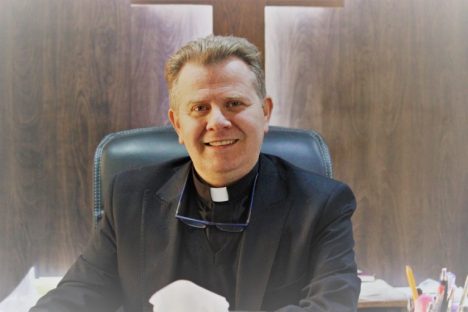
Reverend Ibrahim Nseir, Presbyterian Church, Aleppo. December 31st 2018. (Photo: Vanessa Beeley)
The Presbyterian Church in the Old City of Aleppo was destroyed by the Western-backed terrorist groups in November 2012. An article in the Mennonite World Review in July 2018 described the destruction of the church – “In the old city of Aleppo, Syria, Ibrahim Nseir stands on the pile of rubble that used to be his church. The building where his congregation worshiped is now broken stones and dust. It’s a sunny day, the bright sky a stark contrast to the destruction on the ground.”
After eight years of resistance against the threat of persecution and mass exodus of Christians from Aleppo, Nseir remains defiant and upbeat about the future of Aleppo and Syria. Of the 300,000 Syrian Christians in Aleppo, only 30,000 remain. This is the legacy of sectarian oppression that has been imprinted upon Syria by Western hegemony and it will take generations for it be turned around.
Nseir described the rebuilding process for the Presbyterian Church as difficult but he insisted that it would be rebuilt from its original stones to preserve its historical identity. For Nseir the priorities for Aleppo and Syria are to address the economic situation which has clearly taken a hit on many levels and is suffering in a typical post-war slump. Education is another top priority for this intelligent and enthusiastic Reverend. The intention is to create a center for retreats and conferences at the current Presbyterian Church offices in the center of Aleppo, including a student dormitory.
“We will increase educational capacity by 1000 in the very near future and continue to build upon this progress” Nseir told me.
Education, according to Nseir, is the greatest weapon against extremism and is the only way to re-habilitate children who spent seven of their formative years under occupation of extremist and sectarian factions who worked hard to brainwash almost an entire generation of Syria’s children.
“Ethically the West and the East are responsible for Syria’s destruction. This is not a “Christian” issue, it is a World issue.” Nseir insisted.
The role of the Western media in manufacturing consent for the collective punishment of the Syrian people was clearly a primary cause of the devastation that Nseir and other faith leaders across Syria are now dealing with:
“Western media played more than a negative role, they literally urged the terrorists to take action against the Syrian people by providing false information and blinding people in the West to what was really happening in Syria for eight years. This should never be forgotten.”
Nseir stressed that the healing process for children traumatised by the war would not be easy.
“How do you erase the hatred and horror planted in the brains of 7-10-year-old children by these fanatics? What do you expect from children who have played football with the head of a Syrian Arab Army soldier or who have witnessed the violent abuse of their mother by these terrorists or have seen their father executed by the armed groups? This is the greatest challenge for Humanity and for Syria to put right these terrible wrongs.”
Nseir spoke of the shocking estimated figures of 82,000 children whose father is unknown, referring to the huge number of young women raped or forced into multiple marriages by the terrorist groups and their fighters. How do these children regain their identity and re-integrate into Syrian society? The rebuilding of schools and hospitals must be a priority. The terrorists destroyed “the most developed hospital in the Middle East, Al Kindi” in 2013 and since then, and the destruction of more hospitals across Syria by the terrorist groups, Nseir told me Syria has seen an increase in Cancer and new diseases. Nseir also suggested that this may be attributed to the weapons used by the US Coalition proxies and the U.S itself, which include depleted uranium.
Another important challenge, according to Nseir, is the environmental one. Syria needs to rebuild its natural environment which has also been hugely affected by the conflict. 100,000 trees have been destroyed in Aleppo alone which could lead eventually to desertification of the province if not dealt with. The Governor of Aleppo has recently planted 2,000 new trees but this is an issue that must be addressed with urgency for Nseir.
Nseir strongly believes that Western people should come to Syria independently to see the truth for themselves and report the truth as they see it without any agenda. The Church and the media in the West have maintained a sectarian, divisve narrative which is confusing for people in the West and far from reality.
Nseir addressed the position and status of Syria in the Middle East and described how it has not changed, all that has changed is the perception of Syria portrayed by the media and world leaders who have aligned themselves with the West’s criminal project to partition Syria into sectarian statelets and to remove the elected Syrian government from power by force:
“What has changed since 2011 in reality? Nothing. Syria has always been the protector of the Middle East before 2011, during the conflict and now. The only thing that has changed is the positions of those who turned against Syria, betrayed Syria and who now wish to come back to Syria for protection. We see the Gulf States now change their stance and the UAE has re-opened its embassy in Damascus. The Arab League will welcome Syria back into its fold. Nothing has changed, Syria has remained the same while others have been opportunists and traitors.”
The fact that Syria will forgive its betrayers is testament to what has given Syria victory over its enemies throughout history. With regards to the West, Nseir is not so forgiving:
“The West must go beyond simply stopping its financing of terrorism and the supply of weapons. The West must confess to its crimes against the Syrian people in order to be forgiven. The West must lift the economic sanctions which are a siege upon the Syrian people and it must allow the Syrian people to rebuild in peace without meddling in their affairs. The Syrian people will rebuild according to what the Syrian people want not what the East or the West want. The West has sold the idea that this war was against President Assad but in reality it was against the will of a nation and the people of that nation must be respected”.
Nseir confirmed that the western NGOs are nothing more than political instruments and devices who further the cause of war but he insisted that the West must effectively pay reparations to Syria and expect nothing in return. This is the only way the West can be forgiven by Syria.
Nseir told me that his church will be establishing a medical and health center in the coming months which will be open to everyone in Aleppo to offer medical check-ups and treatment for free. Staff will be trained to deal with the children afflicted by the effects of the war and the terrorist occupation and the plan is to eventually set up special schools to continue the work of rehabilitation for these children. This will enable the coming generations to stand against radicalism and terrorism in the future.
“The West has a duty to respect our dignity and territorial integrity. The Syrian Arab Army has saved the image of our God of Peace, Love and Unity – this has been a spiritual war in Syria not only a military war. The God of love has been embodied by the SAA and our allies and has been victorious over the God of terrorism and hatred. The whole world will change after this war and after Syria’s victory. Syria will be a transformational catalyst for all of Humanity. Syria was never going to be defeated, you only have to study our history to know this. Our society has always embraced diversity and this is the essence of our country. Fanaticism was never going to survive breathing the pure oxygen of our humanity. Actually this demonstrates the stupidity of leaders in the West – to even imagine that extremism has a place in our culture”. Nseir told me.
Nseir ended our talk by stating that the crisis in Syria must be an alarm bell for the country and for its leaders.
“We must re-prioritise our schedule, our agenda and make sure it is not only political but that we address all issues – religious, educational, health care. We must rethink our priorities to ensure a future of peace and stability. At the end I believe strongly that all the negative consequences of this terrible war will be transformed into positive consequences if we address them in the right way. Out of adversity are born the greatest opportunities for the future of Syria and Humanity.”
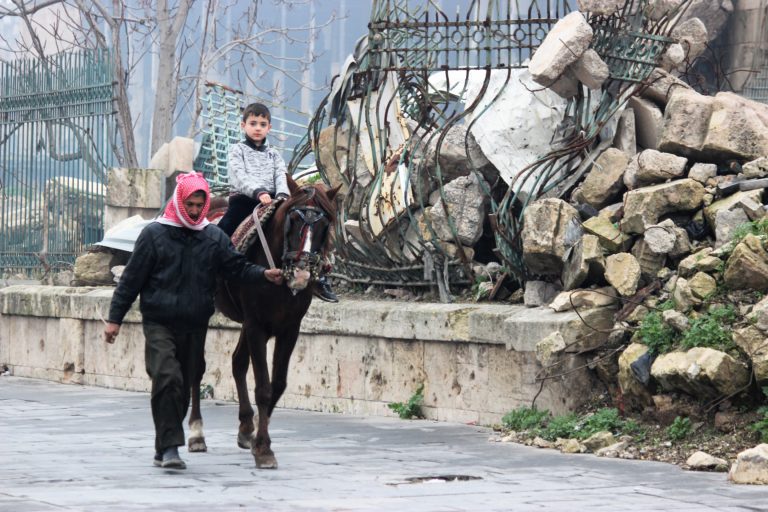
Horse rides on offer at the foot of the Citadel in the Old City of Aleppo. (Photo: Vanessa Beeley)
***
Vanessa Beeley is an independent journalist, peace activist, photographer and associate editor at 21st Century Wire.
Featured Video

Iran FM Araghchi: “Hormuz Will No Longer Be the Same”
or go to
Aletho News Archives – Video-Images
From the Archives
Sam Husseini: The entire US establishment helped lie their way into the Iraq war
By Slava Zilber | American Herald Tribune | October 14, 2019
Sam Husseini is a senior analyst with the Institute for Public Accuracy, independent journalist and contributor to The Nation and FAIR.
Slava Zilber: Sam, three years ago, you appeared on Talk Nation Radio with David Swanson and spoke about the case of the GCHQ whistleblower Katharine Gun. You pointed out that the people involved in the spying on the UN and the people authorizing the Iraq War were not held accountable:
“Virtually everybody who went along with the war, whether it is Kerry or Clinton, of course, the Bush administration themselves has falsified their own records in terms of why, what they did, when they did, why they did it, to the extent that they’ve been scrutinised at all.”
You also address it in a recent article. And recently, Joe Biden has been lying about his position on the Iraq War. How can such an important issue escape meaningful scrutiny? … continue
Blog Roll
 Aletho News
- Oman FM: Persian Gulf states, Iran, Iraq should form security pact excluding US
- Trump peddles fresh falsehoods, claims Iran ‘started the war’ as US aggression drags on
- Ukraine quagmire? Yes, but it’s for NATO, not Russia
- US intelligence hypes Chinese, Russian space threats while accelerating its own military buildup in orbit
- Iran FM Araghchi: “Hormuz Will No Longer Be the Same”
- EU facing trillion-euro debt hole while seeking more cash for Kiev
- How US, Europe, Persian Gulf states exhausted missile stockpiles, splurged billions to defend Israel
- Up in arms… Koreans reject U.S. empire’s plan to make South Korea the next Ukraine
- Iran, Turkey, Pakistan, Saudi Arabia could advance region-led security framework in Tehran: FM spox
- Netizens condemn Japanese drama for projecting Japan’s wartime atrocities onto Chinese characters
- If Americans Knew
- An error has occurred; the feed is probably down. Try again later.
- No Tricks Zone
- Sudden Stratospheric Warming, Powerful El Niño Combination May Lead To Extreme Europe Cold, Energy Crisis!
- Two New Studies Find Thwaites Glacier Melt Cannot Be Driven By Human Activity Or A Warming Ocean
- E-Cars Reduce CO2 Emissions By Only 41% Compared To Internal Combustion Engine Vehicles
- Predictions Made By Renowned Climate Professor Over Past Decades Have Been Proven To Be Poor
- New Study Suggests Large Regions Of The Pacific Ocean Have Been Cooling For The Last 80 Years
- Germany’s Green Energy Debacle: High Energy Costs Force Kahla Porzellan to Close After 182 Years!
- New Study: 50 Years Of The Most Aggressive ‘Net Zero’ Policies Can Only Affect The Global Climate By 0.03°C
- US September “Heat” Was No Record…Many Records Set Decades Ago
- Latest European Green Energy Debacle; Portugal’s Largest Flagship Solar Park Insolvent!
- Green Energy Debacle: German Expert Professor Fritz Vahrenholt Warns Of Severe Economic And Social Consequences

