Did Obama Arm Islamic State Killers?
By Daniel Lazare | Consortium News | December 21, 2017
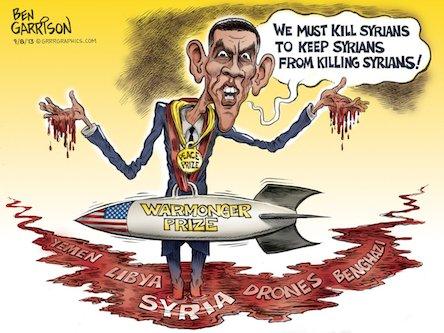
Did Barack Obama arm ISIS? The question strikes many people as absurd, if not offensive. How can anyone suggest something so awful about a nice guy like the former president? But a stunning report by an investigative group known as Conflict Armament Research (CAR) leaves us little choice but to conclude that he did.
CAR, based in London and funded by Switzerland and the European Union, spent three years tracing the origin of some 40,000 pieces of captured ISIS arms and ammunition. Its findings, made public last week, are that much of it originated in former Warsaw Pact nations in Eastern Europe, where it was purchased by United States and Saudi Arabia and then diverted, in violation of various rules and treaties, to Islamist rebels seeking to overthrow Syrian President Bashar al-Assad. The rebels, in turn, somehow caused or allowed the equipment to be passed on to Islamic State, which is also known by the acronyms ISIS or ISIL, or just the abbreviation IS.
This is damning stuff since it makes it clear that rather than fighting ISIS, the U.S. government was feeding it.
But CAR turns vague when it comes to the all-important question of precisely how the second leg of the transfer worked. Did the rebels turn the weapons over voluntarily, involuntarily, or did they somehow drop them when ISIS was in close proximity and forget to pick them up? All CAR will say is that “background information … indicates that IS [Islamic State] forces acquired the materiel through varied means, including battlefield capture and the amalgamation of disparate Syrian opposition groups.” It adds that it “cannot rule out direct supply to IS forces from the territories of Jordan and Turkey, especially given the presence of various opposition groups, with shifting allegiances, in cross-border supply locations.” But that’s it.
If so, this suggests an astonishing level of incompetence on the part of Washington. The Syrian rebel forces are an amazingly fractious lot as they merge, split, attack one another and then team up all over again. So how could the White House have imagined that it could keep weapons tossed into this mix from falling into the wrong hands? Considering how each new gun adds to the chaos, how could it possibly keep track? The answer is that it couldn’t, which is why ISIS wound up reaping the benefits.
But here’s the rub. The report implies a level of incompetence that is not just staggering, but too staggering. How could such a massive transfer occur without field operatives not having a clue as to what was going on? Was every last one of them deaf, dumb, and blind?
Not likely. What seems much more plausible is that once the CIA established “plausible deniability” for itself, all it cared about was that the arms made their way to the most effective fighting force, which in Syria happened to be Islamic State.
This is what had happened in Afghanistan three decades earlier when the lion’s share of anti-Soviet aid, some $600 million in all, went to a brutal warlord named Gulbuddin Hekmatyar. Hekmatyar was a raging bigot, a sectarian, and an anti-western xenophobe, qualities that presumably did not endear him to his CIA handlers. But as Steve Coll notes in Ghost Wars, his bestselling 2004 account of the CIA’s love affair with Islamic holy war, he “was the most efficient at killing Soviets” and that was the only thing that mattered. As one CIA officer put it, “analytically, the best fighters – the best-organized fighters – were the fundamentalists” that Hekmatyar led. Consequently, he ended up with the most money.
After all, if you’re funding a neo-medieval uprising, it makes sense to steer the money to the darkest reactionaries of them all. Something similar occurred in March 2015 when Syrian rebels launched an assault on government positions in the northern province of Idlib. The rebel coalition was under the control of Jabhat al-Nusra, as the local branch of Al Qaeda was known at the time, and what Al-Nusra needed most of all were high-tech TOW missiles with which to counter government tanks and trucks.
Arming Al Qaeda
So the Obama administration arranged for Nusra to get them. To be sure, it didn’t provide them directly. To ensure deniability, rather, it allowed Raytheon to sell some 15,000 TOWs to Saudi Arabia in late 2013 and then looked the other way when the Saudis transferred large numbers of them to pro-Nusra forces in Idlib. [See Consortiumnews.com’s “Climbing into bed with Al-Qaeda.”] Al-Nusra had the toughest fighters in the area, and the offensive was sure to send the Assad regime reeling. So even though its people were compatriots with those who destroyed the World Trade Center, Obama’s White House couldn’t say no.
“Nusra have always demonstrated superior planning and battle management,” Yezid Sayigh, a senior associate at the Carnegie Middle East Center in Beirut, said a few weeks later. If the rebel coalition was successful as a whole, it “was entirely due to their willingness to work with Nusra, who have been the backbone in all of this.”
Scruples, assuming they existed in the first place, fell by the wayside. A senior White House official told The Washington Post that the Obama administration was “not blind to the fact that it is to some extent inevitable” that U.S. weapons would wind up in terrorist hands, but what could you do? It was all part of the game of realpolitik. A senior Washington official crowed that “the trend lines for Assad are bad and getting worse” while The New York Times happily noted that “[t]he Syrian Army has suffered a string of defeats from re-energized insurgents.” So, for the master planners in Washington, it was worth it.
Then there is ISIS, which is even more beyond the pale as most Americans are concerned thanks to its extravagant displays of barbarism and cruelty – its killing of Yazidis and enslavement of Yazidi women and girls, its mass beheadings, its fiery execution of Jordanian fighter pilot Moaz al-Kasasbeh, and so on.
Yet U.S. government attitudes were more ambivalent than most Americans realized. Indeed, the U.S. government was strictly neutral as long as ISIS confined itself to attacking Assad. As a senior defense official told the Wall Street Journal in early 2015: “Certainly, ISIS has been able to expand in Syria, but that’s not our main objective. I wouldn’t call Syria a safe haven for ISIL, but it is a place where it’s easier for them to organize, plan, and seek shelter than it is in Iraq.”
In other words, Syria was a safe haven because, the Journal explained, the U.S. was reluctant to interfere in any way that might “tip the balance of power toward Syrian President Bashar al-Assad, who is fighting Islamic State and other rebels.” So the idea was to allow ISIS to have its fun as long as it didn’t bother anyone else. For the same reason, the U.S. refrained from bombing the group when, shortly after the Idlib offensive, its fighters closed in on the central Syrian city of Palmyra, 80 miles or so to the east. This was despite the fact that the fighters would have made perfect targets while “traversing miles of open desert roads.”
As The New York Times explained: “Any airstrikes against Islamic State militants in and around Palmyra would probably benefit the force of President Bashar al-Assad. So far, United States-led airstrikes in Syria have largely focussed on areas far outside government control, to avoid the perception of aiding a leader whose ouster President Obama has called for.” [See Consortiumnews.com’s “How US-Backed War on Syria Helped ISIS.”]
Looting Palmyra
The United States thus allowed ISIS to capture one of the most archeologically important cities in the world, killing dozens of government soldiers and decapitating 83-year-old Khalid al-Asaad, the city’s retired chief of antiquities. (After looting and destroying many of the ancient treasures, ISIS militants were later driven from Palmyra by a Russian-backed offensive by troops loyal to President Assad.)
Obama’s bottom line was: ISIS is very, very bad when it attacks the U.S.-backed regime in Iraq, but less so when it wreaks havoc just over the border in Syria. In September 2016, John Kerry clarified what the administration was up to in a tape-recorded conversation at the U.N. that was later made public. Referring to Russia’s decision to intervene in Syria against ISIS, also known by the Arabic acronym Daesh, the then-Secretary of State told a small knot of pro-rebel sympathizers:
“The reason Russia came in is because ISIL was getting stronger. Daesh was threatening the possibility of going to Damascus and so forth, and that’s why Russia came in, because they didn’t want a Daesh government and they supported Assad. And we know this was growing. We were watching. We saw that Daesh was growing in strength, and we thought Assad was threatened. We thought, however, we could probably manage, that Assad might then negotiate. Instead of negotiating, he got … Putin in to support him. So it’s truly complicated.” (Quote starts at 26:10.)
“We were watching.” Kerry said. So, by giving ISIS free rein, the administration hoped to use it as a lever with which to dislodge Assad. As in Afghanistan, the United States thought it could use jihad to advance its own imperial interests. Yet the little people – Syrian soldiers, three thousand office workers in lower Manhattan, Yazidis, the Islamic State’s beheading of Western hostages, etc. – made things “truly complicated.”
Putting this all together, a few things seem clear. One is that the Obama administration was happy to see its Saudi allies use U.S.-made weapons to arm Al Qaeda. Another is that it was not displeased to see ISIS battle Assad’s government as well. If so, how unhappy could it have been if its allies then passed along weapons to the Islamic State so it could battle Assad all the more? The administration was desperate to knock out Assad, and it needed someone to do the job before Vladimir Putin stepped in and bombed ISIS instead.
It was a modern version of Henry II’s lament, “Who will rid me of this meddlesome priest?” The imperative was to get rid of Assad; Obama and his team had no interest in the messy details.
None of which proves that Obama armed ISIS. But unless one believes that the CIA is so monumentally inept that it could screw up a two-car funeral, it’s the only explanation that makes sense. Obama is still a congenial fellow. But he’s a classic liberal who had no desire to interfere with the imperatives of empire and whose idea of realism was therefore to leave foreign policy in the hands of neocons or liberal interventionists like Secretaries of State Hillary Clinton and John Kerry.
If America were any kind of healthy democracy, Congress would not rest until it got to the bottom of what should be the scandal of the decade: Did the U.S. government wittingly or unwittingly arm the brutal killers of ISIS and Al Qaeda? However, since that storyline doesn’t fit with the prevailing mainstream narrative of Washington standing up for international human rights and opposing global terrorism, the troublesome question will likely neither be asked nor answered.
Daniel Lazare is the author of several books including The Frozen Republic: How the Constitution Is Paralyzing Democracy (Harcourt Brace).
Suspected cholera cases in Yemen reach 1 million: ICRC
Press TV – December 21, 2017
The International Committee of the Red Cross (ICRC) says the number of suspected cholera cases in war-torn Yemen has hit one million amid the ongoing Saudi military campaign against the impoverished nation.
The ICRC also said Thursday that more than 80 percent of the Yemeni population lacks food, fuel, clean water and access to healthcare.
The World Health Organization (WHO) has recorded 2,219 deaths since the cholera epidemic began in April, with children accounting for nearly a third of infections.
On Wednesday, the Oxfam charity group warned that more than 8.4 million Yemenis are now at acute risk of famine due to Saudi Arabia’s crippling blockade of Yemen’s key ports, which is causing a halt to the delivery of food, fuel, and medicine.
Food prices have shot up by 28 percent since early November, when the Saudi-led coalition tightened the siege. That has made it unaffordable for poor families–already hit by the collapse of the economy –to buy food.
Clean water supplies in towns and cities have been cut due to fuel shortages.
Yemen is also suffering from diphtheria epidemic, with aid groups warning that the spread of the disease is inevitable in Yemen due to low vaccination rates, lack of access to medical care and so many people moving around and coming in contact with those infected.
At least a million children are at risk of contracting the disease.
Saudi Arabia and a group of its allies have been bombing Yemen since 2015 to put its former Riyadh-friendly government back in the saddle. More than 12,000 have died since the war began.
Now, more than eight million Yemenis are on the verge of starvation, making the country the scene of, what the UN calls, the world’s worst humanitarian crisis.
Saudi blockade of Yemen violates US law: Trump nominee
Press TV – December 20, 2017
President Donald Trump’s nominee for the top legal adviser at the State Department has acknowledged that Saudi Arabia’s blockade of Yemen violates US and international law, according to a report.
In written statements to the Senate Foreign Relations Committee before her confirmation Tuesday, Jennifer Newstead signaled a stricter interpretation of statutes that ban US foreign assistance to countries blocking or hindering the flow of humanitarian aid, the Foreign Policy magazine reported.
Newstead said warnings from international aid organizations “raise a substantial question” on whether the Saudi-led coalition has deliberately impeded the transport of aid to civilians in Yemen.
The United Nations has warned that millions of people will die in Yemen due to famine unless the Saudi-led coalition ends its devastating blockade on the southwestern port of Hudaydah, through which about 80 percent of food imports arrive.
A shortage of fuel has shut down many water treatment and pumping stations, aggravating an already deadly outbreak of cholera. The UN warned earlier this month that 8.4 million people were one step away from starvation.
International aid officials have described the situation in Yemen as the world’s worst humanitarian crisis.
Newstead promised to provide firm answers to Congress on the issue within 30 to 45 days after being sworn in. Newstead’s responses indicate that the White House might be willing to take a tougher line with Saudi Arabia over the military aggression in Yemen.
The answers also cleared the way for Newstead’s confirmation on Tuesday, which had been blocked by Senator Todd Young, Republican of Indiana, and two of his colleagues over concerns about the humanitarian situation in Yemen.
Young and others have condemned Saudi Arabia’s military campaign in Yemen, particularly its blockade on vital shipments of humanitarian aid by air and sea to ports controlled by Houthis.
They accuse Riyadh of violating the Geneva Conventions and the US Foreign Assistance Act, which prohibits US aid for countries that impede the flow of humanitarian aid. The US president, however, can still make an exception and provide assistance to a country that hinders aid.
The US has been providing logistical support for the Saudi coalition as well as precision-guided munitions.
Tuesday marked the 1,000th day of the Saudi war in Yemen. Thousands of Yemenis took to the streets, condemning the deadly airstrikes and calling on Arab states to stop contributing to the Saudi-led coalition.
Claim of Iran military aid to Yemen sheer lie: Larijani
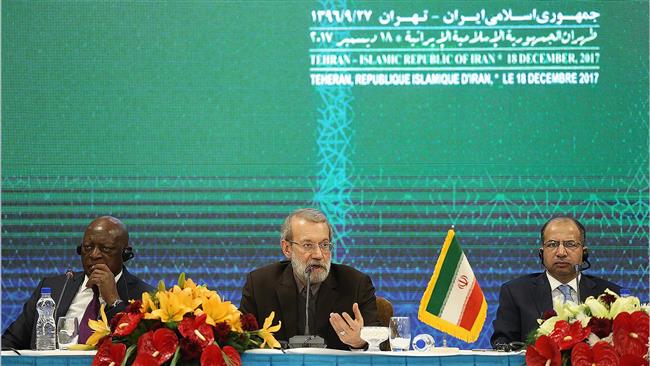
Iran’s Parliament Speaker Ali Larijani (C) speaks to reporters following the Meeting of the PUIC Presidential Troika in the Iranian capital Tehran on December 18, 2017. (Photo by ICANA)
Press TV – December 18, 2017
Iran’s Parliament Speaker Ali Larijani says the Islamic Republic is not providing military assistance to Yemen and all claims to this effect are false.
Larijani made the remarks while addressing the extraordinary meeting of the Palestinian Committee of the Parliamentary Union of the Organization of Islamic Cooperation Member States (PUOICM) in the Iranian capital Tehran on Monday.
“We are not a country that would deny providing military assistance to anybody,” Larijani said.
He added that Iran was providing military assistance to Palestine, but had not helped Yemeni fighters in their war with Saudi Arabia in military terms, dismissing any claim to this effect as a lie.
“The Yemenis’ missiles belong to themselves and some countries cannot achieve their goals by making such claims,” the top Iranian parliamentarian said.
On Thursday, US Ambassador to the United Nations Nikki Haley appeared in a staged show in front of a large and charred tube that she claimed was “concrete evidence” that Iran was providing missiles to Yemeni forces fighting against Saudi Arabia’s war of aggression on their country.
A Saudi Arabian-led coalition launched a war against Yemen in 2015 and has ever since been indiscriminately hitting targets in the country. Yemeni Houthi fighters have been firing missiles in retaliatory attacks against Saudi targets every now and then.
On November 4, a missile fired from Yemen targeted King Khalid International Airport near Riyadh, reaching the Saudi capital for the first time.
Elsewhere in his remarks, Larijani said terrorism has tremendously grown in recent years both in quantitative and qualitative terms, emphasizing that such growth would not have been possible without the support of the US and some countries in the region.
Israel and terrorism are the two sides of the same coin and pursue similar goals, he said.
Larijani also emphasized that US-backed terrorists sought to create chaos in the Middle East and pointed to the recent announcement by the Israeli regime that it enjoyed the best conditions since Muslim countries were grappling with terrorism.
Ali Akbar Velayati, a senior advisor to Leader of the Islamic Revolution Ayatollah Seyyed Ali Khamenei on international affairs, on Sunday dismissed as “baseless and ridiculous” the recent US claim about Iran providing missiles to Yemen’s Houthi Ansarullah movement, saying that even international experts had mocked the accusation.
“The Islamic Republic of Iran has never given missiles to Yemen,” he said.
Iranian Foreign Minister Mohammad Javad Zarif said on Friday that the United States was complicit in Saudi war crimes in Yemen.
He added that the US had sold weapons to its allies enabling them to “kill civilians and impose famine,” in reference to Washington’s arms deal with Riyadh in its aggression against Yemen.
$200bn to reconstruct war-torn Syria… the US and its partners should pay
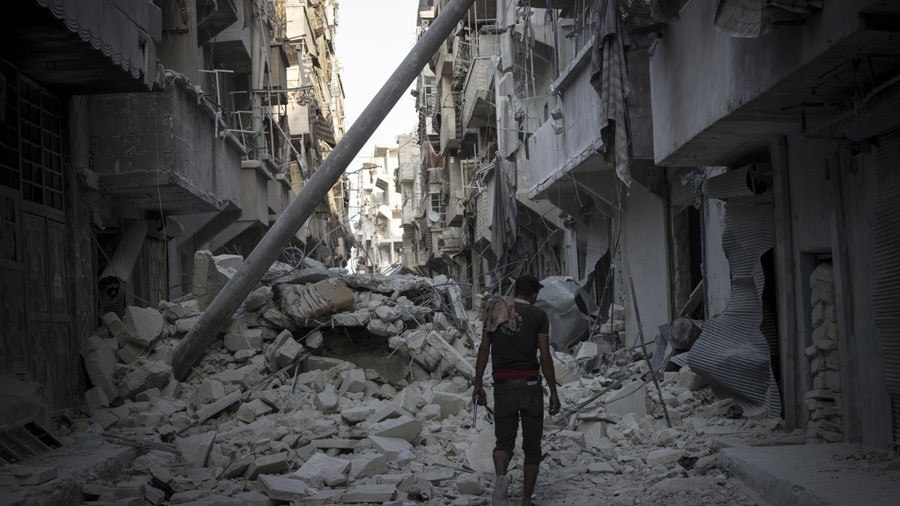
Aleppo, Syria © Karam Almasri / Global Look Press
By Finian Cunningham | RT | December 18, 2017
With Syria’s nearly seven-year war now virtually over, the process of rebuilding the devastated country comes to the fore, with the financial cost of that effort put at $200 billion. Who pays for it?
When you view the ruins of Aleppo alone, Syria’s second biggest city, plus the carnage across the entire country, from towns, villages, bridges, roads, public utilities, hospitals, schools, and so on, the real figure for reconstruction could be far higher than $200 billion.
Then there is the inestimable cost of human suffering and families decimated. All told, the reparations could amount to trillions of dollars.
Syria’s war was no ordinary civil war, as Western mainstream media tended to mendaciously depict it.
From the outset, the conflict was one of an externally driven covert war for regime change against the government of President Bashar Assad. The Arab Spring unrest of 2011 provided a convenient cover for the Western plot to subvert Syria.
The United States and its NATO allies, Britain, France, and Turkey, were the main driving forces behind the war in Syria, which resulted in up to 400,000 deaths and millions of citizens displaced from their homes. Other key regional players sponsoring the campaign against the Syrian government were Saudi Arabia, Qatar, and Israel.
Most of the militants who fought in Syria to overthrow the state authorities were not Syrian nationals. Self-styled jihadists from dozens of countries around the world made their way to Syria, where they were funded, armed and directed by covert forces from Western and Arab states.
The barbarian-like gravitation to Syria indicates the degree to which the effort to overthrow the Syrian government was orchestrated by foreign powers.
This was a planned, concerted project for regime change. The systematic violence imposed on Syria was very arguably due to an international criminal conspiracy perpetrated by the US and all of the above “partners.” The case can, therefore, be made for criminal responsibility.
That, in turn, means that financial reparations and damages can be sued by the Syrian state against those foreign powers which waged the war, albeit indirectly through proxy militant groups.
The bitter irony though is that the US and its Western allies are reportedly using Syria’s war-torn plight as leverage to pursue their political objective of ousting Assad. What these powers could not achieve on the battlefield with their terrorist mercenaries they now seem to be pursuing through their dominance over international financial institutions.
The Washington DC-based International Monetary Fund estimates the reconstruction of Syria’s devastated infrastructure will cost $200 billion. (As noted above, that’s probably a gross underestimate.)
As Bloomberg News reported last week: “The US and its European and Arab partners have for years insisted that Assad must go and are now using the carrot of funding for rebuilding the shattered nation in a final attempt to pressure the Syrian leader. The International Monetary Fund estimates the cost of reconstruction at $200 billion, and neither of Syria’s main allies, Russia and Iran, can afford to pick up the bill.”
It’s a moot point whether Russia and Iran cannot afford to help rebuild Syria. Who’s to say that those two powers along with China and other Eurasian nations could not club together to create a reconstruction fund for Syria, independent of Western countries and their Arab client regimes?
However, regardless of the source of funding for Syria, what Russia, China, Iran and other key international players should push for at the United Nations and other global forums such as the Non-Aligned Movement is the repudiation of Western efforts to link financial aid to future political change in Syria.
Alexander Lavrentiev, Russia’s envoy steering the peace process in Syria, has reiterated Moscow’s position that the political outcome for Syria must be determined by the Syrian people alone, free from external influence. That is also the position of several UN resolutions.
Lavrentiev says Bashar Assad should be free to run in next year’s presidential election if he chooses to and that it is unacceptable for the US and its allies to try to use financial aid as a bargaining tool.
“It’s a simplistic approach when some Western countries say that they’ll give money only when they see that the opposition comes to power or their interests are fully accommodated,” said the Russian envoy.
It’s not merely unacceptable for such Western conditioning. It’s outrageous. Far from quibbling about financial aid to Syria, the debate should be broadened out to hold governments to account for the destruction and loss of life in Syria.
To establish responsibility is not a mystery. Saudi Arabia, Qatar, and Turkey are known to have poured money and weapons into dozens of jihadist-styled groups, including Ahrar al-Sham and Jaysh al Islam under the umbrella of the Islamic Front or Army of Conquest. The precise distinction – if any – between these groups and the internationally proscribed terror organizations of Nusra Front (Hayat Tahrir al-Sham) and Daesh (Islamic State) is elusive and probably negligible.
American, British and French special forces are known to have trained militants under the faux banner of “moderate rebels” and “Free Syrian Army,” even when there is evidence these same groups were cooperating with Al-Qaeda-type extremist networks. Under President Barack Obama, the US government funneled $500 million into training “rebels” in Syria. Trump earlier this year closed down CIA training operations. This is, in effect, an admission of culpability by Washington of fueling the war.
The Americans and British forces were up to recently training the militant group Maghawir al Thawra at Al Tanf base on the Syrian-Iraqi border. The American government also funded another jihadist group Nour al-Din al Zenki, which came to notoriety in a video showing their members beheading a Palestinian boy.
Weapons caches recovered by the Syria Arab Army after the liberation of ISIS strongholds in Deir ez-Zor also show stockpiles of US-made arms and other NATO munitions, including anti-tank missiles.
The Western governments openly funded the fake emergency responders – the so-called White Helmets – who worked hand-in-hand as a propaganda front for Al-Qaeda-affiliated Nusra Front.
There have been systematic links between Western governments, their regional client regimes and the terror proxies who carried out the dirty war on their behalf in Syria over the past seven years.
It is an insult upon injury for Western governments to impose constraints on financial aid to Syria. Furthermore, the economic costs of reconstruction should not be levied on the Syrian people. Those costs should be paid in full by Washington and its partners who engaged in a criminal war on Syria.
Surely, Syria, Russia, Iran and other allied governments should form an international prosecution case for war crimes.
Not only should Washington, London, Paris and others be made to pay damages. Political and military leaders from these countries should be placed in the dock to answer personally for crimes against the Syrian people. To allow impunity is to let Washington and its rogue cohorts keep repeating the same crimes elsewhere, over and over.
Food and medicine can’t get past the Saudi blockade on Yemen, but Nikki Haley thinks missiles can
Nikki Haley once again pushing for war against Iran–this time making an argument that is not only flawed but nonsensical
By Adam Garrie | The Duran | December 15, 2017
Nikki Haley, Donald Trump’s Ambassador to the United Nations, has given an extraordinary “press conference”, even by her habitually outrageous standards.
First all, it was hardly a “press conference” as Haley did not answer any of the questions posed to her. Instead, she merely assured journalists that she has evidence to back her up position, although it is not clear what this evidence might look like.
Haley’s position is that since the outbreak of the current crisis in Yemen, beginning in March of 2015, Iran has been supplying Yemen’s Ansar Allah Movement, more commonly known [in western media] as the Houthis, with the missiles they have sporadically used to target Saudi Arabia and allegedly the UAE.
There is a fatal flaw in this line of thinking however. Saudi Arabia has, since the beginning of the conflict, controlled all air and sea traffic coming into Yemen, while monitoring the region with the latest US made technology.
Yemen has subsequently been surrounded by a Saudi Naval blockade, Saudi borders through which nothing can pass and Omani borders through which there is no evidence of anything passing and which in any case, border areas which do not belong to Ansar Allah fighters, but instead have fluctuated between the Hadi government based in Aden, al-Qaeda terrorists and ISIS terrorists.
Not only has the Saudi blockade caused a man made famine which itself has resulted in a mass outbreak of the disease Cholera, but even the UN has found it difficult to convince the Saudis to allow basic medicine, bottled water and dried foods into the always poor and now starving nation.
But for Nikki Haley, who gave her press conference standing in front of what appeared to be a rusty missile casing–it all makes perfect sense. In Haley’s parallel universe, an aid ship with UN flags cannot bring bottles of water and jars of medical pills to Yemenis, but somehow Iranian ships bearing humongous missiles have easily passed through the Saudi blockade undetected.
There is simply no logic to the argument, no matter how it is interpreted.
Even a journalist at Haley’s “press conference” asked how the US can verify the provenance of the missiles and in particular when they were sent to Yemen. She had no answer apart from effectively saying ‘trust us–we know’.
The fact, as the Ansar Allah themselves have always maintained, is that the missiles which they occasionally launch are taken from Yemeni military bases which Ansar Allah have controlled for approximately two years. Video footage of the missile strikes is consistent with these statements.
Iran’s Foreign Minister Javad Zarif has Tweeted the following photo, comparing Haley’s accusations against Iran to Colin Powell’s infamous accusations against Iraq, saying that Saddam Hussein had weapons of mass destruction which he did not possess.
In reality, Haley’s statement is even more ludicrous as there is physically no way for Iran to transport missiles or anything else for that matter, to Yemen without being seen and almost certainly stopped by the Saudi blockade, a blockade which started in March of 2015, nearly four months before the JCPOA even came into effect.
This last point is crucial as Haley’s allegations rest on the fact that in delivering missiles to the Ansar Allah, Iran is in violation of the terms of the JCPOA, a longstanding US allegation that has been rejected by the EU as a whole, as well as individual parties to the agreement: Germany, France, Britain, China, Russia and the United Nations.
Haley of course repeated what for most American neo-cons is a standard line that Iran sponsors terrorism and is “behaving badly” in Iraq, Syria and Lebanon. If fighting groups like ISIS(Daesh) and al-Qaeda is bad behaviour, the mind simply boggles. The closest Iran is to terrorism is fighting terrorism on the field of battle and advising Iraqi and Syrian partners on how better to do such.
Nikki Haley has proved once again that her aptitude is low, her ethics are non existent and her intelligence is a void.
The fact that she is an Ambassador to the UN but acts increasingly like a hybrid of a Secretary of State combined with a Defense Secretary, is a deeply worrying prospect for all those concerned with global peace and stability.
Saudi Arabia & ‘their Western handlers’ behind Syria peace talks failure – Damascus envoy
RT | December 15, 2017
The ultimatum that President Bashar Assad must go if there is to be peace in Syria, drawn up by the anti-Assad opposition backed by Saudi Arabia and the West, derailed the latest peace talks in Geneva, Damascus’s envoy to the negotiations has said.
The eighth round of Syria peace negotiations in Geneva has ended in failure, after Damascus officials refused to engage in direct talks with the opposition, which continues to demand the removal of President Bashar Assad as a precondition for ending the six-year conflict.
“The Riyadh 2 Communique is a blackmail of the Geneva process,” Syrian government negotiator Bashar Ja’afari told the media, referring to a document adopted during a Syrian opposition summit in the Saudi capital last month. As a result of the conference, attended by 140 participants and backers in the conflict, a communique was adopted insisting that the Syrian president must leave at the start of any transition period following the cessation of hostilities. The conflict has taken more than 400,000 lives.
“Those who drew up the Riyadh 2 statement were the ones who sabotaged this round. I mean by that the other side. I mean the Saudis and the Saudi handlers themselves who are the Western countries. They do not want the Geneva process to succeed.”
Ja’afari insisted that the proposal contradicted previous UN resolutions, and said that outside forces wanted to turn Syria into “another Libya or Iraq.”
The Syrian negotiator also criticized the long-time mediator of the talks, Staffan de Mistura, who on Wednesday urged Russian President Vladimir Putin to put pressure on Assad to accept constitutional reforms and fresh elections.
Ja’afari called de Mistura’s words an “error” that could “derail his mandate as a facilitator of the talks, which will have an impact on the Geneva process altogether.”
In turn, de Mistura said that Damascus’s refusal to engage with the opposition delegation, whom it has branded both unrepresentative and envoys of “terrorists,” as “regrettable.”
“Despite a lot of effort by my whole team, day and night with all sorts of creative formula, we did not have real negotiations,” said de Mistura, who earlier suggested that Syria was on the verge of permanent fragmentation. “It is a big missed opportunity, a golden opportunity missed at the end of this year.”
US allegations on Yemen missile ‘provocative’, ‘destructive’: Iran
Press TV – December 14, 2017
Iran’s UN mission has categorically dismissed as “unfounded” US Ambassador Nikki Haley’s claim that a missile fired at Saudi Arabia from Yemen last month was supplied by the Islamic Republic.
In a statement released on Thursday, the mission denounced the US allegations as “irresponsible, provocative and destructive,” saying “this purported evidence … is as much fabricated as the one presented on some other occasions earlier.”
“These accusations seek also to cover up for the Saudi war crimes in Yemen, with the US complicity, and divert international and regional attention from the stalemate war of aggression against the Yemenis that has so far killed more than 10,000 civilians, displaced three million, crippled Yemen’s infrastructure and health system and pushed the country to the brink of the largest famine the world has seen for decades, as the UN has warned,” the statement read.
It went on to accuse the US government of being “constantly at work to deceive the public into believing the cases they put together” to advance its agenda.
“While Iran has not supplied Yemen with missiles, these hyperboles are also to serve other US agendas in the Middle East, including covering up for its adventurist acts in the region and its unbridled support for the Israeli regime,” the statement read.
It also stressed “the Yemenis’ right to self-defense” and reiterated that the conflict in the impoverished country had no military solution.
Iran’s Foreign Minister Mohammad Javad Zarif also took to twitter to compare Haley’s allegations against Iran to those of former US secretary of defense, Colin Powell, who alleged in 2003 that former Iraqi dictator, Saddam Hussein, was hiding weapons of mass destruction in order to make a case for attacking the country.
The anti-Iran accusations come at a time that the US and Saudi Arabia themselves are under fire for secretly providing weapons to the militants fighting the Syrian government.
Conflict Armament Research (CAR), a UK-based organization that monitors the movement of conventional weapons, warned on Thursday that the sophisticated arms given to the so-called Syria militants fell into the hands of the Daesh terrorist group.
The weapons included anti-tank rockets purchased by the US military that ended up in possession of Daesh within two months of leaving the factory, according to the study, which was funded by the European Union and German government.
This came after the UN Secretary-General Antonio Guterres said in a confidential report obtained by AFP on Monday, December 11, that the world body’s team, which visited Riyadh last month to scrutinize the alleged evidence, had not yet established a link between them and the Islamic Republic.
On November 4, a missile fired from Yemen targeted the King Khalid International Airport near Riyadh, reaching the Saudi capital for the first time.
The Houthi movement, which has been fighting back a Saudi aggression, said it had fired the missile but the Riyadh regime was quick to point the finger at Iran.
Tehran rejected the allegations as “provocative and baseless,” saying the Yemenis had shown an “independent” reaction to the Saudi bombing campaign on their country.
Speaking at a press conference at a military base in Washington on Thursday, Haley presented what she claimed to be “undeniable” evidence, including the allegedly recovered pieces of the missile, saying it proved that Iran was violating international law by giving missiles to the Houthis.
“It was made in Iran then sent to Houthi militants in Yemen,” she added.
However, a panel appointed by the United Nations Security Council said last month that it had seen no evidence to support Saudi Arabia’s claims that missiles had been transferred to Yemen’s Houthi fighters by external sources.
The Security Council-appointed panel said in its confidential assessment that it had seen no evidence to back up the Saudi claims that short-range ballistic missiles (SRBMs) had been transferred to Yemeni fighters in violation of the Resolution 2216.
It said the tightening of the blockade by the Saudi-led coalition and its invoking of Resolution 2216 had been an attempt to merely “obstruct” the delivery of civilian aid.
“The panel finds that imposition of access restrictions is another attempt by the Saudi Arabia-led coalition to use paragraph 14 of resolution 2216 as justification for obstructing the delivery of commodities that are essentially civilian in nature,” the assessment read.
The Saudi war since 2015, accompanied by the land, naval, and aerial blockade on Yemen, has killed over 12,000 people so far and led to a humanitarian crisis as well as a deadly cholera epidemic.
Saudi Arabia and its allies launched the war in a bid to crush the Houthi movement and reinstate the former Riyadh-friendly regime, but the kingdom has achieved neither of its goals.
The UN has listed Yemen as the world’s number one humanitarian crisis, with 17 million Yemenis in need of food and gripping the country.
The US, which has long been a staunch Saudi ally, signed a deal to sell the kingdom $110 billion in weapons in May.
Turkey reclaims Muslim leadership
By M K Bhadrakumar | Indian Punchline | December 13, 2017
The Istanbul Declaration of the Organization of Islamic Conference declaring East Jerusalem as the capital of the state of Palestine is a landmark event. The Turkish initiative to convene an extraordinary summit in Istanbul today targeted such an outcome. The summit was well attended, although convened at short notice.
A notable absentee was King Salman of Saudi Arabia. The Saudi minister for religious affairs apparently represented his country. On Tuesday, Turkey openly taunted Saudi Arabia. Foreign Minister Mevlut Cavusoglu said, “Some Arab countries have shown very weak responses (on Jerusalem). It seems some countries are very timid of the United States.” He added that Saudi Arabia had yet to say how it would participate.
The Istanbul Declaration says it “rejects and condemns in the strongest terms the unilateral decision by the president of the United States America recognizing Jerusalem as the so-called capital of Israel, the occupying power.” It urges the world to recognize East Jerusalem as the occupied capital of the Palestinian state and invites “all countries to recognize the state of Palestine and East Jerusalem as its occupied capital.”
The OIC has set the bar high. But OIC is largely ineffectual and its declarations and statements remain on paper only. Is it any different now? Yes, it could be different. One, the Istanbul Declaration at one stroke debunks United States’ pretension so far to be the charioteer of the Middle East peace process. Washington’s locus standii as mediator has come under questioning from none other than Palestine President Mahmoud Abbas, who has been widely regarded as a cats-paw of the US (and Israeli) intelligence and Saudi Arabia.
The fact that Abbas’ back has stiffened only reflects that the ground beneath the feet has shifted. The popular opinion in the Muslim Middle East has become so overwhelmingly anti-American. This has geopolitical implications. Interestingly, Moscow deputed a representative to attend the OIC summit in Istanbul as observer.
Israel was gaining in confidence lately that it could break out of isolation and form a quasi-alliance with Saudi Arabia. It was not a realistic hope and was predicated on the political personality of the young Saudi Crown Prince. But such hopes must now be mothballed. Israel also may have to live with the reality of a strong Iranian presence in Syria for years to come. Clearly, Israel overreached. It is doubtful whether Israel gains anything at all out of Trump’s decision on Jerusalem. Even a re-location of the US embassy from Tel Aviv may take years – and, for all you know, kept in abeyance indefinitely by Washington as a matter of expediency.
The known unknown is about the mantle of leadership in the Islamic world. The Istanbul summit was a personal initiative of President Recep Erdogan. A poll conducted by Pew has come up with the finding that Erdogan is today the most popular figure in the Muslim Middle East.
For sure, Erdogan is making a determined pitch to reclaim the leadership of the Muslim world, as it used to be under Ottoman sultans. With Saudi Arabia caught up in a difficult transition and its future increasingly uncertain (plus with the brutal war in Yemen where it is bogged down), Turkey’s hour may have come. Erdogan’s main plank is his emphasis on the unity of the ‘Ummah’. His clarion call to put behind sectarian politics gets big resonance. And here Turkey and Iran on the same page, too.
A leadership role will come handy for Erdogan, as it gets him ‘strategic depth’ vis-à-vis the West, apart from consolidating his power base within Turkey. On the other hand, he may take his caliphal authority seriously to reboot the OIC as an interventionist tool to tackle Muslim issues the world over. Countries like Myanmar or India feel the pressure.
All in all, a very transformative period lies ahead for the Muslim world. Trump wouldn’t have anticipated all this in the downstream when he opened the Pandora’s box. He is not known to be a grand strategist. The Anadolu news agency featured an insightful commentary on how Trump’s sense of obligation to the Jewish lobby almost entirely led him to this fateful decision on Jerusalem. Read it here – Trump’s decision: Inside story, expected consequences.
Yemen: Saudi Airstrikes Kill Dozens
teleSUR | December 13, 2017
Renewed Saudi airstrikes against Yemen, mainly in the capital city of Sana’a, have resulted in the deaths of dozens of people.
At least 39 people died and 90 others were left injured, Reuters reported. Yemen’s al-Masirah TV reported that at least 51 people died and 80 were left injured.
The airstrikes reportedly targeted Yemen’s military police headquarters in Sana’a’s Shu’ab district. Some of the casualties included prisoners detained at the facility awaiting investigation.
In a separate series of attacks, Saudi planes levelled Yemen’s northwestern district of Sahar. Four civilians were wounded, one of whom later died from injuries. Eleven people were also killed during airstrikes in Maqbanah District of the southwestern province of Ta’izz.
Since the bombing campaign against Yemen began in 2015, the United Kingdom has licensed roughly US$4.2 billion dollars in weapons to Saudi Arabia, according to PressTV.
In early June, the U.S. Department of Defense also confirmed a US$750 million military sale to Saudi Arabia. It included U.S. made missiles, bombs, armored personnel carriers, warships, munitions and a “blanket order training program” for Saudi security forces receiving the military equipment both inside and outside the kingdom, Reuters reported.
Amid the bombing and devastation, which has killed tens of thousands of people and forced more than a million to flee their homes, Yemen also faces a severe cholera outbreak that has claimed the lives of at least 2,119 people, according to Alexandre Faite, head of the International Committee of the Red Cross. Another eight million are on the verge of starvation.
Wolfgang Jamann, head of the Cooperative for Assistance and Relief non-governmental humanitarian agency, described the ongoing crisis in Yemen as being an absolute “shame on humanity.” The United Nations referred to it as “the world’s worst humanitarian crisis.”
UN experts do not confirm Iran link to Yemen missiles: Report
Press TV – December 12, 2017
UN experts, who examined the debris from missiles fired from Yemen at Saudi Arabia earlier in the year, have not confirmed that the projectiles were “Iranian-made” as claimed by the Riyadh regime and the US.
The missiles were fired by Yemeni Houthi fighters at the Saudi capital on July 22 and November 4 in retaliation for Riyadh’s deadly raids against the country.
United Nations Secretary-General Antonio Guterres said in a confidential report obtained by AFP on Monday that the world body’s team, which visited Riyadh last month to scrutinize the alleged evidence, had not yet established a link between them and the Islamic Republic.
Saudi Arabia, which accuses Iran of arming Yemen’s Houthi Ansarullah movement against the kingdom, claims the missiles, which it says were fired at its capital city, had been supplied to Yemeni forces by Iran.
Following the first missile launch, Riyadh also angered the international community and human rights groups by tightening the already crippling siege against Yemen.
Tehran has invariably dismissed having ever armed the movement and any accusation of regional interference for that matter.
On Monday, Iran’s Foreign Ministry Spokesman Bahram Qassemi said, “Whatever happens inside Yemen concerns the Yemeni people and resistance and does not concern the Islamic Republic.”
The Houthis have been defending Yemen against a Saudi-led military offensive, which seeks to restore the former Riyadh-allied government. The war has killed some 12,000 people and reduced the country’s infrastructure to smithereens since its start in early 2015.
Guterres wrote that UN officials were “still analyzing the information collected and will report back to the [UN] Security Council.”
The investigators also examined two drones allegedly recovered in Yemen, but did not confirm a Saudi claim that one of them was “Iranian-made.”
Featured Video
NATO’s War of Choice – The Sabotage of the Istanbul Negotiations
or go to
Aletho News Archives – Video-Images
From the Archives
National Security Archive Publishes Key Records on Infamous MKULTRA Program
Agency Sought Drugs and Behavior Control Techniques to Use in “Special Interrogations” and Offensive Operations
Edited by Michael Evans | National Security Archive | December 23, 2024
Washington, D.C. – Today, the National Security Archive and ProQuest (part of Clarivate) celebrate the publication of a new scholarly document collection many years in the making on the shocking secret history of the CIA’s mind control research programs. The new collection, CIA and the Behavioral Sciences: Mind Control, Drug Experiments and MKULTRA, brings together more than 1,200 essential records on one of the most infamous and abusive programs in CIA history.
Under code names that included MKULTRA, BLUEBIRD and ARTICHOKE, the CIA conducted terrifying experiments using drugs, hypnosis, isolation, sensory deprivation, and other extreme techniques on human subjects, often U.S. citizens, who frequently had no idea what was being done to them or that they were part of a CIA test.
Today’s announcement comes 50 years after a New York Times investigation by Seymour Hersh touched off probes that would bring MKULTRA abuses to light. The new collection also comes 70 years since U.S. pharmaceutical giant Eli Lilly & Company first developed a process to streamline the manufacture of LSD in late 1954, becoming the CIA’s chief supplier of the newly discovered psychoactive chemical central to many of the Agency’s behavior control efforts.
Highlights of the new MKULTRA collection include… continue
Blog Roll
 Aletho News
- Israel displaces last two families from Al Khalayel valley, Al Mughayyir
- Israeli Opposition Leader Endorses Greater Israel
- Islamic Jihad: Trump’s peace board is a “theatrical stunt detached from reality”
- The Head Of A CIA Cutout Admits To Meddling In Iran To Fuel Unrest
- Iran warns Trump against decisions based on false information
- Pentagon sets deadline for Anthropic to lift AI restrictions on autonomous weapons systems, mass domestic surveillance
- Trump’s military buildup against Iran on Netanyahu’s behalf is a gambit doomed to fail
- Big League War
- Zelensky sells false illusion of building powerful air force capable of overcoming Russia
- Glenn Diesen: NATO’s War of Choice – The Sabotage of the Istanbul Negotiations
- If Americans Knew
- AIPAC Wants to Kill a Bill that would Ensure Israel Complies with Ceasefire
- Former Israeli PM, in Epstein Files, Dreamed of Israeli Eugenics and Pretty Converts
- Israeli settlers join ‘safari’ tour of Palestinian prisoners
- Flooding in Gaza amid rumors of war; fire in West Bank – Not a ceasefire Day 138
- Fourteen Countries Condemn Huckabee’s Support for Israel Taking Over Most of the Middle East
- Israeli Soldiers Killed Gaza Aid Workers at Point Blank Range in 2025 Massacre: Report
- Israel’s insidious network to propagandize American Christians
- Israel’s Best-Kept Secret: Palestinian Resistance Never Agreed to Disarm
- Trump officials plan to build 5,000-person military base in Gaza, files show
- Are MAGA restrainers pulling their punches this time on Iran?
- No Tricks Zone
- Surprising Discovery: Sahara Is Greening…Billions Of Trees Where Once Thought To Be Barren
- New Research Reaffirms Clouds, Aerosols, And Surface Solar Radiation Are ‘Driving The Climate System’
- Germany: Electric Car Catches Fire At Charging Station, Sets Off Local “Inferno”, Widespread Damage
- New Study: Canada’s New Brunswick Was 1°C Warmer Than Today During The Medieval Warm Period
- Coal Power Back In Trend As Globe Tries To Keep Pace With Growing Demand For Power
- New Study: A 4°C Warmer Beaufort Sea Had ‘No Sea Ice’ 11,700 – 8200 Years Ago
- Unfudging The Data: Dutch Meteorological Institute Reinstates Early 20th Centruy Heat Waves It Had Erased Earlier
- German Gas Crisis…Chancellor Merz Allegedly Bans Gas Debate Ahead of Elections!
- Pollen Reconstructions Show The Last Glacial’s Warming Events Were Global, 10x Greater Than Modern
- Germany’s Natural Gas Storage Level Dwindles To Just 28%… Increasingly Critical
 Aletho News