Advance at Farzad B signals Iran’s homegrown leap in complex energy projects
Press TV – November 23, 2025
On Saturday it was announced that Iranian companies will soon begin drilling at the strategically important Farzad B gas field in the middle of the Persian Gulf.
The development marks a rare breakthrough for the country’s energy sector after years of delays, sanctions pressure and missed opportunities.
It signals that Iran has finally gained the technical confidence and institutional capacity to push ahead with one of its most complicated shared fields without relying on hesitant foreign partners.
Farzad B lies near the maritime border with Saudi Arabia, close to Farsi Island, in a geologically difficult zone known for high pressures, high temperatures and fractured formations. Those conditions make it significantly more challenging to develop than South Pars, the country’s flagship offshore field.
Yet for nearly two decades, Farzad B remained stuck in negotiations, mostly with Indian companies that once planned to produce gas there and turn it into LNG for export. Each time political conditions shifted, the project stalled.
India pulled out during the first round of sanctions, returned briefly once sanctions were eased, and again withdrew during the Trump-era restrictions even after Tehran accepted New Delhi’s terms, including dropping its LNG ambitions, to keep the partnership alive.
While Iran waited, Saudi Arabia moved forward. Working with a Canadian-led consortium, it began producing gas from the shared field in 2015 and lifted output to roughly 34 million cubic meters a day the following year.
That imbalance carried economic consequences. Iran holds about 70% of the reservoir, and in shared fields, the country that produces less risks losing pressure in its part of the formation, allowing gas to migrate toward the neighbor extracting more aggressively.
In a period when Iran’s domestic demand has been rising and supply strains have become increasingly visible during winter peaks, the long delay at Farzad B was more than a strategic concern. It risked turning a national asset into a gradually shrinking one.
The administration’s response has been to push a broader strategy that focuses on shared fields as part of strengthening economic resilience. It has already delivered results in South Pars, where Iran eventually overtook Qatar in daily extraction, and in the West Karun region along the Iraqi border.
Bringing Farzad B into full development is now seen as a key part of that policy. With foreign partners unable or unwilling to commit, the government turned inward.
In 2017, the National Iranian Oil Company assigned Petropars to manage the project under a master contract covering subsurface analysis, conceptual design, drilling oversight and preparation for full field development.
The decision was a gamble on domestic capacity at a time when sanctions limited access to global finance, equipment and specialist technology.
But it also reflected a shift in economic planning; rather than wait for sanctions relief and return of foreign investors, authorities pushed national contractors to take the lead on the $1.78 billion project.
Over the past two years, that shift has produced visible results. Most notable is the completion and offshore installation of the 2,650-tonne jacked designed and built inside Iran by local companies.
The operation, led by Petropars and executed by the Iranian Offshore Engineering and Construction Company, required a level of engineering competence that industry analysts once assumed was out of reach for domestic firms working without international support.
The roll-up and installation at sea under demanding conditions demonstrates that Iran can carry out heavy offshore construction at a standard that matches global norms.
The technical hurdles go beyond the platform. The gas composition at Farzad B requires advanced metallurgy and specialized alloys for safe transmission. Laying the offshore pipeline is considered one of the most difficult marine engineering challenges attempted in the country.
Processing the high-pressure, high-temperature gas adds another layer of complexity. Yet Iranian engineers say they have now developed the design, equipment sourcing and operational planning needed to manage those conditions.
For a sector accustomed to relying on international contractors for the most complex offshore work, this represents a meaningful shift.
There is also momentum onshore. Officials have finalized the site of the gas processing plant after a series of environmental, geotechnical and risk assessments that included natural hazards, social and economic impact, access to infrastructure and proximity to offshore installations.
The level of preparatory work reflects a determination to avoid the kind of planning weaknesses that contributed to earlier delays.
The expected economic impact is significant. Once operational, Farzad B is projected to add roughly one billion cubic feet of gas per day to Iran’s supply.
That increase matters for a country that has struggled at times to meet domestic demand, manage seasonal shortages and maintain output in aging fields. It also reduces the risk of further reservoir losses to Saudi Arabia and helps safeguard Iran’s majority share of the field.
The project has become a symbol of the benefits of investing in domestic engineering capacity rather than waiting for foreign partnerships that may be derailed by geopolitics.
Petropars, once a secondary contractor in joint projects, has emerged as the emblem of that approach. Its leadership of Farzad B is evidence that Iranian firms can handle highly complex offshore developments even under sanctions and with restricted access to global suppliers.
The recent progress has pushed Farzad B past the stage of plans and declarations into active development.
For an economy navigating sanctions, rising energy needs and long-term pressure on shared fields, that shift marks a phenomenal achievement.
How Saudi F-35s would not erode Israeli air superiority: Report
By Ali Halawi | Al Mayadeen | November 19, 2025
The Trump administration’s move to advance a potential sale of Lockheed Martin F-35s to Saudi Arabia might mark a significant turning point in regional military dynamics. Yet the central question remains: would the acquisition truly grant Riyadh a decisive edge, or will “Israel’s” deeply entrenched air superiority remain firmly intact?
The announcement, made as Crown Prince Mohammed bin Salman (MBS) visited Washington, does not itself consummate a transfer. Any sale would require formal notification to, and likely scrutiny by, the US Congress, and would reopen the fraught question of how Washington preserves “Israel’s” qualitative military edge (QME) while exporting one of the world’s most advanced fighter aircraft. While the operational edge of Israeli pilots and aircrew is evident, the US retains the ability to constrain Saudi F-35 capabilities through technical and software-based controls.
The deal on the table and the road to congressional approval
When a US president signals willingness to sell F-35 aircraft, the next formal step is notification under the Arms Export Control Act and a review period during which Congress can raise objections or seek certifications. For decades, US administrations have treated QME for “Israel” as a legal and political constraint on certain arms transfers; that tradition has informed reviews of past F-35 discussions with the United Arab Emirates (UAE). Any proposed sale to Riyadh will therefore be judged not only on price and offset packages but on assurances that “Israel’s” operational superiority will remain intact; a determination that is both technical and political and could trigger contentious hearings. Members of both parties have in the past conditioned or slowed high-end sales over human-rights concerns, counter-proliferation assessments, and explicit demands to preserve the QME.
However, competing pressures further complicate Washington’s calculus as the Trump administration attempts to solidify its strategic partnership with Saudi Arabia, secure a landmark normalization agreement with one of West Asia’s most influential powers, and counter the expanding Russian and Chinese footprint in the Kingdom’s defense and technology sectors.
Who in the region flies fifth-generation aircraft today
As of today, the Israeli Air Force is the only air force in West Asia operating the F-35s.
Abu Dhabi negotiated for the aircraft in 2020 but later suspended the talks; other Gulf air forces operate advanced fourth-generation fighters but not fifth-generation stealth airframes.
The practical consequence is that a US sale to Riyadh would not simply add another modern fighter to the region; it would introduce a category of capability that, until now, has been regionally singular.
Why the airframe is only half the story
It is important to separate the aircraft’s physical attributes from the invisible systems that make it decisive in combat. The F-35’s important advantages include low observable design or stealth, powerful sensors, sensor fusion, and integrated electronic warfare, which enable pilots and commanders to detect, identify, and engage threats at ranges and with a fidelity earlier generations cannot match.
Much of the F-35’s real combat power does not lie in the airframe but in the software stack that governs nearly everything the jet does:
- Mission-data files (MDFs)
- Electronic-warfare threat libraries
- Radar-emitter databases
- Electronic-attack and jamming profiles
- Sensor-fusion logic
- Weapons-employment algorithms
Most critically, the US controls every layer of this ecosystem for all export customers, except “Israel”.
“Israel’s” F-35I “Adir” has a special agreement allowing the integration of sovereign Israeli-made sensors, electronic warfare systems, and locally developed software add-ons. While the core flight software remains a US product, “Israel” can add its own “plug-and-play” systems and has the authority for some domestic maintenance and upgrades, giving it a level of independence not afforded to other customers. In practice, the platform’s combat potential is as much a product of data and code as it is of metal and jet engines.
This creates a built-in mechanism for Washington to tilt the operational balance decisively toward “Israel,” even if other states receive the same aircraft on paper.
Update priority, withholding certain mission-data libraries, limiting weapons-integration permissions, and controlling sustainment services are all practical mechanisms to maintain an advantage for one operator over another.
“Israel’s” F-35I “Adir” and operational freedom
Israel negotiated an unusually broad set of privileges for the Adir. Unlike most customers, the Israeli regime has been permitted deep customization, integration of indigenous sensors and weapons, unique mission-data development, and a degree of independence from the US sustainment cloud that most operators use.
Those permissions give the Israeli Air Force both practical freedom of operation and a pathway to maintain and evolve its fleet in ways other buyers cannot match.
Israeli mission data files are infused with intelligence drawn from decades of regional aggression. Their electronic-warfare tuning reflects specific threat libraries, and the backlog of locally developed weapons integrations further differentiates the Adir from standard F-35As.
The aircraft can fire the Israeli Python‑5 and Derby/Derby‑ER air‑to‑air missiles, giving it a sovereign engagement capability independent of US munitions. It also carries advanced stand‑off strike weapons such as the SPICE‑1000 and SPICE‑2000 precision‑guided kits and the Delilah loitering cruise missile, enabling deep, accurate attacks against heavily defended targets. Added to this is a bespoke Israeli C4I architecture and a classified electronic‑warfare suite installed directly into the aircraft’s systems, granting the Israeli Air Force full control over threat libraries, jamming profiles, and data links.
The airframe itself has also been adapted to support these systems. The Israelis received rare permission to incorporate custom apertures, access points, and internal wiring channels into the fuselage in coordination with Lockheed Martin, enabling installation and maintenance of its electronics. In addition, “Israel” is the only country known to operate F‑35s equipped with Conformal Fuel Tanks (CFTs), which add 600–800 gallons of fuel along the fuselage without compromising stealth or weapons capacity. These tanks extend the Adir’s operational range, reduce reliance on aerial refueling, and allow longer, deeper-strike missions, providing a level of flexibility and endurance unavailable to any other F‑35 operator.
Software and sustainment
The F‑35’s combat edge lies less in its airframe than in the software, mission-data, and sustainment systems that govern nearly every aspect of its operations. Historically, the US has used software-centric restrictions to preserve the advantage of favored partners, ensuring that certain operators maintain a decisive qualitative edge.
Key instruments include mission-data files (MDFs), which encode threat signatures, radar and SAM profiles, and geospatial threat maps. Operators with richer, bespoke MDFs detect and classify threats more quickly and respond more effectively. Denying or limiting MDF depth to a buyer is therefore a direct mechanism to sustain another operator’s superiority. Similarly, restricting electronic-warfare software, including emitter libraries, advanced jamming and deception modes, and the timing of mission-data updates, can materially degrade an F‑35’s ability to detect, classify, and suppress hostile radars. The operational effect is slower threat identification, narrower jamming envelopes, and less accurate geolocation for Suppression of enemy air defenses (SEAD) operations, giving the Israeli Air Force a persistent edge even if both sides operate the same airframe.
These fundamental differences could prove decisive in a theoretical Saudi-Israeli confrontation. An export-restricted Saudi F-35, with its potentially downgraded software, might detect Israeli emitters seconds later and with reduced precision. In contrast, the Israeli F-35I Adir, equipped with bespoke software, proprietary threat libraries, and its electronic warfare systems, could identify, geolocate, and suppress Saudi radar networks first.
These software controls illustrate how the US could maintain Israeli superiority should the Saudi deal move forward. While technically effective, such safeguards carry grave political and operational costs for the buyer, the same concerns Abu Dhabi cited when it stepped back from F‑35 talks in 2021.
Basing, geography, Israeli red lines
Unlike the UAE, whose main airbases are distant from Israeli interests, parts of Saudi Arabia lie relatively close to Israeli settler populations and military centers. Israeli officials have publicly signalled concern that basing F-35s in western Saudi Arabia would materially shorten flight times into Israeli airspace and therefore elevate risk perceptions in Tel Aviv. Reports also indicate “Israel” is pressing Washington to condition any sale on formal normalization and legally binding basing limits.
Those basing preferences are intimately linked to the software and sustainment controls described above. Even if Riyadh accepted software tiering, “Israel” still wants to condition the basing of F-35 jets to be outside Western Saudi Arabia airstrips.
Why Abu Dhabi balked despite normalization
The UAE’s experience is a near-perfect case study for what Riyadh may face. Abu Dhabi negotiated a package in 2020 under a broader normalization agreement but informed US officials in December 2021 that it would suspend discussions, citing “technical requirements, sovereign operational restrictions, and cost-benefit analysis” as reasons.
Three interlocking fault lines explain why. First, as explained, export conditions on software, weapons, and mission systems sharply limit a buyer’s operational autonomy. Doing anything beyond the approved list requires US authorization and often a long, costly certification process. For a state that prizes independent strike options and rapid operational adaptation, those limits impose real political and tactical costs.
Second, sustainment architecture locks customers into US logistics and updates ecosystems. The F-35’s logistics and health-monitoring systems (ALIS originally, now the ODIN framework) and the global sustainment enterprise mean that maintenance and updates become levers Washington can control.
Third, and more prosaically, the practicalities of preserving stealth require specialized sustainment. Low-observable coatings, seam integrity, and specialized repairs demand trained personnel, approved materials, and certified processes; many of those tasks are regulated and performed under Lockheed-approved protocols or at regional hubs designated by the program. Buyers often cannot fully sustain the low-observable characteristics that make the jet survivable without continuing contractor or US support.
Finally, political and geostrategic concerns compounded the technical ones. Washington’s scrutiny of buyers’ ties to third parties, notably China, and congressional insistence on preserving “Israel’s” QME raised further strings the UAE found difficult to accept, from restrictions on sensitive supply-chain partners to conditioned access to high-end sustainment and software features.
“The Americans want to sell the Emiratis the planes but they want to tie their hands,” a Gulf source told Reuters at the time. The source, speaking on condition of anonymity, said defense deals include requirements for purchasing nations, but that the restrictions in this deal made it unfeasible.
Geopolitical considerations, only amplified by Riyadh’s larger strategic weight and geography, will determine whether Saudi Arabia accepts comparable limits, if imposed by Washington, or walks the same path as Abu Dhabi.
Trump considers skipping disarmament phase of Gaza plan amid deadlock: Report
The Cradle | November 16, 2025
The US is looking to “forgo” the stage of the Gaza ceasefire initiative, which involves deploying an international security force to the strip to disarm Hamas and other Palestinian resistance factions, Israeli media reported over the weekend.
The October ceasefire agreement remains in its first stage as talks continue to stall over the issue of Hamas’s disarmament and post-war administration of Gaza.
This potential change in US direction is causing ongoing negotiations to “deadlock,” an Israeli security source told Hebrew news outlet Channel 13.
The source said Washington is struggling to get commitments from countries to directly participate in disarming the factions.
As a result, it has started to look for “interim solutions, which are currently unacceptable to Israel.”
“This interim solution is the worst there is,” the source added, referring to the plan to forgo disarmament and skip ahead to reconstruction.
“Hamas has been strengthening in recent weeks since the end of the war. There can be no rehabilitation before demilitarization. It is contrary to Trump’s plan. Gaza must be demilitarized,” the Israeli source went on to say.
Channel 13 notes that there has been a collapse in ceasefire talks over Washington’s inability to form the international force – referred to in Donald Trump’s ‘peace plan’ as the International Stabilization Force (ISF).
The US recently submitted a draft for the establishment of the force, and is seeking UN backing to implement the plan along with the rest of Trump’s 20-point ceasefire initiative.
The draft includes a broad mandate for Washington to govern Gaza for at least two years. It also mentions that the ISF will be established in coordination with the Gaza ‘Board of Peace,’ which Trump will head.
Russia has proposed its own draft, which entirely removes the ‘Board of Peace’ clause and calls on the UN to identify “options” for the ISF.
The US draft is expected to be put to a vote at the UN on Monday. On 14 November, the US, Saudi Arabia, Qatar, Egypt, the UAE, Indonesia, Pakistan, Jordan, and Turkiye issued a joint statement backing the US draft. That day, Indonesia said it had readied 20,000 troops for the plan.
Arab and Islamic states have “leaned toward supporting the US draft because Washington is the only party capable of enforcing its resolution on the ground and pressuring Israel to implement it,” a source told Asharq al-Awsat, adding that there is “firm American intent to deploy forces soon, even if that requires sending a multinational force should Moscow use its veto.”
However, multiple reports in western and Hebrew media over the past several days have revealed an Arab unwillingness to directly force Hamas’s disarmament through a confrontation.
“Most countries that have expressed interest in participating in the ISF have said they would not be willing to enforce the disarmament … and would only act as a peacekeeping force,” Times of Israel wrote.
Israel’s Broadcasting Corporation (KAN) reported on Saturday that Tel Aviv is expecting the resolution to pass, and is preparing for the entry of thousands of foreign soldiers into Gaza.
Yemen between two wars: A fragile truce and the shadow of a regional escalation
By Mawadda Iskandar | The Cradle | November 4, 2025
Since mid-October, Yemen has returned to the forefront of the regional scene. Political and military activity has intensified across several governorates, exposing the limits of the current ceasefire. From Sanaa’s view, the phase of “no war and no peace” cannot continue.
Any attack, it warns, will be met with a direct response. Deterrence, it insists, is now part of its core strategy.
Saudi Arabia, meanwhile, is trying to juggle two tracks – military pressure and renewed dialogue through Omani mediation. Riyadh wants to keep its weight on the ground while testing the possibility of a broader settlement.
The US and Israel have again inserted themselves into the mix, each working to block a negotiated outcome that might strengthen the Sanaa government. Washington has revived coordination channels with the coalition, while Tel Aviv watches the Red Sea front and pushes for the containment of Ansarallah-aligned armed forces. Yemen has once more become an overlapping arena of peace talks, foreign manoeuvring, and military threats.
Negotiations under fire
Oman has returned as the main regional mediator, moving to calm tensions after both Sanaa and Riyadh accused each other of violating the 2024 economic truce – the backbone of the UN “road map.” On 28 October, Muscat announced new diplomatic efforts to prevent a wider clash and reopen a political track.
But the situation on the ground shows little restraint. In Saada governorate alone, monitors recorded 947 violations this year, leaving 153 dead and nearly 900 injured. On 29 October, Saudi artillery shelled border villages in Razeh.
Sanaa affirmed that the “reciprocal equation” remains in place, staging a large military parade near Najran to display readiness. Riyadh, in turn, tested civil-defence sirens in its major cities – a move mocked by Ansarallah figure Hizam al-Assad, who said no siren would protect Saudi cities while the aggression and siege continue.
Speaking to The Cradle, Adel al-Hassani, head of the Peace Forum, points out that the crisis is worsening due to the deterioration of the economic situation and sanctions, which have affected more than 25 million Yemenis, while Oman is intervening as a mediator for the de-escalation.
According to Hasani, the roadmap includes two phases: the first is humanitarian, including the lifting of the blockade, the payment of salaries, and the resumption of oil exports; the second is political – to form a unity or coalition government that would coincide with a declared coalition withdrawal. Only that, he says, could stabilize the situation.
Washington and Tel Aviv’s new strategy
After Operation Al-Aqsa Flood and the ensuing war on Gaza, the US-Israeli approach to Yemen has shifted toward hybrid operations – mobilizing local partners, information warfare, and targeted strikes rather than any open intervention.
Sanaa’s recent warning about hitting Saudi oil sites came after detecting moves to create a US-Israeli front against Ansarallah. Israeli Prime Minister Benjamin Netanyahu called the resistance movement “a very big threat,” and Defense Minister Israel Katz threatened airstrikes on Sanaa itself.
The idea is to keep Saudi Arabia under pressure while allowing Israel to act indirectly. Israeli Finance Minister Bezalel Smotrich said the “Yemeni threat” is unresolved and urged Arab allies to take part in containing it.
Western think tanks have echoed this, urging Washington to rebuild Riyadh’s military role after the failure of the Red Sea naval alliance. The head of Eilat Port, Gideon Golber, admitted that maritime trade has been badly hit, adding that “We need a victory image by restarting the port.” A US Naval Institute report also noted that despite spending over $1 billion on air defense and joint operations, control over the corridor remains weak.
Between November 2023 and September 2025, Yemeni forces carried out more than 750 operations in the Red Sea, Gulf of Aden, and Indian Ocean – part of what Sanaa calls a defensive response. Head of the Supreme Political Council, Mahdi al-Mashat, urged Saudi Arabia to “move from the stage of de-escalation to ending aggression, siege, and occupation and implementing the clear entitlements of peace.”
He further accused Washington of using regional tensions to serve Israel. National Council member Hamid Assem added that an earlier de-escalation deal, signed a year and a half ago in Sanaa, was dropped by Riyadh under US direction after Operation Al-Aqsa Flood.
A source close to Sanaa tells The Cradle:
“The movement’s leadership is firmly convinced that the responsibility for these tools cannot be separated from those who created, armed, and trained them since 2015. Therefore, Sanaa affirms that any movement of these tools in Marib, the west coast, or the south of the country will not remain isolated, and will carry with it direct consequences that will affect the parties that supported and supervised the preparation of these groups.”
The source adds that:
“America has long experience with Yemen and may be inclined to avoid direct ground intervention, as its priorities appear to be focused on protecting Israel by striking Ansarallah’s missile and naval capability without extensive land friction. Therefore, it has begun to implement a plan that adopts hybrid warfare: intensifying media pumping, distortion, information operations, and psychological warfare, in addition to logistical and coordination preparations to move internal fronts through local pro-coalition tools.”
This hybrid strategy may coincide with Israeli military and media steps, the source points out, through threats and statements by officials in Tel Aviv, so that the desired goal becomes to “blow up the scene from within” and weaken Sanaa through internal chaos that paves the way for pressing options or strikes targeting its arsenal without direct American ground intervention.
US and UAE movements in the south
Throughout October, the US, Saudi Arabia, and the UAE expanded their presence in the south, west coast, and Al-Mahra to reorganize coalition factions and tighten control. US and Emirati officers arrived in Lahj Governorate, supervising the restructuring of Southern Transitional Council (STC) units from Al-Kibsi Camp in Al-Raha to Al-Mallah district. Security around these areas was reinforced with barriers and fortifications.
In Shabwa and Hadhramaut, joint committees of American and Emirati officers inspected Ataq Airport and nearby camps, counting recruits, running medical checks, reviewing weapons stock, and mapping command chains. Sources say Latin American contractors and private military firms assisted, ensuring resources stayed under external supervision.
In Taiz, another committee visited Jabal al-Nar to evaluate the Giants Brigades, their numbers, and armaments. On the west coast – from Bab al-Mandab to Zuqar Island – construction work is ongoing: terraces, fortifications, and outposts operated by “joint forces” hostile to Sanaa, including Tariq Saleh’s formations. Coordination reportedly extended to naval meetings aboard the Italian destroyer ‘ITS Caio Duilio’ to secure sea routes and “protect Israeli interests” in the Red Sea.
Hasani, who follows these movements, informs The Cradle that “These committees are evaluation and supervisory, not training, and are directly supervised by the US to ensure the readiness of the forces and perhaps as a signal to pressure Sanaa.”
He adds that British teams have appeared in Al-Mahra, while groups trained on Socotra Island are being redeployed to Sudan and Libya under UAE management.
Saudi-aligned Salafi units known as “Homeland Shield” now operate from Al-Mahra to Abyan and Hadhramaut. “These forces are today a pillar of the coalition to reduce the ability of Ansarallah, taking advantage of its religious beliefs, as part of the coalition’s tendency to turn the conflict into a sectarian war,” Hasani explains.
In Al-Mahra, local discontent is growing. Ali Mubarak Mohamed, spokesman for the Peaceful Sit-in Committee, tells The Cradle that Al-Ghaydah Airport remains closed after being converted into a joint US-British base.
“The committee continues to escalate peacefully through field trips and meetings with sheikhs to raise awareness of the community about the danger of militias,” he says, noting that the US presence has been ongoing since the coalition was established, though the exact nature of its presence is unknown.
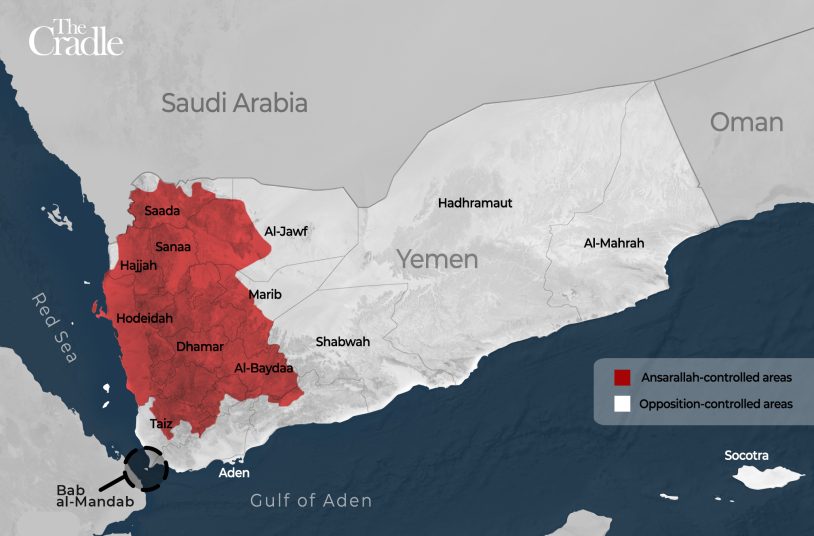
A map showing the distribution of control in Yemen
Where is Yemen heading?
These field movements are taking place as Washington and Abu Dhabi coordinate more closely with Tel Aviv. After meetings in October between the US CENTCOM commander and the Israeli chief of staff, a new plan began to take shape: build a joint ground network across southern Yemen to contain Sanaa and safeguard the Bab al-Mandab Strait – one of the world’s most critical shipping lanes.
At the same time, the US State Department appointed its ambassador to Aden’s Saudi-backed government, Steven Fagin, to lead a “Civil-Military Coordination Center” (CMCC) linked to ceasefire efforts in Gaza. Regional observers see this as a move to integrate the Palestinian and Yemeni fronts into one framework of US security control stretching from the Mediterranean to the Arabian Sea.
Reports circulating in Shabwa and Al-Rayyan say Emirati officers have been dispatched to Gaza to help organize local brigades – a claim still unconfirmed but consistent with the UAE’s wider operational pattern. Investigations by Sky News Arabia noted similarities in the slogans and structure of UAE-backed militias in Yemen and armed factions in Gaza, hinting at shared logistics and training links.
Adnan Bawazir, head of the Southern National Salvation Council in Hadhramaut, tells The Cradle that the scenario of recruiting mercenaries to fight in Gaza is not proven, but is possible – especially with the assignment of the interim administration in Gaza by Fagin, linking local moves to broader regional plans.
In Hadhramaut, Fagin’s visits to Seiyun, which includes the First Military Region, indicate preparations for a possible confrontation, especially since the area is still under the Saudi-backed Islah’s control in the face of the STC conflict, while Riyadh seeks to reduce Islah’s influence by transferring brigades and changing leadership.
Bawazir also points to suspicious movements in Shabwa and at Ataq airport, where field reports indicate flights transporting weapons to strengthen the front, given the governorate’s proximity to Marib and the contact fronts with Ansarallah, which makes it a hinge point for any regional or local escalation.
The moves are therefore part of three interrelated scenarios.
First, shifting pressure from Gaza to Yemen to compensate for the political and moral losses of Tel Aviv and Washington, while using the pro-coalition factions as a pressure arena against Sanaa. Second, preparing for possible military action in the event of the failure of the negotiations. Third, reorganizing the pro-coalition factions and building a central command that can be directed by Washington, thus turning the brigades into executive tools, ready to escalate the situation internally with a sectarian character.
Each scenario positions Yemen once again as a test field for foreign ambitions. The country remains divided between two trajectories: the possibility of a political settlement through Oman’s diplomacy, and the risk of a new conflict fed by regional competition and foreign control over its coasts and resources.
Whether the coming months bring a deal or another war will depend less on what Yemenis want and more on how their neighbors choose to use their soil.
Washington’s ‘new Gaza’ project meets Gulf pushback
The Cradle | November 2, 2025
Saudi Arabia and the UAE are pushing back against US President Donald Trump’s plan to construct roughly half a dozen residential regions on the eastern half of Gaza, which is currently under Israeli control, The Times of Israel reported on 2 November.
Citing two Arab diplomats familiar with the matter, The Times of Israel said that Trump and his real estate developer son-in-law, Jared Kushner, have proposed the plan to donors in the Gulf to build the “new Gaza” on the eastern side of the strip only, which is now under direct Israeli control.
Following the 11 October ceasefire agreement, Israeli forces withdrew to the east of a “Yellow Line” drawn up during the negotiations to divide Gaza into two parts. Hamas remains in control of the territory to the west of the line.
The partial withdrawal leaves Israeli forces in direct control of at least 53 percent of Gaza.
Trump’s plan to build residential areas in the Israeli-controlled east of Gaza reportedly envisions the Israeli army “gradually withdrawing to the other side of the Gaza border and leaving the Strip altogether,” The Times of Israel wrote.
However, such a withdrawal is conditioned on the establishment of an International Stabilization Force (ISF) for postwar Gaza, and the disarmament of the Hamas.
“With those two conditions for continued Israeli withdrawal so difficult to meet, the US is not waiting to begin the reconstruction process,” The Times of Israel added.
The US wants the international force to deploy to the west of the Yellow Line, the area remaining under Hamas control.
Washington also wants its Arab allies, Saudi Arabia and the UAE, to pay for the force.
However, the diplomats stated that the wealthy Gulf states are pushing back on the plan, as are Indonesia, Azerbaijan, Turkiye, and Egypt, who are expected to provide troops.
These nations are reluctant to assist Washington without a clear UN mandate or agreement with Hamas to hand over its weapons, the two Arab diplomats said. They also want to first deploy their forces on the east of the line to replace Israeli troops.
This information aligns with a previous Israel Hayom report, which revealed that Saudi Arabia, Bahrain, and the UAE had warned the US administration that they would not take part in Gaza’s reconstruction unless Washington enforced the ceasefire terms on Hamas and ensured the group’s disarmament.
Israel is also backing four militias as part of a project to oust Hamas and create a “new Gaza,” according to a report released by Sky News on 25 October.
These armed groups – which throughout the war have been engaged in hostilities against Hamas on behalf of Israel – are currently operating along the Yellow Line of Washington’s ceasefire map, in Israeli-held territory.
Jared Kushner stated he wishes to begin building on the Israeli side of the Yellow Line, in particular on the ruins of the destroyed city of Rafah in the south of the strip on the Egyptian border.
“The US proposal envisions as many as one million Palestinians — around half of Gaza’s population — moving to the residential areas on the Israel-held side of the Yellow Line,” The Times of Israel stated.
Kushner plans to complete the construction of these areas within two years, even if Israeli forces have not withdrawn by then, the two diplomats briefed on the plan stated. Both Arab diplomats concluded the timeline was “highly unrealistic.”
“Palestinians may not want to live under the rule of Hamas, but the idea that they’ll be willing to move to live under Israeli occupation and be under control of the party they also see as responsible for killing 70,000 of their brethren is fantastical,” one of the Arab diplomats said.
Additionally, there is no guarantee Palestinians would be allowed to return and live in the new housing developments. If Israeli forces remain in control of the area, Tel Aviv could decide to house Jewish Israeli settlers in the newly built neighborhoods instead, leaving Palestinians to languish in tents on the other side of the line.
One diplomat stated the Trump White House plans to sponsor a UN Security Council resolution to establish the international security force later this month, possibly before Saudi Crown Prince Mohammed bin Salman visits the White House for talks on the future of Gaza on 18 November.
Kushner and Vice President JD Vance previously stated the US and Israel are considering a plan to divide Gaza into separate zones, one controlled by Israel and one by Hamas, with reconstruction only taking place on the Israeli side until Hamas is disarmed and dissolved.
Vance and Kushner summarized the plan during a press conference in Israel on 22 October, explaining that no funds for reconstruction would go to areas that remain under Hamas’s control.
“There are considerations happening now in the area that the [Israeli army] controls, as long as that can be secured, to start the construction as a new Gaza in order to give the Palestinians living in Gaza a place to go, a place to get jobs, a place to live,” Kushner said.
Kushner is seeking to “create an environment that would be safe for the billions of dollars in investment needed to rebuild,” the Wall Street Journal (WSJ) commented.
“White House officials said Kushner is the driving force behind the split-reconstruction plan, having devised it alongside special envoy Steve Witkoff,” the WSJ said.
The financial newspaper added that with time, Israel could take more territory in Gaza from Hamas, and try to replicate what it has done in the occupied West Bank, with Israel taking complete security control while “forcing Gazans into small, unconnected areas of control.”
“Gaza has represented the only patch of territorial contiguity for a Palestinian state,” explained Tahani Mustafa, a fellow with the European Council on Foreign Relations.
“A plan like this could end up creating what Palestinians feared.”
The UAE’s War on Muslims: From Sudan to the Gaza Genocide
By Robert Inlakesh | The Palestine Chronicle | October 30, 2025
While the United Arab Emirates advertises itself as both a peacemaker and opponent of so-called “Islamic radicalism”, it is currently involved in genocide in both Gaza and Sudan. Connecting these dots is key to understanding the overarching goals of the regime.
The United Arab Emirates has created its image in the world as an innovator, a builder, and a peacemaker, a carefully calibrated illusion as artificial as the buildings that mesmerize onlookers in Dubai. But behind the architecture and lavish outer shell is a rotten core that continues to aid in the erosion of the surrounding region.
While claiming to oppose “radical Islam” and paying talentless influencers to attack groups like the Muslim Brotherhood, they foster extremist ideologies and back ISIS-linked militant groups to carry out their regional ambitions.
For all of the critiques that can be offered of groups like the Muslim Brotherhood and of Qatar, they are nothing like the orientalist depictions of them that are spread far and wide through Emirati propaganda.
The reason why the UAE attacks the ideology belonging to groups that are either linked to or part of the Muslim Brotherhood has nothing to do with their religious motivations and everything to do with the Emirati opposition to their political agenda.
For them, they fear any politically engaged Islamic movement that is capable of successfully leading a country and organizing democratic institutions, because they are a dictatorship fully beholden to their Western handlers, including Israel.
The reason why the Islamic element of such movements threatens them the most is that it is popular and the religion that the majority of the region adheres to in some shape or form.
If any Islamic anti-imperialist movement proves successful and leads a democratic process, then this could threaten their rule. So, they seek to undermine, infiltrate, and destroy these movements wherever they rear their heads, including inside the Gaza Strip.
Hamas, or the Islamic Resistance Movement, was an outgrowth of the Egyptian Muslim Brotherhood. Its origins begin in the 1970s and the formation of the social/civil-society movement known as the Mujamma al-Islamiyya in the Gaza Strip, at the time colloquially referred to as the Muslim Brotherhood, as it represented Palestine’s wing of the movement.
Therefore, the success and popularity of Hamas, as part of what is viewed by the Emiratis as a wider body of Islamic political movements, is interpreted as a threat to its rule in the region.
As a means of dismantling the prospects of Democratic oriented Islamic political leaderships, the UAE has engaged in military confrontations and intense propaganda campaigns. On the propaganda front, they are joined by other Gulf leaderships who have their own agendas, also and not only fund direct anti-Hamas or anti-Muslim Brotherhood propaganda, but also fuel religious division.
One of the most powerful means of divisive propaganda is directly targeting Muslims themselves, in particular the Sunni Muslim majority of the region. While they certainly push sectarian rhetoric against the Shia too, they seek to pacify the Sunni population, deter them from engaging in anti-imperialist and anti-occupation struggles, or redirect their anger at fellow Muslims.
They do this through pushing divisions between mainstream Sunni schools of thought and employing their Madkhali propagandists to deter action against the so-called Muslim rulers. Without going too deep into the Madkhalis, as with each group of Muslims, there is always nuance; they are a group of Salafist Muslims who adhere to the dictates of their rulers and sometimes will even justify actions taken by those rulers that are prohibited in Islam.
The primary goal here is to fund and fuel division across the Muslim world, channeling hatred and creating debates around any issue that can distract from what Israel, the United States, and their allies are doing to the region. Another major tactic employed here is to Takfir (declare a disbeliever) or undermine any Muslim group that sides with the likes of Iran, Hezbollah, Ansarallah, or any other Shia groups.
Again, none of this opposition has anything to do with any substance that may be behind said arguments they make; these are well-funded propaganda campaigns designed for political purposes to undermine resistance to imperialism, occupation, and genocide. This is where we can begin looking at Gaza and then Sudan.
The UAE professes to oppose so-called “Islamic radicalism”, yet it now stands accused of providing support to the ISIS-linked gangs operating in the Israeli-occupied portion of the Gaza Strip. Not only has the UAE been accused of directly coordinating with these militia groups – composed of hardline Salafists who have links to ISIS and al-Qaeda, drug traffickers and murderers – but there is even evidence of these death squad members driving around in vehicles with registered UAE license plates.
In opposition to Hamas, the UAE is more than happy to back Israeli proxy collaborator groups that contain ISIS and Al-Qaeda minded elements within them.
Going back to the sorts of divisive propaganda that is encouraged by the Emiratis, a leading member of the Israel-backed so-called “Popular Forces” militia in Gaza, Ghassan Duhine, has openly cited ISIS Fatwas declaring Hamas apostates as a justification for killing them. ISIS officially declared war on Hamas back in 2018.
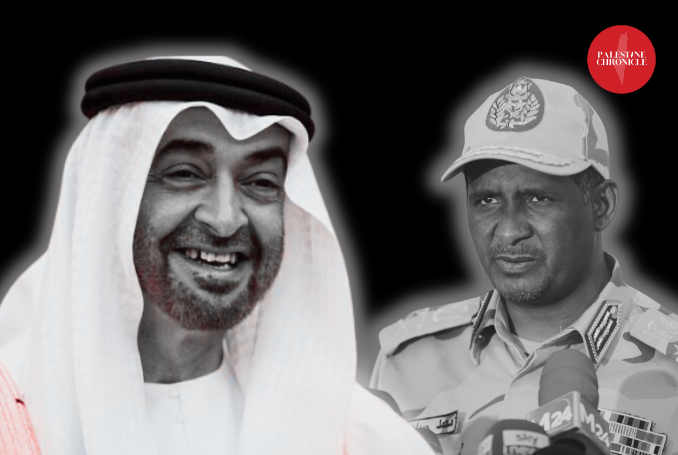
Meanwhile, the UAE has long been backing the Rapid Support Forces (RSF) in Sudan, the group currently accused of committing genocide, and which has re-entered the headlines after it captured Al-Fasher and other areas in North Darfur, resulting in the murder of around 527 people, including civilians who were butchered while sheltering in refugee camps.
RSF leader, Mohamed Hamdan Dagalo (Hemedti), has long collaborated with the Emiratis, and it was even previously pointed out that his official Facebook page was controlled out of the UAE.
Without getting into all of the complexities of the Sudanese civil war, Hemedti is a warlord who has long maintained power over the majority of Sudan’s Gold Mines, slaughtering anyone who dares to get in his way.
His forces have also been accused by the UN and prominent rights groups of committing widespread mass sexual violence, including horrific forms of rape.
Hemedti was additionally supplied with battle-changing technologies through his Israeli Mossad contacts, and despite there being documented rights violations on both the Sudanese Army and RSF sides of the war, there is no doubt that Hemedti’s forces have the most blood on their hands and carry out the most horrific crimes seen in the conflict.
The UAE is not just one of many actors involved in Sudan; it is the primary supporter of the RSF. According to a scoop published by The Guardian this Tuesday, British weapons sold to the United Arab Emirates were even discovered to have been used by the RSF to carry out its genocide.
Despite the United States declaring the horrors in Sudan as a genocide, during the Biden administration, no action has been taken against the UAE for its role in fueling the war. Similarly, the UAE has been involved in countless crimes committed throughout the Horn of Africa and in North Africa too, backing a whole range of extremist militant groups who stand accused of indiscriminately targeting civilians.
Although it is also hidden from the Western corporate media, the UAE even used members of the Sudanese RSF to fight on its behalf as proxy forces against Ansarallah in Yemen, where they were accused of playing a role in what many declared a genocide. Keep in mind that nearly 400,000 people in Yemen were killed due to the inhuman blockade and war of aggression, led by both the UAE and Saudi Arabia.
The Emiratis push propaganda about the Sudanese Military being “Islamists”, accusing them of being part of the Muslim Brotherhood and then linking them to all sorts of other organizations. Ansarallah in Yemen is also branded as “Islamists”, but in their case are accused of being “Iranian proxies”. In essence, this line of propaganda is the typical Israeli-style Hasbara argument for committing egregious war crimes.
Throughout the Gaza genocide, the UAE was one of the only nations that continued its routine flights to Ben Gurion airport and transported materials to aid the Israelis. The Emiratis also turned Dubai into an Israeli safe haven, where soldiers implicated in genocide can go to party, engage in activities like consuming narcotics or hiring escorts, and live in luxury.
The UAE did not lift a finger to force the Israelis to let aid into Gaza, as they blocked all humanitarian aid trucks entering for around three months earlier this year, but will then point to the trickles of aid that they do supply as proof they are helping the people. In their defense, they argue that they were key in achieving a ceasefire, for which there is no evidence, just like there was no evidence that they stopped West Bank annexation when normalized ties with Israel.
Viewing the Emiratis as operating on their own whims, blaming them solely for the actions they commit, is incorrect. These are rulers installed by the West, who work for the West and are simply used as pawns to do the bidding of their masters. If any of their leaders stand up to the crimes that the UAE is inflicting, they will be assassinated and replaced with other members of the ruling bloodline who choose to play ball. They are hostages, posing as rulers and playing their part in the dismantlement of the surrounding region.
Saudi Arabia’s path to normalization with Israel threatens a regional rupture
By Fouad Ibrahim | The Cradle | October 24, 2025
On 17 October, US President Donald Trump told Fox News, “I hope to see Saudi Arabia go in, and I hope to see others go in. I think when Saudi Arabia goes in, everybody goes in.” The statement was calculated to reignite Washington’s normalization push and reassert Riyadh’s place at the heart of the US-Israeli regional alliance plan.
Trump is determined to complete the regional realignment he initiated in 2020 with the signing of the Abraham Accords. Including Saudi Arabia would crown his foreign policy legacy and fundamentally alter the Arab political order. But the costs may be steeper than the gains.
The 2023 near-deal that faltered
In the months preceding Israel’s genocidal war on Gaza, US-mediated talks between Riyadh and Tel Aviv were approaching a breakthrough. The kingdom sought US security guarantees, access to advanced weapons systems, and backing for its civilian nuclear ambitions. The Israeli side, eager for regional legitimacy, saw in Riyadh a historic opportunity.
But Operation Al-Aqsa Flood on 7 October 2023, and Tel Aviv’s ensuing carpet-bombing of Gaza, derailed the entire process. Saudi officials were forced to retreat in the face of overwhelming public outrage across the Muslim world.
Trump’s renewed confidence, however, suggests the framework forged before the war was never truly discarded. It has merely been shelved, pending a more favorable political climate.
Saudi Arabia is not just another Arab state. Its symbolic weight derives from a rare trifecta: custodianship of Islam’s two holiest sites, vast oil wealth and economic clout, and considerable political leadership of the Arab and Islamic mainstream.
If the kingdom normalizes ties with Tel Aviv, a domino effect across Arab and Muslim nations could follow. For Israel, this would be the ultimate regional prize. For Washington, it would cement an American-led bloc from the Mediterranean to the Persian Gulf, aimed squarely at containing both Iran and China.
What could drive normalization forward?
Despite the political fallout from Gaza, several factors continue to draw Riyadh toward normalization. Both Saudi Arabia and Israel view Iran and the Axis of Resistance as their primary regional adversaries.
This strategic alignment has not been fully undone by the 2023 China-brokered thaw between Tehran and Riyadh. Meanwhile, Saudi Arabia’s Vision 2030 plan to diversify its economy sees potential in Israeli sectors like defense technology and cybersecurity.
Trump’s preference for transactional diplomacy means a grand bargain offering defense pacts, nuclear cooperation, or substantial investment flows could appeal to Saudi ambitions. And within the kingdom, a younger, globally attuned population may be less ideologically opposed to normalization – if it is presented as part of a broader modernization drive.
However, polls conducted by the Washington Institute before and after 7 October 2023 show a different inclination. Surveys in December indicated that a majority of Saudis oppose normalizing ties with Israel.
Strategic and moral hazards
Normalization is not without peril. On the contrary, its very success could destabilize the region.
Any Saudi–Israeli deal that sidelines Palestinian rights would be seen as a betrayal of the kingdom’s religious mandate and leadership role. The devastation in Gaza has reignited pan-Islamic solidarity, and any Saudi alignment with Tel Aviv while Palestinians endure siege and bombardment could shatter the kingdom’s legitimacy in the wider Muslim world.
The Axis of Resistance – particularly Iran, Hezbollah, and Ansarallah – would seize on the normalization to portray it as an alliance of apostates and occupiers, fueling more intense and frequent confrontations. By committing to a volatile US-Israeli partnership, Riyadh risks entanglement in wider conflicts, undermining its strategic autonomy and exposing itself to blowback it cannot control.
The security dimension: A trilateral axis
If normalization ushers in a US–Israel–Saudi security architecture, the implications for West Asia would be profound. Tel Aviv would contribute intelligence and military prowess, Washington would provide oversight and guarantees, and Riyadh would bankroll the venture.
But this alliance would be read in Tehran as yet another encirclement strategy, prompting the Islamic Republic to accelerate its missile and nuclear capabilities. The region could slide into an arms race that undermines development, drains budgets, and magnifies the risks of miscalculation.
Moreover, such a pivot could unravel Saudi Arabia’s recent diplomatic gains – including its rapprochement with Iran, Iraq, and Oman-mediated talks with the Sanaa government in Yemen – and alienate its Eurasian partners like China and Russia. The net result could be diminished regional influence and increased dependence on the west.
Domestically, too, the kingdom would face challenges. Clerical critics and nationalist voices could depict normalization as ideological surrender. The government would find itself more reliant on US and Israeli backing to suppress dissent, exacerbating its internal vulnerabilities.
In this sense, the very security guarantees sought through the trilateral axis could paradoxically generate new forms of insecurity – both internal and regional – making the kingdom’s stability increasingly contingent on external actors and volatile power dynamics.
Economic integration
Economic incentives are central to the normalization pitch. Saudi–Israeli integration could unlock massive investment flows and tech partnerships in fields ranging from Artificial Intelligence (AI) to renewables.
Yet this alignment risks reinforcing structural dependencies. Israeli firms, backed by western capital and technological superiority, would dominate the value chains. The Saudi economy could shift from oil dependency to digital subordination.
Further, such a move could sour ties with China, currently Riyadh’s largest trading partner. Over-alignment with the US–Israel axis might jeopardize the kingdom’s multi-vector strategy and reduce its diplomatic room to maneuver.
Even the promise of modernization may ring hollow if perceived as elite enrichment at public expense. The economic corridor could become a tool of inequality, modernizing infrastructure while leaving social contracts untouched.
Economic integration can bring regional prosperity if fair and balanced, but without safeguards, it risks reinforcing dependency and fueling conflicts.
Surveillance state: Normalization’s dark underbelly
One of the least discussed aspects of normalization is cyber collaboration. Israel’s role as a global surveillance hub and Saudi Arabia’s deep pockets could converge to create a formidable digital control grid.
Such a system – integrating spyware, predictive policing, and AI surveillance – would strengthen the US-led intelligence grid across West Asia, enhancing early-warning systems, missile defense coordination, and digital containment of the Axis of Resistance.
It could also extend the reach of western intelligence into theaters such as Yemen, Iraq, Lebanon, and the Red Sea. In practical terms, the alliance could evolve into a regional integrated military and intelligence system encompassing command, control, communications, computers, intelligence, surveillance, and reconnaissance – underpinned by joint data centers, AI-driven threat analysis, and shared satellite networks.
However, this integration would carry profound ethical and political implications. The same tools designed to deter external threats could easily be repurposed for internal control. By combining Israeli-developed spyware, predictive policing algorithms, and US-supplied surveillance hardware, the Saudi government would vastly expand its capacity to monitor dissent, pre-empt protests, and neutralize political opposition.
The normalization process could thus serve as a legitimizing cover for what might become the most sophisticated surveillance apparatus in the Arab world.
Regionally, a Saudi–Israeli cyber partnership would alarm neighboring states, particularly Iran and Qatar, which would perceive it as a threat to their own sovereignty and national security. The likely response would be the acceleration of rival cyber alliances, possibly involving Russia, China, or Turkiye – ushering in a new digital Cold War in the Persian Gulf.
In the long term, the fusion of surveillance technology and political authority poses a deeper civilizational question: Can the Arab world’s quest for security coexist with the preservation of freedom and privacy? If the digital frontier becomes another instrument of domination, the promised “technological peace” may end up securing governments, not peoples – turning the dream of innovation into the architecture of control.
Riyadh’s choices: Three possible trajectories
The Saudi leadership now faces three broad options. First, conditional normalization, where recognition of Israel is tied to measurable progress on Palestinian statehood and sovereignty. Given Tel Aviv’s accelerated settlement expansion in the occupied West Bank, this appears increasingly unrealistic.
Second, incremental engagement (soft normalization), involving quiet cooperation below the threshold of formal recognition that gradually lays the groundwork for future deals.
Third, strategic hedging, in which Riyadh continues to balance between US pressure and regional diplomacy, keeping normalization in reserve as a bargaining chip.
Between realpolitik and regional rupture
Trump’s statement has reignited the debate over the kingdom’s path forward. The immediate gains of normalization – security assurances, economic incentives, and prestige – are tempting. But the long-term consequences could be corrosive.
To join the Abraham Accords while Gaza remains in rubble will irreparably damage Saudi Arabia’s credibility as a leader of the Islamic world. It could sever the kingdom from the Arab street, provoke resistance retaliation, and entrench a neocolonial security order.
Unless normalization is tied to justice for Palestine, it will be remembered not as peace, but as betrayal.
Iran security chief backs Saudi-Hezbollah rapprochement from Beirut
The Cradle | September 27, 2025
Secretary of Iran’s Supreme National Security Council, Ali Larijani, stated on 27 September that Hezbollah is a “bulwark” against Israeli aggression, rapprochement with Saudi Arabia is to be welcomed, and that the Lebanese people do not need the US as a “guardian.”
Larijani made the statements after arriving in the Lebanese capital on Saturday to attend the anniversary ceremony of the assassination of Hezbollah leader Hassan Nasrallah.
During a press conference following his meeting with Parliament Speaker Nabih Berri in Ain al-Tineh, Larijani said Hezbollah “represents a solid barrier against the Israeli entity,” one year after Israel’s devastating war that killed 4,047 Lebanese, including fighters and civilians.
Despite Israel’s air superiority, Hezbollah fighters were able to prevent the invading Israeli forces from moving deep into Lebanese territory.
However, Israeli troops managed to occupy five points on Lebanese territory near the border that they continue to hold.
Since the end of the war, Israel has carried out thousands of airstrikes, including a drone strike on a family traveling by car as they reached their home in Tyre in southern Lebanon earlier this week.
The strike killed Shadi Charara, a car dealer, and three of his daughters. His wife and one of his daughters survived the strike. A man riding a motorcycle nearby was also killed.
“The resistance represents a significant asset for the Islamic nation,” Larijani stated, while praising Nasrallah for recognizing the danger posed by Israel decades ago and developing plans to confront it.
Larijani pointed out that Iran wants countries in the region to cooperate with each other in the face of the Israeli threat, despite previous disagreements. “They must put these aside and make cooperation the basis of their relations.”
As a result, he praised Hezbollah Secretary-General Sheikh Naim Qassem’s efforts to improve relations with Saudi Arabia.
“Saudi Arabia is a sister country to us, and there are ongoing consultations between us. Today is a day of cooperation in confronting a single enemy,” Larijani stressed.
Regarding the deep US influence in the country, Larijani stated that, “The Lebanese people are rational and do not need a guardian, nor do they need the Americans to appoint themselves as their guardians.”
He also addressed US Special Envoy Tom Barrack’s assertion that the US is arming the Lebanese army not to fight against Israel, but to fight Hezbollah.
Larijani said that Barrack is “stirring up discord, sowing division, and causing problems within the country and among its citizens, while the approach adopted by Iran is based on Lebanese officials addressing their internal issues through consensus.”
Regarding Israeli threats, he stressed that Iran is prepared for another war with Israel, but warned that it would be “stupidity” for Israel to launch such a war and that Iran’s response would be severe.
In June, Israel launched an unprovoked war against Iran, killing at least 935 people and targeting the Islamic Republic’s air defense and nuclear sites. Iran responded by hitting Israel with barrages of ballistic missiles and drone strikes.
After meeting with Speaker Berri, Larijani then headed to the Government Palace, where he met with Prime Minister Nawaf Salam.
The two reviewed the latest developments in the region and bilateral relations between the two countries.
Salam emphasized that Lebanese-Iranian relations “must be based on mutual respect for each party’s sovereignty and non-interference in internal affairs.”
Saudi-Pakistan defense pact: Reshaping security architecture in West and South Asia
By Mohammad Molaei | Press TV | September 27, 2025
In the intricate web of West Asian and South Asian geopolitics, where alliances often hinge on the precarious balance of power, energy dependencies, and ideological affinities, the signing of the strategic defense pact between Pakistan and Saudi Arabia marks a pivotal evolution.
This pact represents a calculated maneuver to fortify the alignment of defenses between the two Muslim-majority countries amid waning US commitments. Drawing from operational analyses of similar pacts, like the US-Japan security treaty or the erstwhile CENTO framework, this agreement integrates conventional military interoperability with implicit extended deterrence, potentially altering the calculus of regional power projection.
At its core, the agreement formalizes a mutual defense commitment, stipulating that an armed attack on either party constitutes an assault on both, triggering joint responses under Article 51 of the UN Charter for collective self-defense.
This language echoes NATO’s Article 5 but is tailored to the Persian Gulf’s hybrid threats, encompassing not just conventional invasions but also proxy warfare, cyber intrusions, and ballistic missile salvos. The pact builds on a 1982 protocol that already facilitated Pakistani troop deployments to Saudi Arabia—historically involving up to 20,000 personnel in advisory and training roles—but elevates it to a comprehensive framework for integrated operations.
Militarily, the agreement spans a spectrum of cooperation modalities. Joint exercises will intensify, drawing from existing bilateral drills like the Al-Samsam series, which have honed mechanized infantry maneuvers and anti-tank warfare using platforms such as Pakistan’s Al-Khalid main battle tanks (MBTs) and Saudi M1A2 Abrams variants.
Technology transfers are a cornerstone. Pakistan, with its robust defense-industrial base—including the production of JF-17 Thunder multirole fighters co-developed with China—will share expertise in low-cost unmanned aerial vehicles (UAVs) like the Burraq, equipped with laser-guided munitions for precision strikes.
In return, Saudi Arabia’s petrodollar-fueled arsenal offers access to advanced air defense systems, such as the THAAD (Terminal High Altitude Area Defense) interceptors, potentially integrating with Pakistan’s HQ-9/P (export variant of China’s FD-2000) to create layered anti-ballistic missile shields.
Arms procurement and co-production feature prominently, with provisions for joint ventures in missile technology—leveraging Pakistan’s Shaheen-III intermediate-range ballistic missiles (IRBMs) with a 2,750 km reach—and electronic warfare (EW) suites.
Intelligence sharing via secure datalinks will enhance situational awareness, focusing on various threats. Logistically, the pact enables forward basing: Pakistani Special Forces could embed with Saudi Rapid Intervention Forces for counterterrorism operations, while shared maintenance facilities for F-15SA Eagles and AH-64E Apache helicopters streamline sustainment in prolonged conflicts.
This blueprint for operational synergy mirrors how the Persian Gulf Cooperation Council (PGCC) integrates air assets under Peninsula Shield Force, but with Pakistan’s battle-hardened infantry adding asymmetric depth.
Saudi Arabia’s pursuit of this pact stems from a pragmatic recalibration of its security posture, driven by the kingdom’s Vision 2030 imperatives to reduce oil dependency. Riyadh views Pakistan as a Muslim-majority regional powerhouse with a professional army of over 650,000 active personnel, battle-tested in counterinsurgency campaigns against the Tehrik-i-Taliban Pakistan (TTP) and capable of rapid deployment via C-130J Super Hercules transports.
The kingdom’s goals are multifaceted: first, to hedge against US retrenchment, as evidenced by Washington’s equivocal responses to the 2019 Abqaiq attacks, which exposed vulnerabilities in Saudi Patriot PAC-3 batteries despite their 90 percent intercept rates against subsonic threats.
Second, the pact bolsters deterrence against Iran’s symmetrical arsenal, including medium-range ballistic missiles and tactical ballistic missiles, which have ranges covering the Arabian Peninsula. By aligning with Pakistan, Saudi Arabia gains indirect access to a nuclear-capable partner, complementing its own nascent uranium enrichment program under IAEA safeguards.
Economically, it secures preferential access to Pakistani manpower—over 2 million expatriates already remit billions annually—while channeling investments into Pakistan’s defense sector, such as upgrading the Heavy Industries Taxila (HIT) for co-producing Al-Zarrar tanks.
A critical flashpoint is whether the pact extends Pakistan’s nuclear umbrella to Saudi Arabia. Pakistan possesses an estimated 170 warheads, deliverable via Ghauri MRBMs (1,500 km range) or Ra’ad ALCMs (air-launched cruise missiles) from F-16C/D platforms, adhering to a “minimum credible deterrence” doctrine focused on India but adaptable to West Asian contingencies.
The agreement’s text maintains strategic ambiguity—no explicit mention of nuclear sharing—but statements from Pakistani government officials suggest availability “if needed,” implying extended deterrence similar to US commitments to NATO allies.
Analyses indicate this isn’t a formal nuclear-sharing arrangement like NATO’s B61 gravity bombs in Europe; rather, it’s a de facto assurance where Pakistani assets could be forward-deployed in extremis, perhaps via submarine-launched Babur-3 SLCMs from Agosta 90B-class boats.
Saudi funding has historically supported Pakistan’s program, per declassified US cables, but proliferation risks loom under the NPT, which Pakistan hasn’t signed. The pact stops short of a binding nuclear clause to avoid IAEA scrutiny, opting instead for “all necessary means” language that preserves deniability.
The pact’s ramifications cascade across the region, amplifying fault lines and complicating the Persian Gulf’s A2/AD dynamics. For the broader West Asia, it fortifies a new bloc, potentially integrating with the UAE’s Edge Group UAVs or Bahrain’s naval patrols under the Combined Maritime Forces (CMF). This could escalate proxy conflicts in Yemen, where Saudi-led coalitions already employ Pakistani advisors, or in Syria, straining Russian-mediated de-escalation zones.
However, the agreement does not pose any threat to the Islamic Republic, given Pakistan’s role as Iran’s most important security partner, underscored by recent bilateral agreements on border security, counterterrorism, and economic cooperation, including efforts to combat smuggling and joint patrols.
Iran has welcomed the pact as a step toward “comprehensive cooperation among Muslim nations,” reflecting shared interests in regional stability through frameworks like the SCO.
Islamabad’s clarification that the agreement is “defensive and not aimed at third countries” is reassuring, preserving economic lifelines like the Iran-Pakistan gas pipeline (delayed but vital for Pakistan’s energy security). Joint border patrols under the 2019 MoU persist, though the pact might divert Pakistani resources—e.g., diverting FC (Frontier Corps) units from anti-smuggling ops to Persian Gulf deployments.
Open-source indicators reveal keen interest from several nations in acceding to this framework, potentially evolving it into a multilateral shield. The UAE, with its Mirage 2000-9 fleet and ambitions for a “Persian Gulf NATO,” tops the list—Abu Dhabi’s prior defense MoUs with Pakistan (including pilot training) align seamlessly, and sources suggest imminent talks for integration.
Qatar, despite Al Udeid’s US basing, eyes the pact for diversified deterrence post-2022 blockade scars, with indications of exploratory discussions. Egypt emerges as a likely candidate: Cairo’s Sisi administration seeks Saudi funding for its T-90MS MBTs and could contribute expeditionary forces, as noted in geopolitical analyses.
Bahrain and Jordan, already in Saudi-led coalitions, have expressed interest via diplomatic channels, bolstering maritime interdiction in the Strait of Hormuz. Even Oman, traditionally neutral, monitors developments for selective engagement in counter-piracy ops.
Mohammad Molaei is a Tehran-based military affairs analyst.
West’s grip slips with Saudi–Pakistan security deal
Riyadh’s pact with Islamabad redraws alliances, weakens Indian leverage, and hints at a new Muslim deterrence framework beyond western control.
By F.M. Shakil | The Cradle | September 23, 2025
On 17 September, Riyadh rolled out the rare royal purple carpet for Pakistani Prime Minister Shehbaz Sharif – an honor previously reserved for global power players like US President Donald Trump.
Accompanying him on the trip was Pakistan’s Army Chief, Field Marshal Asim Munir. His presence highlighted that Riyadh values its defense pact with a nuclear power that, despite economic challenges, remains militarily strong.
Nuclear umbrella over Riyadh
The centerpiece of their visit was the signing of a “Strategic Mutual Defense Agreement” (SMDA), which declares that an attack on either country will be considered an attack on both.
Described by a senior Saudi official to Reuters as covering “all military means,” the pact has triggered speculation that it includes a nuclear umbrella, which would be a game-changing development in the military balance of West Asia.
With 81 percent of Pakistan’s weapon imports coming from China, the agreement implicitly aligns Saudi Arabia with the Chinese military-industrial orbit, whether by design or default. The kingdom has long been reliant on US arms, training, and security guarantees.
The pact was signed just two days after an extraordinary joint session between the Arab League and the Organisation of Islamic Cooperation (OIC) was called, following the 9 September Israeli airstrikes on Qatar – a major non-NATO ally and Gulf neighbor – with no substantial response from Washington, reinforcing perceptions that western security commitments are both selective and expendable.
Mushahid Hussain Syed, a former information minister and chairman of Pakistan’s Senate Defense Committee, tells The Cradle that the US has pivoted away from Arab allies toward Tel Aviv, leaving the region disillusioned and increasingly leaning toward alternatives.
“The strategy of ‘Greater Israel,’ spearheaded by Netanyahu, has involved military actions against five more Muslim nations. Pakistan’s recent triumph against India has demonstrated its capacity to contest Israel’s significant ally, India, and establish itself as a strategic alternative for Gulf nations.”
Toward an Islamic NATO?
Iraqi Prime Minister Mohammed Shia al-Sudani recently called for an Islamic military alliance, akin to NATO, in response to Israel’s airstrike on Doha. His proposal echoed Egypt’s earlier attempt to revive a joint Arab defense force under the 1950 treaty – an initiative blocked by Qatar and the UAE, reportedly under US pressure.
A similar proposal has also come from Islamabad when Pakistan’s Defense Minister, Khawaja Asif, urged Muslim countries to band together in a NATO-like military alliance in light of the Israeli aggression in Doha.
During an appearance on Geo TV last week, Asif drove home the point that a united Muslim military front is essential to tackle common security issues and fend off outside dangers. Asif invoked the wider role of the west in instigating instability in West Asia, emphasizing the intricate network of US support for Al-Qaeda and the CIA’s covert actions that led to Osama bin Laden’s relocation to Sudan or the regime change war in Syria.
Is nuclear deterrence a part of the Pact?
The nuclear dimension of the Riyadh–Islamabad pact remains opaque, but highly significant. While no official statement from either side confirms the presence of a nuclear component, Asif hinted that Pakistan’s nuclear capabilities could be shared with Saudi Arabia as part of the agreement.
Syed, however, clarifies to The Cradle that Pakistan’s nuclear doctrine is India-centric and that its deterrence posture is South Asia-specific and does not extend to the Persian Gulf.
“A novel security framework for the region appears to be taking shape, focusing on Global South nations such as Pakistan and Saudi Arabia, whereas the Indo-Israeli Axis, previously supported by the US, now finds itself significantly diminished.”
The defense agreement between Pakistan and Saudi Arabia, he says, represents a notable achievement for Pakistan, establishing it as a pivotal entity within the geopolitical framework of West Asia, particularly among Muslim countries.
“The agreement is shaped by three significant elements: the perceived neglect of Arab allies by the United States, Israel’s proactive maneuvers in areas such as Iran, Qatar, Lebanon, Syria, and Yemen, and Pakistan’s recent triumph over India in May.”
New Delhi, Tel Aviv on alert
Foreign media and analysts are already warning that the pact may have unintended consequences for India and Israel, despite claims that it targets neither. Others predict that this pact is really about Riyadh’s ambitions to counter Iran and Yemen’s Ansarallah-led government in the region.
Dr Abdul Rauf Iqbal, a senior research scholar at the Institute for Strategic Studies, Research and Analysis (ISSRA) at Islamabad’s National Defence University (NDU), tells The Cradle that New Delhi views the pact with unease as it formalizes Saudi–Pakistani security ties that could entangle Riyadh in South Asian rivalries, especially the India–Pakistan border tensions over Jammu and Kashmir:
“It represents a setback for Prime Minister Modi’s foreign policy, potentially leading to Saudi involvement in a prospective Indo–Pak conflict. Furthermore, future Saudi investments in Pakistan’s Gwadar port and economic corridors would challenge India’s regional influence and initiatives such as the India-Middle East-Europe Corridor (IMEC).”
He adds that Saudi Arabia’s pivot toward Pakistan reflects a broader alignment of Muslim powers and could push Tel Aviv to recalibrate its war on Gaza. It also pressures Tel Aviv by placing Pakistan – a vocal opponent of Israeli expansionism – into West Asian affairs.
“This agreement is not meant to counterbalance Iran’s regional influence, but rather to promote the Saudi Iranian reconciliation, as Pakistan maintains friendly relations with both nations. By formalizing ties with nuclear-armed Pakistan, Riyadh secures a credible deterrent as US security guarantees weaken. While western think tanks view it as an effort to contain Iran, the Arab world emphasizes it as strengthening Gulf deterrence independently of Washington.”
Indian concerns also stem from fears that the pact’s NATO-style clause could complicate ongoing operations like Sindoor, which remains active in a limited capacity following the skirmish between the two nuclear powers in May, especially given that the Gulf states’ swift mediation to resolve the crisis reflects their own interests with India and makes any military action against it unlikely.
Secondly, India is strategically analyzing Pakistan’s nuclear capability, which could see a boost if Saudi Arabia, having no such capacity, begins channeling funds to share Pakistan’s nuclear assets.
A post-western Gulf order?
While Tel Aviv and New Delhi remain publicly silent, both capitals are undoubtedly scrutinizing the fallout. Israel’s failed assassination attempt on Hamas leaders in Qatar, and India’s pressure campaign along the Line of Control, suggest that the axis is nervous about the consequences of a Saudi–Pakistani alliance. Israeli media downplayed the Saudi–Pakistan defense deal, seeing it as a show of force after Riyadh failed to influence Trump or West Asian policy.
As Syed notes, “The traditional ‘Oil for Security’ framework, which once defined US relations with the Middle East [West Asia], now serves as a remnant of a bygone era. As Saudi economic power increasingly reinforces China’s backing of Pakistan, India may feel vulnerable and isolated.”
Mark Kinra, an Indian geopolitical analyst with a focus on Pakistan and Balochistan, tells The Cradle that this development holds particular significance for India. New Delhi, he argues, has sustained robust economic and diplomatic ties with Saudi Arabia for many years, and the influx of Saudi investments in India continues to expand:
“India will be meticulously observing the progression of this agreement, particularly given that its specific terms are not publicly available. Any alteration in the regional security equilibrium may influence India’s strategic assessments, energy security, and diplomatic relations.”
As Washington’s selective security guarantees falter and Israel escalates unchecked, Persian Gulf states like Saudi Arabia are looking eastward for credible deterrents and strategic autonomy.
By aligning with nuclear-armed Pakistan, Riyadh is asserting greater independence from the western military order. It also signals the emergence of a multipolar Persian Gulf security architecture –one increasingly shaped by Global South coordination, not western diktats.
Mohammad Marandi: Iran KILLS IAEA Deal — Cairo Agreement Wiped Out After SnapBack!
Dialogue Works | September 21, 2025
Trump scrambles to contain fallout from Israeli crime spree with meeting in New York
MEMO | September 22, 2025
President Donald Trump is set to host a high-level meeting with a select group of Arab and Muslim leaders on Tuesday in New York to discuss the ongoing Israeli genocide in Gaza. The summit, to be held on the sidelines of the UN General Assembly, comes as Western governments declared their recognition of the State of Palestine and amid growing international condemnation of Israel’s war crimes.
Two Arab officials confirmed to Axios that leaders from Saudi Arabia, the United Arab Emirates, Qatar, Egypt, Jordan and Turkey have been invited to the closed-door meeting, which will take place at 2:30pm Eastern Time.
The summit is expected to precede Trump’s meeting with Israeli Prime Minister Benjamin Netanyahu, scheduled for 29 September at the White House. Sources familiar with the preparations said Arab leaders will call on Trump to pressure Netanyahu to end the assault on Gaza and to abandon plans to annex the illegally occupied West Bank.
Washington’s agenda reportedly includes a proposal for Arab and Muslim countries to contribute to a post-war stabilisation plan in Gaza, including potential troop deployments to replace the Israeli occupation forces. However, such proposals are expected to meet resistance unless a political framework guaranteeing Palestinian sovereignty is agreed.
Trump is also expected to hold a second meeting on Tuesday with leaders of the Gulf Cooperation Council (GCC), including Oman, Bahrain and Kuwait, to address broader regional concerns including Israel’s escalation in the region.
The unprovoked attack on Doha two weeks ago by Israel was met was global condemnation. Qatar reportedly demanded an apology before the resumption of negotiations.
Israel’s strike triggered an emergency summit of Arab and Muslim countries in Doha, and was swiftly followed by a new Saudi-Pakistani security pact—widely interpreted as a response to growing doubts about Washington’s reliability as a security guarantor in the Gulf.
Israeli intransigence is also threatening to unravel the hallmark foreign policy initiative of Trump’s previous presidency: the so-called Abrahm Accords. The UAE has reportedly warned that any annexation of the West Bank could lead to the collapse of the agreement which saw a number of Arab states normalise ties with the occupation state. The White House has not issued an official statement in response to the reports.
Featured Video
Seyed M. Marandi: Negotiations Collapsed – Return to War
or go to
Aletho News Archives – Video-Images
From the Archives
The US-Iran Scenario That Most Scares Israel
By Ali Haydar | Al-Akhbar | October 9, 2013
Israeli Prime Minister Benjamin Netanyahu issued a series of threats toward Iran and its interlocutors in the West, including the US, as serious negotiations on Iran’s nuclear program seem more plausible.
As a possible rapprochement looms between the US and Iran, Netanyahu has attempted to impose impossible Israeli conditions on the negotiators, such as the full dismantling of Iran’s nuclear program, not to mention threatening military force.
Whatever the deal that could materialize between Iran and the West, Israel is going to find itself before an open-ended path. One can foresee three possible scenarios… continue
Blog Roll
 Aletho News
- Seyed M. Marandi: Negotiations Collapsed – Return to War
- Tomorrow’s naval blockade showdown
- ‘Israel’ attacks civilians to hide its embarrassing military failures & out of pure sadism
- Any Foreign Military Vessel Approaching Hormuz Under Any Pretext ‘Will Be Dealt With Severely’: IRGC
- Diplomats slam US negotiators’ performance in Iran talks
- Trump Refuses Exit Ramp, War with Iran will Continue
- Trump Says US Naval Blockade in Strait of Hormuz Will Begin Shortly
- US, Iran end 21-hour talks without agreement
- US IRAN TALKS: Who Are the Crazy Ones Here? /Lt Col Daniel Davis
- Talks with the US end without a deal over excessive US demands: Iran
- If Americans Knew
- Critical shortages in Gaza, Lebanon in ruins, “piracy” in Iran – Daily Update
- US-Iran ceasefire negotiations make zero progress – Daily Update
- Pro-Israel ‘Thinktanks’ and Individuals who Influence U.S. Foreign Policy
- Mearsheimer reveals how Israel dictates US policies on Iran, Gaza – video
- After killing 350+, Israel still has a “score to settle” with Lebanon before ceasefire – Daily Update
- Military aid to Israel emerges as the latest political litmus test for Democrats
- The only Palestinian children’s rights organization closes following years-long Israeli campaign against it
- ‘I Can’t Forget the Smell’: Lebanese Reel After Israel Kills Over 300 in Single Day
- DNC Shoots Down Resolutions Calling Out AIPAC and Limiting Arms to Israel
- TCN: Is Israel Blackmailing President Trump?
- No Tricks Zone
- Cave Discovery Reveals Today’s Desert Climates Were Recently Far Warmer, Wetter, Teeming With Life
- German Expert: Heat Dome Led To Record Temps In Western USA…Warmer In 1934, 1936
- New Study: No Linear Warming Or Glacier Retreat Along Northern Antarctic Peninsula Since 1980s
- An Inconvenient Tree: Uncovered In Alps… Europe Much Warmer Than Today 6000 Years Ago
- New Study Reports A 60% Slowdown In Greenland’s Ice Loss Rate In The Last Decade
- Low Intensity Tornado Wrecks Major Solar Farm, Creating A Potential Toxic Dump
- New Study Finds Warming Saves Lives…Cold Temperatures 12 Times More Deadly Than Excess Heat
- German Science Blog Accuses PIK Climate Institute Of Hallucinating Climate Tipping Points
- Devastating Assessment Of Comirnaty Vaccine By Former Senior Pfizer Europe Toxicologist
- New Study: CO2 Is ‘Effectively Negligible’ As An Explanatory Climate Change Factor Since 2000
 Aletho News