How US Blunders Strengthened Iran
By Jonathan Marshall | Consortium News | November 5, 2017
Behind only North Korea, Iran is the country the Trump administration vilifies most. The White House endorses Israeli Prime Minister Benjamin Netanyahu’s injunction that “We must all stand together to stop Iran’s march of conquest, subjugation and terror.”
Parroting Netanyahu’s claim that Iran is “busy gobbling up the nations” of the Middle East, CIA Director and conservative GOP stalwart Mike Pompeo warned in June that Iran — which he branded “the world’s largest state sponsor of terrorism” — now wields “enormous influence . . . that far outstrips where it was six or seven years ago.”
In an interview with MSNBC, Pompeo elaborated, “Whether it’s the influence they have over the government in Baghdad, whether it’s the increasing strength of Hezbollah and Lebanon, their work alongside the Houthis in Iran, (or) the Iraqi Shias that are fighting along now the border in Syria . . . Iran is everywhere throughout the Middle East.”
Few would deny that Iran’s influence in the region has grown over the past decade. What’s missing from such dire warnings of its imperial designs, however, is any reflection on how aggressive policies by the United States and its allies have consistently backfired, creating needless chaos that Iran has exploited as a matter of self-interest and self-defense.
Consider the case of Hezbollah, a Lebanese-based Shiite organization that Israeli leaders describe as a major threat and almost certainly the target of Israel’s next war. Although the Iranian-backed force intervened actively in Syria to back the Assad government, it disclaims any intent to start a war with Israel.
It does, however, declare with great bravado its intent to deter another Israeli invasion of its homeland. “Israel should think a million times before waging any war with Lebanon,” said its leader earlier this year.
Spurred by Israeli Invasions
In fact, Hezbollah owes its very existence to Israel’s repeated invasions of their country. In 1982, Israel broke a cease-fire with the Palestine Liberation Organization and invaded southern Lebanon with 60,000 troops. The Reagan administration took no steps to stop that invasion, which caused thousands of civilian casualties and turned much of the population against Israel.
With Iranian money and guidance, the Shiite resistance in Lebanon coalesced around the organization that became known as Hezbollah. “We are only exercising our legitimate right to defend our Islam and the dignity of our nation,” the group claimed in one of its ideological tracts. “We appealed to the world’s conscience, but heard nothing.”
Years later, former Israeli Prime Minister Ehud Barak conceded that “It was our presence [in Lebanon] that created Hezbollah.” Former Prime Minister Yitzhak Rabin seconded that assessment, saying that Israel had let the “genie out of the bottle.”
In 2006, Israel again invaded Lebanon, this time to wipe out Hezbollah. Israel’s indiscriminate attacks against civilians drew condemnation from international human rights organizations. They also succeeded in strengthening the very enemy Israel sought to annihilate.
“Especially since the 2006 war with Israel, . . . an overwhelming majority of the Shi’a have embraced Hezbollah as the defender of their community,” writes Augustus Richard Norton in his study, Hezbollah: A Short History. “This suggests that outsiders . . . seeking to reduce Hezbollah’s influence in Lebanon must redress the security narrative rather than take steps that validate it.”
Instead, of course, the United States and its Sunni Arab and Turkish allies promoted the violent overthrow of Syria’s government, drawing Hezbollah forces into the fight for the survival of their longtime ally. While Hezbollah has paid a political and human price for its military expedition, its soldiers have gained tremendous battle experience, making them all the more formidable a foe.
The Iraqi Gift
Washington’s greatest geostrategic gift to Iran was the unprovoked U.S. overthrow of Iran’s arch enemy, Saddam Hussein, in 2003. Iran had lost hundreds of thousands of lives and hundreds of billions of dollars in an eight-year war with Iraq, triggered by Saddam’s invasion in 1980. The Bush administration not only killed Saddam, but handed political power to Iraq’s majority Shiite population, which looked to Iran for spiritual and political guidance.
That windfall may not have been entirely luck. The leading Iraqi lobbyist for war, the neoconservatives’ darling Ahmed Chalabi, was later identified by U.S. authorities as a key Iranian intelligence asset. U.S. counterintelligence agents concluded that Chalabi and other Iraqi exiles, who peddled false claims about Iraq’s weapons of mass destruction, had “been used as agents of a foreign intelligence service … to reach into and influence the highest levels of the U.S. government,” in the words of a Senate Intelligence Committee report.
But Secretary of Defense Donald Rumsfeld’s office shut down the investigation, leaving Chalabi to direct the political purge of Iraq’s government and then become Iraq’s deputy prime minister and oil minister. The Chalabi-led purge targeted Iraq’s Sunni politicians, aggravating the country’s sectarian divide and fueling the insurgency that still plagues the country today. The violence strengthened Iran’s hand in the country, as Shiite militia sought Tehran’s help to defend their communities.
At the same time, popular opposition to the U.S. occupation led to the rise of radical Sunni terrorists. It was from their swelling ranks in Iraq’s prisons that ISIS was born. ISIS made lightning gains across much of western Iraq in June 2014, with the conquest of Fallujah, Tikrit, and Mosul, the country’s second most populous city. With its very existence in jeopardy, Iraq’s beleaguered government welcomed Iran’s immediate dispatch of 2,000 soldiers to help block the ISIS offensive. Syria’s air force also began striking ISIS bases in coordination with Baghdad.
Misguided Pressure
Washington, in contrast, rejected Iraq’s call for air strikes and suggested that its Shiite-led government should step down to placate aggrieved Sunnis. Only in August 2014 did President Obama authorize limited bombing of ISIS to protect minorities threatened by their military advance. Needless to say, many Iraqis were grateful to Iran for its military support at a critical time.
“The Iranians are playing a long game and a waiting game,” said Sajad Jiyad, the director of the Al Bayan Center for Planning and Studies in Baghdad. “They put their skins on the line. They lost three or four generals plus a dozen senior officers.”
So when a “hamfisted” Secretary of State Rex Tillerson, speaking in Saudi Arabia, recently demanded that Baghdad send home Iranian-backed paramilitary units that helped defeat ISIS, it didn’t go over well with Iraqi Prime Minister Haider al-Abadi.
“No party has the right to interfere in Iraqi matters,” his office stated. Abadi called the Popular Mobilization forces “Iraqi patriots,” not mere proxies of Iran, and insisted that they “should be encouraged because they will be the hope of country and the region.” Score another few points for Tehran.
ISIS might never have spread into Syria had not the United States publicly promoted the overthrow of the Assad government in 2011, following years of covert efforts by Washington and Israel to weaken the regime and promote sectarian divisions within Syria.
Contributing greatly to the rise of radical Islamist forces in Syria was the U.S.-backed overthrow of the Gaddafi regime in Libya, which unleashed large stocks of arms and hundreds of hardened fighters to spread their revolution into Syria.
By late 2011, Sunni-led states such as Turkey, Saudi Arabia, and Qatar began financing and arming militant Islamist rebels in Syria, including Al Qaeda and even ISIS. The resulting war killed hundreds of thousands of combatants and civilians, uprooted millions of refugees, and laid waste to ancient cities.
The Obama administration proved itself just as deluded as the Bush administration about the efficacy of armed intervention. Describing hopes by the White House that Libya’s uprising would “ripple out to other nations in the region” and fuel anti-regime movements in Syria and Iran, the Wall Street Journal reported, “Syria has served for 30 years as Iran’s closest strategic ally in the region. U.S. officials believe the growing challenge to Mr. Assad’s regime could motivate Iran’s democratic forces.”
Instead, of course, Syria’s conflict prompted Iran’s hardliners to send Revolutionary Guard units and Hezbollah forces to the defense of their ally. With the help of Russian air power, they turned the tide in Assad’s favor, leaving the Damascus regime intact and greatly in Tehran’s debt.
The Yemeni Mess
 Echoing longstanding claims by Saudi Arabia, the Trump administration also insists that Iran is a major backer of Houthi tribal forces who swept down from northern Yemen to seize control of most of the country in early 2015. That March, with U.S. backing, a Saudi-led coalition of Arab states launched a scorched–earth military campaign to oust the Houthis, in the name of resisting Iran.
The coalition’s indiscriminate bombing of industrial and other civilian targets, including schools and hospitals, has laid waste to much of the country and destroyed the economy. Its blockade of ports caused mass hunger and triggered the world’s worst cholera epidemic.
“Cynics can argue that the real strategy of the Saudi coalition is to rely on starvation and disease to wear down the Yemeni people,” observed former White House adviser and CIA analyst Bruce Riedel. “The United Nations has labeled the war the worst humanitarian catastrophe in the world . . . (Yet) Iran is the only winner, as it provides aid and expertise to the Houthis at a tiny fraction of the cost of the Saudi war effort while the Islamic Republic’s Gulf enemies spend fortunes on a conflict they jumped into with no endgame or strategy.”
Experts point out that Washington picked the wrong ally in this fight. “The Houthis are one of the few groups in the Middle East that has little intention or ability to confront the United States or Israel,” writes Harvard lecturer Asher Orkaby. “And far from being aligned with extremists, the Houthi movement has repeatedly clashed with the Islamic State . . . and al Qaeda in the Arabian Peninsula. It is Saudi Arabia that has long supported Sunni Islamist groups in Yemen.”
To compound the irony, the paranoid sheiks in Riyadh created the very threat they set out to crush with their invasion in 2015. Iranian ties to the Houthis were negligible before then. Remarking on years of attempts to smear them as pawns of Iran, the U.S. ambassador to Yemen reported in a classified cable in 2009, “The fact that . . . there is still no compelling evidence of that link must force us to view this claim with some skepticism.”
Two former members of the State Department’s Office of Policy Planning have recently confirmed that “the vast majority of the Houthi arsenal . . . was seized from Yemeni army stockpiles,” not provided by Iran.
As the devastating war grinds on, however, Iran has provided the Houthis with modest training, advice, and ground munitions. “Iran has exploited, on the cheap, the Saudi-led campaign, and thus made the expansion of Iranian influence in Yemen a Saudi self-fulfilling prophecy,” they observe.
“By catering to the Saudis in Yemen,” they add, “the United States has . . . strengthened Iranian influence in Yemen, undermined Saudi security, brought Yemen closer to the brink of collapse, and visited more death, destruction, and displacement on the Yemeni population.”
Qatar and Beyond
In a moment of particular lunacy, President Trump this June tweeted his support for a Saudi-led political and economic blockade of Qatar, a tiny but gas-rich Gulf emirate. Riyadh is aggrieved in part by Qatar’s sponsorship of Al Jazeera, the politically nettlesome broadcaster. Trump’s action surprised and embarrassed the Pentagon, which operates a huge military base in Qatar.
Iran quickly took advantage of this latest Saudi blunder. It opened its airspace to Qatari flights that were barred from crossing the Arabian Peninsula. It shipped food to replace supplies lost by the closure of the Saudi-Qatari border. In gratitude, Qatar restored full diplomatic relations with Tehran after recalling its ambassador two years ago.
“This dispute has pushed Qatar towards other players in the region who are critical: Iran, Turkey, Russia, China,” said Rob Richer, former Associate Deputy Director for Operations at the CIA. “These are players who now have a lot more influence as we diminish our influence in the region. In this way, the blockade has actually undermined everything that the Saudis and Emiratis wanted by pushing the Qataris into the arms of these other regional players.”
Time after time, in other words, the United States and its regional supporters have made a mess of matters with their overt and covert military interventions in the Middle East. It’s only natural that Iran, having long been targeted by Washington and its allies (sometimes for understandable reasons), tries to seize opportunities to defend its interests.
The lesson we should learn is that curbing Iran and promoting U.S. security interests will require less intervention from afar, not more self-defeating forays into the region.
As Chatham House research fellow Renad Mansour recently observed, until the United States overcomes its counterproductive reactions to obsessive fears of Iranian influence, “the Iranophobes will be right about one thing: Iran is the smarter player in the region.”
Iran slams Saudi lies over Yemen missile strike
By Adam Garrie Adam Garrie | The Duran | November 5, 2017
Saudi Arabia and Donald Trump have both accused Iran of providing Yemen’s Houthi rebels with the missile that was launched at the Saudi capital Riyadh yesterday evening.
Saudi Arabia in particular, has accused Iran of supplying the Houthis with new missiles capable of longer distances than those previously thought to be in their possession.
However, Saudi’s accusation is inconsistent with the fact that Yemen is totally besieged from both land and sea.
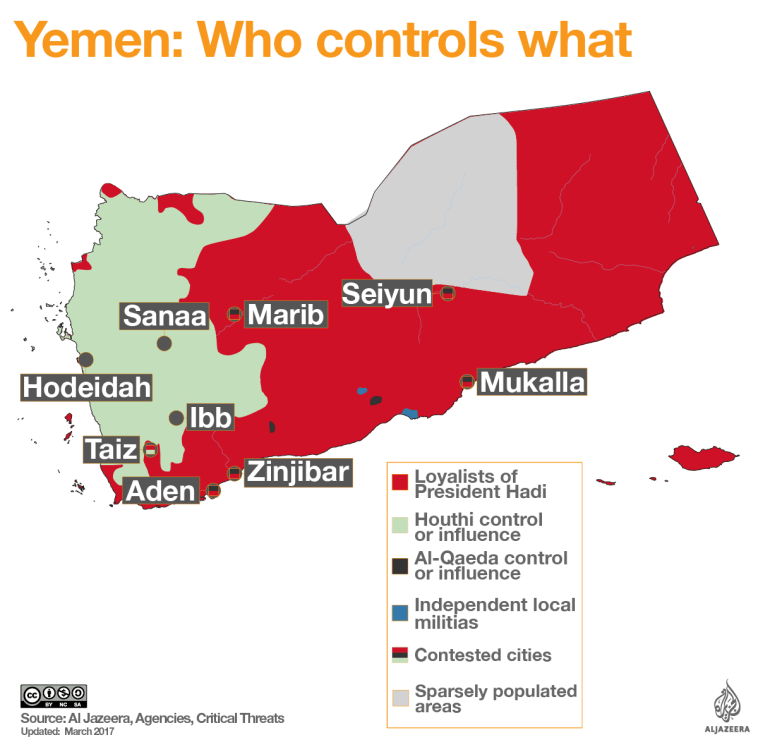
Yemen is bordered by Saudi Arabia and fellow Gulf Cooperation Council Oman, a state which would never allow shipments of Iranian weapons to Houthis and could not easily do in any case as Oman borders areas of Yemen controlled either by the pro-Saudi Hadi government or by anti-Iranian al-Qaeda and ISIS fighters.
Yemen’s north-west maritime borders have been cut off from the world, including from crucial medical and food supplies by a Saudi naval blockade that has caused a man-made famine and a cholera epidemic.
If the UN cannot even get foodstuffs past the Saudi blockade, it goes without saying that Iran could not get ballistic missiles to Houthi controlled areas.
The Houthis themselves claimed that they modified their missiles to achieve longer ranges, a claim which Iran acknowledges as the most likely scenario in respect of yesterday’s launch. Others have stated that the launch was a Saudi false flag, but as the Houthis themselves took credit for the launch and with video emerging which appears to back up Houthi claims, the only remaining credible scenario is that the Houthi fighters were indeed able to modify their missiles to reach Riyadh.
In any case, it would appear that Saudi’s US made defensive missile systems shot the Houthi rocket down, although some reports on social media from the Arab world contradict this.
At the end of the day, the facts hardly matter to the spokesmen and leaders of Saudi, Israel and United States who have all accused Iran of having a direct hand in the missile launch.
The fact of the matter is that while Iranian sympathies and limited support are certainly with the Houthis, the blockade means that this support amounts to very little in terms of material support, including and especially military support.
The facts on the ground and more important on the sea, dictate that accusations of Iran meddling in Yemen are de-facto baseless.
Unlike Syria, in which militants could be supplied on virtually all sides from ISIS controlled Iraq to the large Turkish border as well as the borders with Jordan and Israel, Yemen’s Houthis are not in any such position to be so easily supplied.
The fact that many in the media have conspired to hide this patently obvious reality means that one either is not engaging in honest journalism or one is simply repeating mythical Saudi claims.
Saudi succession struggle enters home stretch
By M K Bhadrakumar | Indian Punchline | November 5, 2017
Within hours of a decree by the Saudi King Salman bin Abdulaziz on Sunday announcing the constitution of a new committee to combat corruption under the chairmanship of the Crown Prince Mohammed bin Salman [MBS], an unprecedented purge of top establishment figures unfolded, signaling a pre-planned political campaign. The purge involves the sacking and/or detention of dozens of princes, ministers and former ministers. Several senior ministers, including those in charge of the kingdom’s National Guard, economy, and planning have also been dismissed. Notably, billionaire Prince Al-Waleed bin Talal is among those detained. The security forces grounded private jets in Jeddah to stop any high-profile figures from leaving the country.
King Salman’s decree invests the new anti-corruption committee with draconian powers. The decree says that the anti-corruption committee shall be exempted from “laws, regulations, instructions, orders and decisions”, while performing its tasks of identifying “offenses, crimes, persons and entities involved in cases of public corruption.” It empowers MBS to issue “arrest warrants, travel ban, disclosure and freezing of accounts and portfolios, tracking of funds, assets” as well as take “precautionary measures”.
Corruption is synonymous with oligarchies and the House of Saud is no exception. The Saudi way is traditionally to throw money at problems. Make no mistake that Saturday’s purge signifies another step in the no-holds-barred attempt by the 32-year old Crown Prince for consolidating absolute political power and paving the way for his ascension as the next ruler. Evidently, MBS intends to strike fear into the hearts of the elites who could be rival power centres when the time for succession arrives, which could be in a conceivable future as per indications.
An intriguing twist to the tale lies in the recent speech by MBS at a ceremony launching a $500 billion project on the Red Sea where he vowed to “destroy extremism” and return to a “a moderate Islam open to the world and all religions”. MBS was addressing an international audience and the speech was widely interpreted as an attempt to give a new face of Saudi Arabia aimed at the Western world, primarily, by pressing all the buttons that the West may like to hear pushed about entrepreneurship, liberalism, moderate Islam.
However, such a facile explanation is insufficient. For, there is indeed a contradiction insofar as the Saudi royal family has traditionally depended on backing from the ultra-conservative religious establishment to ensure its claim to legitimacy, while under MBS’s watch during recent months, the regime has begun implementing unprecedented economic and social reforms that might potentially undermine the regime’s deeply conservative power base. The noted Saudi editor and opinion maker Jamal Kashoggi told Deutsche Welle in a recent interview his explanation of what MBS is attempting:
“It is hard for Saudi Arabia to disown Wahhabism, seeing as how it created a hard-line Salafi current that has been in power for 30 years… I believe that the prince’s (MBS) social and economic reforms enjoy wide popular support and great momentum… The country needs to be freed from the hard-line Salafi approach that has been prevailing for 30 years with the state’s permission… Today, the carpet has been pulled from underneath this current’s feet, and it does not have the strength to prevent reform… On the other hand, there will always be Saudi hardliners who oppose those reforms… but they are not sufficiently powerful to prevent that march… It is hard to disown Wahhabism… it is the basis on which the Kingdom was built. But it can replace it with a centrist Islam… There are modern Islamic ideas available to the state, and it can use them without having to announce its disowning of Wahhabism.
Doesn’t it look like a Saudi-style “cultural revolution” where ideology and reform become the leitmotif of what is at the core a transition in the calculus of political power? By means of liberalizing rhetoric, MBS is on the one hand engaging the West and appeasing ordinary Saudis (and even sections of conservative clerics), while on the other hand also aiming to consolidate his and his father’s power by removing opposition voices. Arguably, they form two sides of the same coin.
Clearly, there is a foreign-policy angle to all this, which will impact regional security. The Saudi Crown Prince cannot do without American backing. (The former Crown Prince Mohammed bin Naif, rival to MBS who was ousted earlier this year, used to be Washington’s favorite as successor to King Salman.) Now, the exit of Lebanese Prime Minister Saad Hariri on Saturday is the latest telling evidence of a growing US-Saudi-Israeli congruence. A relatively stable set-up in Beirut (involving co-habitation between Hariri and Hezbollah), which acquitted itself remarkably well in the war against terrorist groups, has been suddenly thrown into disarray. What follows next in Lebanon dovetails into the US-Israeli-Saudi strategy toward post-ISIS Syria and Iraq where the balance of forces currently works in favor of Iran. Interestingly, Hariri announced his resignation in a speech broadcast from Saudi Arabia following a meeting with MBS. (Read the report in Tehran Times titled Hariri makes surprise resignation under Saudi pressure.)
Saudi gamble risks plunging Lebanon into war
Press TV – November 5, 2017
Saad Hariri’s sudden resignation from Lebanon’s premiership, announced from Saudi Arabia, has raised fears that regional tensions were about to escalate and that the small country would once again pay a heavy price.
Hariri quit his post on Saturday in a televised speech broadcast by Saudi Arabia’s Al-Arabiya television, during which he appeared tense as he carefully read out from a written statement.
He claimed that he feared the same fate as his assassinated father and accused Iran and the Lebanese resistance movement Hezbollah of meddling in Arab countries’ affairs.
Hariri’s departure sent shockwaves through Lebanon as the country is struggling to maintain stability at a time when much of the Middle East is gripped by Takfiri violence rooted in Saudi Arabia.
Lebanon’s Minister of Justice Salim Jreissati said the development was “confusing and suspicious in its timing and location as well as the way it was delivered and the content of the resignation.”
“The optics are terrible — for Hariri to resign from Riyadh, imagine how his audience [in Lebanon] feels watching that,” said Emile Hokayem, a regional analyst at the Institute for Strategic Studies.
“God protect Lebanon from the evil of Saudi Arabia’s reckless adventures,” Sheikh Nabil Kawouk, a member of Hezbollah’s central committee, told Lebanon’s Al Jadeed television.
Last week, Qatar’s former prime minister Hamad bin Jassim revealed how the US coordinated support by Doha, Riyadh and Ankara for terrorists operating against the Syrian government.
Syria has always been a thorn in the side of Israel. The Arab country is part of the “axis of resistance” along with Lebanon’s Hezbollah and Iran, which has brought Daesh to the brink of elimination.
The triangle of Saudi Arabia, Israel and the US is alarmed and the prospect of an eventual triumph of this axis which has now become inevitable has prompted them to take drastic measures.
On Friday, as Syria began celebrating the capture of Dayr al-Zawr, Nusra Front terrorists launched a massive assault on a Druze village neighboring the occupied Golan Heights.
According to Syrian state media, the onslaught was carried out with Israeli coordination and assistance but Tel Aviv used the occasion to threaten direct intervention in the war.
Hariri’s resignation over what he called Hezbollah’s “grip” on Lebanon is the latest drastic step which Saudi Arabia and its allies have taken to tip the scales even at the cost of turning Lebanon into another Syria.
With the prime minister out of the political landscape, the architects of the new “plot” could claim that Lebanon was exclusively under Hezbollah’s control. That idea was articulated by Israeli minister of military affairs Avigdor Lieberman on Saturday.
“Lebanon=Hezbollah. Hezbollah=Iran. Lebanon=Iran,” he tweeted.
Hariri was appointed as the Lebanese premier in late 2016, after two years of political deadlock in the country. He formed a national unity government that included almost all of the main political parties in Lebanon, including Hezbollah.
Under the Lebanese constitution, the prime minister should be picked from among the Sunni community, but Saudi Arabia has tried to use the prerogative to maintain its influence in the country.
Riyadh says the government should be purged of Hezbollah, especially at a time when the resistance movement is emerging stronger from the Syria conflict.
Over the past few weeks, Saudi Arabia’s Minister of State for Persian Gulf Affairs Thamer al-Sabhan had unleashed a series of vitriolic attacks against Hezbollah, saying the group “should be punished… and confronted by force.”
The accusations coincided with new sanctions approved by US House of Representatives on the Lebanese resistance movement.
Hossein Sheikholeslam, a senior Iranian politician, told Al Mayadeen TV that Hariri’s’ resignation had been coordinated before between US president Donald Trump and Saudi Crown Prince Mohammed bin Salman.
He said, “After the defeat of Daesh and the US in the region, Washington and Riyadh are trying to fuel tensions in Lebanon and the region.”
Hossein Amir-Abdollahian, an adviser to the Iranian parliament speaker, agreed. “The decision has been made by the anti-Iran and anti-Hezbollah front following the disillusionment of US and its allies with Daesh,” he said.
In Lebanon, political leaders expressed their apprehension, including the leader of Lebanon’s Druze minority, who has frequently played kingmaker in Lebanese politics.
Walid Jumblatt, the leader of Lebanon’s Progressive Socialist Party (PSP), warned of the political burden and consequences of the resignation.
Hilal Khashan, a professor of political science at the American University of Beirut, said Hariri’s departure was “a dangerous decision whose consequences will be heavier than what Lebanon can bear.”
“Hariri has started a cold war that could escalate into a civil war, bearing in mind that Hezbollah is unmatched in Lebanon on the military level,” he added.
Israeli Prime Minister Benjamin Netanyahu, however, welcomed the decision and said Hariri’s departure should be a “wake-up call” to the international community to what he described as the threat posed by Iran.
In Shocking, Viral Interview, Qatar Confesses Secrets Behind Syrian War
By Tyler Durden | Zero Hedge | October 28, 2017
A television interview of a top Qatari official confessing the truth behind the origins of the war in Syria is going viral across Arabic social media during the same week a leaked top secret NSA document was published which confirms that the armed opposition in Syria was under the direct command of foreign governments from the early years of the conflict.
And according to a well-known Syria analyst and economic adviser with close contacts in the Syrian government, the explosive interview constitutes a high level “public admission to collusion and coordination between four countries to destabilize an independent state, [including] possible support for Nusra/al-Qaeda.” Importantly, “this admission will help build case for what Damascus sees as an attack on its security & sovereignty. It will form basis for compensation claims.”

A 2013 London press conference: Qatari Prime Minister Sheikh Hamad bin Jassim bin Jabr Al Thani with U.S. Secretary of State John Kerry. A 2014 Hillary Clinton email confirmed Qatar as a state-sponsor of ISIS during that same time period.
As the war in Syria continues slowly winding down, it seems new source material comes out on an almost a weekly basis in the form of testimonials of top officials involved in destabilizing Syria, and even occasional leaked emails and documents which further detail covert regime change operations against the Assad government. Though much of this content serves to confirm what has already long been known by those who have never accepted the simplistic propaganda which has dominated mainstream media, details continue to fall in place, providing future historians with a clearer picture of the true nature of the war.
This process of clarity has been aided – as predicted – by the continued infighting among Gulf Cooperation Council (GCC) former allies Saudi Arabia and Qatar, with each side accusing the other of funding Islamic State and al-Qaeda terrorists (ironically, both true). Increasingly, the world watches as more dirty laundry is aired and the GCC implodes after years of nearly all the gulf monarchies funding jihadist movements in places like Syria, Iraq, and Libya.
The top Qatari official is no less than former Prime Minister Hamad bin Jassim bin Jaber al-Thani, who oversaw Syria operations on behalf of Qatar until 2013 (also as foreign minister), and is seen below with then-Secretary of State Hillary Clinton in this Jan. 2010 photo (as a reminder, Qatar’s 2022 World Cup Committee donated $500,000 to the Clinton Foundation in 2014).

In an interview with Qatari TV Wednesday, bin Jaber al-Thani revealed that his country, alongside Saudi Arabia, Turkey, and the United States, began shipping weapons to jihadists from the very moment events “first started” (in 2011).
Al-Thani even likened the covert operation to “hunting prey” – the prey being President Assad and his supporters – “prey” which he admits got away (as Assad is still in power; he used a Gulf Arabic dialect word, “al-sayda”, which implies hunting animals or prey for sport). Though Thani denied credible allegations of support for ISIS, the former prime minister’s words implied direct Gulf and US support for al-Qaeda in Syria (al-Nusra Front) from the earliest years of the war, and even said Qatar has “full documents” and records proving that the war was planned to effect regime change.
According to Zero Hedge’s translation, al-Thani said while acknowledging Gulf nations were arming jihadists in Syria with the approval and support of US and Turkey: “I don’t want to go into details but we have full documents about us taking charge [in Syria].” He claimed that both Saudi Arabia’s King Abdullah (who reigned until his death in 2015) and the United States placed Qatar in a lead role concerning covert operations to execute the proxy war.
The former prime minister’s comments, while very revealing, were intended as a defense and excuse of Qatar’s support for terrorism, and as a critique of the US and Saudi Arabia for essentially leaving Qatar “holding the bag” in terms of the war against Assad. Al-Thani explained that Qatar continued its financing of armed insurgents in Syria while other countries eventually wound down large-scale support, which is why he lashed out at the US and the Saudis, who initially “were with us in the same trench.”
In a previous US television interview which was vastly underreported, al-Thani told Charlie Rose when asked about allegations of Qatar’s support for terrorism that, “in Syria, everybody did mistakes, including your country.” And said that when the war began in Syria, “all of us worked through two operation rooms: one in Jordan and one in Turkey.”
Below is the key section of Wednesday’s interview, translated and subtitled by @Walid970721. Zero Hedge has reviewed and confirmed the translation, however, as the original rush translator has acknowledged, al-Thani doesn’t say “lady” but “prey” [“al-sayda”]- as in both Assad and Syrians were being hunted by the outside countries.
The partial English transcript is as follows:
“When the events first started in Syria I went to Saudi Arabia and met with King Abdullah. I did that on the instructions of his highness the prince, my father. He [Abdullah] said we are behind you. You go ahead with this plan and we will coordinate but you should be in charge. I won’t get into details but we have full documents and anything that was sent [to Syria] would go to Turkey and was in coordination with the US forces and everything was distributed via the Turks and the US forces. And us and everyone else was involved, the military people. There may have been mistakes and support was given to the wrong faction… Maybe there was a relationship with Nusra, its possible but I myself don’t know about this… we were fighting over the prey [“al-sayda”] and now the prey is gone and we are still fighting… and now Bashar is still there. You [US and Saudi Arabia] were with us in the same trench… I have no objection to one changing if he finds that he was wrong, but at least inform your partner… for example leave Bashar [al-Assad] or do this or that, but the situation that has been created now will never allow any progress in the GCC [Gulf Cooperation Council], or any progress on anything if we continue to openly fight.”
As is now well-known, the CIA was directly involved in leading regime change efforts in Syria with allied gulf partners, as leaked and declassified US intelligence memos confirm. The US government understood in real time that Gulf and West-supplied advanced weaponry was going to al-Qaeda and ISIS, despite official claims of arming so-called “moderate” rebels. For example, a leaked 2014 intelligence memo sent to Hillary Clinton acknowledged Qatari and Saudi support for ISIS.
The email stated in direct and unambiguous language that:
“the governments of Qatar and Saudi Arabia, which are providing clandestine financial and logistic support to ISIL and other radical Sunni groups in the region.”
Furthermore, one day before Prime Minister Thani’s interview, The Intercept released a new top-secret NSA document unearthed from leaked intelligence files provided by Edward Snowden which show in stunning clarity that the armed opposition in Syria was under the direct command of foreign governments from the early years of the war which has now claimed half a million lives.

The newly released NSA document confirms that a 2013 insurgent attack with advanced surface-to-surface rockets upon civilian areas of Damascus, including Damascus International Airport, was directly supplied and commanded by Saudi Arabia with full prior awareness of US intelligence. As the former Qatari prime minister now also confirms, both the Saudis and US government staffed “operations rooms” overseeing such heinous attacks during the time period of the 2013 Damascus airport attack.
No doubt there remains a massive trove of damning documentary evidence which will continue to trickle out in the coming months and years. At the very least, the continuing Qatari-Saudi diplomatic war will bear more fruit as each side builds a case against the other with charges of supporting terrorism. And as we can see from this latest Qatari TV interview, the United States itself will not be spared in this new open season of airing dirty laundry as old allies turn on each other.
US attempt to fuel Iraq-Iran rift backfires
By M K Bhadrakumar | Indian Punchline | October 26, 2017
The US project to create a rift between Iraq and Iran backfired just a couple of days of its launch from Riyadh on October 22 by US Secretary of State Rex Tillerson. Washington effectively sought out Saudi Arabia to project itself as counterweight to Iran in the Iraqi theatre, predicated on the presumption that Riyadh’s offer to extend funding to ‘rebuild’ post-ISIS Iraq will be found irresistible by Baghdad. Washington fancied that Iraqi Prime Minister Haider al-Abadi is looking for ways to push back at Tehran, as his dependency on Iran’s military support is diminishing with the defeat of ISIS.
Tillerson travelled to Riyadh over the weekend to be present as a special guest at the first inaugural meeting of the so-called Saudi Arabia-Iraq Coordination Council. Things seemed to go well and Tillerson’s remarks to the media exuded optimism. At a press conference in Riyadh, he said that the Saudi largesse will “strengthen Iraq as an independent and whole country… (and) this will be in some ways counter some of the unproductive influences of Iran inside of Iraq.” Tillerson then came to the point:
- Certainly, Iranian militias that are in Iraq, now that the fight against Daesh and ISIS is coming to a close, those militias need to go home. Any foreign fighters in Iraq need to go home and allow the Iraqi people to regain control of areas that had been overtaken by ISIS and Daesh that have now been liberated, allow the Iraqi people to rebuild their lives with the help of their neighbors. And I think this agreement that has been put in place between the Kingdom of Saudi Arabia and Iraq is a crucial element to assisting the Iraqi people to do that. (Transcript)
The reference was to the Shi’ite militia groups funded, trained and deployed by Iran’s Revolutionary Guards Corps, which literally bore the brunt of the fight against the ISIS in the recent years. Washington is particularly incensed over the lead role by the Shi’ite paramilitary groups in seizing Kirkuk recently from the Kurdish Peshmerga who are US allies. (See my blog Kirkuk bells also toll for US strategy in Syria.)
Evidently, Tillerson crossed the red line. The point is, these Shi’ite groups, collectively known as Popular Mobilisation Forces and several tens of thousands strong, are probably going to be designated as part of the Iraqi armed forces. Abadi’s office in Baghdad came out in no time with a stinging rebuke – “No party has the right to interfere in Iraqi matters” – and called the Shi’ite paramilitary groups “patriots.” The next day, when Tillerson showed up in Baghdad for a meeting with Abadi, the latter was fairly explicit. Abadi said the Popular Mobilisation Forces form “part of the Iraqi institutions” and they will be the “hope of country and the region.” (Reuters )
Later, in an interview with the American press, Abadi retorted: “We would like to work with you (US)… But please don’t bring your trouble inside Iraq. You can sort it anywhere else.” Abadi then began suggesting a US troop withdrawal from Iraq. He said that US air power won’t be needed anymore and Iraq’s requirements will be henceforth on intelligence sharing and help to train Iraqi forces. The way things are shaping up between Washington and Tehran, continued US military presence in Iraq may become problematic in a near future.
Meanwhile, having gambled on the independence referendum only to lose oil-rich Kirkuk, Iraqi Kurdish leader Massoud Barzani is suing for ceasefire and talks with Baghdad. The US is urging Abadi to respond to Barzani’s overture and engage with him in discussions. The Trump administration has secured strong Congressional support for its demands on Abadi. Signaling the seriousness of the demands, On Wednesday, House Speaker Paul Ryan, House Intelligence Committee Chairman Devin Nunes, House Foreign Affairs Committee Chairman Ed Royce, and House Armed Services Committee Chairman Mac Thornberry issued the following statement to pressure Baghdad:
- Ongoing clashes between forces aligned with the Iraqi government and Kurdistan Regional Government are undermining hard-fought gains in the fight against ISIS, and threatening to plunge Iraq into a new wave of sectarian violence. The bloodshed must stop immediately. We support a united Iraq under the federal government in Baghdad, and we support the Kurdistan Regional Government.
- To that end, we welcome today’s reports that the Kurds are offering to suspend results of their recent referendum in return for a ceasefire and negotiations with the central government. Baghdad should accept this offer and enter into meaningful discussions that address long-term Kurdish concerns about autonomy, share of the national budget, and oil revenues. Meanwhile, it is critical that the Iraqi government heed Secretary Tillerson’s concern about the role and activities of Iranian-backed Shia militias. We are very concerned about Iranian involvement in recent operations. These forces have been responsible for horrible abuses, including the deaths of Americans. They have no place in a peaceful, united, and stable Iraq.
But Abadi is parrying. He visited Ankara on Wednesday to consult President Recep Erdogan. (Rudaw ) The latest reports suggest that the Iraqi forces with the support of the Shi’ite forces might go for the jugular veins of the Iraqi Kurds. Baghdad will want to drive home the advantage that the Kurds are not cohesive and are split 3-ways with the PUK (which was led by late Talabani) inclined to cooperate with Baghdad and Tehran, thereby isolating Barzani who is reduced now increasingly as a US-Israeli proxy. (Turkey has also become hostile toward Barzani following his push for the Kurdish independence referndum.) The Russian news agency Sputnik reported today as ‘breaking news’ that Iraqi troops and Shi’ite militias had been pulling heavy artillery and tanks close to Peshmerga positions near Zummar and shelling their positions. (Sputnik ) If a flare-up ensues in coming days, the US will be in a tight spot, apart from the breakdown of ties between Washington and Baghdad.
The US’ problem, quintessentially, is that its intentions are suspect in all three key regional capitals confronting the Kurdish question – Ankara, Baghdad, Tehran. At a recent meeting with US ambassador Douglas Sliman, Iraqi Vice-President Nouri al-Maliki said with brutal frankness, “We will not allow the creation of a second Israel in northern Iraq.”
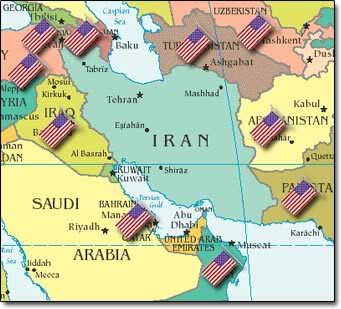 Last week’s events underscore three things. One, the US does not intend to end its military presence in Iraq (and Syria), although the pretext of the war against the ISIS is no longer there. Two, US is planning to turn Iraq into a major theatre of confrontation with Iran.
A US control of Iraq puts it in a position to pile pressure on Iran from different directions — interfering with Iranian supply routes to Syria and Lebanon; playing itself back to regain a role in the Syrian settlement; having a say in Iraq’s rising oil production and staging covert cross-border operations to destabilize the Iranian regime. Indeed, with the open-ended US military presence already in place in Afghanistan, the intention is to squash with a similar western neighbor under American tutelage.
Three, fundamentally, it becomes all too obvious that the US-Saudi alliance in regional politics is very much alive and kicking, and any reports to the contrary are greatly exaggerated. The US’ return to the centre stage in Iraq to challenge Iran’s regional influence will give much verve to the US alliance with Saudi Arabia.
Interestingly, the Saudi establishment daily Asharq Al-Awsat reported last week that the Pentagon plans to boost deployments to the Middle East specifically to counter Iran. The report cited General Joseph Votel, commander of the US Central Command, as saying, “The United States wants to help the Arab countries deal with Iranian threats. The Pentagon is working to achieve that desire and ensure its effective implementation. That includes the establishment of US military battalions sent as missions to the region and be designed specifically to provide advice and assistance.”
CONFIRMED: US and Saudi coordinated barbaric terrorist attacks on Syria
By Adam Garrie | The Duran | October 25, 2017
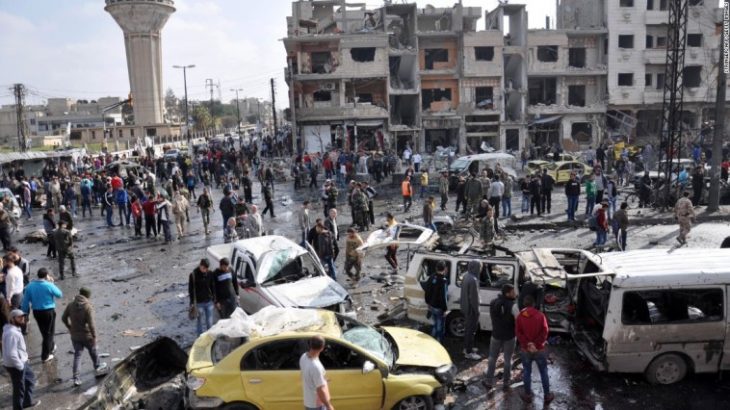
The intricate role played by Saudi Arabia and the United States in ushering in a proxy terrorist war on Syria, have been both explicitly and implicitly known, since virtually the beginning of the US instigated proxy conflict in Syria, which was inaugurated in 2011.
In many ways, 2013 represented the nadir of the Syrian conflict. It was a time when it looked as though the combined strength of terrorist groups including ISIS/Daesh, FSA and al-Qaeda might succeed in destroying the secular, tolerant, pluralist Syrian Arab Republic and realise their goal of creating a Takfiri state based on extremist religious supremacist ideology and racism.
With Syria on the verge of a full victory and with Russia confirming that ISIS now controls less than 5% of Syrian territory, 2013 seems like a very distant time in the context of the Syrian conflict.
But on the 18th of March, 2013, large scale coordinated rocket attacks on Damascus International Airport, the Syrian Presidential Palace and other vital security targets in the capital, were conducted by the Takfiri terrorist group FSA.
Today, the exiled American whistleblower who once worked for the notorious NSA, Edward Snowden has released the following short top secret document which plainly details how the US and a powerful member of the Saudi regime, helped to fund and organise the illegal attack on Syria.
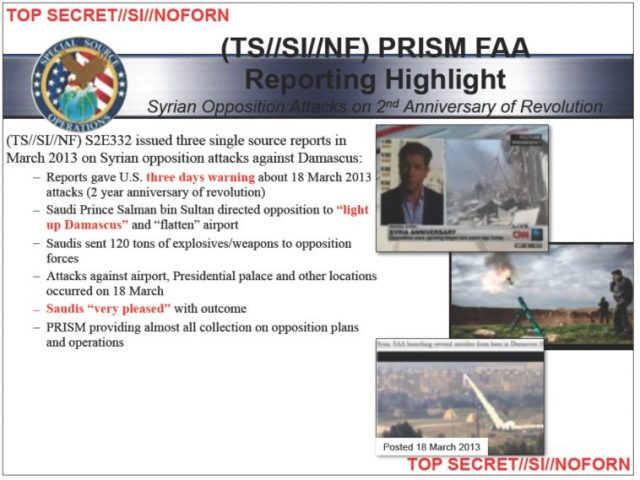
The text of the document reads as follows:
“TOP SECRET//S1//NOFORN
(TS//S1//NF) S2E332 issued three single source reports in
March 2013 on Syrian opposition attacks against Damascus:
– Reports gave U.S. three days warning about 18 March 2013
attacks (2 year anniversary of revolution)
– Saudi Prince Salman bin Sultan directed opposition to “light
up Damascus ” and “flatten” airport
– Saudis sent 120 tons of explosives/weapons to opposition
forces
– Attacks against airport, Presidential palace and other locations
occurred on 18 March
– Saudis “very pleased” with outcome
– PRISM providing almost all collection on opposition plans
and operationsTOP SECRET//S1//NOFORN”.
The collusion between Saudi and the US in a deadly terrorist attack constitutes nothing less than a war crime.
Because of the patently biased nature of the International Criminal Court, it is unlikely that anyone from the US or Saudi will be prosecuted for this war crime.
However, Snowden’s document does help to explain Syria’s unity in the face of a campaign of foreign state sponsored organised terrorism. Contrary to what many al-Qaeda apologists say, the Syrian conflict was a proxy war from day one. Of course, foreign powers used the promise of enhanced material status to woo a small number of disgruntled locals, but the main sources of terrorist fighters and virtually all of the funding and arms came from abroad.
While Syria faced onslaughts funded and directed by some of the wealthiest and most powerful states in the world including, the USA, Saudi Arabia, Qatar, Israel, Turkey, UK, France, Belgium, Germany, Netherlands and others, Syria managed to retain her sovereignty, even prior to Russia’s game-changing legal intervention in 2015.
The anti-Syrian alliance did its utmost to destroy one of the last truly revolutionary Arab Republics in the world. The fact that of all their efforts ultimately failed, is a testament both to the resolve of the Syrian Arab Republic and to the powerful anti-terrorist alliance that Damascus built throughout the conflict, one which has been capable of resisting imperialist obscurantist aggression from the west and its Middle East proxies and allies.
US Mercenaries, Iraqi Highways and the Mystery of the Never-Ending ISIS Hordes
By Ulson Gunnar – New Eastern Outlook – 22.10.2017
While the US and European media provided little explanation as to how militants from the self-titled Islamic State (IS) managed to appear, expand and then fight for years against the combined military power of Iraq, Syria, Iran and Russia, it was abundantly clear to many analysts that the IS organization was not only receiving state sponsorship, but it was receiving reinforcements, weapons and supplies from far beyond Syria’s and Iraq’s borders.
Maps of the conflict stretching over the last several years show clear corridors used to reinforce IS positions, leading primarily from Turkey’s southern border and to a lesser extent, from Jordan’s borders.
However, another possible vector may be desert highways in Iraq’s western Anbar province where US military contractors are allegedly to “provide security” as well as build gas stations and rest areas. These highways contributed to the current conflict and still serve as a hotbed for state sponsored terrorism. Whether these US-controlled and improved highways pose a significant threat for a reorganized effort by the US and its regional allies to divide and destroy Iraq and Syria seems all but inevitable.
US Mercenaries “Guarding” Iraqi Highways
Al Monitor in an April 2017 article titled, “How Iraq is planning to secure key border road,” would claim:
Due to the imminent threats to the road, which is one of Iraq’s vital economic lines as it connects Basra in the south to Jordan in the west, Iraq commissioned an American company to secure and rebuild the road. The contract also included reconstructing bridges, 36 of which are destroyed.
The article would elaborate, stating:
A security source from the Iraqi intelligence service told Al-Monitor, “The American company will only secure the two roads reaching Terbil from Basra and Baghdad and will build gas stations and rest areas, in addition to building bridges and cordoning off the roads with barbed wires, as per distances that would be determined later.”
Al Monitor would claim that Iraq’s popular mobilization units found themselves unable to oppose the move made by the central government in Baghdad. It would also note that Iraq’s Hezbollah Brigades claimed, in opposition to the plan, that:
The road connecting Iraq and Jordan is a strategic gateway allowing the US and forces seeking to control it to tighten their grip on Anbar and the potential Sunni region as per a US-Gulf plan.
One could imagine future potential scenarios including these rebuilt roads, complete with gas stations and rest areas, leading from Jordan and Saudi Arabia and providing an efficient route for future wars waged either directly or by proxy against Iraq. The infiltration of fighters and supplies, for example, would be greatly expedited should the US and its partners decide to shift their efforts along this new axis.
Beyond this more obvious threat comes the fact that US-Jordanian-Saudi influence would be greatly enhanced with stronger logistical lines leading into Iraq’s western regions.
How the US Might Use its New Highways
The Islamic State’s de facto invasion of Syria and Iraq was a more massive and dramatic replay of an earlier surge of foreign militants into the region, following the 2003 US invasion of Iraq.
It would be America’s own Combating Terrorism Center at the West Point United States Military Academy in two reports published in 2007 and 2008 (.pdf) respectively that would describe in detail the networks some of Washington’s closest regional allies used to flood post-war Iraq with foreign fighters.
While these fighters indeed attacked US soldiers, what they also did was disrupt a relatively unified resistance movement before plunging Sunni and Shia’a militias into a deadly and costly “civil war.”
Fighters, weapons and cash infiltrated into Iraq from a network that fed fighters from across the Middle East and North Africa (MENA) region first into Turkey, through Syria via the help of many of the senior leadership of anti-government militant groups now fighting Damascus, and then into Iraq primarily where IS has been based and where the remnants of its militancy remains.
During the more recent conflict, these same networks were utilized successfully until Russia’s intervention in 2015 when these terrorist “ratlines” came under fire by Russian warplanes. The cause and effect of attacking these terrorist ratlines was visible on conflict maps, causing an almost immediate shrinking of IS-occupied territory and a corresponding atrophy of IS fighting capacity.
The Jordanian-Iraqi and Saudi-Iraqi border crossings and the highways running through them represent an alternative means to reorient Washington’s proxy conflict either now or in the near future.
US Already Planning to Weaponize the Project
Raising further alarm bells should be the New York Times’ May 2017 article, “U.S. Sees a Vital Iraqi Toll Road, but Iran Sees a Threat,” which helps frame the very sort of conflict US policymakers are seeking with this move and the reaction it has already provoked among America’s primary targets in the region, particularly Iran.
The article would claim:
As part of an American effort to promote economic development in Iraq and secure influence in the country after the fight against the Islamic State subsides, the American government has helped broker a deal between Iraq and Olive Group, a private security company, to establish and secure the country’s first toll highway.
This being Iraq, though, the project has quickly been caught up in geopolitics, sectarianism and tensions between the United States and Iran, which seems determined to sabotage the highway project as an unacceptable projection of American influence right on its doorstep.
The New York Times also helps prepare a narrative so that any attack on American contractors along the highway could easily be blamed on militias linked to Iran, or even on Iran itself. The article states:
Already, Iraqi militia leaders linked to Iran, whose statements are seen as reflective of the views of Tehran, have pledged to resume attacks against American forces if the Trump administration decides to leave troops behind to train the Iraqi military and mount counterterrorism missions, as appears likely. And the militia leaders have specifically singled out the highway project for criticism.
The New York Times ultimately admits that the US is attempting to control the highway specifically to continue its increasingly dangerous proxy war against Tehran. The article also admits that the highways will be entirely controlled by US contractors, including the collection of tolls of which only a portion would be handed over to the Iraqi government. The article also claims other highways, including one leading directly from Saudi Arabia, are being considered.
In essence, these would be terrorist ratlines directly controlled by the United States, leading directly out of the very epicenter of state sponsored terrorism in the region, Saudi Arabia, other Persian Gulf states and to a lesser but still significant extent, Jordan.
They would be terrorist ratlines difficult for Iraq’s central government or its allies to attack without providing a much welcomed pretext for Washington to directly retaliate against the faction of its choosing.
While the New York Times and US politicians and businessmen involved in the highway deal attempt to portray it as a means of providing peace, stability and economic prosperity for Iraq, a quick audit of US policy in the Middle East should ground those lofty promises in a much more frightening reality.
The scope of this project is nothing short of both a US occupation and a US-administered “safe zone” in which militant groups backed by the US and its regional partners can safely be harbored, and from which they can strike out against Iraq and its neighbors with the full protection of US military force.
Some US policymakers may feel that their failing proxy war against Syria involved a cart-before-the-horse policy in which the creation of US-administered and protected safe zones turned out to be more difficult to implement than initially anticipated, and that in the future, such zones should be created before another round of proxy-hostilities.
No matter what, the US presence and the more-than-certain intentions that underpin it will ensure not peace, stability or prosperity, but another decade of division and strife both in Iraq and beyond. Confounding this project, and those like it, and replacing them with actual projects to fulfill the promises of progress the US is merely hiding behind, will be key to truly moving Iraq and the region forward.
Kirkuk bell also tolls for US strategy in Syria
By M K Bhadrakumar | Indian Punchline | October 22, 2017
The rout of the Kurds in the northern Iraqi city of Kirkuk this week constitutes a major setback for the overall American strategies toward Iraq and Syria. The prospect of an unceremonious US retreat from Syria haunts the Trump administration in immediate terms, and it is all the more galling because Tehran is calibrating it.
Clearly, Iran has pushed the envelope, furious over US President Donald Trump’s provocative threats of sanctions against the Islamic Revolutionary Guards Corps (IRGC). Tehran had warned that US position in the entire Middle East will become increasingly untenable if Trump moved against the IRGC. The capture of Kirkuk by the Baghdad government was a de facto military operation by the Shi’ite militia known as the Hashd al-Shaabi, which was trained and equipped by the IRGC. The western reports suggest that the charismatic commander of the IRGC’s secretive Quds Force, General Qassem Soleimani personally masterminded the military operation – and even prepared the political ground for it.
The US had tried to prevail upon the Iraqi Prime Minister Haider al-Abadi not to move against the Kurds who were its allies. Kirkuk is estimated to hold at least 8000 million barrels of subterranean oil. The oil revenue is critical for the survival of any independent Kurdish state. Evidently, Abadi didn’t listen due to the emergent threat posed by the Kurds’ recent independence referendum. Equally, Iran wanted to finish off the spectre of an independent Kurdistan in the region spearheaded by Massoud Barzani (who enjoys the backing of US and Israel.)
Indeed, the defeat in Kirkuk destroys the Iraqi Kurds’ dream of an independent state and derails the longstanding US-Israeli project to create a base with strategic location. Equally, the liberation of Kirkuk, which is populated by the Kurds, Arabs and Turkmen by the Iran-supported Shi’te militia highlights the strategic convergence between Baghdad, Tehran and Ankara in preventing the creation of an independent Kurdistan in the region.
However, the defeat of Barzani in Kirkuk has far wider ramifications – for Iraq as well as the Syrian conflict, apart from the US’ influence in the Middle East as a whole. At its most obvious level, Iran is thwarting the US plans to balkanize Iraq. Iraq’s unity is no longer under serious threat. Control of the vast oil reserves in Kirkuk will also bolster the Iraqi economy. Baghdad can be expected to reassert its authority over the country. The federal government has taken over the border crossings with Turkey and Syria.
The US attempt in the coming period will be to woo Abadi and encourage him to whittle down Iran’s influence in Iraq. The US Secretary of State Rex Tillerson arrived in Riyadh on Saturday on a hastily arranged trip with the hope of getting Saudi King Salman to take a hand in persuading Abadi to keep Tehran’s influence on Iraq at bay and to mediate between Abadi and Barzani. The US and Saudi Arabia’s best hope lies in creating differences between Baghdad and Tehran by leveraging Abadi. But the chances of such a ploy working seem remote.
The fact that the US watched the defeat of the Kurds in Kirkuk passively tarnishes the overall American image, especially among Syrian Kurds. This casts shadows on the Syrian situation. The US has been routing the military supplies for Syrian Kurds in Raqqa via Erbil, Massoud’s stronghold (in the face of Turkey’s virulent opposition.) This supply route is no longer under Barzani’s control and the disruption will affect the US’ operations in Raqqa. The US-led Syrian Kurdish militia claims to have liberated Raqqa, but a real consolidation needs the decimation of the residual ISIS fighters present in the region and it may take months.
More importantly, a ‘trust deficit’ between Syrian Kurds and Washington at this juncture will be calamitous. Raqqa is Arab territory and the Kurdish militia’s supply lines are already overstretched. The disruption in American supplies means that it may now be a mater of time before Syrian Kurds seek some modus vivendi with the Syrian regime. If American military supplies dry up, Syrian Kurds will also come under pressure from Turkey in the swathe of northern Syria bordering Turkey, which form their traditional homelands. Turkey never liked a Kurdish entity taking shape across their border.
Interestingly, the commander of the Syrian Kurdish militia Sipan Hamo visited Moscow last weekend. The Russians indeed find themselves in an enviable position to drive a hard bargain over the Kurds’ sorrows. Russia is in a unique position to mediate between Syrian Kurds on one side and Ankara and Damascus on the other. But then, what is it that the Kurds can offer Russia in return? Last Thursday, Rosneft signed a big oil deal with Barzani’s government in northern Iraq. To be sure, the old Kurdish saying has some merit – ‘The Kurds have no friends but the mountains.’ (Guardian )
The main impact of last week’s dramatic events is that the US now has no conceivable reason to continue with a military intervention in eastern Syria. The likelihood is that Syrian Kurds will sooner or later hand over Raqqa also to the government forces. Clearly, the Syrian regime’s march to victory is from now onward relentless and irreversible. That is to say, the best-laid plans of the US and its regional allies to balkanize Syria have also gone awry.
Maybe, there will be a federal system in future Iraq and Syria. But last week’s events have ensured that the two countries’ territorial unity and integrity will no longer be under serious threat. Of course, that has also been at the core of the Iranian strategy.
Featured Video
NATO’s War of Choice – The Sabotage of the Istanbul Negotiations
or go to
Aletho News Archives – Video-Images
From the Archives
National Security Archive Publishes Key Records on Infamous MKULTRA Program
Agency Sought Drugs and Behavior Control Techniques to Use in “Special Interrogations” and Offensive Operations
Edited by Michael Evans | National Security Archive | December 23, 2024
Washington, D.C. – Today, the National Security Archive and ProQuest (part of Clarivate) celebrate the publication of a new scholarly document collection many years in the making on the shocking secret history of the CIA’s mind control research programs. The new collection, CIA and the Behavioral Sciences: Mind Control, Drug Experiments and MKULTRA, brings together more than 1,200 essential records on one of the most infamous and abusive programs in CIA history.
Under code names that included MKULTRA, BLUEBIRD and ARTICHOKE, the CIA conducted terrifying experiments using drugs, hypnosis, isolation, sensory deprivation, and other extreme techniques on human subjects, often U.S. citizens, who frequently had no idea what was being done to them or that they were part of a CIA test.
Today’s announcement comes 50 years after a New York Times investigation by Seymour Hersh touched off probes that would bring MKULTRA abuses to light. The new collection also comes 70 years since U.S. pharmaceutical giant Eli Lilly & Company first developed a process to streamline the manufacture of LSD in late 1954, becoming the CIA’s chief supplier of the newly discovered psychoactive chemical central to many of the Agency’s behavior control efforts.
Highlights of the new MKULTRA collection include… continue
Blog Roll
 Aletho News
- The Founder Who Turned Against Root Canals
- Israel displaces last two families from Al Khalayel valley, Al Mughayyir
- Israeli Opposition Leader Endorses Greater Israel
- Islamic Jihad: Trump’s peace board is a “theatrical stunt detached from reality”
- The Head Of A CIA Cutout Admits To Meddling In Iran To Fuel Unrest
- Iran warns Trump against decisions based on false information
- Pentagon sets deadline for Anthropic to lift AI restrictions on autonomous weapons systems, mass domestic surveillance
- Trump’s military buildup against Iran on Netanyahu’s behalf is a gambit doomed to fail
- Big League War
- Zelensky sells false illusion of building powerful air force capable of overcoming Russia
- If Americans Knew
- Are the Jews indigenous to Palestine?
- AIPAC Wants to Kill a Bill that would Ensure Israel Complies with Ceasefire
- Former Israeli PM, in Epstein Files, Dreamed of Israeli Eugenics and Pretty Converts
- Israeli settlers join ‘safari’ tour of Palestinian prisoners
- Flooding in Gaza amid rumors of war; fire in West Bank – Not a ceasefire Day 138
- Fourteen Countries Condemn Huckabee’s Support for Israel Taking Over Most of the Middle East
- Israeli Soldiers Killed Gaza Aid Workers at Point Blank Range in 2025 Massacre: Report
- Israel’s insidious network to propagandize American Christians
- Israel’s Best-Kept Secret: Palestinian Resistance Never Agreed to Disarm
- Trump officials plan to build 5,000-person military base in Gaza, files show
- No Tricks Zone
- Surprising Discovery: Sahara Is Greening…Billions Of Trees Where Once Thought To Be Barren
- New Research Reaffirms Clouds, Aerosols, And Surface Solar Radiation Are ‘Driving The Climate System’
- Germany: Electric Car Catches Fire At Charging Station, Sets Off Local “Inferno”, Widespread Damage
- New Study: Canada’s New Brunswick Was 1°C Warmer Than Today During The Medieval Warm Period
- Coal Power Back In Trend As Globe Tries To Keep Pace With Growing Demand For Power
- New Study: A 4°C Warmer Beaufort Sea Had ‘No Sea Ice’ 11,700 – 8200 Years Ago
- Unfudging The Data: Dutch Meteorological Institute Reinstates Early 20th Centruy Heat Waves It Had Erased Earlier
- German Gas Crisis…Chancellor Merz Allegedly Bans Gas Debate Ahead of Elections!
- Pollen Reconstructions Show The Last Glacial’s Warming Events Were Global, 10x Greater Than Modern
- Germany’s Natural Gas Storage Level Dwindles To Just 28%… Increasingly Critical
 Aletho News