“The Agreement of the Century”
By Paul Larudee | Dissident Voice | October 18, 2017
According to a report circulating unofficially in Arabic, the latest in a sixty-nine year history of proposals to resolve the western Zionist invasion of Palestine (AKA the Israeli-Palestinian “conflict”) is about to see the light of day. It claims Israeli Prime Minister Benjamin Netanyahu originated the proposal and that secret deliberations have been underway for more than five months.
Netanyahu has now presented the proposal to the US, which made some changes and agreed to promote it. Palestinian President Mahmoud Abbas will carry the plan, called “the Agreement of the Century” to Egypt, Jordan, Saudi Arabia, the United Arab Emirates and Kuwait for review and discussion.
The provisions
The proposal has 21 points, but the main provisions are that the West Bank will be federated (or re-federated) with Jordan, and the Gaza Strip with Egypt. Together, they will be known as the Palestinian Confederation, ostensibly converting the Palestinian “Authority” into a national government, although it is already widely recognized as such and although it will not have any of the authority or sovereignty that nation states are deemed to have under international law.
Israel will govern Jewish settlements directly and Jerusalem is excluded from the proposal, for resolution at a later time. The primary function of Jordan, Egypt and the Palestinian Authority, therefore, will be to take over the security functions currently administered by the Israeli armed forces; i.e., to protect Israel and repress Palestinians. As they say in Israel, “When you have a dirty job, give it to an Arab.”
Other provisions concern development of infrastructure, international guarantees, and conversion of Hamas into a purely political party while integrating its military wing into the Palestinian security forces. The borders will be based on the armistice lines as of June 4th, 1967, with some territorial swaps. Refugees will be permitted to “return” to the West Bank and Gaza, even if it is not the home from which they were displaced. This is not going to be accepted by expatriate refugees in Lebanon, Syria and other countries, but they have always been disenfranchised in all proposals, and this one is no exception.
Unanswered questions
The biggest unanswered question is the status of Jerusalem. Will the Arab leaders accept an agreement that has no assurances at all with respect to Jerusalem? This is hard to imagine, and it was, in fact, the major stumbling block to an agreement at the Camp David Summit in 2000.
Another major unknown is what happens to the West Bank areas designated A, B and C in the Oslo agreement. Area A is the only one of the three where Oslo grants full administrative and security control to the Palestinian Authority, and it comprises less than 15% of the total area of the West Bank, itself only 18% of historic Palestine. Israel is unlikely to hand B and C over to Palestinian authority and limit the settlements to their current footprints, without prospect of outward expansion or new settlements. More likely, they will insist upon continuing the current arrangement, allowing Israel to continue expanding the settlements indefinitely. This is also unlikely to be acceptable to the Arabs and to the Palestinian people.
Analysis
What do the parties to the agreement expect to gain from it?
Israel wants to rid itself of the Palestinians. It wants the land but not the people. It also wants to stop being considered an occupier of someone else’s land. In 1948 it achieved this by massive ethnic cleansing and genocide. In 1967 it used the same methods but was somewhat less successful except on the Golan Heights, where it expelled 94% of the population. Since then, expulsions have been gradual and slower, except for the 2006 expulsion of a million people in south Lebanon, which was subsequently reversed by the victory of the Hezbollah resistance.
If the above assumptions about areas A, B and C are correct, a signed agreement means that Israel concedes nothing at all and will be able to continue with its territorial ambitions. However, it will rid itself of the Palestinians by farming out the occupation to Jordan, Egypt and the Palestinian Authority. The agreement also removes the teeth (such as they are) of Hamas, and makes Israel appear to be a “peacemaker” with a “generous proposal”.
Mahmoud Abbas’s interest is to become the president of a “real” (though not sovereign) country, recognized universally, even by Israel. He also gets Gaza in the bargain, as well as some handsome development funds that will improve the economy, at least in the short run. The recently announced “unity government” between Hamas and Fatah can be seen as a prelude to such an agreement, and a means of strengthening Abbas’s hand in the negotiations (which is why Israel is not very happy about it).
Hamas gains the least of any of the parties, but Israel’s decade-long siege on Gaza is now so debilitating that they are possibly loathe to dash the hopes of their people for relieving their isolation. They are under tremendous pressure to improve the intolerable living conditions, and may not wish to be seen as spoilers.
The Arab monarchies and Egypt want to be rid of the problem and to get on with other concerns, chiefly their rivalry and potential conflict with Iran. In this case they would like to be able to collaborate and ally themselves more openly with a powerful Israel, which the agreement will legitimate. Iraq and Syria, who are friendly to Iran, are not currently on Abbas’s itinerary, which underscores that their views are not likely to be given consideration.
The US also gets a Middle East peace agreement that has eluded eleven administrations since 1948, and which Trump desperately needs to bolster his flagging image on the domestic front. The agreement would also strengthen the hand of both the US and Israel to undertake aggressive action against Iran and destroy it as a regional power, which is an ambition of both countries and the conservative Arab regimes.
All of this assumes that the agreement will be approved. That is still a very big “if”. But Israel is also prepared for failure, which also works to their advantage. In that case Israel will do what it has always done: blame the Palestinians for refusing to be complicit in their own demise. They will then give their military a free hand to commit another pogrom, known in Israel as “mowing the grass”.
In fact, Israel may pull another plan off the shelf, one using a more direct means of ridding themselves of the Palestinians. They learned in Lebanon that they could create a million refugees in ten days, and thereby clear the land of its inhabitants. Instead of “mowing the grass”, this would be more akin to “scorching the earth”, which is also a definition of the term “holocaust”.
Paul Larudee is one of the founders of the Free Gaza and Free Palestine Movements and an organizer in the International Solidarity Movement.
Russia ready to mediate talks between Saudi Arabia & Iran – deputy FM
RT | October 11, 2017
Russia is ready and willing to mediate in establishing relations between Saudi Arabia and Iran, Russian Deputy Foreign Minister Mikhail Bogdanov has stated.
“We tried several times and offered [to help Iran and Saudi Arabia sit down at the negotiating table], but we do not impose our intermediary role,” Bogdanov told reporters.
“But we have always told our partners in both Saudi Arabia and Iran that we are ready to provide both a platform for contacts and friendly services.”
Bogdanov added that Moscow has always highlighted the need to resolve the issues between the two countries.
“Many problems would have been much easier to resolve had there been mutual understanding and trust between Tehran and Riyadh,” Bogdanov said.
He added that the situation in the entire region, especially regarding antiterrorism efforts, depends on mutual understanding and cooperation between Iran and Saudi Arabia.
Bogdanov stressed that Russia always tells Saudi Arabia and Iran that it is ready to report something from one side to another or to organize their bilateral contacts. “These proposals remain on the table both with our Saudi and Iranian partners,” he said.
In May, an Iranian Foreign Ministry spokesman accused Saudi Arabia of supporting terrorism and seeking confrontational policies in the region. He was responding to comments by the Saudi deputy crown prince, who earlier ruled out dialogue with Tehran. Saudi Deputy Crown Prince Mohammed bin Salman al-Saud, the kingdom’s defense minister, said it was impossible to mend relations between his country and Iran due to Tehran’s “extremist ideology” and ambitions to “control the Islamic world.”
Diplomatic ties between the two countries were severed in 2016 after Iranian protesters attacked the Saudi embassy in Tehran, following the execution of prominent Shiite cleric Sheikh Nimr al-Nimr in Riyadh. Saudi Arabia’s foreign minister responded by accusing Iran of setting up “terrorist cells” inside the kingdom. Iran then issued a warning that “divine vengeance” would come to Saudi Arabia as a punishment for Nimr’s execution as well as for Riyadh’s bombings in Yemen and support for the Bahraini government.
In February of this year, Iranian President Hassan Rouhani, while on a visit to Saudi ally Kuwait, said that Tehran would like to restore relations and improve ties with all its Gulf Arab neighbors.
One area where Moscow and Riyadh disagree is Iran’s involvement in Syria.
Riyadh, a main backer of the Syrian opposition, is against the actions of Iran’s Islamic Revolutionary Guard Corps (IRGC) and the Hezbollah group in Syria. According to Saudi Foreign Minister Adel Jubeir, these groups influence the situations in Iraq, Syria, Lebanon, the Gulf countries, and Yemen, and have no place in Syria or any other part of the world. Riyadh’s primary objective has been to put an end to Iran’s involvement in the region.
Meanwhile, Russia has argued that Iran and Hezbollah are operating in Syria at the official request of President Bashar Assad.
“We don’t see Hezbollah as a terrorist organization. We believe that both of them [Iran and Hezbollah] – like Russia’s air forces – came to Syria following the request of the legitimate government,” Russian Foreign Minister Sergey Lavrov stressed in April.
UNHRC Yemen Inquiry is Doomed to Fail Magnanimously
By Salman Rafi Sheikh | New Eastern Outlook | 09.10.2017
The United Nations Human Rights Council (UNHRC) seems to have finally awakened up to the brazen human rights violations that the Saudia led Arab coalition forces have been blamed to have committed in the conflict in Yemen that has been going on for more than two years now, and has consumed thousands of lives, and destroyed the country, its polity and economy alike. While UNHRC has resolved to find out the atrocities that have been committed, the question that remains unanswered is if this ‘fact-finding’ mission would lead to an end of the war, let alone punish the antagonists?A compromise has been achieved from the very beginning, which will allow the House of Saud to not only to manipulate or dispute the results, but also escape any consequences whatsoever. As a matter of fact, Saudi Arabia was able to steer things to a course of its own advantage by simply altering the original resolution adopted by the Council, making the UNHRC look like a meaningless and worthless house of cards.
Let’s consider what the original resolution had called for and what is actually going to happen now. The original resolution had called for the establishment of an independent inquiry commission. However, thanks to Saudi Arabia’s intense lobbying and coercive diplomacy, the amended version is now restricted only to sending some “eminent experts”. According to reports, Riyadh had threatened to restrict and even cut trade and diplomatic ties with the council members which had backed the much more robust version. The House of Saud also publicly appreciated the UK, US and France for their cooperation in securing a compromise on resolution. The three countries also support Saudi Arabia’s deadly military aggression against the impoverished Yemen. The UK and the US had no reason to criminalize Saudi Arabia not only because they are allies but also because the US is itself a party to destroying Yemen.
This is evident from the way the US president Donald Trump has almost doubled the number of covert US airstrikes in Yemen. According to the data compiled by The Bureau of Investigative Journalism, the US has carried out about 100 strikes in Yemen in 2017. While the official narrative is that these strikes target Al-Qaeda in the Arabian Peninsula (AQAP), there are evidences that suggest that the US has been equally targeting the Houthis as well. Nothing perhaps could illustrate this ‘US vs Houthis’ phenomenon more than the fact that a US drone was attacked and shot down by the Houthis in western Yemen as recently as October 2, 2017. While the US officials said that the matter was under investigation, the Houthi-controled Defense Ministry announced that it had downed an American drone in the outskirts of Yemen’s capital Sanaa, thus rejecting the US claim that it was mainly involved in non-combatant missions in the aid of the Arab coalition.
On the other hand, what really explains the reason for the Trump administration’s decision to increase drone attacks is the policy of isolating and defeating Iran that the US and Saudi Arabia are following. Interestingly enough, perusal of this policy has caused political tension in the UK as well, where the parliament’s joint committee on human rights has raised strong concerns about the UK’s involvement in the US targeted killing programme, noting that the UK’s intelligence agencies work “hand in glove” with the US.
Given the extent of co-operation between the West and its key ally in the Middle East, an independent inquiry into war atrocities committed by the self-declared regional hegemon is unlikely to take place ever, let alone punish the wrongdoers. Besides the current UNHRC debacle, this is also evident from the way the House of Saud was able, back in July 2016, to turn upside down a UN report that had blacklisted the country after it found out that the Kingdom was responsible for 60 percent of the 785 deaths of children in Yemen in 2015. A few days later, however, the world body announced that the Riyadh regime would be scratched off the list, pending a joint review with the Arab kingdom. Sounds like really independent and impartial!
Once again Riyadh has been able to manipulate inquiry into atrocities by radically altering the resolution that had called for an independent inquiry. Could there be a greater irony than the fact that the new resolution that decided to set up a committee of experts had been set up by Riyadh itself? How can an accused set up, or even influence, a committee to investigate into his own crimes? Can such a body be expected to be impartial and truly reveal what the Arab coalition has done in Yemen?
Answers to all of these questions have, unfortunately, to be in the negative. It is not that we are expressing pessimism, there are certainly concrete basis for what we have said. Besides the above given arguments with regard to the co-operation between the US, the UK and Saudi Arabia, the fact remains that not even the EU, the so-called champion of human rights, is able to leave a decisive impact on the situation and turn things against Saudia. For instance, the European human rights organisation had to face a lot of ridicule when, despite its earlier statement that had confirmed that airstrikes carried out by the Arab coalition in the past two months had killed 39 civilians, including 26 children, the resolution was amended and the bid for constituting an independent inquiry was replaced by a committee of “experts.” Not only were their reports and arguments not accepted, but their demand that the matter be brought before the International Criminal Court (ICC) was squarely rejected, thanks again to the Saudi lobbying and the help it received from its key allies in the West i.e., the US and UK and France and the way it coerced countries into backing down on this demand.
According to a Reuters report, in a letter seen by one of the diplomats, Saudi Arabia – the world’s biggest oil exporter – had warned some states of possible consequences should they support the Dutch resolution, submitted jointly with Canada, calling for a full commission. This lobbying was the perfectly echoed by French diplomatic source who was reported to have said that “there is room to satisfy everybody.”
It appears that no other party is more satisfied now than the House of Saud, the principal accused in the scene. The accused stands vindicated as it is well “satisfied” with the way things have ended in the UNHRC session and the way things will proceed in the future. It is possible that by the time the committee of experts is constituted, does its investigation and submits its report in a year from now on, the Arab coalition, which believes that airstrikes killing civilians are legally justifiable, might end up killing thousands of innocent people. Who will then the UNHRC blame for the loss?
What Saudis hope to get out of Russia ties
By M.K. Bhadrakumar | Asia Times | October 8, 2017
The mishap at the Moscow airport on Wednesday when the Saudi King Salman bin Abdulaziz arrived on a historic visit, was a wake-up call that even the most carefully choreographed enterprises may hold unpleasant surprises.
When Salman exited his plane and stepped out onto the special escalator he travels with, something went wrong. It malfunctioned halfway down, leaving the king standing awkwardly for about 20 seconds before he decided to walk the rest of the way. For ordinary mortals, this wouldn’t have been an uncommon occurrence but divinity ordains when a king is involved.
The Russian-Saudi entente is not going to be smooth. The climactic event last week drawing Saudi Arabia into President Vladimir Putin’s Middle East sphere of influence, must be assessed with a sense of proportions.
Salman had hardly departed from Russian soil when the Pentagon issued a statement announcing that the State Department had on Friday approved a possible US$15-billion sale of Terminal High Altitude Area Defense (THAAD) systems to Saudi Arabia. The statement recalled that Saudi Arabia had requested to purchase from America 44 THAAD launchers, 360 missiles, 16 fire control stations and seven radars.
The US officials confirmed that the sale was part of the $110-billion package of defense equipment and services initially announced during US President Donald Trump’s trip to Saudi Arabia in May. The Pentagon statement said, “This potential sale will substantially increase Saudi Arabia’s capability to defend itself against the growing ballistic missile threat in the region.”
The timing of the US announcement is highly significant. It comes in the wake of claims by Russian officials that Saudi Arabia had shown interest in buying the S-400 missile defense system from Russia. The Saudis have successfully pressured the Trump administration to approve the sale of the THAAD system. And Washington has signaled that the US will not let Russia make an entry into the Saudi arms bazaar.
Hard-nosed realpolitik
The hard-nosed realpolitik in the Saudi-Russian entente had a dramatic start when the then Saudi intelligence chief Prince Bandar bin Sultan visited Russia and held a four-hour meeting with Putin at the latter’s dacha outside Moscow in early August 2013. According to media leaks from Russian sources, the Prince allegedly confronted the Kremlin with a mix of inducements and threats in a bid to break Russia’s support for the Syrian regime, which Riyadh was trying to overthrow.
Bandar’s package was riveted on the alluring proposal of a unified Russian-Saudi strategy to keep oil production quantities at a level that keeps the price stable in global markets via an alliance between the OPEC cartel and Russia. And, in return for throwing the Syrian regime under the bus – thereby leaving Iran to face the brunt of the ISIS threat – Bandar promised that Russia could retain the naval base in Tartus under a successor regime in Damascus and be assured of security from a ‘jihadi’ backlash.
The Kremlin apparently spurned the overture in a huff. At any rate, by the beginning of 2014, symptoms of a new Cold War began appearing in Russia’s relations with the West following the regime change in Ukraine. The year 2015 also saw a ‘transition’ in Saudi Arabia with the death of King Abdullah. Of course, the year ended with Russia’s military intervention in Syria.
However, the seeds left behind by Bandar began sprouting and with the Russian economy feeling the crunch from Western sanctions, the fall in oil prices on the world market assumed an existential overtone for the Kremlin. The challenge of the US oil shale industry also meant that Saudi-Russian cooperation became a practical necessity. The rest is history.
Agreement to cut oil production
Indeed, the hallmark of Salman’s visit to Moscow has been the pledge by the two countries to carry forward their agreement to cut oil production. Putin disclosed that the deal to cut oil output to boost prices could be extended till the end of 2018, instead of expiring in March 2018.
Putin described his talks with the Saudi king as “very substantive, informative and very trusting”. And Russian commentators have hyped up that Saudi Arabia is “leaning toward Moscow in solving the Syrian crisis”. The Russian reports mentioned that Moscow and Riyadh are eyeing cooperation on nuclear energy, space exploration, plus infrastructure and arms deals.
However, Bandar’s proposal on oil production still remains the leitmotif of Saudi-Russian cooperation, as apparent from the rise in oil prices this week – as word came that Saudi Arabia and Russia would limit oil production through next year. (Brent crude was up 70 cents at $56.50 per barrel on Thursday.)
The point is, how do the Saudis view their ties with Russia? Are they aiming at a geopolitical shift in the Middle East? Evidently, Salman’s visit underscores that the Saudi and Russian leaders have decided to shift their focus toward common interests rather than let disagreements crowd the centre stage of relations. But then, the THAAD deal signals that Saudi Arabia also has a ‘big picture’ of itself being a major regional and international player.
Suffice to say, the Saudis are shifting away from their special relations with the West to a balanced foreign policy by opening up with Russia and creating multiple options for pursuing national interests. To be sure, the Saudis hope to diversify their partnerships based on common interests. While disagreements remain with Moscow over Syria – and notwithstanding the close ties between Moscow and Tehran – the Saudis have adopted a realistic policy toward the Kremlin.
Most certainly, the Saudi expectation is that at some point, the prospect of lucrative business opportunities would encourage the Kremlin to balance Russia’s relations with Iran. Basically, Bandar’s overture to Putin remains the bottom line.
Americans Can Stop America’s War on Yemen
By Shireen Al-Adeimi | CounterPunch | October 5, 2017
Yemen continues to suffer in silence as the world turns away from its ongoing misery. Despite two and a half years of brutal war, the average American remains oblivious to the inconvenient truth that the United States has been helping Saudi Arabia and the United Arab Emirates destroy a sovereign country that posed a threat to no one. While rich Arab states bombard the Middle East’s poorest country, creating the world’s largest humanitarian crisis and an unprecedented cholera outbreak, our government (starting with the Obama administration and continuing with Trump’s) has continued to support them not only through the sale of weapons, but also through mid-air refueling, targeting intelligence, and other logistical support.
The international community has betrayed Yemenis over and over again – examples include the United Nation’s capitulation to Saudi pressure by removing it from the list of child killers and allowing the Saudi-led Coalition to investigate (and clear) itself from any wrongdoing. Even as an inquiry into Yemen war crimes was finally agreed upon this week, the word “investigation” was dropped, and it remains to be seen which “regional experts” will comprise the committee.
But have we, the American people, turned our backs to our government’s involvement in Yemen’s destruction? Yemenis are not seeking refuge in Europe or America because of a land, air, and sea blockade that has kept food and medicines out, while trapping people in. Unlike those fleeing the war in Syria, Yemenis may be ‘out of sight, of mind.’ But those of us who do know about the plight of Yemenis may feel helpless or unclear about what can be done to help. The truth is, we have to act, and we have to act fast.
We can no longer stand by and watch as Yemeni children die of curable diseases like cholera (with 750,000 cases and counting) because they can’t access clean water. Nor can we stand by and watch them die of hunger in a time of immense global wealth because their parents can’t afford what little food is available. We can no longer watch as Yemeni children, women, and men are killed by US-supported, Saudi and Emirati airstrikes that target homes, schools, funeral gatherings, and hospitals alike. We must confront our government’s role in creating this “man-made catastrophe” that has pushed this already-impoverished nation to its utmost limit.
Now, 30 months into this aimless war, there’s an opportunity for the United States to finally withdraw from Yemen. Congress will soon debate and vote on House Concurrent Resolution 81, a bipartisan bill introduced by Representatives Ro Khanna (D-CA), Thomas Massie (R-KY), Mark Pocan (D-WI), and Walter Jones (R-NC), that aims to end the United States’ support for the Saudi-led Coalition in Yemen.
If we don’t act now, we may find ourselves looking back and wondering what could have been done to save millions of people from certain death. We have an opportunity to end this destructive war by urging our political leaders to stop supporting the Saudi-led Coalition. And we have a moral and legal obligation to extricate ourselves from aiding an ally that has worked with terrorists to achieve its goals, and has continued to commit what may amount to several and ongoing war crimes in Yemen.
Let’s email and call our representatives and urge them to vote in favor of H.Con.Res.81 and put an end to the atrocities committed in our name. For the sake of Yemen’s tiniest victims, whose little bodies gave up fighting hunger and disease in the time it took you to read this piece, let’s end the war on Yemen.
Activist: Saudi’s 2030 Vision Coordinated by Washington, Tel Aviv
Al-Manar | September 28, 2017
Saudi activist Mujtahid said that the inclusive change in Saudi Arabia (political, social and economic change) is coming, noting that the authorities will arrest all those who stand against this change,
On his Twitter account, Mujtahid quoted a US advisor, who takes part in Saudi Arabia’s Vision for 2030 project, as saying that the change is coming.
This change requires Crown Prince Mohamamd Bin Salman’s monopolization of power on the political level, secularizing the kingdom on the social level, and selling Aramco firm on the economical level, Mujtahid said, citing the US advisor.
He revealed that such plan is being coordinated with the US, Zionist entity, Egypt and UAE, noting that all these sides share the same stance regarding the arrest campaign which will target all those who reject this change.
In this context, Mujtahid, who is believed to be a member of or have a well-connected source in the royal family, pointed out that the arrests which were made recently represents an early stage of this plan of change.
Corbyn criticizes UK foreign policy, Israel oppression, Trump

Press TV – September 27, 2017
British Labour Party Leader Jeremy Corbyn has slammed London’s foreign policy, asserting that “terrorism is thriving in a world our governments have helped to shape.”
“The targeting of our democracy, of teenage girls at a pop concert, of people enjoying a night out, worshipers outside a mosque, commuters going to work — all of these are horrific crimes…But we also know that terrorism is thriving in a world our governments have helped to shape, with its failed states, military interventions and occupations where millions are forced to flee conflict or hunger,” Corbyn said at the party’s annual conference in Brighton on Wednesday.
Military solutions to the threats of terrorism in Europe were another area of Corbyn’s speech.
“We have to do better and swap the knee-jerk response of another bombing campaign for long-term help to solve conflicts rather than fuel them,” Corbyn said.
Corbyn also hinted at the double standards of British foreign policy in the Middle East region, criticizing arms sales to Saudi Arabia.
“Democracy and human rights are not an optional extra to be deployed selectively. So we cannot be silent at the cruel Saudi war in Yemen while continuing to supply arms to Saudi Arabia, or the crushing of democracy in Egypt or Bahrain, or the tragic loss of life in Congo.”
The Labour leader addressed the brutal suppression of Rohingya Muslims in Myanmar and demanded that Aung San Suu Kyi end the violence against the Rohingya and allow the UN and international aid agencies into Rakhine state. “The Rohingya have suffered for too long,” Corbyn emphasized.
Corbyn criticized Israel’s 50-year oppression of Palestinians and called for an end to the “oppression of the Palestinian people, the 50-year occupation and illegal settlement expansion.”
On Donald Trump
US President Donald Trump’s speech at the UN and his policies were another area that Corbyn critically addressed.
Corbyn said Trump’s UN speech was “devoid of concern for human rights or universal values” and “was not the speech of a world leader.”
Pointing to the historical relationship between the UK and the US, Corbyn said, “If the special relationship means anything, it must mean that we can say to Washington: that way is the wrong way.”
As a veteran peace activist, Corbyn has long been critical of London’s involvement in US-led wars across the world its support of Israel in its unending oppression against Palestinians.
Corbyn has stood up for Palestine and Palestinian rights and has been a strong advocate against Britain’s foreign wars in the Middle East.
US to obscure arms exports after Pentagon ‘pipeline’ to Syria exposed
RT | September 23, 2017
The day after US President Trump’s barnstorming speech to the UN General Assembly decrying ‘the scourge’ of rogue states and terrorism, it was reported that his administration is set to greatly loosen American arms exports.
The trade in question is in the private sector of so-called “non-military weapons”. There seems little doubt that unleashing an already massive American export trade in private weapons will further fuel “the scourge” of conflicts and terrorism around the world.
What is also telling is the timing of the move by the Trump administration.
The move to boost exports of private American gun makers also follows an investigative report revealing a $2.2 billion arms pipeline run by the Pentagon and the CIA into Syria. Citing incriminating procurement papers, the explosive report shows how American government agencies are funneling assault rifles and rocket launchers, among other munitions, from Central and Eastern Europe into Syria to arm anti-government militant groups.
What the latest move by the Trump administration will do is obscure the potential paper trail of the weapons trade. In effect, the proposed change in US export regulations amounts to privatizing arms dealing.
As Reuters reported, the Trump administration wants to shift the responsibility for issuing export licenses for “non-military firearms” from the State Department to Commerce. The change could be implemented within the next months.
The volume of US privately manufactured weapons that are traded around the world is already huge. Last year, the State Department granted licenses for the export of $4 billion-worth of US-made small and medium arms. These weapons included handguns, assault rifles and even rocket launchers for the more adventurist gun enthusiasts.
Under the proposed Commerce Department’s purview the flow of arms overseas is expected to dramatically increase. That’s because Commerce has less restrictions than State on the risk of illicit weapons proliferation. Commerce is more driven by basic concerns to maximize trade and profit.
“There will be more leeway to do arms sales,” one senior administration official told Reuters. “You could really turn the spigot on if you do it the right way.”
The Trump administration is pushing for the regulatory change on the basis that it will boost America’s trade figures. “Buy American” is part of Trump’s plan to “make American great again”.
One key area to reduce the US trade deficit and supposedly give a fillip to American manufacturing jobs is to expand the export of “non-military” weapons.
Trump’s election campaign was bankrolled by the National Rifle Association to the tune of $30 million. Earlier this year, in April, he told an NRA convention: “I am going to come through for you.”
Some senior US lawmakers have expressed concern that the loosening of trade regulations will fuel conflicts overseas.
As Reuters reported: “Assault rifles like the Bushmaster would be some of the most powerful weapons expected to be more readily available for commercial export under the new rules.”
Democrat Senators Dianne Feinstein and Patrick Leahy reportedly wrote objections to US Secretary of State Rex Tillerson, pointing out that combat firearms are the “primary means of injury and destruction in civil and military conflicts throughout the world.”
However, the issue is about more than just callous indifference in the pursuit of profit. It is also about obscuring the potential links between US authorities and the arming of terrorist groups in the Middle East and elsewhere.
In the investigative report cited above, published earlier this month by the Balkans Investigative Reporters Network (BIRN), it confirms what many observers have been claiming for a long time. Namely, that the Pentagon and CIA have been covertly running a massive arms pipeline to militants in Syria to overthrow the Assad government.
According to the BIRN, the transfer of arms include Soviet-made assault rifles and rocket-propelled grenades. The arms were apparently scooped up from suppliers in Bosnia, Czech Republic, Poland, Germany, and elsewhere, and then shipped from Bulgaria and Romania to Turkey and Jordan before final destination in Syria.
The problem for the American authorities is that such industrial-scale trading leaves an embarrassing paper trail, from procurement documents to shipping contracts. The paper trail unearthed by BIRN clearly implicates the Pentagon’s Special Operations Command (SOCOM) and the CIA. The exposure compromises one of the main tenets of the CIA which is “plausible denial”. So serious are the findings of US gun running from Europe to the Middle East that the German authorities have been now reportedly forced to investigate.
The repercussions do not only concern Syria. It concerns any other country where American planners endeavor to covertly arm mercenaries for regime change or some other illicit function.
By shifting the responsibility for overseeing non-military arms exports from the State Department to Commerce, the Trump administration’s move potentially obscures federal government involvement in illicit arms trade. Rather than the Pentagon or CIA having to do paperwork for its ventures, the onus will be on private weapons companies and their private buyers overseas. That inevitably lessens the accountability of the US authorities when weapons end up fueling conflicts.
As noted, the American trade in non-military weapons is already substantial at an annual volume of $4 billion. Under Commerce’s looser regulations that trade figure is expected to jump by 15-20 per cent, according to Reuters.
One of the main importers of American private arms is Saudi Arabia. Which, as Hillary Clinton’s communications leaked by Wikileaks acknowledged, is accused of being the biggest sponsor of “Sunni extremist groups” operating globally.
The Trump administration appears to be primarily motivated by an unscrupulous objective of maximizing profits.
“Commerce wants more exports to help reduce the trade deficit. And State wants to stop things because it sees [arms] proliferation as inherently bad,” one of US official is quoted as saying. “We want to make a decision that prioritizes what’s more important,” he added, pointing to the need to get ahead of international arms competitors based in Europe.
But equally important, it would seem, is the erasing of connection between US authorities and “the scourge of terrorism”, which ironically President Trump admonished the UN General Assembly about earlier this week.
In effect, the Trump administration will make it easier for US weapons to end up in the hands of terror groups. What has been up to now the shady business of the Pentagon and CIA will henceforth become even more darkened through private networks of sellers and buyers.
The move is a corollary of how much of American military operations overseas have been privatized to security contract firms like Eric Prince’s Black Water. In Afghanistan and Iraq, for example, it is estimated that thousands of such private contractors have taken over the role formerly carried out by US troops. There are also suspicions that American-run mercenaries are active in Ukraine, Syria and Yemen. That privatization allows for Washington to dodge questions about its violation of international law.
Similarly, the deregulation of American arms trade involving private manufacturers allows for the Pentagon and the CIA to better invoke plausible denial when they are accused of sponsoring terrorist proxies.
It serves to show how Trump’s touted concern about terrorism at the UN was a cynical “hoax” – to use one of his favorite catchphrases.
Finian Cunningham (born 1963) has written extensively on international affairs, with articles published in several languages. Originally from Belfast, Ireland, he is a Master’s graduate in Agricultural Chemistry and worked as a scientific editor for the Royal Society of Chemistry, Cambridge, England, before pursuing a career in newspaper journalism. For over 20 years he worked as an editor and writer in major news media organizations, including The Mirror, Irish Times and Independent. Now a freelance journalist based in East Africa, his columns appear on RT, Sputnik, Strategic Culture Foundation and Press TV.
Italy Ramps Up Weapons Supplies to Saudi Arabia in Spite of EU Calls for Embargo
Sputnik – September 16, 2017
European countries such as Italy continue to increase arms exports to Saudi Arabia in spite of European Parliament resolutions calling for an embargo on sales to Riyadh in light of violations of human rights and international law in Yemen.
A recent European Parliament resolution which calls for an arms embargo against Saudi Arabia is no deterrent to Italy, which continues to increase its arms sales to the Middle East despite concerns that the flow of weapons is contributing to instability there.
Enrico Piovesana, an Italian journalist and director of the Center for Monitoring of Arms Expenditures (MILEX), told Sputnik Italia that Italy’s exports have risen dramatically.
“According to the most recent data, for 2016, income from arms exports doubled in comparison with the previous year, from €7.9 billion ($9.4 billion) to €14.16 billion. This figure is even more impressive if we compare it with data for 2014: €2.6 billion.”
“This is significant growth, and the Italian foreign ministry considers it a triumph: in its last report, it said that this sector has finally emerged from the [economic] crisis thanks to the flexibility of its supply.”
According to the Stockholm International Peace Research Institute (SIPRI), Italy was the world’s eighth largest arms exporter in 2016.
Italy is also third on the global ranking of arms exporters by number of countries to which it exports, Piovesana said.
“Saudi Arabia is the sixth largest client for Italian weapons producers,” he explained.
The non-binding resolution passed by the European Parliament on Wednesday is the third call in two years by EU parliamentarians to enforce EU Council rules on the arms export control and impose an embargo on exports to Saudi Arabia.
On September 5, the UN Human Rights Office issued a report recording violations and abuses of human rights and international humanitarian law which occurred in the two-and-a-half years since Saudi Arabia and its coalition partners launched a bombing campaign in Yemen to overthrow the Houthi rebels who ousted former President Abdrabbuh Mansour Hadi.
Between March 2015 and 30 August 2017, at least 5,144 civilians have been documented as killed and more than 8,749 injured, according to the UN figures. Some 3,233 of the civilians killed were reportedly killed by Coalition forces, whose airstrikes continued to be the leading cause of civilian casualties.
Giorgio Beretta, an analyst from the Union of Italian Disarmament Associations, told Sputnik that Italian-made bombs are known to have been used in airstrikes on civilians.
“The UN report talks about documentation confirming the use of Italian bombs in civilian areas in Yemen. These are bombs manufactured by the Italian company RWM, which were produced and exported with the permission of the Italian government. Both the Gentiloni government and the previous Renzi government gave permission for the export of these bombs.”
“Some EU countries, such as Sweden and the Netherlands, have suspended the supply of military equipment to Saudi Arabia. Other countries, such as Germany, decided to suspend the supply of weapons that could be used by Saudi Arabia in the conflict with Yemen. The UK, France and Italy continue to deliver supplies. In 2016, Italy delivered nearly 20,000 aerial bombs worth more than €411 million, which is the country’s largest supply of bombs since the end of World War II. It is absolutely clear that this is a political decision,” Beretta said.
Saudi Arabia has become the world’s second largest arms importer after India, with an 8.2% share in the market. While Italy has increased its supplies, they are still dwarfed by the US, which exports 52% of Riyadh’s imports, and the UK, which exports 27%, according to the SIPRI.
“It should be noted that that Italy is not the largest supplier to Riyadh. Trump signed a contract to sell $110 billion million of weapons to the Saudis. But nevertheless, supplies from the EU are important since there are European components in many military systems that Saudi Arabia buys.”
Beretta said that the European Parliament’s resolution and the EU Council’s Common Policy on arms exports are rather toothless in the face of lobbying from arms producers.
“International norms, as well as EU norms, don’t provide for sanctions for those who violate the International Arms Trade Treaty, as well as for those who contradict EU position. This is a big mistake, but it’s not surprising [because] these same countries exerted strong pressure to prevent the introduction of sanctions measures. At the international level, the only competent authority that can actually impose or remove sanctions is the UN Security Council. At the EU level, this is the EU Council.”
“However, there is another way: in the case of Riyadh, if one of the member countries violates the embargo, another country may legally refuse to sell arms to them. For example, if the UK violates this possible embargo, Italy could stop supplying arms to London. It can break the vicious circle. But let’s not forget that lobbyists and large arms corporations will exert pressure and try to prevent sanctions measures for violators of the embargo,” Beretta warned.
Featured Video
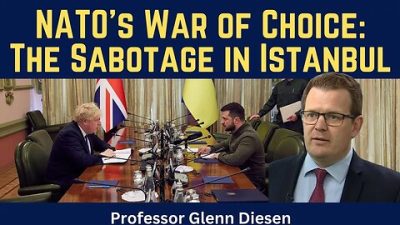
NATO’s War of Choice – The Sabotage of the Istanbul Negotiations
or go to
Aletho News Archives – Video-Images
From the Archives
National Security Archive Publishes Key Records on Infamous MKULTRA Program
Agency Sought Drugs and Behavior Control Techniques to Use in “Special Interrogations” and Offensive Operations
Edited by Michael Evans | National Security Archive | December 23, 2024
Washington, D.C. – Today, the National Security Archive and ProQuest (part of Clarivate) celebrate the publication of a new scholarly document collection many years in the making on the shocking secret history of the CIA’s mind control research programs. The new collection, CIA and the Behavioral Sciences: Mind Control, Drug Experiments and MKULTRA, brings together more than 1,200 essential records on one of the most infamous and abusive programs in CIA history.
Under code names that included MKULTRA, BLUEBIRD and ARTICHOKE, the CIA conducted terrifying experiments using drugs, hypnosis, isolation, sensory deprivation, and other extreme techniques on human subjects, often U.S. citizens, who frequently had no idea what was being done to them or that they were part of a CIA test.
Today’s announcement comes 50 years after a New York Times investigation by Seymour Hersh touched off probes that would bring MKULTRA abuses to light. The new collection also comes 70 years since U.S. pharmaceutical giant Eli Lilly & Company first developed a process to streamline the manufacture of LSD in late 1954, becoming the CIA’s chief supplier of the newly discovered psychoactive chemical central to many of the Agency’s behavior control efforts.
Highlights of the new MKULTRA collection include… continue
Blog Roll
 Aletho News
- The Founder Who Turned Against Root Canals
- Israel displaces last two families from Al Khalayel valley, Al Mughayyir
- Israeli Opposition Leader Endorses Greater Israel
- Islamic Jihad: Trump’s peace board is a “theatrical stunt detached from reality”
- The Head Of A CIA Cutout Admits To Meddling In Iran To Fuel Unrest
- Iran warns Trump against decisions based on false information
- Pentagon sets deadline for Anthropic to lift AI restrictions on autonomous weapons systems, mass domestic surveillance
- Trump’s military buildup against Iran on Netanyahu’s behalf is a gambit doomed to fail
- Big League War
- Zelensky sells false illusion of building powerful air force capable of overcoming Russia
- If Americans Knew
- Are the Jews indigenous to Palestine?
- AIPAC Wants to Kill a Bill that would Ensure Israel Complies with Ceasefire
- Former Israeli PM, in Epstein Files, Dreamed of Israeli Eugenics and Pretty Converts
- Israeli settlers join ‘safari’ tour of Palestinian prisoners
- Flooding in Gaza amid rumors of war; fire in West Bank – Not a ceasefire Day 138
- Fourteen Countries Condemn Huckabee’s Support for Israel Taking Over Most of the Middle East
- Israeli Soldiers Killed Gaza Aid Workers at Point Blank Range in 2025 Massacre: Report
- Israel’s insidious network to propagandize American Christians
- Israel’s Best-Kept Secret: Palestinian Resistance Never Agreed to Disarm
- Trump officials plan to build 5,000-person military base in Gaza, files show
- No Tricks Zone
- Surprising Discovery: Sahara Is Greening…Billions Of Trees Where Once Thought To Be Barren
- New Research Reaffirms Clouds, Aerosols, And Surface Solar Radiation Are ‘Driving The Climate System’
- Germany: Electric Car Catches Fire At Charging Station, Sets Off Local “Inferno”, Widespread Damage
- New Study: Canada’s New Brunswick Was 1°C Warmer Than Today During The Medieval Warm Period
- Coal Power Back In Trend As Globe Tries To Keep Pace With Growing Demand For Power
- New Study: A 4°C Warmer Beaufort Sea Had ‘No Sea Ice’ 11,700 – 8200 Years Ago
- Unfudging The Data: Dutch Meteorological Institute Reinstates Early 20th Centruy Heat Waves It Had Erased Earlier
- German Gas Crisis…Chancellor Merz Allegedly Bans Gas Debate Ahead of Elections!
- Pollen Reconstructions Show The Last Glacial’s Warming Events Were Global, 10x Greater Than Modern
- Germany’s Natural Gas Storage Level Dwindles To Just 28%… Increasingly Critical
 Aletho News