Message from the High Court: Carry on Arming The Saudis (And Never Mind the Slaughter in Yemen)

Campaigners are furious with a High Court decision in London allowing the UK Government to carry on exporting arms to Saudi Arabia for use against Yemenis
By Stuart Littlewood | American Herald Tribune | July 13, 2017
The Campaign Against Arms Trade (CAAT) brought the legal action against the Secretary of State for International Trade for continuing to grant export licences for arms to Saudi Arabia, arguing that this was against UK policy, which states that the government must refuse such licences if there’s a clear risk that the arms might be used to commit serious violations of International Humanitarian Law.
It is undeniable that Saudi forces have used UK-supplied weaponry to violate International Humanitarian Law in their war on Yemen. According to the United Nations, well over 10,000 people have been killed, the majority by the Saudi-led bombing campaign which has also destroyed vital infrastructure such as schools and hospitals and contributed to the cholera crisis. 3 million Yemenis have been displaced from their homes and 7 million are on the brink of dying from famine. UNICEF reports that a child is dying in Yemen every ten minutes from preventable causes including starvation and malnourishment.
A crippling naval blockade of the country by the US has been key to the cruel onslaught. The European Parliament and numerous humanitarian NGOs have condemned the Saudi air strikes as unlawful. And 18 months ago a UN Panel of Experts accused Saudi forces of “widespread and systematic” targeting of civilians.
Yet the UK has licensed £3.3 billions worth of arms such as aircraft, helicopters, drones, missiles, grenades, bombs and armoured vehicles to the Saudi regime and refused to suspend the supply of weaponry for use in Yemen in the face of the horrors perpetrated. It is claimed that the Government has even ignored warnings by senior civil servants and its own arms control experts, and that some records of expressed concern have gone missing.
So who is the UK’s helping hand behind that vile regime’s murderous adventure in the Yemen? Why, it’s none other that senior Israel stooge Dr Liam Fox, now Secretary of State for International Trade and the lead on trade and investment in the defence and security sector. He of course oversees export licensing. He also has ‘form’ when it comes to thinking silly thoughts and doing stupid things in the foreign affairs arena, and he’s known as a crazed flag-waver for Israel and a sworn enemy of Iran.
While Secretary of State for Defence, Fox told us: “Israel’s enemies are our enemies and this is a battle in which we all stand together or we will all fall divided.”
Fox was forced to resign as Defence Secretary in 2011 following the scandal involving him, his ‘close friend’ Adam Werritty, the UK ambassador to Israel, and Israeli intelligence figures allegedly involved in plotting sanctions against Iran.
The reason for the British government’s hostility towards Iran was spelled out by David Cameron in a speech to the Knesset in 2014: “A nuclear armed Iran is a threat to the whole world not just Israel. And with Israel and all our allies, Britain will ensure that it is never allowed to happen.” That position carries forward into the present day.
And in June 2015 Fox declared: “It is logical to assume that Iran’s intentions are to develop a nuclear weapons capability and any claims that its intentions are exclusively peaceful should not be regarded as credible… Iran’s nuclear intentions cannot be seen outside the context of its support for terror proxies, arguably the defining feature of its foreign policy. The risks are clear.”
What he omitted to say was that Iran’s intentions must also be seen in the context of Israel’s foreign policy, its refusal to sign the Nuclear Non-Proliferation Treaty and the grave threat posed by the Zionist regime’s 200 (or is it 400?) nuclear warheads. Israel hasn’t signed the Biological and Toxin Weapons Convention either, and has signed but not ratified the Comprehensive Nuclear Test-Ban Treaty, likewise the Chemical Weapons Convention. Iran and all the other nations in the region have every right to feel nervous.
As is well known, Israel and Saudi Arabia have formed a cosy alliance. No entities deserve each other more. And Britain will do anything, it seems, to get at Iran through these repulsive ‘friends’.
Instead of dangling from a lamp-post on Tower Bridge, Fox was quickly rehabilitated and re-promoted to senior office by fellow stooges like Theresa May. Just lately prime minister May has accused Iran of working with Hezbollah, interfering in Iraq, sending fighters to Syria to help Assad, and supporting the Houthis in the conflict in Yemen. The British Government, of course, can meddle where it pleases and do dirty weapons deals with the Saudis which, Mrs May assures us, are for the sake of long-term security in the Gulf. “Gulf security is our security,” she says, arguing that the same extremists who plot terror in the Gulf states are also targeting the streets of Europe.
Toxic relationship with Saudi Arabia exposed
So how did Fox manage to defeat the campaigners in court? After all, as Rosa Curling of Leigh Day (acting for CAAT) said, “The law is clear: where there is a clear risk that UK arms might be used in the commission of serious violations of international law, arm sales cannot go ahead.
“Nothing in the open evidence presented by the UK government to the court suggests this risk does not exist in relation to arms to Saudi Arabia. Indeed, all the evidence we have seen from Yemen suggests the opposite: the risk is very real…. Our government should not be allowing itself to be complicit in the grave violations of law taking place by the Saudi coalition in Yemen.”
Andrew Smith of CAAT said: “If this verdict is upheld then it will be seen as a green light for government to continue arming and supporting brutal dictatorships and human rights abusers like Saudi Arabia that have shown a blatant disregard for international humanitarian law….
“This case has seen an increased scrutiny of the government’s toxic relationship with Saudi Arabia. It is a relationship that more than ever needs to be examined and exposed. For decades the UK has been complicit in the oppression of Saudi people, and now it is complicit in the destruction of Yemen.”
Rachel Sylvester in The Times noted that the judges concluded there was “a substantial body of evidence suggesting that the [Saudi-led] coalition committed serious breaches of international humanitarian law in the course of its engagement in the Yemen conflict”, but the ruling was based on a narrow legal point about whether ministers had followed proper procedures and acted rationally in assessing the risks.
“Whatever the result of the legal process,” she wrote, “it’s time for the government to reconsider Britain’s poisonous relationship with Saudi Arabia, starting with the suspension of arms sales to a country that stands accused of appalling human rights abuses within its own borders as well as the funding of extremism abroad. What is UK foreign policy for if not the promotion of this country’s values around the world?”
And, as she points out, last year the UK committed £85 million to the aid effort in Yemen, making the Department for International Development the fourth largest donor to the crisis.
So, just as we pour £millions of aid into the Palestinian Territories to subsidise the illegal Israeli occupation while at the same time supplying the regime in Tel Aviv with arms to sustain its occupation, we are spending all this taxpayers’ money in Yemen to clean up the mess we’re helping the Saudis to make.
Secret evidence favours the evil
Fox succeeded thanks to ‘closed sessions’. This meant that CAAT and their legal team weren’t allowed to see much of what was presented by the Government, which could only be examined by a security-cleared “special advocate”.
The secret evidence is said to have included Saudi Arabia’s “fast-jet operational reporting data”, “high-resolution MoD-sourced imagery” and “UK defence intelligence reports and battle damage assessments”. The MoD and Foreign Office analysis had “all the hallmarks of a rigorous and robust, multi-layered process of analysis” while the evidence presented by the campaigners was “only part of the picture”. The Court said the secret evidence could not be referred to in open court for reasons of “national security”.
But what has all the MoD’s high-faluting technical tosh to do with justice? Or the basic concept of right and wrong? An especially International Humanitarian Law?
And our national security? Yeah, yeah, yeah. So the slaughter must go on in that distant land…
Labour’s shadow international trade secretary Barry Gardenier suggested in the House of Commons that the “secret” evidence should be made available to MPs for scrutiny “on privy council terms” or handed to the Intelligence and Security Select Committee. Sounds reasonable enough.
But Fox is reported saying: “This idea that somehow, if we have closed sessions, that makes the judgment less valid, I simply don’t accept. Because I don’t accept this idea that we simply can’t have closed sessions that protect our national security or the personnel involved in our national security. Our sources need to be protected.”
Yeah, and so do Yemeni civilians…. from us.
He admitted that “Yemen is indeed a humanitarian disaster” but said it was right to keep selling arms to Saudi Arabia. He may have won the legal point – for now. But he has clearly lost his moral compass, if he ever had one.
As Rachel Sylvester remarks, “So craven is the Whitehall establishment that the government has refused to publish a report on the foreign funding of terrorism, for fear of annoying its Saudi friends.”
*(London, UK. 11th July, 2016. Human rights campaigners dressed as Grim Reapers protest against the Farnborough International arms fair, and in particular against arms sales to Saudi Arabia used in human rights abuses in Yemen, at Waterloo station. Image credit: Campaign Against Arms Trade/ flickr).
Saudi’s Qatif in Mourning after Regime Killed Four Political Detainees
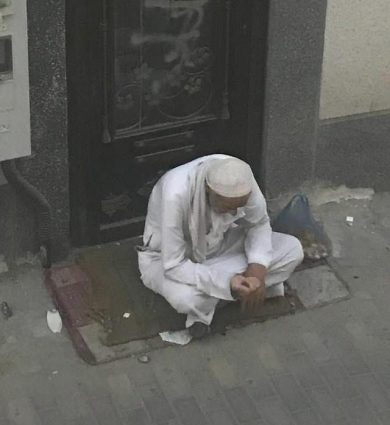
Father of Saudi martyr Yousef Ali Abdullah al-Mishaikhesh, after being informed of his son’s execution.
Al-Manar | July 12, 2017
Saudi Arabia’s Qatif region is in mourning on Wednesday after the ruling regime announced a day earlier it had executed four people over allegations of “conducting terror activities”.
The Saudi Interior Ministry claims that the four, who were executed in Qatif Governorate in Eastern Province, had attacked police stations and petrol officers.
The ministry identified the four men as Zaher Abdulraheem Hussein al-Basri, Yousef Ali Abdullah al-Mishaikhesh, Mahdi Mohammed Hasan al-Sayegh, and Amjad Naji Hasan Al Moaibed.
The Shia-dominated Eastern Province, particularly the Qatif region, has been the scene of peaceful demonstrations since February 2011. Protesters, complaining of marginalization in the Sunni-ruled kingdom, have been demanding reforms, freedom of expression, the release of political prisoners, and an end to economic and religious discrimination against the oil-rich region.
However, the government has responded to the protests with a heavy-handed crackdown, but the rallies have intensified since January 2016 when Saudi Arabia executed respected Shia cleric, Sheikh Nimr al-Nimr, an outspoken critic of the policies of the Riyadh regime.
Saudi Arabia has one of the world’s highest rates of execution. Rights groups last month expressed concern that 14 Saudi Shia individuals face execution for protest-related crimes.
Condemnation as govt bans report into who funds Britain’s extremists
RT | July 12, 2017
UK Home Secretary Amber Rudd has confirmed an already much-delayed report into the foreign funding and support of extremist groups in the UK will be banned from publication for “national security” reasons.
Rudd instead released a parliamentary written answer outlining the details of the report, which was commissioned by former Conservative Prime Minister David Cameron.
“Having taken advice, I have decided against publishing the classified report produced during the review in full,” she said.
“This is because of the volume of personal information it contains and for national security reasons.”
“We will be inviting privy counselors from the opposition parties to the Home Office to have access to the classified report on privy council terms.”
According to the Home Secretary’s summary, some key findings include that UK-based individual donors primarily fund extremist organizations in the UK, while some donations also came from overseas.
The report was finished six months ago, and it is thought its publication had been further delayed over government fears diplomatic links with principal Middle East ally Saudi Arabia would be at stake if had been implicated in the foreign financing of UK radical groups.
The summary said foreign aid helped individuals enter institutions that “teach deeply conservative forms of Islam and provide highly socially conservative literature and preachers to the UK’s Islamic institutions.”
Some of those individuals have since become of “extremist concern,” the report added.
The decision to permanently shelve the report has caused an outcry among opposition parties, with Liberal Democrat leader Tim Farron arguing that extremism can only be tackled if full information is released, regardless of what consequences there may be for the UK’s diplomatic ties abroad.
“We cannot tackle the root causes of terrorism in the UK without full disclosure of the states and institutions that fund extremism in our country.”
“Instead of supporting the perpetrators of these vile ideologies, the government should be naming and shaming them – including so-called allies like Saudi Arabia and Qatar if need be,” he said, according to Business Insider.
“It seems like the government, yet again, is putting our so-called friendship with Saudi Arabia above our values. This shoddy decision is the latest in a long line where we have put profit over principle.”
Green Party co-leader Caroline Lucas also blasted the “unacceptable decision” not to publish the report, warning that it fuels speculation the government wants to cover up Saudi Arabia’s terrorist funding.
“The statement gives absolutely no clue as to which countries foreign funding for extremism originates from – leaving the government open to further allegations of refusing to expose the role of Saudi Arabian money in terrorism in the UK,” Lucas said.
The Saudis Are Bombing Their Own People And Nobody’s Talking About it
Geopolitics Alert | July 8, 2017
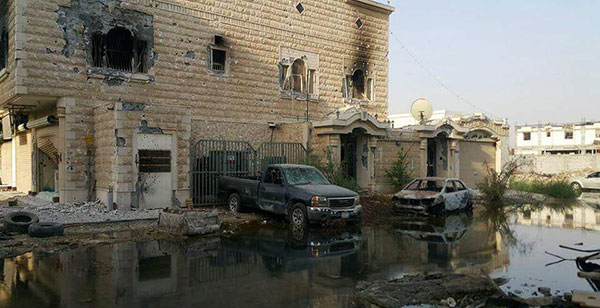
For the past 60 days, the Saudis have imposed a devastating siege on the Shiite town of Awamiya. And of course, mainstream western media remains silent.
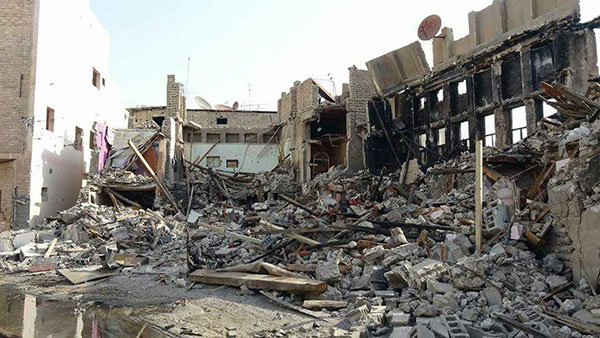
These photos aren’t from Yemen, they’re from the Saudi Arabian eastern town of Awamiya. Where Saudi forces are waging war against an oppressed shia minority. Saudi Arabia adheres to the extreme fundamentalist and intolerant sect of Wahhabism. Making it the country’s religious majority. This ideology is also enforced through state tactics. Which make it illegal to publicly carry out any religious practice or teaching that conflicts with Wahhabism. Even other Muslims (especially Shiites) are considered infidels by the Saudi government. And thus, all religious minorities in Saudi Arabia remain an extremely oppressed group; often lacking the same health care, public services, and wages granted to their Wahhabi counterparts; if not facing death.
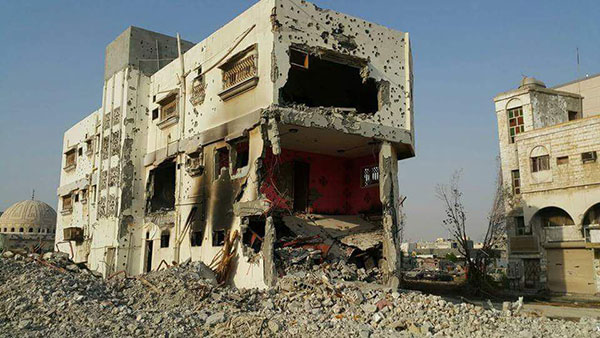
While the majority of Saudi citizens adhere to Wahhabi principles, many towns in the eastern province of Qatif– like Awamiya– hold a Shia majority. Where they’ve been essentially doomed to live in “ghettos” as second class citizens. But the Saudi oppression of Shiites and other religious minorities goes way beyond just economic devastation. In fact for the past two months Saudi forces have held Awamiya under siege, destroyed buildings with bombs and shelling, and set up barricades to control free movement. This is likely a response to Shia citizens calling for basic human rights.
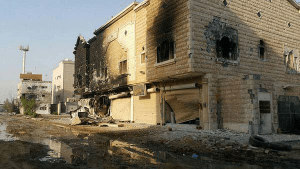
In videos posted to social media, it looks like Saudi security forces are using white phosphorus to drive-out citizens from their homes. Residents also report that Saudi forces are shelling homes and buildings with .50 caliber weapons. In one instance, a building was set on fire and Saudi police refused to allow firetrucks to pass through the barricades.
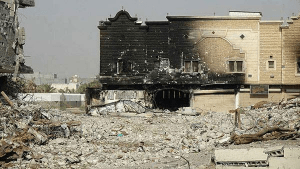
It’s been confirmed that a number of people have died as a result of gunfire. But it’s unclear exactly what the death toll could be since Saudi Arabia severely restricts media access. When the Saudi-run state media are reporting the numbers, they surely can’t be trusted.
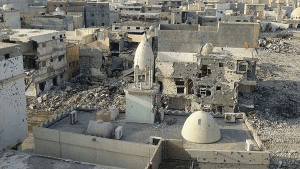
Of course, instead of reporting on the Saudis brutal repression, mainstream media has framed the story (in the few articles available) as though the Saudi security forces are simply clashing with an armed Shiite “militant” uprising. Which ultimately places the Saudi security forces in the “good guy” category just simply trying to keep order.
This however completely whitewashes the fact that the Shiite population in Saudi Arabia has been brutally repressed since the Kingdom’s formation. It also completely ignores the fact that the Saudis are using American-supplied weapons to kill their own people. Which if we look at Syria, this was supposedly the west’s entire reason for their intervention against Bashar al-Assad. “Assad is bombing his own people” the headlines still read to this day.
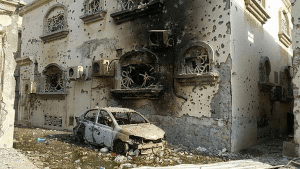
The happenings in Qatif only further demonstrate not only the Saudis’ intolerant disregard for human life, but also their genocidal tendencies as they move further towards an apartheid state within their own borders.
SEE ALSO:
Amid Yemen’s Cholera Outbreak, Saudi Airstrikes Destroy Desalination Plant
Saudis Target Home in Yemen (Again), Killing About a Dozen Civilians
Court rules Britain’s arms sales to Saudi Arabia are ‘lawful’, despite destruction of Yemen
RT | July 10, 2017
London’s High Court has ruled that UK arms sales to the Saudi Arabian regime are “lawful” in response to a judicial review brought by the Campaign Against the Arms Trade (CAAT).
The case hinged on the question of whether the UK failed to suspend sales in line with legal obligations, given the Saudi’s current war in neighboring Yemen, which has been waged in part using British manufactured military equipment.
Documents cited in court showed that civil servants had, in fact, recommended that sales should no longer go ahead, but ministers had ignored the advice.
“This is a very disappointing verdict, and we are pursuing an appeal,” Andrew Smith of Campaign Against Arms Trade said.
“If this verdict is upheld then it will be seen as a green light for government to continue arming and supporting brutal dictatorships and human rights abusers like Saudi Arabia that have shown a blatant disregard for international humanitarian law.”
CAAT’s lawyer, Rosa Curling, said: “Nothing in the open evidence, presented by the UK government to the court, suggests this risk does not exist in relation to arms to Saudi Arabia.
“Indeed, all the evidence we have seen from Yemen suggests the opposite: the risk is very real. You need only look at the devastating reality of the situation there.”
CAAT, who have said they will appeal, had argued that the UK’s continued sales are a breach of international law while the EU’s common council also insists that sales to nations where violations of the law might occur must be halted.
In the last two years, the UK has licensed the sales of £3 billion (US$3.86 billion) worth of arms to the Saudi government, with which Britain is a longstanding ally.
Arm sales have included Typhoon and Tornado jets and the UK has had military personnel embedded in Saudi headquarters throughout the Yemen conflict, which has raged since 2015.
The British government maintains that the personnel are there to support adherence to international law and advice on rules of engagement.
Both Royal Air Force (RAF) and Royal Artillery (RA) personnel have been deployed to train the Saudi military during the war.
The conflict – which has been accompanied with a blockade of major ports – has drastically worsened the humanitarian situation in the already-impoverished gulf nation.
The UN says 17 million people in Yemen are at imminent risk of famine, while dwindling medical supplies and lack of trained medical personnel have led to epidemics.
Leading humanitarian organizations, including the Red Cross, have named the aerial bombing campaign and blockade as the main causes behind the ongoing cholera epidemic in the capital, Sanaa, that has already claimed some 200 lives, while over 11,000 cases of the disease have been registered.
Theresa May ‘sitting’ on UK terrorism funding report to protect Saudi allies
RT | July 4, 2017
Prime Minister Theresa May is withholding a Home Office report on foreign funding of British terrorist organizations because exposing the truth could sour relations with the UK’s major trading and security partner, Saudi Arabia.
The report, commissioned to investigate foreign states funding extremist groups in the UK, has yet to be made public despite being completed six months ago. The government’s reluctance to share it has left many concerned about how ethical Britain’s ongoing diplomatic relationship with the Gulf kingdom is.
Green Party co-leader Caroline Lucas branded the delay “astonishing.”
“The government is sitting on this report but refusing to publish it or give any reason for their continued secrecy,” the Brighton Pavilion MP said in a statement.
“To defeat terror it’s vital that politicians have full view of the facts, even if they are inconvenient for the government.”
She added that the secrecy surrounding the report “leaves question marks over whether their decision is influenced by our diplomatic ties.”
Home Office sources insist that, although the report does mention Saudi Arabia, the Gulf theocracy is not its main subject.
Prime Minister May has always made clear that Britain’s relationship with the Saudis lies at the core of her diplomatic agenda. She visited Riyadh to discuss strengthening trade ties mere days after triggering the Brexit process.
The report, which was commissioned by May’s predecessor, David Cameron, was due to be submitted by Easter last year. It was originally meant to study the origins and extent of funding received by British extremist groups that involve international forces.
Responding to parliamentary questions on the document and its delays, May argued that “ministers are considering advice on what is able to be published and will report to parliament with an update in due course.”
It is believed some government insiders think the material is too sensitive to be made public.
On Monday evening, outgoing Liberal Democrat leader Tim Farron said: “The government are covering up this report. It’s a scandal that this is sitting in Downing Street gathering dust. What has the prime minister got to hide?
“I believe this report will be deeply critical of Saudi and that is why it is being hidden from the public. The government seems too desperate to keep Saudi Arabia happy rather than stand up to them.”
Other party leaders, Jeremy Corbyn of the Labour Party and Nicola Sturgeon of the Scottish National Party (SNP), have also urged Downing Street to make the findings public.
Green Party leader Lucas said, in the light of the London Bridge and Manchester Arena attacks, the public was “quite rightly asking questions about routes to radicalization, and the funding of terror is central to this.
“I urge Theresa May to reveal immediately whose advice they are following as to whether or not to publish this report, and to do all they can to put the facts into the public domain if it is safe to do so,” she said.”
In response, Home Office minister Sarah Newton said: “The review has improved the government’s understanding of the nature, scale and sources of funding for Islamist extremism in the UK. Publication of the review is a decision for the prime minister.”
US faces historic setback in the Middle East
By M K Bhadrakumar | Indian Punchline | June 23, 2017
The bloc of four Arab countries led by Saudi Arabia that imposed an embargo against Qatar on June 5 has finally presented their charter of demands. An AP dispatch, lists the 13 demands. The most striking demands include Doha reducing ties with Iran, severing relationships with Hezbollah and the Muslim Brotherhood, closing a Turkish military base in the country, and shuttering state broadcaster Al Jazeera and several news outlets.
Interestingly, Qatar is also expected to “consent to monthly audits for the first year after agreeing to the demands, then once per quarter during the second year. For the following 10 years, Qatar would be monitored annually for compliance.” All this means that abject, unconditional capitulation by Qatar only will satisfy its ‘big brothers’ – nothing less. By the way, there is also a timeline to comply – within the next 10 days – or else the demands get ratcheted up.
To my mind, Qatar will have no difficulty to see this is nothing short of a thinly-veiled push for ‘regime change’. The regime’s response can only be that these Arab bigwigs can go and hang themselves.
What happens next? Simply put, the (Sunni) Muslim Middle East is about to split and the historic schism will have profound consequences for regional and international security.
Make no mistake, this latest development also signifies a slap on the face for the Trump administration. Only last Tuesday, US state department warned Saudi Arabia to resolve the standoff without any further delay lest direct US intervention became necessary, doubting the stance taken by Riyadh (which is widely regarded as carrying the imprimatur of the new Crown Prince Mohammed bin Salman) and showing broad empathy with Qatar (where the US Central Command is headquartered.) Curiously, the US spokesperson also had alluded to Saudi Arabia’s past involvement in terrorism “whether it’s through terror financing or other means”.
Evidently, Saudi pride has been touched to the quick and Riyadh has taken exception to the US censuring. Without doubt, these demands are a show of defiance at Washington, too. This is all now going to become a protracted crisis in all likelihood, which will seriously debilitate the US’ regional strategies – unless of course Qatar crawls on its knees — and weaken its war against the ISIS.
To be sure, Turkey will take great exception to the Saudi demand that its so-called military base in Doha should be shut down unceremoniously. President Recep Erdogan will see this demand as an intolerable affront to Ottoman legacy. The VOA reported on Thursday that Turkey has been moving food and troops to Qatar in a big way.
Quite obviously, the crux of the matter is that the virus of Arab Spring is hibernating in Qatar and it threatens to become an epidemic someday again, threatening the autocratic regimes in the Middle East. Only Turkey, Iran and Israel are immune to the virus of democratic empowerment. Evidently, Al Jazeera and the Muslim Brotherhood are driving the sheikhs crazy in Saudi Arabia, UAE and Bahrain and threaten the military dictatorship in Egypt.
The credibility of the US on the ‘Arab Street’ is now irreparably damaged. For President Donald Trump all this becomes a big political embarrassment domestically. (Bloomberg ) It remains to be seen how the US can afford to sustain its belligerent posturing in Syria and Iraq much longer without any regional allies from the Arab world.
The Trump administration’s containment strategy against Iran seems destined to collapse even before its launch and Trump’s pet project of the ‘Arab NATO’ looks a macabre joke. Can the US ever restore its hegemony over the Muslim Middle East? Doubtful. A big slice of modern history of the western hegemony over Arabs is breaking away and drifting toward the horizon. To be sure, Russians are coming!
A warrior prince rises in Arabia as the monarch of all he surveys
By M K Bhadrakumar | Indian Punchline | June 22, 2017
The royal decree of June 21 by Saudi Arabia’s King Salman appointing his son Mohammed bin Salman as the Crown Prince and next in line to the throne is a watershed event in Middle East politics. Such a development has been expected for some time, but when it actually happened, it still looks momentous and somewhat awesome.
For a start, 31-year old MbS, whom many tend to deride as the “warrior prince”, has earned a reputation for being rash in the use of force. The extremely brutal war in Yemen is his signature foreign-policy project. Saudi Arabia, famous for its caution and its glacial pace of decision-making, has changed remarkably since MbS trooped in alongside King Salman to the centre stage of the Saudi regime in January 2015.
Considering King Salman’s age and health condition, MbS is being positioned in advance so that there will be no succession struggle. MbS has been steadily tightening his grip on the key instruments of power through the past 2-year period – national security apparatus and intelligence, armed forces and oil industry – in a grim power struggle with the Crown Prince Mohammed bin Nayef, who has now lost the game and is retiring from the arena.
With the vast powers of patronage vested in MbS as the Crown Prince, make no mistake, the winner takes it all. In short, the Persian Gulf’s – nay, Middle East’s – power house is about to get a new ruler who is only 31 and he may lead Saudi Arabia for decades.
The timing of the shift in the power fulcrum cannot but be noted. It is exactly one month since US President Donald Trump visited Saudi Arabia. Trump’s visit revived the Saudi-American alliance, which was adrift during the second term of President Barack Obama. MbS has emerged as the Trump administration’s number one interlocutor in the Saudi regime, superseding Nayef who used to be the favorite of the Obama administration.
MbS has forged links at personal level with Trump’s son-in-law Jared Kushner. In a rare gesture, the Prince invited Kushner and wife Ivanka Trump to his residence for a private meal during father-in-law Trump’s visit to Riyadh. So, Saudi-US relations from now onward will be a cozy, exclusive, secretive family affair imbued with a “win-win” spirit – as it used to be in the halcyon days when the Bush family was holding power in the US.
Trump’s visit to Riyadh signalled that Saudi Arabia has regained its stature as the US’ number one partner in the Muslim Middle East. Trump has publicly endorsed the Saudi stance in their standoff with Qatar, which, incidentally, is widely attributed to MbS.
MbS is widely regarded as the mastermind of the tough policy policy to isolate Qatar to make it submissive and has personally identified with the virulently anti-Iran thrust in the Saudi regional strategies. Therefore, MbS’ ascendancy impacts Middle East politics along the following fault lines:
· The war in Yemen;
· The standoff with Qatar;
· The Saudi-Iranian tensions;
· The nascent Saudi-Israeli regional axis;
· Situation in Syria and Gaza and/or Lebanon; and,
· The crackdown in Bahrain.
It remains to be seen whether the unity of the Gulf Cooperation Council (GCC) can be preserved. MbS enjoys personal rapport with Sheikh Mohammed bin Zayed, the crown prince of Abu Dhabi in the United Arab Emirates. But other GCC states — Kuwait, Oman and Qatar — will have a profound sense of unease about the “warrior prince” and this may lead to some major realignments in the Persian Gulf.
On the one hand, MbS may advance a normalization of relations between Saudi Arabia and Israel. If that happens, Israel breaks out of isolation and the Arab-Israeli conflict can never be the same again. Again, it is conceivable that MbS may throw the Palestinians under the bus. On the other hand, Iran too may finally succeed in breaching the GCC cordon that Saudi Arabia had erected, which in turn, may somewhat blur the sectarian divide in the Muslim Middle East and bring about a convergence of interests with Qatar and Turkey as regards perceived Saudi hegemony.
MbS is a man in a hurry. He has radical ideas to transform Saudi society and its economy under the rubric of Vision 2030. He has brought in western-educated technocrats into the governmental apparatus, replacing the Old Guard. How the conservative religious establishment views these winds of change remains the big ‘unknown unknown’ — especially MbS’ management style such as his openness to out-of-the-box thinking, his uniquely public profile in a deeply conservative country, his risk-taking character and his willingness to break conventions.
There is indeed a lot of pent-up disaffection within Saudi Arabia, which makes the period of reform and transition very tricky. The example of Shah’s Iran readily comes to mind. In the ultimate analysis, therefore, the big question is Who is the real MbS?
Clearly, his conduct so far cannot be the yardstick to fathom his personality, since it was primarily a swift, decisive action plan to elbow out the incumbent Crown Prince and take his job. Now that MbS’ actual hold over the levers of power is going to be unchallenged, his priorities can also change. Indeed, there are intriguing sides to his personality – his personal role in forging Saudi Arabia’s working relationships with Moscow, his determination to reduce the economy’s dependence on oil, his appeal to the Saudi youth as the harbinger of “change” and so on. The bottom line is that social and political stability in the country is vital for the success of Vision 2030, in which MbS has staked his prestige, envisaging wide-ranging structural reforms, geo-economic restructuring and the infusion of massive investments.
King Salman’s recent visit to China underscored that MbS understands the potential linkage between his Vision 2030 and China’s Belt and Road Initiative. Of course, China is highly receptive to the idea, too. Deals worth $65 billion were signed in Beijing during King Salman’s visit. Similarly, MbS has been a frequent visitor to the Kremlin and enjoys some degree of personal rapport with President Vladimir Putin. The OPEC decision on cut in oil production has been a joint enterprise in which Putin had a “hands-on” role. Rosneft has signalled interest in acquiring shares in Aramco when its “privatisation” begins next year, and at the recent meet of the St. Petersburg International Economic Forum, the two countries agreed to set up a joint energy investment fund.
MbS, who is Saudi Defence Minister, has also intensified his country’s military cooperation with Russia and China. A notable project will be the Chinese drone factory to be set up in Saudi Arabia. Again, Russia is in talks currently for the sale of T-80 battle tanks to Saudi Arabia, among other weaponry.
Suffice to say, MbS is quite aware of the seamless possibilities that the multipolar world setting offers. It is useful to remember that MbS is a unique Saudi prince who never attended a western university. He is far from a greenhorn in the world of politics either, having begun as fulltime advisor to the council of ministers in 2007.
Indeed, his trademark is his assertiveness in foreign policies that stands in sharp contrast with the traditional Saudi style, and, which, therefore, looks aggressive. But then, it needs to be factored in that the war in Yemen and the strident anti-Iran outlook are immensely popular in the domestic opinion in terms of the surge of Saudi nationalism. The big question, therefore, will be how he deploys the surge of nationalism — amongst the youth, in particular — in his hugely ambitious plan to reform and modernise the country. Traditionally, Saudi rulers used to derive legitimacy from the approval of the Wahhabist religious establishment. (Read an Al Jazeera write-up on MbS’s profile here.)
Qatar: ‘Neighbors’ leading economic siege hacked our news agency
Press TV – June 21, 2017
Qatar says it has evidence showing the same “neighboring” countries that are leading a boycott campaign against Doha had a hand in the alleged hacking of its state news agency, an incident that triggered an unprecedented diplomatic crisis in the Persian Gulf region.
Attorney General Ali bin Fetais al-Marri Ali bin Fetais al-Marri told a press conference in Doha on Tuesday that the hacking incident originated in “neighboring countries,” without naming them.
“We have evidence to show that iPhones originating from the countries laying siege to us have been used in this hacking. We have enough evidence to point the finger of blame at these countries,” Marri said.
Last month, the Qatar News Agency (QNA) released comments attributed to Emir Sheikh Tamim bin Hamad Al Thani, describing Iran as an “Islamic power,” praising the Palestinian resistance movement Hamas and criticizing US President Donald Trump.
Qatar said hackers had broken into the QNA website and published the fake news, but the denial did not convince the Riyadh regime and its Persian Gulf Arab allies.
Elsewhere in his remarks, the Qatari attorney general said it was “very soon” to give specific phone numbers for those he said were responsible for the hacking.
He also noted that Qatari investigators had traced the internet service providers used to the Saudi-led allied countries.
“We have sent the information to the countries concerned and we are awaiting their response,” Marri pointed out, adding, “As far as we are concerned, the case is very clear.”
Following the hacking report, Saudi Arabia, the United Arab Emirates, Bahrain and Egypt severed diplomatic ties and cut off transport links with Qatar in early June, accusing Doha of supporting terrorism, an allegation rejected by the Qatari government.
They put 12 organizations and 59 people associated with Qatar on a terror sanctions list.
Marri said the blacklist was “baseless” and stressed that Qatar would legally pursue those who had done harm to it.
Qatar has long been at odds with other Arab countries about the Muslim Brotherhood, which the UAE and Egypt regard as a terrorist group.
Back in March, 2014, Saudi Arabia, the UAE and Bahrain temporarily recalled their ambassadors from Doha after alleging that it has been interfering in their domestic affairs. The diplomatic relations resumed eight months later when Qatar ordered some Muslim Brotherhood members to leave the country.
The recent dispute, however, is said to be the worst to hit the Persian Gulf since the formation of the Persian Gulf Cooperation Council (GCC) in 1981.
Observers say the fresh rift surfaced in the wake of Qatar’s break with past policies and its leaning toward Russia and Iran.
Qatar’s Foreign Minister Sheikh Mohammed bin Abdulrahman Al Thani said lately that Doha would not “surrender,” vowing to keep “the independence of our foreign policy.”
Featured Video
NATO’s War of Choice – The Sabotage of the Istanbul Negotiations
or go to
Aletho News Archives – Video-Images
From the Archives
National Security Archive Publishes Key Records on Infamous MKULTRA Program
Agency Sought Drugs and Behavior Control Techniques to Use in “Special Interrogations” and Offensive Operations
Edited by Michael Evans | National Security Archive | December 23, 2024
Washington, D.C. – Today, the National Security Archive and ProQuest (part of Clarivate) celebrate the publication of a new scholarly document collection many years in the making on the shocking secret history of the CIA’s mind control research programs. The new collection, CIA and the Behavioral Sciences: Mind Control, Drug Experiments and MKULTRA, brings together more than 1,200 essential records on one of the most infamous and abusive programs in CIA history.
Under code names that included MKULTRA, BLUEBIRD and ARTICHOKE, the CIA conducted terrifying experiments using drugs, hypnosis, isolation, sensory deprivation, and other extreme techniques on human subjects, often U.S. citizens, who frequently had no idea what was being done to them or that they were part of a CIA test.
Today’s announcement comes 50 years after a New York Times investigation by Seymour Hersh touched off probes that would bring MKULTRA abuses to light. The new collection also comes 70 years since U.S. pharmaceutical giant Eli Lilly & Company first developed a process to streamline the manufacture of LSD in late 1954, becoming the CIA’s chief supplier of the newly discovered psychoactive chemical central to many of the Agency’s behavior control efforts.
Highlights of the new MKULTRA collection include… continue
Blog Roll
 Aletho News
- John Mearsheimer: The Case for a Nuclear Iran
- The Founder Who Turned Against Root Canals
- Israel displaces last two families from Al Khalayel valley, Al Mughayyir
- Israeli Opposition Leader Endorses Greater Israel
- Islamic Jihad: Trump’s peace board is a “theatrical stunt detached from reality”
- The Head Of A CIA Cutout Admits To Meddling In Iran To Fuel Unrest
- Iran warns Trump against decisions based on false information
- Pentagon sets deadline for Anthropic to lift AI restrictions on autonomous weapons systems, mass domestic surveillance
- Trump’s military buildup against Iran on Netanyahu’s behalf is a gambit doomed to fail
- Big League War
- If Americans Knew
- Are the Jews indigenous to Palestine?
- AIPAC Wants to Kill a Bill that would Ensure Israel Complies with Ceasefire
- Former Israeli PM, in Epstein Files, Dreamed of Israeli Eugenics and Pretty Converts
- Israeli settlers join ‘safari’ tour of Palestinian prisoners
- Flooding in Gaza amid rumors of war; fire in West Bank – Not a ceasefire Day 138
- Fourteen Countries Condemn Huckabee’s Support for Israel Taking Over Most of the Middle East
- Israeli Soldiers Killed Gaza Aid Workers at Point Blank Range in 2025 Massacre: Report
- Israel’s insidious network to propagandize American Christians
- Israel’s Best-Kept Secret: Palestinian Resistance Never Agreed to Disarm
- Trump officials plan to build 5,000-person military base in Gaza, files show
- No Tricks Zone
- Surprising Discovery: Sahara Is Greening…Billions Of Trees Where Once Thought To Be Barren
- New Research Reaffirms Clouds, Aerosols, And Surface Solar Radiation Are ‘Driving The Climate System’
- Germany: Electric Car Catches Fire At Charging Station, Sets Off Local “Inferno”, Widespread Damage
- New Study: Canada’s New Brunswick Was 1°C Warmer Than Today During The Medieval Warm Period
- Coal Power Back In Trend As Globe Tries To Keep Pace With Growing Demand For Power
- New Study: A 4°C Warmer Beaufort Sea Had ‘No Sea Ice’ 11,700 – 8200 Years Ago
- Unfudging The Data: Dutch Meteorological Institute Reinstates Early 20th Centruy Heat Waves It Had Erased Earlier
- German Gas Crisis…Chancellor Merz Allegedly Bans Gas Debate Ahead of Elections!
- Pollen Reconstructions Show The Last Glacial’s Warming Events Were Global, 10x Greater Than Modern
- Germany’s Natural Gas Storage Level Dwindles To Just 28%… Increasingly Critical
 Aletho News