Hamas pledges not to intervene in the affairs of Arab countries amid Qatar crisis
Ma’an – June 10, 2017
BETHLEHEM – Days after Saudi Arabia, Bahrain, the United Arab Emirates, and Egypt severed diplomatic ties with Qatar, accusing the Gulf state of supporting “terrorism,” the Hamas movement — named as one of the groups allegedly receiving Qatari sponsorship — pledged Saturday it would not intervene in the affairs of any Arab countries “regardless of the pressures.”
“Hamas’ weapons will be directed only at the enemy (Israel), and Hamas will maintain its policy of not intervening in Arab countries’ affairs regardless of pressures or events,” Deputy Hamas chief Mousa Abu Marzouk was quoted in an official Hamas statement as saying.
Disagreements among Arab countries, “are their own business,” he said, though the question of Palestine “will remain the core issue for everybody, and support for the Palestinian plight should be indisputable regardless of any situation that may arise.”
Abu Marzouk added that Hamas has come under pressure in the past from the Arab world and internationally, and said “we will always deal with such pressures responsibly. We won’t be in disagreement with any country.”
In a similar statement Friday, member of Hamas’ politburo Khalil Al-Hayya that “the Palestinian armed resistance is directed only towards the Israeli occupation, and that the Palestinian resistance will not deviate from this track,” he said, reiterating the faction’s rejection of its designation as a terrorist organization by the US, Israel, and several other countries. Hamas identifies as a Islamist national resistance movement.
Meanwhile, Qatari Foreign Minister Sheikh Muhammed bin Abd al-Rahman al-Thani reportedly said Saturday that, “The US views Hamas as a terror organization, but to the rest of the Arab nations it is a legitimate resistance movement. We do not support Hamas, we support the Palestinian people.”
“Hamas’s presence in Qatar doesn’t mean there’s support for Hamas in Qatar,” he said, highlighting the fact that Qatar also cooperates with the occupied West Bank-based Palestinian Authority to promote Palestinian reconciliation between Hamas and Fatah.
Following the abrupt severing of political ties with Qatar, Hamas slammed the development as a “politicized” attempt to force Qatar to abide by the interests of Israel and the United States.
Ahmad Yousif, a former senior Hamas figure who remains close to the movement’s leadership, described the political developments as part of an “American-Israeli-Saudi coalition” in the region — a sentiment expressed by other commentators owing to US President Donald Trump’s visit to Saudi Arabia and Israel in recent weeks and Saudi Arabia’s growing ties with Israel over the years.
Saudi Arabia’s Minister of Foreign Affairs Adel al-Jubeir had stated that Qatar would have to cut support to Hamas and the Muslim Brotherhood if the country wanted to restore diplomatic relations.
Qatar has also reportedly expelled members of Hamas from the country owing to the pressure, however, Hamas denied these claims, saying several leaders left Qatar “willingly” in order to avoid adding to Qatar’s difficulties.
Is Qatar paying the price for its pro-Palestine stance?
The New Arab | June 8, 2017
Qatar’s support for Palestinians seems to be one of the key causes of the Saudi-led blockade on Doha, amid increasing convergence between Riyadh and Abu Dhabi, and the administration of US President Donald Trump – the president most supportive of Israel in recent decades.
On Tuesday, Adel al-Jubeir, the Saudi foreign minister, made it clear that a key demand of his government in return for restoring ties with Doha was for Qatar to end its “support” for Palestinian group Hamas, which champions armed resistance against Israel and was the winner of the last general election held in the occupied Palestinian territories.
Jubeir, for the first time in Saudi history, suggested Hamas was an “extremist” group. During Trump’s visit to Riyadh in late May, the US president proclaimed the group a terrorist outfit akin to the Islamic State group and al-Qaeda, and Riyadh did not object.
Saudi Arabia previously provided support to Hamas and welcomed its leaders as recently as 2015. However, on the back of the Iranian nuclear deal, both the kingdom and its ally, the UAE, have been making increasing offers of normalisation with Israel – with whom they share Iran as a common foe.
Since the events of the Arab Spring, both Saudi Arabia and the UAE have also become hostile to the Muslim Brotherhood, to which Hamas is affiliated, seeing it as an imminent threat to their regimes.
Qatar, by contrast, has maintained good relations with most Palestinian factions, including Hamas and Fatah, and invested tens of millions of dollars in the reconstruction of besieged Gaza, decimated by years of Israeli war.
Qatar, although closely allied to the United States, has maintained an independent policy on Palestine, which has often caused it problems with pro-Israel officials in the West.
Now, Qatar’s neighbours seem to have joined the fray, inching closer to fully endorsing Israel’s narrative on groups such as Hamas, in the name of fighting extremism and terrorism, without defining either.
It is worth noting that the UAE hosts and supports Hamas’ arch-rival, exiled Fatah leader Mohammed Dahlan, whom it hopes to install as the next Palestinian president.
“Qatar is being punished for its role and influence in the Palestinian arena, with both President Mahmoud Abbas and Hamas,” Ibrahim al-Madhoun, political analyst, told The New Arab.
“Qatar’s role is one of the causes of the Gulf crisis, as its balanced position and influence has become a source of annoyance for its rivals,” he added.
Taysir Muhaisen, political commentator, agrees. “All the parties, in light of the emergence of a new US administration, have decided to pressure Qatar, which has had a different approach to many issues including the Palestinian issue, dealing with Hamas and all Palestinian factions… and helping Gaza weather the blockade,” he said.
Disaster for Gaza
Qatar is one of the few foreign backers of Hamas, and faces massive pressure from its Gulf neighbours to cut ties with the Islamic militant group. If it does, the result could be disastrous for Hamas-ruled Gaza, according to an AP analysis.
Qatar has invested hundreds of millions of dollars in roads, housing and a major hospital in the tiny territory. Its infrastructure projects are one of the few job-creators in a devastated economy.
Gaza already suffers from an Israeli-Egyptian blockade, widespread destruction from a string of Israel-Hamas wars, economic misery and chronic electricity shortages. For Hamas, Qatar’s money pumping into the economy is a vital lifeline bolstering its rule.
The mere prospect of losing Qatari support prompted Hamas on Wednesday to issue rare criticism of Saudi Arabia, which has been leading the campaign against its tiny Gulf neighbour.
Hamas official Mushir al-Masri said the Saudi call for Qatar to cut ties with the Palestinian group was “regrettable”, and contradicts traditional Arab support for the Palestinian cause. He accused Saudi Arabia of siding with “American and Zionist calls to put Hamas on the terrorism list”.
Qatar has denied the allegations made against it by Riyadh. But its small size and reliance on food imports from Saudi Arabia could make it susceptible to pressure.
This could spell trouble for Hamas. The group – which calls for Israel’s destruction, even if it has offered long-term interim cease-fires – is considered a terrorist organisation by Israel and its Western allies. Israel and Hamas have fought three cross-border wars that caused large-scale damage in Gaza.
Qatar doesn’t support Hamas directly, but its large-scale projects have significantly eased the burden on Hamas authorities and given it some credit for bringing this money to Gaza.
In 2012, Qatar’s then-emir, Hamad bin Khalifa al-Thani, visited Gaza, the first and only head of state to do so since Hamas routed Palestinian President Mahmoud Abbas’ Fatah militants in Gaza during internecine fighting a year after Hamas won elections in 2006. The emir announced a grant of $407 million for humanitarian projects.
The grant is being used to build a housing complex of 3,000 units. Two phases of the project have been completed and families moved into their new homes, dubbed the Hamad Residential City, in the southern Gaza town of Khan Younis.
Last month, Palestinian contractors and Qatari envoys signed deals to start the third and final phase of Hamad City. Now, those deals could be in question.
Using that grant, Qatar also built a specialist prosthetic centre, the first of its kind in Gaza. Qatar paved roads, repaired or rebuilt mosques and oversaw dozens of other infrastructure projects.
Following a 50-day war between Israel and Hamas in 2014, Qatar was the largest single donor to the reconstruction of Gaza, pledging $1 billion at a Cairo-hosted international conference.
Qatar also helped pay for fuel and electricity deliveries from neighbouring Israel, which, despite its enmity to Hamas, supplies energy to Gaza for what it says are humanitarian reasons.
On Wednesday, bulldozers with Qatari flags were seen leveling land overlooking Gaza City’s coastal road. The spot is supposed to house the headquarters of Qatar’s Gaza reconstruction mission and a residence for an envoy.
In Hamad City, new shops and stores are opening, including a pharmacy named Qatar, barber shops and a video gaming cafe as more families move in. The complex is the largest in Gaza.
Wael al-Naqla, a contractor, has won a bid to build several buildings in the final phase. Thanks to Qatari money, he is one of the few business owners who can hire workers in today’s Gaza.
“Without these projects, we would have been idled a long time ago,” he said, voicing fears that the funding could soon dry up. “We are afraid I won’t be able to keep paying for my 20 workers and they will not be able to eat.”
The construction here is one of the few bright spots in Gaza.
The situation here is grim. The territory suffers from rolling power cuts, with just four hours of electricity at a time, followed by 14-18 hours of blackout. Tap water is undrinkable, youth unemployment is estimated at 60 percent. Thousands wait for a rare chance to exit the blockaded territory.
Mkhaimar Abusada, an independent Gaza political analyst, said the pressure on Qatar could increase Hamas’ political and financial isolation.
This week, a high-level Hamas delegation was summoned to neighbouring Egypt, which has had cooling relations with Hamas. “If these talks don’t lead to new understandings getting Hamas out of its difficult political situation, I think there will be more crises,” said Abusada.
UAE-tied militants kidnap, torture hundreds in Yemen: Probe
Press TV – June 10, 2017
Militants backed by the United Arab Emirates (UAE) have reportedly kidnapped and tortured hundreds of people in southern Yemen.
On Friday, the American news and analysis website The Daily Beast published an investigation bankrolled by the Bureau of Investigative Journalism NGO, which pointed to the findings.
The probe said the militants, who would fight under the banner of the Elite Forces, had spirited the men away from their homes and brought them to a secret prison compound in southern Yemen, where they were tortured.
Earlier in the year, the United Nations had likewise reported an increase in forced disappearances in southern Yemen.
The UAE has served as an ally of Saudi Arabia in the latter’s 2015-present campaign in Yemen to restore the impoverished country’s former Riyadh-allied government. The Elite Forces have been fighting in Yemen since the same year to assist the Saudi-led campaign.
The investigators interviewed local rights activists and families of those abducted, who said the situation at the al-Riyyan airport, which has been used as a place of incarceration for the abductees, compared to that in the notorious US-run prisons such as Guantanamo Bay in Cuba and Abu Ghraib in Iraq.
The kidnapping spree took place under the pretext of clearing out suspected al-Qaeda-linked elements. Activists, however, told the Bureau that many of those abducted had normal jobs while al-Qaeda was in control in the area, and were not tied to the group.
According to various reports, Abu Dhabi holds notable sway in southern Yemen and looks to be trying to expand its leverage there by lending its support to southern separatists.
The separatists are led by two pro-Emirati officials of Yemen’s former president Abd Rabbuh Mansur Hadi, who have been sacked by him over suspicions of serving the Emirates.
The men, Hadi’s governor for Yemen’s port city of Aden, Maj. Gen. Aidarous al-Zubaidi, and his state minister Hani bin Breik, reacted to the sacking by breaking ranks with Hadi and forming an autonomous regional body in southern Yemen.
Saudi Arabia then “invited” the separatists to the kingdom, in what was seen as an effort at seeking explanation from them for parting ways with Riyadh-allied Hadi.
Observers say the Emirates increased activities could drag Doha into a political struggle against Saudi Arabia.
Earlier in the month, Yemeni sources reported that militants backed by Saudi Arabia and the United Arab Emirates had engaged in infighting in the southern port city of Aden, with UAE-backed militia seizing a facility there.
$110bn US-Saudi arms deal is ‘fake news’
MEMO | June 8, 2017
A $110 billion arms deal between Saudi Arabia and the US, which was touted as the biggest single arms deal in American history has been characterised as “fake news”, a US think tank has said.
Defence industry experts confirmed to experts within the Brookings Institution, that no such deal had been finalised.
There are a bunch of letters of interest or intent, but not contracts said Bruce Riedel, senior fellow at the institute. “Many are offers that the defence industry thinks the Saudis will be interested in someday.”
The Defence Security Cooperation Agency, the arms sales wing of the Pentagon, calls them “intended sales”. The only sale expected in the immediate future was a deal for $1 billion in munitions intended to resupply Riyadh’s war in Yemen.
Riedel said that none of the potential sales were new, and all had been initiated by the Obama administration. President Barack Obama sold the kingdom $112 billion in weapons over eight years, most of which was a single, huge deal in 2012 negotiated by then-Secretary of Defence Robert Gates.
Moreover, it’s unlikely that the Saudis could pay for a $110 billion deal any longer, due to low oil prices and the two-plus years old war in Yemen, said Reidel.
White House spokesman Sean Spicer said on Twitter that the defence agreement was the “largest single arms deal in US history” and said other deals amounted to $250 billion in commercial investment.
The deal also raised concern in Israel where the Times of Israel reported Defence Minister, Avigdor Lieberman, “was uneasy over the agreement, which he saw as part of a ‘crazy’ regional arms race”.
Bahrain to jail Qatar sympathisers
Middle East Online | June 8, 2017
MANAMA – Bahrain Thursday followed the United Arab Emirates in announcing that expressing sympathy for Qatar over sanctions imposed by its Gulf neighbours was an offence punishable by a lengthy jail term.
Saudi Arabia, the UAE, Bahrain and Egypt on Monday cut diplomatic ties with Qatar over accusations that the emirate is a champion of extremist groups in the region.
Qatar firmly denies the allegations.
“Any expression of sympathy with the government of Qatar or opposition to the measures taken by the government of Bahrain, whether through social media, Twitter or any other form of communication, is a criminal offence punishable by up to five years in prison and a fine,” a Bahraini interior ministry statement said.
The UAE on Wednesday announced a similar decision, warning that offenders could face between three and 15 years in prison and a fine of 500,000 dirhams ($136,125, 120,715 euros) should they criticise the decision to boycott Qatar.
Bahrain, home to the US Navy’s Fifth Fleet, has been rocked by unrest since security forces crushed Shiite-led protests in 2011 demanding a constitutional monarchy and an elected prime minister.
The authorities accuse Iran of backing the protesters and aiming to incite unrest in Shiite-majority Bahrain, a charge Tehran denies.
Sunni-ruled Bahrain’s strict cyber crime law prohibits the expression of dissent online, including via social media.
Nabeel Rajab, one of the country’s most high-profile activists, is currently on trial for a series of tweets criticising a Saudi-led Arab military campaign in Yemen.
ISIS Was “Allegedly” Behind the London Bridge Attacks, Who Is Behind ISIS?
By Michel Chossudovsky | Global Research | June 6, 2017
London’s tabloids have gone into high gear with vivid descriptions of the attacks and the tragic loss of life. Seven killed and 48 wounded.
“ISIS has claimed responsibility for the depraved attack in London Bridge as chilling video shows three jihadis calmly strolling past a pub while in the midst of the van and knife rampage that killed seven and critically injured 21.” ( The Sun, June 5, 2017)
ISIS has claimed responsibility, Is there a pattern?
Without exception, Al Qaeda or ISIS were allegedly behind the Paris, Brussels, Berlin, Manchester and London Bridge terror attacks, which served to spearhead a wave of Islamophobia across Western Europe, while also providing a pretext for the introduction of drastic police state measures:
“The twisted killers are seen calmly walking through Borough Market moments before they launched a stabbing attack on pubgoers while shouting “this is for Allah”, having already driven a van into crowds.” The Sun, June 5, 2017)
The statement of Prime Minister May (three days before the UK elections) points in the direction of an organized hate campaign against Muslims:
[The Manchester and London attacks] …are bound together by the single, evil ideology of Islamist extremism that preaches hatred, sows division, and promotes sectarianism. It is an ideology that claims our Western values of freedom, democracy and human rights are incompatible with the religion of Islam. It is an ideology that is a perversion of Islam and a perversion of the truth.
… It will only be defeated when we turn people’s minds away from this violence – and make them understand that our values – pluralistic, British values – are superior to anything offered by the preachers and supporters of hate. (emphasis added),
“Perversion of the Truth”? Lies, fabrications, omissions. What the British media in chorus fails to mention is that both ISIS and Al Qaeda are creations of US intelligence, recruited, trained and financed by the US and its allies including Saudi Arabia, Qatar, Turkey, Israel and Jordan.
The Islamic State (ISIS) was originally an Al Qaeda affiliated entity created by US intelligence with the support of Britain’s MI6, Israel’s Mossad, Pakistan’s Inter-Services Intelligence (ISI) and Saudi Arabia’s General Intelligence Presidency (GIP), Ri’āsat Al-Istikhbārāt Al-’Āmah ( رئاسة الاستخبارات العامة).
The origins of Al Qaeda date back to the Soviet-Afghan war. The Koranic schools in Afghanistan used to train Al Qaeda recruits were financed by the CIA, using textbooks published by the University of Nebraska. That’s where the “evil ideology of Islamist extremism” referred to by PM May originated: The “Global War on Terrorism” is a lie, “Islamic terrorism” is a product of US foreign policy which claims to be spreading “Western civilization”:
… the United States spent millions of dollars to supply Afghan schoolchildren with textbooks filled with violent images and militant Islamic teachings, part of covert attempts to spur resistance to the Soviet occupation.
The primers, which were filled with talk of jihad and featured drawings of guns, bullets, soldiers and mines, have served since then as the Afghan school system’s core curriculum. Even the Taliban used the American-produced books,..
Picture above is translated as follows: “Jihad – Often many different wars and conflicts arise among people, which cause material damages and loss of human life. If these wars and disputes occur among people for the sake of community, nation, territory, or even because of verbal differences, and for the sake of progress…”
This page is from a third-grade language arts textbook dating from the mujahidin period. A copy of the book was purchased new in Kabul in May 2000.

… Published in the dominant Afghan languages of Dari and Pashtun, the textbooks were developed in the early 1980s under an AID grant to the University of Nebraska -Omaha and its Center for Afghanistan Studies. The agency spent $ 51 million on the university’s education programs in Afghanistan from 1984 to 1994.” (Washington Post, 23 March 2002)
The ISIS is a terrorist paramilitary entity created by US intelligence. It has nothing to do with the tenets of Islam. The ISIS and Al Qaeda terrorists are the foot soldiers of the Western military alliance in Syria who are fighting a secular government. While America claims to be targeting the ISIS, in reality it is protecting the ISIS.
Britain’s Role in the “War on Terrorism”
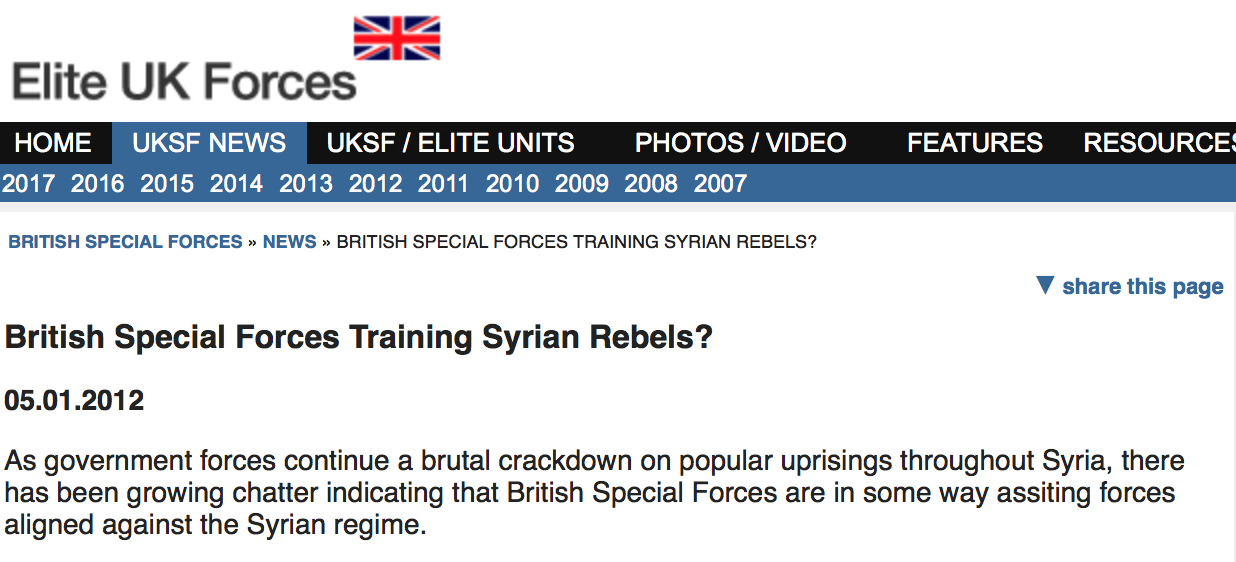
There is evidence that British SAS Special Forces were dispatched to Syria in 2011 to integrate the ranks of the so-called moderate Al Qaeda rebels. Special Forces often hired through a private mercenary company on contract to NATO or the Pentagon were embedded within most paramilitary rebel formations, According to Elite UK Forces (the website of the SAS)
Reports from late November last year [2011] state that British Special forces have met up with members of the Free Syrian Army (FSA), the armed wing of the Syrian National Council. The apparent goal of this initial contact was to establish the rebel forces’ strength and to pave the way for any future training operations.
More recent reports have stated that British and French Special Forces have been actively training members of the FSA, from a base in Turkey. Some reports indicate that training is also taking place in locations in Libya and Northern Lebanon. British MI6 operatives and UKSF (SAS/SBS) personnel have reportedly been training the rebels in urban warfare as well as supplying them with arms and equipment. US CIA operatives and special forces are believed to be providing communications assistance to the rebels.
British MI6 were actively involved, collaborating with the CIA:
As the unrest and killings escalate in the troubled Arab state, agents from MI6 and the CIA are already in Syria assessing the situation, a security official has revealed.
Special forces are also talking to Syrian dissident soldiers [Al Qaeda].
They want to know about weapons and communications kit rebel forces will need if the Government decides to help.
“MI6 and the CIA are in Syria to infiltrate[rebel ranks] and get at the truth,” said the well-placed source.
“We have SAS and SBS not far away who want to know what is happening and are finding out what kit dissident soldiers [Al Qaeda] need.” Syria will be bloodiest yet, Daily Star, January 1, 2012 (emphasis added)
The air campaign launched by Obama in 2014, which had the full support of the United Kingdom, was intent upon destroying Syria and Iraq rather than “going after the terrorists”. There is ample evidence that the Islamic State is protected by the US-led coalition.
The inflow and delivery of weapons and supplies are coordinated by the Pentagon in liaison with America’s allies.
US military aid is channelled to Al Qaeda as well as to ISIS-Daesh.
The US has also used the illegal weapons market to channel vast amounts of weapons and military hardware to the Syrian “rebels”.
The State sponsors of ISIS-Al Qaeda are now heralded as the victims of ISIS-Al Qaeda, an absurd proposition. Those who are funded and supported by Western intelligence services are now said to be fighting back.
The ISIS nonetheless has a certain degree of independence in relation to its State sponsors. That is the nature of what is called an “intelligence asset”. But an “intelligence asset” is always on the radar of the intelligence services.
The British government through its intelligence services is known to have covertly supported several Al Qaeda affiliated entities including the Libya Islamic Fighting Group (LIFG) which was linked to the Manchester bombings.
The “Liberation” of Tripoli was carried out by “former” members of the Libya Islamic Fighting Group (LIFG), which is affiliated to Al Qaeda. These “former” Al Qaeda affiliated brigades constituted the backbone of the “pro-democracy” rebellion, which was supported by NATO.
Within the ranks of the LIFG rebels, US Navy SEALS, British SAS and French legionnaires disguised in civilian rebel garb, were reported to be behind major operations directed against key government buildings including Gadhafi’s Bab al-Aziziya compound in central Tripoli.
“Highly-trained [British Special Forces] units, known as ‘Smash’ teams for their prowess and destructive ability, have carried out secret reconnaissance missions to provide up-to-date information on the Libyan armed forces.” (SAS ‘Smash’ squads on the ground in Libya to mark targets for coalition jets, Daily Mirror, March 21, 2011)
And in the wake of NATO’s war Libya, these pro-democracy LIFG Al Qaeda affiliates have joined the ranks of the ISIS.
Washington’s Regime Change for Syria: Install the Islamic State
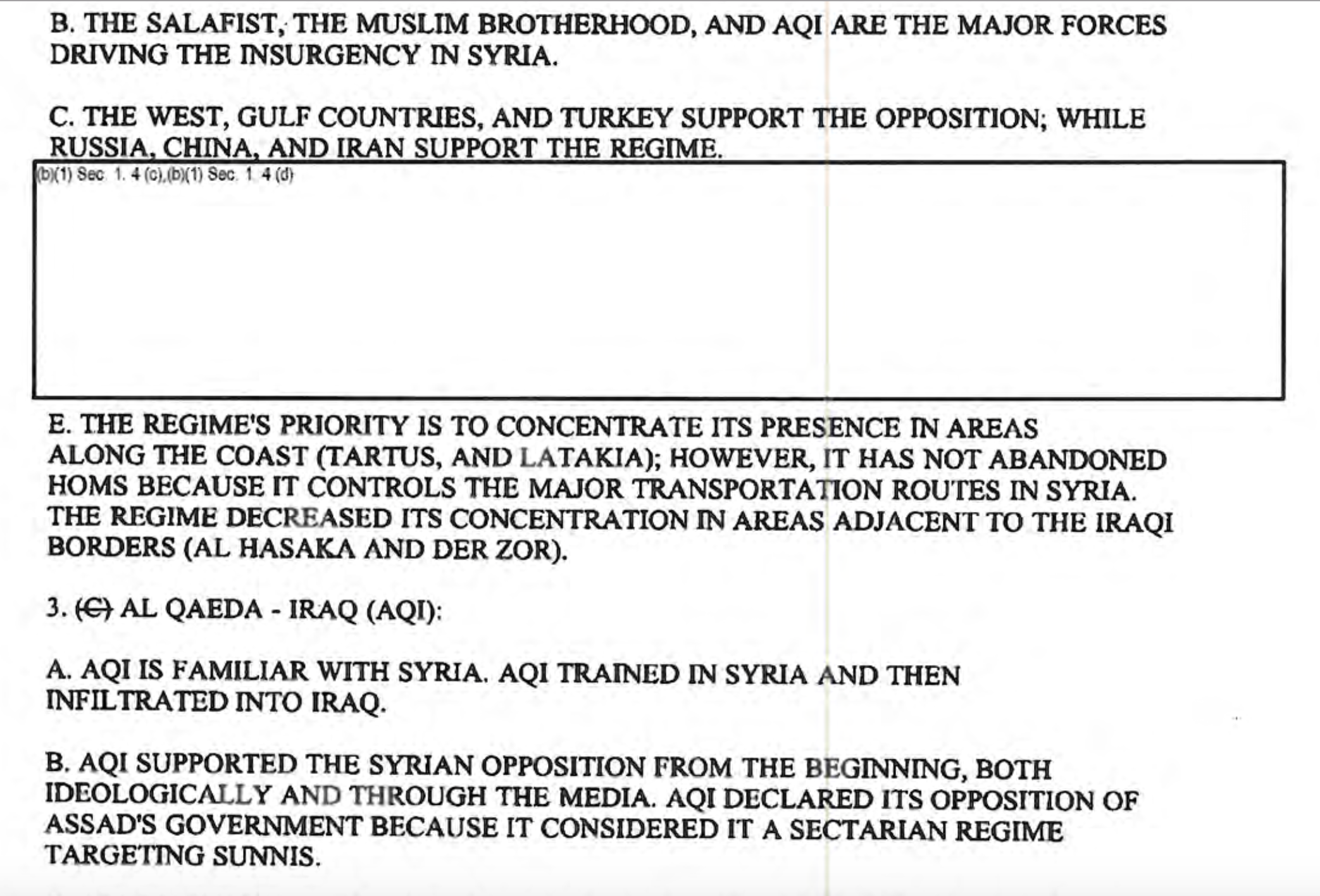
It is worth noting that the release of the Hillary Clinton email archive as well as leaked Pentagon documents confirm that the US and its allies are supportive of ISIS.
Moreover, a 7-page Defense Intelligence Agency (DIA) document dated August of 2012, points to US complicity in supporting the creation of an Islamic State.(Excerpt below)
Concluding Remarks
Despite the evidence, it is very difficult for people to accept the fact that their own government is supporting terrorism.
Most people will dispel this as an impossibility. But it is the forbidden truth.
The established consensus is that the role of a government is to protect its people. That myth has to be sustained.
The media’s role is to ensure that the truth does not trickle down to the broader public.
If that were to occur, the legitimacy of Western heads of State and heads of government would collapse like a house of cards.
The governments of the countries whose citizens are the victims of terror attacks are supporting ISIS-Daesh through their intelligence services.
Copyright © Prof Michel Chossudovsky, Global Research, 2017
Hamas: Israel will exploit Arab rift to kill our people
MEMO | June 7, 2017
Hamas today criticised statements made by Saudi Foreign Minister Adel Al-Jubeir that Qatar should stop backing the Palestinian resistance movement as a condition to ending the rift with its neighbours.
In a statement the movement said: “Hamas is a legitimate resistance movement against the Zionist occupation, which represents the central enemy of the Arab and Islamic nations, especially Hamas.”
Yesterday evening, Al-Jubeir told journalists on a visit to France that Qatar was undermining the Palestinian Authority and Egypt in its support of Hamas and the Muslim Brotherhood. “We don’t think this is good. Qatar has to stop these policies so that it can contribute to stability in the Middle East.”
In response, Hamas said: “It is no secret to anyone how the Zionist enemy exploits such statements to commit more violations and crimes against our people and our land and our sanctities and the right of Jerusalem and the Al-Aqsa Mosque.”
The movement stressed that Al-Jubeir’s statements violate international laws and Arab and Islamic positions which emphasise the right of the Palestinian people to resist and struggle to liberate their land and holy sites. Hamas called on the brothers in Saudi Arabia to stop these statements that harm the kingdom and its positions on the issue of the Palestinian people and their legitimate rights.
Riyadh Requires From Doha to Expel Hamas, Muslim Brotherhood Members
Sputnik – 07.06.2017
Saudi Arabia set out several conditions for Qatar to normalize the bilateral relations amid the diplomatic rift and gave Doha 24 hours for the implementation of the conditions, local media reported Wednesday.
According to Akhbar Al Aan news outlet, the conditions included the expulsion of all the members of the Muslim Brotherhood terror group (outlawed in Russia) and the Palestinian Hamas movement from the country, freezing of their bank accounts and the suspension of any interrelations with these groups. The immediate break of the diplomatic ties with Iran was also reportedly one of the conditions laid down by Riyadh.
Apart from this, Saudi Arabia required from Doha to immediately change the policies of Qatar’s Al Jazeera broadcaster and as well as its administration staff so that the broadcasting would not contradict the interests of the Persian Gulf countries and the Arab world, the same reports added.
On Monday, Saudi Arabia, Bahrain, the United Arab Emirates and Egypt announced a break in diplomatic relations with Qatar, accusing Doha of supporting terrorist organizations and destabilizing the situation in the Middle East. The authorities of eastern Libya, Yemen, as well as the Maldives and Mauritius, later also announced the severance of relations with Qatar. On Tuesday, the Jordanian authorities announced lowering the level of diplomatic contacts with Qatar and closing the office of Al Jazeera operating in the country.
The Qatari Foreign Ministry rejected the accusations of Doha’s interference in other countries’ domestic affairs and expressed regret over the decision of the Gulf States to cut off the diplomatic ties with it.
See also:
Saudi tells Israel: No place for Hamas in Middle East
MEMO | June 6, 2017
A Saudi expert has for the first time been interviewed on Israeli television. Abdel Hamid Hakim, who heads the Jeddah-based Institute for Middle East Studies, told Israel’s Channel 2 via Skype that the decision by three Gulf countries to sever relations to Qatar “comes in the framework of a new policy in which there is no room for terrorism.”
Asked what the aim of the Saudi, Egyptian, Bahraini, Emirati step regarding Qatar was, Hakim replied:
“There is a political stance which Saudi, Egypt and the Emirates agreed to, especially after the Riyadh Summit which was the first visit by the new American administration to the Kingdom of Saudi Arabia, that there is no place in the political arena of these countries for terrorism or for groups who use religion for political gains like Hamas and [Islamic] Jihad.”
“I believe these countries took a decision in a step towards peace, and achieving piece in the Middle East.”
He added:
“The first for this is to weed out terrorism. There is no place for any religious group, be it the [Muslim] Brotherhood or any other, which uses religion for political gain or commits terrorism in the name of religion, in the name of resistance or in the name of jihad.”
‘The BBC Has Betrayed Its Own Rules Of Impartiality’: Yemen, Saudi Arabia And The General Election
Media Lens – June 5, 2017
A key function of BBC propaganda is to present the perspective of ‘the West’ on the wars and conflicts of the world. Thus, in a recent online report, BBC News once again gave prominence to the Pentagon propaganda version of yet more US killings in Yemen. The headline stated:
US forces kill seven al-Qaeda militants in Yemen, says Pentagon
Seven ‘militants’ killed is the stark message. A veneer of ‘impartiality’ is provided by the weasel words, ‘says Pentagon’. BBC News then notes blandly, and without quotation marks:
The primary objective of the operation was to gather intelligence.
Nowhere in the short article was there any attempt to provide an alternative view of who had been killed and why. Were they really all ‘militants’? How is a ‘militant’ distinguished from a ‘civilian’, or from a soldier defending his country against foreign invaders? There was not even a cautious statement to the effect that the Pentagon’s claims could not be verified, as one might expect of responsible journalism.
Instead, we have to turn to Reprieve, an international human rights organisation founded in 1999 by the British lawyer Clive Stafford Smith. The group reports that five of the ‘militants’ were civilians, including a partially blind 70-year-old man who was shot when he tried to greet the US Navy Seals, mistaking them for guests arriving in his village.
But their civilians are mere ‘collateral damage’ in war. Since January 2017, the US has launched 90 or more drone strikes in Yemen, killing around 100 people, according to the Bureau of Investigative Journalism. This death toll includes 25 civilians, among whom were 10 children, killed in the village of al Ghayil in the Yemeni highlands during a US raid that was described by President Trump as ‘highly successful’.
Mentions of such atrocities were notable by their absence in ‘mainstream’ media coverage of Trump’s recent trip to Saudi Arabia where he signed trade deals worth around $350 billion. This included an arms deal of $110 billion which the White House described as ‘the single biggest in US history.’ It would not do for the corporate media, including BBC News, to dwell on the implications for Yemen where at least 10,000 people have been killed since the start of the Saudi-led bombing campaign in 2015. 14 million Yemenis, more than half the population, are facing hunger with the Saudis deliberately targeting food production.
The World Health Organisation recently warned of the rising numbers of deaths in Yemen due to cholera, saying that it was ‘unprecedented’. Save the Children says that at the current rate, more than 65,000 cases of cholera are expected by the end of June. The cholera outbreak could well become ‘a full blown-epidemic’. Moreover:
The upsurge comes as the health system, sanitation facilities and civil infrastructure have reached breaking point because of the ongoing war.
As US investigative journalist Gareth Porter observes via Twitter:
World leaders are silent as #Yemen faces horrible cholera epidemic linked to #Saudi War & famine. Politics as usual.
Iona Craig, formerly a Yemen-based correspondent for The Times, notes that ‘more than 58 hospitals now have been bombed by the coalition airstrikes, and people just do not have access to medical care in a way that they did before the war.’ As if the bombing was not already brutal, Saudi Arabia has imposed a cruel blockade on Yemen that is delaying, or even preventing, vital commodities from getting into the country. Grant Pritchard, interim country director for Save the Children in Yemen, says:
These delays are killing children. Our teams are dealing with outbreaks of cholera, and children suffering from diarrhoea, measles, malaria and malnutrition.
With the right medicines these are all completely treatable — but the Saudi-led coalition is stopping them getting in. They are turning aid and commercial supplies into weapons of war.
As one doctor at the Republic teaching hospital in Sanaa commented:
We are unable to get medical supplies. Anaesthetics. Medicines for kidneys. There are babies dying in incubators because we can’t get supplies to treat them.
The doctor estimated that 25 people were dying every day at the hospital because of the blockade. He continued:
They call it natural death. But it’s not. If we had the medicines they wouldn’t be dead.
I consider them killed as if they were killed by an air strike, because if we had the medicines they would still be alive.
None of this grim reality was deemed relevant to Trump’s signing of the massive new arms deal with Saudi Arabia. BBC News focused instead on inanities such as Trump ‘to soften his rhetoric’, ‘joins Saudi sword dance’ and ‘no scarf for Melania’. But then, it is standard practice for the BBC to absolve the West of any blame for the Yemen war and humanitarian disaster.
British historian Mark Curtis poses a vital question that journalists fear to raise, not least those at the BBC: is there, in effect, collusion between the BBC and UK arms manufacturer BAE Systems not to report on UK support for the Saudi bombing of Yemen, and not to make it an election issue? Curtis also notes that the BBC has not published any online article about UK arms being sold to the Saudis for use in Yemen since as far back as January. This, he says, is ‘misinforming the public, a disgrace’. He also rightly points out that the BAE Systems Chairman, Sir Roger Carr, was also Vice-Chair of the BBC Trust until April 2017 (when the Trust was wound up at the end of its 10-year tenure). The BBC Trust’s role was to ensure the BBC lived up to its statutory obligations to the public, including news ‘balance’ and ‘impartiality’. How could Sir Roger’s dual role not suggest a major potential conflict of interest?
On the wider issue of ‘mainstream’ media coverage of foreign policy, the political journalist Peter Oborne notes that:
Needless to say, the British media (and in particular the BBC, which has a constitutional duty to ensure fair play during general elections) has practically ignored Corbyn’s foreign policy manifesto.
Oborne writes that the manifesto:
is radical and morally courageous.
He explains that, pre-Corbyn:
Foreign policy on both sides was literally identical. The leadership of both Labour and the Conservatives backed the wars in Iraq, Libya and Afghanistan, the alliance with Saudi Arabia and the Sunni states in the Gulf.
London did what it was told by Washington. […] This cross-party consensus has been smashed, thanks to Jeremy Corbyn, the current Labour leader. Whatever one thinks of Corbyn’s political views (and I disagree with many of them), British democracy owes him a colossal debt of gratitude for restoring genuine political debate to Britain.
And of course his extremely brave and radical decision to break with the foreign policy analysis of Blair and his successors explains why he is viewed with such hatred and contempt across so much of the media and within the Westminster political establishment.
But, as Oborne notes, this important change has not been fairly represented in media coverage. In particular, on Yemen and Saudi Arabia:
It is deeply upsetting that the BBC has betrayed its own rules of impartiality and ignored Corbyn’s brave stand on this issue.
We challenged Andrew Roy, the BBC News Foreign Editor, to respond to Oborne’s observations. He ignored us (here and here). Roy’s silence is especially noteworthy given that he had once promised:
If there is a considered detailed complaint to something we’ve done, I will always respond to it personally.
Perhaps Oborne’s challenge to the BBC was not deemed sufficiently ‘considered’ or ‘detailed’ by the senior BBC News editor. Likewise, our own challenges over many years in numerous media alerts addressing BBC foreign coverage have been ignored or, at best, brushed away.
It was noteworthy that Corbyn’s considered response to the most recent terrorist attack in London was selectively reported, arguably censored, by BBC News. Corbyn said:
We need to have some difficult conversations, starting with Saudi Arabia and other Gulf states that have funded and fuelled extremist ideology.
It is no good Theresa May suppressing a report into the foreign funding of terrorist groups. We have to get serious about cutting off the funding to these terror networks, including Isis here and in the Middle East.
Sky News broadcast Corbyn’s comments, but they do not appear to have been covered by BBC News. Certainly, as far as we can see, there is no mention of them in their ‘Live’ blog on the London attack or in Laura Kuenssberg’s analysis, ‘Election 2017: Impact of London terror attack on campaign’. And nothing about the Saudi link with terrorism appears in the BBC’s online report on Corbyn’s speech, focusing instead on the issue of May’s cuts to police numbers while Home Secretary. Even this issue alone, if properly and fully addressed by the media, should be a resigning matter for May as Prime Minister. Responding to the London attacks, Peter Kirkham, a former Senior Investigating Officer with the Metropolitan police, accused the government of lying over police numbers on UK streets. And a serving firearms officer says that:
The Government is wrong to claim police cuts have nothing to do with recent attacks.
Despite her denials, Theresa May’s cuts to police numbers have made attacks like London and Manchester much more likely.
Kuenssberg’s piece included passing mention of ‘the Tories’ record on squeezing money for the police’. But she gave no figures showing a reduction in the number of armed police; crucial statistics which she could have easily found from the Home Office.
Mark Curtis gives a damning assessment of BBC reporting on foreign affairs, particularly during the general election campaign. Noting first that:
One aspect of a free and fair election is “nonpartisan” coverage by state media.
He continues:
Yet BBC reporting on Britain’s foreign policy is simply amplifying state priorities and burying its complicity in human rights abuses. The BBC is unable to report even that Britain is at war – in Yemen, where the UK is arming the Saudis to conduct mass bombing, having supplied them with aircraft and £1 billion worth of bombs, while training their pilots.
Curtis then provides some telling statistics:
From 4 April to 15 May, the BBC website carried only 10 articles on Yemen but 97 on Syria: focusing on the crimes of an official enemy rather than our own. Almost no BBC articles on Yemen mention British arms exports. Theresa May’s government is complicit in mass civilian deaths in Yemen and pushing millions of people to the brink of starvation; that this is not an election issue is a stupendous propaganda achievement.
Indeed, our newspaper database searches reveal that, since the election was called on April 18, there has been no significant journalistic scrutiny of May’s support of Saudi Arabia’s bombing campaign in Yemen. The subject was even deemed radioactive during a public meeting in Rye, Sussex, when Amber Rudd, standing for re-election, appeared to shut down discussion of arms sales to Saudi Arabia. Electoral candidate Nicholas Wilson explains what happened:
At a hustings in Rye on 3 June, where I am standing as an independent anti-corruption parliamentary candidate, a question was asked about law & order. Home Secretary Amber Rudd, in answering it referred to the Manchester terrorist attack. I took up the theme and referred to UK arms sales to Saudi Arabia & HSBC business there. She spoke to and handed a note to the chairman who removed the mic from me.
The footage of this shameful censorship deserves to be widely seen. If a similar event had happened in Russia or North Korea, it would have received intensive media scrutiny here. Once again, we note the arms connection with the BBC through BAE Systems Chairman, Sir Roger Carr. Wilson has also pointed out a potential conflict of interest between HSBC and the BBC through Rona Fairhead who was a non-executive director of HSBC while serving as Chair of the BBC Trust.
These links, and Theresa May’s support for the Saudi regime, have gone essentially unexamined by the BBC. And yet, when BBC political editor Laura Kuenssberg responded to Corbyn’s manifesto launch, her subtle use of insidious language betrayed an inherent bias against Corbyn and his policies on foreign affairs. She wrote: ‘rather than scramble to cover up his past views for fear they would be unpopular’, he would ‘double down… proudly’. Kuenssberg’s use of pejorative language – ‘scramble’, ‘cover up’, ‘unpopular’ – delivered a powerful negative spin against Corbyn policies that, in fact, as Oborne argues, are hugely to his credit.
When has Kuenssberg ever pressed May over her appalling voting record on Afghanistan, Iraq, Libya, Syria and Yemen? In fact, there is no need for May to ‘scramble’ to ‘cover up’ her past views. Why not? Because the ‘mainstream’ media rarely, if ever, seriously challenge her about being consistently and disastrously wrong in her foreign policy choices; not least, on decisions to go to war.
Featured Video
NATO’s War of Choice – The Sabotage of the Istanbul Negotiations
or go to
Aletho News Archives – Video-Images
From the Archives
National Security Archive Publishes Key Records on Infamous MKULTRA Program
Agency Sought Drugs and Behavior Control Techniques to Use in “Special Interrogations” and Offensive Operations
Edited by Michael Evans | National Security Archive | December 23, 2024
Washington, D.C. – Today, the National Security Archive and ProQuest (part of Clarivate) celebrate the publication of a new scholarly document collection many years in the making on the shocking secret history of the CIA’s mind control research programs. The new collection, CIA and the Behavioral Sciences: Mind Control, Drug Experiments and MKULTRA, brings together more than 1,200 essential records on one of the most infamous and abusive programs in CIA history.
Under code names that included MKULTRA, BLUEBIRD and ARTICHOKE, the CIA conducted terrifying experiments using drugs, hypnosis, isolation, sensory deprivation, and other extreme techniques on human subjects, often U.S. citizens, who frequently had no idea what was being done to them or that they were part of a CIA test.
Today’s announcement comes 50 years after a New York Times investigation by Seymour Hersh touched off probes that would bring MKULTRA abuses to light. The new collection also comes 70 years since U.S. pharmaceutical giant Eli Lilly & Company first developed a process to streamline the manufacture of LSD in late 1954, becoming the CIA’s chief supplier of the newly discovered psychoactive chemical central to many of the Agency’s behavior control efforts.
Highlights of the new MKULTRA collection include… continue
Blog Roll
 Aletho News
- John Mearsheimer: The Case for a Nuclear Iran
- The Founder Who Turned Against Root Canals
- Israel displaces last two families from Al Khalayel valley, Al Mughayyir
- Israeli Opposition Leader Endorses Greater Israel
- Islamic Jihad: Trump’s peace board is a “theatrical stunt detached from reality”
- The Head Of A CIA Cutout Admits To Meddling In Iran To Fuel Unrest
- Iran warns Trump against decisions based on false information
- Pentagon sets deadline for Anthropic to lift AI restrictions on autonomous weapons systems, mass domestic surveillance
- Trump’s military buildup against Iran on Netanyahu’s behalf is a gambit doomed to fail
- Big League War
- If Americans Knew
- Are the Jews indigenous to Palestine?
- AIPAC Wants to Kill a Bill that would Ensure Israel Complies with Ceasefire
- Former Israeli PM, in Epstein Files, Dreamed of Israeli Eugenics and Pretty Converts
- Israeli settlers join ‘safari’ tour of Palestinian prisoners
- Flooding in Gaza amid rumors of war; fire in West Bank – Not a ceasefire Day 138
- Fourteen Countries Condemn Huckabee’s Support for Israel Taking Over Most of the Middle East
- Israeli Soldiers Killed Gaza Aid Workers at Point Blank Range in 2025 Massacre: Report
- Israel’s insidious network to propagandize American Christians
- Israel’s Best-Kept Secret: Palestinian Resistance Never Agreed to Disarm
- Trump officials plan to build 5,000-person military base in Gaza, files show
- No Tricks Zone
- Surprising Discovery: Sahara Is Greening…Billions Of Trees Where Once Thought To Be Barren
- New Research Reaffirms Clouds, Aerosols, And Surface Solar Radiation Are ‘Driving The Climate System’
- Germany: Electric Car Catches Fire At Charging Station, Sets Off Local “Inferno”, Widespread Damage
- New Study: Canada’s New Brunswick Was 1°C Warmer Than Today During The Medieval Warm Period
- Coal Power Back In Trend As Globe Tries To Keep Pace With Growing Demand For Power
- New Study: A 4°C Warmer Beaufort Sea Had ‘No Sea Ice’ 11,700 – 8200 Years Ago
- Unfudging The Data: Dutch Meteorological Institute Reinstates Early 20th Centruy Heat Waves It Had Erased Earlier
- German Gas Crisis…Chancellor Merz Allegedly Bans Gas Debate Ahead of Elections!
- Pollen Reconstructions Show The Last Glacial’s Warming Events Were Global, 10x Greater Than Modern
- Germany’s Natural Gas Storage Level Dwindles To Just 28%… Increasingly Critical
 Aletho News