Only Iran, Syria helped Lebanon when it was occupied by Israel

Press TV – May 25, 2017
Secretary General of the Lebanese Hezbollah resistance movement, Sayyed Hassan Nasrallah, says when southern Lebanon was occupied by Israel, no country in the world except Iran and Syria helped the country to end occupation.
Nasrallah made the remarks while delivering a speech in commemoration of the 17th anniversary of the liberation of the southern Lebanon from the Israeli occupation.
Addressing the nation from the southern city of Hermel, Nasrallah said resistance has gotten strong enough not to wait for support from the rest of the world or from inside the country or outside.
Lambasting the world’s indifference toward the occupation of Lebanon by Israel, he said when Lebanon was occupied no country in the world, neither the Organization of Islamic Cooperation, nor the Arab League, nor the United Nations or America helped Lebanon.
“Only the Islamic Republic of Iran and Syria helped Lebanon against Israeli occupation,” the Hezbollah chief added.
He noted that the only time that resistance was helped against Israel was under former president, Émile Lahoud, parliament speaker, Nabih Berri, and former prime minister, Selim al-Hoss.
Sayyed Hassan Nasrallah described the close cooperation between Lebanese army troops and Hezbollah fighters as the main reason behind the 2000 victory over the Israeli regime’s aggression and winning back the occupied lands of southern Lebanon.
He stressed that during the occupation, Western countries stood by Tel Aviv throughout the 15 years in which the Lebanese territories were occupied by Israel’s military forces.
He also praised the steadfastness of the Lebanese nation in the face of Israel and foreign-sponsored Takfiri militant groups.
Riyadh meeting aimed to threaten Iran, resistance
Referring to a recent meeting among leaders of several Muslim countries in the Saudi capital, Riyadh, which was also attended by US President Donald Trump, the Hezbollah chief said anything that was said and decided during the Riyadh meeting would have no effect on the situation in Lebanon, because since the new president has come to office, good consensus has been reached inside the country over a host of issues.
Pointing to participation of an official Lebanese delegation in the Riyadh meeting and that the al-Mustaqbal party had hailed the final statement of the Riyadh summit, he said, “We have reached an understanding in Lebanon to differ over political matters, but follow the same line on economic and security matters.”
He added that the final statement of the Riyadh summit was not acceptable for the resistance movement and it would have no effect on the situation in Lebanon.
Nasrallah also noted that Muslim leaders attending the Riyadh summit had no information whatsoever about the meeting’s final statement, and had emphasized that they will not take heed of the statement.
The Riyadh summit was simply organized in order to glorify US President Donald Trump, the Hezbollah chief said, adding that the meeting sought to threaten the Islamic Republic of Iran as well as the resistance in Iraq and neighboring Syria.
‘Saudi Arabia is the center of world terrorism’
Taking Saudi rulers to task for inviting Trump to the Riyadh summit, Nasrallah described Trump as the US president, who has disrespected Islam as well as Arab nations the most during his presidential campaigning.
He added that Saudi Arabia simply invited Trump to get his support in the face of rising global criticism of Riyadh’s role in fostering terrorism.
“The entire world knows that Saudi Arabia is behind the spread of terrorist Takfiri ideology,” he said adding that the Saudi-backed terrorists were wreaking havoc across the world and that their damage was not limited to a single country or the Islamic world, but had spread to the Western countries as well.
“Saudi Arabia is the center of world terrorism. It is responsible for the creation and supplying arms and munitions to al-Qaeda, Taliban and Daesh terrorist groups. The kingdom’s Wahhabi ideology is fanning the flames of sectarianism and sedition in the Muslim world,” he said.
Nasrallah slams Bahrain’s “heinous assault” on peaceful protesters
Elsewhere in his remarks, the secretary general of Hezbollah censured Bahrain’s Al Khalifah regime for the brutal crackdown on peaceful pro-democracy protests in the tiny Persian Gulf kingdom.
He termed the assaults against supporters of the country’s prominent Shia cleric, Sheikh Isa Qassim in the northwestern village of Diraz as “heinous,” calling for the immediate release of the 77-year-old cleric, who is the spiritual leader of the country’s dissolved opposition bloc, the al-Wefaq National Islamic Society.
Riyadh trying to isolate Tehran due to is support for resistance
Turning to Saudi Arabia’s military onslaught against Yemen, Nasrallah hailed the Yemeni nation’s steadfastness, emphasizing that the Riyadh regime is perpetrating crimes against humanity in the impoverished country through starving and slaughtering ordinary people.
The Hezbollah leader underlined that Saudi Arabia was haplessly seeking to isolate Iran, because of its support for anti-Israel resistance movement, including in Yemen.
He added that Saudi officials had paid billions of dollars to US statesmen in this regard forgetting all about the plight of poor Muslims.
Noting that Saudi Arabia’s aggression of Yemen was a clear political and military failure, Nasrallah advised Saudi authorities to put hostility towards Iran aside and engage in negotiations with the Islamic Republic.
He also leveled strident criticism against Arab leaders for their disregard of the important role that Iran is playing against terrorism in the Middle East region.
Nasrallah also dismissed allegations against the Hezbollah resistance movement as “repetitive,” stressing that members of the group were unfazed by ongoing threats and were fully prepared to defend their land, nation and the future of their children.
The Hezbollah chief stressed that the resistance movement in the region was stronger than ever, adding that Daesh terrorists will soon be defeated in both Iraq and Syria.
Egypt’s President Sisi Drops a Depth Charge in Midst of American Islamic Summit – Shames Supporters of Terrorism
21st Century Wire | May 24, 2017
Whatever criticisms may be justifiably levied at Egypt’s President Al Sisi, the speech he gave at the American Islamic Summit should go down in history as one of the bravest attacks on supporters of terrorism, whilst in their midst. The consternation of the primary terrorism creators and drivers, the Gulf State members, is palpable, as is the frantic tea-making and serving, as a distraction from the weight and power of Sisi’s words. Each barb hit home, Israel, Gulf States, the US, the EU, Turkey, nobody was omitted from the roll call of criminal terrorism support, sponsoring, promotion and funding.
Of course this speech was given zero air-time by western corporate media outlets, as it also exposed their promotion of the terror groups wreaking violent, murderous havoc across the region.
US attack kills 7 in central Yemen: Pentagon
Press TV – May 23, 2017
At least seven people have lost their lives in a US ground and aerial operation in Yemen’s central province of Ma’rib, the Pentagon says.
Centcom, the US military command in the Middle East, said in a statement that the Tuesday raid had been carried out with the support of the former Yemeni government and had targeted a compound belonging to the al-Qaeda militant group.
“During this operation, US forces killed seven AQAP (Al-Qaeda in the Arabian Peninsula) militants through a combination of small arms fire and precision airstrikes,” the statement read.
It said that such assaults “provide insight into AQAP’s disposition, capabilities and intentions,” apparently referring to intelligence that may be obtained as a result of the raids.
On January 29, a similar US attack was conducted in Yakla Village in Bayda Province, the first authorized by President Donald Trump. A $75-million US aircraft was destroyed while dozens of Yemeni civilians and a US Navy SEAL were killed in the ill-prepared commando raid.
The Pentagon claimed that the attack had produced intelligence about al-Qaeda. However, senior US officials rejected the claim, saying that they were not aware of any actionable intelligence.
Yemen has been under regular US drone strikes, with Washington claiming to be targeting al-Qaeda elements while local sources say civilians have been the main victims.
Yemen has also been under military strikes in a prolonged war by Saudi Arabia and a number of its client states since late March 2015. The US has been providing assistance to that war, too.
UN envoy seeks to prevent any attack on crucial port city
On Monday, the United Nations’ Special Envoy for Yemen Ismail Ould Cheikh Ahmed traveled to Yemen, where he said he wanted to prevent any attack on the western port city of Hudaydah, which is a major lifeline for imports into Yemen.
Saudi Arabia has threatened to attack the port city and retake it from the Houthi Ansarullah movement, a popular movement that has teamed up with the Yemeni army to defend the country against the Saudi-led war.
Cheikh Ahmed also stressed that Yemen’s central bank “must remain independent and must belong to all the Yemeni people.”
He further voiced concern about the dire humanitarian situation, saying, “You all know that the cholera epidemic has increased, reaching more than 25,000 cases and there have been many deaths in less than two weeks.”
The UN envoy’s visit to Yemen was met with protests as some 200 people marched from the UN headquarters in Sana’a to the city’s airport.
The demonstrators pelted Ahmed’s motorcade with rocks, shoes, and eggs as the Mauritanian diplomat was leaving the Sana’a Airport. His bodyguards fired into the air to disperse the crowd.
The Yemeni protesters carried banners, reading “Lift the blockade of Sana’a Airport.” The airport has been closed to commercial flights since August 2016, after the Riyadh regime imposed an air embargo on it.
Iran offers peace after bellicose Saudi threats
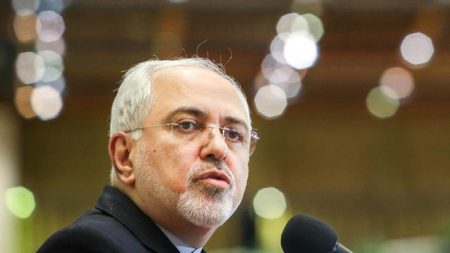
Iran’s Foreign Minister Mohammad Javad Zarif (Photo by Mehr News Agency )
Press TV – May 21, 2017
Foreign Minister Mohammad Javad Zarif says Iran is ready to present peace to Saudi Arabia as a gift after the kingdom’s crown prince threatened to draw war into the Iranian territory.
“A Saudi official has recently threatened to ‘have the battle in Iran’. I declare formally and in the name of the government of Iran today that we are ready to present peace as a gift to the entire region, foremost to Saudi Arabia,” he said.
Zarif’s announcement came in an article published on the London-based al-Araby al-Jadeed media outlet on Saturday, in which he spelled out Iran’s conditions for peace.
“The realization of this issue, however, depends on the Saudi government ending its futile war and deadly attacks against the Yemeni people and abandoning its crackdown on the pro-democracy majority in neighboring countries,” he added.
He was reacting to Saudi Deputy Crown Prince and Defense Minister Mohammed bin Salman who recently said, “We will work to have the battle in Iran rather than in Saudi Arabia.”
Zarif said, “Some Arab governments have drawn our region into instability in recent years through escalating their destructive policies and measures.”
“Promoting and supporting extremist ideologies and presenting a violent and unrealistic image from Islam on the one hand, and sacrificing the interests of the regional countries through promotion of instability, bloodshed and fratricide on the other sums up these policies,” he said.
“These bellicose measures altogether would ultimately result in nothing other than serving the greatest enemies of the Muslim and Arab nations,” Zarif wrote.
The minister said the policy line currently being pursued by Saudi rulers is helping “the Iranophobia project which has been initiated and promoted by the Zionist regime for years.”
“Today, the stable Iran is seeking stability in the entire region because it knows that achieving security at home at the expense of insecurity among neighbors is basically impossible,” the article read.
Tensions between Iran and Saudi Arabia have escalated since the kingdom executed a prominent Shia cleric in January 2016.
The execution triggered angry protests in many countries, including Iran. Protesters attacked the Saudi Embassy in Tehran and its consulate in Mashhad, prompting Riyadh to cut diplomatic ties with the Islamic Republic.
The rupture was followed by exceedingly belligerent remarks against Iran by Saudi officials, including Salman and Foreign Minister Adel al-Jubeir.
On Monday, though, Iran’s Foreign Ministry said its response to such comments was that it did not seek tensions with Saudi Arabia.
Iran is critical of Saudi Arabia’s war on Yemen which has killed thousands of civilians and destroyed the impoverished nation’s infrastructure over the past two years.
Tehran has also lashed out at Riyadh’s assistance to militants fighting to topple the Syrian government as well as its contribution to the ongoing crackdown on pro-democracy protests in Bahrain.
Zarif touched on US President Donald Trump who is currently visiting Saudi Arabia on his first foreign tour since taking office.
“If the American president sees himself as a friend of the Riyadh regime and is loyal to his election campaign slogans, he should talk to it about the ways of containing Takfiri terrorists in the region and preventing other 9/11s from being repeated in Western countries by Saudi citizens.”
Zarif said, “Iran is ready to cooperate with regional and extra-regional countries on fighting terrorism and extremism and helping restore peace and tranquility in Syria.”
Donald Trump at a Lonely Crossroads
By Alastair Crooke | Consortium News | May 19, 2017
It is time to pause, take a deep breath, and reflect. It is very clear that Trump’s Presidency is at a crossroads. This is not because there is any evidence of any wrongdoing. To date, there is a torrent of innuendo, but zero “evidence.” Rather, events have converged at a point of inflection, not because the President might be impeached – that is improbable because the bar in terms of evidence, and of Congressional votes required, is very high – but because recent days have unmasked the sheer breadth and visceral animosity of the forces determined to “take down” the President, by whatever means present themselves.
President Trump faces a mainstream media (MSM) that has become hysterical in perceiving collusion with Russia everywhere – even to the extent of querying how Russian Foreign Minister Sergei Lavrov, the Russian Ambassador, and a Russian photographer could have been allowed access to the Oval Office, thereby compromising American “security.” Trump faces a coalition of Clintonites, “corporate” Republicans, neocons, and more significantly, a fifth column within the intelligence services which regards any attempt at détente with Russia to constitute prima facie treason.
In response to a question from Sen. Lindsey Graham, R-South Carolina, who asked FBI Director James Comey in the Senate Judiciary Committee “what kind of threat” Russia presents “to the democratic process” (that is to say Graham’s question was not about Russia’s military capabilities, but on the threat to Western democracies), Comey answered: “Certainly, in my view, the greatest threat of any nation on Earth, given their [Russia’s] intention and their capability.”
One might reasonably conclude then, that Trump inevitably will be overwhelmed by this onslaught. Certainly the noise from the East Coast media bubble is overwhelming. And that, precisely, is the threat to the President: the drip, drip, of innuendo that Professor Stephen Cohen has dubbed “the accusation of treason.”
“And”, Cohen added, “we have a whole array of allegations that Putin helped him [Trump] get in the White House – to his [Trump’s] associates doing wrong things with Russians … This, [the allegations lacking any solid evidence] is beyond belief now … This has become a national security threat to us, in and of, itself.”
A Paralyzed Administration
And now a Special Prosecutor has been appointed. One commentator summed it up thus: “That’s how special prosecutors work … they hobble the president, drain away his political credibility, separate him from his supporters, and paralyze his administration. No legislator is willing to lend his support for fear of what the prosecutor might find. Each one will run for cover rather than work with Trump to get something done. In appointing a prosecutor, [Deputy Attorney General Rod] Rosenstein has killed this Administration’s ability to function. No health care overhaul. No tax cuts. No government reform. All while we await the results of a nothing investigation into a nothing scandal.”

Deputy Attorney General Rod Rosenstein
The noise is overwhelming, but it is nearly all emanating from the coastal élites who inevitably speak the loudest. Polls may say that Trump’s favorability rating is slipping. That is so; but the polls also speak to the growing polarity between the Republican base, and the coastal Establishment: 81 percent of Clinton voters support impeaching the President, but 83 percent of Trump voters adamantly oppose it. Equally 91 percent of Clinton supporters “disapprove” of Trump, whereas 86 percent of the Trump base “support” him. There is evidence that the “deplorables” have been deeply angered by the impeachment talk.
And here lies the “inflection point”: President Trump’s base is pretty clear in identifying the “game plan” (it is widely dissected on the New Right, and Alt Right sites): The onslaught is not about finding the “evidence” (which probably doesn’t exist): The “Russian interference” meme emerged primarily from the Democratic National Committee email leaks that were originally attributed to a Russian “hack” (rather than a “leak” by Seth Rich, since murdered), via a private company, Crowd Strike, (evidence that experts now contest); from the discredited “dirty dossier” of ex-British spy Christopher Steele; and from unmasked intercepts of Trump aides (which have as yet shown no evidence of electoral collusion).
It is rather the drip, drip of innuendo which is intended – the Trump base avers – to collapse the President’s ratings (among his base) to the point at which even the Republican members of Congress will abandon the President, and join the “movement” to remove him, via one or other of the provisions of the U.S. Constitution.
Obstruction of Justice is unlikely to serve: As George Washington University law professor Jonathan Turley has said, former FBI Director James Comey’s memo offers “no proof for impeachment” of Trump. Turley noted: “Indeed, it raises as many questions for Comey as it does Trump in terms of the alleged underlying conduct.
“A good place to start would be with the federal law, specifically 18 U.S.C. 1503. The criminal code demands more than what Comey reportedly describes in his memo. There are dozens of different variations of obstruction charges ranging from threatening witnesses to influencing jurors. None would fit this case. That leaves the omnibus provision on attempts to interfere with the ‘due administration of justice.’
“However, that still leaves the need to show that the effort was to influence ‘corruptly’ when Trump could say that he did little but express concern for a longtime associate. The term ‘corruptly’ is actually defined differently under the various obstruction provisions, but it often involves a showing that someone acted ‘with the intent to secure an unlawful benefit for oneself or another.’ Encouraging leniency or advocating for an associate is improper but not necessarily seeking an unlawful benefit for him.”
What the point of inflection calls for (Trump’s supporters’ say), is to insist that the FBI investigation be concluded expeditiously, and that a counter-attack on the leaders of those forces (whomsoever they are), and on their “moles” — “embedded insurgents committed to forcing Trump from office” — who are leaking innuendo to the MSM, be prosecuted.
It is a crossroads. Trump has to halt the drumbeat, or see his Presidency crumble into dust. And the blade of “defamation politics” can be two-edged: Hillary Clinton was no paragon of virtue.
An Elusive Achievement
In this context, Trump now needs a policy achievement more than ever. A legislative success in the domestic arena is – evidently – not in prospect, but rather the political convulsions in D.C. may finally spook a somnolent and supine Wall Street to think about risk again (VIX, a litmus of market volatility, has been at historic lows) – especially as market insiders are warning their clients “not to expect to [be] bailed out by the Fed this time.” Indeed the entire Trump reflation program looks as if will be a long time coming (if it comes at all, this year).
At such times, foreign policy may come to the fore. We have already noted that the Astana Process has witnessed a White House, more ready than Obama’s, to work with Russia, Turkey and Iran, to reach some sort of settlement in Syria. The triumph of the “defeat” of ISIS in Raqa’a and Mosul might constitute just such an achievement to rally Trump’s base.
Trump was politically courageous in inviting Lavrov into the Oval Office (at a time when “the drumbeat” of Russia collusion was reaching a crescendo). It seems that Russia and its allies are ready to concede to Trump the taking of Raqa’a, (the Syrian Foreign Minister has effectively acknowledged this); and in return, Russia and Iran have been put on test by the White House.
The hostile rhetoric from Washington on Iran, has been notably absent since Astana, and the secondary sanctions waiver in connection with the JCPOA (the nuclear agreement) has been renewed. It seems Trump has realized that Generals James Mattis (Defense Secretary) and H.R. McMaster (National Security Adviser) were intent on leading the President back into a series of (unwinnable) wars – at least that seems to be the message of Astana which has put two negotiators, Russian Foreign Minister Lavrov and Secretary of State Rex Tillerson firmly in the driver’s seat.
But here too, the onslaught on the President, and on the Astana political process is likely to continue. Recall that President Obama, who was ever more hesitant than Trump – (never fully endorsing) Secretary of State John Kerry’s and FM Lavrov’s negotiating marathons – witnessed those political efforts sabotaged by his own Pentagon (the “accident” at Dier Azor, killing 68 Syrian Army soldiers defending their besieged base against ISIS militants), and Defense Secretary Ashton Carter’s public equivocation about sharing intelligence on ISIS and al-Qae’da with the Russians).
Already the signs of similar sabotage are present: i.e. the Acting Assistant Secretary of State Stuart Jones’s dubious announcement — on the eve of a Geneva round of Syria talks — that the U.S. had found evidence of a crematorium at a Syrian prison, in which the remains of mass executions of prisoners were burned. Two days later Jones resigned from the State Department, with a colleague noting that while Jones was retiring early for personal reasons, his departure was a case of “another senior government official with real competence leaving.” (Or, in other words another anti-Trump dissident leaving the ship.)
Even Anne Barnard of the New York Times noted that the timing of the crematorium allegations seemed “political.” Yes, indeed political, but directed at the Russians or at Trump? There are also reports that a contingent of U.S. and British Special Forces are operating in southern Syria to stymie any Syrian army or Hezbullah advance in order to regain control of the Syrian-Iraqi border. On Thursday, a U.S.-led airstrike hit Syrian military forces that were deemed too close to the U.S.-British base.
So President Trump should beware. Peace settlements require huge efforts to assemble, but can be undone in a moment. And Saudi Defense Minister Prince Mohammad bin Salman should note: Trump just might be more interested in defeating ISIS at this moment, than suffering a further Saudi lecture on the misdeeds of Iran. Though President Trump will be happy to receive whatever boodle with which the Saudis may care to shower him. Rumors say up to $300 billion – $400 billion in arms deals! “Quite nice,” as the Donald might say.
Alastair Crooke is a former British diplomat who was a senior figure in British intelligence and in European Union diplomacy. He is the founder and director of the Conflicts Forum.
When the Trump Coup-makers Cometh
By Robert Parry | Consortium News | May 18, 2017
So what did you think a U.S.-styled “soft coup” would look like? What we’re seeing regarding the intended removal of President Trump is not that much different from what has happened in dozens of other countries, whether Iran in 1953 or Ukraine in 2014 or Brazil in 2016. This one just has a few extra American touches.
Like other coups, there are often vague and unproven accusations leveled against the target and his or her entourage. Even though hard evidence is usually lacking, “process crimes,” such as making misstatements to prosecutors or obstructing justice, are developed as a substitute under the popular saying: “the cover-up is worse than the crime.” Whatever the case, a complicit media then trumpets alleged wrongdoing into grave and impeachable offenses.
And, if you had any doubts about what is looming, you should read Washington Post columnist E.J. Dionne Jr.’s op-ed, entitled in print editions “A quick end would be better,” which states:
“There is really only one issue in American politics at this moment: Will we accelerate our way to the end of the Trump story, or will our government remain mired in scandal, misdirection and paralysis for many more months — or even years? …
“Nothing could be worse than slow-walking the Trump inquiries. The evidence is already overwhelming that he is temperamentally and intellectually incapable of doing the job he holds. He is indifferent to acquiring the knowledge the presidency demands and apparently of the belief that he can improvise hour to hour. He will violate norms whenever it suits him and cross ethical lines whenever he feels like it.”
The History of Coups
As this American coup against Trump progresses, one commonality of coups around the world – whether “hard coups” of military tanks or “soft coups” of “constitutional” removals – is that the coup’s target is not some perfect human being. He or she has likely made political mistakes or cut some corners or had associates who lined their pockets.
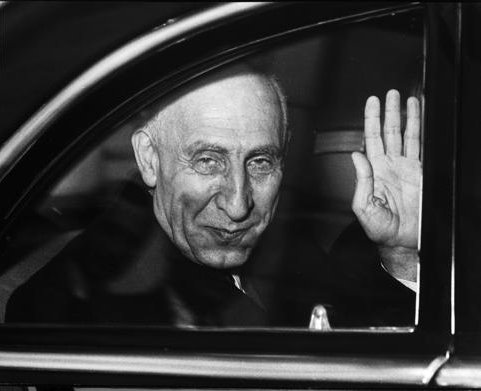
Iranian Prime Minister Mohammad Mossadegh
But the difference between those misdeeds being treated as politics as usual or becoming the stuff of “scandal” has more to do with the interests of powerful interests – a domestic “deep state” or an outside “superpower” – than any evenhanded pursuit of justice.
To say that Trump is an imperfect messenger for whatever populist message he thinks he’s carrying stretches beyond the breaking point any normal definition of the word “imperfect.” Indeed, Trump may be the perfectly imperfect messenger.
Yet, what’s really at stake in any coup is power and the direction that a country will take. In the case of Donald Trump, there appear to be several factors at play: he is regarded by many establishment figures as too incompetent and uncouth to serve as America’s President; he also defies the neoconservative orthodoxy over U.S. foreign policy; and perhaps most significantly, he doesn’t believe in the New Cold War, which will assure the Military-Industrial Complex years of expensive new weapons systems by making Russia the new/old “enemy.”
There is, of course, some truth to all these concerns. Trump is an egotistical buffoon who doesn’t seem to know what he doesn’t know. Often his brain doesn’t connect to his tongue – or his Twitter fingers. He is more a Kardashian “reality star,” saying stuff to get attention and to attract eyeballs, than a sober leader who holds his cards close and chooses his words carefully.
Though many Americans voted for him because they viewed him as a no-nonsense businessman, he was actually someone who ran what amounted to a family business without the kind of accountability that often comes with managing a large public corporation.
Puffing up his own importance, Trump even has bragged about his impunity. During the 2016 campaign, he was revealed as the kind of jerk who boasts about grabbing women by the “pussy” and getting away with it because of his star status and personal power.
So, yes, Trump is both incompetent and uncouth. But he is hardly the first president to bring unseemly personal baggage or an inadequate skill set into the Oval Office. Bill Clinton was known as an insatiable hound dog preying on vulnerable women, and George W. Bush was shockingly unqualified for the demands of the presidency.
While Barack Obama had the intellectual skills and behaved commendably in his personal conduct, he had little experience in managing a complex organization – and it showed in some of his disastrous personnel decisions, such as appointing the hawkish Hillary Clinton as Secretary of State and keeping Bush loyalist Robert Gates as Secretary of Defense.
In other words, Trump’s skill limitations were not by themselves disqualifying. With the proper advice and a modicum of self-control, Trump could have performed acceptably as Chief Executive. But he failed to recruit wise advisers and couldn’t discipline either his tongue or his Twitter fingers.
Even staunch Trump supporters whom I’ve spoken with wish he could have parked his large but fragile ego at the White House gate rather than bringing it into the Oval Office.
Foreign Policy Dissent
Still, Trump’s larger vulnerability was his failure to accept the foreign policy parameters prescribed by the neocon-dominated Establishment. He started out insulting powerful neocons by challenging their self-exculpatory narrative of the Iraq War – that it was a great idea sabotaged by poor execution but then salvaged by the “surge” before being betrayed by Obama.
Trump also belittled some of the neocon champions, such as old-lion Sen. John “No Hero” McCain and rising star Sen. Marco “Little Marco” Rubio. It would have been a neocon dream to have the 2016 campaign a match-up between Marco Rubio and Hillary Clinton, but the former fell to Trump in the primaries and the latter lost to Trump in the general election.
But Trump’s greatest sin was his refusal to buy into Official Washington’s big-ticket Russia-bashing, the goal of making Moscow an implacable enemy that then required massive new spending on both propaganda (supposedly to combat Russian “propaganda”) and military projects (including NATO expansion up to Russia’s borders and new weapons systems to deter Russian “aggression”).
Despite his simple-mindedness (or perhaps because of it), Trump couldn’t understand why the United States had to demonize Russia when he saw many areas of possible cooperation (such as the fight against terrorism).
Trump and a few of his advisers were so out-of-step on the “Russia thing” that Official Washington developed a new groupthink that the only possible explanation was that Trump and his team must be somehow on the Kremlin’s payroll. Any alleged “connection” to Russia – no matter how tenuous or seemingly innocuous – became front-page news.
For instance, retired Lt. Gen. Michael Flynn’s speakers bureau negotiated a relatively modest speaking fee of $45,386 for him to address the tenth anniversary of RT, the Russian network, in December 2015, with RT even whittling down his fee – and that speech became a major cause celebre.
On Dec. 29, 2016, after the election and as the national security adviser-designate, Flynn took a phone call from Russian Ambassador Sergey Kislyak while Flynn was on vacation in the Dominican Republic, and Flynn later offered an incomplete account of the conversation, which the National Security Agency knew because it had intercepted the phone call.
Instead of people shrugging their shoulders and giving Flynn the benefit of the doubt, Obama’s holdovers in the Justice Department literally made a federal case out of it, invoking the archaic and virtually-never-used 1799 Logan Act (which bars private citizens from negotiating with foreigners) and then advancing the absurd argument that somehow the discrepancies in Flynn’s recollection made him vulnerable to Russian blackmail to get Trump to fire Flynn.
Then, Trump’s alleged suggestion to then-FBI Director James Comey that Flynn was a good guy who had served his country and had suffered enough – and that it might be best to “let it go” – has now become the latest argument for impeaching Trump.
In Deep Water
Whether he knows it or not, Trump is now in very deep water and has no idea how to dog-paddle back to the shore. His aides seem to think that a nine-day foreign trip will do him good, but it is more likely to make him grovel before Saudi King Salman and Israeli Prime Minister Benjamin Netanyahu, knowing that any offense that those leaders might take would simply expedite Trump’s political doom.
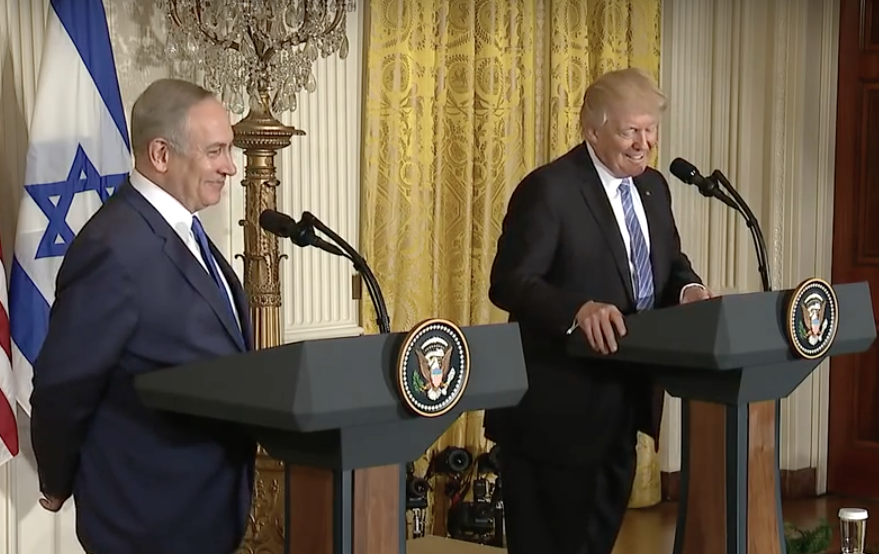
Screen shot from Whitehouse.gov
Trump is surely in no position to tell the Saudis to cut out their covert funding for Al Qaeda and other Sunni terrorist groups – or to insist that they stop bombing Yemen, the poorest country in the Middle East. Nor could Trump dare challenge Netanyahu on the Israeli abuse of the Palestinians, the Prime Minister’s obstruction of the peace process, and his blatant efforts to manipulate U.S. politics in favor of bloody neocon interventions across the region. Trump will be the desperate supplicant hoping for a reassuring pat on the head.
There is one – and perhaps only one – winning move that Trump has left. He could authorize CIA Director Mike Pompeo to prepare for release U.S. intelligence information regarding turning-point moments in recent years, such as the truth about the 2013 sarin incident in Syria and the 2014 Malaysia Airlines shoot-down in eastern Ukraine. [See here and here.]
If – as I’m told – the Obama administration systematically misrepresented the intelligence on those catastrophes to register propaganda gains (against the Syrian government in 2013 and Russia in 2014), the U.S. government’s internal information could shift those key narratives in more peaceful directions.
But whatever the truth is, Trump could shift his own image from a compulsive liar who disdains facts into a champion for transparency and honesty in government. He could turn the tables on The New York Times (which has set itself up as the great hero for Truth) and The Washington Post (which has fashioned a new melodramatic slogan, “Democracy Dies in Darkness”). He could point out their hypocritical lack of aggressiveness in challenging the Obama administration’s excessive secrecy.
Trump would also give his dispirited supporters something to rally around. Many blue-collar voters backed Trump because they thought he was at least addressing their economic fears of lost work and lost status, while Hillary Clinton – in their view – treated them with disregard and disdain, even calling many of them “deplorables.”
But Trump’s promises of recovered jobs were largely hollow. Whatever improvement Americans might be feeling in their pocketbooks, it is more the result of Obama’s careful economic management and the normal recovery from Bush’s Wall Street crash and the Great Recession than anything Trump can or will do.
So, revealing hidden truths – where the American people may have been misled – would not only be the right thing to do for democracy, it also could be the smart thing to do. When the Establishment coup-makers come for Trump – as they now almost certainly will – he can at least say that he tried to do something to return the U.S. government to the American people.
That might not save his presidency but it would at least elevate his purpose and possibly create some positive legacy to attach to the Trump name. As the situation stands now, Trump appears headed for a humiliating exit that won’t just strip him of the presidency but would strip away any luster for the Trump brand.
In other words, his impulsive foray into politics might not just make him one of the most reviled U.S. presidents in history but take down the Trump businesses, too.
Investigative reporter Robert Parry broke many of the Iran-Contra stories for The Associated Press and Newsweek in the 1980s.
Deadly rhetoric: Saudi Arabia opens war of words with Iran
By Sharmine Narwani | RT | May 16, 2017
For years the Saudis have waged proxy battles against Iran, with little success. Now, despite this history of losses, Riyadh appears to be mobilizing for an ill-conceived confrontation with the Islamic Republic.
“We know we are a main target of Iran,” speculated Saudi Deputy Crown Prince Mohammed bin Salman (MbS) in an interview early this month.
Then came the threat. “We are not waiting until there becomes a battle in Saudi Arabia, so we will work so that it becomes a battle for them in Iran and not in Saudi Arabia.”
These are fighting words indeed. The Iranians certainly thought so, Defense Minister Hossein Dehghan responding with unusual ferocity: “We warn them (Saudis) against doing anything ignorant, but if they do something ignorant, we will leave nowhere untouched apart from Mecca and Medina.”
In other words, if the Saudis launch direct aggression against Iran, this will be Riyadh’s last war anywhere, ever.
It’s an important line to draw. The Saudis, after all, have been in meltdown since the 1979 Islamic Revolution in Iran saw popular protests dethroning a King (gasp).
And so, for the past 38 years, we have witnessed an increasingly aggressive Saudi Arabia in the region, chasing down Iranian/Shia enemies where there were none. Just look at Yemen, where the two-year Saudi bombing blitz has killed over 10,000 civilians, or Bahrain, where Saudi troops and tanks snuffed out dissent in the Shia-majority state, or Syria, where Saudis send weapons, cash and support to ISIS, Al-Qaeda and other head-chopping extremists. This Saudi hysteria has now touched every corner of the world, and by the $100+ billion Riyadh has invested in radical schools, mosques, and propaganda to indoctrinate an entire generation of Muslims in Wahhabi-style intolerance.
But while the Saudis are hell-bent on thwarting Iranian influence – real or imagined – Riyadh has never dared to take on the Islamic Republic directly.
As former US Secretary of Defense Robert Gates famously noted in a 2010 WikiLeaks cable, the Saudis always want to “fight the Iranians to the last American.” To which he then added, “it is time for them to get in the game.”
Now perhaps, under the direction of a 31-year old princeling, the Saudis are planning to do just that.
Saudi Arabia vs. Iran
Some perspective first on these two Persian Gulf “rivals,” in which I borrow heavily from an earlier interview of mine:
Both Iran and Saudi Arabia are rich in energy resources and have used this rentier wealth to advance their national goals, albeit with vastly differing results. Iran’s economy is focused on diversification away from the energy sector, developing self-sufficiency and becoming a net exporter. Saudi Arabia is import-focused. Iran spends $15 billion per annum on its military – compared to Saudi’s $80 billion – yet has one of the most competent military forces in the region and builds its own hardware. The Iranian political system is Constitution-based, diverse, and representative, with loudly competing political blocs that come with their own media and constituencies. The Saudi monarchy is based entirely on the rule of one family, with no meaningful elections or contesting political bodies, and little freedom of expression in the media. Regarding power projection, Iran favors the soft power tools of diplomacy, trade, and alliance-building based on common worldviews/objectives, whereas the Saudis have expanded their influence far and wide by spreading Wahhabi doctrine through schools, mosques, media and other institutions globally – and by blatantly buying the loyalty of allies.
In the past few years, we have clearly observed how Iran and Saudi Arabia’s nation-building approaches have affected the success of their geopolitical strategies. Both states have experienced existential fears and threats, and their respective alliances have now confronted each other on a few battlefields. Iran has approached the matter of its strategic depth carefully and built alliances with partners that genuinely share the common values of independence, self-determination, and resistance against imperialism. The Saudis, on the other hand, have forged their external alliances with hegemony or dominance as the primary objective – irrespective of the divergent interests and values of allies. There is little contest – one side is a nation- and region-building, while the other flails about with unreliable alliances, propped up by petrodollars and all the strategic brilliance of a sledgehammer.
How can this relationship be classed as a rivalry, when the two don’t even operate on the same playing field? Would Tehran even notice Riyadh outside of OPEC meetings if it weren’t so belligerent at every turn, on every border?
But Prince MbS’s promise to bring “the battle” to Iran must be taken seriously because it will not be launched alone. The Saudi prince’s chest thumping comes courtesy of an upgrade in relations with Washington. US President Donald Trump is enthusiastically pushing billions of dollars in weapons sales to the Saudis, and has chosen Riyadh as the destination for his first official foreign visit, championing the establishment of an “Arab NATO” that partners with Israel to confront Iran.
Don’t expect a conventional military confrontation as the opening gambit, however. The US, Israel and Saudi Arabia are experienced in subversion and sabotage activities against the Islamic Republic, and this is where they are likely to focus their initial efforts.
Last week, Iran’s Supreme Leader Ali Khamenei warned of foreign interference in the lead-up to Friday’s presidential poll: “the security of the country should be fully protected during the elections. Anyone who violates this should know he will certainly be punished.”
Calling for public vigilance, Khamenei outlined short, medium and long-term “enemy” goals in Iran: “to distort the country’s security and trigger chaos and sedition… targeting issues like that of the economy and living conditions of the people… (and) an effort to change the system.”
So how will the Saudis play a role? Riyadh’s hand in this “battle” will likely be seen on and inside Iran’s borders, in the same form we have witnessed in Syria, Iraq, Afghanistan and other theaters flooded with Saudi-backed militants.
Stirring up minority populations
Demographically, Iran is around 60 percent ethnically Persian, followed by a mix of Azeris, Kurds, Lurs, Turkmens, Arabs, and others. Some 99 percent of Iranians are Muslim, more than 90 percent of these Shia, the rest Sunni, and the remaining one percent a mix of Christians, Jews, Zoroastrians, and others.
The main pockets of Kurds are in the northwest on the Iraqi/Turkish borders and in the north-east bordering Turkmenistan – Iranian Kurds are both Sunni and Shia. The second largest ethnicity, Azeris, who are mainly Shia, are also in the northwest on Iran’s border with Azerbaijan and Armenia.
Iranian Arabs who are concentrated in the south near the Iraqi border and the Persian Gulf – as well as around the Strait of Hormuz – are also mostly Shia. Iranian Sunni populations consist mainly of Kurds, Turkmens, and Balochis, and this is the demographic where signs of foreign interference are most notable today.
In recent years, thousands of Iranian security forces have been killed on the border of Iran’s Sistan and Baluchistan province with Pakistan – most recently in April when ten Iranian border guards died in a cross-border terrorist raid.
Reportedly, the operation was conducted by Jaish al-Adl (Army of Justice), a sectarian terrorist group the Iranians say is being directed by the US and Saudi Arabia. The US has traceable ties to some of these groups, notably Jundallah which received Bush-era funds from Washington before being listed as a terrorist organization. That “terrorist” designation, Iran knows, means little. The Mojahedin-e-Khalq (MEK) was listed by the State Department for decades, but then de-listed in 2012 and is today being actively courted by US officials.
Jaish al-Adl is an offshoot of Sipah-e-Sahaba, an anti-Shia extremist group banned in Pakistan, but which appears to continue to enjoy both Saudi and Pakistani support. Sipah leaders are ferried around the border areas with Pakistani guards, and fill their ranks with young graduates of Saudi-funded Deobandi madrassahs rife inside the Pakistani border.
US hands are all over the minority map in Iran too. Media, think tanks and politicians highlight and encourage aspirations of Iranian minorities at every opportunity, and will undoubtedly take a more active role in stirring divisions as tensions escalate.
Cue the Kurds. Both US and Saudi fingerprints are all over this project of inciting a Kurdish rebellion inside Iran. Last June and July, for the first time in 20 years, Kurds in Iran’s northwest clashed with Revolutionary Guards, killing several on both sides.
The Kurdish group involved was the Democratic Party of Iranian Kurdistan (PDKI), a longtime Iranian-designated terrorist organization that announced in 2015 it would take up arms against the state. Not surprisingly, that declaration came shortly after PDKI leader Mustafa Hijri visited congressional leaders in Washington.
A vigilant Iran
American dirty tricks are certainly not new in Iran. Former Kennedy-era State Department official Richard J. Barnet wrote in 1968: “The (US) intervention in Iran in 1953 to unseat Premier Mohammed Mossadeq was America’s first successful attempt in the postwar period to subvert a nationalist government.”
According to Barnet, “Five US agents and seven Iranian intelligence operatives” led by CIA operative Kermit Roosevelt “plotted the coup from a Tehran basement.” They were responsible for “recruiting street mobs to oppose the Mossadeq supporters… With the help of substantial sums, which Roosevelt used for hired demonstrators to whip up the growing anti-Mossadeq mobs, and the support of the Iranian army, heavily dependent on US equipment, the insurgents were able to turn the tide against the intractable premier and to drive him from office.”
Iran is intimately familiar with these foreign machinations and has been vigilantly countering them in the decades since the Islamic Revolution.
This is not the compliant Shah’s Iran – this Iran, today, is an independent, sovereign nation-state that came through an 8-year foreign-imposed war with Iraq and built with its own hands a formidable military deterrent.
As we have seen with Iran’s activities in Syria, Iraq, and Lebanon, the country’s ‘strategic depth’ is a red line – its national borders even more so. After warning the Iraqi government in 2014 that it would take decisive action if ISIS came within 40 kilometers of its border, the Iranian air force – for the first time since the Iran-Iraq war – used F-4 Phantom fighter jets to conduct airstrikes in Diyala province on its western border.
Iran’s armed forces chief Mohammad Hossein Bagheri has also now threatened military action on Pakistani territory unless Islamabad takes control of its borders, saying: “Unfortunately, the Pakistani border area has turned into a refuge and training ground for terrorists hired by Saudi Arabia, with the approval of the United States.”
In a letter this month to the UN Security Council, Iran’s UN Ambassador Gholamali Khoshroo addressed the Saudi threats: “We have no desire, nor any interest, in an escalation of tension in our neighborhood… We continue to stand ready for dialogue and accommodation to promote regional stability, combat destabilizing extremist violence and reject sectarian hatred… We hope Saudi Arabia will be persuaded to heed the call of reason.”
The Saudi princeling Mohammad bin Salman made a novice’s mistake by threatening to bring war to Iran – he put the world on notice. Any Iranian reaction now bears the full legitimacy of international law for a measured retaliation. The Saudi borders are long, its populations restive, and its soldiers have not seen this kind of war. We may yet live to see a Saudi royal eat his words.
Sharmine Narwani is a commentator and analyst of Middle East geopolitics. She is a former senior associate at St. Antony’s College, Oxford University and has a master’s degree in International Relations from Columbia University. Sharmine has written commentary for a wide array of publications, including Al Akhbar English, the New York Times, the Guardian, Asia Times Online, Salon.com, USA Today, the Huffington Post, Al Jazeera English, BRICS Post and others. You can follow her on Twitter at @snarwani
David Ignatius’ 15 Years of Running Spin for Saudi Regime
By Adam Johnson | FAIR | April 28, 2017
Last week, in “A Young Prince Is Reimagining Saudi Arabia. Can He Make His Vision Come True?,” Washington Post foreign affairs columnist David Ignatius (4/20/17) wrote what read like a press release for the Saudi regime. What’s more, he’s written the same article several times before. For almost 15 years, Ignatius has been breathlessly updating US readers on the token, meaningless public relations gestures that the Saudi regime—and, by extension, Ignatius—refer to as “reforms.”
Ignatius columns on Saudi Arabia break down roughly into two groups: straight reporting mixed with spin and concern trolling, and outright press releases documenting the dictatorship’s spectacular reforms. First the latter:
- “Home-Grown Saudi Reform” (3/7/03)
- “Saudis Act Aggressively to Denounce Terrorism” (6/13/10)
- “Change and Balance in the Saudi Kingdom” (11/21/11)
- “Women Gain Newfound Stature in Saudi Arabia” (1/18/13)
- “Reshuffling the House of Saud” (2/3/15)
- “A 30-Year-Old Saudi Prince Could Jump-Start the Kingdom — or Drive It Off a Cliff” (6/26/16)
Let’s begin by taking a look at his most recent iteration of this genre (4/20/17), featuring a brave Saudi prince taking on “religious conservatives” (vague reactionaries who are never named or defined) to change his own monarchy:
Two years into his campaign as change agent in this conservative oil kingdom, Deputy Crown Prince Mohammed bin Salman appears to be gaining the confidence and political clout to push his agenda of economic and social reform.
Ignatius begins by doing something a lot of “reformer” boosters do in Saudi Arabia: conflating “economic reform” with social reform. The latter is typically the neoliberal lubricant to get to what really matters, the further privatization and leveraging of Saudi’s immense wealth. Indeed, the only social reforms even mentioned in the glowing report are “a Japanese orchestra that included women” performing to “mixed audience,” and a co-ed Comic Con. Perhaps by 2025 they’ll have mixed-gender D&D tournaments.
Ignatius’ cheerleading columns always rely on vague person-on-the-street sources as a placeholder for the Voice of the People. Take, for example, this framing in “Women Gain Newfound Stature in Saudi Arabia” (1/18/13):
King Abdullah announced January 11 that 30 women would join the kingdom’s Shura Council, a consultative body of 150 persons, and that women henceforth would hold 20 percent of the seats. Skeptics cautioned that it’s a symbolic move, since this is an advisory group that doesn’t actually enact any legislation. But it’s a powerful symbol, according to men and women here.
Which men and women? Was a poll done? It’s unclear. He goes on to interview a Cambridge-educated woman who appears hand-picked by the regime for a glossy profile. She’s from a humble background and was about to drop out of college until the king stepped in and benevolently paid her tuition. A story Ignatius, of course, dutifully repeats without skepticism.
Then there’s the other genre of Saudi coverage we’ll call Checking In On the House of Saud:
- “Can Saudi Arabia Help Combat the Islamic State?” (7/28/14)
- “Saudi Arabia’s Coming Struggle” (1/22/15)
- “Saudi Arabia Stirs the Middle East Pot” (8/21/13)
- “The Son Who Would Be the Saudis’ King?” (9/8/15)
- “A Cyclone Brews over Saudi Arabia” (10/13/15)
- “The Costly Blunders of Saudi Arabia’s Anxiety-Ridden Monarchy” (1/5/16)
These pieces generally consist of down-the-middle updates about the status of Saudi Arabia, with some light criticism around the margins. Saudi Arabia is painted as a fearful, almost childlike place, whose evil deeds are animated by paranoia rather than ambition—bumbling “misfires” and “mistakes” rather than sinister motives.
The one piece whose headline seems to indicate actual criticism of the Saudi regime is anything but. In “The Costly Blunders of Saudi Arabia’s Anxiety-Ridden Monarchy” (1/5/16), our tough-luck Saudis are bumbling around the Middle East under siege:
Saudi Arabia is a frightened monarchy…. Countries that feel vulnerable sometimes do impulsive and counterproductive things, and that has been the case recently with Saudi Arabia.
Counterproductive? Saudi Arabia has been a bad boy and needs a timeout.
Strangely, in 15 years of writing columns about the monarchy, David Ignatius has not himself used the term “human rights,” much less addressed their abuse in a meaningful way. In one of the few columns (1/5/16) in which Ignatius actually levels criticism of the Saudi rulers’ gross human rights abuses, they are stripped of all autonomy, with the beheading of a minority religious figure painted as a response to the Evil Iranians: “The kingdom’s fear of a rising Iran led it to execute a dissident Shiite cleric.”
Ignatius went on to lament the execution in equally middle-management terms, saying it was a “mistake” and an “error.” What it wasn’t: “criminal,” “immoral” or “murder.” Moralizing is reserved for US enemies; US allies are simply under-performing employees in need of guidance and mild chiding.
Saudi Arabia, despite being an oppressive absolute monarchy that arbitrarily detains, tortures, executes and mercilessly bombs civilians, is never given the dreaded “regime” moniker like Assad and Gaddafi and North Korea. Actions are not done by an anthropomorphized state, but a nebulous blob of reluctant bureaucrats. And they are not even actions; they are always good-faith reactions to “Iranian hegemony.”
The Saudis’ ruthless bombing of Yemen, which has claimed over 10,000 civilian lives since March 2015, is almost never mentioned by Ignatius, and the few times it is touched upon it is glossed over as “costly and unsuccessful.” It is bad—not in terms of morals, but in process. It’s “costly” like an ill-advised real-estate investment.
Even more shockingly, Ignatius simply takes the regime’s word that all 47 people—including two minors—subject to its 2016 mass execution were guilty of being “extremists”:
A defensive, anxious Saudi leadership tried to show its resolve with last week’s execution of 47 extremists.
That “defensive, anxious Saudi leadership”—a caged animal always responding to threats and occasionally over-correcting.
In 2015, when King Abdullah died, Ignatius (1/22/15) insisted that the monarch who ruled for ten years over a country that didn’t allow women to drive, swim, own property or travel alone “was seen by many Saudi women as their secret champion.” A pretty well-kept secret, it must have been—aside from allowing women to take part in meaningless local “elections” and meaningless advisory councils, it’s unclear what Ignatius’ evidence is for this, but it’s “seen by many Saudi women,” so that’s good enough.
One Washington Post reader put it best in a letter to the editor (2/4/15):
The Saudis have been talking reform at least since I was a student of Middle East affairs in the 1960s. Yet it still is the epicenter of inequality, human rights violations and gratuitous state-sponsored violence.
The wheels of alleged reform in that country are perpetually spinning but going nowhere. The rulers continue to steal the oil revenue that belongs to the people; civil liberties and personal rights are repressed; beheadings, stonings and whippings for nonviolent offenses continue unabated; and people such as Mr. Ignatius still crow about how the regime is a force for change.
Ignatius, of course, is not alone. He joins a long line of faithful Western pundits who frame the Saudi regime as a reformist entity, earnestly pushing change in a fundamentally reactionary country under perma-threat from Shia forces. The Al Saud mafia is not in league with religious extremists, but a bulwark against them; they are not an illegitimate dictatorship, but an enlightened ruling class helping usher in “reform” in the face of a hyper-religious population.
And throughout it all, they are on a 71,500-year reform plan where they are effusively praised for moving their country toward the 19th century every five years or so. Other regimes that oppress their people and bomb civilians “must go” now, and are beyond the moral pale—mere allegations of being friendly with them, a career-ender. But the Saudi regime, a friendly host to light-touch US pundits, is just a well-meaning scrappy band of reformers this close to turning into Switzerland. All they need is a bit more time.
Messages can be sent to the Washington Post at letters@washpost.com, or via Twitter @washingtonpost. Please remember that respectful communication is the most effective.
More NYT ‘Spin’ on the Syria-Sarin Case
By Robert Parry | Consortium News | April 28, 2017
In blaming Syrian President Bashar al-Assad for the April 4 chemical incident in Khan Sheikhoun, The New York Times and other Western news outlets have made a big deal out of discrepancies in the timing and other details provided by the Syrian and Russian governments.

Crater containing alleged canister in Khan Sheikdoun
The Times and the others also have chided anyone who notes that Assad had no logical reason to undertake a sarin attack since his forces were making solid gains and he had just learned that the Trump administration was dropping the longstanding U.S. goal of “regime change” in Syria.
To those of us outside the mainstream media bubble, there seemed to be little or no military advantage to be gained. Instead, Assad would be risking more international intervention, which has ripped his country apart for the past six years. But the Times and other major outlets dismissed our logic by arguing that Assad was simply announcing his impunity in some particularly brutal Arab-sort-of-way.
However, neither the value that the Times and others placed on the Russian-Syrian timing discrepancies nor the strange explanation of Assad’s motive made any sense. After all, if Assad were making some bizarre public declaration of his impunity, why would he then deny that his forces were responsible? Wouldn’t he simply say, “yes, I did it and I don’t care what anyone thinks”? Isn’t that what impunity means: that you do whatever you want knowing that no one can hold you accountable? Instead, Assad has consistently denied ordering the attack.
The gotcha observation about the time element of the bombings fails the logic test, too. Why would Syria and Russia say Syrian warplanes carried out a conventional attack on Khan Sheikhoun around noon if the actual attack occurred around 6 a.m., as it apparently did? There was nothing to be gained for them by having the timing off by six hours, since the point that Syria and Russia were making was that there were indeed airstrikes but that they were conventional bombs that may have unintentionally struck an Al Qaeda depot holding chemical weapons and thus released them. The timing element was immaterial to that point.
What this apparent timing error suggests is confusion, not “spin,” as the Times insists in a tendentious April 27 video by Malachy Browne, Natalie Reneau and Mark Scheffler, entitled “How Syria and Russia Spun a Chemical Strike.”
The Syrians and Russians appeared perplexed by what had happened. Their officials understood that a conventional airstrike had been carried out and stated what they believed the time was. The time discrepancy either meant the Syrian air-wing commander had dispatched warplanes earlier than expected or that some other entity carried out the 6 a.m. strike. But the Syrians and the Russians would seem to have no reason to lie about this detail.
Intervention by Air
Another false assumption pervading the Western accounts on this and other chemical incidents in Syria is that only the Syrian government and its Russian allies have control of the skies. That is clearly not true. Various military forces, including those of the U.S. and its allies, as well as Israel and – to some degree – the rebels have air capabilities in Syria.
According to Syrian accounts, the rebels have captured some government helicopters and apparently used one in what United Nations investigators were told by multiple eyewitnesses was a staged chemical-weapons attack in 2014 with the goal of sticking the blame on the Syrian regime.
Further, the U.S. and its allies have been conducting airstrikes across much of Syria in campaigns against Islamic State and Al Qaeda-linked terror groups, which have been supported by Saudi Arabia, Turkey, Qatar and other Sunni-led sheikdoms. Turkey has been active, too, with strikes against Kurdish forces. And Israel has hit repeatedly at Syrian targets to promote what it regards as its interests, including destruction of Iranian weapons believed headed to the Lebanese militant group, Hezbollah.
Some – if not all – of these entities had a far stronger motive to create a chemical-weapons incident in Syria on April 4 than the Syrian government did. At the end of March, the Trump administration announced that it was no longer a U.S. priority to overthrow the Assad government, an announcement that upset several of the countries involved in the Syrian conflict, including Turkey, Saudi Arabia, the Gulf States and Israel.
All of them – having committed resources and prestige to achieve “regime change” in Syria – had motive to overturn President Trump’s pronouncement. (Israel has had “regime change” in Syria at the top of its to-do list since at least the mid-1990s.) How better to keep that hope alive than to stage another chemical-weapons attack and blame it on Assad? (Another sarin attack in August 2013 also now appears to have been a staged incident by Al Qaeda that killed hundreds while almost tricking President Obama into ordering a massive U.S. military strike on government forces.)
Shortly after the incident at Khan Sheikhoun, I was told by an intelligence source that U.S. satellite imagery had picked up what looked like a drone in the vicinity at around the time that the poison gas was released. Despite some technical difficulties in tracking its route, the source said the analysts believed that it may have come from a Saudi-Israeli special operations base in Jordan, used to assist the rebels.
There are also other combinations of factors that should have been carefully evaluated before President Trump jumped to his Assad-did-it conclusion and fired off 59 Tomahawk missiles at a Syrian airbase on April 6, but they weren’t given serious thought in the rush to blame Assad.
For instance, Al Qaeda’s clever propagandists could have again staged a chemical attack on the ground by creating a crater in the road and inserting what was purported to be a chemical-weapons canister. The Times and others have noted that the crater was not visible in earlier satellite images but that observation doesn’t mean the crater had to be created by an aerial bomb; a ground explosion or simple digging could have done the trick – with the crushed canister inserted later.
Dubious Narrative

Men allegedly inside crater where sarin bomb landed
The canister-in-the-crater story struck MIT’s technology and national security expert Theodore Postol as particularly odd because on-scene photos showed people climbing into the supposedly sarin-saturated crater wearing minimal protection and not keeling over dead. Postol also said the canister appeared to have been crushed rather than exploded.
There is also the possibility that some third party with access to sarin or other powerful chemical weapons could have delivered the poison gas by air – possibly from that drone – with the rebels either coordinating with that delivery before the fact or reacting to the opportunity after the fact.
The hard truth is that intelligence services from a number of countries could fit the bill in terms of producing sarin or some similar substance that could mimic what Syria once had in its arsenal, although those chemical weapons were supposedly destroyed in 2014 as part of an agreement hammered out by Russia and the United States.
And there are plenty of ruthless intelligence operatives on all sides who would have found the deaths of 80 or so people acceptable collateral damage to advance a geopolitical priority. The timing, so close to the Trump administration’s major announcement that Assad no longer had to go, would have represented a logical motive for such a ruse.
The other problem in assessing what has or hasn’t happened in Syria over the past six years is that all sides, but particularly those seeking “regime change,” have deployed sophisticated propaganda operations to the combat zone.
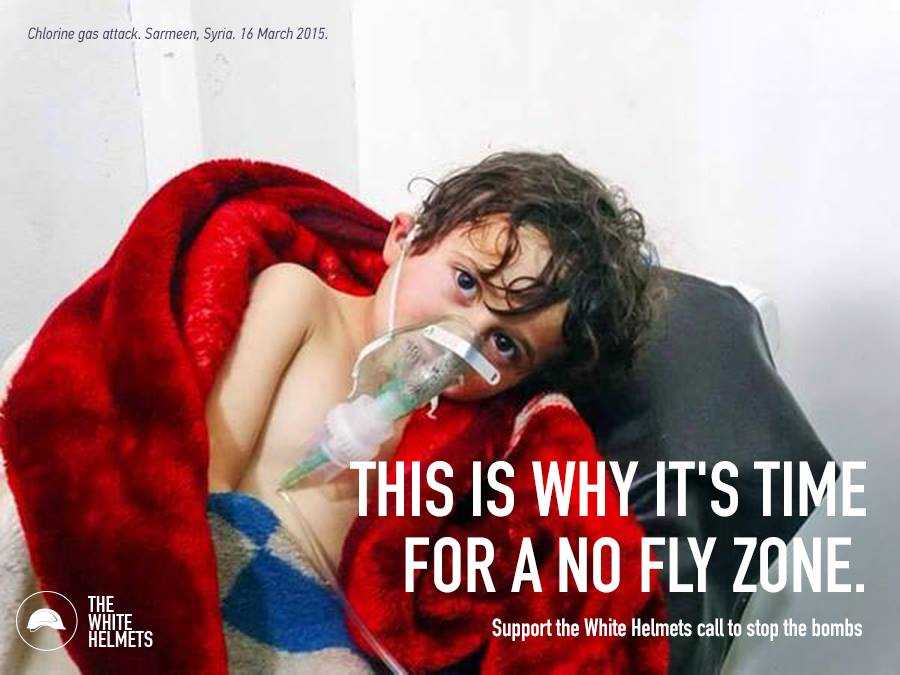
Propaganda designed to justify major US military operation
Anti-regime activists – financed and supplied by the West and the Gulf States – understand the emotional value of showing dying children. These propagandists have regular and uncritical access to major Western media outlets, from the hipsters at VICE to the neocons and liberal-interventionists at The New York Times.
In other words, what is still desperately needed in this latest chapter of the Syrian tragedy is some honest broker who could conduct a serious investigation that isn’t contaminated by all the previous propaganda-infused narratives. But the chances of finding that person or group are slim to none.
Investigative reporter Robert Parry broke many of the Iran-Contra stories for The Associated Press and Newsweek in the 1980s.
Featured Video
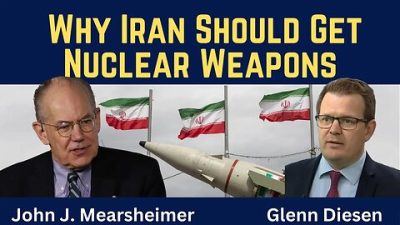
John Mearsheimer: The Case for a Nuclear Iran
or go to
Aletho News Archives – Video-Images
From the Archives
Ethnic Cleansing in a Zionist Fairyland
By Vacy Vlazna | Palestine Chronicle | February 10, 2012
‘De-Arabizing the history of Palestine is another crucial element of the ethnic cleansing. 1500 years of Arab and Muslim rule and culture in Palestine are trivialized, evidence of its existence is being destroyed and all this is done to make the absurd connection between the ancient Hebrew civilization and today’s Israel. The most glaring example of this today is in Silwan, (Wadi Hilwe) a town adjacent to the Old City of Jerusalem with some 50,000 residents. Israel is expelling families from Silwan and destroying their homes because it claims that king David built a city there some 3000 years ago. Thousands of families will be made homeless so that Israel can build a park to commemorate a king that may or may not have lived 3000 years ago. Not a shred of historical evidence exists that can prove King David ever lived yet Palestinian men, women, children and the elderly along with their schools and mosques, churches and ancient cemeteries and any evidence of their existence must be destroyed and then denied so that Zionist claims to exclusive rights to the land may be substantiated.’ — Miko Peled, Israeli dissident.
Indeed, archaeology has become a state apparatus for the ethnic cleansing of Palestinians in the Zionist fairyland aka the City of David Archaeological Park located in the Palestinian village of Silwan in East Jerusalem.
East Jerusalem is the proclaimed capital of the proposed Palestine state. It was illegally annexed by Israel in the 1967 war. Prohibiting annexation of territories gained by military conquest is one of the major principles of international law. The international community does not recognise Israel’s annexation of East Jerusalem nevertheless over 50,000 illegal premises have been built for 250,000 illegal Israeli colonists.
The goal of the archaeological judaisation of Jerusalem is to transform Jerusalem into the City of David, the capital of Greater Israel by eradicating the mixed ethnic composition of the Palestinian and Jewish population of East Jerusalem to a solely Jewish identity and unifying East and West Jerusalem under Israeli sovereignty. … continue
Blog Roll
 Aletho News
- North Korea Open to Rapprochement If US Respects Its Nuclear Status – Kim Jong-un
- John Mearsheimer: The Case for a Nuclear Iran
- The Founder Who Turned Against Root Canals
- Israel displaces last two families from Al Khalayel valley, Al Mughayyir
- Israeli Opposition Leader Endorses Greater Israel
- Islamic Jihad: Trump’s peace board is a “theatrical stunt detached from reality”
- The Head Of A CIA Cutout Admits To Meddling In Iran To Fuel Unrest
- Iran warns Trump against decisions based on false information
- Pentagon sets deadline for Anthropic to lift AI restrictions on autonomous weapons systems, mass domestic surveillance
- Trump’s military buildup against Iran on Netanyahu’s behalf is a gambit doomed to fail
- If Americans Knew
- Are the Jews indigenous to Palestine?
- AIPAC Wants to Kill a Bill that would Ensure Israel Complies with Ceasefire
- Former Israeli PM, in Epstein Files, Dreamed of Israeli Eugenics and Pretty Converts
- Israeli settlers join ‘safari’ tour of Palestinian prisoners
- Flooding in Gaza amid rumors of war; fire in West Bank – Not a ceasefire Day 138
- Fourteen Countries Condemn Huckabee’s Support for Israel Taking Over Most of the Middle East
- Israeli Soldiers Killed Gaza Aid Workers at Point Blank Range in 2025 Massacre: Report
- Israel’s insidious network to propagandize American Christians
- Israel’s Best-Kept Secret: Palestinian Resistance Never Agreed to Disarm
- Trump officials plan to build 5,000-person military base in Gaza, files show
- No Tricks Zone
- Surprising Discovery: Sahara Is Greening…Billions Of Trees Where Once Thought To Be Barren
- New Research Reaffirms Clouds, Aerosols, And Surface Solar Radiation Are ‘Driving The Climate System’
- Germany: Electric Car Catches Fire At Charging Station, Sets Off Local “Inferno”, Widespread Damage
- New Study: Canada’s New Brunswick Was 1°C Warmer Than Today During The Medieval Warm Period
- Coal Power Back In Trend As Globe Tries To Keep Pace With Growing Demand For Power
- New Study: A 4°C Warmer Beaufort Sea Had ‘No Sea Ice’ 11,700 – 8200 Years Ago
- Unfudging The Data: Dutch Meteorological Institute Reinstates Early 20th Centruy Heat Waves It Had Erased Earlier
- German Gas Crisis…Chancellor Merz Allegedly Bans Gas Debate Ahead of Elections!
- Pollen Reconstructions Show The Last Glacial’s Warming Events Were Global, 10x Greater Than Modern
- Germany’s Natural Gas Storage Level Dwindles To Just 28%… Increasingly Critical
 Aletho News