Pakistan expands nuclear umbrella to cover Saudi Arabia
MEMO | September 22, 2025
A source close to the Saudi government said on Sunday that Pakistan’s nuclear umbrella will now extend to Saudi Arabia, just days after the two allies signed a surprise joint defence agreement.
The source revealed that the agreement had been in the works for several years, and added that Saudi Arabia expects India — Pakistan’s long-standing rival — to understand the Kingdom’s security needs.
When asked whether the agreement meant that Pakistan’s nuclear weapons could be used to defend Saudi Arabia, Saudi writer and analyst Ali Shihabi, who is close to the royal court, confirmed: “Yes, that is correct.”
Shihabi added that nuclear protection is an integral part of the agreement, noting that Pakistan understands Saudi Arabia had effectively financed and supported its nuclear programme during times of international sanctions.
He also said he believed India would understand Saudi Arabia’s security requirements, describing current relations between Riyadh and New Delhi as “excellent.”
According to media reports, Pakistan’s Defence Minister, Khawaja Muhammad Asif, told a local radio station that the country’s nuclear programme would be available to Saudi Arabia if needed, following the signing of the defence pact.
Pakistan says ‘door open’ for more Arab states to join mutual-defense pact
The Cradle | September 20, 2025
Pakistan’s Defense Minister Khawaja Asif said on 18 September that “the doors are not closed” for other Arab states to join the new defense pact signed with Saudi Arabia.
Asif emphasized that there was no clause preventing Pakistan from extending similar arrangements to other nations.
The agreement was signed in Riyadh by Pakistani Prime Minister Shehbaz Sharif and Saudi Crown Prince Mohammed bin Salman (MbS) during Sharif’s day-long visit, and declares that aggression against one country will be considered aggression against both.
A joint statement said the deal “reflects the shared commitment of both nations to enhance their security and to achieve security and peace in the region and the world.”
Asif also confirmed that Pakistan’s nuclear arsenal is included within the framework of the pact, describing it as a joint shield that leaves “no doubt” either side would respond if attacked.
“What we have, our capabilities, will absolutely be available under this pact,” Asif told Pakistani broadcaster Geo News.
He stressed that Pakistan had always placed its nuclear facilities under inspection and had “never committed any violation.”
“This agreement will not be a hegemonic arrangement but a defensive arrangement,” Asif emphasized.
“We don’t have any plans to conquer territory or attack anyone. But our fundamental right can’t be denied to us and we exercised that yesterday,” he added.
The minister drew comparisons with NATO, saying Muslim states had the same right to collective defense. “I think it is a fundamental right of the countries and people here, particularly the Muslim population, to together defend their region, countries, and nations.”
Pakistan has long stationed troops and air force units in Saudi Arabia, training Saudi forces and providing advisory support.
“I think that relationship has been more defined now and that understanding has been given the form of a defense agreement,” Asif explained.
Pakistani External Affairs Ministry spokesperson Randhir Jaiswal said India would assess the implications for its national security, adding that the government remained committed to “ensuring comprehensive national security in all domains.”
Asif also tied the pact to Pakistan’s longstanding role in protecting Islamic holy sites in the kingdom, describing it as a “sacred duty.”
Qatar After the Airstrikes: Assessing Viable Responses to Israeli Aggression
By Abbas Hashemite – New Eastern Outlook – September 16, 2025
Since the Israeli attack on Doha, the Arab world has been looking for a collective response. However, the Arab states have limited viable options available due to their over-reliance on the US.
Israel’s Attack on Doha: A Dangerous New Precedent in the Gulf
The Israeli attack on Qatar last week astonished the whole world. Doha has long been seen as a mediator, as it played a constructive role in establishing peace between different conflicting parties, including the United States and the Taliban. It was also playing a mediatory role between Hamas and Israel. Hamas leadership was present in Doha to discuss the peace proposal presented by the Trump administration. However, the Israeli government conducted airstrikes in Doha on the building in which the Hamas leadership was present. Although the Hamas leadership survived the attack, these airstrikes raised serious concerns about the sovereignty and security of the Gulf States.
The Gulf countries have largely been reliant on the US alliance for their security. The latter supplies most of the arms and weapons to these countries. However, the US air defense system did not intercept any Israeli missiles during the recent strikes in Doha, implying that the US security guarantees to the Gulf States are selective and are only motivated to counter threats emanating from Iran. Moreover, this demonstrates that the US green-lighted the Netanyahu administration to conduct these criminal strikes in an affluent neighborhood in Doha.
Although the Trump administration has denied all the claims about the US support to the Israeli government in these strikes, and it has condemned this move in the United Nations, the US Secretary of State, Marco Rubio, is on a two-day visit to Israel to ensure continued US support to the Zionist state. This further demonstrates that the United States prioritizes Israel over its Arab allies, and all its airbases in the Gulf countries are actually to protect Israel against the regional threats.
Limited Military Options and Growing Frustration
Qatar’s Prime Minister Sheikh Mohammed bin Abdulrahman bin Jassim Al Thani described the Israeli attacks on Hamas leadership in Doha as “state terrorism that is being exerted by someone like Netanyahu.” He further stated, “I think that we have reached a decisive moment. There should be retaliation from the whole region in the face of those barbaric actions that only [reflect] one thing: It reflects the barbarism of this person that is leading the region, unfortunately, to a point where we cannot address any situation, and we cannot repair anything, and we cannot work within the frameworks of international laws. He just violates all those international laws.”
A strong response by Qatar and Arab states is mandatory to ensure their sovereignty and security in the future. However, given the Arab states’ overreliance on the US security guarantees and arms, they are left with very few options to retaliate against Israel. A military response to Israel is impossible for the Gulf States, as they do not possess enough military capabilities. Moreover, the US would never allow them to collectively attack Israel. Therefore, a collective military response could lead to internal security threats due to the presence of the US airbases in these countries.
Strategic Realignment: From US Dependence to Eastern Alliances
The Gulf States, however, could push Israel towards regional diplomatic isolation. The UAE, Bahrain, Morocco, and Sudan established diplomatic relations with Israel in 2020, following the Abraham Accords, which were mediated by the United States. The UAE summoned the Israeli diplomat to denounce these airstrikes in Doha. Mohammed bin Zayed Al Nahyan, the President of the UAE, visited Qatar within 24 hours of the attack to discuss the situation. The UAE and other Arab states could limit or downgrade their diplomatic relations with Israel in retaliation for these attacks.
Qatar has already lobbied for a unanimous UN statement condemning the illegal Israeli attack in Doha. It will also host an Arab-Islamic summit in Doha to coordinate a collective response to Israeli attacks. Leaders from almost all the Islamic countries, including KSA, Pakistan, Turkey, and Iran, are expected to attend this extraordinary summit. Moreover, the Gulf States could also join the International Court of Justice’s cases against Israel, further building pressure on the Zionist state to halt its genocide and occupation in Palestine.
Gulf States, especially Qatar, the UAE, the KSA, and Kuwait, hold significant economic leverage over Israel due to their energy resources. They could use their economic leverage to impose trade and economic sanctions on Israel by boycotting companies that have stakes in the Israeli economy. Qatar, Saudi Arabia, and the UAE pledged a collective investment of $3 trillion in the US economy during Trump’s last visit to the region. The intention behind this investment was to strengthen relations with the United States. However, the recent failure of the US to protect Qatar from Israeli attack could result in the Gulf nations’ quest for new global allies.
Over the past few years, the world has witnessed unprecedented economic growth in Russia and China. In 2023, China brokered a peace deal between Iran and Saudi Arabia to normalize their bilateral diplomatic relations. Russia, on its part, has emerged as a strong military and diplomatic power on the global stage. The two new superpowers of the world are already aligned with the Palestine policy of the Muslim world. Moreover, they possess unmatchable military power. The recent US failure to protect Qatar from Israeli attacks has provided the Arab states with a new direction to expand their diplomatic and strategic ties. They could engage with Russia and China to strengthen their defense sector and expand their diplomatic clout. This would not only prove detrimental for Israel but would also hurt the US regional and global interests.
Аbbas Hashemite – is a political observer and research analyst for regional and global geopolitical issues. He is currently working as an independent researcher and journalist
The myth of Israel’s isolation: the reality of Arab collaboration with Zionism
By Lucas Leiroz | Strategic Culture Foundation | September 15, 2025
The narrative construction of Zionism fundamentally depends on two premises: historical victimization and alleged regional isolation. Both are rhetorical weapons designed to justify Israel’s systematic brutality against Palestinians and other native populations of the Middle East. But neither of these narratives holds up under even a minimally honest analysis of the region’s current geopolitical reality. The myth of the “tiny State of Israel surrounded by enemies” is one of the greatest fabrications of contemporary Western propaganda.
The idea that Israel is a solitary bastion in a sea of Arab hostility is, today, completely baseless. With few exceptions, countries in the region not only tolerate Israel but actively collaborate with the Zionist regime — including militarily and diplomatically. The supposed regional resistance has evaporated in recent decades, giving way to a policy of normalization and, in many cases, direct submission to Israeli interests.
The most emblematic case is Syria. The fall of Assad became an obsession for the West, enabled by Islamist militias with logistical and military support from the West, Israel, and the Gulf petro-monarchies. After Al-Qaeda’s victory, the terrorist regime almost immediately engaged in negotiations with Israel, despite ongoing Zionist bombings of Syrian territory. Today, the so-called “Free Syria” is functionally an ally of Israel. Fragmented and destabilized, the country has lost its national capacity for resistance.
In Lebanon, the scenario is equally ambiguous. Despite Hezbollah’s firmly anti-Israeli stance, the Lebanese government follows a path of conciliation with Tel Aviv. The recent ceasefire agreement, signed without Hezbollah’s consent, makes it clear that the Lebanese elites prioritize accommodation with Israel over national sovereignty. Government pressure for Hezbollah’s disarmament is another indicator of veiled collaboration.
Even the Palestinian Authority — supposedly the legitimate representative of the Palestinian people in the West Bank — has acted as a silent partner of the Zionist regime. Its role is increasingly that of a submissive mediator, suppressing popular resistance and ensuring the stability of illegal Israeli settlements. Local authorities in the West Bank seem entirely incapable of challenging the colonial status quo, abandoning any real project of liberation.
Jordan, with its puppet monarchy, is another blatant example of collaboration. While official rhetoric often speaks of “justice for Palestinians,” in practice Amman functions as a key piece in the architecture of regional containment, facilitating Israeli intelligence and surveillance operations. The Jordanian monarchy is essentially an extension of Anglo-American policy in the region and, by extension, an objective ally of Tel Aviv.
In the Gulf, the situation is even more obvious. The United Arab Emirates, Bahrain, Saudi Arabia, and Qatar maintain close relations with Israel, both economically and militarily — even if many of them do not formally recognize the Zionist entity. As Brazilian analyst Rodolfo Laterza correctly observed, the effectiveness of Israel’s air defense is not due solely to systems like the Iron Dome, but to a regionally integrated infrastructure supported by Gulf monarchies. These countries not only allow American military presence and overflights but also share intelligence and threat tracking — giving Israel a significant strategic advantage.
Israel’s recent bombing of Qatar reignited talk of a possible “Arab awakening,” but until concrete developments occur, such “Arab solidarity” remains fiction and empty rhetoric. The Gulf regimes — utterly dependent on Western military support and fearful of internal destabilization — are among Zionism’s most useful agents in the Middle East. This is combined with the region’s typical strategic ambiguity, where governments believe they can maintain multiple alignments simultaneously without paying the price.
In the end, the only full-fledged state actor opposing Israel is Iran — which, ironically, is not even Arab. Isolated, blockaded, demonized, Iran continues to take a confrontational stance toward Israeli apartheid and remains the main supporter of resistance movements like Hezbollah and Hamas. Alongside war-torn and divided Yemen, it is the only state actor on the board that openly challenges Israel’s expansionist agenda.
Tel Aviv’s propaganda, amplified by the Western media, insists on portraying Israel as a victim. But the truth is that Zionism has co-opted and bought off nearly all its neighbors. The so-called “Israeli isolation” is a fiction — a lie repeated endlessly to justify the unjustifiable: the continuation of a colonial, supremacist, and genocidal project.
Iraqi PM Calls For Islamic Military Alliance Against Israel
Sputnik – 14.09.2025
Iraqi Prime Minister Mohammed Shia al-Sudani urged Arab and Muslim nations to form a joint security force in response to Israel’s recent strikes in Gaza and Qatar.
He said Tuesday’s Israeli attack on Doha, which killed Hamas members and a Qatari officer, was a “shocking breach of international law” and a threat to regional security.
Sudani stressed that the Islamic world has “numerous levers” to deter Israel, warning that aggression “will not stop at Qatar.”
His remarks came ahead of the Arab-Islamic emergency summit in Doha on Sept 15–16, amid Israeli strikes on Qatar, where leaders are expected to discuss activating the long-proposed joint Arab military force.
Iranian Supreme National Security Council chairman Ali Larijani has also called on Islamic nations to create a “joint operations room” against Israel.
Egypt, meanwhile, is pushing for a NATO-style Arab military force for rapid defense in case of attacks, with Cairo seeking regional backing for the plan ahead of the summit.
The Israeli strike on Doha hit a residential compound where Hamas politburo members were meeting to discuss a US proposal to end the Gaza war, which has already claimed more than 64,800 Palestinian lives since October 2023.
Israel’s Doha Strike Burns Bridges for Peace, Marks Dangerous Strategic Overstretch – Experts
Sputnik – 10.09.2025
Israel expanded the geography of countries it has bombed on Tuesday, targeting a delegation of Hamas officials involved in peace negotiations in Qatar. Sputnik asked a pair of regional experts how the aggression will impact Israel’s position in the region in the long term.
Israeli military operations in Gaza, Lebanon, Syria and now the Gulf signal an “overstretch” that won’t be left without serious diplomatic repercussions, Ankara-based security analyst Dr. Hasan Selim Ozertem has told Sputnik.
“Looking at Europe, looking at the US, looking at the Gulf, these countries have started to articulate their concerns about Israeli aggression, which was not the case before because of the leverage of the Israeli lobby, especially in US politics,” Ozertem explained.
With Qatar serving as mediator in the Gaza war, the Doha attack “also undermines Israel’s credibility” among the Gulf powers Tel Aviv wants to forge ties with through the Abraham Accords.
Israel’s aggression may even result in the creation of new regional pacts, Ozertem says.
“The Saudi Crown Prince said [Riyadh] will be supporting Qatar. In the past, we know that Qatar and Saudi Arabia had political problems. They managed to solve them. Now we are talking about a military alliance…an anti-Israeli opinion or bloc in the region among local actors… increasing the probability of potential confrontation between Israel and others.”
Burning Bridges
“By attacking Doha as peace negotiations for ending the Gaza genocide were in progress, Netanyahu once again demonstrated his disdain for negotiations and his preference for brute force as the ultimate solution,” says Mehran Kamrava, a professor of government at Georgetown University in Qatar.
Netanyahu’s strategy of “managed chaos” threatens to spiral out of control, and further isolate Israel “by making it a rogue, pariah state,” Kamrava said.
Besides Israel’s reputation, the attack promises to “cost the US much of its already diminished credibility in the Arab world,” the scholar says, emphasizing that unconditional US support for Israel is proving “extremely costly” as the Israeli government takes actions that make it seem increasingly “unhinged” and “devoid of all rationality.”
Riyadh realigns: Tehran over Tel Aviv
The Cradle | July 8, 2025
The recent confrontation between Iran and Israel marked a decisive shift in regional power equations, particularly in the Persian Gulf. Iran’s direct and calibrated military response – executed through the Islamic Revolutionary Guard Corps (IRGC) – exposed the strategic vulnerabilities of Tel Aviv and forced Gulf capitals, chiefly Riyadh, to reassess long-standing assumptions about regional security.
The Saudi-led recalibration did not emerge in isolation. Years of cumulative political, military, and diplomatic failures under the umbrella of US-Israeli tutelage have pushed Persian Gulf states to seek more viable, non-confrontational security arrangements. What we are witnessing is the slow dismantling of obsolete alliances and the opening of pragmatic, interest-driven channels with Tehran.
Iran’s war strategy resets Gulf expectations
Tehran’s handling of the latest military clash – with its reliance on precision strikes, regional alliances, and calibrated escalation – demonstrated a new level of deterrence. Using its regional networks, missile bases, and sophisticated drones, Tehran managed the confrontation very carefully, avoiding being drawn into all-out war, but at the same time sending clear messages to the enemy about its ability to deter and expand engagement if necessary.
The message to the Gulf was clear: Iran is neither isolated nor vulnerable. It is capable of shaping outcomes across multiple fronts without falling into full-scale war.
Speaking to The Cradle, a well-informed Arab diplomat says:
“This war was a turning point in the Saudi thinking. Riyadh now understands Iran is a mature military power, immune to coercion. Traditional pressure no longer works. Saudi security now depends on direct engagement with Iran – not on Israel, and certainly not under the receding American security umbrella.”
At the heart of Saudi discontent lies Tel Aviv’s escalating aggression against the Palestinians and its outright dismissal of Arab peace initiatives, including the Riyadh-led 2002 Arab Peace Initiative. Israeli Prime Minister Benjamin Netanyahu’s intransigence – particularly the aggressive expansion of settlements in Jerusalem and the occupied West Bank – has alarmed the Saudis.
These provocations not only sabotage diplomatic efforts but strike at the kingdom’s pan-Islamic legitimacy, forcing a reassessment of Israel’s utility as a strategic partner. As the diplomatic source notes:
“This Israeli political stalemate pushes Saudi Arabia to reconsider its regional bets and view Iran as a regional power factor that cannot be ignored.”
Riyadh turns to Tehran: containment over confrontation
Behind closed doors, Saudi Arabia is advancing a strategy of “positive containment” with Iran. This marks a clear departure from the era of proxy wars and ideological hostility. Riyadh is no longer seeking confrontation – it is seeking coordination, particularly on issues of regional security and energy.
Diplomatic sources inform The Cradle that the reopening of embassies and stepped-up security coordination are not mere side effects of Chinese mediation. They reflect a deeper Saudi conviction: that normalization with Israel yields no meaningful security dividends, especially after Tel Aviv’s exposed vulnerabilities in the last war.
Riyadh’s new path also signals its growing appetite for regional solutions away from Washington – a position increasingly shared by other Persian Gulf states.
For its part, the Islamic Republic is moving swiftly to convert military leverage into political capital. Beyond showcasing its missile and drone capabilities, Iran is now actively courting Arab states of the Persian Gulf with proposals for economic cooperation, regional integration, and the construction of an indigenous security architecture.
Informed sources reveal to The Cradle that Iran is pursuing comprehensive engagement with Saudi Arabia, the UAE, Qatar, and Oman. This includes economic partnerships and alignment on key regional files, from Yemen to Syria and Iraq.
Tehran’s position is consistent with its long-stated view: The Persian Gulf’s security must be decided by its littoral states and peoples – not by foreign agendas.
A new Gulf alliance is taking shape
This is no longer a Saudi story alone. The UAE is expanding economic cooperation with Tehran, while maintaining open security channels. Qatar sustains a solid diplomatic line with Iran, using its credibility to broker key regional talks. Oman remains the region’s trusted bridge and discreet mediator.
An Arab diplomat briefed on recent developments tells The Cradle :
“Upcoming Gulf–Iran meetings will address navigation in the Strait of Hormuz, energy coordination, and broader regional files. There is consensus building that understanding with Iran [will] open the door to a more stable phase in the Gulf.”
Amid these realignments, Israel finds itself regionally sidelined – its project to forge an anti-Iran axis has crumbled. The US-brokered Abraham Accords – once trumpeted as a strategic triumph – now elicit little more than polite disinterest across the Gulf, with even existing Arab signatories walking back their engagement.
Riyadh’s political elite now openly question the utility of normalization. As Tel Aviv continues its war on Gaza, Gulf populations grow more vocal and Saudi leaders more cautious.
The Saudi position is unspoken but unmistakable: Tel Aviv can no longer guarantee security, nor can it be viewed as the gatekeeper to regional stability any longer.
Pragmatism trumps ideology
This Saudi–Iranian thaw is not ideological – it is hard-nosed realpolitik. As another senior Arab diplomat tells The Cradle :
“Riyadh is discarding illusions. Dialogue with neighbors – not alliance with Washington and Tel Aviv – is now the route to safeguarding Saudi interests. This is now about facts, not old loyalties. Iran is now a fixed component of the Gulf’s security equation.”
The binary of “Gulf versus Iran” is fading. The last war accelerated a trend long in motion: the collapse of Pax Americana and the emergence of multipolar regionalism. The Gulf is charting a new course – one less beholden to US-Israeli diktats.
Today, Saudi Arabia sees Tehran not as a threat to be neutralized, but as a power to be engaged. Regional security frameworks are being built from within. Israel, meanwhile, despite its many pontifications about a Tel Aviv-led, Arab-aligned “Middle East,” is struggling to stay relevant.
If these dynamics hold, we are on the cusp of a historic transition – one that may finally allow the Persian Gulf to define its own security and sovereignty, on its own terms.
This is not an ideal future. But it is a strategic upgrade from decades of subservience. Saudi Arabia is turning toward Iran – not out of love, but out of logic.
Russia warns of Israeli ‘war party’ seeking to reignite aggression against Iran
Press TV – July 4, 2025
Russia has warned about various Israeli officials’ efforts to trigger the resumption of aggression against Iran.
Foreign Minister Sergei Lavrov made the remarks during a press conference alongside his visiting Saudi counterpart Faisal bin Farhan in Moscow on Friday.
“We sincerely hope that the so-called 12-day war is indeed over,” the Russian top diplomat said.
He was referring to the Israeli regime’s launching attacks against the Islamic Republic’s nuclear, military, and civilian targets on June 13. The assaults claimed the lives of at least 935 Iranians, including senior military officials and nuclear scientists, the latter group being targeted inside their residential buildings.
The Islamic Republic responded with decisive defensive maneuvers and counterstrikes, hitting critically sensitive nuclear, military, and industrial infrastructure across the occupied Palestinian territories. The retaliation forced the regime to request a ceasefire.
Lavrov, however, warned, “We intend to stay vigilant, as the ‘war party’ remains highly active in the Middle East.”
“We keep hearing a variety of statements from some representatives of the Israeli leadership,” he added, suggesting that those officials were persistently agitating for the resumption of aggression against the Islamic Republic.
Iran has, on many occasions since the cessation of the attacks, cautioned that its next reprisal against potential renewed aggression would be of far more intensity and magnitude to the extent that it would take Tel Aviv and its allies by surprise.
‘European states role in war’
Elsewhere in his remarks, Lavrov criticized some European states’ “aggressive” anti-Iranian efforts, which saw them force the International Atomic Energy Agency (IAEA)’s Board of Governors to issue its most recent anti-Iranian resolution.
He pointed out how the European countries “unnecessarily and aggressively pushed through anti-Iranian resolutions, which did nothing to ease tensions or advance negotiations, but instead created a pretext for forceful measures.”
The Israeli regime used the resolution as a pretext to launch the war. The resolution was also used by the United States, the regime’s biggest ally, as a plea to join it in attacking Iran towards the end of the warfare.
“I sincerely hope that European nations will come to recognize their responsibility and their share of the blame,” Lavrov said.
For his part, the Saudi foreign minister also underlined that differences with the Islamic Republic had to be resolved through diplomatic processes.
BJP-led team returns from West Asia
By M. K. BHADRAKUMAR | Indian Punchline | June 4, 2025
The multi-party delegation led by the BJP Vice-President and spokesman Bijayant Panda which toured four countries in the Gulf region — Saudi Arabia, Kuwait, Bahrain and Algeria — to rally support for the government’s war on terror against Pakistan has returned. External Affairs Minister S. Jaishankar “lauded their efforts,” per media reports.
This was the most consequential delegation out of the five delegations that the government mounted to mobilise international opinion. The tidings from the Gulf have great ‘grassroots resonance’ in India’s domestic politics.
A member of Panda’s team said, “We briefed the EAM … that India’s growing economic might and position in the world order, secured by PM Narendra Modi’s diplomatic push during his tenure and visits to several nations, are key when it comes to the world’s decision to stand with us as partners both in international trade as well as on the issue of zero tolerance against terrorism.”
West Asia is India’s ‘extended neighbourhood.’ And India’s West Asian diplomacy does carry the imprimatur of Modi. For that reason, an ex-Foreign Secretary was included in Panda’s team to navigate the tricky mission. What comes to mind is Panda’s challenge was similar to Nikita Khrushchev’s as the Commissar of the Red Army at the Stalingrad Front in World War II.
Khrushchev shouted at the commanders of the 62nd Army and the 64th Army on the Stalingrad Front, ‘Comrades, this is no ordinary city. This is Stalingrad. It carries the name of the Boss.” The generals got the message and went on to crush the crack Nazi Panzer Divisions and turn the tide of the Battle of Stalingrad, which is still remembered as the bloodiest and fiercest battle of the entirety of World War II — and, arguably, in all of human history.
But Panda didn’t have such an option. His delegation received a warm reception. But the profoundly worrisome reality still continues, namely, the Gulf regimes are taking a ‘proforma’ attitude, voicing hackneyed words on terrorism but also echoing the burgeoning world opinion that India and Pakistan ought to find a solution to their issues through dialogue and negotiations.
The Gulf states have neatly sidestepped Pakistan’s alleged role in Pahalgam. They ask for ‘proof’! The top diplomat of a friendly country apparently remarked a few days ago in a private conversation as an aside that the Pahalgam terrorists physically checking out the religion of their victims first is nothing new in the subcontinent, and cited Khushwant Singh’s Train to Pakistan for reference.
What has Panda’s delegation brought home? Does it make a success story? A member of the delegation later told media in the mother of all quotes, “Every country we visited had already issued statements condemning the Pahalgam terror incident — these were reiterated by them in person to us.” But this is like reinventing the wheel.
Some profoundly troubling question arise here, especially as countdown has begun for the Shashi Tharoor moment in Washington. Tharoor also has a challenging mission. After all those decades in the UN where he handled public relations work, this must be a novel experience — to actually negotiate as a flag carrier.
Not a single senior US official is willing to name Pakistan so far — certainly, not Trump. They will wonder how this flashy neocon liberal from Delhi and an eloquent exponent of globalism in American publications all these years has shrunk and become a pale shadow of himself.
Who’s afraid of terrorism in 21st century? We are in an era where terrorism is becoming the preferred weapon to fight hybrid wars. Trump recently shook hands with the notoriously cruel ex-al Qaeda terrorist leader Ahmad al-Sharaa who committed unspeakable crimes against humanity, underscoring that yesterday’s terrorist can be tomorrow’s key ally.
That al-Qaeda was actually a creation of the Americans is known to everybody but Trump proclaimed himself openly as an admirer of al-Sharaa, telling Gulf sheikhs at a GCC conclave in Riyadh on May 14 after shaking hands with the tall six-footer Syrian that “he’s a “young, attractive guy. Tough guy. Strong past. Very strong past. Fighter.” Trump added, “He’s got a real shot at holding it [Syria] together. He’s a real leader. He led a charge, and he’s pretty amazing.”
Trump had better be right in his optimism because his entire gambit of betting on an ex-al Qaeda ally to reshape West Asia is a risky venture funded by Saudi Arabia and Qatar who’d see in all this by the time Trump becomes history a pathway to sow the germane seeds of a third Wahhabi state modelled after them in the cradle of Islamic civilisation.
In Ukraine too, terrorism is the preferred weapon for the Western powers to bleed Russia in their proxy war when in military technology and defence manufacturing industry they cannot match Russia’s, and they are no longer capable of fighting a continental war either. The stark message coming out of the attacks on Russian military assets two days ago with technical support from NATO satellites — and possibly Elon Musk’s Starlink — is that terrorism can be a game changer in geopolitics.
Therefore, all this global campaign by our government against Pakistan may have a good optic domestically as our media hypes it up dutifully, but what is the net gain for diplomacy? Even if the whole world were to now bracket Pakistan with the US, UK, Saudi Arabia or Qatar as yet another state sponsoring terrorism, so what? Who cares?
Today’s papers have reported that according to a list of chairs of the subsidiary bodies of the UN that monitor international terrorism, Pakistan holds responsible positions as co-chair of the Taliban Sanctions Committee of the UN Security Council for 2025 and the Counter-terrorism Committee. Pakistan will also be the co-chair of the informal working groups on documentation and other procedural questions as well as the general UN Security Council sanctions issues.
How could the alleged epicentre of international terrorism be possibly a watchdog and decision-maker on counter-terrorism and sanctions in a world body? Clearly, international opinion ignores India’s diatribes against Pakistan, which is also currently an elected non-permanent member of the Security Council.
On the other hand, thanks to the Biden administration and Five Eyes, an impression gained ground in recent years that the Indian government is sponsoring assassination of political opponents abroad as a matter of statecraft. Not only have we suffered some ‘reputational damage,’ but the Pakistani claim that it too is a victim of terrorism gained traction. Countries seem to hyphenate India with Pakistan. It has become necessary for Delhi to disown responsibility when a train derails in Baluchistan or an improvised explosive device blows up a Pakistani army convoy or some notorious jihadi fellow meets with unnatural death on the streets of Lahore and Karachi.
This is becoming a vicious cycle which only helps to call attention to the unresolved Kashmir problem as posing threat to regional and international security. Put differently, ‘terrorism’ in the India-Pakistan context has become the objective co-relative of the Kashmir problem and Hindu-Muslim strife. Trump’s caustic remark about the millennial war speaks for itself.
It is high time that the ‘war on terror’ is removed from our diplomatic toolbox. Certainly, our parliamentarians have no role in it. As for the optics domestically, resort to some other means. By all means, meet terrorism with coercion — if that indeed helps. Deploy what Joseph Nye called ‘smart power’. But neither expect external support, nor canvass for it.
MAGA influencers want an Iran deal and for hawks to shut up
Trump is unlikely to pay any political price if he disregards the old guard’s unrealistic demands
By Ben Armbruster | Responsible Statecraft | May 19, 2025
Neocons and their allies in Washington, Israel, and beyond are making unrealistic demands about the outcome of U.S. talks with Iran on limiting its nuclear program. But President Trump has absolutely no reason to listen to them and should not take them seriously.
The anti-Iran deal campaign kicked into overdrive last week when Republicans on Capitol Hill sent a letter to the White House calling on Trump to refuse any agreement that doesn’t include the complete dismantlement of Iran’s nuclear program.
“Every Republican senator except Rand Paul signed a letter to President Trump urging the administration to push for an end to Iran’s enrichment capacity,” Andrew Day, senior editor of the American Conservative, told RS. “They know that this demand is unacceptable to the Iranian regime and are clearly hoping to sabotage Trump’s diplomatic efforts.”
Center for International Policy senior non-resident fellow Sina Toossi called the letter’s demand “a poison pill.”
“Demanding zero enrichment, permanent restrictions, and total dismantlement of Iran’s nuclear infrastructure — after the U.S. already broke the 2015 deal — is not a negotiating position,” he told RS.
Meanwhile, other deal opponents say that Iran can be allowed to keep its program for civilian energy production purposes with the caveat that it cannot enrich its own uranium.
The good news for Trump though — and those who see an opportunity to box in Iran’s nuclear program and avoid war — is that this anti-Iran deal coalition has no constituency outside Washington and Israel, and Trump will pay very little to no political price if he just ignores them.
Take for instance a recent poll conducted by the SSRS Opinion Panel Omnibus in conjunction with the University of Maryland Critical Issues Poll program. That survey found that a large majority of Americans — 69% — favor “a negotiated agreement limiting Iran’s nuclear program to peaceful ends, with stringent monitoring” as opposed to military action. But perhaps more importantly for Trump’s political fortunes, 64% of Republicans surveyed — i.e. his base — agreed.
Opponents of diplomacy with Iran try to obfuscate this reality and muddy the waters. For example, Foundation for the Defense of Democracies CEO Mark Dubowitz — who’s been pushing for regime change in Iran for nearly two decades — promoted a poll last week finding that “76% of Americans say Iran’s nuclear-weapons facilities should be destroyed.”
Of course there is one problem: Iran doesn’t have nuclear weapons or a nuclear weapons program, and thus no nuclear weapons facilities, a fact that the U.S. intelligence community routinely concludes.
But it’s not just the American people or the GOP base that support Trump making a deal with Iran. Some of the more high profile figures in the MAGA-America First world back him too.
“It’s called sanity,” Steve Bannon said last week, referring to the SSRS/UMaryland poll. Bannon, of course, served as a senior adviser to Trump during his first term and remains influential within his orbit and among his supporters.
Rep. Marjorie Taylor Greene (R-Ga.), who also has clout with Trump’s base, has been very vocal recently against going to war with Iran. “There is no wedge between the base and President Trump,” she said earlier this month. “The wedge is between Congress and the establishment Republicans that are undermining the president’s agenda.”
And conservative media star Tucker Carlson, who like Bannon, has close ties to Trump world and is influential with the president’s base, has been similarly calling out neocons and others who are trying to kill Trump’s diplomacy with Iran and push for war.
“Thousands of Americans would die. We’d lose the war that follows. Nothing would be more destructive to our country,” he said last month. “Anyone advocating for conflict with Iran is not an ally of the United States, but an enemy.”
Popular right-wing podcaster Charlie Kirk has piled on as well. “[T]here are people in Washington inside the Pentagon and inside the administration who want to launch military strikes on Iran. Often, they say it’d be easy. Just one strike in and out,” he said recently. “Now pause. How often have they actually been correct about the one in and out thing? Has that ever actually been the case?”
“President Trump has consolidated his power over the Republican Party to a remarkable degree and could certainly sign a good deal with Iran without suffering politically,” Day said. “The base still loves him, and lawmakers and conservative media are afraid of him. The elites would fall in line for fear of MAGA turning on them.”
Ryan Costello, policy director at NIAC, agrees. “Trump wouldn’t have been elected president twice if his foreign policy echoed the discredited views of the Bush-Cheney wing of the Republican party,” he said. “Trump can have a deal with Iran or he can be pushed into war by adopting rigid and inflexible demands — the vast majority of Americans want him to lead with diplomacy.”
Meanwhile, it appears increasingly unlikely that Democrats — most of whom supported President Obama’s Iran nuclear deal back in 2015 — will try to make much political hay with any agreement Trump makes with Tehran.
“This is not a time for politics on Iran,” Rep. Ro Khanna (D-Calif.), a leading Democratic foreign policy voice in the House, said last week. “I support [Trump] trying to get a deal with Iran. I supported the Obama nuclear deal. How about we put the interest of our nation and peace above scoring political points at every moment?”
And what’s perhaps overlooked but maybe equally important: major regional powers like Saudi Arabia, who campaigned hard against Obama’s Iran deal, have changed their tune with Trump.
“Gulf leaders have been broadly supportive of the talks between the Trump administration and Iran because they don’t want to be caught in the crossfire of a regional escalation if they fail,” Ali Vaez of the International Crisis Group told Middle East Eye last week. “That support doesn’t necessarily translate into success at the negotiating table but it’s a shift from the 2015 talks.”
Perhaps most importantly, Trump can get a deal with Iran that places strict limits on its nuclear program with incredibly intrusive verification mechanisms that will satisfy his stated goal of preventing Iran from building a nuclear weapon, all without zero enrichment provisions or requiring Iran to dismantle its entire program.
“Not only will adopting a hardline ‘no enrichment’ position push Iran from the negotiating table entirely, it is not necessary for an effective agreement and would not fully address Iran’s proliferation risk,” the Arms Control Association’s Kelsey Davenport wrote recently, adding that “dismantling the infrastructure does not erase the knowledge Iran has gained about uranium enrichment.”
In short, she concluded, the U.S. “can find the right combination of limits and monitoring to block Iran’s pathways to nuclear weapons while allowing Iran to retain a less risky level of uranium enrichment.”
Ben Armbruster is the Managing Editor of Responsible Statecraft. He has more than a decade of experience working at the intersection of politics, foreign policy, and media. Ben previously held senior editorial and management positions at Media Matters, ThinkProgress, ReThink Media, and Win Without War.
Iran Nuclear Negotiations Bring New, Suprising Developments
By Ted Snider | The Libertarian Institute | May 20, 2025
In the past several days, there have been surprising developments in the negotiations between Washington and Tehran over Iran’s civilian nuclear program.
U.S. President Donald Trump has frequently, but not always, defined the goal of the negotiations as being limited to preventing Iran from getting a nuclear weapon. He repeated that definition as recently as May 25, saying Iran must “permanently and verifiably cease pursuit of nuclear weapons…They cannot have a nuclear weapon.”
But the message from his team has been contradictory. Then-National Security Advisor Mike Waltz said that the United States is demanding “full dismantlement,” and Trump’s special envoy Steve Witkoff said that “a Trump deal” means “Iran must stop and eliminate its nuclear enrichment and weaponization program.” Rubio said that Iran can have a civilian nuclear program, but by importing uranium enriched up to 3.67%, and no longer by enriching their own. On May 9, Witkoff told Breitbart News that “An enrichment program can never exist in the state of Iran ever again. That’s our red line. No enrichment.”
But Iran has drawn the mirror image red line. Iran’s Supreme Leader, Ayatollah Ali Khamenei, has placed a firm limit that Iran will not negotiate “the full dismantling of Iran’s nuclear infrastructure.” Iranian President Masoud Pezeshkian repeated that red line ahead of the talks, insisting that “Iran has never sought, is not seeking, and will never seek nuclear weapons” but that “Iran will not give up its peaceful nuclear rights.”
American insistence on ending Iran’s civilian enrichment program could put a quick end to the talks. Widening the negotiations to Iran’s missile program or to Iran’s relationship with its regional proxy groups could also jeopardize the talks.
But Trump raised that possibility on May 14 when he suggested that breaking off relations with proxy groups in the region must be part of any deal. Iran “must stop sponsoring terror,” he said, and “halt its bloody proxy wars.”
The contradictory statements emanating from the Trump administration appear to have been “because of a lack of decision on key strategic points,” Trita Parsi, Executive Vice President of Quincy Institute for Responsible Statecraft and an expert on Iran, told me. And, indeed, on May 7, Trump said, “We haven’t made that decision yet.”
“As a result,” Parsi said, “the debate on these points is now, rather unhelpfully, taking place out in public.”
That the talks have progressed to a fourth meeting suggests, at this point, that the public crossing of these Iranian red lines may not be being repeated in the private meetings. Iran’s Foreign Minister hinted at that possibility when he identified one of the difficulties in the negotiations as being “contradictions both inside and outside the negotiating room.” Supporting this possibility, when Trump introduced Iran’s support of regional proxies into the discussion, Araghchi called the remark, not unproductive or unhelpful, but “deceitful.”
And Araghchi may know. Barak Ravid of Axios has now reported that, during the fourth round of talks, the United States presented Iran with a written proposal. The report says that, during the third round, Araghchi gave Trump’s special envoy Steve Witkoff a document with Iran’s proposals for a deal. The U.S. studied it and returned it to Iran with “questions and requests for clarifications.” Iran replied, the U.S. prepared a new proposal, and then presented it to Araghchi who has now brought it back to Tehran for consultations with Supreme Leader Ali Khamenei and President Masoud Pezeshkian.
How far down the path to a settlement the proposal is is unknown. Araghchi said future negotiations now become more difficult. But he said that “despite the difficulty and frankness of the talks, very useful discussions were held.” He then said, “We can now say that both sides have a better understanding of each other’s positions.”
This major breakthrough may have been facilitated by another recent development: a subtle change in tone by Trump. Following a flurry of American threats, the fourth round of talks was postponed. Iranian officials said that [d]epending on the U.S. approach, the date of the next round of talks will be announced.”
Recently, that approach subtly changed. Previously, Donald Trump had formulated Iran’s choice as “If they don’t make a deal, there will be bombing. It will be bombing the likes of which they have never seen before.” But in his most recent remarks, which went largely unnoticed, Trump softened the consequence, saying only “If Iran’s leadership rejects this olive branch…we will have no choice but to inflict massive maximum pressure, drive Iranian oil exports to zero.” Notably, bombing was replaced with sanctions.
On May 15, Trump again seemed to reject the risk of war:
“Because things like that get started and they get out of control. I’ve seen it over and over again. They go to war and things get out of control, and we’re not going to let that happen.”
In another surprise development, Iran may have facilitated negotiations with a creative and unexpected proposal.
There are now reports that Iran has suggested for consideration that they could join with Saudi Arabia and the United Arab Emirates in a nuclear enrichment consortium. Iran would continue to enrich uranium but accept a cap at the 3.67% enrichment required by a nuclear energy program. Saudi Arabia and UAE, who would gain access to Iran’s nuclear technology, would be shareholders and funders.
If true, the proposal would be based on a consortium idea first proposed by Princeton physicist Frank von Hippel and former Iranian nuclear negotiator Seyed Hossein Mousavian.
Von Hippel told me that the idea was inspired by the URENCO enrichment consortium of Germany, the Netherlands and Britain and by the ABAAAC consortium of Brazil and Argentina.
The consortiums, he said, allow nuclear experts from each country to “visit each other’s facilities to assure themselves that the activities are peaceful.” He added that “decisions that might have proliferation implications are made by the [partner] governments.” Saudi Arabia’s, the Emirates’ and Iran’s watchful eyes would all help the International Atomic Energy Agency ensure that the program is peaceful.
Aside from the implications for the nuclear negotiations, this level of trust between Iran, Saudi Arabia, and the UAE was unthinkable only a very short time ago and testifies to the changes going on in the region and in the evolving Iran-Saudi Arabia relationship. That Iran would trust Saudi Arabia with access to its nuclear technology indicates that a region changing shift in the relationship is underway.
As Annelle Sheline, research fellow in the Middle East program at the Quincy Institute, told me:
“The Iranians’ willingness to join a consortium with Saudi Arabia and the UAE to develop civilian nuclear energy demonstrates significantly improved relations between these countries. This sends a strong signal that Tehran as well as Riyadh and Abu Dhabi would prefer to prioritize cooperation over conflict.”
She said that all three countries have growing motivation for peace in the region. Crown Prince Mohammed bin Salman needs to avoid violent conflict to encourage the foreign investment and tourism needed to fuel his planned economic diversification. Mohammed bin Zayed needs economic security in the face of competition from Saudi Arabia to be a regional hub. Iran needs to encourage peace in the region because of the recent weakening of its own strategic position in the region. Saudi Arabia and Iran have recently been moving towards enhanced friendship both bilaterally and through multinational organizations.
Sheline expressed the hope to me that “Trump should take advantage of these circumstances to sign a nuclear deal with Iran and avoid unnecessary war.”
All of these developments, from the contradictory American messaging, to the until now unreported existence of a written proposal, to the subtle and little noticed change in Trump’s tone to the Iranian idea of a nuclear consortium with Saudi Arabia and UAE are shocking and new. They may present an opportunity to return to a nuclear agreement with Iran and to usher in a new hope for peace and friendly relations both between the U.S. and Iran and in the region. Hopefully, the two sides will seize this opportunity.
Featured Video
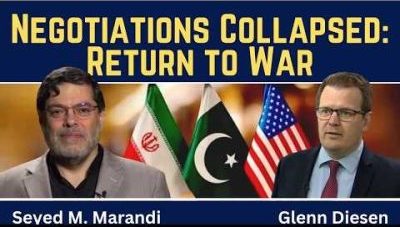
Seyed M. Marandi: Negotiations Collapsed – Return to War
or go to
Aletho News Archives – Video-Images
From the Archives
The US-Iran Scenario That Most Scares Israel
By Ali Haydar | Al-Akhbar | October 9, 2013
Israeli Prime Minister Benjamin Netanyahu issued a series of threats toward Iran and its interlocutors in the West, including the US, as serious negotiations on Iran’s nuclear program seem more plausible.
As a possible rapprochement looms between the US and Iran, Netanyahu has attempted to impose impossible Israeli conditions on the negotiators, such as the full dismantling of Iran’s nuclear program, not to mention threatening military force.
Whatever the deal that could materialize between Iran and the West, Israel is going to find itself before an open-ended path. One can foresee three possible scenarios… continue
Blog Roll
 Aletho News
- UK, Spain reject Trump’s new scheme to blockade Hormuz Strait
- Russian frigate ‘resurfaces’, chases off NATO pirates days after Kiev ‘sank’ it
- Ukraine Targets Russian Merchant Fleet With NATO Intel Support – Presidential Aide
- Russia’s ‘shadow fleet’ makes mockery of UK naval power
- Ukraine plans to attack Russian ships with Norwegian support
- US’s ‘Very Foolish’ Double Blockade of Hormuz Strait Makes Absolutely No Sense: Here’s Why
- China issues rules on countermeasures against foreign states’ unlawful extraterritorial jurisdiction
- Seyed M. Marandi: Negotiations Collapsed – Return to War
- Tomorrow’s naval blockade showdown
- ‘Israel’ attacks civilians to hide its embarrassing military failures & out of pure sadism
- If Americans Knew
- Critical shortages in Gaza, Lebanon in ruins, “piracy” in Iran – Daily Update
- US-Iran ceasefire negotiations make zero progress – Daily Update
- Pro-Israel ‘Thinktanks’ and Individuals who Influence U.S. Foreign Policy
- Mearsheimer reveals how Israel dictates US policies on Iran, Gaza – video
- After killing 350+, Israel still has a “score to settle” with Lebanon before ceasefire – Daily Update
- Military aid to Israel emerges as the latest political litmus test for Democrats
- The only Palestinian children’s rights organization closes following years-long Israeli campaign against it
- ‘I Can’t Forget the Smell’: Lebanese Reel After Israel Kills Over 300 in Single Day
- DNC Shoots Down Resolutions Calling Out AIPAC and Limiting Arms to Israel
- TCN: Is Israel Blackmailing President Trump?
- No Tricks Zone
- Cave Discovery Reveals Today’s Desert Climates Were Recently Far Warmer, Wetter, Teeming With Life
- German Expert: Heat Dome Led To Record Temps In Western USA…Warmer In 1934, 1936
- New Study: No Linear Warming Or Glacier Retreat Along Northern Antarctic Peninsula Since 1980s
- An Inconvenient Tree: Uncovered In Alps… Europe Much Warmer Than Today 6000 Years Ago
- New Study Reports A 60% Slowdown In Greenland’s Ice Loss Rate In The Last Decade
- Low Intensity Tornado Wrecks Major Solar Farm, Creating A Potential Toxic Dump
- New Study Finds Warming Saves Lives…Cold Temperatures 12 Times More Deadly Than Excess Heat
- German Science Blog Accuses PIK Climate Institute Of Hallucinating Climate Tipping Points
- Devastating Assessment Of Comirnaty Vaccine By Former Senior Pfizer Europe Toxicologist
- New Study: CO2 Is ‘Effectively Negligible’ As An Explanatory Climate Change Factor Since 2000
 Aletho News