Are US-Israel ‘special relations’ about to end?
By Murad Sadygzade | RT | May 19, 2025
Last week, US President Donald Trump embarked on his first official overseas tour since taking office, choosing to visit three key Gulf nations – Saudi Arabia, Qatar, and the United Arab Emirates.
This itinerary was both unexpected and, in many ways, unprecedented. Unlike his predecessors, who traditionally began their foreign policy engagements with visits to long-standing Western allies, Trump opted to prioritize America’s Arab partners, deliberately bypassing Israel – Washington’s principal strategic ally in the region. This marked the first time in decades that a sitting US president visiting the Middle East consciously excluded it from the agenda.
This decision signaled a potential recalibration of Washington’s priorities in the region. Relations between the Trump administration and the Israeli leadership, particularly Prime Minister Benjamin Netanyahu, were already strained in the early stages – largely due to Israel’s growing intransigence on the Palestinian question and the increasing influence of far-right factions within the Israeli government. Faced with mounting frustration over Israel’s hardline policies, the White House appeared to pivot toward a more pragmatic, less confrontational, and economically advantageous partnership with the Gulf monarchies.
However, the rationale behind this shift extended beyond political calculation. Saudi Arabia, the UAE, and Qatar have long played a pivotal role in sustaining American influence in the Middle East – not only because of their strategic geography but also due to their substantial investments in the US economy and multi-billion-dollar arms contracts. For a business-minded president eager to showcase the profitability of foreign policy through economic deals, these nations represented ideal counterparts.
The lavish receptions afforded to Trump during his Gulf tour might have been dismissed as mere pageantry were it not for their deeper symbolic resonance. The true significance of the visit lay in what it revealed about broader geopolitical currents: namely, the transformation of the Gulf monarchies from regional players into increasingly assertive global actors.
Saudi Arabia, the UAE, and Qatar are no longer content with being perceived as passive participants in American-led regional frameworks. Instead, they are positioning themselves as independent centers of power in an emerging multipolar world order. Their growing international stature stems from several interrelated factors.
First, these countries have embraced ambitious and forward-looking development strategies, investing heavily in infrastructure, clean energy transitions, technological innovation, and global finance. No longer simply hydrocarbon exporters, they are becoming hubs of digital transformation, international logistics, Islamic finance, and global policy discourse on issues ranging from security to sustainable development.
Second, the Gulf states have pioneered a distinctive model of governance that blends traditionalism with modernization. While maintaining deep-rooted commitments to Islamic and tribal values, they have achieved remarkable progress in building diversified and globally competitive economies. This synthesis has not only enabled them to thrive amid intensifying global competition but, in some respects, to outpace certain Western nations grappling with internal divisions and economic stagnation.
Equally noteworthy is the political resilience of these monarchies. Western narratives often portray them simplistically as ‘absolute monarchies,’ failing to appreciate the internal mechanisms of governance that underpin their stability. In reality, the political architecture of the Gulf is more accurately described as ‘sheikhism’ – a system rooted in consensus among tribal and familial elites, structured around a balance of obligations, reciprocal loyalties, and ongoing consultation. This model, which integrates Islamic principles such as shura (consultation) with practical statecraft, has proven remarkably adaptive and resilient.
In this context, Saudi Arabia, the UAE, and Qatar can no longer be viewed merely as privileged US allies or energy suppliers. They are emerging as autonomous actors in global politics – capable of forging regional alliances, shaping international agendas across energy, media, and technology, and mediating in global conflicts. Their evolving role reflects not dependence on external security guarantees, but the outcome of deliberate, long-term strategies to consolidate sovereignty, enhance prestige, and assert influence in the 21st century.
Money above all: Trump’s deal-based diplomacy
President Donald Trump’s visit to the Gulf states was far more than his first foreign trip as head of state. It was a bold, highly symbolic debut of a new US foreign economic doctrine rooted in pragmatism, transactionalism, and strategic capitalism. Unlike previous administrations, which typically foregrounded diplomacy, security alliances, and value-based partnerships, Trump approached this tour as a high-stakes business deal. His mindset was that of a dealmaker, not a traditional statesman. The objective was clear: to restore America’s economic dominance by leveraging the vast wealth and strategic ambitions of the Middle East’s richest monarchies.
Trump’s campaign slogan, “Make America Great Again,” found tangible expression in this tour. His mission was to bring back jobs, reindustrialize key sectors, boost the US high-tech ecosystem, and enhance national competitiveness – all fueled by a surge in foreign direct investment. In this pursuit, the oil-rich, capital-heavy Gulf monarchies – endowed with massive sovereign wealth funds and seeking greater global visibility – emerged as ideal partners.
In Saudi Arabia, Trump signed an unprecedented economic package worth over $600 billion, including the largest arms deal in US history – $142 billion covering missile defense systems, advanced aviation platforms, cybersecurity capabilities, and military-grade AI technologies. Equally significant was the launch of a new tech alliance: Saudi-based DataVolt committed $20 billion to build data centers and energy facilities in the US, while a consortium led by Nvidia, AMD, and Amazon Web Services will co-develop an AI innovation hub within the Kingdom. A $50 billion venture fund was also established to support US-based startups in renewable energy and cybersecurity.
In Qatar, the results were even more staggering: agreements totaling $1.2 trillion, the largest single-country deal package in US diplomatic history. Central to this was Qatar Airways’ order for 210 Boeing aircraft valued at $96 billion, making it the most lucrative deal ever for the American aerospace giant. Qatar also pledged tens of billions of dollars for joint ventures in quantum computing, smart energy networks, and STEM education programs for engineers and IT specialists in the US. In a provocative symbolic gesture, Qatar proposed gifting President Trump a custom-built Air Force One, sparking intense debate in the American media landscape.
In the United Arab Emirates, new agreements totaling $200 billion were signed – in addition to a previously negotiated $1.4 trillion package. Key components included the construction of an aluminum plant in Oklahoma, expansion of oil and gas infrastructure with US firms, and a landmark $100 billion commitment to American companies specializing in artificial intelligence over the next three years.
In total, Trump’s Gulf tour yielded over $2 trillion in contracts and investment pledges – an economic windfall of historic proportions. But beyond the numbers, the trip marked a fundamental redefinition of American foreign policy: from projecting power through military force and ideological alignment, to securing influence through economic penetration and transactional partnerships. Trump unveiled a new image of the US – not as a global policeman, but as a global entrepreneur. A nation that negotiates not with declarations, but with data, contracts, and employment metrics.
This new model resonated deeply with the Gulf monarchies themselves, which are undergoing profound transformations. Once reliant solely on oil exports, these states are rapidly evolving into tech-driven economies with ambitions to become global hubs of innovation, finance, and logistics. In Trump’s America, they found not just a security guarantor, but a strategic co-architect of a post-oil economic order – one where capital, innovation, and mutual profit outweigh traditional diplomatic protocol and ideological rhetoric.
Trump’s message was unambiguous: the era of foreign policy as charity is over. What now matters are mutual returns, strategic alignments, and economic gains. The Gulf states, driven by their own visions of modernization and diversification, eagerly embraced this shift. Together, they reimagined international relations not as a sphere of obligations, but as a marketplace of opportunities.
What about Israel?
One of the most significant – albeit unofficial – outcomes of Donald Trump’s Middle East tour could be discerned even before the journey began: the US President conspicuously bypassed Israel. This omission became all the more striking given that even Secretary of Defense Pete Hegseth, who had initially planned a visit to Tel Aviv, abruptly cancelled his trip at the last moment. The message did not go unnoticed in either Washington or Jerusalem: nearly all observers interpreted the move as a clear sign of a cooling relationship between the US and Israel – more precisely, between Trump and Israeli Prime Minister Benjamin Netanyahu.
The rift between the two leaders appears less personal than strategic, rooted in diverging visions of the region’s future. Tensions had been mounting for months. The first major flashpoint came when Trump unilaterally announced the withdrawal of American forces from operations against Yemen’s Houthi rebels, citing the group’s supposed commitment to halt attacks on Red Sea shipping lanes. The decision, made without prior consultation with Israel – which continues to endure daily rocket fire from the Houthis – dealt a blow not only to diplomatic norms but also to the foundational trust between Israel and its closest ally.
An even more sensitive issue has been the quiet resumption of US contacts with Iran. With Oman acting as mediator, Washington has been exploring the outlines of a possible new nuclear agreement. Meanwhile, Israel remains steadfast in its conviction that no negotiations with Tehran should occur until decisive military action is taken against its nuclear and military facilities – a show of force intended to compel concessions. Netanyahu failed to persuade Trump of this hardline approach, and the US president has increasingly charted his own, more flexible course.
Tensions have also sharpened over the future of Syria. Israel refuses to recognize the country’s new leader, Ahmad al-Sharaa, branding him a former al-Qaeda affiliate and a dangerous actor. Israeli airstrikes on Syrian territory continue, the buffer zone in the Golan Heights remains under Israeli control, and the Druze population has formally been placed under Israeli protection. While Israel promotes the vision of a weak, decentralized Syria, Washington is embracing the opposite: al-Sharaa was invited to meet with Trump in Saudi Arabia, and following those talks, the US signaled its intent to lift sanctions on Damascus. Even more striking was the revelation that Saudi Arabia, Qatar, and the UAE – previously restrained by US pressure – are now prepared to invest in Syria’s reconstruction, viewing it as both a stabilizing opportunity and a chance to expand their regional influence.
Israeli frustration has been further stoked by Washington’s evolving stance on the Palestinian issue. Despite Israel’s ongoing military operation in Gaza, Trump has increasingly expressed a desire – even a demand – for a resolution to the conflict. His Gaza reconstruction plan, unveiled in February, sent shockwaves through Washington: it proposed the complete depopulation of Palestinians from the enclave and the transformation of the territory into a luxury international resort zone under US control. Not only was this radical proposal never coordinated with Israel, but it also raised fundamental questions about the future of the US-Israel alliance.
To make matters more complex, credible reports have emerged that the US has been engaged in direct negotiations with Hamas, without informing Israel. The recent release of an American citizen, IDF soldier Idan Alexander, who was captured in October 2023, was reportedly achieved through these covert channels – of which the Israeli government only became aware through its own intelligence services.
Against this backdrop, speculation is growing that the White House is seriously considering formally recognizing an independent Palestinian state. Such a move would not be a mere diplomatic gesture – it would reshape the strategic architecture of the Middle East. Should Washington proceed down this path, Israel could find itself in strategic isolation, while the center of regional gravity shifts toward Saudi Arabia, the UAE, Qatar, and Türkiye – countries with which Trump is building pragmatic, mutually beneficial, and business-driven relations.
None of these states demand unconditional support from Washington, meddle in its internal politics, or leverage domestic crises for influence. More importantly, they offer Trump what he values most: investment, trade, strategic partnership based on reciprocal interest, and freedom from ideological constraints.
Thus, a new geopolitical reality is taking shape before our eyes. In this emerging landscape, Donald Trump appears less inclined to view Israel as an indispensable ally and more drawn to politically agile, economically potent, and regionally assertive actors across the Arab world – and Türkiye. If rumors of Palestinian state recognition prove true, it will mark the end of the long-standing era of “special relations” between the US and Israel and signal the dawn of a new chapter in American Middle East policy – one governed not by ideological loyalty, but by unambiguous political and economic rationality.
Murad Sadygzade is President of the Middle East Studies Center, Visiting Lecturer, HSE University (Moscow).
Iran’s Bold Nuclear Deal 2.0?
By Oleg Burunov – Sputnik – 14.05.2025
After the US unilaterally withdrew from the 2015 Iran nucleal deal in May 2018, subsequent efforts to revive the agreement have largely stalled.
Iran has suggested a joint nuclear enrichment project with US investments and regional Arab nations – Saudi Arabia and the United Arab Emirates.
Iranian FM Abbas Araghchi offered the idea as an alternative to US demand for the dismantling of Iran’s nuclear program during the recent talks with US Special Envoy Steve Witkoff in Oman, the New York Times reports.
Iran would use the venture to enrich uranium to a low grade, beneath the levels needed for nuclear weapons.
Representatives from other countries, including the US, will be on the ground to provide “oversight and involvement.”
Israel issues warning over Palestine recognition
RT | May 12, 2025
Israel will respond to any nations who move to unilaterally recognize the state of Palestine, Foreign Minister Gideon Saar has claimed.
Saar issued the warning at a joint press conference with his German counterpart, Johann Wadephul, on Sunday, following announcements by several countries of their intent to recognize Palestine.
The Israeli diplomat claimed that any such unilateral moves would undermine prospects for the peace process and would compel the Jewish state to take measures in response.
Palestine’s sovereignty is recognized by 147 countries, including Russia and the majority of nations in the Middle East, Africa, and Asia. However, most Western European countries, as well as Israel and the US, do not officially consider Palestine a sovereign state. Many nations have advocated for Palestinian recognition as the only way to resolve the Israel-Palestine conflict, which escalated in 2023 when Israel launched a military operation in Gaza following a surprise Hamas attack.
Saar claimed such initiatives were “not constructive but counterproductive” and served “as a prize for Hamas terror.”
Wadephul, however, said that a two-state solution remained “the best chance for Israelis and Palestinians to live in peace, security, and dignity.”
The Media Line news outlet reported on Sunday, citing unnamed diplomatic sources, that US President Donald Trump could formally recognize the state of Palestine at the upcoming Gulf-US summit in Saudi Arabia.
Although US Ambassador to Israel Mike Huckabee has denied any such plans, speculation has grown in the wake of comments Trump made earlier this month in a meeting with Canadian Prime Minister Mark Carney. Trump repeatedly hinted at “a very, very big announcement about a certain subject,” which he said would be revealed either before or during his upcoming trip to the Middle East.
Last month, French President Emmanuel Macron indicated that Paris could move to recognize a Palestinian state as early as June, during a United Nations conference in New York.
Russia has long advocated for a two-state solution to the Israel-Palestinian conflict, reaffirming its stance during a recent meeting between Russian President Vladimir Putin and Palestinian President Mahmoud Abbas in Moscow. Russia has also called for an immediate end to the violence in Gaza.
Iran, Saudi Arabia foreign ministers discuss key bilateral, regional developments
Press TV – May 10, 2025
The top diplomats of Iran and Saudi Arabia met to discuss key issues related to bilateral relations, as well as regional and international developments.
Foreign Minister Abbas Araghchi met with his Saudi counterpart, Prince Faisal bin Farhan Al Saud, upon arriving in Jeddah on Saturday. His visit to Saudi Arabia is part of Tehran’s ongoing policy of strengthening ties with neighboring countries.
During the meeting, Araghchi also signed the Saudi Foreign Ministry’s memorial book.
Araghchi urged the Muslim world to take action to confront threats and challenges, including putting an end to the ongoing Israeli genocide in Gaza and preventing a conspiracy to annihilate Palestine in a colonial manner.
The top Iranian negotiator updated his Saudi counterpart on the latest developments regarding the Tehran-Washington indirect talks.
The Iranian and Saudi foreign ministers expressed the two countries’ determination to promote their common goal of expanding mutual relations in all fields.
On Friday, Araghchi announced that the fourth round of indirect talks between Iran and the United States will take place in Oman on Sunday.
His regional tour includes a visit to Qatar later on Saturday as part of his diplomatic engagements.
Speaking in an interview on Friday, Araghchi said his visit to Saudi Arabia would be in line with consultations between the two countries about regional issues and indirect negotiations between Iran and the United States.
He added that since the beginning of the talks in April, Iran has been in constant contact with regional countries to inform them about the process.
“The sustainability of any potential agreement largely depends on the considerations and concerns of the regional countries regarding the nuclear issue and their common interests with the Islamic Republic,” the Iranian foreign minister emphasized.
Mediated by Oman, Iran and the US have held three rounds of talks in the Omani capital of Muscat and the Italian capital of Rome on April 12, 19, and 26, with the aim of reaching a deal on Iran’s nuclear program and the removal of sanctions on Tehran.
Both parties have so far expressed satisfaction with the way the negotiations are moving on, praising the talks as “positive” and “moving forward.”
A fourth round of the talks was scheduled to be held on May 3 in Muscat but was postponed for “logistical and technical reasons,” as cited by the Iranian foreign minister.
Will Trump recognize a Palestinian State?
Al Mayadeen | May 10, 2025
Gulf analysts wrote in The Media Line on Saturday that Saudi Arabia will host the 2025 Gulf-US Summit in mid-May, aligning with US President Donald Trump’s first visit to the Kingdom in his second term, echoing the huge May 2017 summit in Riyadh during his first term.
All Gulf leaders are expected to attend the summit, except for King Salman bin Abdulaziz, who has remained absent from public engagements due to health concerns.
Ahead of the summit, speculation has grown around what Trump referred to as a “very important announcement” during a recent meeting with Canadian Prime Minister Justin Trudeau at the White House on May 6.
Observers anticipate that the summit could unveil high-level diplomatic shifts, economic agreements, or security deals.
Rumors of US recognition of a Palestinian State
According to The Media Line, the announcement of a Palestinian state is among the most widely discussed possibilities.
Moreover, a Gulf diplomatic source who spoke anonymously to The Media Line said, “President Donald Trump will issue a declaration regarding the State of Palestine and American recognition of it, and that there will be the establishment of a Palestinian state without the presence of Hamas.”
The source added that such an announcement could mark a significant realignment in the region, possibly leading more Arab states to join the normalization agreements.
Additionally, former Gulf diplomat Ahmad al-Ibrahim told The Media Line, “I don’t expect it to be about Palestine. Egyptian President Abdel Fattah el-Sisi and King Abdullah II of Jordan have not been invited. They are the two countries closest to Palestine, and it would be important for them to be present at any event like this.”
It is worth noting that the US is no longer demanding that Saudi Arabia normalize ties with “Israel” as a precondition for advancing civil nuclear cooperation talks, two sources with knowledge of the matter told Reuters, ahead of Trump’s visit to the kingdom.
This marks a significant policy shift by Washington. Under former President Joe Biden, nuclear negotiations with Riyadh were tied to a broader US-Saudi agreement that included recognizing “Israel” and a potential defense treaty with the United States.
Potential economic deals worth billions
Major Saudi economic deals in the 2025 visit may mirror those of the 2017 summit, when agreements worth more than $400 billion were signed, according to The Media Line.
Trump is also expected to visit Qatar and the UAE following his stay in Saudi Arabia, reinforcing speculation of further bilateral and regional economic announcements.
Saudi political analyst Ahmed Boushouki echoed this sentiment, stating, “This is about major economic deals that will take place in the Kingdom of Saudi Arabia.
“Perhaps President Donald Trump hinted at this when he told the American people to ‘buy stocks now, before his big announcement in the next two days.’”
According to the report, the summit may reignite discussions on US-Saudi nuclear cooperation. Saudi Arabia has had a peaceful nuclear energy program in place since 2010, and “International companies are now working to implement these projects in Saudi Arabia.”
It is worth mentioning that Saudi Arabia is advancing plans to build its first nuclear reactor, with several global firms competing for the contract, while the UAE’s Barakah plant remains the Arab world’s only operational four-reactor facility, built with South Korea.
US pressures ‘Israel’ for Gaza deal; Witkoff’s Israeli rebuke leaked
Al Mayadeen | May 9, 2025
The administration of US President Donald Trump is reportedly pressuring “Israel” to agree to a ceasefire and a captive deal with Hamas before Trump’s upcoming Middle East visit, according to Haaretz.
An unnamed source familiar with the negotiations stated that the US has warned Israeli officials that if they do not cooperate in advancing such an agreement, “Israel” will be “left alone”, implying a potential withdrawal of US diplomatic support.
The push for a deal comes as the Trump administration seeks to broker a resolution to the ongoing war in Gaza ahead of the president’s regional trip.
A recent report, without citing a specific source, identified Steve Witkoff as the unnamed senior US official referenced in a Channel 12 story earlier this week.
According to that report, the official had criticized “Israel’s” approach to the captive situation during a meeting with the captives’ families, while the nature of the criticism and the full context of the remarks remain unspecified.
The official was quoted as warning: “If until today, the hostages paid the price for not ending the war, then today the price will be much heavier for Israel, and not only the hostages.”
The remarks also criticized “Israel” for failing to leverage the emerging US-Saudi nuclear deal, an agreement that, according to reports, President Trump has reportedly decoupled from the requirement for Saudi Arabia to normalize ties with the Zionist entity.
“If Israel doesn’t come to its senses, the price of missing out will be higher than ever before,” the official, allegedly Witkoff, warned.
Haaretz further reports that Witkoff’s criticism of Netanyahu’s government was deliberately leaked to the media at his request, though his office has since denied that the Trump administration is pressuring “Israel” to reach a deal.
This comes amid an increasingly souring relationship between the United States and “Israel”, which is reportedly leading Trump to pursue US policy in the Middle East while sidelining its “greatest ally in the Middle East”.
The rift between Trump and Netanyahu
Sources close to Trump indicate he is increasingly disappointed with Netanyahu, following reports that Netanyahu has grown frustrated with the US leader, marking a turning point in their relationship as Trump begins to distance his administration from coordination with “Israel” on key Middle East strategies.
Two senior Trump administration officials, in closed conversations relayed to Israel Hayom, revealed that the president has decided to advance regional policy decisions independently rather than waiting for Netanyahu’s input.
Trump aims to strengthen US influence in the region, particularly with Gulf states, and while initial normalization efforts included coordination with “Israel,” the administration now sees Netanyahu’s reluctance, especially his refusal to publicly endorse a “horizon for a Palestinian state”, as a major hindrance.
Trump’s frustration has intensified following reports that Netanyahu and his associates pressured former National Security Advisor Mike Waltz to take military action against Iran, leading to his ousting from the administration on May 3.
Although Netanyahu denies substantial involvement and claims he only spoke to Waltz once, Trump reportedly remains unconvinced and sees this as part of a wider concerning pattern.
A case for a Saudi-US deal, minus the normalisation
By Muhamad Sayuti Mansor | MEMO | May 8, 2025
On the eve of US President Donald Trump’s upcoming trip to the Gulf next week, one of the most hotly debated questions is the fate of the Saudi-Israel normalisation deal under the US-brokered Abraham Accords. Trump himself fuelled speculation on Tuesday, teasing a “very, very big” announcement before his departure. His Middle East envoy, Steve Witkoff, had already hinted at a breakthrough, reinforcing assumptions that normalisation will take centre stage. The real question, however, is how Saudi Arabia will navigate this pressure.
Saudi Arabia is slated to be Trump’s first stop, underscoring its strategic importance to Washington. Trump had intended to make Saudi Arabia his first foreign destination upon returning to office, but that changed with an earlier detour to Rome for the funeral of Pope Francis. Even so, Riyadh marks his first significant diplomatic stop. The symbolism remains: his first foreign trip in 2017 was also to Riyadh. Now, he returns to ink a potential arms deal exceeding $100 billion—an investment package inherited from the Biden era, which sought to advance the same deal as part of a broader push to expand the Abraham Accords.
The Biden administration had made Saudi-Israel normalisation a “national security interest”, imagining it as a cornerstone to unlock economic corridors across the Middle East, South Asia and Africa. After October 2023, the urgency grew. Washington saw normalisation as a way to both reward and rein in Israel, hoping Saudi leverage might induce Israeli concessions, a ceasefire in Gaza, or even progress on Palestinian statehood.
In this regard, the Trump administration shows continuity. Trump’s inner circle—from Jason Greenblatt to Mike Huckabee and Mike Waltz—have all echoed normalisation as a top priority. A team was already mobilized before inauguration, reflecting Trump’s enduring ambition to expand the Abraham Accords and possibly clinch a Nobel Peace Prize. In a recent Time interview, Trump reiterated his belief that Saudi Arabia will join the fold—a rare note of consistency in his otherwise erratic foreign policy.
But are all hopes lost? The answer lies in the Saudi’s court. Normalisation without statehood is a non-starter. Even under less extreme Israeli leadership, real statehood was never on offer. Today, with Gaza in ruins and the overwhelming majority of Saudis opposed, normalisation risks derailing Saudi Arabia’s de-escalation strategy and undermining Vision 2030. Worse still, it benefits only Netanyahu, who seeks political survival by parading normalisation as a victory.
With Trump’s looming Middle East visit already putting Saudi Arabia under immense pressure, Riyadh must now tread a very delicate line. First and foremost, it must clearly identify where its national interests lie. These are all concentrated in the first half of the proposed deal: a US-Saudi strategic alliance agreement, defence cooperation, deeper trade and investment ties, and crucially, US support for Saudi’s civilian nuclear programme.
This nuclear partnership could allow the Kingdom to build the infrastructure and expertise necessary to become a nuclear-latency state—on par with Germany, Japan, Canada and most importantly, Iran. These are serious, long-term strategic gains. Meanwhile, the second half of the deal—normalisation with Israel—offers Saudi Arabia very little of tangible value.
So why not pursue the former without the latter? Pending the best-case scenario—Israel’s irrevocable commitment to Palestinian statehood—Saudi Arabia should press ahead with securing the US security and economic package, minus normalisation.
Is that even possible? The second thing to recognise is that the Trumpian world offers both challenge and opportunity. Despite Trump’s self-proclaimed status as “the greatest friend Israel ever had in the White House”, there has never been a wider gap between Israel and the US than now. And Trump is clearly the one calling the shots.
There are ample signs of this shift. The very fact that the US is in talks with Iran—against Israel’s wishes—is one. Another was Trump’s decision to proceed with the withdrawal of US troops from northeast Syria, despite Israeli concerns about Turkish influence there. More recently, US is reported to consider lifting sanctions on Damascus—again, over Israeli objections. Observe too how he made a ceasefire deal with the Houthis without even informing the Israelis.
Perhaps the most telling sign came during US Energy Secretary Chris Wright’s April visit to Riyadh, where he confirmed progress on a Saudi-US nuclear agreement. What he did not mention was normalisation with Israel. This omission speaks volumes.
To take advantage of this opening, Saudi Arabia must understand and work with Trump’s transactional mindset. Business comes first. In his first term, Trump openly celebrated arms sales to Saudi Arabia, boasting of $110 billion in promised purchases. He even admitted choosing Riyadh over London as his first foreign visit in 2017 because of the scale of the deal.
Trump 1.0 also saw his administration strive to approve nuclear technology transfers to Saudi Arabia, bypassing Congress in the process. All this suggests that even Trump privately sees the core value of the deal in its economic and strategic dimensions, and not in Israeli normalisation.
Trump’s transactionalism extends beyond simple cash flow. Saudi Arabia can offer to deepen its defence partnership with the US, while keeping competitors like China, Russia, or even the UK and France at arm’s length. Despite America’s shale boom, Washington still relies on Gulf oil to fuel economic growth, while Saudi Arabia depends on stable prices to fund its budget. If the US expects Riyadh to offset Iranian oil cuts, security guarantees must follow.
Saudi Arabia can also leverage its financial clout. It is already pulling back financially, cutting $5 billion in US FDI since 2019 and slashing its US stock holdings by 41 per cent in 2024. Riyadh is now shifting focus to Africa and Latin America. If Washington wants to reverse that trend, it must offer Saudi Arabia robust support, including a green light for its nuclear ambitions. That’s a win-win, without normalisation.
Besides cajoling the US, a dose of reality may be healthy. Saudi Arabia must make one thing clear to Washington: if the US won’t support Riyadh’s post-oil nuclear ambitions, others will. France, South Korea, and especially China have already offered assistance. By tying nuclear cooperation to normalisation, Washington risks forfeiting oversight and influence over a growing Saudi nuclear programme. That would be a strategic blunder.
Despite Trump’s bluster about forcing Saudi Arabia to normalise ties, Riyadh can take comfort in the way Trump often repackages minimal foreign concessions into “historic” US wins. If managed shrewdly, even a scaled-down deal—without normalisation—could still be framed as a diplomatic triumph by the Trump White House.
Ultimately, everything hinges on Saudi leadership and diplomatic finesse. History shows that, on rare but significant occasions, the “Arab lobby” has outmanoeuvred the formidable Israel lobby. If Riyadh can pull this off again, it won’t just secure a strategic alliance with the US, it will also cement its role as a regional leader. Just as importantly, it will send a powerful message to Israel: it is no longer at the centre of the universe, not even America’s.
Defiant Trump advances US plans without Israeli approval: Report
The Cradle | May 8, 2025
US President Donald Trump has lost patience with Israeli Prime Minister Benjamin Netanyahu and will not wait any longer for Israel before advancing initiatives in West Asia, Israel Hayom reported on 8 May.
According to two senior sources in the US President’s entourage, Trump is interested in making decisions that he believes will advance US interests, particularly regarding Saudi Arabia and the Gulf states, without waiting for approval from Netanyahu.
Regarding a potential US–Israeli agreement with Saudi Arabia, Trump believes Netanyahu is delaying making the necessary decisions. The president is not willing to wait until Israel does what is expected of it and will move forward without it.
During the presidency of Joe Biden, the US and Israel were involved in talks with Saudi Arabia that would see Washington enter a defense pact with the kingdom, provide it with civilian nuclear technology, and sell it advanced weapons – all in exchange for normalization with Israel.
As part of any agreement to normalize relations with Israel, Saudi Arabia expects an end to the war in Gaza and an Israeli declaration of a “horizon for a Palestinian state.”
However, senior ministers in Israel’s current government have vowed to never allow a Palestinian state in the occupied West Bank, while promising to “destroy” Gaza, ethnically cleanse its population under the pretext of promoting “voluntary migration,” and to build Jewish settlements there.
The sources added that Trump was furious at what he saw as an attempt by Netanyahu to use US National Security Advisor Mike Waltz, who has since been dismissed from his position, to push for US military action in Iran.
Netanyahu claimed in response to the publication of the affair in the Washington Post that he had only spoken to Waltz once. However, Trump was not convinced.
The president’s anger likely explains why Trump did not involve Israel in the ceasefire he announced with the Ansarallah-led government of Yemen.
Even after Trump announced the agreement with Yemen, Israeli representatives handling relations with the US were reportedly unable to receive information from White House officials about what was happening for a day, Israel Hayom noted.
Additionally, Trump is not currently scheduled to visit Israel as part of his visit to the region next week.
The disconnect between Trump and Netanyahu likely explains why the Israeli prime minister and his Defense Minister, Israel Katz, announced on Wednesday that they are prepared for a situation in which Israel will be left alone in the campaign against Yemen.
Defense Minister Katz said that “Israel must be able to defend itself on its own against any threat and any enemy. This has been true in the face of many challenges in the past and will continue to be so in the future.”
Trump has faced criticism for escalating the war against Yemen since taking office in January, including for withholding information about US military casualties resulting from a military campaign that has never received authorization from Congress.
The operation has involved over 1,000 US airstrikes against the Ansarallah-led Yemeni Armed Forces (YAF) and killed hundreds of Yemenis, including many civilians.
Writing for Haaretz, Israeli journalist Aluf Benn notes that each time US presidents have been angered by Tel Aviv’s actions, “Israel stood its ground, deflected the pressure and over time got what it wanted.”
Benn stated that Trump is also pursuing a deal with Iran over its nuclear program that is contrary to Netanyahu’s position on the matter.
Trump pulled the US out of the Obama-era Joint Comprehensive Plan of Action (JCPOA) in 2018 amid encouragement from Netanyahu. However, the president has been trying to come to a diplomatic understanding with Iran to halt the development of its nuclear program during his second term.
Three rounds of talks have taken place, mediated by the government of Oman and involving Trump’s special envoy to the region, Steve Witkoff.
Saudi Arabia tells ICJ Israel considers itself above all laws
MEMO | April 30, 2025
A representative of Saudi Arabia told the International Court of Justice (ICJ) yesterday that Israel considers itself above all laws and refuses to comply with the court’s advisory opinion on halting its aggression against the Gaza Strip.
Mohamed Saud Alnasser, who is the director of legal affairs at the kingdom’s Foreign Ministry, condemned Israel’s “flagrant violations of international law” in the occupied West Bank and East Jerusalem, as well as Gaza, adding that Tel Aviv’s unjustified blockade on Gaza, reflects brutality against civilians in the besieged Strip.
“Less than a year ago, the court heard that Israel’s policies and practices in the occupied territory, including its settlement practices, its continued occupation and its annexation of parts of that territory are flagrant violations of international law that must be brought to an end as a matter of urgency,” he said.
“Sadly, but predictably, Israel chose to ignore the court’s ruling, showing it considered itself above the law.”
Alnasser referred to Israel’s “hideous conduct” in Gaza, adding that the “most ruthless application has been the siege conditions imposed over the Gaza Strip since October 2023,” and that the worsening situation there has turned the Strip into a graveyard for thousands of innocent people
Alnasser stressed that preventing the entry of relief supplies into Gaza is a violation of all international conventions, calling on Israel to facilitate the work of humanitarian organisations, especially the United Nations Relief and Works Agency (UNRWA), in Gaza and the West Bank.
He explained that the International Commission of Inquiry had disproved the Israeli allegations against UNRWA employees, and called for protection for workers in humanitarian agencies and organisations in the occupied Palestinian territories from Israeli violations.
“The masters of the universe are Jews,” former US Senator declares in Israel
By Wyatt Reed – The Grayzone – April 28, 2025
Ex-GOP Senator and Republican Jewish Coalition chair Norm Coleman proclaimed with a straight face that Jews control the world during a Jerusalem conference featuring a speech by Israeli PM Benjamin Netanyahu.
Former US Senator Norm Coleman has raised eyebrows by declaring that “the masters of the universe are Jews” at a major Zionist lobby event in Jerusalem. In an address to a summit hosted by the Adelson-funded Jewish News Syndicate on April 27, Coleman pointed to various major technology firms founded by Jews, suggesting the shared religion of the companies’ creators should translate into a greater zeal for censoring criticism of Israel.
“And when you think about it, the Masters of the Universe are Jews! We’ve got Altman at OpenAI, we’ve got [Facebook founder Mark] Zuckerberg, we’ve got [Google founder] Sergey Brin, we’ve got a group across the board. Jan Koum, y’know, founded WhatsApp. It’s us.”
The remarks came as Coleman lamented that pro-Israel propagandists are “losing the digital war” in battle for the hearts and minds of younger generations, and called for more stringent censorship of pro-Palestinian speech.
“A majority or Gen Z have an unfavorable impression of Israel. And, my friends, I think the reason for that is that we’re losing the digital war. They’re getting their information from TikTok, and… and we’re losing that war.”
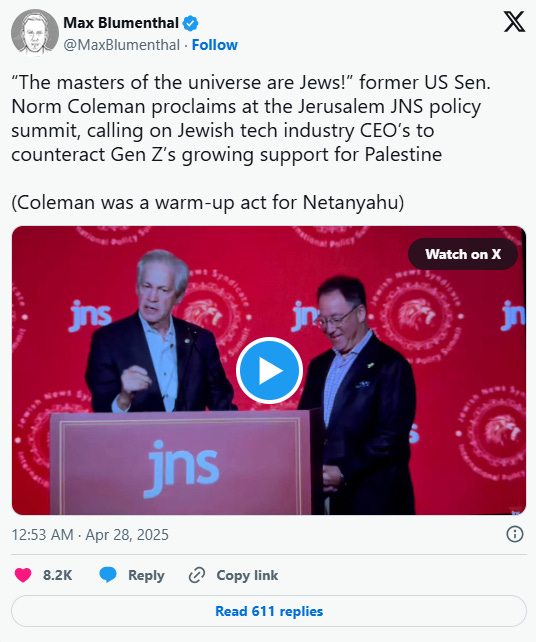
As numerous polls show young Americans are increasingly skeptical of Israel – with a recent survey showing 71% of Democrats and 50% of Republicans under age 49 now hold an unfavorable view of Israel – establishment politicians have consistently blamed TikTok’s algorithm for the decline in enthusiasm for genocide. In February, the top Democrat on the Senate intelligence committee, Mark Warner, revealed that the bill forcing China’s ByteDance to sell TikTok was motivated by the visibility of pro-Palestine content on the app.
For Coleman, though, it appears this wasn’t enough. “We have to figure out a way to win the digital battle,” he told summit attendees. “We’ve got to get our digital sneakers on, so that the truth can prevail over the lies. And when we do that, the future of Israel will be stronger because a majority of all Americans will support Israel. We’ll make that happen, we have to make it happen. Thank you, Baruch hashem.”
Israeli Prime Minister Benjamin Netanyahu took the stage directly after Coleman’s speech, highlighting Tel Aviv’s interest in the event, which was billed as the “Inaugural JNS Policy Summit to address Israel’s pressing strategic issues.”
An archetypal neoconservative, Coleman started off as an anti-war activist who once worked as a roadie for Jethro Tull, and was suspended from Hofstra University for leading a sit-in. “I went to Woodstock, and I inhaled!” he boasted at the JNS summit. After first taking office as a member of the Democratic–Farmer–Labor Party, Coleman wound up narrowly losing his Senate seat to Al Franken in 2008 as a Republican.
In addition to serving as the national chairman of the Republican Jewish Coalition and founder of the Congressional Leadership Fund super PAC, Coleman now works as a top lobbyist for the Kingdom of Saudi Arabia.
‘A battle between right and wrong’: Houthi spokesman on confronting the US and Israel
The Grayzone | April 21, 2025
The Grayzone’s Max Blumenthal interviews Muhammad Al-Bukhaiti, senior political officer and spokesman for Ansar Allah (the Houthi movement), on Yemen’s direct confrontation with a US military machine which is hellbent on destroying its ability to resist Israel. In this third conversation between The Grayzone and Bukhaiti, the Ansar Allah spokesman explains why he believes his movement’s war with the US-Israeli axis is unlike any conflict that preceded it, and why he believes Yemen is engaged in a righteous battle despite the terrible toll its civilians have faced. This interview was translated by Hekmat Aboukhater.
Find more reporting at https://thegrayzone.com Support our original journalism at
Patreon:  / grayzone
Facebook:  / thegrayzone
Twitter:  / thegrayzonenews
Instagram:  / thegrayzonenews
If the US launches a ground operation against Yemen, it will backfire
By Robert Inlakesh | Al Mayadeen | April 21, 2025
Frustrated by its costly ongoing offensive campaign against Yemen, the Trump administration is said to be in talks to launch a ground effort aimed at seizing the strategic port city of Hodeidah, before effecting regime change in Sanaa. If this offensive does occur, it will result in a disastrous defeat for Washington.
In 2015, when then-US President Barack Obama backed the Saudi-led coalition’s war on Yemen, Riyadh had estimated that it would only take a few months to uproot the Ansar Allah leadership that had taken over Sanaa. Instead, they faced defeat after defeat at the hands of a highly-motivated armed force that received the backing of the majority of Yemen’s Armed Forces.
A decade later, despite the 2022 ceasefire, the conflict remains unresolved – and Ansar Allah’s power has only continued to grow. The movement that once seized control of Sanaa with the backing of key elements of the existing power structure, including segments of the military, was a shadow of what it has since become. Not only has it forged strong alliances with various tribal factions across Yemen, but it has also made leaps and bounds in developing both offensive and defensive weapons technologies.
The Yemeni Armed Forces that aligned with the Ansar Allah-led government proved capable of holding off the combined power of the Saudi-backed and UAE-backed Yemeni forces, in addition to various militant groups like Al-Qaeda and ISIS, also battling Saudi Arabia’s armed forces and later mercenary fighters from Sudan and elsewhere. They fought on the ground for years, amidst a US-Saudi blockade in the Red Sea, combined with US-British-Israeli logistical support being provided to their enemies, backing Riyadh’s air attacks against the country.
While managing to inflict countless defeats on what was supposed to be a militarily superior opposition – on paper – the Yemeni government in Sanaa continued to expand its power and territorial control in a country that has historically been divided between north and south.
In late 2021, game changing technological advances introduced a new dynamic to the conflict, ultimately pressuring the Saudi-led coalition to accept a UN mediated ceasefire proposal. By early 2022, after an expansion of the ground war the previous year, the Yemeni Armed Forces had launched a wave of successful drone and missile attacks at targets across the United Arab Emirates (UAE) and Saudi Arabia.
While Riyadh had been dealing with Ansar Allah’s drones and missiles for years by that point, it was clear that a significant technological advancement had occurred. And whereas the Saudi State had some capacity to absorb limited attacks on its vital infrastructure, the Emirati regime was far less equipped to withstand repeated blows from Yemen.
Abu Dhabi in particular cannot afford to absorb sustained waves of drone and missile attacks, especially if Dubai becomes a target. Unlike Saudi Arabia, the UAE is a tiny and vulnerable country. If Yemen decides to blanket them with strikes, their endeavors to diversify their economy will likely disintegrate, and no amount of deals with the US nor the Israelis can help them.
The claims that are being spread, particularly across Arabic language media, speculate that a Saudi-UAE backed force of about 80,000 soldiers is being amassed in order to launch an offensive aimed at seizing Hodeidah. Then, so goes the report, the US will offer air support and even launch a smaller ground attack to invade Yemen.
Donald Trump’s Vietnam?
Yemen was once dubbed Egypt’s Vietnam – and if the United States decides to launch a ground campaign there, the outcome is unlikely to align with President Donald Trump’s intentions. Already, the air campaign alone, which has to date killed around 150 civilians, has proven to be an embarrassing failure, costing US taxpayers billions of dollars with little to show in return.
Despite this war of aggression against Yemen being launched without a popular mandate, nor congressional approval, the US corporate media have largely chosen to ignore it. Yet, if Trump sends boots on the ground, Yemen will quickly dominate headlines, for the simple reason that US service members will start returning home in coffins.
So far, the Yemeni Armed Forces have limited their confrontations with the US’s naval fleets to defensive maneuvers, meaning that they have not been attempting to sink ships or aircraft carriers and are focused on defending their nation. If a large-scale ground operation is launched, the defensive posture will shift to one of offense.
The ground campaign will not only be costly and far from a walk in the park, the US will also endure direct hits to its vessels and significant casualties. Additionally, we should expect major attacks on both Saudi and Emirati infrastructure, which will disrupt oil markets. It is also very likely that US bases located in the Arabian Peninsula and beyond will come under attack.
Furthermore, we should probably expect occasional strikes against the Zionist regime that will be more intense than previous waves. If we begin to see the civilian death toll climb dramatically in Yemen, while the war is overtly an American-Zionist aggression, the way in which Ansar Allah will deal with it won’t be restricted any longer. On top of this, it could even end up uniting the people of Yemen to an even greater degree as a result, including factions and tribes that have always been at odds with Ansarallah.
Yemen is not Iran, but it has the capacity to inflict considerable losses on the US-allied regimes surrounding it and can target US forces directly. The question then becomes, can Riyadh and Abu Dhabi endure continuous barrages of munitions being fired towards them? Also, when the war lasts much longer than anticipated and the proxy ground force used to attack Yemen is suffering severe losses, as American soldiers return home in body bags, what will the strategy be then?
Will the 80,000 strong force continue to fight if they are suffering considerable losses, all in order to achieve a victory for Israeli strategic interests? Or will they begin to experience serious morale issues and defections? Will the US public be able to stomach the losses, and can the US military itself justify the loss of assets in a pointless fight to please their Zionist allies?
There will be no benefits to launching such an assault, and the US has not amassed nearly enough ground troops to launch a war alone. On every level, this would be a catastrophic strategic blunder. If they lose, this would be an embarrassment of historic proportions and nation-defining victory for the Sana’a government, despite the immense civilian suffering that will inevitably come from the war. All of this leaves out the potential involvement of other regional actors who may take advantage of the situation too.
If Trump decides to go ahead with such a conflict, in order to please his Zionist ally, it will greatly backfire. There will also be no way to hide the fact that he is working against US interests and sacrificing his own citizens in order to make the Israelis satisfied, without any real end goal or vision for victory.
Featured Video
Seyed M. Marandi: Negotiations Collapsed – Return to War
or go to
Aletho News Archives – Video-Images
From the Archives
The US-Iran Scenario That Most Scares Israel
By Ali Haydar | Al-Akhbar | October 9, 2013
Israeli Prime Minister Benjamin Netanyahu issued a series of threats toward Iran and its interlocutors in the West, including the US, as serious negotiations on Iran’s nuclear program seem more plausible.
As a possible rapprochement looms between the US and Iran, Netanyahu has attempted to impose impossible Israeli conditions on the negotiators, such as the full dismantling of Iran’s nuclear program, not to mention threatening military force.
Whatever the deal that could materialize between Iran and the West, Israel is going to find itself before an open-ended path. One can foresee three possible scenarios… continue
Blog Roll
 Aletho News
- UK, Spain reject Trump’s new scheme to blockade Hormuz Strait
- Russian frigate ‘resurfaces’, chases off NATO pirates days after Kiev ‘sank’ it
- Ukraine Targets Russian Merchant Fleet With NATO Intel Support – Presidential Aide
- Russia’s ‘shadow fleet’ makes mockery of UK naval power
- Ukraine plans to attack Russian ships with Norwegian support
- US’s ‘Very Foolish’ Double Blockade of Hormuz Strait Makes Absolutely No Sense: Here’s Why
- China issues rules on countermeasures against foreign states’ unlawful extraterritorial jurisdiction
- Seyed M. Marandi: Negotiations Collapsed – Return to War
- Tomorrow’s naval blockade showdown
- ‘Israel’ attacks civilians to hide its embarrassing military failures & out of pure sadism
- If Americans Knew
- Critical shortages in Gaza, Lebanon in ruins, “piracy” in Iran – Daily Update
- US-Iran ceasefire negotiations make zero progress – Daily Update
- Pro-Israel ‘Thinktanks’ and Individuals who Influence U.S. Foreign Policy
- Mearsheimer reveals how Israel dictates US policies on Iran, Gaza – video
- After killing 350+, Israel still has a “score to settle” with Lebanon before ceasefire – Daily Update
- Military aid to Israel emerges as the latest political litmus test for Democrats
- The only Palestinian children’s rights organization closes following years-long Israeli campaign against it
- ‘I Can’t Forget the Smell’: Lebanese Reel After Israel Kills Over 300 in Single Day
- DNC Shoots Down Resolutions Calling Out AIPAC and Limiting Arms to Israel
- TCN: Is Israel Blackmailing President Trump?
- No Tricks Zone
- Cave Discovery Reveals Today’s Desert Climates Were Recently Far Warmer, Wetter, Teeming With Life
- German Expert: Heat Dome Led To Record Temps In Western USA…Warmer In 1934, 1936
- New Study: No Linear Warming Or Glacier Retreat Along Northern Antarctic Peninsula Since 1980s
- An Inconvenient Tree: Uncovered In Alps… Europe Much Warmer Than Today 6000 Years Ago
- New Study Reports A 60% Slowdown In Greenland’s Ice Loss Rate In The Last Decade
- Low Intensity Tornado Wrecks Major Solar Farm, Creating A Potential Toxic Dump
- New Study Finds Warming Saves Lives…Cold Temperatures 12 Times More Deadly Than Excess Heat
- German Science Blog Accuses PIK Climate Institute Of Hallucinating Climate Tipping Points
- Devastating Assessment Of Comirnaty Vaccine By Former Senior Pfizer Europe Toxicologist
- New Study: CO2 Is ‘Effectively Negligible’ As An Explanatory Climate Change Factor Since 2000
 Aletho News