Meeting of the Defense Ministers of the Shanghai Cooperation Organization in Delhi
By Gilbert Doctorow | April 28, 2023
One quite important event today in global politics is unlikely to receive coverage in The New York Times, The Financial Times, the BBC or Euronews. I have in mind the meeting in Delhi of the defense ministers of the Shanghai Cooperation Organization.
The SCO is one of the two principal bodies that bring together the nations that are today challengers to the US-dominated world order. The other such body is BRICS.
Whereas BRICS is primarily an economic fraternity with focus on commercial relations among its members, meaning a platform of Soft Power, the SCO is primarily a Hard Power fraternity focusing on the security of its member states. It is also more limited geographically, concentrated on Eurasia. Its founding members were China, Russia, Kazakhstan, Kyrgyzstan and Tajikistan. Today it also includes Uzbekistan, India and Pakistan. Among the states accorded “observer” status are Afghanistan, Mongolia and Iran. And at its edges as “dialogue partners” are Armenia, Azerbaijan, Cambodia, Egypt, Nepal, Qatar, Saudi Arabia, Sri Lanka and Turkey.
There were a couple of outstanding and newsworthy developments at the SCO gathering in India today. One was the speech delivered by Russian Defense Minister Sergei Shoigu. Several minutes from this speech were carried on Russian news channels and what we heard was Shoigu declaring that from the start of the Special Military Operation in Ukraine the Collective West was throwing all of its military assets against Russia.
The other noteworthy development was the side meeting of Shoigu and his Chinese counterpart Li Shangfu. They were shown on television walking side by side to that meeting. Russian news tells us that Li used their meeting to extend an invitation to Shoigu to visit him in Beijing, and that Shoigu accepted.
The impact on the other SCO member states, observers and dialogue partners of these close and fast developing relations between the Russian and Chinese defense ministries cannot be overstated. Today they were all direct witnesses of this fact. Among other things, this spells the end of opportunities for Central Asian states to play Russia off against China in obtaining favors, as Western media believed they were doing. It completely vitiates all efforts by U.S. Secretary of State Blinken over the past several months to pressure these same Central Asian countries into loosening or breaking ties with Moscow. These states are now all caught between a rock and a hard place.
The drama of the Russian-Chinese entente also will bear on the future conduct of India and Pakistan. Here, too, the options for playing games or fence sitting are fast disappearing. For their part, Iran and Saudi Arabia will surely be among the countries taking great comfort in the bloc forming between the states they rely on to pursue a foreign policy independent of diktat from Washington.
©Gilbert Doctorow, 2023
US is recalibrating the power dynamic in East Mediterranean. Can South Asia be far behind?

File Photo
BY M. K. BHADRAKUMAR | INDIAN PUNCHLINE | OCTOBER 2, 2022
A mild flutter ensued after External Affairs Minister S Jaishankar’s recent meeting with his Turkiye counterpart Mevlut Cavusoglu on the sidelines of the UN General Assembly session in New York on September 21 when it came to be known that Cyprus figured in their discussion. Jaishankar highlighted it in a tweet.
The Indian media instinctively related this to Turkish President Recep Erdogan making a one-line reference to the Kashmir issue earlier that day in his address to the UN GA. But Jaishankar being a scholar-diplomat, would know that Cyprus issue is in the news cycle and the new cold war conditions breathe fresh life into it, as tensions mount in the Turkish-Greek rivalry, which often draws comparison with the India-Pakistan animosity, stemming from another historical “Partition” — under the Treaty of Lausanne (1923) that ended the Ottoman Empire.
The beauty about peace treaties is that they have no ‘expiration date’ but the Treaty of Lausanne was signed for a period of a hundred years between Turkiye on one side and Britain, France, Italy, Greece, and their allies on the other. The approaching date heightens the existential predicament at the heart of Turkiye’s foreign policy.
The stunning reality is that by 24th July 2023, Turkey’s modern borders become “obsolete”. The secret articles of the 1923 Treaty, signed by Turkish and British diplomats, provide for a chain of strange happenings — British troops will reoccupy the forts overlooking the Bosphorus; the Greek Orthodox Patriarch will resurrect a Byzantine mini state within Istanbul’s city walls; and Turkey will finally be able to tap the forbidden vast energy resources of the East Mediterranean (and, perhaps, regain Western Thrace, a province of Greece.)
Of course, none of that can happen and they remain conspiracy theories. Nonetheless, the “end-of-Lausanne” syndrome remains a foundational myth and weaves neatly into the historical revisionism that Ataturk should have got a much better deal from the Western powers.
All this goes to underline the magnitude of the current massively underestimated drama, of which Cyprus is at the epicentre. Suffice to say, Turkey’s geometrically growing rift with Greece and Cyprus over the offshore hydrocarbon reserves and naval borders must be properly understood in terms of the big picture.
Turkiye’s ruling elite believe that Turkey was forced to sign the Treaty of Sevres in 1920 and the “Treaty of Lausanne” in 1923 and thereby concede vast tracts of land under its domain. Erdogan rejects any understanding of history that takes 1919 as the start of the 1,000-year history of his great nation and civilisation. “Whoever leaves out our last 200 years, even 600 years together with its victories and defeats, and jumps directly from old Turkish history to the Republic, is an enemy of our nation and state,” he once stated.
The international community has begun to pay attention as Turkiye celebrates its centenary next year, which also happens to be an election year for Erdogan. In a typical first shot, the US State Department announced on September 16 — just five days before Jaishankar met Cavusoglu — that Washington is lifting defence trade restrictions on the Greek Cypriot administration for the 2023 fiscal year.
Spokesman Ned Price said, “Secretary of State Antony J. Blinken determined and certified to Congress that the Republic of Cyprus has met the necessary conditions under relevant legislation to allow the approval of exports, re-exports, and transfers of defence articles.”
The US move comes against the backdrop of a spate of recent arms deals by Cyprus and Greece, including a deal to purchase attack helicopters from France and efforts to procure missile and long-range radar systems. Turkiye called on the US “to reconsider this decision and to pursue a balanced policy towards the two sides on the Island.” It has since announced a beefing up of its military presence in Northern Cyprus.
To be sure, the unilateral US move also means indirect support for the maritime claims by Greece and the Greek Cypriot administration, which Turkiye, with the longest continental coastline in the Eastern Mediterranean, rejects as excessive and violates its sovereign rights and that of Turkish Cypriots.
Whether these developments figured in Jaishankar’s discussion with Cavusoglu is unclear, but curiously, India too is currently grappling with a similar US decision to offer a $450 million military package to Pakistan to upgrade its nuclear-capable F-16 aircraft.
Indeed, the US-Turkey-Cyprus triangle has some striking similarities with the US-India-Pakistan triangle. In both cases, the Biden administration is dealing with friendly pro-US governments in Nicosia and Islamabad but is discernibly unhappy with the nationalist credo of the leaderships in Ankara and New Delhi.
Washington is annoyed that the governments in Ankara and New Delhi preserve their strategic autonomy. Most important, the US’ attempt to isolate Russia weakening due to the refusal by Turkiye and India to impose sanctions against Moscow.
The US is worried that India and Turkiye, two influential regional powers, pursue foreign policies promoting multipolarity in the international system, which undermines US’ global hegemony. Above all, it is an eyesore for Washington that Erdogan and Prime Minister Modi enjoy warm trustful personal interaction with Russian President Vladimir Putin.
The photo beamed from Samarkand during the recent SCO summit showing Erdogan arm in arm with Putin must have infuriated President Biden. Modi too displayed a rare moment of surging emotions when he told Putin at Samarkand on September 16,
“The relationship between India and Russia has deepened manifold. We also value this relationship because we have been such friends who have been with each other every moment for the last several decades and the whole world also knows how Russia’s relationship with India has been and how India’s relationship with Russia has been and therefore the world also knows that it is an unbreakable friendship. Personally speaking, in a way, the journey for both of us started at the same time. I first met you in 2001, when you were working as the head of the government and I had started working as head of the state government. Today, it has been 22 years, our friendship is constantly growing, we are constantly working together for the betterment of this region, for the well-being of the people. Today, at the SCO Summit, I am very grateful to you for all the feelings that you have expressed for India.”
Amazingly, the western media censored this stirring passage in its reports on the Modi-Putin meeting!
Notably, following the meeting between Modi and Erdogan in Samarkand on Sept. 16, a commentary by the state-owned TRT titled Turkiye-India ties have a bright future ahead signalled the Erdogan government’s interest to move forward in relations with India.
India’s ties with Turkiye deserve to be prioritised, as that country is inching toward BRICS and the SCO and is destined to be a serious player in the emerging multipolar world order. Symptomatic of the shift in tectonic plates is the recent report that Russia might launch direct flights between Moscow and the Turkish Republic of Northern Cyprus, a state supported and recognised only by Ankara. (Incidentally, one “pre-condition” set by the Biden administration to resume military aid to Cyprus was that Nicosia should roll back its relations with Moscow!)
Without doubt, the US and the EU are recalibrating the power dynamics in the Eastern Mediterranean by building up the Cyprus-Greece axis and sending a warning to Turkiye to know its place. In geopolitical terms, this is another way of welcoming Cyprus into NATO. Thus, it becomes part of the new cold war.
Can South Asia’s future be any different? Turkiye has so many advantages over India, having been a longstanding cold-war era ally of the US. It hosts Incirlik Air Base, one of the US’ major strategically located military bases. Kurecik Radar Station partners with the US Air Force and Navy in a mission related to missile interception and defence. Turkey is a NATO power which is irreplaceable in the alliance’s southern tier. Turkey controls the Bosphorus Straits under the Montreux Convention (1936).
Yet, the US is unwilling to have a relationship of mutual interest and mutual respect with Turkiye. Pentagon is openly aligned with the Kurdish separatists. The Obama administration made a failed coup attempt to overthrow Erdogan.
Why the Gulf states’ SCO membership is a big deal
BY M. K. BHADRAKUMAR | INDIAN PUNCHLINE | AUGUST 7, 2022
Washington has backtracked from the dissimulation by US National Security Advisor Jake Sullivan that Washington had intelligence suggesting Iran was preparing to provide Russia with “several hundred” drones to use in Ukraine, with training sessions set to begin in July.
On July 26, NSC spokesman John Kirby, clarified his boss’ remark by admitting to Al Arabiya, “We’ve seen no indications of any sort of actual delivery and/or purchase of Iranian drones by the Russian Ministry of Defence.”
Interestingly, Al Arabiya buttonholed Kirby at all. For, Sullivan’s fake news (probably based on Israeli disinformation) came at his special briefing on President Biden’s visit to Jeddah. Al Arabiya’s dogged downstream pursuit of the “fake news” suggests that Riyadh knew Sullivan making a crude attempt to to hustle the Crown Prince Mohammad bin Salman in directions that would have made Biden’s trip a roaring success.
Biden had three overlapping objectives: one, to rally Saudi leadership behind his containment strategy against Russia and China; two, to break up the OPEC+ alliance between Saudi Arabia and Russia so that a coordinated counterpoint ceases to be in the world oil market that is beyond American control; and, three, to assemble an anti-Iran military military alliance of Gulf states and Israel to give verve to Abraham Accords which has patently lost its fizz.
Biden drew blank on all three counts: Saudis will pursue their friendly relations with Russia and China and its normalisation with Tehran. Prince Mohammed spoke with President Putin within the week of Biden’s visit where they discussed further expansion of trade and economic cooperation and significantly, also underscored “the importance of further coordination within OPEC+”.
Traditionally, Saudi actions speak far better than words. So, when the OPEC+ held a virtual meeting last Wednesday, it concluded that:
- There is “severely limited availability of excess capacity” among oil producing countries resulting from “chronic underinvestment in the oil sector”;
- It is a matter of “particular concern… (that) insufficient investment into the upstream sector will impact the availability of adequate supply in a timely manner to meet growing demand beyond 2023.”
- The importance of maintaining consensus and the “cohesion” of OPEC and OPEC+ (that is, OPEC plus Russia principally) cannot be overstated.
Plainly put, it rejects the July 3 G7 Foreign Ministers’ Statement on Energy Security, which envisages imposing comprehensive embargo on all services for “transportation of Russian seaborne crude oil and petroleum products globally” unless Moscow sells oil at a price to be agreed in consultation with the West.
Simply, the West is once again contemplating a crackdown on a major oil producing country for geopolitical reasons, which would have profound impact on the world oil market. The paradox here is that, unlike in the case of Iran or Venezuela, the West desperately needs Russian oil’s continued flow into the world oil market but is capping the price at which Moscow can sell so that its income from oil exports cannot sustain the special military operations in Ukraine.
Indeed, the West is acting in the spirit of George Kennan’s famous dictum in the early 1950s that oil “belongs to us” because it lubricated the West’s prosperity. The G7 statement is no doubt precedent-setting. As the pressure on world’s resources becomes more acute, this predatory approach harkens back to the colonial era (when India was frog-marched by Imperial Britain to supply cotton to the textile mills in Britain and buy back textiles at prices determined by the colonial master.)
It can extend to resources other than oil as well. China, for example, produces roughly two-thirds of the world’s lithium-ion batteries, whereas, the US only produces 1% of global lithium supply and 7% of refined lithium chemicals — versus China’s 51% — and is about 70% dependent on imported lithium (which has such critical uses in industries ranging from mobile phones, laptops, digital cameras and electric vehicles to aircraft, high-speed trains and satellites.
To be sure, the G7 move to seize control of Russia’s oil exports rings alarm bells all across the oil-producing countries of the Gulf region. The geopolitical message is: ‘Fall in line, or else.’ Now, this comes at a time when the EU is desperately eyeing access to cheap and reliable supply of oil. (Japan just announced that its “sanctions from hell” against Russia will not apply to the Sakhalin 2 gas and oil project!)
Against such a tumultuous backdrop with the industrial powers inclining toward brandishing their latent colonial instincts of a bygone era, the Gulf states become highly vulnerable. The Gulf states already are shell-shocked about the banditry that the EU and US resorted to against Russia by confiscating its reserves in the Western banking system and appropriating the private assets of wealthy Russians.
There is also an added dimension. Tomorrow, what prevents the “Collective West” from resorting to such pressure tactics to enforce “regime change” in the Gulf region on the pretext of advancing democracy and human rights? After all, it is no secret that the former Crown Prince Muhammad bin Nayef was Washington’s preferred choice to succeed King Salman. Make no mistake, Biden’s fist bump with Prince Mohammed is not the last word on Saudi succession.
Indeed, Prince Mohammed’s suggestion (while Biden was still in Jeddah) that Saudi Arabia and Iran should now step up their contacts to the political level becomes highly significant. Even more so, Saudi Arabia’s interest in SCO membership (so soon after Iran’s admission to the grouping.)
Along with Saudi Arabia, a host of other West Asian countries have approached the SCO for membership. The Russian daily Izvestia reported on Thursday that the SCO plans to sign memoranda on granting dialogue partnership to Egypt, Syria, Qatar, Saudi Arabia and Bahrain at the forthcoming summit in Samarkand. Interestingly, Crown Prince Mohammed bin Salman has been invited to the event.
According to Izvestia, as an exception, the UAE has sought SCO membership on an expeditious basis, although the grouping’s established practice so far has been to start with a “dialogue partner”. Izvestia quoted a source close to the SCO organising committee that the SCO has had consultations internally and “the main understanding that dominates is that the SCO is interesting, the SCO attracts, and therefore the most important thing for us is not to wallow in bureaucracy, but to find solutions that will allow us to respond adequately… And react by adapting the rules to new conditions.”
Clearly, Biden’s offer of a military alliance not only had no takers in the Arab world but they seem petrified. If as the Bible says, there are three brands of deception — vanity, flattery, and blasphemy — and Satan uses all three, Biden’s offer contains elements of all three. And if the SCO offers an antidote to the poisoned chalice, why not?
Iran and SCO sign protocol to start accession process for Tehran
Press TV – March 12, 2022
Iran and the Shanghai Cooperation Organization (SCO) have started a formal process for Tehran’s accession to the major economic bloc.
A Saturday report by Iran’s IRIB News said that a document had been signed a day earlier in the Uzbek capital of Tashkent between representatives of the eight-member SCO and Iran to allow the organization to consider Iran’s accession bid.
Uzbekistan’s Foreign Ministry said in a statement that the signing of the protocol would practically allow the implementation of decision by SCO heads of state in Tajikistan last year to provide membership to Iran.
The next step in the process will be for Iran to sign a memorandum of commitment at an SCO summit in Uzbekistan’s Samarkand in September 2022, said the statement, adding that SCO heads of states will then decide to include Iran in the bloc.
Iran was an observer member of the SCO before applying to join the bloc that includes Russia, China, India, Kazakhstan, Kyrgyzstan, Pakistan, Tajikistan and Uzbekistan.
Experts says Iran’s accession to the SCO will be a major boost to the bloc’s influence in the region mainly because Iran’s massive transportation network can facilitate regional and international trade.
Iran is also expected to benefit economically from membership in the bloc. The Iranian customs office (IRICA) said on Saturday that Iranian exports to SCO members had increased by 41% year on year in the 11 months to late February to reach nearly $18.3 billion.
IRICA figures showed that Iran had imported $14.4 billion worth of goods from the SCO countries between March 2021 and February 2022, an increase of 31% against the previous similar period.
Afghanistan Faces a New Future With Some Positive Signs
By James ONeill – New Eastern Outlook – 12.07.2021
The news from Afghanistan is not good for the Americans. The troops abandoned the Bagram military base in the dead of night without bothering to advise their Afghanistan “allies”. Looters moved in before being replaced by the Taliban forces who naturally rejoiced at the treasure trove of weapons and other equipment that the Americans had abandoned.
Throughout the rest of the country the Taliban are making record advances and it is now likely only a matter of weeks before they control the whole of the country. The rapid defeat of the regular government troops has raised some alarm in countries on Afghanistan’s borders. In particular the rapidly changing situation in Afghanistan has raised concerns among member states of the Shanghai Cooperation Organisation (SCO) several of whom share borders with Afghanistan.
The rapidly changing situation has led to China’s foreign minister Wang Yi to make urgent visits to 3 countries that share a border with Afghanistan. The visits come at the invitation of the governments of Turkmenistan, Tajikistan and Uzbekistan and will take place between July 12th and 16th.
These meetings will precede a meeting of the Shanghai Cooperation Organisation-Afghanistan contact group. The object of the meeting is for the parties to exchange views on promoting peace in the region, including, importantly, increasing the level of cooperation between the SCO and Afghanistan.
The rapid United States withdrawal from Afghanistan has given rise to a level of instability in Afghanistan that China, among other neighbouring countries, fears create instability within their own territories.
The SCO has a potentially important role to play in promoting stability in Afghanistan which is one of four observer states of the SCO. Six of Afghanistan’s neighbours are members of the SCO. As such the SCO is uniquely placed to promote a range of development assistance to Afghanistan, including the promotion of projects to develop Afghanistan rich resources. The latter have largely been neglected through the 20 years of American occupation and that of its allies.
A Taliban spokesman Suhail Shaheen gave an interview to This Week in Asia last Wednesday. Mr Shaheen said that the Taliban sees China as a friend and once they hold power they will engage in talks with China about beginning the process of reconstruction of the country’s assets, neglected during the years of occupation.
And important announcement made by the Chinese government through its foreign minister Wang Yi was for an expansion of the huge Pakistan – China economic development corridor to include Afghanistan. If this succeeds it will play an important role in securing Afghanistan’s economic recovery, which has essentially been handicapped for the past 20 years by continuous warfare.
It is clear that Russia will be an important part of Afghanistan’s redevelopment. Although the Russian government does not officially recognise the Taliban group it has nonetheless played host to several important meetings in Moscow involving representatives of the Taliban regime. When asked about a possible Russian return to Afghanistan the foreign minister Sergei Lavrov was dismissive. It is clear that any future Russian involvement in the country will be in the context of the SCO.
At the request of the Tajikistan government Russia has sent a contingent of troops to that country to assist with border protection. The Tajikistan government became alarmed at the influx of Afghan refugees across its borders which threatened the country’s capacity to cope with a sudden and large influx of refugees.
The numbers however, remain relatively small. They do not begin to compare with the estimated 1.5 million Afghans who have sought refuge in Pakistan over the years. The Pakistan government is sympathetic to the Taliban, which is one reason why it refused an American request for the use of its military facilities following the United States withdrawal from Afghanistan, now scheduled for August.
The Americans have announced that they reserve the right to mount air attacks in Afghanistan, presumably flying from one of their Middle East bases. It is difficult to see the rationale behind this announcement. The United States has no sustainable interest in Afghanistan. The flights will presumably be in support of Afghan government troops, but it is difficult seeing the latter having any substantial role following the inevitable Taliban takeover of the country which must now be only a matter of time.
The position of other foreign troops must also be open to question. The Australian government for example, has been conspicuously quiet on the fate of its military contingent in Afghanistan which began 20 years ago. They were first committed to Afghanistan following 11 September 2001 attacks [?] on the World Trade Centre and have been there ever since. The then Australian Prime Minister John Howard cited the ANZUS treaty as the rationale for the involvement, the only time the treaty has ever been invoked.
A number of Australian troops are now under investigation for allegedly murdering Afghanistan prisoners. Whether that matter now proceeds in the light of Australia’s withdrawal of his troops from Afghanistan is an open question. Post withdrawal support for the Afghan government is now conspicuously absent. The response to a Taliban takeover is unknown, but it is unlikely to be favourable.
Afghanistan’s best hope for the future lies in its association with the SCO. The early signs are encouraging with a positive response being shown both by the Taliban leadership and also the major countries involved in the SCO, especially China and Russia. For the first time in several decades, Afghanistan future at last looks positive.
James O’Neill, an Australian-based former Barrister at Law
Russia stood by Iran in showdown with US
By M. K. BHADRAKUMAR | Indian Punchline | January 27, 2020
US President Donald Trump first said there were ‘no casualties’ in the Iranian missile attack on the Ain al-Asad military airbase in Iraq on January 8. “We suffered no casualties, all of our soldiers are safe, and only minimal damage was sustained at our military bases,” Trump had said.
Then a number 11 was mentioned a week later, but Trump minimised the injuries, calling them ‘headaches’. Last Friday, a fortnight after the attack, the number sharply climbed. The Pentagon spokesman told reporters that 34 US military members received concussions or other traumatic brain injuries in the missile strikes.
The true human toll of the Iranian strike is still being assessed. But what Iran achieved through the January 8 attacks may never quite be in the public domain.
The big question is whether Iran acted with Russian backing. Beyond a string of Russian statements empathising with Iran, all we have are tell-tale signs.
To be sure, satellite imagery suggests very precise hits of targets in the Ain al-Asad base. In an interview with Spiegel magazine last week, Iran’s Foreign Minister Mohammad Javad Zarif stated Iran’s objectives:
“There was no intention of causing any casualties with the missile attack… The damage we have done to the US is extensive, because with all its military might, it could not prevent the missiles from hitting its base. It shows how vulnerable the US is.”
The Iranians did succeed in displaying their formidable missile capability and its capacity to inflict lethal damage on US military establishments. But how could such high-precision hits be achieved except with missiles equipped with satellite guidance and target-tracking capabilities?
Importantly, Iran doesn’t have an independent orbital group of satellites. There are four global navigation satellite systems operational today — the US GPS/NAVSTAR, European GNSS, Russian GLONASS and Chinese BeiDou. The US and European systems are out of bounds for Iran.
But there is no embargo on Iran accessing the Russian or Chinese systems and it probably used one of them. But Tehran neither confirms nor denies.
Iran acknowledges it fired two Russian TOR-M1 anti-aircraft missiles but, interestingly, stops short of blaming them for the crash of the Boeing 737-800, flown by Ukraine International Airways. By the way, TOR-M1 is mounted on a tracked vehicle and carries a radar and each vehicle can operate independently. Did Iran’s Russian-made TOR-M1 have access to GLONASS?
Indeed, on January 7, on the eve of the Iranian missile strike, President Vladimir Putin paid an unscheduled visit to Syria to meet up with President Bashar al-Assad.
Again, on January 9, the day after the Iranian missile strike, Putin watched a big naval exercise involving multiple missile launches in the Black Sea. The Navy Times reported, “The Russian naval maneuvers come amid heightened US-Iran tensions after the US strike last week that killed Iran’s most powerful military commander.”
Advanced Russian weapon systems were on display in the maneuvers. MiG-31 interceptor jets launched Kinzhal hypersonic missiles at practice land targets while Navy ships performed several launches of Kalibr cruise missiles and other weapons. More than 30 warships and 39 aircraft, including several Tu-95 strategic bombers, took part in the exercise.
Curiously, again on January 9, in the northern Arabian Sea off Iran’s coastline, there was a rare encounter between the US destroyer USS Farragut and the Russian intelligence gathering ship RFS Ivan Hurs, which was apparently shadowing the operations of a US aircraft carrier battle group in the area.
The above events taken together signalled that Russia was closely monitoring the situation around Iran and was in full readiness to meet any emergent military conflagration in the region. No doubt, the message was addressed to Washington.
It is entirely conceivable that Russia has intelligence-sharing arrangements with Iran. In fact, Russian Foreign Minister Sergey Lavrov, a veteran diplomat, might just have lifted the veil a little bit when he disclosed on January 17 that Iran’s accidental shooting down of the Ukrainian airliner occurred at a time when Tehran was spooked by reports of advanced US stealth fighters in the area.
“There were at least six F-35 fighters in the air in the Iranian border area. This information has yet to be verified, but I’d like to underline the edginess that always accompanies such situations,” Lavrov said. Alas, Lavrov’s disclosure left a cold trail. But it most certainly hinted that Russia is reconnoitring the skies above Iran.
All this may amount to nothing much, or everything — depending on how one looks at it. Russia will not militarily intervene in a US-Iranian conflict. Indeed, such a conflict is unlikely. What Russia can do is to make the probability of a conflict even less likely by aiding Iran to defend itself, by providing it with electronic warfare tools and other high-end arms that would raise the military costs to the US, as had happened on January 8.
How far Russia’s ‘positive neutrality’, which distinctly favoured Iran in the most recent period, irritated Washington no one can tell. But there have been four instances in the past 8 days alone of US forces blocking Russian convoys in northeastern Syria — one forcing back a vehicle driven by a Russian major-general. Poking the bear? In Russian-American relations, nothing is really coincidental.
The debate over the alchemy of Russian-Iranian relations is a never-ending one. But no matter the two countries’ specific interests or national objectives and ideologies, a destruction of Iran or the emergence of a US-friendly regime in Tehran would be profoundly consequential to Russian regional strategies, given the co-relation of forces internationally.
Lavrov gave an indication of Russian priorities when he said in Delhi on January 17 while addressing an international audience (including Zarif) that Moscow backs Tehran’s bid to join Shanghai Cooperation Organisation as a full member and is hopeful it will happen.
Iran turns to old friends amid European exodus
Press TV – June 12, 2018
The world’s biggest container shipper Maersk Line says it is reviewing Iran operations in the face of US sanctions following President Donald Trump’s withdrawal from an international nuclear deal.
Verbal pledges by European governments to shield trade with the Islamic Republic have not stopped companies from pulling out of Iran projects as they face a “wind-down” period of up to six months before the US reimposes sanctions.
On Monday, German container shipping firm Hapag-Lloyd was reported to have stopped one of its two feeder services to Iran.
The Hamburg-based group, which provides third party services to Iran, will decide on the remaining operation before the Nov. 4 US deadline for companies to halt all trade with Tehran, Reuters reported.
The company was awaiting further clarification as to what operations would be permitted after the wind-down period in order to take final decisions on whether to serve Iran, the news agency reported.
Hapag-Lloyd provides third party feeder ships to Iran from Jebel Ali in the United Arab Emirates because it does not have direct dealing with the Islamic Republic.
Danish shipping companies Maersk Tankers and Torm were reported last month to have stopped taking new orders in Iran.
The EU has said it remained committed to the 2015 Iran nuclear deal and the suspension of its own sanctions but European business entities have questioned the viability of continuing their projects after the sanctions kick in.
And in the absence of clear-cut guarantees from the European governments, Iran has started shoring up ties with the countries which stood their ground in the past when Tehran came under similar sancitons.
On Sunday, Iran President Hassan Rouhani met his Chinese counterpart Xi Jinping in Beijing, with China’s foreign policy mouthpiece Global Times writing that the visit saw Iran’s “comprehensive strategic” relationship with China “upgraded to a new level”.
The meeting with China’s president Xi Jinping took place on the sidelines of the Shanghai Cooperation Organization summit in the eastern coastal city of Qingdao,
China, the largest buyer of Iranian crude, did not reduce crude imports from Iran even at the height of the previous sanctions against Tehran in 2012.
In the first quarter of 2018, China’s imports of Iranian crude rose 17.3% year on year to 658,000 barrels per day, making Iran its sixth biggest supplier.
In their talks, Xi called on the two countries to deepen political relations to enhance strategic mutual trust, increase exchanges at all levels, and continue to support each other on issues of major concern involving their respective core interests, Xinhua news agency reported.
Rouhani also met Indian Prime Minister Narendra Modi who stressed the strategic importance of developing Chabahar Port for expansion of economic and regional cooperation.
India is Iran’s second biggest oil customer and its imports are expected to rise this year, even as Nayara Energy, formerly known as Essar Oil, was reported Tuesday to have decided to slash its Iran imports by almost a half.
Another key meeting on Rouhani’s itinerary was with Russian President Vladimir Putin who criticized the unilateral US move to pull out of the nuclear agreement and reimpose sanctions on Iran.
Rouhani said Iran and Russia should continue multilateral cooperation in the fields of security and regional issues.
US Concerned About Increased Russia-Iran Trade Cooperation – Senator
By Leandra Bernstein – Sputnik – 24.07.2015
WASHINGTON — On July 14, the P5+1 countries — the United States, Russia, France, Britain, China, and Germany — reached an agreement with Iran to relieve economic sanctions in exchange for assurances that it will not seek to develop or acquire a nuclear weapon.
“We know, though, under the terms of this agreement, that Russia will have no hesitancy to be involved in Iran’s economy, and that is a concern.”
Cardin, ranking member of the US Senate Foreign Relations Committee, noted that regardless of the nuclear agreement, the expansion of trade between Russia and Iran “has always been a concern.”
The United States has already expressed disapproval over Russian plans to deliver a S-300 air defense system to Iran, fulfilling a contract from 2007. Washington, however, has acknowledged the legality of the deal.
Enhanced Russian-Iranian trade could also result from future Iranian membership in the Shanghai Cooperation Organization (SCO), a proposition discussed on the sidelines of the recent SCO meeting in Ufa, Russia earlier in July.
Russia: Iran to join SCO after sanction lifted
Press TV – July 8, 2015
Iran will join the Eurasian economic, political and military bloc, the Shanghai Cooperation Organization (SCO), after sanctions are lifted on the country, a Russian presidential aide has said.
The announcement came after foreign ministers of the organization met ahead of a summit by SCO and BRICS leaders in the Russian city of Ufa.
“The Iranian application is on the agenda for consideration. Sooner or later, the application will be granted after the UN Security Council sanctions are lifted,” Interfax quoted Russian presidential adviser Anton Kobyakov as saying.
Iran and the P5+1 group of world countries are currently involved in make-or-break talks in order to reach a nuclear agreement which would have sanctions lifted on Tehran.
Russian Foreign Minister Sergei Lavrov told Interfax that the removal of a conventional arms embargo on Iran is a “major problem” in the negotiations.
“I can assure you that there remains one major problem that is related to sanctions: this is the problem of an arms embargo,” he said in Vienna.
Iranian President Hassan Rouhani will head to Russia on Thursday to participate in the summit of SCO and BRICS nations.
Iran has an observer status on SCO, awaiting the removal of sanctions to become a full-fledged member.
SCO currently consists of China, Kazakhstan, Kyrgyzstan, Russia, Tajikistan, and Uzbekistan. Kobyakov said the organization has received 11 new applications for membership, including from Egypt.
Russian officials have said India and Pakistan will join SCO as full members after years of holding observer status as Prime Ministers Narendra Modi and Nawaz Sharif will join regional leaders in Ufa.
The Iranian president will attend the BRICS summit of Brazil, Russia, India, China and South Africa as a special guest and will also deliver a speech to the event.
The BRICS accounts for almost half the world’s population and about one-fifth of global economic output. Its New Development Bank is seen on course to challenge the dominance of US-led World Bank and International Monetary Fund.
Wolf Pack vs. Bear
By Anne Williamson | LewRockwell | April 16, 2015
Having now had a year’s time to get better acquainted with their new Ukrainian friends and the neighborhood overall, Europeans are losing their taste for economic sanctions on Russia.
Contrary to American assurances, economic warfare against Russia meant to compel the return of Crimea to Ukraine hasn’t worked. Nor did the Ukrainian military’s campaign against the Donbas tame the Russian “aggression” mainstream media shouts about daily. All Europe has achieved to date is tens of billions in lost trade and Russia’s abandonment of the South Stream pipeline.
The Russians were building South Stream to insure the – politely put – “integrity” of gas flows to Europe while in transit across Ukraine, and put an end to the country’s 24-year racket of holding Russia’s energy commerce with Europe hostage by virtue of having inherited a key segment of the Soviet pipeline network. The loss of jobs and transit revenues their participation in the construction and operation of South Stream promised was keenly felt in Hungary, Bulgaria, Serbia, Slovenia, Croatia, Macedonia and Bosnia-Herzegovina. Austria, France, Italy, Cyprus, Luxembourg, the Czech Republic and Germany have all taken serious losses thanks to the trade sanctions as well.
Trade and employment losses coupled with some USD 40 billions more in IMF loans to Kiev, whose proceeds are most likely to be spent – at the US’s insistence – on yet more war, and the growing misery of all the Ukrainian people are typical of the now familiar results of US-organized sedition abroad. However, those results are usually observed in militarily weak, third world nations the US chooses to undermine for whatever reasons, and certainly not on the continent their most loyal and most capable allies occupy.
Besides which, the whole cockamamie story the US has been pushing vis a vis Crimea is falling apart. The fact that one year on there are no Crimean protests and no “Back to Kiev!” grass root committees has undermined the entire premise of the sanctions. Even year long multiple polling by western agencies has shown that large majorities of Crimeans have no regrets concerning the 2014 reunification with their motherland of some 300 years.
In truth, the world owes a debt of gratitude to the Russians. While US State Department operatives busied themselves in Kiev with constructing an interim, post-coup government of fascist stooges and native oligarchs, the Russians’ deft and lightening re-absorption of a willing Crimea took the meat right off the table. The American greenhorns in Kiev were left dumbfounded, and hopping mad.
With the Black Sea port of Sevastopol safely in Russian hands, and the country’s immediate strategic interests secure, there was no need for war. Given time, the Russians know Ukraine as presently constituted will defeat Ukraine, and that not even a Himalaya of dollars and the sacrifices of several generations of Ukrainians will put the country back together again. Default will be Ukraine’s only escape route.
But it is the antics of hyperbolic NATO operatives (Dragoon Ride, a Conga line of armored Stryker vehicles and troops rolling across Europe from the Baltics to central Europe in a “show of force,”) the bloviating of chest-beating US generals (the only way “to turn the tide” is “to start killing Russians”) and the dumb bellicosity of the US Congress for having authorized the export of lethal weaponry to Kiev that finally got the EU leadership looking sideways at one another. Just exactly what has the US gotten them into?
But it was the EU itself who bought, by bits and by pieces, into America’s scheme. The events in Ukraine have left the European Union naked before her own members’ populations, exposed as a highly-bureaucratized system of US vassalage so thoroughly in harness individual nations actually agreed to harm their own economies in pursuit of US policies. There’s a reason for the EU’s acquiescence: The EU and its leadership stands to gain should State Department neoconservatives deliver on their promises. The EU will get bigger and its artificial and suffocating institutions more deeply entrenched.
How so?
The only direction in which the EU can expand is to the East. Ukraine, Moldova, Transdniestr, Armenia and Georgia were all believed ripe for the taking, and each is or was being pursued with EU “association agreements,” which subvert each country to EU dictates while holding the prize of EU membership in abeyance.
Absorbing such contrarily-organized lands is the work of decades. No matter. Their capture alone will enable the ECB to go on an immediate super-binge of vendor financing, which it is believed will conjure up jobs, export profits, and, the ECB (European Central Bank) hopes, a new round of euro-based credit expansion and piratization that will, in the fullness of time, strip the newly “associated” lands and their citizens of their savings and property. Once the fiat money-engineered boom begins to fade, the expectation is that ongoing economic warfare against Russia, directed and policed by the US, will at last bear fruit. Only a small shove and a slight push will be needed to topple and then shatter Russia into bite-sized pieces for the west’s further consumption.
So set upon this course is the US that the White House’s recent offer of a slippery framework to Iran to conclude the Israeli-manufactured dispute over the country’s nuclear enrichment program has the look of arbitrage, indicating there are limits to just how much havoc Washington can create and oversee abroad. Besides, Iran is currently useful in the conflict with the US-created ISIS. With sanctions lifted, the flood of Iranian oil and gas coming to market would further harm Russia’s economic interests while supporting the building of new pipelines to Europe originating in the Middle East and North Africa (under indirect US control) and sparing any further need for US ally Saudi Arabia to continue pumping low-priced oil for which there is insufficient global demand.
As long as Angela Merkel keeps Germany on board, and Germany continues to fund the stagnant EU, the US’s high-tech version of a medieval siege of the Kremlin can proceed.
With new multilateral treaties agreed under cover of tax and banking transparency (FATCA) now in place, the US is well on its way to being able to track in real time every currency unit on the planet that is emitted, earned, deposited, withdrawn, spent, invested, loaned, and borrowed by means of the banks, long seen as a US-engineered globalism’s most effective police force. European governments’ war on cash is meant to insure all commerce will flow through the banks and therefore be recorded. These new surveillance capabilities will be exploited to the maximum in the case of both Russia and hesitant Europeans for the purposes of blackmail, extortion, and control.
In a digital battlescape staffed by the west’s soldiers of finance, winter will not save the Russians.
Another attack strategy the US is about to deploy, drawn not from history but from nature, is that of the wolf pack. Though NATO troops will bedevil Russia’s borders, no western troops will actually set foot on Russian territory prior to the country’s imminent collapse. That would be dangerous, but the more proxy wars and political upheavals the US can stir up along Russia’s periphery while the motherland suffers and declines under the west’s economic blockade, the better.
Necessary and experienced personnel are being appointed and NGOs beefed up in preparation for brewing new crises and rainbow revolutions along Russia’s “soft, underbelly”: the Nagorno-Karabakh enclave, which both Armenia and Azerbaijan claim, in Kyrgyzstan where the south and the north are alienated from one another, in Uzbekistan where control of the Fergana Valley is in dispute with Kyrgyzstan, and in Georgia, which hopes for the return of Ossetia and Abkhazia. Carrots and sticks will miraculously set many a fire.
Keeping those flames under control will seriously tax Russia’s resources.
US objectives include busting up the Collective Security Treaty Organization (CSTO), whose members include Armenia, Belarus, Kazakhstan, Kyrgyzstan, Russia and Tajikistan, the Shanghai Cooperation Organization (SCO), whose members include China, Kazakhstan, Kyrgyzstan, Tajikistan, Uzbekistan, and Russia, and the Eurasian Economic Union (EAEU), whose members – to date – include Armenia, Belarus, Kazakhstan, Kyrgyzstan, and Russia.
However, there are problems with the above scenarios unfolding as planned.
US foreign policy assumes everyone on the planet wants to be an American, or – second best – a recipient of American interest and munificence, a notion which the state has successfully sold only to movie-mad foreign teenagers and naive Americans. Rather than being an advertisement for the benefits of American intervention, the Ukraine America is building might better serve as one for the beneficial avoidance of same through membership in the EAEU.
Russia is hardly new to the protection game. Armenia and Georgia, the first Christian nations on earth, soon found themselves unmoored in a sea of Islam. Each petitioned the Kremlin for inclusion into the empire. They wanted and needed the protection of the “Third Rome,” and they got it. Today Armenia wisely continues to huddle close to Russia, eschewing the opportunity of becoming a battle station in any anti-Azeri US campaign, while a US-enamored Georgia still chafes at the protection the US provides their former proxy, the corrupt Saakashvili regime. Azerbaijan has but to look at Iran to see what misfortune the US is quite willing to hand round. Uzbekistan and Kyrgyzstan have the example of their war torn neighbor, US-occupied Afghanistan, to contemplate.
US foreign policy further assumes that targets will stand still and only stare into the blinding glare of America’s oncoming headlights.
Russia’s abrupt shut down of the South Stream gas pipeline’s construction and the rapid replacement of European entry points and participants with a single exit point in Turkey from which Russian gas will flow to the rest of Europe through Greece along pipes it is now the EU’s responsibility to finance and build has put paid to that assumption. It is not only Russia that has an exploitable “soft underbelly.”
Despite the mainstream media’s shameless dissemination of western governments’ fatuous propaganda, and of what is sure to be an exploding supply of tit for tat, sufficient information is available to anyone who cares to look to determine who is destroying and who is trying to build, who is seeking peaceful co-operation and increasing trade and commerce between nations and who is demanding obedience to its diktat while waving a mailed fist.
To paraphrase Mae West, “Democracy has nothin’ to do with it.”
It is certainly an irony of history, wild and raw, that Vladimir Putin, a man who once described himself as “a pure and utterly successful product of a Soviet patriotic education,” is today seen by an increasing number of alarmed citizens worldwide as liberty’s if not civilization’s best, if inadvertent and imperfect, hope. But those souls should have no illusions. Whatever the Russian president does, he will do for Russia’s sake, not ours.
But if Russia cannot stand, we will all sink together into tyranny or eternity.
Featured Video
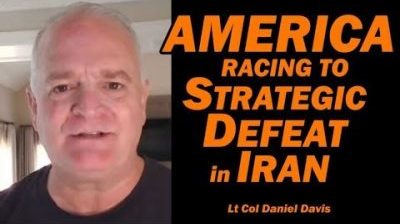
America Racing to Strategic Defeat in Iran
or go to
Aletho News Archives – Video-Images
From the Archives
Should Europeans ‘Thank’ the Americans for Destroying Nord Stream?
By Robert Bridge | Strategic Culture Foundation | September 29, 2022
With an investigation continuing into the destruction of the Nord Stream gas pipeline that provided energy supplies to Europe from Russia, there appears to be just one prime suspect, and that should surprise nobody.
Following the sabotage of the Nord Stream 1 and 2 gas pipelines, former Polish Foreign Minister Radoslaw Sikorski already seemed to know the identity of the perpetrator when he tweeted out: “Thank you, USA.”
At first glance, it seemed that Sikorski was speaking sarcastically, berating Washington for carrying out an attack that will have severe repercussions for the people of Europe. After all, how could anyone see any good coming from the termination of Europe’s primary source of gas reserves with winter just around the corner? It was Sikorski’s homeland of Poland, after all, that urged its citizens to collect firewood in the face of dwindling gas reserves.
In fact, the Polish diplomat was speaking one-hundred percent literally… continue
Blog Roll
 Aletho News
- UK’s New Pandemic Plan Would Turn Big Tech Into a Mass Location Tracking Network
- Growing insecurity, soaring prices fuel protests in north as regime bans evacuation: Sources
- Iran denies responsibility for ‘depraved’ attack on Kuwait desalination plant
- Bring The Troops Back. End This War Now!
- Can we please stop calling Israel the ‘only democracy in the Middle East’ now?
- US should start removing its troops from Germany, proposes AfD co-leader Chrupalla
- Iran Red Crescent: 600 educational centers attacked in US-Israeli ‘war crimes’
- Russian Oil Tanker Arrives in Cuba Amid U.S. Blockade
- America Racing to Strategic Defeat in Iran: Lt Col Daniel Davis
- FTC Warns Visa, Mastercard, PayPal, Stripe Over Political Debanking
- If Americans Knew
- As Iran targets US military bases, will they be relocated to Israel? Not a ceasefire Day 171
- Will Trump Go Kamikaze?
- Is the University of Florida Shutting Down College Republicans over Israel Criticism?
- Jewish extremist arrested over alleged plot to firebomb Palestinian activist Nerdeen Kiswani’s home
- More than half of Palestinian child detainees have no charges
- The More Murderous Israel Gets, The More We Hear About “Antisemitism”
- Land Day and the Palestinian struggle after 30 months of genocide
- The Iran War Is About Palestine
- Israeli soldiers echo settler ideology, talk of revenge after targeting Palestinians and detaining CNN crew in the West Bank
- Israeli Policies Threaten Future of Christian Schools in Jerusalem
- No Tricks Zone
- New Study Finds Warming Saves Lives…Cold Temperatures 12 Times More Deadly Than Excess Heat
- German Science Blog Accuses PIK Climate Institute Of Hallucinating Climate Tipping Points
- Devastating Assessment Of Comirnaty Vaccine By Former Senior Pfizer Europe Toxicologist
- New Study: CO2 Is ‘Effectively Negligible’ As An Explanatory Climate Change Factor Since 2000
- Former Pfizer Toxicologist Dr. Helmut Sterz Tells Bundestag Hearing Pfizer Vaccine Should Have Never Been Approved
- Energy Expert: Germany’s Nuclear Phaseout Was A “500 Billion Euro Mistake”
- New Research: South Australia’s Mid-Holocene Sea Surface Temperatures Were 4°C Warmer Than Today
- Storing Green Energy To Last Germany 10 Days Would Require A 60-Million Tonne Battery
- New Studies: UK Sea Levels Were 4 Meters Higher Than Today During The Mid-Holocene
- Destructive Green New Deal: German Energy And Metal Group Warns Of Drastic Crisis
 Aletho News