Ex-US Airman on Depleted Uranium: ‘I Saw Disfigured Newborns & My Dad Dying From Cancer’
By Ekaterina Blinova – Sputnik – 19.12.2023
It is only a matter of time before Ukraine uses depleted uranium ammunition on the battlefield, if it hasn’t already. The United States and United Kingdom sent the radioactive shells to the Zelensky regime earlier this year, and the rounds have been spotted in warehouses near the frontlines.
Following the costly failure of their “summer counteroffensive,” the Ukrainian military has begun desperately searching for “wonder weapons” to restore their battlefield fortunes.
Announcing the provision of DU rounds to Ukraine, Washington insisted in September that there’s nothing to worry about: the wonder-weapon is somewhat toxic, but overall harmless and fine. Rafael Grossi, International Atomic Energy Agency (IAEA) director general, joined the chorus, asserting to the public that there are “no significant radiological consequences” from the use of depleted uranium shells.
These are barefaced lies, according to Damacio A. Lopez, a US Air Force veteran who founded the International Depleted Uranium Study Team and co-founded the International Coalition to Ban Uranium Weapons (ICBUW).
“He [Grossi] is part of the team, part of the team that promotes this project, use of these weapons, he is part and parcel of the superpowers that use it and making excuses for it and trying to convince the public that this is not a problem, as they do repeatedly here in this country. You asked what the people thought about this. Well, they haven’t been getting accurate information. And I tried my best to get that information out in Uranium Battlefields and go in and talk to all these countries and try to explain what was going on.”
Damacio was one of the first Americans who raised the red flag about the disastrous consequences of the weapons. Since 1985, he has been seeking a global ban on depleted uranium arms, which are still not covered by international chemical or nuclear conventions, despite DU’s toxicity and radioactivity.
Sinister Black Cloud Over Socorro
Damacio was born in Socorro, a town in southern central New Mexico along the Rio Grande. Back in 1945, the Trinity nuclear test rocked the Jornada del Muerto Desert, only 36 miles southeast of his hometown. Damacio was only two years at that time, but later he became curious about radiation hazards.
The Trinity blast wasn’t the only US nuclear experiment in the region. In 1985, when Lopez visited his parents in Socorro during the Christmas holidays, the first thing he heard on his arrival was the sound of very loud explosions less than two miles from his house. Explosions occurred regularly, making dishes rattle and causing cracks in the walls. But even more alarming was a dark black cloud hovering over the town after the blasts.
“This was disturbing. And it wasn’t just my family. It was all the families in Socorro. From the middle of Socorro, the city park, to where the explosions had taken place, is two miles. That’s up. And the prevailing winds come over the community every time one of these bombs goes off. And of course, people were very concerned about what was going on. And my Mom asked me to look into this. And so I did. I contacted the Board of Regents of the New Mexico Institute of Mining and Technology, who are responsible for these explosions. Because they had been testing different kinds of weapons there since 1946.”
Lopez went to a Board of Regents meeting and asked about the explosions and dark clouds of smoke. But in response, he only got evasive answers.
Still, his efforts bore some fruit: one morning, he found five mysterious boxes in the front yard of his Socorro house. When he opened them, he found documents shedding light on the ongoing disaster.
“Well, those boxes were full of information about depleted uranium and testing in Socorro, and their ideas and what they were doing. And it went way, way back, before 1972, explaining the development of these weapons and what they were trying to do and the different kinds of weapons they were experimenting with, like cluster bombs instead of using metal or tungsten or titanium. They would try depleted uranium and see how that worked. So they were doing these kinds of preliminary testing, along with two other laboratories in New Mexico, plus laboratories outside of New Mexico. They were all working together. And I saw all this information. It wasn’t just about Socorro. It was about worldwide testing with what was going on in Europe and who was testing these weapons and what kind of weapons they were testing.”
He learned that the black cloud that he saw was radioactive and chemically toxic dust ejected into the atmosphere by depleted uranium blasts.
Damacio decided to dig deeper. He knew that the exposure to nuclear materials could lead to health problems, so he went to the Health Department in Santa Fe and sought information about Socorro’s residents. The records gave him the shivers: over past years, the community’s health problems had piled up, with the number of cases of hydrocephalus, cancer, and birth defects higher than in the other counties around the state.
This gruesome discovery prompted him to start researching the effects of depleted uranium contamination.
Horrific Effects of Exposure to Depleted Uranium
“I have a brother who’s bent over, and when he speaks, and he’s 10 years younger than me, something’s wrong with his spine,” Damacio said. “And his body is kind of flopped over. And when he looks at you, he looks like a turtle. He’s way down like this, and looks up. I mean, he’s normally about 5 ft 6 in. And now he looks like he’s about 4 ft. It’s a horrible sight. His teeth are all rotten. He’s the one who lives right next to the facility. You know, here’s the facility right here.
Here’s my house. And here is a town. There’s a fence between us and it says ‘Keep out, government property.’ And so our family is very close, one of the closest homes to this facility.”
“My dad ended up dying from cancer,” the activist continued. “And it was a sad situation for us. And like I said earlier, the people there, when they realized the truth about what was going on, instead of saying, ‘Oh, we want to stop this,’ no, they’re saying, ‘What? What can we do to survive? How can we survive this thing?’ And well, they couldn’t leave. So they just stay. And over the years, refusing sometimes to even acknowledge the dangers around them, because I believe they have no other choice. And it’s dehumanizing for people to be in that situation.”
In the late 1990s, Damacio was invited to Iraq by the nation’s authorities to speak at a conference on the depleted uranium weapons used in the country by the US during the Persian Gulf War (1990-1991). In 1993, Lopez and his fellows published the book Uranium Battlefields Home and Abroad: Depleted Uranium Use by the US Department of Defense, looking into DU testing sites in the US and the Pentagon’s use of the weapons abroad. The US and its allies unleashed over 300 tons of DU in Iraq.
“Well, when I went to Iraq and I told the people, I want to see if what’s happening here is happening there as well. So I’m not only the victim, but I’m also a researcher and I want to have accurate information. I just don’t want to take other people’s word for things. And I don’t, and I never have. Maybe at the very beginning of my discovery I did that. But since then, I want to see the people involved in these situations.”
“I found a lot of [health] related issues. At that conference that I went to, I learned a lot of things and I was one of the speakers at this conference. And so I was able to get studies from these medical people who had done a lot of studies on the people in Iraq and birth defects, cancers. These were the top things that were going on in their country, and some of the cancers were the same cancers, the same cancer that my father died from. And a lot of other people in the town were having problems in Socorro with birth defects. So I was able to go into hospitals in Iraq to see for myself the people who were victims.”
But the greatest shock for Damacio was Iraqi children who were born after the US bombing campaign. When he recalls them, he cannot hold back his tears.
“In one particular hospital I was able to see many, many children with birth defects that were so severe that it was so hard for me to think of them as even human.”
“I’m talking about very, very serious birth defects. Can you imagine walking into a place and seeing a child with one eye and his forehead? It’s like not even human. And I met this little boy. He was three years old. He was with his mother and he had a big head, hydrocephalus. And one eye was turned up and his other eye was turned down. He was skin and bones. He was three years old, couldn’t weigh more than 20 pounds. And his head was huge. Little tiny, tiny legs. It’s almost skin and bone. And the mother was holding him and wiping the blood from his mouth. And as I was leaving the hospital, tears started streaming down my face. I couldn’t control it. It was so, so bad.”
The little boy looked listless. Damacio thought for a moment that the toddler couldn’t see or hear. “And as I was leaving the room, I heard the little boy scream out: ‘Mama, mama!’ And it sent chills through my entire body.”
If Damacio were told at the time that the US government would throw another thousand tons of depleted uranium on Iraq in just three weeks during the Second Gulf War, it would have stopped the researcher’s heart.
Geiger Counter Never Lies: DU Weapons are Radioactive
Lopez suspected that these hideous birth defects and the spike in cancer cases were caused by depleted uranium’s radioactivity and toxicity. Preparing for his Iraq trip, he took his Geiger counter. The radiation detector “could identify alpha, beta, and gamma, and could identify whether it was depleted uranium or something more hot than depleted uranium,” according to the researcher.
While in Baghdad, Damacio visited the Amiriyah shelter, which was subjected to a US aerial attack that killed over 400 civilians, including children, on February 13, 1991.
“It was quite a sight when I was looking at the blood and hairs of the people on the walls and the children. And then there was an area where they had all their pictures. I was there with the Japanese delegation in this particular visit. And for them, it was common – it was not common, but they knew this well about the shadows on the wall and the hair and the blood from what happened in their country when they were bombed. So they understood all this.”
“Eyewitnesses told me, more than one said to me: ‘Damacio, what happened here is… I saw this projectile. I saw this large Tomahawk cruise missile making curves around streets.’ And then, when they got to the Amiriyah shelter, they went up high, came straight down in the middle of the shelter that had three stories, three feet of concrete between the stories to protect the people in there. In this case, children. There were more than 600 kids and school kids in that shelter at this time. The missile came down from the middle of the shelter, went through, went all the way down to the bottom of the shelter, and then went into a deep hole there. I saw all this, and they’re watching it.”
Lopez decided to find remnants of projectiles used during the US bombing of Baghdad and other areas and make measurements. He knew that typically, natural background radiation levels could range between five and 60 counts per minute, or a little more. Anything higher than that meant potential radioactive contamination.
“I found in one of the facilities in Baghdad after going to the Amiriyah shelter, there was an exhibition, there was a big building and they had picked up all the war remnants that they had found. One of them was partially, about three quarters, a Tomahawk cruise missile. And I had my detector and I checked it out. It was about a hundred counts per minute, which was an indication that there was radiation within this Tomahawk cruise missile.”
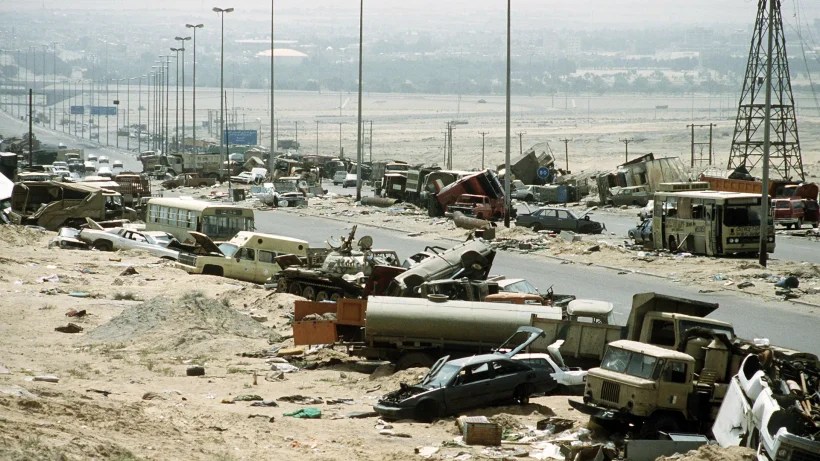
Then he travelled to a site on the border between Kuwait and Iraq, dubbed the “Highway of Death,” where thousands of Iraqi tanks and armored vehicles were pierced and burned by DU munitions fired by US A-10 Warthogs. There, he got readings of about 100-120 counts per minute on the holes of the damaged tanks. Lopez also collected small pieces of metal as samples that showed a reading of 600 counts per minute.
“And I happened to find several projectiles, 30 millimeters, that had missed the target and hit the ground and bounced. And they were intact. So I checked them out with my detector, thinking I’m going to get 600 counts per minute. I was getting 2,500 per minute on these projectiles, so high that my radiation detector wouldn’t go any higher than in its capabilities. And it would go ‘u-u-u-u,’ could have been higher than 2,400 counts per minute. And the only conclusion I could draw from that is that nuclear waste from nuclear facilities was being mixed with what was so-called depleted uranium. And this became even more alarming.”
DU Weapons are Made of Radioactive Waste
Lopez tried to find out why the US had decided to use depleted uranium for its ammo in the first place.
Damacio’s book Uranium Battlefields Home and Abroad: Depleted Uranium Use by the US Department of Defense explains that DU is a byproduct of the uranium enrichment process by which the fissionable isotope uranium-235 (U235) is extracted from natural uranium for subsequent use as fuel for nuclear reactors.
Natural uranium, a silvery-grey metal, contains 0.7% U235, 99.3% U238, and a small amount of U234 by mass. After producing 85 kilograms of enriched uranium, one would get 915 kg of U238, or depleted uranium.
The Pentagon argues that U238 retains “only” 60% of natural uranium’s radioactivity and emits alpha particles, which have low penetration depth and can be stopped by skin. Inside the body, however, alpha-emitters can be extremely harmful, damaging sensitive living tissue. After the explosion of DU projectiles, microscopic and light uranium dust can travel with the wind, be inhaled, swallowed, or enter the body through a wound, later causing cancer and chromosome damage.
One should bear in mind that depleted uranium is radioactive waste that should be disposed of, Lopez pointed out in his book. However, almost all DU tails have been saved by the US government since the early 1940s. Moreover, they can be purchased for commercial use, according to the researcher. To date, the US has accumulated a massive storage of DU amounting to over 700,000 metric tons.
Why Do Pentagon and Defense Contractors Like DU So Much?
Lopez explained that from a military standpoint, the most important property of DU is its great density, relatively low cost of fabrication, and availability. The material is used for tank armor and projectiles of different sizes.
Highly-dense DU munitions easily pierce tanks and other armored vehicles. While tungsten carbide projectiles are capable of doing the same, DU is cheaper, more accessible, and offers greater margins for US military firms.
On the other hand, turning spent uranium into bullets and shells has become an “ingenious” solution for the US nuclear industry on how to “dispose” of radioactive waste, Lopez said in his book. So, as money talks, the US’ testing and use of DU weapons continue unabated, according to the activist.
But has the Pentagon ever been aware of the long-lasting hazard related to DU projectiles?
The US Department of Defense’s internal memos, leaked to the press in the late 1990s and the beginning of the 2000s, indicate that the Pentagon knew. But why would it use the toxic and radioactive substance nevertheless?
A March 1, 1991 document shows the US DoD’s attitude to DU weapons use in a nutshell. Authored by US Lieutenant Colonel M.V. Ziehmn at the Los Alamos Laboratories in New Mexico, the memo reads:
“There has been and continues to be a concern regarding the impact of DU [sic] on the environment.
Therefore, if no one makes a case for the effectiveness of DU on the battlefield, DU rounds may become politically unacceptable and thus, be deleted from the arsenal.”
The memo went on by saying: “If DU penetrators proved their worth during our recent combat activities, then we should assure their future existence (until something better is developed),” adding “we should keep this sensitive issue at mind when after action reports [sic] are written”; otherwise the US may lose “a valuable combat capability.”
Why Are the Pentagon and White House Keeping DU’s Deadly Effects Secret?
The documentary Uranium 238: The Pentagon´s Dirty Pool (2009), used by Lopez’s International Coalition to Ban Uranium Weapons (ICBUW) as part of its international campaign to prohibit DU, said that the Pentagon is in denial about DU munitions potentially leading to carcinogenic diseases, birth defects, and environmental contamination.
The US Defense Department has even invented a sort of “DU diplomacy” to reassure the world community and American citizens that there is nothing to worry about, according to the ICBUW. Meanwhile, the US has not only failed to inform affected nations – Iraq, Bosnia, Serbia, Syria – about the DU hazard, but also repeatedly exposed American soldiers to the toxic and radioactive waste. Per the documentary, DU weapons in all but name are a “dirty bomb” – a mix of explosives and radioactive material – used by terrorists. Yet somehow DU rounds are still called “conventional weapons.”
One could easily imagine that if the US government admits DU’s hazardous effects, the weapon would be banned, influential defense contractors would be stripped of their profits, and Washington would be slapped with a heap of legal cases with compensation demands.
And the US is not the only country that uses depleted uranium as a weapon, as some of its NATO allies also do, according to Lopez.
“[The US keeps DU’s deadly effect secret], for the same reason all the other countries that have the weapon kept secret, as much as they can keep it secret, it is because they know they’re violating international laws, international conventions on weapons, and they know that they’re going to have to pay the price someday, and they may end up with charges of violations of international laws. And so they’re trying to protect themselves. And at the same time, they want to continue to keep the weapon because they’re afraid other countries have weapons too,” Lopez concluded.
50 injured as NATO troops clash with Serb demonstrators
RT | May 29, 2023
NATO forces attacked a group of demonstrators in the majority-Serb town of Zvecan in Kosovo, RT Balkan reported on Monday. Stun grenades and tear gas were deployed, and around 50 people were injured.
Serb demonstrators staged a sit-down protest outside municipal buildings in Zvecan, Zubin Potok and Leposavic on Monday morning, preventing ethnic Albanian officials from taking office after elections boycotted by the Serb population as illegitimate.
Kosovo police officers arrived on the scene in Zvecan, backed up by members of NATO’s Kosovo Force (KFOR). The heavily-armored NATO troops surrounded the demonstrators, who refused to disperse, RT Balkan’s journalist on the scene reported.
KFOR then threw stun grenades and tear gas into the crowd, provoking a riot. The Serb demonstrators pelted rocks at the NATO troops, and received baton strikes and rubber bullets in return. Fifty people went to a hospital in nearby Mitrovica, and two were admitted to the emergency room.
25 KFOR soldiers were injured in the melee, Italy’s ANSA news agency said. 11 of those reportedly hurt were Italians.
The protesters broke up shortly after the clashes, vowing to return and continue their demonstration on Tuesday.
The latest flareup in tensions began when local mayors in four majority Serb towns in northern Kosovo resigned last year after authorities in Pristina announced plans to force residents to switch their Serbian identity documents for Kosovo-issued ones. The Serb population of these four towns boycotted elections in April in which four ethnic Albanian mayors won with a turnout of less than 4%.
Nevertheless, the government in Pristina treated the votes as legitimate and the mayors were installed on Friday amid fierce opposition from the Serbs, who view the debacle as a naked power grab aimed at driving them from the breakaway province.
Kosovo unilaterally declared independence in 2008 with the support of the US and many of its NATO allies. Kosovo was historically a province of Serbia, and Belgrade – along with many world governments – does not recognize Kosovo as an independent state.
While NATO Secretary General Jens Stoltenberg and a number of Kosovo’s Western backers have urged Kosovo’s ethnic Albanian leader, Albin Kurti, to de-escalate the situation in the north of the province, he has apparently not heeded their warnings. Serbian President Aleksandar Vucic said on Sunday that Kurti “longs and dreams of being a [Ukrainian President Vladimir] Zelensky.”
Due to the clashes, Serbia placed its army on high alert, moving some units closer to the region’s border. Defense Minister Milos Vucevic said that “it is clear that terror against the Serb community in Kosovo is happening.”
Serbia ‘urgently’ moving army to Kosovo frontier – minister
RT | May 26, 2023
Serbian President Aleksandar Vucic has placed the national armed forces on high alert and ordered units to move towards the administrative line dividing the breakaway province of Kosovo from the rest of the country. The move comes following clashes between police and protesters in a majority-Serb town in the region on Friday.
“An urgent movement of forces to the Kosovo border has been ordered,” Defense Minister Milos Vucevic confirmed in a TV broadcast, adding that it is clear that “terror against the Serb community in Kosovo” is continuing.
Vucevic said the security of Serbs in Kosovo and Metohija was being threatened by the region’s ethnic Albanian prime minister Albin Kurti. He called on citizens to remain as calm as possible and not to fall for provocations.
Earlier in the day, Serbs in the town of Zvecan had clashed with police as a newly-elected ethnic Albanian mayor prepared to enter his office following local elections. The votes in four municipalities had been boycotted by the majority-Serb residents who had sought more autonomy and representation and regarded the votes as an attempt to seize the Serbian municipalities by illegitimate representatives. Turnout in the vote on April 23 was a mere 3.47%, with locals saying they would not work with the newly elected officials.
According to local media, police from Pristina used stun grenades and fired tear gas at protesters who had gathered in front of an administrative building, while Reuters reported that a police car had been set ablaze.
RT Balkan reported that around a dozen people were admitted to hospital with minor injuries.
Vucevic told Pink TV that what President Vucic had been warning the international community about for days and weeks has now “turned out to be true,” accusing Pristina of escalating tensions and instigating terror against Serbs.
“Someone needs to understand that what Albin Kurti is doing is leading us to red lines and to a complete collapse of dialogue and an escalation on the ground,” Vucevic said.
Last Friday, Vucic declared that Serbia’s refusal to acquiesce to the West’s demands and recognize Kosovo’s independence had made his country a target for foreign interference, but that he would “never surrender” and would “never let them make Kosovo independent.”
Kosovo unilaterally declared independence in 2008 with the support of the US and many of its allies. The breakaway region is not recognized by several countries, including Russia and China, or by Serbia itself.
The EU, however, has repeatedly demanded that Belgrade must recognize and “normalize” relations with Pristina if it wants to become a member of the bloc.
Serbian president reveals what West wants him to do
RT | May 9, 2023
The West has not given up on steamrolling Serbia into imposing sanctions on Russia, the country’s president, Aleksandar Vucic, has revealed. However, he said Belgrade has so far been able to resist the pressure.
Speaking to Serbia’s Happy TV channel on Monday, Vucic said that “whoever comes [to Belgrade feels their] first obligation is to explain to me that I am a jerk who did not introduce sanctions.”
The Serbian head of state acknowledged that he had already gotten used to constant “pressure [and] ultimatums” from Western representatives.
Last month, the European Parliament’s Foreign Affairs Committee slammed Serbia for its failure to join the EU sanctions against Russia, and urged Belgrade to shut down Russian “disinformation” outlets, including RT Balkans.
The US State Department also called for a ban on the media outlet, which began broadcasting in November 2022.
Speaking in mid-March, President Vucic reiterated that his government’s “position is to not impose sanctions” on Moscow over its actions in Ukraine. He made it clear that this could be changed only in “circumstances when there is no way out.”
His remark came in response to calls made earlier that month by the country’s Economy Minister Rade Basta on social media. Basta argued that Belgrade should impose punitive measures because Western pressure was becoming unbearable.
The minister quickly came under fire from within his own party for his comments.
Serbia has resisted pressure from the EU and the US to sanction Russia, citing, among other things, the apparent discrepancy between Western demands that Belgrade recognize the independence of the breakaway province of Kosovo and their simultaneous insistence on Ukraine’s territorial integrity.
Kiev sends media ‘correct terminology’ instructions
RT | April 28, 2023
A list of “correct” phrases, narratives and names emailed to media outlets in Serbia is genuine and came at the instruction of the foreign ministry in Kiev, Ukraine’s embassy in Belgrade confirmed on Friday.
“It’s a recommendation we sent out to the media so that they would use correct terminology in their reporting regarding the war in Ukraine,” the embassy told the daily Novosti. According to RT Balkans, the email was sent to all print and electronic media in Serbia on Thursday.
According to the instructions, reporters should use “Russia’s war of aggression against Ukraine” instead of calling it a crisis, conflict, war, or even “Russian war in Ukraine.” Another guideline insists that “unprovoked full-scale military invasion” should be used instead of “special military operation.”
The Pentagon and multiple US and UK outlets already use this terminology, but it is unclear whether they adopted it on “recommendations” from the Ukrainian Foreign Ministry, or if it was the other way around.
The email comes after the US and the EU demanded Belgrade censor and ban Russian outlets such as RT Balkans and Sputnik, and crack down on ‘Russian narratives’ about Ukraine. While some Western-owned media in Serbia already use Kiev’s preferred phrasing, some outlets were offended by the embassy’s efforts to censor their reporting.
“Who are they to recommend to anyone how to work, or write?” Filip Rodic, the deputy head editor at Pecat magazine, told Novosti. “If they think they can censor the entire world, that’s total insanity.”
There was no explanation why the document sent to Serbian media was entirely in English, either. Some of the politically proscribed phrases in it – “the Ukraine,” for example – are already meaningless in Serbian, whose grammar has no articles. It is also a phonetic language that doesn’t spell, which makes the insistence on using Ukrainian spellings for place names – Horlivka and not Gorlovka, Kharkiv and not Kharkov, Mykolaiv and not Nikolaev, etc. – likewise not applicable.
In places, the document appears to confuse official narratives for recommended phrasing, demanding the use of “Ukraine’s legitimate efforts to de-occupy Crimea, which is a part of Ukraine’s sovereign territory within the internationally recognized borders,” in place of “Ukraine’s attacks on Crimea,” for example.
The government in Kiev has insisted for years on using its preferred phrases and place names, such as imposing “Kyiv” on English speakers. One prominent Ukrainian activist explained last month that language “plays a critical role” in the hybrid war, because it “creates a mental map in our mind which we use to make sense of what’s happening.”
“One of the best ways to support us is using Ukraine-centric terminology,” said Alona Shevchenko of Ukraine DAO.
Moscow responds to EU call for Serbia to ban Russian media
RT | April 27, 2023
The European Parliament’s insistence that Serbia censor RT Balkans and Sputnik in order to “harmonize” with the EU is absurd, evil, and a manifestation of imperialism and colonialism, Russian Foreign Ministry spokeswoman Maria Zakharova has claimed.
On Wednesday, the parliament’s foreign affairs committee adopted the report by Slovakian MEP Vladimir Bilcik, criticizing Serbia for not joining the EU sanctions against Russia and demanding Belgrade shut down Russian “disinformation” outlets just as the bloc has done. The US State Department has also called for a ban on RT Balkans.
“It’s an absurd situation,” Zakharova told reporters at the daily briefing in Moscow on Thursday. “These statements speak for themselves. The West isn’t even hiding, but saying the quiet part out loud.”
The US and the EU are now openly saying that Russia, Russian culture and language, or Russian media and journalists, simply shouldn’t exist, Zakharova noted. She compared the European Parliament’s demands to calls by Ukrainian officials to “exterminate” the Russian population in Crimea and Donbass, saying they can only be described as “evil.”
“The only possible thing to say is that this is an imperialist point of view, a manifestation of neo-colonialism. Some countries, without any moral grounds, illegally arrogate to themselves the right to model the world and its development at their own discretion: who can live, speak, trade, produce, have children, and who cannot,” Zakharova told reporters. “This is a modern version of slavery, in which the colonial powers claim the right to be considered masters, and others – their slaves.”
“Those who like these rules of the game have the right to play by them. We don’t. This is what we rebelled against.”
The US and its allies, Zakharova argued, want Russia to have no opportunity to speak, because the very existence of Russian media threatens the Western plans for narrative manipulation.
“Our media, journalists and outlets report from the epicenters of world events, based on facts, encourage people to critically evaluate reality (as they should),” the Foreign Ministry spokeswoman said. “Apparently, this goes against the plans that the American rulers have to ‘zombify’ their own population.”
American television, Zakharova noted, presents a “a one-sided, practically sterilized, filtered and adjusted picture of the world,” having reached an “ideological dead end.” Any airing of alternative viewpoints threatens to expose this media ecosystem as biased and contradictory.
RT Balkans began operations in November 2022. The EU reportedly plans to blacklist the outlet as part of its 11th package of sanctions against Russia. The bloc had banned all broadcasting activities by RT and Sputnik in March 2022, calling them “Russian propaganda” that endangered Ukraine. Major social media platforms have blocked RT accounts in the bloc, while YouTube extended the ban globally.
Serbia warns of retaliation against Ukraine
RT | April 25, 2023
Serbia may change its stance on Ukraine’s territorial integrity after Kiev abstained during a vote on accepting the breakaway region of Kosovo’s request to join the Council of Europe, Serbian Foreign Minister Ivica Dacic has said.
The Ministerial Committee of the Council of Europe held an extraordinary meeting on Tuesday to decide the fate of Kosovo’s application. The bid was supported by 33 members out of 46, with seven against, and five abstaining.
“I must say that Ukraine has surprised us unpleasantly” by being among the abstaining members, Dacic said shortly after the vote.
“This whole story is based on territorial integrity when it comes to [the conflict in] Ukraine. You know how much effort it takes for [Serbia] to vote for all the resolutions, to condemn the violation of territorial integrity of Ukraine,” he said.
The diplomat pointed out that “foreign policy is based on reciprocity. This will certainly affect our views in the future on territorial integrity of those countries,” he said, referring to Ukraine, Bosnia and Herzegovina, Greece, Slovakia, Armenia as some of the nations whose votes surprised him.
Serbia, which has close ties with Russia, has been resisting Western pressure to sanction Moscow over the conflict in Ukraine. However, it has condemned the use of force by Moscow and insisted that the territorial integrity of the Ukrainian state should be respected.
The majority ethnic Albanian region of Kosovo unilaterally declared independence from Serbia back in 2008. The US and many of its allies recognized the province as a sovereign state almost immediately. However, Belgrade still considers Kosovo to be part of its territory and the region is not recognized by Russia, China and several other nations.
Pristina’s Foreign Minister Donika Gervalla-Schwarz hailed the vote as “a historic step, perhaps the most important after our independence.” The final verdict on the bid by Pristina is to be delivered by the Parliamentary Assembly of the Council of Europe.
Dacic condemned the development, warning that it may well lead to a situation where “a part of some other country is going to be offered to join the Council of Europe.”
Serbia and Hungary form Strategic Council despite EU opposition
By Ahmed Adel | March 29, 2023
The idea of forming a Serbia-Hungary Strategic Council was announced by Serbian President Aleksandar Vučić after his meeting with Hungarian Prime Minister Viktor Orbán in Belgrade on March 25. Specifically, Vučić announced that the strategic council between the two countries would be established in May. As Serbia is a non-EU/NATO member, unlike Hungary, it is guaranteed that Brussels and Washington are not happy about the strengthening ties between the two neighbouring countries.
Accordingly, the council would deal with the issue of security, the fight against terrorism, and opens the possibility of cooperation between their armies and police in the military-technical sense. It is for this reason, despite the benefits that this strategic cooperation brings for both countries, Brussels and Washington are not happy with this emergence.
The issue of security is very important and is back at the forefront due to the crisis in Ukraine. More than ever, the spotlight has not just been placed on security in the traditional sense, but also in regards to energy. Serbia and Hungary are connected not only by good mutual relations, but also by their tense relationship with the European Union. Although Hungary is an EU member, it has a number of open issues with the bloc, such as the handling of the war in Ukraine. Fundamentally, Serbia’s and Hungary’s current interests are opposed to that of the EU, and it is also this factor which unites them.
Serbia has excellent economic relations with Russia and China, and Orbán as a Hungarian nationalist, broke from EU consensus and concluded that his country should not have confrontational ties with Moscow. Serbia and Hungary are looking towards a Eurasian future rather than an Atlanticist one, something which binds their commonalities and necessitates the need for a common strategic council.
In addition, Hungary is surrounded by countries with which it has a rather difficult historical (and sometimes current) relations, regardless of mutual NATO and EU membership, namely Romania and Slovakia. However, Hungary also never had great relations with Ukraine or Yugoslavia. With Serbia though, the successor of Yugoslavia, this has massively changed.
Both Belgrade and Budapest have invested a lot of energy into thawing relations in the last ten years. This developing relationship was epitomised with the Serbian Parliament in December ratifying the agreement on strategic cooperation between Serbia and Hungary.
Hungary is the only country neighbouring Serbia that Belgrade has concluded a strategic cooperation with, and it relates to more than twenty areas. This includes infrastructure and the economy, where Hungary is already among the first foreign trade partners of Serbia. This also extends to other sectors too, which is why Hungary is rapidly becoming one of Serbia’s closest partners.
When the future strategic council of Serbia and Hungary is viewed objectively, it is seen as purely political in nature and an effort to thrive under new global circumstances. That is why the council is essential. The current events in Ukraine, where there is a large Hungarian minority, and the remaining question over Kosovo, means that Serbia and Hungary will need to support each other more than ever as most of Europe is in favour of backing the Kiev regime and separatists in Kosovo.
Hungary has openly and repeatedly said that it does not want to be part of any adventure and war. Serbia also maintains a neutral position politically, although the majority of people are pro-Russian because of their own experience with NATO and the entire historical experience preceding and following it.
The fact that Budapest has good relations with not only Belgrade, but also the Republika Srpska (the Serbian entity of the Bosnia and Herzegovina Federation), is also important as it demonstrates again that Orbán’s Hungary is not only working based on values and principles, but also on the need for an ally in the region. Practically, with an interesting turn of historical circumstances, the Hungarians realised that their most reliable ally would be the Serbs, both in Serbia and Republika Srpska.
Hungarian Foreign Minister Péter Szijjártó commented on the meeting in a video on his Facebook page. He stressed that the strategic partnership and friendship between Belgrade and Budapest will greatly contribute to Hungary’s ability to better address the challenges it faces – primarily economic, security, and energy supply.
Szijjártó also recalled that under the long-term agreement with the Russian state-owned Gazprom, “natural gas for Hungary’s supply comes via Serbia, and Hungary stores hundreds of millions of cubic metres of gas for Serbia.”
European countries have destroyed their economies for sanctioning Russia and cutting gas supplies, something Budapest has done its best to avoid. For this reason, it is increasingly finding itself with more common interests with Belgrade and will not be hindered from jointly pursuing them just because Serbia is not an EU or NATO member.
Ahmed Adel is a Cairo-based geopolitics and political economy researcher.
Featured Video

Iran’s Next Strike May Not Explode. It Could Shut You Down
or go to
Aletho News Archives – Video-Images
From the Archive
Zionism’s Violent Legacy
By Donald Neff | Washington Report On Middle East Affairs | January 1996
On January 4, 1948, Jewish terrorists drove a truck loaded with explosives into the center of the all Arab city of Jaffa and detonated it, killing 26 and wounding around 100 Palestinian men, women and children.[1] The attack was the work of the Irgun Zvai Leumi – the “National Military Organization,” also known by the Hebrew letters Etzel – the largest Jewish terrorist group in Palestine. The Irgun was headed by Revisionist Zionist Menachem Begin and had been killing and maiming Arabs, Britons and even Jews for the previous ten years in its efforts to establish a Jewish state.
This terror campaign meant that at the core of Revisionist Zionism there existed a philosophical embrace of violence. … continue
Blog Roll
 Aletho News
- Trump’s Iran war is on an Israeli leash
- Saudi oil boss issues global supply warning
- Riyadh Says Its Oil System Is Intact. The Numbers Say Otherwise.
- Trump and Netanyahu Want to “Finish the Job” on Iran
- US ‘one-sided dictation’ not Iran’s beliefs makes rational talks impossible: Baghaei
- Iran’s Next Strike May Not Explode. It Could Shut You Down /Col Doug Macgregor
- Iran: US political targets legitimate if assassinations return
- Iraq shuts key border crossing with Iran under US pressure: Report
- Undersea Internet cables could be targeted in retaliation for attacks on Iran: IRGC deputy chief
- EU sending ‘biased’ observers to interfere in Serbian election – president
- If Americans Knew
- Israel’s vision of regional security rests on keeping Arab states weak
- Heidi Levine recounts how Palestinian youths helped save her in settler attack
- DAILY UPDATE: Latest essential news on Palestine, Israel, & region
- Trump’s Intensifying Sabotage of the ICC, for Israel’s Sake
- Israeli military detain US and UK volunteers in West Bank including Democratic NY politician Brad Lander
- Americans at National Conservatism Conference held in Israel this year criticize Israel
- Christiane Amanpour exits CNN with a legacy shaped by the debate over Israel
- Israel’s war on Iran is the final move in a decades-old strategy
- Israel Denies Entry to French Journalist, U.S. Researcher Amid Rise in Entry Denials
- Gaza’s hospitals are running out of life-saving fuel – Daily Update
- No Tricks Zone
- E-Cars Reduce CO2 Emissions By Only 41% Compared To Internal Combustion Engine Vehicles
- Predictions Made By Renowned Climate Professor Over Past Decades Have Been Proven To Be Poor
- New Study Suggests Large Regions Of The Pacific Ocean Have Been Cooling For The Last 80 Years
- Germany’s Green Energy Debacle: High Energy Costs Force Kahla Porzellan to Close After 182 Years!
- New Study: 50 Years Of The Most Aggressive ‘Net Zero’ Policies Can Only Affect The Global Climate By 0.03°C
- US September “Heat” Was No Record…Many Records Set Decades Ago
- Latest European Green Energy Debacle; Portugal’s Largest Flagship Solar Park Insolvent!
- Green Energy Debacle: German Expert Professor Fritz Vahrenholt Warns Of Severe Economic And Social Consequences
- Two More Paleo Reconstructions Affirm Meters-Higher Sea Levels Across Ireland, Brazil 7000-6000 Years Ago
- New Study: Earth And Venus Surface Warmth Largely Explained By Convection And Lapse Rate, Not CO2 Or Radiation

