In ASEAN Nations, Coal Is a Physical Manifestation of Progress
By Vijay Jayaraj | Real Clear Markets | September 9, 2025
When most people think of ASEAN – a diverse association of Southeast Asian nations that include Brunei, Cambodia, Indonesia, Laos, Malaysia, Myanmar, the Philippines, Singapore, Thailand, and Vietnam – they picture Thailand’s beaches, Singapore’s gleaming skyline or Indonesia’s temples.
What they don’t see is an economic juggernaut that will drive some of the planet’s largest growth in energy demand. Vietnam has emerged as a global manufacturing hub. Indonesia processes the world’s nickel for electric vehicle batteries. Thailand manufactures automobiles for export across Asia. Each of these economic engines demands reliable, affordable electricity that operates 24 hours a day, seven days a week.
In fact, 2023 witnessed a demand increase of nearly 45 terawatt-hours (TWh), an amount of energy that must be generated, transmitted regionally, and delivered locally on a continual basis. Where did this new power come from? Coal. An astonishing 96% of that new demand was met by coal-fired power plants.
Let that sink in. Coal, the energy source routinely demonized in Western capitals and at global climate summits, met nearly all the region’s new electricity needs. This reality stands in direct contradiction to rosy predictions of a transition to “renewables” manufactured by highly compensated executives at elite consulting firms who have spent the better part of a decade selling energy fairy tales to governments and investors.
Indonesia alone added 11 TWh of coal-generated electricity in 2023, while its electricity demand rose by 17 TWh, with coal meeting two-thirds of this increase. The Philippines generates more than 60% of its electricity from coal, and Malaysia and Vietnam each around 50%.
Ultra-supercritical coal technology – using extraordinarily high temperatures and pressures and pioneered at Malaysia’s Manjung plant and Indonesia’s Batang facility, delivers higher efficiency than older coal plants. These advanced facilities demonstrate that coal technology continues to improve while wind and solar remain dependent on weather conditions and the time of day.
The wind and solar share across ASEAN remained a pitiful 4.5% in 2023. This minuscule contribution exposes the bankruptcy of consultants’ promises of “renewables” dominating the regional power mix by mid-2020s.
Coal’s dominance in recent years is not an accident; it is a necessity. Indonesia, the region’s economic giant, leans on coal to power its export-driven industries, including nickel for EV batteries. Vietnam’s manufacturing boom, lifting millions into the middle class, runs on coal’s steady output. Malaysia and the Philippines, too, rely on coal to sustain their growing economies. Even Singapore, a global hub of innovation, depends on coal to maintain its energy security.
Yet, to focus solely on the power grid is to miss the forest for the trees, as electricity is just one component of total energy consumption. Electricity represents only a fraction of total consumption across ASEAN. The larger picture is primary energy consumption, which includes fuel for transport, industry and heating.
Oil, natural gas and coal collectively hold the major share of ASEAN’s primary energy mix, with oil leading consumption patterns across transportation and industrial sectors. Factories, petrochemicals, shipping, aviation, and agriculture all consume fossil fuels in large quantities.
ASEAN countries are committing hundreds of billions of dollars to fossil fuel infrastructure that will operate for decades. Coal plants have an average lifespan of 40 years. These capital investments create long-term commitments to hydrocarbon use that extend far beyond current political cycles.
Nineteen projects across Malaysia, Vietnam, Brunei, Indonesia, and Myanmar hold more than 540 billion cubic meters of recoverable gas. Countries don’t spend billions developing gas fields if they plan to abandon fossil fuels within the next decade.
ASEAN’s embrace of coal is about more than just keeping the lights on. These nations aren’t chasing arbitrary climate targets; they’re building the infrastructure of their future and prosperity for people.
Every new airport, every new highway and every new factory is a testament to the power of coal. To argue against coal is to oppose the physical manifestations of progress. The “green” agenda, by seeking to eliminate coal, demands that the developing world stop building – an ultimatum that ASEAN is rightly and wisely ignoring.
I was interrogated in Singapore twice for writing about Palestine
By Dr. Muhammad Zulfikar Rakhmat | MEMO | May 10, 2025
In 2023, I experienced something I never expected in a country like Singapore. Not once, but twice, I was detained and interrogated at Changi Airport—not for breaking any law, not for carrying suspicious items, but for my work as an academic and journalist who writes on Middle Eastern affairs, especially Palestine.
I am an Indonesian citizen. I grew up in Qatar due to my father’s work relocation and completed my high school and undergraduate education there. I later studied in the UK, and between 2022 and 2025, I lived and worked in South Korea as a Research Professor at Busan University of Foreign Studies. My writing has long focused on the politics of the Middle East, with a consistent interest in Palestine—a cause rooted in personal history, moral clarity, and scholarly duty.
In February 2023, my wife and I were in transit in Singapore, flying back to Indonesia from South Korea. We had planned a quiet evening during our overnight layover, including a stop to try halal noodles at Tampines Mall. But instead of a peaceful layover, I was stopped at immigration and taken to a secluded room beside the counter. My wife was told to wait nearby, confused and anxious.
After a short wait, three men approached me, identifying themselves as Singapore’s security officers. They questioned me about my background, my travel history across the Middle East, and most tellingly—my academic and journalistic work. They seized my phone and combed through its contents. One of them referred to me as a “prolific writer,” a remark that made it clear they had done prior research on me before the encounter. Another asked, “Why do you write about the Middle East, especially Palestine?” They also pressed me on my views regarding the situation in the Middle East, suggesting a deeper interest not just in what I had written, but in the perspectives I held.
They never explicitly accused me of wrongdoing. But their fixation on my publications, and on my years living across the Middle East, was a clear indication that my intellectual work had triggered their attention. Later, my wife told me that one officer had directly told her that they were questioning me because of my journalism. After hours of interrogation, I was released and escorted to the departure gate. We never got to try the noodles, and we were told to wait until morning for our connecting flight. Before letting me go, one officer gave a parting warning: “Don’t write about our encounter.”
I’m writing about it now because such intimidation cannot go unchallenged.
Seven months later, in September 2023, it happened again. I was on a flight from Busan to Yogyakarta via Singapore. Because the transfer wasn’t automatic, I had to go through immigration to recheck my bags. The moment my passport was scanned, I was flagged and pulled aside once more. The questioning this time was shorter, but the tone and focus were the same. Even when I returned in the morning to board my next flight, I was flagged again and directed to a “special” immigration counter.
These were not isolated or accidental encounters. My name and passport had clearly been red-flagged.
Ironically, I have professional ties with Singapore itself. I am affiliated with the Middle East Institute at the National University of Singapore—one of the country’s premier academic institutions on Middle Eastern affairs. But that did not seem to matter to the security officers who questioned me. My intellectual contribution meant nothing in the face of state suspicion.
I have traveled to over 40 countries. Like many Muslims and Middle East-focused researchers, I’ve experienced scrutiny at airports, including once under the UK’s notorious Schedule 7 counter-terror law at Manchester Airport. But to face this kind of treatment in Singapore—a country I had visited multiple times in the past without issue, and the very first country I ever traveled to as a young student—was deeply unsettling.
Singapore’s position on Palestine is telling. While it officially supports a two-state solution and often expresses concern over violence in the region, its foreign policy leans heavily toward Israel. Military cooperation between the two states is robust, including procurement of Israeli-made weaponry. As such, open criticism of Israel or public support for Palestinian rights may be quietly discouraged within Singapore’s tightly controlled public sphere. For foreign nationals like myself, even transiting through the airport can be enough to trigger scrutiny.
This raises critical questions about freedom of expression and academic independence—not just inside Singapore, but across a growing network of states that prioritise geopolitical alliances over basic rights. The chilling effect is real. After these experiences, I now actively avoid flights that transit through Singapore. I decline invitations to speak or participate in events there. I no longer feel safe traveling through a country that punishes intellectual inquiry into the Middle East.
We must ask: what kind of global academic and journalistic space are we creating when states begin punishing people not for what they do, but for what they write? When security officers begin quoting your articles to justify a border interrogation, you know you are not just being profiled—you are being surveilled for thought.
Journalists and scholars must remain vigilant. We must continue to speak truth to power, especially when it concerns oppressed peoples like the Palestinians. It is essential to continue challenging power through critical inquiry and to document the subtle and overt ways in which restrictions on freedom of expression and dissent extend beyond national borders.
Singapore, for its part, must be held accountable. If it wants to remain a respected hub for global transit, business, and academia, it cannot target people based on their views. It cannot pick and choose which intellectual conversations are permissible. And it certainly cannot suppress writing on Palestine without revealing its own complicity in a much larger effort to silence that struggle.
Let us be clear: Palestine is not a taboo. Palestine is not a crime. Writing about it should not make anyone a suspect.
I was told not to write about what happened to me at Changi Airport. But silence is not an option.
Is a Social Credit System Coming for Us?
By Tessa Lena | May 13, 2022
A Social Credit Score System Is Piloted in Bologna, Italy
The city administration of Bologna, Italy, is piloting a program that brings the beast of the Fourth Industrial Revolution straight to the citizens. It’s an early reiteration of Klaus’ Schwab’s Fourth Industrial Revolution, the honey moon, so to speak — so it comes to the citizens wrapped in gift paper, with balloons, prizes, and party language. But make no mistake: underneath, there is cruel man-eating machine that wants to mine your data and control your behavior!
So, what exactly is happening in Bologna? The administration is “digitizing” their relationship with the citizens. For starters, they are launching an app — with a catch — that will provide an interface to get access to various local services. Without saying it, the they are implementing the “digital governance” aspect of the Fourth Industrial Revolution. Quoting the Italian source:
“We will give citizens services based on their needs – says the Mayor – and this will allow us to personalize their experience. People will be able to find everything the administration will do on their mobile phones or computers. The physical branches, however, will not disappear.
“We will maintain a ‘physical’ support for all people who do not use the web, especially the older ones,” assures Lepore [Mayor of Bologna]. But the goal is computer literacy that leaves no one behind.”
If we read this announcement with innocent eyes, it sounds like yet another initiative that the bureaucrats are launching, perhaps benevolently, to keep up with the times and with the buzzwords. And in an ideal world — a world filled with flowers, butterflies, rainbows, and harmless, caring bureaucrats — there would be nothing wrong with adding on a little extra convenience via technology.
Technology can be very helpful if done right, and if it comes to us without Trojan horses. But alas, at the moment, we don’t live in such a world!
We live in a world where Klaus Schwab and his buddies and masters are fighting with each other over who gets to eat the most peasants! We live in a world where those who already have great power are seeking even more power — and that world is quickly going back to the feudal-time psychological standards (while, ironically, keeping the modern standards for the levels of industrial poisons in everything around us.)
As far as Trojan horses, the Bologna municipal app actually comes with a social credit system! The “virtuous citizens,” doing nice things, such as using public transport, keeping their energy use low, etc., get “perks,” like points in gaming. For those points, they may be able to get discounts or prizes or access to additional services. Nice Trojan horse, right?
“Among the most innovative interventions is the smart citizen wallet [emphasis mine]. ‘The wallet of the virtuous citizen,’ explains Bugani, who had worked on the project with the Raggi [Virginia Raggi, Mayor of Rome from 2016 to 2021] administration (in Rome today the platform is active in an experimental phase). The idea is similar to the mechanism of ‘a supermarket points collection,’ as the councilor himself points out.
‘Citizens will be recognized if they separate waste, if they use public transport, if they manage energy well, if they do not incur sanctions from the municipal authority, if they are active with the Culture Card.’ Virtuous behaviors that will correspond to a score that the Bolognese will then be able to ‘spend’ on prizes, such as discounts, cultural activities and so on.”
In other words, it’s the “nice” face of digital control. Nice, for now. But we need to be clear: we are looking at the digital control of everything we do in the end of that journey!
Integrated Citizen Relationship Management in Rome
The Italian news source mentions that this approach is already in experimental use in Rome, Italy. In March 2022, Salesforce published the following announcement:
“Salesforce, the global leader in CRM, today announced that the Municipality of Rome has chosen Salesforce to create an Integrated Citizen Relationship Management platform …
Leveraging Salesforce Service Cloud and Marketing Cloud will deliver omni-channel self-service capabilities, seamless collaboration between local government departments, and empower citizens to receive the information they need faster through AI-powered chatbots.
The launch of the MyRhome platform is another step on the Municipality’s path to creating a ‘smart city’ [emphasis mine] — an ecosystem of public and private stakeholders serving citizens wherever they are”.
Of course! We can’t expect any less from Salesforce, given that Marc Benioff is on WEF Board of Trustees!
Also, remember the famous “lockstep scenario” document released by the Rockefeller Foundation and the Global Business Network? The document that the Rockefeller Foundation says today has been misinterpreted by the conspiracy theorists — because the good and virtuous Rockefeller Foundation totally didn’t mean to predict what actually happened in 2020 (and also probably had nothing to do with eugenics)?
Well, keeping in mind that “lockstep scenario” document, here is Peter Schwartz, the Senior Vice President of Strategic Planning at Salesforce and “an internationally renowned futurist and business strategist, specializing in scenario planning and working with corporations, governments, and institutions to create alternative perspectives of the future … Prior to joining Salesforce, Peter was co-founder and chairman of Global Business Network [emphasis mine].” In the words of George Carlin, “It’s a big club, and you ain’t in it! You and I are not in the big club!”
Their Motive for the “Digital Governance” Model? It’s the Data, Stupid!
At first, it’s the data (to train our future boss, the robot) — and then, increasingly, it’s mainly about control!
Let’s look at a very “interesting” 2017 write-up on digitizing governments on the World Economic Forum’s website. It talks about the importance of collecting data to build and train their beloved AI. It also complains about the fact that a lot of the data kept by governments just sits there in paper format and, dammit, is not making itself useful to the sacred goal of training the AI! Not good, they say, what a waste!
Therefore, to “open” that data to the AI beast, they want the governments to digitize their services — sorry that was the quiet part — what they actually say is that the citizens are craving those digital government systems because, who doesn’t know that the elimination of privacy is … good for us?
The World Economic Forum also suggests that the governments should develop new legal frameworks and data management systems to make data available for free. What a great idea! In 2017, the World Economic Forum mouthpieces were more upfront that today, so it is useful to read exactly what they said back then:
“Need for data is quickly becoming a central theme that applies to all aspects of our evolving digital society. A case in point is the field of artificial intelligence, which promises to revolutionize society (governments included). Companies such as Google, Facebook and Microsoft are using AI-related techniques to train computers to recognize objects in photos and understand human language.
It is possible to train computers to perform these difficult feats because we have the enormous quantities of data that is required. The same applies to all forms of machine learning, smart manufacturing and every other tech-driven trend shaping the future. They are all reliant on data, and are only as good as the data they crunch. In this context, data has been described as the new oil.'”
“Today, a large majority of the world’s data is in the hands of the private sector … The remainder of the global data sits in government hands, mostly stored in paper format, or legacy systems. To maximize the societal benefits of the data age, a new movement started promoting open data.
While government data is all data or information that government entities produce or collect, making it open refers to publishing and sharing data that can be readily and easily consulted and re-used by anyone with access to internet with no fees or technological barriers.
Most of this data currently remains locked up and proprietary (private property of companies, governments and other organizations). This severely limits its public value.
Data is now a new social good and governments will need to think of some form of data responsibility legislation that guides the private sector and other data owners on their duties in the data age: the duty to collect, manage and share in a timely manner [emphasis mine], as well as the duty to protect.
This legislation is needed over and above a government’s own open and big data management systems, and will need to cover all data stakeholders (irrespective of ownership or other governing rules).”
“Once a clear legal framework is in place, governments need to develop, and quickly master, a new core capability: data curation … Most governments around the world still struggle with legacy databases that are incompatible with each other, and work against any kind of data-sharing or data-driven design. Laws and regulations are still in their infancy and struggling to cope with the pace of change …”
“Governments must review a vast number of laws and regulations [emphasis mine]. From harmonizing and enforcing privacy regulations and protecting against data-breaches, to regulations that ensure net neutrality and data flows. Today’s debates over the future of big data are based on the assumption that the internet will remain a series of open networks through which data easily flows.
Some countries have begun to harden their internet systems, and the concept of net neutrality is uncertain. If the internet becomes a network of closed networks, the full potential of big data may not be realized.”
“Governments must also improve their capabilities when it comes to citizen engagement to effectively and actively engage with both providers and users of data. This requires governments to create a culture of open data [emphasis mine] – something governments are starting to do with various degrees of success.
The level of citizen engagement is not the typical government communication function, but a more open, horizontal, and fast-paced G2C platform.”
Must, must, must. So I am guessing, national sovereignty is a sore thumb in the way of our aspiring Davos masters because in their minds, they have already decided that they want our data (but not theirs) to be openly available, and that they don’t want any questions from the peasants.
A tangential comment: As a musician, I am remembering with some bitterness how Big Tech was pushing for “open data” and “open access” back in the day, selling it as “free expression” and “democracy,” and as a result — since buying music became unfashionable — musicians lost much of their income … and nobody cared!
I am glad that now at least, a lot more people are realizing what liars whose Big Tech companies are, and what liars they have always been all along, when they were talking about “free expression”! Look at them now, with their “free expression”! They are quite happy to censor! So it’s only our data that they want to be open — not our opinions!
And Here Is Another Curiosity From the World Economic Forum
They published this article in 2018:
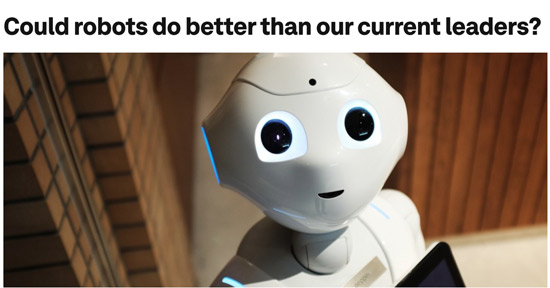
“The Fourth Industrial Revolution is expected to wreak havoc on labour markets, with AI and robots replacing various white-collar jobs. One job category largely excluded from scientific reports is that of government leaders, despite being one of the most critiqued, scrutinized and ridiculed jobs of all.”
“However, commentators from countries as diverse as India, the UK, New Zealand and Japan have started to suggest that robots as government leaders could drastically improve decision-making, by being much less irrational and erratic than their inherently flawed human counterparts.”
After freaking us out, the World Economic Forum writers chuckle and let us continue being governed by human politicians, at least for now:
“For the time being, it seems neither possible nor optimal for robots to replace government leaders, despite the clear imperfections displayed by the latter group … Ultimately, a more realistic and desirable scenario is one in which AI and automation are neither competitors nor substitutes to humans, but tools that government leaders can engage effectively and sometimes defer to, in order to make better, fairer and more inclusive decisions.”
Phew, it’s almost like … you know, when a street robber first tells us to give him all of your money but then agrees to take only half! Such a kindly, generous robber! We are so lucky!
World Economic Forum’s “Agile Nations”
The 2017 WEB write-up about digital governance reads like a “wish list” and a blueprint for the governments to act upon. (I guess, given the bribing and coercive power of the people who’ve composed the wish list, their wish list had a strong chance of becoming the bureaucrats’ blueprint the moment it was written.) So in 2020, seven nations got together and signed an agreement to essentially implement it. A quote from “Agile Canada“:
“In November 2020, seven countries signed on to the Agile Nations Charter, establishing Agile Nations as a forum for countries to collaborate on creating a global regulatory environment in which innovation can thrive.
Member countries include: Canada, Denmark, Italy, Japan, Singapore, the United Arab Emirates, the United Kingdom. The Organisation for Economic Cooperation and Development (OECD) and the World Economic Forum (WEF) also participate as observers.”
“Priority areas for cooperation are: data and communications, transportation, medical diagnosis and treatment, clean technology, legal and professional services, pro-innovation regulatory approaches.”
And here’s from the Organisation for Economic Co-operation and Development:
“The COVID-19 pandemic has wrought economic and social disruption worldwide. As people and businesses focus on recovery, governments must ensure that innovation, which will power economic growth and solve the world’s most pressing social and environmental challenges, is not held back by outdated regulations [emphasis mine].”
Translation from Orwellian to English: “We want your data, including your medical and biometric data — and we want it now. Look at how lovely our AI is … my precious! (Sorry couldn’t help it!) The so called national laws and regulations interfere with the speed at which we can get a hold of your data.
Like we said, we want it now, and so we would very much like it if so called national laws and regulation got replaced with a digital framework that we write and that we can update any time we like! Sounds like a good idea or what? Who wants some funding? You know what you need to do to get that funding, don’t you?” The quote continues:
“As part of the development of the OECD principles on Effective and Innovation Friendly Rule-Making in the Fourth Industrial Revolution, the Organisation for Economic Cooperation and Development (OECD) and the World Economic Forum (WEF) have been co-operating to look deeper into the interlinkages between regulation and emerging technologies …
Ministers from Canada, Denmark, Italy, Japan, Singapore, United Arab Emirates and United Kingdom announced their plan to lead the world in fostering responsible innovation and entrepreneurship.”
“In addition, in support of the mission of the Agile Nations, representatives of Facebook also offered to launch a call for research – overseen by an independent steering committee of experts in the field of law, regulation and entrepreneurship – into what approaches to rulemaking (e.g. regulatory sandboxes, policy prototyping) were the most effective for the Fourth Industrial Revolution.
As this initiative continues to develop, other businesses will be encouraged and invited to co-sponsor this initiative, and to venture their own ideas to support the work of the Agile Nations.”
“In sum, the Agile Nations Charter sets out each country’s commitment to creating a regulatory environment in which new ideas can thrive. The agreement paves the way for these nations to cooperate in helping innovators navigate each country’s rules, test new ideas with regulators and scale them across the seven markets.
Priority areas for cooperation include the green economy, mobility, data, financial and professional services, and medical diagnosis and treatment.”
“Scientific Management”
The World Economic Forum’s agenda is a strange mix of religious fundamentalism and “scientific management.” As I wrote earlier in an article about the mind of a technocrat, scientific management is a “method of industrial optimization developed by Taylor in the late 19th and early 20th century. The essence of his method was extreme fragmentation and compartmentalization of the production process.”
It required taking a complex process, breaking it down into very simple tasks, timing each task, optimizing it to the maximum using the stopwatch, and then assigning each of those simple tasks to different workers, while insisting that the workers should only use the pre-optimized motor patterns and work as efficiently as possible. Under scientific management, there was no room for workers’ creativity.
And while Taylor and Ford intended the scientific management method for the purpose of streamlining industrial production, the Davos charlatans aim to manage our entire lives, and justify it with some bogus “public good” and “community values”!
Whose “Community Values” Are Those, Anyway?
Here is the elephant in the room: It’s the Davos charlatans — and I want to repeat the word “charlatans” because that’s who they are underneath their bank accounts and their important speeches — who are writing our so called “community values”! They are trying to latch onto our natural social instincts and weaponize our good instincts against us!
They want us to be unassuming, guilty “good citizens” who put a limit on our carbon footprint and on the number of children we have — while they, the self-appointed “guardians” of the world, fly private jets to climate change conferences and have as many kids as they damn like!
And here’s the thing. There is nothing wrong with real community values! We are social creatures, and it benefits us to live together well. However, community values are only as good as the people who propose them — and community values turn into a pumpkin the moment someone like Schwab touches them!
As Good as the People
Let’s even forget about Schwab for a second and think how community values work in principle. Let’s imagine a small village. If the people living in that village are mostly healed and grounded, they will raise their children to seek wisdom and live well with others — from the heart, not from the letter.
However, if the people in the village have been abused, and abused, and abused again — and never healed — then even the authentic community values in that village could end up being anxious, rigid, and detrimental to freedom.
Hurt people tend to teach their children that life is meant to be joyless. They tend to slap their children’s wrists for wanting to be free, saying it’s a selfish folly. Hurt people hurt people! And at one point, the rigid rules might have been an invention of a cunning predator — but after prolonged abuse, people might have internalized them and passed them on to their children! (And look at how many people in the West sincerely adopted the religion of the Mask … they have internalized it!)
Another example: in my birth homeland of Russia, there are many small communities where the people carry so much hurt and sadness that the gloom is almost palpable in the air. I am saying this from personal experience, and with much pain and love for my people. I ran away from that gloom and immigrated to America because the “community values” felt too joyless!
So when it comes to Klaus Schwab and friends, they are only as powerful as we let them. I believe that that healing ourselves and our relationships is at the top of our priorities list in the battle against transhumanism — because anything we do from a place of love has more power than anything we do from the place of fear!
Why Will Transhumanism Fail?
This system, the entire man-eating beast, will eventually fail, I have no doubt — but we don’t know when, and we need to stay humble, brave, and very patient. The cruel beast may fail very soon, or it may take a while to fail. I think it depends on how quickly we remember to relate to each other in spirit, with love and happy humility — instead of labeling and judging each other based on ancestry, politics, or differences in opinion.
I think it depends on how quickly we realize that the freedom taken away from the people everywhere, throughout history, has been as existentially precious as the freedom that is being taken away from us right now — because there is no fundamental difference between us and other people, and never has been.
We, here and now, are dealing with the same dilemma that many in the past have dealt with, and some have died from. Spirit is spirit, and freedom is freedom! And I think that when we remember to stand together and honor each other and each other’s love and each other’s courage, we’ll be undefeatable. No Klaus Schwab can do anything to us if we refuse to betray our fellow human beings for any reason.
And sooner or later, spiritual clarity will prevail, and this transhumanist beast, the culmination of abuse, will fail. The reason why it will fail is simple. We are not machines, and when we are managed like machines — increasingly so over the centuries — our souls bleed badly. When we are managed like slaves, we suffer unbearably — and suffering, while it’s not a preferred way of obtaining clarity, still mysteriously leads to spiritual clarity. Life puts no suffering to waste!
And when the pain gets unbearable, and there is nowhere to go but toward our heart of hearts, our souls scream to the skies, and we pray for answers with no arrogance and no talking points, and then something magical happens. When our fear and pain become too much but we keep pushing, we grow our souls to where solutions show up out of nowhere.
And then we cry, laugh, and pray more for healing, and more solutions show up, and we look back and we suddenly know why we had to suffer, and why the sweetness was worth it. And then we start living well because, after all this suffering, we finally remember that everything in the world, everything-everything, has always been about love — and that living well with each other is not just pleasant but also very practical.
Covid-19 – Fun With Figures, Food For Thought
By William Walter Kay BA JD | Principia Scientific | September 9, 2021
Contrast Covid’s impact on four East Asian countries (Taiwan, Singapore, Japan and South Korea) with its impact on four US Northeastern states (New York, Massachusetts, New Jersey and Connecticut).
All eight jurisdictions host high-tech societies with market-orientated economies and democratic constitutions.
All boast ultra-modern hospitals, medical colleges and public health programs.
Two differences: a) compared to the US Northeast, the East Asian countries engage in more trade and travel with Covid’s epicentre, China; and, b) Covid toured East Asia before debuting in the US Northeast.
New York state’s population (19.5 million) is slightly smaller than Taiwan’s (23.8 million). Covid has killed 837 Taiwanese, and 54,895 New Yorkers.
Massachusetts’ population (6.9 million) is comparable to Singapore’s (5.9 million). Covid fatalities in Massachusetts – 18,272. Covid fatalities in Singapore – 55.
The combined population of our four Northeastern states (38.7 million) is well below South Korea’s (51.3 million). Covid’s death toll in our Northeastern states is 108,480. Only 2,303 South Koreans have died from Covid.
Our four East Asian countries (207 million) register a total of 19,308 Covid deaths. New Jersey (8.9 million) claims 26,919 Covid deaths.
Per capita, Covid has proven 341 times deadlier to New Jersians than Singaporeans!
Regarding Covid testing rates, Singapore is East Asia’s outlier. By conducting 17.8 million tests Singaporeans have achieved 3 tests per citizen. This still falls short of New York’s 3.3 tests per citizen and Massachusetts’ 3.8 tests per citizen. (You’ve read correctly. Certain people get tested again and again.)
Most East Asian countries, following Japan’s lead, test only patients exhibiting pneumonia-like symptoms. Japan tests 174,000 per 1 million inhabitants. Our four East Asian countries cumulatively have conducted 58 million tests. New York has conducted 66 million.
Massachusettsans test for Covid at 22 times Japan’s rate!
Medical tyranny boosters attribute East Asia’s “success” to harsh public health regimes; but Northeastern states imposed notorious lockdowns, often more Draconian than those deployed in East Asia.
Testing strategies are key. Testing only symptomatic patients is sounder than mass testing.
Asymptomatic Sars-CoV-2 carriers are extremely unlikely to be contagious.
Most people who contract Sars-CoV-2 become neither sick nor contagious.
PCR tests detect: a) miniscule infections that will not take hold; b) dead viruses from infections defeated by natural immune responses; and c) random genetic flotsam resembling Sars-CoV-2.
Mass testing yields positive results from persons who are neither sick nor contagious, and who are unlikely to become so.
By inflating case counts, mass testing makes Covid appear worse than it is.
Likewise, declaring all those who die after testing positive to be “Covid fatalities” – co-morbidities be damned – inflates death tallies; again, making Covid appear worse than it is.
Testing-based legerdemain doesn’t fully explain the whopping discrepancy between Covid’s impact in East Asia and the US Northeast.
This discrepancy also arises from the fact that the US Northeast was one of several areas following Milan’s lead i.e., during the pandemic’s early months health authorities allowed the contagion to rage unchecked through long-term care facilities.
Senior’s homes became Sars-CoV-2 incubators.
Milan, Montreal, the US Northeast et al became continental super-spreaders evidenced by supersized body counts.
Covid-19 is one matter; government response to Covid-19 is quite another.
Sources
Covid fatality and testing stats were extracted from Worldmeter’s Covid database on September 2, 2021.
Singaporean Ministers Announce That Country Must Learn to Live With COVID-19
By Noah Carl • Lockdown Sceptics • June 29, 2021
Singapore has recorded fewer deaths from COVID-19 than almost any other country with reliable data: only 36 to date, which equates to a rate of just six per million. (The U.K.’s official COVID-19 death rate is 1,890 per million.)
And according to the World Mortality Dataset, Singapore has had zero excess mortality since the pandemic began. On the other hand, the country did take a sizeable economic hit last year – with GDP falling by 5.4% (compared to only 2.8% in Sweden).
What’s more, Singapore has not recorded more than 100 cases in a day since August of last year. If any advanced country has come close to “Zero Covid”, it’s Singapore.
Despite that record, three Singaporean ministers have announced that “COVID-19 may never go away” and “it is possible to live normally with it in our midst”.
Writing in The Straits Times, Gan Kim Yong, Lawrence Wong and Ong Ye Kung (the ministers for trade, finance and health) say that “COVID-19 will very likely become endemic”. This means that “the virus will continue to mutate, and thereby survive in our community”.
In other words, the Singaporean Government is under no illusion that it will be possible to eliminate COVID-19, contrary to the claims of the “Zero COVID” movement. Indeed, a survey by Nature of 119 experts found that 89% believe it is “likely” or “very likely” that SARS-CoV-2 will become an endemic virus.
“We can’t eradicate it”, the ministers write, “but we can turn the pandemic into something much less threatening, like influenza.” How do they propose to deal with the virus going forward?
First, they intend to proceed with their vaccination program, which aims to have two thirds of people vaccinated by August 9th. Second, they intend to continue testing, but “the focus will be different”. For example, the country will cease “monitoring COVID-19 infection numbers every day”. Third, they intend to keep using and developing effective treatments for COVID-19.
As Yong, Wong and Kung conclude, “History has shown that every pandemic will run its course.” Though one might object that even the few remaining measures are no longer necessary, the ministers seem to understand what they’re talking about. Their article is worth reading in full.
The Trans-Pacific Sellout
Guaranteed profits—at any price
By Jason Hirthler | Dissident Voice | April 26, 2015
Last Tuesday, President Barack Obama told beltway bullhorn Chris Matthews that Senator Elizabeth Warren was “wrong” about the Trans-Pacific Partnership (TPP), the largest trade deal in American history, linking United States and Australia, Brunei, Canada, Chile, Japan, Malaysia, Mexico, New Zealand, Peru, Singapore and Vietnam in a pervasive and binding treaty. The president was referring to Warren’s claim that the trade treaty will license corporations to sue governments, and her contention that this was, to put it mildly, a bad idea.
Warren isn’t wrong, Obama is. And he knows it. The entire TPP, as understood, is based on a single overarching idea: that regulation must not hinder profiteering. This is a fundamentally anti-democratic concept that—if implemented—would effectively eliminate the power of a demos to make its own law. The final authority on any law’s validity would rest elsewhere, beyond the reach of popular sovereignty. From the TPP point-of-view, democracy is just another barrier to trade, and the corporate forces behind the draft treaty are intent on removing that barrier. Simple as that.
That’s why the entire deal has been negotiated in conclave, deliberately beyond the public purview, since the president and his trade representatives know that exposing the deal to the unforgiving light of popular scrutiny would doom it to failure. That’s why the president, like his mentor President Clinton, has lobbied hard for Trade Promotion Authority, or Fast Track, which reduces the Congressional role in the passage of the bill to a ‘yea’ or ‘nay.’
Cracks have begun to show in the formidable cloak behind which the deal has been structured. A coalition of advocacy groups advanced on the U.S. Trade Representatives office this week. Wikileaks has obtained and released chapters from the draft document. Senator Harry Reid declared his position on Fast Track as “… not only no, but hell no.” Warren has proved to be a persistent thorn in the side of White House efforts to smooth over troubling issues with the deal. But the monied interests that rule the beltway have all pressed for passage. And as a Fast Track draft makes its way through Congress, stakes are high. The TPP is, in the apt estimation of political activist Jim Hightower, a “corporate coup d’état.”
Not for the first time, the president and his Republican enemies are yoked by the bipartisan appeal of privilege against this faltering fence of protest. The marriage of convenience was described in last Friday’s sub-head to a New York Times article on TPP: “G.O.P. Is Allied With President Against His Own Party.”
All The Usual Suspects
Who else supports the TPP? Aside from this odd confection of neoliberals, the corporations that rule the beltway feverishly back the TPP. From the leak of Sony digital data we learn that it and its media peers have enthusiastically pressed for the passage of the deal. Sony is joined by major agricultural beneficiaries (Monsanto), mining companies like Infinito Gold, currently suing Costa Rica to keep an ecology-harming mine pit active, as well as pharmaceutical coalitions negotiating stiff intellectual property rights unpopular even in Congress, and various other technology and consumer goods groups. And don’t forget nicotine kingpins like Philip Morris.
Obama reinforces the corporate line: “We have the opportunity to open even more new markets to goods and services backed by three proud words: Made in America.” Perhaps he isn’t aware that our leading export is the workforce that once took pride in that moniker. We’ve exported five million manufacturing jobs since 1994, largely thanks to NAFTA, the model on which the TPP is built. The TPP will only continue that sad trend. The only jobs not being offshored are the ones that can’t be: bartenders and waitresses and health care assistants. That’s the Obama economy: a surfeit of low-wage service jobs filled by debt-saddled degree holders. As Paul Craig Roberts argued in The Failure of Laissez Faire Capitalism, between 2007 and 2014, some eight million students would graduate from American universities and likely seek jobs in the United States. A mere one million degree-requiring jobs would await them. The irony of Obama’s statement is that the TPP would actually move to strip the use of labels like, “Buy American,” since they unduly advocate for local goods.
In truth, the authors of the treaty already know all this. The bill concedes as much, with Democrats building in some throwaway provisions of unspecified aid to workers whose jobs have been offshored, and a tax credit to ostensibly help those ex-workers purchase health insurance. Cold comfort for the jobless, as they are exhorted by the gutless paladins of globalization to ‘toughen up’ and deal with the harsh realities of a globalized economy. As neoliberal stooge Thomas Friedman has said, companies in the glorious global marketplace never hire before they ask, “Can this person add value every hour, every day — more than a worker in India, a robot or a computer?” Of course, the answer is invariably no, so the job goes to Bangladesh or a robot. No moral equation ever enters the picture. Just market discipline for the vulnerable and ingenious efforts by a captive state to shelter capital from the market dynamics it would force on others.
The Investment Chapter
Despite Obama’s disingenuous clichés about “… fully enforceable protections for workers’ rights, the environment and a free and open Internet,” the trade deal makes it clear that labor law and environmental law are both barriers to profitability. We know this thanks to Wikileaks, which once again proved its inestimable value by acquiring and releasing another chapter from the cloak-and-dagger negotiations. This time it was the investment chapter, in which so much of the treaty’s raison d’etre is expressed.
As Public Citizen points out in its lengthy analysis of the chapter, any domestic policy that infringes on an investor’s “right” to a regulatory framework that conforms to their “expectations,” is grounds for a suit. Namely, the suit may be pressed to “the extent to which the government action interferes with distinct, reasonable investment-backed expectations.”
Here’s what the TPP says about such legislation as it relates to investor expectations:
For greater certainty, whether an investor’s investment-backed expectations are reasonable depends, to the extent relevant, on factors such as whether the government provided the investor with binding written assurances and the nature and extent of governmental regulation or the potential for government regulation in the relevant sector.
Try putting that tax on financial transactions. Forget it. Barrier to a reasonable return. Don’t believe it? Just read the TPP investment protocols that would ban capital controls, which is what a financial tax is considered to be by TPP proponents. Try passing that environmental legislation. Not a chance. Hindrance to maximum shareholder value. Just ask Germany how it felt when a Swiss company sued it for shutting down its nuclear industry after Fukushima. Try enacting that youth safety law banning tobacco advertising. Sorry. Needless barrier to profits. Just ask Australia, which is being sued by Philip Morris for trying to protect kids from tar and nicotine.
Public Citizen has tabulated that, “The TPP would newly empower about 9,000 foreign-owned firms in the United States to launch ISDS cases against the U.S. government, while empowering more than 18,000 additional U.S.-owned firms to launch ISDS cases against other signatory governments.” It found that “foreign investors launched at least 50 ISDS claims each year from 2011 through 2013, and another 42 claims in 2014.” If these numbers seem small, recall that for a crucial piece of labor legislation to be struck down, only one firm need win in arbitration in order to financially hamstring a government and set a precedent that would likely ice the reformist urge of future legislatures.
As noted earlier, the text also appears to suggest to ban the practice of promoting domestic goods over foreign—another hurdle to shareholder value. This would effectively prohibit a country from implementing an import-substitution economy without threat of being sued. Governments would be relieved of tools, like tariffs, historically used to protect fledgling native industries. This is exactly what IMF prescriptions often produce—agricultural reforms, for instance, that wipe out native crop production and substitute for it the production of, say, cheap Arabica coffee beans, for export to the global north. Meanwhile, that producer nation must then accept costly IMF lending regimes to pay to import food it might have grown itself.
Of course, it is rarely mentioned that protectionism is how the United States and Britain both built their industrial economies. Or that removing competitor market protections is how they’ve exploited developing economies ever since. The TPP would effectively lock in globalization. It’s a wedge that forces markets open to foreign trade—the textual equivalent of Commodore Perry sailing his gunships into Tokyo Harbor.
ISDS Tribunals
The bill’s backers point to language in which natural resources, human and animal life, and public welfare are all dutifully addressed in the document. The leaked chapter explicitly says that it is not intended to prevent laws relating to these core concerns from being implemented. So then, what’s the problem? The problem is that these tepid inclusions lack the teeth of sanctions or punitive fines. They are mere rhetorical asides designed to help corporate Democrats rationalize their support of the TPP. If lawmakers really cared about the public welfare, they’d move to strip the treaty of its various qualifiers that privilege trade over domestic law. By all means, implement your labor protection, but just ensure “… that such measures are not applied in an arbitrary or unjustifiable manner, or do not constitute a disguised restriction on international trade or investment.”
If lawmakers cared about national sovereignty, they wouldn’t outsource dispute settlement to unelected arbitration panels, more fittingly referred to as, “tribunals.” (Think of scrofulous democracy hunched in the dock, peppered with unanswerable legalese by a corporate lawyer, a surreal twist on the Nuremberg Trials.) Just have a glance at Section B of the investment chapter. Suits will be handled using the Investor-State Dispute Settlement (ISDS) model, itself predicated on the tribunal precedent. And in the event a government lost a suit or settled one, legal costs would be picked up by taxpayers, having been fleeced by an unelected committee whose laws it has no recourse to challenge.
Perhaps investor protections like ISDS were once intended to encourage cross-border investment by affording companies a modicum of reassurance that their investments would be safeguarded by international trade law. But the ISDS has been used for far more than that. The ISDS tribunals have a lovely track record of success (first implemented in a treaty between Germany and Pakistan in 1959). Here’s Public Citizen:
Under U.S. “free trade” agreements (FTAs) alone, foreign firms have already pocketed more than $440 million in taxpayer money via investor-state cases. This includes cases against natural resource policies, environmental protections, health and safety measures and more. ISDS tribunals have ordered more than $3.6 billion in compensation to investors under all U.S. FTAs and Bilateral Investment Treaties (BITs). More than $38 billion remains in pending ISDS claims under these pacts, nearly all of which relate to environmental, energy, financial regulation, public health, land use and transportation policies.
New Era, New Priorities
Now the ISDS is a chisel being used to destroy the regulatory function of governments. All of this is being negotiated by corporate trade representatives and their government lackeys, which appear to have no qualms about the deleterious effects the TPP will have on the general population. But then the corporations these suits represent have long since discarded any sense of patriotic duty to their native nation-states, and with it any obligation to regulate their activities to protect vulnerable citizenries. That loyalty has been replaced by a pitiless commitment to profits. In America, there may have been a time when “what was good for Ford was good for America,” as memorably put by Henry Ford. But not anymore. Now what’s good for shareholders is good for Ford. This was best articulated a couple of years ago by former Exxon CEO Lee Raymond, who bluntly reminded an interviewer, “I’m not a U.S. company, and I don’t make decisions based on what’s good for the U.S.” Those decisions usually include offshoring, liberalizing the labor market, practicing labor arbitrage, relocating production to “business friendly climates” with lax regulatory structures, the most vulpine forms of tax evasion, and so on—all practices that ultimately harm the American worker.
Apple says it feels no obligation to solve America’s problems nor, one would assume, any gratitude to the U.S. taxpayer for funding essential research that Apple brilliantly combined in the iPod and iPhone. Former Labor Secretary Robert Reich finally admits corporations don’t want Americans to make higher wages. The U.S. Chamber of Commerce encourages shipping American jobs abroad. World Bank chiefs point to the economic logic of sending toxic waste to developing nations. Wherever you look, there seems to be little if any concern for citizenry.
The Financial Times refers to ISDS as, “investor protection.” But what it really is, is a profitability guarantee, a legal bulwark against democracy expressed as regulation. Forgive me for thinking that navigating a fluid legislative environment was a standard investment risk. Evidently the champions of free trade can’t be bothered to practice it. Still the White House croons that it has our best interests at heart. If that were true, it would release the full text, launch public charettes to debate its finer points, or perhaps just stage a referendum asking the American people to forfeit their hard-won sovereignty. No such thing will ever happen, of course. As it turns out, democracy is the price of corporate plunder. After all, the greatest risk of all is that the mob might vote the wrong way. And, as the language of the TPP makes explicitly obvious, there are some risks that should be avoided at all costs.
Jason Hirthler can be reached at: jasonhirthler@gmail.com.
Trans-Pacific Partnership: Free Trade vs. Democracy
By Cliff DuRand | Americas Program | April 12, 2013
As closed-door negotiations concluded in Singapore on the Trans-Pacific Partnership, opposition begins to build in many countries. At the urging of the United States, Canada and Mexico have joined the nine countries in the talks and now Japan has announced it too wants to be part of this new free trade pact of Pacific rim countries, described by its critics as “NAFTA on steroids”.
Going into its 17th round of negotiations, the Obama administration aims to wrap up an agreement by October, hoping to push ratification through the Senate on a fast- track basis. Called Trade Promotion Authority, fast track would mean an up or down vote without amendments or even hearings on the agreement presented to it. It is a profoundly anti-democratic procedure because it shuts down debate.
But from start to end, TPP has been thoroughly anti-democratic. On the first day of the Singapore talks a broad range of civil society organizations issued an open letter to Congress calling for greater transparency in the proceedings. The agreement is being hammered out in secret discussions among trade ministers. Even Senators have been denied a look at its draft provisions.
However, some 600 transnational corporations are in the inner circle. They are writing the rules for trade in their own interests without any democratic input from the people whose lives will be profoundly affected. If adopted, TPP will deny citizens their democratic rights to shape public policies on a host of domestic issues, conceding those decisions to the large corporations.
Some sections have been leaked. They reveal “an agreement that actually formalizes the priority of corporate power over government,” according to Lori Wallach of Public Citizen’s Global Trade Watch. Only 5 of the 29 chapters have to do with trade. Wallach says the rest of the draft “include[s] new rights for the big pharmaceutical companies to expand, to raise medical prices, expand monopoly patents, limits on Internet freedom, penalties for inadvertent noncommercial copying, sending something to a friend. There are the same rules that promote off-shoring of jobs that were in NAFTA that are more robust that literally give privileges and protections if you leave. There is a ban on ‘buy American’ and ‘buy local’ or ‘green’ or sweat-free procurement. There are limits on domestic financial stability regulations. There are limits on imported food safety standards and product standards. There are limits on how we can regulate energy towards a more green future – all of these things are what they call ‘Behind the Borders’ agenda. And the operating clause of TPP is: ‘Each country shall ensure the conformity of its domestic laws, regulations and administrative procedures with these agreements.’”
Global Class War
Free trade is about more than trade. It is about favoring corporations over the democratic rights of citizens and the sovereignty of nations. As the former Director-General of the WTO, Renato Ruggiero, said in 1995, “We are no longer writing the rules of interaction among separate national economies. We are writing the constitution of a single global economy.”# What is being created is a global governance order in which corporations are the citizens, not flesh and blood humans like you and me. With free trade, corporations are making an end run around democracy.
TPP is the latest offensive in a global class war. For nearly 40 years now, since the mid 1970s, corporations have been rolling back the popular gains of the New Deal era and the 1960s. Democracy has been the target of a class war to restore the class power of capital. And there has been weak resistance, at best, by the popular classes. But the stakes have become increasingly clear to more and more. Indeed, on the issue of free trade, there is now a broad public sentiment against this aspect of the corporate offensive.
The US has become the world advocate of “free trade,” promoting it through trade agreements like NAFTA and other bi-lateral agreements as well as through global governance institutions it has sponsored such as IMF, World Bank and WTO. The US has promoted free trade for much the same reason Great Britain promoted it in the 19th century, viz. the economically strongest country in the world benefits from free trade. It is the weaker countries that seek tariff protection for their infant industries, protection from competition with cheaper and higher quality imports. That protection is what enabled the US to industrialize in the last half of the 19th century. But then when the US became economically strong enough to compete regionally and eventually globally, it became an advocate of free trade and demanded that others abandon protectionism.
The justification for free trade rests on the theory of comparative advantage. This is the view that if countries trade free of government impediments, the market will tend to direct each to export that which they can produce most efficiently and import what can be produced more efficiently and thus more cheaply elsewhere. The invisible hand of the market will guide each to specialize in producing what they have a comparative advantage in. Thus a rational production and trading system will emerge that maximizes efficiency.
Free trade agreements like NAFTA were sold to the US public by appealing to consumer’s interest in having access to cheaper goods imported from Mexico. What was deliberately soft-pedaled was their interest as workers in having jobs. Organized labor opposed NAFTA, fearing it would pit US workers in competition with low wage Mexican workers. Independent presidential candidate Ross Perot warned of “a giant sucking sound” as jobs would be off-shored to Mexico.
But the Clinton administration said US exports to Mexico would create new jobs. And so, ignoring opposition from its traditional base in the unions, new Democrat Clinton pushed ratification of NAFTA through the Senate as his first priority. Perot proved to be correct as US companies shifted production to low wage Mexico – until even lower wage Chinese workers were brought into play when China joined WTO. But Clinton was also right as cheaper consumer goods from abroad filled the shelves of Wal-Mart with bargains welcomed by US workers who found their wages reduced. Free trade proved to be a mixed blessing.
Capital Becomes Global
One important point about free trade that is often overlooked is that it is not only about the free, frictionless movement of goods and services across borders, unrestricted by tariffs, quotas and regulations. It assures the free movement of capital, as corporations are freed to invest abroad. The mobility of investment capital is of utmost importance, with profound economic consequences and consequences for democracy.
Unable to find sufficiently profitable venues for investment in the overdeveloped US economy, large corporations have increasingly moved abroad. They sought not just new outlets to sell their commodities, but low wage workforces that would decrease their production costs and thus boost their profits. Frequently that would involve locating different stages of the productive process in different countries so as to take optimal advantage of local conditions. The assembly lines of US industry were disaggregated and disbursed across the globe.
Global assembly lines emerged. These global production chains have become a signature feature of contemporary capitalism. Components may be manufactured in Singapore, transported to China for subassembly and then shipped to Mexico for final assembly before sale in the United States. Although global assembly lines are geographically dispersed, they overcome the limitations of the fixed assembly lines of the Fordist era in that they no longer have to rely on a fixed labor force that can organize itself to effectively claim a share of the surplus they create.
Instead, the global assembly line gives capital the flexibility to seek out the lowest wage workforce and friendliest business environment available anywhere in the world. This has been made possible by the development of a global computerized network of instant communications via satellite. That and the computerization of banking have made money transfers and the movement of capital both easy and instantaneous. The communications network also allows the decentralization of technological development and design. Technicians can work at points distant from the processes of production to which they address themselves. And the entire process can be coordinated by management located anywhere on the globe. The limitations of space and time have been overcome by digital communications and cheap energy for transporting goods to their ultimate consumers.
For such globalized production to be possible, capital must be able to flow freely across national borders and products have to be able to move with minimum friction across those borders, unhampered by tariffs or quotas or non-uniform standards. In other words, there must be free trade for transnational capital to optimize accumulation.#
But transnational corporations also need legal protection of their investments. They need protection from expropriation of their assets, laws and governments that can ensure their property is secure. A crucial part of free trade agreements is protection of what are called investor rights. This involves more than just protection from expropriation, as happens with revolutions. It also involves protection from governmental actions that might reduce the value of their property or potential profits by environmental and health regulations, labor laws or other such measures even though they might be for the public good. What in US law is called “regulatory takings” are seen as tantamount to expropriation.
When such governmental actions do occur, free trade treaties give the foreign corporation the recourse to sue. The suit is not adjudicated in a national court, but by a transnational body of experts operating in secret. States are expected to enforce its decisions on their own nation’s taxpayers and consumers. This favors investor rights (i.e. the interests of transnational corporations) over the democratic rights of a nation.
Super NAFTA
As corporations have globalized, morphing into transnational corporations, they have promoted free trade agreements to get national governments to assist them. But when “investor rights” trump the democratic rights of citizens, the transnational corporations become the real citizens of the emerging global order. TPP is a further step in this direction, making an end run around a number of important issues –banking regulation, extension of patent protection, food inspection, environmental protection, food sovereignty, internet freedom, health care, job creation policies, and more, denying voters the opportunity to decide such matters when they impinge on corporate profit making.
Here are a few of the issues around which opposition to TPP is beginning to emerge.
* Doctors Without Borders (Medecins Sans Frontieres, MSF) is concerned that TPP would “enhance patent and data protections for pharmaceutical companies, dismantle public health safeguards enshrined in international law and obstruct price-lowering generic competition for medicines.” The intellectual property provisions would give pharmaceutical companies prolonged monopoly protection for medicines and delay access to cheaper generic versions. This would have disastrous consequences in poorer countries.
* Internet freedom is also in danger. The Council of Canadians and OpenMedia have warned that the TPP would “criminalize some everyday uses of the Internet,” including music downloads, making no distinction between commercial and non-commercial copyright infringement. The TPP imposes a “three strikes” system for copyright infringement, where three violations would result in the termination of a household’s Internet access.
* Japanese farmers are concerned that TPP will force removal of protections from Japan’s agriculture needed to maintain food sovereignty for the country. They are protesting Japan’s decision to enter into TPP negotiations at all.
* Guaranteed compensation for loss of “expected future profits” from health, labor or environmental regulations.
* Corporate performance requirements are banned.
* Capital mobility is to be guaranteed, preventing capital controls in event of a financial crisis. TPP will require countries to let capital flow in and out without restriction, not allow the banning or regulation of risky investments like derivatives and credit-default swaps and will prevent the formation of much-needed public banks
Democratic sovereignty
Most fundamentally what is at stake with TPP and existing free trade treaties is the sovereignty of nations and the ability of their peoples to make democratic decisions. This is a concern on both the Left and the Right, suggesting the possibility of a broad coalition opposing TPP, bridging our otherwise polarized politics.
A major NBC News-Wall Street Journal poll from September of 2010 revealed that “the impact of trade and outsourcing is one of the only issues on which Americans of different classes, occupations and political persuasions agree,” with 86% saying that outsourcing jobs by U.S. companies to poor countries was “a top cause of our economic woes,” with 69% thinking that “free trade agreements between the United States and other countries cost the U.S. jobs.” Only 17% of Americans in 2010 felt that “free trade agreements” benefit the U.S., compared to 28% in 2007.
Arthur Stamoulis, executive director of Citizen Trade Campaign said: “If they were to negotiate an agreement that put human rights ahead of corporate profit, creating more just and sustainable social policy, the TPP could be a tool for incredible good. But if you look at who has a seat at the table, with the public shut out and more than 600 corporate lobbyists included, there is nothing to indicate that’s the deal we’re going to get.”
The developing opposition to the corporate coup that the TPP represents has the potential to win. It’s about time for the people to win one victory in the corporate class war. Our first chance in this campaign will be over granting fast track Trade Promotion Authority. And that battle will be followed by the fight over Senate approval of TPP itself. This is one that we can win. The stakes are high. The alternatives are democracy or plutocracy.
******
Cliff DuRand is a Research Associate at the Center for Global Justice and a contributor to the CIP Americas Program http://www.cipamericas.org. He is co-author and co-editor of Recreating Democracy in a Globalized State (Clarity Press, 2012). Contact him at global.justice.cliff@gmail.com
For More Information:
Public Citizen’s Global Trade Watch http://www.citizen.org/trade
on TPP http://www.citizen.org/TPP
Citizens Trade Campaign www.citizenstrade.org
A coalition of labor, environmental, religious, family farm, and consumer organizations united in the pursuit of socially and environmentally just trade policies.
It’s Our Economy www.itsoureconomy.us
It’s Our Economy seeks to educate, organize and mobilize Americans to shift the power from concentrated capital to the people. http://itsoureconomy.us/occupy-the-tpp-stop-the-global-corporate-coup/
Related article
- NAFTA at 20: The New Spin (alethonews.wordpress.com)
Venezuela Among the Most Positive Countries, Gallup Says
Venezuelan Embassy to the U.S. / December 20, 2012

A new survey by the Washington, DC-based public opinion pollster Gallup finds that Latin Americans are the most positive people in the world, and Venezuela is tied for second place among all countries measured.
The survey asked citizens of various countries to answer questions including: “Did you feel well-rested yesterday?” “Were you treated with respect?” and “Did you smile or laugh a lot?”
In Venezuela, 84 percent of respondents answered “yes” to those questions, the same amount as in El Salvador, which tied with Venezuela for second place after Panama and Paraguay, which tied for first with 85 percent.
According to Gallup, eight of the top ten most positive countries in the world are in Latin America, with Trinidad and Tobago coming in at number five (with 83 percent), followed by Thailand (83 percent), Guatemala (82 percent), Philippines (82 percent), Ecuador (81 percent), and Costa Rica (81 percent). At the low end, just 46 percent of respondents in Singapore answered “yes” to the questions.
The implications, according to the analysis, are that a country’s overall economic prosperity does not correspond with the amount of positivity felt by its citizens.
The report explains: “These data may surprise analysts and leaders who solely focus on traditional economic indicators. Residents of Panama, which ranks 90th in the world with respect to GDP per capita, are among the most likely to report positive emotions. Residents of Singapore, which ranks fifth in the world in terms of GDP per capita, are the least likely to report positive emotions.”
On average, 73 percent of adults around the world felt enjoyment a lot of the day, and 72 percent felt well-rested. A smaller proportion – 43 percent on average – said they were able to learn or do something interesting.
The report states that, on the whole, the data “reflects a relatively upbeat world.” It concludes that “Despite many global challenges, people worldwide are experiencing many positive emotions.”
Click here to see the full results.
Related articles
- The Achievements of Hugo Chavez (alethonews.wordpress.com)
- Economic BS in Rich Countries is Reinforced by BS about Venezuela (alethonews.wordpress.com)
$200 million loan from China due to arrive in National Bank of Egypt
Al-Masry Al-Youm 03/09/2012
The National Bank of Egypt said that the US$200 million loan recently granted by the China Development Bank will arrive in the country within days.
The interest rate due on the loan is up to 3.75 percent above Libor rates, which is the central lending price of British banks for a pay period of eight years, including a three-year grace period.
Sharif Elwi, vice-president of the National Bank, said that the loan marks the beginning of Egyptian cooperation with Asian markets in light of worsening economic conditions in Europe.
China has allocated $20 billion to finance projects in Africa, and the National Bank began loan talks with the China Development Bank five months ago, Elwi explained. He denied that the government had pressured the National Bank to broker the deal due to Egypt’s declining international credit rating.
National Bank leaders plan to visit Singapore, Hong Kong, China and Malaysia this October to present investment opportunities in Egypt to potential backers there.
Related articles
- African central banks invest in offshore Chinese bonds (ghanabusinessnews.com)
- Xi hopes Morsi visit boosts bilateral ties (todayonline.com)
- There is no clarity over $3b China loan to Ghana (ghanabusinessnews.com)
China, Singapore to be exempted from Iran sanctions
By Jamie Crawford | Jeenyus Corner | June 28, 2012
China and Singapore will receive exemptions from U.S. sanctions scheduled to go into effect Thursday that would have cut off banks in those countries from the U.S. financial system for handling Iranian oil transactions, a source in the office of Sen. Robert Menendez, D-New Jersey, a source in the office of Sen. Robert Menendez (D-N.J.) tells Security Clearance.
Secretary of State Clinton called Senator Menendez earlier today to inform him.
Under legislation signed by President Barack Obama In December, the United States will take action against countries that continue buying large volumes of Iranian oil through Iran’s Central Bank by cutting off financial institutions engaged in those transactions from the U.S. banking system.
– State Department released a statement from Secretary of State Hillary Clinton:
Today I have made the determination that two additional countries, China and Singapore, have significantly reduced their volume of crude oil purchases from Iran. As a result, I will report to the Congress that sanctions pursuant to Section 1245(d)(1) of the National Defense Authorization Act (NDAA) for Fiscal Year 2012 will not apply to their financial institutions for a potentially renewable period of 180 days.
A total of 20 world economies have now qualified for such an exception. Their cumulative actions are a clear demonstration to Iran’s government that Iran’s continued violation of its international nuclear obligations carries an enormous economic cost. According to the International Energy Agency (IEA), Iran’s crude oil exports in 2011 were approximately 2.5 million barrels per day, and have dropped to roughly 1.5 million barrels per day, which in real terms means almost $8 billion in lost revenues every quarter. When the European Union oil embargo goes into effect July 1, Iran’s leaders will understand even more fully the urgency of the choice they face and the unity of the international community.
Today marks an important milestone in the implementation of the NDAA and U.S. sanctions toward Iran. Following the President’s determinations on March 30 and June 11 on the availability of non-Iranian supplies of oil, as of today, any foreign financial institution based in a country that has not received an NDAA exception is subject to U.S. sanctions if it knowingly conducts a significant transaction with the Central Bank of Iran for the sale or purchase of petroleum or petroleum products to or from Iran.
We have been clear all along that there is a path for Iran to fully re-join the global economy. Iran’s leaders have the opportunity to address international concerns by engaging seriously and substantively in negotiations with the P5+1. I urge Iran to demonstrate its willingness to take concrete steps toward resolving the nuclear issue during the expert-level talks scheduled in Istanbul on July 3. Failure to do so will result in continuing pressure and isolation from the international community.
Related articles
- US Sanctions Policy on a Collision Course against Iran; Increasing Tensions with China (alethonews.wordpress.com)
Featured Video
Yemen joins the war – Red Sea could be blocked next – Saudi regime at risk
or go to
Aletho News Archives – Video-Images
From the Archives
A superpower and “the world’s sickest warrior state”
By Paul J. Balles | March 8, 2010
Living through five or six major wars has hardened me to what I thought were the extremes of inhuman cruelty and brutality.
Two things made those extremes almost bearable: the brutality always revealed – at least according to the media coverage – the viciousness of the enemy. It was therefore quite understandable when our “brave men and women” pulverized the enemy.
Films of Japanese torturing captive Americans somehow justified holding Japanese Americans in internment camps during World War II; and only a small percentage of Americans found the bombing of Hiroshima and Nagasaki unreasonably vengeful at best, at worst, depraved.
The media giants in America portrayed the North Koreans as barbaric beasts with their captives, quite unlike their southern counterpoints – our allies during the Korean War. No one ever felt the need to explain how the South Koreans were a civilized breed while the North Koreans were absolute savages, at least according to the official line.
In Vietnam, our warriors justifiably (or so the media made us believe) dropped napalm on the North Vietnamese who had the gall to hide in villages and tunnels to ravage our invaders. At least it was accepted practice until some rogue photojournalist filmed a young girl screaming down a Vietnamese road in flames. … continue
Blog Roll
 Aletho News
- FTC Warns Visa, Mastercard, PayPal, Stripe Over Political Debanking
- Russian tanker approaches Cuba despite US oil blockade
- Marandi: Yemen joins the war – Red Sea could be blocked next – Saudi regime at risk
- Pro-Palestinian French member of European Parliament denied entry to Canada
- Pakistan to Host US-Iran Talks
- How Indonesia’s tilt toward the US left it stranded in the Strait of Hormuz
- US has no choice but to retreat from Iranian borders: Top commander
- Iran Retaliation Strikes Chemical Plant Near Dimona
- AWACS’ Destruction is a Major Loss for US Military – Ex-DoW Analyst
- Israel’s Iran Strategy Uses US Military & Gulf States as Its Pawns
- If Americans Knew
- Israeli police block Catholic cardinal from entering Church of the Holy Sepulchre on Palm Sunday
- Israel is assassinating journalists again, more than any other nation, anywhere, ever – Not a ceasefire Day 170
- Over 300 US service members wounded, majority have brain injuries – Not a ceasefire Day 169
- Researchers at Human Rights Watch Resign Over Blocked Report on Palestinian Refugee Return
- Jewish Groups Are Backing a War Americans Don’t Want
- Eric Fingerhut Thinks He’s the President of the Jews
- Top Jewish Philanthropists, Rabbis Urge Israeli President to Take Action Against ‘Jewish Extremists’
- Don’t Be Fooled. Zionist Leaders Have Always Wanted to Control Southern Lebanon
- Israel’s widespread use of torture is a core element of its genocide against the Palestinian people
- In Israel’s War on Iran, Many Middle East US Bases Rendered “All But Uninhabitable”
- No Tricks Zone
- New Study Finds Warming Saves Lives…Cold Temperatures 12 Times More Deadly Than Excess Heat
- German Science Blog Accuses PIK Climate Institute Of Hallucinating Climate Tipping Points
- Devastating Assessment Of Comirnaty Vaccine By Former Senior Pfizer Europe Toxicologist
- New Study: CO2 Is ‘Effectively Negligible’ As An Explanatory Climate Change Factor Since 2000
- Former Pfizer Toxicologist Dr. Helmut Sterz Tells Bundestag Hearing Pfizer Vaccine Should Have Never Been Approved
- Energy Expert: Germany’s Nuclear Phaseout Was A “500 Billion Euro Mistake”
- New Research: South Australia’s Mid-Holocene Sea Surface Temperatures Were 4°C Warmer Than Today
- Storing Green Energy To Last Germany 10 Days Would Require A 60-Million Tonne Battery
- New Studies: UK Sea Levels Were 4 Meters Higher Than Today During The Mid-Holocene
- Destructive Green New Deal: German Energy And Metal Group Warns Of Drastic Crisis
 Aletho News