What Happened to South Africa’s Freedom Charter
A Black Agenda Radio commentary by Glen Ford | October 16, 2012
In 1994, the African National Congress of South Africa made a deal with the devil. There would be one-person, one-vote, majority rule of electoral politics. But corporate power over the South African economy would not be tampered with, and white civil servants would be guaranteed they could keep their well-paying jobs, for life. The ANC also set itself another goal: to create a class of Black millionaires.
Much earlier, the ANC had made a solemn commitment to the broad masses of people. It’s called the Freedom Charter, adopted in 1955, which served as the unifying document of the struggle against apartheid that culminated in the elections that brought the ANC to power. The Freedom Charter promised that “the national wealth of [the] country, the heritage of South Africans, shall be restored to the people;” that “the mineral wealth beneath the soil, the Banks and monopoly industry shall be transferred to the ownership of the people as a whole;” that “all other industry and trade shall be controlled to assist the wellbeing of the people; all the land re-divided amongst those who work it to banish famine and land hunger;” and that “all shall have the right to occupy land wherever they choose.”
Yet, none of this has come to pass. The Freedom Charter is absolutely incompatible with the deal the ANC made for a peaceful transition to Black majority rule. If corporate privileges are untouched, there can be no collective ownership of the mineral wealth, the soil, the banks and industries. And social systems that breed new Black millionaires – or millionaires of any kind – cannot possibly give priority to the well-being of the masses of people.
South Africa was one of the most unequal places in the world in 1994, and it is at least as unequal, today – because of the deal cut by the ANC. The covenant with white privilege and corporate power was also entered into by the ANC’s partners: the South African Communist Party and the Congress of South African Trade Unions, COSATU. Thus, the three pillars of the liberation movement agreed that they would not upset the existing corporate framework, and they would not implement the clearly socialist aims of the Freedom Charter. Instead, they nurtured a tiny, Black capitalist class made up largely of ANC insiders. Union leaders became rich men, while conditions for the poor and working classes deteriorated.
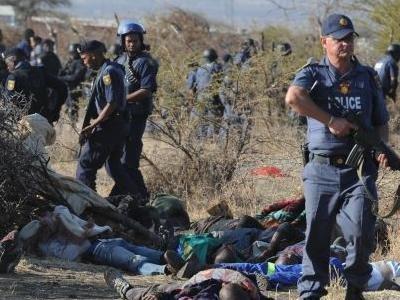
These chickens have now come home to roost, especially following the massacre of 34 miners at Marikana. The mining industry is in turmoil, with 41 percent of South Africa’s gold output shut down. Hundreds of thousands of municipal workers will go on strike this week to protest poor pay and corruption. Yet the official voice of labor, COSATU, cannot credibly claim to represent the interests of working people when it is a partner of the ruling party whose police kill, beat and imprison workers.
This fundamentally corrupt arrangement has run its course. There will be nothing but mass bloodshed at the end of this journey unless the African National Congress breaks the pact that it made with corporate power, in 1994. The ANC stands at a crossroads, and must make a turn.
Glen Ford can be contacted at Glen.Ford@BlackAgendaReport.com.
Related articles
- South Africa’s Unfinished Revolution and the Massacre at Marikana (alethonews.wordpress.com)
South Africa’s Unfinished Revolution and the Massacre at Marikana
A Black Agenda Radio commentary by Glen Ford | August 22, 2012
When thousands of miners went on strike at South Africa’s largest platinum mine, in Marikana, they were confronting not only the London-based owners, but the South African state, which since 1994 has been dominated by the African National Congress (ANC); COSATU, the Congress of South African Trade Unions; and the South African Communist Party. This week, the full weight of the state was brought down on the Black miners, 34 of whom were massacred by police gunfire. Many of the survivors face charges of murder in the earlier deaths of two policemen and eight other miners.
The National Union of Mineworkers, whose representation the strikers rejected, and the Communist Party head in the region claim the strikers are at fault, that they have committed the sin of choosing an alternative union to argue their case for higher wages and, therefore, deserve severe punishment. They are “anarchists,” say these two allies of the South African state, and guilty of fomenting “dual unionism” – which is now, apparently, a capital crime. With a straight face, the Communist Party had the gall to call on all South African workers to “remain united in the fight against exploitation under capitalism.”
That is precisely what the Marikana miners were doing – the struggle they gave their lives for. However, since the peaceful transition to state power to the ANC and its very junior partners, the COSATU unions and the Communist Party, in 1994, the South African state has had different priorities. The “revolution” was put on indefinite hold, so that a new Black capitalist class could be created, largely from the ranks of well-connected members of the ruling party and even union leaders. It is only logical that, if the priority of the state is to nurture Black capitalists, then it must maintain and defend capitalism. This is the central contradiction of the South African arrangement, and the massacre at Marikana is its inevitable result.
The 1994 agreement between Nelson Mandela’s ANC and the white South African regime was a pact with the devil, which could only be tolerated by the masses of the country’s poor because it was seen as averting a bloodbath, and because it was assumed to be temporary. But, 18 years later, the arrangement has calcified into a bizarre protectorate for foreign white capital and the small class of Blacks that have attached themselves to the global rich. Apologists for the African National Congress regime will prattle on about the “complexity” of the issue, but the central truth is that South Africa did not complete its revolution.
The fundamental contradictions of the rule of the many by the few, remain in place – only now, another layer of repression has been added: a Black aristocracy that has soaked itself in the blood of the miners of Marikana.
South Africa remains the continent’s best hope for a fundamental break with colonialism in its new forms. But, as in all anti-colonial struggles, the biggest casualties will occur in the clash between those who truly desire liberation, and those who are intent on an accommodation with the old master.
BAR executive editor Glen Ford can be contacted at Glen.Ford@BlackAgendaReport.com.
Related articles
- Echoes of the Past: Marikana, Cheap Labour and the 1946 Miners Strike (alethonews.wordpress.com)
- South African miners’ families back Julius Malema’s call for nationalisation (guardian.co.uk)
Featured Video
Prof. Ted Postol: Iran Already Achieved Nuclear Deterrence Against Israel
or go to
Aletho News Archives – Video-Images
From the Archives
How the occupied mentality syndrome works
Saudi Arabia on the American chessboard – Part 3
By B. J. Sabri | American Herald Tribune | June 27, 2016
Read part 2: “The occupied mentality Syndrome“
Previously I argued whether Saudi Arabia’s repeated involvements in U.S. interventions and wars stem from free national will or in response to a specific condition. For starters, in Saudi Arabia there is no national will. In Saudi Arabia, the national will is the will of the Al Saud clan. Still, when a major Arab state allies itself with a superpower that committed unspeakable crimes against humanity in almost every Arab country, then something is wrong. This fact alone should compel us to examine the U.S.-Saudi relation for one exceptional reason. As a result of the U.S.-Saudi wars, hundreds of thousands of people in Afghanistan, Iraq, Iran, Libya, Syria, Yemen, and Somalia have lost their lives. Millions became displaced in their own homelands. And millions more rendered refugees.
Attributing the Saudi policies to the bonds of “partnership” with the U.S. is frivolous. There are no bonds between these two thugs except those of business, military deals, secret plots, and wars. Proving this point, bonds such as these have no space for the American and Saudi peoples to share significant cultural or societal exchanges. If partnership is not the reason for the Saudi contribution to the U.S. strategy of empire and imperialism, then another reason must exist.
This leads to three possibilities. … continue
Blog Roll
 Aletho News
- Russia Warns of Retaliation as UK Authorizes Seizure of Vessels
- Serbia thwarts plot to bomb Russia-Hungary gas pipeline – Vucic
- Al Mayadeen voices solidarity with Dr. Marandi amid death threats
- US dismantling international law in its war against Iran while claiming ‘false’ victory: Legal scholar
- One martyr, 5 injuries in US attack on Iraqi border crossing with Iran
- ‘This war is Israel’s war’: World facing ‘security breakdown’, says Qalibaf
- IRGC decries attack on US embassy in Riyadh, says executed by ‘Israel’
- Iran blasts EU hypocrisy as EU invokes international law over Hormuz
- There is no military solution to Strait of Hormuz
- NATO’s structural collapse – the outcome of deviation from reality
- If Americans Knew
- US loses planes over Iran, Israel downgrades Lebanon war goals – Daily Update
- Israel Is Blocking Palestinians from Easter at Church Where Jesus Resurrected
- Plot to assassinate Palestinian activist follows harassment campaign promoted by Zionist groups and elected officials
- Prominent New York synagogue hosts presentation on why U.S. Jews should support the ethnic cleansing of Gaza
- Tapper vs. Piker: Is the CNN Anchor Auditioning for David Ellison?
- Shouldn’t Democrats Be Able to Condemn Genocide?
- Israel-US kill negotiators, destroy civilian structures, but Iran’s military capabilities still largely intact – Daily Update
- ‘War crime’: Global condemnation as Israeli ministers celebrate death penalty law targeting Palestinian prisoners
- 7 Ways Israel Is Turning Lebanon Into Gaza
- World’s Leading Football Bodies Under Fire Over Israel Policies
- No Tricks Zone
- An Inconvenient Tree: Uncovered In Alps… Europe Much Warmer Than Today 6000 Years Ago
- New Study Reports A 60% Slowdown In Greenland’s Ice Loss Rate In The Last Decade
- Low Intensity Tornado Wrecks Major Solar Farm, Creating A Potential Toxic Dump
- New Study Finds Warming Saves Lives…Cold Temperatures 12 Times More Deadly Than Excess Heat
- German Science Blog Accuses PIK Climate Institute Of Hallucinating Climate Tipping Points
- Devastating Assessment Of Comirnaty Vaccine By Former Senior Pfizer Europe Toxicologist
- New Study: CO2 Is ‘Effectively Negligible’ As An Explanatory Climate Change Factor Since 2000
- Former Pfizer Toxicologist Dr. Helmut Sterz Tells Bundestag Hearing Pfizer Vaccine Should Have Never Been Approved
- Energy Expert: Germany’s Nuclear Phaseout Was A “500 Billion Euro Mistake”
- New Research: South Australia’s Mid-Holocene Sea Surface Temperatures Were 4°C Warmer Than Today
 Aletho News