‘Not our war’: Trump’s naval coalition to reopen Strait of Hormuz dead in the water
The Cradle | March 16, 2026
Several countries have either rejected or expressed serious concerns about US President Donald Trump’s plan to form a coalition aimed at escorting vessels through the Strait of Hormuz, which Tehran has closed to Washington and its allies in retaliation for the brutal US-Israeli strikes on the Islamic Republic.
Germany’s Minister for Foreign Affairs, Johann Wadephul, said on 15 March that he was “skeptical” of Trump’s plan.
“Will we soon be an active part of this conflict? No,” he went on to say.
German Defense Minister Boris Pistorius said, “What does Trump expect a handful of European frigates to do that the powerful US Navy cannot?” adding, “This is not our war, and we did not start it.”
Meanwhile, France officially rejected the US request to send warships to the Strait of Hormuz.
The French Foreign Ministry rejected reports that it was gearing up to send vessels, saying, “No. The carrier strike group remains in the Eastern Mediterranean. France’s position remains unchanged: defensive and protective.”
Australia has also denied the request, as have Japan, China, Norway, and Spain. The UK and South Korea said they were reviewing options.
The US president had demanded that NATO states join his proposed coalition, threatening that they would face a “very bad future” if they did not.
Trump had also expressed hope that “China, France, Japan, South Korea, the UK, and others, that are affected by this artificial constraint, will send ships to the area so that the Hormuz Strait will no longer be a threat by a nation that has been totally decapitated.”
Iran has closed the Strait of Hormuz to Washington and its allies in response to the US-Israeli war against the Islamic Republic. Several vessels trying to cross in violation of Iranian warnings have been targeted.
A number of countries have reached out to Tehran for access to the Strait, through which 20 to 30 percent of the world’s energy passed prior to the war.
India has confirmed that two of its ships passed after talks with Iran. Tehran also allowed a Turkish vessel to pass through the strait.
“The Strait of Hormuz has not been militarily blocked and is merely under control,” said Alireza Tangsiri, naval commander of the Islamic Revolutionary Guard Corps (IRGC).
Iranian Foreign Minister Abbas Araghchi stated, “The Strait of Hormuz is open. It is only closed to the tankers and ships belonging to our enemies, to those who are attacking us and their allies. Others are free to pass.”
After Yemen began its pro-Palestine blockade in the Red Sea following the start of the Gaza genocide in 2023, Washington launched a naval operation under the name Prosperity Guardian – aimed at deterring Sanaa’s forces and facilitating the transit of vessels.
The US failed to secure enough partners, and the mission ultimately failed.
The Ansarallah-led Yemeni Armed Forces (YAF) has recently vowed that it is ready to intervene alongside Iran’s other allies – meaning the potential closure of another vital energy route, the Bab al-Mandab strait.
Eurasian Integration as an Anti-Hegemonic Economic System
By Prof. Glenn Diesen | October 30, 2025
We are living in an era of economic disruptions as US-centric globalisation is replaced by a more decentralised format of globalisation spearheaded by the Greater Eurasian continent. The consequence of these disruptions during this transition period is instability in economics, politics, and international security, as economic coercion escalates into war.
The disruptions to the international economy were predictable—and indeed predicted—for decades. When immense economic power is concentrated in a hegemon, the hegemon has incentives to build trust in an economic architecture under its administration. This translates into an open international economic system with access to technologies, industries, energy, food, physical transportation corridors, banks, currencies, and payment systems. This is referred to as a benign hegemon, as building trust in an open system ensures that alternatives are not developed and the world becomes immensely dependent on the hegemon. Subsequently, globalisation meant Americanisation.
Hegemons are, however, inherently temporary. Over the years, the US economy became excessively rent-seeking, financialised, and debt-ridden as its competitive edge declined. A hegemon makes mistakes and fails to prioritise strategically, as it can absorb the costs—until it reaches a breaking point. Around the world, other countries climbed up global value chains and grew concerned about the fiscal irresponsibility and unsustainability of the hegemonic system.
A declining hegemon will predictably behave very differently. It will use its administrative control over the global economy to prevent the rise of rival centres of power. Economic coercion is the new normal—for example, restricting China’s access to key technologies, seizing Iranian tankers and preparing the establishment of maritime choke points, stealing Russia’s sovereign funds, etc. Trust collapses, and efforts to create a more decentralised international economic system only intensify.
The declining hegemon will also attempt to divide rival centres of power: Germany must be severed from Russia, Russia must be split from China, China should be kept at a distance from India, India should reduce its economic connectivity with Iran, Iran should not resolve its disputes with the Gulf States etc. Markets are captured as the declining hegemon, for example, pushes Europe to reduce cooperation with Chinese technology and Russian energy. As the Europeans and other allies develop excessive reliance on the US, economic and industrial power can be transferred to the US. Eventually, Japan, South Korea, Taiwan, and Europe will recognise that hitching their wagon to a declining hegemon to preserve a unipolar order that is already gone, is inherently destructive. The option is to either diversify their economic connectivity for prosperity and political autonomy, or become captured markets that can be cannibalised by the declining hegemon.
The declining hegemon has—much like its adversaries and allies—strong incentives to embrace multipolar realities. New political forces within the declining hegemon will recognise that pursuing hegemonic policies under a multipolar international distribution of power will be punished by the international system. Exhausting its remaining resources and incentivising the rest of the world to collectively balance against the declining hegemon is unsustainable. The ideal strategy for the declining hegemon is to accept a more modest role in the international system as one among many great powers, reducing collective balancing and enabling socio-economic recovery to rebuild former strength.
The rise of Eurasia marks the end of 500 years of Western leadership and dominance in the world, since European maritime powers began connecting the world in the early 16th century. While some panic in the West is therefore understandable, there are nonetheless great opportunities.
Adam Smith famously wrote: “The discovery of America, and that of a passage to the East Indies by the Cape of Good Hope, are the two greatest and most important events recorded in the history of mankind… By uniting, in some measure, the most distant parts of the world, by enabling them to relieve one another’s wants, to increase one another’s enjoyments, and to encourage one another’s industry, their general tendency would seem to be beneficial”.
However, Adam Smith also recognised the problems of the skewed power distribution between the Europeans and the rest of the world. Adam Smith wrote: “To the natives however, both of the East and West Indies, all the commercial benefits which can have resulted from those events have been sunk and lost in the dreadful misfortunes which they have occasioned… At the particular time when these discoveries were made, the superiority of force happened to be so great on the side of the Europeans that they were enabled to commit with impunity every sort of injustice in those remote countries”.
Adam Smith argued that a more even distribution of power could create a more harmonious international economy: “Hereafter, perhaps, the natives of those countries may grow stronger, or those of Europe may grow weaker, and the inhabitants of all the different quarters of the world may arrive at that equality of courage and force which, by inspiring mutual fear, can alone overawe the injustice of independent nations into some sort of respect for the rights of one another. But nothing seems more likely to establish this equality of force than that mutual communication of knowledge and of all sorts of improvements which an extensive commerce from all countries to all countries naturally, or rather necessarily, carries along with it”.
I conclude that the aspiration of Eurasian integration should be to make it anti-hegemonic but not anti-Western by descending into bloc politics.
UK Digital ID Scheme Faces Backlash Over Surveillance Fears — Is a Similar Plan Coming to the U.S.?
By Michael Nevradakis, Ph.D. | The Defender |October 2, 2025
The U.K. plans to introduce a nationwide digital ID scheme that will require citizens and non-citizens to obtain a “BritCard” to work in the U.K., which includes England, Scotland, Wales and Northern Ireland.
Government officials say the plan, to take effect no later than August 2029, will help combat illegal immigration.
But critics like U.K. activist and campaigner Montgomery Toms said the scheme, “far from being a tool for progress,” is instead a “gateway to mass surveillance, control and ultimately the rollout of a centralised social credit system.”
The plan faces broad opposition in the U.K., according to Nigel Utton, a U.K.-based board member of the World Freedom Alliance, who said, “the feeling against the government here is enormous.”
A poll last week found that 47% of respondents opposed digital ID, while 27% supported the ID system and 26% were neutral. The poll was conducted by Electoral Calculus and Find Out Now, on behalf of GB News.
A petition on the U.K. Parliament’s website opposing plans to introduce digital ID may force a parliamentary debate. As of today, the petition has over 2.73 million signatures.
According to The Guardian, petitions with 100,000 signatures or more are considered for debate in the U.K. parliament.
As opposition mounts, there are signs the BritCard may not be a done deal. According to the BBC, a three-month consultation will take place, and legislation will likely be introduced to Parliament in early 2026.
However, U.K. Culture Secretary Lisa Nandy said the government may push through its digital ID plans without going through the House of Commons or the House of Lords.
Protesters plan to gather Oct. 18 in central London.
Digital ID will ‘offer ordinary citizens countless benefits,’ U.K. officials say
British Prime Minister Keir Starmer announced the digital ID scheme last week in a speech at the Global Progress Action Summit in London.
“A secure border and controlled migration are reasonable demands, and this government is listening and delivering,” Starmer said. “Digital ID is an enormous opportunity for the U.K. It will make it tougher to work illegally in this country, making our borders more secure.
The plan “will also offer ordinary citizens countless benefits, like being able to prove your identity to access key services swiftly,” Starmer said.
According to The Guardian, digital ID eventually may be used for driver’s licenses, welfare benefits, access to tax records, and the provision of childcare and other public services.
Darren Jones, chief secretary to Starmer, suggested it may become “the bedrock of the modern state,” the BBC reported.
Supporters of the plan include the Labour Together think tank, which is closely aligned with the Labour Party and which published a report in June calling for the introduction of the BritCard.
Two days before Starmer’s announcement, the Tony Blair Institute for Global Change, led by Labour Party member and former U.K. Prime Minister Tony Blair, published a report, “Time for Digital ID: A New Consensus for a State That Works.”
Blair tried to introduce digital ID two decades ago as a means of fighting terrorism and fraud, but the plan failed amid public opposition. According to the BBC, Starmer recently claimed the world has “moved on in the last 20 years,” as “we all carry a lot more digital ID now than we did.”
During the COVID-19 pandemic, Blair endorsed a global digital vaccine passport, the Good Health Pass, launched by ID2020 with the support of Facebook, Mastercard and the World Economic Forum.
According to Sky News, French President Emmanuel Macron welcomed the BritCard for its ability to help fight illegal immigration into the U.K., much of which originates from France.
Critics: Digital ID marks ‘gateway to mass surveillance’
The BritCard, which would live on people’s phones, will use technology similar to digital wallets. People will not be required to carry their digital ID or be asked to produce it, except for employment purposes, the government said.
According to the BBC, BritCard will likely include a person’s name, photo, date of birth and nationality or residency status.
Digital wallets, which include documents such as driver’s licenses and health certificates, have been introduced in several countries, including the U.S.
Nandy said the U.K. government has “no intention of pursuing a dystopian mess” with its introduction of digital ID.
However, the plan has opened up a “civil liberties row” in the U.K., according to The Guardian, with critics warning it will lead to unprecedented surveillance and control over citizens.
“Digital ID systems are not designed to secure borders,” said Seamus Bruner, author of “Controligarchs: Exposing the Billionaire Class, their Secret Deals, and the Globalist Plot to Dominate Your Life” and director of research at the Government Accountability Institute. “They’re designed to expand bureaucratic control of the masses.”
Bruner told The Defender :
“All attempts to roll out digital ID follow a familiar pattern: corporate and political elites wield crises — such as mass migration, crime, or tech disruptions — as a pretext to expand their control … over private citizens’ identities, finances and movements into a suffocating regime.
“Once rolled out, these systems expand quietly, shifting from access tools to enforcement mechanisms. Yesterday it was vaccine passports and lockdowns; tomorrow it is 15-minute cities and the ‘universal basic income’ dependency trap. ‘Voluntary’ today becomes mandatory tomorrow.”
Tim Hinchliffe, editor of The Sociable, said digital ID is “not about tackling illegal immigration, it has nothing to do with job security and it definitely won’t protect young people online. Digital ID is all about surveillance and control through coercion and force.”
Hinchliffe said:
“Illegal immigration is just one excuse to bring it all online. Be vigilant for other excuses like climate change, cybersecurity, convenience, conflict, refugees, healthcare, war, famine, poverty, welfare benefits. Anything can be used to usher in digital ID.”
Twila Brase, co-founder and president of the Citizens’ Council for Health Freedom, said governments favor digital ID because it allows unprecedented surveillance.
The ID system “notifies the government every time an identity card is used, giving it a bird’s-eye view of where, when and to whom people are showing their identity,” she said.
According to Toms, “A digital ID system gives governments the ability to monitor, restrict, and ultimately punish citizens who do not comply with state directives. It centralises power in a way that is extremely dangerous to liberty.”
Experts disputed claims that digital ID is necessary to improve public services.
“The ‘improved efficiency’ argument is a technocratic fantasy used to seduce a public obsessed with convenience,” said attorney Greg Glaser. “Governments have managed to provide services for centuries without a digital panopticon. This is not about efficiency. It is about creating an immutable, unforgeable link between every individual and the state.”
Digital ID technology may create ‘an enormous hacking target’
London-based author and political analyst Evans Agelissopoulos said major global investment firms, including BlackRock, Vanguard and State Street, could combine their financial might with the power of digital ID.
“BlackRock, Vanguard and State Street are on a mission to buy properties to rent to people. Digital ID could be used against people they deem unfit to rent to,” he said.
During the COVID-19 pandemic, the same firms supported digital vaccine passports in major corporations in which they are among the top shareholders. Some experts suggested digital ID may institutionalize a vaccine passport regime and central bank digital currencies.
“Digital identity is the linchpin to every dystopian nightmare under the sun,” Hinchliffe said. “Without it, there can be no programmable digital currencies, there can be no carbon footprint trackers, no social credit system.”
Other experts suggested that a centralized database containing the data of all citizens could be monetized. “By centralizing everything, they will have access to health, criminal, financial records. This data can be sold,” Agelissopoulos said.
According to Brase, those who will benefit from the centralization of this data include:
“Anybody who’s going to be the third-party administrator, academia and companies who are building biometric systems and what they call ‘augmented authentication systems’ that provide the cameras, the back system operations for biometric identification and for digital systems.”
Several major information technology (IT), defense and accounting firms, including Deloitte and BAE Systems, have received U.K. government contracts totaling 100 million British pounds ($134.7 million) for the development and rollout of BritCard.
U.S. tech companies, including Palantir, Nvidia and OpenAI, “have also been circling the UK government,” The Guardian reported.
Digital ID also raises security concerns, with IT experts describing the U.K.’s plan as “an enormous hacking target,” citing recent large-scale breaches involving digital ID databases in some countries, including Estonia.
“Government databases are frequently hacked — from healthcare systems to tax records,” Toms said. “Centralizing sensitive personal data into a single mandatory digital ID is a disaster waiting to happen.”
The public may also directly bear the cost of these systems. Italy’s largest digital ID provider, Poste Italiane, recently floated plans to levy a 5 euro ($5.87) annual fee for users.
Switzerland to roll out digital ID next year, amid controversy
In a referendum held on Sunday, voters in Switzerland narrowly approved the introduction of a voluntary national digital ID in their country.
According to the BBC, 50.4% of voters approved the proposal. Biometric Update noted that the proposal received a majority in only eight of the country’s 26 cantons, though the country’s government campaigned in favor of the proposal.
Digital ID in Switzerland is expected to be rolled out next year.
Swiss health professional George Deliyanidis said he “does not see any benefits for the public” from the plan. Instead, he sees “a loss of personal freedom.”
“There are suspicions of election fraud,” he added.
In a letter sent Tuesday to the Swiss government, a copy of which was reviewed by The Defender, the Mouvement Fédératif Romand cited “significant statistical disparities” in the referendum’s results and called for a recount.
In 2021, Swiss voters rejected a proposal on digital ID under which data would have been held by private providers, the BBC reported. Under the current proposal, data will remain with the state.
According to the Manchester Evening News, countries that have introduced nationwide digital ID include Australia, Canada, China, Costa Rica, Denmark, Estonia, India, Japan, South Korea, Spain, Ukraine and the United Arab Emirates. Other countries with similar systems include France, Finland and Norway.
In July, Vietnam introduced digital ID for foreigners living in the country. In August, the Vietnamese government helped neighboring Laos launch digital ID.
The New York Times reported that, in 2024, China added an “internet ID” to its digital ID system, “to track citizens’ online usage.”
Bill Gates has supported the rollout of digital ID in several countries, including India.
The European Union plans to launch its Digital Identity Wallet by the end of 2026.
“When you see a nearly simultaneous worldwide push, like this digital ID agenda, people in all nations need to expect to be impacted to some extent,” said James F. Holderman III, director of special investigations for Stand for Health Freedom.
Is national digital ID coming to the U.S.?
Although the U.S. does not have a national identification card, the U.K. did not have one either — until digital ID was introduced. The U.K. scrapped national ID in 1952.
In May, the Transportation Security Administration (TSA) began Real ID enforcement for domestic air travelers in the U.S. In the months before, TSA engaged in a push to encourage U.S. citizens to acquire Real ID-compliant documents, such as driver’s licenses. Full enforcement will begin in 2027.
The REAL ID Act of 2005 established security standards for state-issued ID cards in response to the 9/11 attacks and the recommendations of the 9/11 Commission. In the intervening years, its implementation was repeatedly delayed.
Last year, then-President Joe Biden issued an executive order for federal and state governments to speed up the adoption of digital ID.
Brase said Real ID “is really a national ID system for America, currently disguised as a state driver’s license with a star. The American people really have no idea that what’s in their pocket is a national ID and they have no idea that the [Department of Motor Vehicles offices] are planning to digitize them.”
Hinchliffe said 193 countries, including the U.S., accepted digital ID last year when they approved the United Nations’ Pact for the Future.
Earlier this month, Sen. Rand Paul (R-Ky.) introduced the Safeguarding Personal Information Act of 2025 (S 2769), a bill to repeal the REAL ID Act of 2005.
“If digital ID is allowed to spread globally, future generations will never know freedom,” Hinchliffe said.
This article was originally published by The Defender — Children’s Health Defense’s News & Views Website under Creative Commons license CC BY-NC-ND 4.0. Please consider subscribing to The Defender or donating to Children’s Health Defense.
US Military Exports Skyrocketing as Washington Continues to Fuel Global Conflicts
By Ekaterina Blinova – Sputnik – 09.08.2024
The US’ arms exports have risen dramatically since 2022 and may top $100 billion by the year’s end, according to the Pentagon.
In fiscal year (FY) 2022, sales through the US government’s Foreign Military Sales (FMS) system jumped to $49.7 billion from $34.8 billion in FY2021; in FY2023, this number rose again to around $66.2 billion.
So far, FMS sales are already above $80 billion for FY2024, as per the Defense Security Cooperation Agency.
Still, the total value of transferred weapons, services and security cooperation activities conducted under the Foreign Military Sales system in FY2023 was $80.9 billion, representing a 55.9% increase from a total of $51.9 billion in FY2022.
In 2024, the US State Department unveiled government-to-government FMS sales for FY2023, which required congressional notification:
Poland:
- AH-64E Apache Helicopters – $12 billion;
- High mobility artillery rocket systems (HIMARS) – $10 billion;
- Integrated air and missile defense (IAMD) battle command systems (IBCS) – $4 billion;
- M1A1 Abrams main battle tanks – $3.75 billion.
Germany:
- CH-47F Chinook helicopters – $8.5 billion;
- AIM-120C-8 advanced medium-range air-to-air missiles (AMRAAM) – $2.9 billion.
Norway:
- Defense articles and services related to the MH-60R multi-mission helicopters – $1 billion.
Czech Republic:
- F-35 aircraft and munitions – $5.62 billion.
Bulgaria:
- Stryker vehicles – $1.5 billion.
Australia:
- C-130J-30 aircraft – $6.35 billion.
Canada:
- P-8A aircraft – $5.9 billion.
South Korea:
- F-35 aircraft – $5.06 billion;
- CH-47F Chinook helicopters – $1.5 billion.
Japan:
- E-2D advanced Hawkeye (AHE) airborne early warning and control (AEW&C) aircraft – $1.381 billion.
Kuwait:
- National advanced surface-to-air missile system (NASAMS) medium range air defense systems (MRADS) – $3 billion;
- Follow-up technical support – $1.8 billion.
Qatar:
- Fixed site-low, slow, small unmanned aircraft system integrated defeat system (FS-LIDS) – $1 billion.
In addition to that, direct commercial sales (DCS) between foreign nations and US defense contractors jumped from $153.6 billion in FY2022 to $157.5 billion for FY2023. These sales included unspecified military hardware, services and technical data.
The US State Department provided a glimpse on what major DCS Congressional Notifications included in FY2023:
- Italy – For the manufacturing of F-35 wing assemblies and sub-assemblies – $2.8 billion;
- India – For the manufacturing of GE F414-INS6 engine hardware – $1.8 billion;
- Singapore – F100 propulsion system and spare parts – $1.2 billion;
- South Korea – F100 propulsion system and spare parts – $1.2 billion;
- Norway, Ukraine – National advanced surface to air missile systems (NASAMS) – $1.2 billion;
- Saudi Arabia – Patriot guided missile – $1 billion.
Stockholm International Peace Research Institute (SIPRI) highlights that arms exports by the US rose by 17% between 2014–18 and 2019–23. The US share of total global arms exports increased from 34% to 42%. Between 2019 and 2023, the US delivered major arms to 107 states, which was more than the next two biggest exporters combined, as per SIPRI.
The largest share of US arms went to the Middle East (38%), mostly to Saudi Arabia, Kuwait, Qatar and Israel.
US arms exports to states in Asia and Oceania increased by 14% between 2014–18 and 2019–23; 31% of all US arms exports in 2019–23 went to the region with Japan, South Korea and Australia being the largest buyers.
Europe purchased a total of 28% of US arms exports in 2019–23. US arms exports to the region increased by over 200% between the 2014–18 and 2019–23 periods. Ukraine accounted for 4.7% of all US arms exports and 17% of those to Europe.
The institute projects that the US will continue to ramp up military sales in 2024 and beyond, with the focus on combat aircraft, tanks and other armored vehicles, artillery, SAM systems and warships.
Potential US Tactical Nuke Deployment in Asia-Pacific Could Bring Catastrophic Fallout – Expert
Sputnik – 06.06.2024
The director of the Knowfar Institute for Strategic and Defense Studies, Li Jian, provided insight regarding the potential deployment of US tactical nuclear weapons in the western Pacific Ocean in an interview with Sputnik.
“The question of US nuclear weapon deployment has a long history,” Jian told Sputnik, highlighting advancements in US tactical nuclear capabilities, such as the B61-12 bomb, and the completion of testing for various aircraft models.
“Since the US Department of Defense purchased 400 B61-12 tactical nuclear bombs, there needs to be somewhere to deploy them,” Jian emphasized.
The expert outlined potential deployment sites in the western Pacific, including military bases in South Korea, Japan, Okinawa, the Philippines, and Diego Garcia island.
“If tactical nuclear weapons are deployed directly in South Korea, this would become a direct factor of strategic containment against Russia’s Far East, Northern China, and North Korea,” the expert warned.
Addressing concerns in Northeast Asia, Jian questions the likelihood of deployment in South Korea over Okinawa due to prevalent anti-war and anti-nuclear sentiments among the Japanese, particularly island locals. He cautioned that such actions could disrupt the regional strategic balance, exacerbate arms races, and impede nuclear non-proliferation efforts.
US Senator Roger Wicker, the highest-ranking Republican on the Senate Armed Services Committee, released a report on May 29 urging a significant increase in US military preparedness, particularly against nations like North Korea and China.
Titled “Peace Through Strength,” the report suggests exploring new strategies, including a “nuclear sharing agreement in the Indo-Pacific and re-deployment of US tactical nuclear weapons in the Korean Peninsula.” This call comes in the wake of the US Army’s deployment of the Mid-Range Capability, also known as the Typhon Weapon System, to Northern Luzon, Philippines, for the Salaknib 24 exercises in April.
New Asian contracts to double Russian gas project’s revenue – Reuters
RT | January 26, 2023
The Sakhalin-2 liquefied natural gas (LNG) project is expected to generate twice as much revenue in 2023 compared to its earnings before the Ukraine-related sanctions rained down on Russia’s energy sector, Reuters reported on Thursday, citing industry analysts.
The boost is attributed to long-term contracts with clients from the Asian region, along with higher global energy prices.
Renewed deals with Asian buyers are expected to secure demand for up to 6.5 million tons of the super-chilled fuel annually from Sakhalin 2, according to calculations by the agency and contractual volume data provided by the GIIGNL international group of LNG importers.
The contracts could earn up to $4.5 billion in revenue for Sakhalin 2 shareholders, which include state-run energy giant Gazprom and Japanese companies Mitsubishi and Mitsui, according to Masanori Odaka, a senior analyst on Rystad Energy’s gas and LNG team.
The enterprise is expected to generate another $7.45 billion in 2023 if production remains in line with 2022, while its sales on the spot market are retained at 4.9 million tons, Alexei Kokin, chief analyst at Russia’s Otkritie brokerage, told Reuters.
On Thursday, Sakhalin Energy, the operator of the project, said it produced 11.5 million tons of LNG and some 3.7 million tons of its Sakhalin blend crude oil at the Sakhalin-2 facilities in 2022, exceeding its production plan. That is 10% more than the project produced in the previous year.
The company had managed to continue production despite “a period of unprecedented pressure from external factors on production and economic activity,” according to Andrey Oleinikov, Sakhalin Energy’s managing director.
According to the company’s statement, LNG and oil shipments in 2022 were delivered to the buyers on time in full compliance with the terms of Stock Purchase Agreement, while its production remained on schedule. The major markets for exports are Japan, China, South Korea and Indonesia, Sakhalin Energy said.
China Cannot Ignore Deployment of US THAAD Missile Systems in South Korea: Beijing
Samizdat – 12.08.2022
BEIJING – Beijing cannot ignore the deployment of US Terminal High Altitude Area Defense (THAAD) systems in South Korea as it undermines China’s strategic security, Chinese Foreign Ministry spokesman Wang Wenbin said on Friday.
“China has always respected South Korea’s sovereignty and understood its security concerns, but the US deployment of THAAD missile systems in South Korea undermines China’s strategic security, and Beijing cannot ignore this,” Wang told a briefing.
Heads of foreign ministries of South Korea and China during a meeting in the Chinese city of Qingdao earlier this week, exchanged views and expressed their positions on the THAAD matter. The parties agreed that this issue should not be a stumbling block between Beijing and Seoul.
“We hope that the South Korean side will continue to properly resolve this issue in accordance with the mutual understanding and consensus reached at the meeting of foreign ministers of the two countries,” Wang added.
THAAD is an anti-ballistic missile defense system capable of shooting down short-, medium-, and intermediate-range ballistic missiles. The deployment of additional THAAD missiles in South Korea was an initiative put forward by President Yoon Suk-yeol in January, when he was still a candidate for the top post.
Sanctions catch up to Russian energy project
Samizdat | July 7, 2022
Oil production at Russia’s far-eastern Sakhalin-1 oil and gas project has decreased significantly due to sanctions imposed by the West, according to Russian Deputy Prime Minister Yuri Trutnev.
“As for the Sakhalin-1 project, due to the restrictions imposed … oil production at the project has decreased by 22 times – from 220,000 barrels per day to 10,000 barrels per day,” Trutnev said.
The Sakhalin-1 project produces Sokol grade crude oil off the coast of Sakhalin Island in Russia’s Far East, exporting about 273,000 barrels per day, mainly to South Korea, but also to other destinations including Japan, Australia, Thailand, and the US.
In May, US oil giant ExxonMobil’s Russian unit Exxon Neftegas declared force majeure for its Sakhalin-1 operations due to sanctions. It had become increasingly difficult to ship crude to customers, the company explained.
Project stakeholders, which also include Japan’s Sakhalin Oil and Gas Development consortium and Indian explorer ONGC Videsh, were reportedly having difficulty chartering tankers to ship oil out of the region.
Exxon had earlier announced it would exit about $4 billion in assets and discontinue all of its Russia operations, including the Sakhalin-1 project.
On Thursday, Reuters reported the head of the energy committee in Russia’s lower house of parliament, Pavel Zavalny, as saying that the Sakhalin-1 oil and gas project would be put under Moscow’s jurisdiction, just as the neighboring Sakhalin-2 has.
Last week, President Vladimir Putin ordered the re-organization of the Sakhalin-2 LNG project, transferring ownership to a new, domestic, company.
South Korea, Poster Child for Containment Strategy, Now Has Same Excess Mortality as Sweden
BY NOAH CARL | THE DAILY SCEPTIC | JUNE 30, 2022
Until recently, South Korea was the poster child for the ‘contain and vaccinate’ strategy, having kept infections to a minimum until completing its vaccine rollout.
In November of last year, former ‘Zero Covid’ proponent Devi Sridhar argued, “It is never too late to learn lessons from countries such as South Korea, which pursued maximum suppression, and succeeded.” And in a super-viral tweet, Vincent Rajkumar (a professor at the Mayo Clinic) proclaimed, “South Korea followed the textbook principles of epidemiology. Kept deaths 40 times lower all the way till 75% of population fully vaccinated. This is success.”
All that was true until February of this year, when the country saw its first major outbreak. This outbreak, as I noted previously, led to a large spike in excess mortality; by March’s end, the number of weekly deaths was almost 70% higher than normal.
Owing to this spike, South Korea now has the same excess mortality as Sweden – which took a famously relaxed approach to dealing with Covid. Note: the chart below is based on weekly deaths, rather than age-standardised mortality rates, so it overstates excess mortality in both countries.
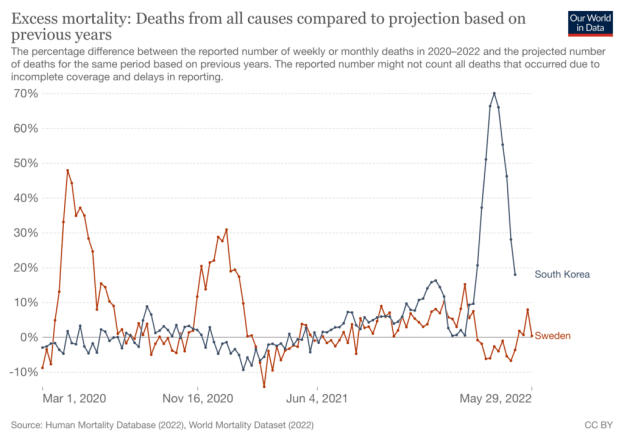
Incidentally, you wouldn’t know this from looking at the official Covid death rates. As the chart below indicates, the number of ‘confirmed’ Covid deaths per million people is much higher in Sweden, presumably due to differences in testing or diagnosis. Which illustrates the importance of tracking excess mortality.
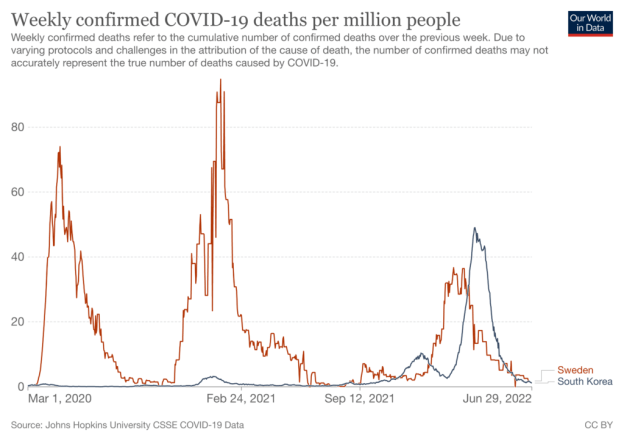
So, the country that did least to contain Covid has ended up with the same death toll as one of the countries that did most. What’s more, the majority of Sweden’s infections occurred before the vaccine rollout, whereas the vast majority of South Korea’s occurred after. Which suggests the benefits of containing the virus until after the vaccine rollout have been overstated.
Of course, South Korea didn’t do terribly. By containing the virus using border controls and contact tracing, they avoided really draconian lockdowns, and saw a comparatively mild downturn. Yet the measures they took still constitute a major infringement on civil liberties. As the Guardian notes, “Koreans’ movements were so finely and publicly tracked that secret love affairs and even hidden sexualities were brought to light.”
Anyone who cares about civil liberties will now have to ask whether South Korea’s strategy was worth it, given that Sweden ended up with the same death toll.
Covid-19 – Fun With Figures, Food For Thought
By William Walter Kay BA JD | Principia Scientific | September 9, 2021
Contrast Covid’s impact on four East Asian countries (Taiwan, Singapore, Japan and South Korea) with its impact on four US Northeastern states (New York, Massachusetts, New Jersey and Connecticut).
All eight jurisdictions host high-tech societies with market-orientated economies and democratic constitutions.
All boast ultra-modern hospitals, medical colleges and public health programs.
Two differences: a) compared to the US Northeast, the East Asian countries engage in more trade and travel with Covid’s epicentre, China; and, b) Covid toured East Asia before debuting in the US Northeast.
New York state’s population (19.5 million) is slightly smaller than Taiwan’s (23.8 million). Covid has killed 837 Taiwanese, and 54,895 New Yorkers.
Massachusetts’ population (6.9 million) is comparable to Singapore’s (5.9 million). Covid fatalities in Massachusetts – 18,272. Covid fatalities in Singapore – 55.
The combined population of our four Northeastern states (38.7 million) is well below South Korea’s (51.3 million). Covid’s death toll in our Northeastern states is 108,480. Only 2,303 South Koreans have died from Covid.
Our four East Asian countries (207 million) register a total of 19,308 Covid deaths. New Jersey (8.9 million) claims 26,919 Covid deaths.
Per capita, Covid has proven 341 times deadlier to New Jersians than Singaporeans!
Regarding Covid testing rates, Singapore is East Asia’s outlier. By conducting 17.8 million tests Singaporeans have achieved 3 tests per citizen. This still falls short of New York’s 3.3 tests per citizen and Massachusetts’ 3.8 tests per citizen. (You’ve read correctly. Certain people get tested again and again.)
Most East Asian countries, following Japan’s lead, test only patients exhibiting pneumonia-like symptoms. Japan tests 174,000 per 1 million inhabitants. Our four East Asian countries cumulatively have conducted 58 million tests. New York has conducted 66 million.
Massachusettsans test for Covid at 22 times Japan’s rate!
Medical tyranny boosters attribute East Asia’s “success” to harsh public health regimes; but Northeastern states imposed notorious lockdowns, often more Draconian than those deployed in East Asia.
Testing strategies are key. Testing only symptomatic patients is sounder than mass testing.
Asymptomatic Sars-CoV-2 carriers are extremely unlikely to be contagious.
Most people who contract Sars-CoV-2 become neither sick nor contagious.
PCR tests detect: a) miniscule infections that will not take hold; b) dead viruses from infections defeated by natural immune responses; and c) random genetic flotsam resembling Sars-CoV-2.
Mass testing yields positive results from persons who are neither sick nor contagious, and who are unlikely to become so.
By inflating case counts, mass testing makes Covid appear worse than it is.
Likewise, declaring all those who die after testing positive to be “Covid fatalities” – co-morbidities be damned – inflates death tallies; again, making Covid appear worse than it is.
Testing-based legerdemain doesn’t fully explain the whopping discrepancy between Covid’s impact in East Asia and the US Northeast.
This discrepancy also arises from the fact that the US Northeast was one of several areas following Milan’s lead i.e., during the pandemic’s early months health authorities allowed the contagion to rage unchecked through long-term care facilities.
Senior’s homes became Sars-CoV-2 incubators.
Milan, Montreal, the US Northeast et al became continental super-spreaders evidenced by supersized body counts.
Covid-19 is one matter; government response to Covid-19 is quite another.
Sources
Covid fatality and testing stats were extracted from Worldmeter’s Covid database on September 2, 2021.
North & South Korea may announce official end to war – local media
RT | April 17, 2018
Seoul and Pyongyang are reportedly set to make a huge step in the peace settlement on the Korean Peninsula, as officials from the two states are negotiating a joint statement outlining a formal end to hostilities.
North Korean leader Kim Jong-un and the South’s president, Moon Jae-in, are scheduled to meet at a rare inter-Korean summit on April 27. A local media report indicated that the date could put an end to more than half a century of confrontation.
Kim Jong-un and Moon Jae-in are to meet in the demilitarized zone in the village of Panmunjom, 53km north of Seoul. It will be the third event of its kind in the history of the two nations. Two previous meetings in 2000 and 2007 focused on political and economic issues.
Delegations from the North and the South have been holding meetings prior to the high-level talks to discuss a joint statement. The document may lead to “the end of confrontation,” newspaper Munhwa Ilbo reported Tuesday, citing a government official.
War broke out between the two Koreas in 1950, and they formally remain at war despite the de facto end of hostilities in 1953.
The thaw in relations began on the eve of the 2018 Olympic Winter Games in PyeongChang, South Korea, when the two nations formed a joint women’s ice-hockey team and agreed to march under a unified banner at the opening ceremony.
On Monday, South Korean envoy to Russia Wu Yun Gin said that Seoul will “do its utmost” to persuade the North to support the denuclearization of the Korean peninsula during the forthcoming talks. North Korea has repeatedly stressed that it is not going to stop its nuclear program until the US abandons its ‘hostile’ policy towards Pyongyang and halts military drills on the country’s doorstep.
China becomes Trump’s indispensable partner
By M K Bhadrakumar | Indian Punchline | March 29, 2018
On Wednesday, the Chinese ambassador to the United States briefed the National Security Council in the White House regarding the visit by the North Korean leader Kim Jong Un to Beijing. The White House Press Secretary Sarah Sanders later expressed cautious optimism that in their estimation, “things are moving in the right direction” and the meeting in Beijing between Kim and Chinese President Xi Jinping was “a good indication that the maximum pressure campaign (on North Korea) has been working.” She said:
- You saw him (Kim) leave for the first time — since becoming the leader of North Korea — for that meeting. And we consider that to be a positive sign that the maximum pressure campaign is continuing to work. And we’re going to continue moving forward in this process in hopes for a meeting down the road.
- Certainly we would like to see this (end-May meeting between Trump and Kim). Obviously this is something of global importance and we want to make sure that it’s done as soon as we can, but we also want to make sure it’s done properly. And we’re working towards that goal. As we’ve said before, the North Koreans have made that offer and we’ve accepted, and we’re moving forward in that process.
Trump himself gave thumbs-up. He tweeted: “For years and through many administrations, everyone said that peace and the denuclearization of the Korean peninsula was not even a small possibility. Now there is a good chance that Kim Jong Un will do what is right for his people and for humanity. Look forward to our meeting!”
Evidently, Beijing transmitted some extraordinarily hopeful tidings. The remarks by former US state secretary James Baker (who still remains an influential voice in the conservative spectrum) praising China’s role suggests that Beijing is moving in tandem with the Trump administration. In an exclusive interview with NBC News, Baker said:
- “I think it’s too bad that there wasn’t some way that we could work with the Chinese to achieve this, this result of denuclearization of the peninsula. China is the only country in the world that really has any influence, significant influence on North Korea.”
- “I would have sent some high-level envoy to Xi Jinping, the president of China, that the Chinese trust and have confidence in. And I would have said, ‘Look, you don’t like what’s going on in the Korean Peninsula. We don’t like what’s going on. Why don’t we cooperate to stop it?”
- “We, the United States, will support any government you (China) install in North Korea, provided they repudiate the acquisition or maintenance of nuclear weapons. We will trade with that government, we will establish diplomatic relations, we will execute a peace treaty ending the Korean War. Your (China’s) job is to put a government in place there that is different than this government.” (See the video of the interview.)
There is great poignancy here in these remarks because Baker had played a key role under President Ronald Reagan (Trump’s role model) negotiating the end of the Cold War in the 1980s face to face with Mikhail Gorbachev.
China has positioned itself brilliantly as the facilitator-cum-partner-cum-ally-cum-friend – depending on who its interlocutor on the Korean Question happens to be. Xi deputed politburo member Yang Jiechi as his special envoy to visit Seoul to brief the South Korean leadership, even as preparatory talks for the inter-Korean summit in April were scheduled in the DMZ in Panmunjom. Evidently, Yang had a hand in the positive outcome today at the Panmunjom meeting where there is agreement to schedule the inter-Korean summit on April 27. (here and here)
Quite obviously, there are processes today that are beyond the US’ control. Again, the US’ number one ally in Northeast Asia – Japan – has been marginalized. No one set out from Beijing to brief Tokyo. Inevitably, there are conspiracy theories. The London Times newspaper resuscitated today the hackneyed thesis that China is driving a wedge between the US and South Korea. But that seductive conspiracy theory underestimates that China is, in actuality, playing for far higher stakes in its rise on the global stage as a great power.
To be sure, history is in the making. If, as Baker says, the US is willing to normalize with North Korea and conclude a peace treaty to bring the Korean War to a formal end, the raison d’etre of continued US military presence in South Korea (on which there is significant local opposition already) becomes unsustainable. That impacts the overall US power projection in Asia. Again, if the North Korean problem is resolved peacefully, can the Taiwan Question be far behind?
Equally, China must know that there is no quick fix to the North Korean problem and it suits China to leverage the US’ critical dependence on its cooperation for the long haul – which in turn can stabilize the Sino-American relationship itself and open a new era of big-power relationship based on trust, mutual respect and sensitivity to each other’s core interests, which Beijing has been assiduously seeking.
On the other hand, Trump is well aware that if he can swing a deal on North Korea, it will significantly boost his re-election bid in 2020. Wouldn’t China know it, too? (Read my column in The Week magazine recently – The art of the Korean deal.)
Featured Video

Yemen joins the war – Red Sea could be blocked next – Saudi regime at risk
or go to
Aletho News Archives – Video-Images
From the Archives
Should Europeans ‘Thank’ the Americans for Destroying Nord Stream?
By Robert Bridge | Strategic Culture Foundation | September 29, 2022
With an investigation continuing into the destruction of the Nord Stream gas pipeline that provided energy supplies to Europe from Russia, there appears to be just one prime suspect, and that should surprise nobody.
Following the sabotage of the Nord Stream 1 and 2 gas pipelines, former Polish Foreign Minister Radoslaw Sikorski already seemed to know the identity of the perpetrator when he tweeted out: “Thank you, USA.”
At first glance, it seemed that Sikorski was speaking sarcastically, berating Washington for carrying out an attack that will have severe repercussions for the people of Europe. After all, how could anyone see any good coming from the termination of Europe’s primary source of gas reserves with winter just around the corner? It was Sikorski’s homeland of Poland, after all, that urged its citizens to collect firewood in the face of dwindling gas reserves.
In fact, the Polish diplomat was speaking one-hundred percent literally… continue
Blog Roll
 Aletho News
- America Racing to Strategic Defeat in Iran: Lt Col Daniel Davis
- FTC Warns Visa, Mastercard, PayPal, Stripe Over Political Debanking
- Russian tanker approaches Cuba despite US oil blockade
- Marandi: Yemen joins the war – Red Sea could be blocked next – Saudi regime at risk
- Pro-Palestinian French member of European Parliament denied entry to Canada
- Pakistan to Host US-Iran Talks
- How Indonesia’s tilt toward the US left it stranded in the Strait of Hormuz
- US has no choice but to retreat from Iranian borders: Top commander
- Iran Retaliation Strikes Chemical Plant Near Dimona
- AWACS’ Destruction is a Major Loss for US Military – Ex-DoW Analyst
- If Americans Knew
- Israeli police block Catholic cardinal from entering Church of the Holy Sepulchre on Palm Sunday
- Israel is assassinating journalists again, more than any other nation, anywhere, ever – Not a ceasefire Day 170
- Over 300 US service members wounded, majority have brain injuries – Not a ceasefire Day 169
- Researchers at Human Rights Watch Resign Over Blocked Report on Palestinian Refugee Return
- Jewish Groups Are Backing a War Americans Don’t Want
- Eric Fingerhut Thinks He’s the President of the Jews
- Top Jewish Philanthropists, Rabbis Urge Israeli President to Take Action Against ‘Jewish Extremists’
- Don’t Be Fooled. Zionist Leaders Have Always Wanted to Control Southern Lebanon
- Israel’s widespread use of torture is a core element of its genocide against the Palestinian people
- In Israel’s War on Iran, Many Middle East US Bases Rendered “All But Uninhabitable”
- No Tricks Zone
- New Study Finds Warming Saves Lives…Cold Temperatures 12 Times More Deadly Than Excess Heat
- German Science Blog Accuses PIK Climate Institute Of Hallucinating Climate Tipping Points
- Devastating Assessment Of Comirnaty Vaccine By Former Senior Pfizer Europe Toxicologist
- New Study: CO2 Is ‘Effectively Negligible’ As An Explanatory Climate Change Factor Since 2000
- Former Pfizer Toxicologist Dr. Helmut Sterz Tells Bundestag Hearing Pfizer Vaccine Should Have Never Been Approved
- Energy Expert: Germany’s Nuclear Phaseout Was A “500 Billion Euro Mistake”
- New Research: South Australia’s Mid-Holocene Sea Surface Temperatures Were 4°C Warmer Than Today
- Storing Green Energy To Last Germany 10 Days Would Require A 60-Million Tonne Battery
- New Studies: UK Sea Levels Were 4 Meters Higher Than Today During The Mid-Holocene
- Destructive Green New Deal: German Energy And Metal Group Warns Of Drastic Crisis
 Aletho News