Iran attacks on UAE leaves RSF militia high and dry
The Canary | March 12, 2026
Iran’s retaliatory strikes on Israel and the United Arab Emirates (UAE) are reportedly contributing to a rapid collapse of the genocidal so-called ‘Rapid Support Forces’ (RSF) in Sudan.
The RSF, funded and armed by the UAE and Israel, had been making gains up to February 2026. It has murdered hundreds of thousands of people in Sudan. Rapes, sexual torture and executions have been common and almost 400,000 people are in starvation.
However, Sudanese government forces have achieved a string of military victories that appear to be turning into a rout.
With UAE shipments rerouted from the Hormuz Straight and the UAE to Saudi Arabia due to Iran’s counterattacks of shipping, the UAE economy, and it’s global financiers, have been dealt a major blow.
Meanwhile, Sudanese forces are targeting RSF arms and supply depots, crippling front-line RSF troops by cutting off ammunition, fuel, and essentials.
Regime Change In Iran Is The Final Phase Of The ‘Clean Break’ Strategy
The Dissident | January 21, 2026
Lindsey Graham, the Neo-con Republican Senator, at the Zionist Tzedek conference, gave the real reason for America’s policy of regime change in Iran, namely to isolate the Palestinians in the Middle East and pave the way for Israeli domination.
Graham, referring to regime change in Iran said, “If we can pull this off, it would be the biggest change in the Middle East in a thousand years: Hamas, Hezbollah gone, the Houthis gone, the Iranian people an ally not an enemy, the Arab world moving towards Israel without fear, Saudi-Israel normalize, no more October the 7th”.
In other words, Lindsey Graham and the U.S. believe that regime change in Iran would lead to the collapse of Palestinian resistance and allied groups Hezbollah and Ansar Allah and lead Middle Eastern powers to normalize with Israel without any concessions to Palestinians, thus paving the way for the ethnic cleansing of Gaza and the West Bank, and further expansion into Syria and Lebanon in service of the Greater Israel project.
This motive is not only driving the desire for regime change in Iran, but has been the main motive for U.S. foreign policy in the Middle East since 9/11, not fighting a “war on terror”.
In 1996, key figures who ended up in high level positions in the Bush administration, such as Richard Perle, Douglas Feith and David Wurmser, who were at the time advising the newly elected Benjamin Netanyahu, sent him a letter titled, “A Clean Break: A New Strategy for Securing the Realm”, which called on him to make a “clean break” from peace talks with Palestinians and instead focus on isolating them in the region, first a for-most by, “removing Saddam Hussein from power in Iraq — an important Israeli strategic objective in its own right”.
Netanyahu kept to his word and made his “Clean Break” from the Oslo Accords during his first term as Prime Minister, later boasting:
how he forced former U.S. Secretary of State Warren Christopher to agree to let Israel alone determine which parts of the West Bank were to be defined as military zones. ‘They didn’t want to give me that letter,’ Netanyahu said, ‘so I didn’t give them the Hebron agreement [the agreement giving Hebron back to the Palestinians]. I cut the cabinet meeting short and said, ‘I’m not signing.’ Only when the letter came, during that meeting, to me and to Arafat, did I ratify the Hebron agreement. Why is this important? Because from that moment on, I de facto put an end to the Oslo accords.”
Soon after, the authors of the clean break document became key advisors on the Middle East in the George W. Bush administration.
After 9/11, they used the attack to carry out the “important Israeli strategic objective” of “removing Saddam Hussein from power in Iraq”, who was seen as too sympathetic to Palestinians.
As David Wurmser, one of the authors of the clean break document and the Middle East Adviser to former US Vice President Dick Cheney, later admitted , “In terms of Israel, we wanted Yasser Arafat not to have the cavalry over the horizon in terms of Saddam”.
George W. Bush aide, Philip Zelikow said , “the real threat (from Iraq) (is) the threat against Israel”, “this is the threat that dare not speak its name, because the Europeans don’t care deeply about that threat”, “the American government doesn’t want to lean too hard on it rhetorically, because it is not a popular sell”.
But for Israel and the Bush administration, the war in Iraq was just the first phase of the “clean break strategy”, to take out all of Israel’s enemies in the Middle East.
As the U.S. General Wesley Clark revealed the clean break went from a plan to take out Saddam Hussein in Iraq to a plan to “take out seven countries in five years, starting with Iraq, and then Syria, Lebanon, Libya, Somalia, Sudan, and, finishing off, Iran”. (Emphasis added)
As Clark later explained on the Piers Morgan show, the list came from a study which was “paid for by the Israelis” and said, “if you want to protect Israel, and you want Israel to succeed… you’ve got to get rid of the states that are surrounding”.
With every other country on the hit list either weakened (Lebanon, Somalia, Sudan) or taken out (Iraq, Libya, Syria) from the ensuing years of U.S. and Israeli intervention, Neo-cons and Zionists see Iran as the last bulwark in the way of carrying out the Clean Break plan.
The UAE’s reverse trajectory: From riches to rags
By Dr Zakir Hussain | MEMO | December 18, 2025
One of the most enduring and widely quoted dialogues in Indian cinema is: “Do not throw stones at others’ houses when your own house is made of glass.” Unfortunately, this wisdom appears to be lost on the United Arab Emirates. Instead of exercising restraint and responsibility, the UAE has increasingly been accused of conspiring with, financing, and backing a wide range of actors and armed groups that have contributed to chaos, instability, and even genocidal violence in several countries.
Over the years, the UAE has steadily expanded the scope of its controversial activities—from Libya and Sudan in North Africa to other mineral-rich Muslim-majority African countries, and further eastward to Afghanistan and Yemen. Its involvement in the Palestinian context also raises serious concerns, as there appears to be no clear moral or political limit to its actions. These interventions have not promoted peace or stability; rather, they have intensified conflicts, deepened humanitarian crises, and prolonged wars.
What makes this approach particularly perplexing is that the UAE itself lacks a credible and robust defensive shield to protect its own territory. It does not possess the capability to fully defend its iconic skyscrapers and critical infrastructure even against relatively unsophisticated, low-cost drones. A coordinated volley of such drone strikes would be sufficient to cause panic among the millionaires and billionaires who have invested heavily in Abu Dhabi and Dubai. Capital, after all, is highly sensitive to risk, and fear alone can trigger massive capital flight.
Against this backdrop, it is difficult to comprehend why Mohammed bin Zayed has chosen to indulge in a strategy of regional destabilisation and proxy warfare. History clearly demonstrates that mercenaries neither win wars nor sustain long, decisive military campaigns. They fight only as long as their financial incentives are met, avoid heavy casualties, and withdraw the moment the cost-benefit equation turns unfavourable.
The UAE has already experienced the consequences of such adventurism in Yemen, where its involvement against the Houthis proved costly and ultimately unproductive. The episode exposed the limits of Emirati military power and underscored its lack of preparedness for prolonged, brutal conflicts. The Emiratis have shown remarkable efficiency in event management, diplomacy branding, and global image-building, but they are ill-suited for sustained warfare or managing the complex realities of civil wars and insurgencies.
Despite these lessons, the UAE continues to deploy mercenaries, supply arms, and push destabilising agendas that risk mass civilian suffering. Such actions not only tarnish its international standing but also make the future of the UAE increasingly uncertain. More importantly, they significantly raise the vulnerability of those who have invested billions and billions of dollars in the country—particularly in real estate and financial assets that depend heavily on perceptions of safety and stability. The UAE has attracted the largest number of high net worth people since the Ukraine war started.
According to one estimate, in 2025 alone, approximately 9,800 high-net-worth individuals moved to the UAE. In 2024, the total number of millionaires who moved to the UAE from Russia, Africa, and the UK is around 130,000, thus fuelling its status as a premier global wealth hub. The reasons are zero tax, stability, and safety, lifestyle.
However, the overindulgence of MBZ and misuse of the sovereign wealth fund is likely to negate all the toil and troubles endured by the forefathers of the Emirates since 1972.
As an Indian, my concern is both professional and moral. A large number of Indians have invested substantial sums in the UAE, especially in real estate. It is therefore necessary to issue a timely warning and provide a realistic assessment of emerging risks, so that Indian interests can be protected before irreversible damage occurs.
I remain open to offering constructive suggestions and responsible assessments, with the sole objective of safeguarding long-term stability and protecting the legitimate interests of investors and the expatriate community.
Emirati, Israeli disinformation campaign frames Sudan conflict as Christian persecution: Report
Press TV – November 21, 2025
Far-right Emirati and Israeli social media influencers have engaged in a coordinated digital campaign to falsely claim that Christians were being killed by “Islamists” in Sudan, a new report has revealed.
Sudanese investigative platform Beam Reports said that after the Rapid Support Forces (RSF) paramilitary group seized control of el-Fasher in Darfur nearly a month ago, misleading content about the nature of events began to surface online in a “synchronised manner.”
Beam found that several accounts took to social media to re-use images of RSF abuses against civilians in el-Fasher and frame them as “Islamist violence against Christians.”
The outlet accused Amjad Taha, an Emirati analyst, of being the architect of the campaign. He reportedly posted several claims about alleged Islamists in Sudan, which were then amplified by other accounts.
For several months, the Emirati figure has led the charge on social media to link Sudan’s armed forces with the Muslim Brotherhood and Islamic resistance movement Hamas in Gaza.
Amjad Taha claimed that Sudan’s army had “killed 2 million Christians, displaced 8 million, and raped 15,000 women, while leftists stay busy attacking the UAE… a nation where church bells ring freely.”
However, none of the numbers cited were supported by credible sources or verified reports, according to the investigation.
The Emirati influencer also said that a Sudanese army officer had “eaten a man’s heart after killing him and his children.” Again, no evidence was provided, but such claims were amplified by Emirati, Israeli, and far-right accounts.
According to the report published by Beam, the objectives of the coordinated campaign included shifting blame of atrocities away from the RSF, recasting Sudan’s war as a religious conflict to “evoke foreign sympathy,” and flooding the online space with fabricated content to confuse media coverage.
One such example was American influencer Nima Yamini, who shared images from el-Fasher and claimed they showed “Christians slaughtered in Sudan – and no one talks about it,” adding that massacres against Christians were so severe that you can “see blood from space.”
In reality, blood splatters seen from space were from areas of el-Fasher where the RSF were reported to have shot residents.
In a different post, far-right Polish politician Dominik Tarczynski shared a purported image of a mother and child in el-Fasher with the false caption: “Sudan: genocide of Christians by the Islamists.”
In 2023, a conflict broke out between the Sudanese army and the RSF, far from religious lines, which has resulted in the deaths of tens of thousands, displaced over 12 million people, and led the International Rescue Committee to characterize it as “the largest humanitarian crisis ever documented.”
Sudanese authorities have repeatedly said the RSF enjoys unconditional support from the United Arab Emirates (UAE), with Khartoum taking legal action against the country at the International Court of Justice (ICJ) in April.
A report by British daily newspaper The Guardian late last month revealed that British-made weapons and military equipment are being supplied by the UAE to militants from the RSF.
Furthermore, Khartoum-based writer and strategic affairs analyst Makkawi Elmalik also said in October that what is happening in Sudan “is not a regular military battle, but a systematic extermination committed by the RSF, supported by the UAE and Israel.”
He further stated that both the UAE and the Israeli regime have participated in planning the militia’s attacks on civilians in the Sudanese city and provided them with weapons and intelligence.
The UAE’s War on Muslims: From Sudan to the Gaza Genocide
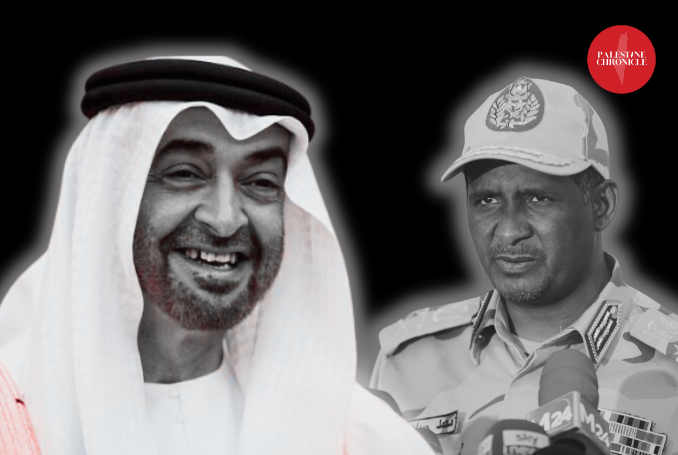
By Robert Inlakesh | The Palestine Chronicle | October 30, 2025
While the United Arab Emirates advertises itself as both a peacemaker and opponent of so-called “Islamic radicalism”, it is currently involved in genocide in both Gaza and Sudan. Connecting these dots is key to understanding the overarching goals of the regime.
The United Arab Emirates has created its image in the world as an innovator, a builder, and a peacemaker, a carefully calibrated illusion as artificial as the buildings that mesmerize onlookers in Dubai. But behind the architecture and lavish outer shell is a rotten core that continues to aid in the erosion of the surrounding region.
While claiming to oppose “radical Islam” and paying talentless influencers to attack groups like the Muslim Brotherhood, they foster extremist ideologies and back ISIS-linked militant groups to carry out their regional ambitions.
For all of the critiques that can be offered of groups like the Muslim Brotherhood and of Qatar, they are nothing like the orientalist depictions of them that are spread far and wide through Emirati propaganda.
The reason why the UAE attacks the ideology belonging to groups that are either linked to or part of the Muslim Brotherhood has nothing to do with their religious motivations and everything to do with the Emirati opposition to their political agenda.
For them, they fear any politically engaged Islamic movement that is capable of successfully leading a country and organizing democratic institutions, because they are a dictatorship fully beholden to their Western handlers, including Israel.
The reason why the Islamic element of such movements threatens them the most is that it is popular and the religion that the majority of the region adheres to in some shape or form.
If any Islamic anti-imperialist movement proves successful and leads a democratic process, then this could threaten their rule. So, they seek to undermine, infiltrate, and destroy these movements wherever they rear their heads, including inside the Gaza Strip.
Hamas, or the Islamic Resistance Movement, was an outgrowth of the Egyptian Muslim Brotherhood. Its origins begin in the 1970s and the formation of the social/civil-society movement known as the Mujamma al-Islamiyya in the Gaza Strip, at the time colloquially referred to as the Muslim Brotherhood, as it represented Palestine’s wing of the movement.
Therefore, the success and popularity of Hamas, as part of what is viewed by the Emiratis as a wider body of Islamic political movements, is interpreted as a threat to its rule in the region.
As a means of dismantling the prospects of Democratic oriented Islamic political leaderships, the UAE has engaged in military confrontations and intense propaganda campaigns. On the propaganda front, they are joined by other Gulf leaderships who have their own agendas, also and not only fund direct anti-Hamas or anti-Muslim Brotherhood propaganda, but also fuel religious division.
One of the most powerful means of divisive propaganda is directly targeting Muslims themselves, in particular the Sunni Muslim majority of the region. While they certainly push sectarian rhetoric against the Shia too, they seek to pacify the Sunni population, deter them from engaging in anti-imperialist and anti-occupation struggles, or redirect their anger at fellow Muslims.
They do this through pushing divisions between mainstream Sunni schools of thought and employing their Madkhali propagandists to deter action against the so-called Muslim rulers. Without going too deep into the Madkhalis, as with each group of Muslims, there is always nuance; they are a group of Salafist Muslims who adhere to the dictates of their rulers and sometimes will even justify actions taken by those rulers that are prohibited in Islam.
The primary goal here is to fund and fuel division across the Muslim world, channeling hatred and creating debates around any issue that can distract from what Israel, the United States, and their allies are doing to the region. Another major tactic employed here is to Takfir (declare a disbeliever) or undermine any Muslim group that sides with the likes of Iran, Hezbollah, Ansarallah, or any other Shia groups.
Again, none of this opposition has anything to do with any substance that may be behind said arguments they make; these are well-funded propaganda campaigns designed for political purposes to undermine resistance to imperialism, occupation, and genocide. This is where we can begin looking at Gaza and then Sudan.
The UAE professes to oppose so-called “Islamic radicalism”, yet it now stands accused of providing support to the ISIS-linked gangs operating in the Israeli-occupied portion of the Gaza Strip. Not only has the UAE been accused of directly coordinating with these militia groups – composed of hardline Salafists who have links to ISIS and al-Qaeda, drug traffickers and murderers – but there is even evidence of these death squad members driving around in vehicles with registered UAE license plates.
In opposition to Hamas, the UAE is more than happy to back Israeli proxy collaborator groups that contain ISIS and Al-Qaeda minded elements within them.
Going back to the sorts of divisive propaganda that is encouraged by the Emiratis, a leading member of the Israel-backed so-called “Popular Forces” militia in Gaza, Ghassan Duhine, has openly cited ISIS Fatwas declaring Hamas apostates as a justification for killing them. ISIS officially declared war on Hamas back in 2018.
Meanwhile, the UAE has long been backing the Rapid Support Forces (RSF) in Sudan, the group currently accused of committing genocide, and which has re-entered the headlines after it captured Al-Fasher and other areas in North Darfur, resulting in the murder of around 527 people, including civilians who were butchered while sheltering in refugee camps.
RSF leader, Mohamed Hamdan Dagalo (Hemedti), has long collaborated with the Emiratis, and it was even previously pointed out that his official Facebook page was controlled out of the UAE.
Without getting into all of the complexities of the Sudanese civil war, Hemedti is a warlord who has long maintained power over the majority of Sudan’s Gold Mines, slaughtering anyone who dares to get in his way.
His forces have also been accused by the UN and prominent rights groups of committing widespread mass sexual violence, including horrific forms of rape.
Hemedti was additionally supplied with battle-changing technologies through his Israeli Mossad contacts, and despite there being documented rights violations on both the Sudanese Army and RSF sides of the war, there is no doubt that Hemedti’s forces have the most blood on their hands and carry out the most horrific crimes seen in the conflict.
The UAE is not just one of many actors involved in Sudan; it is the primary supporter of the RSF. According to a scoop published by The Guardian this Tuesday, British weapons sold to the United Arab Emirates were even discovered to have been used by the RSF to carry out its genocide.
Despite the United States declaring the horrors in Sudan as a genocide, during the Biden administration, no action has been taken against the UAE for its role in fueling the war. Similarly, the UAE has been involved in countless crimes committed throughout the Horn of Africa and in North Africa too, backing a whole range of extremist militant groups who stand accused of indiscriminately targeting civilians.
Although it is also hidden from the Western corporate media, the UAE even used members of the Sudanese RSF to fight on its behalf as proxy forces against Ansarallah in Yemen, where they were accused of playing a role in what many declared a genocide. Keep in mind that nearly 400,000 people in Yemen were killed due to the inhuman blockade and war of aggression, led by both the UAE and Saudi Arabia.
The Emiratis push propaganda about the Sudanese Military being “Islamists”, accusing them of being part of the Muslim Brotherhood and then linking them to all sorts of other organizations. Ansarallah in Yemen is also branded as “Islamists”, but in their case are accused of being “Iranian proxies”. In essence, this line of propaganda is the typical Israeli-style Hasbara argument for committing egregious war crimes.
Throughout the Gaza genocide, the UAE was one of the only nations that continued its routine flights to Ben Gurion airport and transported materials to aid the Israelis. The Emiratis also turned Dubai into an Israeli safe haven, where soldiers implicated in genocide can go to party, engage in activities like consuming narcotics or hiring escorts, and live in luxury.
The UAE did not lift a finger to force the Israelis to let aid into Gaza, as they blocked all humanitarian aid trucks entering for around three months earlier this year, but will then point to the trickles of aid that they do supply as proof they are helping the people. In their defense, they argue that they were key in achieving a ceasefire, for which there is no evidence, just like there was no evidence that they stopped West Bank annexation when normalized ties with Israel.
Viewing the Emiratis as operating on their own whims, blaming them solely for the actions they commit, is incorrect. These are rulers installed by the West, who work for the West and are simply used as pawns to do the bidding of their masters. If any of their leaders stand up to the crimes that the UAE is inflicting, they will be assassinated and replaced with other members of the ruling bloodline who choose to play ball. They are hostages, posing as rulers and playing their part in the dismantlement of the surrounding region.
Normalisation is death of Arab sovereignty, Syria is the best example
By Robert Inlakesh | Al Mayadeen | August 14, 2025
We have reached the stage where it can no longer be denied that the Syrian leadership is at the complete mercy of the US and its allies. Its normalisation drive, whereby its officials meet with their Israeli counterparts, are not negotiations but discussions aimed at achieving the best implementation of Tel Aviv’s orders.
When Arab states make the decision to capitulate to the Israeli-US normalisation and neo-liberal economic model, they set themselves up for a loss of sovereignty and to become at best a tool for policy makers in Washington.
If we look at the Jordanian and Egyptian models, we see that their agreements have not saved them from growing instability and economic decline, particularly in Egypt’s case. Once, it had become a big deal when President Hosni Mubarak began selling gas to the Israelis, now, Cairo purchases gas through its own pipelines that have reversed the flow.
Turning our focus to the current predicament of Syria, it is not even correct to assess it is based upon the Egypt model. In fact, despite some similarities, it is in even worse a predicament than Sudan.
The Sudanese state, following the fall of its former leader Omar Bashir, went into a transitional phase whereby the Army and Rapid Support Forces (RSF) militia agreed upon a power-sharing phase. During this time, the Zionist Entity swept in to take advantage of the situation, fostering relations with both sides, but particularly with notorious goldmine owning war-lord Hemedti’s RSF.
Sudan, working closely with US President Donald Trump’s administration at the time, managed to get sanctions lifted, remove itself from the State Sponsors of Terrorism List, receive sanctions relief and aid, while almost paving the way to adopt a neo-liberal economic model; seeking IMF and World Bank loans.
Khartoum had pledged that in exchange for these “gifts” from the US, they would join the so-called “Abraham Accords” and began negotiations behind closed doors with the Israelis.
Is this starting to sound familiar?
Then, in April of 2023, the Civil War erupted, and the Israelis swept in to back both sides, after having covertly provided the RSF with military capabilities that enabled it to balance the power on the battlefield in the first place. While the Mossad supported the RSF, the Israeli Foreign Ministry leaned towards the Sudanese Army.
In Syria, almost the exact same process has occurred. Yet most pretend as if we haven’t seen this same story before.
The key difference, however, is that the new Syrian government of Ahmad al-Sharaa has less control than when the RSF and Sudanese Army ran an interim unity government. The recent sectarian bloodshed in Sweida proved this without a shadow of a doubt.
There are now separatist militias in Sweida who actually coordinated with Israeli-Druze army forces who had set up a joint communications room to help locate targets during the latest round of bloodshed. Meanwhile, the Syrian security forces had coordinated the entry of tanks into Sweida with the Israelis, yet were bombed anyway, leading to as many as 700 dead amongst their ranks.
While the majority of the Syrian Druze and wider Syrian public oppose ties with the Israelis, the Zionist Entity finds inroads with both sides and watches on as they slaughter each other, all in the interest of further weakening the country.
Ahmad al-Sharaa was basically non-existent, as it appeared for over a week that Syria was heading towards another civil war, only offering brief statements before the US envoy announced a bizarre arrangement, claiming that Damascus and Tel Aviv had agreed to a truce.
It was especially strange because the announcement didn’t initially come from the Syrians themselves, but also due to the fact that there was no Syrian-Israeli war. What was happening was that Syrian forces were getting blown to pieces and ordered to stand down. The only relevance the Syrian government forces had was in their failed role inside Sweida, where they went out of control and participated in civilian massacres, alongside Bedouin tribal forces.
Never in the known history of war has a nation been invaded, occupied, its capital repeatedly bombed and hundreds of its soldiers blown to pieces, and the country being attacked did not respond in any way. Not only have Ahmad al-Sharaa’s forces failed to fire a single bullet towards their occupiers, they have not even threatened the use of force.
Even worse, rather than respond, they give the Israelis gifts like infamous spy Eli Cohen’s belongings, cracking down on the Palestinian Resistance forces, and declaring fellow Muslims and Arabs their enemies, despite them being the only ones willing to stand up for Syria.
Meanwhile, every minority group in the country is isolated, and every community feels the need to bear arms and protect themselves, as nobody trusts the ill-trained, unprofessional security forces.
This is what capitulation looks like, a leadership which exists more so on Facebook, X, and Instagram than it does in real life. A sectarian bloodbath, with no stability, no national unity, no sovereignty, and whose leaders are collaborating with the genocidal entity, in violation of all the regional, national, cultural, and religious moral obligations.
This is normalisation. This is capitulation. This is what happens when you worship at the feet of your occupiers. Syria is the worst case of all, because there is no longer even a united nation or cause that it embodies, which has, for the current moment, died.
Only through a unified resistance front will Syria liberate itself. It may take time, but this is the only path, and historically, the Syrian people had resisted the Ottomans, the French, and even got themselves back on their feet after the CIA overthrew their government in 1949. It can happen, but it will take the Syrian people coming together in order to overcome their predicament.
There is no example of where normalisation with the Zionist regime, or total capitulation to the US, saves a nation in turmoil. Even in the cases where the US poured trillions into attempts to set up new regimes, like what happened with Iraq and Afghanistan. The only examples of where a regime has not yet declined or sacrificed its security predicament due to normalisation, are in the cases of the UAE and Bahrain, but both were already immensely rich, and nothing much changed upon normalisation.
However, even in the cases of the UAE and Bahrain, their positioning themselves as part of the Israeli-US regional anti-Iran alliance puts them in the firing line and could risk national stability in the event of a broader war.
The positions of the current regime in Syria are indefensible. Not even from a selfish materialist perspective could you argue their case without engaging in mental gymnastics. There is no strategic depth, nor a demonstration of competent governance in the direction we see the nation going, and at a time when unity is needed the most.
Will Trump Deliver Peace?
Glenn Diesen | January 11, 2025
I had a conversation with Professor Jeffrey Sachs and Alexander Mercouris about the possibility of Trump delivering peace in the Middle East and Ukraine. Trump recently posted a video of Professor Sachs criticising the presentation of international conflicts as a struggle between democracy and authoritarianism. In the video, Professor Sachs also scolded Netanyahu and blamed Israel for America’s wars in the Middle East over the past 30 years (Netanyahu will reportedly not attend Trump’s inauguration). Trump has also recognised that NATO expansionism was the source of the proxy war in Ukraine, and has been vocal about his desire to end the proxy.
These actions give some reason for cautious optimism that peace can be achieved at a time when the world appears to be heading toward major wars. The false narratives that conflict in the world derives from a struggle between democracy and authoritarianism create a dangerous Manichaean worldview. Peace then requires good defeating evil, while compromise and workable peace are derided as appeasement. Anyone contesting the Manichaean worldview can be accused of betraying liberal democratic values. Trump has many flaws, but his greatest strength is his ability to say what he wants and break away from the West’s ideological narratives and Manichaean worldview. By recognising the security interests of rival powers (a big taboo in the West), Trump can also mitigate these concerns as the foundation for any durable peace.
Jeffrey Sachs, Alexander Mercouris & Glenn Diesen on the Duran:
How the US and Israel Destroyed Syria and Called it Peace
By Jeffrey D. Sachs | Common Dreams | December 12, 2024
In the famous lines of Tacitus, Roman historian, “To ravage, to slaughter, to usurp under false titles, they call empire; and where they make a desert, they call it peace.”
In our age, it is Israel and the U.S. that make a desert and call it peace.
The story is simple. In stark violation of international law, Israeli Prime Minister Benjamin Netanyahu and his ministers claim the right to rule over seven million Palestinian Arabs. When Israel’s occupation of Palestinian lands leads to militant resistance, Israel labels the resistance “terrorism” and calls on the U.S. to overthrow the Middle East governments that back the “terrorists.” The U.S., under the sway of the Israel Lobby, goes to war on Israel’s behalf.
The fall of Syria this week is the culmination of the Israel-U.S. campaign against Syria that goes back to 1996 with Netanyahu’s arrival to office as Prime Minister. The Israel-U.S. war on Syria escalated in 2011 and 2012, when Barack Obama covertly tasked the CIA with the overthrow of the Syrian Government in Operation Timber Sycamore. That effort finally came to “fruition” this week, after more than 300,000 deaths in the Syrian war since 2011.
Syria’s fall came swiftly because of more than a decade of crushing economic sanctions, the burdens of war, the U.S. seizure of Syria’s oil, Russia’s priorities regarding the conflict in Ukraine, and most immediately, Israel’s attacks on Hezbollah, which was the key military backstop to the Syrian Government. No doubt Assad often misplayed his own hand and faced severe internal discontent, but his regime was targeted for collapse for decades by the U.S. and Israel.
Before the U.S.-Israel campaign to overthrow Assad began in earnest in 2011, Syria was a functioning, growing middle-income country. In January 2009, the IMF Executive Board had this to say:
Executive Directors welcomed Syria’s strong macroeconomic performance in recent years, as manifested in the rapid non-oil GDP growth, comfortable level of foreign reserves, and low and declining government debt. This performance reflected both robust regional demand and the authorities’ reform efforts to shift toward a more market- based economy.
Since 2011, the Israel-U.S. perpetual war on Syria, including bombing, jihadists, economic sanctions, U.S. seizure of Syria’s oil fields, and more, has sunk the Syrian people into misery.
In the immediate two days following the collapse of the government, Israel conducted about 480 strikes across Syria, and completely destroyed the Syrian fleet in Latakia. Pursuing his expansionist agenda, Prime Minister Netanyahu illegally claimed control over the demilitarized buffer zone in the Golan Heights and declared that the Golan Heights will be a part of the State of Israel “for eternity.”
Netanyahu’s ambition to transform the region through war, which dates back almost three decades, is playing out in front of our eyes. In a press conference on December 9th, the Israeli prime minister boasted of an “absolute victory,” justifying the on-going genocide in Gaza and escalating violence throughout the region:
I ask you, just think, if we had acceded to those who told us time and again: “The war must be stopped”– we would not have entered Rafah, we would not have seized the Philadelphia Corridor, we would not have eliminated Sinwar, we would not have surprised our enemies in Lebanon and the entire world in a daring operation-stratagem, we would not have eliminated Nasrallah, we would not have destroyed Hezbollah’s underground network, and we would not have exposed Iran’s weakness. The operations that we have carried out since the beginning of the war are dismantling the axis brick by brick.
The long history of Israel’s campaign to overthrow the Syrian Government is not widely understood, yet the documentary record is clear. Israel’s war on Syria began with U.S. and Israeli neoconservatives in 1996, who fashioned a “Clean Break” strategy for the Middle East for Netanyahu as he came to office. The core of the “clean break” strategy called for Israel (and the US) to reject “land for peace,” the idea that Israel would withdraw from the occupied Palestinian lands in return for peace. Instead, Israel would retain the occupied Palestinian lands, rule over the Palestinian people in an Apartheid state, step-by-step ethnically cleanse the state, and enforce so-called “peace for peace” by overthrowing neighboring governments that resisted Israel’s land claims.
The Clean Break strategy asserts, “Our claim to the land—to which we have clung for hope for 2000 years—is legitimate and noble,” and goes on to state, “Syria challenges Israel on Lebanese soil. An effective approach, and one with which American can sympathize, would be if Israel seized the strategic initiative along its northern borders by engaging Hizballah, Syria, and Iran, as the principal agents of aggression in Lebanon…”
In his 1996 book Fighting Terrorism, Netanyahu set out the new strategy. Israel would not fight the terrorists; it would fight the states that support the terrorists. More accurately, it would get the US to do Israel’s fighting for it. As he elaborated in 2001:
The first and most crucial thing to understand is this: There is no international terrorism without the support of sovereign states… Take away all this state support, and the entire scaffolding of international terrorism will collapse into dust.
Netanyahu’s strategy was integrated into U.S. foreign policy. Taking out Syria was always a key part of the plan. This was confirmed to General Wesley Clark after 9/11. He was told, during a visit at the Pentagon, that “we’re going to attack and destroy the governments in seven countries in five years—we’re going to start with Iraq, and then we’re going to move to Syria, Lebanon, Libya, Somalia, Sudan and Iran.” Iraq would be first, then Syria, and the rest. (Netanyahu’s campaign for the Iraq War is spelled out in detail in Dennis Fritz’s new book, Deadly Betrayal. The role of the Israel Lobby is spelled out in Ilan Pappé’s new book, Lobbying for Zionism on Both Sides of the Atlantic). The insurgency that hit U.S. troops in Iraq set back the five-year timeline, but did not change the basic strategy.
The U.S. has by now led or sponsored wars against Iraq (invasion in 2003), Lebanon (U.S. funding and arming Israel), Libya (NATO bombing in 2011), Syria (CIA operation during 2010’s), Sudan (supporting rebels to break Sudan apart in 2011), and Somalia (backing Ethiopia’s invasion in 2006). A prospective U.S. war with Iran, ardently sought by Israel, is still pending.
Strange as it might seem, the CIA has repeatedly backed Islamist Jihadists to fight these wars, and jihadists have just toppled the Syrian regime. The CIA, after all, helped to create al-Qaeda in the first place by training, arming, and financing the Mujahideen in Afghanistan from the late 1970s onward. Yes, Osama bin Laden later turned on the U.S., but his movement was a U.S. creation all the same. Ironically, as Seymour Hersh confirms, it was Assad’s intelligence that “tipped off the U.S. to an impending Al Qaeda bombing attack on the headquarters of the U.S. Navy’s Fifth Fleet.”
Operation Timber Sycamore was a billion-dollar CIA covert program launched by Obama to overthrow Bashar al-Assad. The CIA funded, trained, and provided intelligence to radical and extreme Islamist groups. The CIA effort also involved a “rat line” to run weapons from Libya (attacked by NATO in 2011) to the jihadists in Syria. In 2014, Seymour Hersh described the operation in his piece “The Red Line and the Rat Line”:
“A highly classified annex to the report, not made public, described a secret agreement reached in early 2012 between the Obama and Erdoğan administrations. It pertained to the rat line. By the terms of the agreement, funding came from Turkey, as well as Saudi Arabia and Qatar; the CIA, with the support of MI6, was responsible for getting arms from Gaddafi’s arsenals into Syria.”
Soon after the launch of Timber Sycamore, in March 2013, at a joint conference by President Obama and Prime Minister Netanyahu at the White House, Obama said: “With respect to Syria, the United States continues to work with allies and friends and the Syrian opposition to hasten the end of Assad’s rule.”
To the U.S.-Israeli Zionist mentality, a call for negotiation by an adversary is taken as a sign of weakness of the adversary. Those who call for negotiations on the other side typically end up dead—murdered by Israel or U.S. assets. We’ve seen this play out recently in Lebanon. The Lebanese Foreign Minister confirmed that Hassan Nasrallah, Former Secretary-General of Hezbollah had agreed to a ceasefire with Israel days before his assassination. Hezbollah’s willingness to accept a peace agreement according to the Arab-Islamic world’s wishes of a two-state solution is long-standing. Similarly, instead of negotiating to end the war in Gaza, Israel assassinated Hamas’ political chief, Ismail Haniyeh, in Tehran.
Similarly in Syria, instead of allowing for a political solution to emerge, the U.S. opposed the peace process multiple times. In 2012, the UN had negotiated a peace agreement in Syria that was blocked by the Americans, who demanded that Assad must go on the first day of the peace agreement. The U.S. wanted regime change, not peace. In September 2024, Netanyahu addressed the General Assembly with a map of the Middle East divided between “Blessing” and “Curse,” with Lebanon, Syria, Iraq, and Iran as part of Netanyahu’s curse. The real curse is Israel’s path of mayhem and war, which has now engulfed Lebanon and Syria, with Netayahu’s fervent hope to draw the U.S. into war with Iran as well.
The U.S. and Israel are high-fiving that they have successfully wrecked yet another adversary of Israel and defender of the Palestinian cause, with Netanyahu claiming “credit for starting the historic process.” Most likely Syria will now succumb to continued war among the many armed protagonists, as has happened in the previous U.S.-Israeli regime-change operations.
In short, American interference, at the behest of Netanyahu’s Israel, has left the Middle East in ruins, with over a million dead and open wars raging in Libya, Sudan, Somalia, Lebanon, Syria, and Palestine, and with Iran on the brink of a nuclear arsenal, being pushed against its own inclinations to this eventuality.
All this is in the service of a profoundly unjust cause: to deny Palestinians their political rights in the service of Zionist extremism based on the 7th century BCE Book of Joshua. Remarkably, according to that text—one relied on by Israel’s own religious zealots—the Israelites were not even the original inhabitants of the land. Rather, according the text, God instructs Joshua and his warriors to commit multiple genocides to conquer the land.
Against this backdrop, the Arab-Islamic nations and indeed almost all of the world have repeatedly united in the call for a two-state solution and peace between Israel and Palestine.
Instead of the two-state solution, Israel and the U.S. have made a desert and called it peace.
War in Sudan and its Grim Prospects
By Viktor Mikhin – New Eastern Outlook – November 29, 2024
Russia used its veto power in the UN Security Council (UNSC) to block a draft resolution calling for an end to the 20-month war in Sudan and the commencement of negotiations between the Sudanese Armed Forces (SAF) and the Rapid Support Forces (RSF).
The draft resolution, widely seen as neo-colonial in its design, was proposed by the UK, which holds the UNSC presidency on Sudan, and Sierra Leone, a non-permanent UNSC member, which London appears to have pressured into supporting Western interests in this instance.
Reasons for the Russian Veto
During the drafting process leading up to the vote, several concerns regarding the wording were raised. However, following the vote, it became clear that constructive proposals from UNSC members were disregarded, and their legitimate concerns were not adequately addressed. The Chinese representative stressed that any UNSC resolution or action must “respect the sovereignty, independence, and territorial integrity of Sudan.” He warned that, “Imposing external solutions will only worsen the situation and will neither help end the war nor protect the civilian population.”
Explaining the outcome of the vote, the Russian representative stated: “The main problem with the British draft lies in its misunderstanding of who bears responsibility for protecting the civilian population, as well as border control and security within the country.” According to the Russian representative, “this should be exclusively a matter for the Sudanese government.” He further accused British diplomats of “clearly denying Sudan this right.” He concluded, “Our country will continue to consistently use its veto power to prevent such occurrences against our African brothers.”
Sudanese Support
According to Sudanese Armed Forces (SAF) chief Abdel Fattah al-Burhan, the draft resolution’s wording violated Sudan’s sovereignty. An Arab diplomatic source at the UN explained al-Burhan’s position, stating that the draft “implied an equivalence between the SAF and the RSF, which is something al-Burhan could not accept, especially now that the army is making gains on the ground and receiving stronger political support regionally and internationally.”
Many diplomatic sources in the region agree that the draft resolution failed to reflect the balance of power on the ground, which, according to one, has “definitely shifted in favour of the SAF.” The army currently controls much of Sudanese territory, and al-Burhan enjoys greater international recognition than the RSF and its leader, Mohamed Hamdan Dagalo, also known as Hemeti. They point out that Hemeti heads the RSF, a militia created in 2013 by Omar al-Bashir to protect his brutal regime and responsible for numerous atrocities, particularly in Darfur. Hemeti, along with other RSF figures, has been accused by international humanitarian organisations of ethnic cleansing targeting non-Arab tribes in West Darfur.
The Rift Between al-Burhan and Hemeti
Al-Burhan appointed Hemeti as his deputy on the Transitional Sovereign Council (TSC) formed after the overthrow of al-Bashir. This move drew criticism from the African Union, which stated that it was “a very bad sign, showing that al-Bashir’s successors were attempting to recreate his dictatorial regime, albeit under a democratic façade.” The TSC, it seems, was designed more for the internal distribution of power within al-Bashir’s clique than for any other purpose.
The conflict began in mid-April 2023. Following al-Bashir’s removal, al-Burhan and Hemeti initially joined forces, seizing control but allowing for limited power-sharing with civilians. However, when al-Burhan dismissed the interim civilian government in October 2022, Hemeti seized the opportunity to oppose al-Burhan, claiming the move was “anti-democratic.” According to Arab diplomatic sources, including those who served in Khartoum, Hemeti’s pronouncements on democracy ring hollow. In reality, they say, Hemeti has always aspired to power and believed he could strike a deal with the civilian government to replace al-Burhan as commander-in-chief.
Sudan’s problems are largely driven by regional powers vying for control of the country’s natural resources and exploiting its strategic location. It’s no secret that an Arab capital, with significant investments and interests in Sudan, pushed the West to draft a self-serving resolution which they attempted to sneak through the UNSC. They failed! However, the West remains undeterred, continuing its sophisticated attempts to bring Sudan entirely under its control.
Attempts to Resolve the Conflict
The international community has been closely monitoring the situation in Sudan since the conflict began and, over the past year, has been working with like-minded regional partners to create an opportunity for peace. Cairo, a view shared by Ankara and Tehran, believes that the best chance for peace lies in a unified Sudanese army under a single command, arguing that “otherwise, the country will simply move from one war to another.” Over the past 11 months, a series of meetings have been held in Cairo with representatives from Sudan’s armed, political, and religious forces, aiming to forge a united front capable of cooperating with the SAF based on power-sharing and stability. As the SAF has made military gains against the RSF, the number of Sudanese actors willing to participate has increased. Many believe it is only a matter of time before the RSF is forced to acknowledge its weakening position, despite the support it receives from regional allies.
Since the start of the war, 11 million Sudanese have been displaced. The UN estimates that half are children, the majority of whom lack access to basic nutrition. Furthermore, a further 15 million Sudanese are suffering from food insecurity and a lack of access to essential healthcare.
It was only in mid-August that significant UN humanitarian aid reached Sudan via the Adre crossing point connecting Darfur to Chad. According to the UNHCR, just over 50% of the $2.7 billion budget required for humanitarian assistance in Sudan has been secured in 2023. The UN believes that “Sudan needs more than just immediate humanitarian aid; it needs a proper and workable peace plan. This is what we are working on, and we have the support of several global and regional capitals.”
According to David Patteritt, US envoy to Sudan, outgoing US President Joe Biden is making every effort to secure a deal on Sudan before leaving office on 20 January. However, according to Cairo’s Al-Ahram, this deadline is overly optimistic. The newspaper warns that “we’ll be lucky to see any movement by then, and a deal will take considerably longer,” suggesting that much will depend on the stance of US President Donald Trump’s new administration.
It is therefore abundantly clear who is fanning the flames of civil war in Sudan, attempting to profit from the Sudanese people’s suffering. But this is the 2020s, and neo-colonial politics, however alluringly packaged, no longer hold sway.
Victor Mikhin is a Corresponding Member of the Russian Academy of Natural Sciences (RANS).
“Political Engineering” From Abroad Is Responsible For The Sudanese Crisis
BY ANDREW KORYBKO | APRIL 27, 2023
Russian Deputy Permanent Representative to the UN Anna Yevstigneyeva shared her thoughts earlier this week about the root cause of the Sudanese Crisis. According to her:
“We must state that the current Sudanese crisis was largely caused by an external interference in Sudanese sovereign affairs, attempts at forced political engineering in the country and imposing democratic recipes on it.
Security sector reform in the country was among the most complicated issues that required elevated attention and a thorough negotiations process. At the same time, we saw that many external actors tried to enforce the transfer of authority to civil powers artificially, and imposed a number of decisions that were not supported among broader population.
Some states widely promoted the political framework of 5 December 2022, but it failed to become an inclusive platform for various Sudanese forces. This format left behind some of Sudan’s political heavyweights. Such an approach could hardly help to promote a comprehensive settlement.”
The present piece will now elaborate more on why she’s right, which is important to understand since such “political engineering” from abroad can result in more crises elsewhere in the coming future.
Former Sudanese President Bashir was a long-time foe of the US, which supported his ouster in early 2019 after a military coup took advantage of an incipient Color Revolution. Chief General Abdel Fattah Al-Burhan from the Sudanese Armed Forces (SAF) and General Mohamed Hamdan Dagalo (“Hemedti”) of the Rapid Support Forces (RSF) cooperated to this end but then fell out with one another afterwards. Their resultant feud greatly complicated Sudan’s post-coup political transition to civilian rule.
The US diplomatically intervened in this process on the pretext of “protecting democracy”, which enabled it to unprecedentedly deepen its influence in Sudan. With this inside view into that country’s most sensitive political affairs, it learned just how serious the divisions were between Burhan and Hemedti as well as between the military and the population. This insight would have informed its policymakers that meddling in Sudan’s transition posed a very real risk of provoking conflict.
That cynically seems to be precisely what the US was hoping for in hindsight so as to artificially manufacture a crisis that could subsequently be exploited to push back against Russian influence there exactly as was explained at length in this recent analysis here. To that end, it pressured Sudan to accelerate its security sector reform on the grounds that this would speed up its democratic transition, but which was intended all along to force Burhan into making a power play against Hemedti.
Had there been no such reform in the first place or if it was decoupled from the transition to civilian rule, then those two influential figures might have peacefully worked out their differences or at least agreed not to interfere in the other’s economic and security affairs. In that scenario, however, the US would have feared that the continued existence of Hemedti’s independent power center within the armed forces could be taken advantage of by Russia/Wagner to pose a latent threat to its influence in Sudan.
That’s not to suggest that Russia/Wagner had any such intentions, but just to point out the fears that influenced US policymakers to plunge Sudan into crisis by pressuring it to accelerate security sector reform with the intent of provoking a “deep state” war. Burhan was assessed by them as being much more reliable than Hemedti, especially since the former is considered an Egyptian proxy while the latter admitted that he used to have “a good relationship” with Wagner prior to them being sanctioned.
The US didn’t expect Hemedti to put up such an impressive fight, having likely calculated prior to the outbreak of this artificially manufactured crisis that the RSF would either be swiftly subordinated to the SAF or dissolved. That outcome would have much more smoothly expanded the US’ influence in Sudan, but the conflict that Burhan’s power play against Hemedti sparked can also be exploited by it to this end too, albeit at a reduced pace and with the risk of weakening US influence.
If the US-backed SAF are defeated or enter into some sort of peace deal with the RSF that preserves the second’s independent power center, then this “deep state” war that the US artificially manufactured wouldn’t advance its strategic interests. The former scenario would be counterproductive to the aforesaid while the latter would restore the status quo ante bellum and thus leave open the possibility of Russia/Wagner working through the RSF to curtail the expansion of US influence in Sudan.
Nevertheless, the US would prefer the second scenario if forced by circumstances to choose between them, which could explain why it’s urgently calling for a ceasefire after the SAF underperformed and didn’t come anywhere close to meeting policymakers’ expectations. They might calculate that it’s better to have a lull in fighting that safeguards US influence in Sudan and possibly creates the opportunity for the SAF to subvert the RSF through non-kinetic means under the cover of the democratic transition.
In any case, it’s unlikely that the US will leave the RSF alone since its policymakers have already arguably concluded – whether rightly or wrongly – that it’s the greatest threat to their country’s influence in Sudan. This assessment suggests that it’ll continue working against that group’s interests one way or another, which it’s already begun doing through its information warfare campaign fearmongering about the RSF’s ties with Russia/Wagner.
Accusations of war crimes might soon follow, after which sanctions could be imposed too. It also can’t be ruled out that the US would support a more direct Egyptian role in the conflict if Burhan appears on the brink of defeat and Hemedti refuses to cut a power-sharing deal with him. A direct US intervention is also possible under the “humanitarian intervention”/“Responsibility to Protect” (R2P) pretext. Observers should therefore closely monitor this “deep state” war for any signs of these scenarios unfolding.
Returning to Yevstigneyeva’s analysis of this conflict’s origins, which was elaborated throughout the present piece, the importance lies in the fact that the meddling model that she described can be applied against other countries too. US pressure on them to implement security reform, especially in those countries undergoing democratic transitions from military rule, could spark similar crises as Sudan’s. Upon becoming aware of such demands, one can likely predict the next New Cold War battleground.
A Senior Pentagon Official Strongly Implied Impending “Mission Creep” In Sudan
BY ANDREW KORYBKO | APRIL 23, 2023
The US evacuated a little less than 100 of its diplomats, their families, and a “small number” of other countries’ diplomats from the Sudanese capital of Khartoum on Saturday. The mission was launched from a base in nearby Djibouti, refueled in neighboring Ethiopia, and then spent less than an hour on the ground before departing that war-torn country. That could have closed the book on the US’ military involvement in Sudan had a senior Pentagon official not told reporters about what’s being planned next.
CNN reported that Assistant Secretary of Defense for Special Operations and Low-Intensity Conflict Chris Maier said the following in a call with journalists sometime after the evacuation ended:
“In the coming days, we will continue to work with the State Department to help American citizens who may want to leave Sudan. One of those ways is to potentially make the overland routes out of Sudan potentially more viable.
[The Department of Defense] is at present considering action that may include use of intelligence, surveillance, and reconnaissance capabilities to be able to observe routes and detect threats.
Secondly, the employment of naval assets outside the port of Sudan to potentially help Americans who arrive at the port, and third, the establishment at the US Africa Command in Stuttgart deconfliction cell focused particularly on the overland route.”
Instead of washing its hands of this “deep state” war that risks turning into a civil and even international war, the US is getting drawn into “mission creep” on the pretext of evacuating its remaining citizens.
CNN mentioned in their report that “Officials told staffers (from the State Department) that there could be an estimated 16,000 Americans in Sudan, most of whom are dual nationals.” This means that foreign-born US citizens who returned to their homeland for whatever reason are being exploited as the “justification” for redirecting intelligence, surveillance, and reconnaissance (ISR) capabilities there, possibly deploying naval assets to its main port, and creating a “deconfliction cell” for managing events.
In simple English, the Pentagon will likely use a combination of drones, electronic means, and satellites to spy on the Sudanese Armed Forces’ (SAF) Rapid Support Forces (RSF) opponents, after which they’ll dispatch warships to Port Sudan that’ll be organized by AFRICOM’s newest (warfighting) “cell”. Those vessels can either carry armed aid (irrespective of whether it’s disguised as humanitarian aid) for the SAF and/or be capable of conducting their own offensive actions against the RSF under certain conditions.
The so-called “overland routes out of Sudan” that the Pentagon wants to “make… potentially more viable” could be sold to the public as a “humanitarian corridor” but will in reality function as a means for supplying the SAF. The “deconfliction” element of this equation purely refers to the contact that the US also has with the RSF, whom Undersecretary of State for Management John Bass said on Saturday “cooperated to the extent that they did not fire on our service members in the course of the operation.”
In the emerging context of “mission creep”, the Pentagon could simply warn the RSF not to impede the creation of these “overland routes out of Sudan” just like they stayed out of the way during Saturday’s evacuation under threat of being bombed on “humanitarian” pretexts if they don’t. The American public could easily be manipulated into supporting this action if they’re misled to believe that “Russian-/Wagner-backed insurgents/terrorists are holding approximately 16,000 US citizens hostage in Africa”.
Therein lies the importance of the latest narrative being pushed by the Mainstream Media (MSM) suggesting that this entire conflict is Russia’s fault, the false claims of which were reviewed and analyzed in this piece here. Basically, the US sees an opportunity to proverbially kill multiple birds with one stone on a Russophobic basis, which could ultimately result in them putting Moscow on the backfoot in Africa and securing a symbolic victory in this little-discussed but hugely significant New Cold War front.
Policymakers don’t truly care about those Americans that are stranded in Sudan, especially since the majority of them are thought to be dual nationals, but they see a chance to exploit the “humanitarian” optics as part of a larger power play against Russia. The first step was to safely evacuate US diplomats since it’s those citizens who lives are truly valued by the government after it invested a considerable sum in each of them over the course of their careers. Everyone else is expandable in their view.
Now that its “VIPs” are out of harm’s way, the US can up the ante in Sudan on a “humanitarian” pretext as part of its latest anti-Russian proxy war. There’s still the possibility that it’ll reconsider, but events are quickly moving in that direction as evidenced by what the earlier mentioned senior Pentagon official revealed to the media on Saturday about the US’ impending “mission creep”. If it goes ahead with this scenario, then precedent shows that Sudan might become the next Libya, or perhaps even worse.
Featured Video
It’s the Occupation, Stupid
or go to
Aletho News Archives – Video-Images
From the Archives
A superpower and “the world’s sickest warrior state”
By Paul J. Balles | March 8, 2010
Living through five or six major wars has hardened me to what I thought were the extremes of inhuman cruelty and brutality.
Two things made those extremes almost bearable: the brutality always revealed – at least according to the media coverage – the viciousness of the enemy. It was therefore quite understandable when our “brave men and women” pulverized the enemy.
Films of Japanese torturing captive Americans somehow justified holding Japanese Americans in internment camps during World War II; and only a small percentage of Americans found the bombing of Hiroshima and Nagasaki unreasonably vengeful at best, at worst, depraved.
The media giants in America portrayed the North Koreans as barbaric beasts with their captives, quite unlike their southern counterpoints – our allies during the Korean War. No one ever felt the need to explain how the South Koreans were a civilized breed while the North Koreans were absolute savages, at least according to the official line.
In Vietnam, our warriors justifiably (or so the media made us believe) dropped napalm on the North Vietnamese who had the gall to hide in villages and tunnels to ravage our invaders. At least it was accepted practice until some rogue photojournalist filmed a young girl screaming down a Vietnamese road in flames. … continue
Blog Roll
 Aletho News
- Pro-Palestinian French member of European Parliament denied entry to Canada
- Pakistan to Host US-Iran Talks
- How Indonesia’s tilt toward the US left it stranded in the Strait of Hormuz
- US has no choice but to retreat from Iranian borders: Top commander
- Iran Retaliation Strikes Chemical Plant Near Dimona
- AWACS’ Destruction is a Major Loss for US Military – Ex-DoW Analyst
- Israel’s Iran Strategy Uses US Military & Gulf States as Its Pawns
- Iran: Trump wanted regime change, now just begging for Hormuz to open
- IRGC: Israeli, US universities in region legitimate targets after strikes on Iranian university
- Trump admits Iran hit USS Ford carrier: ‘We ran for our lives’
- If Americans Knew
- Israeli police block Catholic cardinal from entering Church of the Holy Sepulchre on Palm Sunday
- Israel is assassinating journalists again, more than any other nation, anywhere, ever – Not a ceasefire Day 170
- Over 300 US service members wounded, majority have brain injuries – Not a ceasefire Day 169
- Researchers at Human Rights Watch Resign Over Blocked Report on Palestinian Refugee Return
- Jewish Groups Are Backing a War Americans Don’t Want
- Eric Fingerhut Thinks He’s the President of the Jews
- Top Jewish Philanthropists, Rabbis Urge Israeli President to Take Action Against ‘Jewish Extremists’
- Don’t Be Fooled. Zionist Leaders Have Always Wanted to Control Southern Lebanon
- Israel’s widespread use of torture is a core element of its genocide against the Palestinian people
- In Israel’s War on Iran, Many Middle East US Bases Rendered “All But Uninhabitable”
- No Tricks Zone
- German Science Blog Accuses PIK Climate Institute Of Hallucinating Climate Tipping Points
- Devastating Assessment Of Comirnaty Vaccine By Former Senior Pfizer Europe Toxicologist
- New Study: CO2 Is ‘Effectively Negligible’ As An Explanatory Climate Change Factor Since 2000
- Former Pfizer Toxicologist Dr. Helmut Sterz Tells Bundestag Hearing Pfizer Vaccine Should Have Never Been Approved
- Energy Expert: Germany’s Nuclear Phaseout Was A “500 Billion Euro Mistake”
- New Research: South Australia’s Mid-Holocene Sea Surface Temperatures Were 4°C Warmer Than Today
- Storing Green Energy To Last Germany 10 Days Would Require A 60-Million Tonne Battery
- New Studies: UK Sea Levels Were 4 Meters Higher Than Today During The Mid-Holocene
- Destructive Green New Deal: German Energy And Metal Group Warns Of Drastic Crisis
- New Study Documents A 20-Year Pause In Arctic Sea Ice Decline – Driven By Internal Variability
 Aletho News