Pakistan closes Zionist-run charity for spying
Rehmat’s World | June 14, 2015
On Thursday, the Pakistani government ordered Islamabad police to shut-down the local office of London-based Save the Children charity. It also ordered all its foreign employees to leave Pakistan within next two weeks.
Pakistan’s government took the decision on recommendation from Pakistan’s intelligence agency ISI. The agency claims that the NGO is conducting spying missions in Pakistan’s Balochistan province, which long has been on the US-Israel radar.
Pakistan’s interior minister Chaudhry Nisar Ali claimed on Friday that several NGOs working in Pakistan work for the interests of the US, Israel and India.
Many analysts believe that despite the NGO’s commendable work in helping children, mostly victims of western wars on third world countries, Save the Children, has a political agenda too.
Judging by Washington’s reaction, it seems the NGO must have working links with CIA, MI6 and Mossad. According to AFP Washington warned Islamabad on Friday that it was only hurting itself after Save the Children was expelled for working against the country.
In 2012, the government expelled the expat staff of Save the Children, which has worked in Pakistan for over 35 years and employs 1,200 Pakistanis. Pakistani doctors have long been suspicious of foreign and local medical staff attached with the NGO of using fake vaccination injections which were harming young children in remote areas of Pakistan. In 2011, even the France-based Médecins Sans Frontières, an international medical aid group accused the NGO of using these injections as cover for CIA activities in Pakistan and many other countries in the world.
Save the Children has been producing faked documentaries over the plight of children in Syria, Sudan, Libya and other countries for CIA to justify the West’s “humanitarian” wars against anti-Israel regimes. The NGO was banned in Syria, Sudan and Libya ahead of the West’s ‘regime change’ wars in those countries. Now, it works in Syria’s bordering countries, Turkey, Jordan and Israel to exploit the Syrian children killed and injured by the ISIL and other pro-Israel rebel groups.
The Save the Children is headed by Justin Forsyth, a British Zionist diplomat who held top posts under the country’s two pro-Israel and Islamophobe prime ministers, Gordon Brown and Tony Blair. A Malaysian international court declared Tony Blair WAR CRIMINAL a few years ago. Now, he is appointed to lead Europe’s largest Jewish lobby group.
Last year, Justin Forsyth honored Tony Blair with the NGO’s Global Legacy award.
Last year, the UK’s ex-ambassador to Uzbekistan exposed the evil face of Save the Children – a 176 million pounds annual charity.
Russia and China support Sudanese demand for UNAMID withdrawal from Darfur
MEMO | June 13, 2015
A Sudanese diplomat revealed on Friday that Russia and China are supporting the demand for the UN-African Union Mission in Darfur (UNAMID) to be withdrawn from the area, Quds Press has reported.
According to Sudanese Radio, Foreign Minister Ibrahim Ghandour met with the Russian and Chinese ambassadors in Khartoum separately. After discussing the latest developments in the issue he told the ambassadors that the Sudanese, US and African committee had reached “positive understandings” regarding the UNAMID exit from Darfur.
Ghandour criticised the statement about Sudan presented by UN Secretary General Ban Ki-moon to the Security Council on Thursday. He said that Ban’s report sought to confuse the issue by mentioning irrelevant incidents and conflicts that have little bearing on international peace and security.
Ban, added Ghandour, also referred to the battle with the Justice and Equality movement, without referring to the fact that these rebel forces entered from a neighbouring country which has provided all types of assistance to them, in violation of international law. Positive developments like the general amnesty declared by the president of Sudan, who welcomes anyone to join the peace process and negotiations, were omitted by the UN chief, he added.
South African court prevents Sudan’s al-Bashir from leaving country
MEMO | June 14, 2015
A high court in South Africa issued an interim order Sunday preventing Sudanese President Omar al-Bashir from leaving the country.
Al-Bashir is currently in South Africa attending the 25th African Union Summit that is underway in Johannesburg.
The South African court will decide later on Sunday whether or not to hand the Sudanese leader over to the International Criminal Court, which issued an arrest warrant against al-Bashir in 2009.
He is accused of committing war crimes and crimes against humanity in Sudan’s Darfur region.
Pretoria High Court Judge Hans Fabricus issued the order on Sunday after the Southern Africa Litigation Centre submitted an application calling for the Sudanese leader’s arrest.
Amnesty International also appealed to South Africa to arrest al-Bashir.
“Al-Bashir is a fugitive from justice. If the government of President Zuma fails to arrest him, it would have done nothing, save to give succor to a leader who is accused of being complicit in the killing of hundreds of thousands of people in a conflict,” said Netsanet Belay, Amnesty International’s Research and Advocacy Director for Africa, late Friday.
“As soon as he lands in South Africa, the authorities must arrest al-Bashir and ensure that he is transferred to the International Criminal Court,” Belay said in a press release to Anadolu Agency.
South Africa is a signatory to the Rome Statute that formally established the International Criminal Court, which means they can arrest anyone accused of committing genocide, crimes against humanity, war crimes or crimes of aggression.
However, experts believe it will be difficult for South Africa to effect al-Bashir’s arrest when he sets foot on their territory because he is a guest of the African Union and not the government of South Africa.
“It would be unfortunate if South Africa arrested any African head of state wanted by the International Criminal Court because they accepted to host all leaders,” international relations expert Tom Wheeler told Anadolu Agency in an earlier interview.
South African government officials have thus far refused to comment and instead requested that questions be directed to the continental body.
US fines oil giant $232 million over Iran trade
Press TV – March 26, 2015
The US government has slapped oil services giant Schlumberger with a $232.7 million fine for “violating” its sanctions on Iran and Sudan.
The US Justice Department says the company had admitted “knowingly and willfully conspiring to violate” unilateral American sanctions.
The French-US services company is charged with secretly providing services to Iran and Sudan.
While Schlumberger Oilfield Holdings was allowed to work in both countries, the government says the fine involved the company’s US Drilling and Measurements unit which was not.
Schlumberger is incorporated in the British Virgin Islands.
“Over a period of years, Schlumberger Oilfield Holdings Ltd. conducted business with Iran and Sudan from the United States and took steps to disguise those business dealings,” John Carlin, US assistant attorney general for national security, was quoted as saying.
US companies have coveted Iran’s lucrative energy sector with utmost attention despite unilateral American sanctions which are in place since the Islamic Revolution.
They see the punishments a case of lost opportunities where European and Asian rivals have used the absence to their advantage.
According to the Economist, citing unnamed foreign businessmen, American enterprises are using local middlemen to seal initial deals in Iran.
“If there is a nuclear deal (with Iran), you will find overnight that the Americans have signed one-year options on the best projects,” the weekly newspaper recently quoted one middleman as saying.
“The Europeans will be queuing up, but they will end up negotiating with ExxonMobil and Chevron, just as happened in Libya,” he said.
BNP Paribas near record $9bn settlement for violating US sanctions
RT | June 23, 2014
France’s biggest bank has reportedly agreed an $8-9 billion settlement with US prosecutors over hiding $30 billion in money transfers to countries on the US sanctions blacklist. The fine against BNP Paribas could be a record for this type of violation.
In the proposed settlement, BNP Paribas will plead guilty to criminal charges in early July, The Wall Street Journal reports, citing a source close to the matter. After admitting violating the International Economic Powers Act, the bank will temporarily be banned from doing deals in US dollars. France has warned this could have a negative effect on the stability of the euro zone.
The US Department of Justice is negotiating with BNP Paribas over the infractions, and the penalty could be the biggest of its kind. French President Francois Hollande said the fines are ‘unfair’ and ‘disproportionate’.
In 2012, the US fined HSBC $1.9 billion over similar US sanctions violations, and Credit Suisse pled guilty to concealing sanctions data and paid $2.6 billion in fines.
After examining over $100 billion of transactions, US authorities found that $30 billion were illegally conducted with Iran, Cuba, and Sudan as they are countries sanctioned by the US.
The infraction will force the company to reshuffle its US-based management, according to several sources. The Wall Street Journal reports 30 bank employees have already left, or will soon exit, the company.
First set at $3 billion, the penalty later was rumored to have reached $16 billion before the latest $8-9 billion figure. The largest fine on record for a bank is the $13 billion JPMorgan Chase & Co paid out for pre-crisis mortgage frauds. BNP Paribas has only set aside over $1 billion to pay out any potential fines, and a fine between $8-9 billion could nearly wipe out the company’s entire pre-tax earnings of $11.2 billion.
Sudan calls to condemn American “denial” of visa to president Bashir
Sudan Tribune | September 27, 2013
KHARTOUM/WASHINGTON – Sudan’s foreign minister has called on the United Nations General Assembly to condemn the United States “denial of entry visa” to the Sudanese president Omer Al Bashir, as the foreign ministry in Khartoum summoned the American chargé d’affaires to protest the delay on the same day.
“It is with deep regret I inform you of the refusal by the authorities of the United States to give an entry visa to president Omer Al Bashir and his delegation”, said minister Ali Karti, in a speech on Friday before the Assembly general.
The Sudanese top diplomat described Washington’s position as “a very serious precedent in the history of the United Nations”, adding “it requires a firm position be taken on this matter” by all the UN membership.
He also called on the Secretary General Ban Ki-moon to react against “this denial of legitimate right” and to protect the rights of the member states under the agreement signed with the host country.
U.S. State Department officials said recently that Bashir’s visa demand is “pending” stressing that there are different considerations to be taken into account on this regard.
“There are a lot of considerations going into this request, including the outstanding warrant against him (Al-Bashir)” further said Marie Harf, State Department deputy spokesperson on Friday 20 September.
Al-Bashir is wanted by the International Criminal Court which issued two arrest warrants against him for war crimes and genocide in Darfur.
Rights groups said they would legally seek his arrest if he arrives on American soil, and also the ICC urged the American administration to cooperate with the court and to arrest him.
SUDAN SUMMONS U.S. CHARGÉ D’AFFAIRES
In Khartoum, the foreign affairs ministry summoned the American chargé d’affaires on Friday to formally protest against delaying the issuance of the entry visa for president Bashir to participate in the meetings of the 68th session of the UNGA.
In a statement released on Friday, the foreign ministry said that Ambassador Joseph Stafford was summoned to officially protest the “U.S. administration’s procrastination” in issuing a visa to the Sudanese president.
Ambassador Abdalmahmood Abdalhaleem, deputy undersecretary of the foreign ministry told Stafford that the non-issuance of the visa “so far disrupted the vital national interests of the Sudan”.
Bashir had to take part in a meeting of the African Union Peace and Security Council on the relations between Sudan and South Sudan, he also wanted to deliver a speech to the UNGA.
Death toll from Sudan fuel price demos nears 30
Press TV – September 26, 2013
The death toll from three days of protests over a cut in fuel subsidies in Sudan has reached to nearly 30.
Protests broke out in the country on September 23 following a government decision to lift fuel subsidies to raise revenue.
According to initial reports, seven people died during the protests, but a hospital source in Khartoum’s twin city Omdurman said the bodies of 21 people had been received since the protests began on September 23. That announcement put the death at nearly 30 people.
The source also stated that all the victims were civilians.
Activists are scheduled to hold fresh protests in the capital on Thursday.
On Wednesday, security forces fired tear gas and used force to disperse the demonstrators in Khartoum and Omdurman.
The demonstrators burned vehicles in a hotel car park near Khartoum International Airport, and a petrol station in the area was also set alight.
On September 24, protesters stormed and torched the offices of the ruling National Congress Party in Omdurman.
Sudan’s Education Ministry announced that schools in the capital would remain closed until the end of the month.
Sudan has been plagued by running inflation and a weakening currency since it lost billions of dollars in oil revenues after South Sudan gained independence two years ago, taking with it some 75 percent of crude production of the formerly united country.
Sudan Tribune | September 25, 2013
… The Sudanese embassy in Washington said in a press release that the lifting of fuel subsidies was due to the US economic sanctions.
“Due to continuing economic sanctions against the peoples of Sudan, the Government of Sudan lifted subsidies for gasoline. Some citizens violently protested this necessary economic measure by burning government buildings, gasoline stations, shopping malls and private property. Some also attacked the police, who defended themselves while protecting public and private property,” the embassy said.
It also denied imposing an internet blackout.
“The Government of Sudan did not block internet access. Among other targets, violent protesters burned facilities of Canar Telecommunications Company, which hosts the core base of internet services for Sudan. These fires resulted in continuing internet black outs across Sudan,” it added.
“The Government of Sudan and Canar Telecom have now partially restored internet service and will work until internet access is fully restored”.
Renesys Corp., a company that maps the pathways of the Internet, said according to Associated Press that it could not confirm whether the blackout was government-orchestrated. But the outage recalls a similarly dramatic outage in Egypt, Sudan’s neighbour, when authorities shut off Internet access during that country’s 2011 uprising.
“It’s either a government-directed thing or some very catastrophic technological failure that just happens to coincide with violent riots happening in the city,” said senior analyst Doug Madory. He said it was almost a “total blackout.”
On Monday, the Sudanese cabinet formally endorsed a decision that has been circulated the night before by which prices of gasoline and diesel were increased by almost 100%.
A gallon of gasoline now costs 21 Sudanese pounds ($4.77 based on official exchange rate) compared to 12.5 pounds ($2.84).
Diesel also went from 8 pounds ($1.81) a gallon to 14 pounds ($3.18).
Cooking gas cylinders are now are priced at 25 pounds ($5.68) from 15 pounds ($3.40).
The cabinet also raised the US dollar exchange rate for importing purposes to 5.7 pounds compared to 4.4. The black market rate now stands at 8.2.
Senior Sudanese officials including president Omer Hassan Al-Bashir have defended the measure saying the only alternative would be an economic collapse as the state budget can no longer continue offering the generous subsidies on petroleum products to its people.
Sudan’s oil boom that fuelled an unprecedented economic growth and a relative prosperity over the last decade came to an end with the independence of South Sudan which housed around three quarters of the crude reserves prior to the country’s partition. … Full article
Nigeria, AU criticised for hosting Sudan’s Bashir at summit
By Tesfa-Alem Tekle | Sudan Tribune | July 18, 2013
ADDIS ABABA – European Union lawmakers on Wednesday criticised the African Union (AU) and Nigeria for allowing Sudanese president Omer Al-Bashir to attend a special summit on HIV/AIDS, tuberculosis and malaria held in Abuja.
The EU delegation held talks with AU and Ethiopian officials on a number of national and continental concerns, as part of an official visit to Ethiopia.
Barbara Lochbihler, who led the delegation, said the AU’s position towards the International Criminal Court (ICC) and the failure of Nigeria to arrest Bashir undermines the work of the ICC and victims’ fight for justice.
The 54-member continental bloc has called on member states not to cooperate with the ICC arrest warrant for Bashir.
The Sudanese president left for Nigeria on Sunday, but cut short his visit the following day after calls for his arrest intensified.
Nigeria has also come under fire after the government refused to arrest Bashir and surrender him to the ICC.
However, Nigerian officials dismissed criticism, saying the Sudanese president was in Nigeria at the invitation of the AU and not as a guest of the federal government.
“President al-Bashir was in Nigeria under the auspices of the AU, based on the assembly’s decision to convene the special summit in Abuja to deal with three diseases that together constitute a heavy burden on member states”, a statement by the foreign ministry said on Tuesday.
The ICC issued two arrest warrants against Bashir in 2009 and 2010 for alleged war crimes, crimes against humanity and genocide committed in Darfur.
Related articles
US welcomes the resumption of oil production in South Sudan, will host economic conference
Sudan Tribune |April 6, 2013
KHARTOUM – The United States has welcomed the resumption of oil production in South Sudan, saying it signaled an important step in implementing a cooperation agreement it signed with Sudan last September.
The Sudanese government announced on Friday that the first barrels of oil would begin to flow through the pipelines to Port Sudan on Saturday.
“We congratulate both countries on this important step in implementing the cooperation accords they signed on 27 September 2012”, the US embassy in Khartoum said in a statement on Saturday.
“We welcome the spirit of cooperation between Sudan and South Sudan and urge the leadership of both countries to continue the full and immediate implementation of the agreements”, it added.
South Sudan took with it nearly three quarters of the oil wealth when it seceded from the north in July 2011, but remains dependent on Sudanese infrastructure to pump its oil to export markets.
The resumption of oil production marks the first stage in the implementation of a wider cooperation agreement signed by both countries in the Ethiopian capital, Addis Ababa.
South Sudan halted oil production last January following a dispute with Sudan over transportation fees.
In an increasingly bitter argument, the South also accused Sudan of diverting oil for its own profit.
Speaking to the press on Friday, Sudanese government spokesman Barnaba Marial said oil production would restart in Tharjiath oilfield in Unity state’s Koch county before being pumped north to Port Sudan via a 1,400 kilometre-long pipeline.
Another oilfield in the Heglig/Panthou area in Pariang county is also expected to resume production in the coming days.
Both countries have suffered a severe economic downturn as a result of the loss of oil revenues, with South Sudan depending on oil for 98 per cent of its revenue.
The worsening economic crisis following the oil shutdown forced both countries to cut back on spending, as well as introduce a raft of austerity measures.
The two countries as a result of the oil shutdown had to cut back on spending in their institutions by introducing austerity budgets.
US to host economic conference on South Sudan
Sudan Tribune | April 5, 2013
WASHINGTON – The United States State Department announced on Friday that it will host a conference this month for discussions on economic challenges facing South Sudan and ways to help the country face it.
In a press release the US said that the forum taking place on April 16 is held in coordination with the United Kingdom, Norway and the European Union.
“These governments and international financial institutions, including the World Bank, the International Monetary Fund and the African Development Bank, are working with the Government of the Republic of South Sudan to explore concrete options to help bridge the fiscal gap exacerbated by the oil shutdown of the past year, as well as plans to diversify South Sudan’s economy to allow for sustainable long-term growth,” the statement said
“The South Sudan Economic Partners Forum is an opportunity for representatives of governments and international financial institutions to discuss strategies to address South Sudan’s economic challenges with South Sudanese Government officials and offer support for sound government policy-making”.
The announcement comes weeks after Khartoum and Juba reached an agreement by which oil flow from landlocked South Sudan would resume.
South Sudan, which relied on oil revenues for around 98 percent of income, pumped around 350,000 barrels per day (bpd) before a row over transit fees and Khartoum’s move to seize part of the oil prompted it to shut production last year.
The country which became independent in July 2011 must pump its oil to the Red Sea via a pipeline across former civil war foe Sudan to Port Sudan to sell it on international markets.
Both countries stand to receive billions of dollars that will help ease the sharp economic crisis they faced throughout the oil shutdown.
Yesterday the Sudanese finance minister predicted that Khartoum will receive around $2 billion in transit fees from South Sudan.
The US has been unhappy with South Sudan’s decision to suspend oil production and warned Juba that many western countries are not in a position to bail them out given the global economic crisis.
“A percentage of something is better than a percentage of nothing,” former U.S. Secretary of State Hillary Clinton told reporters about importance of reaching an oil deal last year after meeting with South Sudan president Salva Kiir.
In December 2011 the US hosted the International Engagement Conference for South Sudan in Washington which discussed issues connected to the strategic development priorities of the Juba government and highlighted opportunities for engagement with private and public sector investors.
Related article
- South Sudan oil will resume flowing to Port Sudan today (sudantribune.com)
Sudan frees six political prisoners
Press TV – April 2, 2013
Six political prisoners have been freed, after President Omar al-Bashir ordered all political detainees to be released.
The release took place on Tuesday. Most of those freed are believed to have been held for more than two months at the Kober Prison in the capital Khartoum in connection with a conference in Uganda.
The conference held in January released a charter for using both armed and peaceful means to end the president’s 24-year rule.
“We confirm we will continue our communication with all political and social powers without excluding anyone, including those who are armed, for a national dialogue which will bring a solution to all the issues,” said Bashir.
Meanwhile, the opposition headed by Farouk Abu Issa has said that Bashir’s move to release the political detainees is a step toward genuine talk.
Vice President Ali Osman Taha made an offer last week to the Sudan People’s Liberation Movement-North (SPLM-North) rebels and opposition political parties to partake in a constitutional dialogue.
The country is in need of a new constitution to replace the 2005 document, which was based on a peace agreement that ended the country’s 23-year civil war.
The peace agreement also led to the country’s splitting up in July of 2011, causing South Sudan to become an independent nation.
Related article
- Bashir to release political prisoners (morningstaronline.co.uk)
Sudan says it is in the US best interest to forge good relations
Sudan Tribune | December 12, 2012
KHARTOUM – The ruling National Congress Party (NCP) in Sudan blasted the U.S. administration saying it is relying on tactics rather than its strategic interests in its handling of Sudan and is interfering in its affairs under the pretext of improving bilateral ties.
The head of the NCP external relations sector Ibrahim Ghandour said that his country is keen on establishing normal relations with the U.S. based on mutual respect and non-interference in its internal affairs.
Ghandour stressed that Sudan accepted U.S. role as a mediator due to its influence and clout in the world but is not desperate to normalize ties under Washington’s terms.
The NCP official was responding to statements this week by outgoing U.S. special envoy to Sudan Princeton Lyman in which he stressed that Washington would not normalize ties with Khartoum without resolutions to conflicts in Darfur, Blue Nile and South Kordofan.
Lyman proposed a roadmap to normalize bilateral ties including allowing humanitarian access to the Nuba Mountains, settlement of the conflict in the three areas and to resolve the outstanding issues with South Sudan.
But Ghandour said that Sudan is more keen than the U.S. on finding solutions to these problems adding that it is in Washington’s best interest to forge good ties with it.
“We hope that the U.S. realizes that Sudan led by the federal Government will continue, through its geographical position with political and economic abilities and its influence in the region, as a state which is very important to be for the U.S. administration to have relations with” he said.
In October 1997, the US imposed comprehensive economic, trade and financial sanctions against Sudan in response to its alleged connection to terror networks and human rights abuses. Further sanctions, particularly on weapons, have been imposed since the 2003 outbreak of violence in the western Darfur region.
Washington promised Khartoum last year that should the South Sudan referendum go peacefully it would quickly remove the East African nation from the list of states that sponsor terrorism as early as July 2011.
The US has yet to de-list Sudan from the terrorism designation, a decision which appears to be in light of the new conflicts that have erupted last year in South Kordofan and Blue Nile.
Related articles
- Obama’s U.S. special envoy to Sudan stepping down (sudantribune.com)
- Susan Rice is Bad News for Africa (alethonews.wordpress.com)
Featured Video
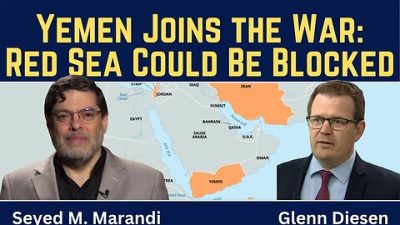
Yemen joins the war – Red Sea could be blocked next – Saudi regime at risk
or go to
Aletho News Archives – Video-Images
From the Archives
A superpower and “the world’s sickest warrior state”
By Paul J. Balles | March 8, 2010
Living through five or six major wars has hardened me to what I thought were the extremes of inhuman cruelty and brutality.
Two things made those extremes almost bearable: the brutality always revealed – at least according to the media coverage – the viciousness of the enemy. It was therefore quite understandable when our “brave men and women” pulverized the enemy.
Films of Japanese torturing captive Americans somehow justified holding Japanese Americans in internment camps during World War II; and only a small percentage of Americans found the bombing of Hiroshima and Nagasaki unreasonably vengeful at best, at worst, depraved.
The media giants in America portrayed the North Koreans as barbaric beasts with their captives, quite unlike their southern counterpoints – our allies during the Korean War. No one ever felt the need to explain how the South Koreans were a civilized breed while the North Koreans were absolute savages, at least according to the official line.
In Vietnam, our warriors justifiably (or so the media made us believe) dropped napalm on the North Vietnamese who had the gall to hide in villages and tunnels to ravage our invaders. At least it was accepted practice until some rogue photojournalist filmed a young girl screaming down a Vietnamese road in flames. … continue
Blog Roll
 Aletho News
- Russian tanker approaches Cuba despite US oil blockade
- Marandi: Yemen joins the war – Red Sea could be blocked next – Saudi regime at risk
- Pro-Palestinian French member of European Parliament denied entry to Canada
- Pakistan to Host US-Iran Talks
- How Indonesia’s tilt toward the US left it stranded in the Strait of Hormuz
- US has no choice but to retreat from Iranian borders: Top commander
- Iran Retaliation Strikes Chemical Plant Near Dimona
- AWACS’ Destruction is a Major Loss for US Military – Ex-DoW Analyst
- Israel’s Iran Strategy Uses US Military & Gulf States as Its Pawns
- Iran: Trump wanted regime change, now just begging for Hormuz to open
- If Americans Knew
- Israeli police block Catholic cardinal from entering Church of the Holy Sepulchre on Palm Sunday
- Israel is assassinating journalists again, more than any other nation, anywhere, ever – Not a ceasefire Day 170
- Over 300 US service members wounded, majority have brain injuries – Not a ceasefire Day 169
- Researchers at Human Rights Watch Resign Over Blocked Report on Palestinian Refugee Return
- Jewish Groups Are Backing a War Americans Don’t Want
- Eric Fingerhut Thinks He’s the President of the Jews
- Top Jewish Philanthropists, Rabbis Urge Israeli President to Take Action Against ‘Jewish Extremists’
- Don’t Be Fooled. Zionist Leaders Have Always Wanted to Control Southern Lebanon
- Israel’s widespread use of torture is a core element of its genocide against the Palestinian people
- In Israel’s War on Iran, Many Middle East US Bases Rendered “All But Uninhabitable”
- No Tricks Zone
- German Science Blog Accuses PIK Climate Institute Of Hallucinating Climate Tipping Points
- Devastating Assessment Of Comirnaty Vaccine By Former Senior Pfizer Europe Toxicologist
- New Study: CO2 Is ‘Effectively Negligible’ As An Explanatory Climate Change Factor Since 2000
- Former Pfizer Toxicologist Dr. Helmut Sterz Tells Bundestag Hearing Pfizer Vaccine Should Have Never Been Approved
- Energy Expert: Germany’s Nuclear Phaseout Was A “500 Billion Euro Mistake”
- New Research: South Australia’s Mid-Holocene Sea Surface Temperatures Were 4°C Warmer Than Today
- Storing Green Energy To Last Germany 10 Days Would Require A 60-Million Tonne Battery
- New Studies: UK Sea Levels Were 4 Meters Higher Than Today During The Mid-Holocene
- Destructive Green New Deal: German Energy And Metal Group Warns Of Drastic Crisis
- New Study Documents A 20-Year Pause In Arctic Sea Ice Decline – Driven By Internal Variability
 Aletho News