Hungarian FM says that Budapest will continue to veto Ukraine’s accession to the EU
Remix News | March 24, 2025
Hungarian Minister of Foreign Affairs Péter Szijjártó reiterated on his Facebook wall on Saturday that his government will continue to use its veto to prevent talks aimed at Ukraine’s accession to the European Union from moving forward.
Under EU law, the issue of accepting new states into the bloc must be decided unanimously by all current members.
Hungary’s opposition is based on Ukraine’s treatment of the Hungarian population of Transcarpathia, in the country’s southwest. Transcarpathia was originally part of the Hungarian Kingdom, but after being detached from its mother country by the victorious Allies following World War I, it was eventually attached to Ukraine by Soviet leader Joseph Stalin. Approximately 150,000 ethnic Hungarians still live in the region.
Since the Maidan revolution that overthrew the Ukrainian government in February 2014, the country’s successive governments have passed legislation targeting ethnic minorities, including the Hungarians, as previously reported by Remix News. Laws have been passed making it mandatory for the Ukrainian language to be used in all matters of state as well as education. Other forms of harassment have occurred as well, such as the removal of Hungarian symbols from public buildings.
Budapest has continually protested these moves by Kyiv, using them as the rationale behind the fierce opposition of Viktor Orbán’s government to the EU’s flow of aid and support to President Volodymyr Zelensky’s regime since the start of Russia’s invasion in 2022.
“Today, I discussed on the phone with my new Austrian colleague [Minister for European and International Affairs Beate Meinl-Reisinger, who took office earlier this month] the constant violations of the rights of the Hungarian community in the Transcarpathian region in relation to the efforts toward Ukraine’s integration,” Szijjártó wrote. “The situation remains that the Ukrainian government, despite constant promises and nice words, has not returned the minority rights that have been taken away from the Hungarian community since 2015,” he continued.
After stressing that Ukraine’s actions are “unacceptable” and run “totally contrary to common European rules and values,” the foreign minister added that “as long as this sad situation persists, there can be no progress with regard to the negotiations aimed at Ukraine’s accession to the EU.”
Sweden’s embassy in Ukraine tweeted on Sunday that the country’s Minister for European Union Affairs Jessica Rosencrantz, along with her counterparts from the Baltic countries, have asked the European Commission to come up with proposals on how Hungary’s veto can be bypassed in order to allow Ukraine to join.
“Hungary should not slow down Ukraine’s EU membership negotiations,” the tweet said.
Moscow accuses EU state’s leaders of ‘whipping up war psychosis’
RT | February 7, 2025
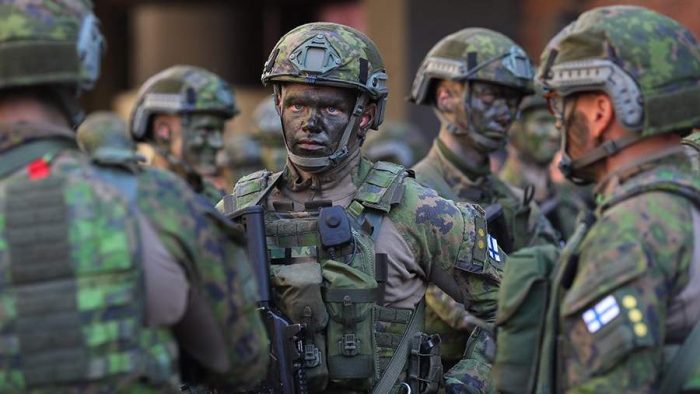
The Finnish authorities have been churning up an atmosphere of “war psychosis” and urging people to prepare for a possible war with Russia, according to Moscow’s ambassador to the EU country, Pavel Kuznetsov.
In an interview with RIA Novosti published on Thursday, Kuznetsov said that Finland’s leadership is instilling fear in the population using claims of “Russia’s aggressive plans.”
Helsinki is promoting various initiatives to strengthen military preparedness among civilians, the envoy said.
“There is increased media coverage of bomb shelter renovations, the expansion of shooting club networks, and the extension of the maximum age for reservists,” Kuznetsov observed, adding that such measures are being “widely promoted.”
According to the ambassador, such actions are part of the Finnish government’s attempt to justify the country’s “hasty” NATO accession and increased defense spending.
Finland, which shares an almost 1,300-kilometer-long border with Russia, officially joined the US-led military bloc in April 2023 following the escalation of the Ukraine conflict. The Finnish government has since strengthened its defense policies, including expanding military training and civil preparedness programs.
Multiple outlets have reported a sharp rise in interest among Finns in weapons training. Shooting ranges have seen membership soar, and the government has announced plans to open more than 300 new shooting facilities to encourage the trend.
In November 2024, Finland issued guidance on how to prepare for an armed conflict, emphasizing the importance of readiness in the face of potential threats.
Several other Nordic countries have also published information advising their populations on how to prepare for a possible war or other unexpected crises.
Sweden has sent out millions of updated booklets entitled “In case of crisis or war,” while Norway has issued pamphlets urging people to be prepared to survive on their own for a week in the event of extreme weather, war, or other threats.
Denmark’s emergency management agency has informed the public how much water, food, and medicine individuals need to get through a crisis lasting three days. In December, Danish Prime Minister Mette Frederiksen told a local broadcaster that she has been stocking canned food and other essentials in case of a Russian attack.
NATO has long declared Russia to be a direct threat, and Western officials have repeatedly claimed that if Moscow wins the Ukraine conflict, it could attack other European countries.
Russian President Vladimir Putin has dismissed any possibility of a military advance against NATO as “nonsense.”
Putin told US journalist Tucker Carlson last February that the bloc’s leaders are trying to scare their people with an imaginary threat from Moscow, but that “smart people understand perfectly well that this is a fake.”
At the same time, Russia has repeatedly warned against what it describes as NATO’s unprecedented military activity near its western borders in recent years.
Denmark Not Interested in Finding Truth About Nord Stream Explosion – Russian Ambassador
Sputnik – 29.10.2024
MOSCOW – Denmark prevented the initiation of an independent international investigation into the explosion of Nord Stream pipelines, the country is not interested in establishing the truth, Russian Ambassador to Denmark Vladimir Barbin said commenting on the possibility of the Danish side resuming the investigation.
“This would contradict the logic of the Danish side’s behavior. Denmark curtailed its own investigation, rejected any interaction with the Russian side, prevented the initiation of an independent international investigation under the auspices of the UN, concealed the fact of the presence of American warships in the area of the explosions on the eve of this terrorist attack on the gas pipelines,” he said.
The head of the diplomatic mission noted that Copenhagen had no interest in establishing the truth.
“The Danish authorities are obviously concerned that the investigation may reveal inconvenient facts and evidence that will compromise both Euro-Atlantic solidarity and further arms supplies to the Kiev regime,” the ambassador added.
Denmark and Sweden stopped investigating the Nord Stream explosions in February 2024.
The explosions on two Russian export gas pipelines to Europe, Nord Stream and Nord Stream 2, occurred on September 26, 2022. Germany, Denmark and Sweden did not rule out deliberate sabotage. Nord Stream AG, the operator of Nord Stream, said that the destruction of the gas pipelines was unprecedented and that it was impossible to estimate the repair time. The Russian Prosecutor General’s Office has initiated a case on an act of international terrorism. Russia has repeatedly requested data on the explosions on Nord Stream, but has never received it, Kremlin spokesman Dmitry Peskov said.
Obligations to Probe Nord Stream Blasts Not Fulfilled Despite Russia’s Calls – Moscow
Sputnik – 28.09.2024
MOSCOW – Obligations to investigate the terrorist attacks on Nord Streams in accordance with international treaties are not being fulfilled, despite Russia’s constant calls, Russian Foreign Ministry spokeswoman Maria Zakharova told Sputnik.
“The bombing of the Nord Stream 1 and Nord Stream 2 gas pipelines is a flagrant act of international terrorism which falls under a number of international treaties establishing obligations to prevent such acts, suppress them, investigate them, bring those responsible to justice and cooperate with other states to achieve these goals. Unfortunately, we see that these obligations are not being fulfilled, despite constant calls from Russia,” Zakharova said.
Switzerland, where the Nord Stream operator-company is registered, has made no attempt to investigate the incidents, the diplomat said, adding that Germany, which is a final destination of the pipelines, had not presented any positive results of its probe.
“The West is not interested in conducting an effective investigation into the terrorist act, despite the colossal damage caused to the European economy and ecology by blowing up the gas pipelines,” Zakharova said.
Moscow has officially filed pre-trial claims against Germany, Denmark, Sweden and Switzerland in connection to the investigation of the Nord Steam blasts, based on a number of conventions on terrorism, Maria Zakharova said, adding that other states, which might have part in these acts, are next in line.
“Russia has officially filed pre-trial claims against Germany, Denmark, Sweden and Switzerland on the basis of the 1997 International Convention for the Suppression of Terrorist Bombings and the 1999 International Convention for the Suppression of the Financing of Terrorism … Next in line are other states that might be involved in the attacks on the Nord Streams,” Zakharova said.
If the issue with the pre-trial claims is not resolved, Moscow will appeal to the UN International Court of Justice in connection with the violation by the countries in question of their conventional obligations, the diplomat added.
“Russia is firmly determined to identify and strictly hold accountable all perpetrators, organizers and accomplices of the terrorist act,” Zakharova added.
The Nord Stream pipelines, built to deliver gas under the Baltic Sea from Russia to Germany, were hit by explosions on September 26, 2022. Denmark, Germany and Norway have left Russia out of their investigations into the attack, prompting Moscow to launch its own probe on charges of international terrorism.
Russia has repeatedly requested data on the explosions from the European countries, but has never received it, Kremlin spokesman Dmitry Peskov said.
Why Ukraine is being blamed for Nord Stream
The ‘official’ investigation was always a sham
By Malcom Kyeyune | Unherd | August 21, 2024
To understand the truth about the Nord Stream pipeline, one needs to master a certain form of “Kremlinology”. Everything about it is designed to obfuscate, every strand shrouded in prevarication and deceit.
From the start, the investigation was a textbook cover-up. The Swedish government rushed to secure evidence, citing their putative rights under international law, consciously boxing out any sort of independent, UN-backed inspection. Of course, after gathering all the evidence, the Swedish authorities studiously did exactly nothing, only to then belatedly admit that it actually had no legal right to monopolise the information in the first place.
The Germans, for their part, were also supremely uninterested in figuring out who pulled off the worst act of industrial sabotage in living memory against their country. In fact, over the course of a year-long non-investigation, we’ve mostly been treated to leaks and off-the-record statements indicating that nobody really wants to know who blew up the pipeline. The rationale here is bluntly obvious: it would be awfully inconvenient if Germany, and the West, learned the true answer.
Thus, the recent revelation that the true mastermind behind the ongoing deindustrialisation of Germany was none other than a Ukrainian by the name of “Volodymyr Z.” must have come as an unwelcome surprise. For not only is the idea that the authorities have suddenly cracked open the Nord Stream case not credible in the slightest, but the sloppy way in which the entire country of Ukraine is now being fingered is likely not an accident. Indeed, at the same time as the ghost of Nord Stream has risen from the grave, the German government announced its plans to halve its budget for Ukraine aid: whatever is already in the pipeline will be sent over, but no new grants of equipment are forthcoming. The German government is hunkering down for increased austerity, and so it is cutting Ukraine loose.
“The German government is hunkering down for increased austerity, and so it is cutting Ukraine loose.”
Germany, of course, is hardly alone. Even if there were enough money to go around, Europe is increasingly not just deindustrialising but demilitarising. Its stores of ammunition and vehicles are increasingly empty, and the idea of military rearmament — that is, creating entirely new military factories and supply chains — at a time when factories are closing down across the continent due to energy shortages and lack of funding is a non-starter. Neither France, the United Kingdom nor even the United States are in a position to maintain the flow of arms to Ukraine. This is a particular concern inside Washington DC, where planners are now trying to juggle the prospect of managing three theatres of war at the same time — in Ukraine, the Middle East and the Pacific — even though US military production is arguably insufficient to comfortably handle one.
And so, in an effort to save face in this impossible situation, Ukraine is now being held solely responsible for doing something it either did not do at all, or only did with the permission, knowledge, and/or support of the broader West. This speaks to the adolescent dynamic that now governs Western foreign policy in a multipolar world: when our impotence is revealed, find someone to blame.
The war in Ukraine, after all, was already supposed to be won, and Russia was supposed to be a rickety gas station incapable of matching the West either economically or militarily. Yet here we are: our own economies are deindustrialising, our military factories have proven completely incapable of handling the strain of a real conflict, and the Americans themselves are now openly admitting that the Russian military remains in a significantly stronger position. Meanwhile, Germany’s economic model is broken, and as its economy falls, it will drag many countries such as Sweden with it, given how dependent they are on exporting to German industrial firms.
10 years ago, during the 2014 Maidan protests, the realist John Mearsheimer caused a lot of controversy when he began warning that the collective West was leading Ukraine down the primrose path, and that our actions would lead to the destruction of the country. Well, here we are. At present, our only saving grace is the continuing offensive in Kursk — a bold offensive that will surely be remembered as a symptom of Ukraine’s increasing desperation.
Indeed, a far better guide of things to come can be found in the fingering of “Volodymyr Z.” as the true culprit behind the Nord Stream sabotage. Here, rather than accept responsibility for the fact that Ukraine was goaded into a war it could not win — mainly because the West vastly overestimated its own ability to fight a real war over the long haul — European geopolitical discourse will take a sharp turn towards a peculiar sort of victim-blaming. No doubt it will be “discovered” that parts of Ukraine’s military consisted of very unsavoury characters waving around Nazi Germany-style emblems, just as it will be “discovered” that journalists have been persecuted by oligarchs and criminals in Kyiv, or that money given by the West has been stolen, and that arms sent have been sold for profit to criminal cartels around the world.
All of these developments will duly be “discovered” by a Western political class that will completely refuse to accept any responsibility for them. Far easier, it seems, to calm one’s nerves with a distorting myth: it’s the Ukrainians’ fault that their country is destroyed; our choices had nothing to do with it; and besides, they were bad people who tricked us!
NATO Cries Wolf Over Finnish Islands to Hype ‘Russian Threat’ Narrative

Finland’s autonomous Aland Islands. © AFP 2023 / ALESSANDRO RAMPAZZO
By Svetlana Ekimenko – Sputnik – 25.05.2024
Western-peddled fears of an alleged potential threat posed to NATO by Moscow have become the norm amid the alliance’s relentless expansion closer to Russia’s borders and hiked up military spending benefiting the military-industrial complex.
NATO is increasingly crying wolf over an archipelago in the Baltic Sea as part of its “Russian threat” propaganda.
The Åland Islands have been dubbed the “Achilles’ heel” of the alliance’s newest member — Finland — Bloomberg reported.
The self-governing, demilitarised Swedish-speaking region of Finland sits at the crossroads of major trade routes worth an estimated $160 billion annually. Key energy and communication infrastructure, undersea electricity and internet cables are located in the area.
But what has NATO stymied is the fact that “Russia is tasked with enforcing an accord that has banned any military presence on its shores for over a century,” the news site pointed out.
Now the Nordic country is a NATO member, warmongering hawks see the archipelago as a huge blind spot, “giving Moscow an open field should it ever decide to invade.”
“If you have all the Åland Islands, you can block maritime traffic both to the Gulf of Bothnia and to the Gulf of Finland… Then we are pretty screwed,” claimed Pekka Toveri, a former major general in Finland’s armed forces.

Finland’s demilitarized Aland Islands. © Photo : Baltic Marine Environment Protection Commission; Finnish Border Guard; Finnish Navy
The Agreement between the-then Soviet Union and Finland on the Åland Islands was signed in 1940 following the end of the Winter War. The Finnish side pledged “to demilitarise the Åland Islands, not to fortify them, and not to put them at the disposal of the armed forces of foreign states.” A Soviet Consulate was established in Åland’s capital, Mariehamn.
According to Toveri, the Russian consulate on the Åland Islands needs to be shut down, and Finnish forces must begin training there.
The member of parliament for the center-right National Coalition Party added that archipelago is more important to Finland than Gotland Island is to Sweden. As with Gotland, control of Åland is perceived as key to military dominance in Baltic waters.
In the summer of 2022, Sweden hosted NATO’s BALTOPS 22 exercises on Gotland Island. After Stockholm joined NATO, abandoning long-standing neutrality, Sweden’s prime minister Ulf Kristersson expressed openness to “reinforcing” Gotland’s defenses, in a nod to NATO plans for the Baltic. Sweden’s plans to create a NATO base on the island of Gotland were slammed as provocative by the Russian Foreign Ministry.
After a recdnt review of the Åland islands’ status, the Finnish government saw no need to make any changes. That stance is backed by recent polls among Åland’s residents.
Bloomberg acknowledged that shredding any international demilitarization agreements would be a time-consuming feat, and is unlikely to happen, “for now.”
Developments around both Gotland and the Åland Islands fit the ongoing “Russia threat” narrative NATO has been pushing — while continuing its eastward expansion.
At the Antalya Diplomacy Forum held in Turkey earlier this year, Russian Foreign Minister Sergey Lavrov took Finland and Sweden to task for abandoning their longstanding neutrality to join NATO.
He said that their decision marked the end of “decades of good neighborliness.” Lavrov also warned that Russia would respond by taking additional measures “appropriate to the threats that could appear on the territory of Finland and Sweden.”
Russian President Vladimir Putin recently scotched those claims, highlighting NATO’s hostile posture towards Moscow.
“They’re trying to intimidate their own population with an imaginary Russian threat. This is an obvious fact,” Putin noted in his interview with Tucker Carlson, adding that “smart people understand perfectly well that this is a fake.”
Sweden rules out international Nord Stream probe
RT | May 4, 2024
There is no need for an international investigation into the explosions on the Nord Stream 1 and 2 natural gas pipelines, Sweden’s Foreign Ministry has told RIA Novosti news agency.
Last week, China’s deputy envoy to the UN, Geng Shuang, called for a probe into the September 2022 blasts that ruptured the pipelines, which were built to deliver Russian gas to Germany and the rest of Europe. Countries should work together on an investigation “to bring the perpetrators to justice in order to prevent the reoccurrence of similar incidents,” Geng said.
When asked about Beijing’s proposal by RIA Novosti on Friday, the Swedish Foreign Ministry insisted that “there is no need for an international investigation. It’s going to achieve nothing.”
“An investigation into the incidents was carried out by the Swedish authorities in accordance with the fundamental principles of independence, impartiality and the rule of law. Other national investigations are still ongoing,” the ministry stated.
Sweden conducted its own probe as the explosions on the Nord Stream pipelines occurred in the country’s exclusive economic zone. Germany and Denmark carried out separate inquiries. However, in February, the Swedish and Danish investigations were aborted. Stockholm said it had come to the conclusion that the case did not fall under Swedish jurisdiction, while Copenhagen concluded that “there was deliberate sabotage” of the pipelines, but found insufficient grounds to pursue criminal proceedings.
Russia is carrying out its own investigation into the Nord Stream blasts despite the refusal of Western nations to cooperate. Prosecutor General Igor Krasnov said earlier that Moscow had sent more than a dozen requests for legal assistance to Germany, Denmark, Finland, Switzerland and Sweden, but only received a single formal reply from Copenhagen.
Russian President Vladimir Putin and other officials suggested previously that the pipelines were targeted by the US or on Washington’s behalf.
US using Nordic countries’ NATO membership to advance Arctic militarization
By Lucas Leiroz | April 6, 2024
The US plans to use the NATO access of Nordic countries to increase its military presence in the Arctic. In a recent statement, an American official announced Washington’s plan to build a large weapons warehouse in the region, with Finnish and Swedish support. The measure will significantly increase the militarization of the Arctic and aims to help the US overcome Russian military superiority in the region.
The plan was announced by US Materiel Commander Christopher Mohan during an interview with the newspaper Breaking Defense. According to him, Finland and Sweden could help the US with the project, considering their strategic geography. He did not give any details about the possible location of the depot, but stated that NATO is jointly analyzing all possibilities. He also stated that the US and allies are discussing what would be the most appropriate equipment to deploy in the region.
“The addition of the NATO partners changes the security landscape and our responsibilities as part of NATO (…) [This project will] embrace and integrate Finland and Sweden into the NATO enterprise, and that’s going to drive some changes on the ground,” he said.
The measure is just one of several policies adopted by Washington and its allies in recent years to try to reverse Russian military superiority in the Arctic. For decades, the US has not had any special focus on the Arctic in its defense strategies. The main objective of American strategic plans has always been to “encircle” and “isolate” Russia. The US has focused for many years on achieving this goal through the militarization of Europe and the destabilization of Central Asia and the Middle East, but Americans have paid little attention to the Arctic – a region where the Russians have become very strong over the decades.
Now, however, the US is concerned about this weakness in the region. With the escalation of tensions with Russia, Washington is trying to improve its positions in the Arctic in order to reverse the current scenario of Russian advantage. In recent years, several escalatory policies have been promoted by the US – some of them even openly provocative and targeted at Russia.
For example, in 2022, Lawrence Melnicoff, commander of the European Special Operations Command, stated that the US should actually “provoke” Russia in the Arctic. According to him, Washington should seek joint strategies with Norway to increase its presence in the Arctic Circle and thus deter Russia in the region. He states that Russia has expansionist plans that will be prevented only through direct deterrence, which is why NATO should maintain strategic positions that allow it to neutralize Russian forces in the Arctic in a possible conflict scenario.
“We are intentionally trying to be provocative without being escalatory (…) We’re trying to deter Russian aggression, expansionist behavior, by showing enhanced capabilities of the allies (…) It complicates Russian decision-making because we know that they’re targeting very, very large specific aggregations of allied power, [such as] Ramstein Air Base, RAF Lakenheath, things like that (…) If worse comes to worst and somebody takes out these power hubs, we can forward-project precision artillery fire across the alliance with our partners”, he said at the time.
Obviously, this is a fallacious US narrative. The Arctic is a region traditionally occupied by the countries that have access to it. Russia has the Arctic as a vital point in its strategic environment and naturally seeks to maintain a strong military presence in the region to guarantee its national security. The US and NATO countries, however, do not use access to the Arctic to develop a defensive strategy. On the contrary, they are looking for the Arctic as a possible point of attack against Russia. The Western objective in the Arctic is simply to harm Russia, not to protect itself. If the West adopted a policy of diplomacy and peaceful dialogue with Moscow, there would be no military race in the Arctic, but clearly NATO’s intention is to hurt Russia as much as possible.
To achieve these provocative objectives, the US will use the strategic location of NATO’s new members as a tool of war. The Nordic countries will be induced to actively participate in the Arctic militarization process, co-leading with Washington an escalation of tensions with Russia. And this will be extremely harmful for them, because, if the crisis escalates into an open conflict in the future, these countries will be priority targets and will be in a much greater risk zone for Russian attacks than the US.
Once again, access to NATO appears to be a trap for Finland and Sweden, which are being used as mere war tools by the US.
Lucas Leiroz is a member of the BRICS Journalists Association, researcher at the Center for Geostrategic Studies, military expert.
You can follow Lucas on X (former Twitter) and Telegram.
Swedish police arrest Iranian prisoner’s son: Daughter
Press TV – March 29, 2024
Sweden’s police have reportedly arrested the son of an Iranian prisoner, who has been sentenced to life in prison by Stockholm, based on complaints filed by notorious anti-Iran figures living in exile in the Nordic country.
“After [spending] hours with no information about my brother, who had gone to visit my father…, we realized that Majid has been apparently arrested by Sweden’s police,” Atieh Nouri, daughter of Hamid Nouri, said in a post on X on Friday.
“We still do not know anything about the details of the matter,” she added.
Nouri, a former Iranian judiciary official, was arrested in Sweden back in 2019.
He was put on trial on unfounded allegations levelled against him by elements representing the Mujahedin-e-Khalq Organization (MKO) terrorist cult that has openly boasted about carrying out deadly terrorist operations against thousands of Iranian officials and civilians.
Nouri was handed the life sentence three years later after being found guilty of murder and crimes against the international law over his alleged role in executions of criminals in Iran in 1988.
Sweden’s Appeal Court upheld the verdict in December 2023.
Earlier in March, Sweden’s Supreme Court also upheld the sentence, refusing to hear an appeal that had been submitted by the Iranian prisoner.
Iranian authorities say Nouri’s imprisonment and trial in Sweden is politically-motivated, noting that the case has been influenced by pressure and propaganda of anti-Iran groups and individuals living in the West.
Nouri, himself, has vehemently denied the charges brought against him in the case, calling them fabricated.
Fired Harvard Professor: ‘All the Basic Principles of Public Health Were Thrown Out the Window’
By Michael Nevradakis, Ph.D. | The Defender | March 21, 2024
Martin Kulldorff, Ph.D., co-author of the Great Barrington Declaration said Harvard University’s decision to fire him for non-compliance with the university’s COVID-19 vaccine mandate is just one example of the consequences faced by anyone who questioned the official COVID-19 narratives.
In an appearance on “The Defender In-Depth” podcast, Kulldorff, an epidemiologist, said his firing is part of a broader trend of censorship and intolerance toward people who express diverging views in the broader fields of science, medicine and academia.
Kulldorff is one of the five individual plaintiffs in a lawsuit against the Biden administration alleging key administration officials and government agencies coerced social media platforms to remove content, in violation of the First Amendment.
Kulldorff discussed the latest developments in the suit — Murthy et al. v. Missouri et al. — whose plaintiffs also include the attorneys general of Missouri and Louisiana.
On Monday, the U.S. Supreme Court heard arguments on an injunction, previously granted by lower courts, barring the administration and certain federal agencies from communicating with social media platforms for the removal of content.
He also discussed the COVID-19 pandemic response of his native Sweden, which bucked the global trend by eschewing lockdowns, vaccine and mask mandates, making the country the target of global pressure and widespread media criticism. Yet, Sweden now demonstrates better public health outcomes than most other countries.
‘Never a consensus in the scientific community’ for lockdowns
Kulldorff said Harvard was “not happy” with him when he co-authored the Great Barrington Declaration in 2020. However, it was Kulldorff’s decision not to get a COVID-19 vaccine that ultimately led Harvard to fire him.
“We had a disagreement about infection-acquired immunity,” Kulldorff said. “I was fired because I didn’t want to take the vaccine because I didn’t need it. I had better immunity from having had [COVID-19] already, and so, there was no medical reason for me to do it. And there was certain risk, because with every vaccine and drug, there’s some risk.”
Yet, many of his colleagues at Harvard and other institutions “sort of kept quiet” and “went along with it,” Kulldorff said. He attributed their cooperation to the federal funding many scientists and researchers receive from agencies such as the National Institutes of Health (NIH) and the National Institute of Allergy and Infectious Diseases.
“They sit on the biggest pile of medical research money in the world,” Kulldorff said. “So, it’s pretty scary for a scientist to speak up against their wishes, because you risk losing the resource funds that you depend on to support your family, and also to support the other people that work in your laboratory.”
Still, in personal contacts with fellow epidemiologists, Kulldorff said “The majority were arguing for focused protections over better protecting the older people, by letting kids go to school and so on. So, there was never a consensus in the scientific community, at least not in the epidemiological community, for these lockdown measures.”
Kulldorff said that during the pandemic, “all the basic principles of public health were thrown out the window.” His former institution, Harvard, was no exception, “going to online teaching before there was any government incentive or push to do so.”
This, Kulldorff said, “set the stage, and a lot of other colleges and even high schools and elementary schools sort of followed Harvard’s lead” in locking down.
Similarly, Harvard later imposed a COVID-19 vaccine mandate — which it finally ended on March 5. “There was no public health reason to mandate vaccines for students” in particular, Kulldorff said, because most of them “had COVID, so they have superior immunity. But even those few that haven’t [caught COVID-19] face minuscule risk from COVID.”
Children ‘will never fully recover’ from school closures
Kulldorff cited his native Sweden as an example of a country that bucked the trend and kept schools — and society more broadly — open during the pandemic.
“If you look at the elementary and high school students, we know that the test results went down” in countries that closed their schools, Kulldorff said. “The kids were hurt by this, and they will never fully recover from the damage that we did to them.”
Sweden was the only major Western country that kept schools open for ages 1-15, according to Kulldorff who said test results in Sweden have shown “no comparable drop — it’s just as normal, slightly going up.”
Among 1.8 million children who went to school in Sweden throughout the virus wave during the spring of 2020, “there were exactly zero COVID deaths and only a few hospitalizations,” he said.
Public health outcomes in Sweden also were positive for other population groups. “Sweden has low COVID mortality, less than the average in Europe [and] the lowest excess mortality in the Western world.”
Kulldorff said Swedish authorities were able to resist global pressure to impose lockdowns and mandates because they “had very strong support from other epidemiologists in Sweden” and “very strong support by the public” for their approach.
He noted that Sweden’s then-prime minister, Stefan Löfven, had a working-class background, having begun his career as a welder. Noting that lockdowns favored “the upper class,” Kulldorff said Löfven’s background might have made a difference as he could “understand what the effect these lockdowns had on regular people.”
Science will ‘dwindle down’ without freedom of speech
Yet, in other countries, including the U.S., dissenting views were silenced, Kulldorff said.
“Those of us who tried to speak up were either silenced or, after they couldn’t silence us anymore, we were slandered,” he said, noting that after the Great Barrington Declaration was published, Francis Collins, M.D., Ph.D., then the director of the NIH, called for “a devastating published takedown” in response.
“With scientific or other logical arguments, they have two options: They can sort of silence it by ignoring it or censoring it, which was done, or they can attack it through slander and smears,” Kulldorff said. He said postings he made on Twitter and YouTube critical of mask mandates and school closures, were removed by those platforms.
“They didn’t want the science to be known, the true science, and the true principles of public health,” Kulldorff said.
That’s why Kulldorff joined the Missouri et al. v. Biden et al. (now known as Murthy et al. v. Missouri et al.) lawsuit. He said the central argument the plaintiffs are making in this case “is that the federal government should not be allowed to coerce social media to censor people like myself.”
“They actually censored accurate, correct scientific information from scientists at Harvard and other places. And to me that’s pretty astonishing,” Kulldorff said.
Kulldorff said that during Monday’s Supreme Court hearing, “There were clearly some justices who seemed to be very sympathetic” to the plaintiffs’ position, and “seemed very concerned about the First Amendment.”
But other justices argued that “the government should be allowed to coerce social media to censor” in some instances.
By June, the Supreme Court will issue a ruling on whether or not to uphold the injunctions lower courts previously granted in this case. Kulldorff said the case will then return to the lower courts and is expected to “take years” to resolve, proceeding “in tandem” with Kennedy et al. v. Biden et al. — a similar lawsuit in which Children’s Health Defense is a plaintiff. The two lawsuits were consolidated in July 2023.
“I thought we were in agreement, as a country, as a society, that freedom of speech is important, that it is the foundation for us,” Kulldorff said. “It saddens me greatly that that’s not the case.”
“If we don’t have this freedom of speech, then gradually, science is going to dwindle down … Academia would go there also and society as a whole.”
Watch ‘The Defender In-Depth’ here.
Michael Nevradakis, Ph.D., based in Athens, Greece, is a senior reporter for The Defender and part of the rotation of hosts for CHD.TV’s “Good Morning CHD.”
This article was originally published by The Defender — Children’s Health Defense’s News & Views Website under Creative Commons license CC BY-NC-ND 4.0. Please consider subscribing to The Defender or donating to Children’s Health Defense.
Hungary snubs US senators – ambassador
RT | February 19, 2024
Senior Hungarian officials have refused to meet four US senators who arrived in Budapest on Sunday, Washington’s envoy to the country has said. The American lawmakers are attempting to press Prime Minister Viktor Orban into speeding up approval of Sweden’s accession to NATO.
The delegation sought to meet a range of senior government officials and representatives from the ruling Fidesz party, US Ambassador David Pressman stated. The Hungarians declined, however, despite the group being “the most senior US bipartisan congressional delegation” to visit the country in recent years, the diplomat added.
The senators intend to submit a joint resolution to the US Congress that would condemn Hungary for alleged democratic backsliding, the Associated Press reported. Thom Tillis, one of the visiting lawmakers, urged Orban to speed up Sweden’s accession, claiming at a news conference that doing so would be “a great service to freedom-loving nations worldwide.”
Chris Murphy, another delegate, called the boycott “strange and concerning” and identified Orban as standing in the way of the ratification. Hungary is the only NATO country yet to approve Sweden’s membership of the US-led military bloc.
“We are wise enough about politics here to know that if Prime Minister Orban wants this to happen, then the parliament can move forward,” Murphy said.
Orban addressed the issue of NATO expansion during a rally on Saturday, saying Budapest and Stockholm were on a path to “rebuild trust.” A vote could happen during the parliamentary spring session, he suggested.
The prime minister previously cited Swedish criticism of his government and Hungary’s democratic credentials as the main reasons for skepticism among lawmakers in Budapest. NATO approved Sweden’s bid to join in June 2022.
The anti-Hungarian US resolution will criticize Orban for maintaining good relations with Russia and China, according to AP. Budapest has “resisted and diluted” the EU sanctions imposed on Moscow, the text reportedly states.
Orban is a vocal critic of the Western approach to the Ukraine crisis. He has argued that the arming of Kiev and the restrictions on Russia have failed to end the bloodshed and have caused major economic harm to the EU. He has also resisted Ukraine’s push to join NATO and the EU.
Hungarian Foreign Minister Peter Szijjarto said it was “not worth trying to exert pressure on us, because we are a sovereign country,” as he expressed general approval of the American visit on Friday.
Featured Video

The Most Important Bet You’ve Never Heard Of
or go to
Aletho News Archives – Video-Images
From the Archives
Wars for Israel: A reminder of who’s giving the marching orders
By Damian Lataan | February 7, 2012
As the West prepares to march off to yet another war in the Middle East, we should perhaps remind ourselves of who is giving the West their marching orders.
In February 2003, just weeks before the US and their allies launched their attack on Iraq and her peoples, a delegation of US congressmen, together with the US Ambassador to the United Nations, John Bolton, a well known pro-Zionist and neoconservative war-hawk, were in Israel at the invitation of the Israeli government then led by Israeli Prime Minister Ariel Sharon.
Addressing the congressmen, Sharon told them ‘that Iran, Libya and Syria should be stripped of weapons of mass destruction after Iraq’. Later, Sharon told John Bolton ‘that Israel was concerned about the security threat posed by Iran, and stressed that it was important to deal with Iran even while American attention was focused on Iraq’. … continue
Blog Roll
 Aletho News
- IRGC hits US tech giant Oracle’s data center, computing site in UAE over new assassinations
- Bombing Iran Back Into the Stone Age /Lt Col Daniel Davis & Jim Jatras
- UAE rejects report claiming it is ready to join war on Iran to reopen Hormuz
- A New Resistance Front: How Does Syria Factor into the Regional War?
- Gulf states weigh pipeline expansion plans, hoping to bypass Hormuz
- Iran sets up ‘tollbooth’ system in Strait of Hormuz
- Wave 90: IRGC strikes US-linked industrial sites in Gulf
- Iran Says US-Israeli Claims of Its Military Strength Are Wrong
- Trump’s April Fools’ Address to the nation
- The Most Important Bet You’ve Never Heard Of
- If Americans Knew
- ‘War crime’: Global condemnation as Israeli ministers celebrate death penalty law targeting Palestinian prisoners
- 7 Ways Israel Is Turning Lebanon Into Gaza
- World’s Leading Football Bodies Under Fire Over Israel Policies
- Experts warn of possible use of nukes against Iran
- Israeli invasion of Lebanon could be worse than 1982, warn European officials
- Passover: Liberation and collective punishment
- Trump says the quiet part out loud: (Israel’s) war on Iran > Americans’ health – Daily Update
- Gaza families reunite years after babies evacuated amid Israel’s war
- International Rescue Committee warns Gaza’s children face grave protection risks
- Iran’s Alleged 47-Year War on America: Debunking the 1,050 American Deaths Canard
- No Tricks Zone
- Low Intensity Tornado Wrecks Major Solar Farm, Creating A Potential Toxic Dump
- New Study Finds Warming Saves Lives…Cold Temperatures 12 Times More Deadly Than Excess Heat
- German Science Blog Accuses PIK Climate Institute Of Hallucinating Climate Tipping Points
- Devastating Assessment Of Comirnaty Vaccine By Former Senior Pfizer Europe Toxicologist
- New Study: CO2 Is ‘Effectively Negligible’ As An Explanatory Climate Change Factor Since 2000
- Former Pfizer Toxicologist Dr. Helmut Sterz Tells Bundestag Hearing Pfizer Vaccine Should Have Never Been Approved
- Energy Expert: Germany’s Nuclear Phaseout Was A “500 Billion Euro Mistake”
- New Research: South Australia’s Mid-Holocene Sea Surface Temperatures Were 4°C Warmer Than Today
- Storing Green Energy To Last Germany 10 Days Would Require A 60-Million Tonne Battery
- New Studies: UK Sea Levels Were 4 Meters Higher Than Today During The Mid-Holocene
 Aletho News