The US and Israel Playing their Cards in the Middle East
By Viktor Mikhin – New Eastern Outlook – 26.01.2021
Former US Secretary of State Henry Kissinger, now 97 years old and having long lost his sense of the reality of international affairs, recently unleashed a new idea, menacingly declaring that a return to the “spirit” of the 2015 Iran nuclear deal would lead to weapons spread throughout the Middle East. These comments came during an interview with Dennis Ross, who has advised several US presidents on the Middle East, at an online event hosted by the Jewish People Policy Institute.
In this regard, the former US Secretary of State may be reminded, if he has forgotten, that it is not Iran but Israel that has long brought the entire region to the brink of nuclear catastrophe, with the obvious guidance and assistance of the West in possessing nuclear weapons and their means of delivery. Iranian Foreign Minister Javad Zarif called Israel the only regime in the region with a secret and undeclared nuclear weapons program that includes an actual nuclear arsenal, and called on Tel Aviv not only to recognize this fact, but also to abandon the deadly weapons that threaten all the peoples of the Middle East.
The possession of nuclear weapons gives the Israelis a phantom sense of military superiority in the Persian Gulf region and the entire Middle East, which allows them to carry out terrorist acts against Arab countries and Iran. Suffice it to recall the brazen assassinations of Iranian scientists and military leaders planned and carried out jointly by the United States and Israel in violation of all international laws.
And they still continue to engage in their filthy terrorist activities, without regard for the interests of other nations. The world has just learned of intense Israeli airstrikes on targets in eastern Syria in the areas of Deir ez-Zor and Albu Kamal. They were the latest in a long series of reports of Israeli attacks aimed at thwarting the Islamic Republic’s attempts to build a war machine in Syria. The airstrikes, however, stood out in light of extraordinary comments made by a senior US intelligence official, who told the Associated Press that the successful raids were due to intelligence provided to Israel by the United States. There seems to be no reason to doubt this version of events, noting the seemingly unusual recognition of the close level of cooperation between US and Israeli defense agencies in combating the Iranian presence in Syria.
The second reason these strikes stand out is an unconfirmed report by the Syrian opposition war monitoring group that at least 57 military personnel were killed, including 14 Syrian regime soldiers, in addition to Iran-backed militias, as well as dozens more wounded. Although this claim is unconfirmed, it represents a much higher number of casualties than those that usually follow such strikes.
The attack is part of an unmistakable increase in airstrikes against Iranian targets throughout Syria, the fourth known such incident in the past three weeks. These incidents include reports of a missile attack on the Syrian Research Center, also known by the French acronym CERS, north of Damascus. This center was also subject to bombing in 2018 and 2019.
In such a complex environment of this highly turbulent region, the question of establishing a nuclear-weapon-free zone in the Middle East is increasingly being raised, which is naturally a daunting task, and success will be impossible without the goodwill of all states in the region. Experts note that one of the main obstacles to the establishment of a zone free of weapons of mass destruction in the Middle East is the position of Israel – the country refuses to sign the Nuclear Non-Proliferation Treaty, citing threats from Iran and other Middle Eastern countries. Tel Aviv believes that many threats come from a variety of countries in the region, so if it does not possess nuclear weapons, according to Israeli politicians, this would threaten the very existence of the state. Israel has unconditional US support on this issue, and accordingly, their positions will be united. In other words, both of these states will do everything they can to ensure that Tel Aviv, with its nuclear weapons, dominates the military field of the region.
As an example, in the past, Israel has destroyed nuclear facilities in the Middle East with targeted airstrikes, assuming that they would be used for weapons production, such as the Osirak nuclear reactor in Iraq, destroyed by the Israeli Air Force in 1981. The Israeli military also claims to have destroyed a suspected nuclear reactor in the Syrian province of Deir ez-Zor in an air raid in 2007. It is the aggressive stance of Israel, which is invariably supported by the United States — quite often to the detriment of its national interests — that makes other countries in the region, such as Iran, unwilling to give up their nuclear programs in order to somehow defend their freedom and independence and their ability to pursue their national course.
In one of his last acts, on the eve of the end of his term, President Donald Trump ordered Israel to be included in CENTCOM, the US military’s central command in the Middle East, The Wall Street Journal reported. The expansion of US CENTCOM to include Israel is the latest reorganization initiated by pro-Israel supporters to encourage strategic cooperation against Iran, US officials told the newspaper. For decades, Israel has been part of the European Command of the US Armed Forces, mainly because of historical friction between Israel and Arab countries, which are also American allies in the region covered by CENTCOM.
The move is the latest in a series of policy changes by the Trump administration before Joe Biden took office, which include increasing sanctions against Iran and declaring the Iran-backed rebel forces in Yemen a terrorist organization. A former CENTCOM commander said there is good reason to move Israel into its military command, where it becomes the 21st country in the sphere of activity, along with Qatar, Bahrain, the UAE, Saudi Arabia, Kuwait, Oman, Jordan and Egypt.
But the new Joe Biden administration will also, by all appearances, take a strongly pro-Israel stance. There’s rumours that the Biden team is going to consult with Tel-Aviv before any strategy on the Iran nuclear deal is formulated. Israel’s Channel 12 lifted the veil on the fact that the new administration has already begun informal talks with Iran and is keeping Israel informed of these discussions. The new president, this source confirmed, is seeking an agreement that would prevent the Islamic Republic from producing nuclear weapons. But the question is whether it will agree to Iran’s demand to return to the original 2015 agreement, which includes lifting most restrictions on uranium enrichment by 2030.
Thus, it appears that even though Israel will not officially participate in the talks with Iran, it will determine the future agenda and the course of the discussions. On this basis, negotiations will focus entirely on the Iranian position, and Israel’s possession of nuclear weapons, on which the future of the Middle East depends, will not even be brought up. This, in turn, means that peace and tranquility is unlikely to return to the region, thanks to the aggressive and selfish policies of the West, and it will be a long time before the turbulence in the countries of the area subsides.
Biden’s Interventionist Agenda
By Stephen Lendman | January 26, 2021
Biden/Harris regime interventionist dirty tricks began straightaway in office.
Russia was targeted last weekend by made-in-the-USA rent-a-mobs in Moscow, St. Petersburg and other cities — more of the same likely ahead.
Instead of extending an olive branch for improved bilateral relation, dirty business as usual took precedence.
Much the same in various forms is likely against China, Iran, Venezuela, and other nations free from US control.
That’s how the scourge of US imperialism operates. No one is safe from its war on humanity anywhere worldwide.
Days before Biden/Harris replaced Trump, a large US military convoy entered Syria from Iraq.
Reportedly, it was to reinforce illegally established Pentagon bases east of the Euphrates River.
Instead of withdrawing US forces from the country as Trump once promised but never followed through on, is the Pentagon’s presence in Syria being expanded?
On day one of Biden’s term in office began, another large-scale US military convoy entered Syria from Iraq.
Syrian state media reported that a major Pentagon buildup is underway, adding:
“(A) convoy… of 40 trucks loaded with weapons and logistical materials, affiliated to the so-called international coalition have entered in Hasaka countryside via al-Walid illegitimate border crossing with north of Iraq, to reinforce illegitimate bases in the area.”
“Over the past few days, helicopters affiliated to the so-called international coalition have transported logistical equipment and heavy military vehicles to Conoco oil field in northeastern Deir Ezzor countryside, after turning it into military base to reinforce its presence and loot the Syrian resources.”
The Biden/Harris regime is infested with some of the same hawks responsible for launching aggression against Syria and Libya in 2011.
Is what’s ongoing prelude for escalating war in Syria instead of ending what’s gone on for the past decade that’s been responsible for mass slaughter and destruction?
At a Security Council Session last week, Syria’s UN envoy Bashar al-Jaafari said the following:
“The new US (regime) must stop acts of aggression and occupation, plundering the wealth of my country, (and) withdraw its occupying forces, and stop supporting (ISIS and other jihadists), illegal entities, and attempts to threaten Syria’s sovereignty, unity and territorial integrity.”
“The American occupation forces continue to plunder Syria’s wealth of oil, gas and agricultural crops, burning and destroying what it cannot steal.”
The above remarks and similar ones when made fall on deaf ears in Washington.
US aggression in Syria continues with no end of it in prospect, the same true for Afghanistan, Yemen, and numerous other nations by illegal sanctions and other dirty tricks.
Since the US launched war on Syria a decade ago, Biden falsely blamed President Assad for US high crimes committed against the country and its people, along with illegitimately calling for him to step down.
It remains to be seen how Biden’s agenda toward Syria unfolds ahead.
According to his campaign’s foreign policy statement:
“Biden would recommit to standing with civil society and pro-democracy partners on the ground (sic).”
“He will ensure the US is leading the global coalition to defeat ISIS (sic) and use what leverage we have in the region to help shape a political settlement to give more Syrians a voice (sic).”
The US is committed to eliminating democracy wherever it exists, prohibiting it at home.
Instead of waging peace, it prioritizes endless wars of aggression in multiple theaters
ISIS, al-Qaeda, and likeminded terrorists groups were created by the US for use as proxy fighters in Syria, Iraq and elsewhere.
In December, the UN accused the US of obstructing Syria’s ability to rebuild, along with enforcing illegal sanctions to suffocate its people into submission to Washington’s will.
According to the UN, the US is running “roughshod over human rights, including the Syrian people’s rights to housing, health, and an adequate standard of living and development.”
What Obama/Biden began and Trump continued, Biden/Harris are likely to pursue — an agenda of endless US war on Syria and its long-suffering people, perhaps intending to escalate things ahead.
In response to Biden/Harris interventionism in Russian cities last weekend, China’s Global Times accused the US of “hyping up the protests,” adding:
“Just as global analysts have predicted, the (Dems) now in majority political power (are) not a good thing for Russia” or any other nations free from US control.
What happened last weekend shows that Biden/Harris are committed to “interventionism.”
Dems “will not miss the opportunity to interfere in the internal affairs of Eurasia, or anywhere in the world.”
On Monday, China’s Foreign Ministry spokesman Zhao Lijian stressed Beijing’s “oppos(ition) (to) external interference in the internal affairs of a sovereign country.”
Biden’s press secretary Jennifer Psaki expressed support for unlawful interventionism against Russia, China, and other nations, saying:
“He’s committed to stopping… abuses on many fronts (sic), and the most effective way to do that is through working in concert with our allies and partners to do exactly that (sic).”
Under both wings of its war party, the US is committed to seek regime change in all nations unwilling to sell their souls to Washington.
Biden’s entire public career included pursuit of this diabolical agenda.
He and dark forces in charge of directing his domestic and geopolitical policies are virtually certain to continue US war on humanity without letup ahead.
Russia rejects any closed-door discussion of Syrian chemical case at UN Security Council
Press TV – January 25, 2021
Russia’s permanent ambassador to the United Nations says Moscow will oppose any attempt to return to closed-door discussions on the purported use of chemical arms in Syria at the UN Security Council.
Vassily Nebenzia, the permanent representative of the Russian Federation to the UN, said on Monday that the United Kingdom, which will become the head of the Council for the month of February, has proposed to return to discussing Syria’s chemical case behind closed doors.
He added, in an interview with TASS news agency, that such discussions would be held “without video conference and also without the participation of the representative of Syria, but we’ll oppose that.”
“With our initiative, these sessions have become open, and we do not see why they should hide from the public community,” Nebenzia further said, as cited by Syria’s official SANA news agency.
The Russian envoy said the international community must be aware of what is going on about the chemical file in Syria, “so we would insist that the meeting be open.”
The Syrian government surrendered its stockpiles of chemical weapons in 2013 to a joint mission led by the UN and the Organization for the Prohibition of Chemical Weapons (OPCW), which oversaw the destruction of the weaponry.
However, Western governments and their allies have never stopped pointing the finger at Damascus whenever an apparent chemical attack has taken place.
Damascus has time and again strongly denied any use of chemical weapons, saying it is not in possession of such weapons and remains committed to cooperating with OPCW.
On January 5, Syria lambasted Western pressure aimed at forcing the OPCW and its member states to adopt a French-Western draft resolution that falsely claimed its “Syria’s non-abidance” by the obligations according to the Chemical Weapons Convention.
Damascus further stressed that any resolution that would be released by the Executive Council based on the fabrications of the OPCW Investigation and Identification Team (IIT) was a politicized resolution with the aim of accusing the Syrian government of using chemical weapons and acquitting the terrorists and their sponsors.
Back in December, Syria also emphasized the necessity of closing its chemical file for good after it fulfilled all the obligations entailed by its accession to the Chemical Weapons Convention 2013.
Syria: 70 notables assassinated in YPG-controlled areas
MEMO | January 14, 2021
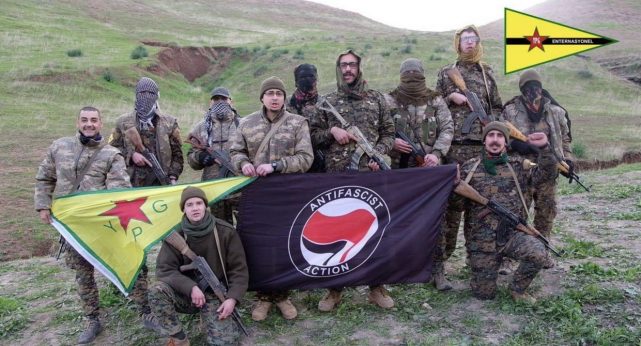
In recent months, the areas controlled by the People’s Protection Units (YPG) in the governorate of Deir ez-Zor (eastern Syria) have witnessed assassinations of notables and respected personalities on a near-daily basis.
Local sources in the governorate revealed on Wednesday that they had documented about 70 assassinations of notables in the YPG-controlled areas over the last five months.
The sources told Anadolu Agency that unknown individuals carried out assassinations on an almost daily basis, since the murder of Leader of Al-Aqeedat tribe Mutashar Al-Hafl in August 2020, taking advantage of the significant security deterioration in the YPG areas.
The sources added that last November, in the town of Al-Sijr, unidentified individuals assassinated Abdul-Razzaq Al-Muhammad and Ibrahim Al-Attiyah (nicknamed Abu Bakr Qadisiyah), a former commander of the Free Syrian Army (FSA) who was known for his strong opposition to the YPG.
On Sunday, unidentified gunmen assassinated Sheikh Talyush Eshatat, his son Mahmoud and another unidentified person, after storming his house in the town of Al-Hawaij. Former FSA Commander Ahmed Al-Alwan and his son were also killed in the city of Al-Busayrah in the countryside of Deir ez-Zor, according to the same source.
Following the murders, the High Council for Syrian Tribes and Clans issued a statement condemning the assassinations targeting notables and well-known personalities in the region.
According to the statement, the council: “Condemns in the name of its Arab, Kurdish, Turkmen and Syriac-Assyrian components all terrorist operations that targeted the Syrian people in general, and the tribal sheikhs and tribesmen in particular in the Deir ez-Zor governorate.”
The statement held: “Terrorist organisations that want to manipulate the tribal components and end their presence in the region”, responsible for the assassinations.
Earlier, the Syrian Al-Aqeedat tribe demanded that the international coalition hand over the administration of the Arab regions in eastern Syria to the locals, accusing the SDF, which is dominated by the YPG terror group, of carelessness in pursuing the assassinators.
Several towns in the eastern countryside of Deir ez-Zor have witnessed mass protests against the assassinations. At the same time, the YPG responded by attacking and besieging the towns, leading to civilian fatalities and injuries in addition to dozens of arrests.
Whatever is Wrong with Mike Morell?

By Steve Brown | Ron Paul Institute | January 7, 2021
Obama – er, Biden – pushed hard for the removal of Syria’s Assad and engineered US destabilization of Syria partly at the behest of Israel in 2011 and 2014 , in part to allow Israel free reign to annex the Jordan Valley and West Bank, in tandem with Israel’s long-standing annexation of the Golan. Yes, the Israeli Nile-to-Euphrates agenda is alive and quite well, not just among Israel’s 3rd templars, but within Biden’s proto-expansionist regime in the DC wings, too. Now, what’s that again about Russia Russia? Biden’s Russia, Russia? There’s just one problem for the Axis of Evil’s plan going forward: Russia’s continued opposition to the US plan in Syria.
Russia likely anticipated the complete destabilization of the Middle East by the US and its Israeli ally by design in 2014, where Takfiri malign infestation of the region not only threatened Europe, but Russia too, with a further militarist threat to Iran and West Asia. Russia stands in the way of that Imperial agenda, and that’s a big deal for Washington’s elite donor class. Russia also provided succor to Ed Snowden, when the DC shark pit would have crucified him alive; just as the same bloodthirsty pack will crucify Julian Assange too should they ever get their bloody incisors into him.
Now, rather than risk world war, the former US regime chose to tread a fine line with Russia in Syria, although outright war was much closer than the public realized or knew at the time. The current shape-of-things-to-come will test that envelope once more, and in a very big way. By definition, the reappearance of war-criminal and dinosaur Madeliene Albright, to re-blight a thoroughly blighted major media proves that intent. Albright’s abysmal record and advanced years have evidently not prevented her from seeking a new term within the putrefying endless expanse of DC’s Neoliberal cesspool.
Lately the voluble Albright has graced the CIA-corporate-led media to tout all subjects great and small, whether the contagion and failed US foreign policy, to the Balkans and somewhat erratic behavior of others. Apparently the non-apologetic self-acknowledged child-killer is safe for the time being for the DC establishment to trot out again — after all these years — and Albright holds her CIA-surveillance state brief well, even at the tidy age of 83.
Along with Albright and other foreign policy wonks littering the Biden-Harris space (Jen Psaki, Sam Power, and Wendy Sherman etc) Mike Morell’s reappearance has been as inspired and imaginative as his call to murder Russians (with Iranians thrown in for good measure, of course). Which apparently posed no problem for the incorporated CIA-run major media at the time; and whether Morell’s twitter account was ever suspended then for publicly threatening violence, remains unknown.
Notably the recent storming of the US bastille on January 6th caused our dear Mike to lament this failed example of democracy-in-action via a televised CBS news interview on that day, Mike posing that such brazen acts could be an inspiration for anti-American propaganda to be exploited by none other than… er, well, ahem… the Russians and RT! When a not-so-incredulous but mainly pandering CBS co-host pressed Mike about how Russia could possibly be running the Proud Boys to storm the capitol?? … our dear Mike back-pedaled a bit to say, well, like always (but never proven) the Russians definitely did hack Hillary in 2016 and cost her the election. Leaving hosts and viewers alike somewhat baffled, but fortunately the CBS ‘analyst’s’ cum CIA guy’s conversation moved on, saving further embarrassment.
If public consciousness were not just a few milliseconds, the irony of media claims that Trump’s allegations about voter fraud are baseless since proof has not yet been provided, would not be lost on the public, when compared to US intelligence claims that Russian collusion in 2015 cost Hillary the election when no proof or evidential record of that has ever been provided, either. But then again, Morell is a former CIA spy guy and CBS anchor, so that’s just how he rolls…
In closing we are left with one final perplexing and inevitable question: which CIA-led news network will pick up Gina Haspel and Mike Pompeo as news analysts going forward? CBS too? And who is the next Clinton-Obama dinosaur and war criminal to re-appear and pollute the new regime in DC?
For certain, we shall see.
Steve is an antiwar activist and a published scholar on the US monetary system.
Twitter: @newsypaperz
More War by Other Means: Sanctioning the Wife of Syria’s President Makes No Sense to Anyone
By Philip Giraldi | Strategic Culture Foundation | January 7, 2021
More sanctions, by all means. More grief and suffering and more people around the world wondering what exactly the United States is doing.
I am a recipient of regular, usual weekly, emails from the Department of the Treasury providing an “Update to OFAC’s list of Specially Designated Nationals (SDN) and Blocked Persons.” OFAC is the Office of Foreign Assets Control, which is tasked with both identifying and managing the financial punishments meted out to those individuals and groups that have been sanctioned by the United States government. A recent update, on November 10th, included “Non-Proliferation Designations; Iran-related Designations.” There were ten items on the list, names of Chinese and Iranian individuals and companies. Those who are “Specially Designated” on the list are subject to having their assets blocked if located in the United States and are also not allowed to engage in any financial transactions that go through U.S. banking channels. As many international banks respect U.S. Treasury “designations” lest they themselves be subjected to secondary sanctions that often means in effect that the individual or group cannot move money in a large part of the global financial marketplace.
The complete SDN list is hundreds of pages long. The Treasury Department defines and justifies OFAC’s mission “As part of its enforcement efforts, OFAC publishes a list of individuals and companies owned or controlled by, or acting for or on behalf of, targeted countries. It also lists individuals, groups, and entities, such as terrorists and narcotics traffickers designated under programs that are not country-specific. Collectively, such individuals and companies are called ‘Specially Designated Nationals’ or ‘SDNs.’ Their assets are blocked and U.S. persons are generally prohibited from dealing with them.”
In reality, of course, OFAC’s sanctions are highly political. They are clearly a form of economic warfare, particularly when entire sectors of a nation’s economy are blocked or a part of a government itself is listed as has been the case with the Iranian Revolutionary Guard Force. Wave after wave of “maximum pressure” sanctions on Iran have made it difficult for the country to sell its only major marketable resource, oil, and it has been locked out of most normal financial networks, making it difficult or even impossible to buy food and medicines.
In many cases sanctions have no practical effect but are rather intended to send a message. There have been new sanctions directed against Moscow and Russian government officials have been sanctioned due to their alleged involvement in activities that the United States does not approve of. The sanctions are imposed even though those “specially designated” have no assets in the U.S. and do not engage in any international financial transactions that could be blocked or disrupted. In those cases, the federal government is sending a message to whomever has been sanctioned to warn them that they are being watched and their behavior has become a matter of record. It is basically a form of intimidation.
Whether sanctions actually work is debatable. The example of Cuba, which was sanctioned by the U.S. for nearly sixty years, would suggest not. Some would argue that on the contrary countries with totalitarian regimes would actually improve their behavior if their citizens could travel freely and welcome visitors, providing evidence that foreigners do not pose a threat justifying a police state.
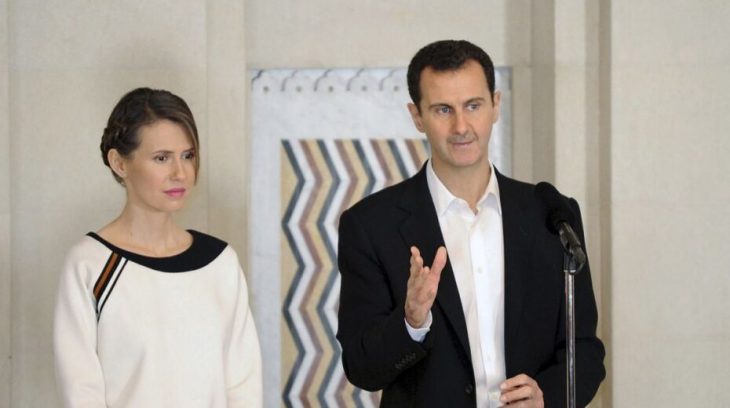
Within the United States government, it is largely accepted that the most powerful advocate of the sanctions regime is Secretary of State Michael Pompeo, who has been the driving force behind recent sanctions directed against both China and Iran. If that is so he might well be challenged on one of the most bizarre and basically pointless applications of sanctions in recent years, targeting Asma the wife of Syrian President Bashar al-Assad as well as her family that lives in London and are British citizens. Per Pompeo’s statement on the new sanctions “The Department of State today is imposing sanctions on Asma al-Assad, the wife of Bashar al-Assad, for impeding efforts to promote a political resolution of the Syrian conflict pursuant to Section 2(a)(i)(D) of Executive Order 13894… Asma al-Assad has spearheaded efforts on behalf of the regime to consolidate economic and political power, including by using her so-called charities and civil society organizations.”
But the real kicker is Pompeo’s condemnation of Asma, of Syrian origin but English born and raised, is how he involves her family. Her father-in-law Fawaz is a renowned cardiologist at Cromwell Hospital in South Kensington who was educated in England and has lived there for decades. “In addition, we are sanctioning several members of Asma al-Assad’s immediate family, including Fawaz Akhras, Sahar Otri Akhras, Firas al Akhras, and Eyad Akhras as per Section 2(a)(ii) of EO 13894. The Assad and Akhras families have accumulated their ill-gotten riches at the expense of the Syrian people through their control over an extensive, illicit network with links in Europe, the Gulf, and elsewhere.”
Inevitably, no evidence is provided to support any of the allegations about Asma al-Assad and her English family. Asma’s charities are for real in her war-torn country and she is highly respected and admired by those who know her and are not influenced by U.S. and Israeli propaganda.
In reality, the United States has been trying hard to overthrow the Syrian government since 2004 when the Syria Accountability Act was passed. Much of the heat in Congress behind the passage of the act was generated by the Israel Lobby, which wanted to weaken the regime and reduce its ability to represent a viable military force possibly capable of regaining the occupied Golan Heights. Be that as it may, the United States has been hostile to the country’s government and has frequently called for regime change. To bring that about, the U.S. supported al-Qaeda linked terrorist groups operating against Damascus and American soldiers continue to occupy Syrian oil fields in the southeast portion of the country. The Syrians have also been subjected to waves of sanctions that have done grave damage to their economy. American and Israeli concerns have sometimes been linked to the presence of Damascus’ allies Hezbollah and Iran, both of whom have military units based inside Syria, but the simple fact is that neither Iranians nor Lebanese in any way threaten the vastly superior American and Israeli forces present in the region.
One has to ask why, given the realpolitik playing out in the Middle East, Washington and Pompeo feel compelled to go after Asma al-Assad and her family, apparently to include absurdly blaming relatives living for many years outside of Syria for fueling the war. More sanctions, by all means. More grief and suffering and more people around the world wondering what exactly the United States is doing.
The Kurds have Once Again been Abandoned by their “American Brothers”
By Valery Kulikov – New Eastern Outlook – 28.12.2020
Yet again thrown by their “older American brothers” to the winds of fate, the Kurds in the Levant nowadays are not living through the best of times. On the border running between Syria and Iraq, a new armed conflict entailing human casualties is unfolding, one which demonstrates, among other things, a clear lack of unity among the Kurds, and that so-called Kurdistan is divided into parts ruled by various leaders, many of whom are competitors, and often almost irreconcilable enemies. Against this backdrop in the past few years, fierce battles between Kurdish formations have begun to occur more and more frequently, with the warring parties, while losing their fighters, the warring parties, concentrating their forces along the border in anticipation of new clashes.
The Syrian Kurds blame their Iraqi compatriots from the Peshmerga group for causing this conflict, including preparing for war in the Syrian Arab Republic. So, according to the position announced in ANF News by the Syrian Kurds, since October the Kurdistan Democratic Party (KDP) has been organizing provocations in South Kurdistan. The KDP, controlled by the family of Iraqi Kurdish leader Barzani, has been accused of both working closely with Turkey in various areas, including intelligence gathering, spreading propaganda, and logistics, and fueling domestic conflicts that could lead to civil war.
In October, Peshmerga proclaimed that an attack had been committed by Syrian Kurds on an oil pipeline, which resulted in oil exports from Kurdistan to Turkey being suspended.
On November 4, local media outlets reported that armed clashes broke out between Peshmerga forces and Kurdistan Workers’ Party militants in the area of Duhok, which resulted in the death of one Iraqi Kurdish fighter and injuries for three others.
On December 15, General Mazloum Abdi, who is the commander-in-chief of the Kurdish-Arab “Syrian Democratic Forces”, which was created by the United States, accused Iraqi Kurds of attacking and wounding three SDF members.
On December 16, the Iraqi Kurdistan regional authorities announced that Syrian armed groups from the YPG (which forms the backbone of the SDF) attacked bases and positions held by the Iraqi Peshmerga near the border. Syrian Kurdish leaders denied these accusations, calling them false, and leveled similar accusations toward Iraqi tribesmen themselves.
Local observers note that Iraqi Kurds are being transferred to the Syrian front with support provided by Turkish combat drones. It is worth noting that Ankara considers the YPG to be the Syrian wing of the Kurdistan Workers’ Party, which is labeled as a terrorist group in Turkey; this was used as the rationale for it to invade Rojava last October, displacing hundreds of thousands of civilians. Selahattin Demirtas, the co-chairman of Turkey’s largest Kurdish People’s Democratic Party, has been behind bars for the fourth year on charges of “supporting terrorism”. To mitigate the influence of this Kurdish movement, which is represented in the Turkish parliament, and to sow more discord in the Kurdish community, Turkey is preparing to organize a new Kurdish party with support from the country’s ruling Justice and Development Party.
 Regarding the military potential possessed by Kurdish groups in Syria and Iraq, it should be specified that both sides have virtually full-fledged armed forces that have been equipped with help from “foreign players”. Washington and Ankara are the ones helping the Iraqi Kurds. The Syrian Kurdish groups were financed, armed, and trained by the United States and its allies in the anti-terrorist coalition. At the same time, it is evident that both sides have been lent support by Washington, as well as used by it in the struggle for influence, power, and oil – both in Syria and Iraq. On top of that, the United States essentially put its seal of approval on the defeat of the Kurdistan Workers’ Party – a party recognized by them as terrorists in the European Union – in the Syrian Arab Republic and Iraq, where the main bases that the PKK has are located since their forces were defeated in Turkey.
In recent years, Trump has effectively lost interest in supporting the Kurds in the region, and even announced in October 2019 that American troops would be withdrawn from the area, and this time would not defend the Kurds. After that, Turkish aircraft started to attack the region and the positions that were held by the Kurds.
Donald Trump stated his position on the Kurds and the reason why the United States is abandoning them yet again on his Twitter page a year ago, noting in particular that the Kurds, an Iranian ethnic group, did not help the United States during WWII – including during the invasion of Normandy. It seems that the US president clearly drew on this kind of “extensive expertise” in WWII history from an article by Kurt Schlichter in the publication Townhall – which praises Trump’s policies – that stated: “The Kurds helped destroy DAESH (a terrorist group banned in the Russian Federation) … But let’s be honest: the Kurds did not come to help us in Normandy, Incheon, Khe Sanh, and Kandahar”. Well, what else can be expected for the Kurds from their “elder American brothers”?
The processes among the Kurds, which began in 2019 after another episode involving betrayal by the United States, were described in sufficient detail by The New York Times. Today, these processes have intensified, as have Turkey’s operations against the Kurds in Syria. One of the very hot spots in this regard was the city of Ain Issa in the northern part of the Raqqa Governorate, where Turkey has stepped up its shelling of Kurdish positions. For example, on the evening of December 17, the Turkish army and militants allied with it struck a powerful blow to the positions held by the predominantly Kurdish “Syrian Democratic Forces” in the area of the city of Ain Issa, attacking two nearby villages, and this forced SDF groups to abandon these positions and regroup their forces to keep the enemy from advancing any further. On the night of December 22, pro-Turkish forces ratcheted up the intensity of their strikes on the city of Ain Issa and its environs, and the Turkish military itself switched to using heavy artillery to strike the northern part of the Raqqa Governorate.
Under these conditions, representatives of the Russian and Syria military held talks on December 22 with representatives of Kurdish autonomous organizations – with participation on the part of Turkish officers – to try to ease tensions, but the parties did not reach any agreement. Representatives from the Turkish military demanded the withdrawal of all militants from the SDF, promising to stop the attacks by pro-Turkish criminal groups on Ain Issa if this occurs, although Ankara had previously denied that the militants were acting on its instruction.
The situation remains filled with tension, despite the measures taken by Russia to help foster stabilization.
The subject of Israeli hegemony over US must be addressed

By Walt Peretto | Press TV | December 25, 2020
It’s pardon season for President Trump. The likely outgoing president has issued 15 pardons that include two members of the Russian investigation and four convicted murderers who worked for the private security firm Blackwater.
These four were convicted of murdering 14 Iraqi civilians in 2007. Private security corporations such as Blackwater (since renamed Academi) have played a major role in war zones since the invasions of Afghanistan and Iraq after the false flag events of 9/11/2001. They are also suspected of participation in other domestic false flag events that include the Boston Marathon event in 2013.
These pardons by Trump will facilitate the use of private security firms in the near future both domestically and abroad. Further lockdowns in the US and crushing strains on small business may create unrest which could overwhelm municipal law enforcement and the federal government may choose to hire private security to deal with such occurrences. Overseas, tensions may increase in Syria as the new Democratic president may resurrect the goal of toppling President Assad which would likely be carried out by hiring private mercenaries which the West has done in the past.
I think these pardons by Trump send a signal to private security firms that their actions will not be hampered by long prison sentences for employees who engage in murder. Similar to municipal policing in which cops that murder are virtually never convicted. If the US does rededicate itself to regime change in Damascus, it’s hired security forces and clandestine paid terrorists don’t want restraints like convictions of murder in the courts.
Trump’s pardon of two people involved with the Russiagate fiasco makes sense since Russian collusion was never proven and the whole story was really a distraction for 4 years designed to take people’s eyes off of leaked emails involving Hillary Clinton, the Podesta brothers, Barack Obama and others that were quite damning if they were thoroughly investigated.
For four years the left-leaning media in the United States filled the news with accusations of Russian collusion in US elections and other illegal and immoral interactions between Russian officials and the Trump administration.
This also kept the eye off the elephant in the room called Israel which has seized control of the presidency, the Congress, the Judiciary, the economy through the FED, and the mainstream media.
China has provided another useful distraction from Israeli influence in America. If one honestly examines recent US presidential administrations — don’t strain to find any Chinese or Russian nationals in positions of power in the US federal government. Dual US/Israeli citizens are abundant and ubiquitous in the Trump administration and it will be similar in the Biden administration if he makes it to the White House. The subject of Israeli hegemony over the United States is a subject no one seems to want to address.
Judging from the proposed COVID Stimulus Package which allocates billions of dollars to other countries, this proves that the globalist intention is to bleed the United States dry until it submits wholly to the international cabal of psychopaths that includes Klaus Schwab and his World Economic Forum who are attempting to reset the world into a one-world system led by global organized psychopathy.
Latest evasions and cover-ups by Western governments over funding of terrorist groups in Syria are unraveling
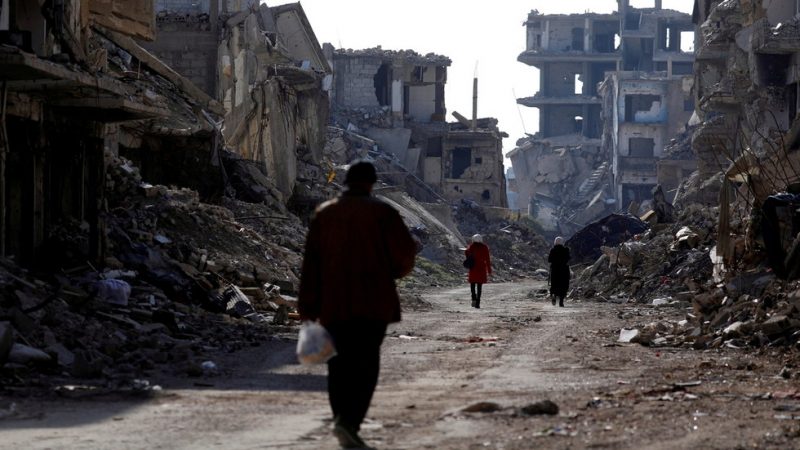
People walk past damaged buildings at the Yarmouk refugee camp on the southern outskirts of Damascus © Reuters
By Vanessa Beeley | RT | December 13, 2020
Evidence of Dutch and British funding for extremists who’ve beheaded children & carried out ethnic-cleansing grows by the day. Yet most of the mainstream media – including the BBC – still try to keep this truth silent.
Recently, Dutch Prime Minister Mark Rutte effectively blocked a Parliamentary motion to allow an external independent investigation of Dutch government funding of terrorist groups in Syria.
Rutte initially tried to deny his involvement in the burial of the investigation but tenacious questioning from journalists forced him to admit his personal interference. According to Rutte, such an investigation could result in “tensions with our allies […] the lives of former members of opposition groups could be put at stake.”
Rutte’s protection of illegal armed groups wreaking havoc in Syria is reminiscent of the UK Government’s response to similar Parliamentary questions requesting clarity on the armed groups supported by its Foreign Office (UK FCO). The standard line is, “for security reasons, we do not disclose the names of those moderate opposition groups supported.”
This article will demonstrate that Rutte is very probably preventing tensions with the UK by quashing an investigation, and that the “moderate opposition” promoted by both governments actually consists of savage, extremist gangs who think nothing of conducting ethnic cleansing pogroms in Syria.
Turning ‘non-lethal aid’ into deadly weapons
In 2018, Dutch officials were accused of providing equipment to terrorist groups in Syria. Equipment that included Toyota and Isuzu trucks that were, probably, later converted into machine-gun carriers by groups such as Jabhat al-Shamiya, considered a “Salafist” group by the Dutch Prosecution Service. This equipment was euphemistically described as non-lethal aid, a convenient caveat for governments ensuring the armed groups are given the means to recast this ‘aid’ into military hardware.
Dutch journalist Eric Van Den Beek has followed this affair from the outset. He wrote recently: “It’s a mystery why the Dutch Public Prosecution Office still has not launched a criminal investigation against current and former political officials who were involved in the support of Jabhat al-Shamiya.”
In October 2020, Dutch media reported that a former leader of a terrorist group operating in Syria had been receiving funding from the Dutch Foreign Ministry for years. The group, Ahrar Al Sham, was designated a terrorist organisation by the Dutch Court in 2019.
It is worth noting that Ahrar Al Sham merged with Nour Al Din Zinki in 2018, to form the “Syrian Liberation Front.” Zinki had been formerly funded as “moderates” by the US, but this aid was withdrawn after the group tortured and beheaded a 12-year-old boy, Abdullah Issa, in Al Ansari square, Aleppo in July 2016.
White Helmets soaked in blood
Incidentally, the square where this heinous crime took place was only 200 meters from the White Helmet center that featured in the Oscar-nominated promotional movie for the FCO-midwived, terrorist-linked organisation, “Last Men in Aleppo.” The Dutch government only withdrew funding from the White Helmets in 2018, citing lack of assurances that funds would not be funneled to terrorist groups in Syria. Up until this point, the Netherlands had given the White Helmets $14.5 million.
It was Dutch media that broke the story of the suspected involvement of the White Helmets founder, James Le Mesurier, in defrauding Mayday Rescue – the organisation Le Mesurier established to siphon UK and EU funding to his organisation.
The BBC has recently produced a 15-part radio documentary ‘probe’ into the Le Mesurier fraud allegation and the White Helmets. The “Mayday” series, produced by Chloe Hadjimatheou, turned out to be nothing more than an attempt to smear and discredit researchers, academics, scientists and journalists whose work has exposed the White Helmets to be an armed-group-auxiliary, an extension of power for the UK/US-led regime-change coalition, whose failed agenda is the removal of the Syrian government and President Bashar Assad.
Rutte’s denial of a rigorous and transparent investigation into Dutch sponsorship of terrorist groups in Syria is likely to be connected to the BBC-Mayday series and the FCO’s support for sectarian armed groups in Syria as part of an externally managed “political process.” A recent leak of FCO documents has revealed the extent to which the British government and intelligence agencies have been involved in extensive public relations and media operations to clean up the image of bands of war-crime-committing extremist groups.
This context is important to understand why the alleged financial support provided to the leader of Ahrar Al Sham by the Dutch Foreign Ministry, is very likely connected to the UK efforts to create a vast complex of PR and media back-up for these mercenary armed groups in Syria.
The ex-UK student turned fundraiser for Islamism
The former “foreign affairs minister” of Ahrar Al Sham is a UK-educated, Spanish-Syrian called Labib Al Nahhas. Dutch media has reported that documents show that the country awarded two million euros in subsidies to the European Institute of Peace (EIP), based in Brussels. Much of this funding went on to the Syrian Association for Citizens’ Dignity (SACD). Al Nahhas is the program director and he, personally, receives 700 euros per day, for an average of more than ten days per month as a senior consultant for EIP. This funding covers 2018-2021.
A recent article by journalist Kit Klarenberg revealed the role that Le Mesurier’s widow, Emma Winberg, played in the PR support for Syrian armed groups. Winberg was co-founder of Incostrat, a FCO-outreach agency funded by the Conflict Stability and Security Fund that also finances Mayday Rescue and the White Helmets. The BBC, curiously, made no mention of Winberg’s involvement in what is effectively a clandestine black-op run by the British government in an effort to destabilise Syria and to effect “regime change.”
Among the groups believed to be provided with PR and media support via Incostrat, are Jaish Al Islam, and, according to French journalist Thierry Meyssan, Ahrar Al Sham. In 2016, The Guardian ran a story on an “ex-UK student clock[ing] up air miles on mission to rebrand Syrian Islamists” (emphasis added). The Guardian admits that Ahrar Al Sham had fought in alliance with Nusra Front (Al Qaeda in Syria) and that their goal was to establish an Islamist theocracy in Syria. The Guardian also reports that one of the original leaders of AS had “personal connections with Osama Bin Laden.”
Al Nahhas had deep connections to the US, EU and UK, where he had established a tech company in a West London suburb. IKPA Communications Ltd was set up in October 2012 and apparently liquidated in 2014. Two other directors were named at Company House, Labib Shalak and Swedish-born UK resident, John Carl Gandeborn. This background builds the picture of someone who would be an ideal candidate for the UK FCO-sponsored agencies to promote as an acceptable frontman of an unacceptably sectarian, brutal armed group.
Al Nahhas resigned as director of his tech company in April 2014, the same year he joined Liwa al-Haq, a faction that merged with Ahrar Al Sham in late 2014. Al Nahhas was appointed Ahrar Al Sham’s “foreign minister” after the assassination of the majority of the armed group’s leaders in September 2014. This event is recorded in the leaked FCO documents, in a submission by Analysis Research and Knowledge (ARK) for the “Rapid Response” contract. ARK was also responsible for the creation of the White Helmets in Turkey and Jordan in 2013, with James Le Mesurier at the helm while an employee of ARK.
Turning a blind eye to outrages
Immediately after the largely unexplained assassination of Ahrar Al Sham leaders, Al Nahhas was dispatched on a mission to secure US/UK/EU support for the armed group, visiting Western diplomats and publishing “opinion pieces” in the Washington Post and the Telegraph that called on the West to “engage with Ahrar Al Sham”. Former US Ambassador to Syria, Robert Ford, accused by Syrian officials of fomenting the armed uprising in 2011, joined the campaign (in 2015) to whitewash Ahrar Al Sham and to distance them from their alliance with Nusra Front.
The access and UK/US state-aligned-media support given to Al Nahhas and the timing of his moves to join armed groups fighting on behalf of the US Coalition in Syria, must lead to speculation that his role was managed by entities like Incosrat with the backing of the FCO and intelligence agencies. Ahrar Al Sham did not cease their ethnic cleansing atrocities in Syria despite the elevation of the group to “political process” status. In May 2016, just before Nour Al Din Zinki beheaded Abdullah Issa, Ahrar Al Sham and Nusra Front carried out the massacre of Syrian Alawite civilians in Zara, in the Aleppo governorate. The UK and US still refused to bow to pressure from Russia to designate Ahrar Al Sham a terrorist group.
Ahrar Al Sham’s involvement with the BBC dates back to the 2013 BBC Panorama report, “Saving Syria’s Children,” when the armed group escorted the BBC production team during the fabrication of what is suspected to be an elaborate hoax based on the forensic analysis of independent researcher Robert Stuart.
As late as 2017, it was reported that Kenan Al Nahhas, Labib’s brother, was appointed the new “political” leader of Ahrar Al Sham. At this time, the group was participating in the brutal siege and daily targeting of Shia Muslim Syrian civilians in the villages of Kafarya and Foua in Idlib. Ahrar Al Sham was also present, with Nusra Front, in Rashideen, Aleppo, in April 2017, when a terrorist suicide car attack massacred recently evacuated children and families from Kafarya and Foua.
The western campaign to rebrand and decriminalise this armed group continued unaffected by the war crimes they were systematically committing against the Syrian people. An opinion piece by Al Nahhas was published by the Guardian in February 2020. The Guardian has also been instrumental in maintaining the criminalisation of the Syrian government, an effort designed to corroborate the FCO’s “regime change” policy. The Guardian was drafted in to posthumously rebrand James Le Mesurier as a “mainstream saint” and was heavily involved in the White Hemet PR industry, alongside the BBC and Channel 4.
Al Nahhas allegedly distanced himself from Ahrar Al Sham in November 2016, but his brother stepped up to lead the armed group. While the Dutch officials involved in the financial sponsorship of a terrorist group profess ignorance of this, opposition members of Parliament say this suggests a lack of robust screening of recipients of government funding. This, combined with the 2018 revelations of the funding of Jabhat Al Shamiya, paint a damning picture of Dutch government involvement in the promotion and material support for violent, criminal armed groups involved in ten years of bloodshed in Syria.
In a curious turn of fate, Chloe Hadjimatheou, the producer of the BBC “Mayday” series, had been “the driving engine” behind a King’s College London, War Department, paper, entitled “The New Jihadism: A Global Snapshot”. The paper concluded that Ahrar Al Sham should be placed alongside Nusra Front and ISIS as a “Salafist,” in other words, a terrorist organisation operating in Syria.
Hadjimatheou refused to answer when asked if she subscribed to the view that the organisation that collaborated closely with the BBC Panorama team was deemed to be a terrorist group. It seems that the promoters, financiers and supporters of terrorism in Syria are not too keen to own up to their involvement in sustaining the illegal war against the Syrian people for ten years.
Vanessa Beeley is an independent journalist and photographer who has worked extensively in the Middle East – on the ground in Syria, Egypt, Iraq and Palestine, while also covering the conflict in Yemen since 2015. Follow her on Twitter @VanessaBeeley
White Helmets founder Le Mesurier is now a mainstream saint, but leaked docs raise questions about his widow’s role
By Kit Klarenberg | RT | December 8, 2020
An extraordinary, concerted establishment campaign to rehabilitate the reputation of White Helmets founder James Le Mesurier has unfolded over recent months.
First, in late October, came a 6,000-word hagiography in The Guardian — less than a fortnight later, the BBC transmitted a 15-part radio documentary on his firm, Mayday Rescue.
Emma Winberg, Le Mesurier’s spouse and Mayday’s Chief Impact Officer, played a starring role in both efforts, in the process breaking the public silence she’d rigidly maintained since her husband’s mysterious death in November 2019.
Strangely though, discussion of her professional history was almost entirely absent. The Guardian was slightly more informative on this point than the BBC, sparingly describing Winberg as “a former British diplomat” working for a “communications firm in northern Iraq” when she became romantically involved with Le Mesurier in March 2016, before joining Mayday in January 2017.
‘Some of the funds will go missing’
The communications firm in question was Innovative Communications and Strategy (Incostrat), cofounded by Winberg in November 2014 with military intelligence veteran Paul Tilley, former director of Strategic Communications for the UK Ministry of Defence in the Middle East and North Africa. Like Le Mesurier, he attended Sandhurst Royal Military Academy.
Media references to Incostrat are sparse, although in December 2016 Rania Khalek revealed the company had approached a Middle East journalist and offered them US$17,000 per month to produce pro-opposition propaganda.
Private correspondence between the reporter and Incostrat indicates the company positioned itself as one of “three partners” of the UK Foreign & Commonwealth Office (FCO) “working on media surrounding the Syrian conflict.”
Incostrat’s work was funded by the FCO’s Conflict, Stability and Security Fund (CSSF). In February 2017, a parliamentary report stated CSSF had “substantial allocations” in Syria, amounting to £60 million.
The same report noted there was significant risk the CSSF was “being used as a ‘slush fund’ for projects that…do not collectively meet the needs of UK national security,” and some of the financing it afforded “will go missing or be linked to groups that may carry out human rights abuses.”
‘Using media to create events’
Significant light was shed on Incostrat’s cloak-and-dagger activities in September, when ‘hacktivist’ collective Anonymous dumped a vast number of FCO files on the web, exposing a variety of covert information warfare actions undertaken by the UK government against the Syrian state over many years.
The overriding objective behind all the initiatives was to destabilise the government of Bashar Assad, convince Syrians, Western citizens, foreign governments, and international bodies the Free Syrian Army (FSA) was a legitimate alternative, and flood media the world over with pro-opposition propaganda.
In one document, Incostrat boasts of surreptitiously “initiating events to create media effect” and of “using media to create events.” One example of this dual-strategy saw the company create mock Syrian currency in three denominations, imploring citizens to “be on the right side of history.”
The campaign was intended to ensure international opinion remained arrayed against Assad, at a time “media attention has shifted almost exclusively towards ISIS and some influential voices are calling for co-operation with the Syrian regime to combat ISIS.”
“The notes are due to be smuggled into regime-held parts of Syria once formal clearance has been authorized by [UK government] officials,” the file states. “We will engage the international media to create a story around the event… The message to the regime [is] covert but active resistance continues.”
Another saw Incostrat produce “postcards, posters and reports” to “draw behavioural parallels” between the Assad government and ISIS, and dishonestly further the conspiracy theory that “a latent relationship exists between the two.”
Incostrat also provided “a credible, Arabic-English speaking Syrian spokesperson” to the media to further the campaign’s messaging, securing interviews in “major news outlets” such as Al-Jazeera, Buzzfeed, CNN, The Guardian, New York Times, Times, and Washington Post.
‘Human interest stories’
Another document indicates the company was staffed by veterans of covert Whitehall-funded psyops, noting Incostrat partners previously established a local media platform in Iraq “immediately following the fall of Saddam Hussein,” training “a cadre of journalists” who were “instrumental in reporting on events in Basra.”
The same file also makes clear Incostrat personnel had been providing support to Syrian media platforms and civil society organisations since 2012, before the firm was founded.
In the process, Incostrat operatives played a role in creating eight FM radio stations and six community magazines across the country, developing and managing the Syrian National Coalition’s media office, and helped establish Basma – “a media platform providing human interest stories and campaigns that support [UK government] policy objectives.”
Other files leaked by Anonymous indicate Basma was the primary creation of ARK, a shadowy “conflict transformation and stabilization consultancy” headed by veteran FCO operative Alistair Harris, implying significant overlap between the pair.
Le Mesurier himself worked at ARK 2011 – 2014, and Mayday Rescue was spun out of the company – yet The Guardian’s lengthy elegy alleges Winberg had only been “briefly introduced” to him twice at “garden parties” prior to their formal March 2016 meeting.
Moderate torturers and murderers
As with other FCO contractors operating in Syria, including ARK, Incostrat produced propaganda promoting extremist groups as credible alternatives to the Assad government, and whitewashing their barbarous nature.
One document refers to the firm “providing strategic communications support to the moderate armed opposition.” An FCO tender for the project indicates some of the “moderate” groups to which Incostrat may have provided “strategic communications support” — “the Free Syrian Army, the Supreme Military Council, Revolutionary Forces Syria and… mid-level units such as Syrian Revolutionaries Front, Jaysh al-Islam [and] Harakat al-Hazm.”
The inclusion of Jaysh al-Islam (JAI) on this list is striking, for more reasons than one. While none of the collectives mentioned would adhere even vaguely to any definition of the term ‘moderate’, except perhaps broadly relative to the most murderous ‘rebel’ elements in Syria — with which each group regularly collaborated in any event — JAI was an especially and notoriously brutal fraternity.
For years, it ran the assorted areas it occupied under extremely vicious interpretations of Sharia law, kidnapping, imprisoning, torturing and executing innocent men, women and children for even the mildest infringements of strict Islamist code. Along the way, JAI carried out many atrocities, including parading caged Alawite families in the streets, using hostages as human shields, and attacking Kurdish civilians with chemical weapons.
While the UK government denies providing any backing to JAI, the files released by Anonymous confirm the other groups mentioned by the FCO all did receive Whitehall support of various kinds. Moreover, independent journalists who visited areas the group occupied found JAI worked closely with the White Helmets, which received tens of millions in funding from London.
Other files released by Anonymous indicate ARK reaped vast sums promoting the Helmets at the FCO’s behest, developing “an internationally focused communications campaign to raise global awareness” of the group in order to “keep Syria in the news.”
Along the way, ARK produced a documentary on the Helmets and ran their various social media accounts, including the Facebook page for Idlib City Council, at one time mooted as a potential interim government to replace Bashar Assad. When Al-Nusra overwhelmed the city, numerous Helmets were filmed celebrating the ‘victory’ in its main square.
The linkage between JAI and the Helmets gains an acutely sinister dimension given the former’s primary base of operations was the city of Douma, the site of a highly controversial alleged chemical weapons attack 7th April 2018.
The Helmets were central to Western news reporting in the initial hours and days following the contested strike, its operatives claiming two Syrian Air Force helicopters dropped barrel bombs containing the nerve agent sarin on the city.
Images they provided of cylinders embedded in buildings circulated widely on social networks and media platforms the world over, along with footage of local residents being hosed down in hospitals, children foaming at the mouth, and piles of dead bodies in a housing complex.
Paris, London and Washington claimed to possess secret proof Assad’s forces had attacked the city with chemical weapons, and in response launched a series of military strikes against multiple government sites in Syria 14th April 2018.
In March 2019, the Organization for the Prevention of Chemical Weapons (OPCW) issued a final report on the incident, which concluded there were “reasonable grounds” to believe a chemical weapons attack had occurred in Douma, and “the toxic chemical was likely molecular chlorine.”
However, a number of the organization’s previously suppressed files are now in the public domain — they make clear the report’s findings were directly contrary to the overwhelming majority of evidence collected by investigators who actually visited Douma, which pointed strongly to a staged ‘false flag’ incident.
An illicit affair
The documents imply witness and forensic evidence contradicting the notion a chemical weapons attack occurred in Douma, excluded from the OPCW’s final report on the incident, was collected in Turkey. The BBC’s radio series on Mayday confirmed this evidence was provided to investigators by Le Mesurier and the White Helmets.
While the OPCW website makes no reference to this assistance, not merely in respect of the Douma investigation but its probes of at least three other alleged government chemical weapon attacks in Syria, in June 2018 Mayday’s deep and cohering ties with the organization were exposed by none other than Emma Winberg.
Speaking at an Atlantic Council event alongside Bellingcat founder and chief Eliot Higgins, she described how the Helmets had in 2015 specifically been provided with OPCW-standard training and equipment to collect samples from the scenes of airstrikes for the organization. The ease with which this privileged position could be abused was apparently not considered, or indeed of no concern.
This followed two years in which the group’s status as ‘first responders’ in the Syrian crisis had become ever-more firmly established in the mainstream, thanks in no small part to the endless deluge of footage posted on the group’s social media channels, which was frequently broadcast by Western news platforms subsequently.
In 2014, Winberg said, human rights organisations began “taking an interest” in the footage and reaching out to Mayday directly, seeking witness testimony from Helmets among other things.
She also suggested the attention generated by the group’s video clips was serendipitous, as the helmet-mounted cameras they wore were originally intended to be a “training aid” — it wasn’t until later, allegedly, they thought to publicise the content captured.
Fittingly, Winberg’s brief talk fed into a speech by Higgins, in which he demonstrated how Bellingcat and other media organisations made use of the White Helmets’ footage.
‘How communications influence’
It’s highly implausible the FCO-funded information warfare specialists that trained and promoted the Helmets weren’t well-aware in advance of the propaganda value of imagery from the conflict.
Yet, Winberg’s narrative is even more incredible given ARK, the firm so intimately intertwined with Incostrat and Mayday, extensively tutored and equipped hundreds of Syrians in “camera handling, lighting, sound, interviewing, filming a story,” post-production techniques including “video and sound editing and software, voice-over, scriptwriting,” and “graphics and 2D and 3D animation design and software.”
ARK’s students were also instructed in practical propaganda theory, such as “target audience identification, media and media narrative analysis and monitoring, behavioral identification/understanding, campaign planning, behavioral change, and how communications can influence it,” and more. Such disciplines would no doubt be extremely effective in the staging of a ‘false flag’ attack.
The FCO continued funding Incostrat to the tune of millions after Winberg’s departure, and does so to this day. Cofounder Paul Tilley also left the company at around the same time, and founded IN-2 Comms, which“provides a more tailored product to the public and private sector focussing on specialised communication campaigns.” The firm has likewise reaped vast sums from Whitehall ever since.
One wonders whether the FCO’s extensive network of psyops cutouts played any role in the recent propaganda blitz surrounding Le Mesurier, Winberg, and the Helmets.
The BBC’s Mayday series credits Abdul Kader Habak as having provided “Arabic translation and additional research” to the project. According to his Facebook page, he worked for ARK 2013 – 2019.
Chloe Hadjimatheou, the documentary’s producer and presenter, has previously reported on events in Syria. In 2016, she produced a five-part documentary, Islamic State’s Most Wanted, on citizen activist collective Raqqa is Being Slaughtered Silently.
The group was founded by journalist Naji al-Jerf, who subsequently served as its primary spokesperson — he was also an ARK employee, playing a pivotal role in training and coordinating the firm’s vast network of stringers in Syria, and managing its distribution networks. He was murdered by ISIS operatives for these activities in December 2015.
On 18th November, Winberg announced her retreat from the public eye via Twitter, saying she would be “offline for the foreseeable” in order to “get to work”. It’s not certain what this “work” will entail, but mainstream efforts to deify her husband and obscure the reality of his professional history, the group he founded, and how and why he died, are evidently ongoing.
Kit Klarenberg, an investigative journalist exploring the role of intelligence services in shaping politics and perceptions. Follow Kit on Twitter @Kit Klarenberg
Featured Video
Chinese jet fuel and the myth of energy independence
or go to
Aletho News Archives – Video-Images
Book Review
Former Insiders Criticize Iran Policy as U.S. Hegemony
By GARETH PORTER | CounterPunch | February 27, 2013
“Going to Tehran” arguably represents the most important work on the subject of U.S.-Iran relations to be published thus far.
Flynt Leverett and Hillary Mann Leverett tackle not only U.S. policy toward Iran but the broader context of Middle East policy with a systematic analytical perspective informed by personal experience, as well as very extensive documentation.
More importantly, however, their exposé required a degree of courage that may be unparalleled in the writing of former U.S. national security officials about issues on which they worked. They have chosen not just to criticise U.S. policy toward Iran but to analyse that policy as a problem of U.S. hegemony. … continue
Blog Roll
 Aletho News
- Chinese jet fuel and the myth of energy independence
- Ukraine Sea Drone Fired From Libya Hit Russian Tanker in Mediterranean
- IRGC: Iranian forces launched no attacks during ceasefire hours
- Trump Administration Moves To Automate U.S. Military Draft Registration
- Spain orders reopening of Tehran embassy, condemns Israel’s carpet bombing of Lebanon
- Israel faces ‘unsustainable’ strategic crisis following 40-day war against Iran: Analyst
- Iran restricts Hormuz access to 15 vessels per day under ceasefire terms: Report
- The ‘Opposition Party’ Has Done Nothing to Stop the Iran War and Much to Goad Trump Into Continuing It
- Moscow backs Tehran on status of Lebanon in US-Iran deal
- How UK Regulator Ofcom Quietly Bypassed International Law to Police American Speech
- If Americans Knew
- Amnesty: Urgent – Protect Lebanese civilians from brutal escalation in Israeli attacks
- Is The War Against Iran Over?
- Inside the Israeli army’s propaganda wing
- Hundreds of Gaza Amputees Stranded in Legal Limbo
- The gallows law: Israel moves toward executing Palestinian children
- Tucker Carlson: The Path to Peace requires ending ‘special alliance’ with Israel
- This is ceasefire? Israel’s biggest massacre yet in Lebanon, another journalist killed in Gaza – Daily Update
- Tucker Carlson on Israel: This Is the Behavior of an Ally? Really?
- Gazans face a triple crisis: severe shortages of water and bread, healthcare in tatters
- NY Times reports how Netanyahu took the US into Iran War
- No Tricks Zone
- An Inconvenient Tree: Uncovered In Alps… Europe Much Warmer Than Today 6000 Years Ago
- New Study Reports A 60% Slowdown In Greenland’s Ice Loss Rate In The Last Decade
- Low Intensity Tornado Wrecks Major Solar Farm, Creating A Potential Toxic Dump
- New Study Finds Warming Saves Lives…Cold Temperatures 12 Times More Deadly Than Excess Heat
- German Science Blog Accuses PIK Climate Institute Of Hallucinating Climate Tipping Points
- Devastating Assessment Of Comirnaty Vaccine By Former Senior Pfizer Europe Toxicologist
- New Study: CO2 Is ‘Effectively Negligible’ As An Explanatory Climate Change Factor Since 2000
- Former Pfizer Toxicologist Dr. Helmut Sterz Tells Bundestag Hearing Pfizer Vaccine Should Have Never Been Approved
- Energy Expert: Germany’s Nuclear Phaseout Was A “500 Billion Euro Mistake”
- New Research: South Australia’s Mid-Holocene Sea Surface Temperatures Were 4°C Warmer Than Today
 Aletho News